Search results for: “2025”

  • The Green Jellyfish R&D tax fraud: how they fooled creative writing graduates into making £100m of false tax claims

    The Green Jellyfish R&D tax fraud: how they fooled creative writing graduates into making £100m of false tax claims

    The UK loses £1bn each year to fraudulent claims for research and development (R&D) tax relief. We revealed last week that one of the largest firms in the market, Green Jellyfish (and its associated firm Kirby & Haslam), made fraudulent claims. We can now reveal in detail how the fraud worked. We believe they’re responsible for over £100m of fraudulent claims.

    Unqualified sales people cold-called businesses with no R&D (like carpenters and care homes), and promised them R&D relief would be available. “Technical writers” – none of whom had any relevant experience or qualifications, and many of whom had creative writing degrees – wrote reports justifying the relief. The employees were given briefings with examples of supposedly valid claims. But those briefings were false – none of the example projects actually qualified.

    We are today publishing the details of how Green Jellyfish, Kirby & Haslam and other “Impact Group” companies worked from the inside, together with their internal briefing documents.

    Update: there have now been arrests. Comments on this post are closed.

    The claim: an expert team

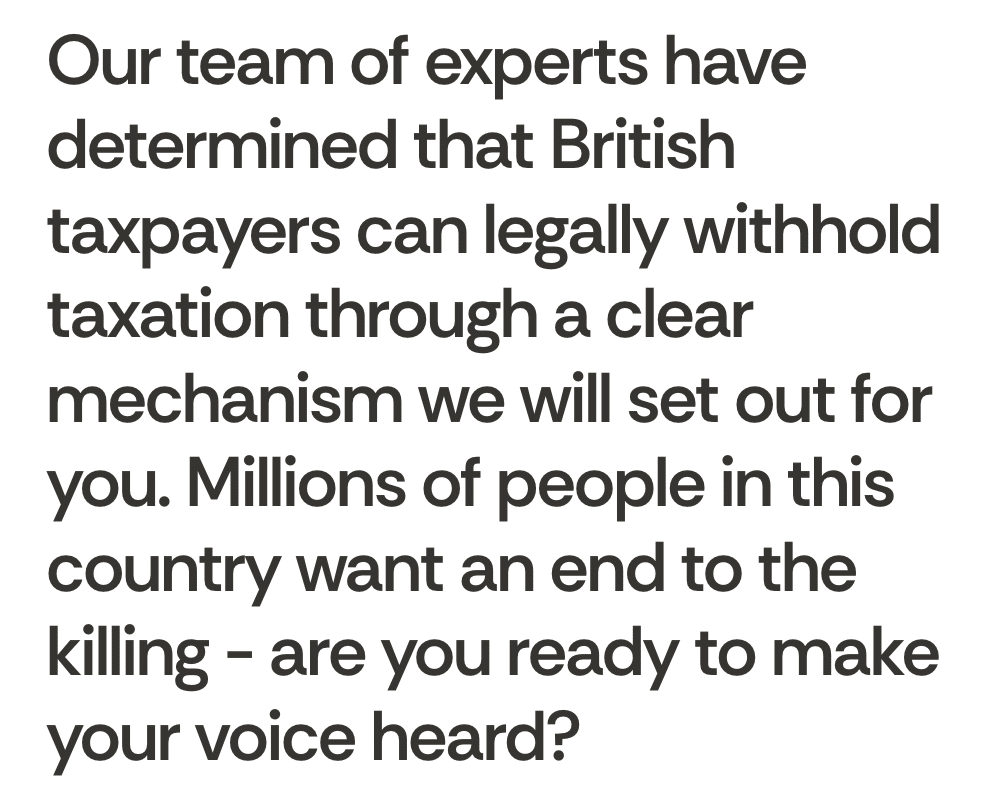
    Green Jellyfish promised their clients they had a team of expert R&D specialists.

    This is from a promotion sent by Green Jellyfish to care homes in 2022, talking about their team of “Tax Specialists”:

    This is from their website and LinkedIn pages (as of 23 August 2024) – “we are the R&D tax experts”, a “team of specialists” and “a team of Research and Development Tax Specialists”:

    And this email to a client (in 2022) talked about “an FCA regulated team of experienced experts in this field”.

    The reality – zero expertise

    We have not found a single Green Jellyfish or Kirby & Haslam employee with any background in tax, accounting, law, science, or technology.

    We identified ten Green Jellyfish technical writers using open source materials, and metadata from our dossier of the company’s R&D claims. In most cases they were hired straight from university. In other cases they had unrelated previous experience.

    Here are typical examples:

    The cold-calls to clients, in which clients are assured that R&D tax relief will be available, came from “business development executives” (BDEs). Successful leads were passed to “business development managers” (BDMs) who would have telephone meetings with the clients.

    This was a large team with high turnover- we’ve identified over 50 individuals who worked in this role for Green Jellyfish from 2021. They typically had a sales background, but none had any expertise in any legal, accounting, tax or technical area:

    So this was a team with zero expertise. Clients were lied to.

    The employees’ story

    We have been speaking to current and former Green Jellyfish employees. We have verified their employment from LinkedIn, historic emails, and document metadata.

    Their stories are consistent, and paint a picture of a business that worked like this:

    The sales teams

    • The business development executives (BDEs) cold-called clients and sent follow-up emails which (without exception, as far as we’re aware) said the BDE was confident a claim could be made.
    • They would target different sectors on different days, obtaining company details from Companies House and then looking up phone numbers on Google. For example: two days electricians, then plumbers, then bricklayers, groundworkers, pubs etc. The one thing these sectors had in common was that they were highly unlikely to qualify for R&D tax relief. Two sources have told us they believe that was intentional: it meant Green Jellyfish wouldn’t be competing with other advisers.
    • Potential leads were passed to business development managers (BDMs) for follow-up calls. There were about 15-20 BDEs at any one time, and 10-15 BDMs. As we note above, none of the BDEs or BDMs had any technical background or experience.
    • The BDMs asked clients about their business in very general terms, and were supposed to identify “innovative projects”. The BDMs were given lists of example qualifying R&D expenditure (see below), but in practice BDMs almost always said R&D relief was available.
    • The BDMs sent a follow-up email to the client confirming that relief would be available, and asking for copies of the client’s accounts and corporation tax return. There would normally be nothing in writing from the client or the BDM setting out the details of the project.
    • The BDEs and BDMs saw this purely as a sales job, and had no understanding of the legal requirements, or the consequences of wrongly claiming tax relief.
    • Several BDMs/BDEs have told us they were given the initial explanation that almost everything qualified for R&D tax relief if you worded the claim correctly.
    • BDEs and BDMs were under huge pressure to meet sales targets. There was rapid turnover of the BDE and BDM teams (unusually high even by the standards of junior sales jobs).
    • Some of the BDMs relied heavily on ChatGPT to write their notes.
    • That was particularly the case when, later on, BDMs were hired in the Philippines and South Africa – they heavily (one source thought “exclusively”) wrote to the technical report team using ChatGPT.

    The numbers

    • The BDMs would put numbers together for the tax relief claims based on the clients’ accounts and corporation tax returns.
    • Sometimes this followed a discussion about potential R&D projects. Often it didn’t.
    • We have seen multiple emails from BDMs to clients saying that they would establish the qualifying R&D expenses by looking through the company’s accounts and tax returns. Qualifying R&D expenses cannot be calculated in this way – individual projects must be identified.
    • Several sources have told us that the BDM team would have “industry standards” of the amount they could claim for each sector – for example 20% for care homes. Later they would adjust percentages slightly so the numbers didn’t look too round, for example 20.21%. Later still, different percentages were used for different categories of expense. If our sources are correct, this would be blatant fraud. We would, however, caution that (unlike most of the other information provided to us by our sources) we have no documentary evidence to directly support this claim, and our sources could be mistaken or exaggerating. However we have noted many of the claims in our dossier are almost-round percentages of the company’s expenses.
    • Our sources have different views on the total volume of claims made by Green Jellyfish, but they all agree the total must be more than £100m. We believe that’s consistent with Green Jellyfish’s accounts.
    • HMRC are now very alert to refund claims. Several sources told us Green Jellyfish had been “blacklisted” by HMRC, and no refunds would be made when Green Jellyfish was the agent. One solution was to use affiliated entities. Another was to find businesses who were about to submit corporation tax returns, and make last minute changes to add large amounts of R&D tax relief – HMRC would then have no idea any R&D agent had been involved. (We would caution accountants to be alert to this.)

    The technical team

    • Sometimes a BDM sent a note of their call with the client to the team of “technical writers” to prepare a report.
    • A report was required after August 2023, when HMRC tightened claim procedures. Before that, the technical team were only involved in some cases (we believe, but aren’t sure, it’s where there was a more realistic identifiable R&D project). More often, the claims were like Sophie’s, where a claim was submitted without a report (but a report produced much later if there was an HMRC enquiry).
    • The technical writers were formally employed by Kirby & Haslam, not Green Jellyfish, but in practice the two companies operated as one business.
    • As we note above, most of the “technical writers” were hired straight out of university with no prior experience. Many had English literature and creative writing degrees; a few had other Arts degrees. None had any prior R&D, legal, accounting or tax experience.
    • Two of the “technical writers” were referred to as “R&D Tax Specialists” by BDEs on client calls within a few weeks of starting work for Green Jellyfish.
    • The technical writers realised quite quickly that there was nobody around with any tax qualifications. The BDMs and BDEs sometimes did not realise this, and one we spoke to appears to have genuinely believed that the technical writers were experts.

    The reports

    • We have seen images of notes sent by BDMs to the technical writers. We aren’t publishing them because of the risk our sources could be identified – but we would describe the text as poorly written half-descriptions of a standard care home business. We believe we can link one to a case where a six figure sum was claimed from HMRC (and later had to be refunded, with penalties).
    • It was made very difficult for the technical writers to refuse to write reports based on the BDM’s notes. If they could not write a report, the claim would go to HMRC anyway, pre-Aug 2023 (after that, the rules were tightened and additional information specifying the R&D had to be provided to HMRC).
    • The technical writers were dissuaded from telling BDMs that claims did not qualify for tax relief – this was considered “aggressive language”.
    • Some of the BDMs referred to the technical writers as the “sales prevention department”.
    • We have now seen many reports prepared by the technical writing team. We have not seen one which actually meets the conditions for R&D tax relief.

    The group structure

    • The business was run day-to-day by Daniel Robinson and Scott Herd, with Steve Christophi known to be involved at board level, but rarely seen.
    • Several of our sources commented on the obscure group structure, with the BDMs in a different company from the technical writers. They thought this to make it easier for the technical writers and BDMs to blame each other for poor quality claims.
    • There was also a “legal team” made up of recent law graduates. They were called “paralegals” but this was not accurate – the term “paralegal” usually means someone with legal training working under the supervision of a qualified lawyer. So far as we are aware, there were no qualified solicitors or barristers working for Green Jellyfish or any of the associated entities. The paralegal team got involved when HMRC opened an enquiry into a Green Jellyfish claim. We have also seen a number of legal letters and emails drafted by the “paralegal” team. The letters rely heavily on Google and show signs of being written by ChatGPT or a similar LLM.

    The junior personnel working for Green Jellyfish had an appalling experience in a very hostile environment. We don’t see them as morally or legally responsible for the false R&D tax claims. At least two made anonymous reports to HMRC. The blame lies with those who hired staff with no experience and fed them false information, knowing that clients would be misled.

    The fake training materials

    Green Jellyfish gave the business development and technical writing teams examples of what they said were valid R&D relief claims; these were sometimes also given to clients to “help them identify” qualifying projects.

    The legal position is that R&D tax relief is only available for “research and development”. That term is defined in guidance published by BEIS/DIST and given statutory force under the Corporation Tax Act 2010. HMRC accurately summarise the rules as follows:

    Projects that count as R&D
The work that qualifies for R&D relief must be part of a specific project to make an advance in science or technology. It cannot be an advance within a social science - like economics - or a theoretical field - such as pure maths.

The project must relate to your company’s trade - either an existing one, or one that you intend to start up based on the results of the R&D.

To get R&D relief you need to explain how a project:

looked for an advance in science and technology
had to overcome uncertainty
tried to overcome this uncertainty
could not be easily worked out by a professional in the field
Your project may research or develop a new process, product or service or improve on an existing one.

Advances in the field
Your project must aim to create an advance in the overall field, not just for your business. This means an advance cannot just be an existing technology that has been used for the first time in your sector.

    Here’s Green Jellyfish’s list of examples of R&D projects run by care homes (PDF here):

    As a general proposition, the prospect of any care home having qualifying R&D relief is highly unlikely. A care home and its staff may be very innovative in how they plan and deliver care, but it is hard to see how they will ever look for “advances in science and technology”.

    But, despite this, care homes were a key market for Green Jellyfish. Two of our sources estimated that care homes made up 40% of Green Jellyfish’s business and 25% of the group companies’ business.

    In our view it is clear that none of the examples in this list are valid:

    • Some are not science and technology at all: e.g.: “Manage and control symptoms of dementia through a wide range of interior and exterior designs” and “Management of a specialised outdoor garden design to mitigate common dementia symptoms”
    • Others are just using existing technology, e.g. “new software… installation of sensors… to optimise the delivery of care services and… in particular, the detection of symptoms relating to diabetes, addiction, and dementia”, or “create a data analysis tool that can detect and recognise dementia traits”.
    • Some of the projects would qualify, but it’s implausible a care home would ever have the expertise, resources or facilities to carry them out. Seeking to “advance the field of clinical neuroscience” or “advance the scientific field of neurology” are realistic objectives for a hospital or laboratory, but not a care home.

    Green Jellyfish also gave their staff and clients this document, again focusing on care homes (PDF here):

    The summary of the qualification criteria are reasonably accurate. We believe anyone with an accounting, tax, legal or technical background reading these paragraphs will realise immediately that care homes usually won’t undertake “research and development”. But nobody in the business development or technical writing team had that background.

    In our opinion the examples are, once more, all clearly invalid:

    • Developments in care plans” are not an advance in science and technology. Green Jellyfish seem aware of this, by adding the caveats “if the specific care plan is an advance in science or technology” and “and is not easily deducible by a competent professional within the field”. But we don’t believe any care plan can be an advance in science or technology, and given it’s devised by professionals in the ordinary course of their business, it will be “easy deducible”. The caveats look like someone was trying to cover their back.
    • IT software designed by organisation for bespoke needs of clients/ carers”. Software will only in exceptional cases be an “advance in science or technology”. Realistically, care homes will use existing platforms and technology with minor modifications.
    • Use of AI for service standardisation, operations, and capture of new symptoms within patients”. We doubt any care home will develop its own AI systems. It is much more likely it uses existing platforms such as OpenAI/chatGPT – and that will not be an “advance in science and technology”.
    • Development and implementation of biosensors and trackers in clothing of residents and carers to monitor changes in health”. We very much doubt the care homes are developing biosensors/trackers. They will be buying off-the-shelf products. That is not an advance.
    • Technology suppliers in the sector (e.g., Birdie) during COVID-19: e.g. partnering… with NHSX for Techforce19 to build the NHS111 symptom tracker into the Birdie app”. Integrating an existing service into an app is obvious, and not an advance in science or technology.
    • Revolutionising technology relating to medicine (trying to mitigate medicine waste)”. It is not plausible a care home has the equipment, resources or staff to “revolutionise technology”.
    • Improving or creating technology to address a specific scientific or technological problem within the care sector”. This is so vague as to be meaningless.
    • “R&D within risk assessments – creating a plan that is able to reduce the potential for harm or risk”. Creating a plan is not a scientific or technical advance.
    • “Innovation in approaches to Dementia care (or other neurological conditions), especially the use of activities and tools to aid recollection”. Using activities and tools is not a scientific or technological advance.

    The more detailed “specific client examples” in the documents are, again, invalid:

    Implementing behaviour strategies is not an advance in science and technology. Developing a computer programme is not usually an advance in science and technology (unless e.g. it goes “far beyond routine adaptation of existing technologies“). “Recording a person’s behaviour in real time” sounds routine, and not much like an advance at all.

    Company B
Company F is a home care company which uses traditional care and digital and AI technology to alter
the way care services are delivered. Some of their initiatives include:
i. Join Social Care
Join Social Care is a platform which has been developed with the intention of developing and
licensing a new online platform to fast-track social care recruitment.
Candidates can record a video interview and access free training before starting employment
Registered providers are also able to search for candidates in their local area, and experience
a more streamlined recruitment process during the coronavirus pandemic, and beyond.

    Video interviews and streamlining recruitment are not advances in science and technology.

    Company C
Management of a specialised outdoor garden design to mitigate common dementia symptoms
(ultimate goal)
• Scientific advance; The company sought to advance the scientific field of neurology
• Competent professional; A dementia garden specialist designer was acknowledged for her
specialist work by winning the RHS Gold Medal.

    Designing gardens for people with dementia is not an advance in science and technology, and a garden designer is not a competent professional in the field of neurology.

    Company D
The objective of this project is to improve the industry benchmark surrounding epilepsy and
schizophrenia by extending the knowledge and research to appreciably improve the industry level of
care that is being provided (ultimate goal)
• Scientific advance; The company sought to advance the scientific fields of neurology and
neurobiology
• Competent professional; A registered nurse for the company. After many years of learning,
they have become experienced in the role, being able to provide care to complex neurological
and mental health needs

    Advancing the scientific fields of neurology and neurobiology absolutely could be a scientific advance qualifying for R&D relief, but we are very doubtful any care homes have the resources, expertise or budget for neurology research.

    The game is given away by the second bullet point. A highly experienced nurse is providing care; he or she is not making scientific advances, and is not a competent professional in the fields of neurology and neurobiology.

    The use of the term “neurobiology” is particularly silly. Neurobiology is the study of nerve cells at the molecular level, requiring a sophisticated laboratory. We expect the author didn’t know what the term meant.

    These examples corroborate what we were told by current and former Green Jellyfish employees – that they were instructed that almost everything qualifies for R&D tax relief, provided the claim is worded correctly.

    These instructions, and the lists of examples misled Green Jellyfish staff and their clients. We think this was intentional.

    Who ran Green Jellyfish?

    The different entities involved in the business have a variety of different owners, in some cases changing entity and owners over time. Back in 2023, all were listed as part of the “Impact Group”; today they are more shy about admitting that the entities are linked.

    Three names come up again and again when we speak to current and former employees.

    • Steve Christophi, who owns Kirby & Haslam. He is not listed as a shareholder or director of Green Jellyfish, but he was described as a “stakeholder” in internal communications, and our sources report that he was one of those running it. It is notable that, when Paul Rosser wrote about Green Jellyfish, it was Steve Christophi who went to talk to Paul about it (Christophi’s version) or intimidate him (Paul’s version).
    • Daniel Robinson was listed as “managing director” of the Impact Group in 2022 and 2023. He was the registered owner of the previous Green Jellyfish entity and today, according to our sources, acts as the CEO of the group. He is currently the owner of Impact Business Partnerships Ltd, which appears to act as a kind of holding entity for the group.
    • Scott Herd was listed as the “Non-Executive Chair” of the Impact Group in 2022 and 2023, and described as “a crucial board member at one of the leading R&D tax credit firms in the UK”. He was previously a director of the current Green Jellyfish entity.

    Others are undoubtedly responsible. Paul Rosser researched a structure diagram which reveals other names; we will be writing more on this soon.

    Green Jellyfish’s response.

    We asked Green Jellyfish to comment on the documents and the evidence of their unqualified staff and unethical business practices. We also warned Messrs Robinson and Herd that we would be naming them in this article:

    Green Jellyfish’s lawyers, Fladgate, are still acting. However, despite the seriousness of the allegations, we received a response from Green Jellyfish rather than from their lawyers. This is surprising given the seriousness of the allegations we are making.

    The response complains about our timetable, makes a series of irrelevant claims about Steve Christophi’s peculiar visit to Paul Rosser, demands that we review a recording of that visit (we are unaware a recording exists), and demands “specific, detailed questions and concrete evidence to substantiate [our] claims”. They refuse to respond until we do this.

    Our response was as follows:

    Evidence of fraud

    One explanation is that this was all an accident. That those running Green Jellyfish and its other affiliates were acting in good faith, but completely misunderstood the law. They thought all innovations qualified for R&D Tax relief, hired the wrong staff, created wrong examples, and so forth. It would follow that, whilst they were responsible for a large number of incorrect R&D tax relief applications – they did not know that would be the outcome, and no question of fraud arises.

    We find this explanation implausible on its face.

    As we have mentioned above, we believe that anybody with any appropriate experience would realise that the guidance provided to the staff was (and Steve Christophi, one of those who run the company, is a chartered accountant).

    And even if we (charitably) assume Christophi, Herd and Robinson started out acting in good faith, they surely would have realised something was going on when they started to see HMRC challenge their claims and explain very clearly why the claims were being challenged.

    At this point an honest person would stop and ask whether there was something in their procedures which was resulting in so many failed claims.

    But there is no sign that this happened. Our sources suggest that things actually got worse, not better, as HMRC tightened up its procedures. Even by the sorry standards of cowboy R&D claims firms, this was extraordinary.

    It is therefore our view that those in charge of Green Jellyfish (who we believe were Christophi, Robinson and Herd) knew that false R&D claims were being made, and knew that they were misrepresenting the nature of their team to clients. If they were “dishonest” then this amounts to a fraud on their own clients, and on HMRC.

    Dishonesty

    Whether Green Jellyfish’s leadership team were actually dishonest is a question for a jury.

    The jury would be asked to decide whether their conduct was dishonest by the standards of ordinary decent people (regardless of whether the individuals in question believed at the time they were being dishonest). The leading textbook of criminal law and practice, Archbold, says:

    “In most cases the jury will need no further direction than the short two-limb test in Barton “(a) what was the defendant’s actual state of knowledge or belief as to the facts and (b) was his conduct dishonest by the standards of ordinary decent people?”

    We expect that, presented with the evidence we have published to date, most ordinary decent people would say the behaviour of those running Green Jellyfish was dishonest. However, ultimately that is something for a jury to decide.

    In our view there is more than enough evidence to justify a criminal investigation of Green Jellyfish’s leadership team, which we believe includes Christophi, Robinson and Herd.


    Thanks above all to the current and former employees of Green Jellyfish for telling us their stories. Given Green Jellyfish’s history of legal and physical intimidation, this involved considerable bravery on their part.

    Many thanks to K and T for their R&D tax relief expertise, and to P for additional research. Thanks, as ever, to S for his review and technical suggestions.

    Thanks to Mark Strafford, of Sedulo Forensic Accountants and his R&D tax colleagues for their high level forensic accounting review of Green Jellyfish’s accounts.

    Paul Rosser of R&D Consulting reviewed a late draft of this article – Paul deserves full credit for discovering and pursuing this story over the last couple of years.

    Some images and text © GJ2020 Limited, and used here in the public interest and for purposes of criticism.

    Footnotes

    1. Two exceptions. First, Steve Christophi, who is a chartered accountant. Christophi was one of those managing the business and perhaps had ultimate ownership of it, but he played no part in day-to-day advice. Second, the web design and IT staff, who had obvious technical ability but played no role in the R&D tax relief claims ↩︎

    2. After the events of the last few days, many Green Jellyfish employees and former employees have removed their profiles from LinkedIn and/or removed Green Jellyfish from their online CVs. We would discourage others from trying to identify junior Green Jellyfish personnel; we don’t think it’s fair to hold them responsible for the misdeeds of the business. ↩︎

    3. “Complete Care Advisory” is another firm associated with Green Jellyfish; it provided services to care homes including false R&D tax relief claims. We do not know if its other services were bona fide or not. ↩︎

    4. Possibly this should say “always”; nobody we spoke to was aware of a case where a client was rejected. The very poor quality of the projects that were identified by the BDMs suggested that few if any were rejected. ↩︎

    5. Current/former employees of Green Jellyfish and its affiliates ↩︎

    6. Because trade debtors are shown as £2.3m at December 2021 and £3m at December 2022. We can conservatively assume clients paid within 90 days, which implies over £25m of fee income, which (given their 20% fee) implies £125m of tax benefit claimed before the business became much harder in August 2023. Update – 27 August: Mark Strafford, of Sedulo Forensic Accountants and his R&D tax colleagues kindly conducted a high level review of these accounts for us, pro bono, and they agree that this is the right ballpark figure. (Although they believe 60 days would be more typical for this kind of business, implying that the true figure of Green Jellyfish claims may be higher than our previous estimate). ↩︎

    7. We are not sure that’s right; the scattered group structure looks more like an attempt to hide the true ownership of the business and segregate liability. But we do not know for sure, and we could easily be wrong. ↩︎

    8. Nor were any of the “paralegals” registered with the (voluntary) Professional Paralegal Register. We see the use of the job title “paralegal” as a cynical way to hire law graduates and hold out the false promise that this is the start of a legal career. ↩︎

    9. See the Get Onbord case where an “impressive” machine learning/AI system created by a tech startup was found to qualify. The judgment says that a “massive amount of new code was written as part of the project, which goes far beyond “routine” adaptation of existing technologies”. ↩︎

    10. One can imagine a scenario where a care home commissioned a tech company to develop a very sophisticated AI system, but we haven’t seen any examples of this in our Green Jellyfish dossier, or heard about any such case from our industry contacts. ↩︎

    11. The subjective element of the test for dishonesty (see Ghosh (1982)) was removed by Ivey [2017] for civil cases, and that decision was confirmed to apply to criminal cases in Barton [2020]. The fact that a defendant might plead he or she was acting in line with what others in the sector were doing, and therefore did not believe it to be dishonest is no longer relevant if the jury finds they knew what they were doing and it was objectively dishonest. ↩︎

    Comments are now closed for legal reasons. Our apologies.

  • Property118 – more hopelessly wrong tax advice for landlords

    Property118 – more hopelessly wrong tax advice for landlords

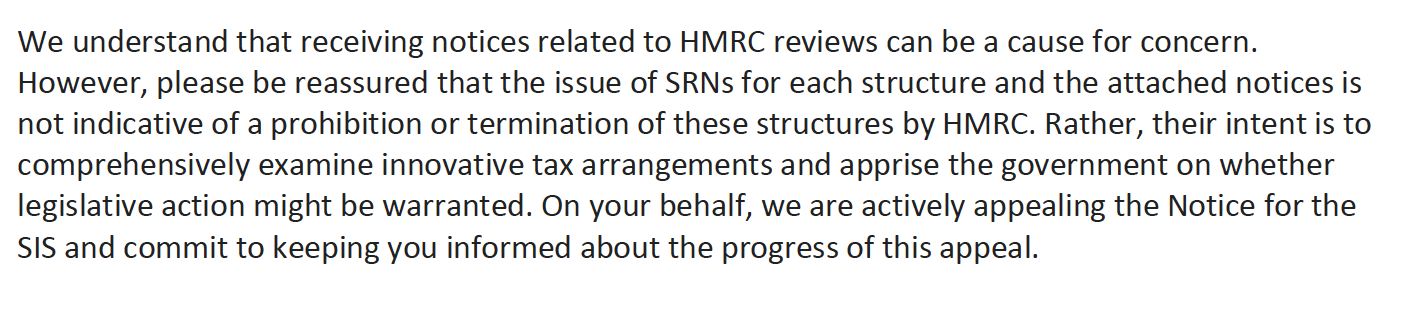
    We have previously reported on a high profile unregulated firm called “Property118”, which promoted a series of landlord tax avoidance schemes. HMRC took action, and Property118 has resorted to asking their clients to make donations to fund their appeals. Despite this, Property118 continues to promote tax avoidance that doesn’t work and will land its clients in a financial mess.

    UPDATE 20 July 2024: HMRC issued a stop notice to Property118 on 18 July 2024, and most of the Property118 website has now been taken down

    Property118 is continuing to publish tax advice for landlords, in the form of a 36 page ebook (now taken down; but you can read an archived version here). One of our team, a stamp duty land tax specialist, reviewed the ebook and was alarmed by its contents. We have discussed his concerns with other SDLT experts, and the consensus is that much of the advice is objectively wrong. By this we don’t mean that we disagree with it; we mean that it misses obvious points which a newly qualified tax adviser would immediately identify.

    This article is solely focused on two significant SDLT errors. There are other serious problems with the SDLT advice in the ebook, as well as numerous non-SDLT problems (particularly around interest deductibility, capital gains tax and the potential to default a landlord’s existing mortgages). If this was a regulated firm then we expect disciplinary action would be taken. But Property118 is completely unregulated.

    Failed SDLT avoidance on incorporation

    It is sometimes sensible for landlords to incorporate – i.e. to transfer their properties, and their property rental business, to a company. This should be done with care, and will sometimes cost more in increased tax and financing costs than it saves.

    One particular challenge is that, if properties are held by a landlord personally, then when the landlord transfers the properties to a company there will be an immediate SDLT charge.

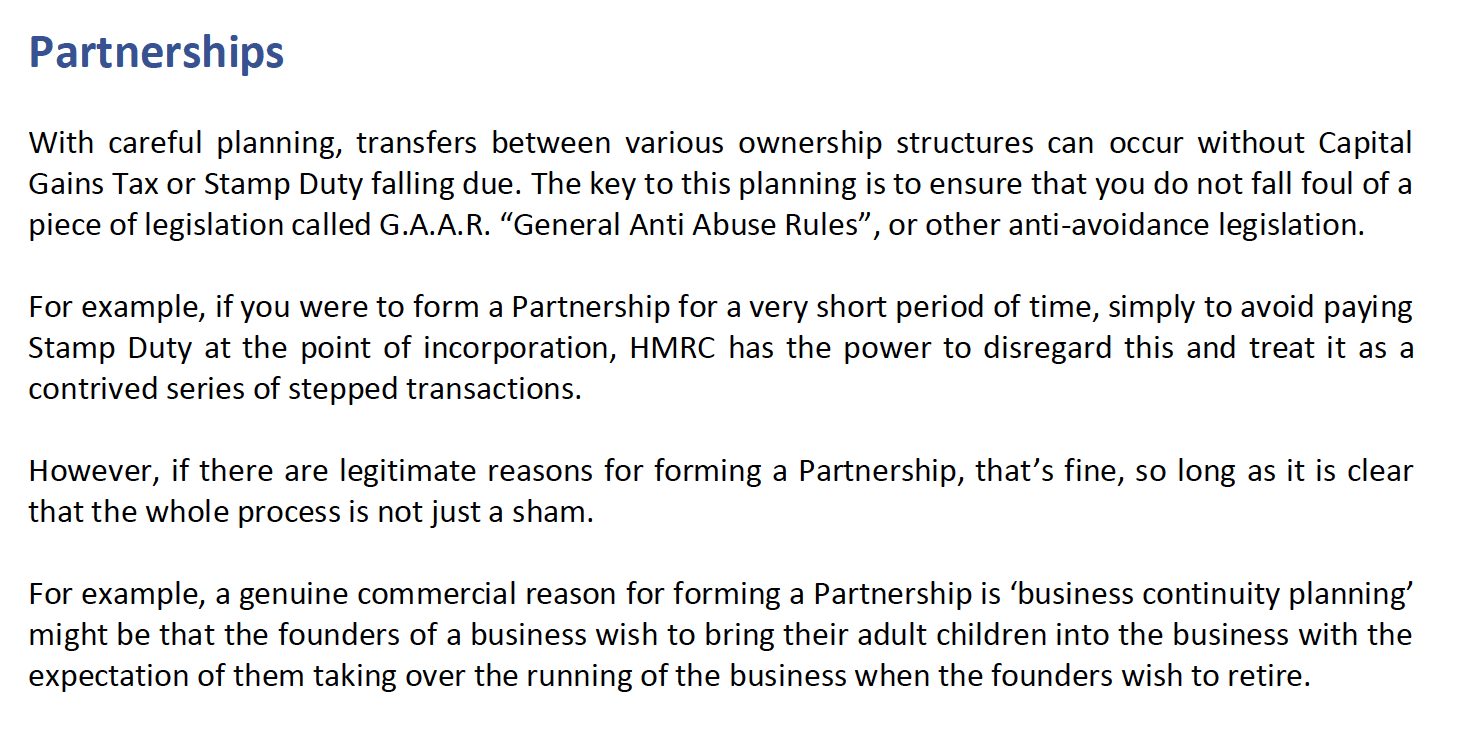
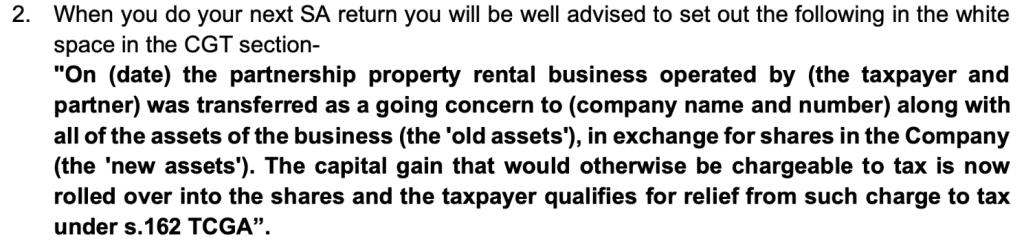
    Property118 think you can get round this by moving property into a partnership, and only subsequently into a company:

    This completely ignores the specific SDLT anti-avoidance rule in section 75A Finance Act 2003. Section 75A is an extraordinarily wide rule which the Supreme Court has confirmed applies regardless of the parties’ motives. Having a “legitimate reason” is of no help. The only relevant questions are whether there’s a disposal and acquisition of property, a number of transactions are involved in connection with that disposal/acquisition, and this all results in less SDLT than would have been due on a simple sale.

    So if you plan to save SDLT by moving property into a partnership and later from the partnership into a company, then s75A will apply. It doesn’t matter if you wait a week or four years, and it doesn’t matter whether you say this is tax avoidance, or claim you have a commercial rationale. Section 75A doesn’t care about any of that. And taxpayers are expected to apply section 75A themselves under self assessment – it’s not a matter of waiting to see if HMRC applies it (but if a taxpayer doesn’t apply s75A when they should have done, HMRC would likely have 20 years to open an enquiry and would likely impose a tax-geared penalty for failure to make a return).

    There are a surprisingly large number of online articles suggesting that you are safe after three years. That is not correct – there is no three year rule here, and possibly people are confusing s75A with an unrelated rule. There is an excellent article by Simon Howley covering these issues.

    Section 75A isn’t an obscure provision – all SDLT advisers are very aware of it… and if you google “SDLT anti avoidance rule” you’ll find thousands of helpful articles.

    The obvious conclusion: Property118 don’t know what they’re doing. Anyone following their advice risks triggering an SDLT bill far in excess of the expected savings from incorporation.

    Increasing your children’s future stamp duty bills

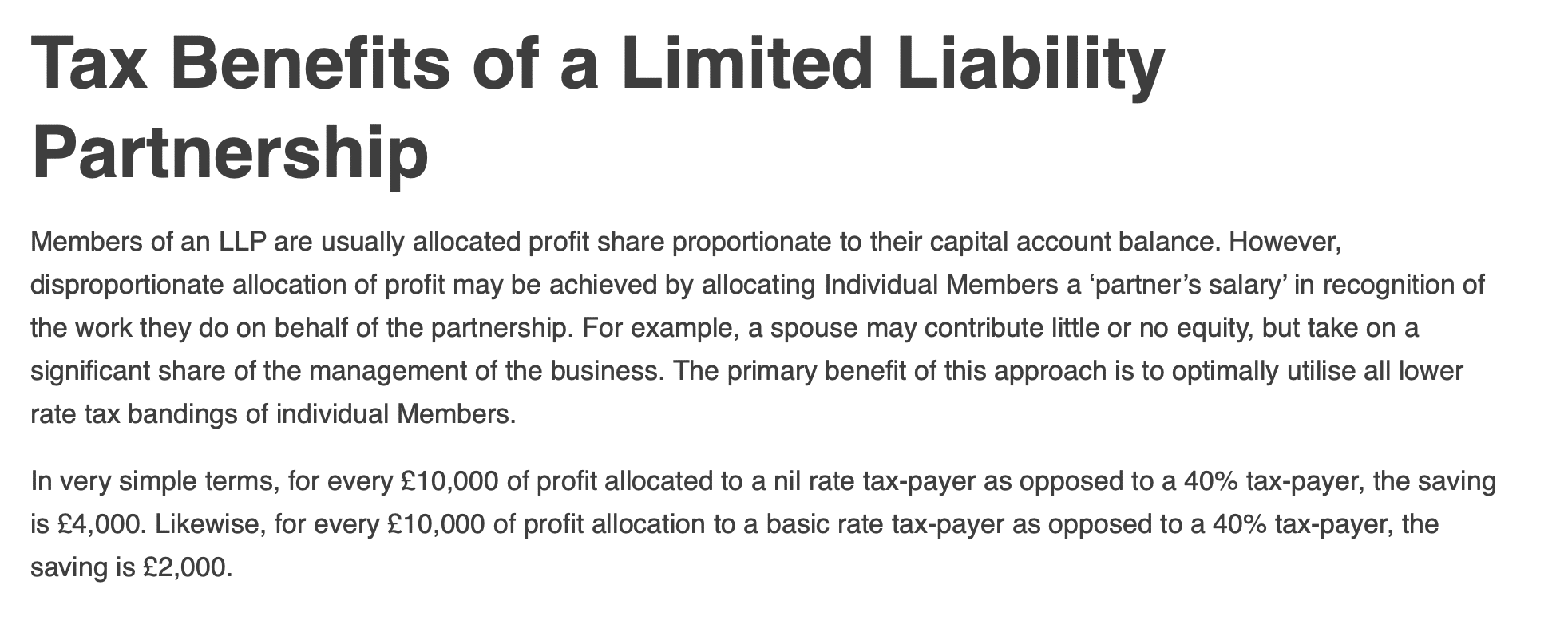
    One of the Property118 schemes involves a landlord moving their property into a limited liability partnership, and then adding their spouse and children as members of the LLP. The idea is that rental income is then taxed in the hands of the spouse/children, who are in lower tax bands:

    But there’s a big problem with this – it means that the children are deemed to own property (“through” the LLP), and that can have expensive future consequences for them.

    First, when/if the children come to buy property, they probably expect to benefit from the special threshold for first time buyers (presently £425K, due to fall to £300K with effect from 1 April 2025).

    But will they?

    The Property118 ebook says this will be just fine:

    But here’s the definition of “first time buyer” in the SDLT legislation. Note how the words “own property” are not used, and instead specific technical terms are used:

    The way these terms are defined kills the structure.

    When the children are given an interest in the LLP after it has acquired a property, they will likely in practice be a “purchaser in relation to a land transaction” (see paragraph 17 Schedule 15 Finance Act 2003). If they’re a member of an LLP at the time it acquires a property, they’re deemed to enter into a land transaction themselves (see para 2(1)(b) of Schedule 15).

    So the children likely won’t qualify as first time buyers when they come to buy a property later in life.

    It gets worse. There’s a 3% SDLT surcharge on people buying second/subsequent properties. When the children come to buy their own property, I doubt they expect the surcharge to apply. But it probably will.

    The rules are complicated, but broadly speaking, if the child’s interest in a property held by the LLP is worth more than £40,000 then he or she will be treated as already owning an interest in a property.

    So if/when the child buys property for themselves, not only will they be disqualified from the special first time buyer’s regime, they’ll potentially be hit with the 3% surcharge. This is a very poor result.

    How can Property118 get the law so wrong?

    Property118 is run by salespeople, not tax experts. As far as we are aware, they employ nobody with any tax or legal qualifications. They used to work in a joint venture with a barrister’s chambers called “Cotswold Barristers”, which again had no personnel with any tax experience (and, as a consequence, made a series of serious errors of law). It’s unclear if that relationship continues, as the Cotswold Barristers branding is no longer present on the Property 118 website.

    We recommend that any landlords looking for tax advice approach regulated firms of tax advisers, not unregulated outfits run by salespeople. We set out more thoughts on choosing a tax adviser here.

    Does this demonstrate why tax advice should be regulated?

    We’re not sure.

    The previous Government recently closed a consultation on requiring tax advisers to be regulated. We are, however, doubtful that this would stop Property118 and others like them.

    It would be straightforward for Property118 to hire a junior accountant, give them straightforward compliance work, and then claim to be a regulated firm. And Property118’s approach to tax seems to originate with Cotswold Barristers, who were regulated by the Bar Standards Board.

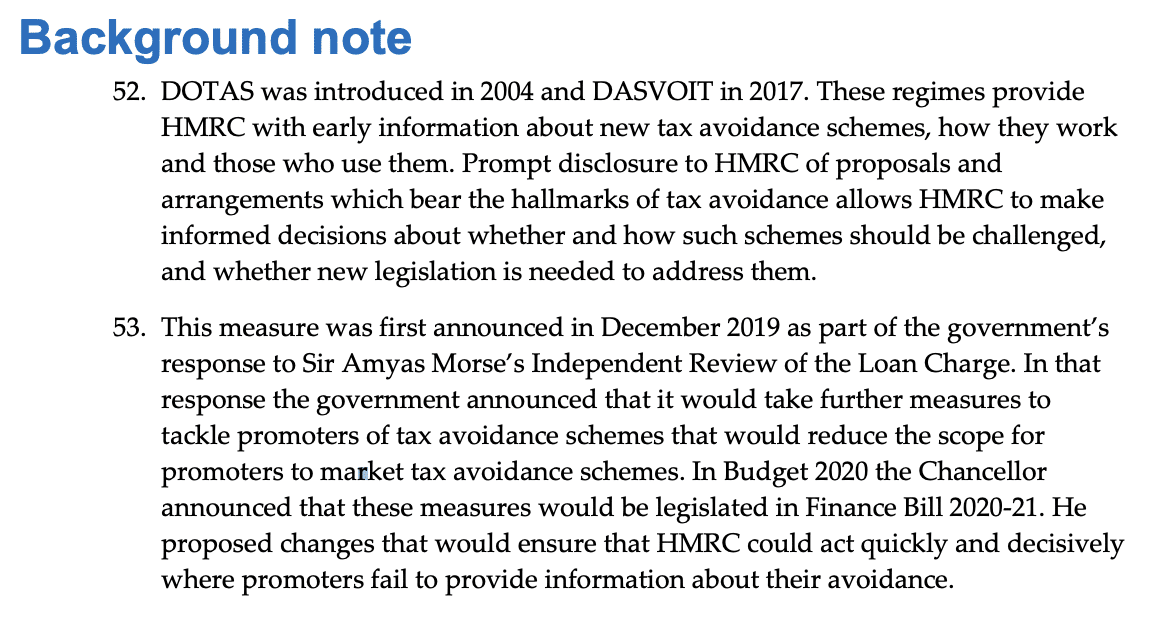
    We believe creating the right incentives will likely be more effective than creating layers of new regulation. Stiff penalties for people who promote tax avoidance schemes without disclosing them to HMRC under DOTAS, and perhaps even criminal sanctions.


    Thanks to J for spotting these points and writing the initial analysis; thanks to P, T and Sean Randall for their subsequent review.

    Excerpts from the Property118 ebook are © Property118 and reproduced here as fair dealing for the purposes of criticism and review.

    Footnotes

    1. The General Anti-Abuse Rule (not “Rules”) certainly exists, but isn’t terribly relevant to this structure. The fact Property118 mention it (and not s75A) shows their lack of expertise. Indeed a small but telling detail is that nobody in the tax world calls the GAAR the “G.A.A.R” – it’s a bit like calling an ISDA an “I.S.D.A”. ↩︎

    2. Because a person holding an interest in an LLP which holds land is treated as if they held the land themselves. The child’s LLP interest will therefore be a major interest in property, which triggers the surcharge rules. ↩︎

  • Half the British public doesn’t understand income tax – new data

    Half the British public doesn’t understand income tax – new data

    Updated polling evidence from Tax Policy Associates and WeThink shows that half the public doesn’t understand a basic principle of income tax: the way that tax rates apply to income above a threshold. Half of voters believe that, once you hit the higher rate threshold, the 40% higher rate applies to all your earnings.

    The full data polling data and our analysis spreadsheet is available here.

    In the 1990s, the Liberal Democrats had a policy to “put a penny” on the basic rate of income tax to increase funding for schools. Daniel Finkelstein was then the Conservative Party’s head of research. He and their head of polling, Andrew Cooper, commissioned ICM to look into how popular this policy was. They found the policy was very popular, but that many of those supporting it thought it would cost them one penny. Not 1%, but one shiny copper penny.

    There’s been research in the US about another tax misunderstanding – that if you go into a higher tax bracket, it means all your income is taxed at a higher rate. You earn one cent more, but pay thousands in tax. Some polls have shown a majority of Americans believe this; others that a third do; YouGov found 52% getting it right. The misunderstanding is sufficiently common amongst ordinary members of the public that the Tax Foundation has a page dedicated to correcting it.

    Which made us wonder whether there is a similar confusion in the UK. When we poll people about different tax rates, do people understand that (for example) the higher rate of tax only applies to the part of your income that falls in the higher rate band?

    All things being equal, Americans should understand more about their tax system than we do, given that they are required to file tax in a much more detailed and laborious manner than us.

    How tax bands work

    For example: if you live in England, earn £50,269, and receive a £1 pay rise, you’ll pay an additional 28p in tax – 20% income tax and 8% national insurance.

    The £50,270 you’re now earning puts you at the top of the basic rate tax band. Get another £1 pay rise and you’re now in the higher rate tax band – and you’ll pay an additional 42p in tax – 40% income tax and 2% national insurance.

    The important thing is that the higher 40% rate applies only to your income above the £50,270 40% threshold. Hitting that threshold doesn’t mean all of your income becomes subject to tax at 40%, so that the £1 pay raise results in thousands of pounds of additional tax.

    The polling evidence

    WeThink kindly included this issue as part of their regular opinion polling back in April. They polled 1,164 people, before weighting (a pretty typical number for this kind of poll). I wrote about it at the time, but the answers were so surprising that WeThink, even more generously, carried out some more polling to obtain an unusually large sample (3,312). That lets us at the subgroups and try to figure out what is going on.

    Our question was:

    “Suppose that you earn £50,270, the highest amount in the basic rate 20% income tax band. You get a £1 a year pay rise, and are now in the 40% higher rate tax band. How much additional tax do you think you will pay?”

    The options we gave were modelled on US polling from YouGov:

    • “a small amount of extra tax”, or
    • “a substantial amount of extra tax”

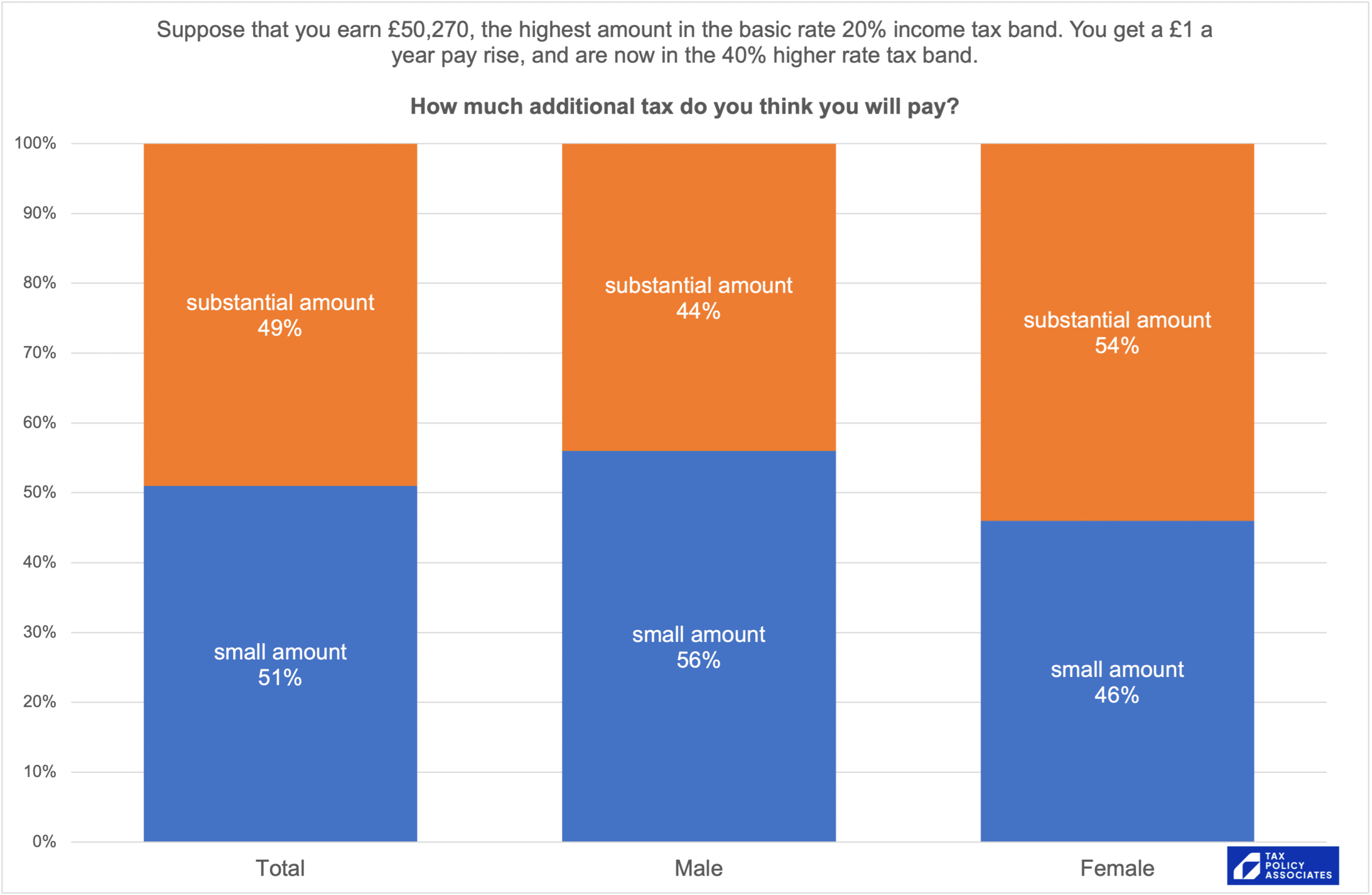
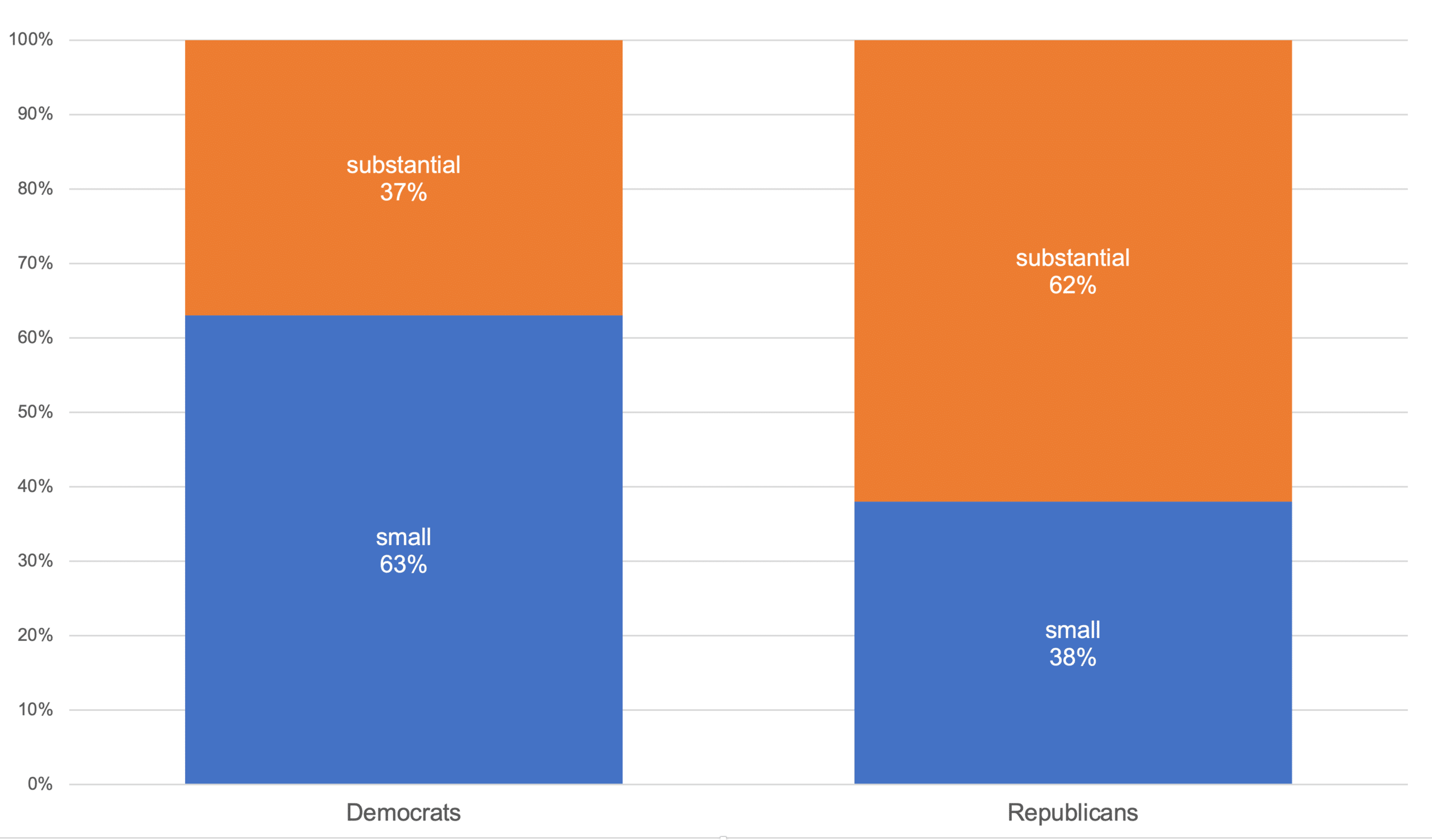
    I think it’s clear that the correct answer is “a small amount”. But 49% of the public, and 54% of women, don’t agree:

    This is consistent with YouGov’s polling of an essentially identical question in the US.

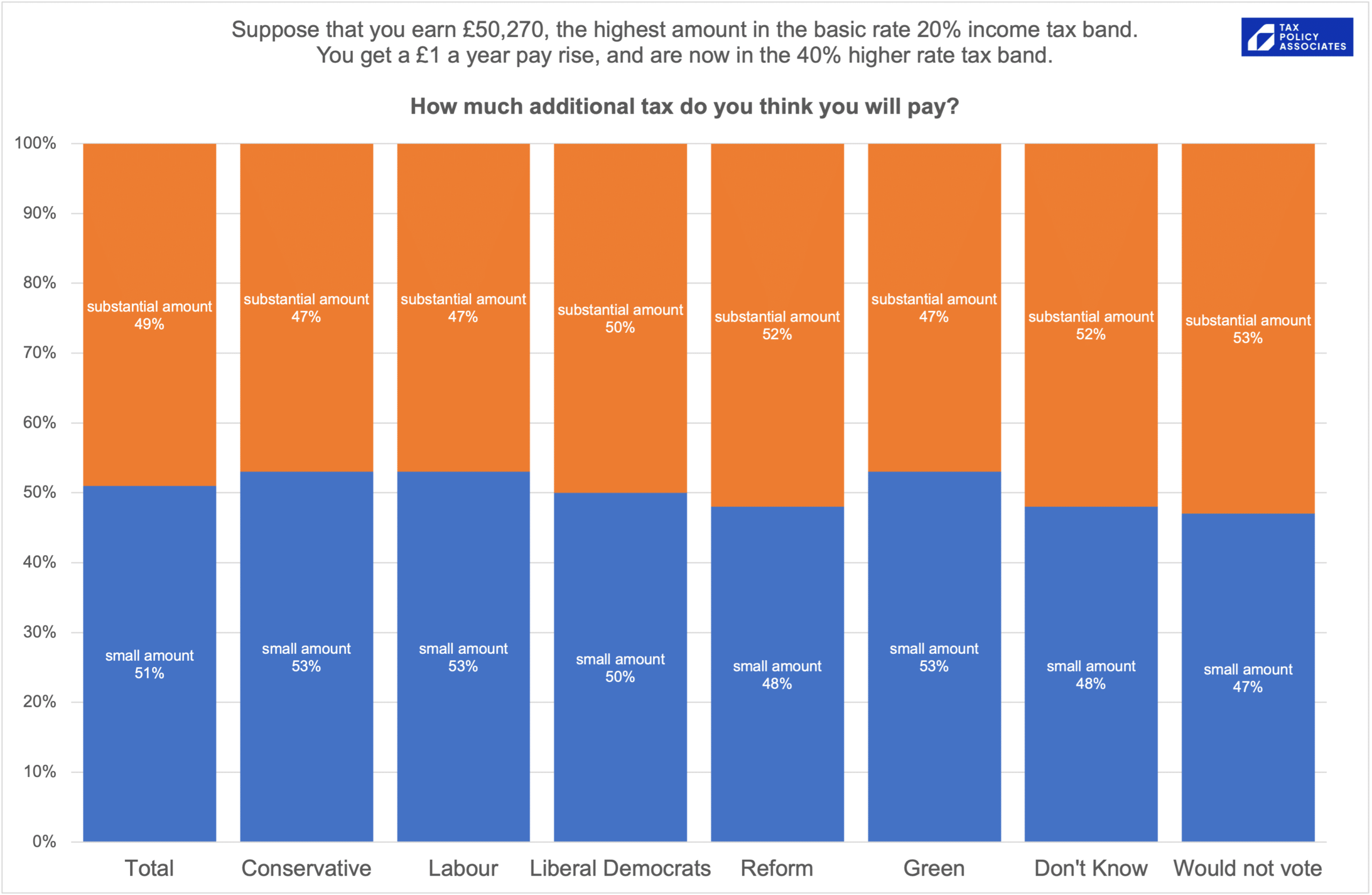
    We have large enough subgroups that we can test if there is a statistically significant difference between supporters of different parties – there isn’t:

    This suggests that whatever is driving the difference we’re seeing, it isn’t ideological.

    That is very different from YouGov’s US polling, where there was a very large difference between the parties, perhaps reflecting the very partisan nature of US politics and peoples’ views of the US tax system (i.e. the “substantial” answer from Republications signally a hostility to tax and the US Government rather than an assessment of the arithmetic):

    An obvious question is whether understanding of the tax system changes with age.

    It does not – again, no statistically significant difference here:

    We do, however, see a highly statistically significant difference if we look at income levels:

    Scotland

    The Scottish rates are different. There is a 21% “intermediate rate” income tax band for earnings up to £43,662, and then a 42% “higher rate” tax band.

    It looks on the surface as if there’s better understanding in Scotland; but the Scottish and Welsh samples are both too small to be able to rule out a fluke – this difference is not statistically significant.

    There’s a similar story if we look at the other subgroups; small differences, but mostly not statistically significant (and the large number of subgroups mean we should be careful not to cherry-pick or “p-hack“).

    Did we ask the wrong question?

    When we published our initial results, there were two ways in which some people said our question could be misinterpreted.

    • The first is that people could think that paying 40% tax on your next £1 of income is a significant amount. So when we thought we were getting an arithmetic answer, we were getting a political one. I’m unconvinced this is a natural reading of the question. But, more importantly, if the answers were driven by politics more than misunderstanding, then we’d see differences between e.g. Labour and Conservative supporters. We don’t.
    • The second is that people are accurately understanding the effect of the loss of the savings allowance. This is the £1,000 of interest you can earn tax-free until you become a higher rate payer – it’s then reduced to £500. For someone with around £12,000 of savings outside an ISA that could mean the £1 tax increase costs them £200 (£500 x 40%). For such a person “a substantial amount of tax” might be a correct answer. Intuitively it seems unlikely many people are aware about this effect. But if it was driving the answers, then we’d expect higher awareness of it, and more “a substantial amount” answers, as we go up the income levels. We see the opposite – which is consistent with people understanding the question as expected.

    I’m grateful to the people who made these observations; it’s largely thanks to them that we went back to obtain more polling data.

    Another possible criticism is that many people didn’t understand the question, and that plus the “forced choice” means that we’re seeing a lot of random noise. We can’t exclude that possibility.

    So, if WeThink is kind enough to give us the opportunity, it would be interesting to re-run this polling with a slightly different question. We’d welcome suggestions.

    But the consistency with the US polling results suggests that the effect we are seeing is a real one.

    Why is this important?

    It used to be that only a small number of people paid higher rate tax – that is no longer the case. By 2027/28, the IFS has estimated 14% of adults will be in this tax band, which equates to about a quarter of all individual income taxpayers. It’s reasonable to expect that about half of all households will include someone paying higher rate tax at some point in their lifetime. So the higher rate is more important than it ever was.

    Our poll findings shouldn’t cause concern that people are paying the wrong amount of tax. Employees are paid by PAYE, which deducts the correct tax automatically. The self employed either use HMRC’s self assessment system (which calculates the tax due) or use an accountant.

    There are, however, other potential consequences of a widespread misunderstanding as to how income tax works.

    First, and perhaps most importantly, there are anecdotal reports of people turning away work because they believe entering the higher rate tax band will cost them large amounts of money. If that’s true for even a small percentage of the population, then it’s a problem for the individuals in question and the country as a whole. We’d suggest it’s something that HMRC and policymakers should investigate. (We are unlikely to be able to look into this ourselves with further polling, due to the statistical limits of polling samples.)

    Second, it would be sensible to assume that other basic tax concepts are equally misunderstood. Policymakers, media and others communicating about tax (including Tax Policy Associates) should try to bear this in mind.

    Finally, it means that we should be careful when looking at opinion polling on tax questions: the responses may be based upon fundamental misunderstandings of the question.


    Many thanks to Brian Cooper and Mike Gray at WeThink/Omnisis for their generosity in running polls for us pro bono. They ask for nothing in return, and don’t even ask to be credited.

    Many thanks to Daniel Finkelstein for the top quality anecdote.

    Photo by William Warby on Unsplash

    Footnotes

    1. This story has been going round for years, and is often regarded as an urban myth, but Baron Finkelstein kindly confirmed it to me earlier in the week; prompting me to finally update this article. ↩︎

    2. The difference presumably down to the wording of the poll. The first poll had “You pay your marginal tax rate on all of your income” vs “You pay the same rate as others on income up to a certain amount, then a higher rate on every dollar up to the next threshold”. This seems a little technical and long-winded, particularly given there is no “don’t know” option. The second is much simpler, but refers to “tax brackets”, which rather presupposes their existence is understood. I favour the YouGov approach ↩︎

    3. The amazing reason why the US doesn’t have a UK-style self-assessment system is that Intuit and the tax preparation industry lobbied to prevent the IRS creating a free automated filing system. This sounds like a conspiracy theory but is well established. ↩︎

    4. or Wales or Northern Ireland ↩︎

    5. It used to be slightly more because of the High Income Child Benefit charge, but that’s now moved from £50k to £60k. However that doesn’t change the point of this article – the additional tax is still less than the £1 of additional earnings ↩︎

    6. In other words, a marginal tax rate of over 100%. There are some points in our income tax system where that actually happens, but not here (with the exception of the savings allowance, of which more later). And stamp duty land tax used to work in this way. ↩︎

    7. Note that we forced people to make a choice, and didn’t provide a “not sure” option. The question of whether “forced choice” is the best approach has a long history… I have no expertise in this, and was happy to be guided by the experts at WeThink. ↩︎

    8. Depending on how you read the question, the additional tax might be 14p, 20p, 40p, or 42p – but I don’t think that matters.. the amount is “small” in each case. The only exception is if you have significant savings, due to the loss of £500 personal savings allowance you’re a higher rate payer – more on that later. ↩︎

    9. chi-squared test for independence, p-value=0.34, all calculations in spreadsheet linked at the top of this article. ↩︎

    10. Our initial polling had a very high understanding of the “correct” position amongst Green Party supporters – at 66% it was the highest of all subgroups. However the small numbers in that subgroup suggested it wasn’t statistically significant, and the updated polling with larger subgroups has confirmed that, with the high Green figure disappearing. ↩︎

    11. p=0.45 ↩︎

    12. p=0.0020 ↩︎

    13. p=0.24 ↩︎

  • What are marginal rates? And why do they matter?

    What are marginal rates? And why do they matter?

    We keep talking about marginal rates, but rarely stop to explain exactly what they are, and why they matter. Here’s a short explainer, to accompany our interactive marginal rate charts.

    There is an updated article on marginal rates here.

    The marginal rate is the percentage of tax you’ll pay on your next £1 of income. It therefore affects your incentive to earn that £1..

    If you doubt that, imagine that you pay tax at 20% on your income, but the next £1 you earn, or indeed the next £10,000 you earn, will all be taxed at a marginal rate of 100%. Would you work extra hours for zero after-tax pay? I think most people would not.

    That seems a silly example (although we can find worse ones in our own tax system – see below). But a marginal rate below 100% will also change your incentives.

    Perhaps you are only just managing to afford childcare, and every hour you earn increases your childcare costs. A marginal rate of 70% might mean your take-home pay is less than the childcare cost.

    Or it may just be that you value your own time so that, if your take-home pay from working additional hours drops below a certain point, it’s not worth it to you.

    We should look at some examples.

    Marginal rates – a boring example

    In the current, 2024/25 tax year, combined income tax and national insurance rates for an employee look like this:

    • No tax on incomes below the £12,570 personal allowance.
    • £12,570 to £50,270 – a combined income tax and employee national insurance rate of 28%
    • £50,271 to £125,140 – a combined rate of 42%
    • Above £125,140 – a combined rate of 47%.

    It’s important to realise that the different tax brackets only apply to income in that bracket. If you earn £50,271 you’re in the higher tax bracket, but you only pay 42% tax on £1. You still pay 28% tax on everything you earned before above the personal allowance. This is unfortunately not very well understood.

    Imagine Bob is an employee earning £12,570. None of his income is taxed. Bob has the opportunity to earn an additional £1,000, putting him in the 28% tax bracket.

    There are three ways we could describe Bob’s position after earning that £1,000.

    1. The applicable headline rate. Bob is a basic rate 28% taxpayer.
    2. The overall effective tax rate. This is the total tax paid divided by Bob’s income. Total tax paid = £1,000 x 28% = £280. Income = £13,570. So effective tax rate is 280/13570 = about 2%.
    3. The marginal rate – the percentage tax you’re paying on that new £1,000. This is 280/1000 = 28%.

    Each of these has their uses.

    The first figure is simple.

    The second is useful for assessing how much tax Bob pays overall. If a political party proposed a sweeping set of tax reforms, Bob would be very interested in the impact on his effective rate.

    But the third – the marginal rate – is important, because it affects Bob’s incentive to earn the additional pound. Right now it’s the same as the headline rate – but that’s not always the case…

    Marginal rates – a less boring example

    Jane is earning £60k and claiming child benefit for three children. That’s worth £3,094.

    She’s now in the 42% tax band. Jane still pays basic rate tax for her income between £12,570 and £50,270, but now pays 42% tax for everything over that. So her total tax bill is (50270 – 12570) * 28% + (60000-50270) * 42% = £14,643 and Jane takes home £45,357.

    Jane is thinking of working a few more hours to earn another £1,000. She’s still in the higher tax band – so in a sane world she’d expect another £420 of tax, and a marginal rate of 42%.

    But that is not the result. Once Jane’s income hits £60,200, the “High Income Child Benefit Charge” starts to apply to claw back her child benefit – 1% for every £200 of earnings.

    So that £1,000 of additional earnings costs Jane HICBC of £154.70, on top of the £420 of “normal” tax. A total of £565.

    So how do we describe Jane’s position after earning that £1,000?

    1. The applicable headline rate. Jane is a higher rate 42% taxpayer.
    2. The overall effective tax rate – the total tax paid divided by Jane’s income. That’s 15207/61000 = about 25%.
    3. The marginal rate – the tax Jane is paying on that new £1,000. This is 56.5% – and we will have the same result for all incomes between £60k and £80k.

    As I mentioned at the start, there can be practical reasons for people to turn down work if the marginal tax rate gets too high – but there are also psychological factors. For many people, 50% feels like a high rate.

    Oh, and if Jane’s a student repaying her student debt, then the marginal rate goes up by 9% to 66%.

    And if the Green Party formed a government they’ll raise this to 72%.

    The big picture

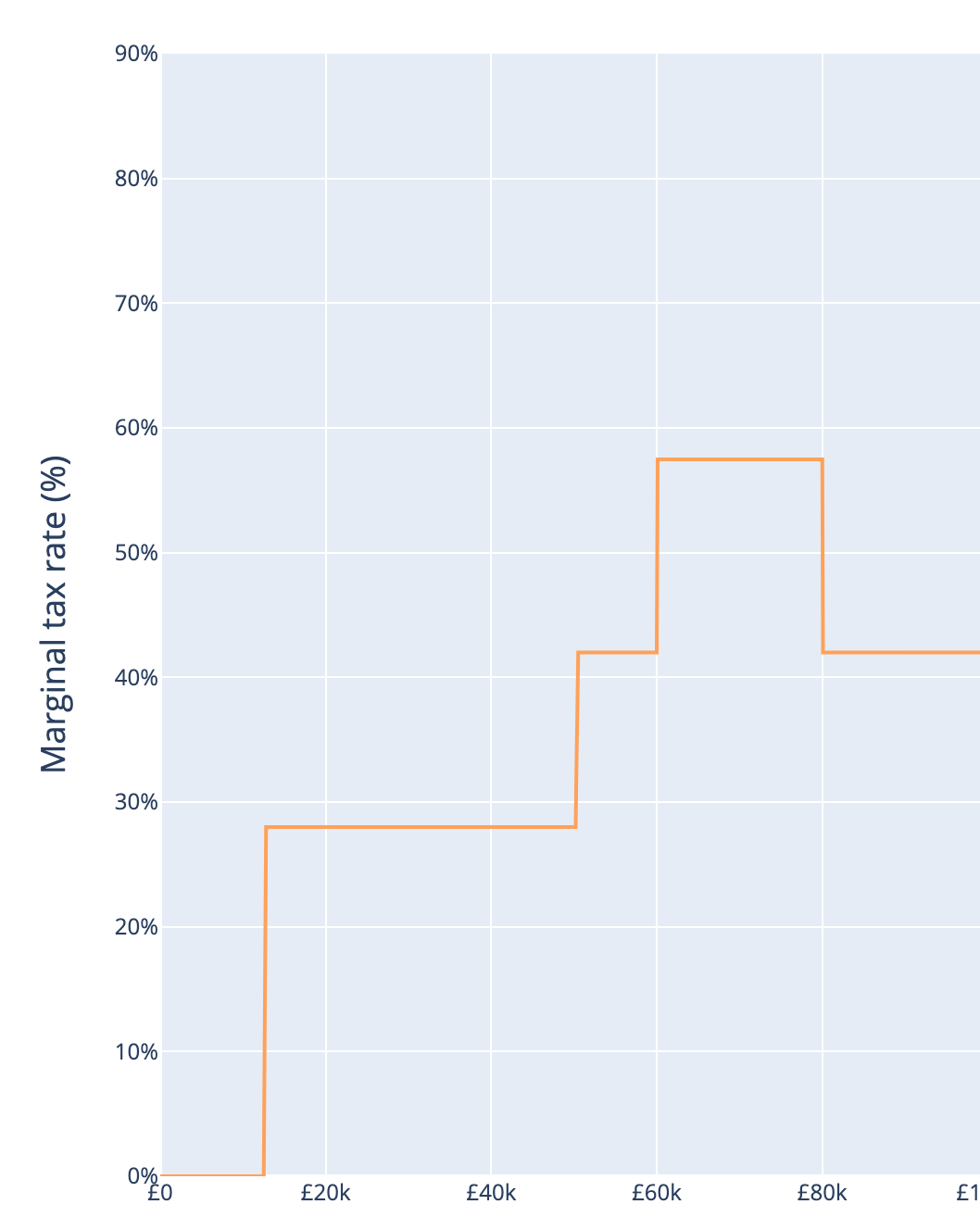
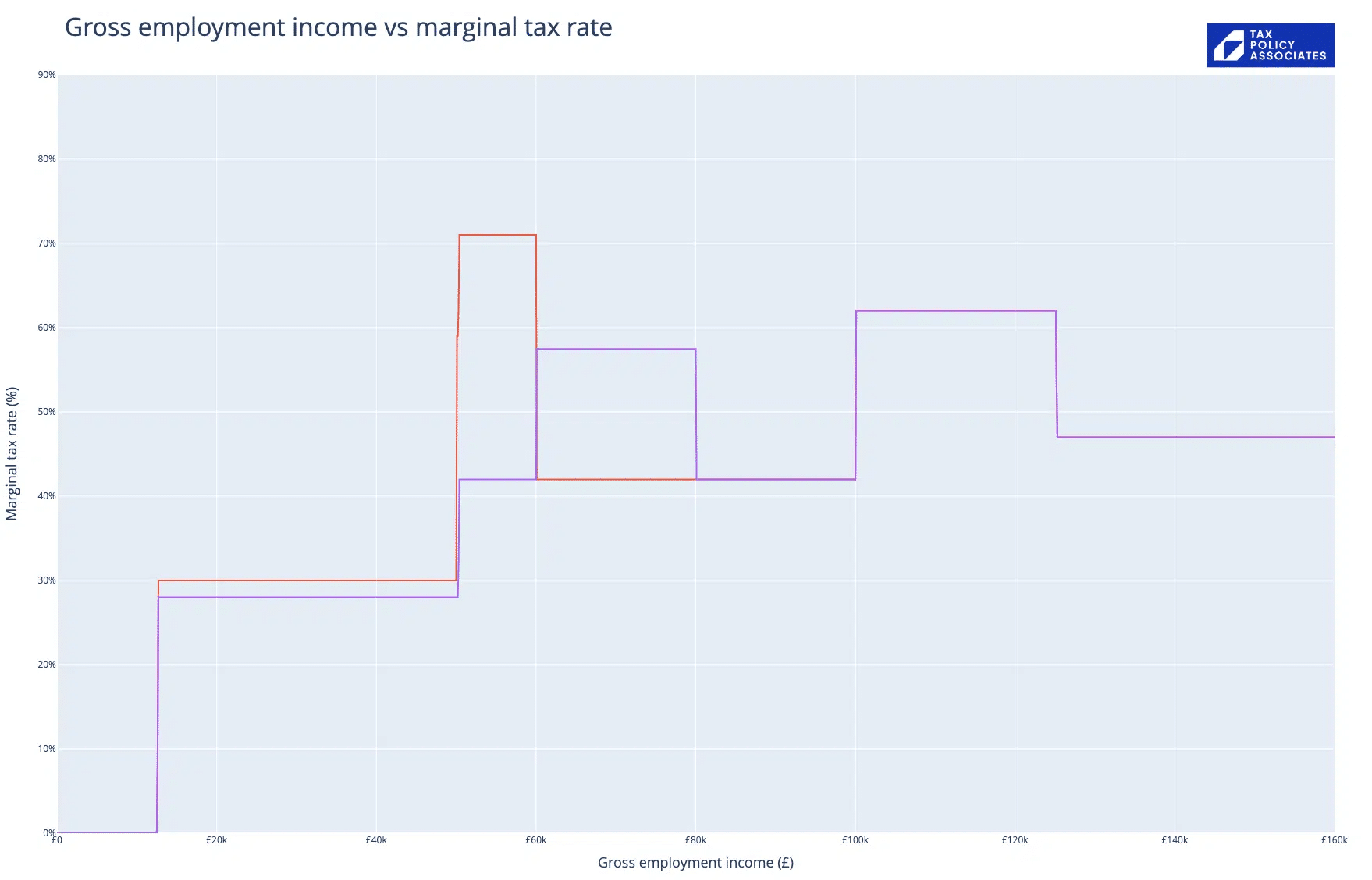
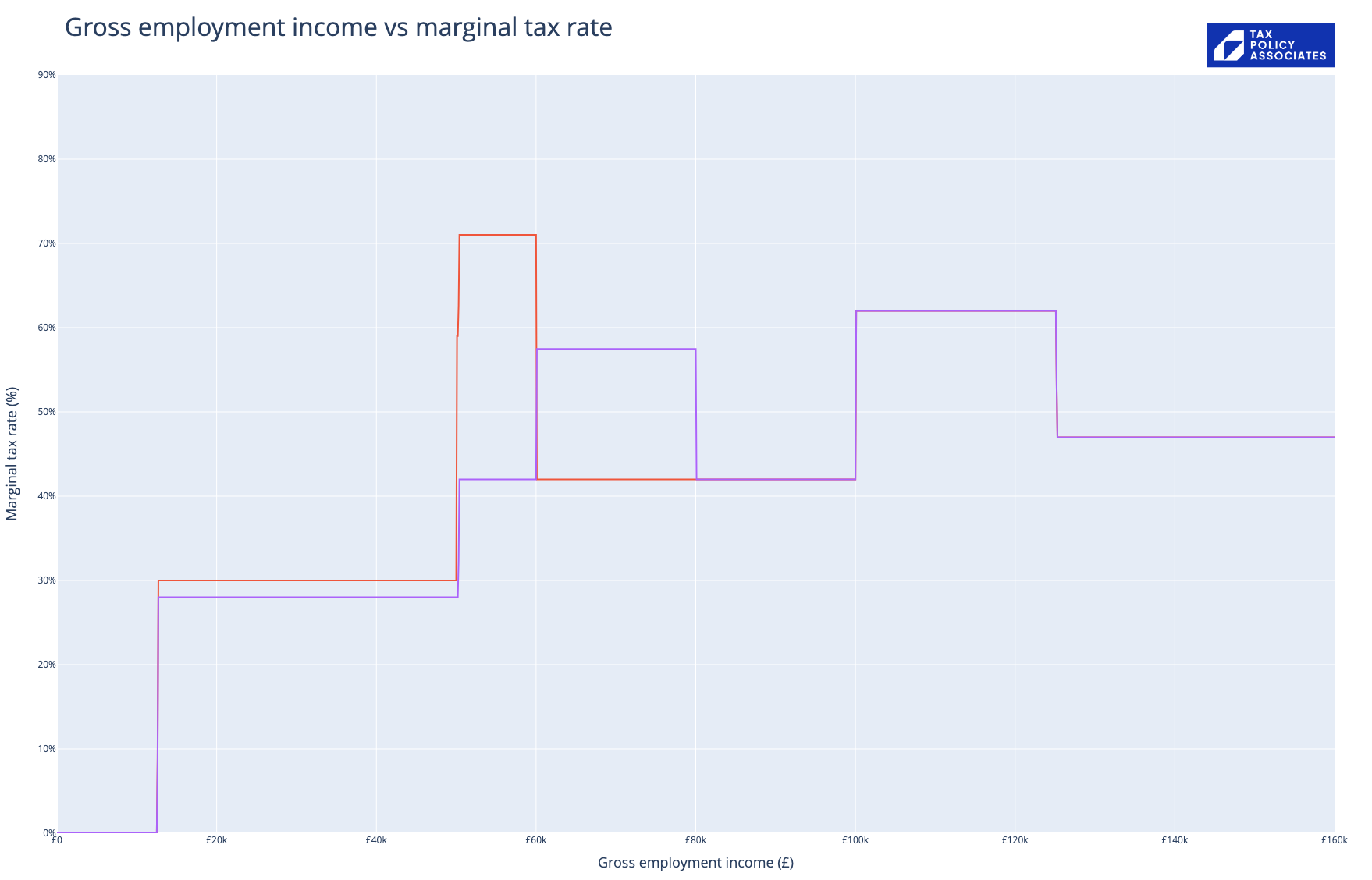
    We can chart Jane’s marginal rate for each income she could earn. Incomes along the bottom, marginal rate along the top:

    You can see the HICBC as the “tower” between £60k and £80k, which should be a smooth 42% plateau. Instead it hits 57%. (I’m hiding what happens after £100k)

    The HICBC is a gimmick which enabled George Osborne to somewhat-surreptitiously raise tax on people on high incomes without raising the tax rate itself.

    It’s a really bad policy:

    • It means that Jane pays a higher marginal rate rate than someone earning £90k, or indeed £900k. Where’s the logic in that?
    • The way in which HICBC works creates a nasty trap for the unwary, with thousands of people accidentally incurring HMRC penalties.

    The politics are nice and intuitive – surely it’s not right for people on high incomes to receive child benefit? But the reality is that this logic inexorably leads to a high marginal rate, and a cumbersome and sometimes unjust collection mechanism.

    Can it get worse?

    Very much worse.

    George Osborne’s HICBC was copying a trick invented by Gordon Brown to clawback the personal allowance for people earning £100k.

    Again, the politics are nice, but the consequences are a mess.

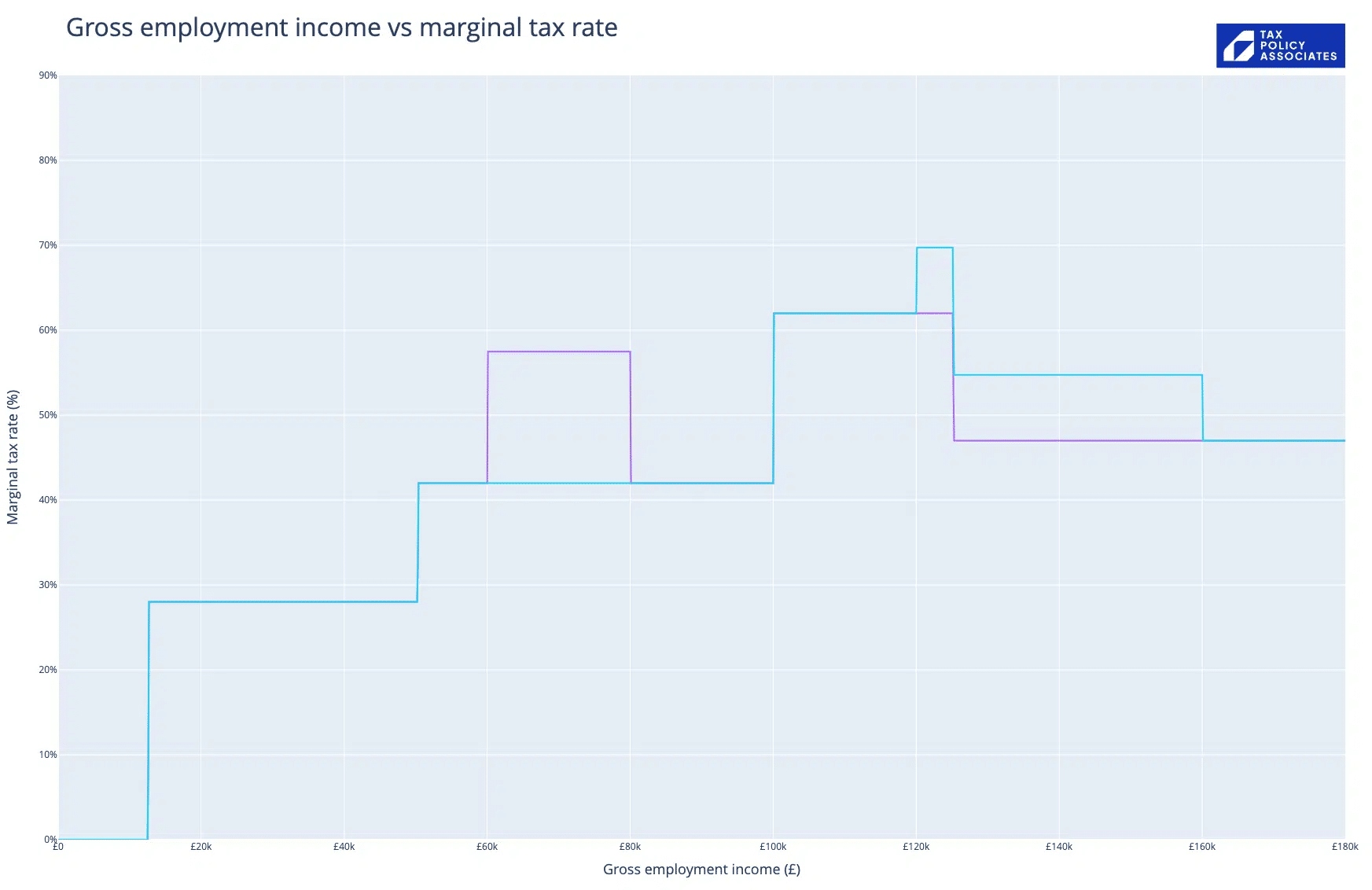
    If Jane starts earning between £100k and £125k then she faces a marginal tax rate of 62%. It then drops to 47% from £125k. Her marginal rate chart looks like this:

    62% is a very high rate. And if she has a student loan, that will add on 9% to the marginal rate, taking her total marginal rate, between £100k and £125k, to 71%.

    We’ve received many reports saying that high marginal rates affecting senior doctors/consultants are an important factor in the NHS’s current staffing problems – exacerbated by the fact that the starting salary for a full time consultant is just under £100,000. But it’s important not to just focus on the impact on jobs that we think are of particular societal importance. It’s also problematic if an accountant, estate agent or telephone sanitiser turns away work because of high marginal rates – it represents lost economic growth and lost tax revenue. Sometimes people take the work, but use salary sacrifice or additional pension contributions so their taxable income doesn’t hit the threshold. But that doesn’t work for everyone; sometimes they’ve hit the pensions allowance; sometimes it doesn’t always make sense to work harder now, for money that they can’t touch for years.

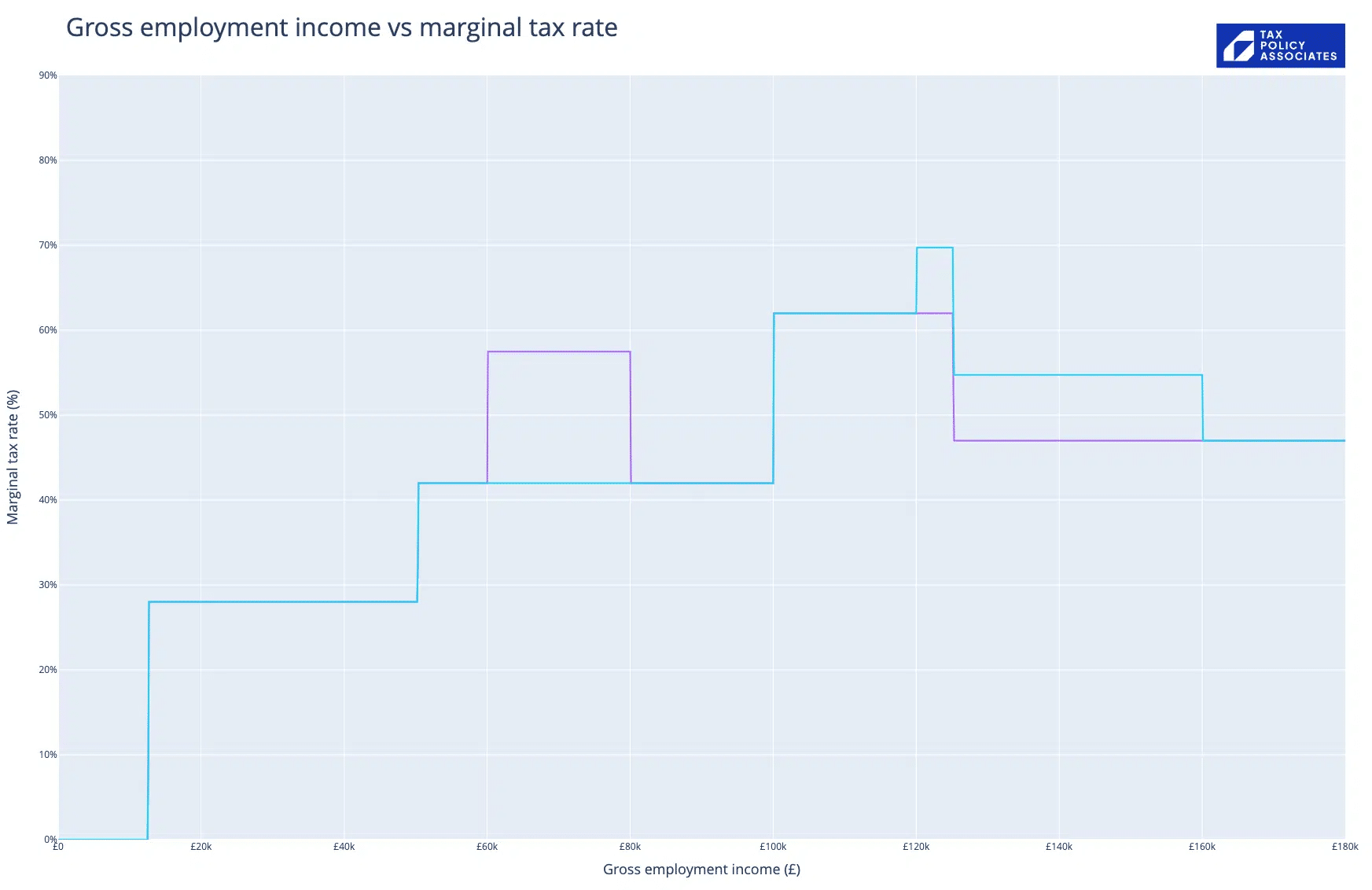
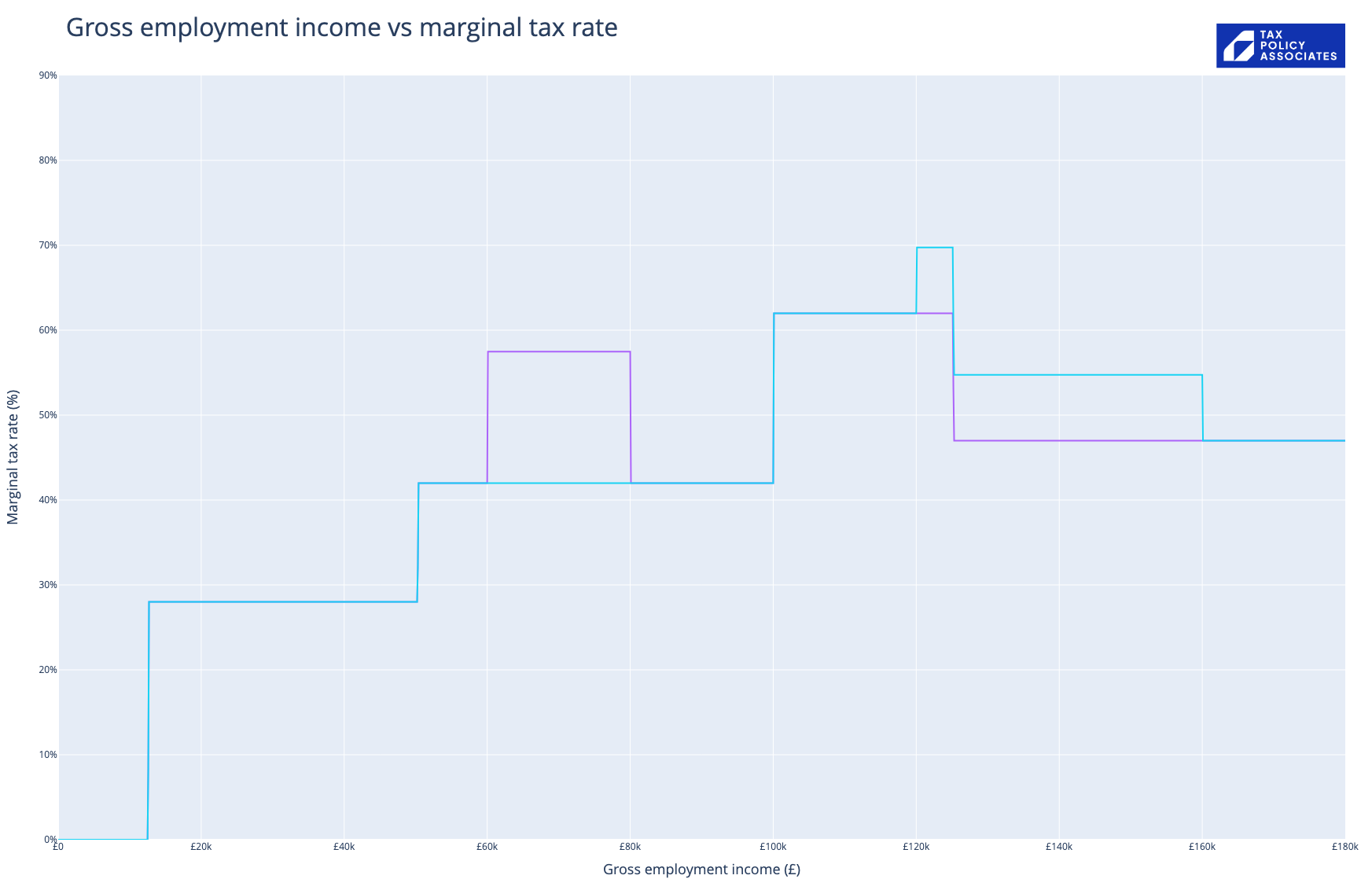
    The Conservative Party election manifesto pledges to move the HICBC from £60-80k to £120-160k. That helped Jane on £60k but now creates a nasty problem. When she’s earning £120k, and almost out of the personal allowance clawback, she gets the full effect of both the child benefit clawback and the personal allowance clawback:

    (Purple is how things are now; blue is the Conservative manifesto proposal)

    That’s a marginal rate of 70%. And then, when she hits £125k, she’ll have a marginal rate of 55% all the way to £160k.

    It’s a mystery to me why the Conservative manifesto didn’t set the new HICBC at £125k – you’d still have a 55% marginal rate beyond that, but at least you’d avoid 70%. The most plausible reason is that they were defeated by the complexity of the system.

    And worse?

    There are other similar features I’m skating over. The £1,000 personal savings allowance drops to £500 once you hit the higher rate band, and to zero once you hit the additional rate band. That can create high marginal rates at these points. The marriage allowance lets a non-working spouse transfer £1,260 of their unused personal allowance to their partner, if they’re earning less than the £50,270 higher rate threshold. So it’s worth £252 – and it disappears once the higher rate band is hit.

    And worse?

    The Government keeps creating generous childcare schemes that are removed suddenly when your wage hits £100,000. That creates a marginal rate that can only be described as “insane”.

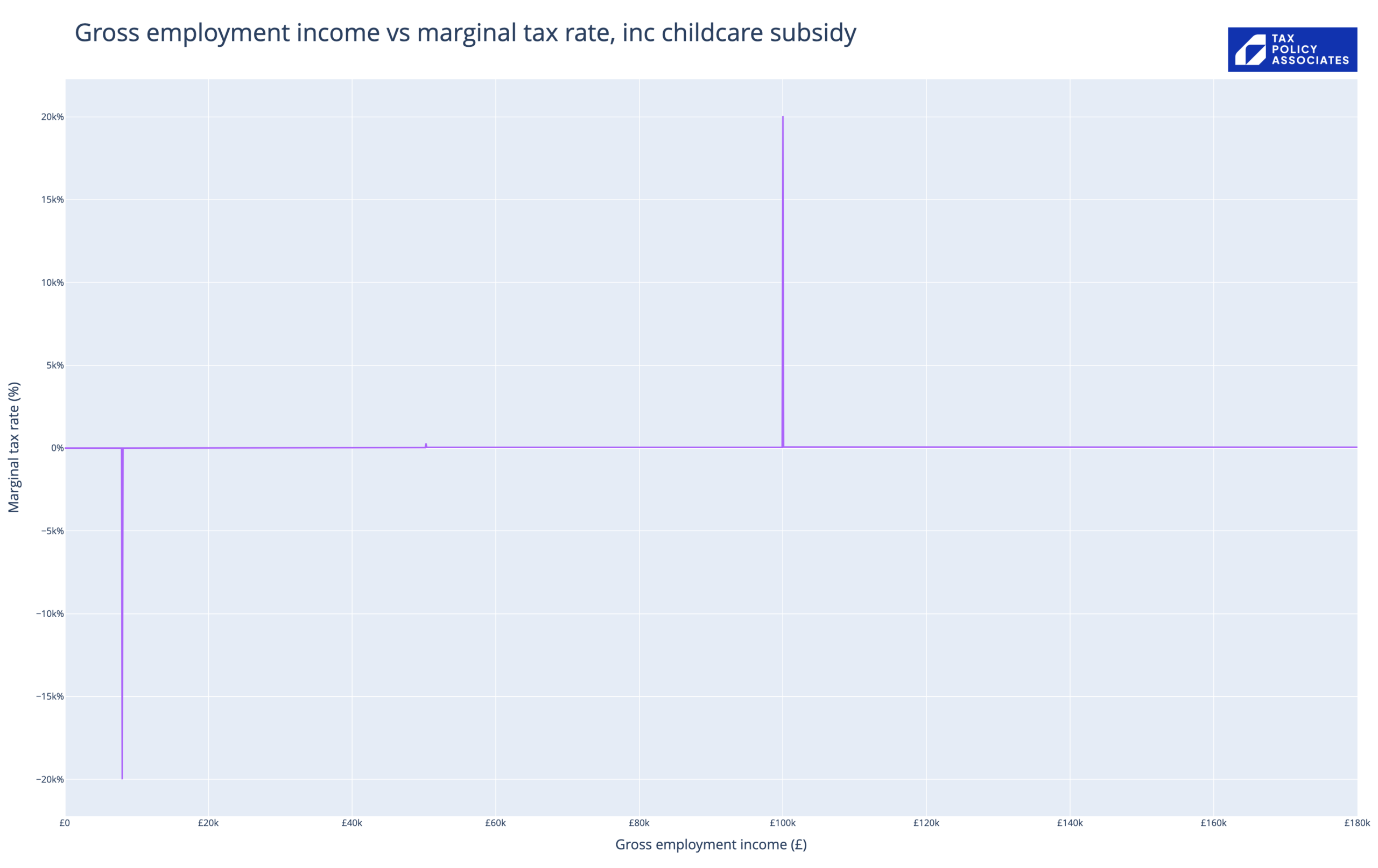
    This year, the Government created a new childcare support scheme for parents with children under 3. This could be worth £10,000 per child for parents living in London. And it vanishes completely once one parent’s earnings hit £100k. Here’s what that does to the marginal tax rate:

    The 20,000% spike at £100,000 is absolutely not a joke – someone earning £99,999.99 with two children under three in London will lose an immediate £20k if they earn a penny more. And the negative spike at £8,668 is because it’s at that point you qualify for the scheme – you have a huge negative marginal tax rate (which has the potential to create obvious distortions of its own).

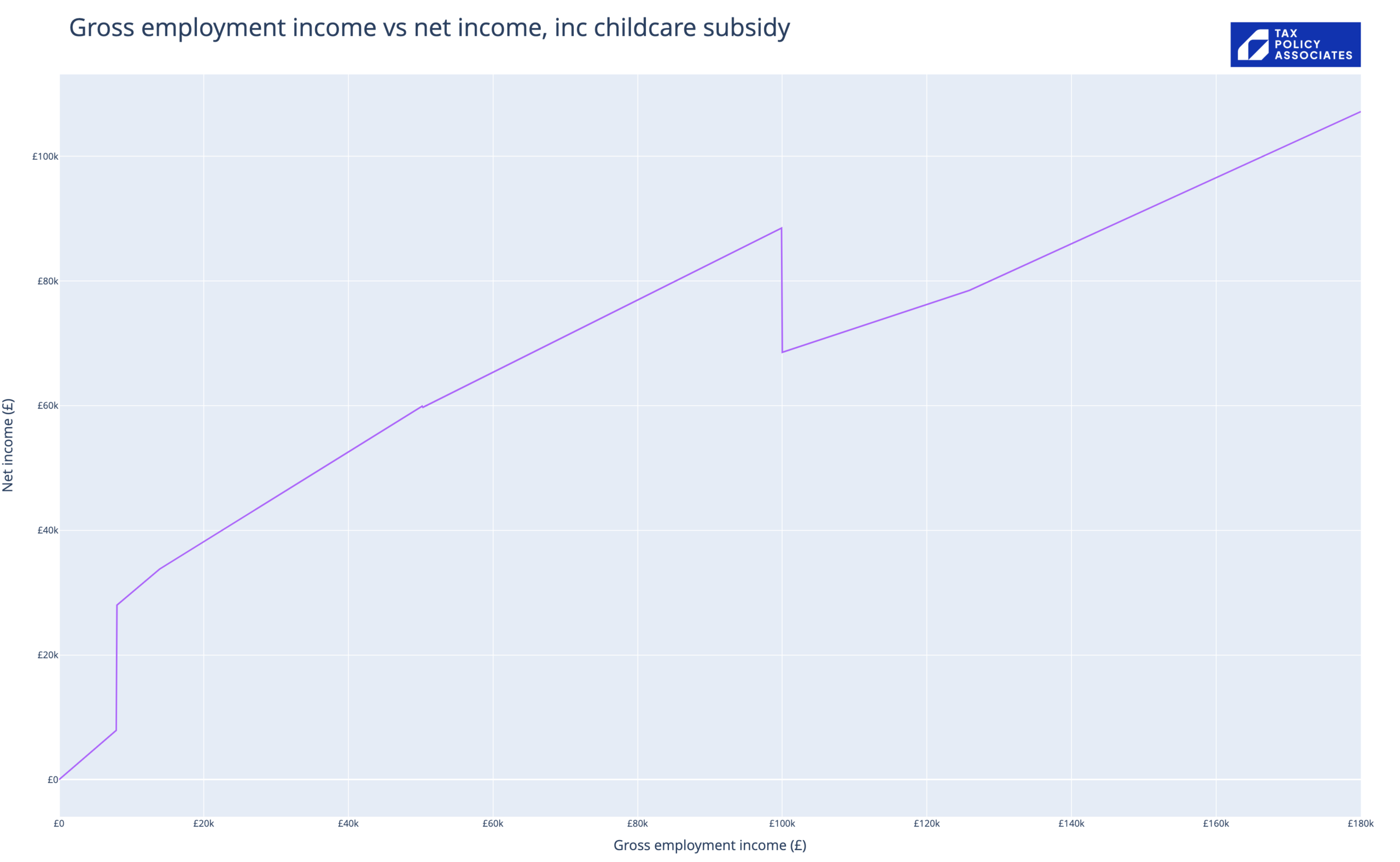
    The practical effect is clearer if we plot gross vs net income:

    After-tax income drops calamitously at £100k, and doesn’t recover to where it was until the gross salary hits £145k.

    This is ignoring the pre-existing tax-free childcare scheme, which also vanishes at £100k. The amounts are less (usually under c£7k/child) so the curve would look less dramatic. However, as the scheme applies to children under 11, taxpayers feel these effects for many more years.

    But don’t worry

    If Jane started earning beyond £145k, all of these problems go away, and she has a nice straightforward marginal rate of 47% forever. 

    What kind of tax system creates complexities and high marginal rates for people earning £50-125k, and simplicity and lower marginal rates for peopel earning more than £125k?

    What’s the solution?

    But these problems are going to get worse over time, as more and more people get dragged into the thresholds that trigger these high marginal rates. When the HICBC was initially set at £50k, that was a fairly high salary. By 2025/26, around 21% of taxpayers will earn £50k – and that’s likely what motivated Jeremy Hunt to raise it to £60k. But in these inflationary times, £60k will be the new £50k relatively soon.

    In theory it’s easy: don’t add tricks and gimmicks into the tax system. If you want to raise more money from people on high incomes, raise rates or lower thresholds so you raise more money from people on high incomes.

    In practice it’s hard. Scrapping these rules and making child benefit, the personal allowance, and childcare subsidies universal, would be expensive (somewhere between £5-10bn, depending on your assumptions). And the obvious way of funding that – increasing income tax on high earners, appears to have been ruled out by all main parties.

    Let’s hope whoever is the next Chancellor can see these problems clearly, doesn’t make them worse, and – ideally – looks for smart solutions.


    Photo by Osman Köycü on Unsplash

    Footnotes

    1. Everything interesting happens at the margin. For more on why that is, and some international context, there’s a fascinating paper by the Tax Foundation here ↩︎

    2. Ignoring Scotland for the moment. I’m sorry, Scotland – you are included on the charts, but I can’t lie to you… it’s not pretty ↩︎

    3. That’s the headline rate – the actual rate is different… for which see further below. ↩︎

    4. Perhaps he is self-employed and chooses which clients/work he takes on. Perhaps he is employed, and can choose how much overtime to work, or whether to accept a promotion. Perhaps he is going back to work after time spent looking after young children. Many people have the ability to work additional hours if they wish. ↩︎

    5. Strictly that doesn’t exist – you’re paying basic rate tax plus Class 1 employee national insurance contributions. But realistically this amounts to 28% tax. I’m going to count income tax and national insurance as if they’re one tax throughout this article. ↩︎

    6. Strictly that doesn’t exist – she’s paying 40% higher rate tax plus 2% Class 1 employee national insurance contributions. Realistically this is 42% tax. ↩︎

    7. Note that the marginal rate will vary depending on how we calculate it, and the size of the “perturbation” we calculate the marginal rate over. Most textbooks define the marginal rate as the % tax on the next pound/dollar of income. Say that we looked at the tax Jane paid on £60,199 of income – that would be £14,726. A £1 pay rise takes her to £60,200, and tips her into the HICBC – she now pays £0.42 more higher rate tax, plus an additional HICBC charge of 1% of your child benefit – £30.94 (assuming you have three kids). So the marginal rate is 100 * (£31.63/£1) = 3,163%. This is not very meaningful, as nobody’s incentives are going to be affected by the consequence of a £1 pay rise. It also creates the silly result that the marginal rate on her next £1 pay rise will be 42%, because the HICBC won’t increase until she gets to £60,400. So it’s better to use a more realistic figure like £1,000. The practical consequence is that the 56.5% figure isn’t *the* correct answer, but it’s a sensible and useful one, and it’s important to check that weird marginal rates aren’t just an artifact of the chosen perturbation. Our charts use a £100 marginal rate for convenience, but then “smooths” the HICBC formula so the marginal rate doesn’t leap up and down. ↩︎

    8. I think this is an unfortunate consequence of the Green Party having a policy to forgive all student loans, and another policy to increase national insurance by 6% for everyone earning £50k+. That would be a net win for someone paying off a student loan. However at some point during the manifesto process, they relegated student loan forgiveness to a “long term objective”, but didn’t change their national insurance plan. ↩︎

    9. Particularly when the economy is running at very little spare capacity; it would be different if there was high unemployment/plenty of spare capacity, because the work that was turned away would (at least in theory, in the long term) be undertaken by others ↩︎

    10. The £5,000 starting rate for savings is also phased out, but very slowly, and the phasing-out seems unlikely to be relevant to many people. ↩︎

    11. The chart is for a single earner, but if they have a partner, the partner would also need to be earning at least £8,668 (the national minimum wage for 16 hours a week) ↩︎

    12. The 20,000% figure is a consequence of the code that produces the chart incrementing the gross salary by £100 in each step. It would be a mere 2,000% if we used the same £1,000 perturbation as above. ↩︎

    13. Ignoring pensions, which create a marginal rate problem all of their own… ↩︎

  • Our take on the Reform UK manifesto

    Our take on the Reform UK manifesto

    Reform UK has published its manifesto. They plan personal tax cuts which they say will cost £70bn; however our analysis shows that they’ve miscalculated, and the actual cost will be at least £88bn.

    Reform UK says it will fund these tax costs with £70bn of savings and additional revenue, but it provides few details. Their proposal to change Bank of England reserve rules is over-stated by at least £15bn, and the cost would likely fall on businesses and consumers, not banks.

    These two factors mean that Reform UK’s plans have a total unfunded cost of at least £33bn – about twice the unfunded cost of Liz Truss’ ill-fated 2022 “mini-Budget“.

    We hope other estimates become available soon, but for the moment this is the only currently available estimate of the impact of Reform UK’s proposals. We asked Reform UK for the calculations they had used; they did not respond.

    We have published our methodology in full, together with the supporting spreadsheet and modelling. We welcome suggestions and corrections.

    Our analysis is for tax year 2025/26 only; the cost will be higher towards the end of the Parliament. And, as the Institute for Fiscal Studies points out, the long-run annual cost will be higher still.

    The overall tax effect of the manifesto

    We have previously said that the tax increases that Labour and the Conservatives were arguing about were so small as to be irrelevant.

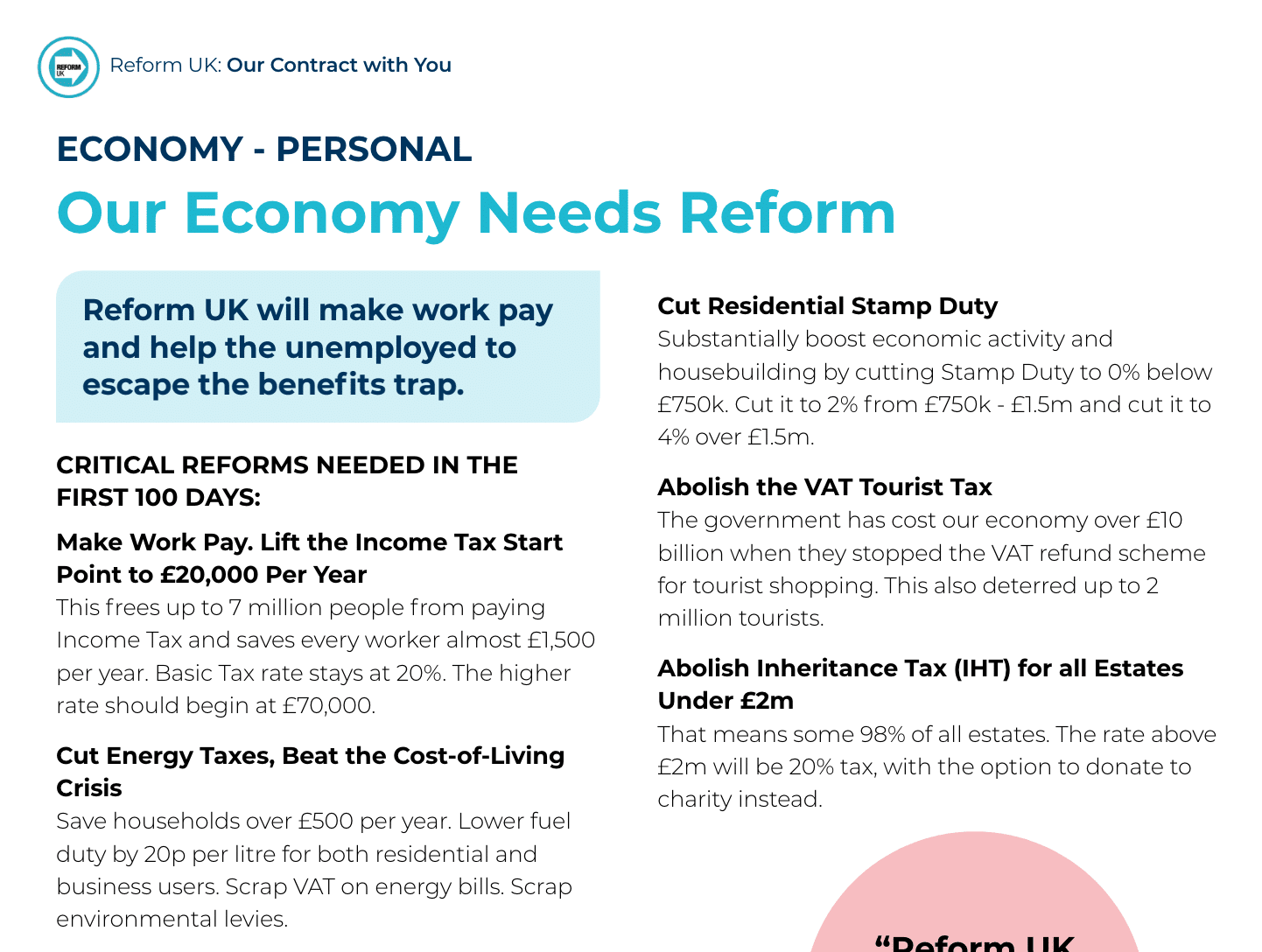
    Reform UK, on the other hand, are proposing £70bn of personal tax cuts:

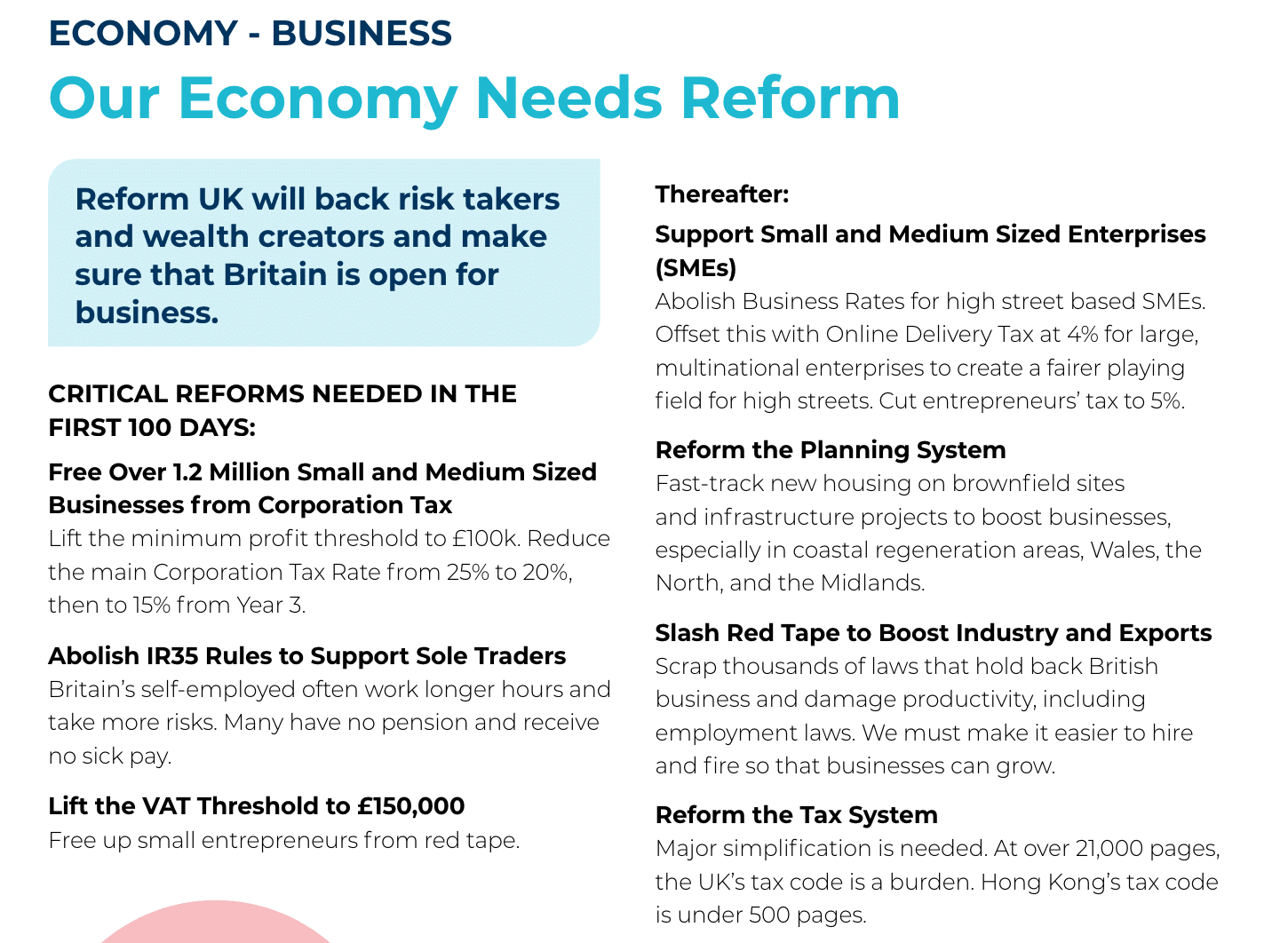
    And £18bn of business tax cuts:

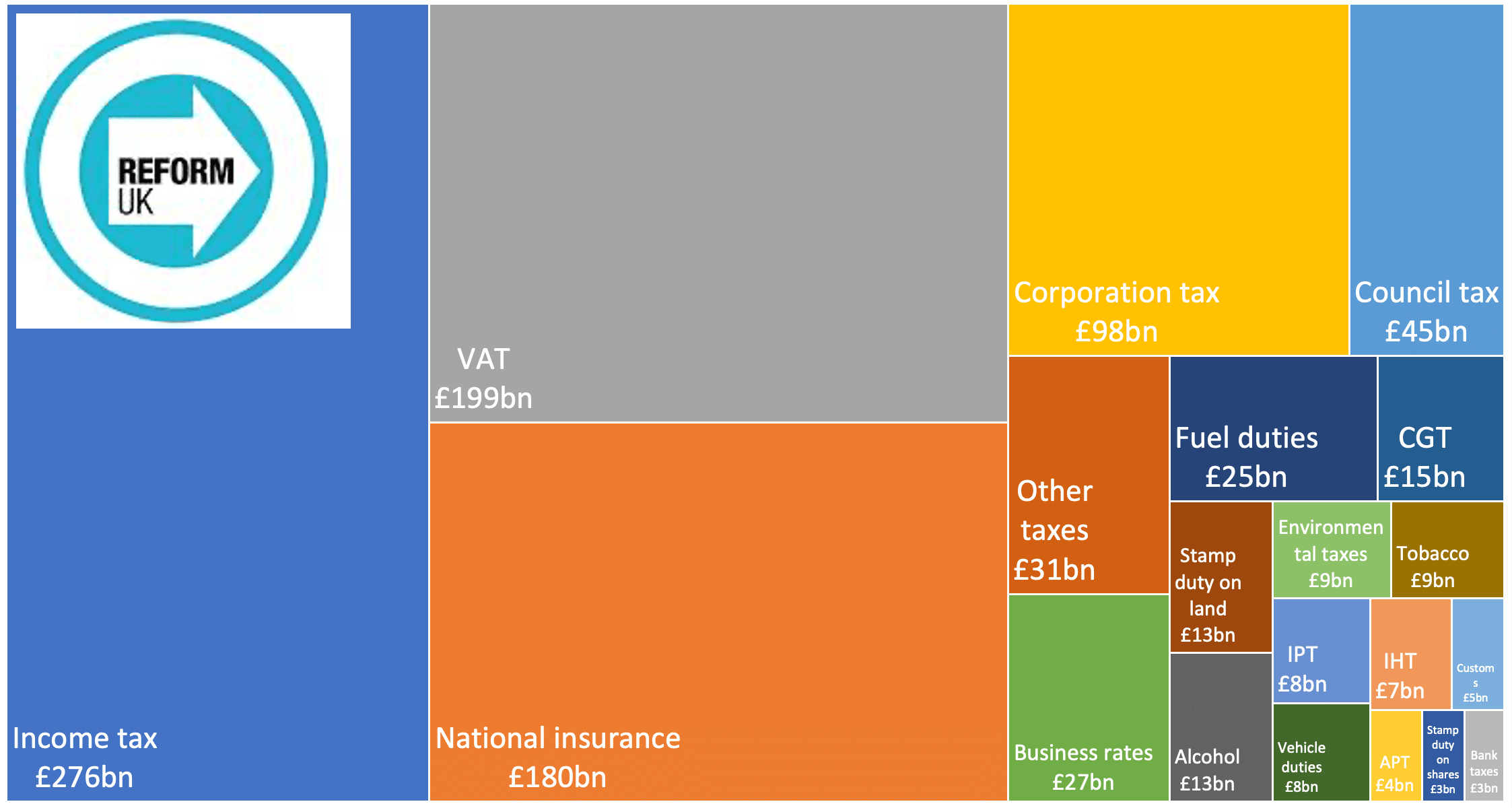
    This chart superimposes the size of Reform’s tax cuts over all the figures for UK tax receipts in 2023/24 (and, for ease, it’s in the top left, but not all the cuts are to income tax):

    Costing the tax cuts

    Reform UK don’t break down their estimates between their various tax cuts, and provide no explanation for how they arrived at their figures. All they present is the £70bn and £18bn totals:

    We were critical of the Green Party for failing to explain their figures, but at least, when we asked them, they were able to provide a breakdown between the different taxes. We asked Reform UK for a breakdown, and received no response.

    Reform UK’s lack of detail is very disappointing given the ambition and magnitude of their tax costs.

    Our analysis is that the £70bn figure for personal tax cuts is a significant under-counting of the actual cost, even when we make very generous assumptions as to the cost of each measure. Our breakdown looks like this:

    We were not able to properly assess the £18bn figure for business tax cuts, because it lacks sufficient detail. In particular, we do not know what is meant by “abolish IR35”. However we believe that the minimum cost is very close to Reform UK’s actual estimated cost. The actual cost could be many £bn higher, depending upon what precisely Reform UK’s proposals actually are:

    If Reform UK are serious about entirely abolishing IR35, and not just changing the enforcement rules, then the cost would be very much higher than this.

    We set out below the methodology we used in arriving at these figures.

    Methodology – income tax cuts

    Increase income tax personal allowance to £20k and increase higher rate from £50k to £70k

    Increasing the personal allowance is very expensive, because it benefits everyone earning above £12,570 – that’s 70% of all taxpayers. Increasing the higher rate affects everyone earning over £50k – which will be about 21% of all taxpayers in 2025/26.

    The easiest way to assess many proposed changes in tax rules is to use the “direct effects of illustrative tax changes bulletin” provided by HMRC – sometimes called the “ready-reckoner”.

    Using the figures in the ready-reckoner suggests that increasing the personal allowance by 10% costs £10.6bn for 2025-26, and increasing the starting point of the higher rate by 10% costs £5.4bn. On its face, that means the overall cost of the Reform UK proposals would be £82bn.

    However the ready-reckoner was prepared to illustrate the effect of small changes. It is not intended or designed to be used to model the kinds of large changes Reform UK are proposing.

    Reform UK’s proposal can be modelled statically as follows:

    • Take HMRC’s income percentiles for 2020/21
    • Update the income in each percentile by an inflator so that the percentage paying higher rate tax accords with the percentage for 2025/26 set out in table 3.4 of the OBR’s latest economic and fiscal outlook.
    • For each percentile:
      • Calculate the tax due under current rules, and subtract the tax due under the Reform UK proposals. This gives the revenue cost of Reform UK’s income tax proposals for one taxpayer in this percentile.
      • Multiply that by the total number of income tax payers (also from table 3.4) and divide by 100 – this gives the total revenue cost for all taxpayers in this percentile.
    • Repeat for all percentiles and add together: this gives the total revenue cost of the Reform UK income tax proposals.

    The result of this is an estimated revenue cost of £70bn.

    This is a simple static calculation. In reality, declared taxable income increases when tax rates reduce; in part this is people paying tax that was previously avoided or evaded. In part this is people rationally deciding to take on more work when tax rates drop. Any realistic estimate of the impact of tax changes, particularly large ones, should take account of these “dynamic” effects.

    We can express these effects quantitatively as the “elasticity of taxable income” or ETI – the amount that declared income will change when the rate of tax changes. However estimating the ETI is very difficult, and there has always been a wide variation in results. We see larger elasticities for large tax changes, and larger elasticities for higher earners. Research suggests that for moderate earners in the UK (i.e. not the very wealthy), the figure is likely between 0.10 and 0.30. There is an excellent summary of the state of the research in this Scottish Fiscal Commission paper, table 4.2, page 17, and a clear explanation of how ETIs work on page 16 (although they refer to ETIs as TIEs).

    We included dynamic effects into the methodology above, using what we think is a reasonable “best case” scenario for Reform UK by taking the rather high ETIs used by the Scottish Fiscal Commission (see page 20 of the paper). We say this is a “best case” because Scottish ETIs are higher than rest-of-UK ETIs for the obvious reason that it’s relatively easy for many Scottish taxpayers to escape Scottish tax by moving over the border to England. However, as we will explain below, the exact ETI chosen does not materially impact the analysis.

    The methodology for each income percentile is then as follows:

    • calculate the tax position of a taxpayer in that percentile under current rules, and their marginal rate
    • calculate the tax position of the taxpayer under Reform UK’s proposals
    • increase their pre-tax income by (% increase in marginal rate) x ETI for that level of income
    • calculate final tax position in light of increased taxable income

    On this basis, the estimated revenue cost is £68bn, only slightly less than the static costs.

    One might wonder why dynamic effects are so limited. The reason is that ETI operates at the marginal rate, and the Reform UK proposal doesn’t do much to marginal rates:

    • Moving the higher rate threshold to £70k reduces the marginal rate for taxpayers earning between £50k and £70k, because they are now paying the 22% basic rate (plus NI) or their income instead of 42% higher rate (plus NI). In our model, for example a taxpayer on £60k increases their declared taxable income by about £2k, meaning they pay around £500 more tax.
    • A taxpayer earning more than £70k pays £4k less tax (i.e. because they now have £20k of income taxed at 22% not 42%) but this is a windfall that doesn’t change their marginal rate. Tax elasticity theory says they therefore have no additional incentive to earn.
    • Moving the personal allowance to £20k has a big benefit for people on incomes just below that – someone on £19k sees their marginal rate fall from 28% to 19%. But on such low incomes the magnitude of incentive effects are limited.
    • And taxpayers earning more than £20k receive a £1,634 tax cut (because they now have £7.5k taxed at 0% rather than 22%) but again it’s a windfall that doesn’t change their marginal rate. Increasing the personal allowance is very expensive.

    So the final result is not very sensitive to the ETIs used – if we (unrealistically) double the ETIs, only £2bn of additional tax is collected. Dynamic effects are much greater if you cut rates rather than increase thresholds. For example, and purely for illustrative purposes, our model suggests that if took the very dramatic step of replacing all of income tax with a flat tax of 17% it would cost £84bn on a static basis, but £12bn of dynamic effects mean the end cost would be about the same as Reform UK’s (£72bn). That is, however, on the basis of the unrealistically high ETIs we are using to be generous to Reform UK’s proposal, and a very simplified model – that would almost certainly not be the result in reality. However it does illustrate that tax cuts should be designed to cut marginal rates – this makes them more affordable, which is another way of saying that they are then more effective at driving growth.

    These are, therefore, badly designed tax cuts, that don’t provide much “bang for the buck” and are unlikely to drive growth.

    All these calculations were performed using an adaption of the well-tested code used to create our marginal tax rate chart. We have made the new code available on our GitHub here.

    This is a simple model with important limitations. In particular:

    • It assumes everybody is only receiving employment income (and not self-employment income, rent, dividends etc). That means the model cannot be used for e.g. changes in the level of national insurance or tax on passive income. However, Reform UK’s proposal affects all types of income without regard to the source, and therefore this limitation doesn’t impact our analysis.
    • It doesn’t properly model the income of the top 1%, because it analyses it as if all the top 1% earned the base pre-tax income for that percentile of £216k. In fact the income of the top 1% is much higher than this – there are 28,000 people with income over £1 million, collectively paying £28.3 billion in income tax – that’s more tax than the 18 million taxpayers earning less than £20k. This means the model will dramatically undercount the cost and ETI effects of tax changes that impact the marginal rates of people earning more than £216k. However, Reform UK’s proposal does not affect the marginal rates of anyone earning more than £70k, and therefore this limitation doesn’t impact our analysis.
    • When people’s after-tax income increases, they are likely to spend more, especially those on lower incomes. This increased spending often results in higher VAT revenue and stimulates economic activity, creating positive ripple effects throughout the economy. Conversely, reduced government expenditure resulting from a tax cut can decrease the income of others in the economy, leading to negative ripple effects.A full analysis would require detailed econometric modelling, but the economists we spoke to were reasonably confident there would be an overall negative effect given that most of the benefit of Reform UK’s tax cuts goes to higher-income individuals, who have a lower propensity to spend.

    Methodology – other personal tax cuts

    All the calculations supporting the figures below are set out in the spreadsheet available on our GitHub.

    Scrap VAT on energy bills

    There is a figure for this in HMRC’s document setting out the cost of different reliefs – the current rate of 5% is estimated to represent a revenue cost of £8bn compared to if it was at the standard rate of 20%. Hence the cost of scrapping the 5% rate will be approximately £3bn.

    Lower fuel duty by 20p per litre

    The ready-reckoner suggests a cost of £9bn for reducing fuel duty by 20p. We understand that this figure includes dynamic effects (i.e. people using more fuel when duty falls).

    We can sense-check this result by adjusting the current £25bn fuel duty yield to reflect a 20p cut. That results in a figure of £10bn – this will be a slight over-estimate given that the HMRC data includes non-domestic fuel duty (e.g. aviation fuel).

    We can sense-check again using RAC figures for the volume of petrol and diesel sold in the UK. That gives a figure of £12bn – but it will include agricultural petrol and diesel, which is not taxed.

    We will therefore use the £9bn figure.

    These calculations are shown in the spreadsheet available on our GitHub here.

    Stamp duty

    The current rates are 0% for up to £250k, 5% to £925k, 10% to £1.5m and 12% thereafter.

    Reform want to cut this to 0% up to £750k, 2% up to £1.5m and 4% thereafter.

    We can calculate this with the HMRC ready-reckoner. The total comes to £3bn.

    The calculations are again shown in the spreadsheet available on our GitHub.

    It’s important to note that this change would likely result in increased property prices – buyers would probably not end up better off. This therefore ends up as an expensive house price subsidy. We explain why here.

    Inheritance tax – increase nil rate band from £325k to £2m

    This is again too big an increase for the HMRC “ready-reckoner” to be useful.

    We can better estimate the result from the raw data on IHT returns, calculating the revenue reduction at each level of estate value. This comes to £5bn. Dynamic effects are obviously limited.

    Methodology – business tax cuts

    All the calculations supporting the figures below are set out in the spreadsheet available on our GitHub.

    Reduction in corporation tax from 25% to 20%

    The “ready-reckoner” suggests a figure of £18.5bn, but that should be viewed with caution given the magnitude of the change.

    The 2022 Autumn Statement reversed the tax cut from the controversial Spring Statement, and put the rate back from 19% to 25%. The stated revenue from this was £17bn for 2025/26. It follows that we can prudently estimate the cost of a cut from 25% to 20% as £14.2bn. We would suggest that is the appropriate figure to use.

    Lift minimum profit threshold to £100k

    We do not understand this proposal.

    Currently the rate for companies with profit of less than £50k is 19%; the rate for companies with a profit of more than £250k is 25%. Between these £50k and £250k the rate smoothly increases.

    But Reform UK are proposing cutting the rate to 20%. What is the point of a special small company rate of 19%? The small company rules are highly complex and create an administration headache for taxpayers and HMRC. That is perhaps justified where the tax rate saving is 6% – it cannot be sensible where the tax rate saving is 1%.

    We calculate the cost of the tax cut, and therefore the total benefit to small business, as a very small £100m.

    Lift VAT threshold to from £90k to £120k

    In our view this would be a serious mistake which would cause many growing small companies to constrain their growth to £120,000. We already see this effect at the £85,000 level of the current VAT threshold, where there is a “bulge” in the statistics of companies holding back their growth. That effect would be more serious (and more deleterious to economic growth) at a higher turnover level. Our analysis of the current situation is here.

    We can estimate this in two ways.

    First, we can look at the £185m cost of increasing the threshold from £85k to £90k in the most recent budget, and simply multiply that by five. That results in a figure of £1.1bn.

    Alternatively, we can look at the £2.3bn of total VAT (see table T5b) paid by companies with a turnover of between £85k and £150k, and pro-rate that linearly to reflect a £120k threshold, resulting in a figure of £1.2bn.

    We will use the £1.1bn figure.

    Abolish IR35

    We do not know what this means.

    “IR35” is name usually given to the rules introduced in 2000 to stop people who are realistically employed from instead being engaged as contractors, via a personal service company (PSCs). PSCs were widely used in cases where someone (particularly IT consultants working for large businesses) was working as part of a team for a long period of time, and being treated in almost every respect as an employee.

    If Reform UK were really going to abolish these rules then we would see a return to the very large-scale levels of avoidance seen in the 1990s – except it would now be worse given that corporation tax has fallen, and income tax has risen, making PSCs more attractive and the losses from avoidance therefore greater. We are not at this point able to estimate the cost in lost tax, but it would be very high indeed, plausibly £10bn or more.

    There have been more recent changes to IR35. Some larger employers failed to apply the rules correctly, relying on the fact that the risk of this was on the contractor or their PSC, not the employer. So in 2017, rules were introduced putting liability on public sector employers ; the stated revenue from this measure was around £150m/year. In 2021, this was extended to the private sector; the stated revenue from this for 2025/26 was about £1.7bn/year. It is important to stress that the 2017 and 2021 changes do not alter the technical application of IR35 at all; all they do is change the person who is liable to the employing business, and therefore effectively force businesses to take the rules more seriously.

    It may be that Reform UK are only proposing to abolish the 2017 and 2021 reforms – in that case the cost would be around £1.8bn. This would in our view be unwise, because it rewards businesses that ignore the law.

    Assessing the revenue-raising

    Reform UK say:

    And they put figures on these proposals here:

    These are massive numbers – about 5% of GDP in total. No details are provided; it is also unclear how “first 100 day tax cuts” can be funded from savings that would take time to implement. The 5% figure ignores the fact that some areas (e.g. the NHS) are said to be protected from cuts. And the long-term impact of significantly reducing immigration surely deserves more analysis than one number in a table.

    We, however, will focus on the “stop bank interest” figure of £35bn figure, which arises from (broadly speaking) ending the practice of the Bank of England paying interest on the reserves placed with it by UK banks.

    This is a proposal that’s been made by others, including Chris Giles (the economic commentator) and the Left-wing New Economics Foundation. However Reform UK’s figure is much higher than anyone else’s, and we doubt it is correct:

    • The fundamental business of banks is charging customers an interest rate that reflects their own average/marginal cost of funding (plus a margin). If their costs increase, the interest rate increases. So, for example, there is good evidence that the cost of a levy on banks isn’t actually borne by banks, but by their mortgage customers in the form of higher rates. We expect the same would be true here – ultimately it would be consumers and (non-bank) businesses paying the most of that £35bn cost, in higher borrowing rates or lower savings rates.
    • That is all the more so given that we estimate that total UK profits of the bank sector are around £30bn..
    • If interest rates fall, the figure will fall from £35bn. This is not a sustainable way of funding a long term tax cut.
    • Experts in monetary policy think £35bn is much too big a figure. The New Economics Foundation suggested a realistic figure was £19bn. The Institute for Fiscal Studies thinks slightly less. Chris Giles has said around £5bn to £10bn is a realistic figure..
    • And economics and financial markets expert Toby Nangle thinks there would be much wider economic implications to Reform UK’s approach. In macroeconomic terms, the proposal amounts to “helicopter money“. More seriously, the Bank of England would risk losing monetary control. Toby thinks these risks would be minimal if the Bank of England slowly ramped up the proportion of reserves on which it didn’t pay interest (to say the kind of £5-10bn figure Chris Giles suggests).
    • Reform UK don’t appear to have considered any of these issues at all; the Toby Nangle article gives the impression that Reform UK were hearing them for the first time.

    Reform UK’s revenue projections therefore appear to be over-stated by at least £15bn and possibly as much as £30bn, the actual revenues would likely come at the expense of households and businesses, not banks and their shareholders, and there are complex macroeconomic consequences which Reform UK appears to not have considered.


    Thanks to O, R and K for their work on the calculations and modelling.

    Disclosure: Our founder, Dan Neidle, is a member of the Labour Party, and sits on its most senior disciplinary body. His tax advice has always been regarded as non-partisan, and he was highly critical of Labour Party tax proposals in the 2017 and 2019 elections.

    Footnotes

    1. The cost of the mini-Budget was projected by the Truss government to be £19bn in 2022/23, rising to £45bn by 2026/27, and others thought the true figures would be higher ↩︎

    2. Note that these figures don’t include Reform UK’s proposal to exempt all NHS medical staff from basic rate income tax for three years – this seems to be included in the £17bn “NHS pledge” rather than on the tax side. No breakdown of the £17bn is provided, but we can estimate the cost from the 627,000 FTE medically-qualified NHS staff and the average NHS FTE pay of £38,000. After Reform UK’s £20k personal allowance, that’s a basic rate tax saving of £3,600 each, so about £2.3bn altogether. Thanks to James Goffin for asking about this. ↩︎

    3. Until the point at the personal allowance gets phased out; £125k at the moment. ↩︎

    4. With Reform’s 60% increase in the personal allowance costing £60bn and the 40% increase in the higher rate costing £22bn ↩︎

    5. Or, more precisely, the rate of retaining after-tax income changes) ↩︎

    6. UK_tax_change_calculator.py is the script, using the same UK_marginal_tax_datasets.json as the marginal tax rate calculator, with a new dataset added into that json for the Reform UK proposal ↩︎

    7. One might expect these two effects to cancel out, but that is not necessarily the case. It largely depends on who receives the benefit of the tax cuts and who faces lower income from reduced government expenditure. Tax cuts for lower-income individuals typically have a higher multiplier effect compared to cuts for higher-income individuals who might save more – people on lower income spend more – they have a higher “propensity to spend“. Government spending can also have a higher multiplier effect, depending on the nature of the spending, the economy’s capacity at the time, and wider macroeconomic conditions – in some circumstances government spending can “crowd out” private spending. The OBR has published an excellent summary of how they model multiplier effects. ↩︎

    8. Many thanks to Paul in the comments for pointing out an error in the initial version of this report. Our apologies. ↩︎

    9. Reform UK’s bands are different from the current stamp duty bands; we adjusted for that with a simple pro rata calculation. ↩︎

    10. It provides an estimate of £90m for increasing the nil rate band by £5,000. A linear application of that to Reform UK’s increase results in reduced revenues of £30bn, which is obviously nonsensical. ↩︎

    11. But not zero – there is evidence that the timing of reported deaths is affected by inheritance tax rates. ↩︎

    12. The figure comes as a result of the Truss/Kwarteng abolition of this rule in the 2021 “mini-Budget” and its subsequent reinstatement. There is an extended analysis for this here. ↩︎

    13. See the second tab of our spreadsheet, available on our GitHub. Note that this is lower than the figure for the total profits of the UK banks, because much of this profit is generated overseas. Our figure is, however, too high, because it will include foreign banks with UK operations; but only UK banks place reserves with the Bank of England. ↩︎

    14. That is derived from the “non-remunerated” tier and so is a sustainable figure, not affected by changes in rates ↩︎

  • Our take on the Green Party manifesto

    Our take on the Green Party manifesto

    The Green Party has published its manifesto. The Green Party propose raising taxes by £115bn in 2026/27 and £172bn in 2029/30 – about 4.5% of GDP. There is very little detail presented and the proposals are impossible to assess in any depth. It’s a huge missed opportunity to advocate for radical tax proposals, and move them into the mainstream.

    We set out the issues in more detail below.

    Lack of detail

    The Green Party manifesto has a very radical approach to tax, raising a large amount of money from complex new taxes. However this is covered in two brief pages, which present no detail and no figures.

    A statistical appendix then provides figures for the overall effect:

    I asked the Green Party press office, and they kindly sent me this breakdown between the various proposals:

    This is very unsatisfactory. It’s impossible to assess tax proposals, particularly radical ones, if they are not explained. Otherwise we are being asked to take these numbers on trust.

    Tackle avoidance and evasion

    The manifesto says:

    We will clamp down on tax dodging. When companies and individuals fail to pay their fair share, it deprives our vital public services of much needed investment.  

    Greens support small businesses that are currently paying taxes for the services they use, and will take steps to tackle the global corporations that are not. It will be a priority to strengthen global tax agreements to stop corporate tax avoidance and evasion, and to ensure a level playing field between UK and transnational businesses. We will also ensure that HMRC has the resources it needs to reduce the gap between taxes due and taxes paid.  

    This is all very vague. The Labour and Conservative parties have set out plans to raise £5-6bn of additional annual tax from “tackling tax avoidance and evasion”. The Lib Dems don’t have a published plan, but think they can raise £7bn. The Greens just have these two paragraphs.

    Wealth tax

    The manifesto says:

    “Elected Greens will push for a wealth tax. This will tax the wealth of individual taxpayers with assets above £10 million at 1% and assets above £1bn at 2% annually. Only a very small minority of people would be subject to the wealth tax, while the overwhelming majority would benefit. “

    The Green Party plans to raise a very large amount from this:

    There has never been a tax like this anywhere in the world, raising so much money from such a small number of people. The Green Party provide no calculations, no references, and no explanations of how this tax would work.

    The closest tax is the Spanish “solidarity tax on large fortunes“, which applies at 1.7% for wealth of €3m, 2.1% for wealth of €5.4m, and 3.5% for wealth of €10.7m. The rates are therefore not dissimilar to the proposed Green tax, but it raised €632m in 2023. UK GDP is about twice Spanish GDP, but it’s not at all obvious from this why the Greens think they can raise £14bn.

    Possibly the tax would be designed differently from the Spanish tax? But given we have no information at all on its design, it’s impossible to say.

    The Greens might well respond that the UK has many more internationally mobile billionaires living here than Spain does. That is certainly true – but their mobility means they are difficult to tax. One look at the Sunday Times Rich List shows that most of the billionaires associated with the UK have relatively limited ties here.

    The Wealth Tax Commission produced a magisterial report on wealth taxes in 2020. It recommended against an annual wealth tax because of implementation and administration difficulties, and the likelihood of avoidance. It instead suggested a one-off retrospective wealth tax – the retrospection would mean it was impossible to avoid. We have doubts about the political economy of such a retrospective tax, but technically we agree that (if it could be implemented) it would be effective.

    Inheritance tax

    The manifesto says:

    “We would reform inheritance tax, ensuring that intergenerational transfers of wealth are taxed more fairly”

    That is the only mention of “inheritance tax” in any of the Green Party materials. We do not know what reforms are proposed.

    Despite the absence of any proposals, the Green Party expects to book £4bn of new revenue from inheritance tax in 2026/27:

    That’s a significant amount from a tax that currently raises £7bn.

    Carbon tax

    A carbon tax is a tax that places a price on carbon dioxide emissions, either in-country or imported. So the tax incentivises businesses to cut emissions. It’s a conceptually brilliant design which we support.

    However, the Green manifesto has almost no detail:

    “Elected Greens will propose levying a carbon tax at an initial rate of £120 per tonne, rising to a maximum of £500 per tonne of carbon emitted within ten years. This is deliberately designed to make it cheaper for the emitter to take steps to reduce emissions rather than pay the tax.  We estimate we will be raising up to an additional £80bn by the end of the parliament, then falling back after that as carbon emissions reduce across the economy.”

    We asked the Green Party for more information and they kindly sent us a short explanatory document. The document provides calculations but little in the way of technical detail on how the tax should work. It’s an extremely brief treatment of a complex tax, particularly when it’s set to raise such a huge sum (4% of GDP).

    However those details they do provide suggest that the Greens are proposing a very unusual, and perhaps unique, carbon tax.

    A simple carbon tax is on either the carbon emitted by UK production or the carbon emitted by UK consumption.

    These days it’s more typical to talk about a “border adjusted” carbon tax. This means that we would tax domestic production and imports, but not exports. This has several advantages:

    • It works extremely nicely as an international system, if others then adopt the same tax. No credit system or complexity is required – each country just taxes the products entering (or produced and consumed in) its own borders.
    • And that’s the point: what the UK does with carbon taxes is irrelevant in global terms – the UK is responsible for 1% of global emissions. A more important aim is for the UK can help spearhead a global move to a carbon tax (e.g. as part of current OECD/Inclusive Forum discussions).
    • More practically: if we tax exports then UK cars sold to the US (for example) are subject to a UK carbon tax, but Chinese cars sold to the US would not be subject to a carbon tax anywhere in the world. UK industry becomes globally uncompetitive. That’s obviously bad for the UK; but it doesn’t help global carbon emissions, because demand for cars would shift from the UK to China – “emissions leakage”. There would be no carbon reduction. It’s pointless.

    The Green proposal is unusual, because it’s not border adjusted, and it applies to UK production, imports and exports. That does not seem very coherent or workable.

    Carbon tax proposals usually phase in the tax gradually, rather than risk creating an economic shock. However the Green Party carbon tax starts at a high rate of £120 per tonne – much higher than the EU carbon price (which has never gone over €105 per tonne). It then increases to £265 per tonne by 2030. The document explains this:

    We apply a rising tax rate based on HMG carbon values (central estimate). These are the estimated prices at which iit is cheape [sic] for the emitter to reduce its emissions than pay the tax.”

    That’s not how a carbon tax usually works. The idea is to price it at the “social cost of carbon emissions”. It’s unclear why the Greens are taking a different approach.

    The regressivity problem

    An obvious problem with the carbon tax is that it is regressive. Costs resulting from the carbon tax will (inevitably) increase prices, not just of fuel but of all products. That will disproportionately impact the poor, and people on middle incomes will also lose out.

    For this reason, carbon tax proposals are usually accompanied by proposals to redistribute a significant proportion of the tax revenues to households in the form of tax rebates and/or benefits. Some have suggested simply distributing carbon tax refunds across the population. Others suggest more targeted subsidies.

    The Green Party’s carbon tax paper says: “We would provide funding for poorer households to convert to lower carbon alternatives” but provides no details, and no such funding is evident in their figures. In any case, “funding for poorer households” would be insufficient to undo the regressive effects of the carbon tax.
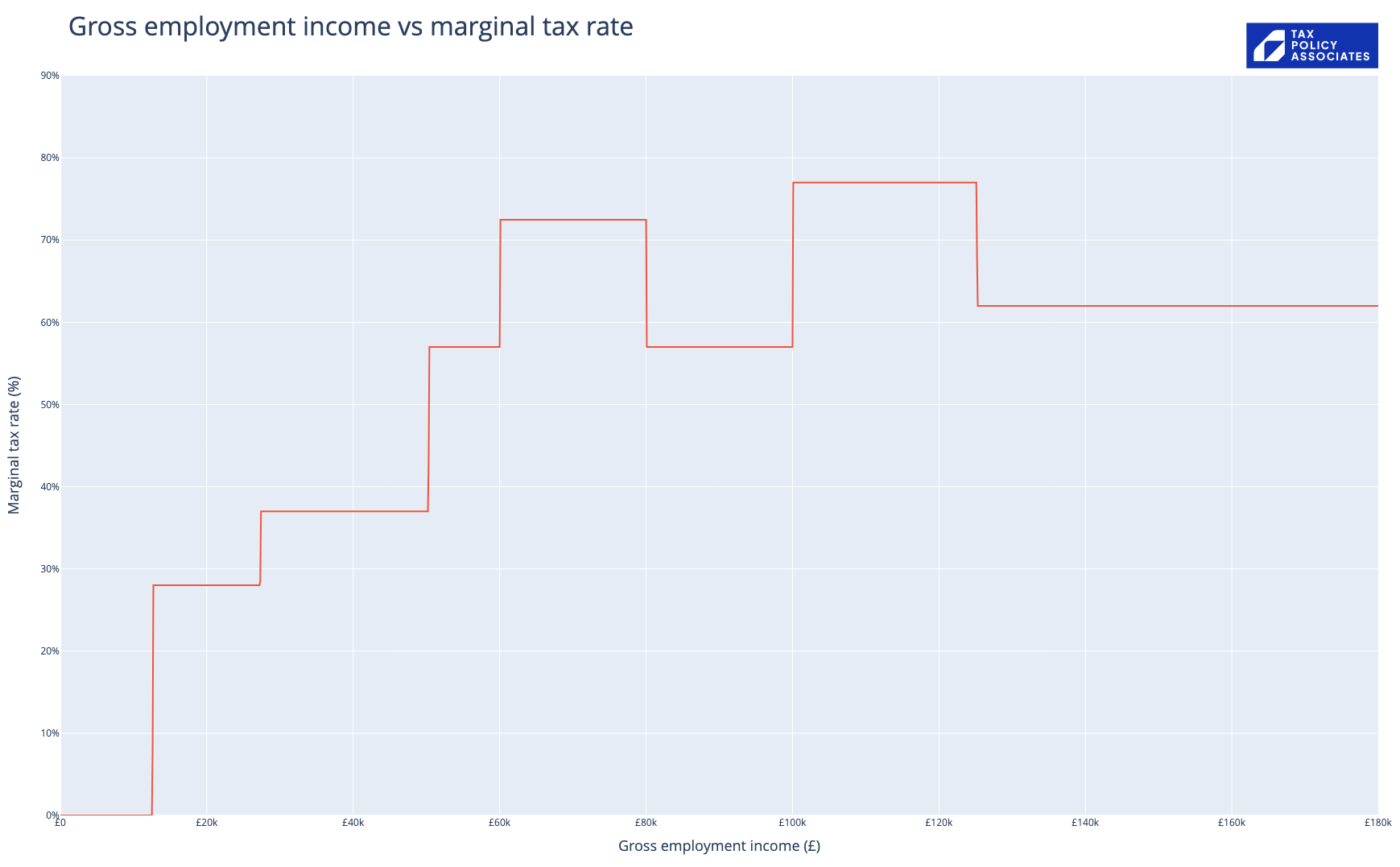
    The sad truth may be that the Greens wish to use carbon tax revenues for general spending, and this has eclipsed the more appropriate use of the revenues for redistribution.

    Incompatibility with their other proposals

    The rest of the Green manifesto speaks as if there is no carbon tax. It talks about an extended windfall tax on oil/gas production, and a new tax on frequent air passengers. The carbon tax document itself says “Carbon tax on aviation could include extensions to the existing Air Passenger Duty or a Frequent Flyer Levy.”

    All this should be irrelevant if a carbon tax is introduced.

    National insurance increase

    “Elected Greens will also call for the reform of tax rates on investment income, by aligning them with the tax and NIC rates on employment income

    We would remove the Upper Earnings Limit that restricts the amount of National Insurance paid by high earners. Tax rates should not fall as income increases. “

    What does “removing the cap on national insurance” mean?

    Here are the current Class 1 rates:

    £967 is the “upper earnings limit”. There used to be no national insurance past that point; it’s now 2%. “Uncapping” means removing the limit so that the 8% rate continues to apply past £967 a week.

    We should, however, discard the pretence there’s something special about national insurance. It’s just income tax by another name, with an antiquated weekly calculation, a complicated history and a funny national accounting treatment. A realistic approach looks at the overall combined rate of income tax and national insurance.

    In the current, 2024/25 tax year, this looks like this for an employee:

    • No tax on incomes below the £12,570 personal allowance.
    • £12,570 to £50,270 – a combined income tax and employee national insurance rate of 28%
    • £50,271 to £125,140 – a combined rate of 42%
    • Above £125,140 – a combined rate of 47%. 

    The Greens are therefore proposing that the third of these should rise to 48%, and the fourth to 53%. 

    However things aren’t that simple. The personal allowance starts to be withdrawn (“tapered”) when your income hits £100,000, and is gone by £125,140. This means that the marginal rate in the £100,000 to £125,140 range is much higher than the headline rate.

    This chart shows the effect, as things stand today (blue) and under the Green proposal yellow):

    There’s an interactive version of the chart here that lets you select different scenarios and touch/mouse over the chart to get exact figures.

    This is not the only factor that means the actual marginal rate is higher than the headline rate. There are a series of poorly thought-through tricks and gimmicks that have this effect, most significantly child benefit withdrawal and student loan repayments.

    Here’s the marginal rates under the Green proposal for a graduate with three kids under 18:

    So a graduate earning £60,000 with three kids pays a 72% marginal rate, and everyone earning £100k-£125k pays a 77% marginal rate. I don’t think this would be sensible or sustainable. There are many people (think: hospital consultants) who would prefer to reduce their hours than earn just 23p in the pound.

    Uncapping national insurance was a perfectly rational policy in the 90s, but it’s not viable today unless the various tricks and gimmicks in the system are fixed or removed. 

    Who would pay this?

    The Green proposal will affect quite a lot of people. 

    £50,270 is not that far above the average London salary. And, by 2027/28, one in five taxpayers, and one in four teachers will be affected; I expect a majority of households will have someone who earns that figure at some point in their life. To say this is a tax on the “richest” is not particularly accurate.

    Pension tax relief limit

    The manifesto says:

    We would equate the rate of pension tax relief with the basic rate of income tax to help fund the social care that will allow elderly and disabled people on low incomes to live in dignity. 

    This is, on the face of it, a sensible way to raise money from the upper middle class without too many distortive effects. It doesn’t affect the very wealthy because they’re past the pension cap.

    The Green Party’s annual revenue figures from this are:

    No justification for these figures is provided, but they are likely in the right ballpark.

    This will affect everyone earning £50k who makes a pension contribution. Many people would respond by stop making pension contributions – that will have obvious wider effects. There are also potential administrative complications.

    VAT on financial services

    “We would also propose a range of changes to VAT, reducing it on hard-pressed areas such as hospitality and the arts and increasing it on financial services and private education. “

    Some financial services are currently either exempt from VAT or outside VAT altogether. These include lending, operating accounts, and most transactions in shares and securities. This means that banks don’t apply VAT to interest or fees on these services; it also means banks can’t recover their input VAT.

    In principle it would be much preferable to end the financial services exemption. However there are significant technical difficulties in doing so; identifying the outputs and inputs is not straightforward (the issues are nicely set out in this paper, which also proposes a solution). There is also the significant practical problem that many customers of banks, such as household borrowers under mortgages, would not be able to recover any VAT they were charged – the likely impact of applying VAT to financial services would be to increase household mortgage bills.

    There have been numerous EU discussions about ending the financial services exemption, but all have failed. The most recent one was abandoned because it was thought too politically difficult to increase prices for consumers during the “cost of living crisis”. We recently spoke to a leading VAT academic who advocates for ending all VAT exemptions; but even she balked at the financial services exemption – “just too difficult”.

    Even if a solution was found, it would be preferable for the UK to proceed in lockstep with the EU; having two different VAT systems for financial services would complicate cross-border business and create the potential for avoidance and evasion.

    All of which is to say that, if the Greens really plan to end the financial services VAT exemption, they need to do better than three words, and be a little more hesitant than assuming they can start booking £8bn of new revenue from April 2025.

    Capital gains tax

    “Elected Greens will push too for the reform [of] Capital Gains Tax (CGT) by aligning the rates paid by taxpayers on income and taxable gains. This would affect less than 2% of all income-tax payers.”

    The Lib Dems think they can raise £5bn from aligning rates. The Greens show £16bn to £20bn:

    £16bn in 2026/2027 is a very large number compared to the actual CGT receipts in 2023/24 of £15bn.

    The problem with capital gains tax is that people can control when they pay it. If you say you’re going to increase the rate, they’ll sell early and take advantage of the current rate. And, if the above is to be believed, the Greens are planning to give people a year before they raise the rate (which is very strange).

    We expect it’s for these reasons that HMRC data shows a projected loss in capital gains tax revenues of about £3bn if rates are equalised. We talk more about this in our analysis of the Lib Dem CGT proposal.

    But the £16bn figure has to be regarded as very wrong.

    Bank tax

    The manifesto says:

    “We would introduce a windfall tax on banks when excessive profits are being made. 

    This seems to leave open whether and how the Greens are proposing taxing the banks, but they nevertheless book £4bn a year of projected revenue from 2027:

    Property tax

    We at Tax Policy Associates are strong supporters of land value taxation, something the Green Party has historically supported.

    So it’s very disappointing that the Green Party says this is a “long-term policy aim” and is just proposing modest tweaks to council tax and business rates:

    “Our long-term policy aim is a Land Value Tax so that those with the most valuable and largest land holdings would contribute the most. In the next parliament, elected Greens will take steps towards this by pushing for: 

    • Re-evaluation of Council Tax bands to reflect big changes in value since 1990s. 

    • Removal of business rate relief on Enterprise Zones, Freeports, petrol stations and most empty properties. 

    • A survey of all landholdings to pave the way for fair taxation of land.”

    There is no further detail on this, and no figures presented for the consequences.


    Disclosure: Our founder, Dan Neidle, is a member of the Labour Party, and sits on its most senior disciplinary body. His tax policy analysis is widely regarded as non-partisan, and he was highly critical of Labour Party tax proposals in the 2017 and 2019 elections.

    Footnotes

    1. We understand that the Green Party wealth tax may be modelled on proposals from the University of Greenwich which suggest a wealth tax could raise as much as £130bn. We regard such figures as pure fantasy. ↩︎

    2. The manifesto itself suggests that the carbon tax replaces fuel duty, which would result in a fuel duty cut – however it seems from the carbon tax document the fuel duty would be maintained until it was eclipsed by the rising carbon tax. ↩︎

    3. The self-employed pay slightly less ↩︎

    4. Uncapping the upper earnings limit was a key element of Labour’s “shadow budget” for the 1992 general election. The “shadow budget” in general, and this proposal in particular, are often blamed for Labour’s loss, although whether that is correct is contested. ↩︎

    5. Ignoring Scotland for the moment, and also ignoring weird marginal rate effects ↩︎

    6. Reports on the Green Party manifesto sometimes say the Greens will cancel student debt,and this has been a Green Party policy in the past. But the actual manifesto for 2024 just has this as a “long term plan” (see page 30), with no figure for this included in their costings. ↩︎

    7. Albeit after providing some new reliefs – there are no details. ↩︎

  • Our take on the Conservative manifesto

    Our take on the Conservative manifesto

    The Conservative manifesto is here, and an accompanying costings document is here. It proposes £6bn of tax cuts in 2024/25, rising to £17bn in 2029/30. The tax cut figures appear realistic; the question is whether they are affordable. But the bigger question is why the manifesto is almost completely silent on tax reform, when so much of the UK tax system is badly broken.

    And the manifesto itself falls into a tax trap our broken tax system creates. A proposed change to child benefit tax accidentally creates a new marginal rate of 70% for a parent earning £120k who has three children under 18.

    If the governing party can’t spot these kinds of problems, what chance for the rest of us?

    We set out the issues in more detail below.

    No tax reform. No pro-growth tax policies.

    From a tax policy perspective, the most important thing about this manifesto is what’s not in it – tax reform. We make the same criticism of the other parties’ manifestos.

    There are serious problems with many of the UK’s most important taxes:

    • VAT is inefficient; the VAT threshold is too high, and that stops small businesses from growing. The exemptions and zero rates are too broad, causing uncertainty for business and disproportionately benefiting the wealthy. The flat rate scheme is being widely abused by criminals.
    • Corporation tax has become impossibly complicated. The move to “full expensing” was incomplete. The constant changes to the rate (three in one year) make it difficult to plan. The OECD global minimum tax means that the largest companies now have to undertake two completely different corporate tax calculations.
    • Income tax has been damaged by a series of gimmicks, bodges and compromises employed to avoid increasing the rate. There’s an “accidental” top marginal rate of 62% (if we include national insurance) for people earning between £100k and £125k (and, if they’re a graduate, 9% more than that). Someone with three children under 18 faces a top marginal rate of 57%. Anyone claiming free childcare and earning £100k potentially faces a marginal rate of over one million percent.
    • Employer national insurance creates a massive difference between the cost of employing someone and the cost of engaging an independent contractor. This means that the thin – and ultimately notional – line between employment and self-employment becomes hugely important. Complex rules are created to guard the line. HMRC’s efforts to police it waste their time and that of taxpayers. And there remains plenty of avoidance and evasion.
    • Stamp duty land tax reduces labour mobility, results in inefficient use of land, and plausibly holds back economic growth.
    • Council tax is hilariously broken, based on 1991 valuations, and with bands which mean that the Buckingham Palace residence pays less council tax than a semi in Blackpool.
    • Inheritance tax is deservedly unpopular. The rate is too high. The burden falls on the upper middle class. The very wealthy easily escape it.
    • Bank taxation is unnecessarily complex, with an entire tax that has no reason to exist, and could easily be shifted to another, better, tax.
    • Capital gains tax has a rate that’s so low it invites avoidance from people shifting income into capital.
    • Our environmental taxes are a muddled mess. There’s an economic consensus across the political spectrum in favour of a carbon tax. This is hard to do unilaterally, but the UK could play an important role advocating for a carbon tax in current OECD discussions.
    • There is now a widespread view, amongst individual taxpayers, business and the tax profession, that HMRC is seriously under-resourced. That is highly inconvenient for taxpayers (and sometimes much more serious than that). But it also means that some tax is not being paid: taxpayers are making mistakes, and HMRC is not helping them.

    We believe a pro-growth agenda has to include tax reform. It’s therefore a shame that there is little discussion of any of these issues in the Conservative Party manifesto (and we fear we won’t see it in the Labour manifesto either).

    The only items in the Conservative Party manifesto which might qualify as tax reform are the income tax child benefit marginal rate change, and stamp duty – but in both cases their proposed solutions cause other problems. More on that below.

    That leaves us with a few Conservative tax cut pledges that are of limited relevance.

    To provide some context, this chart shows current tax receipts for 2023/24. We’ve overlaid a Conservative Party logo equal to the size of the Conservatives’ proposed tax cuts for 2024/25 (for ease of reference, the logo is in the top left of the chart, but the cuts are not to income tax).

    Cuts to national insurance – £5bn cost in 2025/26, rising to £13bn by 2029/30

    The manifesto says the Conservatives plan to:

    Cut tax for workers by taking another 2p off employee National Insurance so that we will have halved it from 12% at the beginning of this year to 6% by April 2027, a total tax cut of £1,350 for the average
    worker on £35,000 – and the next step in our longterm ambition to end the double tax on work when financial conditions allow.

    Cut taxes to support the self-employed by abolishing the main rate of self-employed National Insurance entirely by the end of the Parliament.”

    We believe the figures presented for the cost of these tax cuts are realistic.

    If you are going to cut tax on income, then national insurance is a better tax to cut than income tax (because it’s only paid on working income, not investment income). Some have suggested the rich will benefit more from the cut – that misunderstands the nature of national insurance. Cutting the main rate of national insurance means it’s only income between £12,570 and £50,000 that benefits. So someone earning £1m benefits the same as someone earning £50,000.

    The key questions are around whether this is realistically funded. In part that is by closing the tax gap, for which more below. In part it is by cutting welfare expenditure, where we have no expertise, but we note that the Institute for Fiscal Studies is sceptical.

    Tackle avoidance and evasion – £6bn planned to be raised

    Partly to fund those tax cuts, the manifesto says:

    “It is vital we make sure people and companies are paying the tax they owe. That’s why, since 2010, Conservative Governments have introduced over 200 measures to tackle tax non-compliance. In total across all the fiscal events we have delivered since 2010, the OBR 16 has scored these measures as raising £95 billion across the forecasts it has produced – £6.7 billion for each year. Building on that, we will raise at least a further £6 billion a year from tackling tax avoidance and evasion by the end of the Parliament.”

    The three main parties have provided three very different sets of claims for how much revenue they could raise in each year of the next Parliament:

    Both Labour and the Conservatives cite the head of the National Audit Office, who said earlier this year that £6bn could be raised by cracking down on avoidance and evasion. But he didn’t say how, or how much it would cost.

    The Labour Party plan is in their “Plan to Close the Tax Gap” document. The Conservatives’ included a plan as part of their National Service press release. This doesn’t appear to be publicly available; we’re publishing it here. The Conservative figures weren’t in that press release, but are in their manifesto costings document. The Lib Dems haven’t published any kind of plan.

    Both Labour and the Conservatives cite figures for historic ninefold returns from compliance expenditure. In an email to us, the Lib Dems cited figures from nine to eighteen times. However, all these figures are derived from historic targeted compliance measures which were relatively small. We are a little sceptical that they can be extrapolated to very significant billion pound measures, as is now proposed.

    Comparing the Labour and Conservative plans: the Conservatives’ in large part reflects current Government initiatives (unsurprisingly). Labour’s plans are more detailed (as you’d expect, from an opposition with something to prove).

    We believe the Labour and Conservative figures are ambitious but may be achievable. We do not believe the Lib Dem figures are achievable in the early years, and the suggestion the £7.2bn figure is year-on-year may be a mistake.

    “Triple Lock Plus” for pensioners – £800m in 2025/26, rising to £2.4bn by 2029/30

    The manifesto says the Conservatives plan to:

    Cut tax for pensioners with the new Triple Lock Plus, guaranteeing that both the State Pension and the tax free allowance for pensioners always rise with the highest of inflation, earnings or 2.5% – so the new State Pension doesn’t get dragged into income tax.”

    This means pensioners will receive a higher tax-free personal allowance than others. That used to be the case, but was phased out from April 2013. So this change is something of a reversal of policy.

    The general personal allowance is being frozen, which in real terms means it’s being reduced – a tax rise. So what’s really happening here is that pensioners are being exempted from this tax rise. It’s hard to see how that’s justified, given that pensioners’ incomes are on average higher than those of working age (and their poverty rate is lower).

    Abolish stamp duty for first time buyers. £320m cost in 2025/26 rising to £590m in 2029/30

    The manifesto says:

    “We will ensure the majority of first-time buyers pay no Stamp Duty at all, lowering the upfront costs of buying a first home. We will make permanent the increase to the threshold at which first-time buyers pay Stamp Duty to £425,000 from £300,000, which we introduced in 2022.”

    Abolishing stamp duty is easy. The question is whether it makes any actual difference to first time buyers – and the evidence is that it does not.

    Research has shown that stamp duty holidays and reductions just increase house prices. An HMRC working paper found that the 2011 stamp duty relief for first time buyers had no measurable effect on the numbers of first time buyers. We expect the same result here.

    Stamp duty is a terrible tax, and we should abolish it. But abolition needs to be carefully planned in conjunction with other tax reform – otherwise prices will rise, buyers won’t benefit, and the whole exercise just becomes a handout to existing property-owners.

    New landlord CGT exemption – £20m cost for two years

    The manifesto says:

    “To further support homeowners, we will introduce a two-year temporary Capital Gains Tax relief for landlords who sell to their existing tenants.”

    This sounded significant until we looked at the costings – the cost this measure is put at just £20m. That means it is almost irrelevant in the context of total CGT on residential property sales:

    There is also a serious problem with the proposal. This would be amazingly valuable to some people – there are individual landlords who potentially would have tens of millions of pounds of gains. There is much recent history of incompetent or unscrupulous tax advisers selling avoidance schemes to landlords – we would be confident that schemes would be marketed abusing this relief. It wouldn’t take much for the cost of that abuse to greatly exceed the £20m intended cost.

    This comes back to a point we’ve often made: tax reliefs are inherently dangerous: policing the margins of reliefs is difficult, and people will inevitably try to abuse them. It’s much better to have a wide base (i.e. few reliefs) and a lower base.

    In our view this is a gimmick which will benefit very few people and could badly backfire.

    Child benefit reforms clawback – £954m cost in 2026/27 rising to £1.3bn in 2029/30

    End the unfairness in Child Benefit by moving to a household system, so families don’t start losing Child Benefit until their combined income reaches £120,000 – saving the average family which benefits £1,500.”

    This is another cure to a problem created by a previous Conservative Government.

    One of the worst of the gimmicks in the tax system is the “high income child benefit charge” (HICBC), which claws back child benefit once your income hits a certain threshold. Until the 2024 Budget, the HICBC meant that a family with three children where the highest earner was on £50k faced a marginal rate of tax of 68%.

    The HICBC was, therefore, a problem (with other serious practical issues too, which we discuss here). So Jeremy Hunt deserves credit for making it significantly less awful in this year’s Budget. He moved the HICBC phasing so instead of applying on incomes from £50k to £60k, it applies from 6 April 2024 to incomes from £60k to 80k. That reduced the marginal rates for a graduate with three children under 18 to from 71% to 57%:

    (Red is before the Budget; purple is after.)

    There’s a more readable interactive version here, that lets you play with and compare all the rates discussed in this article – you can click on the legend to select different scenarios, finger/mouse over to see exact figures, and zoom in/out of details of the chart. The code that creates the marginal rate charts is available on our github.

    The Conservative manifesto now proposes to move the threshold from £60k to £120k.

    That’s good news for people earning £60k – their marginal rate drops right back down to 42%.

    However, this creates a new and very high marginal rate of 70% for parents with three children under 18 earning between £120k and £125k:

    (Purple is after the Budget; blue is today’s announcement)

    Why? Because the personal allowance clawback already creates a 62% marginal tax rate for everyone earning between £100k and £125k. And the Tories are moving the child benefit clawback so it partially overlaps with the personal allowance clawback.

    The 70% rate is bad but temporary. The more serious effect is that, once earnings get past the £125k point, there’s a 55% marginal tax rate all the way up to £160k (after that, the marginal rate reverts to the standard 47%). Of course these rates will be less for people with less than three children under 18, and higher for people with more.

    This feels like a serious mistake. The Conservatives should have had the courage of their convictions, and ended the HICBC altogether.

    Moving to a household basis

    The manifesto also adopts current Government policy of changing the HICBC so, instead of applying by reference to the highest earner in the household, it applies to the overall household income.

    The difficulty is that the tax system doesn’t track household income. Married couples used to be taxed on their joint income – that was scrapped following a decades-long feminist campaign for independent taxation. There’s an almost unanimous view amongst tax policy wonks that this change will be technically complex, and in some cases cause hardship.

    It’s correct that applying HICBC to the highest earner is often unfair – a couple each earning £49k aren’t caught by the HICBC, but a couple where only one is working, earning £60k, are caught. But any change needs to fully think through the new unfairnesses that it will create. It’s not clear that has been done.


    Thanks to P and L for their work on this article.

    Disclosure: Our founder, Dan Neidle, is a member of the Labour Party, and sits on its most senior disciplinary body. His tax policy analysis is widely regarded as non-partisan, and he was highly critical of Labour Party tax proposals in the 2017 and 2019 elections.

    Footnotes

    1. See page 31 of the CBI report ↩︎

    2. It’s not merely that HMRC funding has failed to keep pace with inflation; its most experienced personnel have been moved onto other projects, particularly Brexit and the pandemic. See paragraph 1.8 onwards in this National Audit Office report. This was probably sensible, but is having long term consequences. ↩︎

  • Matrix Freedom – the scam conspiracy theory that makes £500k a month from the vulnerable

    Matrix Freedom – the scam conspiracy theory that makes £500k a month from the vulnerable

    Iain Clifford Stamp and his business, “Matrix Freedom”, are selling a scheme which falsely claims to make their clients’ mortgages disappear. The scheme relies upon “freeman on the land” conspiracy theories about how the world and the legal system work. The High Court just threw out Stamp’s claims, and said those behind the schemes may have committed criminal offences. The police and the FCA should investigate before more consumers are defrauded, and more court time is wasted.

    The High Court judgment makes for alarming reading. We believe the increasing prevalence of pseudolaw scams like this represent a threat to vulnerable people in financial difficulties. The authorities should act.

    UPDATE 24 June 2024: Iain Stamp brought a defamation claim against openDemocracy for their excellent article on Stamp and Matrix Freedom. That has just been dismissed as “totally without merit”, with the case being transferred to a High Court judge, which made a general civil restraint order against Stamp.

    UPDATE January 2025: In response to this article, Stamp sent me a very long pseudo-legal document demanding that I respond to a number of nonsensical claims (including that “The UNITED KINGDOM is a UK limited company registered at 6 Sharon Court, London, N12 8NX”). I ignored it. Stamp sent a second similar document – I sent him a short response, asking him to stop sending me meaningless documents. Stamp didn’t reply, but sent me a third document on 6 January 2025, threatening to impose a $1.5m “lien” on me if I don’t agree to all manner of bizarre things. Finally on 20 January 2025 they served that fake “lien” on me. This is probably just playacting to impress his followers/victims, but if Stamp makes any attempt to collect on his fraudulent “lien” then he should expect serious consequences.

    UPDATE JULY 2025: the FCA is pursuing a prosecution against Stamp for undertaking unauthorised related activity. It obtained an restraint order in 2023 preventing Stamp from hiding his assets, and a disclosure order in 2024 requiring Stamp to disclose all his assets. Stamp ignored the orders. As a result, he was found in contempt of court and sentenced to one year’s imprisonment. Here’s Stamp’s pseudo-legal defence (which the court described as “nonsense”).

    UPDATE AUGUST 2025: Instead of complying with the contempt order, or indeed appealing Stamp, has raised complaints to the ECHR and the International Criminal Court (both of which complain about this report and name Dan Neidle).

    UPDATE FEBRUARY 2026: Stamp is now threatening to sue Dan Neidle in Wyoming for “suppressing his ministry“. Here’s our response.

    UPDATE MARCH 2026: Stamp is involved in litigation in New York which appears to relate to funds which he had an associate place in a New York bullion account on his behalf; the associate now claims sole ownership of the funds.

    Iain Clifford Stamp and Matrix Freedom

    Stamp runs a company, a website and a “private members association”, all called “Matrix Freedom”.

    Stamp himself has a background of business failure and losing investors’ money in dubious circumstances.

    Matrix Freedom uses their website, Facebook, TikTok, and traditional doorstep leaflets to make a series of spectacular “get rich quick” claims.

    The website includes a calculator that lets you see how much you can “claim”, based on their theories. It says that someone earning £50,000 could claim £80,000 “recoupment and compensation”.

    The internet is full of weird conspiracy theories about the nature of the financial and legal systems. This element of Matrix Freedom’s pitch is typical:

    But Matrix Freedom are unusual in that they aggressively monetise their conspiracy theories. The first step is a “facilitation fee”:

    And Matrix Freedom seems to operate like a normal business, complete with management meetings by Zoom (some of which were leaked here).

    In February 2023, OpenDemocracy published a detailed analysis by Dimitris Dimitriadis into Stamp’s history and activities. It’s well worth a read.

    The mortgage scam

    The materials on the website claim that you can “discharge your mortgage and get your payments back”. This is all set out in more detail in this webinar:

    Here’s the key slide explaining how it works:

    That list makes no legal sense at all, and neither do the “references” Stamp provides:

    None of these are UK Acts of Parliament; most relate to US Federal and state law.

    There is more detail, but no more sense, in the ebook Stamp makes available on his website:

    Most of this is taken directly from the “pseudolaw” Freeman on the Land and Sovereign Citizen conspiracy theories, which started in the US but are now increasingly common here. The footnote here has more background.

    But everything starts to make sense once we see this:

    In other words, Stamp and his associates charge people a £3k fee to give them template documents that (they claim) will make their mortgage magically disappear.

    How much money does Matrix Freedom make?

    A leaked Zoom management meeting shows that in its best month in 2022, Matrix Freedom made £500,000 from its clients:

    The High Court case

    Prior to 2022, it seems that Matrix Freedom’s main strategy was persuading clients to reverse previous direct debits made on their mortgages. On a leaked management video, one of Stamp’s colleagues says (while laughing) that some people actually managed to recover ten years’ of mortgage payments in this way, but the banks got a “little bit more careful”.

    In that same video, Stamp says that using the “public” courts was not going to be effective. But, nevertheless, in 2023 and 2024, he appears to have coordinated over 200 people to bring court claims against various mortgage lenders. Stamp was the lead claimant. The High Court handed down judgment on 9 May 2024.

    The claims were completely incoherent; in Stamp’s case he had borrowed £312,500, repaid the mortgage in 2016, and now claimed £265,000. He said he had been mis-sold because the mortgage had been securitised – but was unable to explain why securitisation (which doesn’t affect a borrower’s rights) amounts to mis-selling, or why it caused him any loss. He claimed that the securitisation hadn’t been registered with the Land Registry (which it couldn’t have been, because securitisation doesn’t affect the legal title to security).

    Stamp’s further legal justification for his claims was summarised by the court as follows:

    The other claims all took the same form (almost identically), with some of the mortgages still being in existence, and some being in default. None of the 200 claimants was represented by a solicitor, but all the filings shared “a near miraculous uniformity of common purpose, style and prose”.

    The defendant lenders applied for the claims to be struck out, and the court readily agreed:

    Stamp didn’t turn up to the hearing – he said he was “beyond the seas” and would rely on the documents already delivered to the court.

    There is a comprehensive summary of the judgment here, from Henderson Chambers.

    The High Court’s view of the behaviour

    The Court had previously ordered five of the claimants to explain why they had all filed identical claims with the courts, despite not identifying a legal representative. They did not comply.

    The Court asked the same question of the claimants present at the hearing. One admitted to buying this scheme from Stamp. Given the near-identical documents the claimants submitted, however, it’s a reasonable inference that many or most of the 200 bought the scheme.

    The conclusion was that whoever was behind these claims had likely committed a contempt of court, and it was “potentially criminal conduct”.

    Contempt of Court

30.
It is a contempt of Court for any person to do any act in the purported exercise of a right to conduct litigation where none exists or has been sought or conferred. It is central to the efficient administration of justice that the Court takes a firm line with any person who appears to offer services to litigants in the higher courts where that person does not have the disciplines and competence of those who are professionally qualified and members of an appropriate professional body.

31.
The present claims and the larger group of claims feature over two hundred claimants, apparently acting in person and sharing a near miraculous uniformity of common purpose, style and prose. In the absence of greater explanation than has so far been made available, they have the appearance of involving a person, or more likely persons, whose involvement may well amount to the conduct of litigation and a conduct that is likely to be a contempt of this Court. It is worth being clear; this is potentially criminal conduct.

32.
With such claims there must inevitably be doubts as to the competence of anyone having an unaccounted involvement with, or co-ordination, of them. Such doubts arise in relation to the present claims and the large group of claims of which they are representative.

    The court was deeply concerned at all this:

    37.
The totality of claims that are the subject of this judgment have not revealed the full extent of the source, and nature, of encouragement and co-ordination that lies behind them but there is every appearance of deceit, of abuse and contempt of Court, and it is a matter of time before a full picture of these comes to light. Anyone drawn into bringing claims like this should be cautious. Those that promote them are duly warned. Claims that are presented with these characteristics can expect the Court’s mercy and forbearance to be particularly limited. Claimants that are unable to explain the meaning of words that they appear to rely upon can expect to be frustrated and to lose money in the payment of fees that cannot be recovered and in costs ordered against them. Claimants that rely upon stock templates that are purchased by or given to them and that are nonsensical can expect to incur the Court’s displeasure. Those indifferent towards wasting the Court’s resources can anticipate having claims stayed or struck out and costs ordered against them. Claims listing elderly statutes and home-made legal labels and maxims can expect to be identified as being totally without merit. Those failing to comply with orders directing them in ways clearly aimed at providing assistance to the Court cannot expect to cast themselves in the light of being genuine and credible parties to justice. Those that pursue abusive claims can expect to be made the subject of orders that curtail their ability to adversely impact upon the proper and efficient administration of justice.

    … and concludes by saying that:

    We have never seen this before. There is a procedure for “civil restraint orders” to be obtained to prevent vexatious litigants filing repeated meritless claims, but here the court is saying that that the courts will ignore Stamp’s attempts to file claims, because they’re invalid on their face. Defendants won’t even need to file a defence.

    Stamp appears to have a number of other active claims, referred to obliquely in the judgment. Most of these seem to relate to a feud or falling-out with others providing similar “services” to Stamp. It is unclear whether the Court’s pragmatic attitude to Stamp’s claims against lenders will extend to his claims against private individuals.

    Stamp and tax

    The Matrix Freedom website makes predictably far-fetched claims about tax:

    “To learn how you can benefit from the fact that no Acts and Statutes have Royal Assent since 1973, meaning no tax Acts, including the council tax, applies, and all other Acts and Statutes from 1973 are void, attend the webinar.”

    Stamp also appears to offers various tax services under companies called Creditor Tax Rebates Ltd, CQV Tax Rebates Ltd, Creditor Tax Filings Ltd and Creditor Tax Assessments Ltd. We haven’t been able to find out any further details, but anyone who has any information should get in touch.

    He has another company probably called MTRXF Ltd, which claims to offer an “IRS tax filing service“. It is doubtful they have the US IRS authorisation required to do this; their directors aren’t registered with the IRS as tax preparers. We asked them why this was and received no response.

    Stamp also appears to have attempted to file some kind of claim of his own against HMRC. It wasn’t the usual tax appeal in a tribunal, but a high court claim for (we infer, given it’s under Part 7) over £100,000 which was dismissed.

    It seems from Stamp’s failed defamation claim that the HMRC claim was struck out as “wholly without merit“.

    Others appear to be actively using these kind of theories to attempt to defraud HMRC.

    Who will protect the public?

    These kinds of scams tend to be marketed to people who are vulnerable and in financial trouble. They’re precisely the kind of people who are supposed to be protected by the rules preventing non-lawyers from litigating. But, at the moment, nobody seems to be taking any action to stop Stamp and Matrix from ripping off their clients, wasting valuable court time, and wasting the time and money of the people and organisations they bring claims against.

    We don’t know whether Stamp and his colleagues genuinely believe the bizarre legal theories they are promoting, but we don’t think that matters. Here are some steps that could be taken:

    • The police could investigate what the High Court has already described as “having every appearance of deceit, of abuse and contempt of court”, and “potentially criminal conduct”.
    • The police could also investigate whether Stamp and his associates defrauded their own clients, given the High Court’s suggestion that the long list of “elderly statutes” may have been intended to deceive them. OpenDemocracy published other evidence of potential fraud last year. There are also numerous claims on this website of fraud by Matrix Freedom – we do not know whether these reports are reliable or not. And, in their own management meetings, Stamp admitted that it was their fault that their “solutions” had caused problems to their own clients.

    We are not aware of any active criminal proceedings.

    Matrix Freedom has posted documents on the internet suggesting that the FCA is already taking action. Matrix Freedom haven’t stopped marketing their schemes. But they have demanded £100m in gold or silver from the FCA and the judge, failing which Stamp says he will “employ the US Secretary of the Treasury and the IRS” to collect it.

    We’d like to see Stamp try to do that. But we’d prefer to see a criminal investigation into what looks like a conspiracy to defraud the public, mortgage lenders, and tax authorities.


    Many thanks to K and I for their research and other contributions to this article, and thanks to B for technical review of the videos.

    All videos/images (c) Iain Clifford Stamp/Matrix Freedom Limited, and reproduced in the public interest, and as fair dealing for the purposes of criticism.

    Footnotes

    1. Iain Clifford Stamp & Ors v Capital Home Loans Limited T/A CHL Mortgages & Ors [2024] EWHC 1092 (KB) ↩︎

    2. It unlawfully uses a PO Box for its registered office, has never filed accounts, is late filing its confirmation statement, and is about to be struck off. ↩︎

    3. Registration is required; it’s easy to do that with a disposable email address. This and all other links to Stamp’s business are marked “nofollow” so that our link does not increase their search engine prominence. ↩︎

    4. Not an actual legal term, but one that appears to be used exclusively by “sovereign citizens” and similar pseudolaw practitioners ↩︎

    5. There are also reports he used a company called SENJ Limited (Seychelles); however we can find no evidence that this company exists. Possibly it was dissolved at some point after the FCA started asking questions. ↩︎

    6. This appears to have led to a libel claim by Stamp against OpenDemocracy. ↩︎

    7. The second item on the list may be intended to refer to the Bills of Exchange Act 1882, which is mostly still in force, but of no relevance. ↩︎

    8. There is a magisterial analysis of all these theories in the Canadian judgment Meads v Meads. Yisroel Greenberg has written about UK adherents to these theories, from the perspective of a local government lawyer. The criminal barrister who tweets as @CrimeGirl has compiled a useful summary of UK caselaw. The Ministry of Justice recently sent an impressively complete FOIA response to someone asking about these theories. We recently covered a tax-flavoured variant of this conspiracy theory, which used the war in Gaza as an excuse for tax evasion. ↩︎

    9. The video was made available here. We would be cautious about believing many of the claims on this website, as the owner appears to have some kind of feud with Stamp. However, this video has every sign of being genuine (we showed it to an expert in “deep fake” video creation and he was confident that such techniques were not used). ↩︎

    10. See the 31 May 2022 “full council meeting” video on this website, around the 31 minute mark ↩︎

    11. Two of whom were wrongly identified; see the front page of the judgment ↩︎

    12. The court had already struck out some of the claims on its own, without an application from the defendant lenders; the 9 May judgment includes an appeal against that decision by the affected claimants. ↩︎

    13. A quick and simplified summary of securitisation: Banks can make only a limited amount of mortgage loans before running out of regulatory capital. So many banks will sell the beneficial interest in their loans to a “special purpose vehicle” which has raised funds issuing bonds on the capital markets. The risk of the loans not performing is now mostly borne by the bondholders, not the bank, meaning the bank has freed up regulatory capital and can make more loans. The bank remains the legal owner of the mortgage loans, and so has the relationship with the borrower. By definition, that means the arrangement doesn’t affect the borrower’s legal rights. ↩︎

    14. A term very redolent of the “Freeman on the Land” movement ↩︎

    15. As is typical of the genre, the claims are not even internally consistent – in the (impossible) event that all statutes since 1973 were void, we would have to pay tax under the pre-1973 statutes. This would not necessarily be a good outcome for their clients. There’s a not-entirely-serious comment below from Richard Thomas, the respected retired tax tribunal judge, on how this could play out. ↩︎

    16. That is a little unclear, as the company number on its website is in fact the company number for Creditor Tax Rebates Ltd ↩︎

    17. And despite the claims on the Matrix Freedom website that Matrix Freedom doesn’t have clients, Stamp freely uses that word in their own management meetings. ↩︎

    18. Why a contempt of court? Because of the High Court’s statement that the activities “could well amount” to the conduct of litigation. That’s a “reserved legal activity” under the Legal Services Act, and it’s a criminal offence to carry on a reserved legal activity if you are not a qualified/regulated legal professional; and in addition to that specific offence, it’s also a contempt of court. ↩︎

    19. See the 31 May 2022 “full council meeting” recording, at 37:00 ↩︎

    20. This document claims that the FCA applied for, and obtained, some form of court order against Stamp at Southwark Crown Court 7th June 2023 (No 34 2023). This document attempts to appoint a judge and an FCA lawyer as “trustees” of Stamp’s “estate” (with both terms used in ways that have little in common with their actual meaning). It is unclear whether all of this relates to the mortgage scam, or other activities of Stamp/Matrix Freedom – we asked the FCA and they said they couldn’t comment on individual cases. ↩︎

  • The Tories’ accidental 70% tax on people earning £120k

    The Tories’ accidental 70% tax on people earning £120k

    The Conservative Party has just proposed moving the point at which child benefit is phased out from income of £60k to £120k. This will greatly reduce the marginal rate for parents earning £60-80k. But it means that a parent earning £120k who has three children will face a 70% marginal rate. And they’ll face a long stretch of earnings (£100k to £160k) with a marginal tax rate of over 50%.

    The Conservative Press was released at 10.30pm on Thursday 6 June 2024 – we’ll link to it if it’s published online, but for the moment there’s a copy at the end of this article.

    Our income tax system is a mess of awkward gimmicks, bodges and compromises. One of the worst is the “high income child benefit charge” (HICBC), which claws back child benefit once your income hits a certain threshold.

    The HICBC

    Until the 2024 Budget, the HICBC meant that a family with three children where the highest earner was on £50k faced a marginal rate of tax of 68%.

    The “marginal rate” is the rate of tax on the next £ earned – it’s important because it affects the incentive to work. It’s slightly counter-intuitive, but marginal rates can be more important than headline rates and overall/effective rates. If my overall rate of tax is 20%, but I’ll be taxed 100% on the next £1,000 I make then I’m unlikely to want to work for that extra £1,000.

    The HICBC was, therefore, a problem (with other serious practical issues too, which we discuss here). So Jeremy Hunt deserves credit for making it significantly less awful in this year’s Budget. He moved the HICBC phasing so instead of applying on incomes from £50k to £60k, it applies from 6 April 2024 to incomes from £60k to 80k. That reduced the marginal rates for a parent with three children under 18 to from 71% to 57%:

    Red is before the Budget; purple is after.

    There’s a more readable interactive version here, that lets you play with and compare all the rates discussed in this article – you can click on the legend to select different scenarios, finger/mouse over to see exact figures, and zoom in/out of details of the chart. The code that creates the marginal rate charts is available on our github.

    The new Tory proposal

    The Conservatives have just put out a press release (copied below). They say their manifesto will move the HICBC phasing out to £120k-£160k. That’s good news for people earning £60k – their marginal rate drops right back down to 42%.

    However, this creates a new and very high marginal rate of 70% for parents with three children under 18 earning between £120k and £125k:

    (Purple is after the Budget; blue is today’s announcement)

    Why? Because the personal allowance clawback already creates a 62% marginal tax rate for everyone earning between £100k and £125k. And the Tories are moving the child benefit clawback so it partially overlaps with the personal allowance clawback.

    The 70% rate is bad but temporary. The more serious effect is that, once earnings get past the £125k point, there’s a 55% marginal tax rate all the way up to £160k (after that, the marginal rate reverts to the standard 47%). Of course these rates will be less for people with less than three children under 18, and higher for people with more.

    This all feels like a big mistake.

    They also want to move the HICBC so instead of applying by reference to the highest earner in the household, it applies to the overall household income. This isn’t a surprise – the Government announced it in the Budget. Problem is, the tax system doesn’t track household income. Married couples used to be taxed on their joint income – that was scrapped following a decades-long feminist campaign for independent taxation. There’s an almost unanimous view amongst tax policy wonks that this change will be technically complex and in some cases cause hardship.

    It’s true that applying HICBC to the highest earner is often unfair – a couple each earning £49k aren’t caught, but a couple with one not working, another earning £60k are caught. But any change needs to fully think through the new unfairnesses that it will create, and I fear the Government, and the Tories, haven’t done this.

    So what?

    Why does it matter if people earning £120,000 pay a 70% marginal tax rate, and those earning £125k-£160k pay a 55% marginal tax rate?

    • First, because going past the 50% mark is psychologically significant, and this change creates a long stretch of the tax system (£100k to £160k) where the marginal rate is over 50% for people with three children under 18.
    • Second, because it’s irrational. It’s perfectly reasonable to support a 55% tax rate on high earners. It’s not reasonable or rational to have a 70% or 55% marginal tax rate on a particular segment of high earners earning £120k-£160k, but 47% on those earning more than £160k.
    • And both these factors mean that some high earners, who often have control over how, when and where they work, have a reduced incentive to work in the UK. That’s not good for growth.

    This is the problem with gimmicks like the child benefit and the personal allowance clawback. They’re introduced as cute tricks to avoid increasing the headline rate of tax. They then become more and more significant over time, capturing more and more taxpayers… and therefore become more expensive to remove. And tweaking them without repealing them altogether is complicated by all the other gimmicks in the system.

    The answer is to end the gimmicks.


    Original text of Conservative Party press release

    EMBARGOED STRICTLY NO APPROACH: 2230 Thursday 06 June 2024 

    Conservatives pledge £1,500 tax cut for parents 

    ·     Threshold at which families pay the Child Benefit Tax Charge will rise from £60,000 to £120,000 

    ·     Major reform to the Child Benefit system to make it fairer by treating parents as households rather than individuals  

    ·     700,000 families will benefit by an average of £1,500 from this tax cut 

    The Conservatives will cut taxes for 700,000 families by an average of £1,500 as Labour continue to refuse ruling out tax rises of £2,094 per working household to plug their financial black hole. 

    We will do this by raising the threshold at which people start to pay the High Income Child Benefit Tax Charge (HICBC) to £120,000, up from £60,000 currently. 

    And to end the unfairness that means single earner households can start paying the tax charge when a household with two working parents and a much higher total income can keep Child Benefit in full, we will move to a household rather than individual basis for assessing the tax charge.  

    Single-earner households and households where one individual earns substantially more than the other will be the biggest beneficiaries. 

    The announcement underlines the Conservatives’ commitment to rewarding aspiration, boosting households’ financial security and incentivising work by allowing hard-working families keep more of what they earn. 

    It builds on our tax-cutting plan announced in April to raise the threshold at which individuals start to pay the Child Benefit tax charge from £50,000 to £60,000. 

    These changes have taken 170,000 families out of paying the tax charge, and mean that almost half a million families gain an average of £1,260 to help with the cost of raising their children this year.   

    Chancellor of the Exchequer, Jeremy Hunt said:  

    “Today we have announced a £1,500 tax cut for parents to boost families’ financial security and give them more money to spend on the things that matter most. 

    “Raising the next generation is the most important job any of us can do so it’s right that, as part of our clear plan to bring taxes down, we are reducing the burden on working families. 

    “There is a clear choice for voters at this election: bold action to cut taxes for working families under the Conservatives, or a £2094 tax rise to fill Labour’s £38.5 billion spending black hole”.

    The pledge is fully funded, paid for by clamping down on tax avoidance, which is expected to raise a total of £6 billion. Labour have said they would raise a similar amount from tax avoidance, but have said they will spend it on other things. 

    Notes to Editors:  

    Costing and funding

    ·      Our policy to end the unfairness of the High Income Child Benefit Charge has been fully funded and costed. Increasing the threshold to £120,000 and the taper rate to £160,000 will cost £1.3bn in 2029/30. It will be paid for by our previously announced plan to raise £6 billion from further clamping down on tax avoidance and evasion. So far, of this £6 billion we have committed:

    o £1 billion for National Service

    o £2.4 billion for the Triple Lock Plus

    o £60 million for 30 news towns

    ·      The Labour Party has said it will raise £5.1 billion from tax avoidance and evasion by the end of the Parliament. It has decided to spend this money on other things.

    In April 2024, the Conservatives reformed the High-Income Child Benefit Charge, cutting tax for half a million families:  

    ·     In April, the Conservatives reformed the High-Income Child Benefit Charge, cutting tax for nearly half a million families. As of April 2024, the Conservatives raised the threshold for the High-Income Child Benefit Charge from £50,000 to £60,000 and halved the rate so that it is not paid in full until you earn over £80,000 – estimated to support nearly half a million families with an average gain of up to £1,260 in 2024-25 towards the costs of raising their children (HM Treasury, Spring Budget, 6 March 2024, link).  

    ·     Reforms to the High Income Child Benefit Charge are predicted to boost economic growth and support jobs across the country. The OBR estimated that the changes to the HICBC we introduced this year will increase economic growth and increase the average hours worked by workers employees by an amount equivalent to 10,000 full-time employees (Office for Budget Responsibility, Economic and Fiscal Outlook, March 2024, link).   

    However, the current system is still unfair, which is why the Conservatives have set out a clear plan to deliver the support working families across the country need:  

    ·     We will end the unfairness of the High-Income Child Benefit Charge by moving to a system based of households, cutting taxes for 700,000 households by an average of £1,500 per year. We will ensure that the High-Income Child Benefit Charge is only paid by households with a combined income of more than £120,000 per year and increase the threshold at which Child Benefit is fully withdrawn to £160,000 per household.  

    ·     Following consultation, we will legislate and deliver these changes by Autumn 2025. Moving to a household basis requires significant reform to how HMRC administers the High-Income Child Benefit Charge and so we will first launch a consultation to resolve the key design issues to deliver the new system by April 2026.


    Image by DALL-E 3 – “a children’s buggy overflowing with pound notes”

  • How the Independent Schools Council created a misleading headline on VAT

    How the Independent Schools Council created a misleading headline on VAT

    The Independent Schools Council received a survey on parents’ responses to VAT on private school fees. It was statistically meaningless, and the authors of the report say this was clear in the report. The ISC then gave the survey results to the Daily Mail without this vital context, and the result was a highly misleading headline suggesting that 40% of children would leave private schools. The ISC should be ashamed.

    UPDATE 5 June 2024: Baines Cutler have published a statement saying that their research was misused and wasn’t representative of the sector, and distancing themselves from the 42% figure. Coverage in ipaper here.

    We’ve written before about interest groups generating headlines using dodgy statistics. There was a particularly bad example last week in The Daily Mail.

    If you tried to find the report in question, from education consultancy Baines Cutler, you won’t have succeeded – it’s not published anywhere.

    The methodology

    Baines Cutler kindly provided us with background on the report. They sent a full copy to the Independent Schools Council, who sent the Mail a short summary and these two charts:

    We should immediately be sceptical of this result. Would a 15% fee increase really cause 40% of private school pupils to leave, when significant historic increases haven’t had measurable effects? And how reliable a guide is this kind of question to what people will actually do? And doesn’t the second chart contradict the first?

    But the more fundamental issue is that the survey was not statistically representative. Here’s what Baines Cutler told me about their methodology:

    “The data is from parental surveys which represent 30,000 parents and 35,000 pupils.”

    In other words, they sent a survey to parents, and then just collated the responses and published the results. Baines Cutler applied no statistical controls of any kind. It’s no more reliable than a Twitter poll.

    The problem is that, whether for systematic reasons or sheer chance, those responding to surveys will usually be unrepresentative of those who don’t respond. There are two ways of dealing with this.

    • Traditional opinion polling surveys a random sample of the population (e.g. by calling randomly selected numbers).
    • The newer approach, pioneered by YouGov and others, has a panel of registered users, and then sends surveys to a statistically representative sample of that panel.

    In both cases, the results are statistically adjusted (“weighted”) so they are representative of the population.

    The fallacy that a large survey will be accurate was most famously illustrated by the Literary Digest, who surveyed 2,376,523 readers for their poll of the 1936 US Presidential election, and got it spectacularly wrong.

    The importance of random sampling is literally GCSE-level maths.

    The professional view

    I have studied advanced statistics, and am reasonably proficient – but I would never claim to be an expert. Matt Singh of Number Cruncher Politics very much is. Here’s his take on the presentation of the Baines Cutler report:

    Dan Neidle of Tax Policy Associates drew my attention to a report in the Daily Mail claiming that 4 in 10 private school pupils could be “driven out” by VAT on fees. Dan dug into the background to this research and the consultancy that did it, and was told only that it had an impressive sounding sample size and response rate.

    Regular readers will know that those things are, on their own, meaningless– the sample has to be scientific for you to generalise to people that haven’t taken part from those that have. And based on the information provided, this survey appears to be unscientific, not being a quota or random sample, and therefore cannot be generalised.

    Additionally, even with a representative sample, this would still be difficult to poll. For one thing, people are not good at predicting their behaviour in the future, and for another, people may “preference signal” by exaggerating their likelihood of taking an action, in order to emphasise their view (in this case on charging VAT).

    I doubt this will be the last time something like this pops up during the campaign. My advice to all is to be on your toes and exercise appropriate scepticism.

    This is from Matt’s latest newsletter – you can subscribe to it here.

    The Baines Cutler and ISC response

    I asked Baines Cutler about this. They told me:

    “The full report makes it clear that 30,000 parents is not statistically representative of the entire sector “

    and:

    “The entire point of this data in our report was to give schools “something to model” – because there is such lack of clarity from Labour’s actual plans. 

    It was never designed to be grossed up to the entire population of pupils like the Daily Mail have done, and the 224k number has never been published anywhere in our reports and is in our eyes too high for many reasons.”

    This is pretty astonishing, because it implies that the ISC received a report that said it wasn’t representative, but then press-released a summary without this caveat.

    I asked the Independent Schools Council if this was true. They denied that the report said it was unrepresentative but refused to go into more detail. I put to them that anyone with any knowledge of statistics would know a survey of this kind was meaningless – they didn’t respond.

    There are really only two possible conclusions here.

    • If we believe Baines Cutler, then the ISC cynically presented their report as meaningful when they knew it was not.
    • If we believe the ISC, then they didn’t know what they were doing, and would fail GCSE maths.

    Either way, it seems clear that nobody should trust any statistics from the ISC. And private schools should speak to their Year 11 maths classes before they use any of this data themselves.

    What’s the correct figure?

    I have no view on this question, as it requires expertise in econometrics and education policy which we do not have.

    We wrote about the difficulties of coming up with an estimate here. The only serious attempt to come up with an estimate is this from the IFS. The analysis is, as the authors note, subject to numerous uncertainties, but it takes a rigorous approach.

    There’s also a report from the Adam Smith Institute. It contains some valid criticisms of the IFS approach, but is then fatally undermined by using Baines Cutler figures employing the same worthless methodology as those discussed above.


    Many thanks to polling expert Matt Singh for his comments. And a quick plug for How to Lie with Statistics, which is brilliant.

    Daily Mail front page © Associated Newspapers Limited, and reproduced here for purposes of review/criticism.

    Footnotes

    1. The original version of this article said that the ISC commissioned the report. The ISC tells me that is not correct. ↩︎

    2. It’s generally agreed, by the ISC and individual schools, that VAT recovery means the net cost of VAT will be 15% not 20%. Baines Cutler surveyed the effect of a 20% increase and then reduced that by 1/4 to reflect the expected 15% increase. ↩︎

    3. As the pollster Matt Singh put it to us, “people are not good at predicting their behaviour in the future… and may “preference signal” by exaggerating their likelihood of taking an action, in order to emphasise their view”. ↩︎

    4. Most obviously: more engaged people, not representative of the population, are more likely to return the survey ↩︎

    5. Many thanks to Matt Singh for this. A mistake in the first draft read “Readers Digest” – that was my error, and (again) shows the danger of writing anything from memory without checking it first. ↩︎

  • Avoiding VAT on school fees – the risks parents and schools are taking

    Avoiding VAT on school fees – the risks parents and schools are taking

    We wrote in January about some of the ways private schools might try to avoid Labour’s proposed 20% VAT on school fees. One approach we mentioned – paying years’ of fees in advance – is now being widely used. We are concerned that schools and parents are not fully understanding the risks that these advance fee schemes create. Parents are being warned about the possibility of retrospective legislation – but a far worse prospect would be a challenge under existing law, and years of litigation.

    This short report explains the risks, and suggests how the Labour Party, HMRC and schools could prevent a protracted period of uncertainty, and the potential for schools and parents to face significant unexpected costs. The Financial Times has more on this here.

    We published a report in January concluding that most of the ways schools and parents could try to avoid VAT would not work. The one exception was paying fees in advance. We said that paying several years’ fees in advance would in principle avoid any later VAT change, because VAT would be charged at the point an early payment is made. We added that we doubted many people would want to do this – but it turns out we were wrong.

    We have now received numerous reports of schools promoting the scheme.

    The advance payment schemes

    Many schools (like Eton) have had advance fee schemes for years. They have in most cases been only occasionally used, but are now seeing much wider take-up. We’ve received reports that private schools across the country are now offering the schemes, and schools that have historically had only a couple of parents using the scheme each year, now have dozens.

    This mostly isn’t visible to outsiders, but the sheer number of websites discussing the schemes gives an indication of how mainstream this is. For example:

    The older schemes usually don’t mention VAT; the schemes were a means of financial planning (and often limited to one year). By contrast, schemes now make clear that it’s all about the VAT – here’s one typical example:

    As the law is currently written, VAT is due on a taxable supply of a service at the earlier of the service being provided or payment being made. If the fees in advance scheme is used, the time of supply would be time that cash is received into the School’s bank; and under current legislation that means VAT would not be due. If VAT does get added to school fees in the future and the time of supply rules are not changed, VAT would not be due on the amounts paid in advance. Parents could therefore potentially save the cost of the additional VAT by paying in advance.

However, if VAT is added to school fees at some point in the future it is also possible that the time of supply rules could be changed at the same time. If VAT does become chargeable, the School will have to pass this on to parents regardless of fees having been paid in advance. There is therefore a risk that either way parents will be liable for VAT at some point in the future.

The School is unable to provide legal or taxation advice on whether using the fees in advance scheme is appropriate for parents. We recommend that parents obtain appropriate advice from an accountant or solicitor before opting to make a lump sum payment.

    Interestingly, the wealthier/most sophisticated private schools appear not to be promoting fee schemes.

    How do the schemes work?

    VAT is charged at the point an early payment is made. If I pay £5,000 for a car today, for delivery in a year’s time, then VAT is chargeable now, and the relevant rules are those in force today. This principle is part of what’s called the “time of supply” rules.

    The basic idea of the advance fee schemes is that, by paying several years’ fees in advance, the time of supply is now, and parents can “lock in” today’s VAT rules and be entirely unaffected by any subsequent imposition of VAT on school fees. As a general proposition, this is correct.

    However when we look at the way the school advance fee schemes work, things get more complicated. Unlike the car example, parents paying school fees in advance aren’t paying an agreed sum and buying a product. The amount they pay is in reality placed on deposit with the school, and then used by the school to satisfy each term’s fees. This means that if, for example, school fees increase, then the fees paid in advance will be used up more quickly than anticipated, and the parents will (eventually) have to pay more. If the parents decide to remove the child from the school, they get the money back (subject to notice periods). If the child gets a scholarship, the parents get a refund. And the schemes often let parents pull out of the scheme, and get their money back, at any time (with notice).

    Or, as one school puts it: the scheme operates by “parents buying a credit against future invoices at a discounted amount.” And:

    What does the School do with fees paid in advance?

    Fees paid in advance form part of the general unrestricted reserves of the School, the School is therefore free to used fees paid in advance as it sees fit. However, as a general rule fees paid in advance are held in a separate bank account from the School’s general account and an amount is then released to general funds at the start of each term.

    These schemes therefore don’t work at all like normal advance payments arrangements, and don’t have the usual benefit of locking in a price.

    This means that, if we ignore VAT for a moment, the schemes don’t make much sense for most parents. There’s a discount for advance payment, but the discount rates we have seen are small – between 1% and 4%. That doesn’t make much sense given current bank base rates – you’d be better off putting the cash in a deposit account or other investments. And that would have the considerable advantage of being safe – by contrast, money paid in advance to a school may be lost if the school experiences financial difficulty.

    It’s therefore unsurprising that, historically, advance fee schemes were only rarely used – typically a handful of parents each year. Generally those parents had particular circumstances for which paying fees in advance made sense. One example would be where parents divorce, and pre-paying many years’ fees in advance formed part of the financial settlement

    The recent widespread take-up of these schemes is, therefore, all about VAT.

    So what tax risk are schools and parents running?

    Retrospective legislation

    The first risk is retrospective legislation.

    It’s fairly common for new tax and VAT legislation to include “anti-forestalling” rules which prevent someone avoiding the tax between the date the legislation is announced, and the date it’s enacted. Labour have said that they’ll do this.

    So, if we assume (for example) an election on 10 October 2024, we’d expect an announcement on school fee VAT a few days later, saying that legislation would be brought forward to apply VAT to school fees from April 2025. We’d also expect this to include a statement that anti-forestalling rules will apply VAT to any advance payment of more than one term made on or after the date of the announcement.

    This won’t affect people who prepaid years of school fees before the election.

    If Labour want to close that “loophole”, they’d need to enact proper retrospective legislation, going back before the post-election announcement. There are suggestions Labour has already discussed this.

    The simplest way for retrospection to work would be to simply apply VAT to all payments in advance which relate to education services provided from April 2025 onwards. The time of supply could be (for example) the start of the term, or the time at which parents generally are required to pay for that term’s education.

    What practical effect would retrospective legislation have?

    If the suggested approach above were adopted, then the school would be required to account for VAT around the start of each term. Most of the scheme T&Cs we’ve seen should permit the schools to charge tax when necessary. So, in addition to applying part of the parents’ advance payment to school fees, they’d apply part of it to cover the VAT.

    So where, for example, parents had paid in advance for five years, the additional VAT charges mean the funds would be used-up after four years, and the parents would then have to pay again. I expect in practice parents would cancel their participation in the scheme.

    Things are messier if parents only paid for the Summer 2025 term in advance. Their advance payment would not be enough to cover the VAT, and the schools would have to ask them to pay more. This would present schools with the practical difficulty and risk of collecting additional money from unhappy parents.

    So, whilst retrospective legislation is unlikely to be welcomed by schools or parents, its implementation would be reasonably straightforward, and schools should in practice be able to cover the tax.

    Most schools which are offering advance fee schemes are explicitly warning parents about the potential for retrospective legislation, and saying that if this happens then the parents would have to pay the VAT. That is unlikely to perturb parents too much, because it’s a one-way bet: best case, they save the VAT; worst case, they don’t. They’re not running any new risks (except the risk of the school going bust).

    Could retrospective legislation be challenged?

    It is often suggested that retrospective legislation is unlawful, either the ECHR/Human Rights Act or for some other reason. Our view is that any legal challenge is very unlikely to succeed, for two reasons. First, the courts have generally been relaxed about retrospective tax legislation in the context of anti-avoidance. Second, and more fundamentally, even if a taxpayer were successful, the way the Human Rights Act works means that primary tax legislation cannot be overriden – the court would issue a “declaration of incompatibility” and ask Parliament to think again.

    Retrospection will remain politically controversial – Geoffrey Howe made the argument against it very well back in 1978, and many people still share that view. But as a legal matter it’s our view that retrospective tax legislation to close what Government perceives (rightly or wrongly) as an avoidance scheme will generally be lawful, and when it’s implemented by primary legislation, there’s no realistic prospect of challenging it.

    HMRC challenge

    The messier outcome is that there is no retrospective legislation, but HMRC start to challenge some advance fee schemes on the the basis that they are not effective under the usual VAT principles. We haven’t seen any schools warning parents of this risk, probably because they aren’t aware of it themselves.

    Advance fee schemes have been around for decades, and never to our knowledge challenged – but of course there was never any reason to challenge them until now, as they created no tax advantage.

    How might such a challenge be made? We can think of a few potential approaches:

    • That, realistically, the invoice for the advance fees is not actually an invoice for the supply of school fees, but rather relates to an advance of credit. The parents are making a deposit with the school. The school then charges parents for each term’s school fees, and the deposit is used to satisfy this. It would follow that VAT is due separately on each term’s fees, at the time it is invoiced or applied to the deposit. Some of the scheme T&Cs we’ve seen look susceptible to this kind of challenge (particularly where termly invoices are issued); others less so.
    • That the advance fee arrangement is artificial with the essential aim of avoiding a future VAT charge, and so can be countered using the Halifax VAT anti-abuse doctrine. If VAT had already been imposed on private school fees for a future date, and people were paying in advance before that date, then we believe it’s likely Halifax would apply, given the somewhat artificial nature of the schemes. However given that currently there is no VAT on private school fees, and the scheme is avoiding anticipated future change in law, the argument becomes much more difficult for HMRC. We are unaware of any authority permitting Halifax to be used in this manner, but it is not out of the question.
    • A year before the Halifax judgment, in the BUPA Hospitals case, the CJEU ruled against a scheme operated by private health companies to make advance payments to pre-empt a change in UK VAT law. The time of supply rules are in large part anti-avoidance rules, and so the CJEU applied them purposively to defeat the scheme. There are a number of differences between the BUPA Hospitals advance payment scheme and the private schools’ scheme; but it would not take much imagination to apply a similar argument.
    • Other technical VAT arguments, for example that the prepayment actually amounts to the purchase of a voucher so that the complex VAT rules on vouchers apply – HMRC may be able to argue that it is a “multi-purpose voucher” so that VAT is chargeable at the point that termly fees are satisfied with the prepayment arrangement.

    Considerable analysis would be required to reach a view on these issues. We haven’t undertaken that analysis, and so have no view on whether ultimately HMRC or schools/parents would prevail. However these arguments are not fanciful, and the prospect of an HMRC challenge is in our view real.

    What practical effect would an HMRC challenge have?

    Any HMRC challenge would be a bad outcome for schools and parents.

    HMRC VAT challenges are often made years after the event. HMRC usually has between one and four years to open an enquiry (depending on whether full disclosure was made to it). But HMRC can take broadly as long as it likes before issuing a “closure notice” saying that VAT is due. By this time, several years of VAT liability could have built up.

    Unlike income tax/corporation tax, when HMRC issues that “closure notice”, the taxpayer has to pay the VAT up-front. Schools would then presumably seek to recover the VAT from parents.

    • Given that years may have passed, this may not be straightforward (particularly where children have left the school).
    • Whilst scheme T&Cs generally permit schools to recover the VAT from parents, parents argue that this was limited to the retrospective tax scenario that they were warned about. As far as we are aware, parents have not been warned about the possibility of challenge under current law, and that may both make them unhappy and provide potential legal grounds for resisting claims by schools.

    It is therefore our view that schools may be running material risks which they don’t fully understand – years of litigation and uncertainty over whether they can recover the VAT from parents. Some schools could get into serious financial difficulty, particularly if several years of VAT have built up.

    This is a much worse outcome for schools and parents than retrospective legislation.

    What’s the impact on VAT revenues?

    Let’s say Labour don’t legislation retrospectively, and HMRC either don’t challenge the schemes, or the challenges fail.

    How much VAT revenue would be lost as a result of these schemes?

    The IFS has estimated that imposing VAT on private school fees would raise about £1.6bn. We have written about the difficulty of making estimates in this area, and so that figure needs to be viewed cautiously, but it is in our view the only serious estimate that has been published.

    So for every 1% of parents that use the schemes, there would broadly be a loss of VAT revenue of £16m. Plus the costs of challenging the scheme, if that is how HMRC proceeds.

    What should happen?

    We believe it’s in nobody’s interest to have years of litigation, and schools potentially finding themselves with large VAT bills they cannot afford to pay. To prevent this worst-case scenario, we would suggest that all parties try to provide as much clarity as possible.

    • If Labour plans to enact retrospective legislation, it should say so now, at least in broad terms, and not just drop hints. That would probably end the schemes now, and prevent everyone involved wasting time and money.
    • Schools should warn parents of the potential for legal challenge under current law, and that this could result in the schools pursuing parents for VAT potentially years later.
    • It would also seem sensible for schools to warn parents that fees paid in advance could be lost if the school enters into financial difficulty. We’ve received many reports of communications from schools, and of those only Dulwich College mentions this scenario.
    • Schools should be careful to plan for the worst-case scenario, and ensure that they will always have enough funds to cover a VAT assessment.
    • If Labour wins the election, and announces it will introduce VAT on school fees without retrospection, then HMRC should either challenge the schemes early or say clearly that it will not be challenging them. HMRC often waits until the last week of the limitation period – that would be unfortunate here.
    • In that same scenario, schools could minimise the risk of an HMRC challenge years after the event by providing full disclosure up-front, for example by sending HMRC a letter explaining precisely how their advance fee scheme works.


    Thanks to L, R, O, W and C for drawing our attention to this, to E for the VAT technical input and K for a discussion on insolvency rules. And thanks to Anna Gross at the Financial Times.

    Image by www.raisin.co.uk and licensed under Creative Commons Attribution Licensing.

    Footnotes

    1. We have also received a few reports of other schools considering the scheme but not doing so, because of the risks we discuss below. ↩︎

    2. From Stamford School. ↩︎

    3. In other words, the parents would just be unsecured creditors if the school became insolvent. ↩︎

    4. It might therefore be wise for schools running these schemes to require advance payment for at least a year, so they don’t run into this problem. ↩︎

    5. A few examples:

      1. Legislation in 2008 retrospectively overrode a tax treaty to close down an income tax avoidance scheme that dated back to a 1987 Court of Appeal decision that the scheme was effective. There were numerous attempts by taxpayers to sidestep or override the legislation, all of which failed.

      2. Legislation in 2012 retrospectively reversed a tax avoidance scheme implemented by Barclays. There was no attempt to challenge this in the courts.

      3. Legislation in 2013 retrospectively closed down an SDLT avoidance scheme – the High Court refused permission for a judicial review to challenge the retrospection.

      4. Whether the 2016 loan charge is retrospective is a complex question; attempts to challenge it in the courts have failed.

      The House of Commons Library has written an excellent briefing on retrospective legislation which goes through these and other cases. ↩︎

    6. By contrast, EU-law based challenges arguments enabled the courts to potentially override Acts of Parliament – but, post Brexit, such challenges can no longer be made. ↩︎

    7. See, for example, the Protocol published by the Government in 2011 which says that retrospective legislation will only be enacted in “exceptional” cases. This is, however, in no sense legally binding. ↩︎

    8. In the many briefings on advance fee schemes online, we’ve seen only one, from haysmacintyre, which mentions the point. ↩︎

    9. An important point which we missed in the first draft of this report. Thanks to Professor Rita de la Feria for raising it. ↩︎

    10. On the basis that the VAT due on the supply of education services is not known at the time the advance fee scheme is entered into or, in some implementations of the scheme which cover ancillary fees, because the services supplied are not known. This feels a rather artificial argument, but the voucher rules have always been rather artificial ↩︎

    11. Presumably actually more, because parents at more expensive schools have a stronger incentive to pay in advance, and more ability to do so. There is also a technical reason it would be higher than the naive £16m figure, because in future years the schools will have reduced input VAT but their output VAT will be unchanged. So the parents who don’t use the scheme will obtain a small benefit from the fact others have used it. A quick example: imagine a school with £1,000 of fee income and £250 of VATable expenses. Without advance payment, it would have a VAT bill of 15% of its fees (i.e. 20% x (1000 – 250) = £150 out of £1,000). But say (unrealistically) 10% of the fees are paid in advance, its VAT bill would now be 14% of its fees (20% x (900 x 250) = £130 out of £900). ↩︎

  • Who is the mystery tax avoider?

    Who is the mystery tax avoider?

    An unknown individual is trying to keep their tax avoidance scheme, and resultant dispute with HMRC, private. They attempted to apply to the courts for anonymity – and failed. But they’re so desperate to keep their name out of the papers that they then dropped their dispute with HMRC and applied for a lifetime anonymity order. HMRC are opposing this. So are Tax Policy Associates.

    UPDATE 22 November 2024: the anonymous taxpayer lost their appeal and, unless they take the point to the Court of Appeal, their name will be revealed on 11 December.

    UPDATE 9 December 2024: the anonymity has now been lost. It’s Frankie Dettori.

    UPDATE 3 April 2025. We’ve published the bundle of legal arguments from the anonymity appeal here, and the authorities bundle (i.e. supporting caselaw/legislation) here.

    There is an excellent Telegraph article on the Dettori affair here.

    UPDATE 20 May 2025: HMRC has committed that, whenever a taxpayer makes an application for anonymity at a court/tribunal, it will (where appropriate) ask the court to serve notice of the application on the Press Association.

    Open justice and tax appeals

    Here’s the deal: your tax affairs are confidential. HMRC is bound by a strict statutory confidentiality obligation. Nobody can see your tax return. Nobody can find out if HMRC investigates you. If you buy a tax avoidance scheme, HMRC challenges you, and you give up and pay the tax, nobody will ever know. But if you appeal against HMRC’s decision, and it hits a tax tribunal, everybody will find out.

    There is a longstanding common law principle of open justice – trials are public, even when private matters are litigated, and there is no special treatment for public figures or celebrities. This is reflected in the tax tribunal rules. A litigant can apply for an anonymity order, but only in special circumstances, and there is a very high bar. Peter Andre thought his celebrity status meant his tax appeal could remain confidential – the courts were unimpressed. Anonymity must be “strictly necessary”.

    So normally tax appeals are open: anyone can attend, decisions are often published, and you don’t get to hide anything.

    This is important in its own right, but it also shapes taxpayer incentives. If I was a billionaire faced with an HMRC demand for say £100m, I have an incentive to contest it even if my prospects of winning are low. The costs of an appeal are unlikely to top £1m, so an appeal is economically sensible even if I have only a 5% chance of winning. The prospect of public opprobrium changes the calculation. If taxpayers could appeal anonymously then we would see more appeals on technically marginal points by wealthy individual and corporate taxpayers.

    The first anonymity order

    So it was very surprising that, in September 2021, an unknown taxpayer was granted anonymity by the First Tier Tribunal. More surprising still was that this was despite the taxpayer providing no evidence whatsoever of any harm or prejudice he would suffer if his name became public. This was in stark contrast with the Peter Andre case. The judgment wasn’t published, and nobody (other than HMRC) knew this had happened.

    HMRC appealed to the Upper Tier Tribunal. In a forceful judgment, the UTT said the First Tier Tribunal had made “material errors of law” which resulted in “a blanket derogation from open justice by the backdoor”:

    and:

    The UTT said the taxpayer’s name would be published two weeks after the appeal deadline passed. The taxpayer didn’t appeal – given the strength of the UTT judgment, his prospects would have been bleak. He did something else…

    The new application

    The mystery taxpayer is so desperate to keep his name out of the papers that, when it became clear he wouldn’t obtain anonymity, he dropped his original appeal against HMRC’s tax assessment, and then applied to the tribunal to preserve his anonymity forever.

    This goes back to the incentives point – the mystery taxpayer was only willing to appeal against the tax assessment if he could do so anonymously. Which is precisely why such anonymous appeals should only be permitted in exceptional circumstances.

    HMRC is opposing the taxpayer’s application. We applied to the Upper Tier Tribunal for copies of the application and HMRC’s response, and the UTT kindly agreed to provide us with the documents, on the condition we didn’t publish them.

    We can however say that we regard the taxpayer’s application as weak; he asks for anonymity whilst not identifying a single reason why his case merits it. The taxpayer then pleads a series of cases which are either irrelevant, or relate to circumstances where there was a genuine reason to seek anonymity (mental illness, a stillborn child, and someone who didn’t want the fact they’d worked as a stripper to become public). HMRC’s response to this is robust and comprehensive.

    We have made our own short submission, which we are able to publish. We don’t repeat the points in HMRC’s response, but make two additional points of general public policy (PDF version here):

    We understand that the Times and the Press Association have also received copies of the UTT documents, and may be making their own submissions.

    Who is the taxpayer?

    We don’t know for sure.

    The judgment does not reveal the identity of the taxpayer, other than that he is a man. Nor does it say what the underlying dispute is – but our team is reasonably confident that, on the basis of the details that are provided in the judgment and certain other materials in the public domain, it relates to a mass-marketed tax avoidance scheme.

    We have gone further, and used those materials to narrow down the identity of the taxpayer, but we don’t believe it would be responsible to publish our findings at this stage. However, to prevent unfair speculation, we will say that we don’t believe the taxpayer is a current or former politician. We won’t respond to any other queries about who the taxpayer might be.

    The role of HMRC and the courts

    HMRC deserves plaudits for pursuing this appeal so robustly. If it hadn’t, then the anonymity would have stood, and nobody would have known about it (given that the original FTT decision doesn’t appear to have been published). HMRC went further, and asked for the Press Association to be sent copies of the tribunal documents.

    It is, however, disconcerting that nobody was aware of the original 2021 anonymity judgment. We would suggest:

    • Tax Tribunals should follow the approach of the High Court in the Zeromska-Smith case, and serve copies of applications for anonymity on the Press Association (i.e. to enable the media to oppose such applications).
    • HMRC doesn’t appear to have requested service on the media in the original 2021 hearing – we believe it should always do so.
    • When anonymity is granted by the First Tier Tribunal, HMRC should ensure that the judgments become public. We should all have a right to know the extent to which anonymity orders are being applied for and granted.

    Update 23 May 2024: there has now been another unrelated anonymity decision – L v Commissioners for HMRC. HMRC took a neutral position on the point, and the FTT’s findings of fact make the decision to grant anonymity look reasonable. However it is still perturbing that no notice was given to the media, and so this was in practice an uncontested application.


    Many thanks to George Peretz KC for his pro bono assistance in this matter (George successfully acted for HMRC on one of the few tax confidentiality cases).

    Thanks also to our frequently collaborator M, and above all to Ian Richardson at Grant Thornton in the Isle of Man – he was I believe being the first person to spot the UTT judgment, and alert us to this case (but it has, we believe, nothing to do with the Isle of Man).

    Most of all, thanks to the Press Association, and to The Times and News Group Newspapers, for intervening in the appeal as third parties.

    Photo by Alexandre Lallemand on Unsplash

    Footnotes

    1. Unless they can figure it out from public sources. ↩︎

    2. In theory. You have to find out where it is, or obtain a link to a video conference – one commenter below has had difficulty doing this. ↩︎

    3. i.e. because appealing has an expected return of £3m. That’s the £100m cost of not appealing minus 95% x the £101m cost in the scenario where I lose, minus 5% x the £1m cost in the scenario where I win. £100m – (95% x £100m + £1m) – (5% x £0m + £1m) = £3m. ↩︎

    4. See paragraph 53 of the Upper Tier Tribunal judgment. ↩︎

    5. At least he claims that’s what he’s doing. It appears to be in some doubt whether he actually has dropped his appeal and/or agreed a settlement. ↩︎

  • “No tax for genocide” – an anti-tax cult, and its false claim you can legally stop paying tax

    “No tax for genocide” – an anti-tax cult, and its false claim you can legally stop paying tax

    There’s a campaign claiming that you can legally stop paying tax to protest the war in Gaza, or even that it is illegal for you to pay tax. None of the claims have any legal basis – they originate in a racist US anti-tax cult. The man behind the campaign used the same arguments to try to avoid paying council tax in 2016 – he failed and spent Christmas in jail. The claim that you can legally stop paying tax is therefore either deluded or dishonest.

    UPDATE 8 June: we reported today on another version of the same conspiracy theories, this time using them to profit from charging fees to vulnerable people in debt

    UPDATE 6 May 2025: the “no tax for genocide” campaign now admits that it’s not lawful (or indeed required) to withhold tax. Instead they propose requesting refunds from HMRC. But Chris Coverdale continues to make false claims that it’s legal (indeed, required) to not pay tax, and to publish a nonsensical “trust deed” that supposedly facilitates this.

    The claims

    The various websites makes a series of legal claims:

    and:

    It is a criminal offence in this country to pay tax if any of it is used to fund genocide, murder or any criminal activity as per the 1945 UN Charter, Terrorism Act 2000 & The Nuremberg Code.

    Parliament has passed laws requiring us to pay tax, and Parliament is the supreme legal authority in the UK – complying with a law cannot be “illegal”. No human rights law or treaty can override a tax obligation. Only in very clear cases does one statute override another, and it is then the most recent statute that takes precedence – and income tax is enacted every year. You are free to believe that the Government is immoral, or that paying tax is immoral, but paying tax is not just legal, but legally required.

    The campaigners have an unusual solution – a magic trust:

    The claim is that, if you sign it, “you are protected against legal action for not paying tax“.

    The trust document is posted here. The first paragraph of the trust refers to the signatory being a “sovereign man/woman”. This wording is legally meaningless and comes straight from the US sovereign citizen movement, which has its origins in a fringe racist group and the KKK. “Sovereign citizens” have used arguments of this kind to try to escape US tax, without any success. It’s also notable that the document says it’s a deed, but isn’t – whoever drafted it hasn’t even bothered to google the word “deed”.

    Here’s the key section of the document (the “Primary Beneficiary” is the Government):

    The idea that we can individually “withdraw our consent” to tax or other laws is (obviously) false but, again, a common theme in sovereign citizen propaganda. If people could legally stop paying tax any time they disapproved of the government, the government would long since have run out of money.

    A further sign that the document originates in the US is that the trust is said to be “revocable” – revocable trusts are a US legal concept which have no equivalent in the UK. The consequences of signing such a document would be complex and uncertain – the trust may not be a substantive trust at all as drafted and, if it is, would give rise to a very messy tax position. One prominent trusts expert told us it would be a “disaster” for the person signing it, if it actually was recognised as a trust. Certainly nobody should do such a thing without detailed tax and trust advice.

    The “trust” then supposedly remains in place until a series of very specific and very unlikely things happen:

    Which in practice means that you are stopping paying tax forever.

    It’s unclear how much reality the trust has, even in the minds of the people running this scheme. At least one has confessed they just spend the money. Others have talked about putting a cheque in an envelope in a drawer.

    So the “trust deed” appears to be neither a trust nor a deed.

    What happens if you stop paying tax?

    The promoters are comfortably reassuring:

    and:

    The problem here is that the campaigners are concealing what actually happened when Coverdale used these arguments in 2016 to try to get out of paying his council tax bill:

    On a previous attempt in 2014, Coverdale was given a suspended sentence.

    Coverdale describes himself as a “behavioural scientist, governance consultant, peace campaigner and memetic engineer.” Despite having been prosecuted for failing to pay tax, he said in January 2023 that you can’t be prosecuted for failing to pay tax:

    In our view, Coverdale is either dishonest or delusional.

    HMRC and councils pursue people for non-payment of tax all the time. They’re not going to behave any differently just because you wave a funny trust document at them.

    The campaigners have the additional practical problem that most people pay don’t actually pay income tax – their employer deducts it under PAYE. The campaigners have an answer to this problem – ask HMRC to stop PAYE:

    We expect most people will realise immediately that this doesn’t work – you can’t stop your employer deducting PAYE by notifying HMRC that you wish the money to go into trust (and tax evasion would be very easy if you could). The law requires employers to apply PAYE, and HMRC has no discretion to disapply the law.

    How fringe are these views?

    The campaign website says:

    We don’t know who the “team of experts” are, but we would be surprised if they include any tax advisers or lawyers. We don’t believe any qualified lawyer or tax adviser would agree with any of the claims made.

    The context

    There is a long history of people protesting by withholding tax: the Peasants’ Revolt against the poll tax; the US colonists protesting against the Tea Act, the Women’s Tax Resistance League demanding equal voting rights, the 1989-91 anti-poll tax campaign. The protesters in these cases knew that their actions were illegal, but believed they were justified by wider moral considerations.

    In recent times there has been a different type of tax protester. Not paying tax is central to their worldview, rather than just a tactic they adopt. They claim that they have found a “true” legal system which lets them walk away from tax and other inconvenient laws. It’s part of what adherents call the “sovereign citizen” or (particularly in the UK) the “freeman on the land” movement, which has its origins in the racist far-right in the US (although, oddly, UK followers seem to be found on the Left as much as the Right.)

    A better term for these movements is “pseudolaw” – the use of arguments that sound legal, but in fact are no more than gobbledegook, and the belief that correctly worded documents (like this trust) have almost magical power. There is a very complete analysis of the history of these arguments in the Canadian decision Meads v Meads (summarised in this post by barrister Adam Wagner). More recently, respected criminal barrister and blogger CrimeGirl has written an excellent summary of reported UK pseudolaw cases, and the “Secret Barrister” has written about pseudolaw arguments deployed to try to escape Covid regulations.

    The most famous modern tax protester is Hollywood star Wesley Snipes – he used sovereign citizen arguments to avoid paying $15m of US tax, and was jailed for three years as a result. We don’t have any evidence for how widespread the modern UK tax protest movement is, but the prominence of the issue on council websites suggests it is more than a small fringe.

    One thing all the various strains of sovereign citizen/freeman on the land have in common is that they behave like a cult, following charismatic leaders and believing to a fanatical level of religious certainty that their pseudo-legal beliefs are correct, regardless of the evidence.

    What about the war in Gaza?

    We are commenting on the law, and take no position on foreign policy, defence policy, or the war in Gaza. However, Gaza doesn’t seem to be the genuine inspiration behind this campaign – the people behind it have been running the same tax arguments for years. The US sovereign citizen movement they’re inspired by, and from where they’ve taken both their arguments and their pseudo-legal documents, has its origins in a fringe racist group and the KKK. These are arguments that have been rejected time and again by the courts in the US, UK, Canada and Australia.

    Anyone who wishes to protest by not paying tax should be aware that this will break the law – that’s what civil disobedience by definition is. If someone believes that’s ethically justified, and is willing to take the legal and financial consequences, then we can respect their choice. But we can’t respect campaigners misleading people with false claims that you can legally stop paying tax.


    Many thanks to criminal barrister Sarah McGill of Lincoln House Chambers for reviewing a draft of this article, and to C for the trusts tax expertise.

    Footnotes

    1. This and many of the other links in this article are tagged “nofollow”, which means that they should be ignored by search engines, and so won’t boost the internet profile of the websites. ↩︎

    2. This is the kind of fringe thing we normally wouldn’t comment on, for fear we’re just giving it further publicity. But now it’s broken into the mainstream, including a disappointingly credulous piece in the Telegraph, we thought it would be helpful to comment. ↩︎

    3. With the obvious exception of tax treaties, at least some of the time. ↩︎

    4. When we were a member of the EU the position was in some cases different, as a UK law could be overriden by EU treaties or legislation. But this was only because Parliament permitted it to be different. ↩︎

    5. This seems to be a variation on the normative fallacy. Sovereign citizens believe that individuals should be able to freely choose to opt out of the legal system that applies to everyone else – a valid political/philosophical view. However they then make an invalid leap of logic to the position that individuals in fact are able to opt out of the legal system. ↩︎

    6. This line was stolen from Ian Rex-Hawes ↩︎

    7. The reference to the trust being “discretionary” also makes no sense, because as drafted there is no discretion. Whoever drafted it appears to have been throwing words at a page. ↩︎

    8. Trusts are nowadays not a good way of avoiding tax, because there’s an immediate 20% inheritance tax charge when you put property into trust. Things are different for non-doms, as they don’t generally face the 20% charge if they put foreign property into a foreign trust, and so trusts remain a very important way for non-doms to minimise their UK tax (or avoid UK tax, depending on your viewpoint). ↩︎

    9. Except where they think they can better collect the tax from the employee directly. ↩︎

    10. Aside from the legal non-sequiturs driving the campaign, their websites make numerous errors of fact and law, for example claiming that council tax receipts go into the (central) Government’s consolidated fund. They don’t – they go to an account held by the council. ↩︎

    11. Although lawyers and advisers may have different views on whether those promoting this scheme have any liability under civil or criminal law. Our initial view was that the rules requiring disclosure of tax avoidance schemes won’t apply, because the promoters here are not acting in the course of a business; however it now seems they charge a monthly subscription, which suggests DOTAS could well apply. And if the promoters are aware that their scheme does not work (and Coverdale’s conviction suggests they might be) then they could be criminally liable for conspiracy to defraud the revenue. The IRS in the US has successfully pursued fraud charges against people organising sovereign citizen tax protest schemes. ↩︎

    12. It was a “sovereign citizen” acting in a very bizarre way who recently caused chaos at Companies House. ↩︎

    13. Obviously by analogy with pseudoscience, although it appears to us more akin to a “cargo cult” – it’s trying to summon legal effects by mimicking legal language. ↩︎

  • Property118: more denial from tax avoiders who’ve been caught

    Property118: more denial from tax avoiders who’ve been caught

    Last year we revealed an inept and dangerous landlord tax avoidance scheme promoted by Property118 and Cotswold Barristers. They responded with a weird campaign of denial, threats and abuse. HMRC then started to investigate, but Property118 didn’t tell their clients. HMRC’s conclusion? Property118 had unlawfully failed to notify HMRC they were promoting a tax avoidance scheme. Property118 and Cotswold Barristers’ response? Telling their clients this is a normal procedure for “innovative tax arrangements” and nothing to worry about.

    UPDATE 16 February 2024: Property118 have published a defence of their position. Per their usual practice, the article doesn’t contain a single reference to legislation, just a series of irrelevant quotes from HMRC manuals. Competent tax advisers always start with the legislation. HMRC guidance can sometimes be of assistance, but it’s not the law, and legally and practically cannot be relied upon. What you certainly can’t do is try to reach your desired result by citing HMRC guidance as if it’s legislation.

    UPDATE 11 July 2024: Property118 are appealing against HMRC’s two DOTAS notifications, expect to have to appeal against discovery assessments, and are asking their clients to make donations to fund their appeals. Property118 aren’t telling their clients what their KC has said about their prospects of prevailing – we expect those prospects are very poor. And on 18 July 2024, HMRC issued a stop notice.

    Property118 run a popular landlord website and sell a series of incompetent tax avoidance schemes. Nobody at Property118 has any tax expertise, and they rely heavily on a peculiar barristers chambers (“Cotswold Barristers”) who also appear to have no tax expertise.

    We published a report on Property118 back in September saying that their scheme didn’t work and, worse, could default landlords’ mortgages. UK Finance, the mortgage lenders’ industry body, agreed.

    We subsequently discovered an even worse element to Property118’s scheme that involved throwing lots of money around in a circle and claiming it created a big tax saving – generating a total of £500k+ in “fees” to a YouTuber who then extensively promoted Property118 without revealing his financial interest. And then we went through Property118 client files and found a series of serious errors, as well as evidence that Cotswold Barristers was just “rubber-stamping” standard form advice without giving it any independent thought.

    Property118’s initial response

    Most of the tax avoidance scheme promoters we’ve reported on simply refuse to comment, and hope that if they stay silent then everything will work out.

    Property118’s response was very different.

    • They responded aggressively to our requests for comment, and seemed angry that we wouldn’t accept a recorded Zoom call instead of correspondence.
    • They then invited me for a drink.
    • Next, they hired a tax KC to provide an opinion that their scheme worked. More conventional types would have hired a KC who says any old avoidance scheme works. Property118 instead hired a reputable KC, but asked her to advise on largely irrelevant questions instead of the ones that mattered. In particular: was the mortgage defaulted? Was this a tax avoidance scheme that should have been disclosed to HMRC under the “DOTAS” disclosure rules? Did anti-avoidance rules apply? What did Property118’s ineptly drafted documents actually do? None of this was covered.
    • They instructed a law firm to send us a summary of the KC’s opinion, demand we retract our report, say we weren’t permitted to publish the summary, and threaten to sue us for libel. We published the opinion and our analysis of it. We weren’t sued.
    • The law firm involved didn’t realise what they’d gotten themselves into; soon after we responded, either Property118 sacked the law firm for being sensible, or the law firm sacked Property118 for being bonkers (we don’t know which it was) .
    • They then made a series of weird, conspiratorial personal attacks on me, complete with spooky AI generated pictures. They accused me of being unqualified, and said that the many other advisers critical of Property118 were acting out of jealousy for not having thought of these brilliant ideas themselves.
    • Property118 then referred me to the Solicitors Regulation Authority for being mean to them. I’ve heard nothing further about this – I’d hope the SRA see the referral as an obviously vexatious abuse of the regulatory process to retaliate against a critic.
    • And finally there were a succession of supposed technical responses to our reports, none of which actually engaged with the substance of what we had said. The peak of this was an article by Mark Smith of Cotswold Barristers claiming that DOTAS didn’t apply (since deleted; this is an archived version), which would be disappointing if handed in by a work experience student.
    • Then, at some point in November 2023, Property118 went silent, and deleted their main technical response.

    Why did they go silent? Because HMRC had started to act.

    HMRC investigates historic incorporation relief claims

    On 16 November 2023, HMRC announced that they’d started to investigate incorporation relief claims from as far back as 2017/18.. “Incorporation relief” is a tax relief that Property118 relied upon to move landlords’ properties into the structure without capital gains tax. However they got the details badly wrong.

    Here’s the key part of a letter which HMRC sent to taxpayers:

    Check your incorporation relief claim is correct
In your 2017 to 2018 Self Assessment return, you declared a disposal of your property interests but stated no Capital
Gains Tax (CGT) was due because incorporation relief was applied.
Information we hold suggests that too much incorporation relief may have been applied. This may mean you haven’t
paid enough CGT. This can happen if you’ve incorrectly calculated the amount of relief available to you.
What you need to do now
Please check that you’ve correctly calculated the incorporation relief available to you. You may need to seek advice
from your tax advisor if you are unsure.
Some areas you may want to check
Please check:
• the capital gain arising on incorporation was not greater than the value of the property business that was
transferred
• when calculating the incorporation relief available to you, that the amount of any gain held over didn’t exceed the
value of any shares received – please go to GOV.UK and search ‘CG65640’ and ‘CG65765’ for the HMRC
manuals which show how to calculate this and an example where relief is restricted.
• that your calculation of the incorporation relief available to you didn’t include any other type of consideration apart
from shares received in exchange for the property business - for example, a sum credited to director’s loan
account.
To find out more, go to GOV.UK and search ‘Incorporation Relief’. Further information is available in HMRC manuals
which you can find by going to GOV.UK and searching ‘CG65740’ and ‘CG65765’.
If you need to disclose an error
If you find that you have made an error and your calculation and tax liability is incorrect, you will need to submit a
disclosure to HMRC. To do this, please email us at responseteam5@hmrc.gov.uk with details of the gain arising on
incorporation

    It’s the third bullet here which kills the Property118 scheme. Property118 create a director loan through a very peculiar circular arrangement. This means that some capital gains tax will always be due, as CGT will be charged on the proportion of the sale consideration that isn’t shares. From the client files we’ve reviewed, it seems Property118 did not appreciate this, and told their clients there would be no capital gains tax at all.

    HMRC concludes it’s a notifiable avoidance scheme

    It was always reasonably clear that Property118’s schemes should have been disclosed to HMRC under DOTAS – the rules requiring disclosure of tax avoidance schemes. Property118’s denials of this revealed only that they and Cotswold Barristers had a very poor understanding of the rules. Ray McCann, who when at HMRC led the launch of DOTAS, described their responses as “hopelessly wrong“.

    HMRC clearly agreed. They sent a formal notice to Property118, saying HMRC had reasonable grounds to suspect that Property118’s incorporation structures, and its circular funding structure, were notifiable under DOTAS. Property118 then had 30 days to try to satisfy HMRC that the arrangements were not in fact notifiable. Property118 failed to do that and, as a consequence, HMRC issued Property118 with two tax avoidance “scheme reference numbers“.

    The rules then require Property118 to notify their client of the scheme names and reference numbers and provide this form

    How did Property118 explain this to their clients?

    This all created a bit of a problem for Property118. Having been adamant that they weren’t selling a tax avoidance scheme, and that they got on splendidly with HMRC, they now have to send to clients a somewhat scary form that starts like this:

    Property118 and Cotswold Barristers should have clearly explained what had happened, and what it means for their client. Instead they decided to mislead their clients with an email which manages not to mention the terms “avoidance” or “DOTAS”:

    I am writing to provide you with a comprehensive background and the latest updates on the HM
Revenue and Customs (HMRC) review of the Beneficial Interest Company Transfer (BICT), Substantial
Incorporation Structure (SIS), and Capital Account Restructure (CAR). Please note that if you have
not engaged in BICT, SIS, or CAR, the following information may not be applicable to you.
HMRC has issued SRNs for each of the BICT/SIS and Capital Account Restructure, and two AAG6
notices are attached. Please read the notices and take the required action promptly. These are sent
to you in your personal capacities and on behalf of your company. You must send us your NI
numbers, your personal UTR and your company UTR. (You may also have to complete form AAG4.
Please take advice from your accountant or tax agent).

    What is an SRN? What is the required action? Why did this happen? Cotswold Barristers don’t say. We’ve uploaded a full copy of the email here.

    “You may have to complete form AAG4” is exceptionally unhelpful. Cotswold Barristers should be saying to their clients who used the schemes for past years that they will have to submit this form.

    Instead, Cotswold Barristers provide reassurance which is comforting, sympathetic, and completely wrong:

    We understand that receiving notices related to HMRC reviews can be a cause for concern.
However, please be reassured that the issue of SRNs for each structure and the attached notices is
not indicative of a prohibition or termination of these structures by HMRC. Rather, their intent is to
comprehensively examine innovative tax arrangements and apprise the government on whether
legislative action might be warranted. On your behalf, we are actively appealing the Notice for the
SIS and commit to keeping you informed about the progress of this appeal.

    No, the intention of DOTAS is not to enable HMRC to “comprehensively examine innovative tax arrangements”. It’s to enable HMRC to discover tax avoidance schemes as soon as they’re used, so it can decide whether to challenge them and/or ask the Government to enact legislation closing any loopholes. This is well known to all practitioners, and was restated when DOTAS was amended in 2021 to enable SRNs to be issued to rogue promoters:

    Anyone reading this will realise the truth: that it’s now likely that Property118’s clients will be the subject of HMRC enquiries, and face large tax liabilities, plus interest and potentially penalties.

    It’s sweet that Property118 are appealing HMRC’s decision that the “substantial incorporation structure” is disclosable (good luck with that), but that suggests even they can’t defend the circular “capital account restructure”.

    So why did Cotswold Barristers and Property118 provide that those empty, sympathetic and wrong words of reassurance?

    In other circumstances we’d say it’s deliberate deception, but we believe Cotswold Barristers and Property118 are simply unqualified and unable to advise properly on tax.

    But whether it’s fraud or haplessness, the question is whether a barrister is permitted to act in this way. That is something we’ll be returning to soon.


    Thanks to everyone who contributed to the original Property118 article, particularly those who were happy to be credited by name (when they knew Property118’s reputation for bullying and abuse).

    “This is fine” cartoon © KC Green, and used with his kind permission.

    Footnotes

    1. We are shocked to find unethical behaviour by YouTubers, particularly in the landlord real estate world. ↩︎

    2. It generally doesn’t. ↩︎

    3. Because, at the time, that was the furthest HMRC could go back. It’s a kind of triage, first attacking the oldest periods, and then (when they’re done and have time) moving onto the newer ones. The approach is absolutely rational for HMRC, but has the considerable disadvantage for taxpayers that it can be years before your avoidance scheme is challenged. The answer is: don’t do avoidance schemes. ↩︎

    4. It’s very clear in this HMRC example. ↩︎

    5. Our analysis goes further, and says that there are several good reasons to believe the Property118 scheme is completely disqualified from incorporation relief. We expect HMRC will take these points, in the fullness of time, but for now is applying the much easier calculation point, given that it’s just arithmetic. ↩︎

    6. As an aside, there is a rather odd paragraph in the Finance Act 2021 legislation that created the new notice procedure. Subsection 311(9) says: “The allocation of a reference number to arrangements or proposed arrangements is not to be regarded as constituting an indication by HMRC that the arrangements could as a matter of law result in the obtaining by any person of a tax advantage”. Of course the intention is to stop promoters using SRNs as badges of approval from HMRC, but quite what the legal effect is of the subsection, we have no idea. Possibly it has none; possibly it would assist in fraud proceedings against dishonest promoters who did try to use SRNs as promotional material? ↩︎

    7. The version of the Regulations on legislation.gov.uk is unfortunately out of date; however the subsequent amendments aren’t material to the scenario discussed here. ↩︎

    8. DOTAS also means HMRC can, after issuing the SRNs, use its new powers to require Property118 to provide further information about their scheme, including documents and names of clients. We expect this will happen soon, if it hasn’t already ↩︎

    9. It looks like at some point they changed their mind, and decided to appeal that too; quite hard to see what the basis for this will be. ↩︎

  • How libel firm Carter-Ruck recklessly enabled a $4bn fraud

    How libel firm Carter-Ruck recklessly enabled a $4bn fraud

    In 2016 and 2017, libel firm Carter-Ruck acted for a business called OneCoin, and threatened defamation proceedings against people who alleged OneCoin was a Ponzi scheme and a fraud. In fact OneCoin was a giant Ponzi fraud – second only to Madoff. Plenty of people realised this at the time. So why were Carter-Ruck helping OneCoin keep the fraud going?

    Ed Siddons and Matthew Valencia reported on Carter-Ruck and OneCoin for The Bureau of Investigative Journalism. We’ve now conducted a detailed review of Carter-Ruck’s actions, and what they should have known at the time. We conclude that Carter-Ruck recklessly acted for a client it should have known was a fraud, and recklessly made accusations Carter-Ruck should have known were false. It’s likely that Carter-Ruck’s actions caused more people to lose more money to the fraud – and this was foreseeable at the time.

    UPDATE: 6 August 2025. Following this report, we referred Carter-Ruck to the Solicitors Regulation Authority (SRA). The SRA announced today that they would be prosecuting the solicitor responsible, Claire Gill, before the Solicitors Disciplinary Tribunal.

    OneCoin

    OneCoin was founded in 2014. It presented itself as a cryptocurrency, akin to BitCoin, which was “mined” by computers, held on a blockchain, and traded on an exchange. OneChain was aggressively marketed online and offline.

    Everything was a lie – OneCoin was one of the biggest scams in history. There was no “mining”. There was no blockchain. The “exchange” presented fake prices, designed to make investors think the price of OneCoin was rising when, in reality, there was no price at all. OneCoin was a fraud from the start – a Ponzi scheme, where new investors’ money was used to pay old investors. It also had pyramid scheme features – existing investors were incentivised to sell packages to new investors, who’d pay up to €118,000 for worthless “training courses” accompanied by “tokens” that could be exchanged for OneCoins

    OneCoin failed spectacularly in 2017, and its executives are all now either in jail or in hiding. Around $4bn was stolen from millions of investors, across 125 countries. Its founder, Ruja Ignatova, is one of the FBI’s ten most wanted fugitives.

    Carter-Ruck and its decision to act for OneCoin

    Carter-Ruck is possibly the UK’s most well-known libel-specialist law firm. At some point in 2016 it decided to act for OneCoin and Ruja Ignatova. How did it make that decision?

    I was a partner in a large law firm for many years. Before a partner could act for a new client, a team went through procedures to check the bona fides of that client and their business. This included searches of the internet and other open source materials, as well as searches of private databases. Partly this was about protecting the firm’s reputation. But also it was about the serious consequences for a law firm which facilitated criminal activity or received money that was the proceeds of crime. I am not giving away any secrets by saying this, because these are procedures followed by all UK law firms.

    What would reasonable due diligence have found in mid-2016, if we limit ourselves to material available on the public internet?

    First, OneCoin’s own publicly available promotional material should have alerted any reasonable person to the likelihood that this was a fraud:

    • A widely circulated projection prepared by OneCoin in 2016 claimed to show that in its “base case”, the value of each OneCoin would increase 200 times in two years. That should raise an immediate red flag.
    • In 2015, OneCoin claimed it had been audited by a firm called Semper Fortis. At that point OneCoin had a market capitalisation of around $2bn. Semper Fortis was a small and unknown firm with no obvious credentials. As at January 2016, its website consisted of one page saying “under construction”. The comparison with Madoff’s obscure auditor is obvious (although there aren’t many other similarities; the warning signs Madoff was running a Ponzi were much more subtle than those for OneCoin, and Madoff likely started off running a real investment fund).
    • At a lavish event at Wembley Arena in June 2016, Ms Ignatova had said that OneCoin would double the number of coins in circulation, but the price of each coin would not change. That is not plausible.

    Second, one glance at OneCoin’s price showed that it did not behave like any cryptocurrency, or indeed any asset with a market price:

    No real asset goes up over time so inexorably (noting of course that the bar chart has no scale and so the steps are not actually as regular as the chart suggests).

    For comparison, here is the Bitcoin price on each of those dates:

    Third, The reported history of Ms Ignatova and OneCoin revealed additional signs of fraud:

    • Ms Ignatova and her father had been accused of fraud in 2012 in connection with an acquisition of a foundry in Waltenhofen, Germany, which they asset-stripped and then bankrupted.
    • In February 2016, the Daily Mirror had reported on a cult-like recruitment rally where OneCoin representatives presented a pyramid scheme-style fee structure, with some unbelievable claims about the price:
    • In March 2016, the Swedish and Norwegian police had started investigating OneCoin. The Norwegian Direct Selling Association warned that OneCoin was a Ponzi scheme and a fraud.
    • That same month, the Finnish Broadcasting Company reported (in English) that local police had interviewed OneCoin staff, and – more seriously – that the business was turning over €3bn, with cash paid by OneCoin “investors” going through a chain of companies that ended up with Ms Ignatova’s mother.
    • There were numerous articles and postings online by cryptocurrency experts (like this, this, this, this, this and this) making a compelling case that OneCoin was not a cryptocurrency, but rather was a Ponzi fraud. In fact I’ve been unable to find a single article at the time by anyone with cryptocurrency expertise expressing a different opinion. This itself was evidence of fraud: cryptocurrency was a small world, and everyone knew which developers were developing which blockchain. Nobody knew anyone who’d developed a blockchain for OneCoin.

    Should Carter-Ruck have agreed to act for OneCoin in mid-2016 given all these warning signs?

    Coin Telegraph

    Coin Telegraph is a website publishing news on the cryptocurrency industry. An indication of its prominence is that its Twitter account has 1.9 million followers.

    In May 2015 it published an article: “One Coin, Much Scam: OneCoin Exposed as Global MLM Ponzi Scheme“.

    On 8 July 2016, Coin Telegraph received a letter from Carter-Ruck (PDF version here):

    There are some very questionable elements to this letter.

    1. False labelling

    The letter is labelled “private and confidential” and “not for publication”. Nothing in the letter constituted confidential information. The claim it was “confidential” was false. In my view, these false claims are included to mislead non-legally qualified recipients, in an attempt to prevent libel threats from being published.

    The Solicitors Regulation Authority said last year that this kind of false “labelling” of letters is unacceptable. This was not a change in practice: solicitors have never been permitted to mislead third parties.

    2. Claims without merit

    The letter threatened legal action if Coin Telegraph did not comply within seven days; it was a pre-action letter. It should, therefore, have complied with the pre-action protocol for defamation. This requires that a claimant should explain why a defamatory statement is incorrect. But, whilst the letter asserts that the allegation OneCoin was a Ponzi scheme was “false and seriously defamatory”, indeed so egregious as to amount to a malicious falsehood, at no point does the letter explain why the statement is incorrect.

    It makes an attempt to do so which betrays a complete lack of understanding by Carter-Ruck:

    "A further crucial difference between the OneLife Network and a pyramid or Ponzi scheme is the way money is handled. As money is earned by members, it is not paid to fulfill overdue financial commitments. 'New money does not satisfy 'old' debts, but rather, the OneLife Network's bonus and commissions plan allows members to profit at every level and at any time."

    If new investors’ money is being used to pay out bonuses and commissions to existing investors then that absolutely is a Ponzi scheme. Carter-Ruck just admitted the very thing they were trying to deny.

    The charitable interpretation is that Carter-Ruck had no idea what pyramids or Ponzis were, and didn’t understand the accusation being made. “Money earned being paid to fulfil overdue financial commitments” is not a correct definition of either a Ponzi scheme or a pyramid scheme.

    The denial that OneCoin was a Ponzi scheme was, therefore, completely without merit, and refuted by the facts set out in Carter-Ruck’s own letter. They had, it seems, failed to speak to anyone with knowledge of financial fraud. This was reckless, incompetent, or both.

    3. False claim about Greenwood and Allan

    Second, Carter-Ruck’s letter makes a factual claim which five minutes’ research would have revealed was false and misleading.

    The Coin Telegraph article says this:

    Also working for OneCoin in various capacities are Sebastian Greenwood and Nigel Allan, both of whom have been involved in scam operations in the past.

Greenwood previously worked with defunct pyramid scheme Unaico, whose activities were the subject of a warning from Pakistan’s Securities and Exchanges Commission. The notice cited “illegal multi-level marketing” practices and advised consumers “to refrain from investing/ dealing in these so-called lucrative business schemes, launched by the Company.”

Allan, the ex-president of OneCoin, has meanwhile previously been implicated in similar pyramid schemes to OneCoin, namely Crypto888 and Brilliant Carbon. Correspondence originally from January 2015 would appear to suggest that Ignatova and Allan had a falling out, with Ignatova describing “betrayal of trust” and Allan as “illoyal” (presumably with the intended meaning of ‘disloyal’).

    Carter-Ruck doesn’t deny the dubious history of the two individuals, but denies (or, at least, appears to deny) any connection between them and OneCoin:

    This is a very peculiar paragraph. Coin Telegraph didn’t say they were “directors”. It said they were “working in various capacities” and that Allan was the “ex-president” of OneCoin. A Google search in 2016 would have immediately revealed that these statements were true:

    This was, therefore, a false and misleading statement by Carter-Ruck, and one which even cursory investigation would have shown to be misleading. The claim that Coin Telegraph’s accusation was false and defamatory was completely without merit.

    Either Carter-Ruck knew the statement was false, and made it anyway, or (more likely) was given the statement by their client and made no attempt whatsoever to check it.

    Either way, the statement should not have been made.

    4. Abuse of data privacy law

    The letter seeks to use the Data Protection Act as a weapon to silence Coin Telegraph:

    Breaches of the Data Protection Act 1999

The Article contains personal data of which Or Ignatova |s the dala subject for Ihe
purposes of Ihe Data Protection Act 1208, specifically personal dala relating to her
academic qualifications and her professional kfe. As such, CoinTetegraph and its slaff,
in 30 far as they have compiled, and are stewing and processing those dale, are dota
controllers under $.1 of Ihe Act, and as such sre subdpect to the statutory duly mmposed
by 3.4(4) of the Act.

{n heir capacity as data controllers, they have failed lo comply with this duty in respect
of Dr Ignateva’s personal data. (n particular, her personal data have not been
processed fairly or lawfully in accordance with the First Data Protection Principle, none
of the comiitions for processing set out in Schedule 2 te the Aci has been mel, and the
Fourth Data Protection Principle, which requires thet your record of her personal deta

OCH: 2D 3

Car

be accurate, has nol been complied with. In the latter connecton, we specifically have
In mind your insinuston thet Or Ignatova does not possess the academic qualifcations
and professsanal axperience that she claims to have.

In Ihe premises, we hereby put you on notice on our client's behalf under 3.10 of the
Dala Protection Act 1998:

(a) that the processing of our client's personal dala by publishing as part of the
Article on the Coin Telegraph wabsile is causing her subsiantal, unwarranted
damage and disiess, and that any further processing of her data by continuing
(o publish it on your website is likely to conlinua to cause her substantial,
unwarranted damage and distress; and

(b) that you should cease processing thease data within 48 hours of the time of
receipt of this letter by amail. We conseder this to ba a reasonable period
under the circumstances. We expact you to cease this processing by
removing the Article as a whole from the intarnel (sae further below).

tf this 5 10 notice is not complied with voluntarily, we reserve our client's ight to apply
to the court under a 10(4) to compe! your compliance.

    Introducing a data privacy angle into what is really a defamation claim is a classic SLAPP tactic, designed to overload the defendant and obtain information on their sources. A similar tactic, also involving Carter-Ruck, was recently criticised by the High Court in the Amersi v Leslie case.

    Carter Ruck’s use of it here is particularly egregious, because it fails to recognise the journalism exemption. It is not appropriate for a law firm to advance an argument to an unrepresented person when it knows that a defence is potentially available.

    Jen McAdam

    Jen McAdam lived in Scotland and had worked as an IT B2B sales consultant. She’d invested her life savings in OneCoin, and encouraged her family to invest. By 2017 she had become convinced that OneCoin was a Ponzi scheme, in part based upon accusations made by Bjørn Bjercke, a Norwegian cryptocurrency expert.

    Ms McAdam discussed the accusations with Mr Bjercke in this webinar in April 2017:

    Mr Bjercke made two key allegations:

    First, that he and others had undertaken extensive testing, and found that when OneCoins were sold from one account to another, the transactions were not visible on OneCoin’s supposed blockchain. Mr Bjercke went into some detail as to what he had found. Given that the whole point of a blockchain is to be a robust and unalterable record of transactions, the obvious conclusion was that the blockchain was being faked.

    Second, that he (and other blockchain specialists he knew) had been approached by recruiters for OneCoin at the end of September 2016 to build a new blockchain for OneCoin. That contradicted OneCoin’s claim that it had switched over to a new blockchain on 1 October 2016.

    Mr Bjercke and Ms McAdam featured again in this Youtube video, and then another webinar. The videos were posted by an account called “Crypto Xpose”, but Ms McAdam linked to the videos on her Facebook page.

    This is what happened next:

    It was exactly three weeks after the webinar that the email arrived. The attachment was a letter from lawyers representing OneCoin and Ignatova, its co-founder. “Our clients’ current instructions”, it stated, “are to initiate proceedings against you for defamation.” The only way to avoid a court case, the letter said, was to refrain from publishing similar allegations and to retract the webinar video (which had actually been uploaded by someone else). She had seven days to act.

    Why was Carter-Ruck still acting for OneCoin in April 2017?

    By this point there were considerably more signs that OneCoin was a fraud:

    • Ms Ignatova had appeared on a promotional video in July 2016 claiming that anyone buying a €118,000 training course would receive 1,311,111 tokens, worth around $5m, which would turn into even more (around $14m) after OneCoin launched their “new blockchain”. These are, again, not credible claims.
    • As Ms Ignatova had promised at the London event (reported by The Mirror), the supply of OneCoins doubled on 1 October 2016, but the price per-coin didn’t change. This should not be possible.
    • On 26 September 2016, the FCA published a warning that consumers should be wary about OneCoin, and that the City of London Police was investigating it:
    aan SENDA ANTHONY About us Firms Markets Consumers J news| Publications
Beware trading virtual currencies with OneCoin a .
inv

News stories | Published: 26/09/2016 | Last updated: 26/09/2016 Print this page Share this page

Beware trading virtual
We believe consumers should be wary of dealing with OneCoin, which claims to offer the currencies with OneCoin

chance to make money through the trading and ‘mining’ of virtual currencies,

Related links

‘OneCoin markets itself as ‘a digital currency, based on cryptography’. It clams to have a finite amount of currency Unauthorised firms to avoid
nits which means itis unaffected by factors such as inflation, and that it is not bound by a central bank.
Protect yourself from

unauthansed firms
Why we are concerned

The City of Londan Police are currently investigating OneCom. If you believe that you have been a victim of fraud Report an unauthonsed firm
in this regard, or have had dealings with OneCoin, then please contact Action Fraud “ or telephone them on 0300

123 2040.

External links

This firm 1s not authorised by us and we do not believe it is undertaking any activities that require our

authorisation. However, we are concerned about the potential risks this firm poses to UK consumers. ‘Action Fraud *

‘As OneCoin is not authorised, consumers who deal with it will have no protection from the Financial Ombudsman
Service or the Financial Services Compensation Scheme.
    • In December 2016, the Italian Anti-Trust Authority suspended all promotion of OneCoin on the basis that it was a Ponzi/pyramid scheme, the Hungarian Central Bank warned that OneCoin was similar to a pyramid scheme, and the Austrian Financial Markets Authority issued a specific warning about OneCoin.
    • Also in December, a Bulgarian newspaper reported that Ms Ignatova had transferred her legal ownership of the business to a 25 year old with a past history of selling his identity. This followed a previous article about Ms Ignatova’s pattern of suspicious transactions.
    • In January 2017, OneCoin suspended clients’ withdrawals of money, but continued to accept new funds.
    • In March 2017, the Croatian Central Bank issued a warning about OneCoin, referring to the warnings issued by other European authorities and regulators.
    • Semper Fortis, the firm which had “audited” OneCoin in 2015 didn’t publish an audit for 2016 or 2017. As at April 2017 its website still consisted of one page saying “under construction”.
    • Bob Summerwill, one of the founders of Ethereum, had described OneCoin as a “scam”, and explained why.
    • The OneCoin Wikipedia page by this point stated OneCoin was a Ponzi scheme, and linked to multiple sources questioning OneCoin’s bona fides.
    • British Muslims were a particular target for OneCoin sales (together with other minority groups). In November 2016, a paper was published by Wifaqul Ulama, a body representing Islamic scholars in Britain – it concluded that OneCoin involves fraud and deception, and therefore it was impermissible for Muslims to invest in the product. The value of the paper for non-Muslims is its careful and detailed analysis of the history and workings of OneCoin, and its extensive footnotes and links. The paper presents the clearest and most complete picture I can find of OneCoin as at late 2016 (although many of the links are now dead).

    I found the materials listed above, and those in the pre-2016 section, after about two hours of basic internet research, using only Google, looking only at pre-April 2017 materials, and using only simple search terms. I expect an experienced KYC professional would have done a better job, faster. A KYC professional would also have had access to newspaper archives, credit reports, corporate ownership databases and other private resources.

    But we don’t need to speculate on what Carter-Ruck’s due diligence could have uncovered in 2017, because we can see the actual actions of two other firms.

    First, thanks to a US civil judgment – we can see the findings of Bank of New York’s compliance team in December 2016. BNY had processed large transfers for a OneCoin affiliate, and so their compliance team was tasked with researching OneCoin. Using only standard internet searches, they concluded that OneCoin was operating a pyramid/Ponzi scheme (see page 7 of the judgment).

    Second, thanks to testimony in a US criminal trial, we can see how Apex Fund Services, a UK investment fund administrator, reacted when they saw OneCoin’s name. Apex was administering a fund for a lawyer, Mark Scott. Paul Spendiff, a managing director at Apex, was concerned about the identity of Scott’s proposed investors. He spent the weekend of 30 June 2016 looking through the Apex team’s historic emails – and found one where Scott had accidentally included a previous email instructing him how to proceed, sent to him from an address at onecoin.eu. Paul Spendiff started Googling OneCoin and, when he saw the Mirror story and various online investigations into OneCoin, he reacted by calling an emergency meeting with his risk and compliance teams, and filing a “suspicious activity report” with his anti-money laundering regulator.

    Note that Spendiff and BNY made their conclusions in 2016. It was on 1 January 2017 that OneCoin blocked its “investors” from withdrawing their money – a significant additional warning sign.

    Why did Carter-Ruck reach a different conclusion to Spendiff and BNY’s compliance team?

    Carter-Ruck’s decision to act as a PR firm

    We know that Carter-Ruck was aware of at least some of what was going on, because they issued a statement responding to the decision of the Italian Competition Authority. This is from The Mirror, 17 February 2017:

    OneCoin hit by £2.2m penalty

A £2.2million fine has been slapped _had been branded a pyramid scheme
onthe supposed cryptocurrency —_by the authorities in Italy and fined
OneCoin. €2.5million.
I've previously told how this lot were “OneCoin and OneLife are aware of
drumming up investors at recruitment —_ the statement issued by the Italian

rallies where you were encouraged to Competition and Markets Authority,
rope in family and friends, being which suggests conclusions based
promised 10% of whatever they on a misunderstanding of the
putin. business, compounded by

In May, the Financial misleading and incorrect facts,
Conduct Authority issued a its lawyers Carter-Ruck replied.
warning about OneCoin, and “"We are considering all our
City of London Police are legal options with a view to

investigating. appealing the reported ruling
It was founded by Ruja inthe administrative court.”
Ignatova, from Sofia in It added: "We are
Bulgaria, and has been committed to transparency
recruiting in other as a responsible and leading
countries, with sister global cryptocurrency.”

operation OneLife. Leading? OneCoin is not
| asked the operation to FOUNDER even in the top 100 of global
Ruja Ignatova
comment on reports that it cryptocurrencies.

    And this is what the Italian Competition Authority had said (rough Google translation):

    sd AL TORITA GARANTE £
LUA COMLORREN SA [Sf
AGCM f bic weeoato

You are here: Home :: Press and communication::Press releases ::P

Competition | Consumer | Conflict of interest | Reporting activities | Moduli | Press and communication

Press releases School project Institutional videos

PS10550 - Pyramid sales: Antitrust suspends One Life's promotion of the OneCoin cryptocurrency = Press

PRESS RELEASE

PYRAMID SALES:

ANTITRUST SUSPENDS ONE LIFE'S
PROMOTION OF THE

ONECOIN CRYPTOCURRENCY

The Antitrust, after having extended the procedure relating to the
by the One Life company. Easy Life Srl instead announced that it had

promotion of the program for the purchase and dissemination of the
connected to it.

persons in their capacity as registrants of the promotiona

promotion of the OneCoin cryptocurrency to the

companies One Life Network Ltd. and Easy Life Srl, ordered the precautionary suspension of the aforementioned activity

interrupted the practice.

In fact, from the information acquired, the two professionals in question would also appear to be involved in the

OneCoin cryptocurrency and the training packages

On this point, the Authority had in fact initiated proceedings against One Network Services Ltd. and three natural

sites onecoinsuedtirol.it, onecoinitaliaofficial it,

onecoinitalia.com. (see press release of 30 December 2016) and ordered the suspension of activities linked to the promotion of the aforementioned cryptocurrency against
them. In fact, the largest part of the income achievable from the activity promoted by professionals would derive not so much from the purchase of the OneCoin virtual
currency but rather from the payment of the fees that consumers are required to pay when joining the system, which they time, to reach the revenue goal, they seem to be

required to recruit other consumers. These methods appear to be attributable to the typical dynamics of pyramid sales.

In gathering the elements that led to the subjective extension of the proceedings, the AGCM made use of the invaluable collaboration of the Special Antitrust Unit of the

Financial Police.

Rome, 27 February 2017

    A law firm is not a PR agency, and needs to be careful when it acts like one. There’s nothing that stops a PR agency from simply repeating the claims of its client, regardless of their apparent truth. Indeed there is nothing that stops a PR agency from misleading the public. But lawyers remain bound by ethical standards and the SRA Principles – they have a duty not to mislead, and acting as an uncritical mouthpiece for claims made by their client is not acceptable.

    Did Carter-Ruck really have a legitimate basis for saying that the Italian authorities had misunderstood the business and had their facts wrong? What did Carter-Ruck think they had misunderstood?

    Carter-Ruck’s letter to Jen McAdam

    Here is the full text of the letter, which Ms McAdam has kindly permitted us to publish for the first time (PDF version here):

    There are, again, a number of curious elements to the letter:

    • We once more see the false “confidential” labelling, which I believe was intended to intimidate Ms McAdam into not publishing the letter. It succeeded in this.
    • The curious reference to Mr Bjercke “holding himself out as having links to Bitcoin, a competitor cryptocurrency”; perhaps the author thought that Bitcoin was a company or organisation?
    • The letter denies Ms McAdam’s accusations that OneCoin is a scam, illegal pyramid scheme or a Ponzi scheme. However it does not say these statements are defamatory. That is very surprising.
    • The letter also fails to engage with, or even mention, Mr Bjercke’s evidence that the OneCoin blockchain was faked.
    • Mr Bjercke had claimed that OneCoin had attempted to hire him to build a blockchain; he concluded that their “new blockchain” did not exist. Carter-Ruck completely misunderstand or misdescribe his claim:
    by suggesting he has some inside knowledge about OneCoin's
systems. However, he has no knowledge about or access to OneCoin's systems: he
spoke to an agency about an IT job with OneCoin and submitted his CV but he was
never recruited.
    • Instead, the letter focuses on Mr Bjercke’s conclusion that OneCoin was a criminal network, without referring to his reasons for that conclusion.
    • The letter threatened legal action if Ms McAdam did not comply within seven days; it was a pre-action letter. However it failed to comply with the pre-action protocol for defamation. In particular, it objected to the “criminal network” accusation but did not “give a sufficient explanation to enable [Ms McAdam] to appreciate why the words are inaccurate or unsupportable”. That explanation could have consisted with quoting Mr Bjercke’s reasons for concluding that OneCoin was a criminal network, and explained why those reasons were wrong. But instead there was nothing. The letter makes no reference to the evidence cited by Mr Bjercke.

    So this was a highly ineffective letter on its face; pursuing ancillary points of detail, missing the main “sting” of the accusations against OneCoin, and breaching the pre-action protocol. Carter-Ruck would have known this.

    My view, and that of libel experts I’ve spoken to, is that the letter was not sent as a precursor to legal action. And indeed, when Ms McAdam (impressively) refused to back down, there was no legal action.

    So why was it sent? To intimidate an unrepresented person of limited means, and to bluff them into a retraction. It failed.

    There was a parallel attempt in Norway to bring a claim against Mr Bjercke, which went as far as an application to the Norwegian equivalent of a county court. The county court rejected the claim on grounds of complexity, and OneCoin never took the matter further.

    The Norwegian lawyer acting for OneCoin, Per Danielsen, was struck off last year (following 67 complaints) for acting recklessly against third parties and his own clients, unlawfully using client funds, and breaches of money-laundering rules. Mr Danielsen’s appeal against that decision was rejected earlier this year. During those proceedings, his decision to act for OneCoin was specifically criticised for his lack of due diligence in identifying the potential money-laundering issues.

    Mr Bjercke believes that Per Danielsen was instructed by Carter-Ruck. I don’t know if that’s correct, or if there’s a wider relationship between Carter-Ruck and Mr Danielsen, but he is featured on Carter-Ruck’s website, despite having been struck off.

    Carter-Ruck write to the FCA

    The warning notice that the FCA had placed on its website on 26 September 2016 had been highly effective, warning both potential investors and regulatory/enforcement authorities around the world.

    Carter-Ruck wrote to the FCA in late July 2017, demanding that it take down the warning notice. By that time, OneCoin was very near its catastrophic end:

    Again the question should be asked why Carter-Ruck continued to act.

    The FCA responded to Carter-Ruck’s letter by taking down its warning notice.

    According to the BBC, the initial FCA explanation was that “it had been on our website for a sufficient amount of time to make investors aware of our concerns”. The subsequent explanation was that the decision to take it down had been made in conjunction with the City of London Police, and that – because the FCA does not regulate crypto-assets – it couldn’t take it further.

    The FCA is now leaning further into that last explanation, telling TBIJ this was because OneCoin’s activities “did not require regulation”. I don’t understand that explanation; it certainly doesn’t prevent the FCA publishing other warnings about Ponzi and pyramid schemes, or initial coin offerings.

    It seems a reasonable inference from the timing, and the changing explanations, that the FCA notice was in fact removed as a result of Carter-Ruck’s letter. Carter-Ruck themselves appear happy to take credit for the removal.

    Jen McAdam was able to stand up to Carter-Ruck – why wasn’t the FCA?

    The end

    On 12 October 2017, Ignatova was charged with fraud and money laundering in New York; two weeks later, she vanished.

    Things then deteriorated quickly:

    This was not a Madoff-style situation where a business starts off legitimate and (for one reason or other) ends up as a fraud. This was a criminal operation right from the start, and emails revealed by US prosecutors make clear that the fraud was not an accident, but Ms Ignatova’s intention.

    Why did Carter-Ruck act for OneCoin?

    Why did Carter-Ruck feel it was appropriate, or even legal, to act for OneCoin given that:

    • OneCoin claimed to be a cryptocurrency like Bitcoin but all the evidence suggested it was not.
    • Its advertising promised returns which were impossible.
    • There was no evidence of any blockchain (and the supposed blockchain entries on its website had been convincingly shown by Bjork Bjercke and others to be fake).
    • The supposed “audit” of a $2bn business by an obscure firm (whose website had disappeared) was redolent of Madoff.
    • All of this had led Apex and Bank of New York to conclude in 2016, solely on the basis of public internet searches, that OneCoin was a fraud.
    • Events since then made it even more obvious, particularly OneCoin’s blocking of investor withdrawals in January 2017, and the various regulatory and criminal investigations/enforcements across the world.

    There are two important reasons why this is different from the usual scenario where a law firm is acting for (or defending) an individual or business accused of behaving unethically or illegally.

    First, this was a case where the accusations were that the entire business of OneCoin was a fraud. If the allegations were true, then Carter-Ruck would be receiving the proceeds of crime.

    Second, Carter-Ruck would not be conducting a criminal defence of OneCoin – it would be assisting its business by silencing its critics.

    Here are some possible hypothetical scenarios for how Carter-Ruck came to act:

    • Carter-Ruck might have told OneCoin it was happy to act in principle, but was concerned about the multiple accusations from regulators, journalists, and others that OneCoin was a Ponzi scheme. Carter-Ruck therefore asked OneCoin to provide sufficient documentation to provide Carter-Ruck with assurance that it was a legitimate investment. OneCoin provided documentation that, at least at the time, provided a reasonable answer to the accusations that had been made, and on that basis Carter-Ruck thought it was appropriate to act.
    • Carter-Ruck might have asked OneCoin if the accusations against it were true. OneCoin said they weren’t, and denied it was a Ponzi scheme (without any justification or evidence). Carter-Ruck accepted that assertion and proceeded to act.
    • Carter-Ruck might have decided that it was in the business of advising controversial clients, and it was not for it to make any judgment about whether the accusations against OneCoin were correct.
    • Carter-Ruck might have conducted no due diligence, or inadequate due diligence, and was not aware of the widely reported allegations against OneCoin.

    The first of these scenarios could – in principle – have been a perfectly proper way for a law firm to act. No law firm can be expected to undertake a full-scale investigation of a potential client, but there should be a serious assessment undertaken, proportionate to the level of risk. In this case, the high level of risk and the seriousness of the accusations suggest that Carter-Ruck should have applied its procedures robustly. It is conceptually possible that this is what happened but, given the surrounding facts and circumstances, I find it very difficult to see how the conclusion of robust procedures could have resulted in a decision to act for OneCoin.

    In my view, the other three scenarios above would represent ethically unacceptable behaviour, and possibly unlawful behaviour. In these scenarios, Carter-Ruck acted recklessly and, as a result, abetted a fraudster.

    Of course the reality may have involved a completely different scenario from the four above, but the same question arises in each case: why, given everything that was known about OneCoin, did Carter-Ruck think it was appropriate to act? Did Carter-Ruck miss what BNY and Apex spotted? Or did Carter-Ruck not care?

    Carter-Ruck’s decision to threaten defamation proceedings

    The decision to act is one thing. The decision to threaten defamation proceedings against Coin Telegraph and Ms McAdam is another.

    At this point, Carter-Ruck went beyond merely acting for a potentially criminal business. It was sending an aggressive communication to unrepresented individuals. If OneCoin was a fraud, its motivation in instructing Carter-Ruck to send these letters would be to protect its fraud from scrutiny, and enable it to continue to defraud investors. This should have been regarded by any law firm as a very high risk situation.

    A meritless factual claim

    What steps, if any should Carter-Ruck have taken to establish that the accusations were false?

    One view is that Carter-Ruck had no duty to take any steps. If a client instructs it to make a factual assertion in correspondence to the other side, it may do so, and perhaps is even required to do so. In many ordinary cases this may be a respectable position to take; I don’t think it’s defensible in this case.

    I’d suggest that the extent to which a firm is required to check factual points depends upon the likelihood that, by making those points, it will be misleading a court or a third party (such as Ms McAdam or Coin Telegraph). In this case there was, at the time, a high risk that the factual claim by OneCoin (“we are not a Ponzi scheme”) was false, and therefore a high risk that Carter-Ruck would be misleading Coin Telegraph and Ms McAdam (and, indirectly, the wider public). A solicitor’s duty to uphold the rule of law, act with integrity, and maintain the public trust meant that Carter-Ruck should have considered the matter extremely carefully before writing as it did.

    The evidence of those letters, and the content of those letters, suggests that Carter-Ruck did not consider the matter carefully. It seems reasonably likely they did not conduct even basic background research into cryptocurrency, OneCoin, or the accusations. If that’s right, then Carter-Ruck’s decision to send the letters was even more reckless than its original decision to act.

    Everyone has a right to a criminal defence, and a criminal lawyer is perfectly entitled to run a factual defence that the lawyer may privately regard as far-fetched (provided the lawyer does not positively know the defence is false). That does not apply to civil litigation. SRA guidance is clear that lawyers may not run meritless claims. This applies to meritless factual claims in the same way as meritless legal claims.

    The FCA letter

    More serious issues arise from Carter-Ruck’s decision, three months after their letter to Ms McAdam, to write to the FCA to request that it take down its warning notice. I say “more serious” for two reasons:

    First, by this time it should have been clear to a reasonable observer that OneCoin was fraudulent – countries were starting to arrest OneCoin employees, and India had an arrest warrant out for Ms Ignatova herself.

    Second, the letter to the FCA had more impact. Ms McAdam and The Coin Telegraph did not take down their postings; but the FCA did take down its warning notice. That plausibly facilitated the continued fleecing of “investors” by OneCoin until the whole enterprise exploded three months later. This was a very foreseeable outcome, and presumably OneCoin’s intended outcome. Carter-Ruck’s recklessness had consequences.

    Carter-Ruck’s response

    I asked Carter-Ruck why they acted for a client which public sources, at the time, indicated was likely involved in criminal activity. They refused to comment, citing legal privilege:

    Adri |@carter-tuck.com
RE: Request for comment - OneCoin
5 December 2023 at 10:52

: Dan Neidle gg @taxpolicy.org.uk

Dear Mr Neidle
‘Thank you for your email of 4 December

We are not able to comment on client matters, including in relation to our instructions concerning the correspondence to which you
refer. You wil no doubt be aware that we were cle of a number of fims instructed to act on behalf of One Coin and Ruja lgnalova. We
acted properly at all times in accordance with our professional and regulatory obligations. Given that we had no involvement in setting
Up the relevant scheme, the actions we took were based on information available af the time of our retainer 6 years ago including
information from cur cents, legal opinions from law firms in this jurisdiction and elsewhere and where appropriate we acted in
consultafion with other law fms and Counsel. 4s to the FCA Notice, you will no doubt have seen that the FCA is reported fo have
stated recently that it removed its waming notice because One Coin did not require regulation.

Yours sincerely
Carter-Ruck

    Carter-Ruck say they acted based on information available at the time. If that included the information set out above then Carter-Ruck’s decision to act is hard to defend. If it didn’t, then Carter-Ruck’s client due diligence procedures were inadequate.

    Their other points are unconvincing:

    • Nobody has accused Carter-Ruck of setting up the scheme. I’m not sure why they think this is relevant.
    • The fact other firms may have acted is problematic for those firms, and hardly a defence for Carter-Ruck. However, as far as I’m aware, Carter-Ruck was the only UK firm which sent letters to unrepresented individuals threatening libel proceedings for accusing OneCoin of being a fraud.
    • The content of the “legal opinions in this jurisdiction and elsewhere” is a mystery. I doubt very much they were opinions that considered the allegations of fraud (legal opinions cover the law, not factual matters). More likely they were opinions that OneCoin’s pretended business of offering training courses and a cryptocurrency did not fall foul of securities rules and/or prohibitions on pyramid schemes. If so, this is again not relevant – Carter-Ruck should have been on notice of OneCoin’s actual business of defrauding its investors.
    • The reason why the FCA agreed to remove its warning notice is important but once more not relevant: the impetus for the removal was Carter-Ruck’s letter to the FCA, and Carter-Ruck should not have sent that letter.

    Finally, the usual prohibition on commenting on client matters does not apply here. OneCoin was a fraud, right from the start. Even if Carter-Ruck had done nothing wrong, and had no way of knowing that they were furthering that fraud, that wouldn’t change the fact that they were furthering the fraud. Legal privilege and confidentiality do not apply in such circumstances. Unlike other recent cases, this isn’t just one transaction which is alleged to be fraudulent; it’s a business where the entire executive team is now either in jail or has disappeared. The man who instructed Carter-Ruck, Frank Schneider, is himself on the run.

    I put this point to Carter-Ruck. They did not reply. A copy of my email requesting comment is here.

    Lawyers understandably don’t disapply privilege and confidentiality whenever an accusation of fraud is made, but this is the rare case where there is no doubt that OneCoin’s business was entirely fraudulent. Carter-Ruck’s refusal to comment is therefore in my view self-serving.

    The consequences for Carter-Ruck

    I cannot recall a case where a law firm acted for a client whose business was entirely fraudulent, where that was widely understood at the time , and where the effect of the law firm’s involvement was to assist the fraud. It seems inconceivable Carter-Ruck knew that OneCoin was fraudulent, but all the signs were there. Carter-Ruck’s actions throughout were reckless, and that had serious consequences.

    Carter-Ruck appears to have breached the SRA Principles on multiple occasions. In particular:

    • The original decision to act, given the available evidence that OneCoin was fraudulent (evidence that warned off BNY and Apex).
    • The decision to continue to act, as evidence piled up that OneCoin was a fraud.
    • The lack of thought and research that went into the letter to Coin Telegraph showed a high level of recklessness. The fact that Carter-Ruck didn’t know what a Ponzi was, and so didn’t see that their own facts showed OneCoin to be a Ponzi. The denial that OneCoin was connected to Messrs Greenwood and Allan (which one Google search would have revealed was false and misleading). The inclusion of a false “confidentiality” heading in the letter.
    • The decision to write to Jen McAdam, an unrepresented individual of limited means, with a false “confidentiality” heading that served to intimidate, when their letter breached the pre-action protocol and failed to engage with the actual evidence presented by Mr Bjerke that OneCoin was fraudulent. Did Carter-Ruck at that point have any legitimate basis for contesting Mr Bjercke’s allegations?
    • Carter-Ruck’s decision to act as a PR firm and claim that actions of the Italian Competition Authority was based on a misunderstanding and incorrect facts. It wasn’t – it was based on an entirely correct understanding. What led Carter-Ruck to think otherwise? Or did they just issue their statement without any consideration of whether it was correct?
    • The decision to write to the FCA at a time when the evidence OneCoin was a fraud was overwhelming. What was the content of that letter?
    • All of this showed a lack of integrity. It also breached the specific rule that a solicitor “can only make assertions or put forward statements, representations or submissions to the court or others which are properly arguable”. The statements in Carter-Ruck’s letters were not properly arguable.

    There are also uncomfortable questions for two other firms, Locke Lord and Hogan Lovells It is important to note that these two firms were not making accusations of defamation against people criticising OneCoin – Carter-Ruck should be held to a higher standard.

    I’ll be asking the SRA to consider these issues.

    I’ll also ask the SRA to provide guidance to solicitors on the general question of the extent to which lawyers are required to verify factual matters before asserting them in civil litigation, or correspondence relating to potential civil litigation.

    It appears from a number of recent cases that some defamation lawyers believe that they have no responsibility to verify factual claims by their clients, even when the claims are far-fetched. There’s a strong case for reforming defamation law, but on its own that won’t solve the problem. Lawyers would continue to make meritless legal and factual claims, with a reckless disregard as to whether they are true. There is a strong public interest in changing this behaviour; a high profile SRA intervention is the only way I can see this happening.


    I wouldn’t have been motivated to look into OneCoin without Ed Siddons and Matthew Valencia‘s article for The Bureau of Investigative Journalism – many thanks to them. And thanks to Andrew Penman, former Daily Mirror columnist, probably the first journalist in the UK to write about OneCoin, who drew my attention to Carter-Ruck’s PR activity.

    I’m very grateful to Jen McAdam and Bjørn Bjercke, who generously spent time talking me through their experiences.

    As ever, I am completely reliant on the expertise and goodwill of legal experts across the profession. Thanks to Y and T for defamation law advice, P for criminal law input, A for data privacy advice, and G for an invaluable discussion on law firm client due diligence. Professor Richard Moorhead kindly reviewed an early draft from a legal ethics standpoint.

    For anyone interested in reading more about OneCoin, I strongly recommend The Missing Cryptoqueen by Jamie Bartlett, and Devil’s Coin by Jen McAdam. There’s plenty more to be said – those books came out too early to pick up the latest New York trial evidence (Jamie has added an addendum-of-sorts here). We may see some of that in a documentary on OneCoin which Bjørn Bjercke has been working on, and is due to be released in 2024 – trailer here.

    Thanks also to Trustnodes for their article, and for kindly fixing what was previously a dead link to the Carter-Ruck letter to Coin Telegraph.

    Photo by Ronny Martin JunnilainenCC BY-SA 3.0, via Wikimedia Commons

    Footnotes

    1. The “training courses” being an attempt to evade prohibitions on pyramid schemes that don’t actually sell products, and securities regulations that in many countries would prohibit direct sales of OneCoin ↩︎

    2. A side note: Ms Ignatova claimed to have studied European law at Oxford University. A poor quality scan of a degree certificate is available, which purports to show her having studied at St Hilda’s, and received a Magister Juris. There’s an open question if her Oxford qualification is genuine; media reports generally report her degree uncritically, but sources from St Hilda’s are sceptical she was there. I’ve asked St Hilda’s if they can confirm, and I’ll update this if I hear back. ↩︎

    3. The nature of many law firms’ work means they are also covered by anti-money laundering rules, which require more onerous procedures. I expect Carter-Ruck are not in scope of the AML regulations, and therefore this article assumes they were only required to undertake more basic due diligence. ↩︎

    4. OneCoin published a somewhat odd video of Ms Ignatova interviewing the senior partner of Semper Fortis. It comes as no surprise that the audit turned out to be have been written by OneCoin staff. ↩︎

    5. Source: data from Yahoo Finance, chart by Tax Policy Associates Ltd. You can see a more conventional chart of the Bitcoin price here; no amount of cherry-picking dates will create a result like the OneCoin chart. ↩︎

    6. There is much more about this in Jamie Bartlett‘s book, however the Kreisbote article is probably all that would have been easily found by a desktop search exercise in 2017. That should have been enough to raise a red flag. ↩︎

    7. which we’ve made available in more readable form as a PDF here ↩︎

    8. I suppose a possible defence is that “we just said they weren’t directors and that is correct – they weren’t directors”. But if that was indeed the rationale, then this was a deliberate attempt to mislead. ↩︎

    9. As this was 2016, the pre-GDPR position applied ↩︎

    10. I haven’t been able to locate it; the link given by Carter-Ruck was https://www.youtube.com/watch?v=OmQtWRd_FqU, but that link is now dead ↩︎

    11. “onecoin ponzi”, “onecoin fraud” and so on. I didn’t use any terms which relied upon post-2017 knowledge, e.g. the names of the entities later discovered to be laundering the funds ↩︎

    12. This is all from Spendiff’s testimony at Scott’s trial for money-laundering. I can’t find a primary source, but there is a good summary in this Twitter thread (unrolled here) and in Jamie Bartlett‘s book The Missing Cryptoqueen ↩︎

    13. My source for this is a discussion with Mr Bjercke. ↩︎

    14. In March 2017 law enforcement agencies from around the world had met at Europol’s offices in The Hague to discuss OneCoin. This wasn’t public at the time, but it explains the subsequent acceleration in worldwide enforcement actions. ↩︎

    15. It is also not necessarily the case that OneCoin did not require regulation. Cryptocurrency usually falls outside UK regulatory rules, but in reality OneCoin had no connection to cryptocurrency aside from marketing. Plausibly the correct legal analysis is that OneCoin was a transferrable token issued by a company (OneCoin) – in which case it could well have been regulated in the UK, in the same way as some ICOs. Andrew Penman at The Mirror made this point back in 2020 and I’ve never seen it answered. ↩︎

    16. The SRA may already have investigated Locke-Lord following the conviction of Mark Scott (although I don’t believe he was a partner in their UK firm) and following the revelation that a UK corporate lawyer from Lock Lorde was still writing to Ms Ignatova as late as June 2018 (see chapter 32 of The Missing Cryptoqueen). ↩︎

    17. These extracts from a Hogan Lovells opinion (if genuine) show a disappointing failure to step back and appreciate the “big picture” of what was going on – this was March 2017, and there was already good reason to be highly suspicious of OneCoin. Some of the recommendations in the opinion were unreal; and signs that OneCoin was a pyramid/Ponzi were noted, but then there was a failure to realise what this meant. ↩︎

    18. On the other hand, it is unclear how both firms’ due diligence failed to identify the obvious problems with OneCoin (both firms are AML-regulated). ↩︎

  • A TV property pundit and YouTuber promotes Property118’s tax avoidance scheme. What he doesn’t say: he’s been paid over £500k for facilitating it

    A TV property pundit and YouTuber promotes Property118’s tax avoidance scheme. What he doesn’t say: he’s been paid over £500k for facilitating it

    UPDATED 21 July 2024: Bhattacharya filed a DMCA takedown notice to try to remove this video from the internet. US fair use and UK fair dealing rules means it’s not going anywhere.

    UPDATED 20 July 2024: in early 2024, HMRC notified Property118 that this was a tax avoidance scheme that should have been disclosed under DOTAS. Property118 continued to market the scheme, and as a consequence HMRC issued a stop notice on 18 July 2024.

    UPDATED 1pm on 13 October 2023 with comment from HSBC UK

    Here’s “property guru” and YouTuber Ranjan Bhattacharya promoting the Property118 tax avoidance scheme:

    Part of the Property118 scheme involves the landlord borrowing under a “bridge loan” for a few hours, with the money moving swiftly between three different bank accounts all controlled by the lender. The claim is that this magically avoids £100k+ of tax for the landlord.

    But what kind of lender would facilitate such a scheme?

    Who owns Avocado Properties Ltd?

    Rajan Bhattacharya.

    If what Property118 says is true, Avocado has made hundreds of such loans, charging a 1% fee each time. So Mr Bhattacharya has been paid more than £500k for facilitating the scheme.

    His failure to disclose that in his promotional videos is startling – a breach of Advertising Standards Association guidance and YouTube’s own rules. But that’s the least of it.

    When HMRC challenge the arrangement, which we expect they will, the landlords involved will potentially have to pay hundreds of thousands of pounds in tax, interest and penalties.

    And Property118 and Mr Bhattacharya’s companies could be liable for fines of up to £1m for failing to disclose the scheme to HMRC.

    The short summary above doesn’t do justice to how brazen the scheme is – full details are below.

    Why hasn’t HMRC challenged the scheme yet?

    Because Property118 tell their clients not to mention the bridge loan when they file their self assessment return:

    Actually the business is sold for shares PLUS the assumption of the bridge loan (and other liabilities). Property118 surely know this, because their own documents say it. We expect they also know that the assumption of liabilities is highly relevant to incorporation relief, particularly when tax avoidance is involved. But they provide clients with disclosure that ensures HMRC don’t find out.

    The scheme

    When a company makes a profit, it pays corporation tax. If it then pays the profit to its shareholders as a dividend, they pay tax on that. But if it can use the profit to repay a loan from the shareholders then they don’t pay tax on the loan repayment.

    Standard (and legitimate) tax planning on incorporation takes advantage of that. In the standard approach, the landlord sells property to the newly incorporated company in return for (1) shares, (2) assumption of mortgage debt, and (3) a “loan note” (or similar) issued by the company to the landlord. Future profits can be used to repay the loan note.

    That is uncontroversial, but has the disadvantage that the sale of the property to the company will be subject to capital gains tax.

    Property118 think they’ve found a way to avoid the capital gains tax and extract profits by a tax-free loan repayment.

    An example: let’s take a landlord who owns properties worth £1m, has a mortgage of £500k, and wishes to transfer the properties to a newly incorporated company.

    Step 1 – The loan

    Avocado Properties Limited lends £450k to the landlord. So, on paper, the arrangement looks like this:

    In reality, the money actually goes from Avocado Properties Limited to an HSBC bank account held by Fab Lets (London) LLP, a company owned by Mr Bhattacharya, held on escrow for the landlord. The landlord never gets the £450k.

    Here’s what Property118 tell their clients about Avocado Properties Limited:

    I am pleased to confirm I have now submitted your bridging finance application to our preferred lender and that:

        • Your application matches their lending criteria perfectly
        • Their processes and documentation have been compliance checked by Cotswold Barristers
        • We have a 100% success record with this lender
        • We have completed hundreds of loans with this lender

    And here’s what they say about Fab Lets (London) LLP:

    This is another of Ranjan’s companies and was originally purposed as a property management business, so it has the correct structures to securely create and manage clients’ accounts in a fully compliant, insured and ring-fenced manner.

    The reality:

    • Avocado Properties Limited is not a regulated lender, despite apparently making hundreds of loans to individuals.
    • Fab Lets (London) LLP is not regulated to act as an escrow agent, despite apparently having a significant escrow business.
    • As far as we are aware, Fab Lets (London) LLP has no insurance that would cover this arrangement. There is no evidence of any “ring-fencing”. Why did Property118 claim otherwise?
    • There may also be a breach of HSBC’s account terms.

    There are obvious questions as to the regulatory propriety of these arrangements, but that is not our expertise. We will leave such matters to regulatory lawyers and the FCA. The remainder of this report will focus on tax.

    HSBC has now seen this report. A spokesperson for HSBC UK told us:

    “HSBC has zero tolerance for the facilitation of tax avoidance schemes using HSBC products and services.”

    Our assumption is/was that HSBC had no knowledge or involvement in the scheme.

    Step 2 – Novation 

    Immediately after the bridge loan, the landlord’s new company buys the rental properties. In return, the company issues £50k of shares to the landlord, and agrees to assume responsibility for the £500k mortgage and the £450k bridge loan (under a “novation”).

    In theory, it’s this:

    In practice, nothing happens, and no money moves.

    Step 3 – Director loan

    The landlord now makes a £450k “director loan” to his company, using the £450k advanced under the bridge loan in step 1:

    In practice, Fab Lets (London) LLP transfers the cash from the first HSBC bank account (supposedly held on escrow for the landlord), and moves it into a second HSBC bank account (but now supposedly held on escrow for the company).

    Back in the real world, the landlord isn’t lending £450k, because the landlord never really had £450k.

    Step 4 – Repayment

    Immediately afterwards – this is all happening on the same day – the company uses the £450k to “repay” the bridge loan. In theory:

    In practice, Fab Lets (London) LLP returns the £450k to Avocado Properties Ltd. The money never left Mr Bhattacharya’s control.

    The intended consequences

    There are four intended consequences:

    • The company now magically owes £450k to the landlord under the “director loan”, despite the landlord never having £450k and the company never receiving £450k. The next £450k of profit made by the company can be paid to the landlord as a repayment of the “loan” – and the landlord won’t be taxed on it. That’s saved/avoided up to £177k of tax.
    • Incorporation relief applies so there is no capital gains tax, thanks to the HMRC concession that allows a company to assume liabilities of the business.
    • Rajan Bhattacharya has made £5,250 for moving £450k between three bank accounts in the course of one day. If Property118 have really “completed hundreds of loans with this lender” then Mr Bhattacharya has made well over £500k in total.
    • Property118 has made a £4,500 “arrangement fee”.

    The actual consequence – a large CGT hit

    When a landlord incorporates their property rental business, an important and legitimate part of the tax planning is ensuring “incorporation relief” applies to prevent an immediate capital gains tax hit on moving the properties into the company.

    That requires (amongst other conditions) that the property is sold in consideration for shares in the company, and only for shares.

    By concession, HMRC also permit the company to take over business liabilities of the landlord:

    In the Property118 scheme, the bridge loan is taken over by the company; but the problem is that it’s not a “business liability” of the landlord. It barely exists at all, and certainly isn’t used for the landlord’s business.

    Oh, and HMRC expressly say that this concession can’t be used for tax avoidance:

    So incorporation relief is DOA. Not “it’s doubtful the relief applies” or “some would question whether the relief applies”. We see no reasonable basis for believing incorporation relief applies to the assumption of debt in such circumstances. That means a large up-front capital gains tax hit for the landlord, probably around £130k on the numbers in the example above.

    If the bridge loan had been properly disclosed to HMRC we expect that HMRC would have raised this point. However, Property118 tell their clients not to mention it:

    We asked Property118 why they do this. They didn’t respond, so we have to speculate. Our view is that no reasonable adviser would advise a client to mis-describe a transaction to HMRC. Best case, it’s carelessness, for which penalties apply. Worst case, it’s deliberate and concealed, and we are into serious penalties. We still believe Property118 are incompetent rather than dishonest… but if we are wrong, and this is dishonesty, then we get into criminal tax fraud territory.

    Another consequence – the “director loan” isn’t a loan

    This is an artificial tax avoidance structure. The bridge loan is taken immediately prior to incorporation for no purpose other than tax avoidance. Money is then moved in a predetermined circle for no purpose other than tax avoidance, and achieves no result other than tax avoidance. The bridge loan doesn’t even exist for a whole day. Structures of this kind have been repeatedly struck down by the courts over the last 25 years.

    So the question is: despite that artificiality, can the director loan be used to facilitate tax-free profit-extraction in the same way as the “loan note” in the standard version of the structure?

    There are several ways this could be viewed:

    • Realistically, the bridge loan did nothing and can be disregarded – but the director loan can still be viewed as part of the consideration for the sale of the property. In other words, if we step back and ignore the silly intermediate steps, the landlord sold the property to the company for consideration comprising: shares, the assumption of the mortgage debt, and another £450k which remains outstanding as a director loan. In this scenario it’s clear CGT incorporation relief fails. But future profits can be paid out on the director loan without suffering income tax. The structure failed to achieve its CGT aim, but did achieve the basic planning aim of the standard structure… in a much more complicated way and at much greater expense for the landlord.
    • The bridge loan didn’t exist and neither did the director loan. So future profits can’t be paid out on it, and the structure fails completely. This seems a harsh result. Can HMRC really say the director loan exists enough to kill CGT incorporation relief, but not enough to shield future profits from income tax on dividends? HMRC has a history of running such harsh “double tax” arguments when attacking tax avoidance schemes, but not always successfully.

    The consequence of failing to disclose to HMRC

    Most tax avoidance schemes are required to be disclosed to HMRC under the “DOTAS” rules. The idea is that a promoter who comes up with a scheme has to disclose it to HMRC. HMRC will then give them a “scheme reference number”, which they have to give to clients, and those clients have to put on their tax return. The expected HMRC response is to challenge the scheme and pursue the taxpayers for the tax.

    For this reason, promoters of tax avoidance schemes typically don’t disclose, even though they should. This is often on the basis of tenuous legal and factual arguments, to which the courts have given short shrift. One recent example was Less Tax for Landlords, who were adamant their structure was “not a scheme” and so not disclosable. HMRC disagreed.

    It is, therefore, unsurprising that the Property118 structure has not been disclosed under DOTAS. In our view, it clearly should have been. The structure has the main purpose of avoiding tax – indeed that’s its sole purpose. The high fees charged by Property118 and Mr Bhattacharya are the kind of “premium fee” that triggers disclosure

    The failure to disclose means Property118 may be liable for penalties of up to £1m. It also means that HMRC could have up to 20 years to challenge the landlord’s tax position.

    Mr Bhattacharya’s companies may also be liable as “promoters”, as their role administering the transaction may make them a “relevant business”. HMRC say:

    How do Property118 defend the structure?

    We asked Mr Bhattacharya and Property118 for comment; neither responded.

    In the advice note Property118 sends to clients, they refer to HMRC guidance in the “Business Income Manual”. Advisers questioning the structure have received the same explanation. But that guidance is irrelevant – it relates to when a company can claim an interest deduction for a loan taken by the company to fund a withdrawal of capital by its shareholders. It has nothing to do with creating a “director loan” out of nothing, and nothing to do with circular tax avoidance transactions.

    Property118 have also assured advisers that HMRC have accepted the structure in numerous cases. We are highly doubtful that the true nature of the structure was ever explained to HMRC (and, as noted above, Property118 appear to advise against providing an explanation). Any clearance, or enquiry closure, obtained on the basis of incomplete disclosure is worthless.

    These two responses are typical of Property118 and other avoidance scheme promoters. Little or no reference is ever made to the law, and certainly never to tax avoidance caselaw. Instead, HMRC guidance is quoted out of context, and clients are assured that nothing has ever gone wrong in the past, whilst success is (apparently) assured by never revealing the full details to HMRC.

    When and if Property118 and Mr Bhattacharya do respond, we will gladly correct any factual or legal errors they identify.

    What if you’ve implemented this structure?

    We would strongly suggest you seek advice from an independent tax professional, in particular a tax lawyer or an accountant who is a member of a regulated tax body (e.g. ACCA, ATT, CIOT, ICAEW, ICAS or STEP).

    If it appears you will suffer a financial loss from the scheme, you may wish to also approach a lawyer with a record of bringing claims against tax avoidance scheme promoters.

    We would advise against approaching Property118 given the obvious conflict of interest.


    Thanks to accountants and tax advisers across the country for telling us about their experiences with Property118, as well as the clients who contacted us directly. Thanks again to all the many advisers who’ve worked with us on these issues.

    Landlord image by rawpixel.com on Freepik. Bank image by Freepik – Flaticon

    Video © Ranjan Bhattacharya and Property118 Limited, and reproduced here in the public interest and for purposes of criticism and review.

    Footnotes

    1. The original video is now taken down; this is a copy we downloaded. ↩︎

    2. We have seen the exact same wording for multiple clients. The fact they don’t even complete the company name illustrates quite how standardised Property118’s advice is. ↩︎

    3. That wording also means HMRC doesn’t find out about the trust, or the assumption of the mortgage liabilities. ↩︎

    4. Why a loan note and not a loan? Because, conceptually, the company is then giving something (the loan note) as part of the purchase price for the properties. In part because the tax treatment for the company is more certain, as a loan note is clearly a “loan relationship” for tax purposes, and simply leaving money on account may not be ↩︎

    5. This is an update of our earlier piece here – we have since learned more about the scheme mechanics, thanks to a detailed review of the scheme documentation and bank account statements. We have also been able to confirm the identity of the parties. ↩︎

    6. The actual figures we’ve seen are typically twice as large as this, but we’ll use the same figures as in our original explanation, in the interests of clarity. ↩︎

    7. It can be a criminal offence for an unregulated company to carry out “unauthorised business” such as making a loan to an individual. Not all lending is required to be regulated; however in this case, the exemption for loans made “wholly or predominantly for the purposes of a business” may not apply, because the loan is not for the business, it’s for the personal tax benefit of the landlord. The exemption for loans to high net worth individuals might have applied if the loan included an appropriate declaration, but it does not. The absence of a declaration suggests that Property118 may not have taken appropriate legal advice. However, we take no position on the substantive question of whether the lending was unlawful . ↩︎

    8. Escrow agents are generally required to be regulated under the Payment Services Regulation 2017, breach of which may be a criminal offence. We take no position on whether Fab Lets (London) LLP is in breach. ↩︎

    9. Fab Lets is a member of the Property Ombudsman. That doesn’t make it insured to operate escrow accounts. ↩︎

    10. There are additional VAT questions for Mr Bhattacharya’s companies: does the exempt lending activity impact VAT recovery by Avocado? Should VAT be charged on the escrow services? We have insufficient facts to comment. ↩︎

    11. The highest marginal rate of tax on dividends is 39.35% ↩︎

    12. A 1% fee plus £750 “contribution towards administrative costs” ↩︎

    13. That seems a very conservative estimate. The loan in this example is small by Property118’s standards. “Hundreds” would usually mean at least 200. So we could easily be talking over £1m ↩︎

    14. 95% (the proportion of non-share consideration) x 28% (the CGT rate) x £500k (assuming the property has doubled in value). The landlord could argue that incorporation relief should still apply for the assumed mortgage, but not for the bridge loan, roughly halving the CGT cost – however HMRC are entitled to disapply all of ESC D32. ↩︎

    15. We are only aware of one such scheme that wasn’t defeated – SHIPS 2, essentially because the legislation in question was such a mess that the Court of Appeal didn’t feel able to apply a purposive construction. The consequence of that decision was the creation of the GAAR, which doubtless would have kiboshed SHIPS 2 had it existed at the time ↩︎

    16. Our original draft suggested the second scenario was more likely; on reflection we think that would be a harsh result. The CGT element of the structure still fails, but the taxpayer may avoid a double tax disaster ↩︎

    17. See e.g. the Hyrax case, where the tribunal described as “incredible” the evidence of one witness that she wasn’t aware the transaction was involved tax avoidance ↩︎

    18. The terminology is that the premium fee is a “hallmark”. Other plausible hallmarks are the “standardised tax product” hallmark (given how standardised the documents and advice appear to be), the “financial products” hallmark (given the off-market nature of the arrangements), and the “confidentiality hallmark” (given the fact the arrangement appears to be hidden from HMRC). ↩︎

    19. It feels inappropriate for us to recommend anybody, but a simple Google search will find examples fairly quickly ↩︎

  • How does UK inheritance tax compare with other countries?

    How does UK inheritance tax compare with other countries?

    The OECD tax database has data on inheritance tax systems across the world, and we can use that to plot theoretical estate/inheritance tax effective rates in each country. In other words, for estates going from 1x average earnings to 100x average earnings, how much tax does the estate pay, as a % of estate value?

    In many countries, the tax result differs markedly depending on who inherits, so I’ll focus on children inheriting from two married parents (generally the scenario with the lowest tax).

    That gives us this:

    Obvious conclusions:

    • The point at which inheritance tax first applies is much later in the UK than in most other countries. An average UK estate of £335k isn’t taxed – equivalents in many other countries are.
    • By the time we get to estate values of 27 x average earnings (£1m in the UK), every country on the chart is charging tax, except the UK and the US (plus of course the countries that don’t have an inheritance tax at all).
    • On the other hand, the UK rate is higher than most, and so starts catching up fast. When we reach estates worth 80 x average incomes (£3m in the UK), the UK has one of the highest theoretical effective rates of inheritance tax in the world.

    That’s the theory. Here’s the reality, from HMRC’s latest inheritance tax commentary:.

    There is a very noteable drop-off in the effective rate for large estates (£9m+). Perhaps for this reason, the UK’s high rate of inheritance tax is not reflected in its tax revenues:

    Denmark, The Netherlands and Germany all collect about the same amount of tax as us, but with markedly lower rates.

    Why? The most important explanations are likely to be:

    • The complicated-but-generous £1m UK inheritance tax allowance for children inheriting the family home from a married couple.
    • The very generous exemptions for agricultural property and business property, which the latest figures show cost around £1.4bn. The original intention was to avoid forced-sales of small businesses and farms. However, the exemptions are widely used as pure tax planning/avoidance, with particular use of woodlands and AIM shares.
    • The even more generous complete exemption from IHT for foreign property of non-doms, which is supposed to lapse after 15 years, but thanks to standard planning can be made permanent. The cost of this is unknown, because we (and HMRC) know nothing about the foreign assets of non-doms.

    So a tax that’s very progressive in theory, turns out to be only progressive for the upper middle class – who are rich enough to get taxed, but not rich enough to avoid it.. The middle class pay nothing (unlike much of the Continent). The seriously wealthy pay (relatively speaking) considerably less than the upper middle class.

    Where does that leave us? A tax with an unfortunate combination of a high rate (which makes it unpopular and motivates avoidance) and poorly targeted/overly-generous exemptions (which enable avoidance).

    There are lots of proposals for reform, but a dramatic change to such a sensitive tax will always be politically difficult.

    My proposal is simple. Let’s be more Netherlands. Aim to collect the same amount of tax, and from the same people. Keep the £1m threshold, but simplify it. Make the exemptions less generous, and use the proceeds to greatly reduce the rate – perhaps even to as low as 20%. A fairer and more effective inheritance tax system.


    The underlying data is all thanks to the OECD; the code is available here.

    Footnotes

    1. Would be better to use wealth centiles in each country, but I can’t find consistent data across the OECD. If anyone can, please drop me a line). ↩︎

    2. Important caveats: this uses OECD data which covers the broad sweep of estate/inheritance taxes but inevitably misses some of the detail. I manually added in the UK residence nil-rate bands… I didn’t go through other countries and investigate/add in all of their quirks. So this may somewhat flatter the UK compared to other countries. The chart also only covers the scenarios where children inherit from a married couple. Other scenarios are hard to model given that many countries have forced heirship rules, where the children more-or-less always inherit. ↩︎

    3. The US is an interesting case. The rate is the same as the UK’s – 40% – but the per-person exemption has always been much higher. $5.5m in the 2010s and $12.9m today, rising with inflation each year until it resets back to $5.5m in 2025 (unless extended). Like the UK, there are many ways to avoid US estate tax – arguably it’s even easier (the use of trusts is extremely common). ↩︎

    4. Note that the HMRC chart s for individual estates, and my chart above for the overall impact on a married couple couple. You therefore can’t directly compare one against the other – i.e. because the spouse exemption means that 30-40% of all deaths result in no inheritance tax, so even if the 40% rate applied perfectly, the HMRC chart would show an effective rate in the 20%s ↩︎

    5. Primarily because a disproportionate amount of their wealth is in their house, which means taking advantage of the various reliefs/exemptions is impracticable ↩︎

  • Penalising the poor: 420,000 HMRC penalties charged to people who earned too little to pay tax. That’s 40% of all HMRC late filing penalties.

    Penalising the poor: 420,000 HMRC penalties charged to people who earned too little to pay tax. That’s 40% of all HMRC late filing penalties.

    From 2018 to 2022, HMRC charged 420,000 penalties on people with incomes too low to owe any tax. They shouldn’t have needed to file a tax return, but for some reason they were – and because they didn’t file on time, they received a penalty of at least £100. In most cases, that’s more than half their weekly income.

    Astonishingly, 40% of all late filing penalties charged by HMRC over these four years fall into this category.

    We believe the law and HMRC practice should change. Nobody filing late should be required to pay a penalty that exceeds the tax they owe.

    The Guardian’s coverage is here. The Times’ coverage is here

    UPDATED 27 June 2023 with our thoughts on HMRC’s response

    The data

    Our new data shows the percentage of taxpayers in each income decile who were charged a £100 fixed late filing penalty in 2020/21, the most recent year for which full data is available:

    The green bars show where penalties were assessed but successfully appealed. The red bars show where the penalty was charged. The black vertical line shows the £12,570 personal allowance, below which nobody should have any tax liability.

    We view every penalty issued to the left of that line as a policy failure. There were 184,000 in 2020/21.

    The trend is the same for the other years we have data: 2018/19 through 2021/22 (although note that taxpayers are still filing for 2021/22 and so this data is incomplete.):

    Looking at the totals, across the four years, for each decile:

    … we see a total of 660,000 penalties issued to taxpayers in the lowest three deciles, and we estimate that 600,000 of those penalties were issued to people who owed no tax (because their income was lower than the personal allowance; £12,570 for the most recent two years, and slightly lower for the two before that).

    Important to note that this is 600,000 penalties, not 600,000 people – there will be people who received multiple penalties (which is in our view an even larger policy failure, given that HMRC by this point know that the individuals involved earned too little to pay tax).

    Several years of penalties can add up to thousands of pounds – here’s a typical example that was sent to us (digits obscured to preserve privacy):

    People are falling into debt, and in one case we’re away of, actually becoming homeless, as a result of HMRC penalties.

    Even just the lowest penalty of £100 is a large proportion of the weekly income of someone on a low income (indeed over 100% of the weekly income for someone in the lowest income decile):

    A respected retired tax tribunal judge has described the current UK penalties regime as the most punitive in the world for people on low incomes.

    Background

    Self assessment

    Most people in the UK aren’t required to submit a tax return. Where your only income is employment income and a modest amount of bank interest, then in most cases a tax return isn’t required.

    For this reason, out of the 32 million individual taxpayers in the UK, only about a third (11 million people) are required to submit a self assessment income tax return.

    Tax returns must be filed online by 31 January, or three months earlier (31 October) for people submitting paper forms.

    Penalties

    If HMRC has required a taxpayer to submit a tax return, but he or she misses the deadline (even by one day), then a £100 automatic late filing penalty is applied.

    After three months past the deadline, the penalty can start increasing by £10 each day, for a maximum of 90 days (£900)  After six months, a flat £300 additional penalty can be applied, and after twelve months another £300. By that point, total penalties can be £1,600. Unfortunately, we have no data on the distribution of different penalty amounts.

    Until 2011, a late filing penalty would be cancelled if, once a tax return was filed, there was no tax to pay. However the law was changed, and now the penalty will remain even if it turns out the “taxpayer” has no taxable income, and no tax liability. At the time, the Low Incomes Tax Reform Group warned of the hardship this could create, but their advice was not followed.

    Advisers working with low income taxpayers now see this kind of situation all the time, and filing appeals for late payment penalties often makes up a significant amount of their work.

    Appeals

    Anyone receiving a late payment penalty who has a “reasonable excuse” for not paying can make an administrative appeal to HMRC, either using a form or an online service. If HMRC agree, then the penalty will be “cancelled”. If HMRC don’t agree, then a judicial appeal can be made to the First Tier Tribunal, but only a small proportion of late filing penalties reach this point. All the “appeals” discussed in this report are administrative form-based appeals.

    The human cost

    Since publishing our initial report, we’ve been inundated with stories from people on low incomes affected by penalties when they had no tax to pay.

    These are vulnerable people, at a low point in their lives – and the same difficulties which meant they missed the filing deadline mean they often won’t lodge an appeal, and may take months before they pay the penalties (racking up additional penalties in the meantime). A successful appeal is not a success – it means that someone with limited time and resources has had to navigate what is to many a complex and difficult administrative system.

    Here are just some of the responses we received:

    HMRC’s response

    In the Times article, HMRC say:

    This refers to a revamp of all the self assessment penalty rules which will apply to all taxpayers from 6 April 2025.

    From that date, a one-off failure to file will not incur a penalty; rather it will result in a taxpayer incurring a “point”, and only after two points (for an annual filer) or four points (for a quarterly filer) will a penalty be issued. We don’t know how long a delay will run up two points.

    At the same time, the fixed penalty amount will increase to £200.

    This might reduce the number of penalties imposed on low-earning taxpayers (for example where someone currently misses the filing deadline by a few days or weeks), but it could equally well worsen the position given the higher amount. We don’t know when the £200 penalty will kick in, and we don’t have data on how late low income self assessments typically are. It’s our hope that the issues highlighted in this report are considered when the details of the new regime are finalised.

    Conclusions

    We believe that the Government, HM Treasury and HMRC are acting in good faith, and until our report last year were unaware of the disproportionate impact that penalties have on the low-paid.

    In light of the data revealed by this report, we have three recommendations:

    1. Change in law

    Late filing penalties should be automatically cancelled (and, if paid, refunded) if HMRC later determines that a taxpayer has no taxable income. Most likely that would be after a subsequent submission of a self assessment form; but no further application or appeal should be required.

    Similarly, there should be an automatic abatement of penalties (by, say, 50%) if HMRC determines that a taxpayer has a taxable income but it is low (for example less than £15,000).

    Whilst it is possible that some cancellations could be achieved under HMRC’s existing “care and management” powers, we expect that creating a general cancellation and abatement rule falls outside those powers, and therefore may require a change of law.

    Alternatively, we could simply return to the pre-2011 position, with penalties automatically capped at the amount of a taxpayer’s tax liability.

    In the meantime, HMRC should use its powers to cancel penalties on the low-paid as extensively as it can.

    2. Monitoring

    HMRC should start monitoring late submission penalties across income deciles, (using other sources of data, i.e. not limited to those provided to us) to provide a more complete picture of the impact on the low paid, including the level of penalties paid (i.e. not just the data on £100 penalties presented in this report).

    Armed with that data, HMRC should aim to reduce the disparities identified in this report, and report annually on its progress.

    3. Rework processes

    The data reveals that there is a significant population of self assessment “taxpayers” who are being required to complete an income tax self assessment, are charged a late submission penalty, but turn out to have no tax to pay.

    It is unclear why that is happening at so large a scale.

    HMRC should analyse this population with a view to determining:

    • how many of these are taxpayers who in retrospect should not have been required to submit a self assessment return at all,
    • whether that could have been determined in advance, on the basis of the information HMRC possessed at the time,
    • if it could be determined in advance, what additional processes should be put in place by HMRC to prevent such taxpayers being required to submit a self assessment in the future, and
    • if there are small changes which could impact this population’s tax compliance, for example changing envelope labelling.

    Methodology

    Source of data

    HMRC provided data to Tax Policy Associates following two Freedom of Information Act requests. The full methodology is set out below, with links to the original FOIA answers and our calculation spreadsheets.

    All the raw data is available here and here. The data is visible in a more usable form in our GitHub repository, which also contains the Python scripts that drew the charts in this report.

    The fact the lowest three deciles pay little tax is confirmed by the data on penalties issued for late payment (as opposed to late filing). The first three deciles pay almost no late payment penalties. This obviously isn’t because they are more punctual at paying than they are at filing; it’s because they almost always have no tax to pay.

    The lowest three income deciles are mostly below the personal allowance, currently £12,570, but the third decile is partly under and partly over that amount. We therefore estimated the number of penalties charge to people in the third decile but earning under the personal allowance using a simple pro-rata calculation.

    Limitations

    The most important limitation is that, whilst we had asked for income level to be computed by reference to previous self assessments filed by taxpayers, HMRC’s systems were unable to do this (at least within the limited budget available for responding to FOIA requests).

    The data is therefore based upon the income level revealed when a taxpayer did eventually submit his or her return. That means, if a taxpayer did not submit a return at all for the relevant year, they do not appear in this data. In fact, the majority of taxpayers fall in this category, and that proportion will be even greater for the most recent year, 2021/22, where taxpayers are still filing and HMRC still processing returns.

    We expect that the “never filing” taxpayers will disproportionately be low/no income taxpayers rather than higher income taxpayers, as they are more likely to lack the time/resources to file, and HMRC is less likely to pursue them. If that is right then the data we report is underestimating the impact of penalties on low-income taxpayers. However, this is speculation; further data is required.

    Note that the income deciles are different from the usual national income deciles, as self assessment taxpayers have different (and, on average, lower) incomes than the population as a whole.


    Many thanks to HMRC for their detailed and open response to our FOIA requests on penalties and income levels.

    Thanks to all those who responded with their personal experiences of penalties, and to the tax professionals who provided technical input and insight (many of whom spend hours volunteering to help people in this position), particularly Andrew and Richard Thomas, the respected retired Tax Tribunal judge.

    Finally, thanks to Rupert Neate at the Guardian.

    Footnotes

    1. This is an update of our report from last year, with two more years of data and further statistical analysis ↩︎

    2. Because whilst HMRC knows the number of penalties issued for late filing, it doesn’t have tax returns for many of these taxpayers and so can’t assess their incomes. There will also be more appeals over time. We can therefore expect the final figures for 2021/22 to be closer to those for earlier years, with all the numbers around 40% higher. ↩︎

    3. See Richard Thomas’ comments here ↩︎

    4. See the projection for 2022 here: https://www.gov.uk/government/statistics/income-tax-liabilities-statistics-tax-year-2018-to-2019-to-tax-year-2021-to-2022/summary-statistics ↩︎

    5. See HMRC figures at https://www.gov.uk/government/news/fascinating-facts-about-self assessment ↩︎

    6. In response to the Covid pandemic, the filing deadline for 2020/21 was extended by one month. ↩︎

    7. i.e., £100 + 90 x £10 + £300 + £300. Technically the £900 daily penalties are discretionary, but in practice they appear to be applied automatically. ↩︎

    8. See paragraph 4.4.1 of their response to the 2008 HMRC consultation paper on penalties ↩︎

    9. See https://www.gov.uk/government/publications/self assessment-appeal-against-penalties-for-late-filing-and-late-payment-sa370. Strictly the appeal should be made within 30 days of a penalty being notified, but in practice we believe HMRC rarely holds taxpayers to this deadline. ↩︎

    10. The absolute numbers are still quite large; one FTT judge recalls personally hearing over 300 late filing appeals, and they make up a high proportion of overall FTT appeals. See Richard Thomas’ comments here. ↩︎

    11. Possibly later – although this isn’t clear – see Rebecca Cave’s comments below ↩︎

    12. See HMRC policy paper: https://www.gov.uk/government/publications/interest-harmonisation-and-penalties-for-late-submission-and-late-payment-of-tax/interest-harmonisation-and-penalties-for-late-payment-and-late-submission ↩︎

    13. Although some of the late payment penalties applied to those on low income will have been held over from a previous, higher earning, year. Hence the proportion in the lowest three deciles with tax to pay will be lower than suggested by this chart; in principle it should be zero for the lowest two deciles. ↩︎

  • So you dislike the OECD global minimum corporate tax? Tough. The UK now has to implement it, or we’ll lose out.

    So you dislike the OECD global minimum corporate tax? Tough. The UK now has to implement it, or we’ll lose out.

    The reason for this is simple:

    There are 137 countries coloured on that map. Each has signed up to the OECD global minimum tax (sometimes referred to as GLoBE or “Pillar Two”).

    Some are already implementing – including such free market stalwarts as Singapore. Others are discussing implementation details. And many others have signed but are yet to kick off implementation – international tax measures are always slow, and there have been distractions. There is an interactive version of our OECD globe here.

    This means GLoBE is likely to have a critical mass of implementing countries. Its design renders that very important.

    GLoBE’s design brilliance

    There have been many other international tax proposals over the years to end, or at least reduce, “tax competition”. They’ve almost suffered from a fatal flaw – they reward countries that don’t follow the crowd. It’s a particular problem with the various unitary tax proposals where every country taxes companies on the basis of the same formula (which typically takes into account the location of sales, employees and assets). That creates a massive incentive on countries to apply a slightly different formula – tada, tax competition is back! And an obvious incentives for other countries to simply not sign up at all.

    The OECD global minimum tax is much smarter than that. It has three main components:

    • When a multinational group is headquartered in a country, that country gets to apply a “top-up” tax if the multinational has subsidiaries in a country where it pays a less than 15% effective rate of tax.
    • So if a UK-headquartered widget-making multinational makes £100m of profit in its French subsidiary, which pays £20m in French tax, then the UK charges no top-up. But if it also has a Cayman Islands subsidiary which makes £100m of profit, on which it pays £0 of tax, then the UK applies a top-up tax of 15% x £100m = £15m. Naturally, the details are a bit more involved than this.
    • Countries have the option of applying a domestic 15% minimum tax themselves. So, in the above example, the Cayman Islands might think it’s just leaving money on the table. The multinational is going to pay £15m on its Cayman Islands profit, but will be paying it to the UK. If the Cayman Islands instead collects the £15m itself then it makes no difference to the multinational, but it makes £15m difference to the Cayman Islands. And the UK doesn’t get to collect the £15m. It remains to be seen if countries like the Cayman Islands will do this. But plenty of other countries will – including the UK.
    • So we can expect a multinational to pay some 15% minimum tax in the countries where it has subsidiaries, and then a bit more in its headquarters jurisdiction (topping up to 15% the tax on the profit it makes at home, and adding on additional top-ups for the subsidiary countries that don’t have domestic minimum taxes).
    • What if the headquarter country in fact doesn’t implement the minimum tax? On the face of it, that makes it a wonderfully attractive headquarters country for any multinational who wants to continue to keep the benefit of tax havens (because their 0% tax would never be topped up). And indeed it would be a fantastic option for a tax haven that wants to attract multinationals’ headquarters. But. At this point, we see the brilliance of the OECD’s design (for which successive British Conservative Governments should take some of the credit). The top-up tax which the headquarter country should collect, but doesn’t, is instead collected by all the countries where it has subsidiaries under the “under-taxed payments rule” (UTPR).

    So here’s what happens if the UK doesn’t implement the global minimum tax:

    • The UK loses the ability to apply a “domestic minimum tax” to the profits of foreign multinationals operating in the UK. Those multinationals still pay the tax, but they pay it (most likely) in their headquarters jurisdiction. The UK leaves tax on the table.
    • The UK loses the ability to apply the global minimum tax to the profits of UK-headquartered multinationals. Those multinationals will still pay the tax, but they’ll pay it in little chunks in all the countries where they operate over the world. The UK leaves more tax on the table.
    • Those little chunks are extremely complicated chunks. The UK multinationals will consider this a bad result – they’d much rather pay the tax in one go in the UK, rather than have to go through a set of rules in each subsidiary country (and they’re rules that the countries won’t be very used to operating, and very plausibly will work out a bit of a mess).

    There is no upside here. Failing to implement is worse for both HMG and UK plc.

    And this is why even countries that you might expect to duck GLoBE are in fact adopting it. Singapore and Switzerland, for example – with the Swiss even voting for it in a public referendum.

    The arguments against implementing GLoBE

    Priti Patel says that GLoBE is “permanent worldwide socialism”, and says in her Telegraph piece:

    What few highlighted at the time was the imbalance in the OECD plan. Sovereign nations were to be banned from taxing larger international firms at a rate of less than 15 per cent – but no such restraint was proposed when it came to subsidies. The approach could be summarised as “tax-cuts bad, taxpayer-funded subsidies good.” This combination is dangerous for Britain. While this country can engineer competitive tax rates, the UK’s size relative to China and America means we can never hope to match them in a subsidy race. It is not going too far to say that the OECD’s radical plan threatens to tilt the world Left-wards, forever.

    There are several responses to this.

    The first is that, no matter how bad she thinks GLoBE is, I’m afraid she’s just too late. This is an argument Patel could have made in 2021, when the UK could probably have derailed the whole process on its own. But GLoBE has reached critical mass and the only rational course of action is to join the party.

    The second is to wonder why, if GLoBE is “permanent worldwide socialism”, Patel’s own government, when she was Home Secretary, was instrumental in creating it.

    The third (and least important) response is that this isn’t a very good argument. It’s true that the new OECD rules mean that the UK and other countries have a minimum 15% corporate tax rate. It’s also true that some forms of subsidies are permitted under the OECD tax rules. But the UK is in exactly the same position here as everyone else. A pound spent on tax cuts is the same as a pound spent on subsidies. If we could afford to dish out £ in tax cuts and special tax reliefs, we could equally afford to pay out the same amount in GLoBE-compliant subsidies.

    In any event, the idea that the UK would ever have had a corporation tax rate below than 15% is fanciful – no mainstream politician has ever argued for reducing it below 17%. There’s plenty of scope for tax competition or (if you prefer to put it differently) changing aspects of the UK tax system which plausibly hold back growth. Here are some ideas:

    • Repeal ancient taxes which raise no money but cost business ££££ in administration.
    • Abolish the “cliff edges” which impose high marginal rates on people earning relatively modest sums, and incentivise small businesses to stop growing.
    • Review hideously complicated tax legislation which nobody understands, and impose costs on large business. The EU legislated the OECD hybrid mismatch rules in a few pages of principles; the UK has 22 pages of dense legislation and 484 pages of guidance.
    • Stop changing key aspects of corporation tax – particularly the rate and investment reliefs – every year. Business needs certainty more than almost anything else.
    • Replace the non-dom rules with something that’s much easier for normal people to apply. Depending on your political preferences, you could keep the ability for long-term UK residents to benefit from the rules; or you could restrict/abolish it. But, either way, surely we can make it more workable, and end the incentive to keep assets/cash outside the UK?

    When I was in practice, I often advised multinationals looking for a headquarters location, and undecided between half a dozen different countries. They weighed every factor you can think of: transport links, trade agreements, telecommunications, education system, cost of living, culture, personal tax and corporate tax. Of these, corporate tax wasn’t near the top of the list, and when it was considered, certainty (or lack of) was perceived as a much more important factor than the rate.

    By contrast, corporate tax is an absolutely key element in attracting profit-shifting special purpose vehicles, with the rate being less important than the base (i.e. if you can offset almost all your profits with magic payments to Bermuda then the rate of tax on the remaining profit becomes of academic interest). GLoBE definitely stops that, at least for MNEs, but it’s not a game the UK has much need to play.

    Good arguments against implementing GLoBE

    Here are two much better arguments.

    Everything above assumes that other countries are going to implement? What if they don’t?

    A fair point. The UK implemented the last set of OECD tax proposals years before the EU and most other countries. I don’t think it’s wise to repeat that, and HM Treasury should make regulations that allow it to defer implementation until a critical mass of countries are themselves about to implement.

    Hang on, the US hasn’t implemented this. There is no critical mass!

    It’s certainly true that the US is the obvious blank space on the rotating globe above.

    The Trump Administration in many ways inspired and enabled the global minimum tax with its GILTI rules, which are similar but more limited to the OECD minimum tax. The Biden Administration now probably wishes it could sign up to the OECD rules – but passing tax legislation through Congress is always challenging, and in recent times close to impossible.

    So that means US-headquartered multinationals will be subject to the UTPR, which is highly unpopular with some Republican congresspeople. Whether they can do anything about it is another question. If 2024 sees a Republican President elected then things could become very complicated, with a tax/trade war not out of the question. But absent that, the US’s non-participation is unlikely to have any implications for the rest of us.

    GILTI and other features of the US tax system make it an unattractive headquarters destination, and UTPR will be a problem for its multinationals for some time to come. The US’s absence won’t stop GLoBE from achieving critical mass.


    Footnotes

    1. And the code is on our GitHub here ↩︎

    2. Views differ on what precisely “tax competition” is, whether there has been a “race to the bottom”, and whether it is a good thing, bad thing or both. This post isn’t about that – it’s about the narrow question of how Pillar Two works, and the incentives it creates ↩︎

    3. The big exception is the Destination-Based Cash Flow Tax, which I will write more about in the future ↩︎

    4. Okay, it’s horribly complicated, with 70 pages of rules, 111 pages of administrative guidance, and 228 pages of commentary. Anyone who thinks they have a pet solution to international tax which wouldn’t involve hundreds of pages of rules is welcome to write their proposal down in detail, and see how they do. ↩︎

    5. Again I am simplifying a very complex rule. I rather expect the main “top-up” rule will mostly work smoothly in practice, even if in theory it has lots of elements which are difficult to apply. By contrast, the fact the UTPR is a backstop means that many countries won’t be used to applying it, and practice is likely to be less consistent both within countries and between different countries. ↩︎

    6. “Qualified Refundable Tax Credits” – and, again, this gets very complicated very quickly ↩︎

    7. There’s an argument that this drafting approach creates more certainty and ease of application. Anyone who’s advised on the UK hybrid mismatch rules will not agree. ↩︎

  • The stupidest tax: complicated, costs businesses £m, and raises zero money. Let’s abolish stamp duty.

    The stupidest tax: complicated, costs businesses £m, and raises zero money. Let’s abolish stamp duty.

    Stamp duty was one of the triggers for the American Revolution. Somehow, 250 years later, we still have it. That makes no sense – it raises no money, is pointlessly complex, and creates cost and uncertainty for business. The Government should abolish it.

    Update: In March 2025, the Government announced the results of a consultation into stamp taxes; it looks very much like stamp duty will indeed be abolished.

    350 years ago, stamp duty made perfect sense. The State had limited power and resources, and collecting tax from people was hard. So some unknown genius had a brilliant idea. Impose a special duty on documents. No need to have an army of tax inspectors. But if you wanted the document to be used for any kind of official purpose, you’d have to pay to get it stamped. No official would accept an unstamped document, for fear of being thrown into jail. Beautiful simplicity – a tax that doesn’t need an enforcement agency.

    Stamp duty once applied to basically everything. Even tea – which helped spark the American Revolution. Over time, it’s shrunk and shrunk, and today it’s basically irrelevant. But still there, and still costing business millions in legal fees.

    At this point I should clarify that I’m talking about old-style stamp duty, the one that actually involves things being stamped. I’m not talking about the two modern taxes that emerged from stamp duty, but work in a sensible modern way: stamp duty reserve tax (SDRT – which applies to shares), and stamp duty land tax (SDLT). Both are often referred to as “stamp duty”, but they are separate taxes.

    What does old-style stamp duty actually cover?

    Given SDRT applies to securities, and SDLT applies to land, what does stamp duty do?

    Answering that question is surprisingly hard, and requires a level of nerdy detail not really suitable for a blog post or twitter thread. But it demonstrates the insanity of the tax, so I’ll do it anyway:

    • The principal charging clause is paragraph 1 of Schedule 13 to Finance Act 1999. This says that stamp duty is chargeable on a transfer on sale, and paragraph 7 extends that to some agreements for sale. So at this point we think: OMG stamp duty applies to everything.
    • But then section 125 Finance Act 2003 says that actually stamp duty is abolished on everything except instruments relating to “stock and marketable securities”. Whew – it only applies to some stuff.
    • But what kind of stuff? The definition of “stock and marketable securities” is in section 122 of the Stamp Act 1891, which reads pretty much like you’d expect from 150-year-old legislation:

    The expression “stock” includes any share in any stocks or funds transferable by the Registrar of Government Stock, any strip (within the meaning of section 47 of the Finance Act 1942) of any such stocks or funds, and any share in the stocks or funds of any foreign or colonial state or government, or in the capital stock or funded debt of any county council, corporation, company, or society in the United Kingdom, or of any foreign or colonial corporation, company, or society.

    The expression “marketable security” means a security of such a description as to be capable of being sold in any stock market in the United Kingdom

    • If you stop and squint at this long enough, you’ll probably conclude it means that stamp duty applies to shares and bonds.
    • But don’t stop there, because section 125 is partially undone by paragraph 31 of Schedule 15 to Finance Act 2003 which says that certain partnership transactions are also subject to stamp duty, if the partnership holds stock or marketable securities.
    • And we’re still not done, because the George Wimpey & Co case says that options can sometimes be subject to stamp duty, for reasons which don’t make a huge amount of sense, but there we go.
    • And where’s the rule actually saying you have to pay stamp duty? There isn’t one. Stamp duty’s “teeth” are found in section 14(4) Stamp Act 1891, which says that a document executed in the UK, or which relates to the UK, can’t be used for any purpose in the UK unless it is stamped. So, for example, a share registrar won’t recognise a transfer of shares unless you get the transfer stamped. And a court won’t accept a document as evidence if it is stampable, but hasn’t been stamped. In principle your multibillion £ deal could be unenforceable if stamp duty isn’t paid, which would be awkward.

    I should emphasise – this unholy mess just tells us what the tax applies to. How it’s calculated, how the timing works, the scope of the exemptions – they make the above look simple and rational, but are a subject for another day.

    So what does this mean in practice?

    There are two ways in which stamp duty is actually relevant.

    First, whenever shares in an unlisted UK company are bought/sold. People actually pay this, and get their documents stamped – because if they don’t, the transfer couldn’t be registered. But if stamp duty was abolished tomorrow, SDRT would apply instead. So in this scenario, stamp duty is payable but pointless..

    Second, there’s a whole universe of cases where stamp duty might apply if you were really unlucky, but in practice never does. Some examples:

    • Transactions in foreign securities. The UK has no business taxing these transactions, and SDRT (stamp duty’s sensible sister) certainly doesn’t. Stamp duty in theory does tax transactions in Upper Volta, if the transactions have a UK party or are signed in the UK (or otherwise “relate” to the UK, whatever that means). But people normally don’t care – the fact you can’t enforce such a transaction in a UK court doesn’t much matter if the securities are foreign (i.e. because you’d enforce in the relevant foreign court).
    • A document might be thought to contain an “option”, and so be technically stampable, even though it’s not realistically an option at all.
    • Sales of loans, for example where a bank is selling part of its business to someone else. In practice the loans will almost always be exempt, but establishing this to a level of legal certainty means reviewing each loan. If the purpose of a tax system is to ensure revenue for tax lawyers, then job done.

    I have never once seen stamp duty actually paid on any of this second class of transactions. But I’ve seen huge amount of time/money spent analysing the issues. Why? Because if a document is stampable but the duty isn’t paid, then it’s unenforceable. On a large commercial transaction that’s an unacceptable risk.

    So there we have it. Stamp duty applies to some transactions pointlessly, and applies to other transactions not at all.

    But all this complexity is an expensive business. During my 25 year career as a tax lawyer, I’m pretty confident I charged at least £2m in fees for stamp duty advice. I will modestly say it was excellent advice, and my clients were very happy with it – but multiply this across all the tax lawyers in the UK, and that’s a lot of wasted fees on a pointless tax.

    Full credit to The Office of Tax Simplification, who made this kind of argument five years ago (and were ignored).

    So what should the Government do?

    Abolish stamp duty. It’s an easy win: a tax-simplifying, pro-investment, pro-growth policy that costs nothing and has no downside.

    It’s not even technically difficult. Expand the SDRT payment/collection rules so SDRT more easily applies to paper transactions in unlisted UK shares. Tidy up the SDRT rules that rely upon stamp duty.. There’s even an IFS paper that goes into details on how to do this.

    Job done.

    Is this really the stupidest tax?

    No, I lied. It’s the second stupidest.

    The very stupidest is bearer instrument duty – a kind of a miniature clone of stamp duty for bearer instruments. In a world where SDRT exists, bearer instrument duty is completely irrelevant and I have never seen any actually paid. For added relevance, real bearer instruments basically don’t exist anymore. The tax is in Schedule 15 Finance Act 1999 and I have not the slightest clue why it still exists.

    Why haven’t both these taxes been abolished?

    Hard to say. Most bad tax rules exist because someone benefits from them – perhaps HMRC, perhaps a few deserving and/or loud taxpayers. But in this case there is literally no point to stamp duty. I can only assume the calculation for HMRC is: no downside for us in keeping it in place; work for us in repealing it.

    If so, that’s the wrong calculation. Stamp duty should join the old stamping machines in graceful retirement.


    Engraving of the Boston Tea Party by E. Newbury, 1789, photo by Cornischong

    Footnotes

    1. Technically this was the Townshend Act not the Stamp Act, but facts shouldn’t get in the way of a good engraving ↩︎

    2. Post-pandemic, it’s an electronic stamping rather than physical stamping – HMRC retired their beautiful old stamping machines. ↩︎

    3. By which I mean that, whilst not great taxes from a policy standpoint, they technically/practically work just fine. They were created because stamp duty just became too old, creaking, and easily avoided. They are “normal” taxes in that if you don’t pay them, you go to jail (maybe). ↩︎

    4. This was created as part of a rather half-hearted and very incomplete consolidation of legislation in 1999. Believe it or not, things used to be worse ↩︎

    5. But only “probably” – there’s a reason why I’ve have seen twenty-page opinions on at least four different words in the definition of “stock” ↩︎

    6. What exactly does Wimpey do following the partial abolition of stamp duty by s125 FA 2003? Good luck. ↩︎

    7. This has never, to my knowledge, happened to a large transaction, but it has created injustice on a small scale – see for example the recent Highscore case – thanks to
      Nicholas Ostrowski for alerting me of this in the comments below. ↩︎

    8. The interaction between stamp duty and SDRT is another deeply fascinating area ↩︎

    9. I am thinking something like – an average of at least £100k/year x 25 years. Obviously, it’s not money I personally received. ↩︎

    10. There are quite a few – SDRT doesn’t have many exemptions, so “hooks in” to stamp duty exemptions – these would have to be preserved ↩︎

    11. Because whether someone stamps a document or decided by the taxpayer – HMRC has zero compliance cost ↩︎

    Comment policy

    This website has benefited from some amazingly insightful comments, some of which have materially advanced our work. Comments are open, but we are really looking for comments which advance the debate – e.g. by specific criticisms, additions, or comments on the article (particularly technical tax comments, or comments from people with practical experience in the area).