This is now out of date. Our more recent report is here.
Between 2018 and 2020, almost 400,000 people earning less than £13,000 received a penalty for not filing a tax return on time. Very few of them had any tax to pay (the tax-free personal allowance was around £12,000). But, by failing to submit a tax return, they were fined at least £100, and often thousands of pounds. For most of those affected, the penalty represents more than half their weekly income.
This paper illustrates the scale of the problem. We believe the law and HMRC practice should change, and we make three key recommendations.
UPDATED with some of the personal stories people sent us. You can submit your own story here.
The full report is here in PDF form. A web version follows below. The original FOIA is here and the spreadsheet with the full data is here. .The BBC’s original report is here, and the new report from The Sun is here. And the first comment below this article is extremely well-informed, written by someone who I know has huge personal experience advising in this area.
Background
Self assessment
Most people in the UK aren’t required to submit a tax return – where a person’s only income is employment income and a modest amount of bank interest, then in most cases a tax return isn’t required.
For this reason, out of the 32 million individual taxpayers[1] in the UK, around a third (12 million people) are required to submit a “self assessment” income tax return[2].
Tax returns must be filed online by 31 January, or three months earlier (31 October) for people submitting paper forms.
Penalties
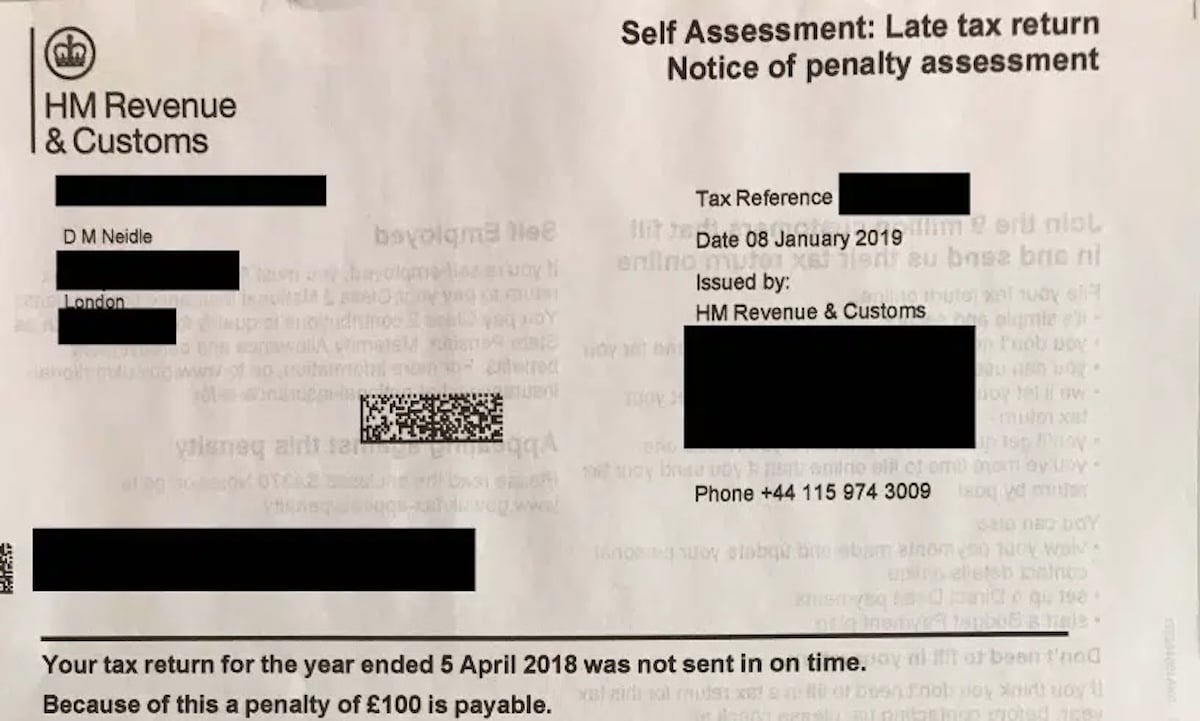
If HMRC has required a taxpayer to submit a tax return, but he or she misses the deadline (even by one day), then a £100 automatic late filing penalty is applied.
After three months past the deadline, the penalty can start increasing by £10 each day. After six months, a flat £300 additional penalty can be applied, and after twelve months another £300. By that point, total penalties can be £1,600.[3] Those advising taxpayers on low income commonly see clients with over £1,000 of penalties (and sometimes thousands of pounds if multiple years are involved). Filing appeals for late payment penalties often makes up a significant amount of their work.
Until 2011, a late filing penalty would be cancelled if, once a tax return was filed, there was no tax to pay. However now the penalty will remain even if it turns out the “taxpayer” has no taxable income, and no tax liability.
Appeals
Anyone receiving a late payment penalty who has a “reasonable excuse” for not paying can make an administrative appeal to HMRC, either using a form or an online service.[4] If HMRC agree, then the penalty will be “cancelled”. If HMRC don’t agree, then a judicial appeal can be made to the First Tier Tribunal, but this is very rare for late filing penalties. All the “appeals” discussed in this report are administrative form-based appeals.
The data
Data provided to Tax Policy Associates by HMRC under a Freedom of Information Act request clearly demonstrates that late filing penalties are being disproportionately levied on those on low incomes, most of whom in fact have no tax to pay.
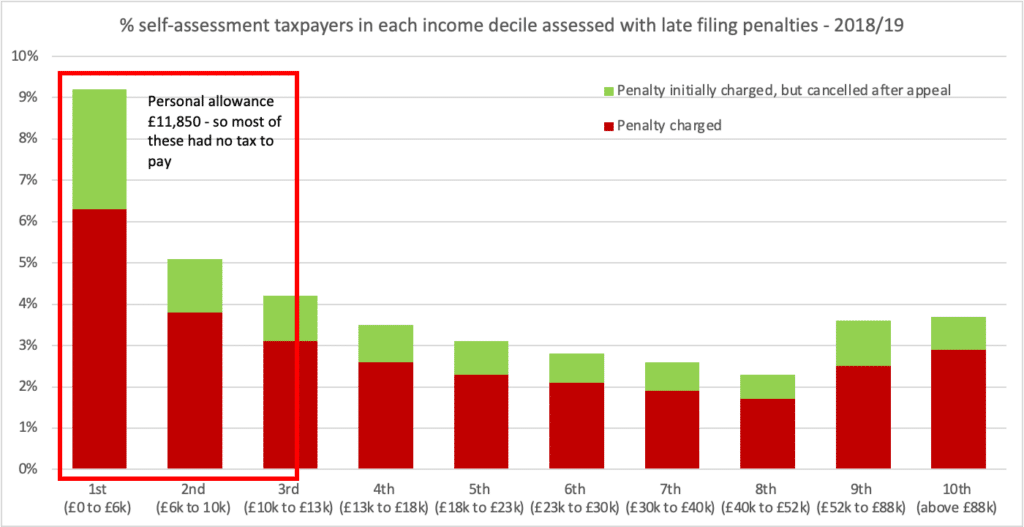
The chart below shows the percentage of taxpayers in each income decile who were charged a £100 fixed late filing penalty in 2018/19. The green bars show where penalties were assessed but successfully appealed. The red bars show where the penalty was charged.
And this is the data for 2019/20, a less representative year:[5]
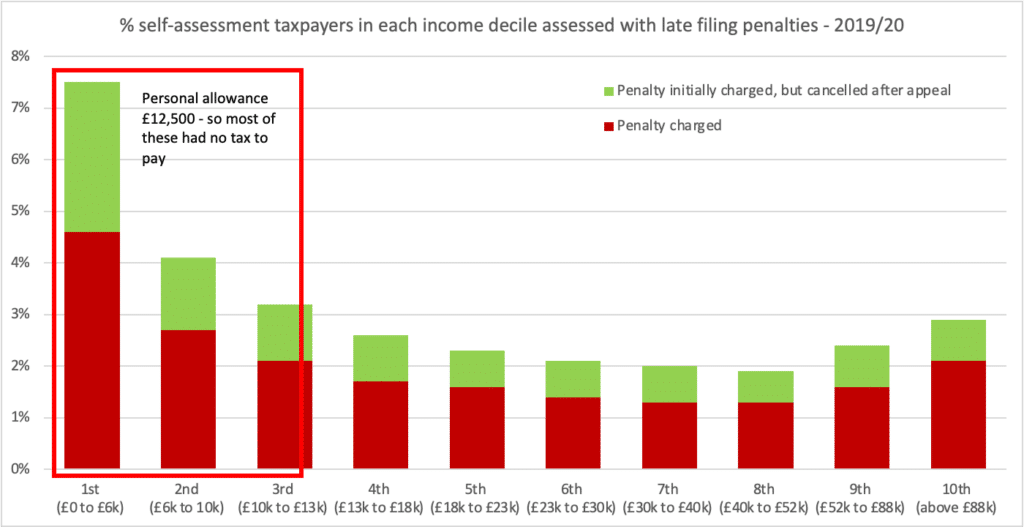
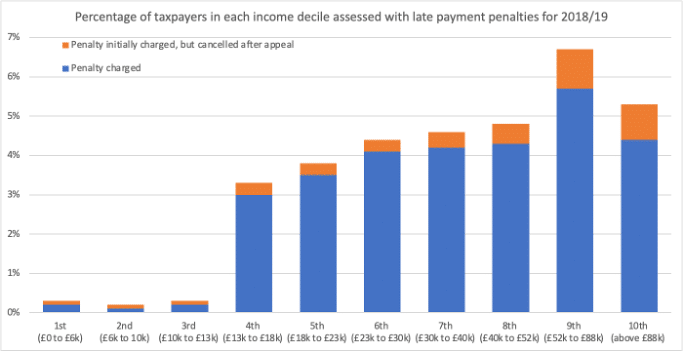
The charts clearly show taxpayers in the lowest three income deciles receiving a disproportionate number of penalties – 210,000 in 2018/19 and (likely less representative) 167,000 in 2019/20.
But the critical problem is that almost none of these taxpayers have any tax to pay.
We know this for two reasons.
First, the personal allowance was £11,850 in 2018/19 and £12,500 in 2019/20, and anyone earning less than that had no income tax liability. Taxpayers in the lowest three income deciles earn less than £13,000 – so very few will have tax to pay.
Second, this is confirmed by the data on penalties issued for late payment (as opposed to late filing). The first three deciles pay almost no late payment penalties[6]. This won’t be because they are more punctual at paying than they are at filing; it will simply be because they almost always have no tax to pay.
The impact of penalties on the poor
A £100 fixed penalty is a large proportion of the weekly income of someone on a low income (indeed over 100% of the weekly income for someone in the lowest income decile), but inconsequential for someone on a high income:

And, whilst the data shows the numbers of people receiving £100 fixed penalties for late filing, many of the same people will have received late filing penalties which are much higher – up to £1,600 for one year, and more than that where a taxpayer fails to file for more than one year.
The human cost
Since publishing our initial report, we’ve been inundated with people’s stories, often very distressing.
These are vulnerable people, at a low point in their lives – and the same difficulties which meant they missed the filing deadline mean they often won’t lodge an appeal, and may take months before they pay the penalties (racking up additional penalties in the meantime).
Here are a representative sample:


Will the 2025 changes change the position?
The income tax self assessment penalty rules will likely be changing from 6 April 2025.
From that date, a one-off failure to file will not incur a penalty; rather it will result in a taxpayer incurring a “point”, and only after two points (for an annual filer) or four points (for a quarterly filer) will a penalty be issued. [7]
At the same time, the fixed penalty amount will increase to £200.
This might overall reduce the penalties imposed on low earning taxpayers (for example if they are currently missing the filing deadline by a few weeks, and then filing), but it could equally well worsen the position (if they are missing multiple deadlines, and particularly if they don’t open correspondence). At this point we have insufficient data to say. However we can say that insufficient consideration appears to have been given to the impact on the low paid when the new rules were drawn up.
Conclusions
We believe that the Government, HM Treasury and HMRC are acting in good faith, and have to date been unaware of the disproportionate impact that penalties have on the low paid.
In light of the data revealed by this report, we have three recommendations:
1. Cancellation
Fixed rate late submission penalties should be automatically cancelled (and, if paid, refunded) if HMRC later determines that a taxpayer has no taxable income. Most likely that would be after a subsequent submission of a self assessment form; but no further application or appeal should be required.
Similarly, there should be an automatic abatement of penalties (by, say, 50%) if HMRC determines that a taxpayer has a taxable income but it is low (for example less than £15,000).
In both cases, an exception could be made where HMRC can demonstrate that the failure to file was intentional (i.e. for truly exceptional cases, and not applied by an automated process).
Whilst it is possible that some cancellations could be achieved under HMRC’s existing “care and management” powers , we expect that creating a general cancellation and abatement rule falls outside those powers, and therefore may require a change of law.
This is not a radical proposal; before 2009 penalties were automatically capped at the amount of a taxpayer’s tax liability. UPDATE: It’s well worth reading the first comment below, from the respected retired tribunal judge Richard Thomas, for more background on this.
2. Monitoring
HMRC should start monitoring late submission penalties across income deciles, (using other sources of data, i.e. not limited to those provided to us) to provide a more complete picture of the impact on the low paid, including the level of penalties paid (i.e. not just the data on £100 penalties presented in this report).
And how many penalties are never paid by these deciles and get written off? We expect a fairly high proportion – in which case all that is being achieved is stress for the recipients of the penalties, and administrative cost for HMRC.
Armed with that data, HMRC should aim to reduce the disparities identified in this report, and report annually on its progress.
3. Rework processes
The data reveals that there is a significant population of self assessment “taxpayers” who are being required to complete an income tax self assessment, are charged a late submission penalty, but turn out to have no tax to pay.
HMRC should analyse this population with a view to determining:
- how many of these are taxpayers who in retrospect should not have been required to submit a self assessment return at all,
- whether that could have been determined in advance, on the basis of the information HMRC possessed at the time,
- if it could be determined in advance, what additional processes should be put in place by HMRC to prevent such taxpayers being required to submit a self assessment in the future, and
- if there are small changes which could impact this population’s tax compliance, for example changing envelope labelling (although it may be this work has already been done)
Methodology
Source of data
HMRC provided data to Tax Policy Associates following a Freedom of Information Act request.
The data shows penalty statistics by income decile of self assessment taxpayers. In the years in question there were 11.3 million self assessment taxpayers, and therefore each decile represents 1.13 million people.
Note that the income deciles are different from the usual national income deciles, as self assessment taxpayers have different (and, on average, lower) incomes than the population as a whole.
Limitations
The most important limitation is that, whilst we had asked for income level to be computed by reference to previous self assessments filed by taxpayers, HMRC’s systems were unable to do this (at least within the limited budget available for responding to FOIA requests).
The data is therefore based upon the income level revealed when a taxpayer did eventually submit his or her return. That means, if a taxpayer did not submit a return at all for the relevant year, they do not appear in this data. In fact, the majority of taxpayers fall in this category – HMRC only has income data for 44% of taxpayers receiving a late filing penalty for 2018/19, and for 30% of taxpayers receiving a late filing penalty for 2019/20.
It is plausible that the “never filing” taxpayers are more likely to be low/no income taxpayers (without the time/resources to file) than higher income taxpayers. If that is right then the data we report is under-estimating the impact of penalties on low-income taxpayers. However, this is speculation; further data is required.
Data
The complete dataset follows below.
“PF1” is the £100 fixed penalty for missing the self assessment deadline; LPP1 is the 30-day late payment penalty. “Pre” are penalties originally assessed. “Post” are penalties which are actually charged (the difference between “Pre” and “Post” being cancelled penalties, usually as the result of a successful administrative appeal).
| 2018/19 | 2019/20 | |||||||
| PF1 | LPP1 | PF1 | LPP1 | |||||
| Deciles | Pre | Post | Pre | Post | Pre | Post | Pre | Post |
| 1st (£0 to £6k) | 9.2% | 6.3% | 0.3% | 0.2% | 7.5% | 4.6% | 0.2% | 0.1% |
| 2nd (£6k to 10k) | 5.1% | 3.8% | 0.2% | 0.1% | 4.1% | 2.7% | 0.2% | 0.1% |
| 3rd (£10k to £13k) | 4.2% | 3.1% | 0.3% | 0.2% | 3.2% | 2.1% | 0.2% | 0.1% |
| 4th (£13k to £18k) | 3.5% | 2.6% | 3.3% | 3.0% | 2.6% | 1.7% | 2.8% | 2.6% |
| 5th (£18k to £23k) | 3.1% | 2.3% | 3.8% | 3.5% | 2.3% | 1.6% | 3.6% | 3.3% |
| 6th (£23k to £30k) | 2.8% | 2.1% | 4.4% | 4.1% | 2.1% | 1.4% | 4.1% | 3.8% |
| 7th (£30k to £40k) | 2.6% | 1.9% | 4.6% | 4.2% | 2.0% | 1.3% | 4.4% | 4.0% |
| 8th (£40k to £52k) | 2.3% | 1.7% | 4.8% | 4.3% | 1.9% | 1.3% | 4.8% | 4.3% |
| 9th (£52k to £88k) | 3.6% | 2.5% | 6.7% | 5.7% | 2.4% | 1.6% | 5.4% | 4.7% |
| 10th (above £88k) | 3.7% | 2.9% | 5.3% | 4.4% | 2.9% | 2.1% | 4.5% | 3.6% |
Acknowledgments
Many thanks to HMRC for their detailed response to our FOIA request on penalties and income levels, and to their openness and responsiveness to our follow-up queries.
Many thanks to all those who responded with their personal experiences of penalties, and to the tax professionals who provided technical input and insight (many of whom spend hours volunteering to help people in this position).
[1] See the projection for 2022 here: https://www.gov.uk/government/statistics/income-tax-liabilities-statistics-tax-year-2018-to-2019-to-tax-year-2021-to-2022/summary-statistics
[2] See HMRC figures at https://www.gov.uk/government/news/fascinating-facts-about-self assessment
[3] i.e., £100 + 90 x £10 + £300 + £300. The way in which penalties escalate does not seem rational, and will be improved from 2025 – see page 9 below. Technically all penalties after the first £100 are discretionary, but in practice they appear to be applied automatically in most cases.
[4] See https://www.gov.uk/government/publications/self assessment-appeal-against-penalties-for-late-filing-and-late-payment-sa370. Strictly the appeal should be made within 30 days of a penalty being notified, but in practice we believe HMRC rarely holds taxpayers to this deadline.
[5] The pandemic meant that HMRC extended the filing deadline to 28 February 2021.
[6] Another factor is that some of the late payment penalties applied to those on low income will have been held over from a previous, higher earning, year. Hence the proportion in the lowest three deciles with tax to pay will be lower than suggested by this chart.
[7] See HMRC policy paper: https://www.gov.uk/government/publications/interest-harmonisation-and-penalties-for-late-submission-and-late-payment-of-tax/interest-harmonisation-and-penalties-for-late-payment-and-late-submission
Comment policy
This website has benefited from some amazingly insightful comments, some of which have materially advanced our work. Comments are open, but we are really looking for comments which advance the debate – e.g. by specific criticisms, additions, or comments on the article (particularly technical tax comments, or comments from people with practical experience in the area). I love reading emails thanking us for our work, but I will delete those when they’re comments – just so people can clearly see the more technical comments. I will also delete comments which are political in nature.