
The general election tax debate has been irrelevant. The few £bn being discussed is dwarfed by the actual tax UK tax increases over the last few years, and the further tax increases we’ll almost certainly see in the future.
I summarised this point on Sky TV on Wednesday.
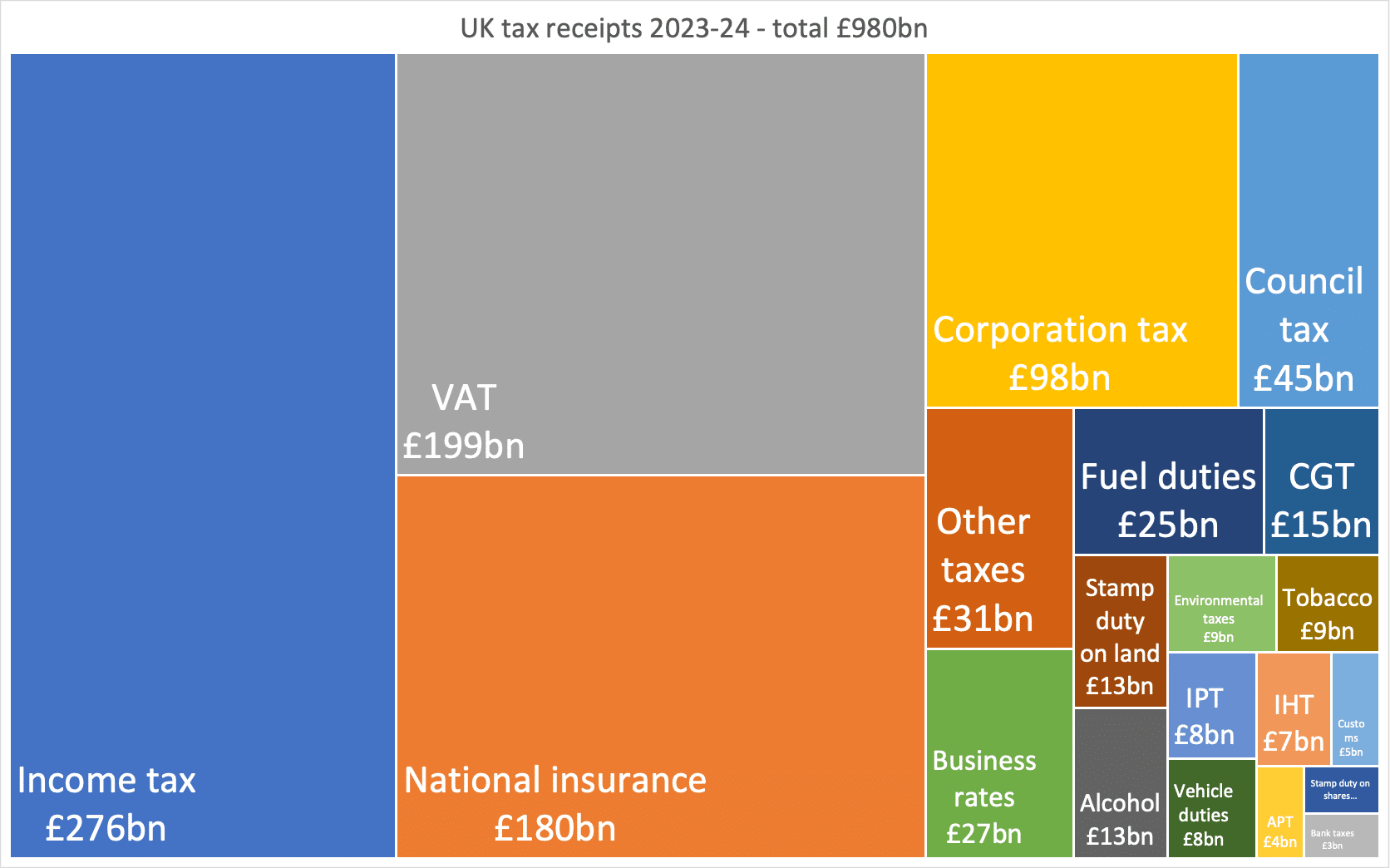
Here’s all UK taxes paid in 2023-24:1
Here’s what happens if we add on the Conservative Party’s extremely debateable claim that Labour will increase household taxes by £2,000 over four years – that’s about £10bn in total:2
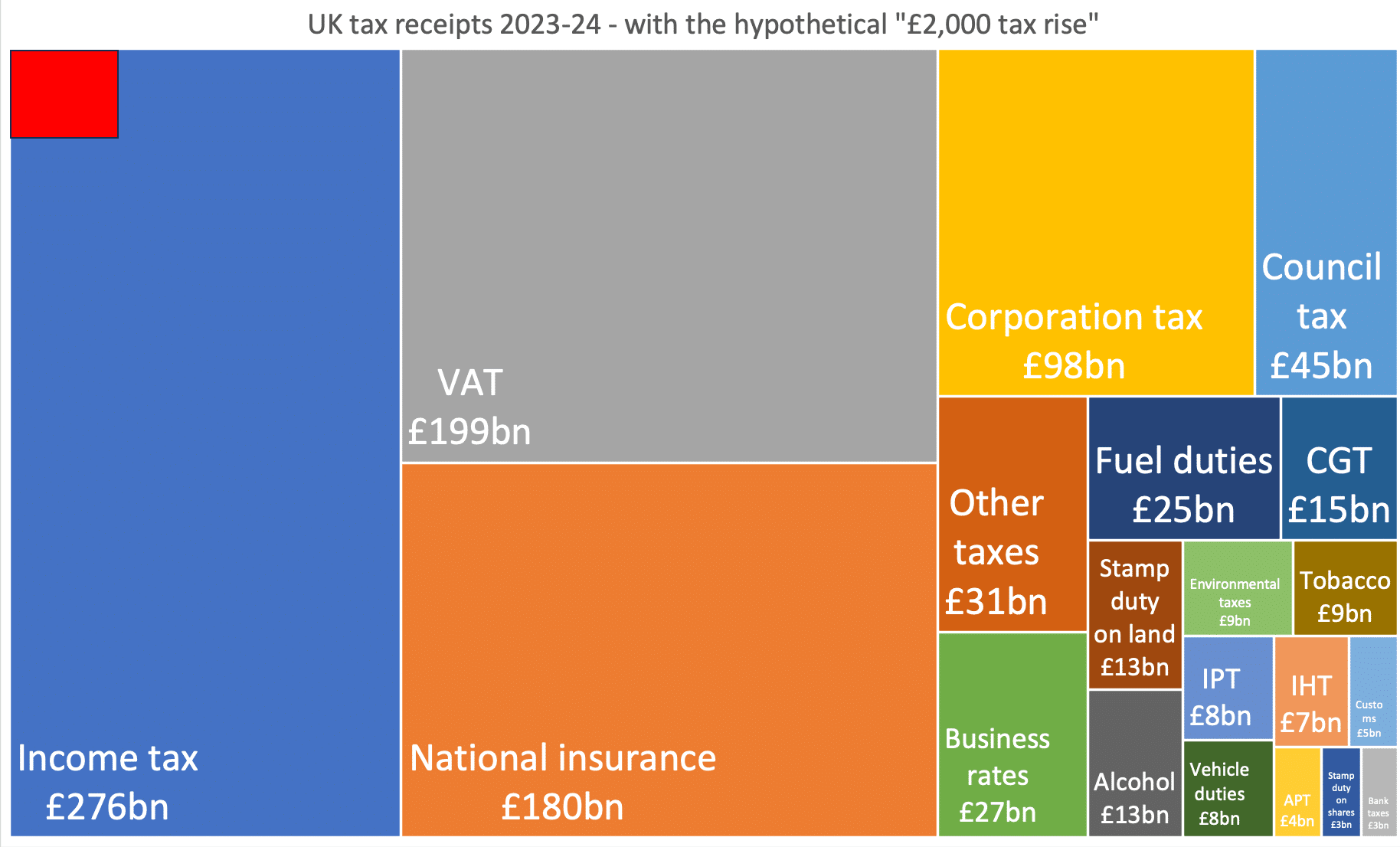
£10bn is just an irrelevance in the context of almost a trillion pounds of total tax receipts. And it vanishes into statistical noise when we remember that OBR tax receipt forecasts are lucky to get within £30bn of the true figure.3
And here’s Labour’s actually announced tax increases:4:
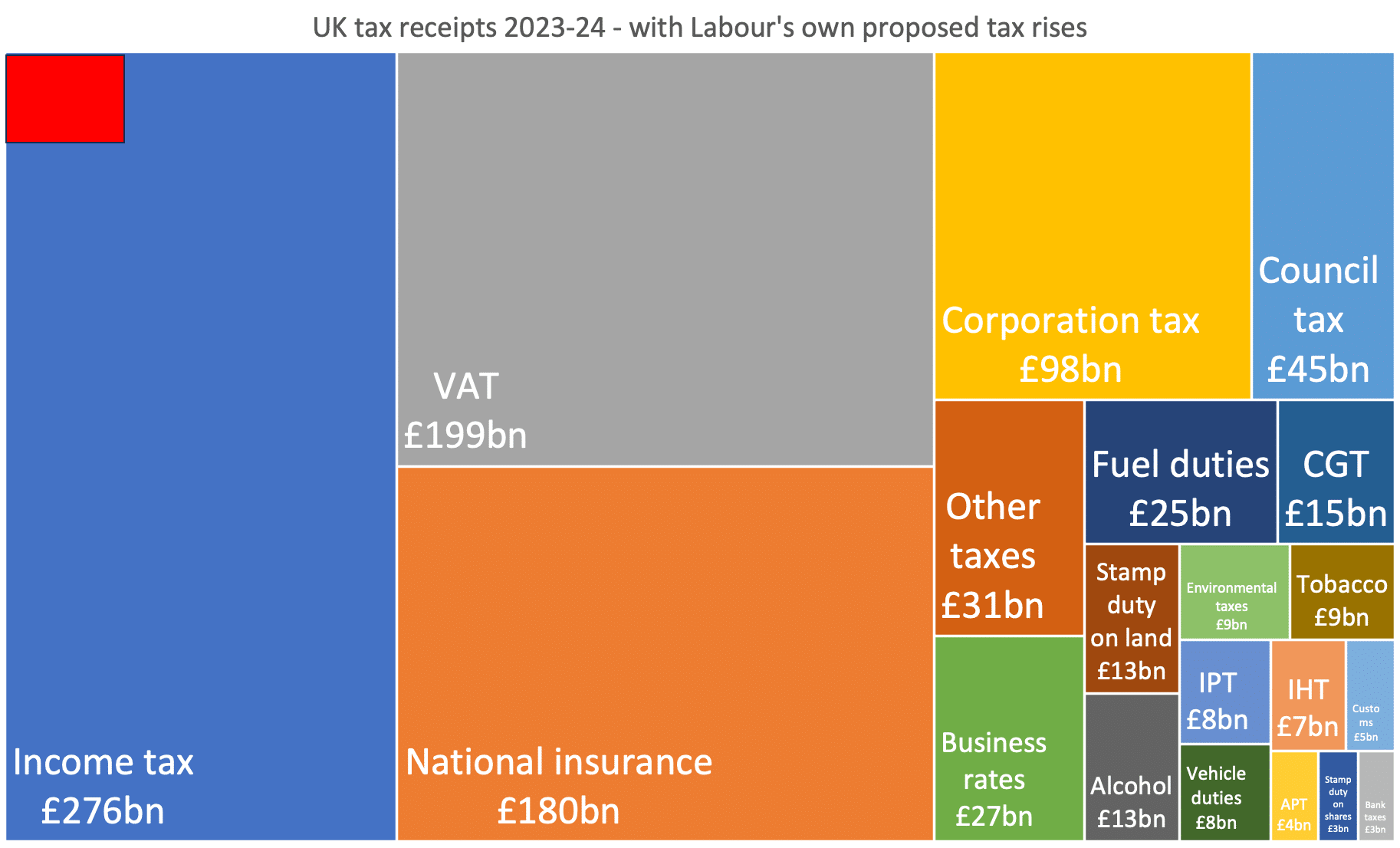
Also an irrelevance.
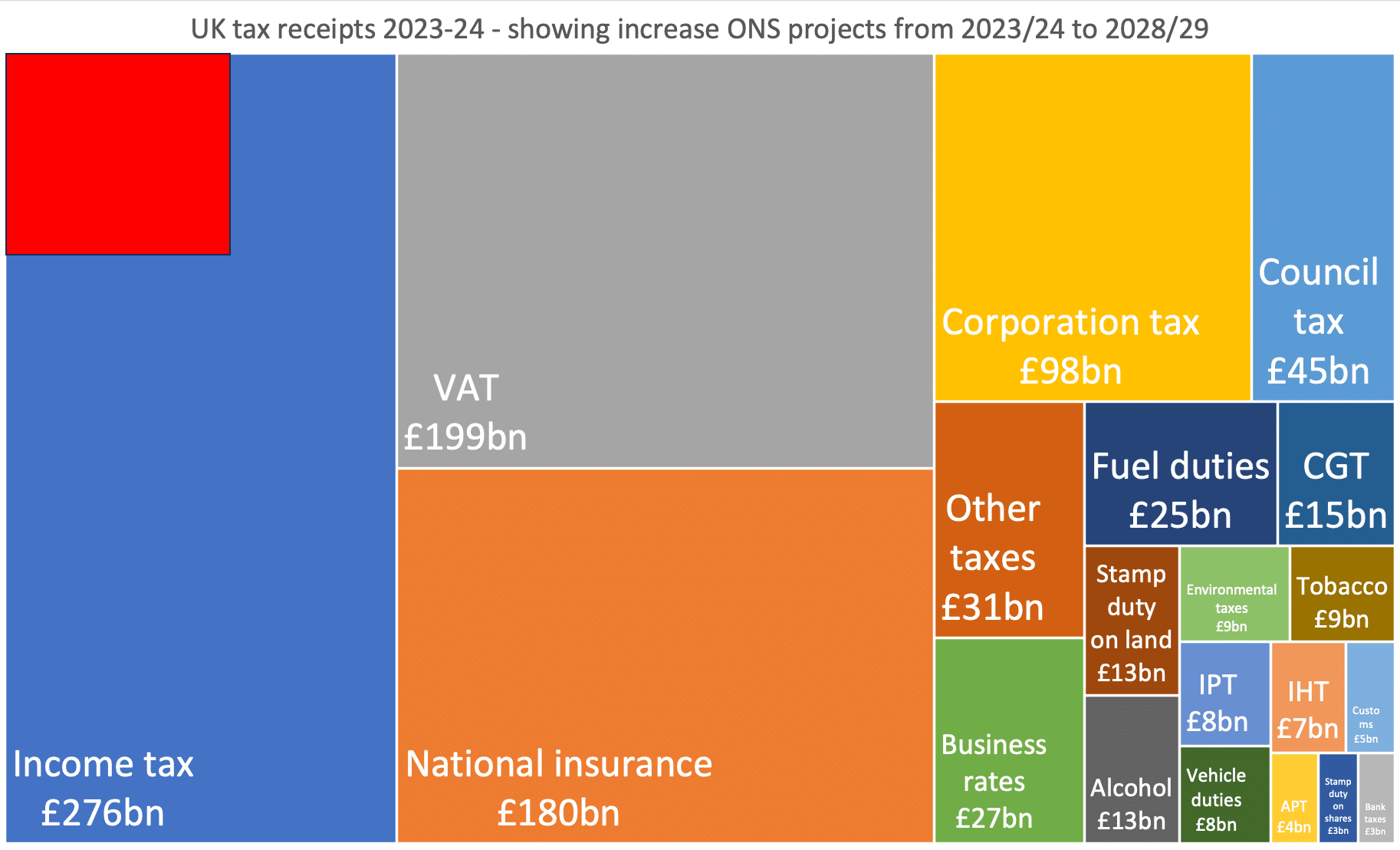
By contrast, here’s the OBR’s projections for the overall increase in taxation as a % of GDP from 2023/24 to 2028/29:5
The bigger picture
The current level of taxation follows a few years of significant increases in tax.
Here’s how much of the 2023/24 tax burden reflects an increase since 2010:6
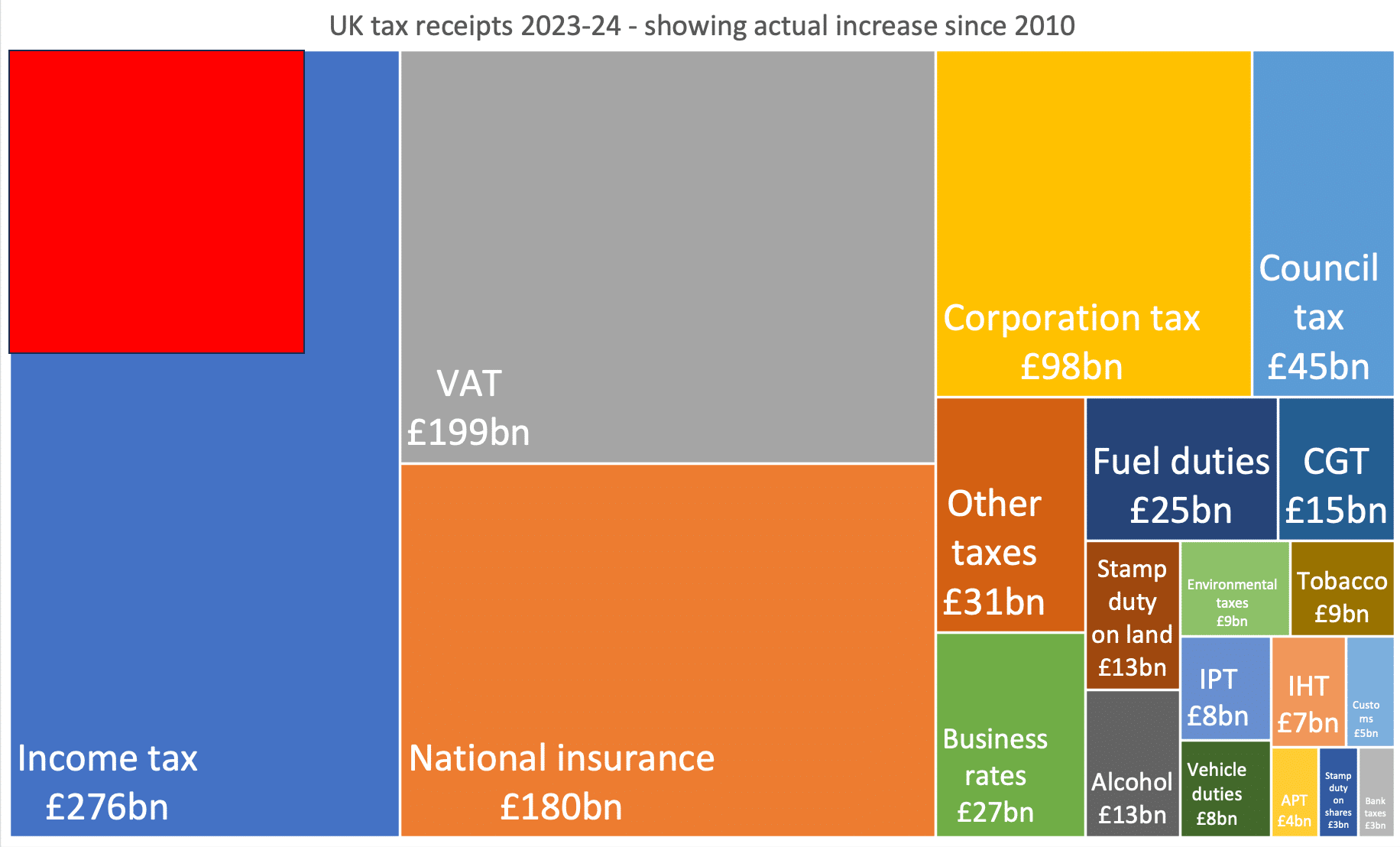
And here’s the OBR’s expected overall increase in taxation from 2010 through to 2028/2029:7
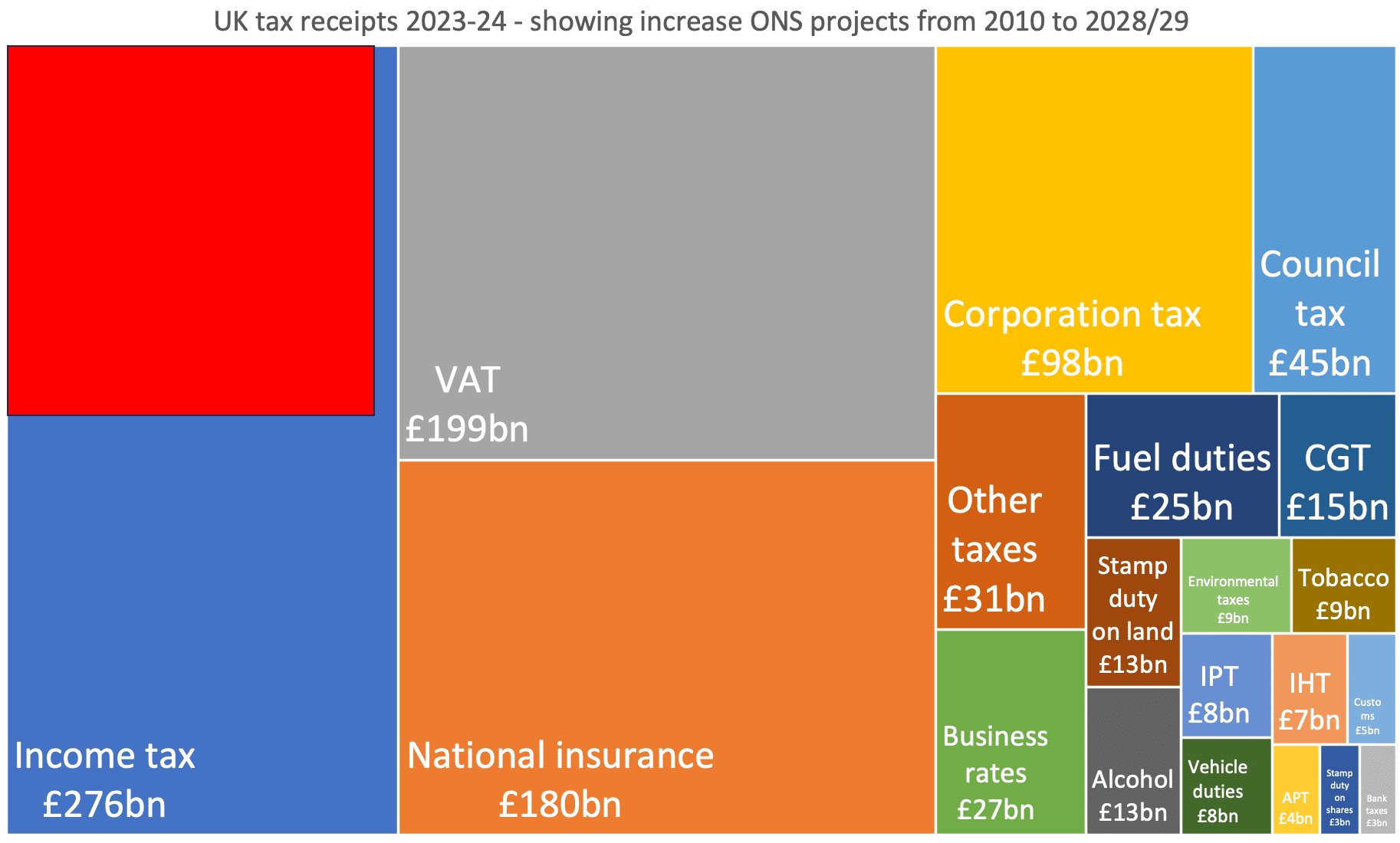
This is dramatic, but not in the main the result of policy choices – it’s largely a function of demographic change and systemic shocks from the financial crisis and the pandemic (and, to a smaller degree, Brexit). And any attempt to convert these figures into “per household” numbers would be highly misleading given that many ordinary households have not seen an increase at all.
The European picture
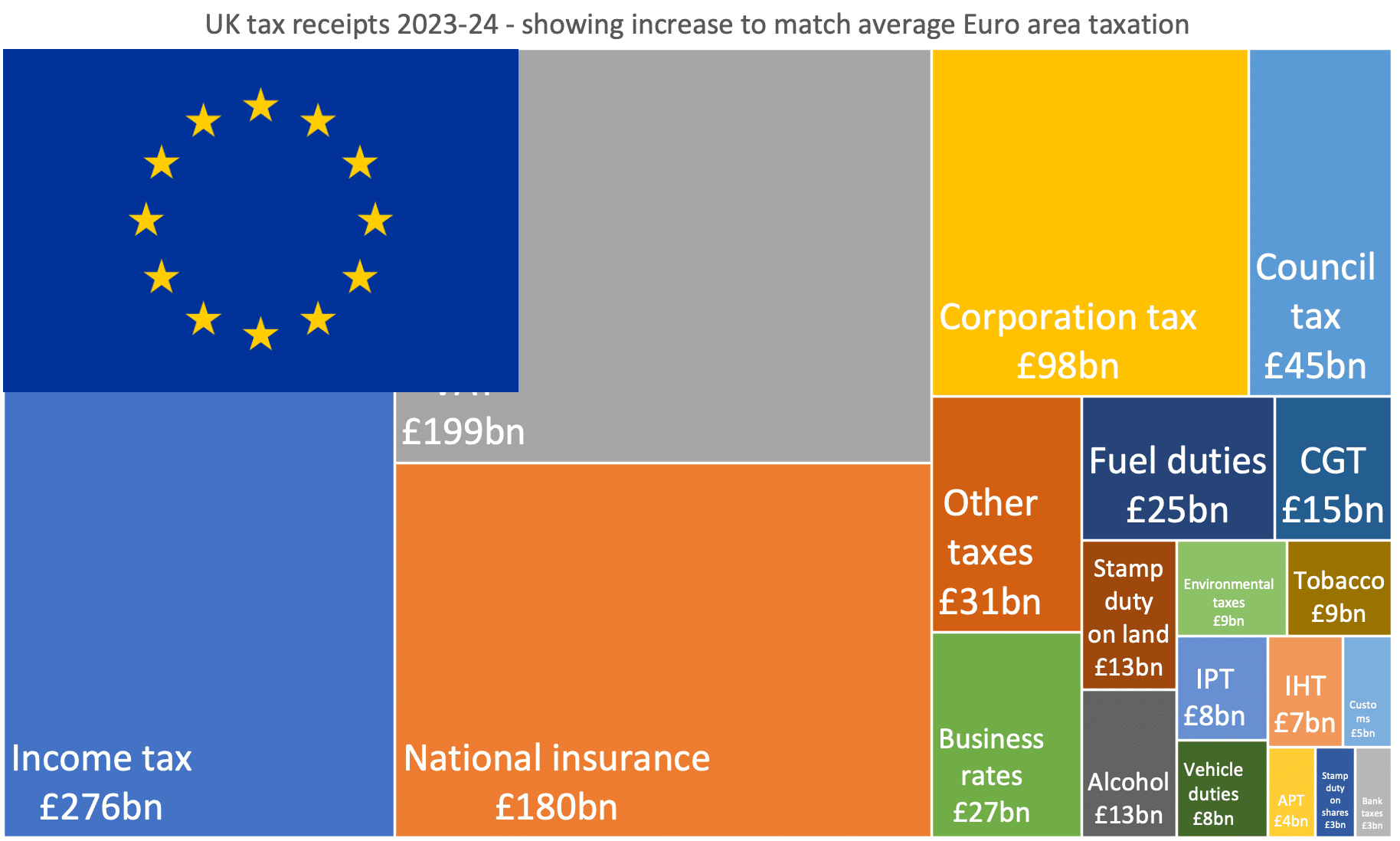
Even the charts above leave us a long way off European levels of taxation.
Here’s the additional tax we’d be paying if we increased UK tax to the average 2023/24 level in the Euro-area:8
And here’s the increase if we matched France:9
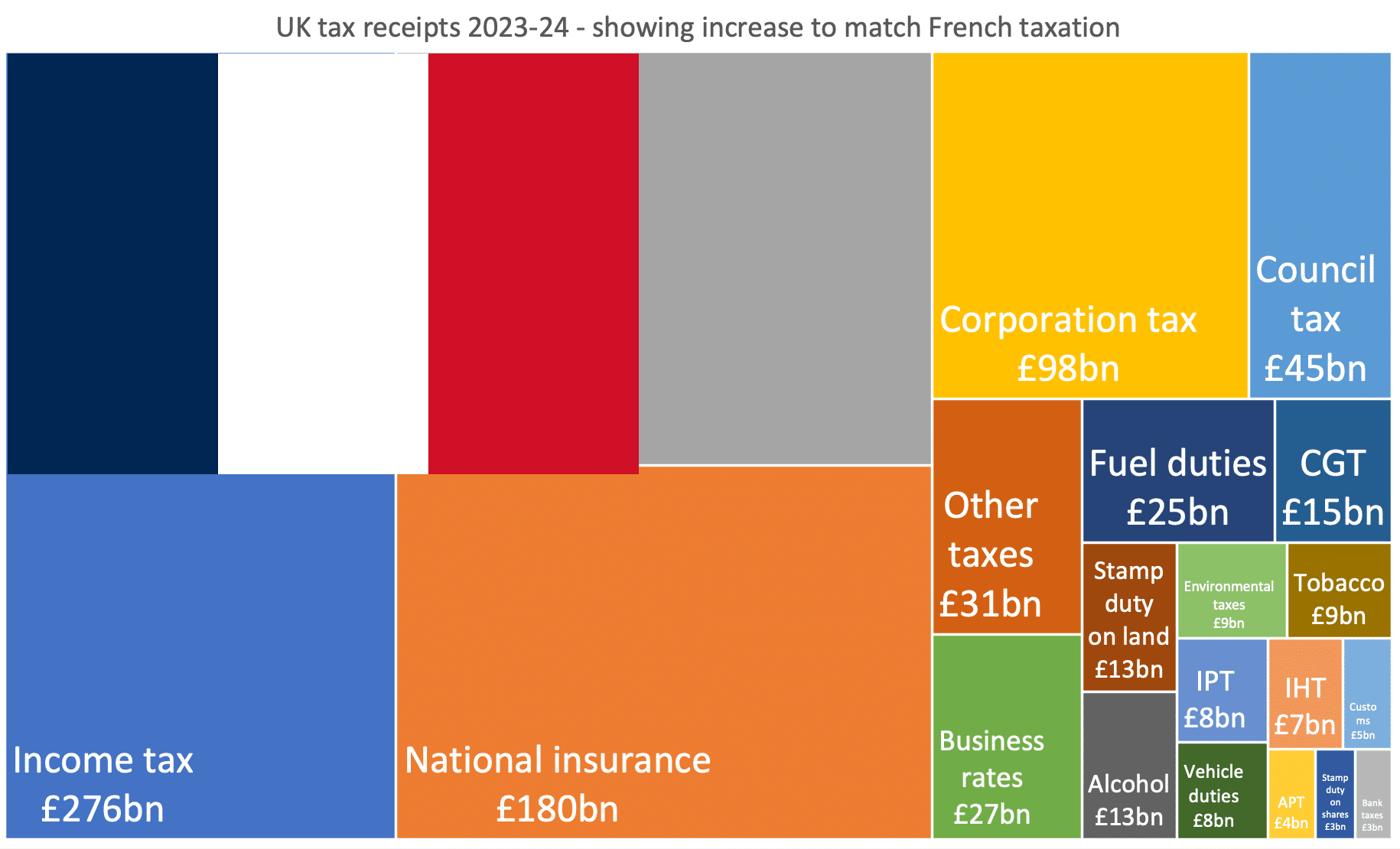
The difference is massive – more than the total UK VAT and corporation tax receipts.
The tax debate I’d like to see
So my plea to everyone is: stop discussing irrelevant amounts of tax as if it matters.
Here are three honest positions politicians could take:10
- Accept the status quo, and that the UK will, by 2028/29, pay about £100bn more tax than it did in 2010/11 (in 2023/24 money). Make changes at the margins but acknowledge that’s all they are. The question then is: where will this burden fall? And what will the consequences of that be?
- Advocate for significantly lower taxes, and (assuming you don’t want to crash the markets) explain which public services you’ll cut to fund the tax cuts, and the consequences of this for households and the wider economy.
- Advocate for a significantly higher level of state spending, comparable with the European or even French figures. Again assuming you don’t want to crash the markets, explain what taxes you’d increase, and the consequences of that for households and the wider economy. And expect everyone to be sceptical if you claim only the rich would pay, because that’s not what happens in any of the countries that actually do have significantly higher spending than the UK.
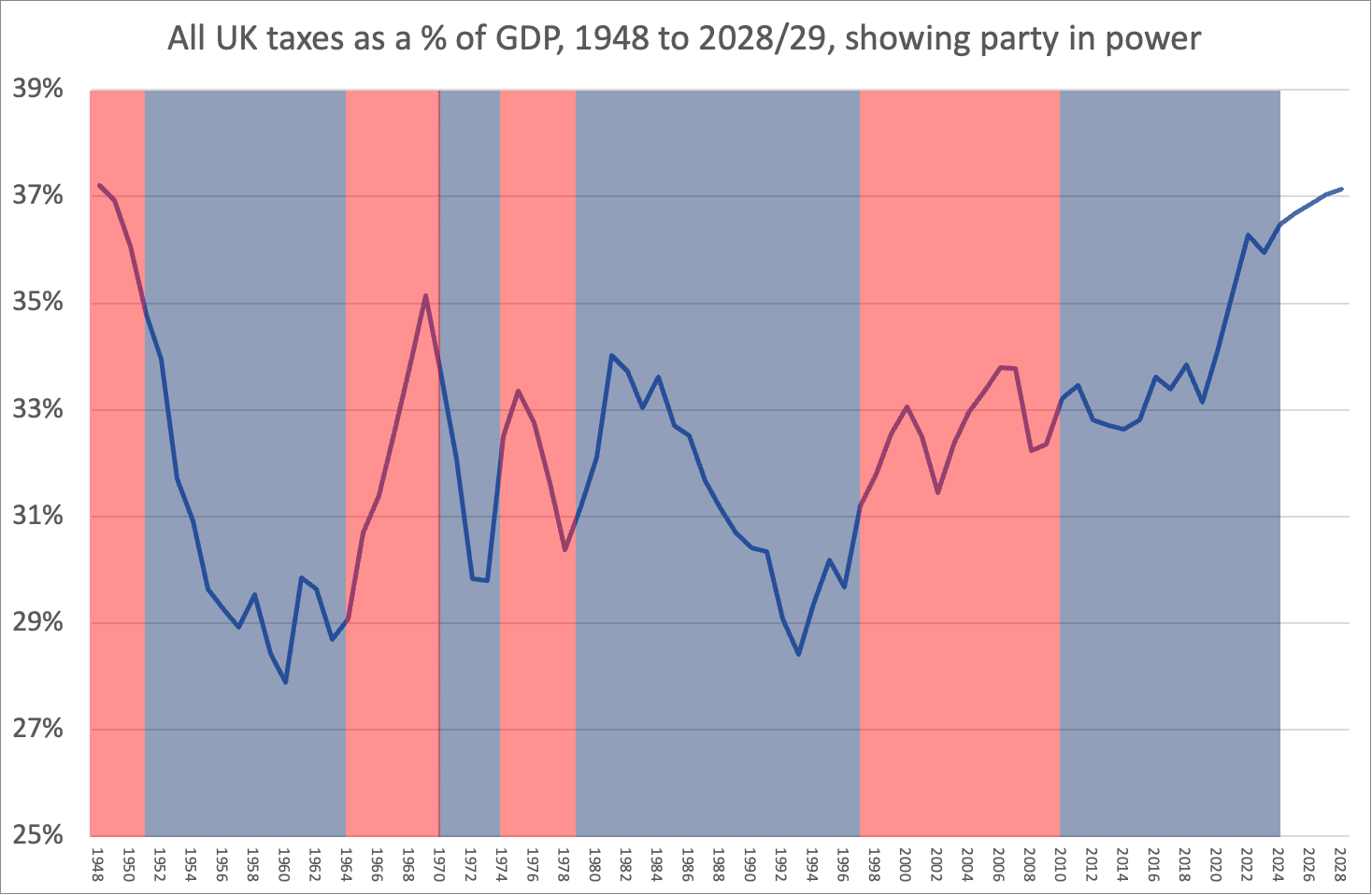
And let’s please try to be careful not to fall for simple stories about political parties and levels of tax. If we take tax as a % of GDP over the last eighty years, and shade in periods of Labour government (red) and Conservative11 government (blue), it’s reasonably clear that the economic cycle has been much more important than the political cycle:
Finding answers is hard – but let’s at least try to ask the right questions.
Footnotes
The source is the receipts figures from the OBR’s public finances databank. This is the raw data – the only change I’ve made is aggregating taxes that raise less than £3bn into the “other taxes” bucket. The OBR’s most recent economic and fiscal outlook is here. ↩︎
Here I’ve just taken their £38.5bn over four years and divided it by four, i.e. £9.6bn. ↩︎
The most recent error was £36bn – see the OBR’s October 2023 forecasting evaluation report, table 3.1. ↩︎
About £10bn in total – a very similar amount to the Conservative estimate, but raised from different people. £5bn from “cracking down on tax dodgers“, £1.7bn from VAT on private school fees, about £1bn from “closing non-dom loopholes“, about £2bn from extending the energy “windfall tax” ↩︎
The source is the receipts figures from the OBR’s public finances databank. The tax increase is calculated by simply taking the difference between tax receipts as a % of GDP in 2023/24 vs 2028/29 (1.2%), and multiplying this by the UK GDP figure used in that same dataset. This results in £30bn. We’d of course get a much larger number if we looked at the real terms difference between cash tax receipts over that period – £114bn – but it’s a fairer comparison to calculate by reference to GDP. ↩︎
Same OBR source. The tax increase is calculated by simply taking the difference between tax receipts as a % of GDP in 2023/24 vs 2010/11 (2.7%), and multiplying this by the UK GDP figure used in that same dataset. This results in £70bn. We’d of course get a larger number if we looked at the real terms difference between cash tax receipts over that period – £216bn – but it’s a fairer comparison to calculate by reference to GDP. ↩︎
Same methodology but looking at the 2028/29 OBR receipts figures and forecast. The increase in tax as a % of GDP over this period is 3.9% which equates into £100bn in 2023/24 money. If we look at the real terms difference between cash tax receipts over this period we’d get £330bn. ↩︎
Source is Eurostat – average 2023/24 figure is 41.9%, equating to £152bn more tax if we apply to UK GDP for 2023/24. We aren’t aware of projections for 2028/29, but we assume the figure will be materially higher. So the fair comparison isn’t with the 2028/29 chart immediately above, but the 2023/24 chart before that. ↩︎
Source again is Eurostat – the French figure for 2023/24 is 49%, equating to £334bn more tax if we apply to UK GDP for 2023/24. One would assume the figure will be higher for 2028/29 but it’s not clear how high it can realistically go. But again the fair comparison is with the UK 2023/24 chart not the 2028/29 chart. ↩︎
In principle there is an alternative; boost productivity and grow the economy. It was economic growth that enabled significant rises in public spending in the 2000s without significant tax rises. But even if this could be achieved, it’s not going to move the dial much in the next few years. ↩︎
And from 2010-2015, Conservative/Lib Dem coalition ↩︎
The hidden reach of inheritance tax: one in five pensioner households
England’s new tourist tax: what it raises, who pays, and what it costs
What would a land value tax actually do?
What if Andy Burnham lowered the mansion tax threshold to £1.5m?

Has Britain run out of “other people” to tax?


Leave a Reply