
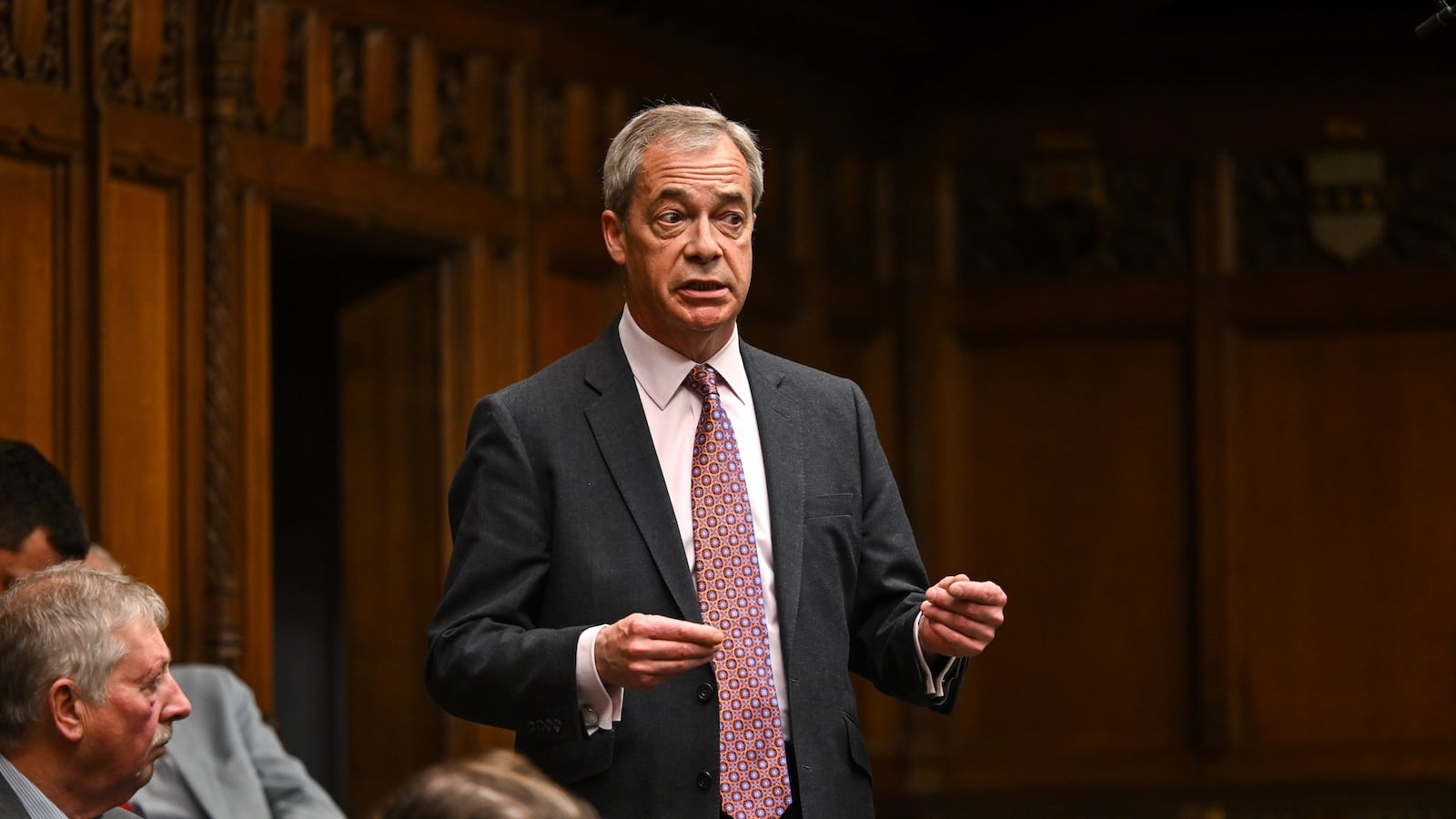
Christopher Harborne, a British-Thai billionaire, gave Nigel Farage £5m in 2024. Genuine gifts are usually tax-free, and when this article was first published our conclusion was that the £5m was probably not taxable. On 15 July 2026 the Guardian reported that in March 2024 – a few weeks before the gift – Mr Farage told senior figures in Reform UK that he would need “a million a year” to cover lost earnings if he stood for Parliament, and that resuming the leadership of Reform through the 2024 and 2029 elections would cost him £5m. If that report is accurate, and the £5m was paid as part of that arrangement, then the analysis changes materially. In our view the “disguised remuneration” rules would probably apply, resulting in about £3m of PAYE and National Insurance liabilities which would, in the first instance, fall on Reform 2025 Ltd rather than on Mr Farage.
Update, 16 July 2026. This article was first published on 20 May 2026 – you can see the original version here. We have amended it significantly to reflect the Guardian’s report of 15 July 2026 – our original statement that there was “no evidence” that the £5m replaced lost earnings has been overtaken by events.
We would summarise the basic principles broadly like this:
- Gifts can be subject to inheritance tax, but only if the donor is UK domiciled (or, now, long term resident) or the gift is of an asset that was in the UK.
- A gift unconnected to your work is (as a general matter) otherwise not taxable in the UK.
- If there is a connection to your work (past, present or future), and it’s strong enough, then you will be taxed on it in the same way as your work is taxed.
- If you create a document regarding the gift, then (if you are not careful) that document could make the gift taxable as a capital gain.
- When a third party makes a payment to an employee as part of an arrangement to reward them, and the payment is strongly connected to the employment, the “disguised” remuneration rules may apply, making the employer liable for PAYE.
Applying these to Mr Farage’s public explanations of the gift, in our view the gift is probably not taxable. It’s connected to Mr Farage’s historic and current political campaigning activity, and not to any trade, profession, employment or office that he carries on or holds. We say “probably” because there are some judgment calls in the analysis.
However, if the gift was connected with the March discussions reported by the Guardian, and was made to compensate Mr Farage for lost earnings if he resumed the leadership of Reform, then the gift is probably taxable. The significant new element is the report that senior Reform figures were involved in discussions about compensating Mr Farage for returning as leader. Because Mr Farage was already a director of the company through which Reform operated, those discussions look like an arrangement to provide a reward connected with an office – the gateway to the disguised remuneration rules. Previously, there was no public evidence connecting the gift to an employment or office. The Guardian does not establish that the gift implemented those discussions: its account is based on three anonymous sources, and Mr Farage has neither confirmed nor denied it.
We would summarise the position like this:
| Basis for tax | Hurdle (legal or factual) | Risk on current facts |
|---|---|---|
| Tip for past services (e.g., MEP, Reform director) | “Brexit campaigning” is not a taxable trade. There is no evidence Mr Farage provided professional services to Mr Harborne. | Low |
| Inducement to stand for election (Shilton v Wilmshurst) | Legally, an election candidate is not an “office-holder”. | Low |
| Miscellaneous income (Casual quid pro quo) | Requires a specific service or favour provided in return. Mere political alignment does not count. No evidence of a quid pro quo. | Very low |
| Disguised remuneration (Part 7A ITEPA) | If the Guardian report of March discussions is correct, and the £5m was paid as part of this arrangement, we think the disguised remuneration rules probably apply. | Low if the report is not correct, or the £5m was an unrelated coincidence. High, and tax probably due, if the report is correct, and the £5m was paid as part of the reported arrangement. |
| Compensation for lost earnings (Replacing income) | There is evidence that Mr Farage advanced this rationale to Reform figures. There is not yet public evidence that Mr Harborne shared that rationale. But the earnings at risk were payable to Thorn in the Side Ltd, not to Mr Farage personally, and this line of caselaw taxes receipts of a trade. | Low, but for different reasons than we originally gave |
| Trading subsidy (The Falkirk Ice Rink rule) | Depends entirely on whether Mr Farage has claimed (or will claim) a tax deduction for the specific security costs funded by the £5m. | Very low if no deduction is claimed. Low-to-medium if deduction claimed and the £5m was earmarked to fund them. |
| Capital Gains Tax (Chose in action) | Requires the “unconditional” gift document to have been drafted poorly enough to accidentally create a taxable legal right. We don’t know what the document says. | Very low if properly drafted; potentially high if it accidentally created an enforceable right before payment. |
| Onward gifting rules (Offshore trusts) | Requires the £5m to derive from a relevant offshore trust payment/benefit, with the statutory onward-gifting conditions satisfied. We don’t know how the £5m was funded. | Nil if £5m not funded from an offshore trust. Potentially high if funded from an offshore trust (the rules are highly complex). |
The disguised remuneration charge is by some distance the strongest potential route for tax to arise. Tax could, however, arise in other cases. In particular:
- Prior services to the donor. If Mr Farage had previously provided services to Mr Harborne or to any entity or trust in which Mr Harborne is interested, the £5m could be taxable as an employment, professional or trading receipt (in much the same way as a tip to a waiter is taxable). We are not aware of any evidence that Mr Farage in fact provided any such services.
- Quid pro quo. If Mr Farage provided services to Mr Harborne in connection with the receipt – or if there was any understanding that he would do, refrain from doing, or procure something for Mr Harborne – the payment could be taxable as miscellaneous income, or as a trading or professional receipt, or as employment-related earnings. A mere expectation that Mr Farage would take certain political positions would not be sufficient to make the payment taxable (after all, most political donations are made in the expectation the donee will take certain positions). We are not aware of any evidence that there were any such services, or that there was such an understanding (and Mr Farage has said there was not).
- Payment to subsidise the recipient’s profession. The £5m could in principle be taxable if it was a payment to enable Mr Farage to maintain the high level of income he received from his non-political career, on the basis that, as an MP, he would have less time to undertake other paid work.
- Security costs deducted as a professional expense. If Mr Farage has claimed (or claims in future) a tax deduction for the security costs funded by the £5m, then the matching receipt might be taxable as a trading subsidy. We do not know if Mr Farage has or will claim such a tax deduction.
- Capital gains tax on a chose in action. If Mr Farage and Mr Harborne signed a document that created a legal right for Mr Farage to receive the £5m, the subsequent payment might be treated as a capital sum derived from that right and trigger a capital gain in his hands.
The rest of this article considers these and other potential arguments in detail.
This article was written by seven UK tax specialists and reflects their collective view. It has benefited from subsequent review by a large number of other tax specialists. It addresses only the current UK tax position. We do not consider whether the gift ought to have been declared under the Code of Conduct for Members of Parliament – that is a matter for the Parliamentary Commissioner for Standards. Nor do we offer any view on politics or the ethics of the gift. Our expertise is limited to tax, and that is all this report covers.
In this report:
- The background
- The starting point: gifts are not income
- 1. Was it a tip?
- 2. Payment as an inducement to stand for election
- 3. Miscellaneous income: ITTOIA 2005, s687
- 4. Disguised remuneration: Part 7A ITEPA 2003
- 5. Compensation for, or replacement of, lost earnings
- 6. Falkirk Ice Rink and the security costs
- 7. Capital gains tax
- 8. Other taxes – National Insurance and VAT
- Conclusion
- Disclosure
The background
Christopher Harborne gave Nigel Farage a £5m gift in 2024.
Mr Harborne, also known by his Thai name Chakrit Sakunkrit, is a British-Thai dual nationality businessman who has been based in Thailand for more than 20 years. His principal business interests are AML Global1 (aviation fuel), Sherriff Global Group (private aviation) and substantial investments in blockchain and cryptocurrency, including reported links to Tether and Bitfinex.
Mr Harborne has been one of the UK’s largest political donors. He gave around £270,000 to the Conservative Party between 2001 and 2019, £1m to The Office of Boris Johnson Ltd in November 2022, over £6m to the Brexit Party in 2019, and (on current reporting) over £17m to Reform UK.
Mr Harborne is a long-standing, large-scale political ally of Mr Farage. He has been resident in Thailand for more than 20 years and, on the public material, is non-UK resident and (we assume) non-UK domiciled.2 On these assumptions, inheritance tax does not arise on the gift.
The relationship between Messrs Farage and Harborne
The publicly available evidence shows:
- A long-running political and donor relationship, including (per The Guardian) Mr Harborne taking a desk at the Brexit Party campaign HQ in 2019 and making multiple million-pound donations to the Brexit Party.
- A social link: Mr Farage is reported to have attended Mr Harborne’s Kamalaya resort gathering in Thailand in 2022.
- Mr Farage and Reform UK have increasingly adopted policies favourable to cryptocurrency, aligning with Mr Harborne’s interests – but this is evidence of alignment, not of paid services.
- Later personal benefits after the gift: £32,000 paid by Mr Harborne for Mr Farage’s US trip in July 2024 and £25,000 for a Maldives flight in February 2026.
What we have not located in the public domain is any evidence that Mr Farage was retained by, invoiced, consulted for, or was paid by Mr Harborne or any of his vehicles (AML Global, Sherriff Global, Tether, Bitfinex) before the £5m gift. The publicly visible trail consists of political donations, proximity, political support, post-election travel funding, and shared positions (particularly in relation to cryptocurrency). As we explain below, that absence is the central reason why the £5m is probably not taxable.
Nor have we found any evidence of additional gifts by Mr Harborne to Mr Farage.3
If evidence emerged that there had been commercial links, then there would be an increased likelihood the £5m was taxable, and the conclusions in this note may change.
The explanations for the gift
Two explanations have been put forward by Mr Farage and Mr Harborne.
The first explanation provided by Mr Farage was that the donation was for personal security. Mr Farage said the funds were to “ensure I can be safe for the rest of my life“, citing repeated physical attacks and a denial of state protection (BBC News; see also The Observer). Mr Harborne is reported to have said he “wasn’t expecting anything in return apart from ensuring his safety“.
The second is that it was a reward for past campaigning for Brexit. Mr Farage told the BBC: “frankly, it was given as a reward for campaigning for Brexit for 27 years“. Mr Harborne has said the gift was made “because of my great admiration for the decades of work he had done to achieve Brexit“. The word “reward” often suggests remuneration and therefore taxable income. However, as we discuss later, a “reward” for political campaigning is very different from a reward for carrying on a taxable trade, profession or employment.
Some people regard the two explanations as contradictory. That is not necessarily the case: Mr Harborne could have given the £5m for the purpose of covering Mr Farage’s security costs, whilst his motivation was gratitude for the Brexit campaigning.
Mr Farage maintains that the gift was “purely private“, “wasn’t political in any sense at all“, “unconditional, non-political, personal“, and that he “cannot be bought by anybody“. The BBC reports that a legal document was signed recording the gift as “unconditional and irrevocable“. Further details of that document are not in the public domain.4
The existence of the document may be more relevant to the politics than the tax question. The position in UK tax law is well established: labels do not bind the court; the true legal effect of a transaction is determined on its facts.5 That said, the document is evidentially significant: it’s contemporaneous evidence of the parties’ stated intention; it removes any plausible contractual counter-claim by Mr Harborne (i.e. there is nothing in the deed for him to enforce). But if there were a separate side agreement, oral understanding or pattern of conduct outside the four corners of the deed amounting to a quid pro quo, the deed would not preclude a tribunal finding accordingly. There is no public evidence of any such extrinsic arrangement.
We would note that it’s very relevant to ask what Mr Harborne and Mr Farage considered the gift to be for. It’s not generally relevant to ask what other things (unintended by Mr Harborne) the money was used to fund. So the analysis in this article is not affected by whether or not Mr Farage used some of the £5m to buy a house.
When was the gift made?
This is an important question because it’s relevant to determining the purpose of the gift.
On 23 May 2024 Mr Farage publicly stated he would not stand in the general election. On 3 June 2024, Mr Farage announced that he would stand in Clacton and take over as leader of Reform UK.
Mr Farage’s own account is that he received the money in “early 2024” and “before he intended to stand for Parliament“. On that account the gift could not have been an inducement to stand for Parliament. Both elements of that account are now in question. The Guardian reports that lawyers for Mr Harborne date the gift to 5 April 2024, but that, according to financial industry sources, “some of the £5m was not received until the end of May” – days before the 3 June announcement, and not naturally described as “early 2024”. And three sources say Mr Farage was actively discussing standing for Parliament in March 2024, which is before the gift on any version of the date.
The Guardian’s original story revealing the gift said “Farage had stated he did not intend to stand as a prospective MP but U-turned in June 2024, within weeks of receiving the personal gift from the Thailand-based businessman”. That suggests the gift was an inducement to stand for Parliament.
Some of the potential ways of taxing the payment are inapplicable if Mr Farage’s timeline is correct. We will note this point each time it’s relevant.
The starting point: gifts are not income
As a general proposition, the UK’s only tax on gifts to individuals6 is inheritance tax.7 At the time of the gift, inheritance tax only applied to gifts by UK domiciled (or deemed UK domiciled) individuals, or gifts of UK situs property by non-UK domiciled individuals. Such gifts to individuals are “potentially exempt transfers“, chargeable to inheritance tax only if the donor dies within seven years. We assume Mr Harborne was not domiciled in the UK at the time of his gift, and the gifted property was not UK situs, so inheritance tax is not relevant.
Gifts are not generally subject to income tax. The UK has no general “donee tax” on the receipt of gifts – unlike, for example, Germany’s Schenkungsteuer, France’s droits de donation, or US federal gift tax. Everyone knows this in their day-to-day life – gifts to friends and family aren’t usually subject to tax (other than inheritance tax).
The same is in principle true for much larger gifts. However, as a practical matter, HMRC is often suspicious of claims that large payments between non-family members are gifts. Such payments can in reality be hidden remuneration of some kind. So, for example, when Bernie Ecclestone made £40m of “gifts” to his lawyer, HMRC sought to tax the gifts – more on that later.
The technical position is that, for a receipt to be taxable as income there must be a “source” of that income.8 A pure voluntary windfall has no source, and so escapes income tax altogether. 9
The key principle is therefore: a pure voluntary gift, untethered to any source (trade, profession, employment, office, asset or casual service), is not income.
The following sections go through the analysis in detail, considering whether in fact the payment was attracted to a source, and whether it was truly a gift. We then look at other taxes which (in certain limited cases) could apply.
1. Was it a tip?
This is the scenario most of us are familiar with in our day-to-day life. A tip is a “gift” in the sense that we are under no legal obligation to pay it, but it’s subject to income tax. There is a long line of authority that taxes voluntary receipts that come as a direct consequence of services rendered10, and/or have the character of a trading or professional receipt.11
At the point of the gift, Mr Farage was a director of several companies (including Reform 2025 Limited, which was previously named Reform UK Party Ltd and before 18 May 2021 was The Brexit Party Ltd). He had previously been a member of the European Parliament.12 So it might be thought Mr Farage’s second explanation means there is a simple tax answer – this was essentially a “tip” by Mr Harborne for services performed by Mr Farage in his current and previous roles/offices. In our view, however, that would probably be incorrect. Notwithstanding the range of possible “employers”, the known connection between the £5m and any of those offices or employments is insufficient. The payment must be “from” the employment in the sense of being a reward qua employee.13 Mr Harborne was not, realistically, thanking Mr Farage for his performance as a Reform UK director, or his performance as an MEP, but for his campaigning activity over 27 years.
“Brexit campaigning” is not, on any orthodox tax view, a trade or profession.14 Mr Farage’s identifiable professions in early 2024 were those of broadcaster/commentator (GB News) and public speaker/author. There is some blurring here, because much of Mr Farage’s taxable income will have arisen from trades/professions that followed from his Brexit campaigning – but it’s still important to separate the Brexit campaigning from those trades/professions.15
We can draw a distinction with the leading recent case on this point, Mullens v HMRC.
Mr Mullens was a solicitor who, having resigned from his City firm in 1999 to work for the Ecclestone family interests, received six payments totalling some £40m between 1999/00 and 2012/13. He treated each as a non-taxable gift; HMRC assessed all of them as income. The First-tier Tribunal held that five of the six payments – around £38.25m – were taxable income (the FTT found they were “Mullens’ income made in return for services he had provided to the Ecclestone family interests“, and this was upheld by the UTT). Only a £187,000 sum used to cover a family holiday to Mauritius was accepted by the Tribunal as a personal gift.16
The relevance to Mr Farage is twofold. First, Mullens shows that the courts will look through the “gift” label where there is a pre-existing professional relationship that adequately explains the payment. Second, the contrast with Mr Farage is the central point: the decision in Mullens depended on a range of services rendered over many years. There is no public evidence that Mr Farage ever rendered any professional services to Mr Harborne or to any Harborne-controlled vehicle. Without that, Mullens in fact supports the conclusion that the £5m is not taxable (on the facts as we know them).
Why some voluntary payments are not taxable even when connected to a profession or office
Even where there is an employment or profession, the courts have held that a voluntary payment is not a taxable receipt in two cases that may be relevant to our facts:
(a) The personal situation cases
Mr Farage’s initial explanation – that the money was gifted by Harborne out of concern for his physical safety following instances of public harassment (such as the 2019 milkshake incident) – potentially engages caselaw suggesting that a payment made to relieve personal distress is not taxable.
To be taxable as earnings under section 62 ITEPA 2003, a payment must arise from the employment or office, rather than simply being paid to someone who happens to hold that position.17 If the £5m was strictly a collateral arrangement to protect a high-profile and distressed individual from physical danger, Mr Farage’s legal team could argue that the source of the payment was Mr Harborne’s personal concern for Mr Farage’s well-being, not a taxable remuneration for services rendered.
(b) The testimonial cases
Mr Farage’s second explanation for the £5m – gratitude for 27 years of Brexit campaigning – potentially engages a second line of caselaw where income paid as a “personal mark of esteem” was not taxable.
Even where there is an employment or profession, the courts have repeatedly held that a voluntary payment is not a taxable receipt where the “dominant character” is a “personal mark of esteem or affection” rather than a reward for services. The leading case is Reed v Seymour [1927] AC 554, in which a benefit-match collection paid to a professional cricketer was a “personal gift … in the nature of a testimonial” and not taxable as an emolument of his employment. There were other cases18 and tax-exempt testimonials became standard practice, to the point that the law was eventually changed to cap the benefit for sportspeople. However the caselaw still applies to those like Mr Farage who are not sportspeople.19
There are three potential ways the caselaw could be distinguished:
- The fact the testimonial payments were one-off and “exceptional” was always a significant part of the reasoning. If there were other similar gifts from Mr Harborne (possible, but no evidence as things stand) then the payment looks more like an emolument, and this “defence” might well not prevent the £5m being taxable.
- It’s also possible HMRC could distinguish the £5m from the cricketer-and-his-fans paradigm of Reed v Seymour, for example on the basis that this is not a cricket club or group of fans, but a single long-standing political ally.
- HMRC could argue that the dominant character of the £5m is political alignment rather than personal esteem. However that suggests there is no taxable source.
Finally, note that the “personal situation” and “testimonial” arguments are relevant to the question of whether there are taxable “general earnings” but not to e.g. a disguised remuneration charge.
2. Payment as an inducement to stand for election
We will now look outside Mr Farage’s stated grounds for the gift and consider other possibilities.
If – hypothetically – Mr Harborne had said “I will give you £5m for your security, but only if you stand for Parliament in Clacton“, and Mr Farage had taken the money and stood, that would be what is often called a “golden hello”, and might be straightforwardly taxable as an “inducement payment”. It’s important to say at the outset that there is no evidence for this hypothesis, and it differs slightly from the Guardian’s scenario.
The clearest case is Shilton v Wilmshurst [1991] 1 AC 684. Peter Shilton’s former club, Nottingham Forest, paid him £75,000 on condition that he agreed to be transferred to Southampton, because Forest needed Shilton’s agreement in order to collect the £325,000 transfer fee from Southampton. The House of Lords held that the £75,000 was an emolument from Shilton’s new Southampton employment.20
There are, however, serious barriers to this approach:
- There is no evidence that the payment was conditional on Mr Farage standing for, or taking up, any office. In Shilton the payment was conditional in fact (no transfer to Southampton, no payment). Here, on the parties’ own evidence, the payment was unconditional. That is not in principle a fatal objection: the courts could find that the parties intended the payment to be an inducement, regardless of how it was documented – but that would require evidence of which we are currently unaware.
- A significant technicality: even if we assume (with no evidence) the agreement was conditional, it would surely not have been conditional on Mr Farage becoming an MP. It would have been conditional on Mr Farage becoming a candidate. A candidate is not an office-holder. This is a serious and perhaps fatal obstacle to applying the inducement caselaw to Mr Farage agreeing to stand for election. But the Guardian reports that the March discussion concerned Mr Farage resuming the leadership of Reform as well as standing as an MP. There is no obstacle in principle to applying the inducement caselaw to Mr Farage agreeing to become leader.
- Policy: applying Shilton on these facts would, in effect, draw many donations made to politicians/candidates into the income tax net, as it’s reasonably common for trade unions and others to make donations to support candidates through selections and elections, and in some cases candidates would not stand without those donations.21 They are not described as inducements to stand, but as a practical matter they are. HMRC has not, as far as we are aware, historically taxed comparable third-party gifts to politicians on a Shilton basis.
3. Miscellaneous income: ITTOIA 2005, s687
Section 687 ITTOIA 2005 is the “residual charge” which taxes “income from any source that is not charged to income tax under or as a result of any other provision of this Act or any other Act“. Crucially, it still requires a “source”.22
The danger zone for section 687 is a casual or one-off quid pro quo. The classic authority is Brocklesby v Merricks (1934) 18 TC 576: an architect who did a one-off favour by introducing an estate agent to a client received a share of the resulting profits, and that receipt was held to be taxable as miscellaneous income even though the architect was not carrying on a trade as an introducer. A single casual service can be a source, and we understand that HMRC as a matter of practice applies section 687 in such cases.
There is, however, no evidence that we are aware of that any service was rendered by Mr Farage to Mr Harborne in return for the £5m. Mere political alignment – even strong alignment, and even alignment that Mr Harborne hoped Mr Farage would maintain – is not a “service” in the Brocklesby sense. If, by contrast, HMRC were to find evidence of a discrete one-off quid pro quo (a specific introduction made by Mr Farage, a single appearance at a private event, a particular intervention in a regulatory matter) the analysis could readily switch. The section 687 risk should not be dismissed simply because there is no evidence of “ongoing” services.23
There is also an important policy point. There is no clean legal or tax distinction between (i) a personal gift to a politician and (ii) a gift earmarked for political campaigning. Many campaigns are run through local parties or companies, but many are run personally by the candidate. Many (or indeed most) political donations are made because the donor believes the candidate is aligned to his or her views. There is nothing exceptional about Mr Harborne giving a donation and Mr Farage’s subsequent support for (for example) reduced tax on cryptocurrency gains (particularly bearing in mind that Mr Harborne would not benefit personally from this change given that he is not subject to UK tax). A general rule taxing personal donations as income would have wide consequences for many political donations.
4. Disguised remuneration: Part 7A ITEPA 2003
Part 7A ITEPA 2003 is a highly technical set of provisions designed to stop people avoiding income tax and National Insurance by having a third party make a payment to an employee. The rules impose PAYE and NIC on “relevant steps” taken by a third party in “connection with” an employment or prospective employment.24
The leading recent authority on “in connection with” is HMRC v Marlborough DP Ltd [2024] UKUT 98 (TCC). Although wide, the words are not unlimited. The Upper Tribunal held:
“We do not think that it was Parliament’s intention to catch loans where the relationship between the loan and the employment was merely incidental or peripheral – merely part of the background, so to speak.
…
The words used by Parliament involve a test of connection not one of causation. … there must be a strong or direct connection between the employment/directorship and the loan“
The original version of this report posed, as a hypothetical, the payment “I’ll give you £5m if you keep leading Reform for another five years“, said there was “no evidence of any such conversation“, and rated the Part 7A risk as very low. The Guardian now reports a conversation which is very close to that hypothetical. If the report is accurate (and it is based on anonymous sources), Part 7A is in our view the most serious of the routes considered in this article. It has displaced the Falkirk analysis in section 6, which we had previously identified as HMRC’s strongest argument.
The essence of the Guardian report is that, in March 2024, senior figures in Reform had a discussion with Mr Farage in which they asked him to resume leadership of the party, and run to be an MP. He said he would need to be compensated, and argued it would cost him £5m.
If the report is correct, and the £5m was paid as part of this arrangement, then HMRC would have a strong argument that the main conditions of Part 7A are satisfied. Their argument would be that:
- Mr Farage (A) held an office with Reform (B). He was appointed a director of Reform UK Party Ltd (now Reform 2025 Ltd) on 29 March 2019 and never resigned, so he was a serving director when the gift was made, not merely a prospective one. A directorship is an office, and an office is an “employment” for these purposes — it makes no difference that it was unpaid.
- There was an “arrangement”. Senior figures at Reform wanted Mr Farage to return as leader and take the party into the 2024 and 2029 elections, and he told them this would require him to receive £5m for his loss of earnings. That could constitute an “arrangement“: the term expressly covers an informal understanding that nobody could have enforced.
- In essence, that arrangement was concerned with rewarding Mr Farage in connection with his directorship. The £5m was, in essence, what it would cost Mr Farage to do the job; and the job – leading Reform – would be an extension of his existing role as a director of the company through which the party operates. The people asking him to do it were senior figures in Reform. In other words, it was a director taking on a further responsibility for his company, and so there was a “strong or direct connection” in the Marlborough sense. The arrangement need only be “wholly or partly” concerned with a reward in connection with that role, so it doesn’t help Mr Farage that the £5m also related to his standing for Parliament, or to 20 years of past campaigning.
- Mr Harborne (P) took a “relevant step” within s554C when he paid the £5m to Mr Farage.
- HMRC would argue that the step was connected with that arrangement. The payment need not have been conditional, and section 554A(11)(b) means that a charge is not defeated merely because Mr Harborne was unaware of the relevant arrangement.25 HMRC would still have to establish that the gift was made in pursuance of, or was otherwise connected with, the arrangement. The identical £5m figure and the timing are strong circumstantial evidence of such a connection. If the similarity was coincidental, there would be no charge.
It must be stressed that this is all on the assumption that the facts are as set out in the Guardian article. But if the reported conversations occurred, and the gift was connected with them, then Mr Farage and Reform 2025 Ltd would in our view have a difficult task in defeating a Part 7A charge.26
Who pays?
Where a relevant step is taken by someone other than the employer, it is the employer that is treated as making a payment of PAYE income.27
The obligation to operate PAYE, and the liability for secondary Class 1 National Insurance, would therefore fall on the old Reform company (now renamed Reform 2025 Ltd; since 2025, Reform has operated through a new company, Reform UK Party Ltd).28
The tax on a £5m gift would be income tax of roughly £2.25m at the additional rate, employee national insurance of around £100,000, and employer national insurance of around £690,000.29 In other words, Reform 2025 Ltd would face a liability of something like £3m (even though it didn’t make the payment).
Mr Farage would have to reimburse Reform for the income tax within 90 days of the end of the tax year. If he didn’t, he’d be subject to a further income tax charge on the amount he didn’t pay (i.e. because he’d received a benefit by having Reform pay the tax for him).
5. Compensation for, or replacement of, lost earnings
The £5m could be taxable if it was a payment to compensate Mr Farage for, or replace, lost earnings. When this article was first published we said that there was no evidence that this was the case, and considered the scenario only for completeness. That is no longer the position. The Guardian reports that Mr Farage told senior Reform figures in March 2024 that he would need “a million a year” to cover lost earnings if he stood, that he “could not put himself through the wringer of standing and end up skint“, and that taking Reform into both the 2024 and 2029 elections “would cost him £5m“. At the time he believed he would have to give up his GB News role, which then paid more than £1m a year.
Compensation for the loss of, or for surrendering, trading or professional profits can be taxable in the same way as the income it replaces.30
There is, however, a technical barrier here, which is that the earnings in question were not paid to Mr Farage. They were paid to his company, Thorn in the Side Ltd.
It is not impossible that an argument could be made that the old case law should be extended to a case such as this, but we have not undertaken further analysis on this, because the Part 7A argument is so much clearer.
6. Falkirk Ice Rink and the security costs
The following proceeds on the assumption that the £5m was used to pay for Mr Farage’s security costs. If that’s incorrect, then this section is inapplicable.
The facts here are unusual, and existing caselaw could be applied in a slightly unusual way.
CIR v Falkirk Ice Rink Ltd [1975] STC 434 held that an unsolicited donation by a curling club to a commercial ice rink, specifically to subsidise the rink’s loss-making curling operations, was a trading receipt: it was given to supplement the company’s trading revenue and ensure the continuation of the trade. Smart v Lincolnshire Sugar Co Ltd 20 TC 643 held that a government subsidy to supplement trading receipts, and preserve the solvency of a company, was taxable.
This principle is not theoretical; in our experience it’s considered by practitioners when voluntary payments are made31, and HMRC’s published manuals suggest it’s applied by HMRC in practice.
The analysis is significantly dependent upon how Mr Farage has treated the security costs that the £5m is said to fund.
Mr Farage very possibly could claim a tax deduction for those costs. There is a specific statutory deduction for security expenditure incurred to meet a “special threat” to a self-employed individual that arises wholly or mainly because of their trade or profession.32
This all suggests that:
- If Mr Farage has claimed (or claims) a tax deduction for the security costs funded by the £5m, on the basis that those costs are part of his profession as broadcaster, commentator and public speaker, then the matching receipt may be, on a Falkirk/Lincolnshire Sugar analysis, a trading subsidy and itself taxable. The £5m would be a payment to supplement the income of the profession and enable it to continue.33
- Conversely, if no deduction is taken, that would be helpful evidence for Mr Farage that the expenditure was personal/political rather than professional. It would not be conclusive: the question would still be the character of the receipt in his hands.
- And of course if in fact the £5m was not used to fund security then this point is of no relevance.
If the disguised remuneration rules don’t apply, then in our view this Falkirk point would be the strongest argument HMRC would have to tax the payment – but there are three important caveats:
- To stress again, as a practical matter we think it’s only relevant if Mr Farage has claimed (or claims) a tax deduction for the security costs funded by the £5m. We do not know if that is the case.
- The argument would be strongest to the extent the payment was earmarked for, and actually used on, deductible security expenditure. It would be much weaker for any part not so earmarked or used.
- The argument may fail if Mr Farage’s trade/profession would have continued to solvently fund the security costs even absent the gift. The extent of his outside activities suggests to us that it plausibly would have been solvent regardless. This is an objection to a Falkirk-style charge; it’s unclear if it’s a fatal one.34
7. Capital gains tax
A gift is not subject to capital gains tax for the recipient.35
We have, however, seen cases where a document, like Mr Farage’s, intended to confirm that a payment was “unconditional and irrevocable”, has ended up actually creating a tax charge. Say, for example, the document was drafted so that Mr Harborne agreed to pay £5m unconditionally to Mr Farage, with the payment following subsequently (as opposed to the document simply describing what happens if the payment is made, or describing the parties’ view after the payment had been made). In such a case, the £5m payment could be treated as a capital sum derived from an asset (the asset being the chose in action created by the document) and potentially taxable under section 22 of the Taxation of Chargeable Gains Act 1992.36
Tax practitioners know this as a dangerous “bear-trap“. If Mr Farage was caught by it then that would be a rather unfair result caused by unfortunate drafting – but that is no defence to a tax charge. While modern tax law allows HMRC to look past artificial legal structures to the underlying economic reality, this principle is famously asymmetrical: taxpayers are generally stuck with the legal consequences of the documents they actually sign, however poorly drafted.37
An additional complication is that, if there is a prima facie capital gains tax charge, the HMRC concession in paragraph 11 of ESC D33 may relieve all or part of it on the basis that the right was a private/domestic asset and not a CGT asset acquired for commercial reasons. Following HMRC’s January 2014 revisions, the concession is limited to the first £500,000 of gain in any one case. The legal status of HMRC’s extra-statutory concessions is more constrained following R v HMRC ex p Wilkinson [2005] UKHL 30; HMRC has retained ESC D33 (in its limited form) but did not legislate it, so its application depends on HMRC’s continuing willingness to operate the concession.
The timing reported in the 15 July 2026 Guardian article makes this possibility less theoretical. Mr Harborne’s lawyers date the gift to 5 April 2024, while some of the money was reportedly not received until the end of May. If a document created an enforceable right on 5 April which was discharged by later payment, that could be the scenario described above. Without knowledge of the terms of the document, it’s impossible to do more than speculate.
8. Other taxes – National Insurance and VAT
If there is an income tax charge then National Insurance may apply.
If re-characterised as a trading or professional receipt, National Insurance at the applicable thresholds and rates would arise on Mr Farage’s self-employed profits. If re-characterised as general earnings of an office or employment, Class 1 NIC (both primary and secondary) would apply; the secondary (employer) NIC liability would fall on the employer (if, broadly speaking, it has a UK presence).38 If re-characterised under Part 7A, Class 1 NIC mirrors PAYE. If treated as miscellaneous income under ITTOIA 2005, section 687, no NIC arises (section 687 income is not “earnings” for Class 1 NIC purposes nor “profits” for Class 4 NIC purposes).
VAT is a tax on consideration for a supply.39 A “gift” that is not consideration for any identifiable supply by Mr Farage to Mr Harborne is outside the scope of VAT. There is no current evidence of any supply by Mr Farage to Mr Harborne, so (on the current facts) no potential for VAT.
We don’t see a scenario in which National Insurance or VAT would apply but income tax would not. Conversely, in many of the income tax scenarios (e.g. simple remuneration or inducement payment) there would be no VAT, and in some no National Insurance.
Conclusion
The first version of this report said that, on the two explanations advanced by Mr Farage – security, and reward for 27 years of Brexit campaigning – the £5m payment from Mr Harborne is most naturally characterised as a non-taxable personal gift.40 That was our conclusion in May and we have not changed it. IHT remains out of scope on the assumption that Mr Harborne is non-UK resident, non-UK domiciled and not deemed UK domiciled, and that the property gifted was not UK situs. VAT does not arise absent an identifiable supply.
But that conclusion was always expressly conditional on Mr Farage’s two explanations, and the Guardian’s report of 15 July 2026 reveals a third – which we had considered only as a hypothetical and dismissed for lack of evidence. On that account the £5m was the price of Mr Farage resuming the leadership of Reform, quantified as five years of the media earnings he expected to give up. If that is right, and the £5m was paid as part of the arrangement discussed in the Guardian’s report, then Part 7A is a serious risk, and in our view around £3m of tax probably is due, with the resulting liability prima facie falling on Reform 2025 Ltd, the company that used to operate the Reform UK Party.
It is important to note, however, that The Guardian‘s account rests on three anonymous sources; Mr Farage’s office did not deny the remarks, but did not confirm them either, saying only that “Mr Farage says he does not feel any answer he gives to you will be reflected accurately“.
HMRC not infrequently open enquiries when large gifts are made between people who are not related to each other, and we expect they would do so in this case.
If HMRC pursue a disguised remuneration charge then their deadline for making an assessment would be four years from the end of the tax year in question, i.e. 5 April 2028 at the earliest.41
If HMRC pursue Mr Farage personally, then the usual deadline to open an enquiry is a year from the date the tax return is filed. Looking at how that will apply in practice:
- If the gift was made before 6 April 2024, it fell in the 2023/24 tax year. The normal filing deadline for that return was 31 January 2025. If Mr Farage filed on or before that date, HMRC’s ordinary enquiry window will now have closed. That does not necessarily prevent HMRC acting: if Mr Farage’s tax return did not contain enough information to alert HMRC to the nature and size of the gift, HMRC would likely be able to raise a discovery assessment. The ordinary discovery time limit is four years after the end of the relevant tax year – so, for 2023/24, 5 April 2028.42
- If the gift was made on or after 6 April 2024, it fell in the 2024/25 tax year. The normal filing deadline was 31 January 2026. Unless Mr Farage filed very early, HMRC are likely still to be within the ordinary enquiry window.
In either case, the key question we would expect HMRC to review is whether the facts are as set out in the Guardian article. HMRC may also consider:
- Previous gifts or undisclosed commercial links. If there were other large gifts, retainers, introductions, consultancy arrangements, business links, or other payments between Mr Harborne and Mr Farage, that could weaken the personal-gift analysis. We have not found evidence of such links in the public domain.
- Evidence of services or a quid pro quo. If HMRC found evidence that Mr Farage had provided services to Mr Harborne, or to a Harborne-connected business, or that there was any understanding that he would do, refrain from doing, or procure something specific in return for the £5m, the analysis could change significantly. That would be the clearest route to an income tax charge.
- The tax treatment of the security costs. If Mr Farage has claimed, or later claims, a deduction for security expenditure on the basis that it’s incurred for his trade or profession, HMRC may say that the matching funding from Mr Harborne is a taxable trading receipt (but this would probably be limited to the part of the gift earmarked or intended to cover security costs).
- The details of the arrangements between the parties. If the “unconditional and irrevocable” document described by Mr Farage actually created a £5m chose in action, then that could give rise to a capital gains tax charge for Mr Farage.43
Disclosure
Dan Neidle, the founder of Tax Policy Associates, is a member of the Labour Party. Tax Policy Associates has no political affiliation. Our work covers UK tax policy and tax avoidance generally; only a minority of our investigations relate to politicians. Our previous reports suggesting politicians avoided or failed to pay tax investigated Angela Rayner (twice), Keir Starmer, Ian Lavery, Nadhim Zahawi, Richard Tice and Zack Polanski. We have also published reports dismissing allegations that Rishi Sunak and Jeremy Hunt avoided tax.
Many thanks to M and B for initial comments, and to X, T, D, A, C, J and K for the final analysis. Thanks to M (again), L, S, G, H and J for their review of the near-final draft.
Most of our contributors are practising solicitors, barristers or accountants, and so for professional reasons cannot be named. Tax Policy Associates would not exist without their work, and so we always credit all contributors by initial.
Photo © House of Commons, licensed under CC BY-NC-ND 2.0

Nick Candy, Suneil Setiya, the UK’s biggest house sale, and £18.5m of avoided stamp duty
The SRA was going to prosecute the Post Office’s lawyers. Then it stopped.
The British fugitive, his $600m US tax fraud, and its 3,000 victims
Liberty Rock’s claim that a magic cheque can pay your tax

Zack Polanski’s boat: if his “home”, he failed to pay council tax. If only there “occasionally”, he broke electoral law.

Richard Tice signed accounts wrongly claiming £98,000 of tax exemptions
Footnotes
Not to be confused with Douglas Barrowman’s AML tax avoidance business, with which it has no connection. ↩︎
Domicile is a point of significance for inheritance tax. An outright cash gift made before 6 April 2025 by a non-UK domiciled donor, of non-UK situs assets, fell outside the scope of UK IHT entirely. The Finance Act 2025 reforms to the “long-term residence” basis (see HMRC guidance and IHTA 1984, s6 (as amended)) have no retrospective effect on a gift made before that date. On the assumptions that Mr Harborne was neither UK domiciled nor deemed UK domiciled at the time, and that the property transferred was non-UK situs, the gift would have been excluded property for IHT purposes. The post-6 April 2025 long-term residence reforms do not apply to a transfer made before that date. It was certainly possible in principle for someone to live outside the UK for 20 years but still be UK domiciled (for example if they intended to return to the UK) but this would be unlikely for someone in Mr Harborne’s position, and we therefore feel it’s a reasonable assumption to make. We are also assuming that the gifted property/cash was non-UK situs; that would be an extraordinary mistake for someone like Mr Harborne to make. ↩︎
Ben Habib has claimed that Mr Harborne gave £1m to Nigel Farage in 2022 and £1m to Boris Johnson in 2022 or 2023 (Mr Habib has given both dates) to “sew up” the 2019 general election. He provided no evidence for this claim, and didn’t explain why Boris Johnson needed to be paid £1m to win an election, or why payments for “sewing up” an election would be made three years after that election. It’s also hard to explain why allegations that are so explosive would be made so long after the event, and dropped fairly casually twenty minutes into a podcast interview. We therefore don’t see the claims as very credible (for the record: Mr Farage has denied the allegation). Mr Habib was Deputy Leader of Reform UK from March 2023 to July 2024; he is currently the leader of a rival party, Advance UK. Even if Mr Habib’s claims were true, it wouldn’t change the conclusions in this article (except possibly there would be a weakened “personal mark of esteem” argument that any income that was prima facie taxable was in fact not taxable). ↩︎
As an aside, the existence of the document suggests that the parties were alive to the tax treatment of the payment and very probably obtained professional tax advice at the time. ↩︎
See e.g. UBS AG v HMRC [2016] UKSC 13 (Lord Reed: the court applies the statute to the facts realistically viewed). ↩︎
Gifts to trusts are potentially taxable as inheritance tax lifetime chargeable transfers. Gifts to trading companies are often taxable in practice – see the Falkirk Ice Rink discussion below. ↩︎
There is another complication which we mention for completeness, but which we have no reason to think is relevant here. Payments or benefits from non-UK resident trusts to UK resident beneficiaries can, depending on the facts, be matched with trust income or gains and taxed on the beneficiary. Anti-avoidance “onward gifting” rules are designed to stop the tax charge being avoided by routing the trust payment through an intermediate recipient who is not taxed on it, who then passes value on to the UK resident beneficiary. Those rules are fact-specific: they require, among other things, a relevant trust payment/benefit, an intention or arrangement to pass value on, and an onward gift to the UK recipient. If the rules applied, the consequence would be that Mr Farage could be treated as receiving the underlying offshore-trust benefit himself, with the tax charge depending on the character of the matched income or gains and the detailed trust history (all of which can be very difficult to determine). We have seen no evidence that Mr Harborne funded the £5m gift from a non-UK resident trust; it’s hard to see why he would do such a thing intentionally, but practitioners do sometimes see the onward gifting rules apply (in essence) by mistake, where a person making a large gift to the UK did not obtain UK tax advice and funded the payment from an offshore trust. We assume these rules are not in point, but it’s something we would expect HMRC to check if they open an enquiry. ↩︎
The classic statement is Lord Macnaghten in London County Council v Attorney-General [1901] AC 26 at 35: “Income tax, if I may be pardoned for saying so, is a tax on income“. The point was developed in Ryall v Hoare (1923) 8 TC 521 (with the then-Government unwilling to override it with legislation) and confirmed by the House of Lords in Scott v Ricketts (1967) 44 TC 303 – there must be income arising from a source. ↩︎
The leading case is Dickinson v Abel [1969] 1 WLR 295, where a farmer received a substantial cash payment from a quarrying company in return for not objecting to a planning application affecting a neighbour. There was no contract and no services. The payment was held to be a pure voluntary windfall and not chargeable to income tax. Goff J held that the payment was a pure voluntary windfall: there was no contract, no services rendered, and therefore no source. It escaped the predecessor of ITTOIA 2005, s687 entirely. The same facts would today give rise to a capital gains tax charge under TCGA 1992, s22 (capital sum derived from an asset or from rights), but that is a separate question and is not engaged here, as Mr Farage held no asset from which the payment was derived. ↩︎
The leading authorities are Calvert v Wainwright [1947] KB 526 (a taxi driver’s tips) and Blakiston v Cooper [1909] AC 104 (Easter offerings to a vicar were emoluments of his office because they were part of the customary receipts of the office). HMRC applies the same test to one-off receipts where there is even a casual service: see BIM65150 (tips and gratuities) and EIM00510 (gifts and gratuities). ↩︎
See ITTOIA 2005, ss5 and 7. The foundational test is in Herbert v McQuade [1902] 2 KB 631 – a payment is taxable if it comes to the recipient “by virtue of his office” or, more broadly, in the character of the relevant office, trade or profession. Modern restatements include Temperley v Smith 36 TC 18 (life-assurance policies given to a doctor in recognition of unpaid services were taxable as professional receipts). HMRC’s own guidance is at BIM41810; the test is the “character of the payment in the recipient’s hands”. ↩︎
An MP is generally thought to hold an office for tax purposes (because it’s a permanent position with independent existence from the person who holds it). We would expect an MEP to be treated similarly, although nothing turns on that for present purposes. ↩︎
See Hochstrasser v Mayes [1960] AC 376 – a payment is taxable if it’s paid “in return for acting as or being an employee”, but is not taxable where the payment is referable to the employee’s personal situation rather than their service. Lord Radcliffe framed the same point as whether the receipt is “in the end a personal gift, or … remuneration”. ↩︎
Graham v Green [1925] 2 KB 37, 9 TC 309 – even systematic activity is not necessarily a trade; see also HMRC manual BIM22017. ↩︎
There is one angle HMRC could explore. Mr Farage’s commercial professions (broadcaster, commentator, public speaker, author) involve trading in his political persona. Davies v Braithwaite [1931] 2 KB 628 confirms that an individual can carry on a single profession through a series of varied engagements (in that case, an actress carrying on a profession of “actress”). On a broad view, the £5m could be argued to be a personal endorsement of, or reward for, the brand that underpins Mr Farage’s commercial work. Loosely analogous to the way HMRC has at times argued that image-rights payments to footballers are in substance employment income (cf. Sports Club plc v Inspector of Taxes [2000] STC (SCD) 443). We are, however, wary of any framing that treats political alignment (or politically congenial public commentary or campaigning) as itself a profession. That route, taken to its logical end, would draw a huge proportion of ordinary political donations into the income-tax net – trade unions funding candidates whose policies they support, philanthropic donors funding causes they admire, party patrons funding party leaders – and there is no authority for, and decades of unchallenged practice against, that view. ↩︎
The £2.25m initial payment in 1999 was held to have been an inducement to leave his firm and work for the family, and the subsequent payments were all found to be in substance remuneration for legal and advisory services provided to Ecclestone interests. See the Law Gazette summary and the UK Property Accountants summary. ↩︎
See Hochstrasser v Mayes(1959) 38 TC 673. This principle was applied in Mairs v Haughey (1993) 66 TC 273, where Lord Woolf said that authorities have consistently held that a sum paid to relieve distress is not earnings. ↩︎
Other key authorities in the same line: Moore v Griffiths [1972] 1 WLR 1024 (the £1,000 bonus paid by the FA to each member of the 1966 England World Cup-winning squad was not an emolument: it was a personal gift “to mark a momentous occasion”); Simpson v John Reynolds & Co (Insurances) Ltd [1975] 1 WLR 617 (an unsolicited voluntary payment by a former client to its former insurance broker was a personal gift, not a trading receipt); Stedeford v Beloe [1932] AC 388 (a pension paid voluntarily and without contractual obligation was not assessable as income). ↩︎
Although the line of authority is narrow. It does not permit an employer simply to dress up remuneration or a retirement payment as a “thank you”: a payment by an employer to a serving or former employee/director will usually be taxable either as earnings or, if connected with termination, under the termination payment rules. The testimonial cases are strongest where the payment comes from third parties and has the character of a personal tribute rather than remuneration for services. This is one reason why we don’t see e.g. tax avoidance schemes to remunerate staff via “testimonial”-style gifts. The other reason is that a gift would not be deductible from a corporation tax perspective. ↩︎
The ratio of Shilton is significantly broader than is sometimes assumed. Lord Templeman expressly rejected the idea that an “emolument from employment” can only be provided by a person with an interest in the recipient’s performance of the new contract. Any third party can in principle make a payment that becomes an emolument from a new employment. Lord Templeman preferred “the simpler view that an emolument arises from employment if it is provided as a reward or inducement for the employee to remain or become an employee and not for something else“. Counsel for Mr Shilton hypothesised that, if the £75,000 had been paid by “a philanthropic millionaire supporter of Southampton sentimentally interested in the fortunes of the club“, the payment would or might have been taxable. Lord Templeman accepted that – and treated Nottingham Forest as no different in principle: the question is the purpose of the payment, not the payer’s identity or motive. The Harborne-Farage fact pattern is structurally closer to the “philanthropic millionaire supporter” hypothetical than is sometimes appreciated. ↩︎
It’s common (but not universal) for actual election campaigns to be funded and run through local parties; but for most internal party selections, the candidate raises and spends the funds themselves. ↩︎
Scott v Ricketts (1967) 44 TC 303; Dickinson v Abel (above). ↩︎
If there were any enforceable promise or understanding that Mr Farage would do, refrain from doing, or procure something specific in return for the £5m, that might raise concerns under sections 1 and 2 of the Bribery Act 2010, particularly if Mr Farage was at the time a candidate for, or holder of, public office. That may be one of the reasons Mr Farage has been so careful to say that the gift was unconditional (and, we should repeat, there is no evidence to the contrary). ↩︎
Introduced by Finance Act 2011, Sch 2. The gateway in s554A applies where it’s “reasonable to suppose that, in essence, … the relevant arrangement so far as it covers or relates to A, is (wholly or partly) a means of providing, or is otherwise concerned (wholly or partly) with the provision of, rewards or recognition or loans in connection with A’s employment, or former or prospective employment, with B“. Section 554A(12) requires “all relevant circumstances” to be taken into account “in order to get to the essence of the matter“. The Part 7A code applies to prospective employments and uses the wide “in connection with” test. ↩︎
Section 554A(11)(b) says “It does not matter if the person taking the relevant step is unaware of the relevant arrangement”. That is important to Part 7A because otherwise there would be an obvious avoidance route of making sure the person taking the relevant step wasn’t told anything about what was going on. ↩︎
One counter-argument would be to return to Marlborough. Mr Farage might say that his directorship of Reform is just part of the background and was an honorary role. The £5m was referable to his political persona and would have been paid even if he hadn’t been a director. We don’t find this terribly persuasive. You can’t realistically separate the leadership of a political party which operates through a company, with the leader’s role as director of that same company – a directorship is not “honorary”. Another counterargument would be to say that the £5m figure is a coincidence and there was no connection at all between the March discussions and the April/May payments. That is possible in principle, but would face an uphill fight from a credibility perspective. ↩︎
ITEPA 2003, s687A. The section applies where the value of a relevant step counts as employment income under Chapter 2 of Part 7A and the relevant step is “the payment of a sum of money” – which a £5m cash gift plainly is. Section 687A(2) then provides that “for the purposes of PAYE regulations B is treated as making a payment of PAYE income of A“. The only escape is s687A(4), which disapplies the rule if the person who takes the relevant step deducts income tax from the payment and accounts for it in accordance with the PAYE regulations. Mr Harborne, needless to say, did not. Because Reform is not itself handing over any cash from which to deduct, this operates as a notional payment, and Reform would have to account for the tax out of its own funds. Note also s687A(3): the payment is treated as made on the latest of the date of the relevant step and the date A’s employment with B starts – here the former, since Mr Farage’s directorship began in 2019. ↩︎
If HMRC made an assessment, and Reform 2025 Ltd didn’t pay within 30 days, then HMRC would likely be able to collect the income tax from Mr Farage directly. It is less likely they would be able to collect the national insurance. ↩︎
At the 13.8% secondary rate applicable for 2024/25; the rate rose to 15% from 6 April 2025. These are illustrative round figures which ignore the interaction with Mr Farage’s other income and the precise timing of the step. ↩︎
Burmah Steam Ship Co Ltd v IRC (1930) 16 TC 67; Donald Fisher (Ealing) Ltd v Spencer [1989] STC 256 (CA); HMRC guidance at BIM40130. Conversely, compensation for the destruction of an income source (as distinct from temporary loss of profits) can be capital and so outside the income-tax net: Glenboig Union Fireclay Co Ltd v IRC [1922] SC (HL) 112. ↩︎
Most commonly in the context of a “capital contribution” by a shareholder to a company, not in consideration for shares but gratis. This is a term of art in countries like the US but not under UK company law; hence has to be analysed from first principles. ↩︎
See ITTOIA 2005, s81. HMRC guidance is at BIM47300, BIM47305 and BIM47310. The analogous employment-income reliefs are at ITEPA 2003, ss 376 (security services) and 377 (security assets) – see Lord Hanson v Mansworth (HM Inspector of Taxes) [2004] UKSpC 410 (and HMRC published practice). Separately, ordinary security expenditure can in principle be deducted under ITTOIA 2005, s34 where the “wholly and exclusively” test is met (cf. Mallalieu v Drummond [1983] 2 AC 861). Section 81 is a tailored relief that recognises the personal/professional duality, and so a taxpayer who claims s81 is making a narrower admission than one who claims an ordinary s34 deduction. ↩︎
Strictly, the Falkirk line does not say that the deduction by itself makes the receipt taxable. The test is whether the receipt itself bears the character of a trading receipt – i.e. whether it was given to the recipient qua trader to supplement the trade. The matching deduction is evidence of that character: a taxpayer who treats security costs as a wholly-and-exclusively professional expense is, in substance, telling HMRC that those costs are a trading expense, and it’s then very difficult for the taxpayer to deny that earmarked third-party funding for those same costs is a trading receipt. ↩︎
Our team had different views on this. It’s probably fair to say that the conventional view of Falkirk is that solvency is relevant. However one contributor to this article stressed the comment by Lord Macmillan in Lincolnshire Sugar that “What to my mind is decisive is that these payments were made to the Company in order that the money might be used in their business”. ↩︎
It’s taxable for a UK resident donor, i.e. if A gives B shares worth £1m which A acquired for £100k, then A is deemed to dispose of the shares for their £1m market value, and has a £900k chargeable gain. Mr Harborne, we assume, was not UK resident. ↩︎
Whether the £5m is in fact a chargeable gain in Mr Farage’s hands depends on his acquisition cost in the chose in action. Under TCGA 1992, s17(1)(a), a person who acquires an asset otherwise than by way of a bargain made at arm’s length is deemed to have acquired it for its market value, which might be thought to give a base cost broadly equal to the £5m face value and therefore little or no capital gain for Mr Farage. However, the market-value rule is disapplied by s17(2) where there is no corresponding disposal of the asset and no consideration was given for the acquisition – and both conditions appear to apply in this case. So (whilst perhaps not free from doubt) we believe s17(1) will not apply. ↩︎
As Rowlatt J famously observed in Cape Brandy Syndicate v IRC [1921] 1 KB 64, “There is no equity about a tax.” The classic rule is that taxpayers are bound by the legal form they choose (CIR v Wesleyan and General Assurance Society (1946) 30 TC 11). While the modern form of the Ramsay line of cases requires the courts to view the facts realistically to apply the statute, this is almost exclusively a sword for HMRC, not a shield for the taxpayer. HMRC can look through artificial steps designed to avoid tax, but an unfortunate taxpayer generally cannot invoke Ramsay to ignore the strict legal rights they actually created (such as a taxable chose in action) just because a tax-free economic equivalent was available but poorly executed. Nor can a taxpayer invoke human rights law – the up-front inheritance tax charge on people making large donations to the Leave campaign was in our view anomalous and unfair, and simple structuring might have avoided it – but as a legal matter tax was plainly due. ↩︎
Although for a third-party payment to an office-holder, especially an MP, the identity of the liable secondary contributor/PAYE operator is not straightforward. ↩︎
VATA 1994, s5; Tolsma v Inspecteur der Omzetbelasting (Case C-16/93) [1994] STC 509 (requiring a “direct link” between the payment and an identifiable supply); Apple and Pear Development Council v CCE (Case 102/86) [1988] STC 221; HMRC manual VATSC06110 (donations are outside the scope of VAT). ↩︎
Consistent with Dickinson v Abel, Reed v Seymour, Simpson v John Reynolds, and the analysis of the £187,000 Mauritius holiday payment in Mullens v HMRC. ↩︎
The PAYE Regulations apply the rules in Part 4 Taxes Management Act 1970. The time limit in Part 4 is usually four years from the end of the tax year in which (in this case) the relevant step occurred. On the Guardian’s timeline, there may have been relevant steps in both 2023/24 and 2024/25, depending on the dates and amounts transferred and the legal effect of any document. ↩︎
Extended to six years where the loss of tax was brought about carelessly, and 20 years in cases of deliberate conduct or certain failures to notify. ↩︎
On a similar theme of accidental tax consequences, we would expect HMRC to enquire as to the source of the payment, to (1) determine if it was a transfer of UK situs property from an IHT perspective, and (2) determine if it was previously received by Mr Harborne from a trust, engaging the “onward gifting” rules. ↩︎


Leave a Reply