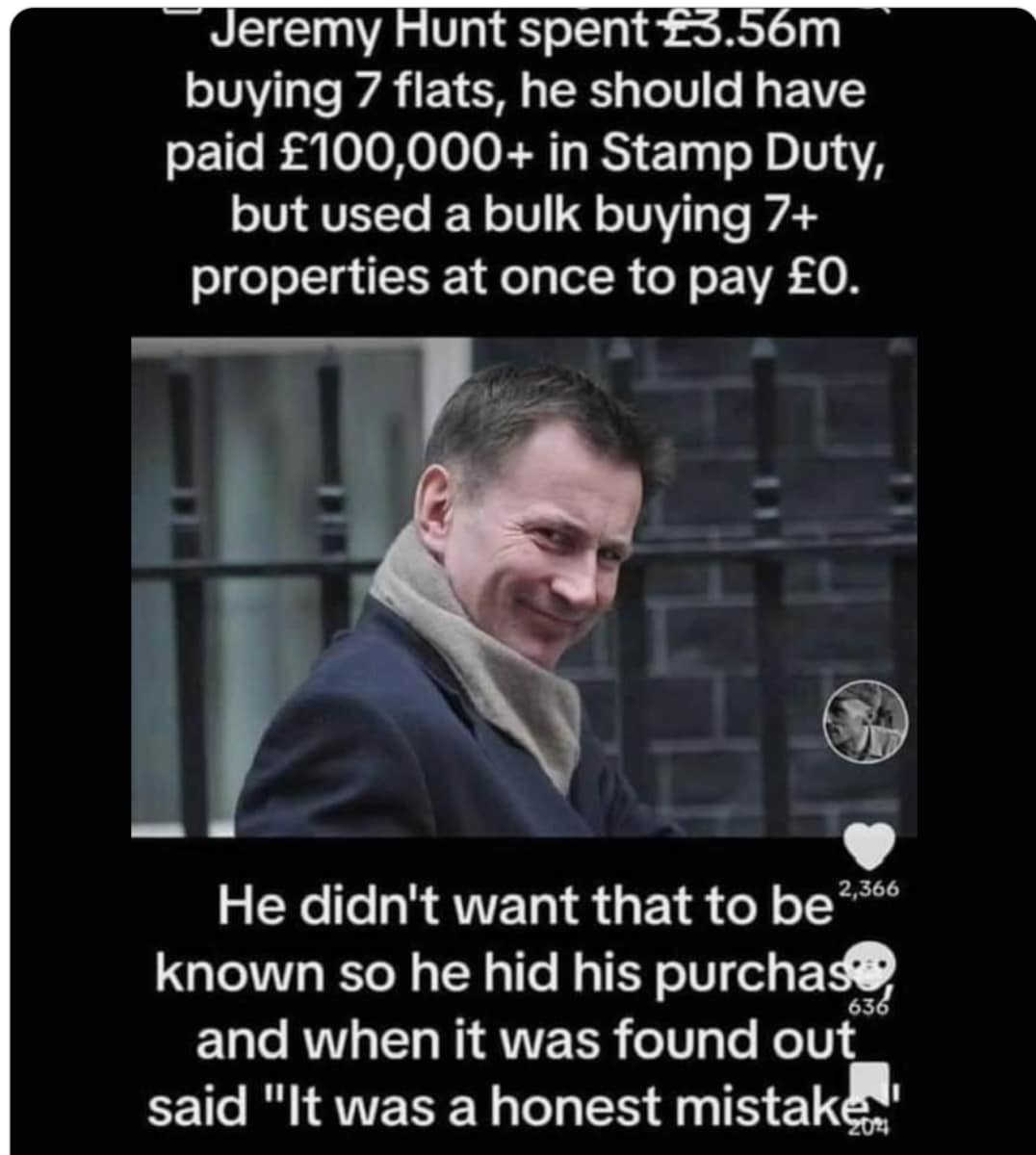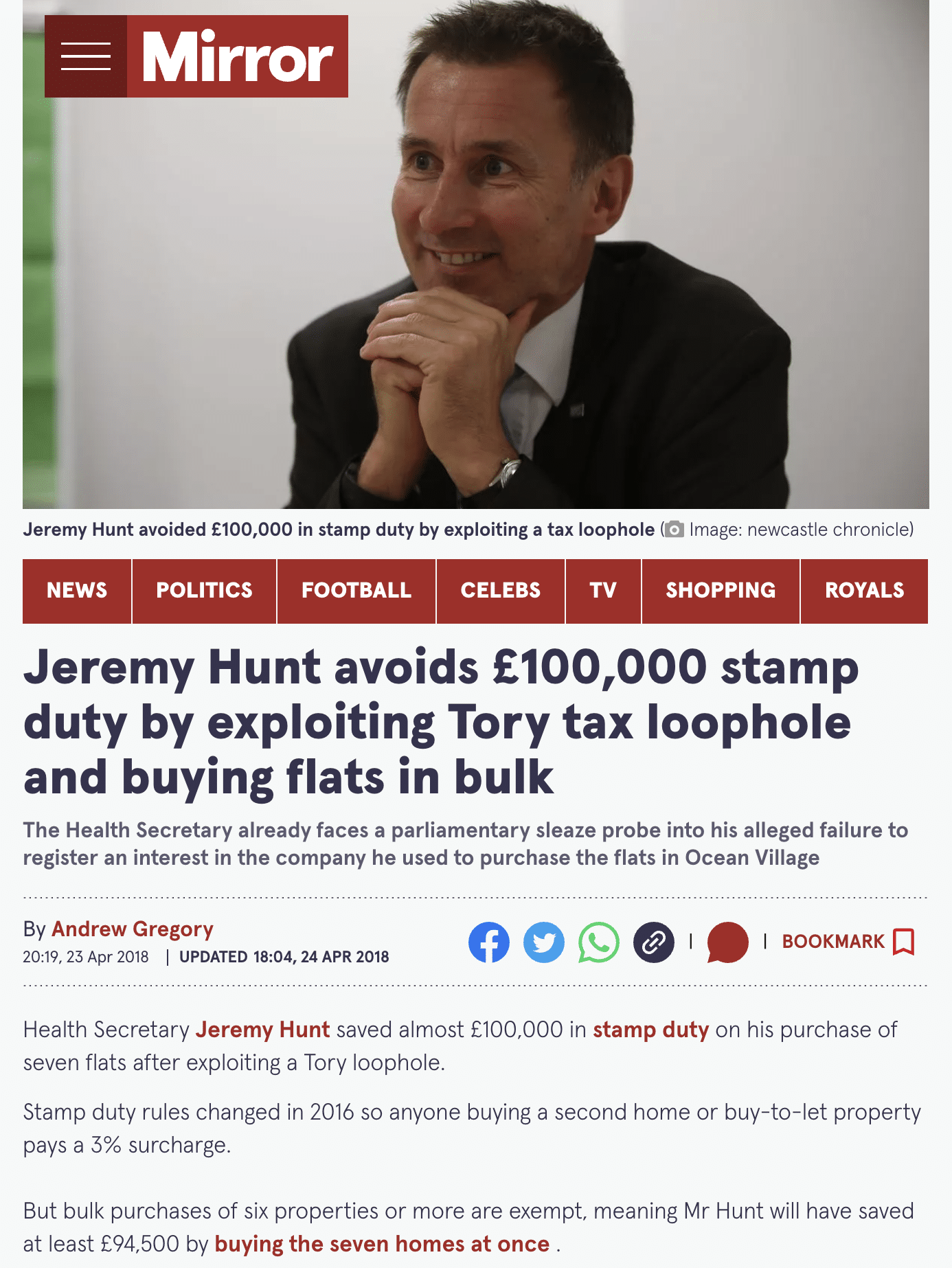
Nadhim Zahawi’s attempt to silence me has now resulted in disciplinary action for his lawyer. This is a short piece on why it happened, and what it means – for the lawyer, for SLAPPs, and for Zahawi himself
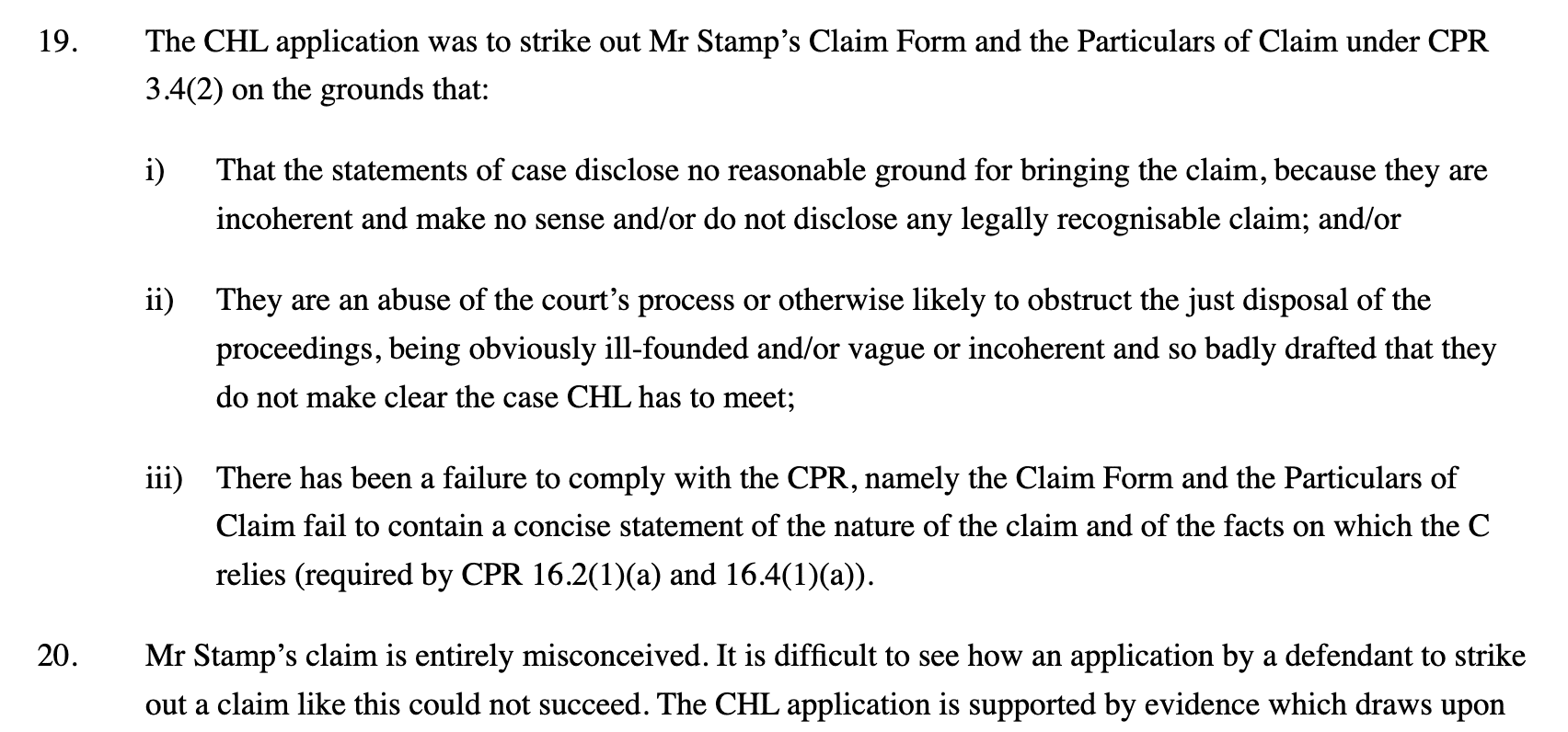
In July 2022, Nadhim Zahawi’s solicitors, Osborne Clarke, threatened me with libel for saying that Zahawi had lied about his taxes (which, of course, he had). They said I couldn’t tell anyone about their threat, and it would be “improper” and a “serious matter” if I did. This was false; an attempt to intimidate me into silence. I referred the matter to the Solicitors Regulatory Authority.
The FT is now reporting that the SRA has taken action, and has referred the solicitor to the Solicitors Disciplinary Tribunal. He1 may be struck off.
I believe this is the first time a solicitor has been referred to the SDT for abusive tactics in libel litigation – often termed SLAPP.
The threats
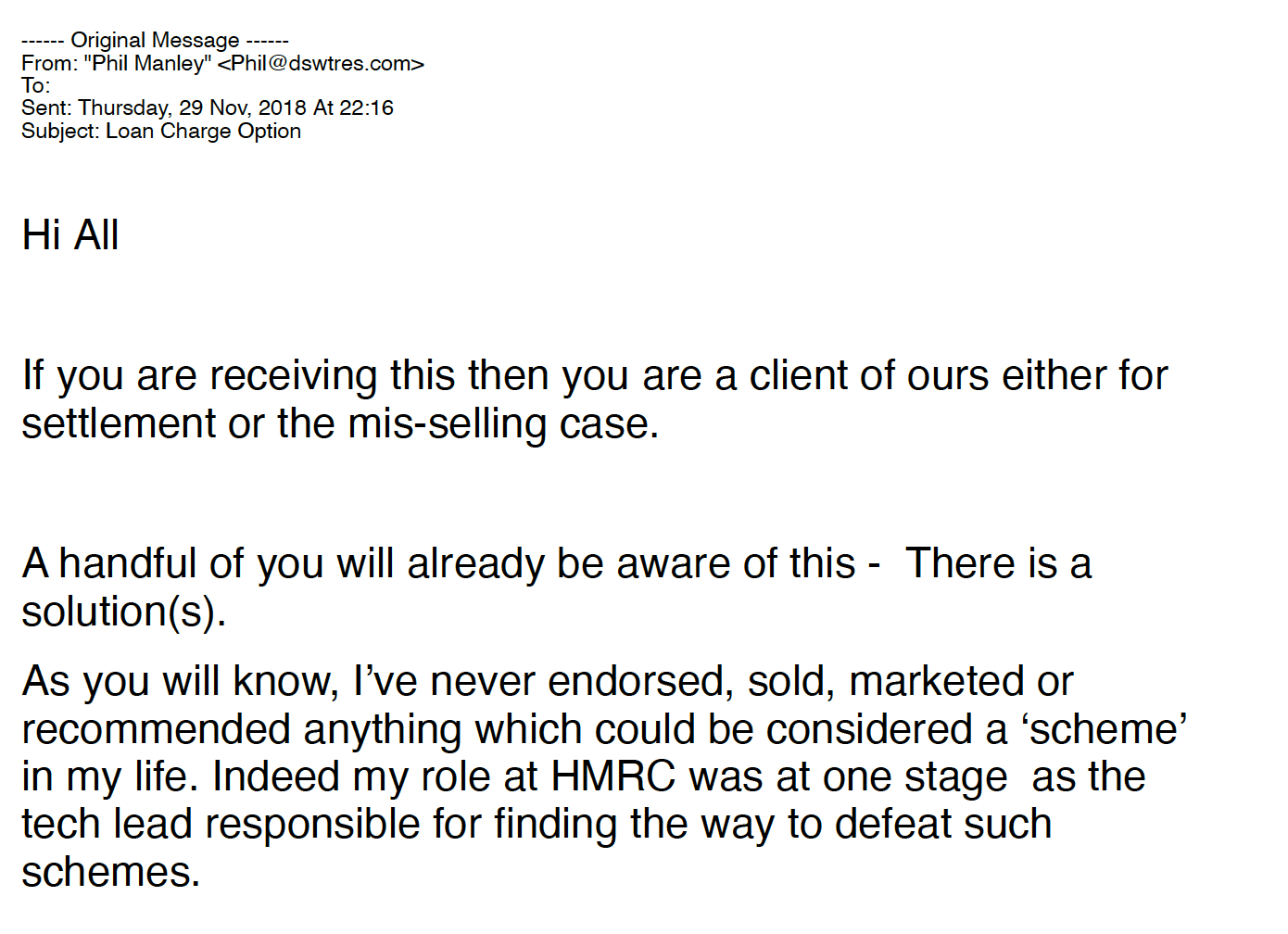
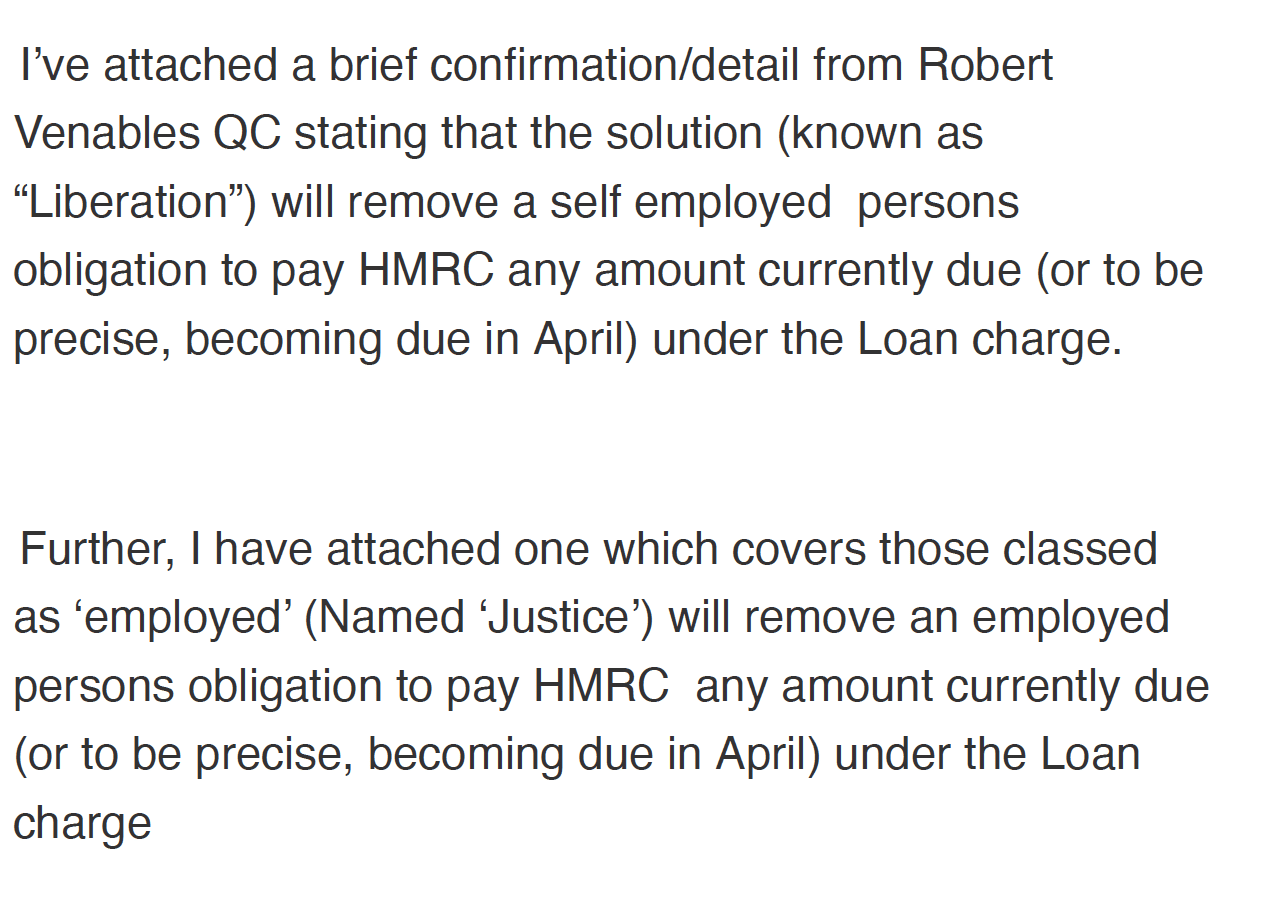
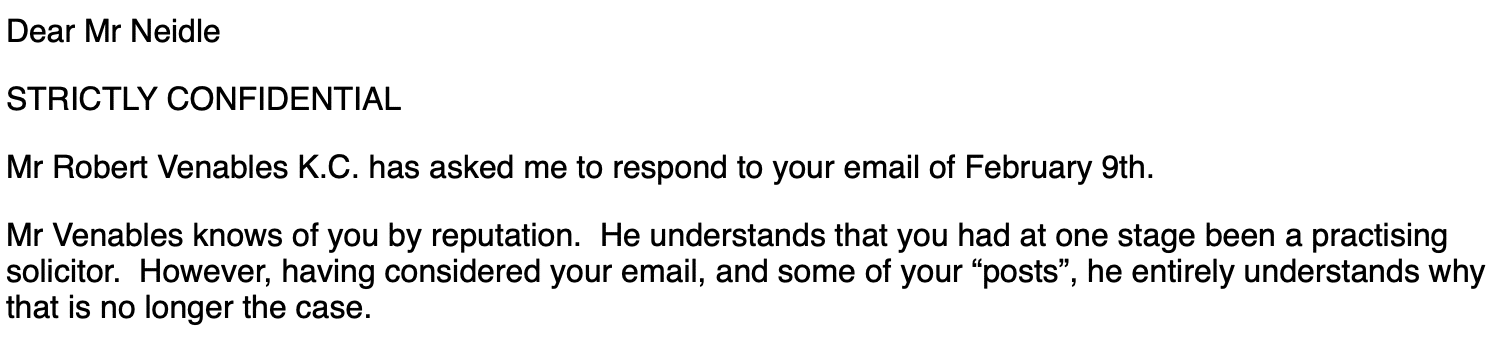
Osborne Clarke sent me an email threatening me with a libel action in July 2022 for saying their client, Nadhim Zahawi, had lied. The email included this:
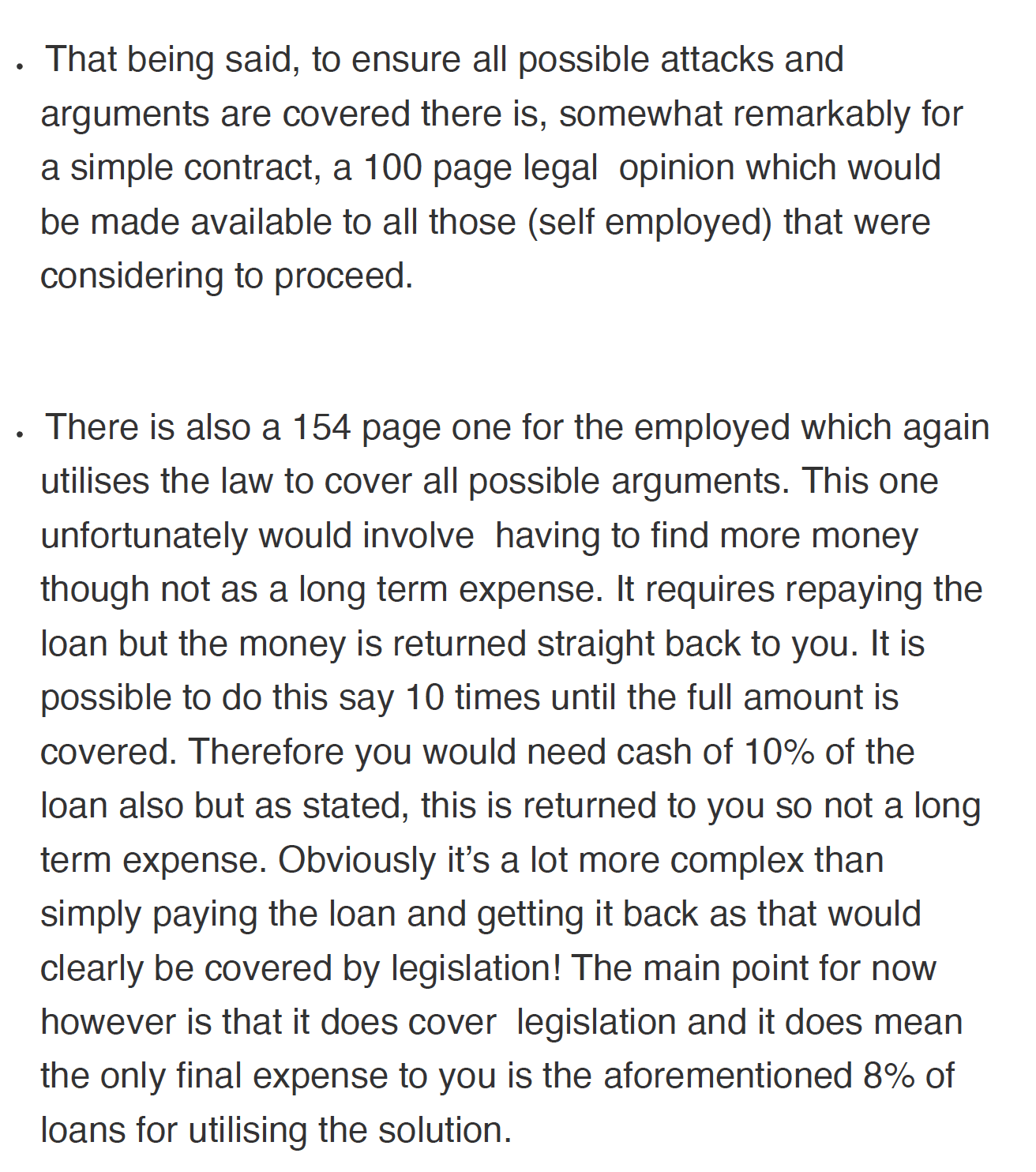
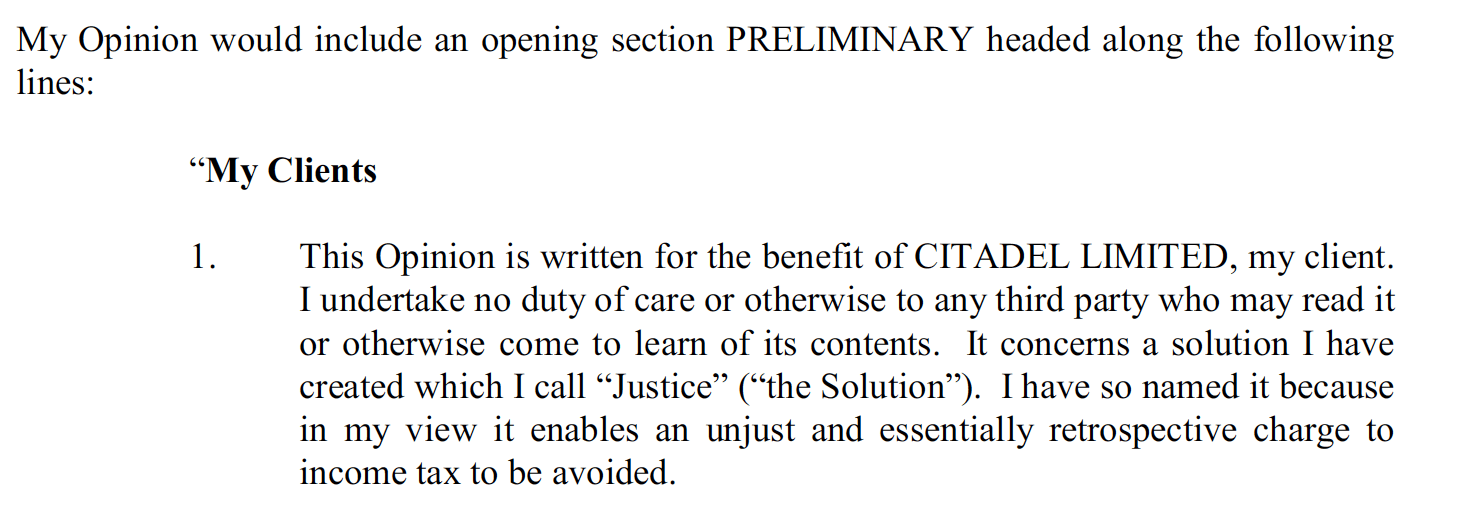
I didn’t respond, but instead published a more detailed analysis of why I thought Zahawi was lying. Osborne Clarke reacted by sending me a letter including this paragaph:
The law
The idea you can send someone a libel threat, and forbid them from telling anyone about it, is outrageous. It’s also without any legal merit.23.
I was shocked to discover that this attempt at intimidation was standard practice in the libel world. I knew the threat was toothless; but many other people who receive correspondence of this kind do not. Often the recipients have no legal representation at all. Even those that do often feel it is risky to publish the correspondence.
Osborne Clarke has made many other false4 claims of confidentiality/without prejudice (as have other libel firms). What makes Osborne Clarke’s behaviour worse is that I know that one recipient of their fake “confidentiality” assertion told Osborne Clarke in 2020 that there was no legal basis for confidentiality. Osborne Clarke responded by backing down. This wasn’t just a case of misunderstanding the law; they knew the confidentiality assertion was false when they made it to me.
Osborne Clarke is a good firm. They could have disciplined the lawyer involved and accepted the consequences. Instead they defend the indefensible.5 This is a disgrace.
The SRA itself has the power to fine solicitors up to £25,000. It only refers case to the Solicitors Disciplinary Tribunal in the most serious cases of misconduct, “particularly if the SRA’s view is that the misconduct is so serious it requires a solicitor to be prevented from practising”.
The wider consequences
The SRA acted with commendable speed after I raised the issue of false confidentiality assertions, and the abuse of without prejudice. It published a “warning notice” in November 2022 making clear that this behaviour was unacceptable.
However some libel solicitors have continued to act in this manner. They either ignore the SRA and continue to run the fake “confidentiality” argument, or they invent new spurious reasons why their libel threat cannot be published. My favourite (which is to say, the most disgraceful) is to claim that their letter is copyrighted.
I very much hope that the SRA’s action against Osborne Clarke will make clear that this behaviour will not be tolerated. Anyone else who’s received a supposedly “secret” libel threat should contact the SRA, particularly if this was after November 2022.
What the SRA has not done – and what that means
I also referred Osborne Clarke to the SRA for saying to me in correspondence things that we now know were untrue.
And:
And again:
All these claims are false. Zahawi’s taxes weren’t in fact “fully declared and paid in the UK”. He was the beneficiary of an offshore structure, which he had used to obtain a tax advantage.6 We can discard the possibility this was an accident, or forgetfulness: at the time these claims were made, Zahawi was deep in negotiations with HMRC to settle his unpaid tax, and pay a £1m penalty for negligence/carelessness.
So why hasn’t the SRA referred Osborne Clarke for making these false statements?
I believe there is only one reason: because Osborne Clarke didn’t know they were false; Zahawi had lied to his own lawyers.7.
So it may not be a coincidence that Zahawi announced he was standing down as an MP the day after the SRA’s decision.
I’ve set out the full timeline to the Zahawi affair, with links to all documents, here. I remain incredibly grateful to the dozens of lawyers, tax advisers and journalists who worked on this with me.
The SRA informed me about their decision on 8 May but said the matter was confidential until the SDT accepted the referral. Osborne Clarke clearly put the development in the public domain when they spoke to the FT, and the SRA has therefore told me that I am free to speak publicly about it. However the name of the solicitor referred to the SDT is not yet in the public domain, and so I won’t mention his name in this piece. ↩︎
Save in unusual cases, e.g. where the correspondence carrying the libel threat also contains confidential information. ↩︎
The claim this was justified by the “without prejudice” rule was also meritless. A party to dispute can make an offer to settle a dispute “without prejudice”; it cannot then be shown to a court. Without prejudice is not a separate rule of confidentiality, but it is often abused as such. Osborne Clarke’s email was not “without prejudice” because it contained no offer of settlement. I had also, anticipating this ploy, previously told Osborne Clarke I would not accept without prejudice correspondence. I wrote more about the legal issues here.↩︎
Not just false in my view; false in the view of every confidentiality specialist I’ve spoken to. Outside of a segment of the libel world, this behaviour is widely seen as bizarre. ↩︎
It is telling that Osborne Clarke say that their actions were “consistent with law and practice”. I’m sure they were consistent with the practice of the dodgier end of the libel profession. That is, however, no defence. And as for “consistent with the law”, neither they nor anyone else has ever attempted to explain how a letter containing no confidential information can be unilaterally asserted to be confidential, nor how the “without prejudice” rule is a barrier to publication. ↩︎
I suspect that Zahawi probably intentionally failed to pay tax, which is to say he “evaded” tax – although there is no way to be sure, and I doubt HMRC ever had sufficient evidence for a criminal prosecution. ↩︎
The SRA won’t say this publicly, because they don’t comment on their reasons for not making a referral, and Osborne Clarke are most unlikely to comment. Nadhim Zahawi’s spokespeople stopped replying to me a long time ago, but if they provide a statement I will of course include it in this article. ↩︎
We wrote in January about some of the ways private schools might try to avoid Labour’s proposed 20% VAT on school fees. One approach we mentioned – paying years’ of fees in advance – is now being widely used. We are concerned that schools and parents are not fully understanding the risks that these advance fee schemes create.Parents are being warned about the possibility of retrospective legislation – but a far worse prospect would be a challenge under existing law, and years of litigation.
This short report explains the risks, and suggests how the Labour Party, HMRC and schools could prevent a protracted period of uncertainty, and the potential for schools and parents to face significant unexpected costs.The Financial Times has more on this here.
We published a report in January concluding that most of the ways schools and parents could try to avoid VAT would not work. The one exception was paying fees in advance. We said that paying several years’ fees in advance would in principle avoid any later VAT change, because VAT would be charged at the point an early payment is made. We added that we doubted many people would want to do this – but it turns out we were wrong.
We have now received numerous reports of schools promoting the scheme.1
The advance payment schemes
Many schools (like Eton) have had advance fee schemes for years. They have in most cases been only occasionally used, but are now seeing much wider take-up. We’ve received reports that private schools across the country are now offering the schemes, and schools that have historically had only a couple of parents using the scheme each year, now have dozens.
This mostly isn’t visible to outsiders, but the sheer number of websites discussing the schemes gives an indication of how mainstream this is. For example:
Haberdashers Boys – the website didn’t mention an advance fee scheme in January 2022; from June 2022 it now does.
Perse School – the scheme wasn’t mentioned in 2022; is now.
Leeds Grammar didn’t mention its advance scheme in June 2023; it now does.
The older schemes usually don’t mention VAT; the schemes were a means of financial planning (and often limited to one year). By contrast, schemes now make clear that it’s all about the VAT – here’s one typical example:2
Interestingly, the wealthier/most sophisticated private schools appear not to be promoting fee schemes.
How do the schemes work?
VAT is charged at the point an early payment is made. If I pay £5,000 for a car today, for delivery in a year’s time, then VAT is chargeable now, and the relevant rules are those in force today. This principle is part of what’s called the “time of supply” rules.
The basic idea of the advance fee schemes is that, by paying several years’ fees in advance, the time of supply is now, and parents can “lock in” today’s VAT rules and be entirely unaffected by any subsequent imposition of VAT on school fees. As a general proposition, this is correct.
However when we look at the way the school advance fee schemes work, things get more complicated. Unlike the car example, parents paying school fees in advance aren’t paying an agreed sum and buying a product. The amount they pay is in reality placed on deposit with the school, and then used by the school to satisfy each term’s fees. This means that if, for example, school fees increase, then the fees paid in advance will be used up more quickly than anticipated, and the parents will (eventually) have to pay more. If the parents decide to remove the child from the school, they get the money back (subject to notice periods). If the child gets a scholarship, the parents get a refund. And the schemes often let parents pull out of the scheme, and get their money back, at any time (with notice).
Or, as one school puts it: the scheme operates by “parents buying a credit against future invoices at a discounted amount.” And:
What does the School do with fees paid in advance?
Fees paid in advance form part of the general unrestricted reserves of the School, the School is therefore free to used fees paid in advance as it sees fit. However, as a general rule fees paid in advance are held in a separate bank account from the School’s general account and an amount is then released to general funds at the start of each term.
These schemes therefore don’t work at all like normal advance payments arrangements, and don’t have the usual benefit of locking in a price.
This means that, if we ignore VAT for a moment, the schemes don’t make much sense for most parents. There’s a discount for advance payment, but the discount rates we have seen are small – between 1% and 4%. That doesn’t make much sense given current bank base rates – you’d be better off putting the cash in a deposit account or other investments. And that would have the considerable advantage of being safe – by contrast, money paid in advance to a school may be lost if the school experiences financial difficulty.3
It’s therefore unsurprising that, historically, advance fee schemes were only rarely used – typically a handful of parents each year. Generally those parents had particular circumstances for which paying fees in advance made sense. One example would be where parents divorce, and pre-paying many years’ fees in advance formed part of the financial settlement
The recent widespread take-up of these schemes is, therefore, all about VAT.
So what tax risk are schools and parents running?
Retrospective legislation
The first risk is retrospective legislation.
It’s fairly common for new tax and VAT legislation to include “anti-forestalling” rules which prevent someone avoiding the tax between the date the legislation is announced, and the date it’s enacted. Labour have said that they’ll do this.
So, if we assume (for example) an election on 10 October 2024, we’d expect an announcement on school fee VAT a few days later, saying that legislation would be brought forward to apply VAT to school fees from April 2025. We’d also expect this to include a statement that anti-forestalling rules will apply VAT to any advance payment of more than one term made on or after the date of the announcement.
This won’t affect people who prepaid years of school fees before the election.
If Labour want to close that “loophole”, they’d need to enact proper retrospective legislation, going back before the post-election announcement. There are suggestions Labour has already discussed this.
The simplest way for retrospection to work would be to simply apply VAT to all payments in advance which relate to education services provided from April 2025 onwards. The time of supply could be (for example) the start of the term, or the time at which parents generally are required to pay for that term’s education.
What practical effect would retrospective legislation have?
If the suggested approach above were adopted, then the school would be required to account for VAT around the start of each term. Most of the scheme T&Cs we’ve seen should permit the schools to charge tax when necessary. So, in addition to applying part of the parents’ advance payment to school fees, they’d apply part of it to cover the VAT.
So where, for example, parents had paid in advance for five years, the additional VAT charges mean the funds would be used-up after four years, and the parents would then have to pay again. I expect in practice parents would cancel their participation in the scheme.
Things are messier if parents only paid for the Summer 2025 term in advance. Their advance payment would not be enough to cover the VAT, and the schools would have to ask them to pay more. This would present schools with the practical difficulty and risk of collecting additional money from unhappy parents.4
So, whilst retrospective legislation is unlikely to be welcomed by schools or parents, its implementation would be reasonably straightforward, and schools should in practice be able to cover the tax.
Most schools which are offering advance fee schemes are explicitly warning parents about the potential for retrospective legislation, and saying that if this happens then the parents would have to pay the VAT. That is unlikely to perturb parents too much, because it’s a one-way bet: best case, they save the VAT; worst case, they don’t. They’re not running any new risks (except the risk of the school going bust).
Could retrospective legislation be challenged?
It is often suggested that retrospective legislation is unlawful, either the ECHR/Human Rights Act or for some other reason. Our view is that any legal challenge is very unlikely to succeed, for two reasons. First, the courts have generally been relaxed about retrospective tax legislation in the context of anti-avoidance.5 Second, and more fundamentally, even if a taxpayer were successful, the way the Human Rights Act works means that primary tax legislation cannot be overriden – the court would issue a “declaration of incompatibility” and ask Parliament to think again.6
Retrospection will remain politically controversial – Geoffrey Howe made the argument against it very well back in 1978, and many people still share that view.7 But as a legal matter it’s our view that retrospective tax legislation to close what Government perceives (rightly or wrongly) as an avoidance scheme will generally be lawful, and when it’s implemented by primary legislation, there’s no realistic prospect of challenging it.
HMRC challenge
The messier outcome is that there is no retrospective legislation, but HMRC start to challenge some advance fee schemes on the the basis that they are not effective under the usual VAT principles. We haven’t seen any schools warning parents of this risk, probably because they aren’t aware of it themselves.8
Advance fee schemes have been around for decades, and never to our knowledge challenged – but of course there was never any reason to challenge them until now, as they created no tax advantage.
How might such a challenge be made? We can think of a few potential approaches:
That, realistically, the invoice for the advance fees is not actually an invoice for the supply of school fees, but rather relates to an advance of credit. The parents are making a deposit with the school. The school then charges parents for each term’s school fees, and the deposit is used to satisfy this. It would follow that VAT is due separately on each term’s fees, at the time it is invoiced or applied to the deposit. Some of the scheme T&Cs we’ve seen look susceptible to this kind of challenge (particularly where termly invoices are issued); others less so.
That the advance fee arrangement is artificial with the essential aim of avoiding a future VAT charge, and so can be countered using the Halifax VAT anti-abuse doctrine. If VAT had already been imposed on private school fees for a future date, and people were paying in advance before that date, then we believe it’s likely Halifax would apply, given the somewhat artificial nature of the schemes. However given that currently there is no VAT on private school fees, and the scheme is avoiding anticipated future change in law, the argument becomes much more difficult for HMRC. We are unaware of any authority permitting Halifax to be used in this manner, but it is not out of the question.
A year before the Halifax judgment, in the BUPA Hospitals case, the CJEU ruled against a scheme operated by private health companies to make advance payments to pre-empt a change in UK VAT law. The time of supply rules are in large part anti-avoidance rules,9 and so the CJEU applied them purposively to defeat the scheme. There are a number of differences between the BUPA Hospitals advance payment scheme and the private schools’ scheme; but it would not take much imagination to apply a similar argument.
Other technical VAT arguments, for example that the prepayment actually amounts to the purchase of a voucher so that the complex VAT rules on vouchers apply – HMRC may be able to argue that it is a “multi-purpose voucher”10 so that VAT is chargeable at the point that termly fees are satisfied with the prepayment arrangement.
Considerable analysis would be required to reach a view on these issues. We haven’t undertaken that analysis, and so have no view on whether ultimately HMRC or schools/parents would prevail. However these arguments are not fanciful, and the prospect of an HMRC challenge is in our view real.
What practical effect would an HMRC challenge have?
Any HMRC challenge would be a bad outcome for schools and parents.
HMRC VAT challenges are often made years after the event. HMRC usually has between one and four years to open an enquiry (depending on whether full disclosure was made to it). But HMRC can take broadly as long as it likes before issuing a “closure notice” saying that VAT is due. By this time, several years of VAT liability could have built up.
Unlike income tax/corporation tax, when HMRC issues that “closure notice”, the taxpayer has to pay the VAT up-front. Schools would then presumably seek to recover the VAT from parents.
Given that years may have passed, this may not be straightforward (particularly where children have left the school).
Whilst scheme T&Cs generally permit schools to recover the VAT from parents, parents argue that this was limited to the retrospective tax scenario that they were warned about. As far as we are aware, parents have not been warned about the possibility of challenge under current law, and that may both make them unhappy and provide potential legal grounds for resisting claims by schools.
It is therefore our view that schools may be running material risks which they don’t fully understand – years of litigation and uncertainty over whether they can recover the VAT from parents. Some schools could get into serious financial difficulty, particularly if several years of VAT have built up.
This is a much worse outcome for schools and parents than retrospective legislation.
What’s the impact on VAT revenues?
Let’s say Labour don’t legislation retrospectively, and HMRC either don’t challenge the schemes, or the challenges fail.
How much VAT revenue would be lost as a result of these schemes?
The IFS has estimated that imposing VAT on private school fees would raise about £1.6bn. We have written about the difficulty of making estimates in this area, and so that figure needs to be viewed cautiously, but it is in our view the only serious estimate that has been published.
So for every 1% of parents that use the schemes, there would broadly be a loss of VAT revenue of £16m.11 Plus the costs of challenging the scheme, if that is how HMRC proceeds.
What should happen?
We believe it’s in nobody’s interest to have years of litigation, and schools potentially finding themselves with large VAT bills they cannot afford to pay. To prevent this worst-case scenario, we would suggest that all parties try to provide as much clarity as possible.
If Labour plans to enact retrospective legislation, it should say so now, at least in broad terms, and not just drop hints. That would probably end the schemes now, and prevent everyone involved wasting time and money.
Schools should warn parents of the potential for legal challenge under current law, and that this could result in the schools pursuing parents for VAT potentially years later.
It would also seem sensible for schools to warn parents that fees paid in advance could be lost if the school enters into financial difficulty. We’ve received many reports of communications from schools, and of those only Dulwich College mentions this scenario.
Schools should be careful to plan for the worst-case scenario, and ensure that they will always have enough funds to cover a VAT assessment.
If Labour wins the election, and announces it will introduce VAT on school fees without retrospection, then HMRC should either challenge the schemes early or say clearly that it will not be challenging them. HMRC often waits until the last week of the limitation period – that would be unfortunate here.
In that same scenario, schools could minimise the risk of an HMRC challenge years after the event by providing full disclosure up-front, for example by sending HMRC a letter explaining precisely how their advance fee scheme works.
Thanks to L, R, O, W and C for drawing our attention to this, to E for the VAT technical input and K for a discussion on insolvency rules. And thanks to Anna Gross at the Financial Times.
Image by www.raisin.co.uk and licensed under Creative Commons Attribution Licensing.
Footnotes
We have also received a few reports of other schools considering the scheme but not doing so, because of the risks we discuss below. ↩︎
2. Legislation in 2012 retrospectively reversed a tax avoidance scheme implemented by Barclays. There was no attempt to challenge this in the courts.
3. Legislation in 2013 retrospectively closed down an SDLT avoidance scheme – the High Court refused permission for a judicial review to challenge the retrospection.
The House of Commons Library has written an excellent briefing on retrospective legislation which goes through these and other cases. ↩︎
By contrast, EU-law based challenges arguments enabled the courts to potentially override Acts of Parliament – but, post Brexit, such challenges can no longer be made. ↩︎
See, for example, the Protocol published by the Government in 2011 which says that retrospective legislation will only be enacted in “exceptional” cases. This is, however, in no sense legally binding. ↩︎
In the many briefings on advance fee schemes online, we’ve seen only one, from haysmacintyre, which mentions the point. ↩︎
An important point which we missed in the first draft of this report. Thanks to Professor Rita de la Feria for raising it. ↩︎
On the basis that the VAT due on the supply of education services is not known at the time the advance fee scheme is entered into or, in some implementations of the scheme which cover ancillary fees, because the services supplied are not known. This feels a rather artificial argument, but the voucher rules have always been rather artificial ↩︎
Presumably actually more, because parents at more expensive schools have a stronger incentive to pay in advance, and more ability to do so. There is also a technical reason it would be higher than the naive £16m figure, because in future years the schools will have reduced input VAT but their output VAT will be unchanged. So the parents who don’t use the scheme will obtain a small benefit from the fact others have used it. A quick example: imagine a school with £1,000 of fee income and £250 of VATable expenses. Without advance payment, it would have a VAT bill of 15% of its fees (i.e. 20% x (1000 – 250) = £150 out of £1,000). But say (unrealistically) 10% of the fees are paid in advance, its VAT bill would now be 14% of its fees (20% x (900 x 250) = £130 out of £900). ↩︎
An unknown individual is trying to keep their tax avoidance scheme, and resultant dispute with HMRC, private. They attempted to apply to the courts for anonymity – and failed. But they’re so desperate to keep their name out of the papers that they then dropped their dispute with HMRC and applied for a lifetime anonymity order. HMRC are opposing this. So are Tax Policy Associates.
UPDATE 22 November 2024: the anonymous taxpayer lost their appeal and, unless they take the point to the Court of Appeal, their name will be revealed on 11 December.
UPDATE 9 December 2024: the anonymity has now been lost. It’s Frankie Dettori.
UPDATE 3 April 2025. We’ve published the bundle of legal arguments from the anonymity appeal here, and the authorities bundle (i.e. supporting caselaw/legislation) here.
There is an excellent Telegraph article on the Dettori affair here.
UPDATE 20 May 2025: HMRC has committed that, whenever a taxpayer makes an application for anonymity at a court/tribunal, it will (where appropriate) ask the court to serve notice of the application on the Press Association.
Open justice and tax appeals
Here’s the deal: your tax affairs are confidential. HMRC is bound by a strict statutory confidentiality obligation. Nobody can see your tax return. Nobody can find out if HMRC investigates you. If you buy a tax avoidance scheme, HMRC challenges you, and you give up and pay the tax, nobody will ever know.1 But if you appeal against HMRC’s decision, and it hits a tax tribunal, everybody will find out.
So normally tax appeals are open: anyone can attend,2 decisions are often published, and you don’t get to hide anything.
This is important in its own right, but it also shapes taxpayer incentives. If I was a billionaire faced with an HMRC demand for say £100m, I have an incentive to contest it even if my prospects of winning are low. The costs of an appeal are unlikely to top £1m, so an appeal is economically sensible even if I have only a 5% chance of winning. 3 The prospect of public opprobrium changes the calculation. If taxpayers could appeal anonymously then we would see more appeals on technically marginal points by wealthy individual and corporate taxpayers.
The first anonymity order
So it was very surprising that, in September 2021, an unknown taxpayer was granted anonymity by the First Tier Tribunal. More surprising still was that this was despite the taxpayer providing no evidence whatsoever of any harm or prejudice he would suffer if his name became public.4 This was in stark contrast with the Peter Andre case. The judgment wasn’t published, and nobody (other than HMRC) knew this had happened.
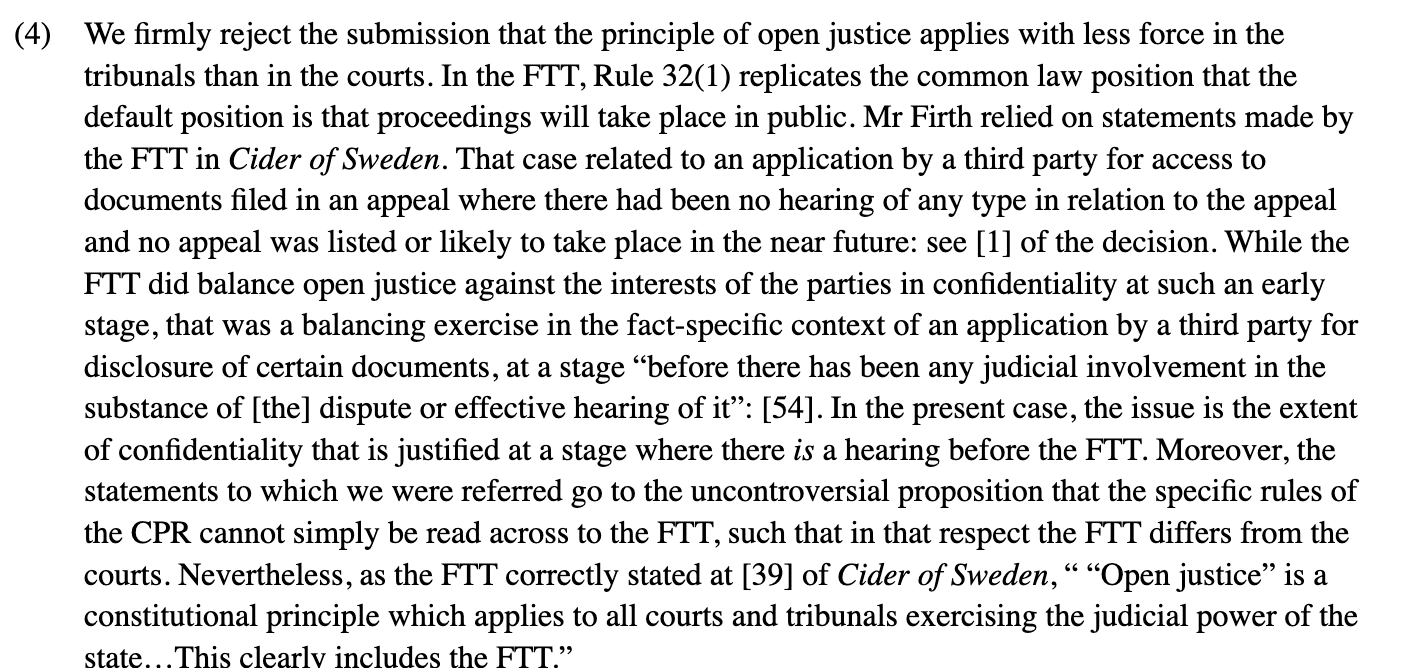
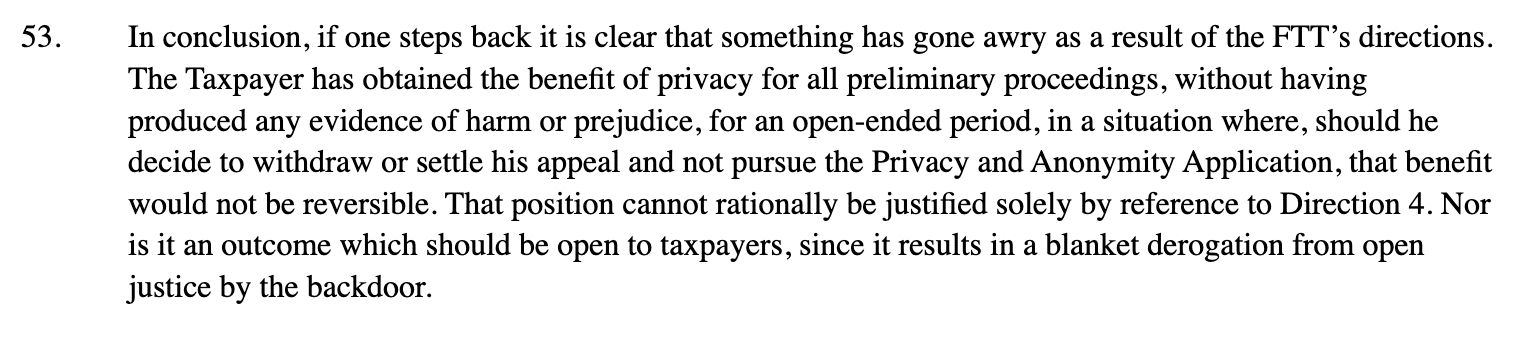
HMRC appealed to the Upper Tier Tribunal. In a forceful judgment, the UTT said the First Tier Tribunal had made “material errors of law” which resulted in “a blanket derogation from open justice by the backdoor”:
and:
The UTT said the taxpayer’s name would be published two weeks after the appeal deadline passed. The taxpayer didn’t appeal – given the strength of the UTT judgment, his prospects would have been bleak. He did something else…
The new application
The mystery taxpayer is so desperate to keep his name out of the papers that, when it became clear he wouldn’t obtain anonymity, he dropped his original appeal against HMRC’s tax assessment,5 and then applied to the tribunal to preserve his anonymity forever.
This goes back to the incentives point – the mystery taxpayer was only willing to appeal against the tax assessment if he could do so anonymously. Which is precisely why such anonymous appeals should only be permitted in exceptional circumstances.
HMRC is opposing the taxpayer’s application. We applied to the Upper Tier Tribunal for copies of the application and HMRC’s response, and the UTT kindly agreed to provide us with the documents, on the condition we didn’t publish them.
We can however say that we regard the taxpayer’s application as weak; he asks for anonymity whilst not identifying a single reason why his case merits it. The taxpayer then pleads a series of cases which are either irrelevant, or relate to circumstances where there was a genuine reason to seek anonymity (mental illness, a stillborn child, and someone who didn’t want the fact they’d worked as a stripper to become public). HMRC’s response to this is robust and comprehensive.
We have made our own short submission, which we are able to publish. We don’t repeat the points in HMRC’s response, but make two additional points of general public policy (PDF version here):
We understand that the Times and the Press Association have also received copies of the UTT documents, and may be making their own submissions.
Who is the taxpayer?
We don’t know for sure.
The judgment does not reveal the identity of the taxpayer, other than that he is a man. Nor does it say what the underlying dispute is – but our team is reasonably confident that, on the basis of the details that are provided in the judgment and certain other materials in the public domain, it relates to a mass-marketed tax avoidance scheme.
We have gone further, and used those materials to narrow down the identity of the taxpayer, but we don’t believe it would be responsible to publish our findings at this stage. However, to prevent unfair speculation, we will say that we don’t believe the taxpayer is a current or former politician. We won’t respond to any other queries about who the taxpayer might be.
The role of HMRC and the courts
HMRC deserves plaudits for pursuing this appeal so robustly. If it hadn’t, then the anonymity would have stood, and nobody would have known about it (given that the original FTT decision doesn’t appear to have been published). HMRC went further, and asked for the Press Association to be sent copies of the tribunal documents.
It is, however, disconcerting that nobody was aware of the original 2021 anonymity judgment. We would suggest:
Tax Tribunals should follow the approach of the High Court in the Zeromska-Smith case, and serve copies of applications for anonymity on the Press Association (i.e. to enable the media to oppose such applications).
HMRC doesn’t appear to have requested service on the media in the original 2021 hearing – we believe it should always do so.
When anonymity is granted by the First Tier Tribunal, HMRC should ensure that the judgments become public. We should all have a right to know the extent to which anonymity orders are being applied for and granted.
Update 23 May 2024: there has now been another unrelated anonymity decision – L v Commissioners for HMRC. HMRC took a neutral position on the point, and the FTT’s findings of fact make the decision to grant anonymity look reasonable. However it is still perturbing that no notice was given to the media, and so this was in practice an uncontested application.
Many thanks to George Peretz KC for his pro bono assistance in this matter (George successfully acted for HMRC on one of the few tax confidentiality cases).
Thanks also to our frequently collaborator M, and above all to Ian Richardson at Grant Thornton in the Isle of Man – he was I believe being the first person to spot the UTT judgment, and alert us to this case (but it has, we believe, nothing to do with the Isle of Man).
Most of all, thanks to the Press Association, and to The Times and News Group Newspapers, for intervening in the appeal as third parties.
In theory. You have to find out where it is, or obtain a link to a video conference – one commenter below has had difficulty doing this. ↩︎
i.e. because appealing has an expected return of £3m. That’s the £100m cost of not appealing minus 95% x the £101m cost in the scenario where I lose, minus 5% x the £1m cost in the scenario where I win. £100m – (95% x £100m + £1m) – (5% x £0m + £1m) = £3m. ↩︎
We are aware of a new form of VAT fraud which came close to stealing £m from HMRC last week, after fraudsters impersonated a FTSE 100 company. At least two other FTSE companies have been targeted the same way, plus an unknown number of smaller businesses. The fraud is remarkably easy to implement, and immediate action from HMRC is required to close it down.
Over £4bn each year is stolen from the UK by organised criminal gangs manipulating the tax system. We’re not talking about ordinary VAT fraud committed by a normal business or individual (such as failing to disclose income), but something more akin to theft that takes advantage of weaknesses in the tax system.
The criminal gangs who run these schemes appear to have found a new trick.
Last week, the head of tax at a FTSE 100 company had a call from HMRC. HMRC had received a form VAT484 from the company changing its bank details. The company was due a VAT refund next quarter – if HMRC had processed the form, the refund would have gone to the fraudsters. Two other FTSE 100 companies had identical experiences, plus an unknown number of smaller businesses. I missed the first public report on this, two weeks ago from Tony Cochrane at RSM.
This was a very easy fraud. All the details for the VAT484 are publicly available. One dodgy bank account, one Google search to get the company’s details, and filling in the form takes two minutes.
In this case, the size of the target, and the strangeness of receiving a paper form, meant that alarm bells rung at HMRC and the fraud was prevented. But the fraudsters have likely sent out many VAT484s for many companies, and they are presumably more likely to succeed where the target is smaller… particularly if it ordinarily files using paper forms.
This won’t be an issue for the majority of companies, who don’t normally receive VAT refunds. But some businesses are almost always in a refund position, e.g. retailers supplying 0% VAT goods (eg a children’s clothing shop), exporters and residential property developers.
I understand HMRC are already tightening up their procedures. There are several obvious steps that could be taken:
HMRC should not accept VAT484 forms at all from businesses that have an online account – they have a much easier and more secure way to change their details.
The VAT484 form needs to be made more secure given its significance. At a minimum HMRC should require the company to add its unique tax reference (UTR) number, which isn’t publicly available (although it would not be that difficult to find it).
Changing bank details should always trigger a verification process: for example, where HMRC receives a paper form, it should write to the business and ask for confirmation.
HMRC should review its procedures to see if there are other paper forms which could be exploited by fraudsters.
We’d also suggest that businesses regularly check their Government Gateway page to verify that the bank account listed is as expect. Large businesses that have a Customer Compliance Manager should speak to them urgently, and request that any VAT484s or other paper tax forms received by HMRC are rejected.
New polling evidence from Tax Policy Associates and WeThink shows that half the public doesn’t understand a basic principle of income tax: the way that tax rates apply to income above a threshold. Our polling suggests that 50% of people believe that, once you hit the higher rate threshold, the 40% higher rate applies to all your earnings.
UPDATE October 2024 – we ran a new poll with completely different wording, testing the same point. The results were consistent.
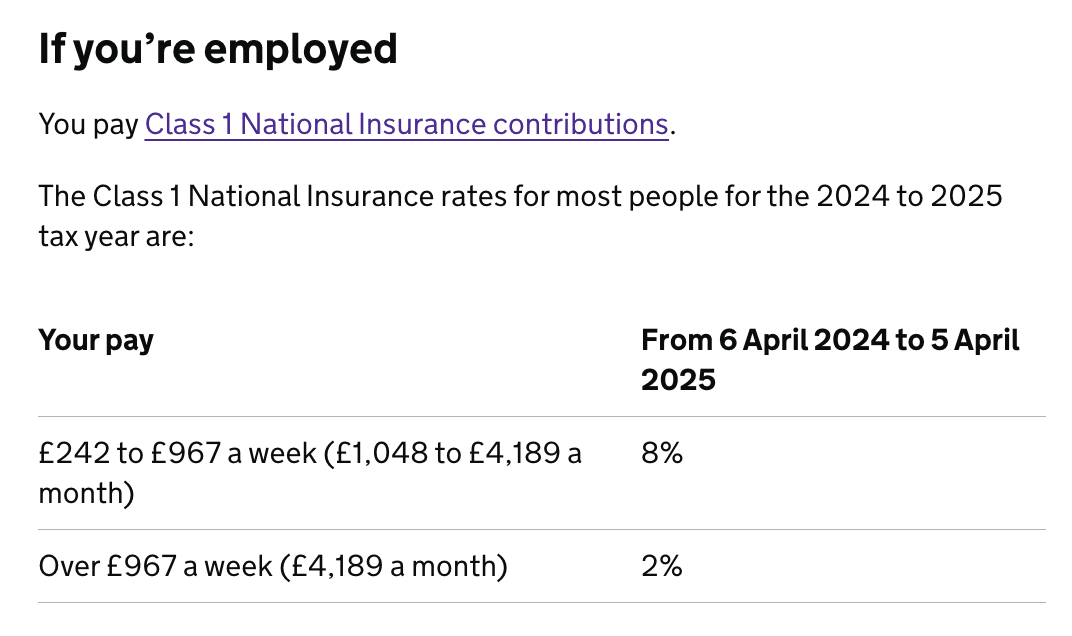
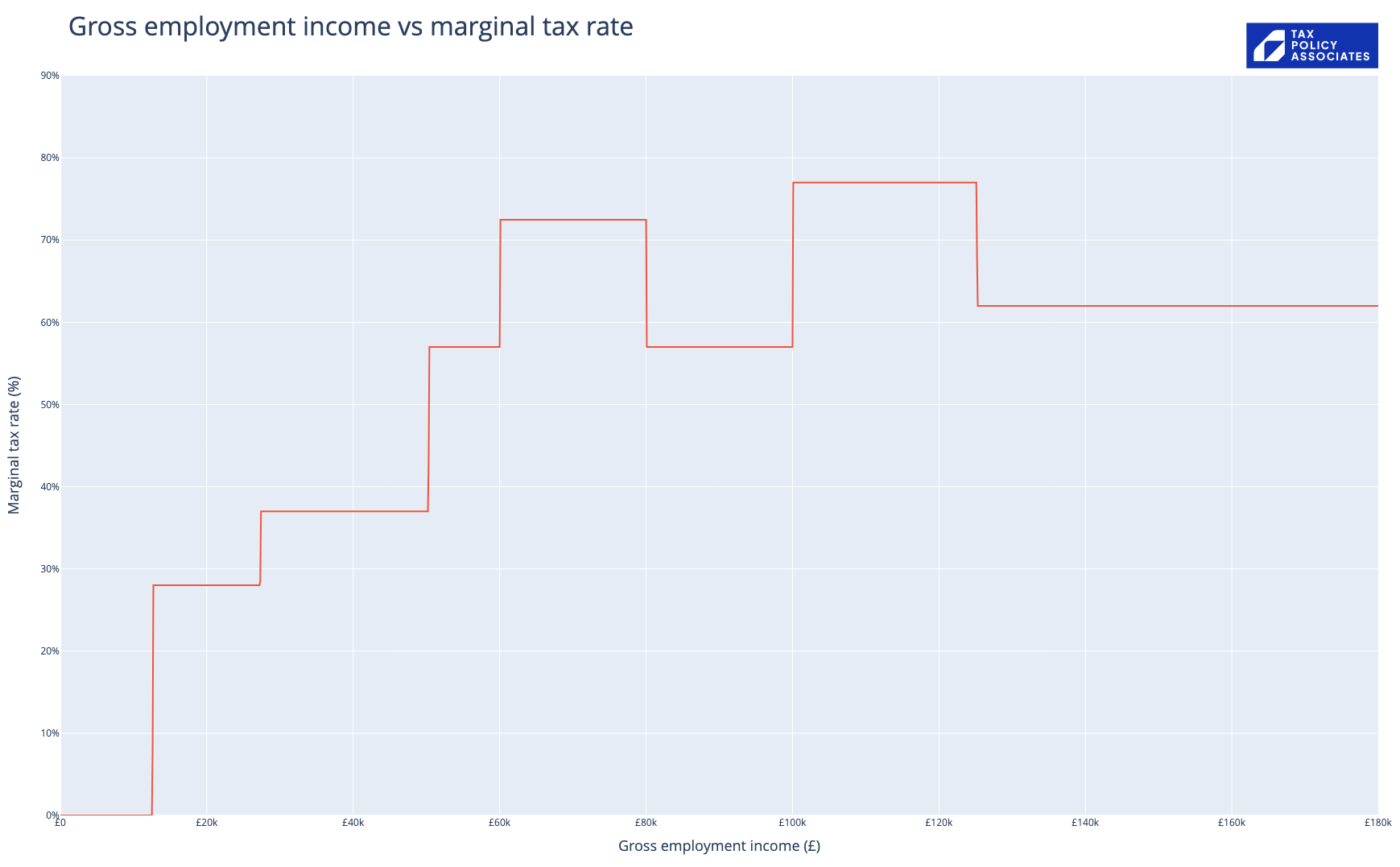
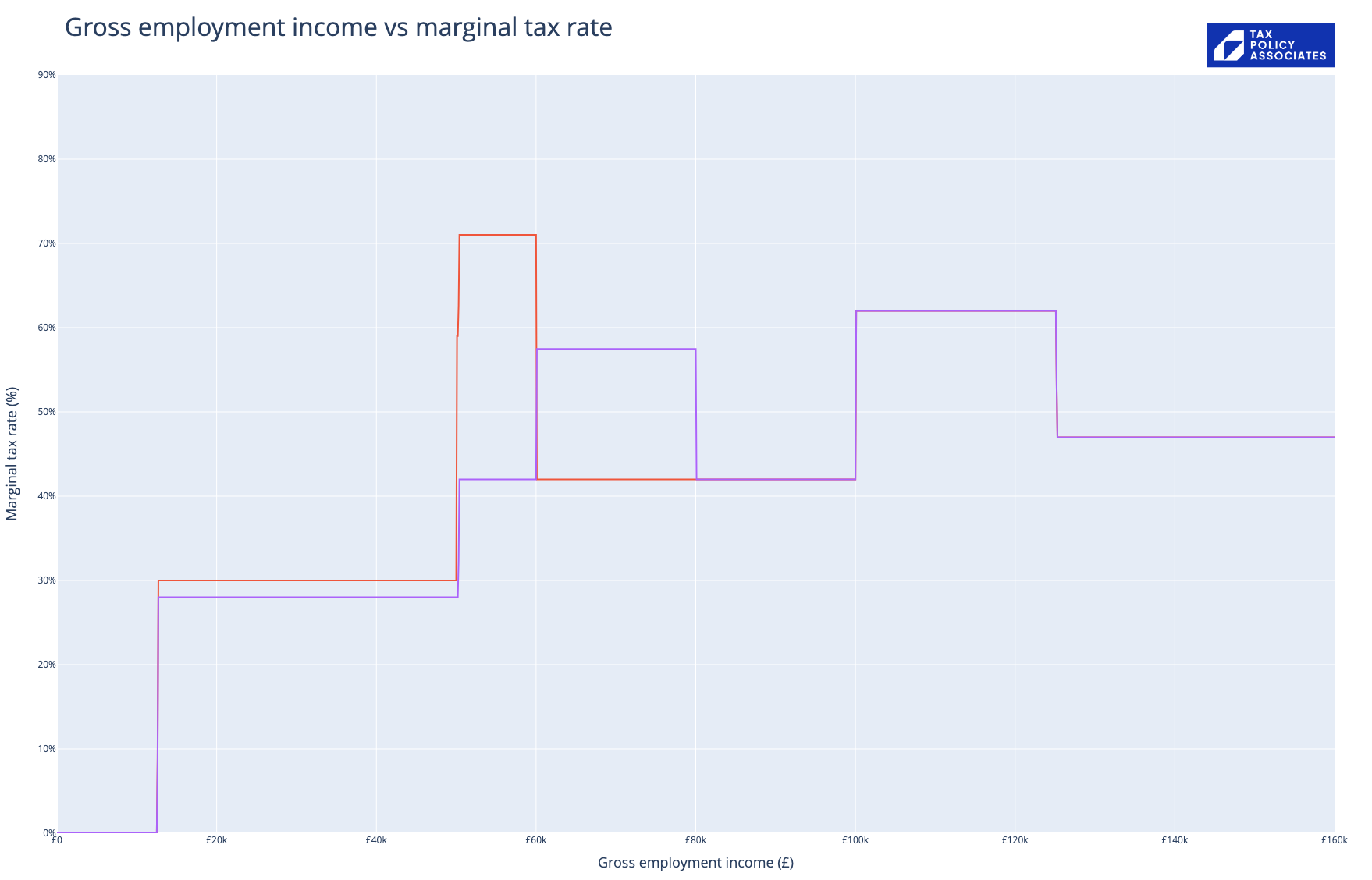
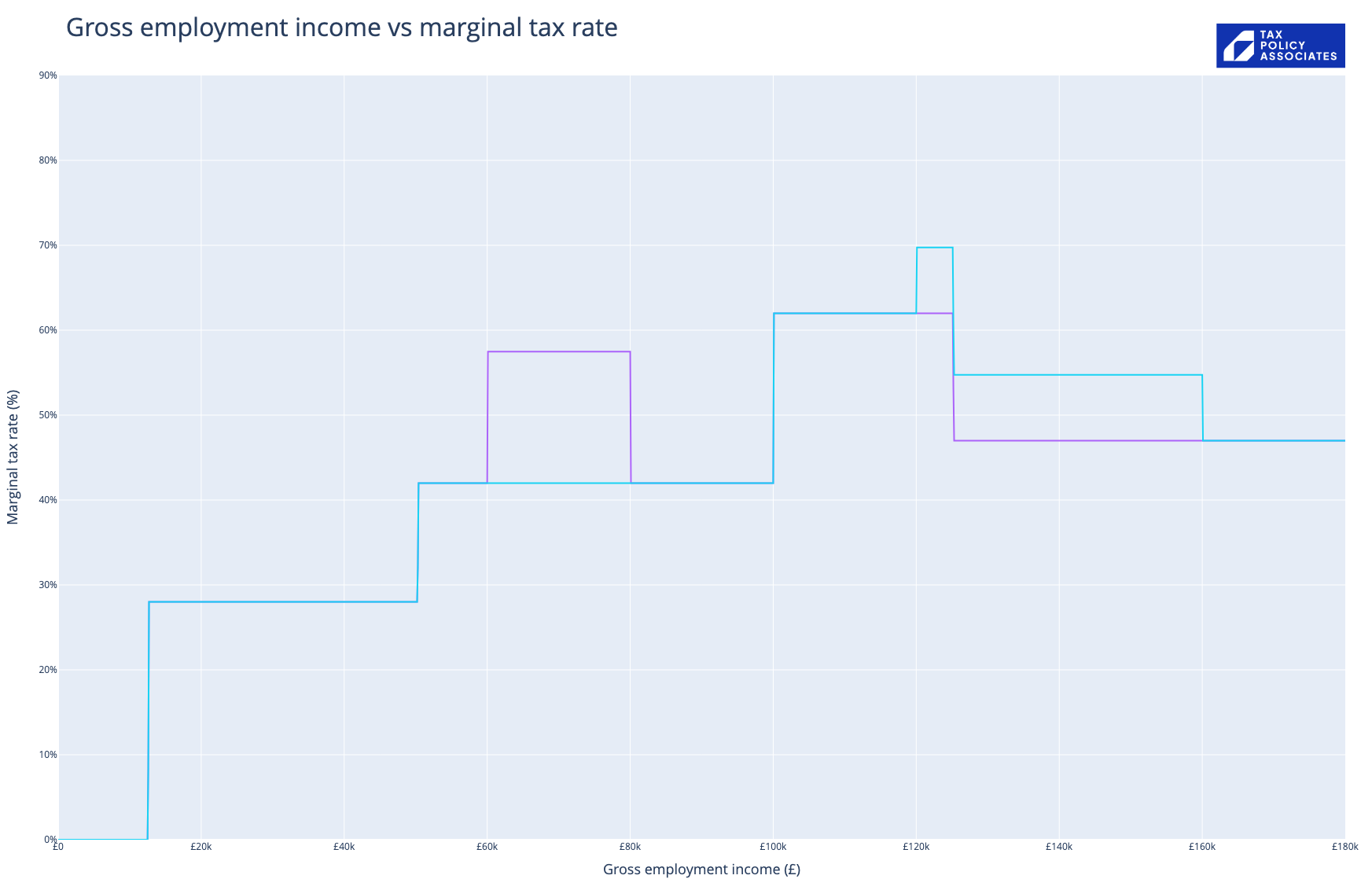
If you live in England1, earn £50,269, and get a £1 pay rise, you’ll pay an additional 28p in tax – 20% income tax and 8% national insurance.
The £50,270 you’re now earning puts you at the top of the basic rate tax band. Get another £1 pay rise and you’re now in the higher rate tax band – and you’ll pay an additional 42p in tax – 40% income tax and 2% national insurance.2
The important thing is that the higher 40% rate applies only to your income above the £50,270 40% threshold. But it’s often suggested that many people don’t appreciate this, and think that the 40% applies to all your income – so that the £1 pay raise results in a massive additional tax bill.3 That is a very significant misunderstanding – but how common is it really?4
I was surprised at the results when I tested this with a Twitter poll:
This should be taken as nothing more than entertainment – Twitter polls are useless as a measure of public opinion.5 Thanks to WeThink, we can now do rather better.
The polling evidence
WeThink kindly included this issue as part of their regular opinion polling (they polled 1,164 people, before weighting).
Our question was:
“Suppose that you earn £50,270, the highest amount in the basic rate 20% income tax band. You get a £1 a year pay rise, and are now in the 40% higher rate tax band. How much additional tax do you think you will pay?”
I think it’s clear that the correct answer is “a small amount”.7 But 50% of the public doesn’t agree:
What about supporters of different political parties?
Given their very different demographics we might expect to see different results. We don’t:8
Scotland
The Scottish rates are different. There is a 21% “intermediate rate” income tax band for earnings up to £43,662, and then a 42% “higher rate” tax band.
But the level of public understanding is almost identical:
How does the result vary with income, education, etc?
One obvious response to his data is to say that, as only a small proportion of the country pays the higher rate, it stands to reason that only a small proportion understand it.
If that were really what’s going on then we’d see a wide variation across polling subgroups, with higher awareness of the correct position amongst graduates, people living in London, and others who statistically are more likely to earn £50k. But we don’t see this at all in the data – the 50-50 breakdown is true across almost all the subgroups.
That said, we don’t right now have enough data to say this definitively – many of the subgroups are too small for statistical validity. So WeThink have kindly agreed to run some more polling so we can get enough data to do proper justice to the question, look in detail at the subgroups, and test the question by reference to income levels.
We’ll be returning to this issue soon.
Why is this important?
It used to be that only a small number of people paid higher rate tax – that is no longer the case. By 2027/28, the IFS has estimated 14% of adults will be in this tax band, which equates to about a quarter of all individual income taxpayers. It’s reasonable to expect that about half of all households will include someone paying higher rate tax at some point in their lifetime. So the higher rate is more important than it ever was.
Our poll findings shouldn’t cause concern that people are paying the wrong amount of tax. Employees are paid by PAYE, which deducts the correct tax automatically. The self employed either use HMRC’s self assessment system (which calculates the tax due) or use an accountant.
There are, however, other potential consequences of a widespread misunderstanding as to how income tax works.
First, and perhaps most importantly, there are anecdotal reports of people turning away work because they believe entering the higher rate tax band will cost them large amounts of money. If that’s true for even a small percentage of the population, then it’s a problem for the individuals in question and the country as a whole. We’d suggest it’s something that HMRC and policymakers should investigate. (We are unlikely to be able to look into this ourselves with further polling, due to the statistical limits of polling samples.)
Second, it would be sensible to assume that other basic tax concepts are equally misunderstood. Policymakers, media and others communicating about tax (including Tax Policy Associates) should try to bear this in mind.
Finally, it means that we should be careful when looking at opinion polling on tax questions: the responses may be based upon fundamental misunderstandings of the question.
Many thanks to Brian Cooper and Mike Gray at WeThink/Omnisis for their generosity in running polls for us pro bono. They ask for nothing in return, and don’t even ask to be credited.
It used to be slightly more because of the High Income Child Benefit charge, but that’s now moved from £50k to £60k. However that doesn’t change the point of this article – the additional tax is still less than the £1 of additional earnings ↩︎
A similar misconception used to exist regarding the Lib Dem policy in the 1990s and 2000s of putting a penny on income tax to increase funding for education. It was often said that many voters believed this meant exactly 1p more tax, rather than a 1% increase in the rate of income tax. I dimly recall there may have been an opinion poll confirming that this was a widespread belief, but I can’t find it now, and the story may be more myth than reality. ↩︎
i.e. because Twitter is not an accurate reflection of the population, my followers on Twitter are not an accurate reflection of Twitter users, and people clicking on the poll weren’t an accurate reflection of my followers. Twitter polls are fun, but are mostly useless. There is an excellent explainer on this here. ↩︎
Note that we forced people to make a choice, and didn’t provide a “not sure” option. The question of whether “forced choice” is the best approach has a long history… I have no expertise in this, and was happy to be guided by the experts at WeThink. ↩︎
Depending on how you read the question, the additional tax might be 14p, 20p, 40p, or 42p – but I don’t think that matters.. the amount is “small” in each case. The only exception is if you have significant savings, due to the loss of £500 personal savings allowance you’re a higher rate payer. For someone with around £12,000 of savings outside an ISA that could mean the £1 tax increase costs them £200 (£500 x 40%). ↩︎
The Lib Dem result is subject to larger uncertainties given the smaller number of respondents – there’s no statistically significant difference between the Lib Dem result and the Labour/Tory result. ↩︎
It’s very hard for normal people to understand tax legislation, and it’s often equally hard for tax lawyers, unless they have a deep familiarity with the rules.
Here’s an example, promoted by the Angela Rayner CGT controversy (although I don’t believe this point has any bearing on her position).1 A couple who are not living together in reality can, nevertheless, be “living together” for tax purposes.
So imagine a couple, with no children, who are married, but keep separate houses and live separate lifestyles (as if they’re dating, but they’re actually married). They are not, in the normal meaning of the term, “living together”. Does that mean they can each have a CGT-exempt main residence?
The legislation
HMRC guidance on divorce and separation says what HMRC think “living together” means. But it’s unclear whether this is just HMRC’s view (which has no legal status) or reflects the law. So it’s always important to look at the actual legislation (which, unhelpfully but typically, isn’t cited by the HMRC guidance).
There is nothing in this section, or near it, that suggests the phrase “living together” has a different meaning from normal English, and someone reading this (tax specialist or layperson) would be forgiven for thinking that the usual ordinary meaning can be applied.
But TCGA ends with an interpretation provision in section 288, and in subsection 3 we see:
Section 1011 of the Income Tax Act 2007 then says:
So our hypothetical “separate lifestyle” married couple may not be living together in ordinary human terms, but they are almost certainly4 “living together” from a tax perspective, unless they have split up.
They aren’t living together, but they are “living together”. Brilliant.
This is really poor legislative drafting. It’s an area highly relevant to normal people, who often won’t be advised, and yet the way the legislation is drafted is impenetrable; misleading, even. How hard would it have been to add a provision to s222(6) TCGA cross-referencing either to section 288(6), or directly to s1011?
Modern legislation is usually better – there was a “Tax Rewrite Project” in the 2000s which aimed to clarify things, for example by including copious cross-references to defined terms. But in this case it didn’t help – take for example this provision of the ITA 2007 which uses the “living together” term without any hint that it’s defined in s1011.
How could anyone get this point right?
Practitioners working in the area will know this point.
For other practitioners, it is always good practice to check the interpretation provisions at the end of an Act before advising, but it’s easy to forget to do this, particularly when a term doesn’t look like a defined term.5 A non-specialist, particularly one in a hurry, could easily assume “living together” is just a simple factual question, and not check. That’s why it’s so dangerous for a tax adviser to advise outside their area of expertise.
For the layperson, it seems to me almost hopeless. You can’t rely on HMRC guidance, and you can’t dip in and out of tax legislation and hope to find the correct rule. I have no answer to this.
For completeness, there are two ways it could in theory be relevant. First, Angela Rayner could have been wrongly advised that the fact she and Mark Rayner lived in separate houses meant that they were not “living together” and they each had a separate main residence exemption. That seems unlikely, but is not impossible if she was advised by a non-specialist. Second, it could be that there are personal circumstances we are unaware of that mean that Angela and Mark Rayner really were separated well in advance of the 2020 date that they announced their separation – but there’s no reason to think that’s the case. ↩︎
That’s not the only CGT consequence of being married. Transfers of assets between spouses aren’t subject to CGT (the original acquisition cost of the asset is “inherited” by the receiving spouse). Again, this is only if they are “living together”. ↩︎
This and the other excerpts I’ve quoted are from the legislation as it stood in 2015, when Angela Rayner sold her property. Tax legislation changes frequently and one always has to look at the legislation as it stood at the time in question (although in this case the changes aren’t material). ↩︎
I say “almost certainly” because it could be argued that s1011(c) applies to a “separate lifestyle” couple. I would say not – my view is that in context it means the couple have split up, but this point is not beyond doubt. ↩︎
In my first week as a tax trainee, a partner (Richard McIlwee, long retired) gave us a fantastic 30 minute talk on statutory interpretation. The key message was “keep reading”. When you’ve read a clause, read to the end of that section. Then read to the end of the chapter. Then read to the end of the Part. Then read the interpretation provisions of the Act. ↩︎
The Post Office’s incompetent compensation process left thousands of postmasters with large tax liabilities. When we revealed this, the Government forced the Post Office to fix the situation – but the Post Office did so far too slowly. New Freedom of Information Act disclosures reveal that, when we identified this new problem, the Post Office’s only concern was the PR impact.And the Post Office continues to cover-up the reasons for its failures.
The Post Office scandal has had three separate phases, with three separate scandals. First, from 1999 to 2015, persecuting and prosecuting postmasters for “shortfalls” which it knew were caused by bugs in its Horizon system, and withholdingevidence which would have demonstrated their innocence. Second, from 2017 to 2021, aggressively and improperly litigating to cover-up its failures, when it knew a core plank of its defence was a lie. Third, from 2021, designing and running compensation schemes to ensure it paid its victims as little as possible.
The Post Office says that it’s changed and is now dedicated to righting the wrongs of the past. But the evidence shows that it continues to prioritise covering-up its misdeeds over doing the right thing.
The incompetence
One small scandal within the compensation scandal was that, when the Post Office designed its HSS compensation scheme, it gave no thought to the tax position of the postmasters. The result was that many saw almost half of their compensation lost to tax. Any competent tax adviser would have identified this issue and suggested solutions; the Post Office either didn’t obtain proper advice, or ignored it. It was incompetent.
When we identified the issue, the Government intervened and, in June 2023, required the Post Office to make “top-up” payments to postmasters to cover their tax liability, and provide them with a letter explaining their tax position. It then changed the law to ensure the “top-up” payments would not themselves be taxable. Everything had been done to fix the Post Office’s mess, and all that the Post Office had to do was run the calculations and get the letters out.
So it was incomprehensible that, by the end of 2023, with the self assessment deadline looming, the Post Office had only made a fraction of the top-up payments. 1,100 postmasters hadn’t received a letter or top-up payment, and were left with a £10k tax bill they’d have to pay without any help or assistance.
This should not have been a difficult task. The Post Office knew what the HSS compensation payments were, and what years they covered. So calculating the amount of the top-up payment should have been a spreadsheet exercise. I’ve spoken to accountants familiar with this kind of exercise (from other compensation schemes), and they think a small team could have calculated the appropriate top-ups in a few weeks.1
However the Post Office was unable to do this after six months. More incompetence.
The sole focus was on the PR
How did Nick Read, the Post Office CEO, react when we reported that the Post Office had incompetently left 1,200 postmasters with a serious tax problem? Did he demand an explanation for this from his team? Did he ensure a solution was prioritised?
There is no sign of Read being surprised by the Post Office’s slow response, much less being disturbed by it. Instead, the sole focus of Read and his team was on the public relations impact. Apparently my twitter thread identifying the issue wasn’t very “helpful”:
The team’s subsequent response showed no attempt to understand, or even recognise, the actual criticism: that the Post Office’s response was unjustifiably slow, and had – completely unnecessarily – left 1,100 postmasters in a difficult position:
I don’t know if this is because they didn’t understand the issue, or were shielding Read from it. Either way, this looks like a dysfunctional management team.
And so, in the end, Read thought it was all okay, because there wasn’t much media pickup of the story:
Read had zero interest in the fundamental question: how come the Post Office had left 1,100 postmasters hanging?
I tried to establish how the Post Office had got this so wrong, and failed to achieve in six months what a competent team of accountants would have achieved in a few weeks. The obvious answer is that they didn’t have enough staff engaged on the task – so I filed a Freedom of Information Act request asking how many staff had been involved.
The Post Office is refusing to tell me:
Needless to say, the idea that telling me the number of staff involved in a project would enable those staff to be identified is daft. It’s a cover-up, and not a very good one. (You can see the Post Office’s complete response here.)
I asked for a review of this decision immediately, on 21 February. The Post Office should have responded within 20 business days. They haven’t responded at all, not even to acknowledge receipt.
The Post Office hasn’t changed. Its only interest is in preserving the little that’s left of its own reputation.
Footnotes
A few would have been trickier, for example where the postmaster operated their business through a partnership or company; but reasonable simplifying assumptions could have been made. ↩︎
The Post Office’s offers of compensation under its “HSS” settlement scheme were often insultingly low. But it falsely claimed the offers were confidential, and couldn’t be shown to anyone. That resulted in most being accepted; in 90% of cases the postmasters didn’t even take legal advice. The Solicitors Regulation Authority has now ordered the Post Office to stop making this false confidentiality claim. But it’s too late – most of the settlements are now completed. The Post Office has again succeeded in using unethical legal tactics to minimise compensation payouts.
The Horizon Compensation Advisory Board then took the matter up – it’s published its correspondence with the Post Office and the SRA. The outcome is that the SRA has ordered the Post Office to cease its behaviour, and the Post Office has reluctantly taken a “policy decision” to do so.
The correspondence between the Post Office and the Advisory Board suggests the Post Office never had any genuine legal or commercial basis for its approach. The purpose was to minimise compensation. The Post Office’s legal response to the scandal has been notable for its unethical legal tactics throughout;1 this was just another.
What the Post Office did
When the Post Office made settlement offers to postmasters under its “HSS” scheme, it included this paragraph saying that postmasters couldn’t discuss the offer with anyone:
These were mostly old, vulnerable, people who’d suffered tremendously. Preventing them speaking to anyone had consequences. Postmasters weren’t able to compare compensation terms with each other. They weren’t able to speak to family or friends (who might have suggested they speak to a lawyer). And they weren’t able to write to their MP, or speak to reporters.
Probably as a result, 90% of postmasters never instructed a lawyer.2 Many received derisory amounts of compensation.
I believe the Post Office’s imposition of confidentiality was responsible for all this. And it was a lie. The letters weren’t confidential at all.
Where the Post Office was making an offer, then it was perfectly proper for it to say its offer is made “without prejudice”. That’s a common law doctrine that prevents statements made in settlement discussions from being adduced as evidence in court. But “without prejudice” is a form of legal privilege, and not a rule of confidentiality – the claim that the “without prejudice” label stopped the postmaster showing the letter to third parties was false.
Worse, the paragraph was included on all settlement offers, even “nil offers” where the Post Office was offering nothing. In those cases it was entirely improper to claim the letter was “without prejudice”, because it wasn’t an attempt to settle a dispute, just a denial of liability.
There was never anything to stop recipients of the HSS offers from sharing them with other postmasters, friends, or journalists, or indeed publishing them (although it would be advisable to redact identifying details, to prevent any future court from seeing publication as an attempt to circumvent the “without prejudice” rule).
The Post Office’s lawyers surely knew this. I believe this was a deliberate and cynical tactic to minimise compensation.3 It was a breach of professional ethics by the lawyers involved – the in-house lawyers at the Post Office, and also their external lawyers, Herbert Smith (if they were involved – it’s not clear if they were). That breach is all the more serious given that the lawyers knew that the vast majority of the recipients of these letters would be unrepresented.
The Post Office’s defence
The Post Office provided several defences in correspondence with the Advisory Board in December 2023 and January 2024:
This explains why the letters are “without prejudice”, and why the Post Office want the communications to be confidential, but it doesn’t explain why the Post Office thinks that the letters are confidential.
“Nobody else has complained” is not a legal argument, and in any case it’s the unrepresented postmasters who suffered prejudice.
Then:
This is deeply patronising. Postmasters should be able to choose whether or not to share their offers, and make their own decisions about their privacy. But in any case, this isn’t a legal defence of the Post Office’s position.
And here’s the Post Office’s defence of claiming that “nil offer” letters were “without prejudice”:
A nil offer is not an offer of settlement and the “without prejudice” doctrine does not apply. The Post Office’s wish “to be consistent” is not relevant.
This correspondence suggests to me that the Post Office never had any genuine legal or commercial basis for its approach. It was always about minimising compensation.
The SRA response
The SRA doesn’t normally write to lawyers and tell them to stop doing something; that’s not its role. It investigates solicitors where there may have been a breach of SRA standards and regulations, and in extreme cases it intervenes to shut down firms.
But in this case the SRA has acted decisively – this is from their letter to the Advisory Board of 31 January:
Note the key points: the SRA says that “without prejudice” cannot unilaterally impose a duty of confidentiality, and that in any event the term should not be used when the Post Office is asserting it has no liability.
The Post Office’s response
The Post Office has now said it’s made a “policy decision” to cease the “without prejudice” labelling. It is not even trying to defend its previous position that the labelling enabled it to unilaterally assert that its offers were confidential.
and:
This is disingenuous. Nobody ever doubted that it was acceptable to label settlement offers “without prejudice”, so the fact the Post Office received external legal advice on this point tells us nothing.
But look at what is missing: a statement that the Post Office received external legal advice that its assertion of confidentiality was appropriate, or that it was acceptable to label nil offers “without prejudice”. The obvious inference is that the Post Office wasn’t acting on the basis of external legal advice at all. But it proceeded to mislead postmasters, and continued even after being put on notice that its position was wrong.
If that is correct, it’s scandalous.
What should happen next?
At least 1,726 settlements were agreed with postmasters who never received any legal advice, off the back of settlement offers that falsely claimed to be confidential. The Post Office behaved oppressively, and all these settlements should be reopened, with the Post Office having no role in the settlement process.
The SRA’s investigation into the Post Office’s internal and external lawyers is necessarily highly complex and will, I expect take years to resolve. The “without prejudice” issue, by contrast, is freestanding and should be relatively straightforward. I hope that the SRA can accelerate it.
Thanks to the Advisory Board for pursuing this matter, and The Times and Channel 4 for reporting it. Thanks also to B and K for their assistance on the law of confidence and the “without prejudice” doctrine, and C and X for sharing their practical experience of confidentiality provisions in settlements.
As of 4 April 2023, 1,924 settlements had been entered into. The Post Office agreed to cover limited legal fees for postmasters receiving offers, but as of that date the Post Office had covered legal fees of only 198 (see our FOIA correspondence, linked here). Given the age and limited resources of most of the postmasters, it is reasonable to take from these figures that around 90% of the postmasters had no legal representation. ↩︎
Settlement offers aren’t usually stated to be confidential at all, for the very good reason that confidentiality can’t be unilaterally imposed. Final settlements, on the other hand, often are confidential (sometimes improperly), but that is typically achieved by a separately negotiated NDA/confidentiality agreement, not just an assertion by one party. There would usually be a list of people to whom disclosure could be made (such as family members, lawyers and insurers). Two experienced defendant tort barristers have told they would personally be uncomfortable negotiating a confidentiality agreement if the claimant was unrepresented. So the behaviour of the Post Office was as unusual as it is troubling. ↩︎
Less Tax for Landlords was the trading name of the One Consultancy Group. It was badly named, because its incompetence means many landlords are now paying more tax. Most of LT4L’s key staff were salesmen who, by their own admission, know nothing about tax. They relied on LT4L’s co-founder Chris Bailey.
Bailey was previously severely reprimanded by the Association of Chartered Certified Accountants (ACCA), and subsequently ceased to be a member. He’s now been reprimanded and fined by the Institute of Chartered Accountants in England & Wales (ICAEW), and then expelled by the ICAEW for failing to pay the fine. We don’t believe any of this has been disclosed to his clients.
So Bailey is now completely unregulated – we don’t believe that’s been disclosed to his clients (although his colleagues apparently knew). Just one more reason (on top of their incompetent advice) why LT4L should not be acting for anyone, and why their clients should urgently be seeking independent advice.
ICAEW
Bailey was reprimanded by the ICAEW in a disciplinary decision on 20 December 2022. He was accused of submitting tax returns for a client over four years without her authorisation, and then corresponding with HMRC about that client – again without her authorisation. From April to September 2020, Bailey failed to reply to enquiries from the ICAEW’s professional conduct department. He was therefore reprimanded, and agreed to pay a fine of £10,000 plus £4,285 costs.
Chris Bailey has sent me a statement in which he denies any wrongdoing, but says he lost all his emails and so couldn’t prove he’d obtained the clients’ authorisation. He doesn’t explain why he didn’t respond to the ICAEW’s emails for six months. Bailey says he appealed; that’s not what the ICAEW told me, and seems inconsistent with the fact that he agreed to the reprimand and fine.
Bailey’s explanation for not paying the fine is that Barclays erroneously restricted access to his accounts. It’s unclear how that could have happened without Bailey being aware of it.
And Bailey says he’s in the process of rejoining the ICAEW. However the ICAEW told me it’s not aware of an application from him.
An ICAEW spokesperson told me:
“Christopher Bailey has ceased to be an ICAEW member and this decision will be included in our next monthly Disciplinary Orders and Regulatory Decisions publication, in line with our processes.
“We encourage anyone who thinks they have had contact with someone holding themselves out as an ICAEW member when their membership has been cessated to contact our Professional Standards department.”
Because Bailey’s membership has ceased, the ICAEW says (not unreasonably) it’s not in the public interest to pursue our complaint about Bailey’s actions, but I expect they will take our complaint forward if/when Bailey applies to be readmitted.
ACCA
At around the same time, Bailey was disciplined by the Association of Chartered Certified Accountants for failing to provide audit files when requested. He provided a series of excuses for this: he first said he needed more time, then claimed the clients were audit-exempt, then claimed the files were offsite, and finally blamed a software issue. He was found guilty of misconduct and severely reprimanded.
The ACCA accepted that the failure to disclose was not deliberate; it is not clear how they came to this conclusion, given his successive contradictory excuses.
Some time after the ACCA decision, Bailey’s ACCA membership ceased.
There’sacampaignclaiming that you can legally stop paying tax to protest the war in Gaza, or even that it is illegal for you to pay tax. None of the claims have any legal basis – they originate in a racist US anti-tax cult. The man behind the campaign used the same arguments to try to avoid paying council tax in 2016 – he failed and spent Christmas in jail. The claim that you can legally stop paying tax is therefore either deluded or dishonest.
UPDATE 8 June: we reported today on another version of the same conspiracy theories, this time using them to profit from charging fees to vulnerable people in debt
UPDATE 6 May 2025: the “no tax for genocide” campaign now admits that it’s not lawful (or indeed required) to withhold tax. Instead they propose requesting refunds from HMRC.But Chris Coverdale continues to make false claims that it’s legal (indeed, required) to not pay tax, and to publish a nonsensical “trust deed” that supposedly facilitates this.
The claims
The various websites1 makes a series of legal claims:2
The trust document is posted here. The first paragraph of the trust refers to the signatory being a “sovereign man/woman”. This wording is legally meaningless and comes straight from the US sovereign citizen movement, which has its origins in a fringe racist group and the KKK. “Sovereign citizens” have used arguments of this kind to try to escape US tax, without any success. It’s also notable that the document says it’s a deed, but isn’t – whoever drafted it hasn’t even bothered to google the word “deed”.
Here’s the key section of the document (the “Primary Beneficiary” is the Government):
The idea that we can individually “withdraw our consent” to tax or other laws is (obviously) false but, again, a common theme in sovereign citizen propaganda.5 If people could legally stop paying tax any time they disapproved of the government, the government would long since have run out of money.6
A further sign that the document originates in the US is that the trust is said to be “revocable” – revocable trusts are a US legal concept which have no equivalent in the UK.7 The consequences of signing such a document would be complex and uncertain – the trust may not be a substantive trust at all as drafted and, if it is, would give rise to a very messy tax position. One prominent trusts expert told us it would be a “disaster” for the person signing it, if it actually was recognised as a trust. Certainly nobody should do such a thing without detailed tax and trust advice.8
The “trust” then supposedly remains in place until a series of very specific and very unlikely things happen:
Which in practice means that you are stopping paying tax forever.
It’s unclear how much reality the trust has, even in the minds of the people running this scheme. At least one has confessed they just spend the money. Others have talked about putting a cheque in an envelope in a drawer.
So the “trust deed” appears to be neither a trust nor a deed.
Coverdale describes himself as a “behavioural scientist, governance consultant, peace campaigner and memetic engineer.” Despite having been prosecuted for failing to pay tax, he said in January 2023 that you can’t be prosecuted for failing to pay tax:
In our view, Coverdale is either dishonest or delusional.
HMRC and councils pursue people for non-payment of tax all the time. They’re not going to behave any differently just because you wave a funny trust document at them.
The campaigners have the additional practical problem that most people pay don’t actually pay income tax – their employer deducts it under PAYE. The campaigners have an answer to this problem – ask HMRC to stop PAYE:
We expect most people will realise immediately that this doesn’t work – you can’t stop your employer deducting PAYE by notifying HMRC that you wish the money to go into trust (and tax evasion would be very easy if you could). The law requires employers to apply PAYE, and HMRC has no discretion to disapply the law.9
We don’t know who the “team of experts” are, but we would be surprised if they include any tax advisers or lawyers.10 We don’t believe any qualified lawyer or tax adviser would agree with any of the claims made.11
The context
There is a long history of people protesting by withholding tax: the Peasants’ Revolt against the poll tax; the US colonists protesting against the Tea Act, the Women’s Tax Resistance League demanding equal voting rights, the 1989-91 anti-poll tax campaign. The protesters in these cases knew that their actions were illegal, but believed they were justified by wider moral considerations.
In recent times there has been a different type of tax protester. Not paying tax is central to their worldview, rather than just a tactic they adopt. They claim that they have found a “true” legal system which lets them walk away from tax and other inconvenient laws. It’s part of what adherents call the “sovereign citizen” or (particularly in the UK) the “freeman on the land” movement, which has its origins in the racist far-right in the US (although, oddly, UK followers seem to be found on the Left as much as the Right.)12
A better term for these movements is “pseudolaw” – the use of arguments that sound legal, but in fact are no more than gobbledegook, and the belief that correctly worded documents (like this trust) have almost magical power.13 There is a very complete analysis of the history of these arguments in the Canadian decision Meads v Meads (summarised in this post by barrister Adam Wagner). More recently, respected criminal barrister and blogger CrimeGirl has written an excellent summary of reported UK pseudolaw cases, and the “Secret Barrister” has written about pseudolaw arguments deployed to try to escape Covid regulations.
The most famous modern tax protester is Hollywood star Wesley Snipes – he used sovereign citizen arguments to avoid paying $15m of US tax, and was jailed for three years as a result. We don’t have any evidence for how widespread the modern UK tax protest movement is, but the prominence of the issue on council websites suggests it is more than a small fringe.
One thing all the various strains of sovereign citizen/freeman on the land have in common is that they behave like a cult, following charismatic leaders and believing to a fanatical level of religious certainty that their pseudo-legal beliefs are correct, regardless of the evidence.
What about the war in Gaza?
We are commenting on the law, and take no position on foreign policy, defence policy, or the war in Gaza. However, Gaza doesn’t seem to be the genuine inspiration behind this campaign – the people behind it have been runningthesame tax argumentsforyears. The US sovereign citizen movement they’re inspired by, and from where they’ve taken both their arguments and their pseudo-legal documents, has its origins in a fringe racist group and the KKK. These are arguments that have been rejected time and again by the courts in the US, UK, Canada and Australia.
Anyone who wishes to protest by not paying tax should be aware that this will break the law – that’s what civil disobedience by definition is. If someone believes that’s ethically justified, and is willing to take the legal and financial consequences, then we can respect their choice. But we can’t respect campaigners misleading people with false claims that you can legally stop paying tax.
Many thanks to criminal barrister Sarah McGill of Lincoln House Chambers for reviewing a draft of this article, and to C for the trusts tax expertise.
Footnotes
This and many of the other links in this article are tagged “nofollow”, which means that they should be ignored by search engines, and so won’t boost the internet profile of the websites. ↩︎
This is the kind of fringe thing we normally wouldn’t comment on, for fear we’re just giving it further publicity. But now it’s broken into the mainstream, including a disappointingly credulous piece in the Telegraph, we thought it would be helpful to comment. ↩︎
With the obvious exception of tax treaties, at least some of the time. ↩︎
When we were a member of the EU the position was in some cases different, as a UK law could be overriden by EU treaties or legislation. But this was only because Parliament permitted it to be different. ↩︎
This seems to be a variation on the normative fallacy. Sovereign citizens believe that individuals should be able to freely choose to opt out of the legal system that applies to everyone else – a valid political/philosophical view. However they then make an invalid leap of logic to the position that individuals in fact are able to opt out of the legal system. ↩︎
The reference to the trust being “discretionary” also makes no sense, because as drafted there is no discretion. Whoever drafted it appears to have been throwing words at a page. ↩︎
Trusts are nowadays not a good way of avoiding tax, because there’s an immediate 20% inheritance tax charge when you put property into trust. Things are different for non-doms, as they don’t generally face the 20% charge if they put foreign property into a foreign trust, and so trusts remain a very important way for non-doms to minimise their UK tax (or avoid UK tax, depending on your viewpoint). ↩︎
Although lawyers and advisers may have different views on whether those promoting this scheme have any liability under civil or criminal law. Our initial view was that the rules requiring disclosure of tax avoidance schemes won’t apply, because the promoters here are not acting in the course of a business; however it now seems they charge a monthly subscription, which suggests DOTAS could well apply. And if the promoters are aware that their scheme does not work (and Coverdale’s conviction suggests they might be) then they could be criminally liable for conspiracy to defraud the revenue. The IRS in the US has successfully pursued fraud charges against people organising sovereign citizen tax protest schemes. ↩︎
Obviously by analogy with pseudoscience, although it appears to us more akin to a “cargo cult” – it’s trying to summon legal effects by mimicking legal language. ↩︎
Thanks to pollsters WeThink, we polled public attitudes to paying more tax to provide the NHS with additional funding. We found a majority against raising tax, and few of those in favour of raising tax willing to pay more than £100 per year.
There may no longer be a majority in favour of increasing tax to pay for NHS spending
We first asked a simple question: “Do you think taxes should be increased to pay for additional NHS funding?”:
I was surprised to see a majority against increasing tax.1 Historic YouGov polling from 2017, 2018 and 2019 showed a majority in favour of raising income tax to fund the NHS. Recent YouGov polling has showed this majority reducing somewhat. Our result may be a further development of that, or it may result from polling differences.2
Women are more strongly against increasing tax to fund the NHS:
Regional variation is limited, with the striking exception of Wales:
But we get more of a clue as to what’s going on if we break it down by age:
Perhaps it’s unsurprising that people who use the NHS more, and pay less tax, are more willing for tax to go up to pay for additional NHS funding.
And high earners are less in favour of raising tax:3
Supporters of higher tax are willing to pay more tax themselves, but not much
Contrary to what some cynics might believe, the vast majority of those in favour of increasing tax are willing to pay more tax themselves:
But only to a very small degree. Very few of those people are then willing to pay more than £100/year in additional tax:
Willingness to pay goes up with income, but not enough to make much difference – the majority of people earning £60k or more aren’t willing to pay more than £100:4
The detailed tables don’t show much variation by age, region or education.
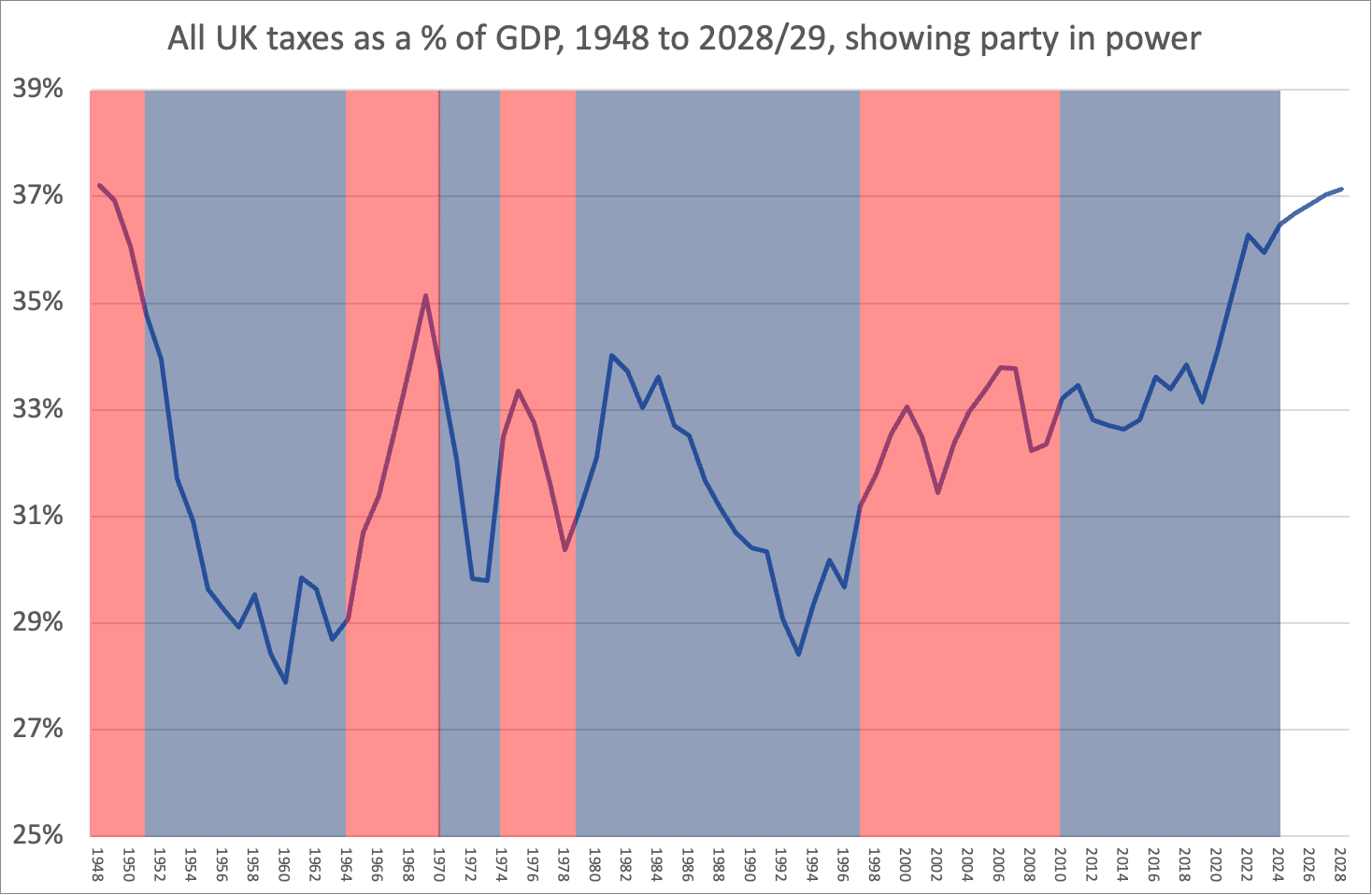
The reluctance by UK voters to pay additional tax either reflects, or causes, the UK to have one of the lowest overall rates of tax on average earners in the developed world. This statistic – the proportion of gross wages paid in tax – is often called the “tax wedge”, and the OECD provides data for 2022 which looks like this:
It’s even more dramatic than that, because those countries with a lower tax wedge than the UK, have a smaller state than the UK.
Another way to put that is: every country in the world which has higher public spending than the UK (as a % of GDP) also taxes the average worker more than the UK:
As the IFS points out, average earners in the UK have seen their tax burden fall over the last few years (with the overall tax increase borne by higher earners).
The relatively low income tax paid by an average earner in the UK, and the fact that this has fallen in recent times, is very rarely heard in public discourse. Indeed I’m not sure I can ever recall a politician making it.
This might explain why, despite widespread unhappiness with the state of the NHS, politicians are so unwilling to raise taxes significantly, and instead resort to gimmicks.
If you’re on the Left and you don’t talk about this, or your response is to question the statistics, then you’re in denial.
These polls are what happens when you want European-style public services, but think you can achieve it without European-style tax.
We can (and in my view should) raise additional tax from the wealthiest. But those who want to see significantly expanded public services need to either accept that means most ordinary people paying more tax (and advocate for that!), or believe that the UK can do something no country in the world can, and fund European levels of spending solely by taxing above-average taxpayers. I don’t think that’s possible. You’re free to disagree with me – but you need to understand you’re arguing for something that literally nobody has achieved.
I’m keen to explore more about public attitudes to tax using questions with actual numbers, rather than asking people generalities. Please do drop me a line if you have any suggestions for topics and approaches. When we commission a poll we will always publish its findings in full.
Many thanks to WeThink for conducting this polling for us pro bono – they didn’t even ask to be credited. The polling was conducted by WeThink on 14-15 March 2024, questioned 1,270 people and is weighted to a national representative population. The full tables are available here.
Footnotes
Other parties are included in the data, but I don’t show them here because the numbers are too small for statistical significance. ↩︎
Note that YouGov specifies income tax; we didn’t specify which tax we’d raise. YouGov also gives a “not sure” option and we did not. The question of whether “forced choice” is the best approach has a long history… I have no expertise in this, and was happy to be guided by the experts at WeThink. ↩︎
I’ve combined the £60-80k, £80k-100k and £100k+ brackets in the data because otherwise the numbers are too small to be statistically valid. ↩︎
I’ve combined earning brackets and additional tax amounts to achieve statistically validity. We would need a much larger sample than that obtained by normal opinion polls to obtain statistically valid results for those on £100k+ incomes. So, tempting as it is to look at the raw numbers, and snigger at the 26% of people earning £100k are only willing to pay £10 more tax, these numbers are subject to massive uncertainty and shouldn’t be used. ↩︎
Until last week’s Budget, someone earning £50k with three children under 18 faced a marginal tax rate of 71%. That was deeply unfair to those affected, and damaging for the country as a whole. So it’s great news that this marginal rate has been cut to 57% – about 500,000 families will benefit. But other high marginal rates remain in the tax system – the challenge is how to fix them fairly, without the burden falling on people on lower incomes.
In the run up to the Budget, we and many others were concerned about the very high marginal tax rates hitting parents earning £50-60k. This chart shows how the marginal tax rate (y axis) varies with gross employment income (x axis) for someone with three children under 18:
(If you click on this chart and the others below, you’ll go to an interactive version that lets you see the effects of the various different marginal rates for the UK and Scotland).
The “marginal tax rate” is the percentage of tax you’ll pay on the next £ you earn. The tower at the £50-60k point shows the marginal rate hitting 71%. The reason: the phasing out of of child benefit (via the “high income child benefit charge”) that started at £50k. So when your earnings hit this level, you’d take home only 29p for every £ you earned. For many people that wasn’t worth it – so they chose to work fewer hours. That’s bad for the UK as a whole.
This is why the marginal rate is so important – it affects the incentive to work more hours/earn more money.1
The marginal rate of tax in the UK for high earners in theory caps out at 47% (45% income tax plus 2% national insurance2) once you get to £125,140. I’m not terribly convinced this disincentivises anyone to work (and I spent many years working in an environment surrounded by colleagues and clients paying tax at this rate). But once you get to marginal rates of well over 50%, things are very different.
The Hunt solution
I’d like to see a complete end to the child benefit taper, paid for by a slightly higher tax rate on high earners. Jeremy Hunt didn’t do that. But he pushed out the start of the taper from £50k to £60, and made the phasing gentler, running from £60-80k instead of £50-60k. That, and the national insurance change, means the chart now looks like this:
We can overlay the two – 2023/24 in red and 2024/25 in orange (although it’s not terribly readable; you can play with the different rates on the interactive version of the charts here):
The longer taper period means that the top marginal rate has fallen from 71% to 57% – but of course this rate applies across a wider range of incomes. A less serious effect, but more people affected.
This cost about £660m:
And more radical change is promised. One of the unfairnesses of the child benefit taper is that it applies to a household if one earner hits £60k in income; it doesn’t apply if (for example) there are two earners, both on £59k. The promise is that this will be fixed by applying the high income child benefit charge to household income, not individual income. That faces a number of practical and technical challenges. I’d simply abolish the taper and the high income child benefit charge altogether.
What’s the highest marginal rate now?
Even after Hunt’s reforms, with three children under 18, the tapering of child benefit takes the marginal rate to 57%. It’s very odd that someone earning £60-80k has a higher marginal rate than someone earning £1m.
And there are other anomalies.
Personal allowance taper
The personal allowance – the amount we earn before income tax kicks in – starts to be tapered-out if your salary hits £100k, and is gone completely by £125k. That’s responsible for the second tower on the chart above – a marginal rate of £62% between £100k and £125k.
And if we add in student loans, which are really just a complicated hidden graduate tax…3
… we see a top marginal rate for someone earning £100k of over 70%. This isn’t just theoretical – we’ve received lots of messages like this:
That’s a problem for all of us, just not just those personally affected.
There’s not much popular appeal in cutting taxes on people earning £100k. But it would be the right thing to do – the challenge is how to do it without increasing the tax burden on people earning less. The obvious answer is to slightly increase tax on everyone earning more than £100k – for example with a new 45% marginal rate on people earning £100k and a new 48% rate on people earning £125k.
But the tax raises required to fund an end to the taper may be significantly less than this, given the widespread “avoidance” of the 60+% rates by people making additional pension contributions, or simply working fewer hours/turning away work.
Childcare subsidy
The Government has created a new childcare support scheme for parents with children under 3. This could be worth £10,000 per child for parents living in London, once both parents have income of £7,904. And it vanishes completely once one parent’s earnings hit £100k. That does impossible things to the marginal tax rate:
That’s a marginal rate of -20,000% when the parents become eligible for the childcare, and a marginal rate of 20,000% when they lose it at £100k.4.
It’s easier to see what this means if we plot the gross salary vs the net salary:
As your income hits £100k, you lose £20k of net income, and that doesn’t recover until you earn £154k. Clearly no rational person in this position would earn between £100k-£154k if they had a choice, and that’s a deeply irrational result.
This all relates to the new childcare subsidy, and not the pre-existing tax-free childcare scheme, which also vanishes at £100k. The benefit of tax-free childcare are less (usually under c£7k/child) so the curve for that looks less dramatic. However, as the scheme applies to children under 11, taxpayers feel these effects for many more years.
Where next?
If a political party went into an election promising a tax system with these marginal rates, there would be uproar. But instead, we’ve drifted into this disaster over many years, with the topic entirely absent from public debate.
That’s now changed – and that’s a good thing for the country as a whole. The challenge is how to make further progress, and eliminate anomalous marginal rates without raising tax on everyone else.
And the other key challenge, particularly for the next Government, is resisting the temptation to introduce further tapers into the tax system.
Official portrait of the Chancellor of the Exchequer Jeremy Hunt by Andrew Parsons / No 10 Downing Street. Crown copyright.
Footnotes
Everything interesting happens at the margin. For more on why that is, and some international context, there’s a fascinating paper by the Tax Foundation here. ↩︎
Note that I’m not including employer’s national insurance here. Employer’s national insurance is absolutely a tax on labour in the long term, because it reduces pay packets in the long term. But it’s not usually included in a calculation of a marginal tax rate, because it’s not economically passed to you in the short term, and so it won’t rationally affect your decision whether or not to work more hours. There’s a good explanation of this point here.↩︎
For someone starting university between 2012 and 2023, you pay 9% of your salary over £27,295, until the loan is repaid. Of course, the effect on individuals – even those on the same income – will vary widely, depending on how much loan they borrowed, how long they’ve been earning, and how their salary ramped up over time. ↩︎
The 20,000% figure is rather arbitrary, and a result of the code having a resolution of £100 of income . If the resolution was 1p then the marginal rate would be 200 million percent. But the concept of a marginal tax rate doesn’t really work in this scenario ↩︎
This interactive chart lets you see the current rUK and Scottish marginal tax rates for 2023/24 and 2024/25, with/without child benefit and student loans. You can turn on/off different years and options by clicking on the legend below the chart. Some of these charts won’t work well on mobile; you can see static versions here.
This interactive chart plots the same data, but gross income vs net income:
Finally, this chart again plots gross vs net income, but adds in the effect of the marriage allowance and a £20k childcare subsidy:
Income tax/NI as for tax year 2023/24 and 2024/25 in the UK and Scotland (but applying the September 2023 national insurance change as if it applied for the whole of 23/24)
One earner in a household, who is over 21 and not an apprentice, not a veteran, and under the state pension age
Ignores benefits aside from child benefit (although benefits are notorious for creating very high marginal rates – not, however, an area where I and our team have expertise). Child benefit assumes three children (you can freely change that in the code).
Doesn’t include tapering of pensions annual allowance (starting at £240k)
Do please send us any corrections, additions or comments.
A very strange High Court decision was just published – Webster v HMRC. It reveals that an unknown person or company is engaged in an international strategic litigation campaign to block international tax and transparency initiatives, and is going to great lengths to remain anonymous.
On the face of it, this case is about FATCA.
It used to be easy to evade tax on your income. Open an offshore bank account, put your money in that, and HMRC would likely never find out.
That changed in the mid-2010s. The US created FATCA, which forced governments all over the world to require their banks to report US citizens’ bank accounts to the IRS. The rest of the world first complained this was outrageous, Yankee imperialism, then decided it was a brilliant idea.
The outcome was the OECD common reporting standard (CRS), which does much the same thing for most countries in the world.1 On the face of it, Ms Webster is seeking a declaration that HMRC’s reporting of her UK bank accounts to the US was unlawful. But the implications are very wide. If she succeeded, it’s likely that reporting under CRS would also be unlawful. And if a UK court reached that view, we could easily see courts across the world, striking FATCA and CRS legislation down. This would be a disaster.
It became clear in the course of Ms Webster’s litigation that her claim was funded by an anonymous third party which was running “an international strategic data protection litigation campaign” seeking to block the implementation of tax and transparency measures:
This could be someone with a genuine ideological belief that an individual right to privacy is more important than countering tax evasion (a kind of libertarian equivalent of the Good Law Project). But it is also possibly something more sinister: a person with something to hide, using this litigation to block the rules that prevent its secrets from being uncovered – that would (of course) be entirely improper. So HMRC added abuse of process to its defence, and obtained a court order seeking disclosure of the identity of the funder.
At which point Ms Webster said she didn’t know – only her lawyers, Mishcon de Reya, knew the identity of the funder.
This judgment concerns an attempt by Ms Webster (or, more likely, her funder) to strike out the abuse of process defence, so the funder’s identity doesn’t have to be disclosed.
It did not go well:
Indeed the judge, Mrs Justice Collins Rice, seemed rather concerned at what was going on:
So it seems either the mysterious funder will have to step out of the shadows, or the case will have to be dropped. A successful appeal against this judgment is unlikely.
Which begs the question: who is the mysterious funder, and what else are they up to in their “international strategic litigation” to block tax and transparency initiatives?
We don’t have to look very far. The biggest reversal to recent transparency initiatives was the 2022 decision of the CJEU to block public disclosure of beneficial ownership of companies across the EU.2 And the law firm involved in that?
So we don’t know who is behind this campaign, and we don’t know what else they’re up to, but it’s a reasonable inference that they’ve had one huge success already.
There was an intriguing report from Sky News yesterday that UK Finance had warned its members that 800 fraudulent forms discharging the liabilities of 190 companies had been submitted to Companies House.
UPDATE: it turns out this article was completely wrong, and the story was actually much weirder, involving a “sovereign citizen” acting in a very bizarre way. We’ll keep the article up because it demonstrates a Companies House vulnerability, albeit one that has hopefully now been closed.
The report doesn’t make at all clear what the fraud was. Often it’s a bad idea to make details of frauds public. In this case we think there’s a public interest in revealing how the fraud works, both so companies can protect themselves against it, and so policymakers can see what the underlying vulnerabilities are, and how they can be fixed.
Our informed guess is that the fraud looked like this:
Let’s take a random business – call it Amalgamated Widgets Ltd.
Amalgamated Widgets Ltd currently has a £1m loan from MegaBank, secured by a mortgage.
The fraudsters submit a fraudulent form MR04 to Companies House, supposedly on behalf of MegaBank, saying that the mortgage has been discharged. This doesn’t need to be a very sophisticated fraud. You could probably sign the form “xxx” and Companies House would accept it. There is an excellent guide to MR04 here, from law firm Stevens & Bolton LLP.
The fraudsters then steal Amalgamated Widgets’ identity. Perhaps the fraudsters have hacked Amalgamated Widgets’ email system; perhaps they intercept the post; perhaps they just use social engineering; perhaps all of the above and/or something else. But this is a fairly sophisticated fraud.
The fraudsters now pretend to be Amalgamated Widgets and apply for a new £1m secured loan from FriendlyBank. FriendlyBank sees the repaid MegaBank loan and thinks it’s perfectly rational that the company would be looking for a new loan to replace it.
The fraudsters would probably need to fool a law firm into acting for them (because FriendlyBank would be suspicious if Amalgamated Widgets Ltd didn’t have a law firm acting for it). Or maybe the fraudsters have their own corrupted or fake law firm. Either way, this again requires quite a sophisticated fraud.
Once the loan is granted, the fraudsters arrange for FriendlyBank to deposit the £1m loan in an account controlled by the fraudsters. Given that the fraudsters impersonated Amalgamated Widgets to apply for the loan, it’s not going to be too much of a challenge for them to set up an account in its name.
The fraudsters then take the money and disappear.
FriendlyBank has lost the £1m – its security will be void and it will have to try to track down the cash. Fraud unravels everything – so Amalgamated Widgets probably won’t be liable to FriendlyBank, and MegaBank’s original security will still probably be good.
Who is to blame?
There may well have been failings by Amalgamated Widgets (e.g. if its email got hacked), FriendlyBank (if it could have spotted the fraud), and any lawyers acting for the fraudsters (they’re either bent, or had an AML disaster). Maybe a corporate services provided got hacked and that gave access to hundreds of companies’ Companies House login details?
The Sky article suggests that perhaps Companies House was hacked. I very much doubt that was necessary. When you can register as a director in the name of Adolf Tooth Fairy Hitler, then filing an MR04 in the name of someone else isn’t terribly challenging. I expect, rather than file 190 paper forms (which would be tedious), the fraudsters created a Companies House account and then automated the process.
We are back to Companies House being a “giant fraud robot” – an incredibly efficient system which will accept anything that’s filed with it without verification. I say “potentially” because it looks like the banks did Companies House’s job for it, and spotted the problem – hopefully before the fraud had claimed any victims. But of course it’s possible that there are many similar frauds going on under the surface.
The question is whether the planned Companies House reforms will improve matters. I’m afraid I’m sceptical. Identity requirements for people making filings should in principle be a straightforward change, but on its own is insufficient – Companies House needs systems and people who can proactively identify suspicious transactions The banks took decades to build their current KYC systems. They’re very sophisticated, and far from perfect – but make financial malfeasance far more difficult than it was in the past. It’s very ambitious to think that Companies House can build something comparable within a few months.
For the moment, it would be wise for companies to regularly check the Companies House website for any suspicious changes.1
Thanks to Matthew Letts, I and T for their insight into how the fraud may operate.
Footnotes
I expect the banks do that already, and that’s how the fraud was caught. ↩︎
Barrowman’s notorious PPE contract was in the name of PPE Medpro Limited, a UK company. The company has a “shadow” – there’s an identically named Isle of Man company controlled by Barrowman. This is highly unusual – and we’ve found six other Barrowman businesses with identically named offshore “shadow companies”. In one case, involving Barrowman’s Smartpay business, there’s evidence that the “shadow” was used to trick third parties into thinking that they were dealing with a UK company, when they were actually contracting with an offshore company. And Smartpay admitted to a tax tribunal that this was the purpose of the arrangement. We believe there are grounds for a criminal investigation into whether Smartpay committed fraud.
And this all raises the question whether PPE Medpro used a similar tactic to trick the Government into thinking they were dealing with a UK company, when they were actually contracting with an offshore company. That could explain how the £65m profit from the sale of PPE to the Government ended up untaxed and offshore. Barrowman doesn’t deny the Smartpay “trick”, but does deny misleading the Government.
The shadow companies
We can identify seven “shadow companies” – offshore companies which duplicate the names of other, mostly UK, companies:
This won’t be tax planning or tax avoidance, for the simple reason that tax rules don’t care about company names. It isn’t brand/name protection,14 because the UK companies are active, not dormant. It’s not to serve Isle of Man customers rather than UK customers, because the solutions sold by these companies are, we believe, very focused on the UK, and (excepting PPE Medpro) UK tax avoidance.15
Our team can’t recall seeing legitimate businesses with identically named companies incorporated in different jurisdictions.
The reason is obvious: the potential for error.16 For this reason, businesses much larger than Barrowman’s, with very complex group structures, don’t duplicate names.17
So, when normal companies go out of their way to avoid even similar company names, why does Barrowman’s group do the opposite, and deliberately create “shadow companies”?
There’s one obvious answer: to trick people into thinking they’re dealing with a UK company, when they’re actually dealing with an offshore company. This isn’t speculation: we have evidence of Smartpay doing exactly this. And Smartpay has admitted it.
The evidence of fraud by Smartpay
In September 2015, Jane18 secured a contract through a recruitment agency, and decided to use Smartpay as her umbrella company. This turned out to be a bad mistake, because Smartpay embroiled Jane in a tax avoidance scheme which may have been a fraud on Jane and HMRC, and ended up costing Jane a large amount of money. This report, however, focuses on a entirely separate issue.
The idea behind “umbrella companies” is that employment agencies don’t want to take on employees, but individual contractors don’t want to be self-employed (given the complications of “IR35”). So both essentially farm this out to an “umbrella company”. The umbrella company has lots of individuals on its books, including Jane. When Jane found a job through a recruitment company, Fuel Recruitment, they engaged the umbrella, and the umbrella employed Jane.19
On the other hand, Fuel Recruitment and other recruitment agencies insisted that umbrellas were UK companies. By 2015 there was widespread suspicion of umbrella companies, and the legal and reputational risks they created, and it had become market practice to require assurance that the umbrella was a UK company in the form of a “compliance pack”.
Smartpay chose to resolve this with a “bait and switch”. Their Isle of Man company, Smartpay Consulting Limited changed its name to Smartpay Limited on 27 April 2015. It was this Smartpay Limited that engaged Jane as an employee. The UK Smartpay Limited would give Fuel Recruitment the compliance certificate as if it was the employer. That wasn’t true.
Jane didn’t notice, but when Smartpay sent her their application form, the company’s registered office (shown at the bottom of each page) was in the Isle of Man:
And when she signed an employment contract, she didn’t notice that her legal employer would be Smartpay Limited, an Isle of Man company:
The UK Smartpay Limited provides the compliance pack
Fuel Recruitment, Jane’s recruitment agency, then asked Smartpay for its “compliance pack”.20
So Smartpay sent out this email to Fuel Recruitment:
Jane was definitely employed by the Isle of Man Smartpay Limited. But in that email, the UK Smartpay Limited was claiming to be the employer. Here’s the company information they provided to Fuel Recruitment:
They then provided a (poor quality) scan of the UK company’s certificate of incorporation:
The professional indemnity insurance certificate provided was for the UK company:
The “compliance pack” was therefore a false representation – a claim that the employer was a UK company when it was not.23
The metadata to Smartpay’s standard compliance pack indicates it was prepared by John Hardman, the former solicitor, struck off for dishonesty, who acts as Barrowman’s legal adviser.24
The Smartpay admission
This wasn’t a one-off – it was in fact Smartpay’s standard practice. That has been confirmed, surprisingly, by Smartpay itself.
Like other Barrowman companies, the two Smartpay Limited entities unlawfully failed to notify HMRC that they were promoting a tax avoidance scheme.25 HMRC took this to a tax tribunal, which reached the same conclusions as other tribunals had for the other Barrowman companies: the failure to notify was unlawful.
In trying to construct an argument for their scheme not being notifiable, the Smartpay companies (the “Respondents” in the tribunal hearing) admitted that the UK company acted as “undisclosed agent” of the Isle of Man company in order to trick employment agencies (and perhaps even the individual employees) into thinking that they were dealing with a UK company. Here’s the key paragraph of the tribunal judgment:
Undisclosed agency26 can be a perfectly proper arrangement.27 However in this case the employment agencies were seeking specific confirmation that the employer was a UK company. That was the whole purpose of the “compliance pack”.
The head of operations at Fuel Recruitment, told the FT his company only works with UK-registered companies and was only ever engaged with Smartpay Ltd in the UK. He added that he had “no knowledge of a business registered in the Isle of Man”.
In providing the pack from the wrong company, Smartpay was being deliberately deceptive, for the purpose of obtaining business that it otherwise wouldn’t receive.
The legal consequences
Did this mean Smartpay committed the criminal offence of fraud by false representation?
We asked Michael Gomulka, a criminal barrister at 25 Bedford Row who specialises in fraud. He says that fraud is “very simple… it’s making a dishonest misrepresentation for the purposes of making a gain for oneself or the risk of causing a loss to another”. And “prima facie, there appear to be good grounds for the authorities to investigate whether fraud was taking place” in Smartpay Limited’s dealings with its clients.
In this case it seems reasonably clear that a false representation was made (i.e. that the employer was a UK company), that those involved knew it was false, and that they made it to make a gain (i.e. earn fees from the arrangement, which they wouldn’t have earned if Fuel Recruitment knew about the Isle of Man company).
Were those individuals running Smartpay “dishonest”?
That means asking whether their conduct was dishonest by the standards of ordinary decent people (regardless of whether the individuals in question believed at the time they were being dishonest).28 The leading textbook of criminal law and practice, Archbold, says:
“In most cases the jury will need no further direction than the short two-limb test in Barton “(a) what was the defendant’s actual state of knowledge or belief as to the facts and (b) was his conduct dishonest by the standards of ordinary decent people?”
We expect most ordinary decent people would say the behaviour here was dishonest; but ultimately that is something a jury would have to decide.
Which individuals would have committed the offence? We don’t know who was operating the Smartpay business day-to-day, although we understand that Timothy Eve and Lisa Rowe run Barrowman’s tax business day-to-day. The director of the Isle of Man Smartpay Limited was Timothy Eve (the Deputy Chairman of Knox, Barrowman’s business). We don’t recognise the names of the individuals who were directors of the UK Smartpay Limited at the time.29 We also don’t know how involved Douglas Barrowman was personally in these arrangements.
We therefore believe there should be a criminal investigation into Smartpay. There is no statute of limitation on fraud.
Did the Smartpay companies avoid corporation tax?
The fact that Smartpay UK was acting as the agent of Smartpay Isle of Man means that Smartpay Isle of Man may be subject to UK corporation tax on its profits. We do not know if HMRC has already investigated this matter; if not, we believe they should.
Ordinarily 2015 is too long ago for HMRC to open an investigation (technically a “discovery assessment”), but if the Isle of Man company never notified HMRC that it had come within the charge to corporation tax, and the correct analysis is that it did, then HMRC are able to go back 20 years.
The PPE Medpro hypothesis
Given that we know the Smartpay Limited “shadow” was used to trick its commercial counterparties, the obvious question is whether the other “shadow” companies were used for the same purpose.
And there is one obvious suspect: PPE Medpro Limited.
The Guardian reported (and Barrowman does not seem to contest) that PPE Medpro made a £65m profit from its sale of £202m of PPE to the Government:
But whilst the Government certainly seems to have thought it paid the £202m to the UK PPE Medpro Limited,30 between 8 July 2020 and 28 August 2020,31 there is no sign of a £65m profit in the company’s accounts for the year ending 5 April 2021:
There is, in fact, only £4m of profit32, and no sign elsewhere in the accounts of the other £61m of profit.33
This is very strange, and there is a legitimate public interest in asking how a UK company can make £61m of profit without it appearing in the company’s accounts and (presumably) without the company paying tax on that profit.
We can probably discard three possibilities:
The UK PPE Medpro received the £202m but paid most or all of it away in payments to other parties, leaving it with only a small accounting profit. In a normal case of buying products from a wholesaler and on-selling them, this would be uncontroversial. However in this case it would be highly aggressive from a UK tax perspective – I would expect HMRC to assert that paying out most/all of the £65m profit was not arm’s length, and therefore tax the UK PPE Medpro on some of that profit. There’s no sign that this has happened.34
The UK PPE Medpro was acting as a disclosed agent for other parties. That would be consistent with the accounts, because it would be the other parties who received most, or even all, of the £202m and not UK PPE Medpro. It would in principle leave little UK tax in the UK PPE Medpro, save some small amount sufficient to remunerate it for its (minor) role. But the existence of an agency arrangement lets HMRC argue that the other parties have a UK taxable presence (a “permanent establishment”). This would therefore be a highly tax-inefficient structure. Furthermore, there is no sign of any agency in PPE Medpro’s contract with the Government, and it is not mentioned in the Governments’ civil claim (if the Government was aware of an agency relationship then it would usually want to add the principals as defendants, so it could seek recovery from them).
Some very sophisticated and/or unusual accounting treatment. The FY21 accounts were prepared using the free Companies House filing service. The last two sets of accounts were prepared using Taxfiler – the cheapest alternative to the free Companies House software. We’ve spoken to accounting firms who believe this means the accounts were prepared in-house, without the involvement of a proper firm of accountants. It therefore seems unlikely anything very complicated is going on with the accounts
That leaves two other possibilities, which are more aggressive variants of the first two above.
The UK PPE Medpro again pays most of the £202m away to other parties, leaving it with only a small profit, but argues that the payments are all tax-deductible and so it pays little or no corporation tax. This would be a bold claim, given the size of the profit, and an HMRC enquiry/challenge would be almost inevitable. This would, therefore, not be a structure most advisers would recommend. We would not necessarily know about any HMRC enquiry (such matters are confidential). Whilst there would often be a reference included in subsequent company accounts, the absence of such a reference does not mean there is no challenge.
The UK PPE Medpro was acting as an agent for other parties, but an undisclosed agent. Smartpay’s trick was that Fuel Recruitment thought it was contracting with the UK Smartpay Limited, but was actually contracting with the Isle of Man Smartpay Limited. Could PPE Medpro have played the same game? The UK Government perhaps thought it was contracting with the UK PPE Medpro, but was actually contracting with the Isle of Man PPE Medpro (and potentially also with other parties.35). This again seems a real possibility. But an undisclosed agency arrangement could create serious legal jeopardy for Barrowman – it creates the potential for both a fraud against the Government (who thought they were contracting with a UK company) and a fraud against HMRC (given that the very tax-relevant agency arrangement would have been hidden from them).
These two scenarios feel more likely than the first two possibilities – but fundamentally all we have is the mystery of the UK PPE Medpro’s accounts. There is no evidence which lets us choose between these two scenarios, and it is perfectly possible there was some other scenario which we are missing. Isle of Man companies aren’t required to publish accounts. Barrowman shows no inclination to reveal any details of his business affairs, and indeed will break the law to keep his affairs private. The question of what happened to the “missing” £61m therefore may remain unresolved.
We expect that the Government will, in the course of its civil litigation, seek disclosure of the “behind the scenes” legal documentation that could shed light on what happened to the £61m of profit. We also expect that HMRC has open enquiries against the UK PPE Medpro and can issue an information notice requiring disclosure of all relevant documentation.36 If it doesn’t, we would urge HMRC to make a discovery assessment in light of Barrowman’s admission that the company made a large profit which (it appears) has gone untaxed.
What about the other five companies?
We currently have no explanation for the shadow companies other than Smartpay Limited and (possibly) PPE Medpro Limited. We have no evidence they behaved improperly; we also have no legitimate explanation for why they were established.
Barrowman’s response
We asked both Barrowman and his lawyers for comment, specifically asking why Barrowman operated identically named companies in different jurisdictions. Barrowman’s lawyers, Grosvenor Law, told us that “Mr Barrowman has confirmed that he has no intention to engage with you”. Barrowman didn’t respond, even when we put to him the fraud accusation concerning Smartpay Limited, and mentioned the admission by Smartpay in the tax tribunal.
It is very unusual for someone to respond to an accusation of fraud with what amounts to “no comment”.
A spokesperson for the Knox Group did respond to the FT, saying:
“We do not operate shadow companies and consider that your description of these entities is deliberately misleading. The Smartpay business was at all times a significant commercial operation. Disputes with HMRC happen across all business sectors and the matter to which you refer has been determined through a court process. All taxes have been paid. Further, PPE Medpro did not mislead anybody and all appropriate taxes have been paid.”
Note the absence of any denial that their standard practice was for the Isle of Man Smartpay Limited to employ the contractors, and then the UK Smartpay Limited to falsely represent to recruitment agencies that it was the employer. Instead this seems to be a denial of a tax evasion allegation which has not been made.37 It would, of course, be hard for Barrowman to deny something which his own companies admitted in court.
The claim that “disputes with HMRC happen across all business sectors” is highly misleading. Our team has worked with a wide range of companies, from SMEs to the world’s largest corporations. Disputes with HMRC are indeed commonplace; but the disputes Barrowman’s companies have are highly abnormal. We are unaware of any legitimate business which has unlawfully failed to disclose tax avoidance schemes to HMRC on at least three occasions38. We are also unaware of any legitimate business which has been described by HMRC as using “a series of tactics to try and frustrate efforts to work out the tax legally due, in a sustained campaign of non-compliance”.
Douglas Barrowman told the FT:
“This deliberate witch-hunt is being pursued against me by individuals with hidden agendas, who hide behind their keyboards and invent theories of foul play at every situation — regardless of whether it bears any resemblance to the truth.”
Again, Barrowman’s problem is that previous “theories of foul play” turned out to be correct, as admitted by Barrowman himself, and that Barrowman has admitted not telling the truth. Given his failure to address the serious accusations which have been made, we expect people will form their own judgment as to who is “hiding”.
Thanks to V for helping review documentation, C, T and I for their helpful discussion around corporate structures, and Michael Gomulka and L for their invaluable input on criminal law and the modern dishonesty test. Thanks again to D for insurance advice, and to S for his review of our draft. Thanks to R for their accounting expertise. And to Anna Gross at the FT for her work developing the story, and in particular for asking the critical questions that led to us discovering the evidence of fraud.
Thanks most of all to Jane (who we cannot name), for providing the critical documentary evidence.
Footnotes
The UK PPE Medpro’s deep links to Barrowman are well documented, and whilst he initially denied any connection, he has since admitted it. The Isle of Man company has the same directors; Voirrey Coole and Anthony Page ↩︎
The Isle of Man company was called Smartpay Consulting Limited but changed its name to Smartpay Limited on 27 April 2015. The registered offices of both the UK and Isle of Man companies are associated with Knox/Barrowman. Email headers in emails sent by Smartpay refer to the sending IP address and internal networks used by Barrowman’s AML tax avoidance business. Smartpay legal documentation has metadata showing John Hardman as the author. Barrowman’s correspondence with the FT implicitly accepts that he controls Smartpay. ↩︎
The Carnegie Knox website is currently down, so we are linking to an archived version on the Internet Archive. Note that some business networks block the Internet Archive; if this happens to you we suggest using your mobile or a home computer. ↩︎
We understand that the UK company has recently been sold to a third party; we do not know if the Isle of Man company has also been sold. We have no reason to believe that the new owner of Carnegie Knox (UK) was involved in any of the matters discussed in this report. ↩︎
We are also excluding Monthly Advance Loans Limited, as the UK company appears to serve UK customers and the Isle of Man company served Isle of Man customers (although it appears to have ceased that business and changed its name last year to MAL Technology Limited). Regulatory considerations often mean that consumer lending has to be carried out by a locally-incorporated company, although it is still unusual to use the same name in two different jurisdictions ↩︎
We have, after some thought, excluded one company which have Paul Ruocco and Knox links, but which we are not confident are part of Barrowman’s group: Umbrellaworx Limited, which runs a live contractor umbrella scheme, is the name of both a UK company and a Maltese company. ↩︎
i.e. stopping some third party setting up a UK company with the same name as your foreign company, and then leaving the UK company dormant ↩︎
With the exception we note above, Monthly Advance Loans Limited, where the Isle of Man company does appear to have undertaken Isle of Man business, and therefore it’s not included in our list of seven. ↩︎
We are aware of one multinational which had two similarly named companies (something like “Pineapple 58233 Ltd” and “Pineapple 582233 Limited”) and accidentally put the wrong company name on an important contract it had signed with a third party. Extricating itself from that mess was very expensive. ↩︎
That’s the theory. Unfortunately the reality is that this arrangement creates lots of opportunities for bad actors to abuse tax and employment law, and downright commit fraud. A recent government consultation may improve things. ↩︎
Many people we speak to who are active in this area believe that some recruitment companies have connived in bad, and even criminal, behaviour by umbrella companies. Fuel Recruitment, by contrast, were extremely straight with the FT, and it is in our view clear that they had no involvement in Smartpay’s unethical and perhaps illegal behaviour ↩︎
It’s unclear why some emails came from smartpaylimited.co.uk and some from smartpaylimited.com. ↩︎
The company is shown as Smart Pay Limited; there seems to be some inconsistency here. Even the current website shows the spelling as “Smart Pay Limited” on the homepage, but “Smartpay Limited” in the privacy policy. As far as Companies House is concerned, Smart Pay Limited is the same as Smartpay Limited, which is the same as S M Artpay Limited. Spaces and punctuation don’t matter. ↩︎
The arrangement may have invalidated the insurance, in which case there may also have been a false representation that the employee was properly insured. However the impact of the undisclosed agency on the insurance is a difficult question, dependent on the precise terms of the insurance (which we have not been able to review). ↩︎
Metadata is the hidden information contained in computer document files. For example, if you open a PDF document in Adobe Acrobat, then click “File” and “Properties”, you will see the author of the document (or at least the person whose details were entered into the application that generated the original document) and the details of the application that generated the PDF. Metadata should be interpreted with caution. It can be easily faked. More importantly, metadata does not tell you who wrote a document. The default setting is that the name of the “author” is taken from the current logged-in user of the machine on which the PDF was created, but this default can be changed. Someone else could be using that person’s computer. In this case we have seen metadata identifying Hardman as the author across a large number of documents used by many members of Barrowman’s group. It is therefore a reasonable inference that Hardman, or someone working closely with him, is responsible for the documents. We have also had confirmation from independent sources that Hardman acts as legal counsel to Barrowman and the Knox Group. ↩︎
We are not sure if the UK company was truly acting as an “undisclosed agent”; that would have required an appointment by the Isle of Man company. It would also have had VAT, corporation tax and possibly insurance law and employment law consequences. A proper assessment would require a review of the full facts and circumstances surrounding the relationship between the two Smartpay entities, including legal documentation. That will not change the potentially criminal consequences of a fraudulent misrepresentation, but could impact these other issues. ↩︎
For example someone purchasing goods or real estate may be acting for a particular end-purchaser, but think they obtain a better price by not disclosing the identity of the end-purchaser to the seller. That might annoy the seller, but it’s not fraud. Unless the seller asks “are you buying for yourself, or are you acting for another party”, and the buyer lies – then it is potentially fraud. So, where it matters, particularly in financial contracts entered into by regulated parties, businesses often require a representation that their counterparty is not acting as agent. ↩︎
The subjective element of the test for dishonesty (see Ghosh (1982)) was removed by Ivey [2017] for civil cases, and that decision was confirmed to apply to criminal cases in Barton [2020]. The fact that a defendant might plead he or she was acting in line with what others in the sector were doing, and therefore did not believe it to be dishonest is no longer relevant if the jury finds they knew what they were doing and it was objectively dishonest. ↩︎
Paul Ruocco, who has extensive Barrowman connections, became listed as the “person with significant control” of the company in 2017, and became a director on 1 November 2019. ↩︎
The profit and loss account balance doesn’t necessarily tell us that – there could have been dividends. But the accounts show £913k owing to HMRC and, whilst some of it could be PAYE for the month, we expect most of it is corporation tax. That implies a profit of around £4m. ↩︎
It is also possible that some or even all of the £4m comes from another source, as the company made a similar amount of profit in the following two years (suggesting PPE Medpro had another source of income).33Note the £4m of “other debtors”. If these related to PPE supply, we would expect them to be ‘trade debtors’. This suggests that money has come in and been loaned to another party. ↩︎
There is a tax and social security balance in the accounts of £931k. This will likely be a mix of corporation tax and VAT (on the basis that there’s unlikely to be PAYE given there are no staff disclosed). Assuming that all is corporation tax, this would imply a taxable profit below £5m (based on a headline rate of 19%) if all the tax was paid post year end, as would normally be the case for a small company. ↩︎
Barrowman has mentioned a “consortium”, but the UK PPE Medpro is clearly not a consortium itself – perhaps it was fronting for the consortium via an undisclosed agency of some kind? ↩︎
The statement also amounts to an admission than Smartpay is part of the Knox Group, which we believed was the case but can now be considered confirmed. ↩︎
Smartpay, AML and AML/Denmedical; we also understand there were additional cases which Barrowman companies conceded before they reached a tribunal. ↩︎
It’s being reported that Jeremy Hunt is considering abolishing the non-dom regime. Some are suggesting he’s thinking of stealing Labour’s policy. But he could have a rather different objective – a principled reform of the existing rules, which are currently deeply irrational.
The non-dom rules mean (very broadly) that a foreigner living in the UK who is classified as having a non-UK domicile isn’t taxed on their foreign income and gains, unless they bring (“remit”) the proceeds into the UK. That can continue for up to 15 years, even if they live in the UK for all of that time.
Labour are committed to abolishing the non-dom regime. It’s probably fair to say this is for three reasons:
Labour believes the non-dom regime is of little practical use to normal people arriving in the UK (even highly paid ones), but of huge value to the exceedingly wealthy.
That means the rules are inequitable, because some people (non-doms, sometimes very wealthy) pay less tax on their income than normal UK domiciled individuals (whether poor or wealthy).
Labour doesn’t believe large numbers of non-doms will leave the UK as a result of scrapping the rules, and can point to supporting evidence. Hence they believe abolishing the non-dom regime could raise funds for spending.
That all suggests the non-dom rules should be scrapped and replaced with a simpler system that operates for a shorter amount of time, perhaps providing a more useful exemption to “normal” people, but a less useful exemption for the very wealthy. That appears to be Labour’s current policy.
It’s possible Jeremy Hunt is considering stealing Labour’s clothes, out of some mixture of principle (perhaps he agrees with the above analysis!) and politics (it will neuter a popular Labour policy).
But it’s also possible that Mr Hunt has his own reasons for wanting to abolish the non-dom regime, which are similar in some respects to Labours, but with a very different emphasis. For example:
Mr Hunt could believe that the rules are absurdly complicated given the uncertainty around the “domicile” definition. If so, he’s correct – HMRC accurately but unhelpfully says the concept “cannot be defined precisely“. This is not how tax rules should work.
He may also regard it as deeply irrational that the non-dom rules, and the remittance basis in particular, creates a powerful incentive for some very wealthy people to keep their wealth outside the UK.
On the other hand, Mr Hunt may be more relaxed about the vertical inequity created by the rules, particularly if he believes there is an overall economic benefit.
And he may be less sanguine about the prospect of non-doms fleeing the UK upon any abolition of the rules, and therefore not see abolition as a practical source of revenues. That seems to have been Mr Hunt’s view back in 2022.
These views point to abolition, but a different kind of abolition from Labour.
Mr Hunt could abolish the concept of “domicile” and replace it with a simple year-count using the (very successful) modern statutory residence test (sufficiently simple that it can be fairly comprehensively summarised in flowcharts like this).
He could then also abolish the “remittance” concept and simply exempt non-doms on all of their foreign income and gains.
But, unlike Labour, he might keep the current 15 year limit (or perhaps reduce it slightly).
There would be some obvious advantages from such a change:
The rules would be fairer, and much more useful to moderately wealthy immigrants (think: doctors, IT professionals, junior and mid-level bankers) who have some wealth abroad, but can’t justify the cost of advisers to manage their “remittance” position, and so don’t get much benefit from the non-dom regime.
The UK would therefore, at the margins, become more attractive to moderately wealthy immigrants.
The rules would be less easy to manipulate if they had a simple robust test of domicile.
The UK economy might benefit from an influx of spending from non-doms who no longer need to manage their remittances very cautiously.
This does raise some difficult questions:
That influx of spending from non-doms could have negative effects, e.g. adding to asset price inflation. I’m not an economist, so I’m not able to assess the pros and cons here.
There would be winners and losers, as there are from most tax changes – replacing domicile with a simple statutory test would be better for some people and worse for others. But many of the wealthy losers would manage their affairs so they didn’t in fact lose (e.g. by leaving the UK). The wealthy winners would cash their winnings – we’d collect less tax from them. Would this be overcome by additional tax from the immigrants we attracted, or from multiplier effects from “good” new spending from existing non-doms?
Non-doms would be able to bring more funds into the UK without paying more tax; this could be portrayed as a tax-cut for the very wealthy (and in some respects it would be).
How do you deal with the transition from the old rules to the new? There must be £10bns of unremitted non-dom income and gains sitting offshore. Do you keep make those funds subject to the old remittance rules forever? That means you keep all the complexity, and reduce the benefit of encouraging non-doms to bring funds to the UK. Or do you bin the remittance rules entirely, and effectively have an amnesty on non-doms’ offshore funds? That means you lose the small-but-significant tax currently collected from historic remittances. There could be simplified compromise approaches, for example a 15% flat rate on all historic remittances (but then you need to keep mixed fund rules to track what is a historic remittance and what isn’t). No easy answers!
These would be good questions for Mr Hunt to consider.
However all discussions about the non-dom rules should come with a health warning: remember the trusts. The 15 year limit is essentially voluntary for the very wealthy, because a non-dom who is about to run into the time limit can put foreign property in a trust, and then (big simplification alert) essentially preserve the benefit of the non-dom rules forever. Any non-dom reform which doesn’t change the treatment of these trusts will not materially impact the very wealthy. A reduction of the 15 year limit would have only a very limited impact on people in this category.
Any reform (Labour or Conservative) that doesn’t properly consider the position of trusts will be half-baked.
There is currently press speculation that Labour Deputy Leader Angela Rayner failed to pay CGT on her house sale. Ms Rayner’s statement suggests she may have misunderstood the law. In some scenarios that could mean she failed to pay CGT of up to £3,500, but potentially less or zero. The amount of tax involved is therefore small but, in the interests of transparency, it would be helpful for Ms Rayner to clarify the position.
Here’s what appears to have happened, based on press reports and Angela Rayner’s statement:
Angela Rayner bought her house on Vicarage Road in Stockport for £79,000 in January 2007.
In September 2010, AR married Mark Rayner. At some point shortly before or after that date, AR moved into MR’s house.
AR’s brother moved into her house from that time. AR didn’t charge him rent.1
AR sold her property in March 2015 for £127,500. So a gain of £48,500 before we consider costs of acquisition/disposal (such as estate agent fees) and improvements such as extensions etc.
MR’s property was sold in April 2016 for £145,250. We don’t know the purchase date or price.
AR and MR separated in 2020
Ms Rayner says “As with the majority of ordinary people who sell their own homes, I was not liable for capital gains tax because it was my home and the only one I owned.”
I suspect many people would find every part of this surprising. Most taxation works by reference to individuals, so it’s odd this rule allows only one principal residence per married couple. Odder still that marriage potentially creates a big tax disadvantage. And even more curious that you are free to choose which property is your “principal residence” without reference to whether it really is. It’s therefore hard to blame Ms Rayner for misunderstanding the rules.
But it’s important to remember two things:
First, the tax system is complicated, and lots of people accidentally pay the wrong amount of tax (I’ve done it myself). That’s not a crime. It’s not a crime even if you’re careless or negligent. Ignorance is (in effect) a defence to the crime of tax evasion – because “tax evasion” means intentionally and dishonestly failing to pay tax. Calls for prosecutions for tax evasion were silly when we were talking about Nadhim Zahawi; they’re plain daft when we’re talking about Angela Rayner.
Second, everyone still has a duty to pay the correct amount of tax, and ignorance is no defence to having to pay it. Pay the wrong amount of tax (for any reason) and you’ll have to make up the difference, plus interest. And if you were careless, or fail to fess up to HMRC, then you’ll pay penalties too.
How much CGT is due
There are, broadly speaking,3 three possible scenarios:
1. AR and MR nominated AR’s house as their principal residence from 2010 to 2015
Again, it may seem weird that you can nominate somewhere as your principal residence when you don’t live there, but you can provided it’s been your home at some point, and you’re not renting it out. Letting someone live there for free is fine, and there’s no suggestion AR charged her brother rent.4
In this scenario then AR had no CGT to pay, but MR potentially had CGT on his 2016 sale – if there was a gain (we know nothing about whether there was or not).
2. AR and MR nominated MR’s house as their principal residence
AR still gets the principal residence relief for the three years before her marriage. She also automatically received principal residence relief for the last 18 months of her ownership.5
When the relief applies for part of a period of ownership, you make a simple pro-rata calculation. AR therefore is exempt for about 63% of the gain, and taxable for 37%.6
What’s the gain? It’s the £127,500 sale price less the £79,000 purchase price7, i.e. £48,500. AR should also deduct “allowable expenditure“. This will include estate agent, survey and conveyancing costs on the sale and purchase- I’d guesstimate all of this was around £4,000.8 There may also have been costs of improving the house, for example building an extension or conservatory – broadly speaking anything that adds value (but decorating doesn’t count). I’ll assume for the moment there were no improvement costs (that may be wrong given Ms Rayner’s reference to her brother being good at DIY).
So if we limit the allowable expenses to that £4k, the pro-rated gain would be £16k (£44,500 x 37%).
The CGT annual exemption amount for 2014/15 was £11,000. Meaning a taxable gain of about £5k and CGT of about £1.5k.9
And if AR had spent £15k or more on improvements, there would be no gain.10
So if we are in this scenario, and AR spent less than £15k on improvements, it may be that she accidentally failed to pay up to £1.5k of CGT. The rules are pretty complicated, with lots of special cases, so it would be wrong to assume this is the correct number. It is, however, probably the upper limit,11 and there are circumstances which could result in a smaller figure.
The other point about this scenario is that AR probably deserves more criticism: if she understood enough about the rules to make a nomination, then why didn’t she pay the correct amount of tax?
But it is of course also possible, and probably most likely, that she made no nomination at all.
3. AR and MR didn’t make a nomination
In that case the principal private residence relief applies by reference to the property that was AR and MR’s main residence as a matter of fact.
If AR moved in with MR from 2010 then that means the result will be the same as in scenario 2. If she moved in the year before, then she’d be exempt for about 48% of the gain rather than 63%. So more CGT to pay – about £3.5k rather than £1.5k.
Or the other way to view this is that, if she’d moved into MR’s house in 2009, AR would need to have spent £23k12 on improvements to have no capital gain.
The £3.5k figure is again probably an upper limit,13 and there are circumstances (aside from improvement expenditure) which could result in a smaller figure.
What next?
I’m not generally in favour of forcing politicians to publish all the details of their tax affairs – anyone with something to hide will hide it, and all we’ll see are prurient details of their financial affairs, plus the occasional accident/mistake. But now the story is out, it would be sensible for Ms Rayner to speak to a tax adviser and work out what her CGT position in 2015 actually was. If it turns out she failed to pay a small amount of CGT, I think most people would understand that as a mistake – but it’s a mistake she can and should explain and correct.
If that’s wrong then the position gets more complicated. Possibly more CGT. Possibly, because of the availability of letting relief, less/zero CGT (and letting relief probably doesn’t apply to informal arrangements where no rent is charged, although the point is not entirely clear). ↩︎
Who are living together – this is defined to basically mean “not separated”, so even if a married couple live separate lives in separate houses, they are probably “living together” for tax purposes ↩︎
Because they could have changed their nomination. ↩︎
Given the large gain that arises from buying a council house at a discount, nominating AR’s house may have been the rational move, even if it was slightly less valuable than MR’s house. ↩︎
2,981 days of ownership, 1,339 days in which she lived there, 548 days for the last eighteen months. (1,339 + 548) / 2,981 = 63%). ↩︎
Probably! It is a bit of an unusual situation, because the purchase is plainly not at market value, thanks to the discount. CGT rules provide that, where a transaction is not at arm’s length (or between connected persons) then the actual value paid is replaced by the market value. One could argue that the unusual nature of a council house sale-at-a-discount, where the parties don’t negotiate at all, is that it’s not at arm’s length. If so, Ms Rayner would have £26,000 less gain, and so (after the pro-rata calculation and annual exemption) not tax to pay. However I am very doubtful that is the correct result. My instinct is that the council and Ms Rayner are unrelated parties, acting commercially, and the fact the sale terms are driven by statute doesn’t stop the sale being at arm’s length. However I have not researched the point and it may be more nuanced than this. Thanks to S for suggesting this point. ↩︎
I made some quick calls, and real estate contacts estimated that in 2015 the survey will have cost around £400, estate agent fees on her sale would have been about 1.5% plus VAT, plus conveyancing fees of about £600 on sale and purchase. ↩︎
Assuming AR had exhausted her basic rate band and so was taxed at 28%; also assuming AR had no other capital gains that year, and no carried-forward losses. These feel like reasonable assumptions. And finally, assuming that AR didn’t sell part of her interest in the property to MR before the sale, so using his annual exemption as well. That would likely have eliminated any CGT, but it’s the kind of planning that seems unlikely for someone who was not receiving tax advice at the time. ↩︎
I made a bad mistake in the original version of this article, and forgot that the improvement amount is subject to the same pro rata calculation as the gain. So I said £5k of improvements would mean no gain. My apologies – and many thanks to Martin Wardle on LinkedIn. It goes to show the danger of advising in an area where you don’t have real expertise. The original article was based on a discussion with three experts in this area, one of whom kindly reviewed the draft. However I added the “amount of improvements you’d need to eliminate the CGT” just before publishing, and didn’t check with the experts. So naturally that’s the bit I got wrong. It’s not good enough – my apologies. The practical difference means we’re probably now at the “new kitchen and bathroom plus other works” level of improvement required to zero the CGT, rather than just a new kitchen. ↩︎
Bearing in mind in this scenario we are assuming Ms Rayner lived in the house until she married ↩︎
The same bad mistake – the original version of this article said £12k ↩︎
Again noting the assumption that she moved out of Vicarage Road in 2009 ↩︎
The recent publication of Rishi Sunak and Keir Starmer’s tax returns brought into focus the large difference between the marginal rates of tax on employment income (47%) and capital gains tax (20% for shares; 28% for real estate). Many people propose closing this gap. But how unusual is it in an international context? What do we see if we look across the rest of the OECD?
The UK rate of income tax on dividends tops out at 39.35%, but the rate of capital gains tax on sales of shares is 20%.1 This is a large gap, and encourages significant avoidance – so I’ve suggested closing it. Some people responded by saying that other countries also had a large gap between CGT and income tax, and the UK would be an outlier if we closed it. My initial reaction was that this was wrong, but I don’t think it’s wise to ever propose tax policy changes without looking at what the rest of the world does.2 This short article therefore compares rates across the developed world.3
CGT vs income tax on dividends
Here’s a chart showing, for each country in the OECD, the highest marginal rate of income tax on dividends and the highest marginal rate of capital gains tax on share sales. The arrowhead is the CGT rate. The tail of the arrow is the income tax rate. The chart is sorted by CGT rate.
In other words, this shows us the size of the CGT/income tax gap:
The position is rather nuanced:
The big Continental economies – France, Germany, Italy, Spain, have CGT rates more-or-less equal to income tax rates. In that sense the UK is an anomaly.
However whilst the UK has a slightly below average rate of CGT on shares, it has one of the highest rates of income tax on dividends. Higher than France, Portugal, Italy, Spain. Which is surprising.
Quite a few countries have no CGT at all (arrowheads on the 0% line), although one could probably make a fair case that none of those are particularly comparable to the UK.4 I’d expect those countries have a lot of avoidance, with people manufacturing gains rather than taking dividends from private companies.
Two countries have no income tax on dividends at all (arrow tails on the 0%) line – Latvia and Estonia. Curiously they charge CGT on shares, so I’d expect there is a lot of avoidance by taking dividends rather than selling shares in private companies.
So is it true to say the UK has an unusually large gap between the rates of income tax and capital gains tax? Somewhat, depending on whether you think the comparison should be focussed on the big Continental economies or drawn more widely.
This differential between the income tax rate on dividends and the CGT rate on shares is important when we’re thinking about the potential for avoidance, given how easy it is for owners of private companies to shift their return from dividends to capital gains. That was Nigel Lawson’s point back in 1988.
But if we increased the UK CGT rate to match the dividend income tax rate of 39.35% it would be one of the highest in the world, with only Denmark and Australia higher (and the Australian rate is halved where an asset is owned for a year or more). That shouldn’t rule out such a change, but it should make us hesitate.5
And I suspect it would be politically highly controversial to follow France, Germany, Italy and Spain, equalise the rates of income tax and CGT on dividends/shares at around 30%. It would be seen by many as a tax cut for the rich, and that would probably be correct.6
CGT vs income tax and NI/SS on employment income
As a tax lawyer, I start by looking at the problems of avoidance and economic distortion caused by a large income tax/GGT rate differential. However, often people are making a more political point: that it’s inequitable to tax capital gains so much less than employment income. That’s most often an argument associated with the political Left, but even a technocratic centrist like James Mirrlees argued that the combined rates of corporate and shareholder taxation should equal the tax rates on employment income.7
What if we take the chart above, but instead of comparing CGT with income tax on dividend income, we compare it with tax on employment income, i.e. income tax and national insurance/social security?
This is a dramatically different picture, as almost all countries tax employment income significantly higher than investment income, and therefore almost all the OECD has a big differential between CGT and tax on employment income.8 Once we include national insurance/social security, the UK’s differential looks unexceptional (particularly compared to the likes of Belgium – 0% CGT vs 60% tax on employment income!).9
The UK would therefore be an outlier if we equalised CGT and income tax on dividends at the employment income marginal rate of 47%. We’d have the highest rate of CGT in the developed world, which doesn’t feel like a great idea. I find this an uncomfortable conclusion, given the avoidance and distortion that results from taxing different types of income at wildly different rates.
I still believe we should increase the rate of UK capital gains tax, but I’d probably be cautious at going much above 30%, although if indexation (allowance for inflation) is reintroduced then perhaps we have more scope.10 But in a world full of crazy and inequitable tax systems, perhaps we have to be careful not to be too sane.
The data and code that created the charts is here.
Notes on the underlying data:
The tax rate on dividends is the highest marginal combined national/state rate taking account of imputation systems, tax credits and tax allowances. Source is the wonderful OECD tax database, column K.
The tax rate on labour income is the highest marginal rate of combined national/state, including employee social security/NI (but not employer rates). Again the OECD tax database is the source – see the “all in rate” column F.
The CGT rate is the highest marginal combined national/state rate on shares. Source: this helpful table from PwC and Tax Policy Associates research.
Note that these are rates for local residents. Some countries (e.g. France) in principle tax foreigners on local gains (although tax treaties mean in practice this rarely applies). Other countries like the UK/US only tax local residents on gains in stock/shares.
Footnotes
In principle both rates reflect the fact that a company’s profits are subject to tax at 25% – that means the effective rate of tax on dividends from a UK company can be as 54%, if the dividend is entirely paid out of taxable profits. However using the 54% figure would be misleading for two important reasons. First, dividends aren’t always paid out of taxable profits (in some circumstances you can borrow to pay a dividend). Second, UK resident individuals receive dividends from countries all over the world. The 54% is relevant only to where a UK resident individual receives a dividend from a UK company. This will in practice be a minority of cases. The same is true for most other countries, and therefore it would be misleading to present each country’s rate of tax on dividends adjusted to reflect that same country’s rate of corporate tax. ↩︎
Both in terms of being informed by their experiences and because of the inevitable-if-controversial spectre of tax competition. It is absolutely possible to make the case that the UK should have a tax system that’s very different from the rest of the world but, if one does so, it’s important to understant that this is what you are doing, and consider the implications. ↩︎
It therefore doesn’t include countries like Singapore and the tax havens, who are not OECD members. ↩︎
Switzerland is interesting, because whilst it has no CGT it does have a wealth tax, raising about 1% of GDP – by comparison the UK raises about 0.5% of GDP from CGT, and most countries raise much less. Given the concentration of financial wealth in Switzerland it is likely that the Swiss system as a whole ends up significantly under-taxing wealth. ↩︎
It’s sometimes proposed we increase the rate to 57%. That would be significantly higher than any other country. ↩︎
i.e. because I expect the revenue gains from increasing the rate of CGT would be smaller than the revenue losses from reducing dividend tax. ↩︎
It’s even more dramatic if you bring employer national insurance into it. On the face of it that would make sense, given that in the long run most of the economic incidence of employer national insurance falls on employee wages. But in the short term it doesn’t, and therefore marginal rates (and the charts in this article) don’t include employer taxes. Suffice to say that for almost all countries including employer taxation would materially expand the delta between rates of tax on labour income and CGT ↩︎
Anecdotally, this leads to a large amount of planning/avoidance by those on high incomes, so that the apparently high income tax rate in France, Belgium etc tends to be paid by the middle classes and not the very wealthy. However I am not aware of any data on the subject (and anecdotes from tax lawyers are inevitably unrepresentative and should be treated with caution). ↩︎
People used to complain indexation was too complicated; in the days of online tax return that should no longer be an issue. The advantage of a higher rate plus indexation is that we are (effectively) reducing the rate for “real” longer term investors, but not for people who magically turn income into gains. The analysis really requires us to look at how inflation is catered for in other countries’ tax system; I believe most countries don’t have any indexation allowance, but I’m not aware of any centralised resource on the subject. So this would be a reasonably sized project, but one which is worth doing. ↩︎
There’s an enormous and largely invisible campaign to use fraudulent notices under the US Digital Millennium Copyright Act to remove critical articles from the internet. We don’t know who is running the campaign, but we do know it’s facilitated by Google’s amazingly trustworthy approach to DMCA complaints made by companies that don’t exist.
The notice was sent by “LMG Media Group” in the UAE. I don’t believe it exists – but Google rather brilliantly accepts takedown notices without checking if the person filing it exists.
Another identical notice was sent by “Lamar Media Corporation” in the US, which also doesn’t appear to exist:
The intended effect is to remove my article from Google searches.3
Note the unusual wording of the two notices: “completely infringing” (which reads like someone without legal training trying to sound like a lawyer).
With a duplicate from another made-up company (“Ventuky Media Corporation”), and another from “Bryan Media Corporation”, and another from “Yan Media Corporation”, and another from “Richards Media Corporation”, and another from “Venkata Media Corporation”. There are many more.
The fraudulent companies set up automated systems that can file zillions of complaints instantly. The victim, however, is unlikely to have any automated way to file counter-notices… they’ll have to do so individually. It’s also widely believed that the more reports Google receives, the greater the chance it downgrades the target website in its ranking.
And others have been at this. If you google the name of the solicitor and “striking off” you’ll see some search results, then this:
It claims to be sent by BR Law & Co in Abu Dhabi. BR Law does exist, and has an office in Abu Dhabi, but doesn’t style itself BR Law & Co. I asked BR Law for comment and didn’t hear back.
The former solicitor concerned, his old law firm and his current law firm all deny any involvement in these takedowns. I believe them; even if we ignore the ethics and legality, why take action in January 2024 to remove news from six months earlier? So the identity of those responsible remains a mystery.
Similar searches reveal more attempts to takedown inconvenient reports.
And this – it’s unclear why Alison Media Corporation (which again doesn’t exist) is trying to take down a Harris County court report (link now dead), but they are:
But clearly someone is trying to hide something in Harris County, because here the non-existent Smith Media Corporation is trying to take down another page of court reports:
The legal theme continues – here the non-existent Ranthom Media Corporation is trying to take down a Utah case report:
There also appear to be many attempts to take down gambling websites – perhaps by owners of rival websites?
Filing a bad faith takedown notice is a breach of the DMCA; in principle those affected could sue for damages (probably very small) plus attorney fees (potentially large). More seriously, attempting to gain a financial benefit through a fraudulent filing may amount to a criminal offence in the US (wire fraud) and the UK (false representation fraud and/or a breach of the Computer Misuse Act). In both cases, criminal liability could extend to the individual paying for the takedown service, if they were aware that the takedown would be fraudulent (and how could it not be?).
The problem here is that Google assists the frauds, by being amazingly trusting and not requiring any proof of the identity of people submitting takedown notices. I recently “took ownership” of the “knowledge panel” Google displays if someone googles my name. This required an image of my passport and a selfie. It is very unfortunate that Google has much less stringent procedures to file a DMCA takedown notice. Others are more careful.
A Google spokesperson provided this statement:
“We have robust tools and processes in place to fight fraudulent takedown attempts, and we use a combination of automated and human review to detect signals of abuse – including tactics that are well-known to us like backdating. We provide extensive transparency and submit notices to Lumen about removal requests to hold requesters accountable. Sites can file counter notifications for us to re-review if they believe content has been removed from our results in error. We track networks of abuse and apply extra scrutiny to removal requests where appropriate, and we’ve taken legal action to fight bad actors abusing the DMCA.”
Unfortunately this doesn’t seem to be working. Google is accepting takedown notices which have obvious signs of fraud (e.g. multiple companies claiming copyright over the same article, which is highly unlikely). Google could tighten up its existing processes. An additional step would be for Google to require ID verification for people submitting DMCA claims. It’s not at all clear to me why they can’t do that.
Many thanks to Lumen for providing access to their database.
Photo by DALL-E 3 – “a photo of an evil hacker in silhouette at a computer terminal, photorealistic”
Footnotes
Mogul Press’s website T&Cs purport to forbid most third party websites from linking to it, and say “You approve to immediately remove all links to our Website upon request”. Oddly there are a few other websites that contain the same unusual formulation. ↩︎
Everything on this website is licensed under a Creative Commons licence; it can be freely copied, but must be attributed. The fake website doesn’t contain any attribution, and is therefore breaching my copyright. I have therefore submitted a DMCA takedown notice. ↩︎
I filed a counter-notice, which restored my article. In this case that was straightforward; in other cases the sheer volume of automated DMCA takedown notices makes it hard for the victim to respond, particularly if they’re not a large media corporation. ↩︎
You need an account with Lumen to explore these requests in detail. Accounts aren’t generally available, given it’s a non-profit operating a massive database potentially open to abuse, but they do provide access to non-profits and researchers, and kindly provided us with login credentials. ↩︎
As an aside, I don’t understand why Eliminalia hasn’t been prosecuted by the Spanish authorities; its business model appears to rely upon fraud. ↩︎
I asked Mogul Press for comment and they didn’t reply, despite having been very chatty previously. I’m therefore seems reasonably likely that the takedown attempt was commissioned by them. ↩︎