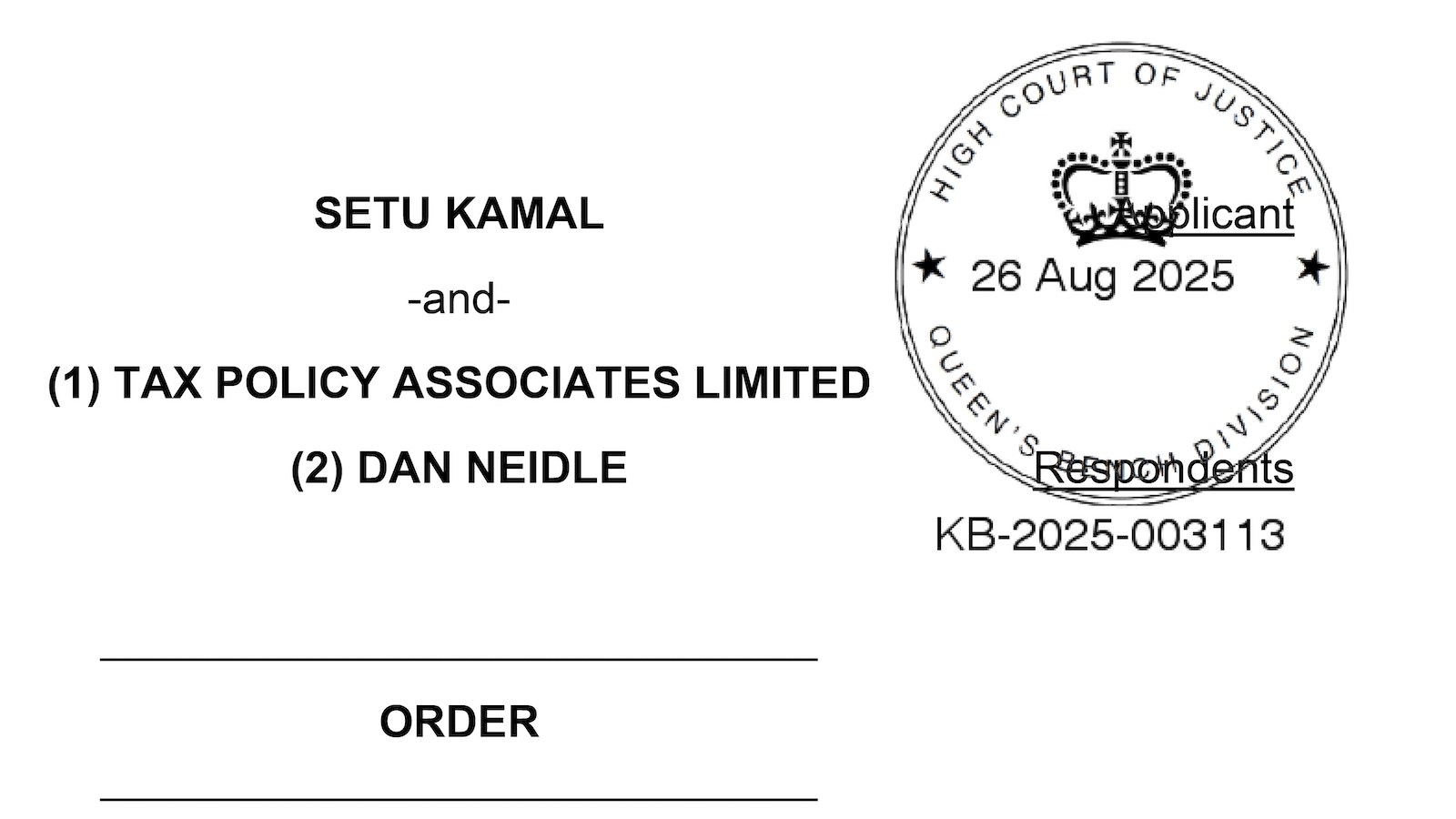
Last Tuesday, I awoke to an email from the High Court, rejecting an attempt to silence me with an interim injunction. This came as a surprise, because I’d no idea anyone had applied for an injunction.
This was an “on notice” injunction application – but I had received no notice. What kind of lawyer would do that?
The “leading tax barrister in the country”
The injunction application was brought by a tax barrister called Setu Kamal.1
Mr Kamal is unhappy with our report about him and Arka Wealth, the tax avoidance scheme promoter he worked with and helped promote.2 Mr Kamal claims our report costs him £1m every year in lost business. Back in May, Mr Kamal threatened to sue me unless I published my “sincere belief” that he is “the leading barrister in the field of taxation in the country”:
I did not do as asked. Mr Kamal is not, in fact, the leading tax barrister in the country.
Mr Kamal’s practice
On 4 September 2025, HMRC named Mr Kamal as responsible for promoting and designing tax avoidance arrangements, saying he has created contract templates that are “essential to how these arrangements operate”.
It’s HMRC’s view that these schemes do not work – I agree, and I believe most advisers do too.
This is an unusual step by HMRC, and the first time a practising lawyer has been named as a tax avoidance scheme promoter.
The “on notice” application, without notice
On 13 August, Mr Kamal asked my solicitors if they’d accept service of a defamation claim; they said they would. Six days later, without telling us, he applied for an interim injunction (representing himself, without a lawyer).
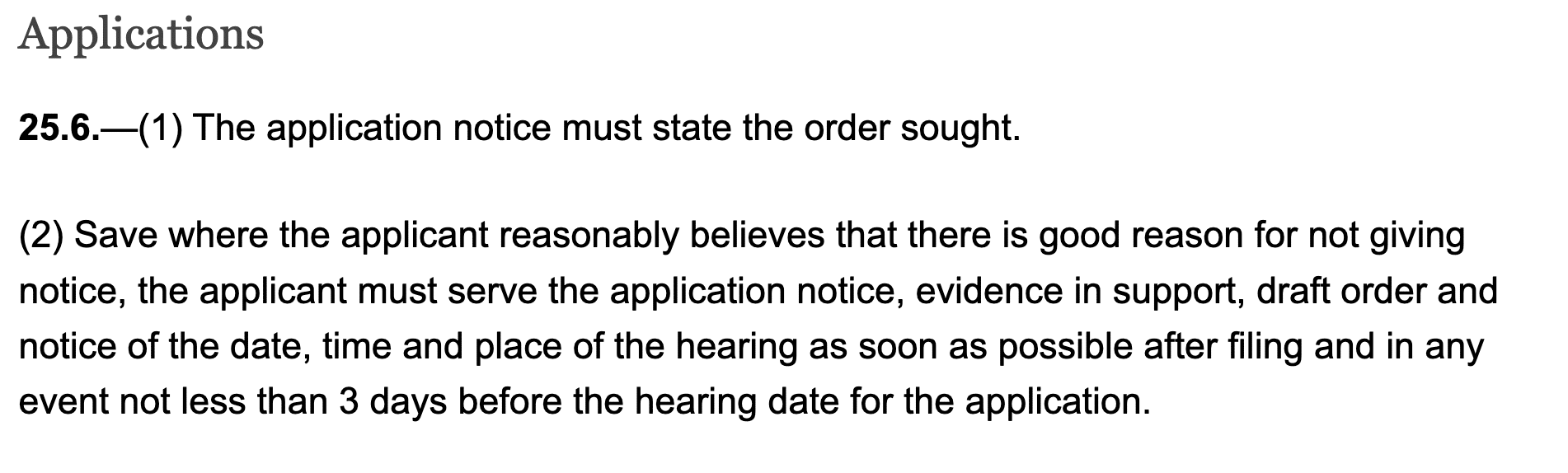
This was an “on notice” application. This means that, as is fairly obvious from the title, the other side has to be given notice of the application.4 The Civil Procedure Rules couldn’t be clearer, and even a simple Google search reveals the answer in seconds:
After I received the court order, my solicitors wrote to Mr Kamal asking what he thought he was doing (at that point we hadn’t seen the application, and didn’t really know what was going on).
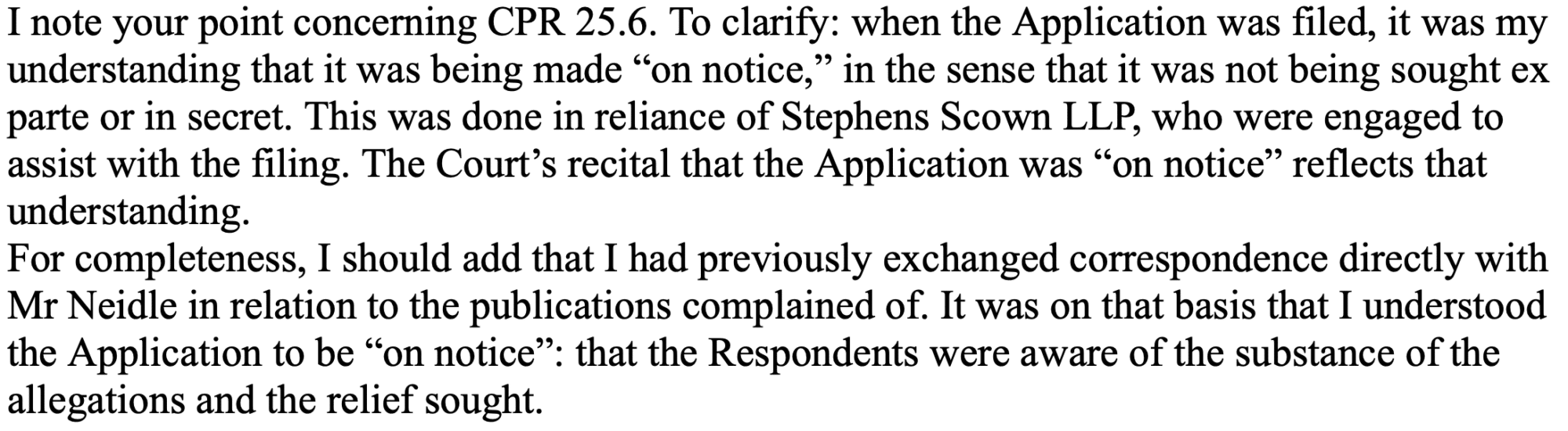
Mr Kamal’s reply was that he simply had no idea that an “on notice” injunction required notice:
This is word salad. A barrister shouldn’t be relying on a solicitor to understand a simple CPR point. But I’m going to take Mr Kamal at his word, and accept that this was not a malicious attempt to mislead the court and obtain an injunction on the sly, but merely incompetence.
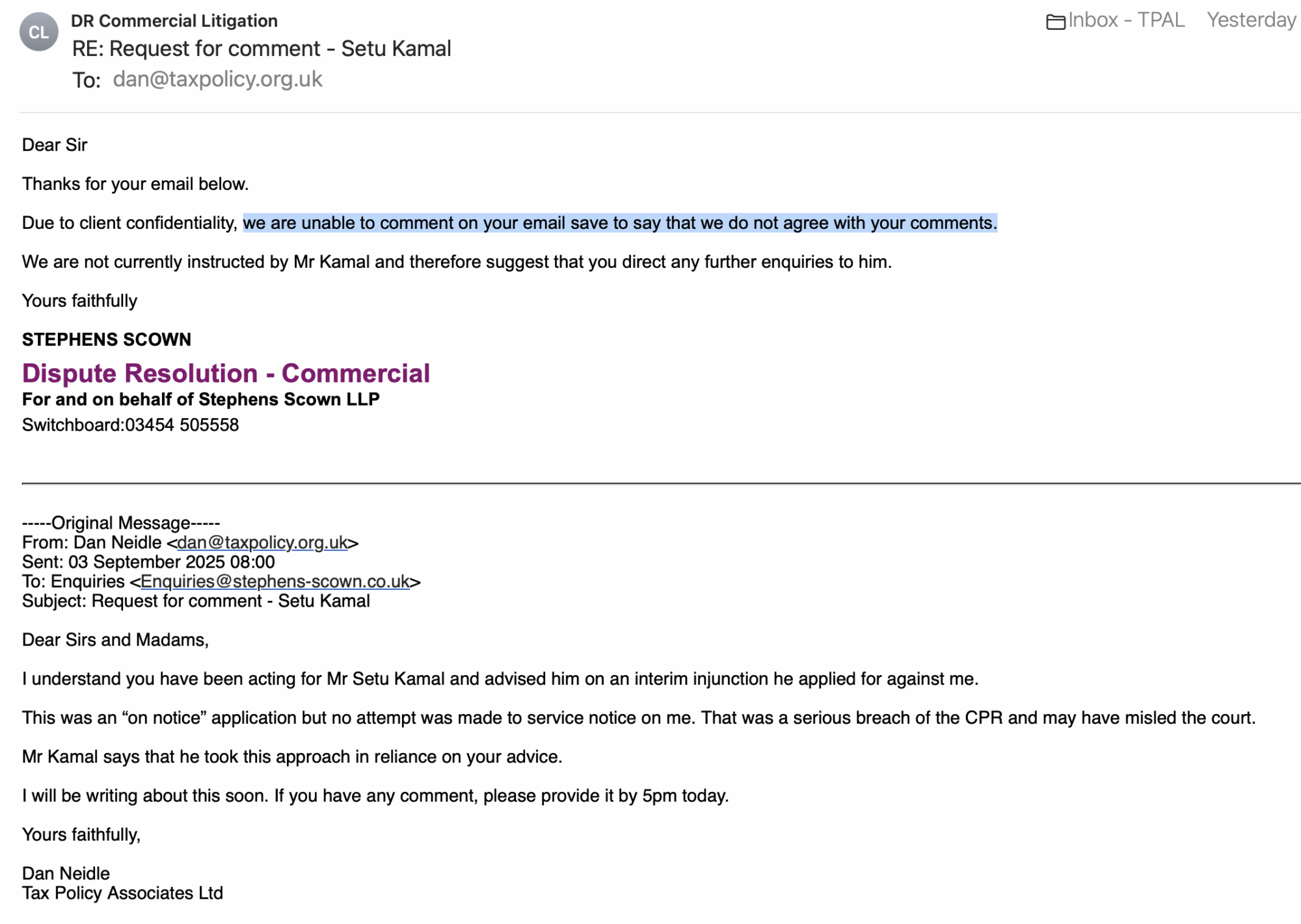
I asked Stephens Scown about this and received a slightly mysterious reply, which may (or may not) be a denial that they advised Mr Kamal that no notice was required:
The defective application
Incompetence is the most plausible explanation, because the entire injunction application was defective.
That’s just the start of Mr Kamal’s problems. English courts have resisted interim injunctions that restrain freedom of speech ever since Bonnard v Perryman in 1891.5 Such an injunction will only be granted if it is clear that the statement is unarguably defamatory, and that no defence is possible. Again, Mr Kamal doesn’t seem to be aware of this.
There are then other oddities. The extreme vagueness of his draft order – what, exactly, was I supposed to delete? The absence of the required undertaking by the applicant of an interim injunction to pay damages if so determined by the court. The general sloppiness, with the draft order giving me a deadline that expired a month before he applied for the injunction.
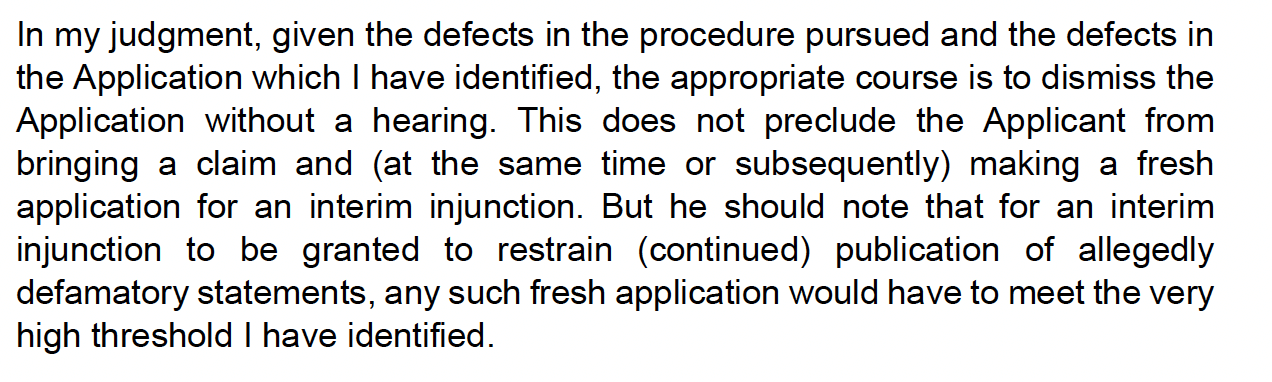
For all these reasons, Mrs Justice Steyn rejected the application without a hearing, saying:
Here’s the full judgment:
I’m expecting to hear more from Mr Kamal soon.
Many thanks to my solicitors at the Good Law Project.
Footnotes
Mr Kamal was a member of Old Square Tax Chambers until November 2024. He is now based in Cyprus and practices on his own. ↩︎
Arka Wealth appears to have ceased business since our report. The related firm Benedictus Global may still be in business, although its website hasn’t been updated for a while – it still lists Mr Kamal as a member of Old Square. ↩︎
I have omitted the witness statement, because I am probably prevented from publishing it at this point, under CPR 32.12. ↩︎
As opposed to a “without notice” (or ex parte) application, which is reserved for cases of extreme urgency where alerting the respondent would defeat the purpose of the injunction (e.g., they might destroy evidence). An applicant in a “without notice” hearing is under a strict duty of “full and frank disclosure” to the court, meaning they must present all relevant facts, even those unhelpful to their case. ↩︎
Bonnard v Perryman [1891] 2 Ch 269 is a cornerstone of free speech protection in English law, long pre-dating the ECHR and the Human Rights Act, This principle has been consistently upheld, for example in Greene v Associated Newspapers Ltd [2004] EWCA Civ 1462. Before Greene, there was some debate whether section 12 of the Human Rights Act limited Bonnard v Perryman.– Greene confirmed it did not. There remains, however, an ongoing effort by claimant libel lawyers to argue that the principle is contrary to the ECHR, on the basis that the right to freedom of expression in Article 10 should be balanced with the right to reputation included in Article 8. ↩︎
Sometimes a company is on the list because of a Companies House delay/error. More often, it’s because the company is troubled, bust, or incompetent. And occasionally it reveals an active fraud.
Despite the real progress made by Companies House, the UK company register remains stuffed full of fraudulent companies.
Here’s a quick example showing how easy it is to find them.
Herran Finance’s fake accounts
Clicking through the list, there’s an interesting sounding company: Herran Finance PLC.
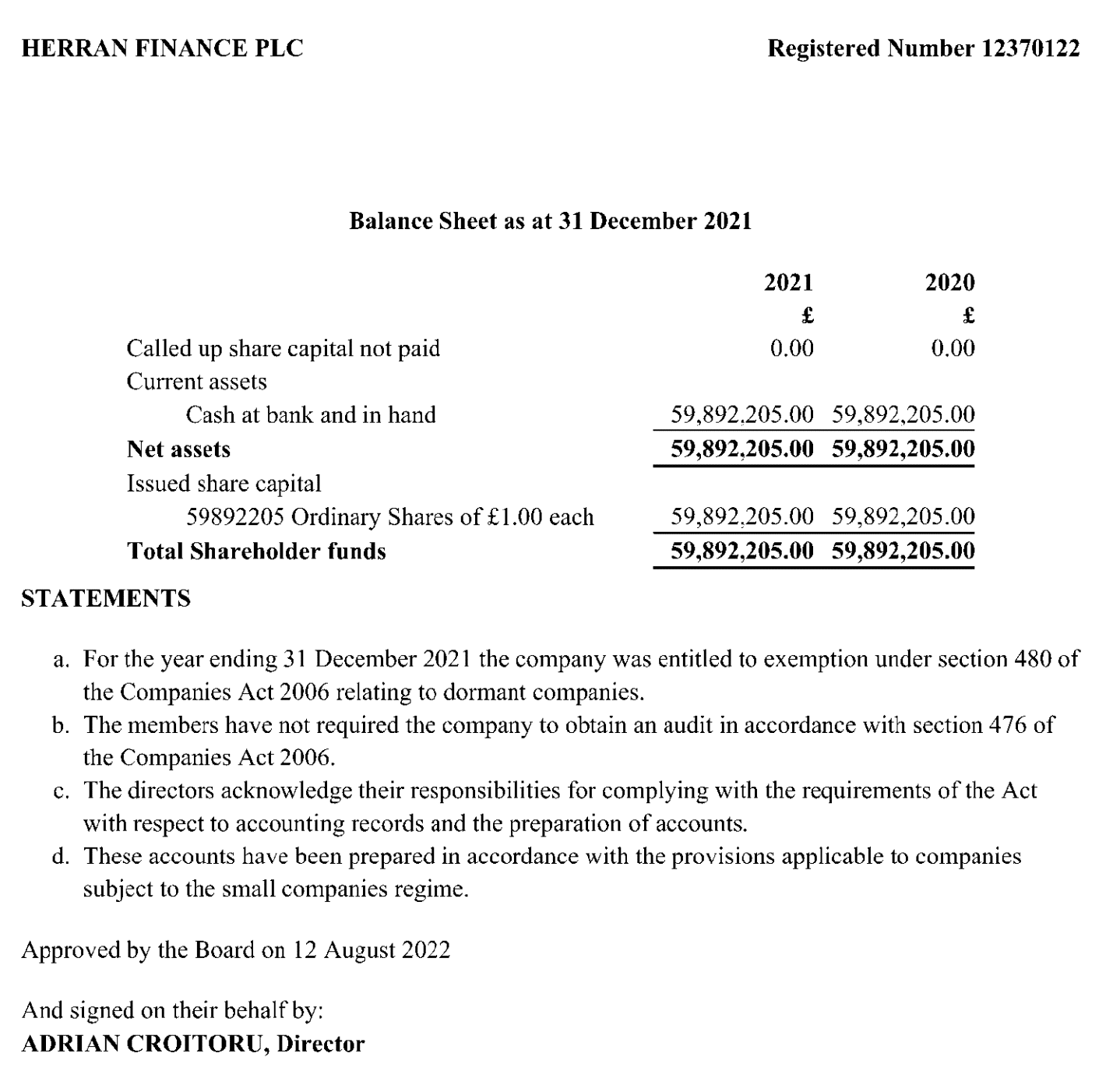
We are supposed to believe that the company had £59,892,205 cash in 2020 and exactly the same in 2021. It made no interest or other return, and had no expenses of any kind, so filed as dormant. This is impossible. The accounts are faked.
There are no contact details, no privacy policy, no name of the legal entity, and none of the details one expects on a genuine bank website. Half the links are dead, returning straight back to the homepage. (Please be cautious; we recommend against visiting the website unless you are very confident in your browser security setup.)
The website says Herran Finance is regulated and deposits are fully protected by the FDIC, the US deposit protection scheme. But there’s no Herran Finance authorised by the FCA in the UK or covered by the FDIC.
And why does a bank incorporated in the UK, and with a .co.uk domain, provide US dollar accounts and say it’s regulated in the US?
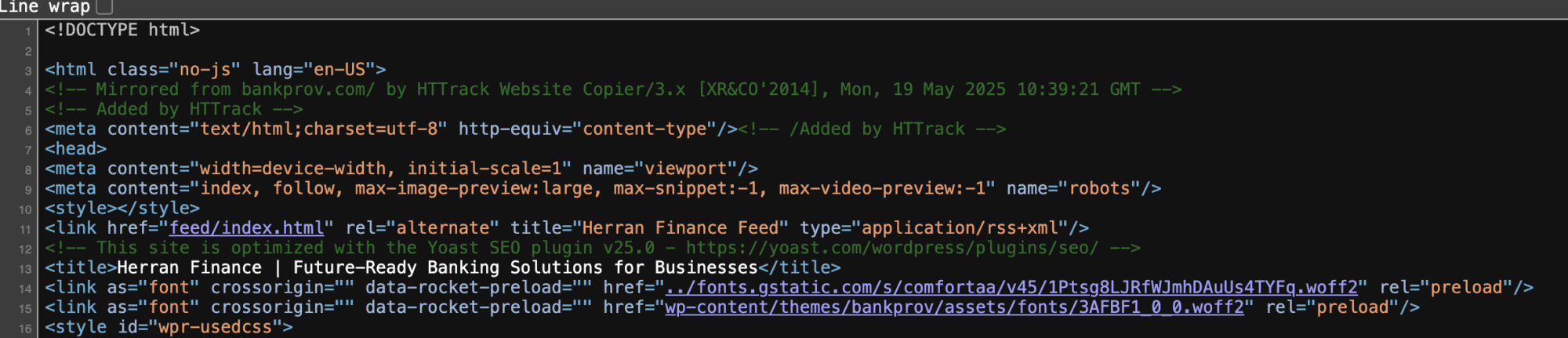
Because the website is a clone of the (real and legitimate) US bank BankProv. The sites look almost identical, and the HTML for Herran Finance shows that they just copied BankProv’s website using the HTTrack tool:
What’s the scam? It could be anything: phishing, money laundering, investor fraud, advance fee fraud, or even immigration fraud2. The company was incorporated back in 2019, but the domain was acquired in May 2025 – so the scam (whatever it is) may be ongoing.
The policy failure
It’s absurdly easy to incorporate a company with an enormous fake share capital and then file dormant accounts – but it shouldn’t be. And large numbers of such companies remain registered.
Companies House should be using its new powers to stop this. It could create a simple automated filter for companies filing dormant accounts with an unchanging large cash balance in its accounts – there’s really no explanation for this other than fraud. The most recent accounts could then be automatically withdrawn, penalties automatically issued for the failure to file correct accounts, and an automated letter sent requiring evidence of the supposedly fully-paid share capital. If the penalties aren’t paid, or the evidence isn’t provided, the company can then be struck off.
A more ambitious approach would be for Companies House to automatically flag and then manually review all incorporations and capital-raisings where shares are being issued for (say) over £10m (ignoring listed companies). These are a vanishingly small percentage of the total number of companies and filings.
Measures of this kind would help stop fraudsters using Companies House to give fake companies financial credibility.
Footnotes
One director, Adrian Croitoru, gives a correspondence address which is a residential property in St. Neots, Cambridgeshire. His name is not on the deeds of that house; very possibly the fraudsters are using an innocent person’s details. ↩︎
i.e. obtaining a work visa on the strength of employment with a company that doesn’t exist. ↩︎
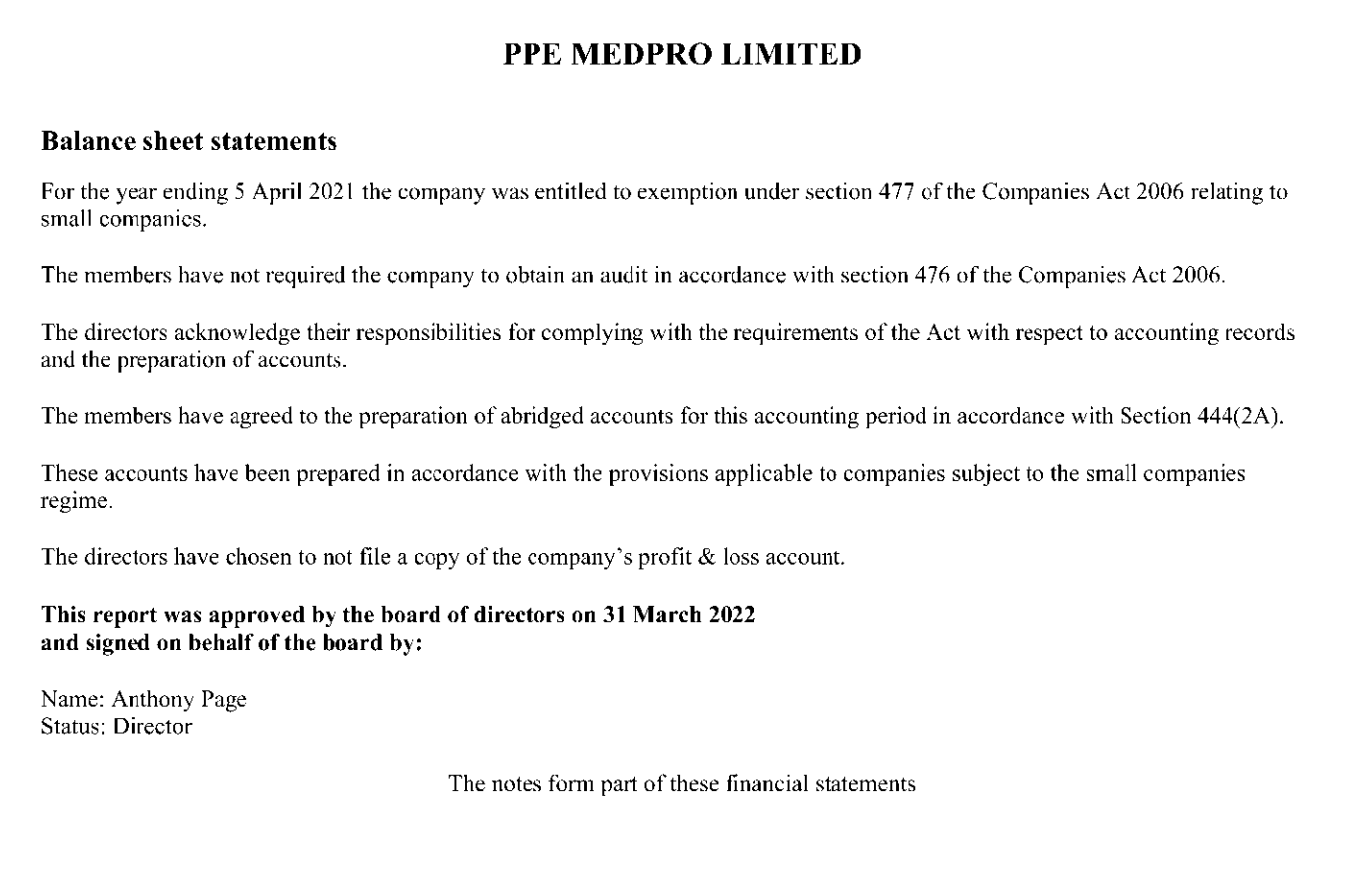
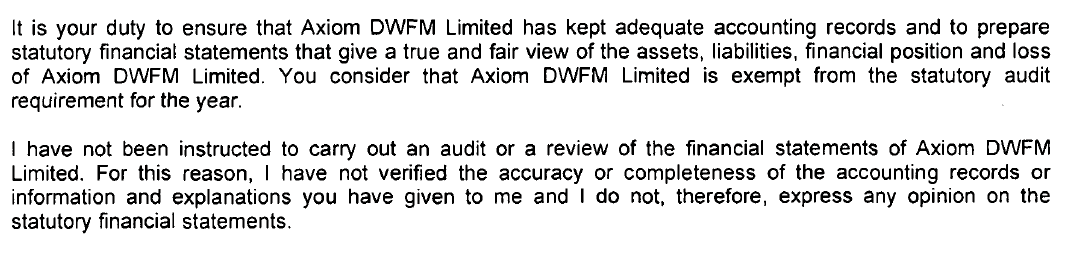
Law firm Axiom Ince failed in October 2023, with £64m of client money missing – losses ultimately covered by the solicitors’ profession. How could the auditors have failed to notice £64m of missing money? The answer is that the company broke the law, and filed unaudited accounts.
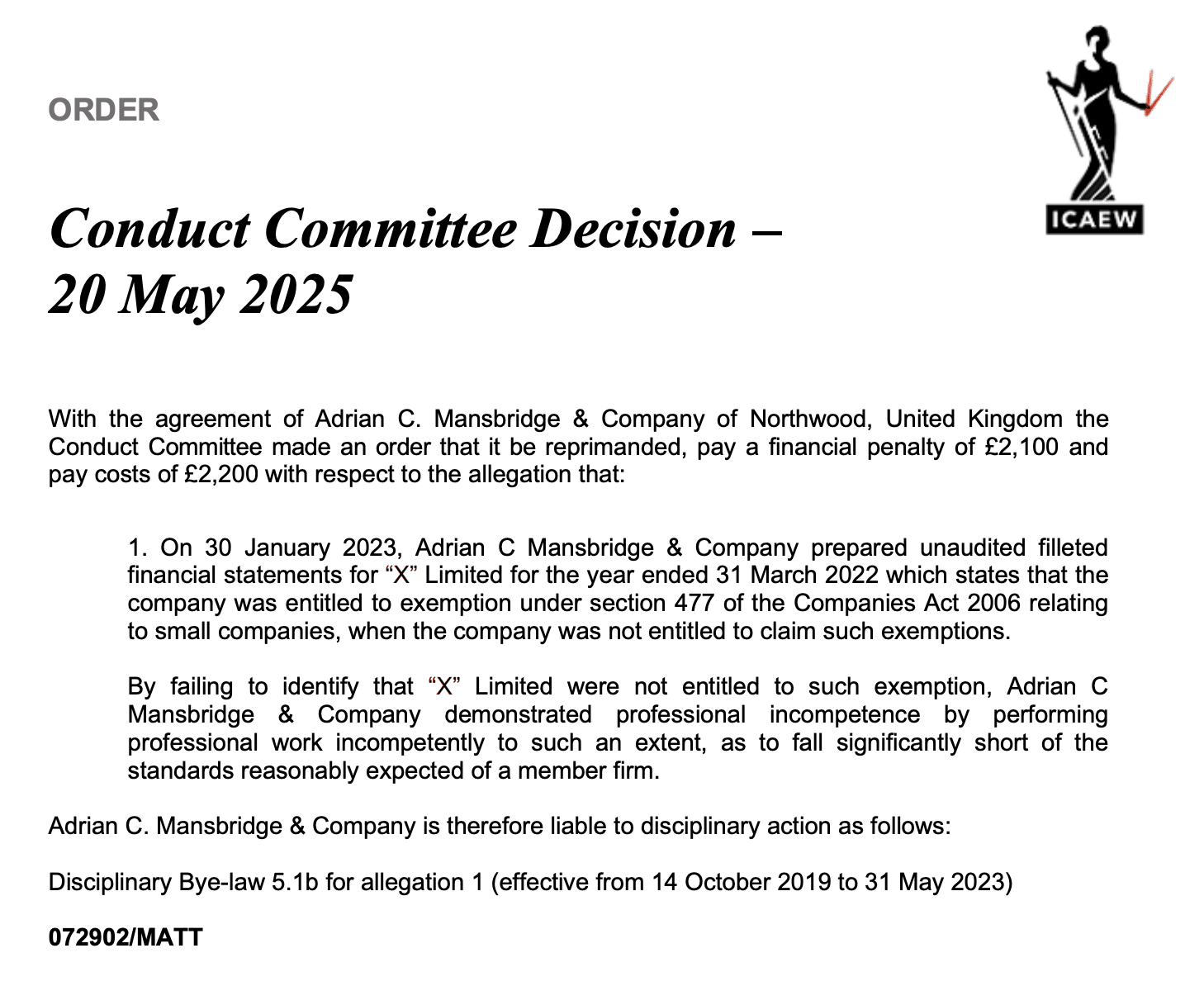
Axiom Ince’s accountants, Adrian C Mansbridge & Co, somehow failed to notice this, and signed off on unaudited accounts. The Institute of Chartered Accountants in England & Wales (ICAEW) described this as “professional incompetence” – and that incompetence will have delayed the moment of reckoning for Axiom Ince, and so increased its losses. The only consequence for Adrian C Mansbridge & Co has been a £4,300 disciplinary penalty.
It’s a double failure of professional regulation. The SRA didn’t spot that a law firm they were already investigating had failed to file audited accounts. The ICAEW gave a “slap on the wrist” for behaviour that realistically merited a suspension or expulsion.
Axiom Ince
Axiom Ince grew rapidly from a series of acquisitions. When the Solicitors Regulation Authority intervened to shut it down, 1,400 people lost their jobs. However, it soon became apparent that this wasn’t a normal law firm failure – £64m of client money was missing. Five men have been charged by the Serious Fraud Office. The Legal Services Board published a report in May identifying a series of failures by the Solicitors Regulation Authority.
There is a one year grace period – so a company will only cease to be “small” after two successive years of failing to satisfy the requirements.
Was Axiom Ince a small company?
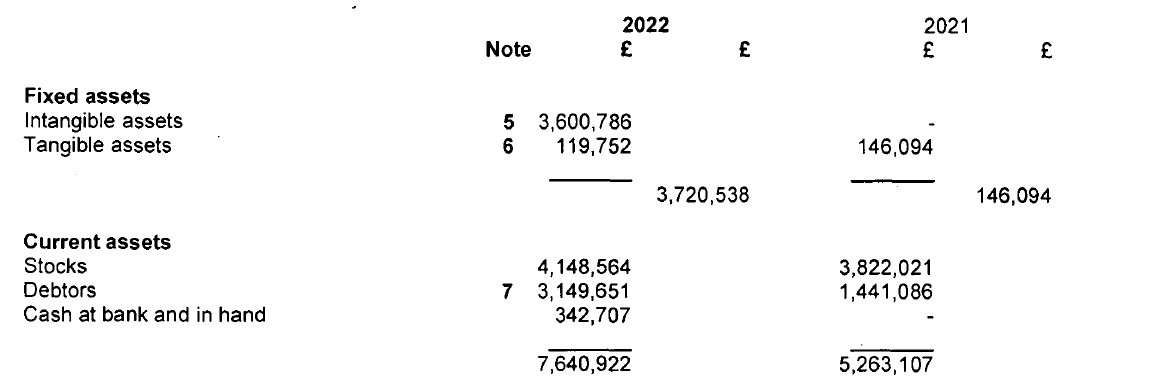
Axiom Ince’s 2022 accounts showed its total balance sheet assets for 2022 and 2021 :
£5.4m in 2021 and £11.3m in 2022 – so the balance sheet requirement was failed for two successive years.
The accounts also stated the number of employees:
The employee requirement was failed for two successive years.
So the company wasn’t small and the accounts should have been audited. It is surely inconceivable Adrian C Mansbridge & Co was involved in any fraud, but we cannot understand how an experienced accountant could have made such a basic error.
The mistake was very significant because, if an audit had been carried out for the 2022 accounts, it is plausible that the fraud would have been spotted, and the £64m losses to the SRA and the solicitors’ profession limited.
A missed opportunity by the SRA
The SRA were already investigating Axiom Ince in early 2023. That investigation included a forensic investigation of the firm’s accounts3 but it seems there was no check of the firm’s statutory accounts.
The SRA therefore didn’t identify that the firm had failed to file audited accounts – a red flag that would have justified immediate action. Instead, Axiom Ince was permitted to remain in business until October 2023.
The Legal Services Board’s report into Axiom Ince’s failure, written by Carson McDowell, is very critical of the SRA’s investigation, and in particular of the SRA’s insufficiently thorough checks of the firm’s accounts in early 2023. However the report does not mention the SRA’s failure to identify the lack of audited accounts. We infer that Carson McDowell missed this point.
The consequence for Adrian C Mansbridge & Co
At some point, the Institute of Chartered Accountants in England and Wales became aware of the error, and pursued disciplinary proceedings against Adrian Mansbridge & Co.
The result:
This outcome is surprising for two reasons:
First, the company is not named (although we are confident it is Axiom Ince4). The ICAEW’s usual policy is that third parties involved in disciplinary matters should not be named, for their own protection. In this case that makes no sense: Axiom Ince has ceased to exist, and the many affected stakeholders have a strong public interest in knowing what happened. No public interest was served in anonymising this case.
Second, the penalty is extraordinary. The ICAEW finds that Adrian Mansbridge demonstrated “professional incompetence”. The result was that Axiom Ince continued to misapply client funds for another ten months. Yet the only consequence was a reprimand and penalty/costs of £4,300. That seems disproportionately lax. The ICAEW’s own sanctions guidance says that “audit work of a seriously defective nature” should trigger a £20,000 penalty. Failure to identify that an audit is required seems “seriously defective” to us. Indeed financial sanctions seem inadequate; suspension or expulsion seem more appropriate.
We have to wonder if the ICAEW’s Conduct Committee was aware of the wider context around Axiom Ince, or just saw this as a technical breach with no material consequences.
The response from the firms and regulators
Adrian Mansbridge & Co did not reply to two requests for comment.
The ICAEW said they couldn’t comment on a specific case, but that it’s their standard policy to anonymise the names of all third parties.
We asked the SRA, the LSB and Carson McDowell if they were aware that Axiom Ince had unlawfully failed to file audited accounts; they each told us they were unable to comment.
The consequences
It may be that there is potential for the SRA Compensation Fund to recover some of its losses from Adrian Mansbridge & Co’s insurers (although we haven’t analysed the prospects for such a claim).5
The ICAEW should review its disciplinary processes. The way it’s applying its anonymity policy does not make sense, and there is something seriously wrong with the penalty applied in this case.
And Companies House should have automated measures in place to detect companies which unlawfully fail to file audited accounts. We’ll be reporting more on this soon.
Thanks to our researcher K, who found the ICAEW disciplinary decision.
Footnotes
Note that the firm appears to be a trading name of Adrian C Mansbridge himself. Whilst there is a company – Adrian C Mansbridge & Co, Ltd – it is dormant. ↩︎
We found the decision by searching against Adrian Mansbridge’s name. The accountant’s report date and balance sheet date match Axiom Ince. The ICAEW would not comment on specifics but did not deny that the reprimand refers to Axiom Ince. Adrian Mansbridge did not reply to our request for comment. ↩︎
The SRA has already taken action against the former owner of Axiom Ince to recover some of its cost, but as far as we are aware no action has been taken against Adrian Mansbridge & Co. ↩︎
The Government needs money. Council tax is regressive – high-value properties pay a trifling sum in comparison with their value. It must be tempting for Rachel Reeves to solve both problems in one go by raising council tax on high-value properties.
We’ve created an interactive calculator that shows how this could be done, and how much could be raised.
How council tax could be raised
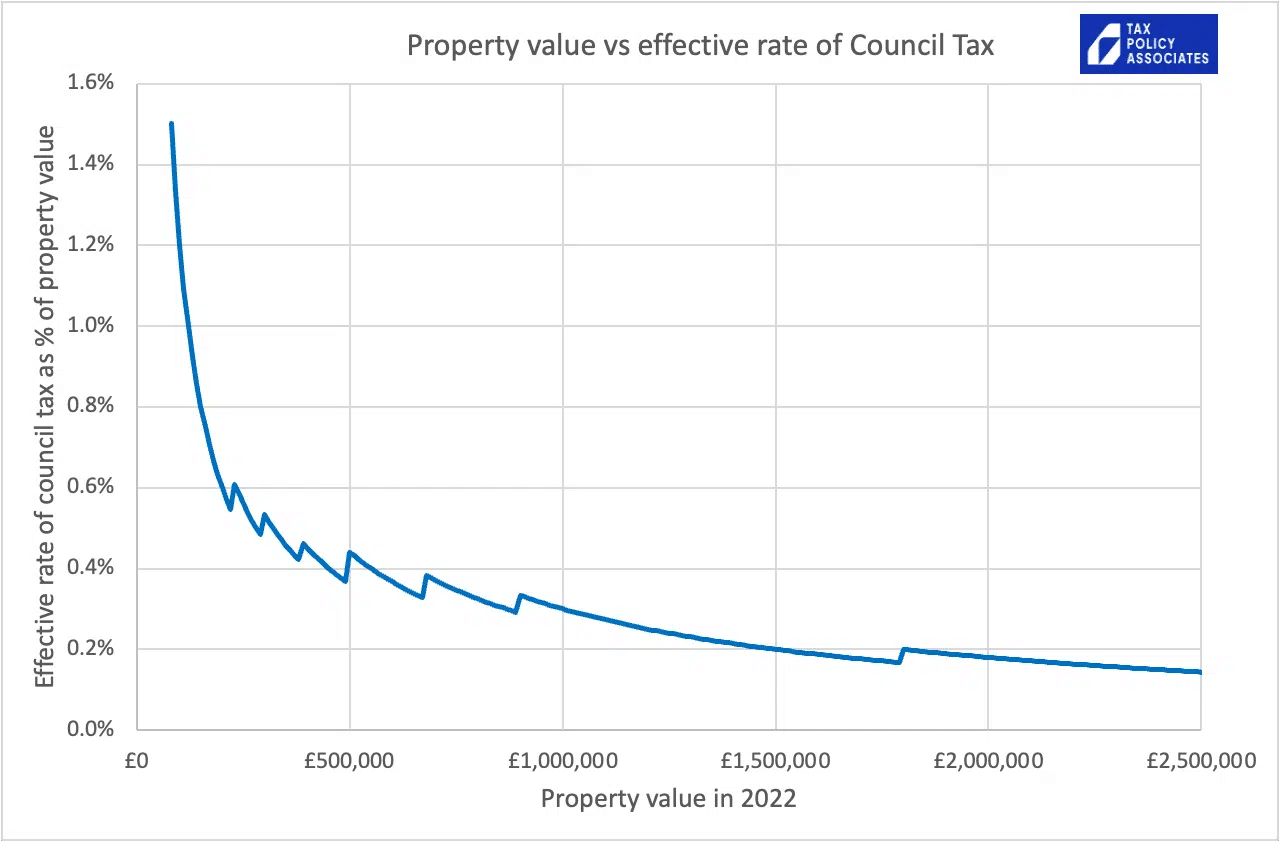
Council tax only slightly varies with the value of properties:
This is because of the way council tax is charged in bands, by reference to 1991 valuations. The middle band, D, is properties worth between £68,001 and £88,000 (in 1991 money). The top band, H, is properties worth more than £320,000 in 1991 (about £1.5m today). By law, band H properties are charged only twice as much council tax as band D properties. The IFS has described all this as “out of date and arbitrary” and said council tax is “ripe for reform”.
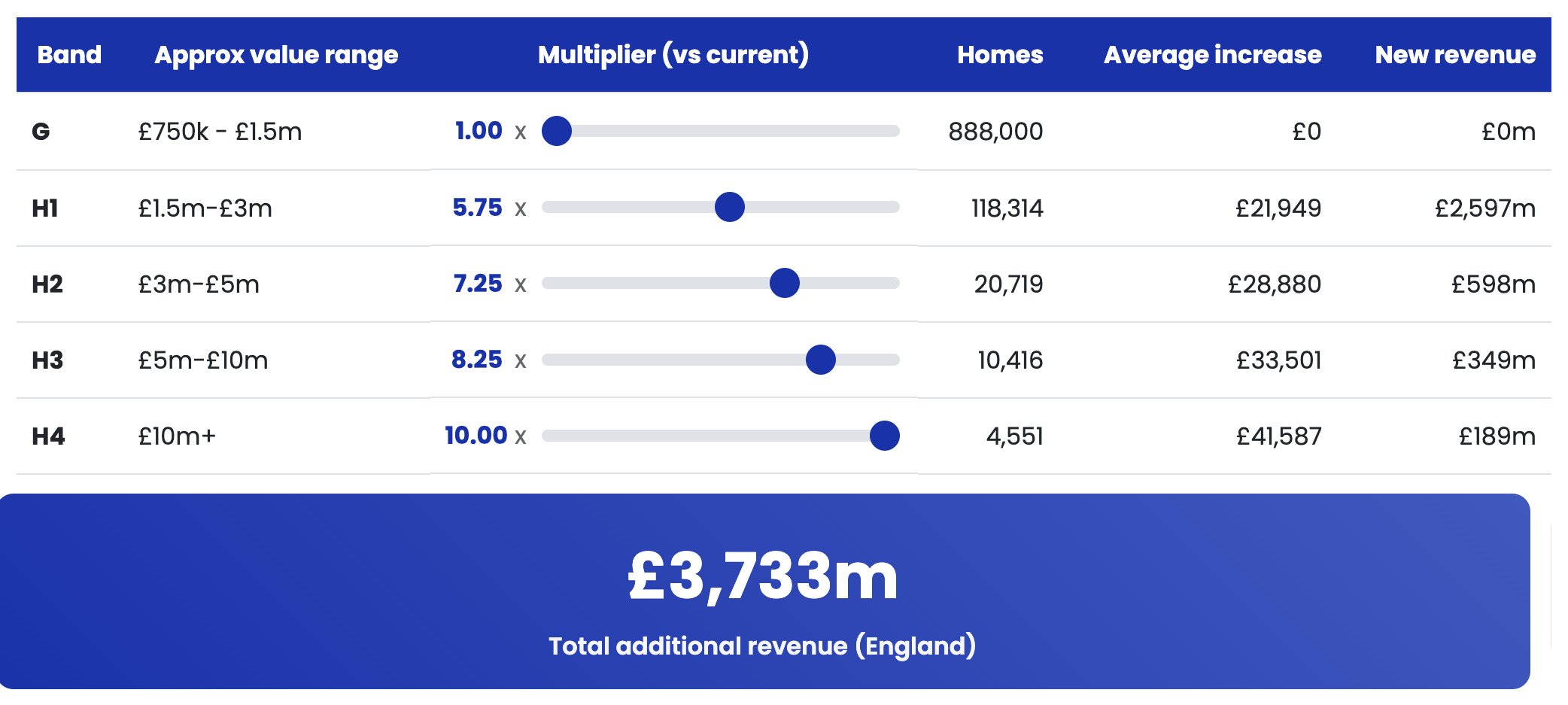
So an obvious fix is to split band H into four bands, H1, H2, H3 and H4, with H1 retaining the 2x multiplier that band H currently has, and the others having higher multipliers.
Or something more radical: a proportional property tax could be charged on properties in bands H2, H3 and H4, as a percentage of property value (but only on the value in those bands, so no “cliff-edges”).
How much could be raised?
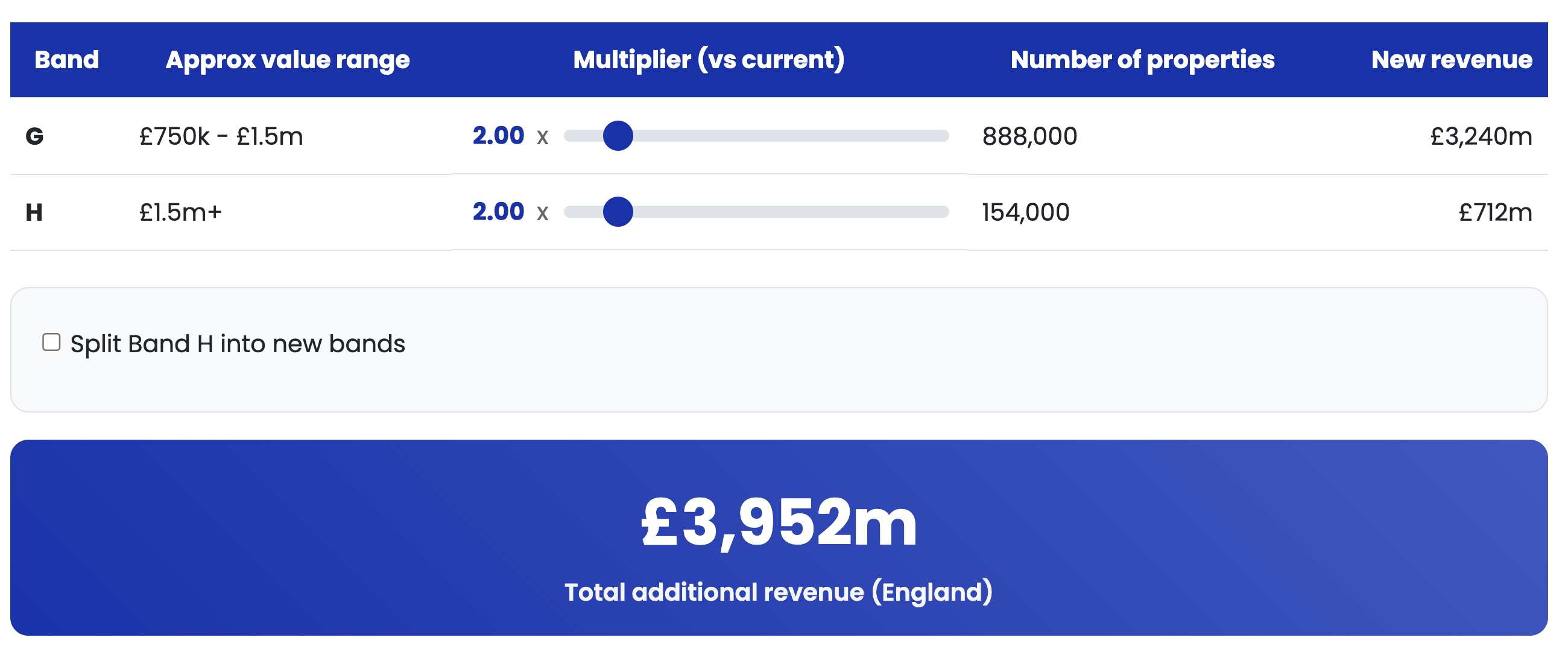
The calculator below lets you experiment with either new multipliers or a percentage tax for high value properties. It shows how much revenue the change would raise across England, and the average council tax bills it would generate.
We split band H in four, and the slider at the top lets you position each of the new bands. Then you can choose between a “multiplier” tax and a “percentage tax” – and the revenue consequence is displayed at the bottom. You can also see the average bill someone in each band will pay (on mobile you have to click the “info” icon for that).
You’ll see that adding a few more bands doesn’t raise much money. For example, a new 3x band at £2m, 4x band at £4m, and 6x band at £8m only raises £270m. Owners of £8m+ properties pay an additional £9,000 of tax each year.
Creating a new percentage tax on top of existing council tax, on the other hand, raises more significant amounts. A flat 0.5% annual tax on all property value above £2m raises about £1bn, with owners of £8m+ properties paying an average of £90,000 more tax each year.
Or make it progressive: 0.5% from £2m to £4m, 0.7% from £4m to £8m and 1.1% for £8m+, and we raise about £1.5bn. Owners of £8m+ properties now pay £120,000 more tax each year.
These figures are just for England; if applied across the whole of the UK, expect overall revenues to be 5-10% higher. And the various approximations and assumptions in our approach mean the real-world revenues would likely be somewhat higher (see the methodology section below).
The obvious conclusion: there is potential for the Government to raise a useful amount of additional tax by taxing high value properties, but the amounts are limited.
Does extending council tax make sense?
The obvious reason to do this is that Government needs to raise tax. Raising it from people who can likely afford it, on property which is currently under-taxed, makes some sense.
There is also an equally obvious moral case for making annual tax on property more progressive. A £100m property in Mayfair currently pays less tax than a terraced house in Bolton. A fairer tax on property feels the right thing to do.
There’s a relatively small economic benefit: an annual tax creates an incentive to use/develop property that may currently be very under-used or even derelict.
There are, however, also some obvious problems:
A percentage property tax would require somewhat regular valuations. Valuing the c4,500 properties over £10m is relatively straightforward. Valuing all the c80,000 properties over £2m is more difficult, and would require considerable resource (and take time to create). The council tax banding system was designed to avoid such difficulties.
There will be some people in very valuable properties who don’t have enough income to comfortably afford the new tax – “asset rich, cash poor”. This is often overplayed: someone owning a £3m house usually has numerous ways to raise funds. However any new tax could include a deferral option (e.g., paying the tax as a lien on the property upon sale or death). These kinds of mechanisms are common in other countries with annual property taxes.
The biggest problem: the tax will be capitalised into property values. The day after the tax is announced, the value of e.g. a £10m property facing (say) an annual £50k bill will fall – in principle by somewhere around £600,000.1 So someone buying the property a week later isn’t really paying the new tax – it’s paid by the person owning the property at the point of announcement (because they’re getting a lower purchase price). In the real world things tend to be not quite so tidy, but there is nevertheless an unfairness that most of the economic burden will fall on current owners – it’s like a one-off property wealth tax. There is no way to solve this problem – land tax proponents often regard it as a form of rough justice. Others may be less sanguine.
So we can expect some people will sell to escape the tax; but that will be mostly a one-off effect, as new buyers economically are much less exposed.
Unlike a proper land value tax, a percentage property tax somewhat disincentivises improving properties. Once you’re into the range of (say) a 0.5% property tax, then every £100k you spend improving the property triggers an additional £500 of property tax each year – in principle reducing the value of the property by about £6,000. So you’re paying £100k but receiving a net benefit of £94,000.
Some would add another disadvantage: if (as would be wise) a percentage tax is charged on the landowner, landlords would simply pass on any additional tax to tenants. That’s widely believed, but mostly not correct: rents are primarily determined by location value and demand, not by the landlord’s costs. More tricky would be an increase in council tax multipliers; the bill would go to tenants. In the medium term rents should adjust so that most of the cost is borne by landlords, but in the short term it would be a tax on tenants in high value properties.
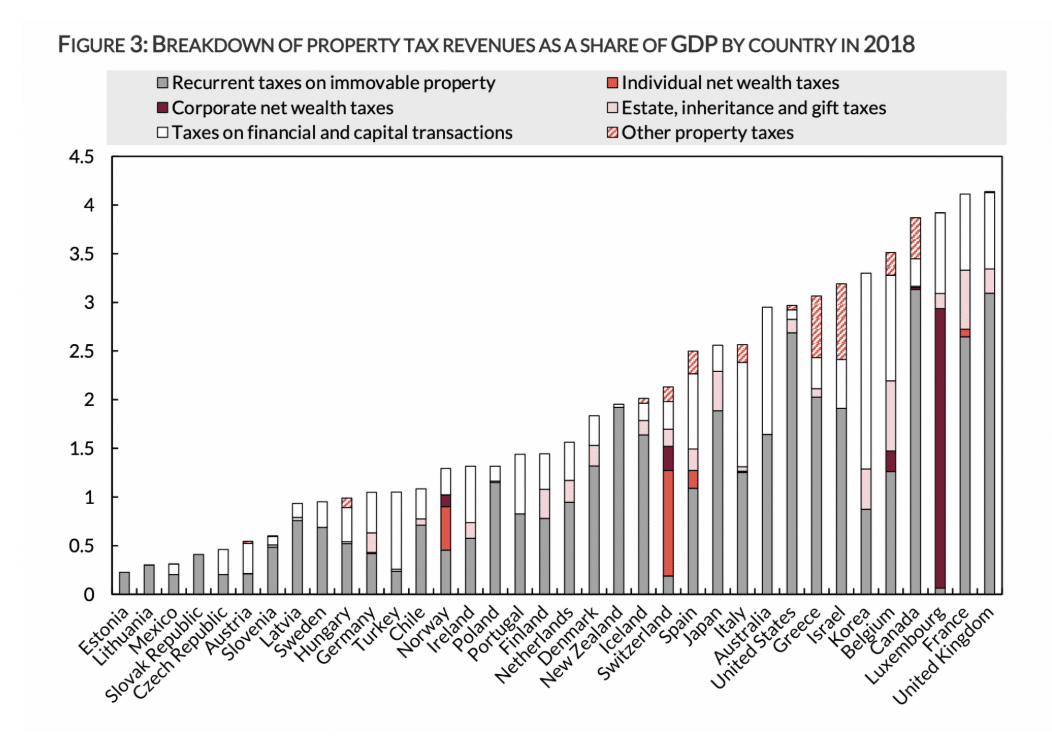
If we look at all taxation of wealth and property, the UK has higher tax as a percentage of GDP than any other OECD country:2
The reason is simple: council tax (it’s most of that grey bar – a “recurrent tax on immovable property”). And that’s council tax paid by most people, not council tax paid by the very wealthy. We under-tax high value property ownership compared to most of the world, at the same time as we overtax purchases.
My view is that there is a strong case for adding more multiplier-based council tax bands. I’m less convinced that a percentage tax makes sense given the administrative/valuation issues and the horizontal equity problem.
The balance changes once we’re looking at wholesale reform: replacing all of council tax, business rates and stamp duty with land value tax. The boost that such a reform would give to growth and homebuilding in my view more than counters the downsides. But bolting on a miniature version of such a tax as a pure revenue-raiser looks less attractive.
Methodology
The calculator works as follows:
First, it estimates the number of properties in a given band. We weren’t able to find any reliable data on the number of high-value properties in the UK, so we estimate this using three data sources:
The council tax data shows 154,000 properties in Band H, which (on average) means they’re worth about £1.5m today. We use £1.5m as our starting point for the new bands, and 154,000 as the “true” figure for the population of £1.5m+ properties.
HMRC stamp duty statistics give us figures for the number of residential property transactions in six bands above £1.5m – the highest is £10m+. We use this to estimate the number of properties in England between any two values, interpolating for values below £10m and using a Pareto distribution above that. We then cap the top-end estimate, fixing the most valuable residential property in the UK at £210m (the reported value of the UK’s most expensive property).
Some property is held in UK or foreign companies or trusts. It isn’t normally sold, and so doesn’t appear in stamp duty returns. But such properties have to pay an annual tax, ATED, and data on such “enveloped” properties is published by HMRC, in bands up to £20m. We use this data to estimate the number of properties; again interpolating when within the published bands, and using a Pareto distribution beyond that. We add the output of this estimate to the stamp duty estimate (it increases the result by 5-10%).
When in “multiplier” mode, we apply council tax discounts (e.g. single person) and premiums (e.g. second homes) using the current data for band H. We don’t discount/premium when in the percentage mode.
This is all very approximate:
Our assumption that annual stamp duty statistics are representative of the housing stock is clearly wrong. A flow is not always representative of a stock. Some very large estates are rarely if ever sold (think “old money”). We will therefore likely be under-counting very valuable properties, and therefore potential revenue, but we weren’t able to quantify this effect.
There will be some double-counting (likely limited) between the ATED and stamp duty datasets, e.g. where a property paid ATED in 2023/24 and was sold that same year.
Our analysis is for England only, but 1% of the ATED properties are in Scotland – this creates a small over-statement of our estimate. We didn’t just deduct 1% from the ATED estimates, because we expect that the Scottish properties are lower in value, and that would therefore potentially add more error than it removes.
We apply band H data for discounts and premiums across all four of our new bands H1 to H4. It is plausible that the most valuable properties are less likely to qualify for discounts (e.g. single owners) and more likely to have premiums (e.g. second homes). Again this suggests we may be under-counting revenue.
We assume that all properties have risen in value to 495% of their 1991 valuations. This likely over-values properties outside London and under-values property in London. It may therefore mean we significantly under-estimate values, and therefore potential revenue, at the top end. A more sophisticated analysis could account for this to some extent.
We apply tax to the bands at the band averages; slice integration would have been more accurate – but only very marginally changed the results, and that didn’t justify the added complexity.
Reports suggest Labour may introduce capital gains tax on home sales in the Autumn Budget. It sounds like an easy revenue raiser – but the evidence shows it would slash transactions, gum up housing chains, and could even collect less tax overall. With stamp duty already doing huge damage, the last thing we should do is add yet another tax on moving house. Particularly when there are better alternatives.
(There are slightly different taxes in Scotland and Wales. The rates are generallyhigher, so we should expect all of the below to apply to Scotland and Wales, but more so)
If you tax something, you get less of it. Stamp duty taxes property transactions, and so we shouldn’t be surprised that stamp duty reduces property transactions.
It is, however, surprising quite how large this effect – “elasticity” – is. Office for Budgetary Responsibility figures shows that every 1% increase in the effective rate of stamp duty cuts transactions by about:
These are not theoretical figures: they’re measured from a big change in 2014, when the previous “slab” system of stamp duty created big changes in the effective rate of the tax at different price points. The observed effects were twice as big as anticipated.
We can use these figures to estimate the effect of abolishing stamp duty (which is another way of saying: the adverse effect that stamp duty currently has).
A £200k property pays £1,500 SDLT.3 That’s only 0.75% of the purchase price – so abolishing stamp duty would increase transactions in such properties by 5.25%
A £291k property (the average England house price) pays £4,550 SDLT. That’s 1.6% of the purchase price – so abolishing stamp duty would increase transactions by 7.2%
A £440k property (an average detached house in England) pays £12,000 SDLT. That’s 2.7% of purchase price. So abolishing stamp duty would increase transactions by 12%.
A £2m property pays £153,750 stamp duty. That’s 7.7% of purchase price. Abolishing stamp duty would increase transactions in such properties by 46%.
These four examples shouldn’t be regarded as existing in separate universes. The £2m market may feel a world away from the £440k market – but it’s in reality one market, and some house purchase “chains” will include both £2m and £440k houses. If someone at the top of a chain doesn’t sell, nobody else in the chain can complete. So a 46% increase in £2m transactions will facilitate additional £440k transactions, beyond the 12% figure that the £440k calculation above suggests.
And the rates are now so high that the top rates raise very little; HMRC believes that increasing the top rate any further would actually result in less tax revenue.
The effects aren’t limited to homeowners. Because SDLT depresses transactions, it reduces the rate at which developers at which developers can sell, therefore delaying their recycling of capital into new housing supply, and tightening the pipeline of new homes.
So there is a powerful case for abolishing stamp duty.
There are, however, two problems.
The obvious problem is that it raises too large a sum to simply be abolished. Any increase in transaction volumes would itself generate tax revenues from other sources (e.g. VAT on estate agent fees) but these effects are much smaller than the cost of the abolishing stamp duty.4
The deeper problem is that abolishing stamp duty would raise prices. Evidence suggests about 40% of any tax cut would be pushed straight into prices.
CGT – making things worse
The Times and Financial Times suggest the Government is considering imposing capital gains tax at 24% (higher rate taxpayers) or 18% (basic rate) on sales of people’s homes.
However abolishing the relief would be as damaging as stamp duty – perhaps more so.
Imagine someone who bought an average detached house in 2010 for £250k. It’s now worth £440k. They want to move to another house of about the same value – perhaps to take up a job elsewhere, perhaps to join their family. Today there’s stamp duty of £12k – and that’s already a problem. But if CGT applied there would be a gain of £190k and capital gains tax of about5 £45k. For most people that would be unaffordable. The OBR stamp duty figures imply that transaction volumes would fall by over 45% – and this kind of “lock-in” has been observed in other countries.6
So no developed country in the world does this.
Most countries – e.g. France, Germany, Australia, Denmark, Ireland, have a simple exemption, like the UK. Others – e.g. Switzerland, Sweden, let you defer the gain if you’re buying a new residence (so the gain is taxed only if/when you sell a residence without buying a replacement).7
The US exempts the first $250k of gain ($500k for married couples). Deferral is available for investment properties, and so a common strategy for owners of high value properties is to “convert” their home into an investment property in advance of a sale.
What if we only impose CGT on high value properties?
It might seem politically tempting to adopt some variant of the US approach, so that high value properties are taxed, and others remain exempt. The Times has reported that the Treasury is considering capital gains on sales of over £1.5m.
Introducing a “cliff edge” at which gains start to be taxed would be unfair and highly distortive. And taxing historic gains feels like retrospective taxation (but if the government didn’t do that, and only taxed future gains, revenues would be very small). However, even if we leave these significant points aside, the mathematics of such a tax are challenging.
Take an example where a £2m house is sold at a £750k gain.
Today there is £153,750 of stamp duty (paid by the purchaser) and (in most cases) no capital gains tax for the seller. But imagine that the £750k becomes a taxable gain for the seller:
The seller would face a £180k CGT liability.
That’s great – lots of new tax raised!
But the tax will deter some people from selling. We can conservatively8 use the OBR SDLT data to quantify this effect. £180k is 9% of the purchase price, and so the OBR figures suggest that would result in a 54%9 drop in transactions (more in the short term).
So, for each transaction before the CGT change, we’re now seeing 0.46 transactions, generating total tax of £153,525 (i.e. 0.46 x (£153,750 + £180,000)).
So we haven’t raised £180k of new tax at all – we’re taking in £225 less tax.
This is just an illustrative example: if the gain had been smaller then some net tax would have been raised, but the high elasticity and much higher stamp duty means the net tax is always much smaller than one would expect.
For example, if instead of a £750k gain, there was a £10k gain, there would be £2,400 of CGT – but the resultant small (but significant) decline in transactions means the net revenue is about half that figure.10
And of course if the gain had been larger then there would be a larger loss of net tax revenue. If, instead of a £750k gain, there was a £1m gain, there would be £240,000 of CGT – but a 72% fall in transactions meaning a net revenue loss of £43,500.11
It’s counter-intuitive, but the property owners with the largest gain, where one would expect the most tax to be raised, actually cause revenue losses.
There will be second order tax revenue effects (lost VAT on fees for the transaction that is no longer happening) or the wider effects to the property market and economy. As discussed above, some house purchase “chains” will include both £2m and £440k houses. Chains propagate “shocks” across the market; if £2m transactions fall by more than 50%, we should expect the rest of the housing market to be affected.
All of this will be exacerbated by the fact that CGT is wiped-out at death – so people sitting on large gains have a powerful incentive to never sell (their estate will pay IHT either way), further gumming-up the housing market.12 It will be exacerbated further if people believe that a future government would change the law – why sell now, if CGT might disappear in two years’ time?
The fundamental point is that, given the high elasticity, adding more tax on property transactions is well past the point of diminishing returns.13
The Treasury know all this. We’re not going to see CGT on our homes.
Like any significant tax reform there would be winners (people who expect to move house) and losers (people who don’t). That could make it a hard political sell. The politics may be easier if the reform as a whole was revenue-neutral – but current fiscal pressures mean there is little political appetite for revenue-neutral tax reform.
There would need to be transitional rules – otherwise people who’d recently paid a large stamp duty bill would feel they were being taxed twice. We could, for example, credit recent stamp duty bills against future land value tax payments.
The balance between local and national taxation would need to be entirely redrawn.
And the whole regime would probably need to be phased in, to avoid price shocks.
There have therefore been few attempts to propose a detailed and viable LVT implementation for the UK.
There was, however, a recent very detailed proposal published by by economist Tim Leunig for centre-right think tank Onward. This wasn’t an LVT, but what Mr Leunig calls a “proportional property tax”. It’s a serious and well-thought-out proposal which would (broadly speaking) replace council tax with (on average) a 0.44% annual tax on property value below £500,000, and replace stamp duty with a national levy of 0.54% on property values between £500,000 and £1m, and 0.81% on any value above £1m.
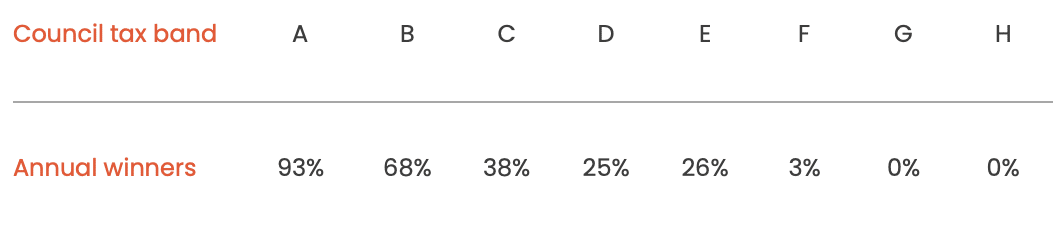
There would, once more, be winners and losers. Mr Leunig is commendably up-front about this, showing the percentage of “winners” in each council tax band:
I fear that telling three-quarters of average households that their annual property tax is going to increase will be a hard political sell. The pain would be eased by making the £500k+ national levy only apply to houses purchased after the tax comes into force – but that has the obvious potential to stall the market in £500k+ houses (and, to be fair, the Onward report acknowledges this issue).
Whilst I applaud the detail and rigour of Mr Leunig’s report, I am doubtful it could be implemented in its current form – but elements of it are well worth detailed consideration. So when The Guardian says that Treasury officials are “drawing on the findings” of the Leunig proposal, that’s promising news.
Apologies to all tax professionals, but I’m going to call SDLT “stamp duty” throughout this article. ↩︎
These are the long run transaction semi-elasticities in the OBR paper. ↩︎
This and the other figures in this article use the standard SDLT rates and ignore all the many potential complications. In particular, I’m ignoring the 2% non-resident premium, the special <£300k rate for first time buyers, and the 5% higher rate for second/subsequent properties. All these factors would tend to increase the effects I discuss. ↩︎
We can illustrate this with a back-of-the-napkin calculation. Abolishing stamp duty would result in around 70,000 additional house sales. Estate agent fees on these would be around £300m (70,000 x 1.5% x £285k), with VAT of £60m. There will of course be other effects, but we’re more than two orders of magnitude too small to overcome the cost of abolition. ↩︎
The precise figure depends on their tax band, but most of the sale will be taxed at the higher rate regardless. ↩︎
In practice the impact would likely be worse. Elasticities are often not linear: a large, sudden and well-publicised increase in a tax often has a much greater effect than a simple elasticity calculation would suggest. ↩︎
The way this works is that, in the above example, there would be no capital gains tax on the purchase of the £440k house, but the new house would “inherit” the old purchase price of £250k. So if the new house was sold for £440k, and not replaced with another residence, the deferred CGT of £45k would be charged. ↩︎
Conservative because SDLT has two effects: it makes buyers pay less (price elasticity) and deters purchases (transaction elasticity). CGT will only have a transaction effect, so we’d expect the transaction elasticity to be higher than for SDLT. ↩︎
Stamp duty still £153,750, CGT is 0.12% of purchase price, so there’s a 0.72% decline in transactions. 0.72% of £153,750 is £1,107. ↩︎
Because £240,000 is 12% of £2m, so there’s a 72% fall in transactions, and 72% of £153,750 is £110,700. ↩︎
Although this will be a significantly smaller effect than stamp duty. Stamp duty defers all transactions. CGT only deters sales at a high gain. ↩︎
That wouldn’t be the case if the tax rate was low, say 5-10%. A small amount of tax could then be raised without adverse effects – but query if raising small amounts in this way is a worthwhile endeavour. ↩︎
There has been a huge amount of controversy over the inheritance tax changes in last year’s Budget. They raised £500m, but hit some small farms and small businesses unfairly – whilst not stopping much existing inheritance tax avoidance. There’s a new proposal from CenTax which seems to do the impossible: protect small farms and businesses, counter tax avoidance more effectively, and double the yield to £1bn.
CenTax are proposing a “minimum share rule”. Where a farm/business forms at least 60% of an estate, there would be full relief from inheritance tax up to £5m per person (so £10m for a married couple). For £5m-10m per person there would be 50% relief. After £10m, no relief.
I’m convinced this proposal would be fairer for small farms and businesses, tougher on avoidance and raise more tax.
Inheritance tax – the background
If someone dies then their estate1 pays inheritance tax (IHT) at 40% on all their assets over the £325k “nil rate band” (NRB).2 A married couple automatically share their nil rate bands, so only marital assets over £650k are taxed.
Transfers to spouses are usually completely exempt from inheritance tax. So, for a married couple, in most cases there’s only inheritance tax when the second spouse dies.
The Cameron government introduced an unnecessarily complicated additional “residence nil rate band” (RNRB) where the main residence is passed to children. This is £175k per person, and again automatically shared between married couples. So for most married couples, only marital assets over £1m are taxed. The RNRB starts to be withdrawn (“tapers”) for assets over £2m (with planning, a married couple can keep the RNRB with joint assets of over £2m3).
Before the Budget
Before the Autumn 2024 Budget, private businesses and farms were often completely exempt from inheritance tax (IHT).
Agricultural property relief (APR) removed the IHT charge on the agricultural value of farmland, farm buildings and usually most of the farmhouse.
Business relief (BR) removed the IHT charge on businesses – including farm businesses and farm assets such as machinery and livestock.
In practice, qualifying APR/BR assets were entirely exempt with no cash cap. This protected small farms and small businesses. However it went further than that:
The exemptions had no limit. What made sense for a policy perspective for a small farm or family business doesn’t really make sense for a £7bn business – but the exemption covered it just the same.
The exemption doesn’t apply to shares in listed/quoted companies, for the very good reason that you can easily fund the tax by selling the shares in the market. But shares in alternative markets like AIM aren’t considered “quoted” for this purpose, even though you can easily fund the tax in precisely the same way. So there’s a large market in AIM portfolios designed solely to save inheritance tax. This has no public benefit – it reduces tax take, distorts investment, and artificially inflates AIM valuations (hence reducing yield).
The Budget 2024 changes
The Budget put a combined cap of £1m per person on agricultural property relief and business relief. Up to that cap, there was still a complete exemption from inheritance tax (except for AIM shares).
Above the cap, relief was cut to 50% – so the marginal IHT rate on qualifying farm/business assets beyond the cap became 20%, not 40%.
That sits on top of the standard IHT thresholds: the £325k nil-rate band (NRB), the £175k residence nil-rate band where a home passes to direct descendants, and the usual spouse exemption.
The Budget changes apply from April 2026 and raise raises £500m per year by 2029/30 (more in earlier years).
Why most farms and small businesses wouldn’t be taxed…
The upshot for farmers and owners of small businesses:
For a single farmer who has no material assets other than his or her farm and farmhouse, and plans to leave everything to their children, the new APR/BR cap plus the nil rate band plus the residence nil rate band comes to a maximum of £2m.4
For a married couple who plan to leave everything to each other and then their children, the new cap plus nil rate band plus residence nil rate band comes to a maximum of £4m with some basic planning.5
For farms/businesses larger than this, the answer in principle is to gift property above the £2-4m limit. Provided they live for seven years, the gift will be entirely outside inheritance tax and, if the owner/farmer is still relatively young (say no older than 70) it will be relatively inexpensive to insure against the risk they died early.
… and why some farms and small businesses would
In practice that £4m figure may not be achieved. Some farmers are unmarried; some married farmers’ spouses aren’t involved in the business.
And the “gifting plus insurance” strategy doesn’t work for everyone.
An owner/farmer may be elderly, and not expected to live for seven years (so gifting won’t work and insurance is unavailable or expensive). This is why the Office for Budgetary Responsibility costings show the IHT changes yielding the most revenue in the first few years, from the “too old to gift” cohort. After that point, gifting/planning is expected to reduce revenues.6
Many small farmers have no material income or assets other than their farm, and expect their “retirement” to be funded through farming income. So it won’t be always be easy for them to make a significant gift to their children (and a gift has to be real to count as a gift for IHT purposes).
All of this means that the consequence of the Budget changes are more nuanced than most media coverage (on both sides) suggests:
Only a few hundred small farm estates will end up paying significant amounts of inheritance tax. The CenTax report has more data and details on this.7
Other farms will spend time/money putting planning in place so they don’t pay significant amounts of tax.
This will be a source of worry and stress for many people, even if their estates don’t end up paying tax.
Why should we care about someone with £5m of assets?
An obvious response to the above is: everyone else pays inheritance tax. Why should farms and small businesses be any different, particularly if they own assets worth millions of pounds?
It’s helpful to compare the position of someone inheriting £5m of cash/securities and someone inheriting a £5m farm or small business.
This doesn’t seem a particularly harsh outcome. After all, I’d have paid at least 40% tax (or more) if I earned £5m – it’s not clear why there should be less tax when I’m getting the money for nothing. And most people could live very comfortably for the rest of their lives on £120,000 of passive income.
Now let’s look at what happens if I inherit a £5m farm or small business, and ignore the house and other assets for now. If my parents put simple planning in place, £2m will be fully covered by APR/BR, and the rest benefit from 50% APR/BR. Meaning the tax bill is £600,000 – 20% of £3m.
I probably can’t sell £600,000 worth of the farm/business to pay this. It’s hard to sell part of a small business, and farms cease to be viable below a certain size.
Nor can I easily fund the tax by borrowing. HMRC lets me pay the inheritance tax over ten years and interest free – i.e. £60,000 per year. That means I need the business to generate a 1.2% return to cover the cost of the tax.
Many small businesses would be able to do this – but many small farms will not. The profit from farming often represents a very small percentage of the value of the land. I’ve spoken to farmers who own land worth £5m whose net income is around £50,000. That seems economically contradictory, even impossible, but it’s nevertheless the case.11
The result would be that the heirs would be forced to sell the farm to pay the tax. The farm as a unit would be unviable. That is undesirable – not just for the family directly affected, but for the local community.
The problems with the Budget changes
This illustrates an obvious problem with the Budget changes: in a small but significant number of cases, small farms bear a cost they cannot afford, and will end up being broken up.
There’s a second problem: the changes don’t remove the tax avoidance opportunities of BR/APR. I can acquire (for example) woodland purely to avoid inheritance tax, and it’s still completely effective for the first £1m, and worthwhile (50% relief, so an effective 20% inheritance tax rate) for the rest.
The question is how we fix this.
Our proposal: clawback
Last year we spoke extensively to farmers and farm tax advisers, and proposed a solution – “clawback“.
We suggested keeping full APR/BR for genuine farm succession but clawing it back if heirs sell the farm within a long, tapering period. That would make farmland useless as a bolt‑on IHT shelter: if your children cash out, the tax is reinstated.12
Since we were only seeking to protect small farms, we suggested there should be a £20m ceiling on the exemption.
This had two effects:
Someone inheriting a small farm and continuing to farm it (or lease it to a tenant farmer) would continue to benefit from a complete inheritance tax exemption
Someone inheriting farmland/woodland acquired for inheritance tax planning purposes would likely want or need to sell it (given the low yield); but they then wouldn’t benefit from the inheritance tax exemption.
The proposal therefore was tougher on tax avoidance than the Budget proposal, whilst also protecting small farms.
Clawback was widely supported by farmers and the National Farmers’ Union. However it has failed to achieve any traction with Government. I believe the main reason is that there is simply no data that lets HMRC or HM Treasury model the revenue impact of clawback. There may also have been a concern that it wasn’t possible to design and implement clawback by April 2026.
It therefore doesn’t look like there is any realistic possibility of clawback being implemented.
The idea is that, to get agricultural property relief or business relief , a minimum share of the estate must be made up of qualifying farm/business assets. If farming/business is what you do, you hold more than the minimum share, and get relief up to a generous allowance. If you’re a wealthy household that bought some farmland/woodland to save inheritance tax, you don’t.
CenTax present various possible scenarios, but the one I think is most workable is as follows:
A minimum share set at 60%. All the small farmers I’ve spoken to would easily clear this hurdle – their farmland, business and farmhouse amount to around 90% of their overall assets. Most small businesses would too.13
If the value of the farm/business is at or over the minimum share, APR/BR provide a complete exemption up to a £5m combined APR/BR allowance. This is per-person, so a married couple should benefit from a combined £10m allowance. The allowance should transfer between spouses, in the same way as the nil rate band and residence nil rate bands currently do. Above the £5m per-person allowance, there would be 50% APR/BR relief, i.e. a 20% effective inheritance tax rate.
If the value of the farm/business is below the minimum share, APR/BR is not available, so the full 40% IHT rate applies.14
There would then be a £10m (per person) upper limit to any APR/BR relief. After that, inheritance tax would apply at the usual 40% rate.
I believe this is a better solution than clawback.
It protects small farms just as effectively than clawback (but without the complexity of worrying that subsequent unplanned sales of land/assets could trigger a large IHT charge).
It counters artificial use of APR/BR for avoidance purposes more effectively than clawback, because it’s not reliant on a subsequent event the timing of which would be uncertain. And it does this much more effectively than the Government’s proposal, because tax planners no longer get a £1m exemption to play with.
It should be possible to implement by April 2026, although some of the detail (and anti-avoidance) would need careful thought.
Most importantly from HM Treasury’s perspective, existing IHT data can be used to estimate the revenue impact. Here’s CenTax’s figures:
My favoured scenario is in the bottom right – the central estimate is that this doubles the revenue from the Government’s IHT reform. So instead of raising £500m by 2029/30, it raises £1bn.
I won’t try to reproduce CenTax’s full technical design here – their paper isn’t short – but the policy principle is a simple one: relief should reflect how far the estate is genuinely a farm business or small business. That’s hard to game, easy to administer off the existing data model, and it avoids pushing viable farms into “sell land to pay the tax” decisions that the Budget proposal inevitably creates.
I think it’s a very good idea – I hope Government and representatives of farmers and small businesses give it careful consideration.
Thanks to the farmers, advisers and policy folk who commented on a draft of this note. Any errors are mine.
Footnotes
The “estate” here has a different meaning from the way the word is often used, e.g. “landed estate”. The “estate” is the legal fiction that springs up when someone dies – the executors manage the estate, and inheritance tax is charged on (usually) the estate. ↩︎
The estate pays as a legal matter, but realistically the burden of inheritance tax falls on the heirs – they’d (obviously) receive more if there was less/no IHT. ↩︎
In principle the RNRB could be retained in full with joint assets up to £4m, but in practice changes in asset values between deaths make this very unlikely. ↩︎
This is because of the order in which reliefs apply. The first £1m is completely relieved by APR/BR. The remaining £1m benefits from 50% relief, leaving £500k. That £500k is covered by the NRB/RNRB. ↩︎
That works as follows. The first of the couple to die leaves £1m of farm/business assets to their children, completely relieved by APR/BR – so no IHT, and the rest to the surviving spouse. The second to die leaves £3m to their children. £1m of that is completely relieved by APR/BR. The remaining £2m has 50% relief, leaving £1m. That £1m is covered by both spouses’ combined NRB/RNRB. But the residence nil rate band tapers, so in practice the full £4m will not be available in all cases. ↩︎
CenTax concludes that, amongst farm estates worth less than £2.5 million, only 15 estates per year would face an increase larger than 5%. All of the 25 farm estates per year facing an increase larger than 15pp are valued at over £7.5 million. See Figure 12 on page 50. ↩︎
Let’s assume a simple 40% flat rate here; perhaps I inherit a house as well, some/all of which is covered by the nil rate band and residence nil rate band. ↩︎
That is of course not an investment recommendation, but in a “I take no liability” sense I strongly recommend investing in an index-tracker ETF. ↩︎
Although there is a tax gotcha here – the return on the portfolio is taxable but the cost of the borrowing is usually not deductible. So a 7% return after tax will be very similar to the 5% cost of the borrowing ↩︎
Why? Some mixture of: farmland prices reflect development potential, even if the chances of planning permission are very low; farmland prices reflect demand from people owning large houses who’d like to acquire the neighbouring fields; and – not least – they also reflect demand from people looking to avoid inheritance tax. ↩︎
The fact their house doesn’t qualify for relief means that their business assets typically form a smaller percentage of their overall assets. ↩︎
This would be a “cliff edge”, with 0% relief switching straight to 100% relief at the 60% point. Cliff edges are usually undesirable features of a tax system, but the reasons explained in the CenTax report, it’s probably the best way for the minimum share rule to apply. ↩︎
The Institute for Public Policy Research (IPPR) has proposed large increases in gambling taxes to raise £3bn. The £3bn would be used to remove the two-child benefit limit and the household benefit, “lifting around half a million children out of poverty overnight”.
However there’s a gap between how the proposal is being pitched – taxing gambling companies on their large profits – and the reality. According to the IPPR itself it would be gamblers, not gambling companies, paying the price.
There’s also a gap in the IPPR’s calculations. This is a very large proposed tax increase – with the largest tax, remote gaming duty, rising 138%. But the IPPR’s calculation is “static” – it simply multiplies current gambling profits by the new rates. The IPPR justifies this with illustrative calculations showing gambling companies worsening their odds to maintain their profits. But there’s a point beyond which gambling companies can’t do that, and the IPPR’s proposal may go well past this point.
If the IPPR are wrong, and the tax can’t be passed on, then the revenues raised would be much less than £3bn – potentially half.
This is always the problem with “sin taxes”. We can use them to raise revenue. We can use them to deter the “sin”. But we need to be clear what we’re trying to achieve. And we need to be honest and admit that most of the tax is realistically paid by the sinners, not the companies selling the sin.
The proposal
The UK has a confusing array of different taxes on gambling. The IPPR paper proposes large increases in the most important ones:
Remote gaming duty increased from 21% to 50%. This applies to online gaming supplied to UK customers, wherever in the world the supplier is, and is expected to raise about £1.1bn this year.
Machine gaming duty increased from 20% to 50%. MGD applies to e.g. fruit machines, quiz machines, and fixed odd betting terminals. The tax raises about £600m this year.
General betting duty increased from 15% to 25%. This applies to sports betting and most other gambling (except horse racing, which already pays an additional 10% levy). The tax raises around £700m.
The £2.4bn raised by these taxes would increase to about £5.6bn. This would probably be the rare case of a popular tax increase – Portland Communications found that, if they asked the public which taxes should be increased, gambling taxes topped the table.
In many cases we’d expect so large an increase in tax to reduce the gambling companies profits and, as these taxes apply to profits, result in only a small increase in revenue – or even a decrease in revenues (a “Laffer curve” effect). However, previous increases in gambling taxation have not had this effect: the rate of remote gaming duty went up by 40% from April 2019, and the result was a 33% increase in revenue.
That suggests there is potential to raise gambling taxes and raise revenue – but the IPPR’s increase is much larger – up to 138% for remote gaming duty. It therefore can’t just be assumed that history is a guide to what will happen. So it’s disappointing that the £3bn estimate is “static” – it doesn’t take account of “Laffer” effects. Instead, the IPPR justify the figure through an illustrative calculation.
The IPPR’s illustrative calculation, and what it means
“It is only fair, therefore, that these companies, which are exempt from any form of VAT and often based overseas, contribute more to help wider social aims where they can – and the industry is booming.“
I think the reader would assume from this that it’s the gambling companies who end up paying the tax. That is, however, not necessarily the case. It’s usually thought that gambling companies respond to increases in gambling taxes by passing the cost on to gamblers, in the form of worse odds. Or, as an economist would say, the “legal incidence” of gambling taxes is on gambling companies – they pay the tax to HMRC, but the “economic incidence” of gambling taxes largely falls on gamblers.
The IPPR report relies on this, because it means profits aren’t hit, and so “Laffer” effects are limited:
This approach is justified by an illustrative example which shows how the incidence falling on gamblers means that tax revenues increase, even when the rate rises significantly:
The first column is how things are now.
The second column is where the gambling company simply absorbs the increased gaming duty (with its post-tax profit dropping by about 40%).
The third column is what the IPPR thinks will happen: the gambling company protects its margin by worsening odds. Its revenue reduces by 40% but its profit remains the same. The increase in duty has, in economic terms, been entirely paid by gamblers.
This is a simplistic illustrative calculation. I doubt gambling companies would be able to pass all the cost of increased duties to gamblers (particularly for online gaming, where the odds across different platforms serving different countries are very visible).
We should, however, expect a good part of the burden of the tax will economically be borne by gamblers. Whether that is an acceptable outcome is a political question. Personally I find it troubling because, as the IPPR report says:
And there is evidence from a Finnish study that the incidence of gambling tax may be particularly focussed on lower income gamblers.
What happens if the IPPR are wrong?
The figure in the IPPR’s illustrative table is based upon a “price elasticity of demand” of -0.5. In other words, that a 10% increase in the “price” of gambling (the odds) will result in a 5% decrease in the gambling revenue. This is a large effect, but IPPR’s illustrative figures show that gambling companies can (in principle) still protect their margins by worsening odds, and so making a greater percentage profit from that reduced revenue.
However there is a point where this stops working.
As the price elasticity rises beyond -0.5, gambling firms have to make the odds worse and worse to keep their margins. But there’s a limit – eventually the odds become impossible.
Here’s what happens if we add a column D to the IPPR’s table, with elasticity of -0.75:1
At that point, margins can only be maintained if customers’ win-rate drops from 85% (as at present) to 2%. It’s unlikely anyone would gamble in such a scenario. And beyond -0.75, it becomes impossible to maintain margins with this strategy.
Gambling companies could, in principle, take the opposite approach, and maintain their margins by greatly increasing sales. It’s unclear if that’s possible, but I expect most people would consider it an undesirable outcome.
So the IPPR’s simple “illustrative” approach only makes sense if its estimate of a -0.5 elasticity is roughly correct. Beyond that point, their simple assumption that profits can remain broadly static fails, and a more complex analysis is required.
The calculation above is absolutely not a proper analysis – it merely identifies an important limitation of the IPPR’s illustrative calculation. There are numerous real-world factors which complicate matters,2 and the real-world limit of the IPPR’s approach will not be -0.75 – a detailed analysis would be required to determine where it lies.
Earlier this year, the Social Market Foundation published a proposal to increase gambling taxes (more modestly than the IPPR’s proposal). The SMF were critical of the figures in the HMRC report, saying that much of it rests upon questionable assumptions rather than empirical evidence. The IPPR say they agree with the SMF.
The HMRC and SMF documents are both serious and considered pieces of work, and I and our team have not assessed the merits of the two positions.
But the point is of critical importance to the IPPR paper. if the HMRC/Frontier figures were correct then, applying the -1.8 (rather than -0.5) elasticity to IPPR’s numbers cuts the extra remote gaming duty revenue by about two-thirds. Because RGD is the single biggest component of the £3bn package, that alone would mean the whole yield would fall to about £1.5bn – half the expected £3bn.
Given the dependence on the -0.5 figure, it is therefore unfortunate that the IPPR present only one scenario. It would be preferable to admit the uncertainty and discuss the range of possible outcomes.
Conclusion
We need to be careful about trying to raise additional revenue from “sin” taxes. The revenue may be less than we expect, and what revenue we do receive may (in economic terms) come from customers rather than the businesses making the sale.
Personally I see compelling arguments for reducing the harms caused by gambling; but I’m unconvinced tax is a good tool for doing that. Regulation may be a better approach.
A tax increase may still be worth doing as a revenue-raiser. But any argument for an increase needs a more robust revenue estimate than the IPPR’s use of a static calculation and illustrative tables. And it needs to acknowledge who is actually paying the price.
The win rate/price of gambling is assumed; it of course varies for different forms of gambling. Firms could cut costs, alter marketing spend, shift product mix, or accept lower margins temporarily. For online gambling in particular, cross-border supply could constrain odds-worsening even before we hit the -0.75 threshold, because consumers could use VPNs etc to use foreign untaxed platforms. And, critically, elasticity is not constant – elasticities from smaller price changes don’t necessarily apply to very large price changes. ↩︎
Thanks to H for a discussion on elasticities and help with the modelling.
In July 2022, I wrote that I thought Nadhim Zahawi had lied about his taxes. I was right. Nadhim Zahawi lied repeatedly about his tax affairs, and continued to do so until it became public in January 2023 that – at the same time he was saying he’d always paid taxes in full – he was negotiating a £5m settlement with HMRC, including back-taxes plus penalties. Mr Zahawi was then sacked by the Prime Minister.
Nadhim Zahawi’s solicitor, Ashley Hurst, emailed me that July demanding that I retract my allegation, with the implicit threat of libel action if I did not. He went further: he claimed that the email was “without prejudice” and confidential, and that I was not permitted to publish it or even refer to it. He said it would be a “serious matter” if I did. I took that to be another threat.
In December 2024, the Solicitors Disciplinary Tribunal found that the email was improper, and agreed that it contained an implicit threat of action against me if I disclosed the existence of the email. Mr Hurst was fined £50,000 and had to pay the SRA’s costs of £298,391, as well as his own costs of £908,172.1
Mr Hurst is now appealing to the Administrative Court. Here are his grounds of appeal:
Here is the SRA’s response:
My take: if Mr Hurst wins this appeal, then solicitors will have a green light to claim their libel threats cannot be published, or even referred to. The “secret SLAPP” will have become blessed by the courts.
That would be a terrible result for everybody who cares about free speech.
Footnotes
Although I expect Osborne Clarke are paying these – the firm has backed Mr Hurst throughout. ↩︎
Chancery Law & Tax is “one of the UK’s leading providers of Legal Services”. It appears to have no employees or directors with any legal or tax qualifications. It’s owned by a man called Tony Gimple.
Mr Gimple’s previous firm, Less Tax for Landlords (aka the One Consultancy Group) promoted a landlord tax avoidance scheme. Mr Gimple sold the scheme very successfully for years – but it was an incompetent disaster, was shut down by HMRC, and has left hundreds of landlords in a dire financial position.
Mr Gimple has learned nothing. Chancery Law & Tax is going down the same path – advising landlords but getting the basics badly wrong. If the new proposed regulation for advisers doesn’t put him out of business, it isn’t working.
LT4L advised landlords to move their properties into an “hybrid partnership” LLP. Mr Gimple said this somehow enabled an inheritance tax exemption (it didn’t) and that LLP income was “trading income” (it isn’t). These were elementary mistakes that a trainee accountant would spot.
This was false – professional indemnity insurance does not work this way. And, sure enough, HMRC did not agree with the way the scheme was structured, and says it should have been disclosed as a tax avoidance scheme. No landlord has received a penny from LT4L’s insurers.
Mr Gimple now says he never understood the structure, and trusted LT4L’s accountant, Chris Bailey, to get the tax right. But listen to one of his interviews – he’s talking at length, with great confidence:1
Or this presentation:
Almost everything he says in the interview and the presentation is dangerous nonsense.
Someone with so little understanding of UK tax should never have been selling a tax scheme, and certainly shouldn’t be running a tax firm now. But he is.
Chancery Law & Tax
Mr Gimple’s new firm has just published a guide to incorporating a property business.
Incorporating therefore creates a potentially significant ongoing tax benefit for landlords.
But there is a big risk. Incorporation of a landlord’s business can easily trigger capital gains tax and stamp duty land tax. These will often be very large liabilities, much larger than the ongoing tax saving. Great care needs to be taken.
Mr Gimple’s guide mainly discusses the section 162 TCGA “incorporation relief” from capital gains tax. However it claims that section 162 also applies to stamp duty land tax:
This claim is simply wrong. Section 162 does not apply to SDLT in any manner.
This isn’t a one-off mistake. The guide goes on to say that “qualifying businesses are not typically subject to SDLT”:
It’s another serious error. In all cases where an individual is incorporating a property rental business, there will be an up-front SDLT charge – potentially a very high one given current rates.
If the individual is carrying on a property rental business in partnership then the complex rules in Schedule 15 Finance Act 2003 may apply to prevent an SDLT charge – but specialist advice is required. There is zero connection between s162 and Schedule 15 (or indeed any aspect of SDLT).
These errors suggest that Mr Gimple and Chancery Law & Tax lack a basic understanding of SDLT.
The Less Tax for Landlords connection
Mr Gimple is promoting incorporation to the very landlords who were sold the failed Less Tax for Landlords scheme. There are some highly complex SDLT consequences of the LT4L scheme2, and on the evidence of this guide, Mr Gimple’s firm lacks the expertise to deal with them. Given his track record, we would strongly advise affected landlords to instead seek independent advice from an adviser with tax qualifications.
Is it legal to call the firm “Chancery Law & Tax”?
Chancery Law & Tax obviously have the word “Law” in the title, and say they’re “one of the UK’s leading providers of Legal Services”. They claim to provide a Will writing service.
Finally, the Advertising Standards Authority may have a view on how reasonable it is for a small unregulated firm with a dismal history to say it is “one of the UK’s leading providers of Legal Services”.
Who should landlords turn to for advice?
Landlords, and anyone else needing tax advice, should use a regulated firm, and only deal with regulated professionals. If you’re speaking to a salesman like Mr Gimple, with no legal or tax qualifications, then our view is that you’re making a mistake, and potentially a very expensive one.
In particular the complex “sum of the lower proportion” rules which apply where the beneficial interest in a property has been partnership property of this kind of property investment partnership. The matter is further complicated by changes in the LLP members’ entitlement to income, and potentially also by the paragraph 12A elections rules. ↩︎
As The Times has reported, there’s evidence that Dundee United claimed R&D tax relief for a quarter of its players’ wages. HMRC – and therefore all of us – may have subsidised the club’s wage bill.
The Times‘ article was based on an R&D tax relief claim document we obtained – we’re publishing it in full below. We’re publishing the document because it’s not just invalid – it is outrageous. R&D tax relief is intended to incentivise innovation. It applies to businesses seeking an “advance in science or technology”. It was never intended to apply to the wages of football players, and in our view it’s clear that it cannot apply in this way.
Dundee United have refused to comment. The firm that drafted the document, ZLX, denied that this document was sent to HMRC, but were unable to explain why it was created, or why it was signed by Dundee United’s finance director and a director of ZLX.
We believe this is part of a wider problem. The Times previously reported that 33 football clubs are being investigated by HMRC. And we have previously reported that the total cost of invalid and fraudulent R&D tax credit claims could be £10bn.
UPDATE: The Courierpublished an article on 10 October 2025 in which a former director of Dundee United says that the document is genuine. And – critically – the Courier obtained emails from Abertay University which suggest that the research project described in the ZLX document never existed, and Abertay University confirmed that in a statement. Paul Rosser has found a research paper which may be the genesis what appears to be a false claim by ZLX/Dundee United. If the ZLX/Dundee United claim we publish below was submitted to HMRC, but the research it describes never existed, then anyone involved who knew they were submitting a false document may have committed tax fraud. We put this point to Stephen McCallion, CEO of ZLX, but his only response was a vague denial; he was unable or unwilling to explain the ZLX document and the Abertay emails.
Here’s the document supporting a claim for £1.4m of R&D tax relief. It’s signed by Dundee United’s finance director and a director of ZLX:
Does the Dundee United document describe valid R&D tax relief claims?
It does not. We spoke to three leading R&D tax advisers, and all were amazed that anyone could consider such a claim legitimate.
The document covers three obvious things that any sports team would do – training, diet and analytics. This is all dressed-up in pseudo-technical language such as “position-specific carbohydrate periodisation” (meaning changing players’ diets based on their activity). All the verbiage cannot hide the fundamental problem with the three projects: if something is widely known about by clubs, then a club simply doing the same is not attempting to create an “advance in science/technology”, and no relief is available.1
The document is therefore invalid on its face, but what’s more troubling is the expenses that the document says are claimed for tax relief:
24% of their players’ wages – as if the players were carrying out scientific/technical research. That is a huge amount of money, and in our view is indefensible. Even if the R&D projects were real, and qualified for relief, the players would be the subjects of that research, and their wages would not qualify for relief.
80% of their chef’s wages – and whilst he appears to be an excellent chef, it seems most unlikely he spent 80% of his time on an R&D project. Even if he did, supporting activities of a non-technical nature are not eligible for relief.
90% of the wages of their “head of tactical performance“. Even if he was a professional engaged in R&D, we are doubtful he spent 90% of his time on this.
21% of their heating and lighting costs, implying that 21% of the use of their premises was for R&D projects. This seems implausible.
The document is for a 2022 claim; Dundee United also claimed £1.27m for 2020 and 2021.
Who would make such a claim?
The document was prepared by ZLX – the R&D tax firm notorious for suing a client who wasn’t willing to put in a comical R&D tax claim for installing a fridge.ZLX was an official partner of Dundee United and, as The Times reported, the club made an R&D tax relief claim worth £600k.
ZLX’s owner, Stephen McCallion, told us that it is “not a document that was submitted to HMRC and the contents were not submitted to HMRC”. However he was unable to explain why the document was created and signed, and he did not deny (to us or The Times) that Dundee United’s claimed R&D tax relief for a large percentage of its player’s wages.
We and The Times asked Dundee United for comment; we didn’t hear back.
We previously reported that ZLX appeared to employ nobody with any tax qualifications. In 2024, ZLX had two people in its compliance team – their previous experience was as a bartender and sales assistant. It is therefore to be expected that ZLX would make invalid claims. The question is whether this was merely reckless, or whether it crosses the line into criminality on the part of ZLX’s management.
Mr McCallion objects to our previous reporting – but has not identified any specific errors.
We don’t believe any reasonable adviser would have thought this claim was valid, or that any reasonable business would have submitted it. We expect HMRC will charge Dundee United penalties.
If ZLX/Dundee United did make R&D tax relief claims described on the basis of the document we reviewed (or substantively similar claims) then we believe ZLX should be the subject of a criminal investigation.
Henley & Partners’ 2025 Wealth Migration Report says 16,500 UK millionaires will leave this year. That’s a very small percentage, which is surprising when the OBR expected 25% of the wealthiest non-doms to leave the UK.1 And many private wealth industry figures have told us that many of the figures in the Henley & Partners reports don’t make sense. Wealth specialists in business and academia have told us they doubt that it’s possible to do what Henley & Partners claim.
Our team has therefore conducted a full statistical and forensic review – which shows that the Henley & Partners reports can’t be trusted:
Definitions change, numbers don’t. The report dropped all property wealth between 2023 and 2025, yet its millionaire counts barely moved. That is impossible if the published methodology were real. And when the FT asked about this, New World Wealth (who write the report) admitted that property was never actually included in the analysis, although before 2025 their reports all said that it was.
Too many even numbers. Wealth reports from Knight Frank, Forbes and UBS have as many odd numbers as even numbers – which is what you’d expect. But the Henley & Partners wealth and migration figures have too many even numbers – the chance of that occurring naturally is 2%. It’s classic evidence of numbers typed, not measured.
Digit patterns look “made‑up”. Trailing digits cluster on 0s and 5s, with almost no 1s. Statistically, the chance of that occurring naturally is about 1 in 240,000. More evidence that the numbers are manually created or adjusted.
Millionaire/centimillionaire ratios are “frozen.” In 2023‑25, 14 of 38 cities show a less than 1 % change in the ratio of millionaires to centimillionaires (people with $100m of net wealth). Five of the world’s largest and most dynamic cities showed a change of less than 0.1 %. Our model gives only a 0.03% likelihood of such stability arising from chance. The likely explanation: a single growth/shrink factor is applied to both brackets: another sign the figures are engineered, not observed.
A one‑man firm says it tracks 150,000 fortunes – right down to investments, cash and crypto – and nets off their debt. That simply can’t be done. Not even by tax authorities.
Official data flatly contradicts the Henley & Partners figures. UK millionaires ($1m+) are overstated by almost 100 %, while UK centimillionaires ($100m+) are understated by around 70 %.
No statistical controls. As was first reported by Tim Harford in 2024, the report uses no statistical controls of any kind. Even if it did what it claimed, it’s just a survey, no more scientific than a Twitter poll.
Until an independent audit is carried out, the Wealth Migration Report should be treated as marketing material, not evidence.
Henley & Partners are a firm which sells migration services. They have no statistical expertise. They told us that New World Wealth doesn’t share the details of its methodology with them. We accept that, if there was fabrication, Henley & Partners are unaware of it.
The methodology changed dramatically. The data didn’t.
The Henley & Partners reports count numbers of millionaires ($1m+), centimillionaires ($100m+) and billionaires ($1bn+) by their “net wealth”. This was originally defined to include real estate. The Henley & Partners 2023 report said “wealth” means “property, cash and equities less any liabilities”. It added “the bulk of the average high-net-worth individual’s wealth is tied up in residential property and equities.”2
The 2024 USA report says they are measuring “wealth” defined as “listed company holdings, cash holdings, and debt-free residential property holdings” (our emphasis). That’s a small but important difference – because now they don’t just net off property debt, they ignore mortgaged property altogether.34
There was then a further change in 2025. The 2025 report said “wealth” only includes “listed company holdings, cash, bonds, gold, and crypto5 holdings”.6 The 2025 USA report says explicitly that “real estate assets are excluded”.
We should therefore see a change in the Henley & Partners figures between 2023 and 2024, and then another between 2024 and 2025.
Over the period 2023 to 2025, the fall in the number of millionaires should be dramatic. In large cities like London and New York, where one-third of a dollar millionaire’s net wealth is tied up in the home,7 eliminating property wealth should cause the number of millionaires to fall by around 20%.8
We don’t see any effects like this.
The data doesn’t change
This is the Henley & Partners 2023 list of the world’s wealthiest cities. At this point the definition of wealth in the reports clearly included property – and these are cities where property is a big component of wealth:
The 2024 figures should show all mortgaged property dropping out of the data. A large amount of wealth should have disappeared, with the number of dollar millionaires dropping significantly (and a smaller effect on centimillionaires).
There should have been a particularly large effect in (for example) New York, the Bay Area and London, where large numbers of people are millionaires based solely upon their net property wealth.
Then, when the final change in 2025excluded all real estate, we should have seen a further change, and overall a drop of around 20% in millionaire numbers in cities with high house prices. We don’t see anything like that:
And everything is presented as if the figures are comparable year-to-year.
It’s as if nothing happened.
What this means
New World Wealth ignored our questions – but when the Financial Times asked, the founder conceded that the model has never counted property wealth at all, even though the published “methodology” said it did.
New World Wealth then told the FT that the wording of the methodology was changed because there had been “a lot of question marks about why our numbers were so much lower than these Credit Suisse numbers . . . we probably had to refine the methodology to explain that”. This is revealing: when the data was criticised, their response wasn’t to revisit the data, but to change the stated methodology.
This could be deliberate deceit; it could also be a small firm out of its depth and acting out of panic. We don’t know – but it means we don’t believe any of the methodology can be trusted.9
There are suspicious patterns in the data
The Henley & Partners data is supposed to be the output of a model/calculation. We used standard forensic accounting techniques to detect whether this was the case.
Odd numbers
A common method used by forensic accountants is checking what percentage of numbers in a list of figures are odd. For many datasets it should be 50%, but humans often have a subconscious preference for even numbers.
So we looked at the Henley & Partners data from 2022 to 202510 and checked the last significant digit in the counts of millionaires, billionaires (ignoring cases where the number is zero11), and centimillionaires:
We’d expect to see as many odd as even numbers – but we don’t.12 There are many fewer odd numbers that we would expect: 42.5% out of 299 datapoints. The chance of such a result (or fewer) occurring by chance is 0.5%.13
The fact we are seeing such a similar percentage of odd numbers across the $1m, $100m and $1bn data (42.7%, 42.5% and 42.2%) suggests that the same process/person is responsible.
The city data is even more anomalous, with the centimillionaire data having only 37% odd numbers out of 210 datapoints – the probability of that being chance is 0.01%.14
We checked the last significant digit of the 159 migration‑flow numbers Henley published for 2022 to 2025. 41.5% of these were odd. That’s only 2% likely to have happened from chance.15
Distribution of digits
Another well-established technique for detecting rigged numbers is to count the last digits.
Imagine you’re investigating an election, and you suspect that the figures for the number of voters in each constituency have been faked.
Computers are pretty good at generating random numbers. Humans are surprisingly bad – we have funny biases. So you could go through all the voting figures and count how many times the last digit is a 1, how many times it is a 2 etc. You’d expect all the digit counts to be roughly the same – because for practical purposes the last digit is random, and so there’s a one in ten chance each digit comes up.
If you find that (say) most of the last digits are 0s, 5s and 8s, and there’s only one 1, then you’d have strong grounds for suspecting foul play.
We did just that with the Henley & Partners data on the centimillionaires ($100m+) in each country,16 counting the last digits.17 And it turns out most of the digits are 0s, 5s and 8s, and there’s only one 1:
We can calculate how likely it is that this just happened through chance.
The probability of getting no more than one 1 is 0.4%.18 That’s unlikely – but the probability of the entire distribution being so peculiar is even less likely: 0.00042% or roughly one in 240,000.19
Forensic accountants often scrutinise datasets for this type of pattern, as it suggests that numbers were not the result of a direct count or measurement but were instead estimated or rounded to convenient figures. While this is common in budgets or forecasts, it is a serious anomaly in a dataset that purports to be a precise count of individuals. The additional spike in the digit 8, coupled with the near-total absence of the digit 1, further strengthens the case for artificial number generation.
We also see a suspicious pattern in the billionaire data:
Again a lack of 1s. This isn’t as anomalous as the centimillionaire data, but still only a 2% likelihood such a distribution would arise through chance.20 This time rounding is not a good explanation, because there is no excess of 0s and 5s.
We then ran the same analysis on the Henley & Partners data for the number of centimillionaires in each city, again looking at the last digit:
Yet again, few 1s, and a spike of 0s and 5s. The probability of this distribution being chance is 0.1%.21
The city billionaire data has too many repeated entries for us to be able to obtain a statistically valid result.
Interestingly, we didn’t see similar statistically significant anomalous patterns in the city or country millionaire data. 22. We also can’t apply these statistical techniques to the migration flow data, as there isn’t enough variation between the numbers – they’re smaller and rounded.
Do other wealth reports have similar anomalies?
We ran a series of statistical tests on the UBS Wealth Report counts of millionaires.23
Here’s the last digit count, which shows the kind of random distribution we’d expect,24:
We also looked at data on the $30m population from Knight Frank.25 The smaller number of datapoints mean the distribution is “bumpier”, but it’s well within what we expect from random chance:26
We ran odd number checks against the UBS and Knight Frank numbers, as well as the most recent Forbes count of billionaires by country. All were in the expected range:27
Before the Henley & Partners reports, New World Wealth created migration reports for AfrAsia Bank for 2018, 2019 and 2020. The stated methodology is very different, and so we didn’t pool these with the Henley & Partners data. However, the format of the migration datapoints is very similar, and the data “looks” similar – so it’s noteworthy that when we run exactly the same tests on the AfrAsia Bank migration data as we did on the Henley & Partners migration data, we don’t see anomalous patterns in the AfrAsia Bank data.28
The even-number bias in the Henley & Partners data therefore looks unique:
Taken together, five independent sources – UBS, Knight Frank, Forbes, and the NWW AfrAsia migration reports – show digit patterns fully consistent with chance. The anomalies are unique to the Henley & Partners series.
Our analysis shows it is statistically almost impossible for the published centimillionaire and billionaire numbers to be the direct, untampered-with output of a financial dataset or model. The over-representation of figures ending in 0 and 5, and significant excess of even numbers, is a sign of human intervention.
The Henley & Partners migration data also looks highly anomalous, with an even-number bias that can’t be explained by normal processes.
We found a total of nine positive results, out of the 27 tests we ran. The likelihood of this being a coincidence is extremely low – many millions to one.29
This leaves two possibilities. The numbers could be fabricated. Alternatively, and probably more likely, raw numbers are taken from a calculation or model and then manually adjusted for unknown reasons before publication.
If these numbers are fabricated or manually adjusted, then it’s prudent to assume that all the other numbers may be too, particularly given the importance that the Henley & Partners methodology attaches to people with higher levels of net wealth. We’re just fortunate that the centimillionaire, billionaire and migration adjustments revealed themselves statistically; this won’t always be the case.
The remarkably steady millionaire/centimillionaire ratio
There are other oddities in the Henley & Partners city data. The ratio of millionaires to centimillionaires is curiously stable from 2023 to 2025:
If we focus on the change in the ratio:
We see fourteen cities (38%) with a change in the ratio of less than 1%. Five (13%) show a change of less than 0.1%, with the numbers of millionaires and centimillionaires just happening to move by almost exactly the same percentage, so that the ratio was largely unchanged.
What’s even stranger is that these five are some of the world’s most economically dynamic cities: New York (0.09%), Los Angeles (-0.09%), the Bay Area (-0.04%), Delhi (0.01%) and Mumbai (0.07%).30 This adds to our sense that the data is artificial.
In reality we should see random noise in the millionaire and centimillionaire data. So an interesting question is: if millionaire and centimillionaire head‑counts are measured quantities that are correlated, but also wiggle around through ordinary economic forces, how often would the ratio between them end up almost perfectly unchanged?
We can answer this with a “Monte Carlo” simulation – running a million iterations on a computer in which we keep the millionaire/centimillionaire counts highly correlated, but add a degree of random noise (with the amount of noise taken from other wealth reports). We can then count how many of those million runs saw five or more cities with a change in ratio of 0.1% or less. This gives us a robust estimate of the likelihood of this occurring through sheer chance.
The result: only a 0.03% chance that five cities would see so small a change in ratio. The most obvious explanation: New World Wealth are applying an assumed common growth/shrinkage rate for some of the numbers, not a measurement.
The credibility of the Henley & Partners report rests upon it being able to identify millionaires, and then track them.
We don’t believe either is possible.
The description of the methodology for both 2024 and 2025 is extremely thin. There are significant changes between years, with additional data sources cited in 2025, but the consistency of the last three years’ results suggest that the methodology itself has not changed.
The firm that created the report, New World Wealth, has one employee. It’s plausible that one man could use public sources to identify CEOs and other prominent wealthy individuals, and then scrape LinkedIn data to find less prominent individuals in high-earning professions. However, other aspects of the methodology do not seem possible for even a large team to accomplish, much less one man:
Determining listed company holdings for CEOs is reasonably straightforward. For the very wealthy with a public profile, public estimates of wealth are available. Estimating wealth for less public people, on an individual (rather than population) level, is not possible. The idea that investment holdings, cash, and (in particular) crypto holdings can be identified on an individual is far-fetched. HMRC can’t see cash holdings – how can New World Wealth?
Determining property holdings (until they were excluded in 2024) is again not possible – either individually or at scale. Even those countries with public land registries, like the UK, don’t let you carry out reverse searches (i.e. finding where a named person lives).
The report also claims to assess net wealth, i.e. deducting levels of debt. We are unaware of any technique that can, either individually or at scale, determine a person’s level of debt.32
The methodology claims to track investment migration program statistics. However, these statistics are usually not available.33
There are then oddities like claiming to use “statistics from high-end international removal firms”. We don’t believe this could be integrated into migration data in a useful way.
The report claims to determine the “true” location of high net worth individuals (particularly investors with net worth of over $30m) using “LinkedIn and other business portals”. That is not possible. LinkedIn data is not reliable.
NWW also claims to use “company registers — with a focus on filings by directors that indicate a change in country of residence”. However company registries are not openly accessible in most countries and, when they are, residence is usually not kept up-to-date.34
Even where high net worth individuals could be identified on LinkedIn, linking that data to other data about the same individual is not trivial. Even linking one name to UK Companies House entries is notoriously difficult. Yet New World Wealth would have to do this for 150,000 individuals worldwide. We don’t believe it’s possible, and certainly not for a one-man firm. So if even they could track millionaires, and could track migration, they wouldn’t be able to marry the two datasets up.
For the very wealthiest, determining the place of residence is often not possible even conceptually: they often have multiple homes in multiple countries, and spend no more than a few months in each one. Even tax authorities can struggle to assess residence.
The author of the study claimed in an interview with Tim Harford that NWW “track people on LinkedIn and other business portals” and that “the bulk of the database is between $20m and $100m in assets”. We don’t believe LinkedIn can be used to identify 75,000+ people who have more than $20m in assets.
There is a suggestion in the report that the true methodology is to estimate salaries35 and then assume that someone with a salary of $200,000 will typically have a million dollars in net liquid assets. If so, this is a bad mistake – the assumption is not correct. HMRC and ONS data suggests that about 3% of UK taxpayers earn £150k/$200k, but only about 1% of UK taxpayers have net financial wealth of £850k/$1m. The reason is obvious: if you earn £150k then your take-home pay is around £91k. It’s certainly possible to save $1m on that income, but it will take decades rather than years.
Before New World Wealth created reports for Henley & Partners, its client was AfrAsia Bank. These reports present apparently comparable (and very similar) migration data but the only cited sources are investor visa programme statistics (which, as noted above, are very limited), interviews with HNWI intermediaries, and tracking HNWI media reports of migrations and property purchases. All of that LinkedIn data appears to have made little change to the results.
If New World Wealth really did track 150,000 individuals’ on LinkedIn they would have to be registered under GDPR in the UK and at least one EU country. New World Wealth are not registered in the UK and we haven’t located any EU registration.
One experienced wealth researcher told us:
“The only asset class for which I would believe they might have semi-reliable info is major shareholdings of listed companies – which is what most of the Sunday Times Rich List relies on. Anyone claiming they have good public data on any other asset class is making it up; it simply does not exist.“
The H&P reports contradict other data
The number of UK millionaires and centimillionaires in the Henley & Partners reports contradict official statistics:
The stated number of dollar millionaires in the UK – 578,400 – is too high. We have reasonably reliable data from the ONS, which shows that about 1% of UK taxpayers have net financial wealth of £850k/$1m, i.e. around 300,000 people.
Conversely, the stated number of dollar centimillionaires in the UK – 730 – is much too low. HMRC data suggests the correct number is around 3,400.36
Given there are about 3,400 centimillionaires in the UK, the idea there are only 10,000 in the USA, and only 30,000 in the world, seems far-fetched.
There are numerous other results that look odd. Checking almost any figure with other reports (e.g. Bain & Company, Knight Frank, Capgemini, Forbes) makes Henley & Partners look like an outlier:37
The results aren’t representative
When we want to investigate something about a large population – voters, shoppers, or millionaires – we usually can’t speak to everyone. So we survey a subset called a sample.
For the survey’s conclusions to be trustworthy, that sample must be representative: its members should mirror the broader population’s key characteristics (age, income, geography, attitudes, and so on) in roughly the same proportions. Sometimes you can achieve this by picking people randomly (for example when conducting an exit poll). Often you can’t, because the way you are picking people will skew the results (people who answer a landline are likely more elderly than people who don’t).
A well-designed study therefore begins by defining the population clearly, selecting participants who reflect that population (as best you can), and then applying statistical weights or other adjustments to correct any imbalances that remain. Bigger samples help reduce random error, but sheer size cannot fix systematic bias: if the people you reach are untypical, larger numbers merely give you a very precise answer to the wrong question.
The Henley & Partners report claims to survey 150,000 people (assuming for the moment this is true). The methodology says there is a “special focus” on those with over $30m of listed company holdings, and the “primary focus” (50% of the database) is on company founders. These are two different things. But all the published data talks about “millionaires” (defined to mean $1m liquid wealth). These are different groups of people, and conclusions about one group do not apply to another. That suggests that the sample is highly unrepresentative.
Economic journalist Tim Harford interviewed the author of the report last year, and asked why he didn’t use a representative sample. The response was: “Well I would argue it is a representative sample. 150,000 people, that’s a lot… polls are normally done on less than 1,000. So 8,000 [the number surveyed in the UK] is quite a big number”. This is not how statistics work – an unrepresentative sample does not become representative as it gets larger.38
It is very surprising that the author of so widely cited a report has never heard of statistical sampling.39
One might conclude from this that the survey places an unrepresentative weight on the very wealthy, and so over-estimates $1m millionaire movement, but provides a good guide to $20m+ millionaire movement. We don’t think that would be correct, because even if the report really surveys the $20m+ population accurately, the people sampled are not representative of that population.4041
Tax Justice UK recently published a paper critiquing the Henley & Partners report.42 We agree with many of the statistical and methodological criticisms made by TJN. We don’t agree with TJN’s subsequent use of the report as evidence that that only 0.3% of millionaires are leaving the UK and therefore there is no “exodus”. The 0.3% figure would be wrong even if Henley & Partners were right43 but, more importantly, if a report has no statistical validity then the correct answer is to say that no conclusions can be drawn from it.
Henley & Partners’ response
We put the issues identified in this report to Henley & Partners. They haven’t seen any more detail on the New World Wealth data than is visible on their website, and they don’t appear to have anyone with statistical expertise on their staff. If the report is fabricated, they don’t know it.
Henley & Partners did say that the consistency of the report, and the fact it showed trends that matched their practical experience, made them believe it was real. But it’s hardly a surprise that the report matches Henley & Partners’ experience, because it uses client data from Henley & Partners.
Nor is “consistency” an answer to our criticisms. The reports may be consistent44 – but it seems likely they are consistently wrong. And the “consistency” is itself problematic when the methodology changed so dramatically from 2023 to 2025.
We wrote to New World Wealth for comment on two occasions before publishing this report, but did not receive a response. As noted above, they admitted to the FT that the methodology had never included property (even though it said it did). They didn’t respond to the FT regarding the other irregularities in the data.
New World Wealth’s founder and sole employee, Andrew Amoils, did provide comments to Spear’ Magazine. These are illuminating:
“In response to the claims made about the removal of property wealth from the methodology, Amoils said that only a very little amount of debt-free investment property was included previously and so the ‘impact of stripping it out was small’”
This looks like an evasion. Until 2024, New World Wealth claimed to include all real estate in their figures. In 2024 they removed indebted property. In 2025 they removed all property. These changes should have resulted in a c20% fall in millionaires in London, New York, and other cities where real estate makes up a significant component of wealth.
“On being the only person at his firm, Amoils said: ‘The “one-man firm” argument sounds good in print. However, the truth is even the big market research houses of 500 plus employees don’t put their whole team on a wealth report. They would typically put three people max.’”
This again looks like an evasion – Mr Amoils is not actually denying that he is the sole author of the New World Wealth reports. As for his claim that other firms only name three people as authors of wealth reports, this is from the 2025 CapGemini wealth report:
And:
“He added that the quantity of even numbers was a consequence of the rounding system he employed, where figures are rounded to the nearest 50, 100 or 1,000 depending on the report. ‘It is important to remember that our figures are not exact, they are modelled estimates, which is why we round them,’ he says.”
Mr Amoils either hasn’t read this report or hasn’t understood it. We looked at the last significant digit. What we saw wasn’t rounding, but something much more suspicious, for example:
The many anomalies in the report mean that we consider the 16,500 figure to be meaningless. There’s also a more fundamental problem: figures on millionaires leaving cannot be translated easily into figures on non-doms. There are around 300,000 people in the UK with net liquid assets of $1m, but only about 21,000 non-doms (many of whom are not millionaires).45
The OBR expects 25% of the wealthiest non-doms to leave (those who use trusts) and 12% of other non-doms.46 The private wealth advisers we speak to estimate that perhaps 5% to 10% have left already. That’s fewer than 2,000 people – they’ll be invisible in even accurate estimates of the total numbers of “millionaires” leaving the UK.47
Our conclusion
The Henley & Partners reports do not do what they say they do. They do not count millionaires, centimillionaires and billionaires by reference to their “liquid investable wealth”. They don’t track migration. The stated methodology isn’t applied, and is probably impossible to apply. There are, at the least, significant manual adjustments to the figures, for whatever reason. The figures contradict authoritative data.
We believe Henley & Partners should withdraw their reports until they have been audited by a suitably qualified independent third party. In the meantime, they shouldn’t be relied upon by policymakers, journalists, or anyone seeking to understand global wealth or migration trends.
Many thanks to B and K for their help with this report, D and I for their statistical and methodological analysis, P and C for their forensic accounting expertise, Y for country advice, and all the private wealth experts who spoke to us.
Our spreadsheet with the forensic analysis and statistical calculations can be found here. All data from Henley & Partners/New World Wealth, UBS/Credit Suisse, Knight Frank, Forbes and Cap Gemini is their respective copyrights, and reproduced here for the purposes of criticism and review, and in the public interest.
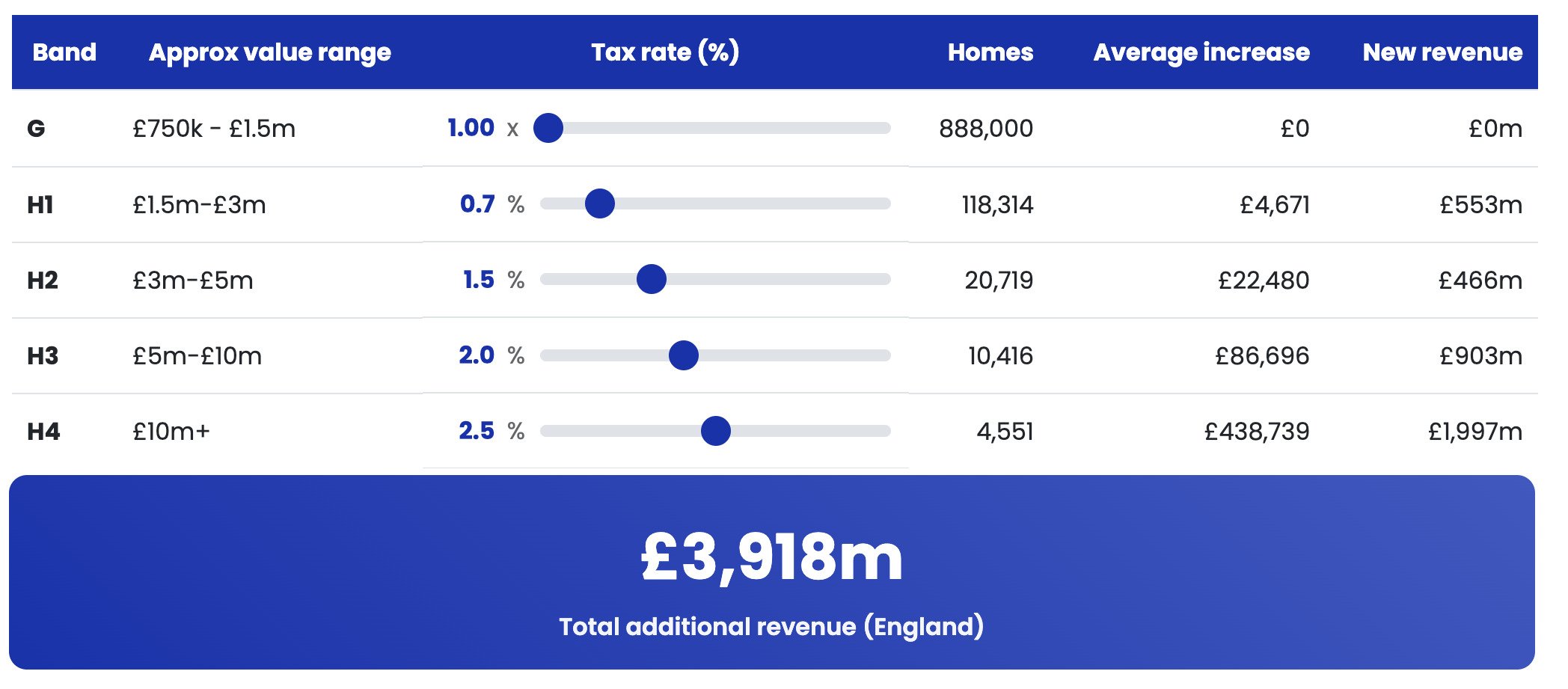
Footnotes
At the end of this article we discuss what the actual migration figures may look like. However we note this point up-front because we don’t want this report to be used to suggest that non-doms are not leaving the UK. We believe it’s clear that they are (and also clear that this is what the OBR expected). ↩︎
Earlier reports were consistent with this. The 2022 Global Citizen reports said “private wealth” includes property (there were multiple reports that year and they are consistent). The Africa report from 2022 says “It should be noted that the average HNWI worldwide has the bulk of their wealth tied up in residential property and equities, so large movements in these two segments impact heavily on the total private wealth held in a country”. The earlier NWW reports for AfrAsia Bank included property. ↩︎
So, for example, someone who borrowed $1m against their $5m penthouse will have had $4m of wealth identified in the 2023 report which disappeared from the 2024 and 2025 reports. Mortgaging property is common even for the very wealthy, either to avoid “locking up” cash in non-yielding assets, or for tax purposes. Similarly, real estate held for investment (even by the very wealthy) will normally be leveraged, because it increases the yield. ↩︎
The main 2024 report is a little more ambiguous – it doesn’t define the term “wealth”, but says that property has a “significant impact on wealth”. ↩︎
There are various public lists of large crypto investors; they are unreliable and only reflect a small proportion of the overall population. ↩︎
Although, when interviewed by Tim Harford, the author of the report said he “mainly” surveyed “listed company holdings and some cash holdings”. ↩︎
If we give households the full benefit of a 30 % equity rally over this period, and (generously) assume they are one-third invested in equities, the elimination of property wealth means anyone worth $1m to $1.2m in 2023 would cease to be a millionaire in 2025 (because $1.2m x (1/3 x 1.3 – 2/3) is less than $1m). A Pareto distribution with α ≈ 1.35 implies around 54,000 people in London fall in that range – roughly 20% of all millionaires. ↩︎
There are also undocumented changes in methodology. The 2022 “Global Citizen Report” figures are substantially different from the 2023 figures, with the number of UK millionaires falling by 12% and the number of Japanese millionaires falling by 30%. Possibly the Global Citizen report is using a different approach – but the lack of any published methodology means we don’t know what. We have excluded the Global Citizen data from our report, although it may bear further analysis. ↩︎
The 2021 Henley & Partners reports don’t contain any detailed data. For earlier years, New World Wealth reports were published by AfrAsia Bank in 2018, 2019, 2020. The stated methodology is very different (see further below), so we didn’t pool this with the Henley & Partners data. However we did check for odd/even numbers and did not see anomalies in this dataset – see below. There was no data for 2020/21 because of lock‑downs and border closures. ↩︎
We were pooling different years’ of data, which is appropriate provided the odd numbers across the data are independent. This is generally the case, with the exception of the billionaire data, where three countries had a repetition year-on-year. We removed the repetitions from the datasets (but retaining the repetitions does not materially change the result). ↩︎
There’s an important but subtle point to watch when applying these techniques. Rounding can produce outputs which are skewed towards even trailing digits if a rounding mode known as “round-to-even” or “banker’s rounding” is used. Spreadsheets generally don’t use round-to-even rounding, but most programming languages do. Great care therefore needs to be taken when applying forensic techniques to data which (for example) was created by a computer programme which rounded a pre-existing dataset containing figures to one decimal point. In such a case, banker’s rounding of random numbers would only be expected to produce 45% odd trailing digits. The likelihood of observing 127 odd numbers in a sample of size 299 would therefore be 20.6%. However, the issue becomes much less significant where the underlying dataset has more than one decimal point (as 2.5 would round to 2, while 2.51 or 2.501 would still round to 3). We therefore don’t believe banker’s rounding explains the results found in this report. ↩︎
One-tailed binomial test, p = 0.0054. The individual results are not significant: p = 0.094, p = 0.066 and p = 0.084 respectively; however given all the results are independent outputs of one process, it is appropriate to pool them together. ↩︎
Centimillionaire result, p = 0.000068, millionaire result p = 0.035, billionaire result p = 0.084, overall result p = 0.000018, but obviously that is dominated by the centimillionaire result. There are repeated datapoints in the billionaire set so, even if we had found a significant result, we would have regarded it with scepticism. ↩︎
p = 0.019. Most of the migration flow numbers are given to the nearest hundred, and so we divide by 100 to obtain the last significant digit. However in 2025 (but not earlier years) numbers under 500 are rounded to the nearest 50. For the 2025 dataset only, we therefore divided all numbers under 500 by ten. We were concerned this might have introduced an element of subjectivity and therefore double-checked by instead binning all migration numbers under 1000 for all years. That left only 58 numbers, of which 38% had an odd last significant digit (p = 0.0060). We are therefore reassured that we did not inadvertently bias the data (and 58 is still high enough for validity). The curious consequence of binning numbers below 1,000 may indicate a higher level of manipulation for larger countries. ↩︎
We used all their data from 2023 to 2025 – as we note above, the 2022 data appears to use a different methodology (for an unknown reason), and we don’t think it’s appropriate to assume that the earlier AfrAsia reports are comparable. For many statistical tests one wouldn’t put different years together, because that means the datasets aren’t independent. However for this test it’s different, because we’re looking at the last digits. None of the centimillionaire number counts remain the same year-on-year, and so we can regard them as independent and pool the years. The first digits however would not be independent (because it’s likely the first digit of the millionaire count would be the same year on year), and so we did not test for first digit frequency. ↩︎
But only where there are three digits in the data, because otherwise you get a Benford-style distribution. For trailing digits, Benford converges to uniform as soon as we get past the first two positions. ↩︎
There are 74 last digits. The chance that none are a 1 is 0.90 ^ 74 = 0.00041. The chance that only one is a 1 is 74 x 1/10 x (9/10) ^ 73 = 0.0038. Adding them together = 0.4%. ↩︎
We used a chi-squared test – this is a statistical test that compares an observed frequency with an expected frequency, and calculates the likelihood that the difference is due to chance. ↩︎
vs a uniform distribution, p = 0.016. A Benford test is unlikely to be appropriate here, but we ran as a check, and p = 0.015. ↩︎
We can’t use the last digit, because the data is rounded to the nearest hundred, so we looked at the “thousands” digit instead. That found no anomalies. A Benford-style test on the first or second digit doesn’t give a statistically significant result, because the number of datapoints in any one year is too small, and combining years is not appropriate because (unlike last digits) first (usually) and second (often) digits are consistent from one year to the next – the datasets aren’t independent. ↩︎
Full data is available for 2020 and 2019 to 2025. The UBS definition of “millionaire” is different from Henley & Partners’, because it isn’t limited to liquid wealth, but that’s not relevant for the purpose of these forensic tests. ↩︎
51% of the 180 UBS numbers are odd (binomial p = 0.42), 50% of the sixty Knight Frank numbers (p = 1), and 52% of the 81 Forbes billionaire counts (p = 0.41). ↩︎
52% of the 61 AfrAsia migration datapoints were odd, p = 0.40. ↩︎
When running several different tests against multiple data sources there is always a risk of achieving positive results solely through chance. More cynically, a researcher can keep running different tests against different subsets of data until eventually finding significant results (i.e. cherry-picking or “p-hacking“). It is therefore important that we disclose all the tests that we ran, with positive and negative outcomes. There were seven H&P datasets – millionaires, centimillionaires and billionaires for cities and the world, plus the migration data. On each of these datasets we tested first and (except migration) second digit Benford’s law, last digit distribution and last significant digit odd/even. That’s a total of 27 tests, of which nine were positive (p <= 0.02). If the data was in fact not anomalous, we’d (on average) expect to run 50 tests before chance gave us a p = 0.02 positive. The chance of fluking nine or more positives under a binomial (n = 27, p = 0.02) model is 1.7 × 10⁻⁹ (≈ 1 in 600 million, but this understates quite how unlikely it is, given that in most cases our results were more significant than p = 0.02). ↩︎
This can’t be down to rounding, because NWW give precise centimillionaire numbers and millionaire numbers to the nearest hundred (so for e.g. London that’s four significant figures. ↩︎
We deliberately used low‑ball volatility (5 % vs the 8 to 15 % many surveys record) and a high 0.7 correlation between centimillionaire and millionaire numbers; even under those gentle assumptions, the odds of five major cities seeing <0.1 % ratio movement are ≈ 0.03 %. Tougher but still realistic parameters drive that probability essentially to zero. If we go the other way, and make the correlation unrealistically high – 0.95 – the probability of seeing five cities with so little change remains well below the usual significance level: 0.5%. ↩︎
Nor do we believe it would be possible to use rules-of-thumb, e.g. average levels of debt, and obtain a meaningful result. ↩︎
There are some exceptions. The UK, US, Portugal and Greece publish data (e.g. Portugal attracted around 2,000 high net worth individuals over ten years). Italy published figures in the numbers taking advantage of its flat tax scheme for wealthy migrants: from 2017 to 2023, around 4,000 people used the scheme. The numbers are small and (even where available) have little impact on country migration figures. ↩︎
For example by scraping job titles/employer from LinkedIn and then using other sources like Glassdoor and Payscale to estimate the salary. ↩︎
In this document, HMRC says there are 5,000 people with £50m+ of assets and 2,500 people with £100m+ of assets. We understand these are more than estimates, and that HMRC actively monitors this population individually. We can use these figures and the number of millionaires from ONS data to estimate the number of people with £73m/$100m of assets. Note that there are credible studies showing that the wealth of the very wealthiest is systematically under-counted, and therefore not always visible to HMRC – HMRC doesn’t know the number of billionaires in the UK. Hence the true figure for the number of centimillionaires may well be higher than the 3,400 figure. ↩︎
Estimating wealth on a global scale is a difficult undertaking. We understand the Capgemini, UBS etc wealth reports are assembled by large and capable teams, and the UBS report is led by a respected professor. However the methodologies are not fully open, and we would regard all these estimates as approximations. ↩︎
The fallacy that a large survey will be accurate was most famously illustrated by the Literary Digest, who surveyed 2,376,523 readers for their poll of the 1936 US Presidential election, and got it spectacularly wrong. Modern opinion polling uses much smaller samples, but with careful statistical controls. ↩︎
Other elements of the reports suggest the author is out of his depth. A peculiar section criticises GDP for, amongst other things, counting value multiple times, and not including wealth. The first point is just a basic mistake – GDP counts the added value at each point – there is no double/multiple counting. The second point is more fundamental: GDP does not include wealth, because wealth is a stock and GDP is a flow. ↩︎
Even if these issues were resolved, the total for migrated wealth would still be incorrect. The methodology section says it’s arrived at by multiplying the number of movers by national average wealth. That’s a very naive approach: wealth distribution is highly skewed and migrants tend to be atypical. You also can’t assume that wealth migrates – a wealthy UK non-dom will almost inevitably have most of their wealth offshore (because that’s how they benefit from the non-dom regime). If they migrate, that offshore wealth won’t be moving. ↩︎
Nor do we think one can simply adjust the Henley & Partner country figures to reflect the difference between their count of millionaires in each country and more robust data – there are too many fundamental problems with the report and its claimed methodology. ↩︎
Available here, password no#exodus. There is an updated version here and a further update here↩︎
TJN takes the reported Henley & Partners migration figures and divides that by the number of millionaires reported in the UBS Global Wealth report but – as TJN themselves note (page 5 here) the UBS figure is for all dollar millionaires, whilst the Henley & Partners figure is (supposedly) counting liquid assets only. You cannot divide one measure by another completely different one. ↩︎
Although the 2022 Global Citizen data certainly isn’t. ↩︎
The number of really wealthy UK non-doms (i.e. billionaires) is so small that statistical techniques are unlikely to be viable approaches for estimating their migration levels. The only way to obtain reliable data will likely be to either identify specific individuals leaving (not easy, without being able to count the days they’re in the UK), or for HMRC to publish its data (which will itself be incomplete). ↩︎
A UK wealth tax is often promoted as an easy revenue-raiser that would only affect the very rich. Our analysis finds the opposite: the revenue is highly uncertain, and would arrive only after years of complex implementation. Most importantly, the tax would lower long‑run growth and employment, thanks to a decline in foreign and domestic investment. It would make UK businesses more fragile and less competitive, and create strong incentives for capital reallocation and migration. There are better solutions to the many problems with our tax system.
The numbers that change the wealth tax debate
2–5% GDP
Modelling of comparable proposals shows long‑run GDP hits ~2% (US) to ~5% (Germany). More.
80% / £4bn
~80% of projected receipts come from ~5,000 people; ~15% (£4bn) from the top ten. The revenue is fragile. More.
60%+
A 2% wealth tax can push marginal effective rates above 60% — and above 100% on low‑return assets. More.
2029
Unlikely to see any revenues before Jan 2029. Too complex and slow to implement. More.
This report summarises the UK wealth tax proposals, analyses the claimed revenue yield, and looks at the potential downsides and risks, and the policy alternatives. We compare the new proposed wealth tax with the older wealth taxes that have largely failed and been repealed. Finally, we suggest better and less risky ways to tax wealth in the UK.
Executive summary
This very brief summary links at each point to the detailed analysis below. You can also navigate with these buttons:
Evidence. International modelling of comparable proposals shows ~2% (US) to ~5% (Germany) long‑run GDP hits, plus large impact on employment; UK exposure may be greater. US studies · German study.
Higher dividend payouts to fund tax mean lower reinvestment. Evidence from Norway & other studies. Dividend response.
Foreign direct investment would fall. Tax must catch foreign owners or is easily avoided. That deters future FDI and prompts withdrawal of current FDI. FDI analysis.
Makes UK business uncompetitive. Because a UK Ltd’s foreign subsidiaries are subject to the UK wealth tax; its foreign competitors are not. Competitiveness.
Worsening recessions. In a downturn, capital and the taxes on it usually fall automatically – “automatic stabilisers” for the economy. Wealth tax bills barely change. Wealth taxes provide a shock during periods of financial stress.
These factors are both more consequential and more complex than the “will they leave?” debate that’s currently playing out in the media.
2. Revenue risk: headline sums are fragile
Claims of £10bn to £25bn a year revenue rest on optimistic behaviour assumptions. Using higher (still plausible) avoidance/migration elasticities cuts receipts sharply. Revenue analysis. The numbers.
80% of projected yield comes from ~5,000 people; ~15% from ten people. A handful changing residence or valuations could remove billions. Migration risk. Worse than non-dom response.
Even proponents’ “low response” scenario implies £200bn of lost capital; “high” ~£500bn. That erodes other tax bases. Capital at risk.
Historic data are misapplied. Past wealth taxes had low rates, wide exemptions and applied broadly; new UK proposals are the opposite. Compare designs.
The UK would be an outlier. No developed country in the world has both a significant wealth tax and a significant inheritance tax. Nobody has implemented a wealth tax of the type proposed. International comparisons.
Requires an unprecedented wealth exit tax to stop large-scale capital flight. But fear of an incoming wealth exit tax would trigger a wave of exits, and the tax would deter entrepreneurs and others from coming to the UK. Undermines the Government’s new FIG regime. Wealth exit tax.
3. Implementation & better options
Complex to legislate & administer. Realistically multi‑year build; no cash until January 2029. Implementation timeline.
Existing wealth taxes abroad work only with big carve‑outs. Spain exempts business assets and collects very little – a deliberate decision of a socialist government to minimise economic damage. Norway/Switzerland heavily discount or cap. International evidence.
Valuation creates an administrative burden far beyond that seen in income or consumption taxes. Valuation difficulties.
Fix current UK wealth taxes instead. Reform land tax, capital gains tax, and inheritance tax. All could raise revenue more fairly, more efficiently and faster, with fewer risks. The UK needs tax reform across a swathe of existing taxes. Policy alternatives.
The apparent polling support for wealth taxes is fragile, based upon questions that provide no context and reveal no trade-offs. The mansion tax was popular – until it wasn’t. Polling.
Bottom line: An annual UK wealth tax is a high‑risk, low‑certainty revenue bet that could harm growth. Better‑targeted reforms can tax wealth more effectively with far less collateral damage. See our recommended reforms.
The rest of this report explores all these points in more detail.
What is being proposed?
There have been many attempts to introduce wealth taxes, with a first wave of taxes in the 1890s and 1900s1, and a second wave after WW22 Wealth taxes were largely abandoned by the 2000s, with only three remaining in Europe.3
Historic and existing wealth taxes have low rates, and/or wide exemptions, and were easily avoided; but that also means they had limited adverse economic impact.
The new “third wave” wealth tax proposals aim to raise much larger sums by eliminating all exemptions, and ease political objections by only applying to the very wealthy.
TUC: 1.7 % on wealth over £3m, 2.1% on wealth over £5m, and 3.5% on wealth over £10m – intended to raise £10bn.5
Green Party: 1% on wealth over £10m and 2% on wealth over £1bn, intended to raise £15bn.6
All share the key feature that, unlike all existing and historic wealth taxes, there will be no exemptions of any kind, and the taxes only apply to a small number of taxpayers. However, at the same time, the proposals all rely on behavioural response data from these old wealth taxes, which applied to many more taxpayers and had exemptions to prevent adverse economic impact.
None of these proposals even acknowledge the potential for adverse economic impact.
By far and away the most serious UK analysis of wealth taxes was from the Wealth Tax Commission, an informal body of academics and tax policy experts which was convened in 2020.7 It recommended against an annual wealth tax and in favour of a one-off retrospective tax. The one-off tax proposal has very different effects to the other current wealth tax proposals, and we consider it at the end of this report.
Most of this report will focus on the Tax Justice Network proposal, because it is the clearest about its mechanics and methodology (taken from the work of the Wealth Tax Commission). However the criticisms we make apply to all the current wealth tax proposals.
Isn’t a 1% or 2% wealth tax tiny?
A wealth tax is often described as a “tiny” or “small” tax. And a 2% tax on income is indeed a small tax, unlikely to prompt dramatic action in response from most taxpayers.
A 2% tax on wealth, on the other hand, is very different.
There are two ways to look at it.
First, as increasing the overall effective rate of tax on the return on assets:
For an investor earning an 8% return8 on their assets over £10m, a 2% wealth tax on top of the existing 39.35% dividend tax creates a marginal effective rate9 of 64.35%.10 If, as we should, we take corporation tax into account, then the overall effective rate is 79.5%.11
For the owner of a business yielding a 4% return, a 2% wealth tax on top of dividend tax creates a marginal effective tax rate of 89.35% – or 104.5% if we include corporation tax. On the other hand, if the business yields a 15% return, the effective rate is 52.7%, or 69% after corporation tax.
So the more profitable the business, the lower the effective rate of tax:
This is counter-intuitive. It’s also the opposite of what optimal tax theory says a tax should do, and is one of the reasons the Mirrlees Review said there was a “persuasive economic argument” against the wealth tax. There is a clear explanation of these effects from the US Tax Foundation here.
We can see these effects in action in an OECD analysis of the marginal effective tax rates of the then-existing wealth taxes in 2016:12
The charts are a little out of date – Spain now has a “cap” which reduces the wealth tax if it would raise the overall effective rate of tax above 60%. We discuss this further below.
The proposed UK wealth taxes have a higher rate than these taxes and no caps or exemptions: the effective rate will therefore be greater than shown in these charts.
Second, as a one-off reduction in the value of an asset.
Because the wealth tax is an annual tax, it amounts to a permanent change in the economic characteristics of assets.
Take someone who owns a £100m company, now subject to a 2% wealth tax. If they expect an 8% return on their holdings, the wealth tax has reduced the value of the company by £25m (i.e. because their return from the £100m company, net of wealth tax, is the same as what their return would have been from a £75m company before the wealth tax).
What this means
A taxpayer’s response to a tax will be driven by the cost to them of that tax. If the cost was really “tiny” we would expect little response. But the nature of the wealth tax means that the cost is actually much higher than existing UK taxes – and so we should expect a heightened response.
The existing real world wealth taxes generally mitigate all of these results with exemptions, discounts, liability caps, valuation safe harbours and other special rules. The proposed new wealth taxes contain none of this. So we should also expect a much higher response than we see from existing wealth taxes.
And the effective rates discussed above will be increased by the cost of complying with the tax. This is highly uncertain – estimates in the Wealth Tax Commission papers range from 0.05%13 to 1.5%14 of net wealth.
A final point: the cost of the wealth tax will extend beyond the taxpayers who are subject to the wealth tax. To prevent avoidance and evasion, HMRC would realistically have to require a wealth tax return for people with assets approaching the threshold. So if the threshold is net wealth of £10m, around 32,000 taxpayers would pay the tax.15 But another 16,000 would have net wealth above £7.5m16, and likely would be required to submit returns, and incur material expenditure on compliance.
Will it raise the claimed sums?
Wealth tax proponents present their revenue projections without acknowledging what serious researchers have always made clear – there is a huge amount of uncertainty as to how taxpayers will respond to these taxes, and what that means for the revenue they will raise. The Wealth Tax Commission paper on behavioural response noted that estimates of taxpayer response in the literature vary by a factor of 800.
However, the basic problem is simply stated. We expect that no tax in the history of the world has relied as heavily as the new wealth tax proposals on collecting so much tax from a small number of people. 29% of UK income tax is paid by the highest earning 1%. Two thirds of Norwegian wealth tax is paid by the wealthiest 1%. But the proposed Tax Justice Network UK wealth tax would raise all its revenue from the top 0.1%.17 About 80% of wealth tax revenue would come from the wealthiest 5,000 people18, and around 15% of wealth tax revenue from just ten individuals.19
That makes the tax uniquely vulnerable to a very small number of people responding to the tax, either by gaming valuation (for which see further below) or ceasing to be UK tax resident.
Migration
The most obvious way to escape the wealth tax is to cease to be UK tax resident.
For the merely very wealthy (£10m to £50m), that may actually mean leaving the UK – never an easy undertaking, practically, emotionally and financially. Anyone with material UK wealth who wishes to escape the wealth tax would need to not just leave the UK, but exit their UK assets. Where assets are illiquid (private company shares and real estate, for example), this would be neither straightforward nor speedy.
However, when it comes to the extremely wealthy – say the approximately 5,000 people with wealth of £50m or more, or the much smaller number of billionaires, things are very different. Talk of such people “leaving” is simplistic – they often have homes in several different countries, spending a few months in each one. UK rich lists are dominated by people who came to the UK from abroad and spend comparatively little time here. Ceasing to be UK tax resident will in many cases mean adjusting diaries to spend no more than 90 days (or in some cases 120 days) in the UK. 20
Any realistic analysis has to recognise the existence of tax exiles, and therefore acknowledge that a disproportionate number of very wealthy UK taxpayers have moved abroad to escape UK tax. Some estimate that one in seven British billionaires now live in tax havens; others one in three.
One final point: existing migration to avoid capital gains tax and income tax on dividends is restricted by a rule that you have to leave the UK for five years (or you are a “temporary non-resident“).
Migration to avoid the wealth tax would be immediately effective. Wealthy people could pop out of the UK just before a wealth tax came in, with the intention of returning if the wealth tax was subsequently repealed.
So we have no doubt that people will leave – some in the usual sense of the word, some in the technical sense of ceasing to be UK tax resident, but not dramatically changing their lifestyle. And the extreme reliance of the tax on a small number of taxpayers means that just ten people leaving would reduce wealth tax revenues by £4bn.
The UK doesn’t currently have an exit tax. If you are (for example) a UK resident who is about to sell a large shareholding and make a substantial gain, you’d pay capital gains tax on that gain. But if you leave the UK, moving say to Monaco, you pay no capital gains tax (provided you stay outside the UK for five years).
A capital gains exit tax would trigger an immediate tax charge upon leaving the UK – as if you sold your shares (probably with an option to defer and complex credits against foreign taxes).
The US has a capital gains exit tax which is very harsh and effective – it can do that because the US taxes on the basis of citizenship not residence (see further discussion below). Many European countries have exit taxes which are less effective: in part because of EU law restrictions, and in part because (in short) they are not the US.
There are good arguments for reforming CGT so that we don’t tax gains people make before coming to the UK, but do tax gains they make when here – such a capital gains exit tax could be good policy, but would have to be implemented with care.
However a capital gains exit tax won’t be effective to deter people leaving to escape a wealth tax. If someone has few uncrystallised gains then they will be little affected by an exit tax.22 Even someone with large potential gains may regard the cost of the exit tax as a good deal compared to the wealth tax – CGT is 24% but many will always have anticipated and accepted that. If an exit tax is to be effective in stopping escape from a wealth tax, then the exit tax needs to do more than crystallise gains – it has to impose a one-off charge on net wealth similar to the future wealth tax charges that exit would avoid – a “net wealth exit tax“. That is a very different kind of exit tax, and one which very few countries have implemented.
Implementing an exit tax of any kind is a high risk endeavour. If the belief takes hold that the Government will introduce an exit tax then people will leave before the exit tax bites; even speculation about exit taxes can be economically damaging. A net wealth exit tax would have a more dramatic effect. Norway recently introduced such a exit tax to protect its wealth tax – and it experienced an immediate wave of exits.
There are also second order effects, after the tax is implemented, as people respond to its existence. UK residents may accelerate plans to leave the UK (or create such plans) because they worry about assets/gains that are anticipated but not yet acquired/accrued.
A net wealth exit tax would make coming to the UK a very consequential decision, and perhaps a financially irreversible one. We should therefore expect a decline in the number of wealthy people coming to the UK and, perhaps more importantly, a decline in the number of people who hope to become wealthy. That would be the opposite of the Government’s intention when it created the new “foreign income and gains” (FIG) regime to make it easier for high-skilled workers to move to the UK.
All of this means that an exit tax is not an easy answer, and comes with its own costs. And no exit tax would realistically apply to foreign residents with UK assets (as that would be correctly seen as a form of capital control, with a significant adverse impact on current and future foreign investment). We therefore once more see the problem of UK residents being put at a competitive disadvantage vs foreign residents with UK assets. And there is, once more, no obvious solution.
It’s not a repeat of the non-dom debate
The wealth tax debate is currently being reported in much of the media as a replay of the non-dom debate. But the impact of wealth tax migration is very different.
A non-dom can leave the UK without selling their UK assets and business interests, because once they become non-resident they won’t be taxed on those assets/business (unless it’s real estate investment). So the loss to the UK (in tax and economic terms) of the non-dom leaving the UK may be limited to the loss of their personal spending.
By contrast, someone migrating to escape the wealth tax would likely have to sell all their UK assets and exit all their UK business interests.23 We should therefore expect the tax and economic loss resulting from a wealth tax exit to be more significant than that from a non-dom exit.
How much do these effects reduce revenue?
The Tax Justice Network claim of £24bn of revenue from their wealth tax assume a “taxpayer behavioural response”, i.e. migration and other avoidance, of 14%. In other words, for each percentage of wealth tax, reported wealth falls by 14%.
This figure comes from the Wealth Tax Commission24, which estimated a behavioural response for a 2% wealth tax ranging from 14% (in a “low avoidance scenario”) to 34% (in a “high avoidance scenario”). The proponents use the 14% figure without any justification. But if the 34% figure was used then the revenue raised would be significantly less – £18.5bn.
We would first pause and note what these figures mean. In the “best case” 14% scenario, £200bn of wealth is lost (to migration and shifting into hard-to-value and unproductive assets25). In the “high avoidance” 34% scenario, £500bn of wealth is lost. These are very large numbers – and the nature of the current wealth tax proposals means they represent “real” taxpayer response, not just paper transactions.26 So there would be an impact on tax revenues (income tax, capital gains tax and VAT) as well as the economy as a whole.
The 14% figure seems very optimistic. Wealth tax proponents Saez and Zucman expected a 15% level of avoidance for a US wealth tax, when the US has citizenship-based taxation that often makes exit extremely costly.27 It would be surprising if the UK, where exit is so much easier, experienced less avoidance.
We believe the 34% figure may also be optimistic. All of these figures are based on studies of historic and existing wealth taxes – these had generous exemptions, and applied to a much broader class of taxpayer.28 It then applies the conclusions of these studies to the new wealth tax proposals, which have no exemptions, apply only to a small number of very wealthy and very mobile people.
There is good reason to believe that taxpayer response to tax rates is highly non-linear – we should therefore expect the very high effective tax rates created by the new wealth tax proposals to have a larger effect than a simple linear extrapolation would suggest (and much larger than other tax reforms we have proposed, which have far smaller effective rates). Given the large effect, and the relative ease of exiting UK tax residence, the experience of historic wealth taxes in other countries is in our view a very poor guide to how the new wealth tax would work in practice in the UK.
We therefore expect the revenue would be significantly less than £24bn. That might not matter if the tax would have no economic downside – but the evidence suggests that the economic consequences are likely to be both complex and serious. The wealth tax is not a costless bet which only has a positive upside.
What’s the economic impact?
Foreign investment
A UK wealth tax realistically has to apply to foreign residents owning UK businesses, as well as to UK residents. Otherwise we’d be making migration much easier (as an individual exiting the UK could keep all their UK shareholdings). We’d also be giving an unfair advantage to foreign-owned companies29, and causing UK businesses to be sold to foreign owners, to whom they would be more valuable. In our example above, a business that was worth £100m before the wealth tax would be worth £75m to private investors after the wealth tax – but if the wealth tax doesn’t apply to foreigners, it would still be worth £100m to them.30
But this creates a problem. Imagine you’re a French privately-owned business (or investor) considering investing €100m in either Germany or the UK. The UK investment will trigger a €2m annual wealth tax. Depending on how you view this:
the UK investment would have to yield a 2% higher return than the German asset just to be equivalent to it, after wealth tax, or
if you’re taking a long-term view, the wealth tax is equivalent to an immediate €25m loss of value (if we assume an 8% rate of return). You’d be paying €100m to obtain a €75m asset.
The German investment doesn’t have these consequences.
The same calculation applies to a privately-owned French company that invested €100m in the UK before the wealth tax. Its return is now 2% lower; it has the return of a €75m asset. So the rational move for the French company is to pull its €100m from the UK and move it to a country without a wealth tax.
Most existing wealth taxes don’t have this difficulty, because they pragmatically contain exemptions. The Spanish tax exempts unlisted company holdings. The Swiss and Norwegian wealth taxes apply only to non-residents if they own local real estate. But the ambitious modern wealth tax proposals realistically have to apply to non-residents. And that’s a problem.
British competitiveness abroad
Under the wealth tax, UK owners of a business abroad will pay a 2% wealth tax on the value of that business.
This creates a competitiveness problem.
A privately held UK company31 with a subsidiary in (say) France will pay32 a 2% wealth tax on the value of the French business. Its French-owned competitor will not.
A UK-owned foreign business would therefore require a higher internal rate of return than foreign-owned rivals to deliver the same post-wealth-tax yield. The UK-owned business may become uncompetitive. Projects or acquisitions that clear the hurdle for a French or US buyer may be rejected by a UK buyer.
The impact on growth
There are different views on whether historic wealth taxes impacted savings and investment, and therefore growth. However these wealth taxes were easily avoided by arrangements with little economic effect (for example restructuring investments through a private company, or even just failing to declare assets).
The new proposed wealth taxes are intended to be very hard to avoid – the most realistic avoidance strategies are moving into hard-to-value assets or migrating. These strategies do have real economic effects.33
The new wealth tax proposals have several effects that impact growth:
The fact that the wealth tax has a higher effective rate for less profitable businesses means it increases the risk and the cost of failure (as well as the cost of owning a startup).34 It therefore makes entrepreneurship less attractive. A study by Hansson found that existing wealth taxes caused a 0.2% to 0.5% fall in self-employment. That’s surprising given that these taxes generally exempt business assets. We should expect much larger effects with the proposed new wealth taxes.35
For privately-owned foreign investors into the UK, a wealth tax will disincentivise investment, for the reasons set out above. This is a significant concern given the UK’s reliance on foreign direct investment (FDI) – the UK’s inward FDI stock is equivalent to about 87% of GDP (one of the highest in the world, and beaten only by Hong Kong and Singapore).
And another effect on both foreign and domestic business owners: when they can, they’ll take dividends from their businesses to fund wealth tax payments. That means less retained in the business for investment. An analysis by Ebeltoft and Johnsen found that the Norwegian wealth tax, 0.5% at the time, elevated dividends by 7.8%. A study by Fuest, Neumeier, Stimmelmayr and Stöhlker into a proposed German wealth tax (at half the rate of most of the proposed UK wealth taxes) found that it would result in a 5% decline in production and a 10% decline in investment.
This effect isn’t limited to privately held companies; public companies respond to the need for their investors to fund wealth taxes. An analysis across 26 countries by Barroso, N’Gatta and Ormazabal found that wealth taxes were associated with significantly larger dividend payouts and reduced investment.
More subtly, a wealth tax will distort investment towards assets that are hard to value – such as art, expensive/vintage cars, yachts, jewellery. If investments in these assets increase, and investment in actual capital decrease, then that reduces savings and reduces productivity.36
Migration to avoid the wealth tax – which we discuss below – will have additional effects in terms of lost investment and jobs, but that may be less important than the above “intensive margin” effects.37
All these effects will be heightened during an economic downturn. Investors’ returns will reduce, but the value of their assets will decline only slightly – so their wealth tax liability will remain unchanged (and the inevitable delay between valuation and payment of tax mean that there may be no decline at all for wealth tax valuation purposes). The effective rate of the wealth tax will therefore rise – increasing all the effects discussed above. The wealth tax may, therefore, make recessions worse.38
Analyses of US wealth tax proposals
The call for implementation of wealth taxes by Elizabeth Warren and others in the US, led to several detailed economic analyses of these effects. The Penn Wharton Budget Model and the Center for Public Finances found that these proposals would reduce long-run GDP by over 2% if the funds were (as is proposed for the UK wealth tax) used to finance current expenditure.3940
How do these results apply to the UK wealth tax proposals?
The UK proposals generally tax wealth above £10 million (versus $50 million in the Warren proposal). That brings in a larger share of the affluent population, and a greater fraction of total wealth. The Warren proposal elevated the rate to 6% on wealth over $1bn; most UK proposals do not – the Centre for Public Finances model anticipated that 6% tax, but the Penn Wharton Budget Model present one scenario (with a 2% long-run GDP hit) which has a uniform 2% tax.41
Another significant difference is that the key uncertainty in the impact of wealth taxes is the elasticity – how much the amount of declared wealth responds to the imposition of the tax. The response will be in part by avoidance (such as splitting wealth between family members) in part by movement into hard-to-value asset classes, and in part (and most significantly) by leaving the jurisdiction. Here the US has the considerable advantage over the UK that it imposes tax by citizenship not by residence – so it’s much harder to escape the tax than it would be to escape the UK equivalent (as discussed above).
The UK is also more exposed to any withdrawal of foreign investment – our foreign direct investment (as a % of GDP) is much higher than the US.
Detailed work would be required to balance the material differences here: the broader base of the Warren tax, the higher rate on billionaires, the greater ease of migration out of the UK, and the greater sensitivity of the UK to the withdrawal of foreign investment. All we’d say for now is that it’s reasonable to expect the UK impact of a wealth tax to be the region of the 2% figure that these US studies suggest.
Analyses of a German wealth tax proposal
Fuest, Neumeier, Stimmelmayr and Stöhlker published a detailed computable general equilibrium (CGE) study of a proposal to (re)introduce a German wealth tax42 at 0.8% on household wealth over €2m – a considerably smaller tax than any current UK proposal.
The study found a 5% decline in long-run GDP and 2% fall in employment, equating to several hundred thousand jobs.43 Whilst the tax would raise about €15bn each year, the adverse economic consequences would mean €46bn would be lost from other taxes.
In terms of exposure to migration and ease of exit, we would say the UK is more comparable to Germany than the US (although the UK high net worth population is considerably more international than Germany’s).44
Analysis of impact of French wealth tax
When the French wealth tax was abolished in 201745, the French Prime Minister claimed the tax had prompted 10,000 people with €35bn worth of assets to leave France in the previous 15 years. He gave no source for that, and the effect of the tax is contested.
Back in 2008, economist Eric Pichet concluded that capital flight since the creation of the wealth tax in 1988 had amounted to €200bn, that the tax had caused an annual fiscal shortfall of €7bn, or about twice its revenue. However Pichet’s estimate has been persuasively contested, and evidence since the abolition of the wealth tax suggests any effect was limited. The view of the French tax advisers we spoke to is that the French wealth tax was so prone to avoidance and evasion that it likely had little impact on GDP. We therefore don’t think any lesson can be drawn from the French experience – it’s the “wealthy tax fallacy” – comparing leaky historic wealth taxes to the new “zero exemption” proposals.
The argument that wealth taxes do not impact growth
Some US wealth tax proponents simply assume there will be no taxpayer response to wealth taxes. Zucman’s proposal for an internationally coordinated wealth tax simply asserts that adverse incentive effects are “unlikely to be significant”.46Zucman and Saez arguedthat a US wealth tax would not reduce overall savings because US domestic savings would be displaced by foreign savings, which wouldn’t be subject to the wealth tax. As we explain above, we don’t believe a UK wealth tax could work this way, given the avoidance/migration it would enable, and the competitive disadvantage it would give to UK-owned businesses. The UK is a more challenging environment for a wealth tax than the US.
Some papershave analysed historic wealth taxes and concluded there was no impact on savings. However, that is another example of the “wealth tax fallacy” – analysing historic and existing wealth taxes which enable “paper” avoidance or shifting into unlisted shares (and therefore maintain savings)4748, and assuming the same conclusions apply to the new wealth tax proposals where the dominant avoidance is “real”, and actually reduces savings. Other of these papers49 focus on income-restricted retirees and near-retirees, who pay the relatively broad-based historic and existing wealth taxes, but are not a significant proportion of taxpayers under new wealth tax proposals with their high thresholds.
We don’t see any of the research as providing reassurance on the growth impact of a “no exemption” UK wealth tax.
The need for a UK-specific analysis
Given the increasingly high profile of the new UK wealth tax proposals, we would welcome a detailed analysis of their economic effect – on investment, employment, growth, and looking specifically at the impact during economic downturns. As far as we are aware, no such study has been carried out.
Some property is easy to value: bank accounts, shares in listed companies, recently-acquired real estate. Applying a wealth tax to such assets is reasonably straightforward – although not without problems. Imagine having a large holding in (for example) Carillion, with the company going bust in-between the valuation point and when the wealth tax falls due. That’s a fundamental problem with the design of a wealth tax that no valuation methodology can fix.
Valuing other property is more challenging – even in principle. A particularly important case is that of private/unlisted companies.
Private companies
For some large private companies there is an obvious listed comparator. For example, Iceland Foods is privately owned, but there are many publicly owned supermarkets – so we can come up with a reasonably objective valuation by using their financial data as a benchmark and conducting a “comparative company analysis” (CCA).50 Even then it’s not straightforward. We should discount the valuation to reflect the fact the company is private, not public – you therefore have no easy way to realise your investment (without a complex M&A process). On the other hand, if you control the company then the valuation should be increased to reflect a “control premium” – you can do what you like with the company. How these factors should be assessed is not straightforward – we are aware of three UK tax disputes over private company valuation which lasted more than ten years.
Some other large private companies have no UK listed peer we can benchmark against – say JCB. Here we value through a “discounted cashflow” (DCF) analysis, looking at the cash the business generates, and how much someone would pay to acquire that stream of cashflows. At this point there are multiple uncertainties. Most importantly: what is the discount rate – i.e. the amount we should discount future cashflows to reflect the delay until we receive them? How will the company’s cashflows change over time?
But hardest of all are the companies with no listed peer and no current cashflows. Take, for example, Wayve – a UK autonomous vehicle and AI startup founded in 2017. It secured $1bn of investment from SoftBank, has a few hundred employees, but likely has little or no current income.
How much is it worth?
Do we say it must be worth at least $1bn, because that’s the implication of the amount that SoftBank invested? Problem is, the company will burn through the $1bn quite quickly, and all that’s left is hope. SoftBank has a history of making extravagant investments into businesses that fail. But also a history of making spectacularinvestments into businesses that soar. Which is Wayve? A wealth tax has to decide.
It’s even harder at an early stage – take the many recentAIstartups.
There are other hard-to-value assets, for example art, cars, furniture, intellectual property and agricultural land.
The consequence of valuation difficulties
The difficulty in valuing private companies and some other asset classes has serious consequences.
First, it creates a loophole. Investors will shift from easily-valued assets into hard-to-value assets. Conversely, they will resist shifting from hard-to-value assets into easily-valued assets – so, for example, the owner of a successful private company may resist an IPO which would facilitate easy valuation. As the Wealth Tax Commission said, “there will necessarily be aspects [to valuation] which are open to gaming”.
Second, it creates administrative cost and complication. Valuing every UK private company and piece of art every year is no small matter. You could value every five years, but that’s hopeless for fast-growing businesses, and both creates an opportunity for gaming the system on the one hand, and potential unfairness on the other (e.g. a company could have become worthless, but you’d be taxed on the basis of the previous high valuation). We agree with Fleischer that taxpayers would have a strong incentive to litigate over valuation disputes (and, conversely, so would HMRC).
All of this creates compliance costs for investors and businesses, and requires significant investment from HMRC (on the Wealth Tax Commission’s figure, over 10% of the £4.3bn total current cost of running HMRC).
A 2019 poll of US economists found a large majority agreeing that a wealth tax would be much more difficult to enforce than existing taxes because of valuation issues. Only 9% disagreed. Valuation difficulties remain a challenge that wealth tax proponents have yet to resolve.51
How other countries manage valuation
It’s these issues that mean all current wealth taxes avoid proper valuations of private companies and (in many cases) other hard-to-value assets:
The Swiss wealth tax deals with these issues for smaller private companies using a simple formula based on net asset value and profitability. That makes valuation very straightforward, but the obvious downside is that it’s easily gamed (with value stripped from a company other than through conventional profits, and debt used to reduce net asset value).
A UK wealth tax could adopt one or more of these approaches, but at the price of greatly reducing revenue and/or creating a substantial loophole that would be exploited. This is the fundamental wealth tax Catch 22: you can have a comprehensive wealth tax with severe valuation problems, or a modest wealth tax that raises much less revenue. You can’t do both.
Wealth tax proponents often minimise valuation difficulties. But the Wealth Tax Commission, after considering valuation issues in significant detail, ultimately recommended against an annual wealth tax.
And the valuation problem exacerbates the liquidity problem…
The liquidity problem
Say you’re the founder of an AI startup. You just struck a deal with a venture capital firm, who paid £10m for a 10% share in your company. At your current “burn rate” of expenses, you think that will last you two years, and you hope that when you get to that point you’ll be able to demonstrate enough success to obtain more funding.
But you now have a company that, on paper, is worth £100m, and you own 90% of it.52 So you have a wealth tax bill of £1.8m.
That’s a big problem. You don’t have £1.8m. You’re living off the VC’s cash injected into the company, and they’re fine with that – but you’re not a millionaire.
So what do you do?
You’ll struggle to borrow the money from a bank at this early stage (unless you mortgage your house; but you probably already have a mortgage, and your house likely isn’t worth £millions).
So you probably have to immediately sell some of your company. This isn’t the company issuing shares; it’s you personally selling some of your 90% stake. In theory you only have to sell 2% of the stake for £1.8m53 – but not many people want only 2% of a startup. And you’re a forced seller – you have to sell, and everyone knows that, so you won’t get a good deal. You may have to sell 5% to get your £1.8m.54
And you have to do this every year.
So you get “diluted”. The founder ends up owning less of their own company, and (most likely) you end up with a splintered share ownership.55 That’s bad for startup formation.
This has been a particular issue in Norway, and the Norwegian Government responded in May this year by proposing that business owners be able to postpone wealth tax payment for up to three years, with interest charged at the rate of (currently) 9.25%. It’s been criticised for being too short a period, and too high a rate. Deferral is also no answer to the problems faced by startups – no founder would defer a wealth tax given the risk that the company fails, leaving them with a large deferred tax bill but no assets.
The Spanish solution is to exempt shares in private companies, provided certain conditions are satisfied, both for the owners and for employees with small shareholdings. That greatly reduced the tax base, and facilitated avoidance resulting in very limited revenue from the tax. The old French wealth tax took the same approach, with similar results.
The liquidity problem of startup founders is particularly economically significant, but liquidity problems are a more general feature of wealth taxes. The Wealth Tax Commission estimated that a quarter of all taxpayers would face liquidity problems.56
There are plenty of mature businesses that don’t spin off much cash – they would now need to, instead of reinvesting the cash into the business. As we noted above, there is evidence that this is a significant effect.
Farmers suffer from land valuations out of all proportion to the cash that their business can generate – there are relatively few farmers with £10m of land, but those few would likely find it very challenging to fund a wealth tax without selling some of their farm (and in due course it’s plausible there would be few privately owned farms over £10m).
In addition to exempting private businesses, the Spanish wealth tax includes a “cap” which means that, if the combined income tax and wealth tax57 tax liability exceed 60% of a person’s income, then the wealth tax is reduced commensurately, up to 80%. That prevents high effective rates, and helps people with liquidity problems, but it also means that some very wealthy people can structure their affairs58 to greatly reduce their liability.59.
The Wealth Tax Commission report included a paper on liquidity which concluded that, at a £5m wealth tax threshold, 98% of those with liquidity issues would be farmers and business owners. It discussed various solutions: loans, caps, transferring part of a business to the Government, but found none to be terribly satisfactory.6061
Bastani and Waldenström‘s review of the literature concluded that there were no easy answers to these problems, and capital gains tax was ultimately a preferable approach to taxing wealth.
Does the tax treat different businesses fairly?
Wealth taxes have complex “horizontal equity” problems that mean people in a similar economic position are treated very differently:
Unfair impact on capital-intensive businesses
The new proposed wealth taxes in principle apply the same way to everybody. But in practice they apply very differently to different types of business. Some example scenarios:
Paul spent five years growing his tech startup. It hasn’t made a profit, but the latest venture capital funding round values his stake at £18m. Paul usually draws £200k from the business to live off. But the wealth tax values his business on the basis it’s worth £18m – so £160k of wealth tax each year62, plus valuation and compliance costs of £180k to £270k in the first year, and £90k to £135k in subsequent years.63 Paul will be forced to sell shares in his business to fund the tax – with the consequences we set out above.
Bob spent ten years building up his widget-making business to the point that it now generates £2m of profit each year. The wealth tax uses standard industry multipliers to value his business on the basis it’s worth £18m – so, again, £160k of wealth tax each year, plus valuation and compliance costs of £180k to £270k in the first year, and £90k to £135k in subsequent years.
Samir spent ten years working as a management consultant and is now a partner in a large firm, making £2m of profit every year. The firm’s value is almost entirely in its human capital64, so he will have little or no wealth tax liability for his ownership of the firm.
The fundamental point here is that the wealth tax taxes capital-intensive businesses more than businesses reliant on human capital (like management consultancies, law firms, and boutique investment banks). The effective rate is highest for startups. This is contrary to the principle of horizontal equity – why should people with identical incomes face wildly different effective tax rates merely because one business needs machinery and the other needs laptops?
And, perhaps more importantly, it will tend to distort investment into less capital‑intensive sectors.
Unfair impact on wealthy people who have paid significant tax
Take these examples:
Emma is a successful commodities trader at a bank. She spent years working and earning enormous bonuses on which the bank was taxed at the time at 13.8% (employer national insurance)65 and she was taxed at 47% (income tax plus employee national insurance). So a total rate of tax of 53%, after which she now has £20m of savings.66
Mira is a private equity executive. Her funds have made impressive returns, some of which she received as “carried interest”, taxed (at the time) at 28%, after which she now has £20m of savings.
Jane inherited £20m from her parents, who gave her their lucrative property development business in their Will when they died. It was entirely exempt from inheritance tax under business relief (before the relief was restricted) and Jane then immediately sold the business to receive £20m cash.
These examples are realistic. Research by Arun Advani and Andy Summers found a huge amount of variation in the effective tax rates on high earners. A rational policy on taxing wealth might say: Emma has paid a fair amount of tax. Mira has paid too little. Jane has paid much too little. Therefore we should change the way we tax carried interest and inheritance.
The wealth tax, however, applies to all three in the same way. Jane is still under-taxed. Emma likely considers herself over-taxed.
Why the unfairness matters
These “horizontal equity” problems mean that the wealth tax is a poor answer to the question of how to tax the rich more fairly. 67 That’s a problem for people who want a fair tax system. It’s also a problem for Emma – she will likely regard the tax as unjust, and take steps to reduce her liability (both our experience and empirical evidence suggests that people are much more likely to seek to avoid a tax they regard as unfair).
Don’t existing wealth taxes show that wealth taxes can work?
In 1990 there were twelve wealth taxes in Europe – now there are only three: Spain, Norway and Switzerland.68. The chart at the top of this report shows the decline over time.
It’s important to look at tax systems as a whole. If Spain, Norway and Switzerland didn’t have wealth taxes then generational wealth would be largely untaxed, because none of these countries have material inheritance taxes.69 So if the UK adopted a wealth tax it would be unique in taxing wealth during life and at death.
This suggests we should immediately be cautious about assuming that what works in Switzerland works in the UK. And when we look at the detail of these taxes, we see that they are very different to the wealth tax proposed for the UK:
Spain
On paper, the Spanish wealth tax70 applies at high rates to the very wealthy – 2.21% on assets above €5.3m and 3.5% on assets over €10m. However, the tax followed the fate of most wealth taxes: it pragmatically contained generous exemptions: most importantly, private company holdings are generally exempt. That limited the economic damage, but also facilitated avoidance – the revenue raised by the tax is therefore small.71
As we mentioned above in the liquidity discussion, the Spanish tax also has a “cap” which can reduce the wealth tax by up to 80% if the combined wealth tax and income tax liability exceeds an effective rate of 60%. That eases liquidity problems, but creates an avenue for avoidance.
So, whilst the Tax Justice Network say countries can raise $2 trillion by copying the Spanish wealth tax, the Spanish wealth tax only raised €619m in 2023.72 When a wealth tax raises so little revenue (0.04% of GDP), the tax is little more than symbolism – and there is a high risk that taxpayer responses mean that overall it has lost revenue.
Norway
The Norwegian wealth tax applies at 1% on assets above about £140k, with an additional 0.1% above £1.6m.
The Norwegian wealth tax raises about 0.4% of GDP. In UK terms that would mean around £10bn. However the Norwegian wealth tax applies to all assets over £140k, so it’s much broader than the UK proposals; if it only applied to wealth over £10m it would have raised (in UK terms) about £7bn.73
Certain asset types benefit from “discounts“. This, the absence of inheritance tax, and other features of the Norwegian tax system mean that overall the Norwegian tax system is regressive, and under-taxes the wealthiest 1%.
Nevertheless, between 2021 and 2023, a series of changes meant that Norway more than doubled the effective rate of its wealth tax on the very wealthy – and that has had consequences.
It’s too early to have reliable data on these changes, but the Norwegian newspaper Dagens Naeringslivreported that 22 wealthy Norwegians left in 2022, in advance of these increases. Further analysis by Kapital, the Norwegian business magazine, found that, out of the wealthiest 400 Norwegian families, 41 relocated in 2022 and 75 in 2023, so that 40% of Norway’s wealth was now owned from abroad – some 780 billion kroner (£57bn) compared to the 32 billion kroner raised by the wealth tax (£2bn).74 This has alarmed the Norwegian tax authority; a consultation was recently launched proposing a new deferral rule to ease the burden on shareholders in illiquid private companies; opinions are mixed on whether it will change anything.
There is a very important difference between the very wealthy in the UK and the very wealthy in Norway. The list of the 400 wealthiest Norwegians is almost entirely a list of Norwegians, born in Norway, and who made their money in Norway. A tenth of the list are salmon farmers. The equivalent UK list is very different. It’s far more international, and many of the list weren’t born in the UK, and made their fortune before coming to the UK. That reflects the nature of the UK, and London in particular – it’s long been a magnet for mobile capital. But that capital remains mobile – many of the most wealthy have only tenuous ties to the UK.
The UK is likely to remain highly international even with the end of the non-dom regime. We should therefore expect that the UK is much more susceptible to wealth tax migration than Norway.
Switzerland
The Swiss wealth tax varies considerably between cantons but, like Norway, it is a broad-based tax, rather than one that only applies to the very wealthy. The wealthiest 1% pay about 60% of the tax.
Despite this, the Swiss wealth tax raises far more than any other wealth tax in the world, past or present: over 1% of Swiss GDP.
How can this be, when Switzerland is usually regarded as a tax haven?
However, the impact of the Swiss wealth tax is limited for many very wealthy people. There is extensive planning. The rate is as low as 0.11% in some cantons, doesn’t apply to foreign investors, some cantons have Spanish-style income-linked caps, and there is a complete exemption for real estate outside Switzerland. Some asset classes are either under-valued or can escape tax altogether. The impact on the Swiss equivalent of non-doms is limited further by the special “lump sum” regime. And Swiss advisers tell us that it’s common for “deals” to be struck between canton tax authorities and very wealthy taxpayers that ensure artificially low valuations of privately held businesses and other hard-to-value assets.
We believe it’s reasonably clear that most very wealthy people pay significantly less tax in Switzerland than in the UK.
The wealth tax would take years to implement
The usual Budget timetable is sixteen months between a Budget announcement and legislation applying from the start of the next tax year. We’ve never had a wealth tax in the UK, and the size of the Wealth Tax Commission papers is an indication of how much legislation would be required, and how complex that legislation would be.75 The Commission concluded that that an annual wealth tax would be “much more difficult to deliver” than a one-off tax, and that its timeline would “likely be longer”.
Looking at other recent taxes, the digital services tax (a reasonable simple standalone tax) took eighteen months between announcement and implementation, and the sugar tax (more complex than the DST but much less so than a wealth tax) took twenty five months. These taxes have one thing in common: they are paid by a small number of taxpayers (we believe under 20 in each case), and therefore didn’t require a “systems build” – everything could be done manually. The wealth tax is very different, and the ten years it took for HMRC to implement “Making Tax Digital” set a cautionary precedent for the relatively large new reporting base the wealth tax would create. As the Institute for Government has said, complex measures need more time for consultation and HMRC operational input to avoid implementation problems.
Having spoken to retired civil servants and retired HMRC officials, we believe it’s realistic to expect that a complete legislative framework for the wealth tax, including the usual rounds of consultations, would take one year more than the usual timetable.76
Tax is paid 31 January after the end of the relevant tax year.77 It follows that, if a wealth tax were announced in the Autumn 2025 Budget and the usual sixteen month timetable was followed, it would first apply in the 2027/28 tax year, with the first revenue from the tax received in January 2029.
However, if – as we expect – the wealth tax legislative process was slower than for normal legislation, the tax would first apply in the 2028/29 tax year, with the first revenue received in January 2030 (i.e. after the next General Election).
What about an internationally coordinated wealth tax?
Many (but not all) of these problems would be eliminated if every country adopted a wealth tax. Cross-border investment decisions wouldn’t be distorted, and billionaires would have nowhere to go.
There are, however, two significant problems with this:
First, the four countries with the largest numbers of billionaires are highly unlikely to introduce a wealth tax, or cooperate in the introduction of a wealth tax: the US, China, India and Russia. The proposal therefore, realistically, has no prospect of success.
Second, the OECD corporate global minimum tax has the considerable advantage that Google is not going to respond to the UK introducing a new corporate minimum tax by exiting the UK. Even after the tax, Google is still better off doing business in the UK than not. That’s not true for a wealth tax. If the UK adopts an internationally coordinated wealth tax and the US does not, then the rational response of a US billionaire would simply be to exit their UK investments and replace them with other investments that aren’t subject to a wealth tax. Or indeed, invest indirectly (such as through index funds), which would be very complex and perhaps impossible for countries to trace through.
Isn’t a wealth tax popular?
Opinion polling has shown strong support for a wealth tax, with three-quarters supporting and only 13% opposing. That’s impressive – it’s also unsurprising.
There’s plenty of evidence that, if people are presented with a tax proposal that apparently raises money without downside, then they will indicate they support it.
Portland Communications conducted polling where people were asked which taxes they thought should be increased (without any context on the amounts raised by each tax). The list was dominated by taxes that few people ever pay (at least not directly). On the other hand, when people are asked which taxes they want to cut (without any context about the impact of those cuts), they choose the taxes that they do pay.
Once a cost is identified then the answer can change significantly. YouGov found that polling support for Brexit (before the referendum) dropped significantly when people were asked to imagine how they’d vote if Brexit made them £100 per year worse off. We undertook polling with WeThink which found that, of those willing to pay more tax to fund the NHS, fewer than 20% were willing to pay more than £100 a year. There is an even broader effect: people presented with a full breakdown of their annual tax liability are more likely to favour tax cuts and spending cuts.
Politicians who’ve made policy on the back of context-free polling have often gone awry:
In the 1992 UK general election, the Labour Party proposed raising both income tax and national insurance for people on higher incomes. This polled and focus-grouped well. The public view changed, however, once it became the focus of political attacks during the election campaign, and it become one of the factors later blamed for Labour’s defeat.79
In the 1993 Australian federal election, opposition leader John Hewson’s Liberal–National Coalition campaigned on a sweeping tax reform, including introducing a 15% Goods and Services Tax to fund other tax cuts. The package polled well; but after political attacks during the campaign, it became blamed for a surprise Labor victory.
Our conclusion is that any tax (or spending) policy put in a polling survey, which doesn’t seem to adversely impact the voter directly, and doesn’t mention trade-offs, will poll and focus-group well. That says nothing about either its merits, or how popular it would be in an actual political environment.
The one-off retrospective wealth tax
The Wealth Tax Commission is, we believe, the most serious and comprehensive examination of wealth taxes ever undertaken. It recommended against an annual wealth tax because of the valuation problem discussed above. Instead, it recommended a one-off retrospective wealth tax. The idea was that the Government would enact a 5% wealth tax on all wealth over a threshold, with valuation determined as at a date in the past. The tax would then be collected over five years, at 1% each year.
The critical element is that the valuation was as of a past date, so no action today (migration, moving to other assets etc) would change the result. Avoidance would be impossible. The economic damage of a wealth tax (disincentivising savings and incentivising shifting into hard-to-value assets) would be avoided. Valuation would still be difficult, but it would only have to be done once.
Many people will recoil at the retrospective nature of the tax80 – legal challenges would be inevitable, and the result not predictable.81
Our view is that the retrospective wealth tax is technically a clever solution to the disadvantages of an annual wealth tax. But that is dependent on the tax being both unexpected (before the valuation date) and a one-off – and we don’t believe these conditions could be met in practice:
The retrospective wealth tax is immune to avoidance only if it is not expected. But could so unusual and unprecedented82 a tax really be implemented, practically and legally83, without a popular mandate? We are doubtful. But a popular mandate means plenty of time for people to respond to the wealth tax by exiting their UK residence or changing asset classes.
We are also doubtful that a retrospective wealth tax could be introduced suddenly and without any warning. Budget leaks are increasingly common, and this would be a highly complex and technical measure involving a large number of politicians and civil servants. One answer is to announce the principle of a retrospective tax, with the detail to follow later, but that would create massive uncertainty as well as heightening the prospect of a successful legal challenge.
A Government could seek to counter people’s expectation of a retrospective wealth tax (and the action they took to avoid it) by making the wealth tax retrospective to a much earlier valuation date, before the tax was expected (and this is what the Wealth Tax Commission proposed). But the further back in time the retrospection runs, the greater the unfairness (given that many people’s wealth would have changed between the valuation date and the date the wealth tax bill comes due). That adds to the risk of a successful legal challenge.
The retrospective wealth tax’s key economic advantage is that, because it’s a one-off, it doesn’t affect future savings/investment/migration decisions. However that is only true if the tax is credibly viewed as a one-off. The Wealth Tax Commission evidence paper on the economics of tax said this was a “daunting” challenge. We agree. There is a long history of one-off taxes becoming permanent – from UK income tax to the 1977 Spanish wealth tax and the more recent Spanish solidarity tax. We expect many wealth tax supporters would want such a wealth tax to recur, and that a rational taxpayer would expect it to recur.
The context is important: the Wealth Tax Commission were working during the height of the pandemic, and looking for a one-off solution to the fiscal challenges the pandemic had created. It is rare to see anyone advocating this kind of tax today.
The policy alternatives
Dan Neidle was recently interviewed by Times Radio alongside a Green Party MP. Her response to Dan’s criticism of the wealth tax was: “Don’t you care about the rise in inequality?”
This is a bad failure of reasoning. The question is whether the wealth tax works. If it doesn’t work, on its own terms, then its aims are irrelevant.
It is certainly possible to argue for a wealth tax on the basis it reduces inequality, even if it causes economic damage – but that is not an argument wealth tax proponents are making. And we agree with Auerbach and Hassett that a wealth tax is not the best instrument for reducing inequality, and with Hebous, Klemm, Michielse and Buitron that a better solution is to reform existing taxes.
The deficiencies in the wealth tax don’t mean we can’t, or shouldn’t, tax wealth. They mean that any proposal has to be looked at realistically, in particular considering the effective rates the proposal creates, the resulting incentives, and the economic consequences (as well as the practicality of implementation).
The current UK taxation of wealth
If we look at all taxation of wealth and property, the UK has higher tax as a percentage of GDP than any other OECD country:84
The reason is simple: council tax (it’s most of that grey bar – a “recurrent tax on immovable property”).
Council tax is a tax on wealth, but a really poorly designed one. A £100m penthouse in Mayfair pays less council tax than a semi in Blackpool. And if we plot council tax liability against property value, it’s clear that the tax that hits lower-value properties the most:
There are serious problems with the UK’s other taxes on wealth and property. Capital gains tax over-taxes actual investment and under-taxes labour income that’s been converted to capital gains. Inheritance tax remains easy to avoid, and (in doing so) distorts investment. Stamp duty land tax (SDLT) discourages property transactions and labour mobility.
The UK’s taxes on income also fall badly short on both equity and efficiency standpoints. Income tax and national insurance contain taper effects that generate marginal tax rates exceeding 60% on relatively modest incomes, and over 100% in some cases.
It would make much more sense to reform these taxes than to begin a dangerous experiment with wealth taxes. We have written about reforming capital gains tax about inheritance tax. However it’s our view that reforming land taxes should be a priority, in the interest of both fairness and boosting economic growth.
A programme of tax reform isn’t just a technical exercise. It requires political will, cross-party consensus, and public engagement. But, as the Wealth Tax Commission report said, even substantial reforms are likely to be administratively easier than a broad-based annual wealth tax.
Every moment spent dreaming about a wealth tax is a wasted opportunity to reform the system for the better.
Conclusion: high risk, wrong priority
The people who’ve looked most seriously at wealth taxes have concluded they’re not workable.
Labour’s 1974 manifesto contained a commitment to implement a wealth tax. Denis Healey said that “We had committed ourselves to a Wealth Tax: but in five years I found it impossible to draft one which would yield enough revenue to be worth the administrative cost and political hassle”.
The Mirrlees Review, the most detailed examination of the UK tax system, said the wealth tax was “exactly the wrong policy”.
The Wealth Tax Commission concluded that the serious problems with valuation meant that an annual wealth tax should not be adopted. As the foreword to the Commission says, “an annual wealth tax is a non-starter in the UK and we should fix our existing taxes on wealth instead”.
An IMF analysis concluded that a wealth tax would be economically damaging and inequitable, and reform priorities should focus on strengthening the design of capital gains tax and inheritance tax.
A report prepared for the Scottish Government considered an annual wealth tax but rejected it, saying “research points to highly negative and distortionary effects on capital accumulation (saving and investment) and residential mobility”.
Wealth tax advocates focus too much on potential revenue and not enough on the economic risks. There are many other tax reforms that would reduce inequality and generate economic growth. The wealth tax gambles with economic growth – and that’s a risk the UK should not take.
Related reading
Some past Tax Policy Associates articles:
Reforming capital gains tax to raise revenue, lower income tax, reduce the effective rate of CGT for long-term investors but increase the effective rate for people converting labour income into capital.
The issues around introducing an exit tax to make it harder for people who’ve built up a business in the UK to migrate to a tax haven and escape all tax on their gain.
Thanks to everyone who contributed to this report, particularly the French, German, Swiss, Norwegian and Spanish advisers who provided the benefit of their experience of how the wealth taxes in these countries have operated in practice.
Footnotes
Like Prussia’s Ergänzungssteuer (supplementary tax) of 1893 (often cited as a pioneering example), The Netherlands’ 1892/93 tax, Norway’s introduction of a wealth tax in 1892, Sweden’s 1911 tax, or Denmark’s 1903 tax. The rates were typically a fraction of a percent and (0.05% for the Ergänzungssteuer, and 0.125% for the Dutch tax), and there were wide exemptions. See Chapter 12 of this IFS paper or this OECD report, or this wonderful history of the Nordic/Scandinavian taxes. Some of these taxes survived, in a very modified form, as second wave wealth taxes. ↩︎
The additional OECD country with a wealth tax is Colombia. The way it was implemented has created a rich source of data, but the very different economic environment in Colombia means that we won’t discuss the Colombian tax in this report. Many Muslim countries implement Zakat, a voluntary 2.5% wealth tax. In Saudi Arabia, Zakat is a legal obligation, although we understand that enforcement is highly inconsistent and in practice it is semi-voluntary. We don’t, therefore, regard Zakat as relevant to modern wealth taxes. ↩︎
We don’t understand how so high rates raise so little money. The TUC refers to research from Landman Economics which isn’t published, and therefore we cannot assess. The owner/director of Landman Economics separately called for a wealth tax of 2% on wealth over £2m, which he said would raise £46bn. We don’t know where these numbers come from. In the same article, he said that “According to HMRC statistics, abolishing just 40 reliefs and allowances that serve no good purpose other than tax avoidance would result in a gain of just under £74 billion.” This claim is false, and is not supported by any statistics from HMRC or anywhere else we are aware of. ↩︎
The Telegraphhas reported that our founder, Dan Neidle, was a co-author of the Wealth Tax Commission report. This is not correct – Dan had no involvement in the writing of the report, but was asked to provide some comments on an “in-specie” payment proposal considered as part of the valuation section of the report. Dan said he thought that specific proposal wasn’t viable, and he doesn’t agree with the report’s conclusions (which recommend a “one-off” wealth tax). The Telegraph appears to have confused acknowledgments with authorship. ↩︎
8% is the figure most often used to represent long-term stock-market returns, although it has been criticised as simplistic and based on 1970s expectations in a high inflation environment. Over the very long term, the return from US stocks after inflation has been 7%. Recent US returns have been much higher. There is fascinating data on investor returns in this FCA paper on the figures that FCA-regulated firms must use when promoting investments. We will use 8% simply because it is a reasonably standard and accepted approach. ↩︎
These calculations are simplified. A proper analysis of the marginal effective tax rate (METR) should also take deductibility rules into account, as well as inflation (given its effect on capital taxation). Adding that complexity would not change the point that the wealth tax greatly increases the effective rate of taxation; it would however illustrate that the METR of the wealth tax is higher in a high inflation environment than a low inflation environment. See pages 59 et seq of this OECD paper. See also para 2.2 of Scheuer and Slemrod↩︎
i.e. because 2% is 25% of 8%; and 25% plus 39.35% = 64.35%. ↩︎
i.e. because, at a corporation tax rate of 25%, £100 of post-tax profit means the pre-tax profit was £133. ↩︎
From page 61 of this report. The report is interesting for its sympathy to the wealth tax concept. It concludes that wealth taxes could have a role in countries with low capital income taxation and/or no inheritance tax, or countries experiencing high wealth inequality. However it recommended that any wealth tax must have an exemption for business assets, cutting against the thrust of the new wealth taxes. ↩︎
The lower figure comes from a paper on administrative costs written by David Burgherr, a PhD student in economics. It concludes compliance costs would be between 0.05% and 0.3% of taxable wealth, with a central estimate of 0.1% of “taxable wealth”, implying c£1bn of taxpayer compliance costs. Whilst some of the details of Burgherr’s approach can be criticised, we feel the central estimate is a plausible number. ↩︎
This figure comes from a report whose lead author was Sir Edward Troup (former First Permanent Secretary of HM Revenue and Customs). Troup’s team analysed the cost of probate returns to estimate the cost to taxpayers of a wealth tax would be 1% to 1.5% of the value of assets in the first year the wealth tax applied, and perhaps half that for subsequent years. This is a very high figure, amounting to £12+bn in the first year of the wealth tax. With respect to Sir Edward, who has a greater knowledge of the practical administration of the tax system than our team, we do not agree. Whilst there would certainly be some cases where people with £10m of assets would have costs of £100,000, or that people with £1bn of assets would have costs of £10m, these don’t feel to us like typical figures. ↩︎
The figure in the Wealth Tax Commission modelling document is 22,000, but that was in 2020 and we estimate the figure would now be 32,000 given post-pandemic inflation. ↩︎
Applying a simple Pareto curve to estimate the numbers at £7.5m from the £10m, £5m and £2m figures in the Wealth Tax Commission report, uprated by inflation. ↩︎
The Wealth Tax Commission estimated in 2020 that 22,000 people would pay a wealth tax with a £10m threshold. Subsequent inflation means the figure would now be around 32,000. There are projected to be 37 million income tax payers in 2024/25. So this is about 0.1%. ↩︎
HMRC has estimated there are 5,000 people with £50m of wealth. We can then approximate their share of wealth tax from the data in Wealth Tax Commission modelling paper and assume that the average (mean) wealth of people with £10m-£50m of wealth is £25m. Thus their contribution is (22,000 – 5,000) * £15m * 2% = £5bn. Meaning that the remaining £19bn comes from the 5,000 wealthiest. These are using 2020 figures without any adjustment for inflation, but the relative percentages should not have changed. Note that this is a lower bound estimate because the shape of the usual distribution curve means that the average wealth of people with £10m-£50m will be less than £25m; we are therefore over-estimating their contribution, and under-estimating that of people with more than £50m. ↩︎
The wealthiest ten people on the Sunday Times Rich List have net worth of approximately £200bn, meaning £4bn of the (supposedly) £24bn revenue would come from them. Two notes of caution: the Sunday Times Rich List is an impressive undertaking, but amounts to a series of highly educated guesses and should not be regarded as definitive. Furthermore, the residence of many individuals on the Sunday Times Rich List is unclear. ↩︎
The modern UK statutory residence test has the benefit of certainty, but that also makes planning an exit much lower-risk than it used to be. In addition, where someone spends significant amounts of time in another country, tax treaties could enable much longer to be spent in the UK without acquiring UK tax residence – this is a common way of mitigating Norwegian wealth tax. The population of wealthy individuals in the UK is much more international than it is in Norway; a serious attempt at maximising wealth tax return would need to consider amending double tax treaties. ↩︎
Obviously this is not evidence of the quantitative effect of changes in tax rates – these individuals undoubtedly left the UK for many different reasons (although we expect capital gains tax, and the lack of a UK exit tax, was the most common motivation). However the sheer number of tax exiles refutes the oft-repeated claim that there is no evidence the wealthy respond to taxes by leaving the UK. In theory quantitative research could be undertaken based on an analysis of identified tax exiles, but as far as we are aware no such research has been published to date. ↩︎
Perhaps they have just disposed of their valuable assets; perhaps they recently inherited their assets and have no gain. ↩︎
That is a design decision, but if the rules permitted someone who’s left the UK to escape wealth tax on their UK assets then this would make migration significantly easier and more attractive; we’re also back to the problem of UK businesses being uncompetitive vs foreign-owned businesses. ↩︎
The Tax Justice UK proposal doesn’t set out a methodology but simply cross-refers to the CenTax online calculator. This updates the Wealth Tax Commission’s estimate of in-scope wealth in line with GDP growth (taking it to £1.4 trillion), then applies the Wealth Tax Commission low-end estimate of a 7% behavioural response per percent of wealth tax. ↩︎
The old second-wave wealth tax response of not reporting/hiding assets is far more difficult in the modern world, and the 5,000 people who would pay 80% of the tax would be under considerable HMRC scrutiny. ↩︎
That is quite unlike the historic and well-studied wealth taxes where some avoidance occurred only on paper, and so had limited or no economic effect, and most of the rest was a shift into exempt classes of asset (such as private shares). The design of the new wealth tax proposals means that the principal ways to mitigate liability are (1) migration, (2) reallocating resources into hard-to-value assets (such as art), (3) fragmentation (splitting wealth across a family to as to utilise multiple £10m thresholds), and (4) tax evasion. In the modern world, with automatic reporting of cross-border financial accounts, tax evasion is much more difficult and high risk. Fragmentation will be most relevant to people just above the £10m threshold, and the vast majority of the wealth tax is collected from people who are well above it. So realistically we believe the main factors will be migration and reallocation into hard-to-value assets. These have real economic consequences – capital is actually being lost. ↩︎
Any suggestion that the UK should adopt citizenship-based taxation would in our view be a serious mistake – citizenship-based taxation is unjust for many people of modest means (which is why no developed country other than the US has adopted such a system). A less significant but still important point: citizenship-based taxation would require a renegotiation of all the UK’s tax treaties. ↩︎
The Tax Foundation modelled a US wealth tax proposal on the assumption that the wealth tax wouldn’t apply to foreign investors, and so foreign investors would replace capital withdrawn by US investors as a result of the wealth tax. This caused huge capital inflows from abroad (hundreds of billions per year) to fill the savings gap, leading to a sharp rise in the trade deficit (potentially doubling it) and a transfer of ownership to foreign investors. A similar effect has been seen in practice with Norway’s wealth tax, which exempts foreign owners of Norwegian business. The tax is being increasingly criticised for weakening the competitiveness of Norwegian-owned companies, and causing Norway to be owned by foreigners. The recent doubling of the rate means there is more pressure than ever on these points, and Norwegian advisers we spoke to said that pressure was building for a solution – either an increased discount rate for holdings in private companies, or an expansion of the tax to apply to foreign investors. ↩︎
The same issues arise for public companies, albeit where (as is normally the case) ownership is fragmented, the number of affected investors will be relatively small. Despite this, Barroso, N’Gatta and Ormazabal showed wealth taxes having an impact on public companies. ↩︎
Of course it’s legally the owner who pays, but it’s the owner’s post-tax returns that drive behaviour of a privately held business. ↩︎
See this IMF paper by Hebous, Klemm, Michielse and Buitron, para 54 on page 19. There is an interesting (but flawed) counter-argument discussed in para 55. ↩︎
It has been suggested that, conversely, a wealth tax could encourage risk taking, i.e. pushing entrepreneurs to seek higher returns to reduce the effective rate of a wealth tax. We don’t think this is, even in principle, possible for startups, given that they will usually generate no profit in the early years. We would also doubt that incentivising mature companies to run higher risks (for example by obtaining greater leverage) is in the public interest. For this argument, see page 63 of the 2018 OECD report – although note it makes the argument in the context of a wealth tax replacing capital gains tax. ↩︎
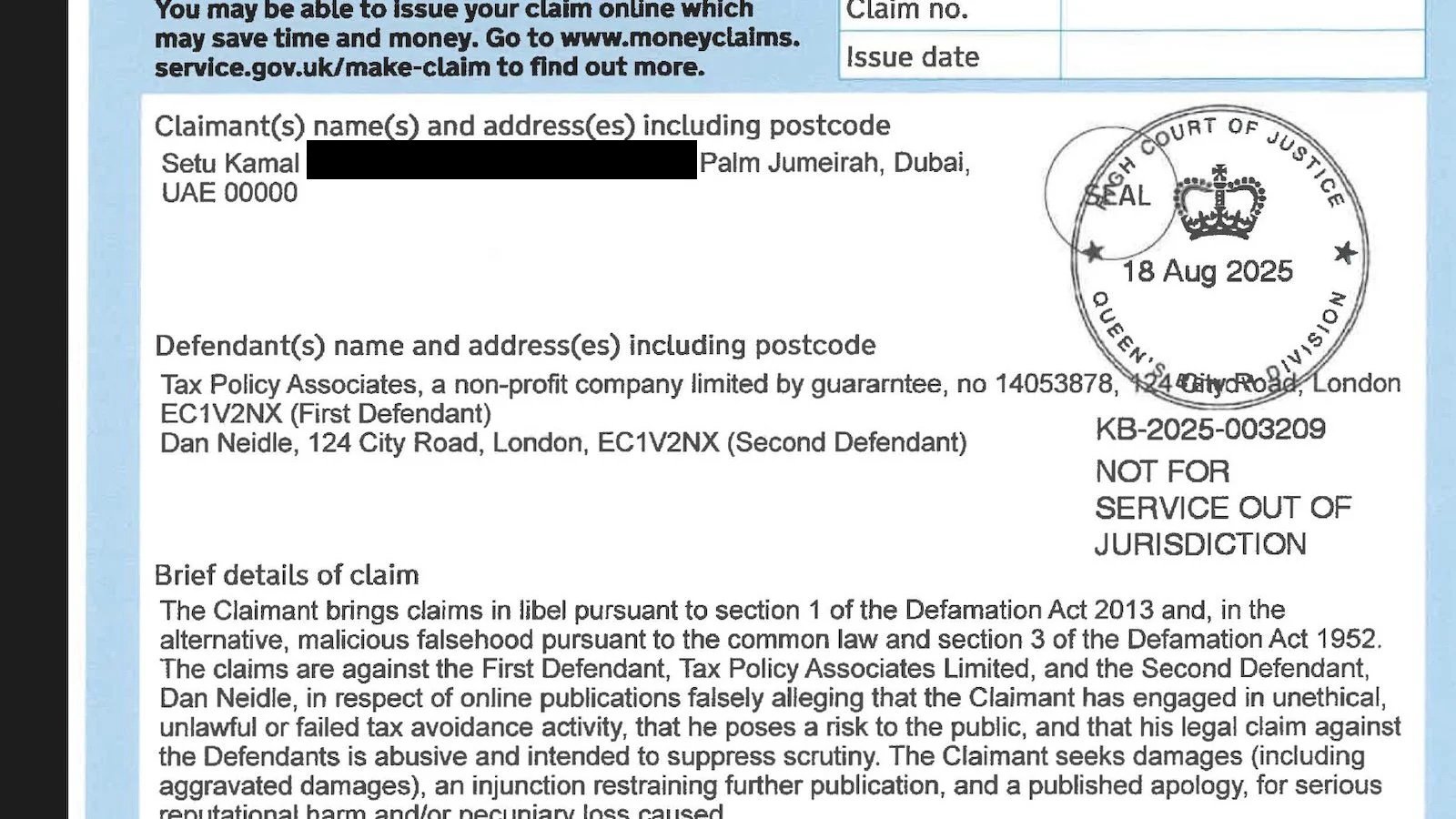
Interestingly, a study by Bjørneby, Markussen and Røed found that the pre-2023 Norwegian wealth tax increased savings because it incentivised investment in private companies (which were exempt from wealth tax). That won’t be an effect of the new proposed wealth taxes, because they have no exemptions. ↩︎
That was the conclusion of a detailed study by Jakobsen et al into the impact of migration under the old Danish wealth tax, although the international nature of the very wealthy in the UK mean this result will not necessarily translate to the UK. And Suzuki’s analysis of the French wealth tax came to the opposite conclusion – that capital flight was more important than savings effects. ↩︎
The effect is reduced if funds are used to finance long-term investment, countering (to some degree) the withdrawal of investment by the private sector. The effect is reduced further if the funds are used to reduce the deficit. The principal current wealth tax proposals do neither of these things. ↩︎
Another study from the Tax Foundation using its General Equilibrium Model found a much smaller effect of about 0.4% of GDP – but on the critical assumption that the wealth tax wouldn’t apply to foreign investors, and so foreign investors would replace capital withdrawn by US investors as a result of the wealth tax. That assumption is unlikely to apply to a workable UK wealth tax, because – for the reasons discussed above – a UK tax would in practice need to apply to foreign investors. The price of the Tax Foundation’s model not applying to foreign investors was huge capital inflows from abroad (hundreds of billions per year) to fill the savings gap, leading to a sharp rise in the trade deficit (potentially doubling it) and a transfer of ownership to foreign investors. ↩︎
The old German wealth tax was ruled unconstitutional by the German Constitutional Court in 1995, because it taxed different forms of wealth differently, and therefore violated the “principle of equal treatment”. It is contested whether a wealth tax with no exemptions or special cases would be constitutional – in principle it would tax all forms of wealth in the same way, but the valuation difficulties we discuss in this report mean that in practice it would not. We understand the dominant view amongst German tax academics and practitioners is that it would not be constitutional. The issues here are very specific to the German constitution and completely different from the (fascinating) question of whether a US wealth tax is permitted under the US constitution. ↩︎
Most of this job loss comes from the indirect effects, as lower capital formation and capital flight reduce GDP, so labour demand is dampened across the economy. With capital scarcer and costlier, firms might initially hire slightly more labour to maintain output – but this effect is not enough to prevent an overall employment decline. ↩︎
These papers tend not to go into the technical details of migration, and how feasible it is, but for completeness we note that it is easier to cease to be German tax resident than to be US tax resident – there’s an exit tax, but it can be paid over seven years and is frequently avoided. Conversely it’s easier to cease to be UK resident than German resident – there’s no exit tax and the UK residence test is more flexible (the availability of any lodgings makes a person automatically resident in Germany). ↩︎
It’s been retained for French real estate, working rather like an inefficient land value tax. ↩︎
It must be right that adverse effects would be greatly mitigated by a truly international tax, as exiting would cease to be an effective avoidance strategy. However, as we discuss below, there’s no realistic prospect for an internationally coordinated wealth tax. ↩︎
To be fair, Bjørneby, Markussen and Røed note that their result was caused by investments shifting from unlisted to listed companies; their focus was on Norway and so they may have seen no need to draw the obvious conclusion that it would not apply to modern wealth tax proposals with no exemption for unlisted shares. ↩︎
This is a simplification for the sake of a quick and clear example – valuations don’t work like that in practice. Founder shares are usually less valuable, % for %, than VC shares, because the VC shares will contain anti-dilution protections, liquidation preferences etc. On the other hand, the founder shares will have a control premium. ↩︎
Plus a bit more, to cover the capital gains tax. ↩︎
Which implies your company is only worth £36m. But the next year’s wealth tax valuation will still value the company at £100m – most tax valuation principles assume a general willing seller and willing buyer, and disregard specific characteristics of particular sellers and buyers, like a forced sale. ↩︎
Another problem: it’s one thing selling shares to fund wealth tax liability when you’re the only shareholder; it is more complex when there are multiple owners, some or all of whom may need to consent to such sales. ↩︎
If, for example, someone is worth €110m they should in principle have a total Spanish wealth and solidarity tax liability of over €3.5m. But perhaps they only take €1m in income, with €150k in Spanish income tax. That implies a total tax of 365%. So in this case, 80% of the wealth tax will be wiped out – leaving them with tax of only €0.7m (an effective wealth tax rate of about 0.6%). ↩︎
Where the wealth tax liability exceeds someone’s income and indeed their liquid assets, we can’t discount the possibility of a successful challenge to a “no exemption” wealth tax under the European Convention on Human Rights. A challenge to the old French wealth tax failed in 2008, but the ECHR’s reasoning included the existence of a ceiling on liability, linked to income. The new proposed wealth taxes contain no ceiling. The Dutch Supreme Court recently voided a Dutch wealth tax on grounds which imply that a wealth tax would be contrary to the ECHR, although we are doubtful that the court’s reasoning would be applied by either a UK court or the ECHR itself. Where a shareholder is resident in a country with a bilateral investment treaty, like the UAE, there is also the possibility of an expropriation claim. These issues are not straightforward and are outside the scope of this report. ↩︎
The Wealth Tax Commission paper on private company share valuation and liquidity challenges concluded that the difficulties were “not widescale enough to be insurmountable”. That is not encouraging. ↩︎
i.e. because valuation/compliance costs are on the gross value of the business, not the business less the threshold. ↩︎
Samir likely has an equity stake he funded in the firm, but large firms almost always arrange for their partners to fund the equity stake through a business loan, so he will have no net capital in the business. ↩︎
The bank pays it, but economically the burden falls on Emma – if the rate had been lower, the bonus pot would have been larger. ↩︎
i.e. on a £1m bonus the bank pays £138k employer national insurance, and Emma pays £470k income tax/national insurance. Total wage bill £1.138m and total tax £608 – that’s 53.4%. ↩︎
The IMF paper by Hebous, Klemm, Michielse and Buitron argues wealth taxes can be less equitable than taxing capital gains or inheritances, as they disproportionately burden illiquid assets (e.g., businesses) while allowing evasion via offshore structures. ↩︎
There are additional taxes in many jurisdictions which are similar in some respects to wealth taxes but have a much more limited scope. So, for example, France’s wealth tax was reduced to an annual tax on property (which Herry shows resulted in a modest change in the portfolio structure of French households). Italy taxes financial assets held abroad that aren’t held through an Italian intermediary (i.e. it’s an anti-tax evasion measure). Belgium has a 0.15% solidarity tax on the value of securities accounts, but private shares aren’t taxed. The UK has a banded tax on the value of residential property held by a company, the annual tax on enveloped dwellings (ATED). We would note as an aside that the Wikipedia article on wealth taxes is not very high quality; most of the content is either out-of-date or inaccurate. ↩︎
In its modern incarnation, with the national “solidarity tax on large fortunes” overriding Madrid and Andalusia’s historic reluctance to impose a wealth tax ↩︎
The taxable wealth of people subject to the wealth tax dropped by over 40% after the wealth tax was reintroduced in 2011. We don’t have data from when the solidarity tax was introduced in 2023, but we should expect a much larger drop. ↩︎
It raised even less – €38m – in 2024 because Andalusia and Madrid reinstated their wealth taxes (as part of further tweaks to their tax systems) so that revenue that would have been collected by central government as solidarity tax was instead collected by the regional governments. The 2023 figure should therefore be regarded as the truer reflection of the revenues raised, not the 2024 figure. We expect another factor is that many affected taxpayers put additional planning in place in 2024 to reduce wealth tax bills; future research may be able to separate the two effects, but there’s no way to do that from the headline numbers. ↩︎
This is significantly higher than the migration rate under the old-style Norwegian wealth tax. It was very plausible that the rise in exits in 2022 was caused by newexit tax rules applying from 22 November 2022, but the continuation of the trend in 2023 suggests that the wealth tax is also a significant driver. ↩︎
The economic simplicity of a “no exemption” wealth tax hides considerable legal complexity. The valuation rules are an obvious source of complication, but there are many others, e.g. household definitions, when debt is taken into account, anti-avoidance rules, application to non-residents with UK assets, and interaction with both existing rules (transfer of assets abroad, ATED) and UK tax treaties. ↩︎
And applying the wealth tax on any basis other than the usual tax year is not a realistic option. ↩︎
Some might suggest accelerating this, but realistically there would need to be a period between the end of the tax year and the return date, given the unfamiliarity with the tax on the part of taxpayers and HMRC. So whilst there is no particular need for wealth tax payments to be on the same timetable as self assessment, materially shortening the normal timeline seems to us unreasonable. ↩︎
The Wealth Tax Commission’s focus grouping fell into this trap. The arguments put to the group in favour of the wealth tax were compelling; the arguments against were weak. ↩︎
The authors of the Wealth Tax Commission didn’t believe their proposal was retrospective, but we disagree – taxing someone today on the basis of yesterday’s facts, and without giving them advance warning, is in our view retrospective. ↩︎
The European Court of Human Rights and UK courts considering the ECHR/Human Rights Act have historically permitted retrospective taxation to close avoidance loopholes and change the treatment of technical tax rules. It’s not entirely clear how they would respond to a retrospective wealth tax. The question is whether the high degree of deference (“margin of appreciation”) the ECHR and UK courts give to Parliament would be sufficient – our view is that such a tax would probably be found lawful if it had been heralded in an election manifesto, but there is a material risk that it would be found unlawful if it had not been. A more challenging issue would be under bilateral investment treaties – there was a successful challenge against a retrospective imposition of a capital gains tax by India. The risk here is high, but the impact would be more limited (e.g. to UAE nationals investing in UK property and nationals of a limited number of other countries). All these issues are complex, and a full analysis of the ECHR and BIT issues is outside the scope of this report; it suffices to say that a retrospective wealth tax carries materially more legal risk than an annual wealth tax. ↩︎
There are precedents for one-off retrospective taxes, but they involve ruined nations after world wars – not really comparable to the UK’s current position. ↩︎
As noted above, any ECHR challenge would in our view be difficult (but not impossible) if the wealth tax had been part of an election manifesto; but if it was not, the tax would be much more vulnerable to challenge. ↩︎
This is from the Wealth Tax Commission report – the data is a little old but it’s unlikely the overall picture has changed. ↩︎
In the past five years, 600,000 people who owe no tax have been charged HMRC late-filing penalties. The penalties start at £100, but can snowball into four- and five-figure debts: one woman with severe mental-health difficulties was pursued for £10,000; another was driven into bankruptcy.
A system that was intended to encourage timely tax filing has become, in the words of retired tax judge Richard Thomas “the most punitive in the world” for people on low incomes.
The previous Government promised to scrap the penalty for a single missed return and cap any bill at £200. These reforms will apply to those earning £50k from April 2026, but there’s no date set for people on low income.
It’s unjust. The Government should act, and stop the most vulnerable in society having their lives made harder by HMRC.
Andrea’s story
Andrea1 suffered from mental health difficulties for many years. During that time, she never earned more than a few thousand pounds – well below the personal allowance, and so never had any income tax liability.
Last year she received a demand from HMRC for £9,595 of late filing penalties – that’s the image above. And then even more:
Over £10,000.
Why?
Some people earning under the £12,570 personal allowance still receive a notice from HMRC requiring them to complete a self assessment. This could be a mistake. It could be because they’re self-employed – even just £1,000 of self-employment income means you have to file a tax return. Either way, if they don’t either file the self assessment form by 31 January or (before that date) tell HMRC they shouldn’t need to self-assess, HMRC automatically applies a £100 penalty.
If they don’t pay, additional penalties will follow, increasing over the following months and eventually reaching £1,600. If the same happens the next year, more penalties will be added on – with interest accruing throughout. And so, after five years, Andrea owed over £10,000 in penalties – despite never owing a pound of tax.
Richard Thomas, the respected retired tax judge, has described the current UK penalties regime as the most punitive in the world for people on low incomes.2
The scale of the problem
Over the last five years, 600,000 penalties were charged to people like Andrea, earning too little to pay income tax.3 This chart shows late filing penalties by income decile:
The chart shows the imbalance starkly: roughly 600,000 penalties charged to taxpayers with no income tax liability – outstripping the 400,000 penalties issued to everyone in the top three income deciles combined. In other words, those who owe nothing are, by far, the group most likely to be fined.
We’ve heard from hundreds of people impacted. Some were coping with a bereavement. One had been diagnosed with terminal cancer. Many had mental health challenges. All felt crushed by the mounting penalties; one declared bankruptcy.
The injustice is made even clearer if we look at penalties issued for late payment of tax, again by income decile:
There were very few penalties issued in the first three deciles – because these individuals only rarely have tax liability.4
When the modern self assessment system was created, a late filing penalty would be cancelled if, once a tax return was filed, there was no tax to pay.
However the law was changed in 2011, and now the penalty will remain even if it turns out the “taxpayer” has no taxable income, and so no income tax liability. At the time, the Low Incomes Tax Reform Group warned of the hardship this could create, but their advice was not followed.5
Why don’t they just file on time? Or appeal?
Since our first reports on this issue, we’ve been inundated with people’s stories. These are disproportionately vulnerable people, often with serious physical or mental health difficulties, living chaotic and difficult lives, sometimes with literacy problems, and often without a settled address.
A successful appeal is not a success – it means that someone with limited time and resources has had the time and stress of navigating what is to many a complex and difficult administrative system.
Are things getting better?
When we published our first article on this issue in March 2023, I thought there would be pressure for change. But I was wrong. We now have 2022/23 figures, for penalties charged in January 2024 – after we published our report:
Andrea’s partner approached us, and we referred Andrea to TaxAid – a charity, staffed by volunteer tax professionals, which provides free tax advice to people in need. I wasn’t sure what they could do, because Andrea was well past the deadline for appealing against her penalties.
Last week, Andrea received this email:
This is amazing news for Andrea, and a tribute to the brilliant work of TaxAid.
There will be no penalty for the first missed deadline. There will be a £200 penalty for the next year (and any subsequent years).8 And – critically – penalties for late filing can never go beyond £200, so the days of five figure penalties will be over.
This would be a huge improvement. However there is currently no timescale for implementation. Making Tax Digital was itself delayed, and will apply to businesses and individuals with income above £50,000 from April 2026, to those with income above £30,000 from April 2027, and to those with income above £20,000 from April 2028. There is no timescale for implementation for those with income below this.
This means that the very people who are suffering most under the current rules – people on low income – will stay on the current rules, even whilst others move onto the new and fairer regime.
The data provides compelling evidence that the Government should go further, and restore the law to how it was before 2011. Nobody should face a late filing penalty when they don’t owe any tax.9
This is one tax reform that should be easy for any Labour Chancellor. The cost would be less than £6m per year.10 There would be a real benefit to some of the poorest and most vulnerable in society.
Many thanks to HMRC for their detailed and open response to our FOIA requests on penalties and income levels. And thanks to all the tax professionals who alerted me to this issue – otherwise I never would have become aware of it.
That doesn’t mean 600,000 people – often it will be the same people receiving penalties each year. ↩︎
Why not “none”? That’s unclear – the first two deciles should contain nobody who actually owes any tax. It could be an HMRC error. It could be that the late payment penalties relate to a different year. We’re not sure. ↩︎
This is made worse by the fact that HMRC’s standard letter notifying a taxpayer of penalties doesn’t make clear that you can have the penalties withdrawn if you show HMRC you don’t need to file a return. See page 11 of the LITRG paper. ↩︎
The figures for the most recent year are always somewhat provisional; so the slight dip we see in all the 2022/23 figures will likely disappear when we get updated numbers later in the year. ↩︎
For an annual filer, penalties will apply after a taxpayer incurs two “points”. A year’s failure to file is one point. Points are wiped out after 24 months of compliance. ↩︎
One objection is that this removes the incentive to file. The opposite is the case. Someone who hasn’t filed will face penalties – but the penalties will disappear entirely once they file (or have the requirement to self-assess cancelled). ↩︎
The Freedom of Information Act response from HMRC shows that about 50% of the penalties charged on the first three income deciles are being collected. That’s around £28m over five years charged to people earning too little to pay tax. ↩︎
One man has set up a series of fake banks on Companies House – with real bank names, no checks, and zero consequences. When he’s caught, he does it again. And he’s been facilitated by a legitimate incorporation agent that, for reasons we don’t understand, incorporated an obviously fraudulent fake bank for him.
This report identifies a serial fraudster, the incorporation agent that enabled him, and how we can stop these frauds in the future.
Mr Giuseppe’s spectacular career is spoilt only by the small detail that it’s all fraudulent.
And it’s also spoilt by the other small detail that Giuseppe might not exist, or could be an innocent person whose name has been stolen (although why someone would invent or steal such an unusual name is unclear).1
“Giuseppe” sometimes gets caught. Perhaps an investigator like Graham Barrow spots one of the fake banks and informs the real bank. Then the real bank has to apply to the UK’s most obscure court, the Company Names Tribunal, for an order changing the company’s name. Here’s an example, brought by the real UBS against “UBS Group AG Ltd”. The fraudsters didn’t bother to defend their position, and the company was then renamed to “14695023 LTD” (after its company number).
The problem is that then nothing happens. No investigation by the police or any regulator.
In one case, the bank made a report to the police and was told that it was a civil matter. In another, a bank was told that the police couldn’t take any action unless a victim of fraud came forward.2
The fraudsters therefore act with total impunity.
So what happened after the fake “UBS Group AG Ltd” was forcibly renamed by the Tribunal and Companies House to “14695023 Ltd”? The fraudsters renamed it again – to “Goldman Sachs Finance Ltd“, and kept going. That wasn’t a one-off.
What is the scam? It’s hard to say. One knowledgable insider told me he suspects it’s money laundering – Giuseppe opens up a bank account in a country with slack KYC procedures and provides ID showing he’s the director of Goldman Sachs. But it could be almost anything – investor fraud, money laundering, sanctions-busting…
And Giuseppe is only one of many playing the same game. In 2024 there were nine defended Company Names Tribunal cases (which appear to have been bona fide disputes). There were 339 undefended orders – most of which look like plain fraud.
Who helped him do it?
The fraud is obvious on the face of the companies’ incorporation documents: a company called “UBS Group AG Ltd”, with the declared beneficial owner an individual living in France. It’s obviously nothing to do with the real UBS. The stated (paid) share capital of EUR1bn makes reasonably clear this isn’t someone’s weird game, but simple fraud.
So who incorporated the company? The incorporation document contains a statement of compliance:
We see a statement of compliance from Registered Office (UK) Ltd on all the Barbarat fake bank companies.
The precise status of Registered Office (UK) Ltd isn’t clear to us. Generally speaking, companies providing incorporation or registered office services are treated as a TCSP (trust or company services provider) and have to be regulated for anti-money laundering (AML) purposes, usually by HMRC. However we can’t see Registered Office (UK) Ltd on the HMRC list.4 A previous story suggested that Registered Office (UK) Ltd believed all they had to do to comply with AML rules was to check clients’ passports. This is not correct.
The first response from Registered Office (UK) Ltd
There’s been no response since. Nor was there any response when we wrote to Registered Office (UK) Ltd back in February asking for comment.
Registered Office (UK)’s defence
We wrote to Registered Office (UK) Ltd again this week – and MYCO Works (their trading name) replied. They first claimed the fraudsters “just used our address”. After we pressed, the story changed – blaming their software and, finally, Companies House.
Here’s the complete chain.
This is Registered Office (UK) Ltd telling us that they didn’t incorporate the UBS Group AG Ltd, but just provided a registered office:
We asked how that could be. The company was incorporated stating that Registered Office (UK) Ltd was the incorporation agent. Even if that could be forged (and I wasn’t sure it could be), surely they would have spotted the forgery, and the other obvious signs of fraud, and not accepted it as a client?
MYCO Works then escalated the matter internally, and we received a completely different response, which doesn’t make much sense:
We replied saying that we didn’t understand how they could let unknown people use their software to incorporate companies, and received another response blaming software:
This again makes no sense. The reference to Companies House’s lack of verification looks like a distraction. Legally, an incorporation agent is responsible for companies they incorporate. That’s clear from the statement of compliance filed when UBS Group AG Ltd was incorporated
We don’t know what Registered Office (UK) Ltd is doing, or why it thinks it’s acceptable to let third parties incorporate companies in its name. We can’t imagine they knew that a fraud was being committed, but they seem to have taken the business decision to let absolutely anyone incorporate absolutely anything in their name.
The bottom line: Registered Office (UK) Ltd provided a certificate of compliance for a string of fake banks, each incorporated with obviously fake share capital of hundreds of millions or billions of pounds. Those certificates of compliance were false – and that should have consequences.
How to shut this down
There are three obvious steps that could be taken.
First, we need to see prosecutions. Skip the hard stuff of finding victims of fraud. Do an “Al Capone” and prosecute the easy offences instead. Anyone filing false information with Companies House has committed a criminal offence.
Second, Companies House should introduce address verification. Right now anyone can incorporate a company giving Buckingham Palace as their address – there are no checks whatsoever. But if someone falsely uses your address for their company, you have to provide full identification details to Companies House to get it fixed. That doesn’t feel right.
There are many ways to solve this: the simplest would be for Companies House to send automated letters with a security code to the registered office address, and only finalise incorporations once the security code has been entered.
Third: the authorities should go after the facilitators: legitimate businesses who share responsibility for the fraud. Not because they are criminals, but because (we believe) they’ve decided that conducting even small checks is inconvenient for their business. It appears in this case, providing fraudsters (unwittingly but, in our view, unethically) with the means to incorporate companies with zero oversight.
When that business decision facilitates fraud, it should have consequences. The lack of any due diligence suggests a breach of anti-money laundering rules. However the more serious consequence is the basic criminal offence (an unlimited fine but no jail time), which applies to any person who, without reasonable excuse, causes a false document to be delivered to Companies House.
It seems likely that this criminal offence was committed by the company formation agent, Registered Office (UK) Ltd.5 We will continue to see company formation agents facilitating fraud until there is a strong deterrent – meaning well-publicised prosecutions.
Many thanks to N for the original tip, and L, O and C for their input. And, most of all, to Graham Barrow for spotting this network years ago, and for freely providing us with his invaluable expertise.
Footnotes
We’d certainly assume that the other named directors of these companies are fictitious. ↩︎
Neither of these were the UBS Bank AG Ltd case. ↩︎
The missing brackets appear to be an error – there was a company called Registered Office UK Ltd, without the brackets, but it dissolved in 2015, eight years before the fake UBS company was incorporated. ↩︎
It’s also not on the FCA register. The HMRC list does list “MYCO Works” as a trading name of Alpha Commerce Ltd, and “London Office” as a trading name of Cooper Davis Associates Ltd, but we don’t know if these are the same businesses – the London Office and MYCO Works websites clearly state that the relevant legal entity is Registered Office (UK) Ltd. Either way, if Registered Office (UK) Ltd is undertaking incorporations then it ought to be registered. ↩︎
Unless they had a “reasonable excuse”. Our view is that letting third parties submit documents for you, without checking them is not a “reasonable excuse”. ↩︎
The “Offshore Advisory Group” publishes political commentary including conspiracy theories originating in Russian propaganda outlets. It uses the attention this attracts to sell a tax avoidance scheme that supposedly lets UK businesses escape UK tax by incorporating in Gibraltar. The scheme is hopeless and will trigger large taxes and penalties – and if not disclosed could be criminal tax evasion.
Update 30 June 2025: OAG responded to this article with an obscene LinkedIn post. That was widely criticised by tax advisers; OAG responded by deleting that post, and then posting another accusing every accountant and tax adviser in the UK of “acting out of self-interest”.
Normally this is just political commentary – rather punchy, and unusual for a tax advisory firm, but run-of-the-mill. However on occasion it’s more sinister.
This is a more obscure conspiracy theory that appears to hasn’t gained as much attention as the “cocaine” story. But, once more, it originated “organically” and was then amplified by pro-Kremlin websites.
These reports were then picked up and further amplified by various conspiratorially minded English websites and accounts (not Kremlin-linked).
These claims normally fester in the darker corners of social media and fringe blogs. We can’t imagine OAG has any idea where the claims are coming from. But seeing them repackaged – uncritically – on the website of a firm that markets itself as a “professional services” outfit is nevertheless startling.
The tax schemes
OAG uses the blogs and conspiracy theories to sell a very unusual form of tax planning. Unusual, because it is nonsensical.
OAG’s central claim is that UK businesses can move invoicing and contracts into a Gibraltar company and escape UK tax. This, however, is false: the structure is hopeless (indeed it’s barely a structure2).
We summarise below some of the most obvious problems. There are, however, many other tax rules that would potentially be engaged, including the transfer of assets abroad rules, capital gains on moving the assets offshore, stamp duty, the liquidation TAAR (where a liquidation is planned).
Landlords
OAG sell the idea that a landlord can move their property rental business to a Gibraltar company and escape UK tax:
This is very basic tax knowledge which we would expect a trainee accountant to know, even one not specialising in tax.
Farmers
OAG say that farmers can restructure into a Gibraltar company and avoid inheritance tax:
The claim is false. Agricultural Property Relief and Business Relief are being restricted, but whether a business is run through a UK company or a Gibraltar company will make no difference.
There will be no cost-savings – quite the reverse. The farm is – obviously – in the UK. So a Gibraltar company owning the farm will have a UK “fixed place of establishment” and be fully subject to corporation tax – but in a more complicated way than a UK company.
OAG’s claim is that a business can escape UK VAT by incorporating in Gibraltar.5
This claim is false. The place of incorporation of a seller does not affect whether UK VAT applies. In fact, incorporation is strictly speaking irrelevant for VAT purposes. The question is where a company “belongs“. A Gibraltar company that’s actually directed from the UK, with no staff in Gibraltar and all the staff in the UK, belongs in the UK. For VAT purposes, it’s just a UK company.
If you’re selling goods, business-to-business (B2B) services or business-to-consumer (B2C) digital services to a UK customer then UK VAT applies regardless of your location. If you’re selling services relating to UK land then UK VAT applies regardless of your location. For other B2C services, it depends on the supplier’s physical location – and if that’s the UK, then contracting through a Gibraltar company will make no difference.
The same principle applies in the opposite case. A UK company exporting goods, B2B services or most B2C services generally will not charge UK VAT. You don’t need to move to Gibraltar to get that result.
The claim that incorporating in Gibraltar “removes you from the VAT noose” is therefore simply false. It will change nothing from a VAT perspective.6
No need to move to Gibraltar
OAG’s claim is that you can stay in the UK, move your business operations offshore to a Gibraltar company, and escape UK tax:
And it’s not about moving the people, just shifting the billing and contracts:
Here’s how OAG claim it works, posted a few days ago on LinkedIn:
There are numerous reasons why this doesn’t work. If you’re running the company from the UK then it will be fully subject to UK tax – either because you make it UK resident, or because your presence creates a taxable “permanent establishment“.7
VAT will continue to apply (as explained above).
We asked about these issues on LinkedIn – Gary Dixon responded by deleting the article and blocking us.
Accountants pointing out the problem are part of a conspiracy
Here’s Mr Dixon, angry that clients are being warned off the structure by their accountants:
The accountants are, of course, correct.
The actual advice
Sometimes unethical advisers hype what they’re doing – they give the appearance of brilliantly clever tax strategies in their marketing, but then actually provide entirely normal and straightforward advice to clients.
OAG, however, continue to make all the above false claims in their communications with clients. Here’s one structure proposal they recently prepared:
The idea is that the client sells their trading and property companies to a new Gibraltar company. They then claim this avoids lots of tax, repeating the false claims in their advertising:
The claim: there’s no UK tax on a Gibraltar company selling UK real estate.
The claim: UK corporation tax of the trading companies can be eliminated by having the Gibraltar company invoice the trading companies for “IP”. There’s no VAT on the invoices.
Any sale of IP to the Gibraltar company would itself be taxed (as a chargeable gain or under the intangibles rules). For most companies, the IP wouldn’t be valuable enough for ongoing royalty payments to materially reduce corporation tax. The invoices are supplies of services to a UK business and so are subject to VAT. Ongoing royalty payments would be subject to 20% royalty withholding tax. The transfer of assets abroad rules potentially apply. So none of this works.
Who is Offshore Advisory Group?
We don’t know.
There is no company registered in the UK or Gibraltar called “Offshore Advisory Group”. We haven’t been able to find a company with that name anywhere in the world.
Gary Dixon tells us it is a general partnership; we don’t know if that’s correct.
OAG says it was established in 2010:
But the oagroup.co.uk website didn’t exist before 2024, and the domain was only acquired in 2024. We can find no evidence of OAG’s existence before that date. It’s possible OAG was quietly operating (with no website) until they saw the opportunity to use conspiracy theories to sell tax services – it’s also possible OAG didn’t exist until recently.
OAG’s senior partner, Gary Dixon, has no accounting, tax or private wealth qualifications or experience:
We can find no public record of either a US “Browse for Books”8 or The Bridge Group.9
The Gibraltar connection
We have many offshore contacts – but only one has heard of OAG. This isn’t a case where an offshore jurisdiction is acting improperly. OAG is not regulated in Gibraltar, and it’s unclear if OAG or Gary Dixon have any connection to Gibraltar at all (although OAG presumably engages a Gibraltar accounting firm to execute incorporations).
What are the consequences?
OAG are giving some of the strangest tax advice we’ve seen. There’s no elaborate structure, no waving of KC opinions – just a naive offshore incorporation that a trainee accountant would know won’t save any tax.
The problem is that OAG’s clients probably don’t know this. We expect they’re filing incorrect tax returns with no disclosure to HMRC of what’s really going on.
If HMRC never find out, that’s a loss for the Exchequer. But HMRC will have at least 12 years (and possibly 20) to investigate OAG’s clients, so there’s a good chance they will eventually catch on. At that point HMRC can apply penalties of up to 200%. That will be a terrible result for the clients even if they didn’t realise what was going on. If they did, and this was deliberate concealment, criminal liability may arise.
The question is what will happen to OAG and Mr Dixon.
If OAG and Mr Dixon know that what they’re doing is wrong, they’re potentially committing tax evasion. If they don’t, they’re just incompetent and reckless10. We believe this is a question a jury should resolve, and that OAG should therefore be the subject of a criminal investigation in the UK.
OAG’s response
We asked OAG for comment before publication on the morning 29 June, but didn’t receive a response. OAG then responded on their website with a stream of invective, but sent us no response.
On the afternoon of 30 June, OAG sent us a response, claiming that they are fully aware of the various tax issues highlighted in this report. We asked them why these issues are wholly absent from their website, LinkedIn channel and the client advice set out above. They didn’t respond. Here’s the document:
Many thanks to the advisers who warned us about OAG, including F. We only find out about firms like OAG because of tips from tax advisers and other professionals – we couldn’t do our work without them.
Thanks to B for the initial draft of this report, K for the VAT input, and all the offshore advisers we spoke to.
This one seems to be targeted at micro-businesses around the £90k turnover threshold, which is very odd. ↩︎
This is also true for supplies to the business. In principle supplies of (eg) legal services to a UK company are subject to UK VAT, and supplies of legal services to a Gibraltar company are not. However this is a Gibraltar company that is entirely run from the UK – it therefore likely “belongs” in the UK and is therefore treated in the same way as a UK company. ↩︎
The UK/Gibraltar double tax treaty won’t apply because the Gibraltar company is only taxed in Gibraltar on its local income, and so not a Gibraltar “resident” for the purposes of Article 4 of the treaty. ↩︎
We located browseforbooks.com, an Isle-of-Man-registered micro-retailer that seems to have used “low-value consignment relief” to avoid UK VAT, but it traded only on a very small scale, shut at some point before or during 2009, and there is no evidence linking it to Mr Dixon. Mr Dixon tells us Browseforbooks US was not “shut down” and was sold in 2009 as a going concern in a legitimate commercial transaction – we don’t know if that’s the same as browseforbooks.com. We don’t know if this is correct ↩︎
We say “reckless” because OAG and Mr Dixon have been told about these problems by accountants (and by us). There may be a point when recklessness tips over into dishonesty ↩︎
There’s a tax paradox in the UK. Overall, we’re paying more tax as a percentage of GDP than at any time since the 1940s – and most people believe they’re over-taxed.12Yet, at the same time, the average UK worker paid less tax on their wages in 2024 than any year since the War, and less tax than their counterparts in any other large European country.
How can this be?
This is the first part of a series on the tax mess that the UK is in… and what we can do about it.
How can we fairly compare taxes on wages?
Comparing like-for-like across different countries is not straightforward – wage structures and tax and benefit systems are all very different. Fortunately, the OECD has done all the hard yards, with decades of work analysing the “tax wedge” – the proportion of labour cost paid in tax for the average worker. This includes income tax, and both employee and employer national insurance/social security.3 It also includes cash transfers (which can be viewed as negative tax) – for the average UK worker that means child benefit.
We can use the OECD’s most recent data to chart the tax wedge for every country in the OECD, looking at the average wage of a single worker, a single-earner family4 with two children, and a dual-earner family with two children.5.
The chart shows all four datapoints for each country. It’s interactive, so you can click on a point and see the precise numbers, and reorder the chart using the dropdown box at the bottom right. On mobile you’ll need to view in landscape mode. There’s a full screen version here.
The result is striking – the UK has one of the lowest tax wedges in the OECD for single workers and dual-earner families, but a comparatively higher tax wedge for single earner families (but still lower than average). The reason is simple: in many countries (like France) the family is taxed as a unit, meaning that the single wage is split between either the parents or the entire family, therefore bringing the earnings into lower tax brackets. In the UK this doesn’t happen, and there is only a small tax benefit for married couples.
Here’s how the picture changes if we look at different income levels.
This interactive chart plots tax wedge against % of average income for the ten largest European OECD members, plus the US and Canada. You can change the taxpayer type with the dropdown at the top right, and add/remove countries by clicking on the legend on the right hand side. Again, on mobile you’ll need to view in landscape mode. There’s a full screen version here.
The 50% to 250% x-axis covers incomes up to roughly £130,000 in UK terms. (Why is the “average” £50k? See the methodology below!)
Some thoughts:
Single workers: At every wage level the UK tax wedge sits well below that of all the other 10 largest European economies.
With kids, the picture shifts: Poland becomes much lower tax than the UK, at all levels.6 Perhaps unexpectedly, the Netherlands edges below the UK.
Higher earners with kids: from about 150 % of average income, Germans with kids also pay less tax than their UK counterparts.7
A UK single worker on the average wage pays less tax than their Canada and the US counterparts, but more once we reach about 120% of average wage (£60k). Marriage immediately lowers the US rates. Children take the US and Canada rates well below the UK’s.
The simple story is that, at all points, French, Italian, Scandinavian, Spanish etc workers pay around 50% more tax on their wages than a comparable earner in the UK. For other countries things are more nuanced, with some surprising countries (Germany!) becoming lower tax than the UK once kids are in the picture.
How did the UK’s tax wedge change over time?
Here’s the data from 1979 to 2024, and my estimate for 2025:
The degree of change here should not be exaggerated – peak to trough represents about £1,500 for a median earner (in today’s money), and the 2024-to-2025 change about half that.8
The recent bump downwards in 2024 was caused by Jeremy Hunt’s cut in employee national insurance, which took tax wedge from 31.3% to 29.4%. The tick up to 31.4% in 2025 is thanks to the rise in employer national insurance in the October 2024 Budget.
Unfortunately the OECD tax wedge data in its modern form only starts in 1979, but the higher rates of income tax (30% to 45%) and lower personal allowance (never more than half the current level, in today’s money) mean we can be reasonably confident that the tax wedge on the average single worker was higher in previous decades.9
How progressive is the UK tax system compared to other countries?
We can draw a simple bar chart showing how the tax “wedge” on people earning 50% of average income compares to people earning 250% of average income:
My feeling is that the charts probably overstate the tax wedge on higher incomes in many countries. I’ve previously written about how the UK’s high statutory rates of income tax in the 1970s were not in fact paid by well-advised people on high incomes – there were many tricks that could be played to reduce the rate. In the main, these tricks no longer work in the UK. Someone on high income wanting to pay less tax has relatively few options – pension contributions (subject to a cap), venture capital trusts and similar investment reliefs, and that’s about it. In France (for example) the use of tax-advantaged “insurance vie” investment wrappers is common for high earners. Incorporation is often used to avoid the very high social security (in the UK the lower national insurance means the benefit is less, and rules like IR35 make the saving harder to achieve).
What does it all mean?
My conclusions:
Most people in the UK on low, moderate or reasonably high earnings (i.e. up to about £100k) pay less tax on their wages than their counterparts in other large developed countries, with the notable exception of the US.
2024 set a post-war record: the average UK worker paid less wage tax than at any time since the 1940s. 2025 nudged upward – back to roughly 1990s levels, which were already the lowest in the modern era.
The source for the UK 1979-1999 numbers is this 1999 OECD report.
The source for the 2000-2024 numbers recent numbers is the excellent OECD data explorer. You can see the exact data for this chart here (but make sure you download a CSV rather than Excel file, or some of the data will be cut off).
The estimate for the UK tax wedge in 2025 is our simple approximation based on the OECD 2024 average wage data, ONS data on the rise in average earnings, and tax changes in 2025/26.
Note that the tax wedge is very different from the marginal rate. The “tax wedge” tells you how much of your overall wage packet goes on tax. The “marginal rate” tells you how much of the next pound you earn goes on tax.11The marginal rate is critically important because it affects incentives – and the UK income tax system has unfortunately created a horrible mess of marginal rates. I wrote about that here.
An important point of detail is that “average worker” doesn’t mean “median worker” (and I misunderstood this myself until recently, for which my apologies). The “average worker” is a concept the OECD defines so that it can make a like-for-like comparison across different countries. So instead of the usual approach of taking the median of all full-time employment, it covers a specific mix of sectors, job-types and seniority levels, which are applied in the same way to each country. In the UK that means the OECD “average” wage is considerably higher than the median wage – £51,310 in 2024 rather than £37,340, and therefore the tax wedge for the median worker will be lower than the figures shown here (about 28% for 2024 instead of 29.4%).12
These kinds of international comparisons can only ever tell part of the story. A few caveats:
The charts don’t include VAT. You can see the complete picture here – OECD countries tend to have similar levels of VAT, with the big exception of the US. Most US States have a sales tax, but it’s typically less than 8% and applies to a narrower range of goods and services than VAT. So whilst the charts above show the UK worker as comparably taxed to their US equivalent, once VAT is taken into account we can be confident the UK worker is more highly taxed. But VAT won’t change the picture much when we compare the UK against other OECD countries.
On the other hand, a US worker may pay less tax, but has to pay for healthcare (either directly or via insurance from their employer, which in the long run is paid by employees in the form of lower wages). In an ideal world this would be built into the data, but that’s far from straightforward. You can compare private healthcare spending here.
The charts also don’t include annual property taxes. In the UK that’s council tax. In many parts of the world, including most US states, it’s an annual levy on the value of property. Council tax is rather low in international terms for people living in high-value property, and rather high in international terms for people living in low-value property.
There are other smaller differences – for example in Germany you have to pay for your bins to be collected by the local authority.
And finally one obvious point: tax doesn’t usually just go up in smoke – countries with higher tax will (all things being equal) have better funded welfare systems and public services. Whether you’d prefer a country more like the US (with lower tax and less expansive welfare and public services than the UK) or more like Denmark (much higher tax, much more generous welfare and more expansive public services) is a political question that no chart can assist with.
Many thanks to P for help with the coding, and to the OECD – both for creating the data and making it so easily accessible to the public. It’s a triumph of open data.
The code that created the interactive charts is available here.
Footnotes
See this Survation polling from November 2023, Table_Q4. Considering the levels of various taxes such as Income Tax, Council Tax, Value Added Tax (VAT), National Insurance, Excise duties and others, do you believe you are currently ‘Paying too much tax’ (52%), ‘Paying about the right amount of tax’ (27%), ‘Paying too little tax’ (8%), ‘Don’t know’ (13%). ↩︎
Because the evidence is that, in the long run, the economic burden of employer national insurance/social security falls on employees in the form of lower wages. ↩︎
Many tax systems provide a more favourable result for families. In some countries there are cash benefits for people on average income with children (like child benefit in the UK). In other countries (like France) there’s a tax credit for people with children. In others (like the US) there’s a child tax credit that is refundable in cash for taxpayers on low income. The tax wedge calculation takes all credits and cash benefits/transfers into account. ↩︎
where one earner is on the average wage and the other on two-thirds of the average wage ↩︎
That’s because of the Family 800+ cash non-taxable benefit (which alone is worth about 20% of the median Polish gross wage), the refundable child tax credit (which can eliminate most income tax for low and moderate earners), and a series of other smaller cash benefits. ↩︎
In part because German marginal income tax rates fall considerably once wages hit the Beitragsbemessungsgrenze (the contributions ceiling) ↩︎
The early data points are a little sparse, but the big moments are Nigel Lawson’s 1988 cut of the basic rate to 25%, and the use of fiscal drag in the 2000s by Gordon Brown to significantly increase tax and increase funding on public services – part of that involved freezing the personal allowance, and therefore increasing the tax wedge. ↩︎
The basic rate of income tax was 45% in the 1940s and the personal allowance was (in today’s money) about £6,000. The rate wobbled around the high 30s and low 40s through to 1972, when Anthony Barber’s first Budget he unified income tax and introduced a 30% basic rate. It then went up to 35% under the Labour Government. The personal allowance was eroded in the 1990s, went up significantly from 2010 to 2020, and has since been eroded by inflation, but remains higher than at any time before 2008. The Family Allowance and (later) child benefit are broadly comparable to today’s figures in real terms. ↩︎
The first version of this article said “next week”. That was woefully optimistic. The answers are not at all obvious. ↩︎
Imagine a country where there is zero tax until you earn £50,000 and then 50% tax after that. If I earn £50,000 my tax wedge is zero; my marginal tax rate is 50%. ↩︎
For the earlier years of the OECD Taxing Wages series, this was the “Average Production Worker” (APW), which was focused on full-time manual workers in the manufacturing sector. This later evolved into the broader “Average Worker” (AW) definition. See Annex A, page 652 here. This is one of the reasons why pre-1979 datasets can’t be compared with later datasets. ↩︎
Reform UK is proposing a “Britannia card” that would let wealthy foreigners pay a £250k fee to move to the UK and live here exempt from all tax on their foreign assets. All fees received would be distributed, “Robin Hood”-style, to the 2.5 million lowest-paid workers in the UK.
Reform UK don’t include any analysis of the cost of their proposal. Our analysis of OBR data suggests the cost would likely be around £34bn over five years.
We believe there are three very serious problems with the policy.
First, it would discourage highly skilled professionals from moving here – they couldn’t afford the £250,000. For the first time in the UK’s history, an ex-pat arriving here would be immediately subject to full UK tax (and likely also tax in their home country). That’s a big tax increase: the Reform UK proposal would make the UK uncompetitive.
Second, all the recent changes to the non-dom regime mean that any Government would struggle to persuade the very wealthy that the “Britannia card” would really provide a lifelong exemption, so take-up would be very limited.
Third, and most seriously, the card would provide a very large and expensive tax windfall to a small number of very wealthy people who are already here. Office for Budget Responsibility data shows that this would amount to £34bn of lost Government revenue over five years. That would have to be funded by either tax increases or spending cuts.
A short history of non-doms
People born abroad but living in the UK, and who plan to return abroad1 are “non-doms”.
For decades, non-doms were only subject to UK income and capital gains tax on their UK income and gains. Offshore income and gains were only taxed if “remitted” – i.e. brought into the UK. This favourable method of taxation was called the “remittance basis“. And, if they died, a non-dom was only subject to inheritance tax on their UK assets.
But this all changed in the 2010s:
In 2008, the Government reformed the non-dom rules and introduced a £30,000 fee. Anyone who’d been on the remittance basis for seven out of the previous nine years would have to pay £30,000 each year to keep that status. About 5,000 people paid the fee.
In 2015, an even higher band was introduced: a £90,000 annual fee for people who’d been on the remittance basis for 17 out of the previous 20 tax years.
There were significant reforms in 2017. From that date people who had been UK-resident for 15 out of the previous 20 tax years were automatically considered “deemed UK‑domiciled”. But a specific “safe harbour” was created2 – before becoming UK domiciled, a person could settle their non-UK assets into an offshore “excluded property trust” – and these assets would (with care) remain outside UK income, capital gains and inheritance tax indefinitely. This was therefore a less dramatic change than it appeared to be. At the same time, the £50,000 fee was increased to £60,000. There is an excellent House of Commons Library briefing paper on these changes.
Then in 2024, the Conservative Party announced they’d scrap the non-dom regime and introduce a modern exemption system – the Foreign Income & Gains (FIG) regime. The concept of domicile would be completely abolished and replaced with a simple count of years resident in the UK. New UK residents would be entirely exempt from tax for four years; then subject to income and capital gains tax in the usual way. Inheritance tax would apply after ten years. Property settled into excluded property trusts before April 2025 would remain untaxed, but after that trusts would cease to shield property from tax.
Labour enacted this regime, but with one significant change: the benefit of excluded property trusts would disappear completely – historic trusts and future ones.
All of this has caused a significant number of very wealthy non-doms to leave the UK. The figures that have been reported are not reliable, but it’s clear from numerous discussions I’ve had with private wealth, banking and legal contacts that the effect is real.3
Labour may be about to row-back on some of the reforms, by softening the most difficult part of the package for many non-doms: inheritance tax fully applying after ten years. My suggestion would be, after ten years, gently phase in inheritance tax, so it initially applies at a 4% rate and then goes up by 4% every year until it reaches 40%.
Reform UK is proposing to go back to the pre-2017 position, with non-doms able to pay a fee and retain the benefit of being a non-dom forever. The fee structure is, however, very different – a one-off £250,000 payment for a “Britannia card”.4
And there’s an entirely new element: the £250,000 payments will be redistributed as a cash payment to the approximately 2.5 million workers earning a full-time salary of less than £23,000. Reform UK’s “low end” estimate is that 6,000 people would buy a “Britannia card” – on that basis the policy would generate £1.6bn, meaning a £600 payment to each low-paid worker.
We have seen a complete copy of the Reform UK proposal. It doesn’t contain any analysis of the cost.5
The full paper is here:
The problems
There are, however, several significant problems with the proposal.
It would deter high earners from coming to the UK
Whilst the proposal makes the UK more attractive to the very wealthy, it makes the UK much less attractive to the highly skilled and highly paid professionals we want to attract into the UK – for example doctors, coders, senior scientists and entrepreneurs. The effect of the Conservative and Labour reforms6 is that these new arrivals would be exempt from tax on foreign income for four years without paying anything. That’s attractive because high earners will often have assets/savings back home, and having those savings taxed in the UK is unattractive.7
The Reform UK proposal makes new arrivals fully taxable immediately – that makes the UK look uncompetitive compared to many other potential destinations. Countries like Ireland, Denmark, France, Belgium and The Netherlands have special tax regimes for an arriving worker’s first few years.8
The Reform UK proposal doesn’t give any grace at all to new arrivals, unless they pay £250,000 – and that will only make sense for the very wealthy. So it will tend to deter highly paid professionals from moving to the UK.
The measure will, for the same reasons, impact the approximately 30,000 expats living in the UK who currently file on the remittance basis but don’t pay the remittance charge.
A large windfall gain for a few people – and so a £34bn cost
The proposal would give a windfall gain to a relatively small number of very wealthy people who were planning to stay here and pay UK tax, but will now pay the £250k fee instead. That’s tax that now won’t be received, and there will be no wider economic benefit (because these people were already going to be here).
The amounts involved are very large. The Office for Budget Responsibility’s assessment of the recent Conservative and Labour non-dom reforms says they raise a net £33.9bn from 2026/27 to 2029/30 (most of which is from the Conservative March 2024 reforms). The OBR’s figures contain “behavioural adjustments” reflecting their expectation that 25% of the most wealthy non-doms (with excluded property trusts) will leave the UK, and 12% of other non-doms. 9
The £33.9bn reflects tax raised from a small number of very wealthy people who would opt to buy a Britannia card and so pay no tax – it’s therefore revenue immediately lost by Reform UK’s proposal.
At first sight the cost would appear to be reduced by all the people who are non-doms under the current rules, but won’t pay the £250,000 to buy a Britannia card – they’ll now be paying tax. But that ignores “Laffer curve” effects. The experts we spoke to believe the four year FIG regime is revenue generative – there would be a net economic and tax cost of deterring highly paid (but not ultra-high net worth) people from coming to the UK. Reform UK’s proposal takes us past the peak of the “Laffer curve”, and what appears to raise revenue in a static analysis would actually lose it.
There is an additional negative factor: Reform UK are providing a much more generous regime for the very wealthy than was in place before March 2024. There are non-doms who’ve been here for many years who aren’t currently eligible for the remittance basis, but would apply for the Britannia card, and essentially zero their tax bill.
Both these factors would tend to increase the impact beyond the OBR £33.9bn figure.
We therefore believe its fair to say that Reform UK’s proposal would cost around £34bn if it was enacted before 2026/27. That sum would therefore likely have to be funded by some combination of spending cuts and tax rises.
It will attract very few wealthy new arrivals to the UK
Reform UK is hoping the proposal would attract a significant number of new arrivals to the UK – people who previously would have paid no UK tax, and will now pay the £250,000.
A critical point to note: because Reform UK would be redistributing all the £250,000 fees, none of the revenue reduces the £34bn impact on the public finances identified above.
We can put an reasonably accurate ceiling on the number of people who’d apply by looking at how many people paid the £30k and £50k annual remittance basis fees. 5,100 people10 paid the annual £30k charge for non-dom tax benefits when it was introduced, declining to 2,400 people paying the £30k and £50k charges in 2024. The £250k will (obviously) be attractive to a smaller number of people – it’s more expensive both as a lump-sum payment and if we compare it to the net present value of ten years’ of £30k charges (around £220k, at an 8% discount rate).
However, Reform UK are expecting 6,000 people to apply for a card every year. That looks very optimistic given the international data and historic UK figures.
There is a more fundamental difficulty, which all the private wealth advisers we spoke to believe would lead to a very limited number of new arrivals.
The problem is that a proposal of this kind might have been realistic decades ago, but the numerous changes in the non-dom rules in the last 20 years mean that few would believe that their £250k would really give them a lifetime of tax exemption in the UK. High-net-worth individuals crave tax stability and predictability when making long-term decisions about their residence – but no Parliament can bind its successors. It follows that, unless ultra-high net worth individuals believe Reform will have a majority for two or more terms, they are very unlikely to move to the UK in the expectation the “Britannia card” will survive long-term. That’s particularly so in light of recent experience of countries making similar generous offers which are later rescinded – Spain lured highly paid foreigners with “Beckham’s law“, but in the 2020s began aggressively asserting tax against people who’d used it. Portugal recently restricted its generous non-habitual residence regime.
We therefore conclude that, even if the proposal was self-funding in principle (rather than losing £34bn) it would likely still be non-viable thanks to the history of non-dom tinkering by other political parties.
Redistributing the proceeds
A full discussion of the administrative and logistical challenges of executing millions of small payments to low-paid workers is outside the scope of this paper. This will include how to identify them, how to deal with intra-year changes in income, how to update eligibility each year, how deliver the payments securely, how to prevent fraud, and the administrative costs associated with these issues.
Reform UK’s response
Zia Yusuf of Reform UK has published a response on X. It’s a disappointing response that spends more time on insults than substance.
Mr Yusuf starts by complaining that we published this report before seeing the Reform UK paper. He can’t have read our report – as it says above, we reviewed a full copy of the paper. We respected Reform UK’s embargo and didn’t publish the paper until 9am, but this report always made clear we’d reviewed the a full copy.
On the substance of Mr Yusuf’s post:
The four year exemption
Mr Yusuf disagrees that Reform UK’s proposal abolishes the current four year exemption. Again, he hasn’t read this report. We explain that Reform UK have to abolish the four year exemption, otherwise there won’t be many new arrivals paying £250k for a “Britannia card” – they’ll just wait four years. And Reform UK’s calculations assume that they receive the money up-front.
So Mr Yusuf has a choice. Reform UK can keep the four year exemption, but then amend their projections to include a four-year time lag, with a much smaller payout to the 2.5 million low-paid workers. Or they can lose the four year exemption, and admit that they are raising tax on an important class of high skill workers.
Which is it?
Stability of the regime
Mr Yusuf disagrees with our claim that nobody is going to buy a ten year card when the non-dom rules changed four times in the last ten years. He doesn’t explain why, and once more doesn’t appear to have read this report. He has no answer for the problem that no law can bind a future Parliament (because there isn’t one). He doesn’t engage with the recent experiences of other countries offering special tax deals. He doesn’t respond to the key point that, if Reform UK is the only party supporting the proposal, then nobody is going to buy a ten year card unless they believe a Reform UK Government will have a workable majority for two terms.
There is no evidence, in the paper or in Mr Yusuf’s reply, that Reform UK have thought at all about how to make a credible ten year offer.
The “already here“ problem
Mr Yusuf fails to engage with the problem that the Britannia card will be available to wealthy people who are already here, and weren’t planning to leave. For these people, it would be irrational not to buy a Britannia card – but that results in lost tax, and no economic upside (because they were already here).
We use OBR figures to estimate the extent of the problem – £34bn if we look only at Reform UK’s reversal of the 2024 and 2025 non-dom reforms. More if we include the reversals of the other post-2015 reforms (although putting a figure on that is difficult).
At this point Mr Yusuf says the OBR figures are “obsolete and irrelevant”. The challenge he has is that £34bn is a very large number. Even if the OBR were out by a factor of twenty (which is surely impossible) that means £1.7bn of lost tax. And the revenues generated by the Britannia card would not plug that fiscal hole – they’re redistributed as cash payments. So even in this rather far-fetched scenario, Reform UK’s proposal leaves a fiscal hole.
Mr Yusuf demonstrates his lack of understanding with this point:
People usually respond rationally to tax incentives. It is rational for a wealthy individual already in the UK to pay £250k to be exempt from tax on foreign income and gains – likely it would pay off in one year. They have nothing to lose, and tax savings to gain.
It is not rational for someone living abroad to migrate to the UK on the promise of a ten year tax exemption, when the history of the non-dom rules is one of requent change, and when other political parties would (if they came into power) likely scrap the Britannia card.
Mr Yusuf cites recent CGT figures as evidence that the OBR makes overly optimistic projections of Labour cannot make tax projections. He is relying on an article in the Telegraph which blamed the October 2024 Budget for a March 2025 correction to OBR projections. However if Mr Yusuf read the OBR report he’d see that the OBR actually expects a short term increase in CGT revenues as a result of the Budget, with people crystallising gains ahead of increased rates coming into force:
(Note that government accounting mostly books CGT receipts the year after they occur, so most of the 2023/24 CGT receipts relate to 2022/23). The OBR says this is simply a return to the long-run trend which is likely correct; CGT receipts are notoriously volatile.
This is all a very bad mistake, and a revealing one. A political party preparing for Government should be analysing OBR reports in detail. It’s very concerning that Mr Yusuf doesn’t appear to have read them at all.
The rate of CGT
It’s a side issue, but Mr Yusuf seems to think we supported the increase in CGT in the Budget. We did not. We were (and are) against increasing the rate of capital gains tax without reforming the tax to create an investment allowance. As things stand inflationary gains are taxed, deterring investment. We wrote about CGT reform here. Mr Yusuf cites that report, but once more appears to not have read it.
This is a very crude summary of what a “non-dom” is – the actual law is complex and uncertain, based on common law rather than any legislation. There is a good summary from the Chartered Institute of Taxation here. ↩︎
Often called a “loophole”, but given it was clearly intended, it wasn’t in any sense a “loophole”. ↩︎
Advani, Burgherr and Summers found only a limited response by the very wealthy to the 2017 changes in the non-dom rules. However we believe that was because of the safe harbour/loophole in the 2017 changes. The current changes have no safe harbour and so we should expect a much larger response. ↩︎
It’s not clear to us from the Reform UK paper whether this is a once-and-forever payment, or once every ten years. It’s also not clear if the card will be available to people who are here – the document says at one point that it’s for newcomers or returning leavers, but the sell has very much been about stopping the non-dom exodus – “halt the exodus and in fact reverse it“. ↩︎
It also appears to misunderstand the history – it makes the (common) criticism that Labour’s changes deter non-doms, but doesn’t acknowledge that the Reform UK proposal also reverses the Conservative Party’s 2024 changes. ↩︎
And the old non-dom rules, but the new rules are clearer, simpler and preferable for many professionals. ↩︎
Particularly in the first year when two countries’ taxes would apply. But even after that things can be complicated, for example because tax-free savings products in one country (other than pensions) are usually not tax-free in another. The old non-dom rules also meant that such assets/savings were free from US tax, but the complexity of the rules (and the remittance concept) meant they were less useful to “normal” people than the new FIG regime. ↩︎
On the face of it, Reform UK could fix this by retaining a four year exemption, with the £250k only payable after that. However that would mean their “Robin Hood” redistribution only happens after four years – which likely undoes the immediate political attraction of the policy. ↩︎
See paragraph 1.17 of this document for details of the behavioural response adjustments, and Table 1.3 on page 8 for the figures. ↩︎
The “tax gap” is the difference between the tax HMRC should collect and the tax it actually collects. Over the last nineteen years, most of the tax gap has fallen by two-thirds – a remarkable achievement. But a deep dive into HMRC’s latest tax gap statistics shows that HMRC has lost control of small business tax: 40% of corporation tax due from small businesses is not being paid. The small business tax gap rose sharply during the pandemic – and hasn’t fallen since.
If HMRC had closed the small business tax gap as effectively as it closed other tax gaps, it would collect £15 billion more each year.
The FT’s report on the new data is here. Our analysis is below.
The tax gap
The difference between the tax that should be paid and the tax HMRC actually collect is the “tax gap”. HMRC say it’s £46.8bn.1 There are a large number of uncertainties, but HMRC’s tax gap estimate work is generally regarded as world-leading.2
Where is most of the tax gap?
Most of the tax gap is from small businesses, meaning businesses with a turnover of less than £10m and less than twenty employees:34
What’s happened to the small business tax gap?
Small businesses have always been the most likely sector to pay the wrong tax (whether by accident or design). However in the last few years, something has changed:5
That sharp uptick in 2019/20 may have initially been caused by the pandemic, but we don’t see that effect for other types of taxpayer, and its now clear that the trend didn’t slow down after the pandemic.6 There have been a series of upward statistical revisions to data for recent years. These took the 2022/23 small business corporation tax gap from 32% to 40% (with the 2021/22, 2022/23 and 2023/24 figures being essentially identical). However HMRC sources have confirmed to us that these revisions don’t call earlier figures into question, and so the apparent trend in the data is real, and not just a statistical artefact.
It is astonishing that 40% of all corporation tax due from small businesses is now not being paid.
There’s a sharp contrast with the large and mid-sized business corporation tax gap, which HMRC has been remarkably successful at closing.
The wider picture
The problems appear to be widespread. HMRC data shows that well over a third of small businesses now underpay their tax by more than £1,000 – a doubling since 2018/19.
An obvious explanation is that this is a post-Covid effect. However there’s no such trend seen if we look at the figures for tax returns from individuals:7
And it’s worse than this. The small business tax gap isn’t limited to corporation tax. If we step back and look at the HMRC figures across all taxes we see another dramatic divergence:8
HMRC have generally done an excellent job shrinking the tax gap, with declines across the board. But after 2017/18 something changed.
The small business tax gap increased from 2.4% of all UK tax revenues in 2005/6 to 3.2% in 2023/24. The rest of the tax gap fell precipitously over that period – large businesses from 1.7% to 0.7%; mid-sized businesses from 1.% to 0.5%.
But whilst the small business tax gap has increased, the efforts to close it have not. This chart from HMRC’s report shows that the tax gap doubled over the last five years, but “compliance yield” (the return from HMRC’s investigation/compliance work) didn’t change at all:9
How much are we losing?
If the small business tax gap had declined at the same rate as the mid-sized business tax gap, HMRC would collect an additional £15 billionevery year.101112).
What is going on?
Small businesses have always been responsible for the majority of tax evasion and non-compliance. The cliché of men in white vans receiving payment in cash isn’t that far from the truth. This explains why the small business tax gap is hard to close. It doesn’t explain why it’s increased.
We believe there are two key factors: a decline in HMRC customer service to small companies, and an upsurge in avoidance and evasion which doesn’t really relate to small companies at all, but is technically allocated to them.
A decline in HMRC customer services
There have been many anecdotal reports of a decline in HMRC customer service (see page 31 of this CBI report and this from the Chartered Institute of Taxation). It’s not merely that HMRC funding has failed to keep pace with inflation; its most experienced personnel were moved onto other projects, particularly Brexit and the pandemic, and didn’t move back (see paragraph 1.8 onwards in this National Audit Office report). We are also hearing about long-term problems with the quality and length of staff training deteriorating.
It isn’t surprising that it’s small business that suffers the most from these problems.
We’ve talked before about realistic ways that the tax gap could be reduced.
Additional funding is a pre-requisite, but on its own isn’t enough.
We are increasingly hearing about problems with the length and quality of training new HMRC employees receive. Customer service needs to be prioritised. HMRC needs to get back in touch with taxpayers, so it can assist the vast majority that are trying to be compliant, and proactively identify those that are not. HMRC’s approach to investigations and disputes needs to change: right now it often pursues weak and irrelevant cases, cases that are oppressive to taxpayers (and sometimes inexplicable and disturbing) but at the same time misses what’s happening on the ground.
Avoidance and evasion
We are inundated with reports of tax avoidance and evasion – more than we can ever investigate. Most of these are relate to small businesses. Some are “traditional” tax avoidance schemes marketed to small businesses. But a great many involve companies established to act as employers of contract workers, evading or avoiding tax on the workers’ remuneration (usually without the workers’ knowledge). These structures are little more than scams, but there are vast numbers of them, and they make up most of the schemes listed on the avoidance pages on the HMRC website. Our sources at both HMRC and in the tax avoidance “industry” have told us they believe these schemes cost HMRC £5bn each year. And the critical point: these schemes are technically classified as small businesses.
So it’s our view, albeit based on anecdote and sources rather than hard evidence, that much of the growing small business tax gap is driven by remuneration tax avoidance schemes.
Another possibility is that a media focus on tax avoidance by billionaires and multinationals has taken too many headlines, and distracted too many people, from what the majority of tax avoidance and evasion actually looks like. We should follow the data.13
What needs to change
One answer is funding. However, HM Treasury mustn’t just shower HMRC with additional funding; new funds need to be carefully directed and managed. Failures to deliver important cases, or drop bad cases, should be investigated; not to blame individuals, but to find out what, systemically, is going wrong, and how to fix it.
Another answer is having the right tools to attack aggressive avoidance. The recent Government consultation is very promising – but HMRC will need both focus and funding to make any new legislation work.
HMRC’s success in reducing the tax gap over the last 20 years suggest that its failure to close the small business tax gap can and should be remedied. £15bn is an extraordinary sum to lose behind the administrative sofa.
Footnotes
Other figures are sometimes quoted, but they are statistically naive. Richard Murphy produced a figure of £90bn back in 2019, but he did this by adopting a “top-down” methodology which, as HMRC and the IMF (page 46 here) have explained, requires a series of significant adjustments which Murphy does not make. Murphy’s estimate also fails the “smell test”. It requires us to believe HMRC are missing more than 95% of all tax evasion – that does not seem plausible given that HMRC conduct random audits of businesses (absent HMRC being corrupt, which is Murphy’s view). We’re unaware of any tax expert who believes Murphy’s approach is credible, and no country has adopted it. ↩︎
Estimating the tax gap is a very difficult exercise, with numerous sources of error and uncertainty. HMRC does an impressive job to rigorous standards, generally believed to be the best in the world (most tax authorities only produce tax gap figures for VAT, which is a far simpler job given that it can be estimated with reasonable accuracy “top-down” from national accounts data). About ten years ago, HMRC’s homework was favourably reviewed by the IMF, who made various recommendations, most of which have been followed. More recently it was also reviewed by the Office for National Statistics. ↩︎
It’s sometimes said that the estimates ignore offshore avoidance. This is not quite right, and there are two separate points here.
First, our work identified that HMRC does not systematically match up offshore account reporting with self assessment data. But that is different from saying that offshore is not included in HMRC’s tax evasion estimates. At most, HMRC’s estimate may be missing some evasion that would be identified by cross-checking HMRC’s sources of data. If so, the amounts are likely modest.
Second, HMRC’s tax gap does not include areas where something we might describe of as “avoidance” is actually permitted under the rules – for example the “double Irish” structure Google used prior to 2015. So in 2015 it was a very valid criticism to say that the tax gap estimates ignore multinational tax avoidance. However, things have changed since 2015. The manyanti–avoidance rules implemented post-2015 make it much harder to see what “avoidance” remains permissible. Even the Tax Justice Network estimates (of which we’ve been very critical) show multinational avoidance costing the UK less than £2bn. This second criticism therefore feels of limited relevance today. ↩︎
Also note that the definition of “avoidance” doesn’t encompass planning that’s clearly permitted by the rules (even if many people wish it wasn’t). So, for example, the big tax advantages for non-doms aren’t a result of tax avoidance – they’re how the rules work. Ditto carried interest, avoiding SDLT on commercial property using enveloping, etc. More on the definition of “tax avoidance” here. ↩︎
Our source for this, and all the data in this article, are the HMRC tax gap tables – see tables 5.2, 5.4 and 5.5. ↩︎
The only other taxes where the tax gap has gone up over this period are inheritance tax (which likely results from so many more estates becoming subject to the tax) and landfill tax (we don’t know why that is; it’s an area where our team has no knowledge or expertise) ↩︎
Overall errors crept up slightly but errors of over £1,000 have been broadly static. ↩︎
Many thanks to Heather Self for identifying this point. ↩︎
As the figure is based on the HMRC tax gap statistics, it is subject to considerable uncertainty; we cannot quantity the uncertainty (given the lack of quantitative error analysis in the HMRC statistics). ↩︎
About £9.5bn corporation tax and £5.5bn other tax (mostly VAT). We can’t show this directly, as there are no detailed statistics for VAT non-compliance in the tax gap tables, and no figures for VAT revenues from small business in the VAT statistics. But HMRC figures show small business PAYE compliance has dramatically improved, with the tax gap reducing by 2/3 – we expect this is due to the widespread move towards outsourced automated PAYE services. Other taxes are not significant to most small businesses, and so by a process of elimination we can be reasonably confident that most of the non-CT tax gap here is VAT ↩︎
It can seem counter-intuitive that the corporation tax gap is bigger than the VAT gap, not just in this case but generally. Since VAT is 20% of turnover, and corporation tax (in this period) 19% of profit, if someone evades tax won’t the VAT loss be greater? Why is the corporation tax gap bigger than the VAT gap? Primarily because VAT compliance is (broad generalisation) easier than corporation tax compliance. It’s your turnover (if you’re a business that only supplies standard rated products) less your inputs. Corporation tax is much more nebulous – what ends up as your “profit” is often less than obvious. What’s more, VAT is hard to avoid or evade these days – sales to customers are visible; sales to business customers leave a paper trail. There’s an additional factor for small companies that every company pays corporation tax, but only companies with over £85,000 of revenue (in 2023/24) are subject to VAT. ↩︎
Obviously that doesn’t mean HMRC should reduce its efforts to prevent avoidance/evasion by the wealthy and large business, or that we shouldn’t be talking about it. ↩︎
Angela Rayner’s leaked tax memo to Rachel Reeves outlines a raft of new revenue raisers. In this post, I look at each proposal, and ask whether it makes sense, and whether it would raise the claimed amount.
My take is that about half the proposals make sense from a policy perspective (if we want to raise additional funding) and could raise £1.5bn.
The Good
Close the commercial property stamp duty loophole – £1bn
We all pay stamp duty land tax if we buy residential property. Commercial property is also subject to stamp duty, at the lower rate of 5%. But in practice it’s often avoided by the simple method of putting the property in a company, and selling the company instead of the property.
This barely qualifies as a “loophole” because it’s such a standard way of selling real estate, and successive Governments have accepted it. Tax legislation prevents outright abuse (e.g. moving real estate into a company and then selling the company right away) but doesn’t prevent it.
I wrote about the issue here, and guesstimated that the yield from closing the loophole would be around £1bn.1
Stamp duty is a terrible tax, and I’d much rather abolish it. But if we’re to keep it, it’s only fair it should apply to everyone. This is a good way to raise a useful amount of money.
Increase the annual tax on enveloped dwellings – £200m
People used to use the same “loophole” when buying residential property, until it was somewhat closed in 2013. I say “somewhat” closed because, instead of simply charging stamp duty when people bought a company containing residential property, such “enveloped” real estate became stung with an annual tax – the “annual tax on enveloped dwellings” (ATED).
But there’s a quirk: ATED is only slightly proportional to property values. This is effective at discouraging “enveloping” for relatively low value real estate, but not at all once we get into seriously valuable property. We can compare the effects with this chart:
So ATED is too low to do the job it was designed to do. The enveloping “loophole” is still worthwhile, and the more expensive the property, the more worthwhile it is.
The sensible solution is to close the loophole properly, and make stamp duty apply on the sale of companies holding residential real estate (just as I think we should for companies purchasing commercial real estate). But if we don’t want to do that (or want a stopgap while we finalise how we’re going to properly sort things out), let’s just increase ATED.
I wrote about this here, and suggested that tripling the rate would raise around £200m.
Remove the inheritance tax exemption for AIM shares – £1bn
There has, for years, been an inheritance tax exemption for holdings of private businesses – business relief.
Business relief is usually justified by a desire to prevent family companies from being broken up when the founder dies. Much harder to understand is why the exemption extends to most shares listed on the Alternative Investment Market (AIM). It’s a pure subsidy for a not very successful stock market. And it created an amazing avoidance opportunity: buy a portfolio of AIM shares (or pay someone else to do that for you), live for two years, and escape inheritance tax.
Business relief was somewhat restricted in the Budget – only the first £1m is completely exempt; remaining holdings are 50% exempt and 50% taxed. AIM shares are 50% exempt and 50% taxed from the start, i.e. with no £1m exemption.2
So AIM shares remain a pretty good inheritance tax avoidance opportunity. The Rayner memo is right to identify this as a problem.
But the reported £1bn revenue estimate in the memo is not correct. The whole of business relief cost £1.4bn, prior to the Budget, and the Budget changes removed about a third of this. So abolishing business relief would probably yield around £1bn, and that may be where the £1bn figure comes from.3 But Ms Rayner isn’t proposing that – she’s proposing abolishing AIM relief. Given the reduction in AIM relief raised £110m, we’d be looking at somewhere under £100m rather than £1bn.
Remove the dividend allowance – £325m
We all have a personal allowance of £12,570 (it’s reduced for those earning £100k, and eliminated for those earning £125k).
We also have a £500 dividend allowance – dividends on shares held outside ISAs and pensions would normally be taxed; but the first £500 is tax free.
The Rayner memo proposes eliminating it, and says that would bring in £325m. The figure comes from the HMRC “ready-reckoner“, which estimates changing the allowance by £100 yields £65m – they’ve multiplied £65m by five. That won’t be quite right4, but should be a good approximation.
I would however pause to check whether there are people receiving a very small amount of dividends, and the administrative cost (for them and HMRC) of making them file tax returns will be disproportionate. Possibly a dividend allowance of £100 makes more sense than no dividend allowance at all.
The not so good
Reinstate the pensions lifetime allowance – £800m
The pensions lifetime allowance was a £1m cap on the total amount of tax-exempt pension savings an individual could build up in their lifetime without incurring extra tax charges.
The lifetime allowance was abolished by the Conservative Government in 2023. Labour had previously pledged to restore it, but changed its mind in June 2024.
£1m sounds like a lot of money – and it is. But many people want to use their retirement savings to buy an annuity guaranteeing retirement income. In 2023 the level of annuity rates meant that £1m would buy a couple a pension of £40,000/year. This isn’t oligarch territory. And it’s hard when you’re (say) 50 to plan retirement savings in a way that avoids hitting a particular number in fifteen years time.
But none of these are the reason Labour changed its mind. The reason was simple: doctors.
Senior NHS doctors have a “final salary” pension scheme, where their annual pension is calculated as the years they worked multiplied by their final salary. As this calculation approached the £1m cap, doctors had a powerful incentive to work fewer hours to avoid hitting the cap (and the 55% tax that resulted).
At one point Labour suggested special lifetime allowance rules for doctors. But that looked unprincipled and unfair – other highly paid professionals faced similar problems, and no tax rule should encourage people to turn away work. There is a good IFS analysis here of the issues around reintroducing the annual allowance.
These problems haven’t gone away, and so it seems unlikely Labour is about to change its mind about changing its mind on the lifetime allowance.
We have an annual limit on pension contributions, which is reduced significantly for high earners. If we want to prevent the very wealthy building-up massive tax-free pensions, this is a much fairer approach than the lifetime allowance.5
Freeze the additional rate tax threshold – £2bn by 2033
Gordon Brown introduced a 50p additional tax rate in 2009 for people earning £150,000. It was then cut to 45p by George Osborne in 2013.
£150k in 2009 is about £240k in today’s money. But today, the additional rate threshold isn’t £240k – it’s £125k.
And it’s worse than that, because the marginal rate between £100k and £125k is actually higher – 62% – because of the way the personal allowance “tapers” for incomes over £100k. Today, about 3% of income tax payers pay the 45p or 60p rate.
The current plan is to continue to freeze the additional rate taper until 2028, and then uprate it in line with inflation. Ms Rayner’s memo proposes freezing it past that point.
Freezing tax thresholds is not good tax policy. It’s a large tax increase, but a hidden one. It undermines the progressivity of the tax system to have the highest rates paid by more and more people. And it doesn’t affect the seriously rich, just the moderately high earning.
Increasing bank taxation
It’s politically very easy to tax banks.
The problem is that they are already highly taxed. Banks pay normal corporation tax of 25%, plus a bank surcharge of 3%, plus a bank levy of 0.1% of their balance sheets.
There isn’t a principled argument for increasing bank tax any further. The fact banks lobbied against increasing the surcharge doesn’t make them wrong (and JPMorgan is right to say that punishing JPMorgan for the sins of UK banks before the financial crisis is unfair).
What we should be doing is looking at making bank tax more rational. Why is there a surcharge and a bank levy? Why not raise the same amount from one tax? I wrote about this here.
The first is that dividends are paid out of company profits that have already been subject to corporation tax at 25%. So the overall effective rate is 54.5%.6
The second is that we want to encourage people to invest in companies, and too high a rate of dividend tax won’t do that. For this reason, most countries tax dividends significantly less than normal income. The UK is a bit of an outlier in how high our dividend tax is. This chart, prepared before the Budget7, compares share CGT and dividend income tax rates across the OECD:
The tail of the red arrow is the UK’s dividend tax rate. It’s one of the highest in the OECD. So the case for increasing it is not persuasive.
Footnotes
Unfortunately we lack the data to come up with a proper estimate. There is good data on commercial real estate transaction volumes (about £40bn in 2023) but the HMRC figure for non-residential stamp duty revenue (about £3bn) can’t be directly compared, because the scope of SDLT is much broader than the commercial sales tracked by BNP and others. for example: the £40bn figure is high-value purchases only (£1m+). The HMRC figure includes all purchases, plus lease extensions and other non-purchase transactions. And the £40bn is only actual commercial real estate; the HMRC figure includes agricultural transactions, mixed transactions, and purchases of rental property portfolios (because of the multiple dwelling relief exemption, now abolished). So we can’t calculate the “missing” SDLT by comparing these two figures. ↩︎
Many thanks to Hugh Goddard for spotting an error in the original version of this article, which suggested that AIM relief benefited from the £1m exemption. It does not. ↩︎
Although there would likely be significant tax planning/avoidance in response, reducing the yield. ↩︎
The “ready-reckoner” is really only good for small changes; completely abolishing the dividend allowance will likely not have the same result as five times a 20% reduction in the allowance. For example: we may see a greater taxpayer response (as was seen for previous changes), reducing the yield. The distribution of dividends may be non-linear, i.e. with lots of people receiving just a few £ of dividends each year, increasing the yield. Administrative costs may increase once very small amounts of dividends are taxed, reducing the yield. ↩︎
Although it’s unfair in many ways. People who earn a high income for a few years do much less well than people with the same overall income spread over more years. ↩︎
Start with £100 of corporate profit. Corporation tax is 25% for large companies (less for small companies), leaving £75 to be paid as a dividend. That £75 is taxed at 39.35%, i.e. £29.51. So total tax out of the £100 is £54.51, or about 54.5%. ↩︎
so the UK CGT rate shown is out-of-date – it’s now 24%, not 20%. ↩︎
A new analysis by Tax Policy Associates shows that 900,000 UK companies have no UK directors – all their directors live abroad. This is permitted by current UK company law – but our analysis finds that these companies are seventeen times more likely to show signs of fraud than companies with at least one UK director.
This isn’t a coincidence. UK directors face fines and (at least in theory) prosecution if they file false information with Companies House. Foreign directors are in practice untouchable. Companies House has now been given a much wider enforcement role. But if this is to mean anything, then all UK companies should have someone in the UK who is accountable when false documents are filed.
It’s an easy problem to solve – we can require all UK companies to either have at least one UK director, or appoint a UK agent who is accountable for the accuracy of the information the company files.
It is possible that a company or director could provide an incorrect address by accident, but we and other researchers believe that these are mostly instances of fraud. We can therefore use the number of companies using the “default address” to create a (lower-bound) estimate of the number of fraudulent companies. It’s very much a lower bound – there will be many frauds which don’t involve a false address.
We analysed 209,431 active companies randomly selected from the 5.1 million currently on the Companies House register. We found that 17.8%3 had no UK directors, implying that 900,000 out of the total 5.1 million active companies have no UK director. We then looked at how many of these companies had the fraud “red flag” of a Companies House default address, compared with active UK companies that had at least one UK director.
The difference was startling:
0.07%4 of active companies with at least one UK director had provided a false address. That compared with 1.2%5 of companies with no UK director.
This “red flag” for fraud is, therefore, over seventeen6 times more likely for companies with no UK director.
We also looked at late filings of accounts and annual confirmation statements (confirming that all information is correct and up-to-date):
Companies with no UK director were also twice as likely to be late filing their confirmation statement as companies with at least one UK director.7 However there was no statistically significant difference for late filings of accounts.8
Graham has tracked every single company (active or dissolved) which had its registered address, correspondence address and the PSC address all defaulted to Companies House on the same day. There are 51,910.
This is a different population to the one we were looking at: it is broader in scope (catching companies that no longer exist) but also more stringent (we mark as potentially fraudulent companies that have either their registered office address or a director’s address changed to the default address: Graham looks for three simultaneous defaults). It’s fair to say that it’s very unlikely this will be an accident; it’s a clear sign of fraud.
Given our findings about the prevalence of non-UK directors, we’d expect 9,240 of the 51,910 companies have entirely foreign directors. In fact, Graham finds 30,662.
That implies that (using Graham’s metric) companies with only foreign directors are over six times more likely to be fraudulent than companies with at least one UK director.9
As with our figure, this will be an under-estimate, because a significant proportion of the apparently UK directors will in reality be foreign individuals concealing their identity and/or location.
Why?
It is well-established, as well as common sense, that people are more likely to follow laws if there are consequences to non-compliance.
A foreign director whose company files false information or commits fraud will in practice face no adverse consequences.
We understand that Companies House is now sending out many more statutory fines to directors of non-compliant companies. But when the directors are based outside the UK, the fines are likely to be ignored. Criminal prosecution will in practice be out of the question.
Companies House is introducing identity verification later this year. That will make it harder to incorporate companies with fake directors, or using stolen identities. Anyone who wants to use a company to commit fraud will have a powerful incentive to use foreign directors who the UK authorities won’t be able to trace.10
So a new answer is required.
The answer
In many countries, you can only incorporate a company if it has at least one local director. That’s true for Australia, Canada, Singapore, for example.
Other countries, including many tax havens, permit companies to be incorporated with no local directors, but they must appoint a local agent who is responsible for anti-money laundering (AML) checks and/or verifying the information that’s filed. For example, the BVI, Guernsey, Jersey, the Cayman Islands, Delaware.
In the UK, normal UK companies have no such requirement.11 But there is a similar requirement for “overseas entities” owning UK property. They’ve had to register with Companies House since 2022 – and an overseas entity has to appoint a UK-regulated agent to verify the ownership information it files with Companies House.
The obvious answer is to treat a UK company with no UK directors in the same way we treat an overseas entity: require it to appoint a UK-regulated agent. UK companies file much more information with Companies House than overseas entities, so it’s reasonable to expand the scope of the agent’s duties. One approach would be to require the agent to conduct reasonable checks before filing information, with the agent liable if it fails to do so.
A UK-regulated agent would need to charge a commercial fee to reflect both the level of work this requires, and the risk it would be undertaking. That may make it unattractive for some foreign individuals to incorporate or maintain a UK company. We don’t see that as a problem for the UK.
It’s cheap and easy to incorporate a company in the UK. That creates an opportunity for fraudsters; but it also helps small and micro businesses in the UK. A policy decision has been taken, rightly or wrongly, that the balance lies in the direction of ease of incorporation.
But the position is very different for UK companies with no UK director. It’s hard to see any public interest in reducing the cost and administration associated with such incorporations. In few if any cases is there a benefit to the UK. But the UK does suffer the consequences of fraudulent incorporations, both directly and in the damage to its international reputation.
It’s reasonable for us to tell people outside the UK that they’re welcome to incorporate a UK company, but they’ll have to either appoint a UK director, or appoint an agent who will be responsible for the company’s filings.
We’ve discussed this proposal with many people in business and government, and we’re yet to hear a convincing argument against it. There’s general agreement that the UK’s standards should be at least as high as those of its tax havens.
Methodology
We created a random sample of 209,431 active companies from the Companies House “snapshot” and then queried data on those companies’ directors using the Companies House application programming interface (API) – a way that Companies House lets researchers and businesses query their database programmatically.
This took two days, because Companies House limits the speed at which people can access its servers – if we’d analysed all 5.1 million companies this would have taken six weeks.
An obvious consequence of not analysing the whole database is that there will be statistical error – the expected error can be calculated using well-established statistical sampling techniques. If we’d just wanted to estimate the percentage of companies with all foreign directors then we’d only have needed to sample a couple of thousand companies – but the relatively small percentage that are fraudulent meant that we needed a significantly larger sample size to reach a statistically significant result.
We identified directors as UK-based if they gave their residence as UK12 and their address identified them as being in the UK. 19.4%13 of directors give their residence as UK but provide a foreign address – that is unlikely to be correct and so we classified these directors as non-UK.14
We then counted the number of companies in the sample which hadn’t any UK directors, and looked at how many of these had been given the Companies House default address for either the company itself or one of the directors. We compared that with the figure for companies with at least one UK director.
Thanks to Graham Barrow for his insight and generously sharing his data. The recent transformation of Companies House’s role is substantially thanks to him.
Thanks to K for help with the coding and to P for help with the statistical analysis. And, as ever, thanks to J for reviewing the draft.
The report says 150,000 companies were identified with fraudulent addresses. Many of these companies will now have been struck off and won’t be included in our analysis. We’re looking at currently active companies only. ↩︎
This is the only way the “default address” will be listed for a company (although there is a similar process for PSCs which is outside the scope of our analysis. There’s a good summary of the 2024 changes here. ↩︎
The sampling error on this was ±0.16% at 95% significance ↩︎
6.29% ±0.11% of companies with at least one UK director are late compared with 12.78% ±0.34% of companies with no UK director. ↩︎
1.82% ±0.06% for companies with at least one UK director, and 1.74% ±0.13% for companies with no UK director. That’s an interesting finding, and one we’ll investigate further. ↩︎
If we assume that our 17.8% is valid historically as well as for current active companies, we find the ratio with (30662 * 0.822) / (21248 * 0.178). Why is this a different number from our figure of seventeen? That could reflect the propensity for different types of companies to commit different types of fraud, or it could reflect the way Companies House uses its powers. ↩︎
Or indeed “muppets” – UK individuals hired off Facebook for a small fee, to act at the behest of the true owner. We talked about this problem in a previous report, and discussed possible solutions. ↩︎
There are businesses who act as a registered office, trust or company service provider (TCSP). They’re registered with HM Revenue & Customs (HMRC) for AML supervision (unless supervised by another body like the Financial Conduct Authority). A TCSP has a legal obligation to conduct due diligence on its clients, including verifying the identities of beneficial owners and directors. But it isn’t mandatory to engage a TCSP. ↩︎
The Companies House data is extremely poor. The residence provided by directors is full of correct variants (e.g. “Great Britain” vs “United Kingdom”), inconsistent variants (“Gt Britain”), regions (“Yorkshire”), spelling errors (“Ubnited Kingdom”) and misunderstandings (“Teacher”). We manually checked this and ensured that all variants were correctly classified. ↩︎
This will be an under-estimate because we’re accepting people’s claim of their residence. A foreign director who wants to be deceptive could easily use a false or stolen name, claim to be UK resident, and then either use a UK forwarding address or a completely false address that was unlikely to be reported. ↩︎