Search results for: “2024”

  • TikTok tax avoidance from Arka Wealth: why the Government and the Bar should act

    TikTok tax avoidance from Arka Wealth: why the Government and the Bar should act

    A firm called Arka Wealth have widely promoted a tax scheme which they claim avoids all corporate tax, income tax, capital gains tax and inheritance tax – not just in the UK but across Europe. They work with a barrister called Setu Kamal, who they say is “one of Europe’s leading tax barristers”.

    Arka Wealth’s claims on TikTok and elsewhere are nonsense. Mr Kamal’s arguments have been repeatedly rejected by the courts. In our view, anyone using the scheme will fail to save tax and instead incur large up-front tax liabilities. Nobody should be going near this scheme, and nobody should hire unqualified and unregulated firms like Arka Wealth and their related company Benedictus Global.

    We believe closing down schemes like this should be a policy imperative, to protect the public purse – but also to protect the public from buying hopeless tax schemes.

    We make specific policy proposals at the end of this report:

    • The law should change to make life much more difficult for the promoters profiting from the schemes. That means imposing personal civil liability and – in some cases – criminal liability.
    • The schemes are enabled by a small number of barristers. Chartered accountants, chartered tax advisers and solicitors are prohibited from facilitating abusive tax avoidance schemes. Barristers are not. The Bar Standards Board should bring the Bar in line with the ethical standards of the rest of the legal profession.

    Arka Wealth’s promises

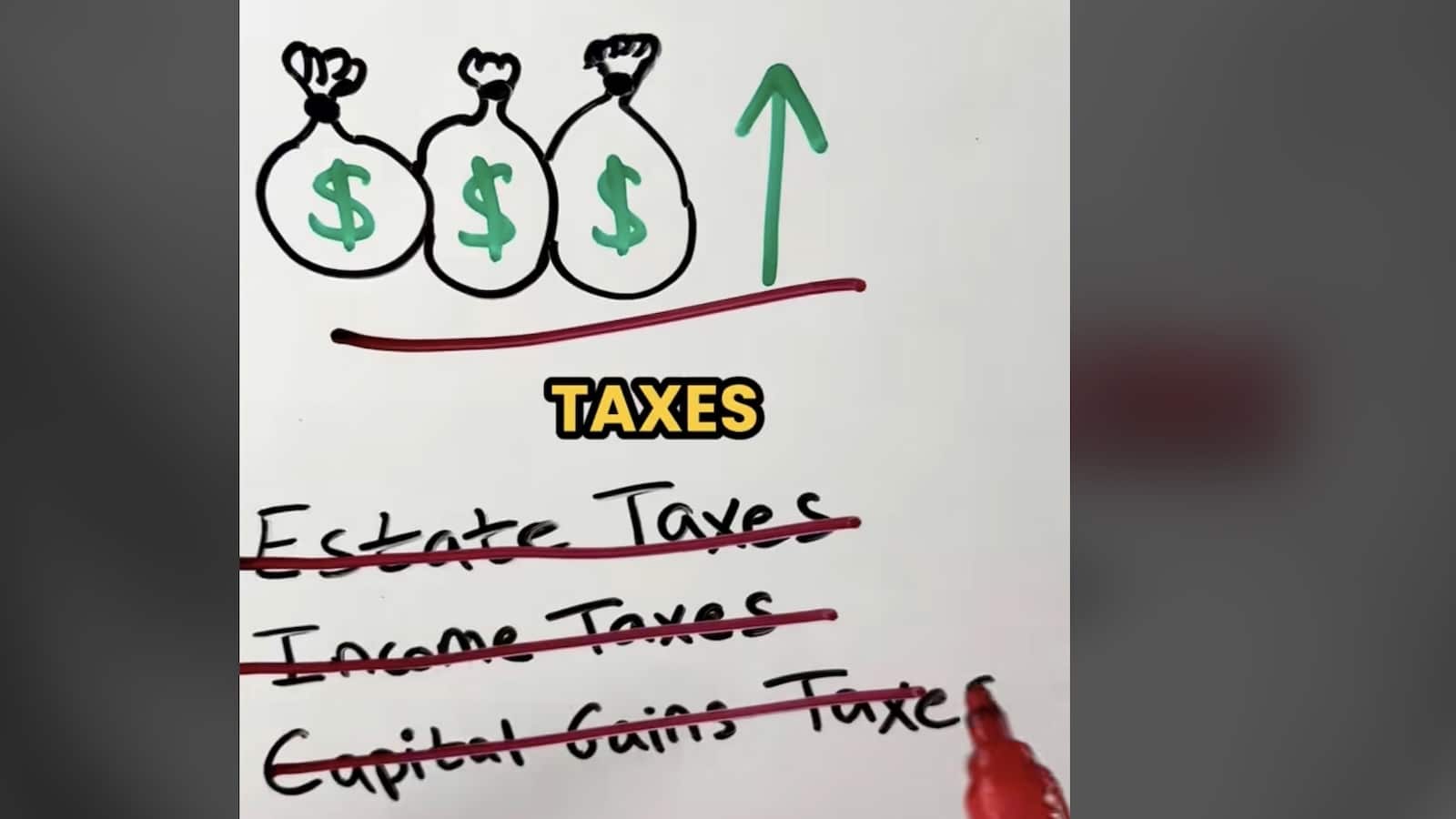
    Here’s one of the almost 200 videos promoting the scheme (originally found on TikTok:

    The scheme is explained in more detail on their website and in this webinar (with a transcript here).

    The idea is:

    1. Your company transfers all its intellectual property to a Cyprus trust.
    2. When your company trades, it’s using the trust’s intellectual property, so it pays over the company’s profits over to the trust.
    3. Your company is therefore “broke on paper” and has no taxable profits. You are, they claim, now “working for your trust“.
    4. Or you can put other assets – your house, cryptocurrency, etc – into the trust, leaving you personally “broke on paper”.
    5. When you want to purchase a sizeable asset (house, car, etc) the trust buys it for you and lets you use it.
    6. For everyday living expenses you take a loan or investment from the trust.
    7. The trust is then exempt from all tax, and you and your company don’t own anything, so aren’t taxed.

    They promise 0% corporation tax, income tax, capital gains tax and inheritance tax. And they say their legal protection acts as an insurance policy, so you are fully legally protected.

    The webinar makes a succession of other outlandish claims – including that Angela Merkel has an offshore trust

    The structure is widely promoted across social media: LinkedIn, Facebook, YouTube and Instagram, as well as TikTok (where they have made an impact, and have over 220,000 followers).

    The UK tax reality

    We discussed the structure with our usual panel of experts, and several other leading tax lawyers. The immediate response of James Quarmby, one of the UK’s leading private client tax and trusts lawyers, was: “it’s nuts”. A tax KC with expertise in trusts taxation told us that the claims made were “legally illiterate”. Another senior tax/trusts barrister told us simply: “it stinks”.

    It’s hard to know where to start, but here’s our incomplete list of the technical problems with the structure:

    • There are rules requiring people selling tax tax avoidance schemes to disclose them to HMRC. We understand this scheme wasn’t disclosed. Arka Wealth will likely have incurred penalties of up to £1m. And a very bad consequence for their clients: the usual HMRC time limits are extended, so HMRC has 20 years in which to pursue the tax.
    • Arka Wealth says that a UK trust is subject to inheritance tax, but a Cypriot trust is not. That’s incorrect: there is an immediate 20% “chargeable lifetime transfer” if a UK domiciled individual puts property into an offshore trust, and then an ongoing 6% charge every ten years or on exit. So the transfer of the intellectual property into the trust will create an immediate inheritance tax charge.
    • Arka Wealth say the trust is not subject to capital gains tax. That’s incorrect: if you put property into an offshore trust then you are personally taxed on the trust’s capital gains.
    • Arka Wealth also believe that, unlike UK trusts, Cypriot trusts don’t pay income tax. That’s again incorrect. The trust will be taxed at 45% on its UK source income. The client will also be directly taxed on the trust’s income under the “settlements” rules or the “transfer of assets abroad” rules.
    • The claim is that the client will “own nothing, control everything”. It therefore may not even be a trust from a UK tax perspective. This is likely the best outcome for a user of the scheme because, whilst they’d fail to obtain any tax benefit, they’d also probably escape up-front tax liabilities caused by the structure.
    • The company’s payments to the trust for the use of the IP will be subject to 20% royalty withholding tax.
    • The company will likely not be able to deduct the royalty payment to the trust.
    • The company will likely be subject to corporation tax on the capital gain from its disposal of the intellectual property into the trust, with the sale price deemed to be its market value.
    • There are potential additional problems, and complex interactions, with the benefits in kind and disguised remuneration rules, plus the potential for a market value stamp duty land tax charge and ATED on any real estate moved into the trust.
    • The claim that a barrister’s insurance provides clients with full protection is often made by tax avoidance scheme promoters. The problem is that the barrister may be insured, but that’s for his protection, not his clients. If his advice is negligent, you will have to sue him and/or Arka Wealth – and win. The insurers will then typically take over the defence; only if you win do they pay out. And the cover could be as low as £500,000.

    This is a tax disaster. Like other schemes we’ve investigated, it won’t just fail to obtain any tax benefit for the clients. It will likely trigger large up-front tax liabilities.

    The courts have struck down almost every tax avoidance scheme they’ve seen in the last 25 years. A sign of the consistent failure of such schemes is that a “general anti-abuse rule” was created in 2013 to counter avoidance schemes. The courts haven’t needed to use it even once; all the schemes considered since it was enacted have failed under normal taxation principles. No reputable adviser would let their client go near a scheme like this.

    However the non-tax consequences could be worse. The scheme results in all of a client’s assets moving into a complex Cypriot trust arrangement. Arka Wealth assure clients everything remains under their control but, given their poor understanding of tax law, it would be optimistic to assume their understanding of Cypriot trust law is any better. One scenario is that assets are trapped in an expensive structure (as has happened with other trust structures). The worst-case scenario is that the assets become stranded, or even disappear.

    The European reality

    Arka Wealth claim the structure works in 30 European countries as well as the UK.

    This is an implausible claim on its face: even the most innocuous commercial structure will usually have different tax consequences in different countries. A tax avoidance scheme is an extreme case.

    We spoke to French, German and Italian tax lawyers, none of whom thought the scheme would work, and all of whom thought it would likely result in a criminal investigation. We also spoke to a Polish tax adviser, who said the structure looked like a sham but, if not, would be countered by the Polish GAAR. The structure will also likely be disclosable to many tax authorities across the EU under the rules often called “DAC 6“.

    Who is behind Arka Wealth?

    Arka Wealth is an Estonian company. – its CEO of Arka Wealth is James Verite-Shephard; the Chief Operating Officer and “Wealth Specialist” is Jeremy Vaughan. Mr Verite-Shephard also owns the company. Neither appears to have any legal, tax or accounting qualifications, or indeed any experience with trusts or the private wealth sector.

    The same two individuals are also CEO and COO and owners of another unregulated wealth manager called Benedictus Global.

    Given that Benedictus Global and Arka Wealth appear to be run by people with no qualifications or experience, and who make transparently false claims, we would suggest that anyone looking for tax advice goes elsewhere.

    We put our criticisms to Arka Wealth and asked them for comment. They didn’t respond to any of our specific points, but said they would now be conducting a review of their materials and how they presented their marketing. We responded that the priority should be to comply with UK and EU tax avoidance scheme disclosure laws. We didn’t hear back. The email thread is here.

    Messrs Verite-Shephard, Vaughan and two junior employees of Arka Wealth are members of a UK limited liability partnership called Fair Share Legal LLP. The other member is a barrister called Setu Kamal, who also controls that LLP.

    Mr Kamal is listed as the legal adviser for Arka Wealth and Benedictus Global as their “legal adviser”.

    Setu Kamal

    Arka Wealth refer extensively to their reliance on the advice of tax barrister Setu Kamal. They host videos in which Mr Kamal recommends that business owners set up a trust, and says that every Arka Wealth client receives a legal opinion from him.

    Mr Kamal tells us that his opinions for non-UK clients are based on arguments that EU law prevents the structure being taxed. He says he doesn’t use this argument for UK clients post-2023.

    Mr Kamal was promoted on Arka Wealth’s website as having a 100% win record, with the claim that “neither HMRC or ECJ have disagreed with his analysis, or been successful in challenging it.”:

    Mr Kamal’s actual win rate is closer to 20%, and probably 0% on substantive tax points. As far as we are aware, Mr Kamal has never appeared before the CJEU.. We pointed this out to Arka Wealth – they didn’t change their website. Update 27 March: one month after we published our report, we reminded Arka Wealth that they were making false claims. They then corrected this page.

    A barrister’s win rate is a crude measure of their ability, because some excellent barristers take on very difficult cases. However in Mr Kamal’s case, we believe that most of the cases relate to tax avoidance schemes that he helped devise. His win rate is an accurate reflection of the success of these structures (indeed it flatters it, because his wins were on valuation and procedural points; we don’t believe he’s ever won a substantive tax point before a court or tribunal).

    Whilst the Arka Wealth scheme is targeted at wealthy individuals, many of the other schemes Mr Kamal has advised on are “contractor schemes”, targeted at people on modest or low earnings. They think they are signing up for normal agency work, but (thanks to complex documents they are asked to sign without advice) end up participating in complex and contrived tax avoidance schemes. Scheme users typically have no idea of the nature of the scheme they are signing up to, and often end up with large tax liabilities as a result. The risks are very high, but rarely if ever disclosed. There’s a good Computer Weekly article on these schemes here.

    Three of the contractor schemes that we believe were created with Mr Kamal’s help have been listed by HMRC as tax avoidance schemes and, we expect, will in due course either lose in front of a tribunal, or vanish before HMRC can pursue them. The Advertising Standards Agency ruled that the same three schemes misled people.

    In defending these and other schemes in court, Mr Kamal has a history of pursuing arguments that we regard as hopeless. This culminated in him being referred by the High Court to the Bar Standards Board for a disciplinary hearing.

    A short summary:

    • In June 2023, Mr Kamal acted for two tax avoidance schemes called Vision HR and Veqta. HMRC planned to list the schemes on its website; the promoters sought judicial review to stop that. Mr Kamal ran the surprising argument that EU law overrode domestic UK law even after Brexit. The court described this as “unarguable” – we believe almost all EU law and constitutional law advisers would agree. Three other of his arguments were held to be “unarguable”. Mr Kamal also failed to answer the Judge’s questions as to how the scheme worked (although, having devised the scheme, we expect that he knew the answers). The promoters were found to have breached the “duty of candour”. Judicial review was refused.
    • A month later, Mr Kamal acted for another tax avoidance scheme, Apricot, on very similar facts; and Mr Kamal made almost identical legal arguments. His application referred to another similar legal challenge “underway in the case of Veqta“. However he failed to disclose that the Veqta challenge had failed, and his arguments had been rejected. The Judge said this prima facie constituted a breach of a barrister’s duty to the court, and made a “Hamid” referral to the High Court to consider whether Bar disciplinary proceedings should be brought against Mr Kamal.
    • The Hamid referral was heard by the High Court in March 2024. The judgment indicates that Mr Kamal made no apology for his omissions, nor any acknowledgment that he failed to comply with his obligations to the court (although he said he had been “flustered“). He failed to attend the hearing, initially claiming he had made an application to attend remotely, but then admitting he hadn’t done so. The Court found that Mr Kamal had breached his duty to the court, and referred the matter to the Bar Standards Board. Mr Kamal has told us that the investigation by the Bar Standards Board concluded on 5 March 2025, he was fined £650, and no further disciplinary action was taken against him, but he has so far refused to provide evidence that the BSB did in fact reach this conclusion.
    • Soon after the Hamid hearing, in April 2024, Mr Kamal acted in another judicial review, Oculus, against HMRC’s decision to force disclosure a promoter who hadn’t disclosed their avoidance scheme under DOTAS. He again ran EU law, GDPR and ECHR arguments which the court found to be “unarguable”.
    • In August 2024, Mr Kamal acted on a failed attempt to challenge the loan charge as contrary to EU law (very far-fetched, particularly post-Brexit) and contrary to the ECHR (which the Court of Appeal had already ruled against). Mr Kamal made an application in which he claimed that two judges were biased and there was an appearance of “institutional corruption”. The court rejected the application, saying it was “frankly scurrilous” and “lacking in any merit”.

    Mr Kamal appears to honestly believe the eccentric legal positions which he takes. Arka Wealth’s staff probably don’t understand them. We expect, however, that may other promoters know these arguments will fail; their aim is to slow down HMRC, and let the promoters extract more money from their clients/victims before their schemes are (inevitably) closed down. In the case of Oculus, that meant that workers continued for a further year before being notified that they were participating in a tax avoidance scheme (we expect they were low-paid and had no idea what was going on) .

    Despite the claim in the webinar (at 00:31:29) that Arka Wealth “use the foremost tax chambers within the UK”, Mr Kamal is no longer a member of a Chambers.

    We wrote to Mr Kamal giving him an opportunity to comment on the Arka Wealth structure. He declined to respond unless we gave him “access to our subscriber base” – when we said this didn’t make sense, he stopped responding. The email thread is here (read from the bottom up):

    We had previously written to Mr Kamal last year, following his referral to the Bar Standards Board. For reasons which aren’t clear, he copied his response into two twitter posts. In short he accused us of a “medieval witchhunt”, and provided more detail of his legal positions (which we regard as highly eccentric).

    The policy implications

    HMRC should investigate and close down Arka Wealth.

    However, Arka Wealth are just one small player in a sizeable industry of tax avoidance scheme promoters. Government action is required.

    1. DOTAS needs to be strengthened, with civil and criminal penalties for the people promoting undisclosed schemes

    Every tax avoidance scheme we’ve investigated has two things in common. It should have been reported to HMRC under DOTAS, the rules requiring up-front disclosure of tax avoidance schemes. But it wasn’t.

    Arka Wealth’s scheme follows the same pattern.

    The reason is simple: having to market a scheme that’s been disclosed to HMRC as a tax avoidance scheme is hard.

    So DOTAS is widely ignored. Often, promoters obtain an opinion from a tax barrister which takes implausible, but highly convenient, positions. An example of such an opinion, and a tribunal’s dismissive attitude to it, can be found in the recent Asset House case. Nevertheless, it’s often the case that the fact an opinion was obtained means that penalties can’t be charged (and Setu Kamal has advocated for precisely this result).

    We suggest two responses.

    • DOTAS penalties should be increased and a promoter’s directors/owners should always be joint and severally liable for the penalties. Right now it’s too easy for them to walk away from their company.
    • Breach of DOTAS should be a criminal offence for the individuals responsible with strong protections to prevent innocent mistakes being penalised.

    2. It should be an offence for an unregulated person to advise on or promote a tax avoidance scheme

    The last Government consulted on regulating the tax profession, but only for advisers who act as agents for taxpayers in their dealings with HMRC. Most tax avoidance scheme promoters do not do this – they provide advice behind the scenes.

    We are therefore pleased to see that the present Government’s response to the consultation states that there will be proposals issued soon dealing specifically with cases where an adviser facilitates a taxpayer’s non-compliance.

    We would suggest this brings within the scope of regulation anyone who provides tax advice for an arrangement which has a main benefit of obtaining a tax advantage.

    3. The Bar Standards Board should bring barristers up to the same standards as solicitors and accountants

    A solicitor, chartered accountant or chartered tax adviser is bound by the rules of the Professional Conduct in Relation to Taxation (PCIRT). These rules include:

    Members must not create, encourage or promote tax planning arrangements or structures that: i) set out to
achieve results that are contrary to the clear intention of Parliament in enacting relevant legislation; and/or ii)
are highly artificial or highly contrived and seek to exploit shortcomings within the relevant legislation.

    This protects the public, because any tax structures falling within this paragraph are very unlikely to work.

    However there is no such restriction on barristers – they are free to create and promote aggressive and abusive tax avoidance schemes which have no realistic prospect of their success. What’s worse is that such barristers usually act for scheme promoters, not the end-users of the scheme. So when – inevitably – the scheme goes wrong, the end-users were not the client, and will not be able to sue the barrister for negligence.

    This is nothing to do with the “cab rank” rule, which obliges a barrister to take on any appropriate case with a paying client. It would be unfair and unreasonable to criticise a barrister for (for example) defending a person accused of tax avoidance or tax evasion. However that is very different from the case where a barrister devises and/or promotes an aggressive tax avoidance scheme. That was the barrister’s choice and, in our view, an indefensible one.

    Thanks to the PCIRT, few of the schemes we have investigated involve a solicitor or accountant; but many of them have involved barristers. A small number of barristers are actively damaging the integrity of the tax system – and everyone in the tax world knows who those barristers are.

    It is over ten years since Jolyon Maugham wrote an article about the problems caused by barristers issuing impossible opinions without consequence. Nothing has changed.

    We will be asking the Bar Standards Board to reconsider its position, and make the PCIRT binding on barristers.


    Thanks to James Quarmby, C, K, T and L for their UK tax technical input, to P, J, D and H for the French, German, Italian and Polish tax commentary, and to T and G for the international arbitration advice. Thanks, most of all, to A for the original tip.

    Videos and other content are © Arka Wealth and reproduced here in the public interest and for purposes of criticism and review.

    Footnotes

    1. We have also archived a copy of Arka Wealth’s TikTok channel, which as at 25 February contained 186 videos. If the channel goes down, please get in touch if you would like access to them. ↩︎

    2. The website went offline in sometime around August 2025 ↩︎

    3. AI generated, so not necessarily accurate ↩︎

    4. See 00:13:35 in the webinar. ↩︎

    5. See 00:28:43. The whole video is well worth watching. Amongst the other claims: that European Union company law is based on trust law (00:40:10), that you can avoid rental withholding tax using a UK holding company (01:13:50), that they work with barristers in the “EU” (00:17:18). For fairness, we should add that a minority of our panel agreed with the claim (at 00:29:33) that “a barrister is always considered an expert in law where a lawyer or a solicitor is not”. And their many other videos make other wild claims, including that billionaires use this structure (we would be surprised if any do; billionaires are generally (but not always) very well advised). ↩︎

    6. Because the main benefits of the structure include obtaining a tax advantage, Arka Wealth is making it available for implementation, and the scheme will (we expect) use standardised documentation. We also expect there will be a premium fee. The references in the webinar to not wanting to disclose their “secret sauce” suggests the confidentiality hallmark applies as well. ↩︎

    7. See 11:54 in the webinar. ↩︎

    8. Or a non-dom settles UK situs assets. In either case, only to the extent the property exceeds the nil rate band ↩︎

    9. See 20:55 in the webinar. ↩︎

    10. See 11:54 in the webinar. ↩︎

    11. With a credit for income tax paid by the trust. ↩︎

    12. See 01:10:29 in the webinar ↩︎

    13. Either on general principles (it’s just not a trust) or under the sham doctrine (see e.g. paragraphs 72 and 73 of the Northwood case) ↩︎

    14. Arka Wealth seem to think the UK/Cyprus treaty will help. They’re wrong: a non-taxable trust can’t be resident in Cyprus for treaty purposes (and the trust in practice is probably resident in the UK anyway). The trustee may be a company resident in Cyprus, but a trustee isn’t the beneficial owner of the trust property. Even if the trust were taxable in Cyprus, treaty relief likely still wouldn’t be available. ↩︎

    15. Either on the basis that it is not “wholly and exclusively” for the purposes of the company’s trade, or on the basis that it was undertaken solely for fiscal purposes and so has been “denatured“. Note that the likely clients are small companies, and so transfer pricing and the diverted profits tax probably won’t apply. ↩︎

    16. We of course do not know the details of how the structure works. The webinar refers to Arka Wealth’s “secret sauce”, which we expect means likely additional steps designed to disguise the nature of the arrangement (see 01:05:17). We discussed these kinds of structures in our previous article on the Minerva structure. However, all of the trust tax specialists we spoke to regarded the claims made as essentially impossible to achieve. It’s been a long time since artificially inserted steps were able to save a tax avoidance scheme. ↩︎

    17. The exceptions: the SHIPS 2 case, essentially because the legislation in question was such a mess that the Court of Appeal didn’t feel able to apply a purposive construction, and D’Arcy, where two anti-avoidance rules accidentally created a loophole. The GAAR was in large part created to prevent cases like SHIPS 2. ↩︎

    18. The full list is: Austria, Belgium, Bulgaria, Croatia, Cyprus, Czech Republic, Denmark, Estonia, Finland, France, Germany, Greece, Hungary, Ireland, Italy, Latvia, Lithuania, Luxembourg, Malta, Netherlands, Norway, Poland, Portugal, Romania, Slovakia, Slovenia, Spain, Sweden, Switzerland, and the UK. ↩︎

    19. The Italian tax authorities tend to treat all tax avoidance, and even many technical tax disputes, as criminal tax evasion – so this response will not surprise many tax practitioners. The French and German responses are less usual. ↩︎

    20. i.e. under the A2 tax-geared fee, A3 standardised documentation or C1 deductible/non-taxable payment hallmarks. ↩︎

    21. As an aside, the Estonian company registry is in our view the best in the world in its openness, and user interface. ↩︎

    22. Mr Kamal says he is advising the “BW Network” and notorious tax avoidance scheme promoter Paul Baxendale-Walker. The similarity between the Arka Wealth structure and the Baxendale-Walker/Minerva structures may not be a coincidence. ↩︎

    23. We believe this is incorrect. EU law never protected wholly artificial tax avoidance structures like those promoted by Arka Wealth (even before the recent CJEU movement towards applying a much weaker standard than “wholly artificial”). ↩︎

    24. We conducted a quick review of decided tax cases where Mr Kamal acted for the taxpayer. We found 14 tax judgments –  of which he won one (Bower, a valuation case), won in part in another (Elphysic, losing on the main point), and lost the remaining 12 (Apricot, Cajdler, Conegate, England, Kondrat-Wilk, Labeikis, Oculus, Opus Bestpay, Phizackerley, Rapid Brickwork, Veqta/Vision HR, Whight). Mr Kamal also won a tax-related insolvency case. ↩︎

    25. The Telegraph suggested Mr Kamal was involved in SDLT avoidance schemes. These schemes have a dismal record of failure in the courts, but we are unaware of any specific reported cases where Mr Kamal acted. ↩︎

    26. The name changed from “European Court of Justice” to “Court of Justice of the European Union” in 2009, following the Lisbon Treaty. ↩︎

    27. Mr Kamal now says he’s seeking ways of challenging the loan charge via an international arbitration. None of the international arbitration lawyers we spoke to believed such a challenge would be possible. ↩︎

    28. Mr Kamal acted for similar claimants in a parallel judicial review, which appears to be unreported, but is mentioned in passing in the Labeikis case. One of the claimants is the Trustees of the Setu Kamal Action Man Trust 2022, so it appears Mr Kamal has himself used a loan/trust tax avoidance structure of some kind. ↩︎

    29. Likely a stop notice can be issued because the scheme is similar in form and effect to others which have been the subject of DOTAS disclosure, and it is more likely than not that Arka Wealth’s structure will not provide the promised tax advantage. ↩︎

    30. Promoters have lied about this in the past; some claiming that DOTAS is a sign of HMRC approval; others that it was a normal process for investigating novel structures. ↩︎

    31. Currently they are £600 per day or (if that is insufficient), £1m. This is an insufficient deterrent when a promoter can make millions of pounds of fees in a few months. The penalty should instead be geared to the fees received by the promoter (say 200% of fees) or, where a promoter does not adequately disclosure the fees received, such amount as is just and reasonable under the circumstances. ↩︎

    32. i.e. expanding HMRC’s existing powers by removing conditions B and D – HMRC should simply be able to pursue directors/participators as soon as a DOTAS penalty is issued. ↩︎

    33. This should be a different test from the usual “directors, shadow directors and participators” formulation, so that directors with no knowledge of the activity are not liable, but an employee who was directing the activity is responsible. ↩︎

    34. We would adopt the approach in the GAAR: the offence should only apply if the failure to comply with DOTAS cannot reasonably be regarded as a reasonable course of action. Merely obtaining legal advice should not be sufficient for a person to taken to be acting reasonably; we’ve seen in Asset House and other cases that some barristers take unreasonable positions. Everyone in the tax world knows who these barristers are. A consequence of criminalising DOTAS is that a rational person looking to protect their position will instruct a barrister whose opinions haven’t repeatedly been contradicted by courts and tribunals. ↩︎

  • Who is Michail Roerich, and why did he build the world’s most convincing fake companies?

    Who is Michail Roerich, and why did he build the world’s most convincing fake companies?

    A mining giant claiming £4bn in revenue, certified by a fake auditor on 128 pages of meticulously detailed fake accounts. A bank with a login page that can’t log anyone in. A trust holding $327bn in Tsarist gold that never existed. Even endorsements from the Duke and Duchess of Cambridge, Nadhim Zahawi, and Baroness Mone – all fabricated. And, incredibly, an entirely fake country.

    Behind all these elaborate deceptions is a real person – Michail Roerich – and a very real attempt to seize a gold mine in Ukraine. Who is Roerich, and what exactly is he trying to achieve?

    This follows our previous reports on companies filing fake accounts, the large number of fake banks filing fake accounts, and the tool we built to identify companies with fraudulent accounts.

    The Observer’s report is here.

    The mining company

    Here are the 128 pages of Gofer Mining plc’s 2019 report and accounts.

    The accounts look like the accounts of a global mining giant, which is what Gofer’s website says it is. 4,000 staff, operating in 21 countries, and expecting to post £4bn of revenue in 2022. It’s listed on Dun & Bradstreet and headquartered in One Canada Square.

    These accounts were filed in 2021 – and Gofer Mining never filed accounts again. Its website also seems to be frozen in 2021. A reader who didn’t know this would be hard-pushed to see anything wrong with the accounts. They are a world away from the fake accounts we have recently investigated, which are full of accounting impossibilities, typographical errors and copy/paste errors.

    A careful reader might, however, wonder why there was so little detail, particularly compared with annual reports from other comparable mining companies. If they then made some enquiries, they’d realise something strange was going on. Anyone who knew Canary Wharf would say that there’s never been a mining group headquarters at One Canada Square. Anyone in the mining industry would say the claim to be the only gold miner in Greece and Ukraine is false – and they would have never heard of Gofer. A minerals expert would note that some of the resource figures are out by a factor of at least 1,000, and that no new mine can be brought into production within a year. A forensic accountant would say the level of growth recorded in the accounts, and lack of detail, is highly suspicious. A capital markets lawyer would be puzzled by the claim to have raised more than £300m from shareholders, without any sign of any capital markets transactions. A mining lawyer would wonder about the lack of any reference to licences or regulatory filings. A banker would know that Barclays would never make a ten year unsecured loan to a new mining company at a 0.5% rate of interest. And nobody would have heard of its Chairman, Sergey Kolpidi, its CFO, Michail Roerich (here calling himself “Michail Sergios Kolpidis“), or indeed any of its board.

    None of this is conclusive; there might just about be explanations for each oddity. And the accounts were audited – whilst isn’t a guarantee of accuracy, but gives us assurance that someone independent has checked that the document is a fair reflection of the business.

    So who was the auditor who signed off on the report? Dr James Whitelaw, of Smith Barclay LLP. Here’s one of the partners of Smith Barclay LLP, showing off their client list:

    That partner is Michail Roerich. The Michail Roerich who was the CFO of Gofer Mining plc – he was also a director and ultimate owner of Smith Barclay LLP.

    That’s just the start of the problem. Neither Smith Barclay LLP nor James Whitelaw ever had an audit licence. There’s no evidence Whitelaw ever existed.

    The audit report was a forgery.

    And there is almost no evidence that Gofer Mining plc existed at all, outside its Companies House filings and its website. No employees, no premises, nothing. The document presents 2019 calendar year accounts, and mentions the 2018 balance sheet, but the company was only incorporated on 12 April 2019, and gofermining.com was created one week before that.

    Someone went to a great deal of effort to create the Gofer Mining plc report and accounts – they’re easily the most impressive fake accounts we’ve seen. We do not know who was responsible, but we can say two things for sure.

    First: Michail Roerich is real – although he goes by several names. He’s the central figure in this report.

    Second: whilst Gofer Mining plc didn’t exist in any real sense, that didn’t prevent it from trying to control a very real Ukrainian gold mine.

    The Ukrainian mine

    Almost immediately after it was incorporated, Gofer Mining plc made a serious attempt to seize control of a Ukrainian gold mine. A deal had been signed for the mine to be sold by the Ukrainian Government to Avellana Gold, a real mining company. Gofer Mining plc tried to stop this.

    On 16 April 2019, a small advertisement was placed in The Times’ “business to business” classified section. It claimed that Gofer Mining plc had been established by “Barclays PLC and its affiliated companies”:

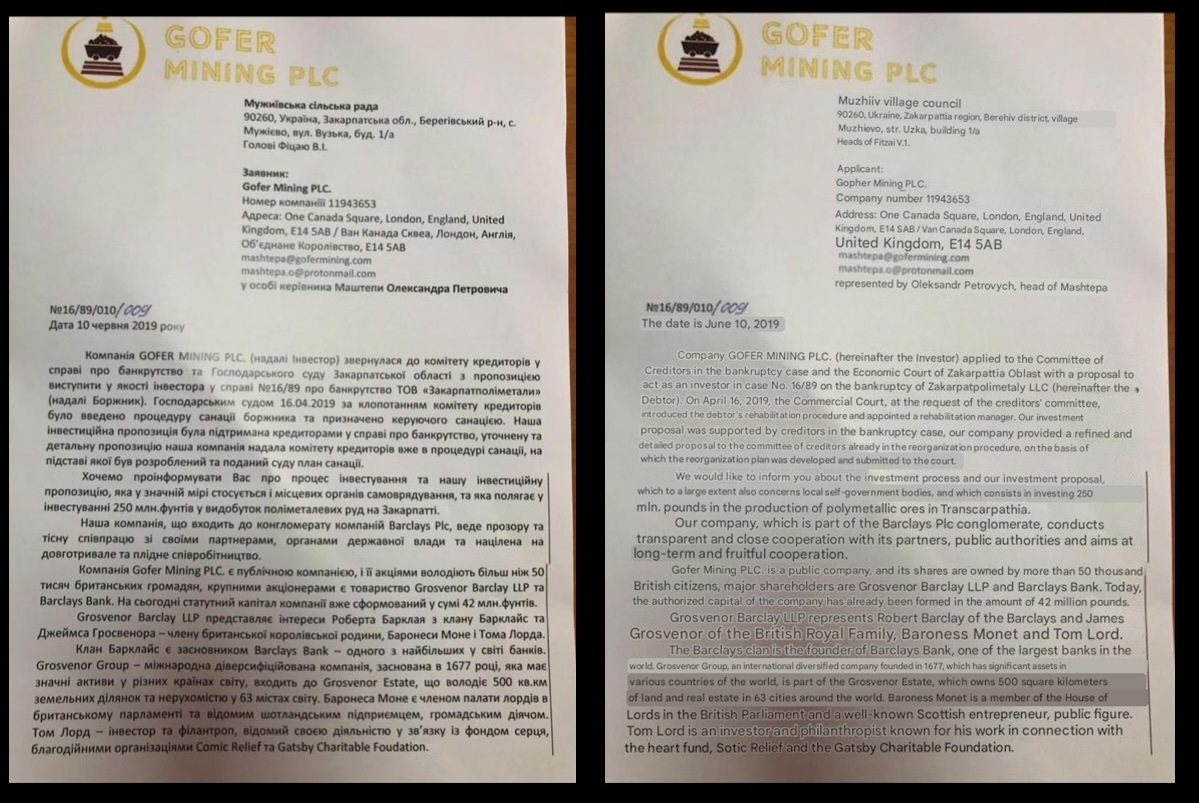
    Two months later, according to a reputable Ukrainian journalist’s blog, this letter was sent by Gofer to a village council near the mine (Google Translate version to the right, verified by a Ukrainian speaker):

    The claims made in the letter go even further than the classified advertisement, including:

    • The company is part of the “Barclays plc conglomerate”.
    • Its shares are owned by more than 50,000 British citizens
    • Shareholders also include Barclays Bank and a firm called Grosvenor Barclay LLP.
    • Grosvenor Barclay LLP is owned by Robert Barclay (of the Barclay family that founded Barclays Bank), the Grosvenor Estate and Baroness Mone.

    All the claims here were false. Barclays Bank plc had no involvement; neither did the Grosvenor Estate or the Mone family. Grosvenor Barclay LLP was incorporated a month after Gofer Mining plc. Its members certainly included “Robert Barclay” and “James Grosvenor” – but Robert Barclay died in 1690, and there is no prominent “James” in the Grosvenor family. Another registered member, outrageously, was Baroness Mone’s teenage daughter.

    On the back of these false claims, Gofer Mining plc obtained a court judgment, blocking the sale to Avellana. This was widely covered in Ukrainian media at the time. The dispute ended when a commercial court and then the Ukrainian Supreme Court ruled in favour of Avellana and against Gofer (although the Ukrainian courts do not appear to have appreciated the fictitious nature of Gofer).

    Avellana have a statement on their website and a video from their CEO, Brian Savage. He says Gofer were an “experienced group of criminal corporate raiders”. He added that they had “no mining expertise” and their claim to be backed by a UK bank was a “lie”. Savage’s claims are extraordinary, but consistent with our findings. If Barclays credit line wasn’t real, and the accounts weren’t real, then their attempt to control a mine cannot have been real either – or, if real, cannot have been legitimate.

    There was at least one other occasion when Gofer Mining plc interacted with the real world. We understand from another mining company that Gofer Mining plc approached them for a deal (unconnected to Ukraine), but couldn’t demonstrate it had funding, and the deal went nowhere.

    There may have been more. Gofer Mining plc won The Business Concept’s “Most Innovative International Precious Mining Company 2023”. A meaningless paid award – but evidence that Gofer Mining plc was still active in some sense in 2023.

    The listed holding company

    Gofer Mining says it’s owned by Gofer Wealth plc. The website is now down, but between 2020 and 2023 Gofer Wealth said it was “the financial services arm of the British conglomerate Gofer Group”. Its incorporation documents show Barclays plc as the sole shareholder. Subsequent Companies House filings claimed it was listed on an EU stock exchange/regulated market. Its accounts show it having £1.7bn of assets.

    None of this is true. Barclays plc had no involvement. Gofer Wealth was never listed on any stock exchange. Its accounts show £1.7bn in cash on its balance sheet for five years straight, with no other balance sheet entries. That is, in practice, impossible. Nobody sits on £1.7bn in cash, earning no return and accruing no expenses. And there is no sign at all in its accounts of its ownership of Gofer Mining plc.

    The company filed as dormant – which meant it had no transactions. That was again impossible – transactions are an inevitable result of holding £1.7bn cash.

    Gofer Wealth’s registered office was 17 Hanover Square, in Mayfair. It’s a serviced office block – but it seems Gofer Wealth was not a paying client. The owners of 17 Hanover Square complained about their unwanted visitor, and so Companies House used its new powers to force Gofer Wealth into a temporary registered office at Companies House itself.

    On the board we again see Michail Roerich – but now he’s calling himself “Michail Sergios Roerich, His Grace the Duke of Commonwealth”. More on the “Commonwealth” later.

    The magnetic technology company

    Magnetic Technologies Group plc’s website says it develops and invests into the field of “Magnitology”, and it’s active in 50 countries, with a presence in 25. It says its shares are AIM listed, that it is audited by Grant Thornton, and its European headquarters are in Slough.

    None of this is true. There is no evidence of the company’s existence. It’s not AIM listed. Grant Thornton told us they’re not the auditor, and have no relationship with the company. Magnetic Technologies Group plc’s “European headquarters” is actually a co-working office space. The company’s accounts show £5m in the bank, and nothing else – and the lack of any change in the figure implies that there is no money here at all.

    Again on the board we see Sergey Kolpidi and Michail Roerich, “the Duke of Commonwealth”.

    The Gofer group

    There are so many related companies that listing them here would take up pages and pages. The oldest is a shipping business that was incorporated in 2006, filed superficially convincing “audited” accounts in 2014, and was dissolved three years later. There’s a charitable foundation, and a company run by Lord Troubach (who does not exist). Perhaps the highlight is Gofer Energy Ltd, which was claimed to be part-owned by Barclays Bank plc, and part by the Royal Foundation of the Duke and Duchess of Cambridge.

    It is most unlikely the group is the sole creation of Michail Roerich, given the amount of work involved, and the variety of expertise required to fake the Gofer Mininc report and accounts. Mr Roerich was only 14 or 15 when the first company, Sunlight Maritime Limited (I), was formed. And its 2007 accounts are extremely strange, with the surface appearance of real accounts (including a presumably fake letter from accounting firm Moore Stephens), but then tiny numbers perhaps 10,000 times smaller than they should be. Why would anyone do this? Or was this Roerich’s first attempt at faking a company?

    If others were involved – who Sergey Kolpidi is listed as a director of nine of the companies; Larisa Kolpidou as a director or secretary of no fewer than thirteen. We believe that Sergey and Larisa are Michail Roerich’s parents. In 2004, a Polish news website published an article in which Sergey Kolpidi was identified as having previously been called Sergei Gavrilov, a Russian businessman whose wife was called Larisa and who had been involved in a Polish banking scandal in the late-1990s, following which he was expelled from Poland.

    The timeline starts in 2006, but most of companies are short-lived. There is a flurry of activity when Gofer Mining plc is created in 2019. This chart illustrates the timeline – click on a bar for company details and Companies House links. Landscape mode recommended on mobile devices; fullscreen version here.

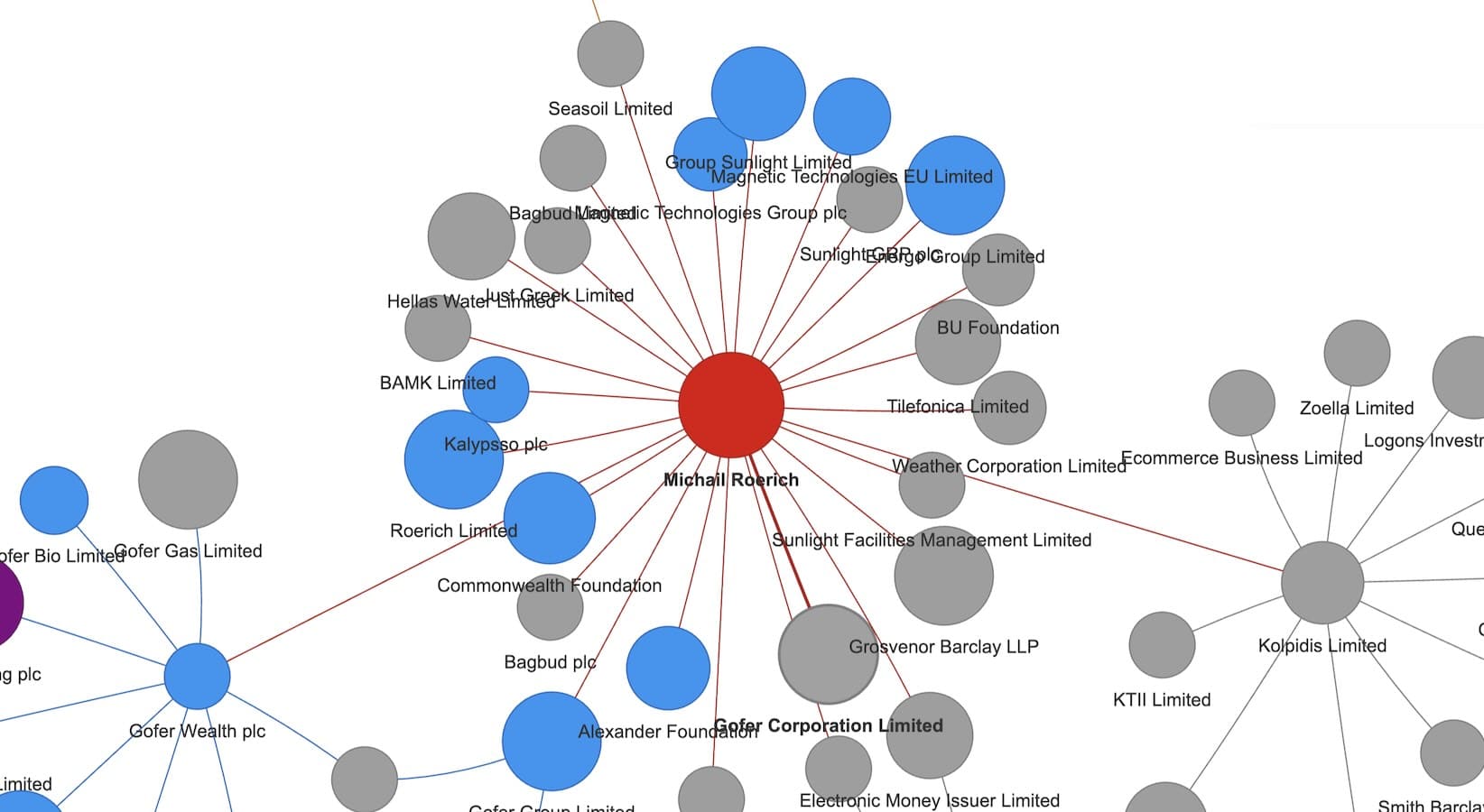
    You can explore the connections between the companies in more detail with this interactive chart – click on a company for its full details/links. You can move companies/individuals around, and zoom in and out, to focus on points of interest. Fullscreen version here (recommended particularly for mobile users):

    We’ve also put this data in a Google spreadsheet.

    We would caution that it is prudent to generally assume that that no director or shareholder (individual or company) mentioned on this chart, or in these companies’ filings, agreed to participate in the companies. In many cases we doubt they exist at all. The sole exception is Michail Roerich, where we are confident that he both exists and was involved.

    The fake country and the Ponzi fraud

    At this point the story takes a very strange turn.

    Mr Roerich has founded the Union State of British Commonwealth – the “sovereign political form of union and alliance of the people of 60 member nations”. Its members include Australia, the UK, Russia and the “Commonwealth of British Ukraine”. Its sovereign is His Serene Highness Michail Roerich-Kolpidis (Duke of Commonwealth). It is supported by a variety of luminaries, including Nadhim Zahawi, a former member of its Financial Group

    It is hardly necessary to add that no country recognises the Union State of British Commonwealth or (so far as we can tell) is even aware of it. Mr Zahawi has no involvement and had never heard of the Union State; likely the same is true for the other named individuals.

    The Union State has a central bank – The Bank of Commonwealth, which claims it is based in Montserrat and is covered by the UK Financial Ombudsman Service (FOS). The Montserrat authorities say there is no such bank in Montserrat. The bank (if it exists at all) is not covered by the FOS. It does, however, have a client login page.

    Roerich makes a variety of eccentric claims linked to the Union State, including:

    These are all very tall tales, but essentially harmless. However the activities of the “central bank” appear rather less innocent.

    The Bank of Commonwealth’s Chief Strategy Officer is a man called Shaun Cohen. This is the same Shaun Cohen who ran a real estate Ponzi scheme in Texas, defrauding investors out of $135m. The SEC sued and Cohen consented to judgment against him.

    Mr Cohen is listed as a consultant to a Florida firm called ClearThink Capital, and responded to an email sent to ClearThink Capital confirming his involvement in the Bank of Commonwealth. One of his colleagues at ClearThink, Richard Whitbeck, is listed as Chief Operations Officer of the Bank of Commonwealth.

    Once again, what starts off looking odd but harmless ends up looking rather more concerning. And, perhaps not coincidentally, there is some evidence that the “Commonwealth” is being used for dubious and potentially illegal purposes:

    • The Bank of Commonwealth used to be known as the British Technology Bank, which it said was 10% owned by the Bank of England.. In 2023, the Financial Conduct Authority issued a warning that the British Technology Bank was an unregulated bank targeting people in the UK. We have seen a letter Roerich sent to the FCA complaining about this warning in which he said that, as a central bank, the British Technology Bank was not required to be regulated. The letter also repeated the claim that the Bank of England held 10% of the BTB.
    • Roerich’s website promotes “Commonwealth Pay“. The concept is that merchants (such as online retailers) can redirect their payments to Commonwealth Pay, and then will pay only 3% tax on their income “with no further taxes due thanks to the double taxation convention“. There is no such convention. It is not at all clear to us if this is a real product, but if it is then it is likely tax evasion, in the UK and any other country where it is sold.
    • And there is a “depositary receipt” which can help you “get financing” or “invest money, risk-free”. And a related “investment bank with a very plausible-looking website offering a variety of financial products. It is, again, not clear if this is a real product or a fantasy – but if real, it looks highly suspicious (and for an unauthorised firm to promote these products into the UK or the EU would in many cases be an offence).

    Who is Michail Roerich?

    Very little described in this report has real existence, with one exception: a person calling himself Michail Roerich certainly exists.

    We know very little about him. Mr Roerich has a Twitter account, a Quora account and a LinkedIn account but otherwise, aside from his many web pages and company filings, there is little evidence of his existence.

    We can be reasonably confident he physically exists: here he was, three months ago, promoting registration on the “ROERICH marketplace”. It has 29 views:

    And one month before that, promoting the “ROERICH Youth Programme for Ukraine” (56 views):

    We corresponded with Mr Roerich earlier this week, and asked him why he was involved with so many fake companies.

    His response was, in short:

    • Roerich is adamant that Gofer Mining plc and the other companies are real. He says that the Gofer group was a victim of political persecution and theft in Ukraine and certain African countries (connected to Russia). He sent us a letter making wild and implausible accusations of involvement by Hillary Clinton and Joe Biden.
    • Mr Roerich admits that he knew Gofer Mining plc’s auditor, Smith Barclay LLP didn’t have an audit licence and was owned by him. In our view this is an admission of two criminal offences. He did not explain why, if Gofer Mining plc was a real company, he established a fake auditor for it.
    • Mr Roerich also admits that Gofer Wealth plc was never listed.
    • When we pointed out that the accounts of most of the companies were crudely faked, Roerich replied that “even if I were to accept and agree that the accounts were improperly created/recorded etc. according to XYZ law, it does not automatically mean they represent fake numbers”. That is a very unpersuasive answer.
    • Roerich claims that the cash is real, but can’t be accessed because it is in Ukraine. This is very unlikely to be true. Nobody would hold that much Sterling in a Ukrainian bank and, if they did, it would be held via a correspondent banking arrangement with a UK bank.
    • Mr Roerich knows Shaun Cohen was accused of running a Ponzi scheme, but seems to believe he was hard done by. It is not clear why he has come to that view, or why he thinks Shaun Cohen is an appropriate person to help run a central bank, even an imaginary one.
    • He insists that his many other claims are true, but without providing any extrinsic evidence, or indeed anything beyond vague assertions.

    Our correspondence with Mr Roerich is set out in full here:

    The criminal offences

    A large number of criminal offences appear to have been committed by Mr Roerich and his (as yet unidentified) associates – all of which have the potential for unlimited fines and imprisonment:

    • Knowingly or recklessly providing false information to Companies House is a criminal offence under section 1250(1) of the Companies Act 2006.
    • Knowingly or recklessly including false material in an auditor’s report is a criminal offence under section 507 of the Companies Act.
    • Failing to file accounts is itself an offence under section 451 of the Companies Act.
    • Falsely claiming you are a registered auditor is a criminal offence under section 1250(2) of the Companies Act.
    • Dishonestly falsifying accounts with the intent to gain for himself is “false accounting” – an offence under section 17 of the Theft Act 1968.

    The first four of these are reasonably straightforward offences to prosecute: there is no need to prove any “dishonesty” or other state of mind beyond the fact that the person knew the accounts were false. Mr Roerich’s admission that he knew the “auditor” of the Gofer Mining plc accounts was unqualified leaves little more to be established. And, whatever he says now, Mr Roerich surely knew the many accounts he filed were false.

    What is going on?

    It seems reasonably clear that Gofer Mining plc had a real purpose. It attempted to steal a Ukrainian gold mine. We’re also aware of one other attempted mining project.

    To some extent this fits in with the pattern of transactions and attempted transactions we’ve seen from other entities with fraudulent accounts. But they usually look to take the money and run – not engaged in protracted court battles.

    The other difference between those cases and this one is the high quality of the accounts created for Gofer Mining plc. This likely involved a small team of people, at least one of whom was a native English speaker and at least one of whom had a familiarity with accounting. An adequate website was created (rather less persuasive than the accounts). A fake auditor was established. Other companies, such as Grosvenor Barclay LLP, Gofer Corporation and Gofer Wealth plc, were incorporated to support the existence of Gofer Mining plc (but much less effort was taken with those companies).

    The supposed financial offerings of Mr Roerich’s “central bank” and “investment bank” could be frauds – we don’t know. The involvement of Shaun Cohen is hard to explain if they are just fantasy, and concerning if they are not.

    We have, however, no explanation for the sprawling conglomerate that the Gofer group became – at least 60 companies. We certainly can’t explain the Union State of Commonwealth.

    The only person who knows is Michail Roerich, and he isn’t telling.

    Why does it matter?

    The Gofer network of fraudulent companies has continued for two decades because of well-known failings by Companies House:

    • Gofer Mining plc and others failed to file accounts for years. Every company on our list made multiple breaches of company law, but they were treated no more seriously than the late return of a library book. In one case, a document was removed from the registry because of forgery; but the company was permitted to just continue as if nothing had happened. No action was taken against the directors.
    • Gofer Wealth plc and others in the group filed impossible accounts claiming huge amounts of cash in the bank, whilst still being dormant and small companies. Companies House could easily create systems to identify false accounts of this type. It doesn’t.
    • Gofer Wealth plc used someone else’s premises as its registered office, without their consent. It’s a form of fraud itself but – more seriously – a sign that something untoward is going. However, Companies House again treated it as no more than an administrative slip-up.
    • Most seriously, we understand that during the attempt to seize the Ukrainian mine, the British Ukraine Chamber of Commerce wrote to Companies House begging for something to be done about an obviously fraudulent company. No action was taken.

    The Gofer Mining plc accounts, on the other hand, present a new and much more difficult challenge to the integrity of Companies House. Companies House can’t be expected to identify that kind of sophisticated fraud (and, by the time the accounts were filed with Companies House, the activity in Ukraine was long over). Assurance should be provided by the audit; but it is trivially easy to forge an audit report.

    We’ve spoken to auditors who believe this is a growing problem: real auditors’ names being fraudulently signed onto companies they’ve never heard of, and fake auditors’ names being fraudulently signed onto others. The rise of ChatGPT and other easily available LLMs mean that creating plausible fake accounts and reports is now much, much easier than when Gofer Mining plc’s documents were prepared.

    In 1844, when modern auditing began, it was reasonable to trust an auditor’s signature. Today, it isn’t – but given there are straightforward ways to electronically sign and verify documents, we believe Companies House needs to reconsider its approach.

    It wouldn’t be hard to create a system where audited accounts have to be submitted by a licensed auditor. Otherwise, in the era of ChatGPT, we are going to see more fake companies like Gofer plc committing fraud, using the credibility that Companies House has given them.

    Companies House should act to give the world assurance that “audited accounts” are actually audited accounts.


    There are many open questions. Is Roerich’s father really Sergei Gavrilov, a Russian businessman who ran a bank accused of money-laundering? What were the other real-world activities of the Gofer group, aside from the Ukrainian gold mine? What is the connection with Shaun Cohen and ClearThink? What is going on with the British Commonwealth Bank, and why does it have such a sophisticated website? These go beyond the resources and expertise of Tax Policy Associates; we hope others will investigate.

    Thanks most of all to K1 for the research on this – almost all the detailed work was undertaken by them. Thanks also to J1 and P for the accounting expertise, T for Companies Act assistance, D for mining knowhow, K2 for practical corporate finance input, VH for the correction regarding the bank javascript, and MS for assistance with Ukrainian language documents. Thanks to J2 for his invaluable review of an early draft, and to JG for his review of a late draft. And thanks to Tom Church of OSINT Industries for additional research.

    And many thanks to Michael Savage at the Guardian for all of his contributions to this report, and finding evidence and documents that we would never have tracked down on our own.

    Footnotes

    1. Note that the PDF in the viewer is the version of the accounts on Gofer’s website. The copy filed with Companies House is a poor quality scanned image – this is a common fate for pretty accounts that get posted to Companies House. This happens to real listed companies as well as Gofer. However what is unusual here is that the two documents are slightly different. Some pages are rearranged; there may be other more substantive changes. The (pretty) website version was created, according to PDF metadata, in February 2020, but nothing was filed with Companies House until November 2021. ↩︎

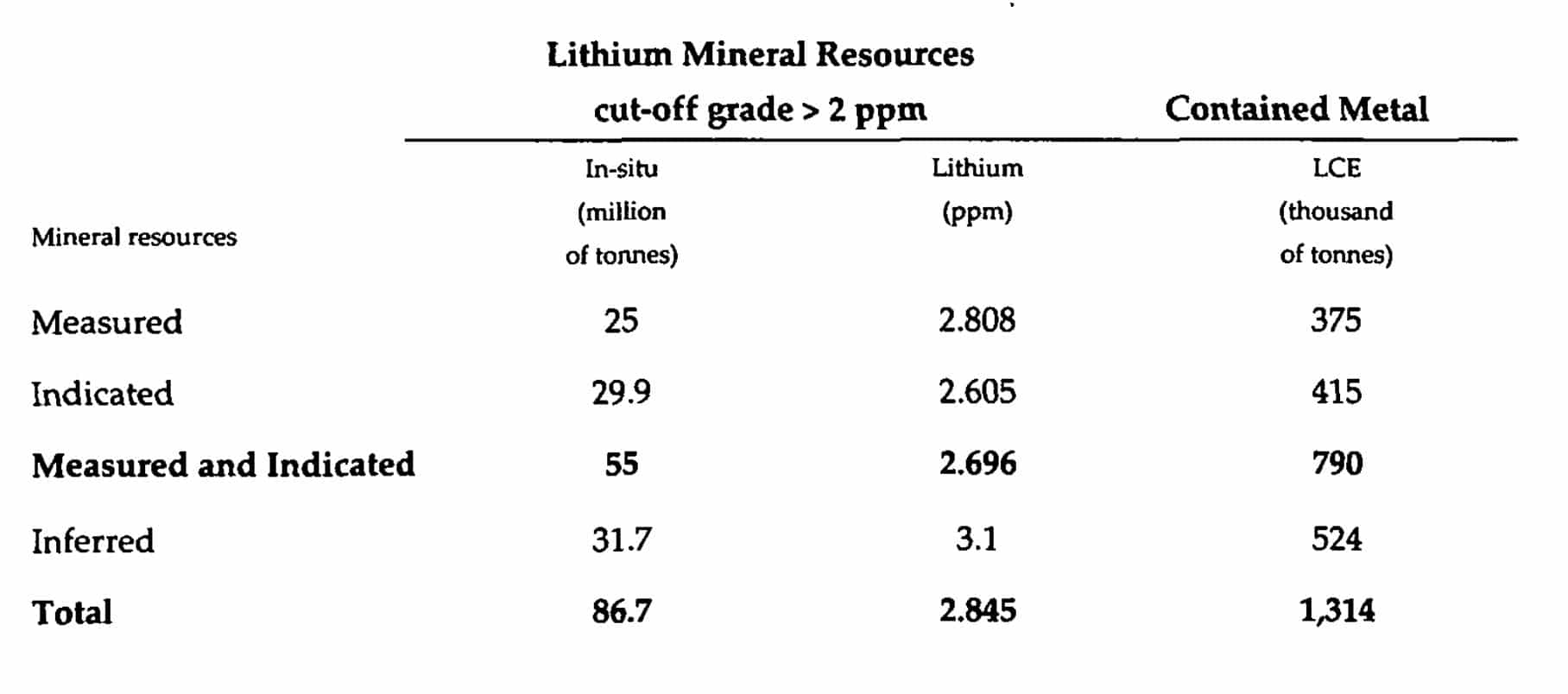
    2. See this chart from the Gofer Mining plc report. Gold is measured in grammes per tonne, or parts per million, because it’s valuable enough to be economically mined at grades that low. Lithium is mined at much higher concentrates – typically low single figure percentages of lithium oxide. The chart is probably wrong even if “ppm” is replaced with “%”. It’s an error no mining company would make. ↩︎

    3. This is a small selection of the oddities in the 2019 report and accounts; there are many more. That’s not to mention the website, with its breathless list of corporate and mining deals – which other parties involve deny ever happened, and which aren’t reflected in registries. ↩︎
    4. It is inconceivable that a company can have thousands of employees, but not one can be found on LinkedIn or Facebook, or anywhere outside Gofer Mining’s own website ↩︎

    5. It was prior to the widespread availability of ChatGPT and other LLMs. ↩︎
    6. For context, the full page of the Times is here. ↩︎
    7. Some reports suggest Gofer was ultimately backed by Russia. We have no idea if this is correct. However, Avellana have put the blame on elements of the Ukrainian government; we would also note that Roerich’s own Twitter account appears generally hostile to the Russian Government and its invasion of Ukraine. ↩︎

    8. A short transcript of his video: “Gofer Mining and several other affiliated companies, also recently formed in the UK, are simply an experienced group of criminal corporate raiders and have been supported in their efforts to damage Avellana by corrupt Ukrainian judges and government officials.

      They know nothing about the mining business and have no ability to develop, much less operate a mine.

      Gofer Mining claims to have a major UK bank [he means Barclays] prepared to fund £250m to develop the project, yet there isn’t any news about the bank’s mining experts visiting the site.

      To prove their claim, Gofer Mining paid for a classified advertisement in a London newspaper, fraudulently using the bank’s name and implying they are involved in the project.

      If the bank really was involved in financing this size, it would certainly be covered by all of the international news organisations and mining journals, not to mention that one of my many industry friends would have called me and asked about it. ↩︎
    9. Interestingly nobody seems to have notified Gofer Mining plc’s presumably equally false claim that it’s registered at One Canada Square. ↩︎

    10. It’s clearly the same person – see here and here. ↩︎

    11. No longer maintained, so the security certificate is out of date. You can visit the archived version here. The website is much less plausible than Gofer Mining plc’s. ↩︎

    12. James Whitelaw, of Smith Barclay LLP, was again the auditor. ↩︎
    13. The later Sunlight Maritime accounts show much larger and more realistic sums, but have numerous other oddities, not least a P&L which makes very little sense. One particularly weird paragraph says that the company is exempt from the requirement to produce consolidated accounts because its accounts are consolidated in its parent, Sunlight Maritime, company 05726487. But these are the accounts of Sunlight Maritime, company 05726487. We are at a loss for any explanation as to why someone would go to the trouble of fabricating reasonably realistic accounts, and then make this kind of error. ↩︎
    14. The small images of Gavrilov on the Polish website look very similar to the photo of “Sergey Roerich” here. ↩︎
    15. There also appear significant bursts of incorporations in 2012 and 2016; we do not know why that is. ↩︎
    16. The chart shows most recent shareholdings and directorships only. Where a company was dissolved, the chart shows shareholdings as at the date of dissolution. ↩︎

    17. The Union State of British Commonwealth also has a Supreme Court, said to be chaired by Chief Justice The Rt. Hon. The Lord Tupitskiy MCC. The name and photo match Oleksandr Tupytskyi, a Ukrainian judge who is not a Lord – we understand he was the judge who initially ruled in favour of Gofer Mining plc. MCC appears to stand for “Member of Commonwealth Congress“. We don’t know if Mr Tupitskiy is aware of his role, and we weren’t able to contact him. ↩︎

    18. It appears Mr Roerich has had some real world meetings in this capacity; he entered the Bank of Commonwealth in France’s lobbyist register, causing some bemusement. ↩︎

    19. We originally said the login page was fake, and you couldn’t actually login. VH has made a convincing case to us this is not right – it’s an unusual approach, and the hosting doesn’t look like a bank, but it may log in. Our apologies for the error. ↩︎

    20. At the current gold price of $2,832 per ounce. ↩︎

    21. Given the significance of the point, we will set out the evidence demonstrating that this is the same Shaun Cohen, and the evidence of his background.

      Cohen’s profile page identifies him as an alumnus of St John’s College (from 1996 to 2000) and George Mason University (with a MA/ADB in Economics) between 2006 and 2009; his experience includes working for an unidentified private equity fund in Plano, Texas (of which he was the founder and co-CEO) between 2008 and 2018.

      Cohen’s LinkedIn profile contains matching biographical information and adds that, in his role as the founder and co-CEO of a private equity fund between 2009 and 2018 Mr Cohen had “self-funded and launched one of the nation’s largest private real estate investment companies” and had built a portfolio of US$250m in assets under management. Once again the name of the private equity fund is not revealed.

      Public documents show that Cohen worked for a company called EquityBuild, Inc. whilst based in Plano, Texas.

      Submissions filed by the receiver in the same US District Court proceedings record that Shaun Cohen had graduated from St John’s College in Annapolis, Maryland with a BA degree in 2000 and had received a Masters’ Degree in Economics from George Mason University in 2009, became Vice-President of EquityBuild Inc in 2009 and served as EquityBuild Finance LLC from 2010. Unless two different people with the name Shaun Cohen had graduated from St John’s College and George Mason University in 2000 and 2009 respectively, and both working in Plano at the same time, we conclude that the Shaun Cohen described in the receiver’s submissions is the same Shaun Cohen described in the profile page on the Bank of Commonwealth website. Finally, it is reasonably clear that the Shaun Cohen in contemporaneous EquityBuild videos is the same man as in the recent profile images. ↩︎

    22. In August 2018, the US Securities and Exchange Commission brought proceedings in the US District Court for the Northern District of Illinois (Eastern Division) against EquityBuild Inc, EquityBuild Finance LLC, Jerome H. Cohen and Shaun D. Cohen “to halt an ongoing Ponzi scheme”. The SEC’s complaint recorded that the defendants “recently started coming clean about their financial distress and inability to repay investors through revenue-producing real estate [but] limited these disclosures only to earlier investors whose interest payments Defendants could no longer afford to make [and] continue to raise funds from new investors by concealing their dire financial condition while promising “guaranteed” returns and annual interest payments as high as 17%”.In a May 2024 judgment (concerning priority over the proceeds of the liquidation of various properties), the United States Court of Appeals for the Seventh Circuit described the Cohen’s Ponzi scheme as follows:

      “Jerome and Shaun Cohen ran a Ponzi scheme through their real estate companies EquityBuild, Inc. and EquityBuild Finance, LLC (“EBF”) from at least 2010 to 2018. The scheme began with the Cohens, through EquityBuild, selling promissory notes to investors, each note representing a fractional interest in a specific real estate property. They promised interest rates ranging from 12% to 20%. A mortgage on the respective properties, mostly located in underdeveloped areas of Chicago, secured each of the notes.

      By overvaluing the properties involved in the scheme, the Cohens generated money that they pocketed as undisclosed fees and used to pay earlier investments. The overvaluation also meant that, contrary to representations, the investments were not fully secured.

      As it became more difficult for the Cohens to sustain making interest payments to investors, they found ways to put off those payments and continue their scheme. That mischief resulted in a new business model in 2017. Instead of offering investors promissory notes, the Cohens began offering opportunities to invest in real estate funds. As before, they told investors that EquityBuild would pool investments to buy and renovate properties at exceptional rates of return. The Cohens apparently used much of these later investments to make payments to earlier investors.

      A receiver was duly appointed for the estate of companies called EquityBuild Inc, EquityBuild Finance LLC, their affiliates and the affiliates of Jerome Cohen and Shaun Cohen. ↩︎

    23. Our original draft said that Whitbeck has also confirmed his involvement; this was a misunderstanding between our team; our apologies. ↩︎

    24. For the record, the Bank of England confirmed to us this is not the case. ↩︎

    25. Which, its privacy policy, gives its contact address as 10 Downing Street. ↩︎

    26. Which claims he’s a CIPFA-qualified chartered accountant; that doesn’t appear to be true. ↩︎

    27. We won’t publish it; the letter is ludicrous but also highly defamatory, and we’ve no wish to put such a document into circulation. ↩︎

    28. Roerich says in his defence that he held the LLP as a nominee. That is irrelevant even if it’s true (and it contradicts Companies House filings). ↩︎

    29. The figures cannot be FX conversions from hryvnia into Sterling, as the figures are round and do not change year-to-year. ↩︎

    30. One exception: as evidence of Gofer Mining plc’s reality he sent us a copy of a draft PwC structure paper for the construction of a solar power facility near Zagreb, involving companies and individuals which appear to have no connection to Gofer Mining plc. The document seems irrelevant and is stated to be confidential – so we will not be publishing it. ↩︎

    31. This is hard to explain – it would surely have been more effective to use the name of a well-known real auditor; likely nobody would have spotted this. ↩︎

  • How criminals are setting up fake banks on Companies House

    How criminals are setting up fake banks on Companies House

    Anyone can set up a company on Companies House, and say it’s a bank. We’ve written an automated tool that smokes them out. In three minutes, it identified sixteen “banks” with fake assets.

    Today we’re publishing our analysis of the sixteen fake banks, together with full instructions on how to use our tool to find companies with fake accounts.

    The trick here is a simple one: you need permission from the Financial Conduct Authority to have the word “bank” in your company’s name, but you don’t need permission to categorise the company as a bank on Companies House.

    And fraudsters are taking advantage of this “trick” – creating companies, categorising them as “banks”, and filing fake balance sheets that make the companies look hugely valuable.

    These aren’t just accounting anomalies. Fake banks can be used to launder illicit funds, deceive investors, and give credibility to fraudulent schemes. We have evidence that some of the firms we’ve identified have done just that; the likelihood is that others are doing it as well – they just haven’t been caught yet.

    This follows our previous reports: the fake £59bn balance sheet of Avis Capital Limited, and fake venture capital companies including the UK’s largest (and fakest) company, the £100 trillion Novateur International Ltd.

    Finding fake banks

    Our search tool is conceptually simple. It searches for companies by their standard industrial classification (“SIC”) code, and then looks for anomalously large balance sheets.

    We’ve made the tool freely available here, with full installation and usage instructions. You will need some command line experience, and a reasonably powerful PC.

    In this video, the tool is used to find companies who categorise themselves as “banks”, have large balance sheets, but aren’t FCA-regulated. That ought to be impossible. Turns out, it isn’t:

    And here’s the output from that session. Sixteen companies who list themselves as a “bank” or “central bank” but aren’t FCA regulated, and claim to hold £10m in cash, or have other balance sheet items over £100m.

    (You can view the table fullscreen here or download here.)

    The fake banks we found

    1. Islamic World Economic Cooperation Organization Ltd

    The company claims to have £499.5bn of cash in the bank, which would make it three times as valuable as AstraZeneca. It says its activities include central banking, banking, being an open-ended investment company and being a fund manager. There’s an active proposal to strike it off. It claims to be controlled by a Professor Ali Ehteshami, who lives in Iran.

    Ehteshami seems to exist, but isn’t a professor – he has a business selling fake degrees in Iran, as part of which he makes an array of patently false claims about his background. Ehteshami sold the degrees from a “college” that was a UK company, until the company was dissolved last year.

    It’s unclear what the purpose of the “Islamic World Economic Cooperation Organisation” is, but it certainly doesn’t own $499.5bn.

    2 and 3. Avis Capital Ltd and Avis Global Green Energy Fund.

    As discussed in our recent report, these seem to be part of an international fraud.

    4. Good Luck Grant Ltd

    This claims to be a bank and a central bank. It files accounts as a dormant company with £9.2bn of cash in the bank and £80bn of unpaid share capital. Its website says it is “a UK group SPV registered legally within the United Kingdom with HMRC for gold transactions under Central Banking Registration Number 64110”. There is, of course, no such registration.

    This looks very much like a scam.

    5. Credit London Ltd

    The company claims in its accounts to have had £648m of liquid assets, mostly in German government bonds which it acquired in exchange for shares in 2022. But if that was true, there would be balance sheet changes reflecting the return on the bonds. The company would have income, and it would have to be audited.

    The sole director is an Italian, Damiano de Iuliis. The company is said to be owned by an Italian, Ciro Liccardi, but most of the shares in the company are said to be held by “D&G International Law Firm Sh.p.k.”. We’re not sure it exists (the letters at the end are the initials for an Albanian LLC).

    We can’t see evidence of the company’s existence outside the Companies House filings, but the peculiar list of shareholders suggests there is something untoward going on.

    Note that this is one of the more uncommon “fake account” companies that doesn’t file accounts as a dormant company. That feels sensible if you want to fool people – filing “dormant” accounts might raise questions.

    6. Savings UK Ltd

    Its website and LinkedIn and Facebook pages say it’s a “leading investment banking company” and is regulated. It has the credible address of 40 Bank Street in Canary Wharf.

    But the company is entirely unregulated, and has for five years filed accounts showing that it’s dormant but somehow nevertheless holds £100m in the bank (on which it receives no income).

    The company is owned by a Pakistani “investment expert”, Dr Hassan Khan, who claims to have personally funded the £100m. There are a number of other UK directors, but we would query if they actually exist.

    This has every sign of being an investment fraud.

    7. Terra Nova Holding Group Ltd

    The accounts claim the company is sitting on £95m cash, although there’s no sign of any income. It filed only one set of accounts in four years.

    There are a number of businesses called “Terra Nova”, most of which appear legitimate, and none of which trace to this company – so the purpose of the company is unclear.

    8. Crown FMB Ltd

    Its accounts for 2020 and 2021 showed £80m of fixed assets. In the 2022 accounts this magically changed to £80m of cash, retrospectively rewriting the 2021 accounts.

    The company’s registered office was originally 20-22 Wenlock Road, London, a well-known virtual office address. This apparently wasn’t authorised, so last year Companies House used its new powers to change the registered address to the default address of Companies House itself. The company promptly changed it back to 20-22 Wenlock Road, London. And did this twice, for some reason.

    The company has one director – Dr Adalberto Caccavelli, an Italian living in France. Mr Caccavelli owns the company, and is also company secretary, but there are two additional current company secretaries, something that our team has never seen before.

    Again, it’s not clear what the purpose of the company is.

    9. EULERM Ltd

    This is, according to its website, the global market leader in credit insurance. Our contacts in that market have never heard of it.

    The company seems more than a vanity website/plaything, because in 2020 it applied for and obtained a Legal Entity Identification Number – something that’s required for a company to enter into regulated transactions.

    EULERM Ltd was incorporated in 2020 by a Cuban resident, Imara Frometa Matos, who claimed to pay EUR72m for her shares. The 2021 accounts claimed the company was just sitting on the cash. It was still sitting on the cash in 2022, according to the accounts, but had magically changed to sterling – £72m.

    We assume this is a scam of some kind.

    10. Ban Credit Ltd

    This is a dormant company whose accounts claims it’s had £30m of cash in the bank for every year since 2011. No interest, no expenses. It has one director, Ihor Karpau, a Belarusian resident in the UK, and one owner, Alena Khaletskaya, also a Belarusian resident in the UK.

    We can find no other trace of this company.

    11. GB Morgan Ltd

    According to its website, GB Morgan “was established in 2018 as a result of co-operation and merging in between a group of companies and field expertise as a new era of digital offshore investment banking, money markets, FX and cryptocurrencies investment”.

    In reality, it’s a dormant company established in 2020 with (supposedly) $10m of cash, which has just been sitting in the bank ever since. Its most recent accounts show $26.5m of cash, and no other balance sheet items.

    The similarity of the company’s name to JPMorgan may not be an accident.

    The company’s sole director and owner is Ismail Shaikhoun, an Egyptian living in Turkey who says he’s an “arbitration counsellor”.

    Rather brilliantly, the company’s majority shareholder is itself, which is unlawful.

    The website’s certificate is invalid, so – if this is a fraud – it may have ended, or have been aborted.

    12. Goldbank UK Limited

    The company claims to be a “central bank”.

    It was incorporated with £2 of shares. It issued 12 million unpaid shares in 2011, and properly accounted for them as not paid for the next few years. Then, from 2015, it started accounting for the £12m as if it was actual cash in the bank. The company has always been dormant, and given the lack of any balance sheet changes, the company is most unlikely to actually have £12m cash.

    We don’t know if this is an accounting error or fraud. But one thing is clear: Goldbank UK Limited is not a central bank.

    13. 1 Stallion Ltd

    This one is more complicated and sophisticated.

    1 Stallion Ltd doesn’t file as dormant – in fact it’s filed audited accounts showing £4bn of assets, a £12.5bn turnover and offices on four continents. Its registered office is in a terraced house in Bolton, and its website is very basic, and under construction.

    The accounts have the surface appearance of normal audited accounts. But they contain numerous oddities, not least a reported audit fee of £888m.

    The companies’ claimed activities vary wildly between website, page 5 of the accounts and page 9 of the accounts.

    So who audited these transparently fake accounts?

    Nobody. The accounts name an individual auditor and an audit firm, but it’s a lie: neither ever saw these accounts, and the named individual never even worked at the named audit firm.

    The company claims to be owned by a Mrs Marrine Isaq, who lives in the UK. She holds £4bn of shares, but it’s not clear where they come from – there are no records of shares being issued.

    The accounts say the company is owned by “BCGI International Group LLC” which claims to be incorporated in Abu Dhabi, but isn’t. BCGI has a fake website, and claims to own four more companies:

    • At the same address as 1 Stallion Ltd is Avantulo SA Ltd, another vague oil/gas company but an even larger one: £26bn turnover, £12.5n share capital. We’ve spoken to someone who received a business proposition from this company (which they wisely turned down).
    • Also at that address, e-bank Ltd. Despite the name, it’s not regulated by the FCA. This appears to be its website. It claims to make £952m of turnover – all from the UAE – with nine employees. It has almost zero profit. To have the word “bank” in your company name, you need a “letter of non-objection” from the Financial Conduct Authority. Query how that happened in this case.
    • And previously at that address, but now dissolved, Kinpro Holding GmbH Limited. The dissolution would have been a huge disappointment to BCGI (if they existed), as the documents claim they’d invested £8.5bn into it.
    • Next door is “XYZ Investment Holdings Ltd“. The accounts claim it’s a financial business with a £15bn turnover and £5bn of net assets, but this is rather spoilt by other text which says “Our strategy is to create shareholder value through being a leading international supplier of components to the door and window industry”. Its previous name was “Stallion Holdings Ltd” and, under that name, it has its own fake website and a fake bank website. We called their phone number; it gives the option of “sales” or “customer services”, but both just go through to a maillbox. Surprisingly, the VAT number on the website really is registered to Stallion Holdings Ltd.
    • And there is a BCGI International Group Ltd, whose balance sheet shows it’s worth £650m and has a turnover of £190m (but it still files unaudited accounts).

    These companies all falsely claim to be audited by the same firm as 1 Stallion. They also all name that same firm as their company secretary – the firm tells us that’s not true (and we believe them).

    These companies are connected to Stallion Financial Investments plc, which was incorporated in 2016, claimed a £12m balance sheet (we expect fraudulently), and applied to the FCA in 2017 for permission to carry on regulated business. This was refused because the company stopped responding to the FCA’s questions, and Stallion Financial Investments plc failed to file accounts and was dissolved soon after.

    They responded by establishing a new company a year later, AR Worldwide Services Ltd which applied for, and obtained, FCA registration as a small payment institution. This is an area notorious for money laundering risk. We know AR Worldwide Services Ltd is connected, because its first director was Stallion Holdings Ltd It is worrying that the FCA did not notice that one of the directors of AR Worldwide was a company with obviously false accounts, and with a name very similar to that of a company whose application they had rejected in suspicious circumstances.

    AR Worldwide Ltd’s Companies House entry shows its owner is a man called Ahmed Shah Rasooli. We would generally not trust any of the names listed on these companies to represent real people – but in this case it would seem likely that the FCA conducted at least some checks in 2019, and therefore that Mr Rasooli is really involved in the company.

    The phone number on AR Worldwide’s website doesn’t work. Their regultory registration also covers “Prompt Remit”, who have their own (partly unbuilt) website. Both claim to operate out of this office in Harrow – there is certainly a payments business there, but we don’t know if it is actually connected to AR Worldwide.

    Linked to all these companies is an individual called Ali Hassan, who gives his address as 102 Chorley Old Road, Bolton – the same address as most of the companies are registered too. Fake companies are often registered to addresses owned by completely unrelated people. However, in this case we can be reasonably confident the address is linked to Hassan, because he made a planning application for that address, in the name of Stallion Financial Holdings Ltd (which doesn’t appear to exist).

    The first draft of this report said we didn’t know if these companies were created for fraud or as the product of someone’s fantasy. However the additional information we’ve received (the bank website, VAT registration, and the attempt to win business for Avantulo SA Ltd) makes reasonably clear this is a fraud. The domain records for the two Stallion Holdings websites suggest the fraud is ongoing.

    14. ADCOF Exchange Limited

    Another company claiming to be a central bank – it looks like it actually may be a scam cryptocurrency exchange.

    The company was previously called “TDSL Finban UK Ltd” and was the subject of a warning from the FCA in December 2022. It almost immediately changed its name to “TSDL Financial Corporation UK Limited” and in 2024 changed its name again to ADCOF Exchange.

    The website which says it is “Revolutionizing Global Monetary through blockchain for Digital Assets management First Exchange operates on cutting-edge robotic and AI systems”. But the website is mostly unbuilt – many of the links (e.g. “about us”) goes to a separate website with placeholders. It’s only really the homepage that works.

    The odd style of wording on the website is repeated in the accounts. They look like accounts for a real company, but the grandiose descriptions of their activity is at odds with the small reported turnover of £1m. The high level of intangibles is not explained; nor are the references to “off-ledger funds” (odd for a non-bank). And the numbers in the balance sheet are all very round – not how real balance sheets look.

    The website suggests the company is regulated – it is not. Its consumer-facing activities, and the financial instrument-holdings described in its accounts, suggest that it should be.

    The company may have falsely claimed to have had a banking licence.

    ADCOF/TDSL is run and owned by a variety of individuals in Singapore, India and Dubai.

    15. P&O Property Accounts Ltd

    Finally we get to a real, non-fraudulent company. P&O Property Accounts Ltd is an administrative company in the P&O group, ultimately owned by Dubai World.

    It appears in this list because, for unknown reasons (possibly a harmless mistake), it was incorporated with the SIC code for “bank”.

    16. Bangko Maharlika Ltd

    The website says it’s the “bank of humanity”, offering various crypto products, but with a strange lack of the legal, contact and privacy information you’d see on a real bank or crypto exchange.

    The company filed bizarre accounts in October 2024 claiming that, as at 30 June 2023, it had £50m exactly of investments, £183m of current assets, and £239 of creditors. Not £239m, or £239k, but £239.

    The company claimed to have lost £250m yet it somehow also claims to be a small company which doesn’t need to file audited accounts. That means turnover of no more than £10.2 million, and assets worth no more than £5.1 million. Needless to say, you cannot lose £250m on a turnover of less than £10.2m.

    Then, two months later, it replaced these with amended accounts for the same period. Investments were now £5bn (exactly). Creditors were £4.95bn – unexplained, but conveniently cancelling out the increase in investments.

    We spoke to one forensic accountant who said he’d never seen more obviously fraudulent accounts.

    The company says it’s owned by a Filipino man called Paul Armand Infante Monozca. The directors are a variety of other individuals – but in reality query if any of these people exist.

    The directors also run a company called Formula Green Corporation Ltd, which appears to have similarly fake accounts.

    Update: the company has written to us complaining about this article. Their head of Public Affairs told us they’re not fraudulent, but she wasn’t able to explain the numbers in the accounts, the way the numbers changed so dramatically, or why they filed as a “small” company. We will keep an open mind as to whether this really is a fraud, or merely people with no understanding of law or accounting.

    17. Genius Bank Ltd

    This company has a billion shares, each with a value of £0.000001 each – so £1,000 in total. The high number of shares triggered our code to shortlist the company, but there are no signs of fraud. It is, however, an unusual arrangement, and it’s unclear how the company was permitted to incorporate with the word “bank”.

    The company’s been dormant for the seven years since it was incorporated, and is owned by a French woman living in the UK.

    We’re guessing it’s an aborted startup, and entirely legitimate.

    18. Suria Global (L) UK Trusted Limited

    This is another more complex and sophisticated arrangement.

    The company’s website describes the business as providing “financial and high-level networking resources for large scale opportunities in South East and North Asia, Australia, New Zealand and Pacific Islands, Europe and ultimately in the United States of America”. This doesn’t mention the UK, but the title of the website is “Suria Global (L) UK Trusted Limited”, which is peculiar.

    The UK business has a separate website which says it “maintains a strategic office” at 27 Old Gloucester Street London WC1. It’s not very strategic, because it’s a postal address, shared by (amongst others) House of Burlesque. The website is unusual for a bona fide business in what it lacks: the company legal name and registration number, any identifiable individuals, or a privacy policy.

    The websites are superficially plausible, much more so than the others in this report. But our contacts in the hedge fund and investment world thought the text was were deeply suspicious: not just the vague language, but the lack of any kind of sector focus. And none of them had heard of Suria.

    The accounts of Suria Global (L) Trusted Limited present £100m of current assets, but this is illusory. The incorporation documents show that the £100m were shares issued to the sole shareholder/director, Omar Yassin Bin Abdullah, for nothing. And that explains why, year after year, the company reports £100m, with no income or expenses. The cash doesn’t exist.

    But this isn’t just a paper company.

    Suria Global (L) Trusted Limited owns a Malaysian company called Suria Global (L) Ltd (although there’s no sign of this in the UK accounts). That Malaysian company previously owned an Australian company called Suria Global (L) Pty Ltd, which went into liquidation amidst accusations of fraud. Its sole director and shareholder was a John Ata Alan Lutui (we don’t know how that is consistent with Suria’s supposed ownership). Lutui failed to attend the court and an arrest warrant was issued; he promptly fled Australia for the US.

    We’ve have heard from a reliable source that Suria has very recently been touting for business.

    So our assumption is that this is an active fraud.

    We wrote to Suria asking for comment, and didn’t hear back.

    The limitations of our approach

    The approach taken by our automated tool is exceedingly simple. It catches just one type of fraud: suspiciously large balance sheets. There are myriad other accounting frauds it can’t begin to identify.

    Inevitably, our approach will also shortlist companies that (like P&O Accounts) are entirely innocuous. So please use the tool with care.

    There are also two significant technical limitations.

    First, the tool only searches accounts filed last year. If a company didn’t file last year, it won’t see its accounts. And the tool isn’t designed to deal with more than one year’s of accounts. It could be modified fairly easily to look across multiple years – at an obvious cost of storage and speed.

    Second, and most importantly, the tool can only access accounts filed electronically. A more sophisticated approach would deal with accounts submitted by post – that’s as many as a third of all companies. There is, however, one benefit of this limitation – larger/complex companies tend to be unable to submit electronically and have to post their accounts to Companies House. So our approach means we are using a set of accounts that omits many legitimate large balance sheets. Of course, if this report becomes widely known, and Companies House doesn’t change its approach, then we may find fraudsters moving to posted accounts to avoid easy electronic scrutiny.

    The response from Companies House

    A spokesperson from Companies House told us:

    We take fraud against the register seriously and all allegations are fully investigated.

    Companies are responsible for filing accounts that are compliant with the law. Where incorrect, suspicious, or fraudulent filings are made, we will take appropriate action. We proactively share information with other relevant government agencies and law enforcement.

    “We are developing systems and processes to enable more checks to determine the accuracy of information delivered to us before it is placed on the register.

    How should the law change?

    But we believe some of our findings in this report suggest the law should change.

    First, companies should be prohibited from choosing the category of “bank”, “central bank” (or other SIC codes that relate to regulated business), without a letter from the Financial Conduct Authority (in the same way as a letter is already required if you want your company to have the word “bank” in its name). Falsely using the word “bank” is a criminal offence under section 24 of FSMA – certainly for the company and plausibly for Companies House as well.

    Second, the current rules exempting small companies from audit are too generous. A company can have a balance sheet of any size at all – even £100 trillion – and , as long as it has fewer than 50 employees and a turnover no more than £5.2m, it’s a “small” company and doesn’t need audited accounts. That creates a loophole that’s being ruthlessly exploited to create fake companies that look like they’re worth a fortune. It’s easy to fix – amend the legislation so that a company with balance sheet assets over (say) £10m always has to file audited accounts, regardless of how recently this happened and regardless of turnover and number of employees.

    Third, to prevent this new rule being subverted, Companies House should introduce verification that a named auditor has actually audited the company’s accounts. As we note above, there are signs that some companies are already faking audits. We’ll be writing more about this soon.

    What should Companies House do?

    Nobody expects Companies House to undertake a detailed audit of the millions of registered companies. But they should be able to use an approach similar to ours to identify companies with obviously suspect accounts.

    Swift action can then be taken:

    • The Companies Act imposes civil penalties where the accounts rules are not followed. A company that’s filed false accounts for years will have incurred multiple £3,000 penalties. These should be immediately charged.
    • The directors have committed a criminal offence unless they can show they “took all reasonable steps” to comply with the rules. That defence seems unlikely to be available for companies with false billion pound balance sheets. The consequence is an unlimited fine and even potential imprisonment.
    • Most important: Companies House has a duty to ensure the integrity of its records. It should use its powers to remove the false accounts from the register. People using the register will then be alerted to the fact the company has not filed accounts.
    • It would be sensible for the false accounts to be still available for viewing, but with a health warning that they have been withdrawn.

    The fraudulent use of UK companies will continue until there are clear adverse consequences for fraudsters.

    There’s no excuse for inaction. Companies House has the data, the legal tools, and now the evidence. The question is: will they act?


    Many thanks to the accountants and forensic accountants who assisted with this report, particularly P and J. Thanks also to J (a different J) for looking through an early draft. And thanks to yet another J who provided us with some important information. Thanks to S for the research on the fake Iranian professor.

    Thanks again to Companies House and the Financial Conduct Authority for their commitment to public access and open data. It’s very possible that other countries have registers as full of frauds as Companies House; but Companies House’s openness means that we in the UK are unusual in being able to spot the frauds so easily.

    Footnotes

    1. A quick note: we provide links to websites for many of these companies. Please exercise extreme caution before clicking on them, given the risk they could contain malware – we would not recommend using a normal desktop browser. We use a dockerised Firefox browser through a VPN. All the website links are set to “no-follow” so we don’t boost their google rankings. ↩︎

    2. Companies can buy their own shares for certain limited purposes, but at that point they must be cancelled (unless acquired out of distributable profits and held “in treasury”, which these clearly aren’t). ↩︎

    3. The website gives an email address, but emails sent to it just bounced. ↩︎

    4. There is a real “Stallion Group” – a West African manufacturer, but its website shows no UK operations and we don’t believe it has any connection to 1 Stallion Ltd. There’s also a Stallion Finance (which may or may not be connected, but also has suspicious accounts) and 1 Stallion Capital (which seems unrelated). ↩︎

    5. Some examples:

      Profit of £190k on a turnover of £12.5bn is very unlikely, and would normally require some explanation. Turnover jumping from £811m to £12.5bn in a year is again very unlikely, and would usually be explained.

      The operations are outside the UK so ordinarily dividends would be received; there’s no sign of them – subsidiaries aren’t even mentioned.

      The accounts show £784m of tangible assets; £516m of capital allowances are claimed; there is an almost identical figure for non-deductible expenses. There is no sign of any return on investments of £583m. Share capital increased from £100m to £4bn with no explanation and no issuance of shares.

      The auditor is far too small for a company of this size. The registered office address is misspelt.

      The company lists numerous global offices and substantial operations in Africa, the Middle East, and beyond, but there’s no sign of this in the financials. The office locations change from page to page. The head office in Dubai does not appear to exist. There are numerous typos. The company claims to have 198 employees. We can’t locate any of them. The figure implies turnover per employee of around £63m. For context, Shell has turnover per employee of about £2m, and this is remarkably high. JPMorgan, about $500k. All in all, the accounts have every appearance of a forensic accounting examination question. ↩︎

    6. That suggests to us that this section of the accounts was copied from real accounts with audit fees of £888,164; the fraudsters then added a ‘000’ so everything would be a thousand times more impressive, but forgot to dial down the audit fees. ↩︎

    7. The business description on the website (a “financial intermediary dedicated to providing innovative solutions to meet your financial needs” is completely different from the description on page 5 of the accounts (“management, trade commission of oil & gas commodities, government securities derivatives and financial instruments”) and different again from that on page 9 (“exploration, procurement, and trade liaison activities”). ↩︎

    8. The firm once provided tax advice for a related company, and presumably that’s when its identify was stolen – but sloppily: the accounts give the wrong address for the firm. We won’t name the firm or individual here – it seems unfair to associate either with a fraudulent use of their name. ↩︎

    9. The company was incorporated with £1 of share capital. There are no records of further shares being issued. Mrs Isaq, lives in the UK and is registered as controlling the company. Until 2024, £3.9bn of shares were held by GCGI Group International LLC and £100m by Ali Hassan, a British citizen living in the UK. The accounts show the shares as fully paid up – Mrs Isaq is a very wealthy woman. ↩︎

    10. Misspelt as Stallion Holding (without the “s”) Ltd in its registry entry, but the company numbers are the same. ↩︎

    11. Compare, for example, with other crypto exchanges. ↩︎

    12. Interestingly, even most of the fraudulent websites we see have a privacy policy; such is the fear of GDPR. ↩︎

    13. A real person wouldn’t do this, save perhaps for a very short period, because it creates a large legal liability. Mr Abdullah owes £100m to the company – an exceedingly unwise thing for a normal person to do. Of course, he may not exist at all. ↩︎

    14. It’s a breach of accounting rules to show unpaid shares as current assets. Under FRS 102, “current assets” are assets that a company could realise within a year. ↩︎

    15. Which means interacting with the Companies House API, downloading a PDF and scraping it. Not that difficult, but much much slower. ↩︎

    16. Potentially only requiring a Minister to put Regulations before the House of Commons ↩︎

  • The £58bn company that doesn’t exist

    The £58bn company that doesn’t exist

    Avis Capital Limited is one of the largest companies in the UK. It says it was spun out from Avis (the car hire company), is FCA-regulated and has £58bn of net assets. It promises investors a 31% return. But all of this is a lie.

    Avis Capital’s accounts are a work of fiction. It’s completely unregulated, and the financial products it sells appear to be fraudulent. It has no connection to the real Avis group. All of this has been facilitated by Companies House accepting filings and accounts which are false on their face, and by accounting firms who failed to notice obvious signs of fraud.

    Companies House’s failure to identify and act on this is a scandal. It could be taking simple steps to stop UK company law being used and abused by criminals. But it isn’t.

    We are aware of even worse cases, and will be reporting on them shortly.

    Avis Capital – the 13th wealthiest company in the UK

    Here’s Avis‘ Capital‘s 2021 accounts – it made a £48bn profit on an initial £10bn, resulting in £58bn of net assets. That would make it the thirteenth biggest company on the FTSE.

    The 2020 column to the right is cut off, but the numbers are almost the same.

    The company then repeated this magic trick in 2022 and 2023: the accounts are identical, to the pound, for each year:

    Trade debtors and creditors, fair value of investments… it’s all the same, every year.

    All while showing no sign of paying any tax on its £48bn profit, and all while claiming the company is dormant.

    Avis Capital is claiming that a multimillion pound business was in exactly the same financial position for three successive years (and almost exactly the same for the previous year). That is not possible – all that cash and other investments will yield a return, that will be taxable, the company will have expenses… all mean that the numbers will inevitably change from one year to another. One expert told us that, for any company with real activities, it was “essentially impossible” for every line on a balance sheet to be unchanged from one year to the next. That’s true for a coffee shop: it’s certainly true for a £58bn financial giant.

    Avis Capital Limited applied Section 1A of FRS 102, simplified accounting standards for small companies. These are inapplicable to a large company like Avis Capital. More significantly, accounts for large companies are required to be audited. Avis Capital Limited filed unaudited accounts.

    The accounting experts we spoke to were certain these accounts are fraudulent.

    Avis Capital – in reality

    We have extensive contacts in banking and finance, in the City and across the world. Nobody has heard of Avis Capital.

    The company’s website says it has 150,000 employees. This is its registered office: an estate agent in Brixton:

    Avis Capital has almost no internet presence aside from its own website, which is full of claims like this:

    The website says Avis Capital was spun out of “the AVIS Car corporation” in 2005. There is no “AVIS Car corporation”; the well-known car-hire business is Avis Budget Group, and it has no connection to Avis Capital.

    There’s also a LinkedIn page boasting that it has “twelve digits of construction cash”…

    The company has a YouTube channel, with 105 subscribers. The most recent video contains vague claims about a “quantum banking system” delivered by an AI generated voiceover…

    Older videos promote financial services through “Avis Bank”:

    And, from 2014, there’s a video promoting the “Avis Humanitarian Foundation”, complete with a music video covering Michael Jackson’s “We Are The World”.

    Aside from Companies House filings and websites/YouTube, the only evidence we can find of Avis Capital’s existence is that on two occasions it was taken to a county court for not paying a debt, a judgment was issued against it, and it didn’t pay:

    The Avis Group

    There are a series of related Avis companies with similarly suspect accounts:

    • Avis Global Green Energy Fund has £19bn of assets and £510m of net assets on its 2023 balance sheet. Its 2022 and 2021 balance sheets are identical.
    • Avis Global Energy Ltd holds Avis Capital Limited and so should have at least £85bn of net assets; but its accounts instead show that its investors put in £5bn, and the company is now worth slightly less than that. Its balance sheets are duplicated from one year to another.
    • Avis Congress Hotels plc is a dormant company with £1bn in cash, and identical balance sheets from 2018 to 2023.
    • Avis Fintech PLC supposedly has £100m of cash, and has done every year since 2019, with no change in its balance sheet.
    • Avis Global Group PLC supposedly has £8m cash in the bank, with its balance sheets never changing.
    • Avis Magnetic Technologies PLC supposedly has £10m cash.
    • Avis Logistic Ltd has £1m in unspecified current assets.
    • Avis Atom Threads PLC has £2bn in “called up share capital not paid” – in other words, the shareholders acquired £2bn of shares but didn’t pay immediately. That is less obviously fraudulent than claiming to have £2bn in cash, but is still not very plausible (normal people don’t agree to acquire shares which means they owe large sums of money to a company).
    • Avis Noage PLC, Avis Vortex Industries PLC, Avis Nuctron PLC – all have £1bn in “called up share capital not paid”.

    Since we published this report, Ray Blake has noticed a 2024 incorporation from the same people:

    • Join Asset Ltd was supposedly incorporated with £1bn paid up shares. It has a website with the same peculiar art style as Avis Capital, and similar vague business descriptions (“tokenised assets”). The website says their values are “honesty, integrity, and transparency”.

    The fraud

    Why would someone, or a group of people, create a ring of fake companies?

    The most likely scenario is that these companies are part of an attempt to defraud investors..

    We see two potential frauds here.

    The first involves Avis Global Energy Ltd, the holding company of the supposedly extremely valuable Avis Capital. Its 2022 confirmation statement shows 70 shareholders, mostly small investors who’ve acquired shares from 2017 to 2022. If these investors paid money for their shares then that could be the fraud: create a fake company, and convince people to buy shares in it.

    The second is more complex, and is revealed by legal documents listed on the Avis Capital website, all of which suggest it is selling sophisticated financial services. The documents are superficially plausible but contain mistakes and oddities. For example, the call option is headed “Institutional Acquicition” and says it is subject to “the laws of the State of United Kingdom”.

    Most notably, there’s a detailed fund memorandum – the kind of document produced when a private fund is being marketed to investors. Here’s the full document, dated 2022:

    The document refers throughout to UK financial services and tax legislation, and may therefore be targeted at UK investors. However it is also possible that the fraud is targeted at foreign investors, with the UK being used to add credibility to the business.

    The key claim in the document is a promise of very high returns:

    The high “gross equivalent” return is because Avis claim that their fund qualifies for a 30% tax relief “offered generally from governments”. This claim is false. Most governments do not offer relief for funds like this, investing in large, well-established companies.

    So, whilst the claim of a 17.1% return is (at best) highly optimistic, the claim that tax credits boost the gross return to over 30% is false.

    We can be reasonably confident that the arrangement is fraudulent from this paragraph alone:

    The Financial Services Authority ceased to exist in 2013, and was replaced by the Financial Conduct Authority and the Prudential Regulation Authority. None of the Avis companies are authorised by the FCA or the PRA. There is no such thing as a “registered financial management company”; interestingly, the websites using that term all appear to be scams.

    Given that the Avis entities are not regulated, this paragraph is untrue:

    The Financial Services Compensation Scheme does not apply to unregulated providers.

    Many of the fund’s investments are into supposed nanoparticle production by Avis companies, and there’s a nanoparticle catalog on the website dating from 2017. On the left, below, is one page from that catalog. On the right is a page from a 2013 nanoparticle catalog published by Skyspring Nanomaterials, Inc.

    It’s a crude copy. They didn’t even change the fonts or shading.

    It therefore appears likely that the web of fictitious companies was created as part of an investor fraud..

    We have not been able to determine if the fraud was successful. They applied for a LEI (the “legal entity identification” number a company needs to acquire securities). There are suggestions that those running this operation tried, and failed, to register as a bank in Zimbabwe (but we do not know how reliable those reports are). An archived website shows what looks like a fake portal for “Avis Bank”, and there is a discussion on an internet forum where someone says they considered signing up for services from Avis. An online website claims that the Avis entities and individuals are linked to a series of frauds – we cannot verify if the information on the website is correct, and our attempts to reach the authors of the website were unsuccessful.

    From 2020 to 2023, Avis operated a website claiming to help victims of fraud recover their funds (the website is down; that’s an archive link). The style of the website is very different from Avis, but its email domain records were the same. So this appears to have been a separate “line of business” for Avis.

    Avis Capital, and many of the other companies, have recently failed to file accounts and/or confirmation statements on time. This may be a sign that the fraud has ended (successfully or unsuccessfully; we do not know).

    Who is behind Avis Capital?

    The owners

    The directors of Avis Capital and many of the other companies are Gerda Maria Koenig (an Austria resident), Jairo Restrepo Chavez (a UK resident), Alfred Schedler (an Austria resident) and Rosemarie Schell (Austria resident).

    The links in the previous paragraph are to the individuals’ entries in the Paradise Papers, which show them to be owners of a Maltese company called Avis Global Energy Ltd. Ms Schell has a LinkedIn page describing her as “Director Controller & Ambassador of the Avis Global Green Energy Fund, Avis Global Energy & Avis Global Humanitarian Foundation”. Aside from that, we have no information on these individuals.

    The “person with significant control” of Avis Capital Limited is said to be Ms Koenig, both directly and via Avis Global Energy Ltd.

    We wrote to Avis Capital asking for comment and received this:

    We then heard nothing further.

    The facilitators

    The registered office for Avis Capital and the other Avis companies is 102 Acre Lane in Brixton, which is an estate agent, Technoestates. One of the two directors of Technoestates Ltd is Andrew Restrepo Oviedo. Mr Oviedo is also a director of Avis Fintech PLC (the company with £100m of (likely) fictitious cash on its balance sheet), and a minority shareholder in Avis Capital’s parent company, Avis Global Energy Ltd.

    Mr Oviedo owns a separate company called Tabono Corporation Limited. There are two directors: Andrew Restrepo Oviedo and Jairo Restrepo Chavez, who is a director of Avis Capital and most of the other Avis companies. Given the coincidence of names, and the Spanish custom of the father’s surname becoming a child’s first surname, it may be that Andrew Restrepo Oviedo is Jairo Restrepo Chavez’s son.

    We wrote to Mr Oviedo via Technoestates asking for comment; we didn’t hear back.

    We don’t know how involved Mr Oviedo is in the Avis companies; at a minimum he is the director of a company which has filed false accounts, and has missed obvious signs of criminality in that company and the many others that use his office as a registered address. It is also possible he is a victim – particularly if he paid cash for the worthless Avis Global Energy Ltd shares.

    An ICAEW-regulated accounting firm called RMR Partnership LLP provided company secretarial services, and a registered office, to Avis Capital (and other Avis companies) from 11 June 2020 to 24 August 2023 (either through the LLP or via one of their partners, Ragen Amin). It was during this period that Avis Capital Limited filed unaudited accounts claiming implausibly large asset holdings, and repeating balance sheet entries from one year to the next. An accounting firm should have realised these accounts were false, and that they should have been audited.

    Mr Amin also appears to have acquired five million shares in Avis Capital’s parent company, Avis Global Energy Ltd. If he paid money for these shares, it may be that he is a victim of the fraud.

    We wrote to RMR asking for comment; we didn’t hear back.

    We don’t know how involved RMR and Mr Amin were in the Avis companies. At a minimum, an accounting firm was the company secretary of companies that filed obviously false accounts, missed obvious signs of criminality, and in acting for what appears to be a criminal enterprise, may have breached anti-money laundering rules.

    Before RMR Partnership LLP’s involvement, the company secretary to Avis Capital and other Avis companies was Derek Williamson, a forensic accountant who runs Williamson Consultants Ltd. Mr Williamson was appointed in September 2018 and resigned in May 2020.

    We asked Mr Williamson for comment – he sent us the following reply:

    The statement that Avis Capital’s balance sheet was “merely issued share capital” is not correct. The accounts filed with Companies House in 2019 when Mr Williamson was company secretary, show £10bn of shares issued for £10bn cash. If Mr Williamson had checked the 2017 statement of capital, he would have seen that the shares were stated to be issued for cash. We would expect a forensic accountant to have understood this.

    So again, an accountant appears to have missed obvious signs of criminality, and may have breached anti-money laundering rules. On Mr Williamson’s account, he has responded to subsequent signs of improper behaviour, although we are unconvinced that “chasing the company” is a sufficient professional response to the situation.

    Mr Williamson didn’t reply to further enquiries from us; we therefore don’t know who the “accountant” was, or who “Mr H Konig” was. It may have been this individual: H K Koenig, “a pivotal member of the Board of the AVIS Umbrella”, who was jailed for fraud in Austria in the 2000s.

    The PDF metadata for the fund memorandum shows the author as “Helmut Koenig”.

    What offences have been committed?

    The failure by Avis Capital to file audited accounts means the directors committed an offence under section 451 of the Companies Act. There’s a defence where the directors can show they took all reasonable steps to file accounts; that seems unlikely to be relevant in this case.

    There is also a general offence of delivering false documents and/or making false statements to Companies House without reasonable excuse. The company itself and its directors are liable.

    It is an offence under FSMA for a person to claim to be authorised by the FCA when they are not. It is also an offence to market regulated financial products when not authorised.

    What should Companies House have done?

    Avis Capital explicitly uses its Companies House entry as evidence that it is a substantial business. We expect many unsophisticated investors would take Companies House accounts at face value. That is why it’s so important that Companies House maintains the integrity of its records.

    It has always been a criminal offence to knowingly file false accounts or other documents with Companies House. Historically, these rules were almost entirely unenforced. We are aware of only one successful prosecution; it involved someone making prominent politicians directors without their knowledge. This gives the unfortunate impression that company law breaches will only be prosecuted when they affect prominent individuals.

    Since last year, Companies House’s role has been expanded – its statutory objectives include ensuring the integrity of the register, and preventing companies from carrying on unlawful activities. Companies House now has wide powers to correct information and serve binding information requests on directors. It says it’s acted against 75,000 companies.

    These powers should have been used in this case. Avis Capital and the related companies raise numerous red flags that should have triggered action:

    • It is technically straightforward to automatically flag companies with anomalously large balance sheets, and submit them for manual review. Clearly Companies House doesn’t do this.
    • It would also be straightforward to flag companies with large balance sheets and turnover which aren’t filing audited accounts.
    • Avis Capital’s stated areas of business are: “banks”, “financial leasing”, “mortgage finance”, “securities dealing”. These would require a banking licence and/or regulatory authorisation – which Avis Capital doesn’t have. It would be straightforward for Companies House to flag companies whose stated activities conflict with their regulatory status. It would be equally straightforward for the FCA to scrape this information from the Companies House API (the interface that lets computers easily access the Companies House database).
    • We identified Avis Capital by looking at our automated webpage showing PLCs that failed to file accounts on time. Companies House should be able to do this in a much more sophisticated and efficient manner.

    But the most important failure is a failure to enforce the rules.

    If blatant abuses like this were routinely identified and prosecuted, then we’d no longer see fraudsters (and worse) exploiting UK company law.

    What should happen next?

    We believe the information in this report provides enough basis for a criminal investigation into those behind Avis Capital. There have been flagrant breaches of company law and regulatory law. We hope the relevant authorities will take action.

    If a case like this can’t be prosecuted, then the offences in the Companies Act may as well not exist.


    Many thanks to the accountants and forensic accountants who assisted with this report, particularly P and J. Thanks to V for company law input and to K for research and review.

    Footnotes

    1. The accounts say the directors were satisfied the audit exemption in section 477 of the Companies Act applied. Section 477 provides an audit exemption for “small companies”. To be a small company you must satisfy two of the following three tests: fewer than 50 employees, turnover not more than £10.2m, balance sheet not more than £5.1m. Avis Capital Limited has balance sheet and turnover well in excess of these figures. It should have filed audited accounts. Indeed Avis Capital isn’t a “medium-sized company” either – to be a “medium-sized company” you must satisfy two of the following three tests: fewer than 250 employees, turnover not more than £36m, balance sheet not more than £18m. ↩︎

    2. The accounts for previous years are also suspicious. Avis Capital Limited started out in 2017 with £10bn cash in the bank from its shareholders. The statement of capital filed by the directors shows 10 billion shares subscribed, for £1 each, with zero unpaid. It is very strange for a company to just put £10bn in the bank and do nothing with it.

      The company’s accounts were exactly the same in 2018. Even a 1% return would produce £100m each year; any commercial business would expect a much higher return than that. Yet there is no sign of any income at all, or any tax or expenses.

      There was an injection of £23.7bn of debt in 2019, but again the company just sat on the cash for two years, with no change in the balance sheet. The 2019 accounts also rewrote history so that the £10bn in previous years became an amount owed to the company. Perhaps they were claiming the £10bn of shares were not paid up, but the return of capital documents say that they were.

      And the “cut off” 2020 balance sheet columns in the 2021 accounts completely contradict the actual 2020 accounts. ↩︎

    3. The Avis Capital homepage shows the same registered address as we see on Companies House, so there’s little doubt this is the same company. ↩︎

    4. We asked the Avis Budget Group for comment; they have not responded. ↩︎

    5. Some people we spoke to thought it might be money laundering. We don’t believe that’s likely. The aim of money laundering is to take “dirty” money and place it into the financial system in a way that ends up looking like “clean” money. So, for example, setting up what looks like a legitimate business, and intermingling the “dirty” money with the “clean” profits of the real business. The Avis companies don’t look like legitimate businesses and don’t appear to have any legitimate income. ↩︎

    6. The call option also refers to “Central European Time (London Time)”. Other documents are said to be subject to “United Kingdom law” (which does not exist; the law of England and Wales is different from the law of Scotland or Northern Ireland) and refer to “state and federal courts located in the United Kingdom”. The fund memorandum refers throughout to a “tax treaty” without ever saying which treaty is means, or why it a tax treaty relevant. The document uses the term “tax treaty qualifying shares” (which is not a term of art) and says, very optimistically, “An investment in the Fund is expected to benefit from the tax advantages offered generally from governments”. There are many more oddities, all of which suggest the documents may have been plagiarised from real legal documents. ↩︎

    7. In the UK, tax relief is available for “venture capital funds” investing in small companies; the Avis companies are (supposedly) much too large to benefit from this. ↩︎

    8. This is a very obvious point, which we’re embarrassed to have missed in the first published version of this report. Thanks to the many people who wrote pointing it out. ↩︎

    9. RMR’s registered office, Vyman House, is named in the fund memorandum and other documents on the website; it’s also listed in the “Avis Bank” YouTube video. ↩︎

    10. A prosecution of Sanjeev Gupta was recently instigated; again, it seems only the highest profile cases are prosecuted. ↩︎

  • Tax cuts and tax rises: do tax cuts pay for themselves?

    Tax cuts and tax rises: do tax cuts pay for themselves?

    It’s often claimed that tax cuts will “pay for themselves”. There’s good reason to believe that some historic tax cuts have done precisely this – what does that tell us about proposals for tax cuts today?

    And what does history tell us about the potential to increase revenues by raising tax on the highest earners?

    When tax cuts probably paid for themselves

    Margaret Thatcher and Geoffrey Howe cut tax dramatically in 1979.

    Thatcher inherited a top rate of income tax of 83% on “earned” income.

    The 83% rate applied to incomes over £24,000; about five times average 1979 earnings, and twice the salary of a headmaster. In today’s money, around £120,000. It was a high income, but not exceptionally high.

    In Howe’s first Budget, the rate was cut to 60%.

    Wearing our 2024 spectacles, 83% to 60% isn’t a hugely generous tax cut. But think about what it means in cash terms. £10,000 taxed at 83% leaves you with £1,700. £10,000 taxed at 60% leaves you with £4,000. That’s a 135% increase in your after-tax income (“change in net of tax rate”, in the jargon).

    This is a much more dramatic change than for the tax cuts we see discussed in 2024. There is literally no tax cut that could have this kind of impact today. Even cutting the top 45p tax rate all the way down to 1p would “only” increase after-tax income by 80%.

    Intuitively, it feels plausible that more than doubling peoples’ after-tax income would have significant effects on peoples’ behaviour. But we can do better than “plausible” – let’s put some numbers on it.

    A simple example

    Economists talk about the “taxable income elasticity” – the TIE. That’s the degree to which people’s reported income increases as tax cuts leave them with more income after-tax. Why does it increase? Some mixture of incentive effects, reduced avoidance and reduced tax evasion.

    Let’s say the TIE in 1979 for people paying the 83% rate was 1. This figure is almost certainly wrong, but it makes the maths easy, and we’ll come back to the true figure later.

    And, whilst TIEs are usually applied to the aggregate tax base, i.e. the whole economy, let’s make our calculation simpler by assuming the economy consists of one taxpayer, who has £10k of earnings in the top tax band.

    Applying the hypothetical TIE of 1, then that Thatcher tax cut, with a 135% increase in after-tax income, would result in reported incomes increasing by 135%.

    Instead of our one taxpayer earning £10k and paying £8,300 tax, they’d be earning £23,529. Perhaps they work more hours, perhaps they work harder, perhaps they stop avoiding tax or under-declaring income. Either way, they are earning more, retaining more after-tax and paying more tax:

    Everybody wins. It’s that rarest thing in economics – a free lunch.

    You can download this example spreadsheet here. The “base case” is before the tax cut. The “static” column is with the tax cut, but ignoring elasticities. The “dynamic” column includes the TIE effect (but not other dynamic effects, e.g. economic growth – see below for that).

    It’s important to stress that this calculation was purely illustrative – I pulled a taxable income elasticity of 1 out of the air, just because it made the calculation easier.

    What would the TIE actually be?

    A more realistic example

    The problem is that estimating the TIE is hard. It varies between countries, changes over time, and is different for people earning different incomes, and even for people of different ages.

    There’s an even more important factor: the TIE varies depending on tax policy. Let’s say I can pay £50 for a tax avoidance scheme that magically reduces my tax rate from 83% to 60%. The TIE on the Howe tax cut would be enormously high, because all the people previously buying the scheme will now just declare their income.

    The TIE has to be inferred from natural experiments created by tax reforms and “kinks” in the tax system. For example, sometimes we see more taxpayers than expected “bunching” at a particular income point, just before a higher marginal rate kicks in (but estimating the TIE from these kind of effects is difficult).

    A TIE of 1 is extremely high. We tend to see elasticities like that only for people on very high incomes – think the top 1% – and in very exceptional circumstances. It is possible that those circumstances applied to the UK 83% rate – I don’t know (and I’m not aware of any evidence on this).

    We do, however, have some recent evidence from the UK’s more recent introduction and then repeal of the 50p top rate. HMRC used the resulting data to estimate a TIE of 0.48, but others have come to very different conclusions.

    Here’s a table from the Scottish Fiscal Commission showing the TIE they expect at different income levels, based on the HMRC 50p data and a review of the literature:

    So, given we can’t be sure what elasticity applied in 1979, let’s ask the question the other way round. What elasticity would be needed for the Thatcher tax cut to pay for itself, on our modelled £10k of income?

    A TIE of only 0.28.

    I should stress again that modelling one taxpayer in this way is an extremely simplified approach, but that the numbers are so stark that we can still say it looks very plausible that the Thatcher top-rate tax cuts paid for themselves.

    This was, however, an exceptional case for two reasons. First, the effect of the tax cut was very significant (with that dramatic 135% increase in after-tax income). Second, the tax rate, even after the cut, was very high – so a good chunk of the additional income that the tax cut incentivised into existence would itself be paid in tax.

    When tax cuts won’t pay for themselves

    What if the UK scraps its current 45p top rate?

    This would have a much less dramatic effect than Thatcher’s tax cut. A tax cut from 45p to 40p is the difference between retaining £55,000 and £60,000 from a £100k slice of gross income above £125k. That’s not nothing, but it’s only a 9.1% increase in after-tax income.

    We therefore need an exceptionally high elasticity for this tax cut to “pay for itself”. Even an (unrealistic) elasticity of 1 doesn’t cut it:

    Let’s do something more exciting. What if we adopted a “flat tax”, with everyone paying a 20p rate? So the marginal rate on a £100k slice of gross income above £125k drops from 45p all the way to 20p.

    Again, let’s assume an unrealistic elasticity of 1:

    The flat tax isn’t even close to paying for itself. Why is that, given the sizeable 45% change in after tax income?

    Partly because 45% is still a lot less than 135%. But also because that £45,000 of new income we’ve incentivised into existence is only taxed at 20%. It’s much, much harder for this tax cut to pay for itself than when the rate, even after the tax cut, was 60%.

    I should repeat the caveat that it’s woefully simplistic to think of the economy as just one taxpayer but (as before) the numbers are clear enough to make the point.

    So the depressing conclusion from this is that what was plausibly true in the 70s and early 80s probably isn’t true today – we shouldn’t expect income tax cuts to pay for themselves in the short/medium term.

    There’s no free lunch in 2024.

    Is the answer different in the long term?

    Perhaps. Whether tax cuts pay for themselves in the long term is a different question, and one that’s highly contested.

    Some economists believe the evidence shows that tax cuts in the US led to higher GDP and lower unemployment, with faster effects when the tax cuts benefit those on high incomes. Other economists have found no evidence that tax cuts for those on high income increases growth; conversely, others have found that tax cuts targeted at people on low income can increase growth.

    There is also a view that funded and carefully implemented tax cuts may create growth, but unfunded/deficit-funded tax cuts will not.

    I’m not an economist and so don’t have a position on these questions. However I would tentatively suggest that the lesson of the Truss/Kwarteng mini-Budget is that either the bond markets don’t believe unfunded tax cuts deliver growth, or they’re not patient enough to wait.

    What does the TIE tell us about raising taxes?

    The simple spreadsheets above show the position for hypothetical individual taxpayers. They don’t attempt to model the impact across all taxpayers.

    You can, however, use the TIE in a more sophisticated calculation to find the “revenue maximising tax rate” – the top income tax rate that will raise the highest amount of tax, based upon assumptions as to the shape of the income distribution.

    So, let’s forget tax cuts for the moment, and answer a different question: can we raise more revenue by increasing tax on those on the highest incomes?

    One influential paper estimated that, if the TIE is 0.46, then the revenue-maximising tax rate on the highest earners would be 56.5% (see page 102).

    An employed high earner in England today pays a top income tax rate of 45%, plus 2% employee national insurance – and their gross wages are subject to 15% employer national insurance. That’s a total effective rate of 55% – rather close to the revenue-maximising rate. More if we take indirect tax into account.

    There are a large number of uncertainties – the TIE itself, as well as the assumed shape of the income distribution. So the 56.5% figure should not be taken as a policy absolute – but it does suggest that we should be cautious about assuming that increasing the 45p rate will raise more tax.

    The Scottish experiment

    The Scottish government is kindly conducting an experiment into what happens if you do go higher than 45p.

    In this year’s Scottish Budget, the top rate went up to 48p (from 47p). Here’s the Scottish Fiscal Commission’s figures on how much that will raise:

    Almost all (85%) of the potential revenue from the 48p rate vanishes in “behavioural responses”. This is an extremely inefficient tax increase.

    There is still a positive revenue yield from the 48p rate, based on reasonable assumed tax elasticities. But, given how close this is to the break-even point, it wouldn’t take much for the behavioural response to exceed the static revenue. We may well find that elasticities that are reasonable for the UK as a whole are not appropriate for Scotland. Scottish taxpayers have a magical tax planning solution available to them that UK taxpayers don’t. They can leave Scotland, or not return, or not arrive in the first place. So, as the IFS says, the Scottish top rate of tax may reduce revenue.

    We should know the result of the Scottish experiment in a few years’ time.

    Is it just about the numbers?

    Of course some people believe high taxes on those on high incomes are justified for reasons other than tax revenue – for example to reduce inequality by reducing the after-tax incomes of people on high incomes. Others believe that we shouldn’t be trying to maximise tax revenues, but rather maximise economic growth or welfare. Some believe that high taxes are not very effective at reducing inequality. And of course some believe that high taxes are immoral per se.

    My take is that, if you want to raise more tax from people on high incomes, you should not do so by raising the top rate of income tax, but focus on the base – for example capital gains tax. And if we want tax cuts, we have to fund them.


    Photo by Levan Ramishvili, identified as public domain.

    Footnotes

    1. Also, astonishingly, 98% on “unearned” income. I’ll focus on the 83% rate in this article. I would hesitate before applying the approach below to the 98% rate, because the numbers get very silly, and I’m doubtful many people ever paid the 98% rate (because: why would you?). ↩︎

    2. Average earning figures are here. I’ve used the figure for average male earnings; average female earnings were 40% lower, but significantly fewer women were in the workplace than today. ↩︎

    3. I’m ignoring another factor; Howe reduced the tax bands in real terms – that makes the tax cut even more effective than this simple model suggests. ↩︎

    4. And in a real “whole economy” approach there would be other factors – increased net migration of high earners, deferred retirement, etc. And of course not all taxpayers paying the top rate of tax are the same – someone earning just a little more than £23,000 would have been very different from someone receiving millions. ↩︎

    5. There’s a good discussion of these issues in this paper by Saez, Slemrod, and Giertz, see page 40. ↩︎

    6. See the reference to “loopholes” on page 16 of Saez et al. ↩︎

    7. This example is not that far away from some of the tax avoidance schemes that were common in the 1970s and early 1980s. ↩︎

    8. Note that I am talking here solely about tax on income – elasticities for some other taxes can be much higher. Stamp duty land tax is an extreme example, given that a person’s decision whether or not to buy a house will in some cases be entirely affected by SDLT. ↩︎

    9. There’s a good introductory Harvard lecture series on this – see here and here. ↩︎

    10. There is an outstanding House of Commons Library briefing paper on the history of the 50p top rate. ↩︎

    11. One might think the UK’s brief 50% top rate was a beautiful natural experiment, but the brevity of the rate means that income effects are dominated by people accelerating their income to before the rate went up, and then deferring it until after the rate went down – the linked IFS paper goes into detail on the attempts to reverse-out these effects. ↩︎

    12. Obviously a different and much, much, easier question than “did the Thatcher tax cut pay for itself overall”. ↩︎

    13. Important to remember that 45p is the marginal rate on this slice of income. The overall rate is much less – but it’s marginal rates that matter for incentives, and therefore for tax elasticity calculations. ↩︎

    14. Although it comes quite close! See below re. Scotland. ↩︎

    15. The outcome of the Truss/Kwarteng Budget tells us nothing about funded tax cuts, but it’s a rare politician these days who proposes to fund tax cuts with either other tax rises, or public spending cuts. Thatcher, by contrast, did fund her income tax cuts. Whilst the cut in the highest rate of income tax probably paid for itself, other income tax cuts (for example cutting the basic rate from 33% to 30%), did not – and they were much more expensive. So Howe’s Budget raised the rate of VAT from 8% to 15%; later tax cuts were partly funded by revenues from oil and gas taxation. ↩︎

    16. If we assume income is flat, the revenue-maximising rate is simply 1 / (1 + TIE), but we shouldn’t assume income is flat. ↩︎

    17. Employer’s national insurance means the marginal rate is much higher for an employee than someone who is genuinely self-employed, or an investor. ↩︎

    18. That’s relevant because, in the long term, the burden of employer national insurance falls on employees. ↩︎

    19. One might think the current effective rate is 62% (45% + 2% + 15%) but the employer NI is a % of the gross salary, and income tax and employee NI is a % of the same gross salary number. As an example: imagine a highly paid employee receiving a £100 pay rise. Employer national insurance applies at 15%. There is then 45% income tax and 2% employee national insurance – so employee taxes of £47. So the total tax is £62 (£47 plus £15) out of a total of £115 paid by the employer – a rate of 53.9%. (Apologies for the error in the original version of this article, which said the rate was 54.95%). ↩︎

    20. Whether we should do that, and how we should do that, isn’t clear to me. Brewer et al uses a 52.7% figure (on page 91) that includes indirect tax, but doesn’t explain where it comes from. ↩︎

    21. See figure 4.12 ↩︎

    22. These effects will be small, but they are real, and across an economy small effects can matter. And migration is a particularly bad effect for a tax rise to have, because you’re not just losing some marginal amount of a taxpayer’s income – you’re losing all of it. ↩︎

    23. Disclosure: I’m a member of the Scottish Government’s Tax Advisory Group, but we were not involved in the decision to raise the top rate. ↩︎

    24. There is also a deeply counter-intuitive view that higher taxes can encourage entrepreneurship. ↩︎

    25. i.e. because when we are the Scottish point of extremely diminishing returns, some of the tax revenues “lost” to behavioural effects represent real lost economic growth ↩︎

  • How to stop IHT avoidance but protect farmers

    How to stop IHT avoidance but protect farmers

    New data suggests that one third of the farm estates affected by the Budget changes aren’t owned by farmers – they’re held by investors for tax planning purposes. This suggests the Budget proposal doesn’t go far enough to stop avoidance, but goes too far in how it applies to actual farms.

    There’s a better approach which can achieve the Government’s aim to stopping avoidance whilst also protecting family farms.

    We’ve calculated, on the basis of new data, that, if the Budget changes had been in place in 2021/22, fewer than 250 actual farm estates would have been charged inheritance tax in that year. That’s a surprisingly small number, and – given the planning that’s likely to be put in place – we wonder quite how much tax the Budget measure will raise.

    At the same time, there’s a surprisingly large number of farm estates which are being held not by actual farmers, but for IHT planning purposes. In 2021/22 there were over 125 £1.5m+ estates in this category. Post-Budget, these would pay some IHT (but much less than a “normal” person). And there’s another 300+ smaller estates using farmland for IHT planning purposes – these would mostly escape the Budget changes, and remain IHT-free.

    The Budget therefore risks missing the target:

    • Overall, the revenue prospects don’t look very good, and the OBR’s forecast of 40% of revenues lost to tax planning looks optimistic.
    • Some individual farmers won’t be able to plan, and will pay too much.
    • People who aren’t farmers will keep using farmland as an IHT planning vehicle, comparatively unaffected by the Budget.

    We can fix all these problems at once. Protect real farmers with a complete exemption from inheritance tax (subject to a very large cap, say £20m). At the same time, counter avoidance by clawing-back the exemption if a farmer’s heirs sell the farm. This could achieve the Government’s aims in a way that’s both fairer and more effective – and plausibly raise about the same amount of revenue.

    The figures and charts in this article can be found in this spreadsheet.

    Inheritance tax – the background

    As of today, if someone dies then their estate is subject to inheritance tax (IHT) at 40% on all their assets over the £325k “nil rate band” (NRB). A married couple automatically share their nil rate bands, so only marital assets over £650k are taxed.

    The “estate” here has a different meaning from the way the word is often used, e.g. “landed estate”. The “estate” is the legal fiction that springs up when someone dies – the executors manage the estate, and inheritance tax is charged on (usually) the estate.

    The Cameron government introduced an unnecessarily complicated additional “residence nil rate band” (RNRB) where the main residence is passed to children. This is £175k per person, and again automatically shared between married couples. So for most married couples, only marital assets over £1m are taxed. The RNRB starts to be withdrawn (“tapers”) for assets over £2m (with planning, a married couple can keep the RNRB with join assets of over £2m).

    It’s different if you’re a farmer. Agricultural property relief (APR) completely exempts the agricultural value of your farmland, farm buildings and (usually) farmhouse (which HMRC tends to accept about 70% is agricultural). Business relief (BPR) completely exempts machinery and (often) any development value of the land above its agricultural value.

    Another important rule: transfers to spouses are usually completely exempt from inheritance tax.

    A brief detour for advice for anyone concerned about the impact of inheritance tax on their children if they unexpectedly die young (because marital assets are over £1m or they’re single and assets are over £500k). If you’re relatively young then the answer isn’t elaborate tax planning, it’s making sure you have enough life insurance to cover the tax. That’s very inexpensive if, for example, you’re a banker in your 40s. It gets more expensive if you’re older, less well, or have a relatively dangerous job (which sometimes includes farming).

    What changed in the Budget?

    BPR and APR were given a combined cap of £1m per person.

    Under the cap, the reliefs continue to provide a complete exemption. Beyond that, the reliefs provide only a 50% reduction in the rate, rather than a complete exemption. In other words, any estate past the cap is subject to inheritance tax at 20% instead of the usual 40%.

    The changes to BPR have a much wider impact on privately held businesses; but in this article I’ll be talking only about agriculture.

    How many people will be affected by the change to APR and BPR?

    Let’s park “affected” for now (but return to it later) and ask the easier question: at what level of assets will IHT apply to a farmer?

    • For a single farmer who has no material assets other than his or her farm and farmhouse, and plans to leave everything to their kids, the new APR/BPR cap plus the nil rate band plus the residence nil rate band comes to £2m.. Given that most small/medium farmers live in the farmhouse (usually/mostly covered by APR) and typically don’t have significant other assets, it is the £2m figure which should be used, not the £1m figure for the APR cap.
    • For a couple, with some reasonably simple planning, the first £4m will be exempt. But that planning won’t always be possible. The couple may want to keep their finances separate, or there may be complications with third parties (like lenders) who don’t agree to the land and business becoming jointly owned.

    So the answer is: usually somewhere between £2m and £4m, depending on circumstances.

    The next question is: how many farm estates have this level of assets?

    Previously we only had APR data for farms, but now we have both APR and BPR data for years from 2018/19 to 2021/22. That gives us a “static” estimate of what the impact would have been, had the Budget changes been in place in that year. The data breaks estate value at £1.5m rather than £2m but, by happy accident, that difference broadly equates to asset price inflation since 2021/22. So the number of estates at £1.5m in 2021/22 should be broadly equal to the number of estates hitting the taxable £2m point in 2025/26.

    Some data was published with the original Government announcement. Further more detailed data was published in a letter sent by Rachel Reeves to the Chair of the Treasury Select Committee this week.

    Here are the two key tables for 2021-22. I’ll focus on that year for now (but will return later to the question of whether other years are different).

    This table shows estates claiming agricultural property relief (APR):

    And this one shows estates claiming APR plus business property relief (BPR).

    First point: it’s sensible not to pay too much attention to the large number of small estates. Some will be small farms. Some will be hobby farms. Some will be small fields held as an investment and rented out to a local farmer. Some will be parts of large estates (for example most of a large farm owned by parents but with a significant but <£1.5m portion owned by adult children). I’m particularly interested in the number of large estates.

    Second point: on the face of it, a lot of BPR is being claimed – 17% of the total.

    One of the reasons for this is stated in the letter:

    “AIM shares” are shares listed on the “alternative investment market” – the junior sibling to the FTSE, for small and medium-sized companies. AIM shares are often used for tax planning because (until the Budget) if you acquired AIM shares, your holding would qualify for BPR after two years and become entirely exempt from IHT. Most normal investors, even sophisticated ones, don’t hold AIM shares, as the historic returns have not been very good.

    Farmers are very unlikely to hold AIM shares. They’re high risk, historically offer poor returns, and most farmers would invest in their own farms instead. The IHT benefit of AIM shares isn’t a planning strategy that’s very sensible for farmers. None of the advisers I’ve spoken to who work in this area have ever seen a farmer who holds AIM shares.

    So we can safely assume that this quarter of all farm APR/BPR claims isn’t from farmers who happen to hold AIM shares. It’s from investors – people looking to shelter their assets from inheritance tax who have bought AIM shares as part of their portfolio, and farmland as another part. The AIM shares are a “signal” that what’s going on here is IHT planning.

    How many of these tax-driven AIM/farming holdings are small, and how many are large? We can calculate this from the information in the Rachel Reeves letter – and the answer is surprising. About 30% of the AIM/farming holdings are over £1.5m. The other way to look at this is that, whilst the figures show 383 farming estates over £1.5m, we can be reasonably confident that about a third of these (32%) are just people engaging in tax planning, not actual farmers.

    This will be an undercount of estates holding farmland as an IHT strategy, because the calculation only counts those IHT planning farm estates which revealed themselves by also containing AIM shares. There will be many that don’t.

    So the true percentage of £1.5m+ agricultural estates which are held for IHT planning purposes will be more than one third.

    So here’s the answer to the question of how many farming estates would have been subject to IHT had the Budget rules been in place in 2021/22. Depending on how many are held by single farmers vs couples, how many couples employ tax planning, and myriad other factors: fewer than 250 “real” farming estates.

    IHT would also be charged (at 20%) on 125 estates of over £1.5m owning farmland as part of an IHT strategy. And there would be another 300 estates of under £1.5m owning farmland for IHT purposes, most of whom would (post-Budget) still escape IHT altogether.

    Or in chart form:

    What about other years?

    It’s often a bad idea to look at one year in isolation. 2021/22 could have been unusual. Perhaps for a good reason – e.g. fewer deaths post-Covid. Or perhaps just statistical fluke – when the numbers are this lowish, they can be dominated by one-off effects (e.g. the absence or presence of a small number of very wealthy estates can push the statistics meaningfully in one direction or another).

    The data shows that 2021/22 didn’t have an unusually low level of farming IHT relief – it was a record high:

    That was driven by a 50% increase in the number of APR claims. There was no such dramatic effect for BPR:

    This level of change is very surprising, and I don’t know what the explanation is.

    We don’t have AIM figures for other years, but it would be surprising to see a very different result.

    Why do these figures show so few farm estates worth over £1.5m?

    The NFU says that 75% of commercial family farms are above the £1m threshold. How can that be the case, if only a few hundred estates would be subject to IHT every year?

    Because the number of estates is not the number of farms, and IHT applies to estates, not farms.

    • Farmers, particularly those owning large farms, often give some or all of their property to their adult children when they retire. This can be for succession or tax planning reasons (because often APR/BPR does not provide a complete exemption). Tax rules make this relatively easy, and there normally isn’t a capital gains tax charge. So relatively few large farms end up in probate – the number of farm estates is always going to be less than the number of farms. (Those owning smaller/less profitable farms often financially aren’t able to do this.)
    • Many farms are held by multiple people, e.g. a married couple and one or more of their children, owning the business together either in partnership or through a company. The NFU says, I’m sure correctly, that multiple ownership is unusual for small farms, but they concede that “multiple ownership might be more common in larger farms”. The farmers and advisers we spoke to believe it is indeed more common. So some (and perhaps many) of the <£1.5m estates will actually be interests in much larger farms.

    There is no conflict in the data, and there conceptually shouldn’t be. If we want to know what the impact of the Budget changes would have been in 2021/22, the only data that’s relevant is the APR and BPR data for 2021/22.

    The NFU are measuring the wrong thing.

    Does this mean fewer than 300 farms will be affected?

    That conclusion would be wrong.

    The number of farms affected by the change will be larger than the number of estates subject to IHT each year. All farmers at, or approaching, the threshold will need to put planning in place. Those well over the threshold, or for whom planning isn’t appropriate, will worry about the consequences.
    This can be for many reasons that are not a result of a failure to act on good advice, e.g. risk of divorce, restrictions on transfers due to banking requirements, financial or personal vulnerability of heirs, etc.

    How many are in this category? That depends on how we define a generation, how long people will think the new IHT rules will remain in place, how worried we think people will be about events 25 years in the future, and what assumptions they’ll make about IHT rules in place at that time. It would be wrong to be more precise than “a few thousand” likely being affected. But that also means a larger number, probably low tens of thousands, are worrying about being affected. Farming tax advisers tell me they’re seeing an unprecedented level of demand.

    What other adjustments do we need to make to the figures?

    There are at least two factors which (of themselves) would make the number of farms affected in 2025/26 larger than the 2021/22 figures suggest:

    • The value of farmland in 2025/26 will be higher than the value in 2021/22. There has been considerable asset-price inflation since 2021/22. Various sources say farmland has gone up somewhere between 4% and 8% each year. That suggests, by the time the new rules come in, valuations will be between 17% and 36% higher than those in the 2021/22 data. So the number of estates we found to be at the £1.5m point in 2021/22 will in fact be closer to £2m in 2025/26. By happy accident, £2m is the actual figure where IHT is likely to start applying… so asset inflation doesn’t end up changing our conclusions.
    • The figures in the tables above include farms held by companies, but don’t include farms held on trust (or farms owned by companies owned by trusts). The rules for trusts are different: broadly speaking trusts aren’t subject to IHT when an individual dies; instead, there’s a 6% charge every ten years. APR and BPR used to provide a complete exemption from that charge. Trust assets over £1m will now be subject to a 3% charge every ten years. Some of the UK’s largest landowners hold property through trusts, as well as sophisticated individuals and some relatively small farms too (typically for current or historic succession planning reasons).

    Set against this, there are three factors pushing in the other direction:

    • The high number of farm purchases driven by IHT considerations means we can expect the IHT changes to reduce the value of farmland, particularly farmland over £1m. Exactly how much is hard to say, other than there will be an effect which is greater than zero, and less than 40%.
    • I took out estates including AIM shares from the figures above, because we can be reasonably confident they were engaged in tax planning rather than farming. But there will be additional estates in the figures where people acquired farmland for tax planning reasons but didn’t acquire AIM shares (e.g. because they viewed AIM shares as too risky). We don’t know how many such estates there are – perhaps dozens, perhaps over a hundred.
    • Taxpayers will, as is always the case, change their behaviour to minimise the tax. The OBR estimates this will reduce revenue by about a third. There will be more use of the spouse exemption, and more gifting. Possibly also more use of trusts.

    Why do the numbers matter?

    Two reasons:

    • The small number of actual farming estates affected tells us that the potential revenues are quite fragile. Any tax which collects relatively large amounts from a small number of people is likely to be subject to very significant planning. The advisers I speak to think that the OBR’s estimate of a one-third revenue loss from planning is optimistic.
    • The surprisingly large number of IHT planning estates affected tells us that the proposal is failing to collect as much revenue as it should from the people it is actually aimed at. And, as noted above, the figures on this are an under-count because there will be IHT planning farm estates which don’t reveal themselves by also containing AIM shares.

    Which raises the question as to whether the right approach is being taken here.

    What would a fair policy look like?

    Questions of “fairness” are very subjective, and we need to start with some principles.

    First, if we accept the basic Budget approach, it should be made to work more fairly

    Here there are some principles I think most people would agree with:

    • Tax systems should treat people in a similar situation similarly. It’s unjust if two people in identical positions face radically different IHT results, depending on whether they obtained advice. All of inheritance tax used to work this way, with one spouse’s nil rate band “lost” unless simple planning was put in place. That changed in 2016, with the NRB now transferring automatically. It’s unclear why the APR/BPR cap doesn’t work the same way.
    • It’s also unjust to make people spend time and money on tax planning to overcome shortcomings in legislation.
    • If we are judging the fairness of the Budget based on a £1m cap as it applies today, then that cap should not be permitted to be eroded by asset price inflation. Recent experience has been that IHT thresholds don’t rise with inflation – the nil rate band hasn’t changed in fifteen years. So many farmers will rationally fear that asset inflation will bring their smaller farms within scope.

    These are fairly easy to overcome:

    • The £1m cap should automatically transfer between spouses, and (as was done for the residence nil rate band) retrospectively transfer for farmers whose spouse died in the last few years – becoming £2m in either case.
    • The legislation should automatically raise the £1m cap in line with inflation (or some other fair measure of asset values).
    • As the IFS suggests, the usual seven year gift rule should be relaxed for farmers. They (entirely reasonably) didn’t expect they’d ever have to plan for inheritance tax, and so some older farmers haven’t passed the farm to their children in the way they might have done if they’d thought about inheritance tax planning. Many will now be too late – and the rules could be relaxed to prevent what would otherwise be a significant unfairness.

    Would these changes be sufficient?

    Second, we should do a better job of targeting IHT planning/avoidance

    Here some people will take the view that IHT itself is immoral, and all IHT planning is acceptable; even laudable. That’s not my view.

    I would say:

    • It’s wrong that one person can inherit a £3m house from their parents and sell it, with £800k inheritance tax, and another inherit £3m of farmland and sell it, with no inheritance tax.
    • That’s a particularly unfair outcome if the situation was engineered (i.e. because their parents weren’t farmers, just wealthy people engaging in tax planning).
    • And this tax planning has wider adverse consequences, creating artificial demand for farmland, boosting asset prices and hence reducing farmers’ return on capital.

    The problem is that the Budget changes don’t stop tax planning very effectively. Acquiring farmland for IHT purposes remains a great strategy if you hold less than £1m (or £2m for a couple). And a pretty good strategy beyond that (20% IHT is better than 40%!).

    I would instead refocus the changes to remove the IHT benefit for people who hold farmland for planning purposes. How to do this in practice?

    • One approach: a “clawback” of all APR/BPR relief for a farm if those inheriting farmland sell it within a certain time. In other words, upon a sale, all the IHT that was previously exempt suddenly reappears and becomes charged. This isn’t a new concept. The UK already has similar clawback rules for other taxes. Ireland has a similar rule for its farming inheritance tax relief. The clawback period would have to be reasonably long (years not months) and should “taper” down gently to avoid a cliff-edge.
    • Or there’s a more radical solution which is being suggested by some – ending all IHT relief for owners of farmland who don’t occupy the land. That would certainly stop the use of farmland for tax planning. It would, however, have much wider effects. About half of all farmland is tenanted, and tenant farmers are concerned that their tenancies could be lost if the landowners sold part of their land to fund an IHT bill. I don’t know if that’s correct, but the point would need to be looked at very carefully. And then there is an additional complication – many farmers who own and operate their own farm will hold the land in a separate company. It would not always be easy for legislation to distinguish this case from a third party investor.

    There may be other potential solutions. However the clawback route seems to me the most practicable.

    Third, do we actually want to impose IHT on family farms?

    Farmers owning farms which they believe are worth c£5m have told me their profit is currently so modest (under 1%) that the £400k inheritance tax bill they’d face under the proposed rules is unaffordable and couldn’t be paid up-front or financed – they would have to sell up.

    How do we respond to this?

    One approach is to say that a family farm yielding a 1% return isn’t economically viable when far better and easier returns on capital could be obtained elsewhere. Someone inheriting a £5m farm post-Budget could sell it, pay the £500k inheritance tax, buy a nice £1m house and stick the rest of the money in an index tracker fund – they and their descendants could then live happily off the c£150k income for essentially ever. Presumably that’s not a result farmers want, or they’d have done it already. Is it a result we as a society want? Are the economic effects positive (larger, more efficient, farms) or negative (lots of smaller <£1.5m less efficient farms)? What about the social consequences? How would food security be affected?

    But if we’re happy with this outcome then we’re done, and all that’s necessary is to to make the new rules a bit fairer in terms of automatic transfer and indexing the cap, and being less facilitative of avoidance.

    If we’re not, we need to find a better solution.

    A better solution?

    One response would be to adjust the way the current proposal works. For example: have a series of different caps and progressive rates.

    I’d suggest something simpler: raise the cap dramatically (say to £20m In practice this will probably almost all be to trusts, so a 6% charge every ten years.[/mfn]) so that only the largest and most sophisticated farm businesses become subject to IHT (which they can fund through finance or selling part of the business). For everyone else, keep APR/BPR for farmland exactly as it is today, but – critically – with the “clawback” rule I suggest above. The clawback period would be set long enough to make farm IHT planning unviable for non-farmers:

    • This would have no impact on a family farm succession planning, if the farmer’s heirs continue to own the farm.
    • It would mean inheritance tax at 40% if some or all of the heirs cash out. But why shouldn’t it? If realistically they’re inheriting £5m cash then it’s only fair they’re taxed the same way as anyone else inheriting £5m of cash.
    • And it would certainly mean inheritance tax at 40% for someone who buys farmland solely for IHT purposes (given that their children won’t be expecting to hold onto farmland forever, particularly at current yields).

    We’d be taxing farmers a lot less, but IHT-exemption-chasing investors a lot more. My back-of-a-napkin calculations suggest that the revenue difference between this and the original Budget proposal is plausibly rather small, and could be positive.


    Thanks to the farmers and farm tax/financial advisers who discussed the CenTax proposal with me. All opinions and any errors are my sole responsibility.

    Photo by Jed Owen on Unsplash

    Footnotes

    1. See page 58 here. ↩︎

    2. In principle the RNRB could be retained in full with joint assets up to £4m, but in practice change in asset values between deaths make this very unlikely. ↩︎

    3. The relief used to be called “business property relief” and many HMRC/HMT publications still refer to that, and “BPR” is more commonly used than “BR”. ↩︎

    4. I and some others initially said the figure here was £1.5m – the £1m cap plus NRB plus RNRB. But that’s wrong, because the 50% APR/BPR relief applies first. So a £2m estate completely covered by APR/BPR has £1m completely exempt, then £1m relieved at 50% to £500k. That £500k is then covered by the NRB/RNRB. ↩︎

    5. The BPR data makes little difference to the number of estates that would be taxed, because BPR for the smaller farms is very limited (BPR of course applies to all private businesses, of which farms are a relatively small proportion). ↩︎

    6. There is additional historic data in the HMRC “non-structural” tax relief statistics here. But these figures are out of date, and therefore the 2021/22 figures are too low. The enticing 2022/23 and 2023/24 figures in this data are just forecasts, so I wouldn’t read too much into them. ↩︎

    7. This is surprising given that agriculture is a small percentage of overall UK private business, even if we adjust for the fact that farming makes up a larger proportion of UK private business assets than it does of UK private business GDP. I’d welcome thoughts on why the figure here is so high. ↩︎

    8. Or at least the right AIM shares ↩︎

    9. Important point of detail: the BPR exemption applies to all shares listed on exchanges which aren’t “recognised stock exchanges“. So it applies to AIM (but not the FTSE). It also applies to some quite significant foreign exchanges, like the National Stock Exchange of India. ↩︎

    10. The forecast on page 5 of the letter projects the number of APR/BPR estates including AIM shares falling dramatically by 2026/27, presumably because of the restriction being introduced on AIM BPR in the Budget. ↩︎

    11. We can find this using simple maths because we have two pieces of information. First, we know that the number of AIM estates is about 432 (25% of 1727). Then we know that if we take the number of AIM estates out of the figures, the proportion of <£1.5m estates rises slightly to 80%. Let P be proportion of AIM estates under £1.5m. The number of <£1.5m estates if we take out the AIM estates is then: 1344 – 432P. As the proportion of <£1.5m estates is 80%, that tells us that (1344-432P) / (1727 – 432) = 0.80. So P = 71%. ↩︎

    12. Some have suggested there could have been underreporting that year due to Covid-era backlogs. That shouldn’t be the case – the figures are for deaths in 2021/22 not filings in that year. The deadlines for probate, IHT returns and HMRC responses mean that the data for 2021/22 should now be reasonably complete. ↩︎

    13. There was a significant jump in high-value BPR claims in 2018/19, but that was likely just a few very high value estates. ↩︎

    14. It shouldn’t be Covid, because the data is for deaths in the relevant year, not filings in that year (and any increase in death rate would impact the BPR figures as well as the APR figures). ↩︎

    15. This is a problem that bedevils IHT planning. If you’re planning for events 30 years ahead, you have to assume IHT rules will change numerous times. Indeed the concept of complete exemption for farms is only 32 years old. ↩︎

    16. This is something it should be possible to analyse after the event, by comparing the change in market value of farmland above and below the £1m and £2m points. ↩︎

    17. See page 55 here. ↩︎

    18. This approach would certainly bring complications. How long would the “clawback period” be? Too short, and people would just wait before they sold. Too long, and it becomes hard to enforce. And applying to trusts brings a further level of complication. “It’s all very complicated” is the usual response to all tax changes, but complication can’t always be avoided. ↩︎

    19. I say “believe” because I confess I don’t understand how economically it’s possible to have an asset worth so much but yielding so little. APR only applies to the pure agricultural value of property (not development value, hope value etc). BPR can apply to exempt non-agricultural value from IHT, but it’s not always straightforward, and won’t apply at all for the 50% of farms that are tenanted. But this is an aside – farmers clearly believe that there is a massive disparity between asset value and return. ↩︎

    20. Important to note that these “return on capital” figures usually deduct an amount for the farmer’s labour. That’s economically the correct approach, but means in cash terms the farmer is receiving more than 1%. ↩︎

    21. I’m not wedded to any particular figure. The idea is that very large landowners, who realistically can afford the IHT, pay it. It also restores the original purpose of the old estate duty – to prevent vast tracts of land becoming permanently locked into huge estates. Beyond the £20m, IHT should apply in full.It may also be worth revisiting the current qualification period. Currently this is seven years for passively held farm interests, and two years for active farmers. The two year period may need extending. ↩︎

    22. It’s six years in Ireland – but I’d tentatively suggest we need a longer period to make IHT planning non-viable. There would undoubtedly be calls to make the clawback more flexible, e.g. an exception for a forced sale of the farmhouse of one kind or other. I would take great care before creating such exceptions, as they’d inevitably be exploited for avoidance purposes. Limit exceptions to cases that are hard to exploit, like compulsory purchase (if the purchase monies are used to acquire new farmland). ↩︎

    23. If this proposal was enacted then the obvious step for someone previously using APR to avoid IHT would be to move into an AIM (or other unlisted share) portfolio given that, even post Budget, AIM shares still receive 50% relief. I would give serious consideration to restricting AIM relief further, or abolishing it. If you close one IHT planning strategy, people will move to others – you have to shut them all. ↩︎

  • The Budget – a missed opportunity

    The Budget – a missed opportunity

    Despite the Government’s stated commitment to growth, the Budget included no pro-growth tax reform, and its largest revenue raising measure is likely to reduce private sector employment and wages.

    The Budget continued a sad trend of tax policy driven by realpolitik rather than long term strategic thinking. It’s to be hoped we see something more substantive in future Labour Budgets.

    The need for tax reform

    Some of the worst features of the UK tax system are the product of short term political expediency:

    • The numerous high marginal income tax rates, often approaching 60% and sometimes over 100%, deter people at the £60k and £100k earning thresholds from working more hours. These rates are a product of “gimmicks” introduced into the tax system to raise more tax without incurring the political pain of increasing headline tax rates.
    • Council tax is based on 1991 valuations. A £100m penthouse in Mayfair pays less council tax than a semi in Skegness. The unfairness and inefficiency of council tax is a consequence of a post-poll tax political fear of touching local government taxation.
    • Stamp duty land tax reduces labour mobility, results in inefficient use of land, and plausibly holds back economic growth. There is a consensus amongst economists of Left and Right that an annual tax on land value would be fairer and more efficient. But there is a political fear of creating losers (and we are currently seeing how loud the complaints of a relatively small number of people can be, if they believe they’ve lost out from a tax change).
    • The rate of capital gains tax is too low, enabling owners of private businesses to convert what is realistically labour income (which should be taxed at 45%) into capital gains (recently taxed at 20%; now rising to 24%). But the rate of capital gains tax is also too high, taxing investors on paper gains even if in real terms they have lost money. Both problems could be fixed at the same time, but that requires taking on vocal interest groups.
    • The UK has the highest VAT threshold in the developed world. It deters small businesses from growing, and creates a competitive advantage for people who cheat. HM Treasury certainly understand the problem, and many across the political spectrum agree that the threshold needs to come down. However politicians are reluctant to act, in large part because of a reluctance to take on the small business lobby (which in my experience doesn’t represent its members, many of whom are frustrated by the competitive distortions created by the current high VAT threshold).
    • The UK has extensive VAT exemptions and special rates – more so than any other country with a VAT/GST system. They’re regressive and result in uncertainty and avoidance. We could restrict the special rates and raise significant revenue and/or cut the rate of VAT from 20%. But no politician feels able to explain this.
    • The UK has one of the highest rates of inheritance tax in the world, but collects comparatively little tax. Why? Because of the many exemptions (or, if you like, “loopholes”) which make tax planning IHT away very easy for the wealthy and well-advised. Perhaps for these reasons, it’s a very unpopular tax. The answer: scrap the exemptions and cut the rate. The complaints of the few who lose out would be drowned by the applause of those who gain. Or go for more ambitious reform still, and replace the tax with something entirely different (capital gains at death, perhaps).
    • The spiralling complexity in the tax system, and the fact that so few of the Office for Tax Simplification’s recommendations were implemented, is a product of a political failure to make tax simplification a priority. The state of corporation tax, in particular, is making the UK increasing uncompetitive, even compared to countries with significantly higher corporate tax rates than the UK.

    And last but not least:

    • Employer national insurance mean that we tax employment income much more than self employment income or investment income. That is economically damaging, and creates a huge amount of complexity, uncertainty, and tax avoidance and evasion. The tax has been irresistible to governments who want to raise tax on income in a way which is not very visible to most of the public. We should abolish employer national insurance (but working out exactly how is a very difficult problem).

    All of these problems, and many more, create a real need for tax reform. A Government committed to improving the UK’s poor recent growth record should be looking at tax reform very seriously indeed.

    The tax reforms in the Budget

    There were no tax reform measures in the Budget. Nor was there any tax simplification.

    All we saw were revenue-raising measures. That’s an important function of the tax system, but a Budget shouldn’t just be about raising tax.

    The need for revenue-raising

    Let’s look at the largest revenue raising-measure in the Budget, and the options that were available. I’ll proceed on the basis that the Government had to raise £10bn from somewhere, and ask what the most rational way to do that would be.

    What principles should have driven the decision as to which tax to raise? Particularly when it was a Labour government making that decision, and a Government which had said it was committed to growth?

    Presumably something like:

    • The tax increase should be disproportionately borne by people who are most able to pay it (the “broadest shoulders“).
    • The tax increase shouldn’t have a negative effect on economic growth, for example by creating incentives on businesses to reduce employment.
    • The tax increase shouldn’t be distortive – i.e. create incentives to do things that are artificial and/or would make no sense if it wasn’t for the tax increase.

    The simplest tax increase consistent with these principles would be to raise income tax – the Government could have raised about £10bn by increasing the rate of income tax by 1%. Those on very low incomes would have paid little or no additional tax (because income tax only starts at £12,570). The impact would have been greatest on those earning higher incomes. Employees, investors, landlords, pensioners – all would have shared the pain of the tax increase.

    Here’s a chart of the percentage reduction to employee take-home pay that would follow from a 1% income tax rise:

    Someone on minimum wage would see a reduction in after-tax pay of about 0.5%; someone on the median wage of about £37k the figure would see a reduction of 0.8%; for someone earning £150k the figure would be 1.65%. I’d think this would be the kind of gently progressive outcome that a Labour Government would be looking for from a tax increase.

    Or if that was too politically tricky, there were plenty of alternatives, albeit more complicated. The Government could have reformed capital gains tax, or made numerous small changes to taxes that mostly impacted the wealthy, but wouldn’t reduce their incentive to invest in the UK.

    The revenue-raising in the Budget

    Labour instead chose to raise £10bn by increasing employer’s national insurance.

    This fails all three tests above:

    • Employer’s national insurance applies only to employment, and not to self employment or investment income. Many of those with the highest incomes are unaffected.
    • For the same reason, employer’s national insurance creates distortions, and a powerful incentive to hire people as contractors rather than employees. There is a huge volume of anti-avoidance legislation that tries to prevent this, but when the lure is as great as a 15% saving, people will and do continue to try to avoid it. The OBR projects a £500m loss in tax from this.
    • Employer’s national insurance is a tax on employment, and it’s axiomatic that if you tax something you get less of it.

    The way Labour implemented the national insurance increase made it worse. There were two changes to employer’s national insurance in the Budget:

    The cut in the threshold disproportionately impacts employers with mostly low-paid staff.

    We can illustrate this by charting different wages levels against the increase in the total cost of employing someone at that wage.

    That spike is for those earning around the current £9,100 employer national insurance threshold – the cost of employing someone in this position goes up by almost 7%. The cost of employing a full time worker on minimum wage goes up by 3.5%; for a worker on the £37k median wage, the cost goes up by 2.5%. But the cost of employing someone on £150k goes up by only 1.5%.

    Why should the Labour Party care if the cost of employing someone on low wages rises?

    Because all the evidence shows that the economic impact falls on the employees, not the employer.

    The evidence

    There is extensive evidence that 60% to 80% of the economic cost of employer national insurance (and similar taxes) is borne by employees in the form of reduced wages. The rest of the cost is shared between reduced employment (again impacting employees, or people who don’t get to become employees), increased prices and reduced corporate profits. I set out some of the research on these effects here.

    It’s important to note that this doesn’t mean that an increase in employer’s national insurance causes wages to be cut and people to be sacked. It means that businesses increase wages less than they otherwise would, take on new employees on low wages less than they otherwise would, and/or take on fewer employees.

    The Office for Budget Responsibility agree that most of the burden of the tax increase falls on employees. Here’s their assessment of the Budget:

    If we look at the 2027/28 figures, the “static analysis” of the employer’s national insurance increase shows it creating £24.7bn of revenue. “Static” means this is a simple multiplication of current employer national insurance revenues to reflect the increased rate.

    The OBR then corrects the static figure to reflect behavioural changes. They project a loss in tax from reduced wages and reduced employment of £7.7bn, and a loss in tax from reduced corporate profits of £600m. Reversing-out these figures suggests that the OBR believes over 85% of the £24bn raised by the employer national insurance increase is coming from reduced wages and lost employment.

    And note the £5.6bn figure at the bottom – the cost to the Government and adult social care providers of covering the employer national insurance increase. This has two consequences. First, the £24bn static estimate of the revenue yield in fact ends up as under £10bn – it’s a remarkably inefficient tax increase. Second, whilst we can expect the private sector to mostly pass the cost of the tax increase to employees, the public sector mostly won’t.

    What’s happening in practice?

    Most of the research suggests it takes a year or more for increases in employer national insurance to be passed-through to employees. However things seem to be moving faster than that. In the last week I’ve spoken to:

    • A board member of a UK financial services business which had planned to increase wages by 5% for 2025; the increase will now be 3%. They will also be moving some jobs from the UK to Eastern Europe (“near-shoring”).
    • The CEO of a large retailer that had planned to increase wages by 4% for 2025; the increase will now be 2%.
    • A board member of a manufacturing company that had planned to increase wages by 5%; the increase will now be 2.5%.
    • The CFO of a large services business which will now be “near-shoring” hundreds of jobs to Eastern Europe.
    • A restaurant owner who has cancelled a plan to expand to a new site.
    • A farmer who will be cutting the hourly wage he offers to seasonal farmworkers this coming Spring.
    • The owner of a small business who had planned to take on a trainee; she now won’t be.
    • The owner of a shop who had been planning to expand out-of-season hours, but now won’t be.

    All of which suggests that the cost of the employer national insurance increase will be passed onto staff as soon as January 2025. Which is four months before the increase takes effect.

    This is a much faster transfer of the cost of the tax increase to employees than I expected.

    The overall picture

    Let’s assume 80% of the cost of the employer national insurance is 80% passed-through to private sector employees in the form of reduced wages. How does the reduction in their take-home pay compare with the effect of my hypothetical 1% income tax increase?

    Everyone earning less than £100k from employment income is better off with an income tax increase.

    How can this be? How can a 1p income tax increase raise the same revenue as a 1.2p employer national insurance increase, but have so much smaller an effect on most people?

    Because of the people not shown on this chart. The self employed, pensioners, partners in professional firms, investors, landlords… they’ll see no impact from the Budget employer national insurance changes, for the simple reason that they’re not employed. But they all pay income tax, and would very much see an impact from a 1p income tax increase.

    So why did Labour end up imposing a regressive tax increase?

    Two weeks before the Budget, I wrote that increasing employer’s national insurance was one of the worst possible tax increases. I didn’t think it was likely, but added a footnote that I was not very good at political prediction. That footnote was correct.

    The point remains: increasing employer’s national insurance as proposed in the Budget is worse in almost every respect than increasing income tax. It’s less progressive and more likely to reduce growth (because it reduces employment). So why do it?

    The obvious answer is: politics.

    Over the last two weeks, I’ve bemoaned the increase in employers national insurance to various people more politically astute than I am. Their response is that Labour had no choice. During the election campaign, Labour had to rule out increasing most taxes, or it would have risked losing the election. Employer national insurance was all that was left, and so it was employer national insurance that had to go up.

    On this version, bad tax policy was the price of election victory. If that’s right, it’s a pretty depressing conclusion.

    Why was there no tax reform in the Budget?

    One explanation is simply: there was no time. Whilst Labour had done some thinking in Opposition, the lack of technical resources available to an Opposition (particularly after the loss of seats in 2019) meant that the real work preparing detailed tax policy proposals had to start after Labour moved into Government on 5 July 2024, and Ministers got their feet properly under the desk in mid-July. With the Budget on 30 October 2024, that appears to give plenty of time – but the OBR has to be given 7-9 weeks’ notice of Budget proposals. So the deadline for finalising Labour’s proposals was early September. Then add the effect of August, and civil service holidays, and Labour really only had a few weeks to come up with the Budget. Expecting Labour to prepare detailed tax reform proposals in that time was unrealistic.

    I don’t really buy this. It’s hard to see there will ever be a better opportunity for tax reform than the first Budget of a new Government elected with a large majority. The Budget could have been later. Or there could have been a quick Budget implementing manifesto commitments, with a further “fiscal event” in March containing more detailed measures that weren’t in the manifesto. That’s exactly what we saw in 1997.

    The other explanation is that Starmer and his team were too cautious to go near tax reform. If so, they may the reaction to the modest tax changes that were contained in the Budget may make them more cautious still.

    My hope is that I am again completely wrong, and that we do see pro-growth tax reform in the next Budget.


    Photo by Vicky Yu on Unsplash.

    Footnotes

    1. e.g. by splitting one business into several different companies. The rules don’t permit that, and it will often amount to (criminal) tax fraud – but it’s often hard for people to spot. ↩︎

    2. A more generous person than me might classify the changes to agricultural property relief and business property relief as tax reform. But I don’t think that would be right – the changes are a partial restriction of existing reliefs rather than actual reform, and they feel more symbolic than substantive (and also could be better structured; I’ll be writing more about that soon). ↩︎

    3. And a particularly generous person might say that the potential partial abolition of the UK-UK transfer pricing rules is “tax simplification”. But the details make it doubtful there will be much real effect, and in any cases the proposal was originally announced by the previous Government. ↩︎

    4. It could certainly be argued that the Government should have cut spending instead (at least in real terms), but that was never a very likely route for a newly elected Labour Government. ↩︎

    5. It is often said that all tax has a negative effect on economic growth. This is not correct – it depends both on the nature of the tax, and what the Government does with the revenue raised by the tax. This article from the National Institute of Economic and Social Research is an excellent discussion of both sides of this point. ↩︎

    6. The Liberal Democrats for many years had a policy of increasing income tax by 1p to pay for additional education spending. At one point the Conservative Party carried out polling which showed that most people misunderstood this to mean actually paying one penny more tax, not a 1% increase in the rate, This sounds incredible, but I’ve heard the story first hand. ↩︎

    7. For simplicity, this only shows part of the picture, because there would also have been an impact on pensioners and investors on high incomes. Both groups would have suffered a slightly higher decrease in take-home pay, because they don’t pay national insurance and so income tax changes have a slightly greater proportionate effect on them. ↩︎

    8. The spreadsheet with the calculations generating this chart can be found here. ↩︎

    9. The “total cost” here is the gross salary plus employer’s national insurance; I’m disregarding the apprenticeship levy in the chart because that only affects larger firms; it will very slightly reduce the % change. There will often be other costs, e.g. office space, pension, administration – these vary considerably between employers and so can’t realistically be included in the chart. ↩︎

    10. Again, the spreadsheet for this chart is here. ↩︎

    11. The minimum wage for a worker over 21 works out at an annual income of about £23,000 if they are working full time for the whole year. However some people working part time and/or for only part of the year can earn much less than that. ↩︎

    12. Higher paid workers are more likely to see a reduction in pay increases; lower paid workers a reduction in employment. We may see a particularly strong impact on low paid employment, given the relatively high level of the UK minimum wage. i.e. because wages cannot be reduced for many lower paid workers without either breaking the law (if they are at the minimum wage) or squeezing differentials (for those just above the minimum wage. ↩︎

    13. From page 55 of this document. ↩︎

    14. My working for this: the mean annual wage (as opposed to the median) is about £37,000. Employer national insurance on that is about £5,500 and employee tax is about £6,800 – so tax on the average wage is 33%. The £7.1bn figure therefore implies a reduction in gross wages of about £21bn; the £0.6bn figure implies a further loss of £1.8bn of gross wages through reduction in employment. The OBR also projects a loss in tax from a reduction in profits of £0.9bn. Profits are subject to corporation tax at 20-25% and (in a different form) VAT; all implying a drop in profits of somewhere around £2-4bn. Hence over 85% of the overall hit is borne by employees in the form of reduced/lost wages, and only around 15% by employers in the form of reduced profit. These are back-of-the-envelope estimates so we shouldn’t be surprised that the figures total £28bn rather than £24bn – the overall picture is reasonably clear. ↩︎

    15. Although that’s not necessarily the case in the long term. Public sector pay is impacted by private sector pay, both informally and (in many cases) formally given that that one of the key pieces of evidence considered by the Pay Review Bodies is the level of private sector pay. Hence public sector pay may well end up affected, in which case the RDEL compensation may prove too high, and the NICs increase may end up netting more than expected. ↩︎

    16. When I first saw the OBR figures I was surprised they were showing such a high percentage of the employer’s national insurance increase being passed to employees so quickly. I had assumed (from the research on previous similar tax changes) that this would take several years to work through, and in the meantime the costs would be borne by shareholders (through lower profits) and customers (in higher prices). These conversations suggest that the OBR may be correct, and the incidence transfers to employees much faster than most of the historic research suggests (and possibly more complete). I don’t know why this is. ↩︎

    17. See page five of this document, second paragraph. ↩︎

  • How to reform HMRC penalties for people on low incomes

    How to reform HMRC penalties for people on low incomes

    In the last few years, HMRC charged 420,000 people with £100 late filing penalties when they earned too little to pay tax. People earning under £6k received twice as many penalties as people earning more than £83k.

    Rachel Reeves should reform the penalties system.

    Our previous reporting on the impact of HMRC penalties on people on low incomes is here. As the Observer reported on Sunday, we now have better data, and the first data on the impact of the £300 penalties for filing one year late. It’s as concerning as our previous data on the impact of the £100 penalties.

    We’ve been presenting a series of tax reform proposals in the run-up to the Budget. This is the seventh – you can see the complete set here.

    The impact of penalties on the poor

    This chart shows the percentage of taxpayers in each income decile who were charged a £100 fixed late filing penalty:

    The green bars show where penalties were assessed but successfully appealed. The red bars show where the penalty was charged. The black vertical line shows the personal allowance, below which nobody should have any tax liability.

    • There are 420,000 penalties to the left of the black line. That means 420,000 £100 late filing penalties were assessed on people who earned too little to pay tax. Another 150,000 were charged with penalties but successfully appealed.
    • More than twice as many £100 penalties were charged on people in the lowest earning decile (earning less than £6k) than in the highest earning decile (earning more than £83k).

    There’s an even more extreme pattern in the £300 penalties for filing a year late: three times as many penalties in the lowest earning decile than the highest earning.

    Every penalty issued to the left of the “personal allowance line” is a policy failure. Those penalties should never have been issued.

    The full dataset and bar chart code is here, and there’s more detail on the technical background here.

    Why are people on such low incomes being asked to complete a self assessment return?

    We don’t know, but likely some mixture of:

    • People with self-employment income (which always requires self assessment),
    • People who had higher income the previous year, and
    • HMRC mistake.

    The human impact

    Several years of penalties can add up to thousands of pounds – here’s a typical example that was sent to us (digits obscured to preserve privacy):

    People are falling into debt, and in one case we’re aware of, actually becoming homeless, as a result of HMRC penalties.

    Even just the lowest penalty of £100 is a large proportion of the weekly income of someone on a low income (indeed over 100% of the weekly income for someone in the lowest income decile):

    A respected retired tax tribunal judge has described the current UK penalties regime as the most punitive in the world for people on low incomes.

    Since publishing our initial reports, we’ve been inundated with stories from people on low incomes affected by penalties when they had no tax to pay.

    These are vulnerable people, at a low point in their lives – and the same difficulties which meant they missed the filing deadline mean they often won’t lodge an appeal, and may take months before they pay the penalties (racking up additional penalties in the meantime). A successful appeal is not a success – it means that someone with limited time and resources has had to navigate what is to many a complex and difficult administrative system.

    Here are just two of the many responses we received:

    What should change

    Until 2010, nobody could be charged a penalty which exceeded the tax due. If you were issued a late filing penalty, and then submitted a return showing no tax was due, the penalty was cancelled.

    The data provides compelling evidence that the law should go back to how it was. We have more detailed recommendations here.

    This is one tax reform that should be easy for any Labour Chancellor. The cost is likely negligible; but there would be a real benefit to some of the poorest and most vulnerable in society.


    Many thanks to HMRC for their detailed and open response to our FOIA requests on penalties and income levels. And thanks to all the tax professionals who alerted me to this issue – otherwise I never would have been aware of it.

    All the data and code for these charts is here.

    Footnotes

    1. It’s for the most recent four years for which data is available ↩︎

    2. The top decile income threshold changed a little during this period – see the data here. ↩︎

    3. See Richard Thomas’ comments here ↩︎

  • Robert Venables, senior tax KC, is being prosecuted by HMRC for tax evasion

    Robert Venables, senior tax KC, is being prosecuted by HMRC for tax evasion

    Robert Venables KC is the most senior barrister at Old Square Tax Chambers, one of the leading specialist tax chambers. HMRC is alleging Mr Venables evaded nine years’ tax in his personal tax returns.

    Tax evasion (technically “cheating the revenue”) is a criminal offence. Tax avoidance is not. The key difference is that tax evasion involves dishonesty. There’s more on what that means in our tax avoidance/evasion FAQ.

    Barristers have been prosecuted for tax evasion before; I can’t remember a tax KC being prosecuted. It’s quite hard to believe, so here is confirmation from HMRC, and comment from Venables’ chambers, Old Square:

    Venables has a reputation for enabling aggressive tax avoidance schemes. Until now, I hadn’t heard any suggestion of tax evasion/dishonesty. It’s important to note he is denying the allegations.

    Barristers and solicitors facing HMRC prosecution have historically stepped down or been suspended from their chambers/law firm. However, Venables is still a full member of Chambers and is still practising/advising clients.

    Old Square Tax Chambers told me “Robert continues to be a member of chambers, continues to practice and has the full support of chambers”.

    I don’t know if Venables’ clients have been informed about the prosecution. I wrote to one (Less Tax for Landlords) and asked if they knew their barrister was on trial for tax evasion; I didn’t receive a reply.

    We don’t know anything about the facts of the prosecution, what HMRC’s case is or what Venables’ defence is (other than that he contests the charges). Given the contempt of court rules and reporting restrictions, I’d suggest people are very cautious when commenting, online or offline.

    Comments on this post are turned off.

    Footnotes

    1. There was a court hearing last week (and a previous one last year) so it’s public information, although not easy to spot. HMRC confirmed, entirely properly, when we asked. ↩︎

  • What is tax avoidance? How’s it different from tax evasion? A short FAQ.

    What is tax avoidance? How’s it different from tax evasion? A short FAQ.

    This is an updated version of an article first published in 2023.

    What’s the very short answer?

    It’s this:

    (click to make bigger)

    But what is the legal definition of “tax avoidance”?

    There isn’t one.

    More precisely, there isn’t a single legal definition of “tax avoidance”. If there was, life would be easy: we’d pass a law saying that if you do tax avoidance, you lose, pay lots of extra tax, and maybe go to jail as well.

    If you ask a lawyer for advice on a complex arrangement or transaction, they will go through many rules, some of which they may call “anti-avoidance rules”. But they won’t write an analysis on whether the arrangement is “tax avoidance” because there is no legal test that works that way.

    So why am I bothering to use the term at all? Because if you do something most people regard as tax avoidance then some or all of the following will happen:

    • People won’t like you. Newspapers will write bad things about you. Consumers might even stop buying your products.
    • You will probably be caught by one of those “anti-avoidance rules” – approximately 64,000 have been enacted by Parliament over the years. So what you hoped would avoid tax in fact won’t avoid anything at all. The phrase used by most practitioners and HMRC is that your scheme “didn’t work”.
    • Even if you brilliantly escape the letter of the 64,000 anti-avoidance rules, you’ll run into the problem that judges really, really, don’t like tax avoidance (and haven’t since the late 1990s). So if you end up in court, the judge will probably magic some way for you to lose anyway (perhaps applying “common law anti-avoidance principles”). This annoys some legal purists, but doesn’t make me particularly unhappy.
    • For all these reasons, if HMRC finds out about your tax avoidance, they will challenge it, and – almost all of the time – they will win. You will end up paying the tax you tried to avoid, very possibly other tax you picked up along the way, plus interest and (potentially) penalties of up to 100% of the tax due.

    So I would strongly advise individuals and businesses not to do tax avoidance, or anything that HMRC will consider is tax avoidance.

    No really – what is “tax avoidance”?

    The conventional view – shared by most advisers, academics and HMRC – is that tax avoidance is using “loopholes” or other features of the tax system to save tax (“obtain a tax advantage”) in a way that wasn’t intended by Parliament. This is not a legal definition, and probably can’t be – but it’s a workable rule of thumb.

    So here are some things that are not tax avoidance, even though (in the usual meaning of the term) you are “avoiding” tax:

    • Investing through a pension or ISA. Yes, it avoids tax, but that was absolutely intended by Parliament. Not tax avoidance. Anyone who says otherwise is very silly.
    • Buying chocolate cake. Cake has 0% VAT. A chocolate-covered biscuit has 20% VAT. If you are pondering whether to buy a cake or a biscuit, and buy a cake because it’s cheaper, you are (in the most literal sense) avoiding VAT. But this is a legitimate choice – Parliament has drawn a stupid line in the sand, and you’re free to walk either side of it. The world is full of such choices, and none of them are tax avoidance.
    • Avoiding 39.35% income tax on dividends by investing in a “growth” company/index, so most of your return will be capital gain (taxed at only 20%, at least prior to the Budget). Another stupid line in the sand, but not tax avoidance.
    • Being genuinely self-employed Self-employed people get to claim deductions for expenses. More importantly, there’s no 13.8% employer national insurance (because there isn’t an employer)

    It seems profoundly illogical that not everything that avoids tax is “tax avoidance”, but it is also correct. All of these examples fit neatly in box 1 of the infographic at the top of the page – “normal tax planning”.

    And here are some things that are definitely tax avoidance:

    • Investing £10,000 in a film and claiming £50,000 film tax relief (i.e. so you had £50,000 of taxable income; you now have zero taxable income, saving around £20k of tax). Where does the other £40,000 come from? It’s borrowed from a bank, but actually goes round in a big complicated circle, so it’s as if it doesn’t exist. Absolutely tax avoidance. Didn’t work.
    • Paying £95,000 to magically create £1m of tax relief through a complex transaction which threw large amounts of money round in a circle, supposedly linked to a second hand car business. Didn’t work.
    • Avoiding £2.6m stamp duty on the purchase of the Dickins & Jones building on Regent Street by taking advantage of a complex interaction between the partnership and subsale SDLT rules. The taxpayer thought it was a simple and elegant scheme. The Court of Appeal took about two pages to kill it.
    • Having your wages paid to an offshore trust which then makes a “loan” to you (scare quotes because it never has to be repaid and there’s no interest on it, so it’s no more a loan that it is a bicycle). Instead of paying income tax on your wages, you pay either nothing or a very small amount. Tax avoidance. Doesn’t work. Amazingly, people still flog these schemes.

    All these schemes had two things in common: they were trying to achieve a result that wasn’t intended by Parliament, and they were highly complex and roundabout ways of achieving something that should be simple (buying a house; receiving a wage; investing in a business).

    Also, none of them worked. Almost no tax avoidance schemes work these days – meaning that the courts decide that the “trick” the taxpayer thought they’d found didn’t actually avoid tax at all.

    So each of these is in box 3 of the infographic (“failed tax avoidance”).

    This seems easy enough – what’s so hard about defining tax avoidance?

    How about these examples?

    • Incorporation. A plumber makes £50k/year. He sets up a company and starts working through that, paying himself dividends from the company. Nothing much changes, but he now doesn’t pay Class 4 National Insurance contributions – saving him about £3k/year. This is incredibly common.
    • Salary sacrifice. A [insert sympathetic employee of choice] earns £60,000. She’s offered a £5k pay rise – but that will be taxed at an almost 60% marginal rate, as she loses child benefit. So she uses a “salary sacrifice” scheme to make larger pension contributions, and gets the benefit of the £5k (eventually) without a high marginal tax rate.
    • Listing. A large plc is about to issue bonds to European pension funds. At the last moment, a tax lawyer spots that the bonds are unlisted, and so will be subject to 20% withholding tax – nobody will buy them. The obvious solution is to list the bonds, even though it serves no commercial purpose. A withholding tax exemption will then apply. Was the decision to list tax avoidance? It certainly avoided tax.
    • Taxable presence. A French champagne company sends a Paris marketing team on a promotional tour of the UK. They worry they might accidentally create a taxable presence in the UK, meaning that a chunk of their profits become subject to UK corporation tax. So they ask their accountants to draw up a list of dos and don’ts for the team to follow. Is that tax avoidance? It could avoid a whole bunch of tax.

    I would say none of these cases are tax avoidance, because in each one a person is making a choice that is anticipated and permitted by tax legislation, and which has actual consequences. They are all in box 1 of the infographic at the top of the page (“normal tax planning”). Other people may disagree.

    And then we get to the really difficult edge cases, where no tax system can produce sensible answers. Like exotic financial products and buying children’s clothes.

    • Sometimes it’s obvious what was intended by Parliament – e.g. your earnings should be taxed. The problem with complex financial products and other esoteric commercial products is that the legislation is often so arcane, and the results completely unintuitive, that the question of whether you’re in box 1 (“normal tax planning”) or box 2 (“successful avoidance”) becomes meaningless.
    • Much more difficult is VAT on clothing. It’s usually subject to 20% VAT, but children’s clothing has 0% VAT. The only person liable for the VAT is the retailer, and they determine the correct rate following HMRC guidance which mostly looks at sizing and whether clothing is sold as children’s clothing. Some smaller-sized women can save 20% of the price by buying children’s clothes (I know someone who does this; it’s not just an urban myth). This result really wasn’t intended by the legislation, but calling it “tax avoidance” feels daft.

    So you can’t realistically define tax avoidance in a legally robust way – and that’s why, as far as I’m aware, no country has managed to do so successfully.

    Doesn’t the GAAR define tax avoidance?

    Since 2013, the UK has had a “general anti-abuse rule” – the GAAR. Note the term is “anti-abuse” not “anti-avoidance”. This isn’t an accident – it reflects the impossibility of comprehensively defining avoidance. Instead the GAAR applies only where a scheme is so outrageous that it can’t reasonably be regarded as a reasonable course of action to take. This is called the “double reasonableness test“.

    The GAAR has in practice had very little effect, as the courts were happily striking down avoidance schemes for 57 different reasons well before the GAAR came in, and they’re equally happy to continue doing so. HMRC have in practice been using it as a shortcut, to save all the time/cost of taking a case to trial. There is an excellent article on the GAAR here, from Tax Adviser magazine.

    But we can be reasonably confident that, even if the four “definitely tax avoidance” examples above had somehow made it through every other anti-avoidance rule and principle, the GAAR would have kiboshed them. However, it wouldn’t have touched my four “maybe tax avoidance” examples – and that’s sensible (because otherwise no plumber would ever know if it’s safe to incorporate, and that would be unfair, and the resultant uncertainty would be bad for all of us).

    Doesn’t some tax avoidance work?

    Perhaps. Here are some things many people would say are tax avoidance but which normally work:

    • A US digital company makes lots of money from customers in the UK, but as it has only a very limited presence in the UK, it pays only a very limited amount of corporation tax. Its huge profits should be taxed in the US, but because the US tax system is broken, they’re largely not (particularly prior to US tax reform in 2017). Most laypeople people would say it’s tax avoidance; most advisers would say it isn’t. I’d say it’s a big problem either way: we’ll see in a year or so how effective the new OECD global minimum tax has been at changing things.
    • A company reducing its profits by borrowing from its shareholders. Fair enough that interest paid to a bank reduces a company’s taxable profit, but we also permit this for interest paid to shareholders. There are now rules that limit the tax benefit, but there’s definitely still a benefit.
    • Non-dom excluded property trusts. Being a non-dom is a perfectly legal way not to pay tax on foreign income for 15 years. After that, they’re fully subject to UK tax. But if they’d prefer not to be then, just before the 15 years is up, they can put their foreign assets into an “excluded property trust”, and keep them outside UK tax forever. Sure seems like tax avoidance, but it’s an inevitable consequence of the ways trusts are taxed, and so not something HMRC can usually challenge. The 2024 Budget seems likely to change that.
    • There’s 5% SDLT when you buy commercial real estate. So most commercial real estate is held in “special purpose vehicles” – offshore companies whose only activity is holding the real estate. Then instead of selling the real estate, you can sell the shares, with no SDLT. Seems fair to say it’s avoidance, but it’s an inevitable consequence of the way SDLT works, and so there’s no chance of HMRC challenge.

    None of these would be stopped by the GAAR, which is reasonable given that each is a choice that Parliament has intentionally made available to taxpayers.

    I think these are within box 1 of the infographic at the top of the page (“normal tax planning”). Others will disagree, and say they are within box 2 (“successful tax avoidance”). But that’s just a moral/ethical/political judgment – no legal or tax consequences follow from which of those two boxes these arrangements are actually in.

    What is the difference between tax avoidance and tax evasion?

    The classic tax lawyer answer is: “the thickness of a prison wall”. Like most classic lawyer answers, it isn’t of any help at all.

    In theory, the difference is simple. Tax evasion is dishonestly failing to pay tax. Usually there is an element of concealment or deception. Tax evasion is illegal – i.e a criminal offence, punishable with jail time and an unlimited fine.

    Here are some classic examples – and let’s assume for now that in each case the people involved know full well what they’re doing:

    • Having “cash in hand” income you don’t declare to HMRC. Easily the most common form of tax evasion.
    • Opening a Monaco bank account in the name of your dog, using it to receive “bungs”, and deliberately not declaring the bung or the bank account to HMRC. This is a hypothetical example.
    • Claiming film tax credits on expenses that never existed.
    • Doing an elaborate tax avoidance scheme, but where the key element is deceiving HMRC about the value of some shares.
    • Doing an elaborate tax avoidance scheme, where a key element is lying about the residence of a company.
    • Holding large amounts in an offshore trust, which you don’t disclose to HMRC even after you are caught evading tax on other offshore accounts.

    These are all clearly tax evasion, and people can and do go to jail for them. It’s box 5 of the infographic (“tax evasion”).

    If they didn’t know, and it was an accident (even a negligent one) they’re in box 4 (“non-compliant”), and may pay penalties, but escape criminal sanctions.

    What is “dishonesty” in this context?

    So it becomes very important whether someone acted dishonestly. In practice that means: whether HMRC think they can prove dishonesty to a jury.

    The modern approach to “dishonesty” applied by UK courts is to ask whether the conduct was dishonest by the standards of ordinary decent people (regardless of whether the individuals in question believed at the time they were being dishonest). The leading textbook of criminal law and practice, Archbold, says:

    “In most cases the jury will need no further direction than the short two-limb test in Barton “(a) what was the defendant’s actual state of knowledge or belief as to the facts and (b) was his conduct dishonest by the standards of ordinary decent people?”

    It used to be different. A jury had to be persuaded not only that an objective person would think I was dishonest, but that I knew I was dishonest. So I could say that I was acting in line with what others in the sector were doing, and thought it was perfectly fine. That no longer helps me if a jury decides that objectively I was being dishonest.

    What’s the difference between tax avoidance, tax mitigation, tax shelters and tax planning?

    All are undefined vague terms that can mean what we want them to mean.

    I usually use the terms like this, but you should feel free to disagree with me:

    • Tax mitigation = a polite term for tax avoidance
    • Tax shelters = a term that the US tax avoidance industry has successfully used for years, so that US media usually refers to “tax shelters” (which sound nice!) rather than “tax avoidance schemes” (which don’t).
    • Tax planning = chosing to walk on on one side of a line that has been drawn by Parliament, and being careful not to step over the line.

    So is tax avoidance legal or illegal?

    It depends:

    • John and Jane both enter into the same tax avoidance scheme. John believes it works. Jane knows it doesn’t, but thinks HMRC won’t spot it. HMRC do spot it, challenge the scheme, and win.

    The result, in theory, is that John and Jane both filed an incorrect tax return, and so owe the tax, interest and (if they were careless) penalties. They got their tax wrong, and that’s not illegal.

    But Jane was dishonest. She committed tax evasion and so did act illegally. The question is: can HMRC prove it?

    Here’s another, and more realistic, example:

    • Catherine devises an elaborate “tax avoidance scheme” which she knows in her heart-of-hearts has no chance of working, but by the time HMRC come round to challenging it, Catherine (and her fees) will be long gone.
    • Catherine flogs the scheme to hundreds of taxpayer clients, assisted by an opinion she somehow obtained from Thelma, a tax QC.
    • Thelma is politically hostile to the idea of taxation, and takes positions on the legal analysis which very few tax advisers would share. In her heart of hearts, she knows the courts won’t agree – but she thinks the courts are wrong.
    • The clients all believe the scheme works.

    This is definitely tax evasion – Catherine was dishonest, because she knew the scheme didn’t work. Thelma was probably dishonest (because her advice was not caveated with “this is my view but you should be aware that the courts will likely disagree”). The question is whether we can prove this.

    Other tax advisers may say the scheme had no reasonable prospect of success, and we can suspect that Catherine and Thelma knew this, but Catherine will say she had an opinion from Thelma. Thelma’s advice is probably legally privileged, so neither HMRC nor the courts will ever see it. If they did, Thelma will say she was advising on the basis of her good faith view of the law.

    I think a jury might well say that, by the standards of ordinary decent people, it’s dishonest to take tax positions that 99% of tax advisers would say are wrong. But HMRC has, to my knowledge, never tested this, and there’s never been a prosecution with facts anything like this. I would like that to change.

    But the key point: it’s incorrect to say that tax avoidance is per se “legal” or “illegal”. Much of the tax avoidance I’ve seen in the last few years falls into the Catherine/Thelma category. It’s really tax evasion, but there’s no prosecution.

    Who will end up out of pocket here? Catherine, Thelma or the clients? Usually the answer is: the clients. HMRC recovers the tax from them. Possibly they try to recover penalties from Catherine, but there’s a good chance she winds up the business and walks away. Thelma is untouched.

    So why do almost all articles about tax avoidance say “there’s no suggestion this was illegal”?

    I’ve no idea.

    Do companies have a legal duty to minimise their tax?

    Directors have a broad duty to promote the success of their company, and tax is just one of the many factors directors should consider in making a decision. A director may well be failing in their duties if they blunder into a large unnecessary tax charge. But in no sense does this create a duty to minimise tax, anymore than it creates a duty to minimise employees’ pay or maximise consumer prices. This is very clear under the Companies Act 2006, and was clear enough under the old common law rules.

    Why do so many people appear to think this is a live issue? I’ve no idea. In 25 years of practice, I didn’t once come across a client or lawyer who thought directors had a duty to minimise tax. So this appears to be a political/ideological point rather than a legal one.

    Did [politician I don’t like] commit tax evasion?

    One consequence of political polarisation is an eagerness to use terms like “tax evasion” to describe what is almost certainly a mistake, if the taxpayer in question is a politician who we don’t like.

    Nadhim Zahawi certainly got his taxes wrong. There was at one point good reason to believe that Angela Rayner go her taxes wrong (although she says HMRC has now confirmed that she didn’t). I once made a small mistake on my own tax return.

    It is, however, not a criminal offence to pay the wrong amount of tax by accident. It’s not even a criminal offence to pay the wrong amount of tax because you were careless (although that can trigger penalties).

    It’s only a criminal offence if you fail to pay tax deliberately and dishonestly. There was never any evidence that Zahawi or Rayner acted dishonestly (or me, for that matter). No jury would have convicted either, and no responsible tax authority or prosecution authority would have brought a prosecution.


    Photo by Maxim Babichev on Unsplash

    Footnotes

    1. I’m probably supposed to say this is not legal advice, but I’m a lawyer, and this is my advice. ↩︎

    2. This link goes to a page on the former website of accounting firm Aston Shaw. When that link was included, we had no idea who they were. We subsequently found they were part of a corporate group engineering what appears to be large-scale tax fraud, and 11 directors/employees have been arrested. ↩︎

    3. Where exactly you draw the boundary between employed and self-employed is a fascinating and difficult question which I am absolutely not going to get into here. Similarly, I’m not even touching IR35. ↩︎

    4. I go into the loan schemes in more detail here. I’m aware lots of people say they were hoodwinked into the schemes and didn’t realise what they were. But one thing is clear and inarguable: they were tax avoidance ↩︎

    5. In principle tax treaty claims could be made, but that’s often commercially undesirable due to the hassle and potential cashflow cost whilst treaty relief is pending. It also potentially makes the bonds hard to sell/illiquid. ↩︎

    6. Unless the diverted profits tax applies. That’s an anti-avoidance rule that, like many anti-avoidance rules, doesn’t require HMRC to prove that there was intentional avoidance. ↩︎

    7. This is definitely not legal advice – if you do this without taking independent advice, you are crackers ↩︎

    8. Or at least some people intended it ↩︎

    9. That quote originates with Denis Healey ↩︎

    10. Actually there isn’t a single criminal offence of “tax evasion” in the UK. There is a common law criminal offence of “cheating the Revenue” and numerous statutory offences covering different taxes; but all share the key feature I mention here. ↩︎

    11. The subjective element of the test for dishonesty (see Ghosh (1982)) was removed by Ivey [2017] for civil cases, and that decision was confirmed to apply to criminal cases in Barton [2020]. ↩︎

    12. Jolyon Maugham wrote an excellent summary of the issues here – he also thinks it is a non-issue. ↩︎

  • The public’s surprising choice of tax increase, and why we should ignore it

    The public’s surprising choice of tax increase, and why we should ignore it

    Gabriel Milland of Portland Communications has published polling conducted by the Portland research team in early October. Gabriel takes some interesting political conclusions from the polling (and I’d recommend his article). However, my focus is what the polling says about tax policy, and about polling on tax policy.

    Amended to include the answers – apologies for missing this out first time

    What do people want?

    Here’s the result of asking the public which tax they’d prefer to put up:

    It’s a surprising win for taxes on betting, with Conservative voters in particular strongly in favour. Capital gains tax runs a close second, and bank taxes and VAT on private schools are tied for third.

    And who do the public think should take the burden of any tax rises?

    People who are not them. Specifically, people earning £75k, second home-owners, non-doms, businesses and shareholders.

    About a quarter want to increase taxes on business. But, if we focus on business tax specifically (and ask the question in a certain way), there’s a large majority that’s against raising business tax, because they think the cost will be passed on to them:

    Should we pay attention to these results?

    In my view we should not, for two reasons.

    First, there is widespread misunderstanding of tax and spending.

    Portland asked respondents to list the top three things Government spends money on:

    Total Government spending is around £1,200bn. Spending on asylum seekers and migrants amounts to about £4bn (0.3% of all spending). Spending on MPs’ expenses and staff costs amounts to about £150m each year (0.01% of all spending).

    Here’s an approximate chart with the actual figures, thanks to ten minutes of very fast work by Maxwell Marlow. Maxwell stresses that we shouldn’t treat it as more than indicative:

    So why do people think that MPs’ expenses are in the top three spending items, when they’re not in the top three hundred?

    Because most people don’t understand the size of the Government budget. Only one in six people got the right order of magnitude:

    The correct answer is £1 trillion (more precisely, around £1.2 trillion).

    And this result in turn may be because most of the population don’t understand billions and trillions:

    There are a thousand millions in a billion, and a thousand billions in a trillion.

    And there is also widespread misunderstanding of one of the simplest feature of the income tax system – the way that bands work:

    The second answer is correct. You pay 40% tax on your income above the 40% band (which for most people is £50,000, but that threshold drops for high earners as the personal allowance is reduced).

    This reflects our earlier polling – the question is intentionally different from last time, but the result is consistent.

    I’d repeat our earlier point that there is a risk this is changing peoples’ real world behaviour – for example causing some people to turn away work for fear of entering the 40% tax band. It would seem prudent for HMRC to investigate if there is a real effect here.

    Second, these are three second conversations

    Tony Blair talked about the fallacy of polling individual policies and thinking that you’re learning something from peoples’ three second take on complex issues. In the real world, they may have a different view after a thirty second conversation, and a very different view after a three minute conversation. Blair’s point was that election campaigns, where policies are contested, are likely to reflect the three minute view more than the thirty second view (where policies are presented without context).

    So, for example, we suspect that the popularity of raising tax on people earning £75k would fall upon realisation that their marginal rate is already often pushing 60%. The consistent popularity of wealth taxes would be unlikely to survive presentation of the history of faliure of previous wealth taxes. People may be attracted to the idea of charging VAT on private school fees, but the amount it raises is economically insignificant. And that interesting finding about the unpopularity of tax on business may well be significantly influenced by the very “three second” framing with which it was presented.

    Should we ignore popular views of tax?

    If most people don’t understand the tax system, or government funding, should tax policy simply ignore popular views of tax and the tax system?

    That would be a mistake, and perhaps even dangerous. Our political system, and our tax system, needs popular consent. And ignoring popular views on tax would give space for populists, of Left and Right, to pursue tax policies that could be highly destructive.

    Tax policy therefore has to be informed by the public mood – but it shouldn’t be led by three second conversations, which confuse public sentiment for public opinion. And tax policy, and tax educators, should seek to challenge popular misapprehensions.

    However there is a wider problem.

    Robert Colville recently wrote in The Times that much bad tax policy is driven by politicians’ fear that they can’t tell voters the truth about the real constraints on tax and spending. He may be right. But how can politicians tell voters the truth about what may have to change, if voters don’t understand the basics of how things work at the moment?

    It seems trite and inadequate to say that we need more education around finance and tax. Right now I don’t have any other suggestions.


    Many thanks to Gabriel Milland and Portland Communications – they ran the tax band question, and shared with polling data with us, entirely pro bono.

    Photo by Red Dot on Unsplash.

    Footnotes

    1. Who already face a top marginal rate of almost 60% ↩︎

    2. It comes out of the foreign aid budget ↩︎

    3. This is a better result than we’d expect if people were guessing (a z-score of approximately 3.355 corresponds to a p-value less than 0.001), but still depressing. ↩︎

    4. The UK used to use a “long billion” of a million millions, but that ceased being used for Government statistics in 1975. We can probably discard the possibility that some of the wrong answers are from people remembering the old billion, because the results vary little across age groups. ↩︎

    5. If you look at the data, linked in Gabriel’s article, people on higher incomes, the self-employed and graduates are more likely to know the correct answer, but not by much. Some of the subgroups have samples too small to be statistically significant. ↩︎

  • Witness tampering from tax avoidance firm Property118?

    Witness tampering from tax avoidance firm Property118?

    HMRC has designated two structures used by the adviser ‘Property118’ as “tax avoidance schemes”. Property118 are appealing to a tax tribunal, and have asked their clients to provide witness statements. That’s perfectly normal. But what’s not normal at all is that Property118 are directing the content of the witness statements.

    It would be serious professional misconduct for a solicitor or barrister to coach a witness in this manner, and the witness statements may now be inadmissible.

    The background to the Property118 tax appeal can be found in our previous reports here.

    The request for witness statements

    It’s usual for a party to a dispute to ask interested third parties to provide witness statements. Court rules require that witness statements from a person should be made in their own words.

    That’s not the approach Property118 took in a message they sent their clients on 18 September:

    This is not merely asking for witness statements; it’s directing what they should say: “In these witness statements, we want to highlight that the decision to use [the structure] was primarily based on commercial practicality – not on tax advantages”.

    Mark Alexander, the founder of Property118, then provided his clients with a list of points to add into their witness statements:

    And Property118 have a template they have “95% prepared”:

    There seems to be some awareness that it is improper to template witness statements – “similar is good, identical is not”:

    The messages above come from Property118’s client forum. Two Property118 clients were so alarmed at what they were being asked to do that they (independently) spoke to lawyers, who contacted us with their clients’ permission.

    The consequences

    We discussed the likely consequences of Property118’s approach with two tax KCs and two solicitors specialising in tax litigation.

    Solicitors and barristers have a duty not to mislead a court or tribunal. It would be serious professional misconduct for a solicitor or barrister to coach a witness or seek to influence the content of a witness statement. The courts have been very unhappy when presented with witness statements which were in reality written by a legal team, not the witness.

    We and the lawyers we spoke to thought it was highly unlikely that Property118’s legal team had agreed to this approach. It was much more likely that Property118 were obtaining the witness statements behind the backs of their legal team.

    That, however, presents a problem. When and if Property118’s legal team becomes aware of how the witness statements were obtained, it is unclear how they will be able to present them to the tribunal.

    Witness statements drafted in this way would probably not be admissible in a civil court. Tax tribunals have more flexibility, but we would expect a barrister to be required to, at the least, draw the tribunal’s attention to the fact that a witness statement was, to a significant degree, prepared by Property118 and not the witness. That would then likely undermine the weight the Tribunal gave to the witness statement.

    The substance of the issue

    The difficulty Property118 are having reflects a common problem faced by promoters of tax avoidance schemes. A judge will expect an answer to the question: “why did you enter into this transaction?” The real answer is: to avoid tax. But if the promoter gives that answer, they’ll likely lose. So they struggle to find some other answeranything, other than tax. Property118’s attempt to construct witness statements should be seen in this context.

    Property118 marketed a structure for landlords. The structure involved the landlords declaring a trust in favour of a company. This supposedly enabled landlords to achieve all the benefits of incorporating their business – lower tax rate, full deduction for mortgage interest, and capital gains tax and potentially inheritance tax advantages. But it avoided all the messy disadvantages of incorporation: needing a new mortgage, having to tell tenants, and moving all the contracts associated with the business.

    None of that actually worked as a technical matter. But even if it had, there’s a basic problem with the proposition. The trust structure has no benefit other than tax.

    If you incorporate a business in the usual way, that will have a large number of legal and commercial implications. Some are desirable; some are not. But the many changes that flow from the incorporation mean that you can’t usually look at someone incorporating a business and say “this is mainly being done for tax reasons”. There’s too much going on.

    Property118’s trust structure had only one benefit: a tax advantage.

    Property118 are trying to coach their witnesses into answering the question: “why did you use the Property118 structure instead of incorporating?” That’s the wrong question. The correct question is “why did you use this structure instead of keeping things as they were?”

    The only answer to that is: tax.

    The main benefit, and perhaps sole benefit, of the structure was tax, and that’s why Property118’s appeal will likely fail.


    Photo by Scott Graham on Unsplash

    Many thanks to K, H, D, V and T for their help with this article.

    Footnotes

    1. See e.g. paragraph 18.1 of Practice Direction 32 of the CPR: “The witness statement must, if practicable, be in the intended witness’s own words and must in any event be drafted in their own language”. The recent MacKenzie v Rosenblatt case (also linked above) shows how courts can be expected to react when a legal team prepares witness statements. ↩︎

    2. See rule 15 of the First-Tier Tribunal Rules ↩︎

  • Budget Prediction Quiz

    Budget Prediction Quiz

    Nobody’s looking forward to tax rises in the Budget.

    To create at least some upside, we’ve made a simple Budget prediction quiz.

    We’ve listed 34 potential ways the Chancellor could raise tax. Go to the quiz (link below), and tick the tax rises that you predict will happen. For every prediction you get right, you win two points. For every prediction that doesn’t pan out, you lose one point.

    Of course there will probably be tax rises that aren’t in our list – you can add additional predictions in the text box at the end of the quiz, and that will be used to resolve any tie on points (but otherwise will be ignored).

    Winner gets (at their option) a bottle of decent wine or large box of chocolates. Plus bragging rights.

    There’s a catch (there’s always a catch). You have to subscribe to our Substack to enter the quiz. It’s free to join, and you then receive our reports and articles ahead of the crowd.

    The link to the quiz is here.


    Footnotes

    1. All judging decisions made at the sole discretion of Tax Policy Associates Ltd. If you disagree with our decision, you can file an appeal with the First Tier Tribunal (Tax Chamber), but we cannot guarantee they will accept jurisdiction. ↩︎

    2. Or you can remain anonymous – up to you. ↩︎

    Graphic by DALL-E 3: “A large Rubik’s cube on a traditional wooden desk, with papers on either side. The cube should have financial figures on it. Widescreen.”

  • The tax longlist – 35 ways Rachel Reeves could raise £22bn

    The tax longlist – 35 ways Rachel Reeves could raise £22bn

    Rachel Reeves has said there is a £22bn “black hole” in the public finances, and that she’ll have to raise tax to fill it. Labour are heavily constrained by their pre-election promises, and that makes raising £22bn a challenging endeavour. But certainly not impossible.

    This is an updated version of my August article.

    I’ve previously written about the case for tax reform, and argued for eight specific tax cuts. This article solely looks at potential tax-raising measures. I’m not an economist, and I won’t discuss the question of whether this level of tax increase at the present time is necessary or desirable.

    The problem

    How much room for manoeuvre does Rachel Reeves have?

    Here’s how UK tax receipts looked in 2023/24 – about a trillion pounds in total:

    During the election campaign, Labour ruled out increasing income tax, national insurance, VAT or corporation tax. They’ve committed to reform business rates, so an increase there seems unlikely. The promise not to increase tax on “working people” probably rules out council tax and air passenger duty. Stamp taxes and bank taxes are already probably past the point where more can be raised. Customs duties are complicated by trade treaties. Raising insurance premium tax without raising VAT would be distortive. Raising alcohol duty would be unpopular out of all proportion to its significance. Labour have already planned an increase to oil/gas taxation.

    What does this leave? About £100bn of taxes:

    It’s hard and perhaps impossible to find £22bn there.

    Two solutions we probably won’t see

    One solution is to simply break the pre-election promises. It’s happened before. However the promises this time were repeated so often, and made so clearly, that breaking them feels (at least to me) out of the question.

    Another solution: radical tax reform.

    This could mean land tax reform – for example replacing business rates, stamp duty land tax and council tax with a land value tax. Most people would pay broadly the same tax as before, but those owning valuable land would pay a lot more. I wrote about that here. Sadly I don’t think this is likely to happen – the poll tax casts a long shadow over anything that affects local government taxation.

    Another would be radical reform to personal taxation, ending the distortive, unfair and economically damaging gap between the tax treatment of employment income and the tax treatment of other kinds of income. Again, this would be politically challenging.

    Tax reform would be welcome – and I’ll be writing more about it soon – but I fear we won’t see much of it in this Budget. And some would say (not unreasonably) that the Government has no mandate for radical changes to the tax system.

    The solutions we probably will see

    If Ms Reeves isn’t going to break pre-election promises, or opt for radical tax reform, then it’s a matter of scrabbling for relatively small tax increases here and there. Here are items I’d expect to be on the Chancellor’s longlist, in a roughly descending order of likeliness:

    • Fiscal drag – £7bn. The FT is reporting that Rachel Reeves is considering freezing tax thresholds until 2028. The idea is that inflation/earnings growth mean we’re all earning more in cash terms, but not in real terms – however tax thresholds stay the same. The result: more and more income, and more and more taxpayers, get dragged into higher rate tax bands. Fiscal drag was very successfully deployed by Blair/Brown (with limited resistance at the time), but then became less relevant as inflation fell. With the resurgence of inflation, and need to raise funding to pay for Covid, the Johnson and then Sunak Governments raised very large amounts with fiscal drag – over £29bn by 2027/28. This has only a limited effect on median earners, but significant tax increases for higher earners. It would be surprising if this new Government doesn’t do the same. Further fiscal drag feels so inevitable that it barely deserves to make this list.
    • Pension tax relief – £3-15bn. Lots of people are predicting this. Right now, contributions to a pension are fully tax-deductible. If you’re a high earner, paying a 45% marginal rate, you get 45% tax relief on your pension contributions. Some view this as unfair, and suggest limiting relief to 30%, or even the 20% basic rate. That could raise significant amounts – £3bn (if limited to 30%) or up to £15bn (if limited to 20%). But withdrawals from a pension, after the tax free lump sum, are taxable at your marginal rate at the time. Offering a 20% or 30% tax deduction for pension contributions, but taxing withdrawals at 40%, isn’t a great deal. High earners may shift their investments to other products. There could be complex second and third order effects. I’d say this is streets ahead of all other tax raising candidates given the large amounts that can be raised, and the ease of implementation. But there’s a catch – applying to defined benefit schemes (meaning, in practice, public sector pensions) is more complicated. And exempting defined benefit/public sector schemes from new rules would be widely – and correctly – seen as unfair. One alternative – fairer, but more complicated – would be to end or restrict the national insurance exemption for pension contributions – the IFS has written about this here and/or impose national insurance on pension drawdowns.
    • End AIM IHT relief – c£100m. It’s daft that my estate would pay 40% inheritance tax on my share portfolio, but if I move it into AIM shares and live for two more years, there would be no inheritance tax at all. Commercial providers sell portfolios designed solely to take advantage of this. But it’s not just AIM shares – if, like Rishi Sunak’s wife, I hold shares in a foreign company that’s listed on an exchange that isn’t a “recognised stock exchange” then those shares would also be entirely exempt. It’s unclear how much tax would be raised by this; the £1bn figure sometimes quoted appears to be incorrect, as that’s looking solely at the total cost of business relief across all unlisted shares, which will include completely unlisted private companies (which we discuss below). A more accurate figure is likely around £100m. Some people are warning it would crash the market. The flipside: AIM yields are currently depressed by market valuations driven by the tax benefit, not fundamentals. This is an unhealthy state for any market to be in.
    • Limit business and agricultural property relief – £1-2bn. Most private businesses – of any size – are exempt from inheritance tax. Protecting small businesses and farms makes sense, but why should the estate of the Duke of Westminster pay almost no tax? And why should we be creating a weird tax-driven market in woodland? There’s potential for £2bn or more here, for a measure that could fairly be presented as closing loopholes. Other reliefs, e.g. heritage relief, could also be looked at.
    • Tax large gifts – £?. The problem with reducing inheritance tax reliefs is that people will rationally respond by giving property to their children. That’s hard for a moderately wealthy person to do with their house, because the “gifts with reservation of benefit” rules mean that you’d then struggle to still live in it. But a very wealthy person owning a large private business could pass it to their children and, provided they live for seven years, the business would completely escape inheritance tax. So, whilst there is already a lot of tax planning around gifts to children, that would explode if BPR/APR were curtailed. There’s also an exemption for gifts which classify as “normal expenditure out of income“, which in practice enables people with large amounts of investment income to make very large untaxed gifts. So those reforms are only rational if at the same time we tax lifetime gifts and cap the “normal expenditure” exemption. To prevent difficult compliance (and difficult politics!) this should only be for large gifts, say over £1m. It would raise additional sums, beyond closing any loophole in new APR/BPR restrictions… but how much is hard to say.
    • Pensions inheritance tax reform – £100m to £2bn. If you inherit the pension of someone who died before age 75, it’s completely tax free. But if they died aged 75 or over, the pension provider deducts PAYE, which means up to 45% tax if the beneficiary takes a lump sum (or less if they drawdown the pension over time). This is a very odd result. Simply applying the usual 40% inheritance tax rules could raise about £2bn in the long term (and in some cases would be a small tax cut for beneficiaries of the over-75s).
    • Increase capital gains tax – £6bn+. The Lib Dems proposed equalising the rate with income tax, and said it would raise £5bn. At the time I said that, on the basis of HMRC figures, this would cost around £3bn in lost tax. There is a better way, to cut the effective rate of CGT for investors putting capital at risk, but increase it for others. That could even be combined with an income tax cut, and still raise significant sums. I talk about it in detail here.
    • Eliminate the stamp duty “loophole” for enveloped commercial property – £1bn+. It’s common for high value commercial property to be sold by selling the single-purpose company in which it’s held (or “enveloped”). So instead of stamp duty land tax at 5%, the buyer pays stamp duty reserve tax at 0.5% of the equity value or if (as is common) an offshore company is used, no stamp duty at all. This practice has been accepted by successive Governments for decades. It would be technically straightforward to apply 5% SDLT to such transactions, and this would raise a large amount – over £1bn.
    • Increase ATED – £200m+. The “annual tax on enveloped dwellings” is an obscure tax that was introduced to deter people from holding residential property in single purpose companies to avoid stamp duty. As we explain here, it’s currently failing because it’s been set too low, and raises a derisory £111m. There’s a case for tripling it.
    • Increase inheritance tax on trusts – £500m. When UK domiciled individuals settle property on trust, the trust is subject to a 6% tax every ten years, and another 6% charge when property leaves the trust (broadly pro rata to the number of years since the last ten yearly charge). These taxes currently raise £1.3bn, on top of the 20% “entry charge” when property goes into trust. This all seems rather a good deal if we compare it to the 40% inheritance tax paid by estates on property that isn’t in trust. So there’s an argument for increasing the rate from 6% to 9% – and that should raise somewhere north of £500m.
    • Reform R&D tax relief – £3bn. We’ve had series of tax reliefs designed to incentivise research and development. They now cost £7bn per year, but I fear most of this is wasted. R&D tax relief is highly complex – only the most sophisticated companies able to plan R&D with confidence that the relief will apply. And they have been widely abused, with perhaps as much as £10 billion wasted in wrong and fraudulent relief claims; HMRC’s response to that is now blocking legitimate claims. The people who could really do with the relief aren’t getting it. Rachel Reeves could solve all these problems at once. Focus the relief narrowly on significant projects aimed at science and development innovation, with harsh penalties for companies and advisors making indefensible claims. Create a simple and fast pre-clearance process to provide certainty. The aim should be to provide more generous relief for, e.g., bio science, engineering, and tech companies, and no relief for anybody else. Simultaneously promote growth and stop wasting taxpayer funds.
    • Push the Bank of England to stop paying interest on some of the QE bonds it holds -c£5bn. This is somewhat esoteric and not strictly tax – but it does represent a relatively pain-free to raise somewhere around £5bn each year (for the short to medium term). The Bank of England currently pays interest on the reserves that commercial banks place with it. In theory it could raise up to £23bn by dividing the reserves into “tiers”, ceasing to pay interest on one tier, and requiring the banks to continue to keep that tier with the. BoE. Reform UK thought that £35bn could be raised this way – but most observers believe that would destabilise the BoE’s control of interest rates, and somewhere around £5bn is more reasonable. I can’t do justice to this point – there’s a pair of excellent FT articles by Chris Giles and (in more detail) Toby Nangle. Rachel Reeves warned against some of the more maximalist variants of this policy, but has perhaps left the door open to a more minimal approach. What’s not clear is who would ultimately bear the economic cost of such a change (the “incidence” in tax wonk-speak). The banks’ shareholders? Or their customers?
    • Council tax increases for valuable property – £1-5bn. It’s indefensible that an average property in Blackpool pays more council tax than a £100m penthouse in Knightsbridge. The obvious answer is to “uncap” council tax so that it bears more relation to the value of the property – either by adding more bands, or applying say 0.5% to all property value over £2m. Depending on how it was done, this could raise several £1bn. The argument seems compelling for any Government, and particularly a Labour government. And whilst Labour promised not to change the council tax bands, that was in the context of revaluation, not adding more bands at the top.
    • Introduce an exit tax – £unknown. There are two features of the UK capital gains tax system which practitioners take for granted, but which non-specialists often think are peculiar. First, if you arrive in the UK, become UK tax resident, and then immediately dispose of an asset, the UK taxes you on the entire lifetime gain of that asset (even if almost all of that gain accrued when you lived abroad). This is rather unfair and deters some entrepreneurs from moving to the UK. Second, if you spend years building up a business in the UK, then leave the UK and dispose of the business in the next tax year, then the UK taxes none of that gain (even if almost all of it accrued when you live here). It would be rational to end both anomalies, so that the UK fairly taxes UK gains. We should measure the gain from the point at which someone arrives in the UK and when someone leaves the UK, the gain they accrued here should still be taxable here as and when they sell. This would overall be a fairer system. It would also likely raise some tax, because entrepreneurs would no longer be able to escape UK CGT by moving to Monaco five minutes before selling their business.
    • Abolish business asset disposal relief – £1.5bn. This is a capital gains tax relief supposedly for the benefit of entrepreneurs. But the Treasury officials forced to create it named it “BAD” for a reason. The benefit for genuine entrepreneurs is limited (a 10% rather than 20% rate). It’s widely exploited. Abolition would raise £1.5bn.
    • Increase vehicle excise duty – £200m+. VED currently applies at various rates for different vehicles, depending on the type of vehicle, registration date and engine sizes. The average for a car is about £200. A £5 increase would raise £200m, and raising £1bn wouldn’t be terribly challenging. However it would impact “working people“.
    • Reverse the Tories’ cancellation of the fuel duty rise – £3bn. For years, Governments have been cancelling scheduled (and budgeted) rises in fuel duty. Most recently, the Conservative Government did that in March, forgoing £3n of revenue. There is an infamous OBR chart showing the effect of this. It would be easy to reverse that – but (unlike most of the other tax changes listed here) it would definitely affect “working people“.
    • Review VAT exemptions – £1bn+. Many of the VAT exemptions/special rates make little sense and should be abolished. The 0% rate on children’s clothes should be first to go, with child benefit uprated by 10% so that people on low/moderate incomes don’t lose out. This change alone would yield about £1bn.
    • Increase the digital services tax – £400m. The digital services tax is a flat % tax on large internet businesses’ income from digital services. So, for example, advertising revenue paid to search platforms and fees paid to marketplaces. The rate is currently 2%, and it raises around £800m, so a 1% increase should raise £400m. On the face of it, an easy tax to increase. However there are two good reasons not to. First, most of the economic burden of the tax falls on UK businesses. Second, there are geopolitical complications given that the DST is part of a complex and still-moving international negotiations over the future of international tax. I discussed these in more details when the Lib Dems proposed tripling the tax in their 2024 manifesto. There is a good analysis from TaxWatch here, a House of Commons Library introduction to the tax here, and a National Audit Office assessment of the tax here.

    These changes could raise between £21bn and £41bn, depending on how each were implemented, and with significant uncertainties around many of the estimates.

    Here are a few more possibilities, which could raise very significant sums but which I think are (for various reasons) unlikely:

    • Increase employer national insurance – c£8.5bn per % increase.. Employer national insurance is currently 13.8%. It’s technically very easy to increase and would raise large sums (the £8.5bn figure comes from the HMRC “ready reckoner“). But employer national insurance is one of the worst taxes to raise; it exacerbates the already highly problematic bias against employment in the tax system. The economic burden would mostly fall on employees, and any increase probably breaks a pre-election promise. I wrote about these issues here.
    • End the pension tax free lump sum – £5.5bn. On retirement, we can withdraw 25% of our pension pot, up to £268k, as a tax free lump sum. The argument for abolition is that most of the benefit goes to people on higher incomes paying a higher marginal rate. The argument against is that people have been paying into their pensions for decades on the promise of the rules working a certain way, and it’s unfair to now change that (and I agree with this position). Labour also seemed to rule out the change. But it’s an “easy” way to raise lots of tax – limiting the benefit to £100,000 would raise £5.5bn.
    • Introduce “sin taxes” on unhealthy food – £3.6bn. An IPPR report recently proposed a “10 per cent tax on non-essential, unhealthy food categories including processed meat, confectionary, cakes and biscuits”, modelled on successful taxes in Hungary and Mexico. As a tax lawyer, my instinct is to be sceptical of such proposals; decades of VAT cake litigation attest to the difficulty of clearing defining different categories of food. There is a concerning gap between the claims from health advocates and the IPPR, and the actual evidence So whilst taxing “unhealthy food” would be an effective way of raising tax, it is questionable if there would be any health benefits, and the tax would overall be regressive.
    • Tax gambling winnings £1-3bn. The US taxes gambling winnings. The UK doesn’t (unless you are a professional gambler so gambling becomes your trade or profession). In theory this would raise £1-3bn. It would have two ancillary benefits: (1) discourage gambling (in a way that raising betting duties would not), (2) end the oddity that spread betting isn’t taxable when equivalent derivative transactions are. But there are three big downsides. First, it would be (in my view) unfair to tax gambling winnings without giving relief for gambling losses (as the US does). That reduces the yield. It also creates a relief that would be exploited for tax avoidance and tax evasion. Second, it would in practice be regressive, hitting the poor disproportionately. Third, the tax would realistically need to be withheld at source (as it is in the US), which requires a new taxing infrastructure to be created. So, whilst an interesting thought, I can’t see this happening.
    • Increase taxes on gambling – up to £2.9bn. The recent IPPR report also proposes increasing gaming duties. This would raise significantly more tax than taxing gambling winnings, and be easy to implement but (I expect) be less effective at reducing gambling (if that is the aim). Taxing gambling winnings has a direct economic and psychological impact on gamblers, and therefore plausibly reduces gambling. Gaming duties reduce supplier profits, and so only reduce gambling if suppliers respond by closing businesses or increasing odds to protect their margin (and gamblers are price-sensitive).
    • Cap tax relief on ISAs – up to £5bn. Cash and shares/stocks in ISAs is exempt from income tax and capital gains tax. This tax relief costs about £7bn of lost tax each year. Most ISAs are small – only 20% hold more than £50,000. But I expect this 20% receive around 80% of the benefit of ISA relief. So in principle the Government could save £5bn by capping relief for the first £50k (or some lesser amount for a higher cap, with diminishing returns setting in fast). However many would regard this as unfair – they took advantage of a widely promoted Government saving scheme, and now the rules are being changed after the event. I think that’s a compelling argument. An alternative approach would be to reduce the £20k annual allowance, which naturally benefits people with the highest disposal income. This however wouldn’t raise very much in the near term; Rachel Reeves may regarding the negative optics as outweighing the small financial benefit.
    • Reduce the VAT registration threshold – £3bn. There is compelling evidence that the current £90k threshold acts as a brake on the growth of small businesses, as they manage their turnover to stay under the threshold. Reducing the threshold so everyone except hobby businesses are taxed would raise at least £3bn, and in the view of many people across the political spectrum, could increase growth. The economy as a whole would benefit, and small businesses would benefit in the long term. But in the short term there would be many unhappy small businesspeople. I fear this is, therefore, too difficult for any Government to touch. It would also take time to put into effect – APIs/apps would need to be ready to assist micro-business compliance, and HMRC would need to significantly gear up.
    • Raise the top rate of income tax – <£1bn. The top rate of income tax (outside Scotland) is currently 45%. The rate was briefly 50% under Gordon Brown – could we return to that? I would be surprised. The previous 50p rate was in place so briefly that nobody’s quite sure what effect it had… but even in a best case analysis it would raise very little. Raising the top rate is a political signal more than it is a fiscal policy. And any increase would probably break Labour’s campaign pledge not to increase income tax.
    • Raise the rate of income tax on dividend and/or interest income – £unknown. It’s sometimes suggested it’s unfair that the top rate of income tax is 45%, but the top rate of tax on dividend income is 39.35%. However dividends are usually paid out of income that’s been subject to corporation tax, meaning the actual effective rate of tax on dividends is around 56%. And even the 39.35% rate is one of the highest in the developed world.
    • CGT on death – £unknown. There’s been considerable focus in the US on the ability of the very wealthy to use a “buy, borrow, die” strategy to avoid tax. A wealthy tech entrepreneur (for example) could be sitting on shares with a large capital gain, and so would face a considerable capital gains tax bill if they sold their shareholding. So what they do is borrow against their shares. They then receive a lump sum, just as they would if they had sold the shares, but with no tax at all. Of course they are paying a funding/interest cost, but this will usually be much lower than the CGT. Eventually they die, their children inherit the shares, but the historic capital gain disappears, so when the children sell, they are only taxed on the gain during their period of ownership. The original capital gain is wiped out. The same strategy works in the UK. One option for Rachel Reeves would be to trigger a CGT charge on death. However, the high resultant overall rate (up to 52%) could be politically unattractive. The alternative would be to change the law so that, when you inherit property that is sitting at a capital gain, you inherit the capital gain too. So if you sell the property immediately you pay the same CGT as the original owner would have done. That seems a pretty rational change.
    • Wealth tax – £1bn to £26bn. Many campaigning groups are keen on a wealth tax targeted at the very wealthy – e.g. people with assets of more than £10m. But the practical experience of wealth taxes is that they’ve been failures, with only a handful of countries retaining a wealth tax. The recent Spanish tax – which adopted the modish idea of only hitting the very wealthy – raised a pathetic €630m. It’s another failed wealth tax to join a long list. The academics on the Wealth Tax Commission recommended against an annual wealth tax, but supported a one-off retrospective tax raising up to £260bn over ten years. My feeling is that such an extraordinary tax would require a specific political mandate, which Labour do not have. And one-off taxes have a habit of not in fact being one-offs.
    • CGT on unrealised gains – £unknown. Another proposal popular with campaigners is to tax capital gains annually, regardless of whether they are realised. No developed country has implemented such a tax. The Dutch tried, but their Supreme Court held it was contrary to the European Convention on Human Rights. Kamala Harris is currently proposing a similar tax in the US, albeit only for taxpayers with wealth of $100m or more. There are four significant problems: valuation, dealing with unrealised losses, people leaving the UK before they hit the threshold, and other avoidance if (as is probably inevitable) some asset classes are excluded. If the US tax is implemented, and proves a success, then the UK (and others) may follow. Until then, I doubt Rachel Reeves would want to experiment with this one.
    • Financial transaction tax – £7bn+. This is another very popular tax amongst campaigners. The usual argument goes: there is a huge volume of financial transactions. Placing a small tax on each of them would be barely noticed, but raise a lot of money. In 2019, Labour claimed they could raise £7bn. The catch lies in what precisely a “financial transaction tax” is. The idea was originated by James Tobin in 1972 – his idea was to “throw sand in the wheels” of international currency markets and tax every currency transaction in the world. The tax would “cascade” as trades flowed through currency markets, essentially ending them in their current form. That was Tobin’s aim – he wasn’t trying to raise revenue. Existing taxes on financial transactions, like UK stamp duty or the French, Italian and Spanish taxes, are quite different. They apply once, to the end-purchaser of securities, and not to market-makers and intermediaries – there is no “cascade effect”. They are designed not to deter transactions (although they have this effect to some degree) but to raise revenue. An actual FTT would necessarily end markets in their current form. The European Union spent years fruitlessly trying to come up with an FTT that didn’t have that effect – it failed, and gave up on the project. In my past life, I wrote about the problems with Labour’s proposal, and the problems with the EU proposal. UK stamp duty is already the highest such tax in any large economy. The question isn’t whether it should be increased – it’s whether we’d raise more tax revenue by abolishing it.
    • CGT on peoples’ homes – £31bn. We have a complete and unlimited capital gains tax exemption on homes – our “main residence”. On the face of it, that costs £31bn – quite the sum. So why not remove or limit the exemption? Because then you’re creating a cost for people moving house. Even if they’re moving from one house to another that’s similarly priced, they’d potentially have a large tax on their historic gain (a gain which has done them no good). It would make the current problems with stamp duty even worse. So realistically you can’t just tax all home sales – you have to introduce exemptions of some kind… so the £31bn figure is illusory. For this reason, those countries that in theory impose CGT on homes, in practice end up collecting little, thanks to a variety of exemptions, loopholes, and rules that let you roll the gain into your next house. Some people have suggested we just tax someone’s “final” sale. Good luck defining that. And the problem then is that people simply won’t sell, as death/inheritance wipes out all gains. You’re locking up the housing market, increasing what’s already a serious problem. Or you just tax at death, which is better dealt with by a general CGT reform. None of these ideas are very workable. This, plus the political reaction such a change would make, means I’d be amazed if it ever happens… although possibly maybe it’s something we could see for the very highest value properties?
    • Means test the State pension – £1bn+. The State pension pays out about £11,500 per year. It’s easy to think that’s an irrelevant amount to wealthy retirees, and we should means test the pension to stop them benefiting. Given the Government spends about £138bn each year on pensions, blocking even just the wealthiest 1% from pensions would raise over £1bn. It seems a slam dunk. But that makes an elementary mistake – a pension of £11,500 per year, updated with the “triple lock“, is actually a highly valuable asset. It would cost the average 66-year old somewhere over £250,000 to buy an asset like that. A family “just” in the wealthiest 1% has average assets of £1.9m per adult. So removing their pension would effectively expropriate over 10% of their wealth. That feels unjust. I doubt any Chancellor would do this.
    • Increase the rate of VAT – £8bn+. This is one of the easiest way to raise significant sums – HMRC estimate that a 1% increase in VAT raises £8.6bn. The Cameron and Major Governments raised VAT upon coming into office, after saying they wouldn’t during the previous election campaign. But this feels very unlikely now.

    My estimate of the actual yield of these “unlikely” items is between £18bn and £25bn, although some of the figures used by campaigners are much higher (£72bn+)

    I believe this covers most of the serious suggestions that are out there – but if I’ve missed anything, or you have any new ideas, do please get in touch (or comment below).


    Image by LGNSComms – own work, CC BY-SA 4.0, and photo-edited by Tax Policy Associates Ltd.

    Footnotes

    1. There were originally 29 proposals here; but someone in the comments pointed out I’d missed the, often suggested, idea that we tax capital gain on peoples’ homes. Another noted the financial transaction tax, and another tax on dividend/interest income. Then I added the DST and employer national insurance. Then fiscal drag. That takes us to 35. ↩︎

    2. The source is the latest ONS data. ↩︎

    3. Disclosure: my previous attempt to predict the tax actions of this Government was a dismal failure. So please take with a pinch of salt. I’m a tax lawyer, not a political columnist… ↩︎

    4. Subject to an annual £60k limit, tapering down to £10k for high earners. ↩︎

    5. Or indeed someone on £60k, with an anomalously high marginal rate of 57% thanks to child benefit clawback, or someone on £100k with an anomalously high marginal rate of 20,000%. ↩︎

    6. Which has the disadvantage of in practice only applying to defined contribution pensions. ↩︎

    7. We can roughly ballpark this if we assume £5-10bn of AIM/etc shares are held for IHT purposes, and 3% of all holders die each year in a non-exempt IHT event (i.e. excluding the first spouse). These figures come from discussions with private wealth and AIM specialists – note that Octopus alone manages £1.5bn in an AIM inheritance tax fund. Some AIM investors would move into EIS investments, but they are considerably more volatile and hence less attractive (even dangerous) from an IHT planning perspective. ↩︎

    8. The headline and start of the article is misleading – trusts aren’t the reason the Duke of Westminster’s estate paid so little tax – it’s all about APR/BPR. ↩︎

    9. The IFS and others believe the HMRC figures overstate the cost of a significant CGT increase; my understanding is that the dramatic HMRC figures reflect people accelerating gains to escape the increase, and then (after it comes in) deferring gains to try to wait it out. The first effect could be negated if the CGT rise was instantaneous, rather than taking effect from the next tax year. ↩︎

    10. We could find no figures that enable a proper estimate to be produced – the £1bn is no more than an educated guess at the lower end of the yield – see the discussion here. ↩︎

    11. Taxpayer responses, and the complexity of trust taxation, mean that determining the actual yield would be complicated. ↩︎

    12. although it is economically akin to one. ↩︎

    13. When the numbers get large, the answer can’t be the shareholders, because the bank profits aren’t enough to cover the figure. When the numbers are smaller, the answer depends on how competitive the market is for each of the banks’ products – in less competitive areas, banks have more scope to pass on the cost. ↩︎

    14. i.e. the base cost should start at market value on the date a taxpayer becomes UK tax resident, not the historic base cost from when they lived abroad ↩︎

    15. In other words, a deferred “exit tax”. ↩︎

    16. The source for this and the other reliefs are the tables found here – this one is the CGT tab on the December 2023 non-structural reliefs table. ↩︎

    17. 0% on children’s clothes costs £2bn/year. It’s hard to find good sources on the average spend on children’s clothes, but estimates range between £380 and £780, suggesting the VAT saving is around 10% of child benefit. ↩︎

    18. However, please note the caveat about taking my predictions with a pinch of salt – I am not a political columnist. ↩︎

    19. I said £7bn on Times Radio on 15 October off the top of my head – my apologies for the error. ↩︎

    20. There isn’t just legal pedantry; there’s evidence that definitional problems meant that Mexican consumers switched to equally unhealthy but untaxed products, so that calorie consumption did not change (but there was an impact on sugary soft drink consumption, with a resultant improvement in dental health). ↩︎

    21. Papers from health organisations report the Hungarian tax positively, but the evidence is much less conclusive. A study in 2021 found that the Hungarian tax had been effective in depressing consumption in economic downturns (when households are economising) but not at other times; and a more recent longitudinal study found that, over the long term, prices were higher but consumption returned to its previous level (and indeed increased). A systematic review in 2021 looked at over 2,000 studies and found no clear effect. The two studies cited by the IPPR are a theoretical modelling study and a review, neither of which refer to the contrary Mexican and Hungarian papers. ↩︎

    22. Rather unsatisfactorily the source is a private conversation with someone knowledgeable and I can’t provide any further information. ↩︎

    23. Although one could imagine designing a tax to minimise these effects, e.g. automatic deduction of 40% tax from winnings, with winnings and losses reported to HMRC by regulated gambling businesses, and no other losses permitted. ↩︎

    24. The IPPR’s £2.9bn figure suggests no fall in gambling at all – this appears to be an error. ↩︎

    25. Those who say that ISAs should be capped at £1m are engaging in symbolism not tax policy – there are only a few thousand people with £1m ISAs, and most of those will be only a little over the cap. A £1m cap would raise little. ↩︎

    26. Disclosure: I have an ISA, but not a terribly large one. ↩︎

    27. The £20k allowance was very generous when introduced in 2017/18, but has since been eroded by inflation. It’s fully used by about 7% of ISA holders, i.e. about 3% of all adults. ↩︎

    28. Tax people would say it is “rebased” to current market value. ↩︎

    29. Although it is less significant at the top end given we have fewer entrepreneurs, and less significant at the “bottom” end of wealth because it’s harder to obtain a margin loan. But people certainly do it with real estate. ↩︎

    30. The political problem is that if someone owns a £1m portfolio that they bought for, say, £100,000 20 years ago, capital gains on death would be £252k and inheritance tax would be £400k – an overall effective tax rate of 65%. That is actually a rational result, because that’s what the rate would have been if they’d sold their house before dying. But politically I suspect the fear of an upfront high rate means this is a non-starter. ↩︎

    31. With the inheritance tax liability then slightly lower to reflect the fact that the asset being inherited is pregnant with CGT. Alternatively the inheritance tax liability could be unchanged, but the CGT base cost adjusted to “credit” the IHT paid on the gain – a messier result. ↩︎

    32. The exception is the Swiss wealth tax – but that is charged at a low rate on most people, not just the very wealthy, and so has little in common with the campaigners’ proposals. Switzerland has no capital gains tax or inheritance tax, and income tax on dividends is easily avoided. So the Swiss wealth tax in practice operates as a kind of minimum tax on wealth – but even with that tax, many Swiss cantons tax wealth much less than the UK (which is why so many very wealthy people move there). ↩︎

    33. I am sceptical this is consistent with ECHR caselaw and I doubt a UK court would take the same approach, although I am sure it would consider the Dutch Supreme Court’s reasoning carefully. ↩︎

    34. This was added thanks to a comment on X. ↩︎

    35. I confess I find this depressing. The problems with an FTT are not obscure; they’re well known amongst economists and tax policy specialists. The question isn’t whether you agree or disagree with the tax, it’s whether it’s workable – and I’m not aware of anyone with expertise who thinks it is. NGOs like Oxfam wasted many £m of their donors’ money on a hopeless and counterproductive cause. And columnists who should have known better hailed the politics without thinking about the actual impact. ↩︎

    36. The French, Italian and Spanish taxes were called “financial transaction taxes” to catch the wave of popularity of such taxes at the time. They are, however, essentially more limited versions of UK stamp duty reserve tax, and nothing like actual FTTs. ↩︎

    37. This one wasn’t in the original list, but was picked up in a comment below – for which, thank you. ↩︎

    38. Which I made myself until looking into the figures properly ↩︎

    39. Annuities can be purchased in the market, but none have anything like the “triple lock”, so precisely pricing such a product is hard. A number of people with expertise kindly commented when I asked about this on social media, with estimates ranging from £250,000 to £400,000. ↩︎

    40. An important caveat is that whilst this figure fairly reflects the commercial cost of such a pension, it doesn’t reflect the cost to the Government of providing it. In part because the Government has access to much cheaper funding than any commercial provider; in part because government will usually collect tax from the pension that it is paying (perhaps income tax on the pension itself; definitely VAT on purchases). ↩︎

    41. Some people thought that a pension can’t be valued in this way, because the government could stop paying it at any time. That’s true in principle, but it’s also true in principle that a commercial annuity could stop paying, e.g. because the insurer goes bust. That is probably more likely than government suddenly ceasing to pay existing pensions. ↩︎

  • How to reform property tax

    How to reform property tax

    Property taxes are probably more in need of reform than any other area of UK tax. We have three taxes on property: stamp duty (SDLT), council tax and business rates. They’re bad taxes: they’re unpopular, inequitable, and they hold back growth.

    There is a way to change this, and tax land in a way that encourages housebuilding and economic growth. But that requires smart thinking and brave politics.

    This Government was elected on a platform of kickstarting economic growth. It has a large majority, and four or five years until the next election. It’s a rare chance for real pro-growth tax reform. That’s all the more necessary if we are going to see tax rises.

    We’ll be presenting a series of tax reform proposals over the coming weeks. This is the sixth – you can see the complete set here.

    Abolish stamp duty

    Stamp duty land tax (SDLT) is a deeply hated tax.

    This is well-deserved. Stamp duty reduces transactions. There’s an excellent HMRC paper summarising research on the “elasticity” (i.e. responsiveness of transactions to changes in the tax) for residential transactions, and looking at new data for commercial transactions. A 1% change in the effective tax rate results in almost a 12% change in the number of commercial transactions and a 5-20% change in the number of residential transactions (different effects for different price points/markets).

    This all creates a distortion in the property market, and often stops businesses and families moving when otherwise would. So stamp duty reduces labour mobility, results in inefficient use of land, and plausibly holds back economic growth.

    It also makes people miserable.

    And the rates are now so high that the top rates raise very little; HMRC figures suggest that increasing the top rate any further would actually result in less tax revenue.

    Stamp duty only exists because, 300 years ago, requiring official documents to be stamped was one of the only ways governments of the time could collect tax. We have much more efficient ways to tax today – but stamp duty remains. Until four years ago HMRC still used a Victorian stamping machine.

    Transaction taxes are generally undesirable from a tax policy perspective. The tax system shouldn’t discourage people from transacting.

    We should abolish stamp duty.

    The problem with abolishing stamp duty

    Abolishing SDLT would result in some additional tax as the pace of transactions picks up, and research in 2019 suggested abolition of SDLT wasn’t too far off from paying for itself. However, at that point SDLT raised £5bn. Subsequently rises in SDLT rates and property values mean that it now raises £12bn each year – an amount that’s hard to ignore. The trouble with many bad taxes is that, as they become more and more significant over time, HM Treasury becomes addicted to them.

    Unfortunately there’s an even worse problem than the cost: abolition would inflate property prices.

    The link between stamp duty and prices is clear when we look at the impact of the 2021 stamp duty “holidays” on house prices.

    The spikes in June and September coincide with the ends of the “holidays”. People rushed to take advantage of the discounted stamp duty, and prices rose accordingly.

    Of course the “holidays” were temporary – but the chart suggests that there was a permanent upwards adjustment in house prices (probably due to the “stickiness” of house prices).

    Previous stamp duty holidays had less dramatic effects. There’s good evidence that the 2008/9 stamp duty holiday did lead to lower net prices, but 40% of the benefit still went to sellers, not buyers. I’d speculate that the difference is explained by the much lower stamp duty rates at the time.

    A detailed Australian study looked at longer-term changes than the recent UK “holidays” – it found that all the incidence of stamp duty changes fell on sellers (and therefore prices). This is what we’d expect economically in a market that’s constrained by supply of houses.

    These effects mean that stamp duty cuts aimed at first time buyers may end up not actually helping first time buyers. An HMRC working paper found that the 2011 stamp duty relief for first time buyers had no measurable effect on the numbers of first time buyers.

    Abolition would just create a windfall for existing property owners. We need something smarter.

    Abolish council tax

    Stamp duty isn’t our only broken property tax. Council tax is hopeless – working off 1991 valuations, and with a distributional curve that looks upside down.

    We can see the problem immediately from the Westminster council tax bands:

    The bands cap out at £320k – equivalent to about a £2m property today. So there are two bedroom apartments paying the same council tax as a £138m mansion.

    And the top Band H rate of £1,946 – restricted by law to twice the Band D rate, is pathetically small compared to the value of many Westminster properties.

    The problem is then exacerbated by the fact that poorer areas tend to have higher council taxes. Here’s Blackpool:

    So that £138m mansion pays less council tax than a semi in Blackpool.

    That’s why, if we plot property values vs council tax, we see a tax that hits lower-value properties the most:

    In a sane world, this curve would either be reasonably straight (with council tax a consistent % of the value of the property), or it would curve upwards (i.e. a progressive tax with the % increasing as the value increases). This curve is the wrong way up.

    Some people look at this and say it’s missing the point – that council tax is a charge for local services, and the owner of the £138m mansion doesn’t use services any more than a tenant in a bedsit. I don’t understand this argument. We don’t view other taxes as charge for local services – why should local taxation be any different?

    The problems of council tax are deep-rooted in its design. The solution: abolition.

    Abolish business rates

    Business rates are based on rateable values, which represent the annual rental value of the property as assessed on a specific valuation date. The rateable value is multiplied by the “multiplier”, currently 54.6% in England and Wales.

    This cost will often be higher than it should be.

    Rateable valuations are only updated every three years (it used to be every five). That understates the degree to which they are out of date – 2017 revaluation applied rental values as of 1 April 2015 and the 2023 revaluation (delayed by Brexit) applies rental values as of 1 April 2021.

    In many retail markets, rents dropped significantly between 2015 and 2019. A landlord could drop the rent to attract tenants, but business rates wouldn’t fall (they’d be “sticky”) and could often end up higher than the rent, making the property unrentable (often with unfortunate consequences). Clearly many factors are responsible for the decline of the high street, but business rates are an important element.

    There’s a further problem with business rates. If a tenant improves a property, that increases its rentable value and therefore increases business rates. This creates a disincentive to improve properties – the opposite of what a sensible tax system should do. The previous Government recognised this problem when it introduced an “improvement relief” – but that only delays the uplift in business rates for a year.

    The good and bad way to reform business rates

    The bad approach is to try to create a level playing field between retailers (who generally occupy high value property, and therefore pay high business rates) and digital businesses (who use out-of-town warehouses with low values, and therefore pay low business rates).

    This would be a serious mistake because, while business rate bills are paid by tenants, in the long term the economic incidence of business rates largely falls on landlords. In other words, business rates reduce the level of market rents.

    Rents are usually renegotiated only every 3-5 years, and often upwards-only, so in the short-to-medium term it can be tenants who bear the cost. But a long-term systemic change like increasing business rates on warehouses and reducing it on retail would mostly benefit landlords (after an initial transition period). It would be a spectacular waste of taxpayer funds.

    The other not-good approach is a series of sticking-plaster measures bolted onto business rates, none of which deal with the two fundamental problems. That was the previous Government’s approach. It remains to be seen if the new Government will be any better – pre-election, Labour promised to overhaul business rates, but details at this point are scant.

    What’s the good way to reform business rates?

    Abolition.

    A new modern tax on land

    There is a much fairer and more efficient way to tax land.

    The correct and courageous thing to do is to scrap council tax, business rates and stamp duty – that’s about £80bn altogether – and replace them all with “land value tax” (LVT). LVT is an annual tax on the unimproved value of land, residential and commercial – probably the rate would be somewhere between 0.5% and 1% of current market values. This excellent article by Martin Wolf makes the case better than I ever could.

    LVT has many advantages. Because it’s a tax on the value of the raw land, disregarding improvements/buildings, it creates a positive incentive to improve land (unlike existing taxes, which do the opposite). And because there is a fixed supply of land (unlike buildings!) the cost of land, i.e. rents – should not increase in response to land value tax. The legal liability to pay would be with the beneficial owner of land, and they shouldn’t be able to pass that economically onto tenants. All taxes hold back economic growth to some degree, but there is good evidence that recurrent land taxes are the most efficient and least harmful.

    There are two surprising things about LVT.

    The first is that it has support from economists and think tanks right across the political spectrum. How many other ideas are backed by the Institute of Economic Affairs, the Adam Smith Institute, the Institute for Fiscal Studies, the New Economics Foundation, the Resolution Foundation, the Fabian Society, the Centre for Economic Policy Research, and the chief economics correspondent at the FT?

    The second is that, despite this academic consensus, conventional wisdom says LVT is politically impossible.

    I wonder how true that is?

    So let’s definitely not implement land value tax. Let’s instead abolish stamp duty and fund it by adding some bands to council tax, so it more closely tracks valuations. Most people will pay a bit more tax, but most people won’t pay much more – hopefully they’ll agree it’s worth it to get rid of the hated stamp duty. We’d calibrate this to be neutral overall, so that the end of stamp duty doesn’t just send house prices soaring. This is not an original proposal – it was one of the recommendations of the Mirrlees Review in 2010. Paul Johnson of the Institute of Fiscal Studies has also written about it.

    Whilst we’re at it, let’s make council tax and business rates both work off the value of the underlying land, disregarding improvements – so people aren’t punished for improving their property.

    And let’s update valuations more regularly, so the taxes are fairer. And introduce fair transitional provisions so that nobody is hit by a huge tax increase. We should, in particular, make sure that anyone who recently bought a property and paid SDLT gets a reduction in their LVT for the next few years.

    What we end up with won’t be called “land value tax”, and won’t exactly be a land value tax. But it’s getting awfully close.

    These reforms could all be neutral overall, so the same amount of tax is collected across property taxes. That would be my preference. Or some tax could be raised; or there could be tax cuts.

    However you do it, there is an opportunity for a big pro-growth tax reform. It might even be popular.


    Photo by Sander Crombach on Unsplash

    Many thanks K for assistance with the economic aspects of this article.

    Footnotes

    1. Apologies to all tax professionals, but I’m going to call SDLT “stamp duty” throughout this article. ↩︎

    2. Strictly semi-elasticities because they are by reference to absolute % changes in the tax rate, not percentage changes in the % tax rate. ↩︎

    3. Another apology to tax professionals. Yes, I know stamp duty and SDLT parted ways in 2003… but the point about the antiquated nature of stamp taxes remains valid. ↩︎

    4. There’s some published research on the 2021 holiday, but it’s qualitative as it was completed too soon to catch the September heart attack. I’m not aware of anything more recent, which is a shame – 2021 was a brilliant double natural experiment. ↩︎

    5. i.e. because tax incidence theory says that where supply is inelastic and demand is elastic, the seller bears the incidence. ↩︎

    6. A quick health warning: many of the people and websites promoting land value tax are eccentric. I once had a lovely discussion with someone from a land value tax campaign. After a while I asked what kind of rate he expected – 1% or 2% perhaps? His answer was 100% (to be fair, 100% of rental value not capital value). Land value tax’s supporters remain one of the biggest obstacles to its adoption. They often suggest income tax/NICs, VAT and corporation tax could all be replaced with LVT – a look at the numbers suggests this is wildly implausible. ↩︎

    7. i.e. as if there was nothing built on it. ↩︎

    8. Meaning a higher % of the unimproved value; but it’s the % of market value that people will care about when the tax is introduced. ↩︎

    9. Failure to pay could result in HMRC automatically gaining an interest in the land via the land registry. ↩︎

    10. A report from the New Economics Foundation suggests landlords will pass on the rent; none of the economists I’ve spoken to agree with that. ↩︎

    11. Significant changes would be required to local government funding formulae, so that the income was pooled appropriately between local and central government, and that Westminster didn’t get an enormous windfall. The wide differentials in property values between local authorities would need to be reflected in the bands, to prevent a scenario where some local authorities have essentially no local property tax at all. ↩︎

    12. i.e. because economically we can expect the present value of future council tax payments to be priced into house prices, and if we increase council tax slightly at the low end and significantly at the high end, we should be able to undo the price effects of abolishing stamp duty. ↩︎

    13. For example allowing the last ten year’s SDLT to be written off over the next over ten years worth of neo-council tax/LVT. So for example someone who paid SDLT nine years ago could get 1/10th of that credited against the new tax (keeping going until the SDLT credit was exhausted). Someone who paid SDLT yesterday could get all of that credited. But this is one of many ways it could work. ↩︎

  • How to reform income tax: end the high marginal rate scandal

    How to reform income tax: end the high marginal rate scandal

    It is a national scandal that teachers, doctors and others earning fairly ordinary salaries can face marginal tax rates of more than 60%, and sometimes approaching 80%. It’s inequitable and holds back growth. Rachel Reeves should commit to ending these anomalies.

    This Government was elected on a platform of kickstarting economic growth. It has a large majority, and four or five years until the next election. It’s a rare chance for real pro-growth tax reform. That’s all the more necessary if we are going to see tax rises.

    We’ll be presenting a series of tax reform proposals over the coming weeks. This is the fifth – you can see the complete set here.

    Marginal rates

    The “marginal rate” is the percentage of tax you’ll pay on your next £1 of income. It therefore affects your incentive to earn that £1.

    If you doubt that, imagine that you pay tax at 20% on your £30k income, but the next £1 you earn will be taxed at a marginal rate of 100%. Would you work extra hours for zero after-tax pay? I think most people would not. The overall tax you pay would only be a bit over 20%, but your decision to work more hours is affected by your after-tax pay for those hours.

    That seems a silly example (although we can find worse ones in our own tax system – see below). But a marginal rate below 100% will also change your incentives.

    Perhaps you are only just managing to afford childcare, and every hour you earn increases your childcare costs? A marginal rate of 70% might mean your take-home pay is less than that childcare cost.

    Or it may just be that you value your own time so that, if your take-home pay from working additional hours drops below a certain point, it’s not worth it to you.

    Marginal rates – a normal example

    In the current, 2024/25 tax year, combined income tax and national insurance rates for an employee look like this:

    • No tax on incomes below the £12,570 personal allowance.
    • £12,570 to £50,270 – a combined income tax and employee national insurance rate of 28%
    • £50,271 to £125,140 – a combined rate of 42%
    • Above £125,140 – a combined rate of 47%.

    It’s important to realise that the different tax brackets only apply to income in that bracket. If you earn £50,271 you’re in the higher tax bracket, but you only pay 42% tax on £1. You still pay 28% tax on everything you earned before above the personal allowance. This is unfortunately not very well understood.

    Imagine Bob is an employee earning £12,569. None of his income is taxed. Bob has the opportunity to earn an additional £1,000, putting him in the 28% tax bracket.

    There are three ways we could describe Bob’s position after earning that £1,000.

    1. The applicable headline rate. Bob is a basic rate 28% taxpayer.
    2. The overall effective tax rate. This is the total tax paid divided by Bob’s income. Total tax paid = £1,000 x 28% = £280. Income = £13,570. So effective tax rate is 280/13570 = about 2%.
    3. The marginal rate – the percentage tax you’re paying on that new £1,000. This is 280/1000 = 28%.

    Each of these has their uses.

    The first figure is simple.

    The second is useful for assessing how much tax Bob pays overall. If a political party proposed a sweeping set of tax reforms, Bob would be very interested in the impact on his effective rate.

    But the third – the marginal rate – is important, because it affects Bob’s incentive to earn the additional pound. Right now it’s the same as the headline rate – but that’s not always the case…

    Marginal rates – the problem

    Jane is earning £60k and claiming child benefit for three children. That’s worth £3,094.

    She’s now in the 42% tax band. Jane still pays basic rate tax for her income between £12,570 and £50,270, but now pays 42% tax for everything over that. So her total tax bill is (50270 – 12570) * 28% + (60000-50270) * 42% = £14,643 and Jane takes home £45,357.

    Jane is thinking of working a few more hours to earn another £1,000. She’s in the higher tax band – so in a sane world she’d expect another £420 of tax, and a marginal rate of 42%.

    But that is not the result. Once Jane’s income hits £60,200, the “High Income Child Benefit Charge” (introduced by George Osborne) starts to apply to claw back her child benefit – 1% for every £200 of earnings.

    So that £1,000 of additional earnings costs Jane HICBC of £154.70, on top of the £420 of “normal” tax. A total of £565.

    So how do we describe Jane’s position after earning that £1,000?

    1. The applicable headline rate. Jane is a higher rate 42% taxpayer.
    2. The overall effective tax rate – the total tax paid divided by Jane’s income. That’s 15207/61000 = about 25%.
    3. The marginal rate – the tax Jane is paying on that new £1,000. This is 56.5% – and we will have the same result for all incomes between £60k and £80k.

    As I mentioned at the start, there can be practical reasons for people to turn down work if the marginal tax rate gets too high – but there are also psychological factors. For many people, 50% feels like a high rate.

    Charting the effect

    We can chart Jane’s marginal rate for each pound of income she could earn. Incomes along the bottom, marginal rate along the top:

    You can see the HICBC as the “tower” between £60k and £80k, which should be a smooth 42% plateau. Instead it hits 57%. (I’m hiding what happens after £100k)

    The HICBC is a gimmick which enabled George Osborne to somewhat-surreptitiously raise tax on people on high incomes without raising the tax rate itself.

    It’s a really bad policy:

    • It means that Jane pays a higher marginal rate rate than someone earning £90k, or indeed £900k. Where’s the logic in that?
    • The way in which HICBC works creates a nasty trap for the unwary, with thousands of people accidentally incurring HMRC penalties.

    The politics are nice and intuitive – surely it’s not right for people on high incomes to receive child benefit? But the reality is that this logic inexorably leads to a high marginal rate, and a cumbersome and sometimes unjust collection mechanism.

    Can it get worse?

    Very much worse.

    George Osborne’s HICBC was copying a trick invented by Gordon Brown to clawback the personal allowance for people earning £100k.

    Again, the politics are nice, but the consequences are a mess.

    If Jane starts earning between £100k and £125k then she faces a marginal tax rate of 62%. It then drops to 47% from £125k. Her marginal rate chart looks like this:

    Needless to say, 62% is a very high rate.

    The graduate tax

    And if Jane has a student loan, that will add on 9% to the marginal rate, meaning that her marginal rate chart now looks like this:

    The student loan system behaves like a crude graduate tax so that, between £100k and £125k, Jane’s marginal rate reaches 71%.

    The anomalous marginal rates

    Student loan repayments, personal allowance tapering and child benefit clawback all result in high marginal rates. But the rates are at least within “normal” bounds – they don’t exceed 100%.

    There are points at which the marginal rate sails way over 100%, meaning that you are actually worse off after a pay rise. This occurs when tax benefits/allowances have a “cliff edge” after which they disappear completely:

    • The £1,000 personal savings allowance drops to £500 once you hit the higher rate band, and to zero once you hit the additional rate band.
    • The marriage allowance lets a non-working spouse transfer £1,260 of their unused personal allowance to their partner, if they’re earning less than the £50,270 higher rate threshold. So it’s worth £252 – and it disappears once the higher rate band is hit.

    These are irrational rules, but the tax at stake is small, and so the high marginal rate is limited to a small range of incomes. The significance is limited.

    A much more significant cliff-edge effect results from the childcare schemes created by the previous Government. These provide generous subsidies that are removed suddenly when your wage hits £100,000. That creates a marginal rate that is truly anomalous – so high it is hard to calculate.

    The childcare support scheme for parents with children under 3 could be worth £10,000 per child for parents living in London. And it vanishes once one parent’s earnings hit £100k. Here’s what that does to the marginal tax rate:

    The 20,000% spike at £100,000 is absolutely not a joke – someone earning £99,999.99 with two children under three in London will lose an immediate £20k if they earn a penny more. And the negative spike at £8,668 is because it’s at that point you qualify for the scheme – you have a huge negative marginal tax rate (which has the potential to create obvious distortions of its own).

    The practical effect is clearer if we plot gross vs net income:

    After-tax income drops calamitously at £100k, and doesn’t recover to where it was until the gross salary hits £145k.

    This is ignoring the pre-existing tax-free childcare scheme, which also vanishes at £100k. The amounts are less (usually under c£7k/child) so the curve would look less dramatic. However, as the scheme applies to children under 11, taxpayers feel these effects for many more years.

    Marginal rates for high earners

    If Jane started earning beyond £145k, all of these problems go away, and she has a nice straightforward marginal rate of 47% forever. 

    What kind of tax system creates complexities and high marginal rates for people earning £60-125k, and simplicity and lower marginal rates for people earning more than £125k?

    The complete picture

    Here’s an interactive chart showing all the UK and Scottish marginal rates. You can click on the legend at the bottom to see the effect of child benefit clawback and student loans. Or you can view in fullscreen here.

    You’ll see that if you are a recent graduate living in Scotland with three children under 18, between £100k and £125k you face a marginal rate of 78.5%.

    The chart doesn’t include marriage allowance, childcare subsidies and the other extremely anomalous marginal rates, as the rates are so high that they make the chart unreadable.

    The effect

    We’ve received many reports saying that high marginal rates affecting senior doctors/consultants are an important factor in the NHS’s current staffing problems – exacerbated by the fact that the starting salary for a full time consultant is just under £100,000.

    But it’s important not to just focus on the impact on jobs that we might think are of particular societal importance.

    It’s also problematic if an accountant, estate agent or telephone sanitiser turns away work because of high marginal rates – it represents lost economic growth and lost tax revenue. It also makes people miserable.

    Sometimes people take the work, but use salary sacrifice or additional pension contributions so their taxable income doesn’t hit the threshold. But that doesn’t work for everyone; sometimes they’ve hit the pensions allowance; sometimes it doesn’t always make sense to work harder now, for money that they can’t touch for years.

    We can see the effect in this chart from the Economist, based on data from the Centre for the Analysis of Taxation:

    That cliff at the £100k point is people holding back their earnings so they don’t hit the £100k marginal rates. That represents a loss of working hours to the public and private sectors and a macroeconomic impact on the UK as a whole. Quite how large an impact is an interesting question, which I hope someone looks at.

    What’s the solution?

    These problems are getting worse over time, as fiscal drag takes more and more people into the thresholds that trigger these high marginal rates.

    When Gordon Brown introduced the personal allowance taper in 2009, only 2% of taxpayers earned £100,000; by 2025/26 over 5% of taxpayers will. When George Osborne introduced child benefit clawback a year later, only 8% if taxpayers earned £50,000; by 2025/26 over 20% of taxpayers will (which is likely what motivated Jeremy Hunt to increase the threshold to £60,000).

    This creates a double problem. First, the economic distortions created by the high marginal rates start to impact into mainstream occupations (doctors, teachers). Second, the revenues raised by the marginal rates are now so great that they become hard to repeal.

    Ending the high marginal rates in one Budget is, therefore, not realistic – particularly in the current fiscal environment. The cost of making child benefit, the personal allowance, and childcare subsidies universal, would be expensive (somewhere between £5-10bn, depending on your assumptions). The obvious way of funding this – increasing income tax on high earners, appears to have been ruled out.

    We would suggest four modest steps:

    • An acknowledgment that the top marginal rates are damagingly high, and that the Government will take steps to reduce them when economic circumstances permit.
    • Some immediate easing of the worst effects, at minimal cost to the Exchequer, for example by smoothing out the personal allowance taper over a longer stretch of income, therefore reducing the top marginal rate.
    • A commitment to uprate the thresholds for the HICBC, personal allowance clawback and childcare subsidy in line with earnings growth.
    • A commitment that no steps will be taken to make the high marginal rates worse, or create new ones.
    • A new rule that Budgets will be accompanied by an OBS scoring of the highest income tax marginal rates before and after the budget.

    There’s a coherent political case for people on high incomes paying higher tax (whether we agree with it or not). There is no coherent case for people earning £60k, or £100k, to pay a higher marginal rate than someone earning £1m. It’s inequitable and economically damaging. Ms Reeves should call time on high marginal rates.


    Graphic by DALL-E 3: “A businesswoman climbing a set of stairs labeled with different tax percentages, with the middle step showing 100% and the others smaller %s, representing the different marginal tax rates. Widescreen. Cinematic.”

    Footnotes

    1. Everything interesting happens at the margin. For more on why that is, and some international context, there’s a fascinating paper by the Tax Foundation here. ↩︎

    2. Ignoring Scotland for the moment; we’ll get to the Scottish rates later. ↩︎

    3. That’s the headline rate – the actual rate is different… for which see further below. ↩︎

    4. Perhaps he is self-employed and chooses which clients/work he takes on. Perhaps he is employed, and can choose how much overtime to work, or whether to accept a promotion. Perhaps he is going back to work after time spent looking after young children. Many people have the ability to work additional hours if they wish. ↩︎

    5. Strictly that doesn’t exist – you’re paying basic rate tax plus Class 1 employee national insurance contributions. But realistically this amounts to 28% tax. I’m going to count income tax and national insurance as if they’re one tax throughout this article. ↩︎

    6. Strictly that doesn’t exist – she’s paying 40% higher rate tax plus 2% Class 1 employee national insurance contributions. Realistically this is 42% tax. ↩︎

    7. Note that the marginal rate will vary depending on how we calculate it, and the size of the “perturbation” we calculate the marginal rate over. Most textbooks define the marginal rate as the % tax on the next pound/dollar of income. Say that we looked at the tax Jane paid on £60,199 of income – that would be £14,726. A £1 pay rise takes her to £60,200, and tips her into the HICBC – she now pays £0.42 more higher rate tax, plus an additional HICBC charge of 1% of your child benefit – £30.94 (assuming you have three kids). So the marginal rate is 100 * (£31.63/£1) = 3,163%. This is not very meaningful, as nobody’s incentives are going to be affected by the consequence of a £1 pay rise. It also creates the silly result that the marginal rate on her next £1 pay rise will be 42%, because the HICBC won’t increase until she gets to £60,400. So it’s better to use a more realistic figure like £1,000. The practical consequence is that the 56.5% figure isn’t *the* correct answer, but it’s a sensible and useful one, and it’s important to check that weird marginal rates aren’t just an artifact of the chosen perturbation. Our charting code uses a £100 perturbation for convenience, but then “smooths” the HICBC formula so the marginal rate doesn’t leap up and down. ↩︎

    8. The £5,000 starting rate for savings tapers out, but slowly, and so it just somewhat increases the marginal rate – it’s also less relevant for most people. ↩︎

    9. The chart is for a single earner, but if they have a partner, the partner would also need to be earning at least £8,668 (the national minimum wage for 16 hours a week) ↩︎

    10. The 20,000% figure is a consequence of the code that produces the chart incrementing the gross salary by £100 in each step. It would be a mere 2,000% if we used the same £1,000 perturbation as above. Two million percent if we used the conventional £1 perturbation. Or two hundred million percent if we looked at the one penny increase. ↩︎

    11. Ignoring pensions, which create a marginal rate problem all of their own… ↩︎

    12. The code and underlying data are available here. ↩︎

    13. Note that the gap between the Scottish and UK marginal rates is much higher than the gap between statutory rates. The HICBC and personal allowance tapers have a bigger effect on higher rates, and so magnify the difference. ↩︎

    14. Particularly when the economy is running at very little spare capacity; it would be different if there was high unemployment/plenty of spare capacity, because the work that was turned away would (at least in theory, in the long term) be undertaken by others ↩︎

    15. Data from the HMRC percentile stats, uprated for post-2022 inflation. ↩︎

  • How to reform capital gains tax and cut income tax

    How to reform capital gains tax and cut income tax

    Capital gains tax (CGT) is currently both too high and too low. It taxes investors at too high a rate when they’ve put capital at risk, only to see it eroded by inflation. But it enables a very low rate of tax for people who haven’t put capital at risk, but are able to pay capital gains tax (rather than income tax) on what’s realistically employment income.

    We can fix both these problems by raising the rate but reforming CGT so investors pay a lower effective rate. That could be pure tax reform, or it could potentially raise up to £14bn. Or – my preference – it could be used to cut the rate of income tax and also raise around £6bn. This article explains how.

    This Government was elected on a platform of kickstarting economic growth. It has a large majority, and four or five years until the next election. It’s a rare chance for real pro-growth tax reform. That’s all the more necessary if we are going to see tax rises.

    We’ll be presenting a series of tax reform proposals over the coming weeks. This is the fourth – you can see the complete set here.

    This article is based heavily on a recent IFS paper by Stuart Adam, Arun Advani, Helen Miller and Andy Summers, and a Centax policy paper by Arun Advani, Andy Summers and Andrew Lonsdale.

    The proposals here are also consistent with those in the Mirrlees Review, the magisterial 2010 review of the UK tax system chaired by Nobel laureate James Mirrlees.

    The rate of CGT is too low

    Capital gains tax will raise about £15bn this year.

    The highest rate is usually 20%, but it’s 24% for residential property and 28% for the “carried interest” which private equity fund managers receive from their funds.

    That’s a lot less than income tax, where the highest rate is 45% (48% in Scotland). There’s an even greater gap with tax on employment earnings, where the 45%/48% top rate of income tax is on top of 2% employee national insurance and 13.8% employer national insurance.

    This creates two problems.

    First, many people think it’s intuitively unfair for a wealthy person making a large gain on their shares to pay less than half the tax rate of someone with normal employment income.

    Second, it creates a massive incentive to transform income into capital gains, to reduce your tax. For people who run a business in their own company, this can be as simple as: don’t take dividends out of the company, take loans from the company for now, and in the long term expect to sell the company and make a capital gain. There are many more complicated schemes.

    So we should raise CGT.

    The rate of CGT is too high

    Economic theory says that, if investors put capital at risk, we shouldn’t tax them on the “normal return” (i.e. the risk free return, broadly equivalent to bank rates). If we do, we discourage investment – the investor has done worse than if they’d put cash in the bank, but we’re taxing it anyway.

    We should instead only tax the “super normal return” (i.e. if an investor’s investment pays off).

    CGT does the opposite of this, because no allowance is given for inflation.

    Take an example where I make a less than normal return. Say I bought an asset for £1,000 in 2014, and I sell it for £1,250 today. On the face of it I’ve made a £250 gain. But inflation since 2014 accounts for £230 of that “gain” – I’ve really only made a gain of £20. So if I pay 20% capital gains tax on £250, that equates to an effective tax on my “real” gain of 250%.

    The longer an investor holds an asset, the greater these effects become. If the investment doesn’t pay off, I’ve made no money (in real terms), but pay tax anyway. I may decide I’m better off spending the money.

    Another bad feature of CGT is that I’m taxed on any gain, but if I make a loss then I can’t use that loss to reduce my general tax burden. HMRC takes a slice out of the upside (fair enough) but won’t share in the downside (unfair).

    All of this means that CGT in its present form discourages investment, particularly long term investment. It acts as a disincentive to people putting capital at risk, which is something we want to encourage.

    By contrast, take an example where I make a super-normal return. Say I buy an asset for £1,000 last week, and sell it for £2,000 today. The normal return is (almost) nothing, and I pay 20% CGT on my super-normal return.

    This is not how a tax system should work.

    So we should cut CGT.

    How to raise and lower CGT at the same time

    How do we cut CGT for people putting capital at risk, but raise it for others?

    Surprisingly that’s simple: we simply increase the rate, but create a new allowance for the “normal return” on the original investment.

    We used to have an allowance for inflation; this would work precisely the same way, but with a different rate. And in the internet age, applying an uplift to acquisition prices in peoples’ tax returns is trivially easy.

    Say we raise the rate to 40% and create a normal return allowance:

    • In the first example above, where my gain is swallowed by inflation, the normal return over 2014-2024 would be something like 40%. So we have to compare my acquisition cost uprated by the normal return (£1,000 x 1.40 = £1,400) with my sale price (£1,250). I’ve made a loss – no CGT to pay.
    • In the second example, the rate increases from 20% to 40% – a sensible result.

    So we have succeeded in cutting and raising CGT, at the same time.

    This is too complicated. Why not just raise the rate?

    If you take the current top rates to 45% then simple arithmetic suggests that would raise about £14bn per year. Why not?

    Because it would be a very bad mistake.

    It would greatly exacerbate the current effect of CGT to discourage long term investment.

    It also won’t raise anything like the £14bn figure. It could lose money

    Simple arithmetic often fails to sensibly estimate the yield of tax changes, because it doesn’t take into account “behavioural effects” – people doing things differently, in response to the tax change.

    The £14bn figure comes from an Office of Tax Simplification paper, which makes clear that the behavioural effects would be extreme:

    What are these behavioural effects? Some mixture of:

    • If you announce a CGT change in advance of it taking effect (which is what’s always happened in the past), then people sitting on large unrealised gains can sell their property before the rate changes. They “accelerate” their gain.
    • Once the change comes into effect, people who want to sell could take the view that the rate is bound to come down again soon, and “defer” their gain. This is particularly likely if there have been many recent changes in tax rates, or the Government is not expected to last many more years.
    • What if someone has a very large gain (e.g. an entrepreneur about to sell their company for billions of pounds), but can’t sell before the rate changes? They have another option. They can leave the UK for somewhere that doesn’t tax foreign gains (and many countries fit the bill here). Then sell and pay no tax.
    • There’s a very similar result if, instead of leaving the UK, a taxpayer dies. When the children (say) inherit the asset (which will often be exempt from inheritance tax), all the historic gain is wiped out. Any future sale by the children is taxed on the capital gain from the point they inherited. So an elderly investor facing a CGT bill has a powerful incentive to simply not sell their assets.

    This isn’t theory – we can see these effects with each of the many, many, changes to capital gains tax over the last 25 years. Massive taxpayer responses:

    CGT is particularly susceptible to these issues, because people control when they sell assets.

    There’s more evidence of that in a recent paper by Arun Advani, Andy Summers and others. People who’d received income into companies were liquidating them to make a capital gain. Then the Government announced that, from 6 April 2016, this structure would no longer work. That prompted a huge rush of people liquidating companies to beat the deadline:

    And this is why HMRC’s “ready reckoner“, showing the effect of changing tax rates, shows that an increase to the top rate of CGT will lose significant amounts of revenue. That was the problem with the Green Party’s general election proposal to raise the rate.

    The lesson is: any increase in capital gains needs to be made very carefully indeed.

    How to avoid leaking tax

    There is a significant risk of tax leakage, as taxpayers think they’ll lose out and take steps to avoid the new higher rate. So any rise in CGT needs to be accompanied by a policy package:

    • There should be an “exit tax”, like many other countries already have, so that gains made in the UK are taxed in the UK. And, to be fair and coherent, we should stop taxing people who’ve moved to the UK on gains they made before they came to the UK (in the jargon, we should “rebase” their assets when they arrive here). I talked about exit taxes and entry rebasing in more detail here. But, in short, people would usually opt for the exit tax to be deferred to the point they actually sell the asset. Given the number of other countries that have exit taxes – the US, Australia, France, Germany – for us to create an exit tax shouldn’t put the UK at a competitive disadvantage.
    • Instead of death erasing historic capital gains, anyone inheriting an asset should also inherit its embedded capital gain. So, when they come to sell, they pay on the asset’s original capital gain as well as the capital gain during their own period of ownership. It is only fair that any inheritance tax is reduced to reflect this practical reduction in the value of the asset (so there is no double tax here).
    • Capital losses should be fully utilisable against other income/profits.
    • Abolish the existing Business Asset Disposal relief, whose initials tell you precisely what its reluctant creators thought of it..

    And there has to be an allowance for the normal return, otherwise the rise in tax will harm investment.

    The rate change, and the reforms, need to apply immediately after the Budget speech, so people can’t accelerate sales to keep the old rate.

    It would be a very serious mistake to increase CGT without these changes. Investment would suffer, and CGT revenues would likely fall. Winners from the new system would benefit; potential losers would avoid the tax.

    The authors of the recent Centax paper agree. Andy Summers said:

    Our proposed package of reforms is about much more than just raising rates. In fact, there’s a big risk that if this is all the government does in the upcoming Budget, it will seriously backfire. There’s big money available, but only if the government is bold and takes on major reform.

    Arun Advani is more blunt:

    if they hike the rate without doing anything else that is a terrible idea. It would be easy to avoid and be bad for growth.

    Winners and losers

    Tax reforms almost always have winners and loses.

    The clear winners are people who hold an asset which has risen in cash terms, but fallen in real terms (after inflation). Right now, they pay CGT when they sell. They’ll pay less tax. Better than that; they’ll get a loss they can use to shelter other income/profits.

    Also winners: people whose assets have risen in real terms, but beat the normal return by a sufficiently small amount that they benefit more from the normal return allowance than they lose from the rise in rates. They’ll pay less tax.

    So for many investors, large and small, and in shares and property, these reforms represent a tax cut.

    But people who significantly beat the normal return will pay more tax.

    We can quantify this. Say the new rate is 40% and the normal return is 5%. Anyone making an annualised return of less than 10% wins from the proposal; anyone making a return of more than 10% loses.

    You’d be forgiven for thinking that this is such a high break-even point that hardly anyone would be paying capital gains tax under our proposal. The surprising answer (from this Advani/Summers paper) is that nearly half of all capital gains are from shares in private companies where the annualised return was over 100%:

    The reason is simple: these are cases where someone starts a company with little or no capital of their own, works for it for many years, and then sells it at a large gain. This wasn’t a return on their financial capital; it was a return on their human capital – remuneration for their labour. But it’s currently taxed as a capital gain, at a lower rate than tax on normal income. It shouldn’t be.

    And private equity executives’ “carried interest” is also in this category. They pay next-to-nothing for interests in their funds which become incredibly valuable if the funds succeed. Currently taxed as a capital gain at a lower rate than income but, again, it shouldn’t be.

    People in these scenarios would pay significantly more tax than at present. If rates were equalised, it would potentially raise £14bn – and most of this new tax comes from these people.

    What does this do to incentives for entrepreneurs?

    I would say: very little. Very few people starting a company today think about what the CGT consequences would be when they sell it in say fifteen years time. If they did think about it, they’d sensibly conclude from history that CGT rates today are no guide to where they will be in fifteen years time.

    There is very little evidence that lower rates of CGT influence entrepreneurship/company start-up rates – our literature search found none. There is, however, evidence that few entrepreneurs consider CGT when they start up a new business – see this IPPR report.

    There is also detailed analysis in the Centax paper (starting on page 32), looking at studies of historic CGT changes in Canada and the US.

    But there would be very real and positive effects for investors who put capital at risk. There is good evidence that has a significant and positive effect on startups, because it makes it easier for them to access capital.

    What should the rate be?

    There are three approaches:

    One answer is to simply equalise rates to the appropriate income tax rate (45% for most assets; 39.35% for shares) whilst creating an investment allowance. The Advani/Summers paper plausibly estimates that would raise £14bn (and that’s a real £14bn, which fully accounts for behavioural effects).

    Another answer would be to raise the rate of CGT less than this. Enough to make the proposals break even, or further – but not to 45%. We’d improve incentives to invest, and reduce the incentive to avoid tax. Raise some lesser sum than £14bn.

    But that loses the wider benefits of equalising rates – an end to income-to-capital avoidance, and considerable simplification (given all the anti-avoidance rules that would become irrelevant).

    So, if the aim is (at least in part) tax reform rather than revenue-raising, a better idea is to equalise rates but reduce the rate of income tax. For example, cutting all income tax rates by 2% would cost about £14bn – so doing this, and raising CGT to that point would, therefore, be broadly neutral.

    Or we could cut all income tax rates by 1% and raise CGT to that point. This would raise around £6bn of additional tax: that would probably be my preference, given the fiscal constraints.

    So why not?

    There are political challenges here.

    The first is that a headline CGT rate of 45% would be the highest in the developed world:

    The effective rate would be much lower, because of the normal return allowance, but that may be too subtle a point to affect perceptions.

    The second is that the losers, entrepreneurs who start a company with nothing and make a very large gain, have a powerful political voice. I don’t see how these proposals would change their incentives – but I expect many entrepreneurs will disagree.

    The third is the risk that politicians see the large figures in the Advani/Summers paper, and think that a simple rise in CGT is the answer, without reform. That would be a disaster.

    The fourth is that the numbers are dependent on the Advani/Summers research. I’ve been through it in detail and am convinced; in fact it appears overly conservative in places. But I am not an economist. HM Treasury would need to undertake a very serious analysis before committing to this kind of reform.

    With these caveats, I’m strongly in favour of proceeding with reform. In the present environment, I’d cut income tax by 1%, raise CGT to the new income tax levels, and then book the c£6bn of proceeds as additional tax revenue.


    Many thanks to Arun Advani and Andy Summers.

    Photo by Austin Distel on Unsplash

    Footnotes

    1. Leaving aside for now the very high top marginal rates that can apply. ↩︎

    2. You can use a capital loss against a capital gain, but only a capital gain – not normal income. ↩︎

    3. NB this is only for UK residents; non-residents aren’t subject to UK capital gains tax, except on land and property. ↩︎

    4. Great care would need to be taken structuring the exit tax, so that people couldn’t escape it using double tax treaties. Treaties are supposed to stop people being taxed twice on the same income/gain, but are frequently used to stop people being taxed even once on an item of income/gain. ↩︎

    5. An interesting consequence is that anyone in this category who tried to “beat the Budget” by selling property ahead of it, to book a gain before the rate went up, will actually have lost money. ↩︎

    6. The formula to give the breakeven return for a new tax rate t and normal return n is: (n x t) / ( t – 20%). ↩︎

    7. It’s sometimes suggested that this is a special kind of labour, because an entrepreneur is taking a small salary in the hope of a large future payoff, but with a significant risk that payoff never comes. However, this situation is by means unique to entrepreneurs. There are many careers where people are gambling that their small initial income will be compensated for by a large payoff in later years, and therefore they accept the opportunity cost of failing to receive an income from a “normal” job. Think: actors, sportspeople – even some legal careers. ↩︎

    8. In particular, I think they underestimate the value of the US “buy, borrow, die” strategy because they assume that assets are subject to US estate tax. In practice, nobody of means pays US estate tax – it is even more full of loopholes than our inheritance tax. ↩︎

  • How to reform employer national insurance – don’t increase it, abolish it

    How to reform employer national insurance – don’t increase it, abolish it

    There’s 13.8% employer national insurance when someone’s employed, and nothing when they’re not. That’s unfair – but also creates a huge amount of uncertainty, litigation and tax avoidance.

    There are reports that Labour is considering increasing employer national insurance. We shouldn’t be talking about raising employer’s national insurance – we should be talking about abolition.

    This Government was elected on a platform of kickstarting economic growth. It has a large majority, and four or five years until the next election. It’s a rare chance for real pro-growth tax reform. That’s all the more necessary if we are going to see tax rises.

    We’ll be presenting a series of tax reform proposals over the coming weeks. This is the third – you can see the complete set here.

    Who pays employer NICs?

    The answer is, mostly, employees.

    Because, in the long run, the economic cost of employer national insurance is born by employees. The reasons why come down to “economic incidence” – it’s a concept many readers will be familiar with, but for those that aren’t, I’ll run through a short explanation.

    Who pays a tax? The obvious answer is: the person responsible for paying tax. This is the “legal incidence“. When I buy a bar of chocolate, the person legally paying the VAT is the shop. If Labour increase employer NICs, it’s the employer paying the tax.

    But who is *actually* paying the economic cost of the tax?

    If VAT goes up on all products, the shop pays more VAT. But everyone knows they’ll pass the cost on to me, buying the chocolate. The “economic incidence” is on me. (It’s different for VAT increases on individual products; they’re not always passed on.)

    If Starmer said “we’re increasing VAT. That’s a tax on business not on workers”, everyone would know that was nonsense. We all intuitively understand economic incidence and VAT. Employer NICs are less obvious.

    Conventional economic theory says the burden of all employer NICs and similar payroll taxes are shifted onto workers. In the long run, wages go up if NICs are cut (and/or more workers hired) and down if NICs are raised (with fewer workers hired). The evidence is extensive:

    • An extensive review by Stuart Adam (of the IFS) and others found that, in the long term, 2/3 of employer NIC increases/cuts were shifted onto workers’ wages. More in some cases.
    • This reflects a large body of work going back to the 70s.
    • A more recent IFS paper on a Hungarian payroll tax cut showed that high skill workers got a pay increase. Low skill workers didn’t; but more were hired. On that basis, an employer NIC increase would likely do the reverse.
    • A recent study in Singapore found that 76% of a payroll tax cut went to higher wages.
    • Another study from Brazil found that, outside of unionised sectors, there was a bigger effect on employment than wages. Cutting NICs increases employment; raising NICs reduces it. (Again that’s a conventional economic result: you tax something; you get less of it.)
    • A big US study for the Congressional Budget Office found that, even in the short term, up to 62% of a payroll tax increase would be passed to employees. The long term effect could be less if the tax was used to reduce Government debt (which seems unlikely).
    • There is some contrary evidence. A study of small businesses in Virginia found that payroll tax increases resulted in higher prices, not lower wages. This may be a special case, but it isn’t a compelling argument for a NIC increase.
    • And a study on Finland found that businesses bear the burden of Finnish payroll tax, resulting in lower employment of low-skilled workers and reduced investment. The result may reflect evasion rather than actual behaviour, but (if the results are “real”) then most policymakers wouldn’t see them as desirable.
    • It was likely on the basis of this evidence that the OBR advised the Government in 2021 that 80% of any rise in employer’s national insurance would be borne by workers.

    None of these results are comforting for anyone who thinks that increasing UK employer national insurance is a good idea. It’s one of the *worst* tax increases Ms Reeves could introduce.

    I listed 32 ways Labour could raise £22bn here. Some are good(ish). Some are bad. Almost all are better than increasing employer NICs. I’ll be very surprised if this is what Labour do.

    The wider point is that nobody should ever discuss a tax cut, or a tax increase, without first thinking about who will bear the economic incidence.

    Labour’s manifesto

    Labour’s manifesto said:

    “Labour will not increase taxes on working people, which is why we will not increase National Insurance, the basic, higher, or additional rates of Income Tax, or VAT.

    On my reading, any increase in employer’s national insurances breaches the letter of the pledge, because employer’s national insurance is (obviously) national insurance. But it also breaks the spirit, because an increase in employer’s national insurance would, in practice, amount to a tax increase on working people, for the reasons noted above.

    The case for abolition

    There’s 13.8% employer national insurance when someone’s employed, and nothing when they’re not. That’s unfair – but also creates a huge amount of uncertainty, litigation and tax avoidance.

    All the many, many schemes to shift an employee into something that looks more like self-employment? They’re all about employer NICs. You can change definitions, and create new anti-avoidance rules; but if you’re going to have a massive tax difference between employment and self employment then avoidance and disputes are inevitable.

    The answer in principle is easy: end employer national insurance.

    Whilst we’re at it, we should abolish the apprenticeship levy. This was introduced in 2017 — a 0.5 per cent tax on employers’ wage bills. It sounds virtuous, but actually the connection to apprenticeships is almost non-existent. The name of the tax is just a marketing trick, when the reality is that it’s a tax on employing people, and (again) its effect is to depress wages. Keeping an entire tax on the books – and a fairly complicated one – just because the name is politically attractive is an insult.

    Why do employer NICs exist?

    Partly it’s because, just as employers contribute towards their employees private pensions, it was thought sensible that they contribute towards their state pensions (although national insurance doesn’t actually work like this).

    But, in recent times, it’s mostly because it’s been politically easier to raise employer labour taxes than employee labour taxes. The electorate, goes the theory, doesn’t see it the same way.

    And so we see very sizeable employer labour taxes in most developed countries (it’s the light blue bar):

    Denmark, New Zealand and Australia are the only developed countries which have (almost) no employer labour taxes. That doesn’t mean the overall level of personal tax is any different (and Denmark is a high tax country). It means that it’s clear to people how much tax they’re paying, and there’s a much lower incentive and ability to avoid tax by shifting income from wages to dividends, consultancy fees, etc.

    We should aim to join them.

    Why abolition is hard

    The problem is that employer contributions raise about £109bn and so can’t simply be abolished. The apprenticeship levy another £4 billion. We’d practically have to increase income tax commensurately. That would be a very large tax increase, given that income tax currently only raises £300bn.

    In the long term things should even out, given that the economic incidence of employer national insurance largely falls on employees (because it reduces pay packets). However in the short term it would represent a huge tax rise for employees, and a huge tax cut for employers. That’s unjustifiable and surely politically unthinkable.

    The question is: is there a clever way to bridge the gap? To, for example, oblige the NIC savings for employers to be paid to employees? It’s not clear to me that can be done, but the prize is so substantial that it’s worth very clever people spending time finding a solution. It might be tempting to pick on individual sectors (like professional partnerships), but that would be unprincipled and drive avoidance.

    Absent a brilliantly innovative solution, I have two suggestions:

    First – next time Government is thinking about cutting corporation tax, consider cutting employer national insurance instead.

    Second – don’t increase employer national insurance again.


    Footnotes

    1. On page 19. ↩︎

    2. Most of the current reports suggest Labour is considering a general increase in employer NICs. A different – but more rational – proposal would be to end the employer NIC exemption for pension contributions. That in principle could raise around £20bn. Again, in the long run the cost would be borne by employees. Like many pension changes, this would also have the disadvantage of (in practical terms) applying only to defined contribution pensions; the large (and mostly public sector) defined benefit pensions would be unaffected. That feels unjust. ↩︎

    3. One could imagine an obligatory 13.8% bonus that employers are required to pay to employees, tapering down over time (in the hope that tax incidence does its thing). Any real world solution would have to be considerably more sophisticated. ↩︎

  • How to reform stamp duty on shares. Abolish it.

    How to reform stamp duty on shares. Abolish it.

    The UK’s 0.5% tax on share transactions is the highest of any major economy. No other country with a major stock exchange has a comparable tax. Stamp duty holds back the FTSE and increases the cost of capital for businesses.

    So the reform is very simple: stamp duty on shares should be abolished. A second Boston tea party, but possibly in slow motion. The cost of abolition would plausibly be less than the tax generated from increased share trading and share prices, and the reduced cost of capital for businesses.

    This Government was elected on a platform of kickstarting economic growth. It has a large majority, and four or five years until the next election. It’s a rare chance for real pro-growth tax reform. That’s all the more necessary if we are going to see tax rises.

    We’ll be presenting a series of tax reform proposals over the coming weeks. This is the second – you can see the complete set here.

    Why do we still have stamp duty?

    Stamp duty was created in 1671. It made perfect sense. The State had limited power and resources, and collecting tax from people was hard. So some unknown genius had a brilliant idea: impose a tax on documents. No need to have an army of tax inspectors, because if you wanted a document to be used for any kind of official purpose, you’d have to pay to get it stamped. Beautiful simplicity – a tax that doesn’t need an enforcement agency.

    Stamp duty once applied to basically everything. Even tea – which helped spark the American Revolution. Over time, it’s shrunk and shrunk, and today old-fashioned stamp duty is of limited relevance, and we’re mostly talking about “stamp duty reserve tax“, which operates electronically, but still fundamentally works in the same way as the 1671 tax.

    So anyone who has bought UK shares will have paid 0.5 per cent stamp duty or stamp duty reserve tax.

    There aren’t many countries which have this kind of tax any more:

    • France, Italian and Spain have a “financial transaction tax” very similar to UK stamp duty, but the rate is lower (0.1% to 0.3%) and it only applies to the largest companies.
    • Belgium has a 0.35% tax on share transfers, but capped at €1,600.
    • The Finnish and Swiss stamp taxes only apply to domestic transactions and so are easily avoided and are of limited significance.
    • Ireland is the only country with a higher rate – 1% – but many observers believe that has significantly damaged its market (even though foreign investors can trade Irish shares free of stamp duty using ADRs).

    If we look at the countries with the biggest listed companies: the US, China, Germany, Hong Kong, Tokyo, India, Saudi and the UK, the only ones with a stamp duty/FTT is the UK (0.5%) and Hong Kong (0.2%).

    On the face of it, UK stamp duties on shares raise about £4 billion. However, revenues have been declining over time in real terms, reflecting the under-performance of the FTSE:

    Stamp duty may be one of the reasons for the underperformance of the London Stock Exchange – certainly many market participants believe that it is.

    What effect does stamp duty have?

    It depresses the share price of companies, particularly companies whose stocks are frequently traded.

    We can quantify this by looking at what happened in 1990, when the Government announced that stamp duty would be abolished. That abolition was put on ice, and this combination of almost-abolition and reprieve creates a nice natural experiment.

    Researchers from the IFS were able to quantify the effect in a 2004 paper, by comparing the relative changes in share price between frequently traded and less frequently traded shares. They concluded that frequently traded shares (broadly meaning larger companies) saw an uplift in share price of between 0.4% and 1.1%. To put that in context, 0.4% of the market cap of the FTSE 100 is £8bn; 1% is £22bn.

    Who pays stamp duty?

    As a legal matter, the answer is usually the broker buying shares for an investor – the broker or other financial intermediary bears the “legal incidence”.

    The broker, whose fee will be tiny fraction of 1%, will inevitably pass on the cost to the buying investor. So the investor, at first sight, bears the economic cost, the “economic incidence”.

    But the question of who really bears the cost is more messy than that.

    First, the structure of stamp duty means that the investor is sometimes exempt. Tax certainly applies if the investor is me, or a pension fund or unit trust. But if the investor is Goldman Sachs’ proprietary trading desk, or (in practice) a high frequency trading fund, the investor will be exempt. It’s not a tax on the City; it’s a tax on end-investors.

    Second, the fact that share transfers are subject to stamp duty means that the market value of shares is less than it otherwise would be. That means that some of the cost of stamp duty is borne by sellers. It also means that some of the cost is borne by the companies themselves – they receive less equity when they issue shares (due to the depressed share price). Stamp duty therefore increases the cost of equity capital.

    A distortive tax

    The ancient origins of stamp duty mean that it is taxed based on a simple legal definition (shares in UK companies) rather than on the economic substance of what is happening.

    That causes distortions:

    • If someone is thinking of establishing a company that will do business in several countries, and the UK is one possible location, stamp duty will (at the margins) mitigate against the choice of the UK.
    • Or if you’re establishing a UK company and want to avoid stamp duty anyway, an absolutely classic structure used by private equity and others is to hold a UK company beneath another company (maybe Jersey; maybe Luxembourg) and when you come to sell, sell the Jersey/Luxembourg company. This is very hard to stop.
    • Another problem is that stamp duty doesn’t usually apply to the transfer of debt. This means that stamp duty will, at the margins, increase the cost of raising funding through equity rather than debt.
    • The fact debt isn’t subject to stamp duty creates a handy loophole. If most of the value of a company is in debt (e.g. shareholder debt) it can be transferred free from stamp duty.
    • Public listed UK companies can’t play these games – they don’t usually have non-UK holding companies. And obviously public companies don’t have shareholder debt.

    This all creates a bias in favour of overseas companies vs UK companies, private companies vs public, and debt vs equity. None of these are desirable.

    These issues are discussed in this IFS paper from 2002. At the time the paper was written, stamp duty revenues were soaring. However, we note above, revenues have declined somewhat since then. The case for abolition is therefore stronger than it was in 2002.

    The cost of abolition – and the case for slow motion

    An IFS paper from 2002 used a simple model to find that increased tax revenue resulting from increased share trading and higher share prices would offset 70% of the cost of abolition. The figures in that paper are consistent with those in the IFS empirical study two years later. A more detailed analysis in a 2024 paper from the Centre for Policy Studies and Oxera found that increased tax revenue would be more than the cost of abolition.

    However it’s the indirect effects on economic growth which are more important. The Oxera paper estimates a permanent increase in GDP of between 0.2% and 0.7%.

    There is clearly significant uncertainty here, and an immediate abolition risks a loss of revenue. It would also produce a windfall for current investors (of the kind seen, temporarily, in 1990).

    It may therefore make sense to announce a tentative phase-out of stamp duty. For example, a reduction of 0.1% per year over five years, with an review after two years that would continue with the abolition only if there was no adverse revenue impact.

    That protects tax revenues during a difficult time; it also has the nice side effect of preventing today’s investors receiving all the windfall from abolition (given there would be genuine uncertainty if the reduction would proceed to complete abolition).

    Old-style stamp duty (which is principally relevant for unlisted shares) should simply be abolished overnight. That would put the UK position on par with France and Italy (where private company shares aren’t taxed), as well as eliminating what is currently a cumbersome tax which necessitates expensive UK tax advice on a swathe of transactions where it wouldn’t otherwise be necessary. Whilst we’re at it, we should eliminate bearer instrument duty (a tax on UK bearer shares and securities, which no longer exist (except in some technical cases where the duty doesn’t apply anyway).

    The politics

    The case for abolishing stamp duty is clear. No other major economy has a tax as high and as broad in scope as ours. It makes the UK a less attractive market/listing venue, and increases the cost of capital for British companies. And it’s not paid by City institutions — the burden falls on ordinary investors (and their ISAs and pension funds) and on businesses trying to raise capital.

    The problem is that, on the surface, abolishing stamp duty looks like a giveaway to the wealthy. Any Tory doing it could expect to be (unfairly and inaccurately) carpeted by Labour for giving a handout to the rich.

    But, just as only President Nixon could go to China, perhaps only Labour can abolish stamp duty.


    Engraving of the Boston Tea Party by E. Newbury, 1789, photo by Cornischong

    Footnotes

    1. No official would accept an unstamped document, for fear of being thrown into jail. That principle is still there in the Stamp Act 1891, which remains in force. ↩︎

    2. Technically this was the Townshend Acts not the Stamp Act ↩︎

    3. Not really an FTT, which is a very different beast ↩︎

    4. The SEC charges a fee of currently $27.80 per million dollars per trade. But that very low level (0.00278%) means it can’t be sensibly compared with the taxes other countries charge. ↩︎

    5. I’m disregarding India’s very small stamp duty on listed shares, as it’s only 0.015%. ↩︎

    6. Data from ONS, chart by Tax Policy Associates. ↩︎

    7. The reason for abolition is curious: the Stock Exchange’s planned new software system for paperless trading, Taurus, couldn’t cope with stamp duty. Taurus failed for unrelated reasons, which meant that stamp duty won a reprieve. The eventual solution, CREST, incorporated a modern electronic version of stamp duty, SDRT. ↩︎

    8. The paper also looks at the impact of the rate reductions in 1984 and 1986, but the data is less good and so the results less reliable. ↩︎

    9. Or at least almost all of it ↩︎

    10. Because of various arrangements, of various degrees of dubiousness, that I should write about at a later date ↩︎

    11. This is inevitable given the way financial transactions work; attempting to tax financial intermediaries is doomed to fail – I explained why in this old piece for my former firm. ↩︎

    12. If you don’t believe that, imagine stamp duty was suddenly increased. Share prices would, logically, fall overnight. And see above for what happened to share prices when stamp duty was (almost) abolished. ↩︎

    13. It’s more complicated than this in theory – I went into this in detail here – but in practice “shares in UK companies” is a good approximation of the truth. ↩︎

    14. Why do sellers care about stamp duty? Because economically, on the sale of a private company, we can expect the cost to be shared between buyer and seller (with buyer paying the duty, and seller receiving a smaller price). ↩︎

    15. An anti-avoidance rule was introduced in 2016 to stop the then-common practice of avoiding stamp duty by cancelling and reissuing shares. However it’s not obvious how rules could stop “enveloping” companies without unwanted knock-on effects on normal commercial transactions… which is probably why none of the other countries with similar taxes have such rules. ↩︎

    16. Stock exchange rules and the requirements for a premium listing mean that UK listed companies in practice are usually UK incorporated. ↩︎

    17. The figures for the impact on share prices in the Oxera paper are derived theoretically and considerably higher than those in the 2004 IFS empirical study. That doesn’t mean they are wrong; the data analysis in the IFS paper was necessarily limited by its design, and relates to a period (1990) where trading volumes were significantly lower than the present day. ↩︎

    18. More details in this OTS paper and this paper from Sara Luder and the IFS Tax Law Review Committee. ↩︎

    19. i.e. cleared securities ↩︎

    20. I asked HMRC in a Freedom of Information Act application for the total revenue from bearer instrument duty; they didn’t know, but suspected there was none. I’ve spoken to senior Treasury officials aren’t weren’t even aware bearer instrument exists. ↩︎

  • How to reform corporation tax

    How to reform corporation tax

    This Government was elected on a platform of kickstarting economic growth. It has a large majority, and four or five years until the next election. It’s a rare chance for real pro-growth tax reform. That’s all the more necessary if we are going to see tax rises.

    We’ll be presenting a series of tax reform proposals over the coming weeks. This is the first: how to reform corporation tax.

    Most of the tax changes we hear about, in Budget speeches or newspaper columns, are driven by necessity or politics. But there’s more to tax policy than tax hikes or tax cuts, which garner headlines out of all proportion to their actual financial significance in the context of a £2.5 trillion economy. Much more important is tax reform – revenue-neutral changes that would drive economic growth.

    Tax reform can do that by lowering the marginal tax rate on work (for example, cutting employee national insurance) or investment (for example, more effective investment reliefs).

    But tax reform can also boost growth by reducing economic anti-growth distortions in the current tax system. There are all too many of those – for example, the way that stamp duty deters people from moving house in search of better opportunities elsewhere.

    Between now and the Budget we’ll be publishing a series of articles on tax reforms we believe are badly needed. This is the first: corporation tax. You can see the complete set here

    All of our proposals could be revenue-neutral, or raise or cut tax, depending on how they were implemented. But revenues aren’t the point: the idea is to make the tax system drive growth (or, at least, not hold it back).

    These pieces are very much summaries rather than full proposals – each proposal links to more detailed analysis elsewhere.

    The most complete guide to the wider issues around UK tax reform remains the Mirrlees Review – written in 2010, but still highly relevant today. It’s available for free here.

    The problem with UK corporation tax

    All taxes have two components: the rate, and the thing the rate is applied to – the base.

    It’s always obvious when the rate changes, but changes to the base can be much less obvious. So, for example, the rate of UK corporation tax fell precipitously from 1980 to 2017 – and lots of people noticed that. However, over the same period – and unnoticed by most non-specialists – the base expanded dramatically. The interaction between these two effects meant that the actual corporate tax paid (as a percent of GDP) was largely unchanged over this period:

    So the base is important.

    But the UK’s corporate tax base is uncompetitive.

    The UK’s corporate tax base is a mess, largely thanks to a mixture of historical accident and modern over-complication. If we reform the base, we could collect the same amount of tax, but reduce complication, create better incentives and make the UK more competitive – all of which would enhance growth.

    My personal experience is that the complexity, uncertainty and constant change of the UK tax base deters foreign investment. However we can obtain a more dispassionate take on how the UK looks from outside thanks to the corporate tax competitiveness work carried out by the Tax Foundation, a US tax think tank.

    The Tax Foundation ranks every OECD country’s tax competitiveness, looking separately at different taxes. Each country’s ranking (1 is the best) is of course significantly driven by tax rates – but not only by tax rates.

    Something interesting happens if we plot corporate tax rates against the Tax Foundation’s corporate tax ranking for each country. We see that the UK is much less competitive than other countries with similar rates of corporate tax. Indeed less competitive than Korea, Italy, Austria and Belgium, all traditionally thought of as high tax jurisdictions:

    It’s not just the rate – we see the same effect if we plot corporate tax revenues as a % of GDP against the Tax Foundation’s corporate tax ranking. Many countries raise as much or more revenue than the UK, but have more competitive systems.

    So, to put it crudely, corporation tax reform should aim to move the UK vertically downwards in these charts. We can’t be Singapore or Hong Kong, but we absolutely could be Finland or Sweden.

    We could collect the same amount of tax, but with a better and more competitive tax system.

    (Or raise corporation tax, or lower corporation tax, as per your preference – nothing in this article is about the overall revenue raised).

    The solution: radical simplification

    Much of the reason for the UK’s poor performance in the Tax Foundation study is complexity.

    An obvious measure of complexity is the sheer length of UK tax legislation. But to get a real sense of what it means in practice, one has to look at the actual steps a business has to go through to work out what its tax liability will be.

    I went through an example last year. I looked at a typical and fairly straightforward arrangement: a US parent company financing its UK subsidiary, and went through the main rules the subsidiary would have to go through to establish if its interest payments were tax deductible. There were nine, often overlapping, and involving thousands of pages of legislation and guidance.

    The worst of the nine was the UK “hybrid mismatch rules”, which aim to stop companies achieving a tax advantage by structuring an arrangement so it’s treated differently in two different countries. That principle is easy to state. The detail, on the other hand, is out of control – the guidance alone runs to 484 pages:

    All of this complexity carries a cost.

    Most obviously: companies spend time and money on tax accountants and tax lawyers. Without that, they wouldn’t be able to carry on in business. It’s facile to say we’d better off if the accountants and lawyers didn’t exist – we’d be worse off. But we would absolutely be better off if the need for tax lawyers and accountants was significantly reduced.

    There’s also a cost in lost investment. Tax complexity creates tax uncertainty (and many of the nine rules I went through in the article linked above are deeply uncertain in their application). There is good evidence that tax uncertainty hinders investment.

    I believe the complexity is mostly unnecessary. It has two main causes.

    • First, the complexity is a fossilised remnant of a 70-year arms race between HMRC and tax avoiders. But the war is over. The attitude of the courts, and modern anti-avoidance rules, means that classic tax avoidance is dead. It’s time to recognise this, and repeal the hundreds of pages of rules that are no longer needed. Whilst at the same time making clear that HMRC will pursue anyone trying to take advantage of “loopholes” created by the repeals.
    • Second, the historic common law approach to legislative drafting has reached its limit in modern internationally-coordinated tax rules. The result has been legislation and guidance of exquisite detail and painful length, which in practice fails to achieve the certainty that the common law approach always prized. We need to move towards principle-based drafting of complex rules.

    The Office of Tax Simplification produced dozens of reports, running to tens thousands of pages, which could have achieved really significant simplification. But it never received political support, and very few of its proposals were enacted. That was a bad mistake. The abolition of the OTS was a recognition of a political failure by successive Ministers, not a failure by the OTS.

    In the medium term, we need a kind of new OTS – but one that has heavyweight political support, and with a junior Minister attached, so that it is a body with real political weight.

    In the immediate term, Rachel Reeves should lock some current and retired policy people in a room, and not open the door until they’ve identified dozens of provisions that can be repealed. I don’t think this is a difficult task.

    A more ambitious solution: real full expensing

    There are lots of problems with the UK tax base. But perhaps the biggest one is the oldest: companies can claim a tax deduction for their ordinary expenses (“revenue”) but not for investments (“capital”). This distinction doesn’t follow economic or accounting concepts; it’s purely a tax invention.

    It’s clearly suboptimal that the tax system incentivises current expenditure over investment. So the rules create a special case where companies can claim relief (“capital allowances”) for a certain type of investment – “plant and machinery”.

    Capital allowances used to be claimed over time; now they’re usually claimed up-front, in “full expensing“. But again that’s only for “plant and machinery”.

    What’s plant and machinery? Inevitably, that’s not actually defined, although there are many rules excluding particular things (like buildings). There used to be an “industrial buildings allowance” which was very valuable to industry, but Gordon Brown abolished that in 2008 to fund a 2% cut in the rate. A more limited “structures and buildings allowance” was introduced in 2018.

    This complexity is a problem. It creates uncertainty, which makes it hard for companies to plan, and therefore reduces the incentivising effect of the reliefs. It also creates a curious incentive towards investing in the particular types of asset which qualify – and there’s no good reason for this. Investing in buildings, intellectual property and other intangible assets should be treated in the same way.

    The answer is simple: give up-front tax relief for all business expenditure. End the capital/income distinction. Real full expensing.

    If that’s the only reform that was made, it would be very expensive. It would also exacerbate the current distortion in favour of debt finance – you could claim tax relief twice for the same asset (once for the purchase of the asset, once for the financing cost).

    Real full expensing therefore has to come with the quid pro quo of ending the bias towards debt, by making interest non-deductible. There would need to be transitional measures or (preferably) a de minimis (as for the existing corporate interest restriction) to prevent disruption to small business.

    The aim should be to not change the overall level of tax on corporates, but to shift incentives decisively in favour of investment and away from financial engineering.

    This is an area where plenty has been written – there’s an excellent piece from the IFS here.


    Photo © The Labour Party, Attribution-NonCommercial-NoDerivs (CC BY-NC-ND 2.0)

    Footnotes

    1. This is not a function of cherry-picking particular measures; however you cut it, the rate has dropped but revenues have not. ↩︎

    2. Data from the OECD tax revenue database. ↩︎

    3. Data again from the OECD tax revenue database. Note that Greece is excluded because there’s no 2022 data as yet. Norway is excluded because its large oil and gas revenues make it an outlier that turns the chart unreadable. ↩︎

    4. It’s often suggested our tax system could be as simple as Hong Kong’s, which runs to a few hundred pages. But it’s clearly unrealistic to expect the UK (where government spending amounts to 45% of GDP) to have a tax system that looks anything like Hong Kong or Singapore (15% of GDP). City states with a very high proportion of highly paid financial sector workers are not remotely comparable to large diverse economies like the UK. ↩︎

    5. Finland and Sweden are often viewed as high tax jurisdictions. From a personal tax perspective that is accurate. From a corporate tax perspective, the overall burden is similar to the UK; but the corporate tax systems are significantly simpler. ↩︎

    6. “Tax competition” is a bad word in some quarters. But, whatever you think about tax competition over rates, tax competition over complexity is a good thing. ↩︎

    7. Figuratively speaking. I am in not generally in favour of unlawfully detaining tax advisers. ↩︎

    8. And a distinction that’s often very unclear, being entirely a creation of common law and not legislation. Advisers spend significant time advising whether a particular transaction is capital or income, and often end up having to advise on both bases, just in case. ↩︎

    9. There is a good guide to the rules from PwC here. ↩︎

    10. i.e. expenditure satisfying the “wholly and exclusively” test. ↩︎

    11. The change would probably have to be prospective only in relation to losses. Many companies have huge amounts of historic capital losses which can’t be used against current (revenue) profits. There is no principled reason for this, and it should be changed going forwards. But enabling utilisation of historic losses would be very expensive; my belief (based on personal experience across the large business and financial institution sector) is that it would cost several billion pounds. ↩︎

    12. Excluding financial traders, such as banks, where interest income and expense is a fundamental part of the business. Taxing interest income but not giving a deduction for interest expense would end banks’ businesses overnight. Permitting a deduction for interest expense, but only against interest income, would result in distortive behaviour and avoidance. The Mirrlees Review discussed this problem in detail; I would duck it entirely by simply exempting financial traders. ↩︎