Search results for: “2024”

  • A TV property pundit and YouTuber promotes Property118’s tax avoidance scheme. What he doesn’t say: he’s been paid over £500k for facilitating it

    A TV property pundit and YouTuber promotes Property118’s tax avoidance scheme. What he doesn’t say: he’s been paid over £500k for facilitating it

    UPDATED 21 July 2024: Bhattacharya filed a DMCA takedown notice to try to remove this video from the internet. US fair use and UK fair dealing rules means it’s not going anywhere.

    UPDATED 20 July 2024: in early 2024, HMRC notified Property118 that this was a tax avoidance scheme that should have been disclosed under DOTAS. Property118 continued to market the scheme, and as a consequence HMRC issued a stop notice on 18 July 2024.

    UPDATED 1pm on 13 October 2023 with comment from HSBC UK

    Here’s “property guru” and YouTuber Ranjan Bhattacharya promoting the Property118 tax avoidance scheme:

    Part of the Property118 scheme involves the landlord borrowing under a “bridge loan” for a few hours, with the money moving swiftly between three different bank accounts all controlled by the lender. The claim is that this magically avoids £100k+ of tax for the landlord.

    But what kind of lender would facilitate such a scheme?

    Who owns Avocado Properties Ltd?

    Rajan Bhattacharya.

    If what Property118 says is true, Avocado has made hundreds of such loans, charging a 1% fee each time. So Mr Bhattacharya has been paid more than £500k for facilitating the scheme.

    His failure to disclose that in his promotional videos is startling – a breach of Advertising Standards Association guidance and YouTube’s own rules. But that’s the least of it.

    When HMRC challenge the arrangement, which we expect they will, the landlords involved will potentially have to pay hundreds of thousands of pounds in tax, interest and penalties.

    And Property118 and Mr Bhattacharya’s companies could be liable for fines of up to £1m for failing to disclose the scheme to HMRC.

    The short summary above doesn’t do justice to how brazen the scheme is – full details are below.

    Why hasn’t HMRC challenged the scheme yet?

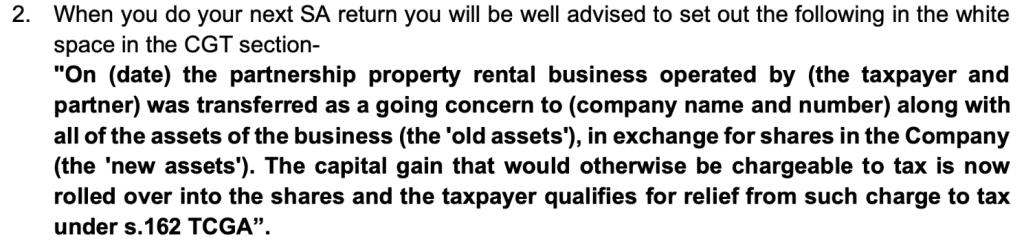
    Because Property118 tell their clients not to mention the bridge loan when they file their self assessment return:

    Actually the business is sold for shares PLUS the assumption of the bridge loan (and other liabilities). Property118 surely know this, because their own documents say it. We expect they also know that the assumption of liabilities is highly relevant to incorporation relief, particularly when tax avoidance is involved. But they provide clients with disclosure that ensures HMRC don’t find out.

    The scheme

    When a company makes a profit, it pays corporation tax. If it then pays the profit to its shareholders as a dividend, they pay tax on that. But if it can use the profit to repay a loan from the shareholders then they don’t pay tax on the loan repayment.

    Standard (and legitimate) tax planning on incorporation takes advantage of that. In the standard approach, the landlord sells property to the newly incorporated company in return for (1) shares, (2) assumption of mortgage debt, and (3) a “loan note” (or similar) issued by the company to the landlord. Future profits can be used to repay the loan note.

    That is uncontroversial, but has the disadvantage that the sale of the property to the company will be subject to capital gains tax.

    Property118 think they’ve found a way to avoid the capital gains tax and extract profits by a tax-free loan repayment.

    An example: let’s take a landlord who owns properties worth £1m, has a mortgage of £500k, and wishes to transfer the properties to a newly incorporated company.

    Step 1 – The loan

    Avocado Properties Limited lends £450k to the landlord. So, on paper, the arrangement looks like this:

    In reality, the money actually goes from Avocado Properties Limited to an HSBC bank account held by Fab Lets (London) LLP, a company owned by Mr Bhattacharya, held on escrow for the landlord. The landlord never gets the £450k.

    Here’s what Property118 tell their clients about Avocado Properties Limited:

    I am pleased to confirm I have now submitted your bridging finance application to our preferred lender and that:

        • Your application matches their lending criteria perfectly
        • Their processes and documentation have been compliance checked by Cotswold Barristers
        • We have a 100% success record with this lender
        • We have completed hundreds of loans with this lender

    And here’s what they say about Fab Lets (London) LLP:

    This is another of Ranjan’s companies and was originally purposed as a property management business, so it has the correct structures to securely create and manage clients’ accounts in a fully compliant, insured and ring-fenced manner.

    The reality:

    • Avocado Properties Limited is not a regulated lender, despite apparently making hundreds of loans to individuals.
    • Fab Lets (London) LLP is not regulated to act as an escrow agent, despite apparently having a significant escrow business.
    • As far as we are aware, Fab Lets (London) LLP has no insurance that would cover this arrangement. There is no evidence of any “ring-fencing”. Why did Property118 claim otherwise?
    • There may also be a breach of HSBC’s account terms.

    There are obvious questions as to the regulatory propriety of these arrangements, but that is not our expertise. We will leave such matters to regulatory lawyers and the FCA. The remainder of this report will focus on tax.

    HSBC has now seen this report. A spokesperson for HSBC UK told us:

    “HSBC has zero tolerance for the facilitation of tax avoidance schemes using HSBC products and services.”

    Our assumption is/was that HSBC had no knowledge or involvement in the scheme.

    Step 2 – Novation 

    Immediately after the bridge loan, the landlord’s new company buys the rental properties. In return, the company issues £50k of shares to the landlord, and agrees to assume responsibility for the £500k mortgage and the £450k bridge loan (under a “novation”).

    In theory, it’s this:

    In practice, nothing happens, and no money moves.

    Step 3 – Director loan

    The landlord now makes a £450k “director loan” to his company, using the £450k advanced under the bridge loan in step 1:
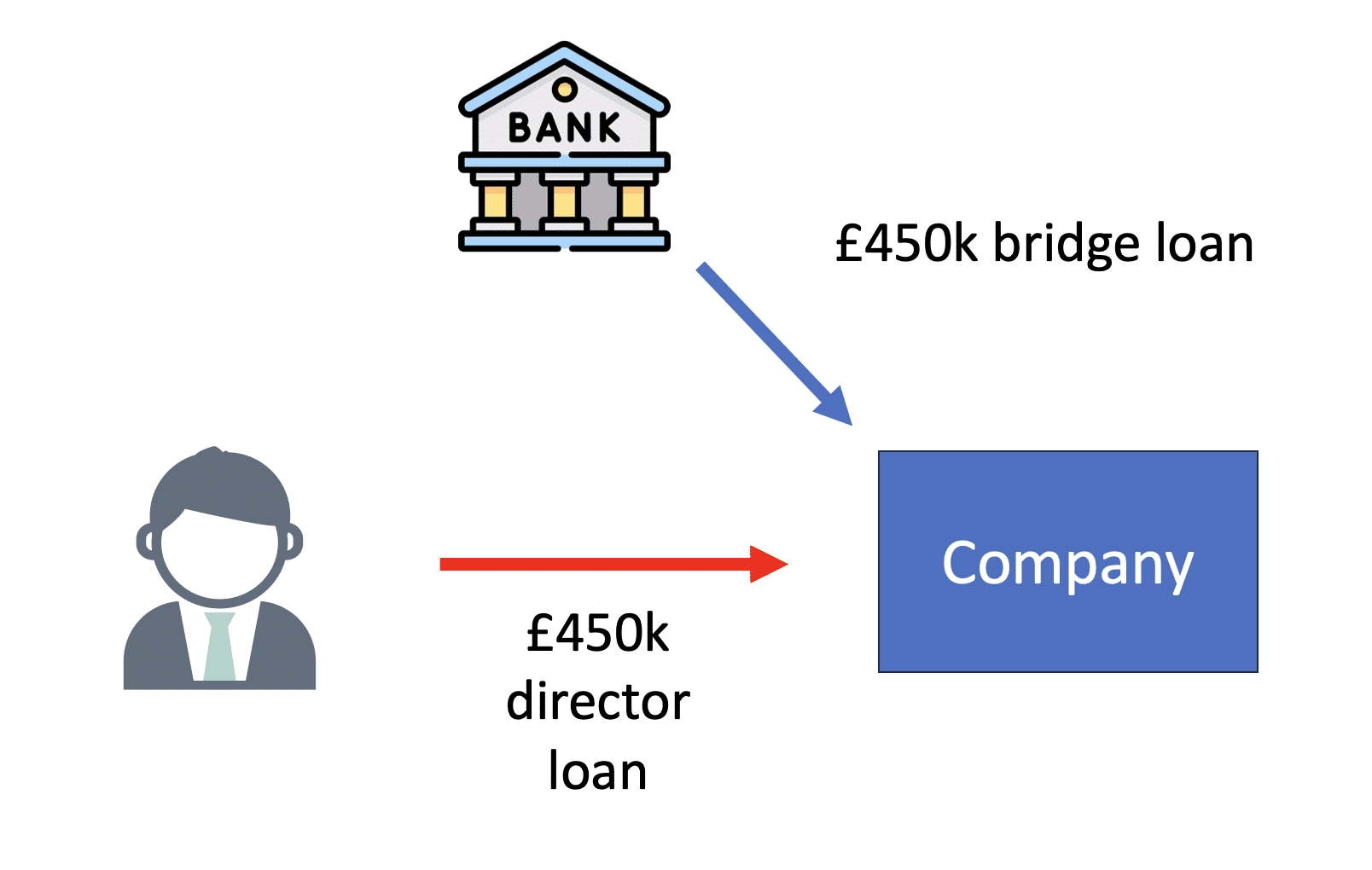
    In practice, Fab Lets (London) LLP transfers the cash from the first HSBC bank account (supposedly held on escrow for the landlord), and moves it into a second HSBC bank account (but now supposedly held on escrow for the company).

    Back in the real world, the landlord isn’t lending £450k, because the landlord never really had £450k.

    Step 4 – Repayment

    Immediately afterwards – this is all happening on the same day – the company uses the £450k to “repay” the bridge loan. In theory:
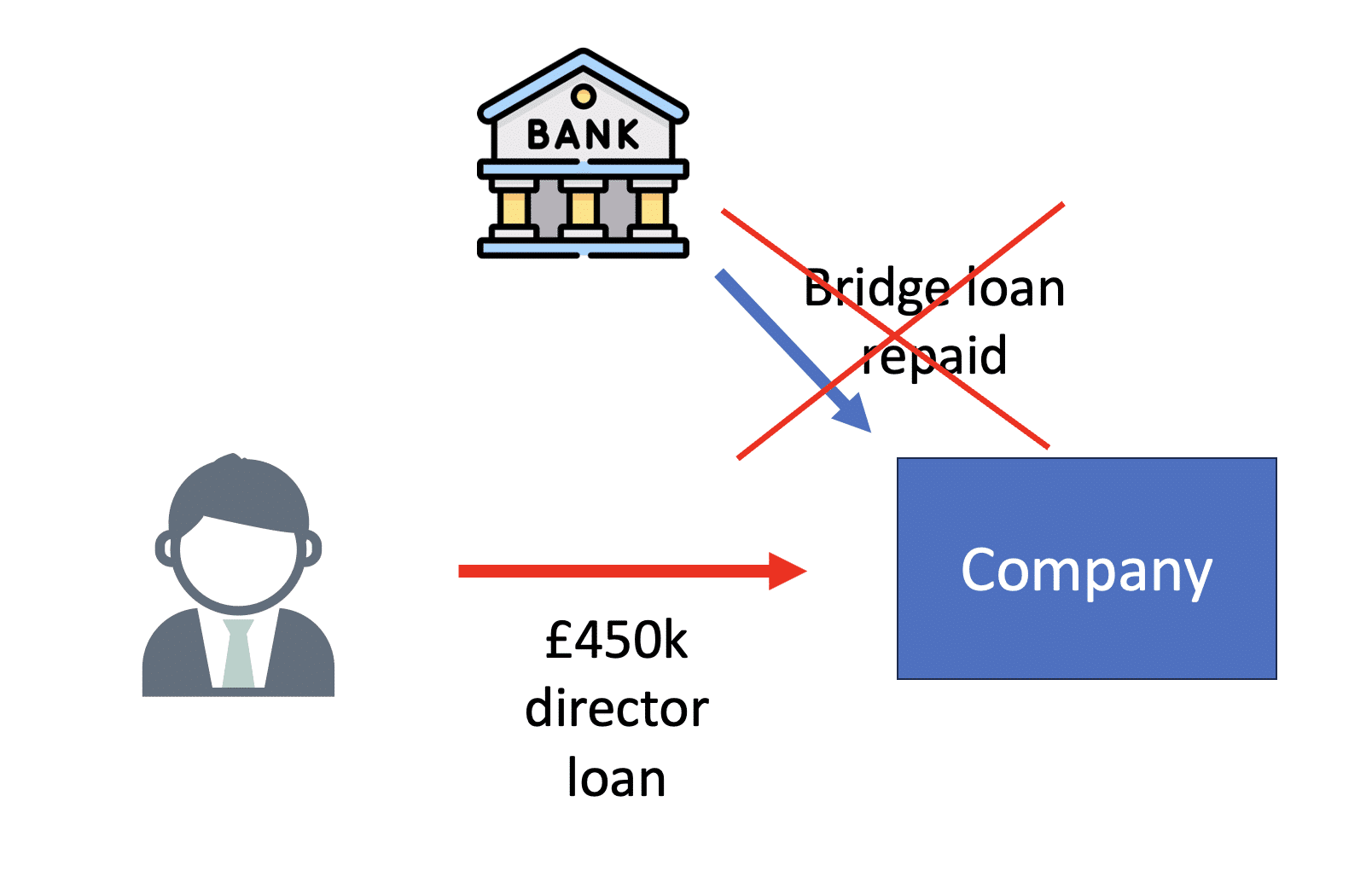
    In practice, Fab Lets (London) LLP returns the £450k to Avocado Properties Ltd. The money never left Mr Bhattacharya’s control.

    The intended consequences

    There are four intended consequences:

    • The company now magically owes £450k to the landlord under the “director loan”, despite the landlord never having £450k and the company never receiving £450k. The next £450k of profit made by the company can be paid to the landlord as a repayment of the “loan” – and the landlord won’t be taxed on it. That’s saved/avoided up to £177k of tax.
    • Incorporation relief applies so there is no capital gains tax, thanks to the HMRC concession that allows a company to assume liabilities of the business.
    • Rajan Bhattacharya has made £5,250 for moving £450k between three bank accounts in the course of one day. If Property118 have really “completed hundreds of loans with this lender” then Mr Bhattacharya has made well over £500k in total.
    • Property118 has made a £4,500 “arrangement fee”.

    The actual consequence – a large CGT hit

    When a landlord incorporates their property rental business, an important and legitimate part of the tax planning is ensuring “incorporation relief” applies to prevent an immediate capital gains tax hit on moving the properties into the company.

    That requires (amongst other conditions) that the property is sold in consideration for shares in the company, and only for shares.

    By concession, HMRC also permit the company to take over business liabilities of the landlord:
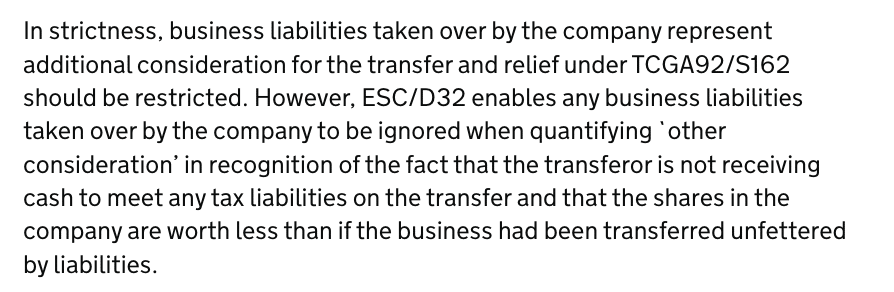
    In the Property118 scheme, the bridge loan is taken over by the company; but the problem is that it’s not a “business liability” of the landlord. It barely exists at all, and certainly isn’t used for the landlord’s business.

    Oh, and HMRC expressly say that this concession can’t be used for tax avoidance:

    So incorporation relief is DOA. Not “it’s doubtful the relief applies” or “some would question whether the relief applies”. We see no reasonable basis for believing incorporation relief applies to the assumption of debt in such circumstances. That means a large up-front capital gains tax hit for the landlord, probably around £130k on the numbers in the example above.

    If the bridge loan had been properly disclosed to HMRC we expect that HMRC would have raised this point. However, Property118 tell their clients not to mention it:
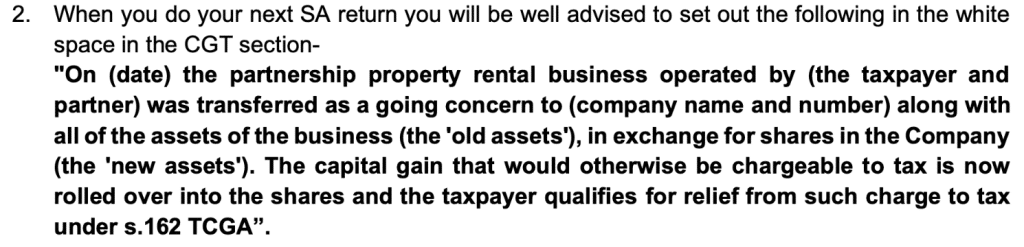
    We asked Property118 why they do this. They didn’t respond, so we have to speculate. Our view is that no reasonable adviser would advise a client to mis-describe a transaction to HMRC. Best case, it’s carelessness, for which penalties apply. Worst case, it’s deliberate and concealed, and we are into serious penalties. We still believe Property118 are incompetent rather than dishonest… but if we are wrong, and this is dishonesty, then we get into criminal tax fraud territory.

    Another consequence – the “director loan” isn’t a loan

    This is an artificial tax avoidance structure. The bridge loan is taken immediately prior to incorporation for no purpose other than tax avoidance. Money is then moved in a predetermined circle for no purpose other than tax avoidance, and achieves no result other than tax avoidance. The bridge loan doesn’t even exist for a whole day. Structures of this kind have been repeatedly struck down by the courts over the last 25 years.

    So the question is: despite that artificiality, can the director loan be used to facilitate tax-free profit-extraction in the same way as the “loan note” in the standard version of the structure?

    There are several ways this could be viewed:

    • Realistically, the bridge loan did nothing and can be disregarded – but the director loan can still be viewed as part of the consideration for the sale of the property. In other words, if we step back and ignore the silly intermediate steps, the landlord sold the property to the company for consideration comprising: shares, the assumption of the mortgage debt, and another £450k which remains outstanding as a director loan. In this scenario it’s clear CGT incorporation relief fails. But future profits can be paid out on the director loan without suffering income tax. The structure failed to achieve its CGT aim, but did achieve the basic planning aim of the standard structure… in a much more complicated way and at much greater expense for the landlord.
    • The bridge loan didn’t exist and neither did the director loan. So future profits can’t be paid out on it, and the structure fails completely. This seems a harsh result. Can HMRC really say the director loan exists enough to kill CGT incorporation relief, but not enough to shield future profits from income tax on dividends? HMRC has a history of running such harsh “double tax” arguments when attacking tax avoidance schemes, but not always successfully.

    The consequence of failing to disclose to HMRC

    Most tax avoidance schemes are required to be disclosed to HMRC under the “DOTAS” rules. The idea is that a promoter who comes up with a scheme has to disclose it to HMRC. HMRC will then give them a “scheme reference number”, which they have to give to clients, and those clients have to put on their tax return. The expected HMRC response is to challenge the scheme and pursue the taxpayers for the tax.

    For this reason, promoters of tax avoidance schemes typically don’t disclose, even though they should. This is often on the basis of tenuous legal and factual arguments, to which the courts have given short shrift. One recent example was Less Tax for Landlords, who were adamant their structure was “not a scheme” and so not disclosable. HMRC disagreed.

    It is, therefore, unsurprising that the Property118 structure has not been disclosed under DOTAS. In our view, it clearly should have been. The structure has the main purpose of avoiding tax – indeed that’s its sole purpose. The high fees charged by Property118 and Mr Bhattacharya are the kind of “premium fee” that triggers disclosure

    The failure to disclose means Property118 may be liable for penalties of up to £1m. It also means that HMRC could have up to 20 years to challenge the landlord’s tax position.

    Mr Bhattacharya’s companies may also be liable as “promoters”, as their role administering the transaction may make them a “relevant business”. HMRC say:

    How do Property118 defend the structure?

    We asked Mr Bhattacharya and Property118 for comment; neither responded.

    In the advice note Property118 sends to clients, they refer to HMRC guidance in the “Business Income Manual”. Advisers questioning the structure have received the same explanation. But that guidance is irrelevant – it relates to when a company can claim an interest deduction for a loan taken by the company to fund a withdrawal of capital by its shareholders. It has nothing to do with creating a “director loan” out of nothing, and nothing to do with circular tax avoidance transactions.

    Property118 have also assured advisers that HMRC have accepted the structure in numerous cases. We are highly doubtful that the true nature of the structure was ever explained to HMRC (and, as noted above, Property118 appear to advise against providing an explanation). Any clearance, or enquiry closure, obtained on the basis of incomplete disclosure is worthless.

    These two responses are typical of Property118 and other avoidance scheme promoters. Little or no reference is ever made to the law, and certainly never to tax avoidance caselaw. Instead, HMRC guidance is quoted out of context, and clients are assured that nothing has ever gone wrong in the past, whilst success is (apparently) assured by never revealing the full details to HMRC.

    When and if Property118 and Mr Bhattacharya do respond, we will gladly correct any factual or legal errors they identify.

    What if you’ve implemented this structure?

    We would strongly suggest you seek advice from an independent tax professional, in particular a tax lawyer or an accountant who is a member of a regulated tax body (e.g. ACCA, ATT, CIOT, ICAEW, ICAS or STEP).

    If it appears you will suffer a financial loss from the scheme, you may wish to also approach a lawyer with a record of bringing claims against tax avoidance scheme promoters.

    We would advise against approaching Property118 given the obvious conflict of interest.


    Thanks to accountants and tax advisers across the country for telling us about their experiences with Property118, as well as the clients who contacted us directly. Thanks again to all the many advisers who’ve worked with us on these issues.

    Landlord image by rawpixel.com on Freepik. Bank image by Freepik – Flaticon

    Video © Ranjan Bhattacharya and Property118 Limited, and reproduced here in the public interest and for purposes of criticism and review.

    Footnotes

    1. The original video is now taken down; this is a copy we downloaded. ↩︎

    2. We have seen the exact same wording for multiple clients. The fact they don’t even complete the company name illustrates quite how standardised Property118’s advice is. ↩︎

    3. That wording also means HMRC doesn’t find out about the trust, or the assumption of the mortgage liabilities. ↩︎

    4. Why a loan note and not a loan? Because, conceptually, the company is then giving something (the loan note) as part of the purchase price for the properties. In part because the tax treatment for the company is more certain, as a loan note is clearly a “loan relationship” for tax purposes, and simply leaving money on account may not be ↩︎

    5. This is an update of our earlier piece here – we have since learned more about the scheme mechanics, thanks to a detailed review of the scheme documentation and bank account statements. We have also been able to confirm the identity of the parties. ↩︎

    6. The actual figures we’ve seen are typically twice as large as this, but we’ll use the same figures as in our original explanation, in the interests of clarity. ↩︎

    7. It can be a criminal offence for an unregulated company to carry out “unauthorised business” such as making a loan to an individual. Not all lending is required to be regulated; however in this case, the exemption for loans made “wholly or predominantly for the purposes of a business” may not apply, because the loan is not for the business, it’s for the personal tax benefit of the landlord. The exemption for loans to high net worth individuals might have applied if the loan included an appropriate declaration, but it does not. The absence of a declaration suggests that Property118 may not have taken appropriate legal advice. However, we take no position on the substantive question of whether the lending was unlawful . ↩︎

    8. Escrow agents are generally required to be regulated under the Payment Services Regulation 2017, breach of which may be a criminal offence. We take no position on whether Fab Lets (London) LLP is in breach. ↩︎

    9. Fab Lets is a member of the Property Ombudsman. That doesn’t make it insured to operate escrow accounts. ↩︎

    10. There are additional VAT questions for Mr Bhattacharya’s companies: does the exempt lending activity impact VAT recovery by Avocado? Should VAT be charged on the escrow services? We have insufficient facts to comment. ↩︎

    11. The highest marginal rate of tax on dividends is 39.35% ↩︎

    12. A 1% fee plus £750 “contribution towards administrative costs” ↩︎

    13. That seems a very conservative estimate. The loan in this example is small by Property118’s standards. “Hundreds” would usually mean at least 200. So we could easily be talking over £1m ↩︎

    14. 95% (the proportion of non-share consideration) x 28% (the CGT rate) x £500k (assuming the property has doubled in value). The landlord could argue that incorporation relief should still apply for the assumed mortgage, but not for the bridge loan, roughly halving the CGT cost – however HMRC are entitled to disapply all of ESC D32. ↩︎

    15. We are only aware of one such scheme that wasn’t defeated – SHIPS 2, essentially because the legislation in question was such a mess that the Court of Appeal didn’t feel able to apply a purposive construction. The consequence of that decision was the creation of the GAAR, which doubtless would have kiboshed SHIPS 2 had it existed at the time ↩︎

    16. Our original draft suggested the second scenario was more likely; on reflection we think that would be a harsh result. The CGT element of the structure still fails, but the taxpayer may avoid a double tax disaster ↩︎

    17. See e.g. the Hyrax case, where the tribunal described as “incredible” the evidence of one witness that she wasn’t aware the transaction was involved tax avoidance ↩︎

    18. The terminology is that the premium fee is a “hallmark”. Other plausible hallmarks are the “standardised tax product” hallmark (given how standardised the documents and advice appear to be), the “financial products” hallmark (given the off-market nature of the arrangements), and the “confidentiality hallmark” (given the fact the arrangement appears to be hidden from HMRC). ↩︎

    19. It feels inappropriate for us to recommend anybody, but a simple Google search will find examples fairly quickly ↩︎

  • How much does the UK tax the average worker, compared to the rest of the world?

    How much does the UK tax the average worker, compared to the rest of the world?

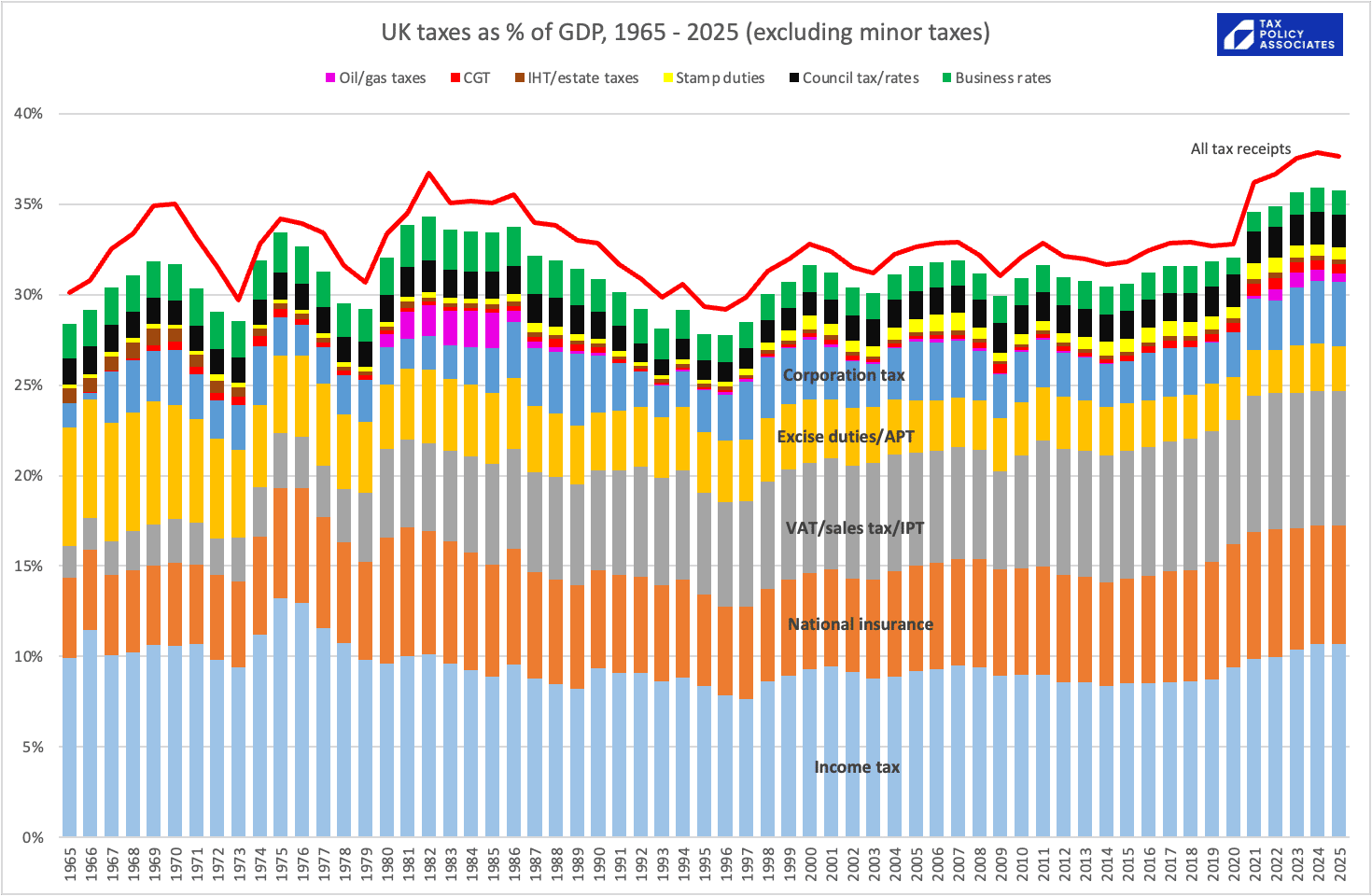
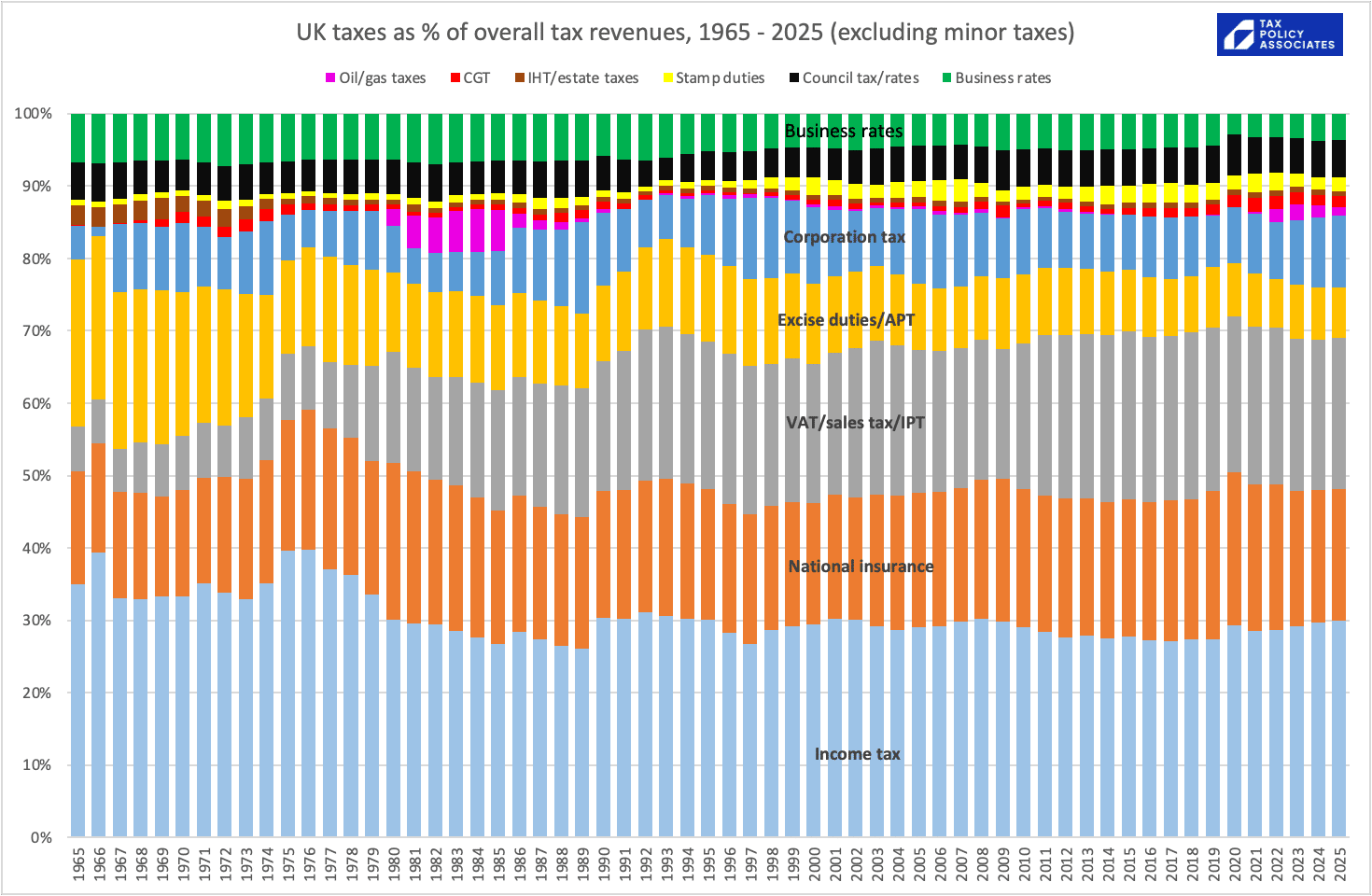
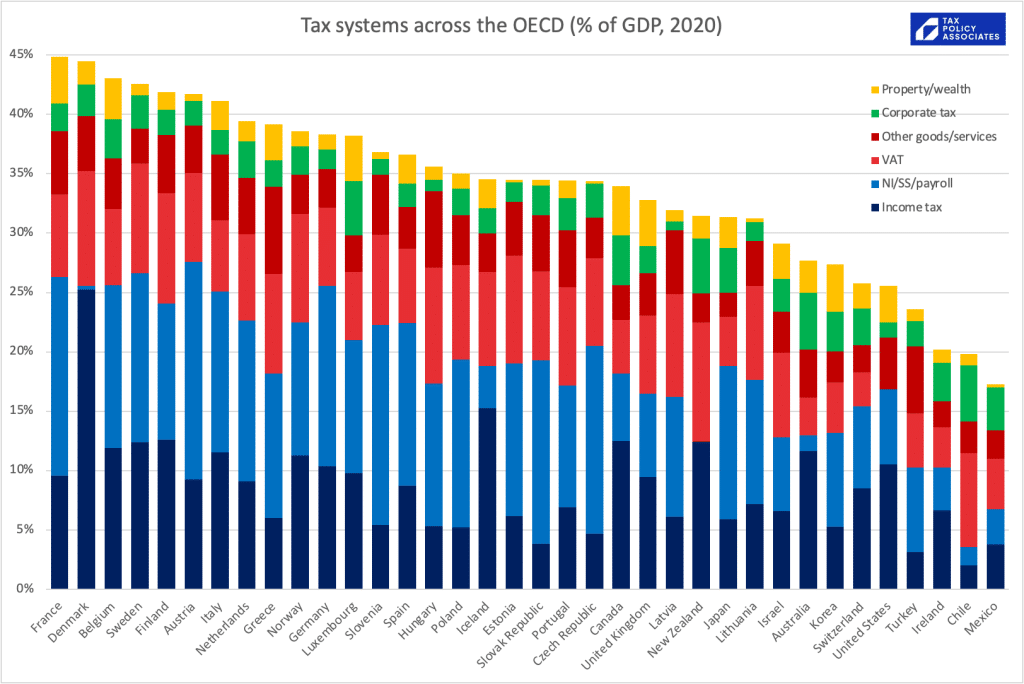
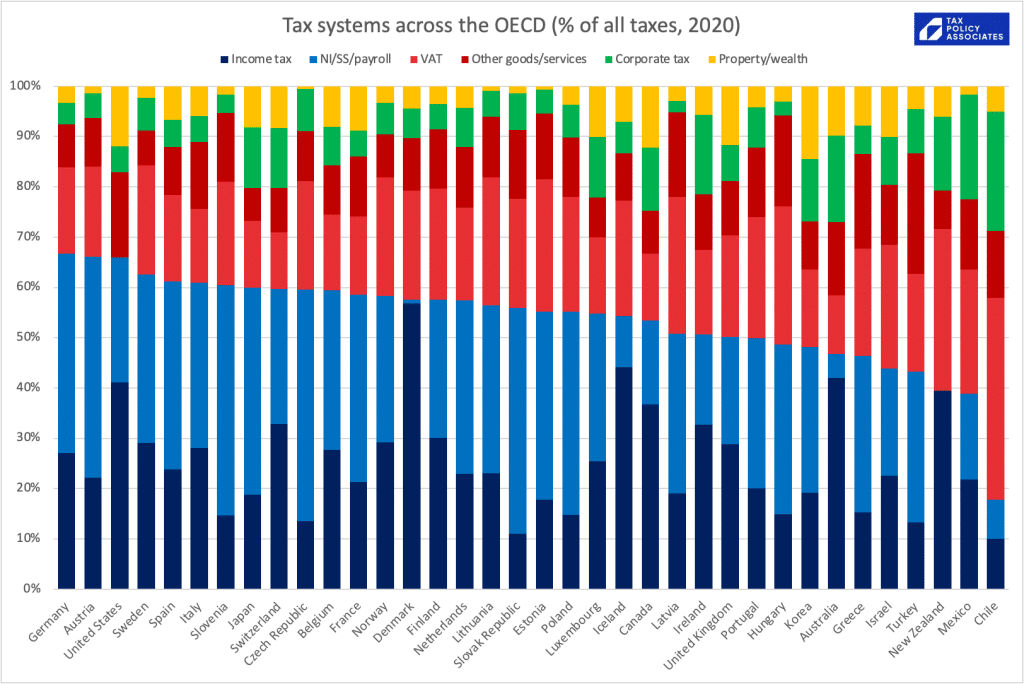
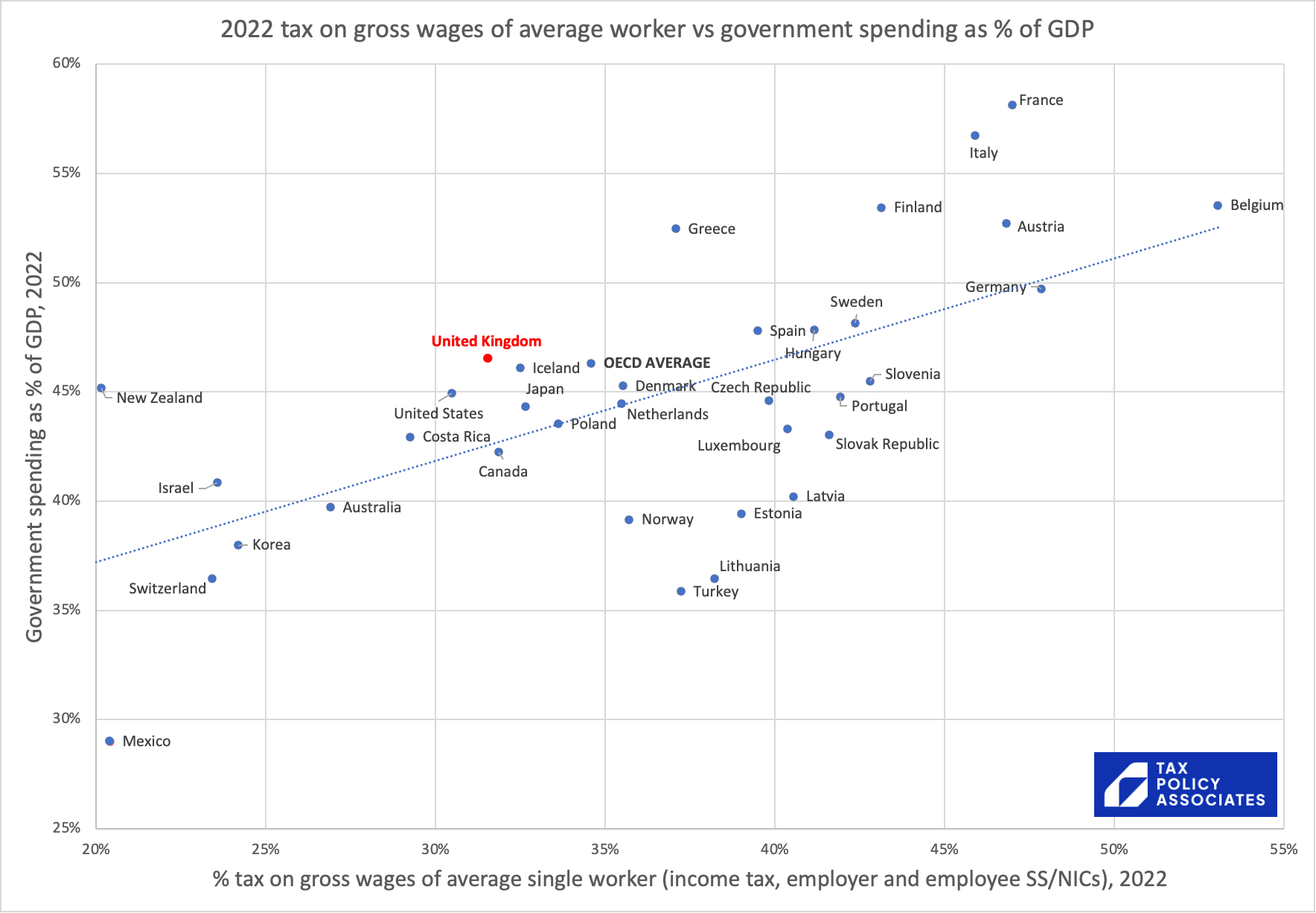
    I posted some charts yesterday on how the UK tax system compares to other countries when we look at tax as a % of GDP. One response was to say: “well, I don’t care about tax as a % of GDP… I care about the tax I pay”. Which is fair enough.

    How can we fairly compare the tax actual people pay?

    Tax wedge

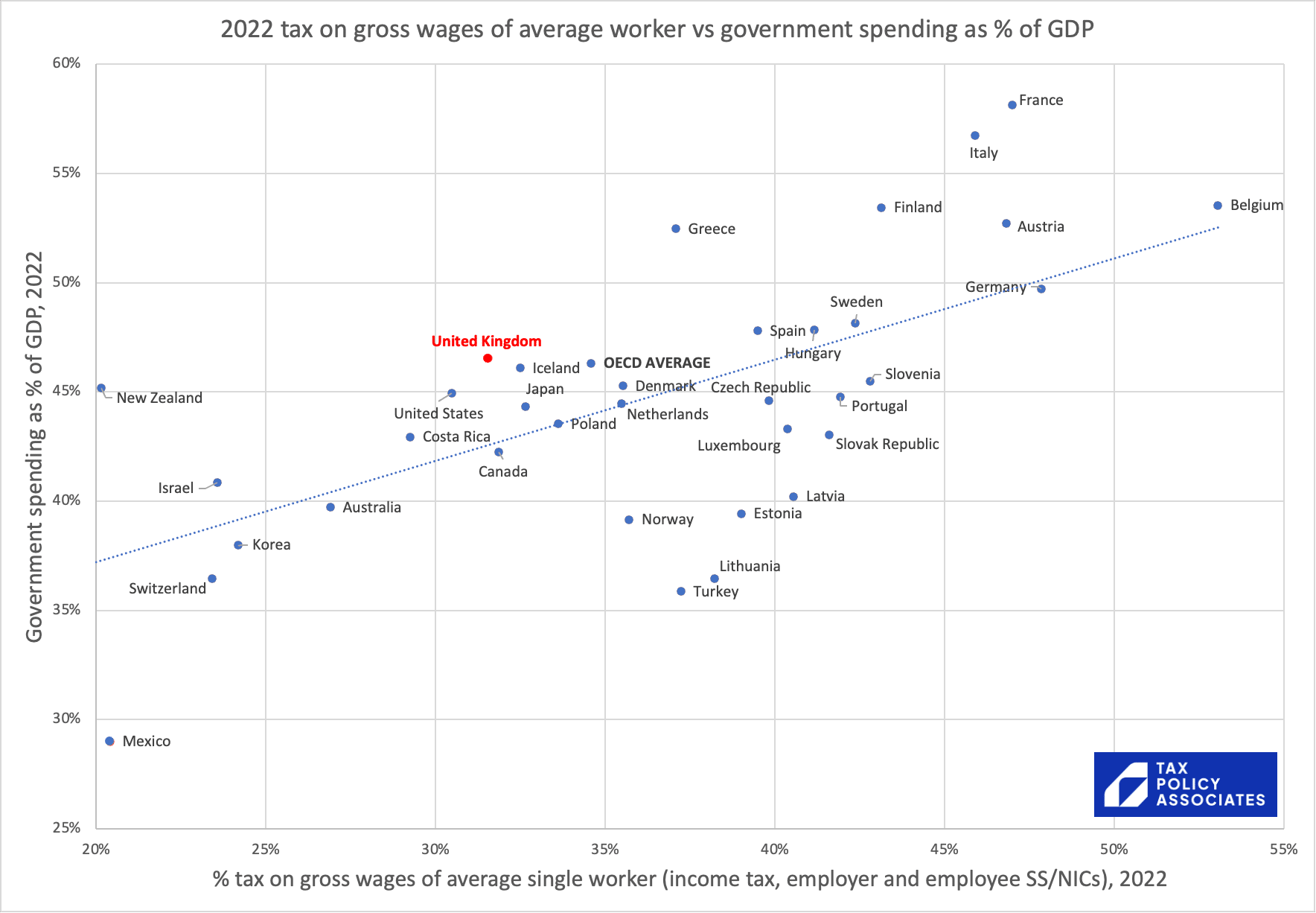
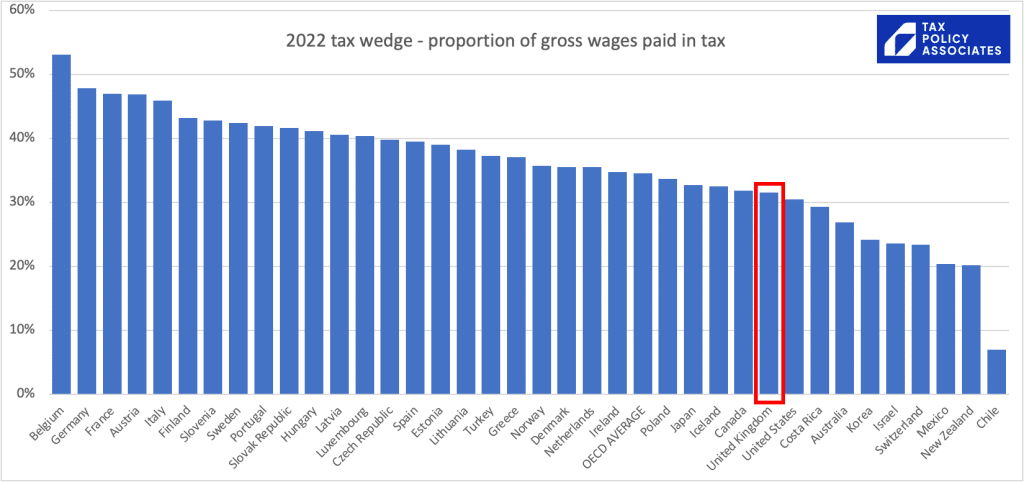
    The “tax wedge” is the tax paid by the average single worker divided by the gross wages. It’s the best way I know to make a fair (or somewhat fair) comparison of the burden on tax on wages across the world.

    Looking at the OECD tax wedge data, we see this:

    I think many people will be surprised, even disbelieving, at where the UK places here.

    Clearly there are some very different social models, with Belgium (for example) having a much more expansive welfare state than Chile. So it’s useful to add in that wider context (again from OECD data):

    So in general terms, if you’re an average worker, you get what you pay for.

    Or, if we want to annoy lots of people, we can point out that there’s no country where the average worker pays less tax than the UK on their wages, but which has higher government spending.

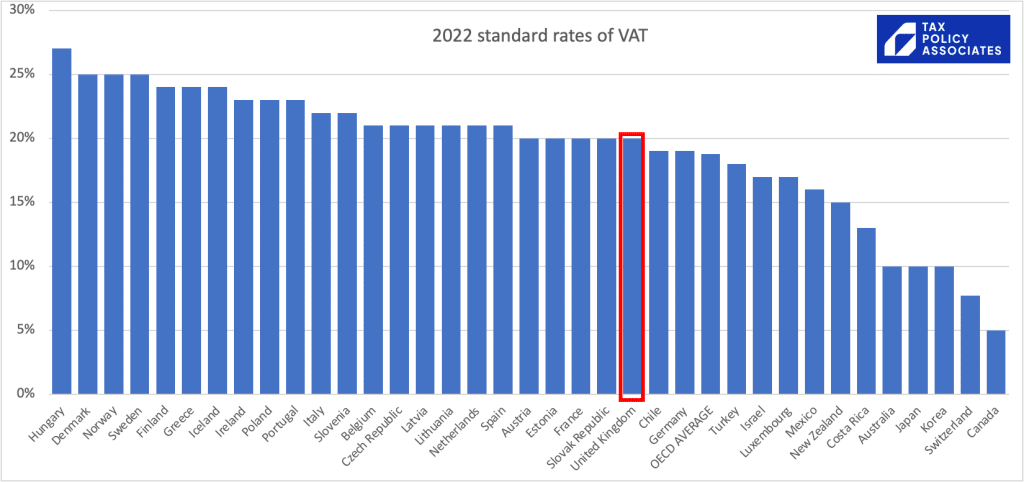
    What about VAT?

    If we just look at the standard rate of VAT in each country:

    On the face of it the UK again looks very average.

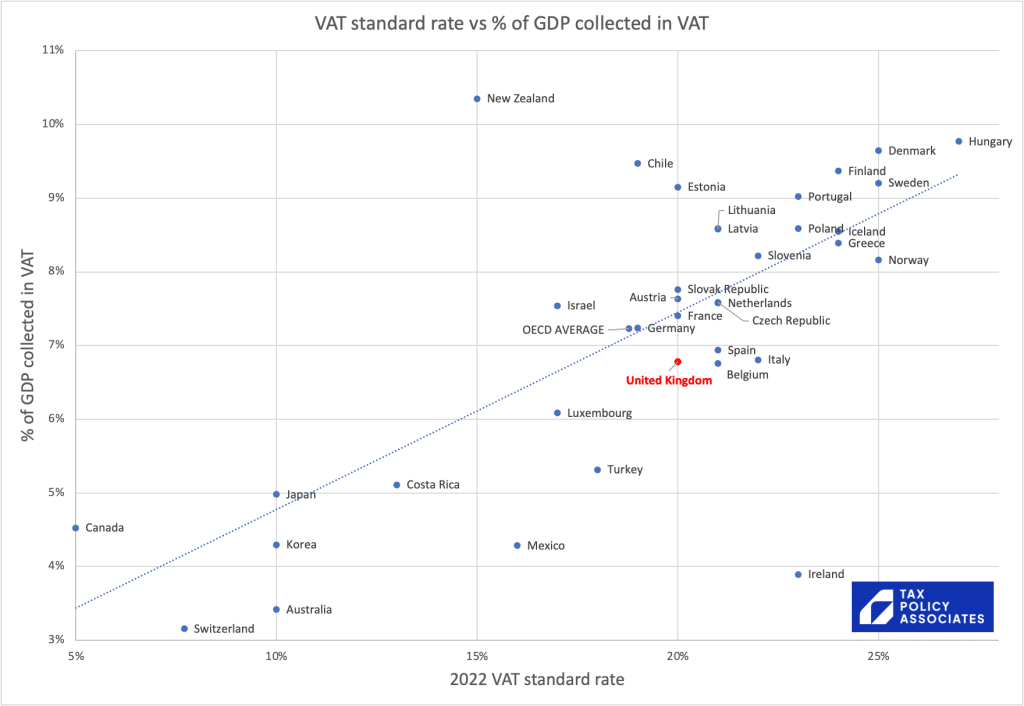
    But we can’t just compare the standard rate. Some countries apply the standard rate to almost everything; others have widespread exemptions and special rates.

    We can get a sense of this if we plot the rate of VAT against the amount of tax VAT collects, as a % of GDP:

    The chart suggests the UK collects a bit less VAT (as a % of GDP) than you might expect from its rate.

    The bottom line is that there is no evidence that the average Brit is over-taxed by international standards.

    The spreadsheets with the data and charts are available here.


    Footnotes

    1. In other words, this takes into account the income tax and national insurance/social security paid by the worker him or herself, and also the national insurance/social security paid by the employer (because there is good evidence that in the long run this is economically paid by the employee in the form of reduced wages). ↩︎

    2. There’s no USA on the chart, because the US has no VAT. Many states have sales taxes, but they’re nothing like VAT – the rate is much less (averaging around 5%) and the goods/services covered are much more limited. ↩︎

    3. Bear in mind the usual caveats about comparing different systems in different countries, and (as usual) ignore Ireland, because its reported GDP is distorted by multinational [HQ locations]/[tax avoidance] (delete per your preference). ↩︎

    4. Actually it’s worse than that, because VAT compliance in the UK is pretty good, and so masks what is a very limited VAT base (i.e. wide exemptions/lower rates) by international standards. Rita de la Feria, perhaps the world’s leading VAT academic, has written convincingly on this. ↩︎

  • What can landlords do about section 24?

    What can landlords do about section 24?

    Following our report on Property118, landlords have been getting in contact and asking what they should be doing. Tax Policy Associates doesn’t, and can’t, provide tax advice – but it’s a fair question. Here’s a quick summary of how we see things:

    Section 24 of the Finance (No. 2) Act 2015 amended the UK tax code to restrict landlords’ ability to deduct their mortgage interest costs from their taxable rental income.

    A landlord whose business looked like this in 2015:

    Now looks like rather different – after tax, he’s making a loss:

    That’s a huge deal for buy-to-let landlords, and it’s understandable that many are desperate for a structure that fixes the problem. There is no such structure.

    There are three choices, and only three choices.

    Choice 1: incorporate

    Instruct a proper tax adviser, incorporate a company, and move the business to that company. The mortgage interest will then be fully deductible against the company’s corporation tax.

    There, however, are several important complications:

    • Your current mortgage lender is very unlikely to agree to carry your existing mortgage over to the new company. You’ll need a new mortgage, and it will almost certainly be more expensive (higher interest and higher fees). This may add up to more than the tax benefit of interest deductibility. Do the math very carefully.
    • There will almost certainly be stamp duty/SDLT at up to 15% on the transfer to the company (and another 2% if you’re a non-resident).
    • Some people claim that married couples can retrospectively claim to be a partnership, and escape SDLT on incorporation using the partnership rules. The recent SC Properties case makes clear this has very little likelihood of working, because of the complete lack of evidence of the married couple in question acting like partners in a business partnership :

    “For these reasons we have concluded that the Partnership has no legal reality. It existed as a planning idea in the minds of the Appellants’ advisers and Mr Cooke, but had no substance beyond the forms which were completed in order for it to obtain the tax result suggested by the Appellant’s advisers.”

    • There may be capital gains tax when you transfer the properties to the company. CGT incorporation relief is potentially available, but you have to demonstrate you have a “business”, something that HMRC do not always accept. Be aware that “clever” structures (such as declaring trusts, creating loans, using LLPs etc) risk blowing up incorporation relief, and costing you much more tax than they save.
    • The company is taxed on its profit, with a deduction for its interest costs. You then have a second level of tax when the company returns that profit to you, as dividends, wages or (in some limited circumstances) as a capital gain. Again, you need to do the math carefully to make sure you fully take this into account.

    Choice 2: don’t incorporate

    Continue as you are, bearing the cost of the section 24 non-deductible interest.

    Your could reduce your leverage, so you don’t make an after-tax loss (but of course you’ll then need to deploy more capital).

    Choice 3: sell-up

    It may be that neither of the first two options work – section 24 simply makes your rental business uneconomic. That seems to have been Osborne’s intention.

    In which case, you may need to sell-up. It’s not an admission of failure – it’s an admission that investors have to adapt when circumstances change.

    What is the fourth choice?

    There isn’t one.

    Trusts, LLPs, offshore arrangements… not only are they very likely to fail when challenged, but the consequence could be much much worse than if you’d done nothing at all. SDLT plus CGT could easily be a six figure sum. And complex structures can easily have complex, and expensive, additional tax consequences.

    Whether you’re a multinational executing a £10bn M&A transaction, or a landlord considering incorporating a one-property business, the key tax question is always the same: “how much do I benefit if this goes right, and how much do I lose if this goes wrong?”.

    Even if the Property118 structure probably worked (which it doesn’t!) the downside risk of it going wrong is much, much larger than the benefit.

    How do I spot the cowboys?

    Here are some warning signs:

    Unqualified people giving tax advice

    Any tax advice should come from someone at a regulated firm (accounting firm or law firm), and/or with a tax qualification such as STEP, or a Chartered Institute of Taxation or Association of Tax Technicians qualification.

    I don’t want to deal with some salesman who then hires the tax adviser. I want to be speaking to the actual tax adviser.

    The safest approach is to only instruct an ICAEW-regulated accounting firm or an SRA-regulated law firm. Avoid unregulated “boutiques”

    “HMRC approved”

    HMRC don’t approve any tax planning

    “HMRC has never challenged any of our structures”

    Unsurprising, if HMRC have never been properly told what precisely the scheme is. Typically promoters are careful to only discuss limited aspects of their schemes with HMRC. Rarely, if ever, is the whole structure explained.

    Responds to all technical queries with confident assertions that HMRC has accepted the structure.

    Again, it’s doubtful full details were given to HMRC. But, if the scheme doesn’t work technically, then any HMRC clearance is worthless, and the fact they may have sneaked it past one sleepy inspector doesn’t stop HMRC re-investigating it at any time in the next 20 years.

    “Our unique system”, “our proprietary strategy”, “our IP”, etc.

    I used to advise the largest businesses in the world, doing deals of many £bn. If I’d told them I planned to use anything “unique” or “proprietary”, I’d have been out the door in seconds.

    When it comes to tax, sensible people do what everyone else is doing. Be boring.

    Any adviser proudly touting their “unique IP” is accidentally revealing a “hallmark” that means the structure may well be disclosable to HMRC as a tax avoidance scheme.

    “We have a KC opinion”

    Normal people shouldn’t be doing anything so complicated and uncertain that it requires a KC opinion (I’d certainly never put myself in that position).

    The fact a KC opinion was obtained is an alarm bell that something high risk is going on. That’s particularly the case if the KC opinion was obtained by the adviser for the adviser. Then you can’t rely on the KC opinion – if everything goes wrong you can’t sue the KC. Worse still, the fact the adviser obtained the KC opinion may make it harder for you to sue the adviser (as they’ll blame the KC). So a KC opinion can actually make your position worse.

    “We’ve glowing testimonials from dozens of clients”

    This is how a salesman talks.

    No discussion of risks and downsides

    Any client – whether an individual or the largest corporation – should ask two important questions of a tax adviser. What’s the result if this goes according to plan? What’s the risk if it doesn’t? And how much will it cost me if it doesn’t?

    Many of these structures have a relatively small benefit (tax relief on interest) but risk a massive up-front SDLT and CGT cost. Not worth the gamble even if the odds were 70% in your favour (which they won’t be).

    Pressure to go ahead/sign a contract

    That’s how a (bad) double glazing salesman behaves.

    “We’re fully insured”

    That’s great – for them.

    Professional indemnity insurance protects an adviser against being successfully sued. It’s useful to a client because it gives you assurance that you will still have someone to sue if the adviser disappears/goes bust. But it doesn’t make it easier to sue them, and it certainly isn’t your insurance..

    “Your normal advisers won’t be familiar with these obscure rules”

    A common tactic to pull clients away from trusted existing advisers, and often said by people who don’t in fact have any tax qualifications.

  • Property118: a tax avoidance scheme for buy-to-let landlords that defaults their mortgage and increases their tax bill

    Property118: a tax avoidance scheme for buy-to-let landlords that defaults their mortgage and increases their tax bill

    Property118 is an unregulated adviser which works in a “joint venture” with a barristers chambers called Cotswold Barristers. They promote a tax avoidance scheme aimed at buy-to-let landlords. But nobody involved appears to have any tax qualifications and in our view the scheme fails spectacularly.

    This report explains the scheme, and explains why in our view, and that of the mortgage lenders’ industry body, it is likely to default the landlord’s mortgage. We also set out a detailed analysis of the serious tax problems with the structure. We are going into more technical detail than usual given the widespread promotion of this scheme in the market. Anyone who has entered into these arrangements should seek independent advice.

    UPDATE: 16 September. Property118 have responded to this report. Despite having two months’ notice of our findings, their response contains no response to any of the points we’ve made, just assertions that their structure is fully compliant, and that HMRC and lenders have never challenged it. As we note below, we doubt the structure has ever been properly disclosed to HMRC or lenders. Now HMRC and lenders is aware of the structure we expect challenges over the coming months and years.

    UPDATE: 22 September. We’ve a further report on another aspect of Property118’s planning.

    UPDATE: 5 October. See also our report on Less Tax for Landlords. A different scheme, but with some commonalities; in many senses an even worse scheme than Property118’s.

    UPDATE: 24 October. Mark Smith of Cotswold Barristers published a response on the s162 point, but one which does not address the key problem with the structure. We’ve updated the text below.

    UPDATE: 9 November. The analysis below is of the structure Property118 intended to implement. Our review of their actual documentation reveals several critical implementation failings which means the actual position of their clients is likely significantly different, and significantly worse. We analyse this here. This means that much of what follows below is likely academic.

    UPDATE: July 2024: HMRC have issued a “stop notice” making it a criminal offence for Property118 to continue to promote the structure.

    The sales pitch

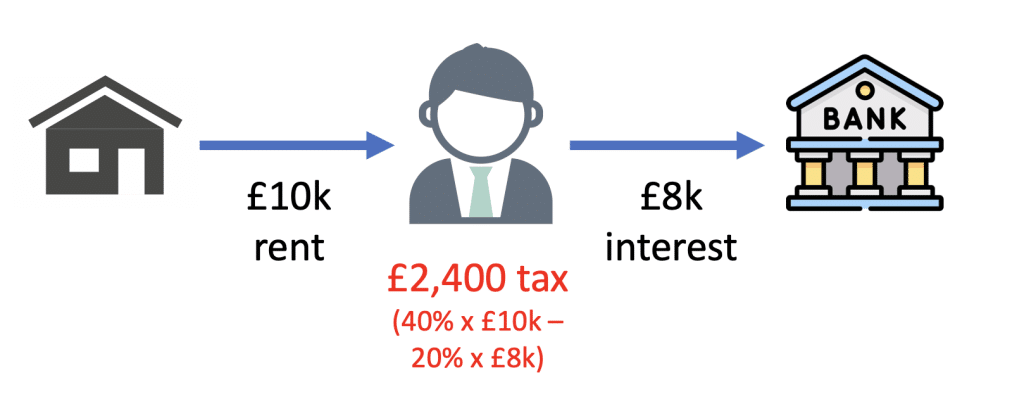
    Most buy-to-let landlords hold their properties personally. So they pay income tax at 40% or 45% on the rental income. Until 2017, their mortgage interest was deductible, meaning a result something like this:

    George Osborne changed that, replacing interest relief with a 20% credit. That makes a big difference:

    Many landlords view this as unfair, because the £2,400 tax is more than their £2,000 net income (although the purpose of the rules was expressly to discourage buy-to-let mortgages, so this rather punitive outcome is actually the point).

    The obvious move is to hold the properties in a company. Corporation tax is less – below 25%, for a small company and companies get full tax relief for mortgage interest.

    But it’s not easy for a buy-to-let landlord to move their properties into a company. There can be capital gains tax and stamp duty land tax (SDLT) on the way in. And – most seriously – the mortgage lender won’t allow the existing individual mortgage to move to a company. You could get a new mortgage, but mortgages for companies are significantly more expensive than buy-to-let mortgages.

    Advisers therefore frequently caution clients that the increased interest cost of moving properties to a company can easily exceed the tax saving. It’s often a mistake to be over-focused on tax savings.

    The Property118 solution

    Wouldn’t it be wonderful if you had all the tax benefits of moving to a company, but could keep your existing bargain-price mortgage?

    Property118 say you can, with what they call the Substantial Incorporation Structure:

    • The landlord – let’s call him X – sets up a new company (which I’ll call the Company), and sells the properties to it, getting shares in return
    • But “completion” of the sale is deferred – X remains the registered owner of the properties. A trust is created, with the landlord as trustee, and the company as beneficiary.
    • This is invisible to the world – and to the mortgage lender. So X doesn’t ask the mortgage lender for consent, or even tell the mortgage lender about it.
    • Property118 claim that, because the transaction creates a trust, it’s not a breach of X’s mortgage.
    • They claim that “incorporation relief” applies so there’s no capital gains tax.
    • Often they say that X and their spouse were in a partnership, so SDLT partnership rules apply and there’s no SDLT to pay either.
    • X continues to make mortgage payments to the lender but, behind the scenes, the Company agrees to reimburse/indemnify X. The Company claims tax relief for those payments. So – claim Property118 – it’s just as good as if the Company had borrowed itself.
    • But it’s better – because they say this isn’t just a company – it’s a “Smart Company“. The idea is that the Company issues shares to X’s children which supposedly have no initial value, but will grow in value over time. So future increase in the value of the property portfolio will fall outside X’s inheritance tax estate.

    The end result is that, by signing a piece of paper, X gets a dramatically better tax result with no downside:

    What actually happens – the short version

    The structure doesn’t work.

    The sale likely puts the mortgage into default. The mortgage terms usually require consent for the sale to the Company, and that wasn’t obtained.

    We asked UK Finance, the trade association for mortgage lenders, and they said:

    “Transferring ownership of a property into a trust without informing your lender and seeking their consent would most likely be a breach of a mortgage’s terms and conditions.”

    The tax will also go badly wrong.

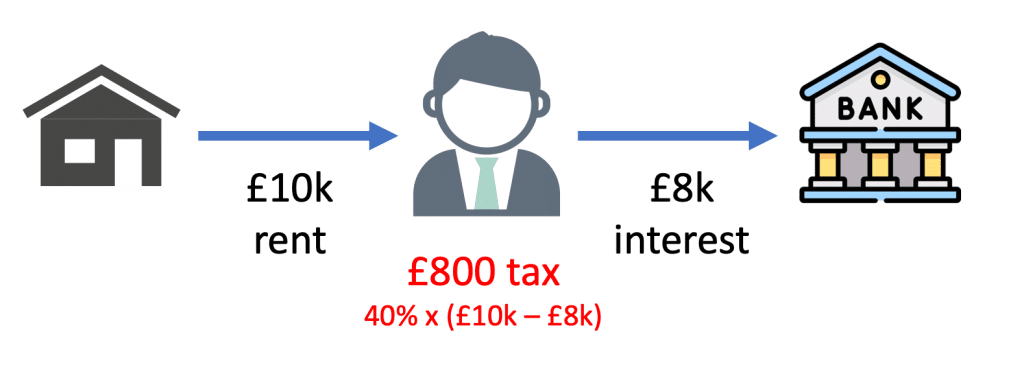
    Property118 have forgotten that X is still there, still paying £8k to the bank, but now receiving £8k of new income in the form of the indemnity payments. Those indemnity payments are fully taxable, but the bank interest isn’t deductible for him (because X no longer has a property business; he has no basis to claim any tax relief).

    So the structure increases the overall tax bill by 50%.

    It gets worse. There is potentially also a large up-front tax hit of a large amount of CGT and SDLT when the structure is established. That could amount to hundreds of thousands of pounds.

    And then an ongoing requirement to file an annual tax on enveloped dwellings (ATED) return, which is easily missed – failure to file creates late-filing penalties of £1,600 per year.

    In our opinion this structure is a disaster.

    We’ve set out the legal analysis of these issues in detail below.

    Is this tax avoidance?

    Yes.

    The “Substantial Incorporation Structure” has no benefit to the landlord other than (supposedly) saving tax. It will therefore be regarded as tax avoidance by a number of statutory anti-avoidance rules, which will potentially negate the tax benefits (if there are any, which there probably aren’t).

    This is by contrast with a normal incorporation, which absolutely does have other benefits for the landlord. In particular, it segregates legal liability: if the landlord is sued by the lender or by a tenant, then if the properties are held in a company, that liability will normally not attach to the landlord personally. A normal incorporation is not usually tax avoidance, even if it has tax benefits.

    However, the substantial incorporation structure does not achieve legal segregation. As far as the lender, the tenants, and the world are concerned, the landlord remains personally the owner of the properties and therefore as a legal matter remains personally liable.

    Property118 and Cotswold Barristers

    Property118 and Cotswold Barristers often charge fees of over £40,000 to relatively small landlords earning less than £100k/year. They’re set up to get referrals from other websites, paying £2,000 for a click that results in new business – meaning that they’re widely promoted by other firms (for example here).

    For £40,000 you could expect to instruct a well-known accounting or law firm, staffed by qualified tax lawyers/accountants.

    But neither Property118 nor Cotswold Barristers appear to have any members or employees with tax qualifications or experience. Property118 is entirely unregulated. I had a very confusing exchange of emails with Mark Alexander, head of Property118, in which he didn’t appear to have even heard of the two main tax qualifications: ATT and CTA.

    The head of Cotswold Barristers, Mark Smith, is a generalist whose practice ranges from business law, to tax, to criminal defence work, to private prosecutions (including one where he was suspended by a month by the Bar Standards Board for acting negligently and “failing to act with reasonable competence“). His profiles in 2017 and 2020 don’t include tax in his areas of practice.

    Barristers chambers usually list their members – the members being the whole point of the chambers. Cotswold Barristers is unusual in not doing this. It did at one point – and included as part of its team a fake barrister with a dubious past who was jailed for conning a dying woman out of her life savings. There is no suggestion that Cotswold Barristers was aware of his actions, but Cotswold Barristers does appear to have been responsible for listing him as part of its team.

    Property118 and professional standards

    Property118 say this to clients:

    Property118 in association with Cotswold Barristers
© August 2022 - Property118 Limited in association with Cotswold Barristers - Page 14
Due diligence and risk mitigation to keep you safe
As discussed during your video conference, Property118 and Cotswold Barristers are a Joint Venture
in the delivery of services to clients. We have worked very closely together since 2015 in developing
the strategies we recommend and the Barristers that service our clients are specially trained, qualified
and experienced in property and tax law.
As a Property118 Consultant, I act under ‘delegated authority’ of Cotswold Barristers, which means
that I am preparing the groundwork for a case to be taken on by a Barrister-at-Law. I am therefore
bound by the same professional standards as the Barrister and our service to you falls under the
protection of their regulatory body, the Bar Standards Board.
If you engage Cotswold Barristers, your Barrister will advise on, adopt and execute my
recommendations as their insured legal advice.
Cotswold Barristers are regulated by the Bar Standards Board and each of their fully qualified and
suitably experienced Barristers carries £10,000,000 of Professional Indemnity Insurance per client,
meaning that you are shielded from financial risk should you appoint them to implement any of my
recommendations.

    The reference to “delegated authority” is strange. The claim that a non-barrister could be bound by Bar professional standards and be subject to the Bar Standards Board has perplexed all of the barristers we’ve spoken to.

    We put this to Mark Smith of Cotswold Barristers. He said:

    “Barristers must disclose, to the BSB and clients, any associations they have with people or entities in their provision of legal services. This is a code of conduct requirement. This was complied with at the outset of our relationship with Property 118 (P118). It has recently (Jan-Mar 2023) been re-examined by the BSB as part of a routine audit of Cotswold Barristers (CB) following an update of the BSB’s Transparency Rules. We had correspondence with the BSB about this, and they were and are satisfied our association is compliant. We did review the wording relating to ‘delegated authority’ at that point, as it was ambiguous. P118 has since amended this portion of their materials, so it makes it clear their consultants only work under delegation when the client has engaged with CB. Again, so long as it is made clear to the client, and the barrister is ultimately responsible, sub-contracting of work is permitted under the Code of Conduct.”

    We don’t see an ambiguity: we think the claim that Property118 are bound by Bar professional standards, and subject to the BSB, is false. We asked Mr Smith to explain this claim, and he did not respond.

    We’re writing to the Bar Standards Board to see if they can cast any light on these issues. We are also asking them to look into the wider question of why Cotswold Barristers are giving legal and tax advice that is obviously wrong.

    Professional indemnity insurance

    Property118 say that their barristers’ professional indemnity insurance means their clients are “shielded from financial risk”:

    That’s not at all how professional indemnity insurance works. If the tax structure turns out to be the disaster we think it is, and the client wants to recover their loss, they have to successfully sue the barrister for negligence. That’s never a straightforward undertaking; not least because the barrister would presumably deny causation on the basis that you would have followed Property118’s advice even if Cotswold Barristers hadn’t been involved. And Property118 aren’t regulated, are unlikely to have any insurance, and probably aren’t good for the money (its owner lives in Malta).

    The mortgage problem

    Property118 say their structure is “fully compliant for mortgage purposes”:

    However this appears to rely significantly on not telling lenders that their security has become the subject of a trust:

    We asked UK Finance, the representative body for mortgage lenders, what they thought of the structure. They said:

    “If someone wishes to transfer ownership of a buy to let property they should contact their lender to discuss whether this is permitted under the terms of any mortgage on the property. Transferring ownership of a property into a trust without informing your lender and seeking their consent would most likely be a breach of a mortgage’s terms and conditions.”

    We believe UK Finance are clearly right on this. But even we didn’t agree, we’d suggest that it’s not a good idea to enter into a structure which your lender believes most likely breaches the terms of your mortgage.

    Property118 and Cotswold Barristers seem to be in denial. They tell their clients:

    IIn June 2016 Mark Alexander (founder of Property118) won a representative
action case in the Court of Appeal which provides useful case law on this point.
A crucial element of the case established whether mortgage lenders can call in
loans if the borrower is in default. The Court of Appeal ruled they CANNOT.

    The idea a lender can’t require repayment of a mortgage when it is in default is very strange. The 2016 Court of Appeal case they cite concerned whether a lender could require repayment of a mortgage when there was no default. We don’t understand how Property118 can make this claim when their own founder was the claimant in the case.

    The problem with the trust

    Property118 do seem aware there could be an issue with declaring a trust that shifts beneficial ownership to a company without telling the mortgage lender. They say:

    Therefore, it is important to establish whether your mortgage terms contain
conditions precluding the transfer of beneficial ownership. To date, such
conditions have only been discovered in the Terms & Conditions of one
mortgage lender; Capital Homeloans CHL.

    There’s a similar theme on the Property118 website:

    There are only two mortgage lenders I know of whose T&C’s specifically prohibit the transfer of beneficial interest for privately owned properties. They are CHL and Fleet mortgages.  Clauses prohibiting Limited Companies from transferring beneficial ownership are slightly more common in mortgage lending contracts (for example TMW have such a clause) but I cannot think of a single reason why a Limited Company would wish to transfer beneficial ownership anyway.

    Is this an accurate reflection of most mortgage T&Cs?

    One of our team undertook a very fast and incomplete review of major mortgage lender BTL T&Cs, carried out in about one hour.

    She found specific prohibitions in Investec:

    When we can require you to repay the loan immediately
We may require you to repay the full amount owing immediately if any of the following occur (we call these ‘enforcement events’). Your Loan Offer will set out the period when an early repayment charge might apply to your loan. If an enforcement event occurs during this period you will also need to pay us an early repayment charge:
    you transfer, let, grant a trust over or create a new interest in the whole or any part of the mortgage property without our consent;

    And Clydesdale:

    We have the right to demand repayment of the entire mortgage from you. If we do this then you must repay to us the
full amount outstanding when you receive the demand for repayment. We will only do this if:
    you sell or create a further interest (such as a lease or trust) in the land, which forms the subject matter of the
Security, unless we have consented in writing to you doing this; or

    So the specific claim there are only two lenders with prohibitions is false.

    But the larger problem is more basic. This is the key claim made by property118 (highlighted in blue):

    There are only two mortgage lenders I know of whose T&C’s specifically prohibit the transfer of beneficial interest for privately owned properties. They are CHL and Fleet mortgages.  Clauses prohibiting Limited Companies from transferring beneficial ownership are slightly more common in mortgage lending contracts (for example TMW have such a clause) but I cannot think of a single reason why a Limited Company would wish to transfer beneficial ownership anyway.

The bottom line is that unless your mortgage contract specifically prohibits the transfer of beneficial ownership then you can do it. Therefore, my advice is simple; ask an experienced, qualified, regulated and fully insured Barrister-At-Law to advise you on whether your mortgage lenders T&C’s prohibit the transfer of beneficial interest or not.

    The “Barrister-At-Law” will be Mark Smith of Cotswold Barristers. He takes the same approach: “as a matter of law, unless it says specifically in the terms and conditions [that] you can’t do it, then you can”.

    This is not how English law security documentation works. The mortgage terms don’t need to have a specific prohibition on declaring a trust. All that’s required – and this is common – is to simply prohibit the sale or transfer of the property, and define “property” so it includes all interests, meaning the beneficial interests that would be transferred by a trust.

    Here’s NatWest:

    If on a sale of the Property the net sale proceeds are
insufficient to repay us in full, you must still pay the
shortfall with interest. The Property means the
property given as security under the mortgage,
and includes any part of it and all interests in it.
    3.4 You will obtain our permission in writing before:
• selling or transferring the Property (or any part of it)
to anyone else;

    Or The Mortgage Works (aka Nationwide):

    The property described in the mortgage or any part or parts of it together with all your estates, rights, title and other interests in such property and all buildings, structures, fxtures and fttings and the fxed plant and machinery and all fxed apparatus goods materials and equipment from time to time on or belonging to it. And where there is more than one such property, references to the property are to each and every property (and any part or parts of each and any property).
    not without our previous written consent convey assign, transfer, mortgage or otherwise dispose of the property

    Other lenders have a general transfer of ownership prohibition which is drafted broadly enough to capture trusts and sales of beneficial interest. For example, TSB:

    When you must ask for our permission
You must get our permission before you do any of the following things relating to the whole of your property, or any part of it.
•
Sell your property, give your property away or transfer the ownership of your property in any other way. You do not need our permission if you pay off everything you owe before or at the time you do this.

    After undertaking this review, we spoke to a series of experienced real estate finance lawyers, who act for lenders and borrowers on everything from small domestic conveyancing transactions to the largest commercial real estate transactions. It was their unanimous view that, one way or another, a trust would be prohibited by most and possibly all mortgage T&Cs.

    We put this point to Property118 and Cotswold Barristers, and specifically gave one of these mortgage terms as an example. They declined to explain their position as a legal matter, instead asserting that large conveyancing companies agreed with them, and that no bank had ever raised the point. That, again, does not answer the question. The large conveyancing firms are built to handle straightforward conveyancing at scale, not to answer technical queries on unusual trust arrangements. Mortgage lenders will not raise the point unless they become aware of it. Until now, we don’t believe they were. However, we briefed the mortgage lenders’ representative body, UK Finance, on the structure, and their view is now clear:

    “Transferring ownership of a property into a trust without informing your lender and seeking their consent would most likely be a breach of a mortgage’s terms and conditions.”

    It is therefore reasonably clear that entering into this arrangement without the consent of the lender likely defaults the mortgage.

    Legal and tax analysis – capital gain

    X probably has a large latent capital gain in the properties. For example, if X’s acquisition cost of the portfolio was £4m, and X sold it now for current market value of £8m, X would have a £4m capital gain, and pay £1.12m CGT.

    But Property118 claim their Substantial Incorporation Structure means that CGT incorporation relief applies.

    That would have two very nice outcomes for X. First, there’s no CGT at all to pay on the transfer to the Company. Second, the capital gain is “rolled over” into the shares in the Company, so that any sale of the shares is subject to CGT broadly as if X had held them all along. The latent capital gain of the properties themselves is eliminated – the properties are “rebased” to current market value. So if the Company sold the properties for £8m, there would be zero tax to pay.

    However, there is considerable doubt whether incorporation relief will apply.

    The legislation requires that “the whole of the assets of the business” move to the Company. And that’s not happening

    The problem here is that legal title in the properties is being left behind. This is not some minor legal formality; legal title over real estate has reality and value to it. You can’t borrow without legal title. You can’t refinance. You can’t sell. In many “bare trust” cases this is a distinction without a difference, because the beneficiary can call for legal title at any time. Here they cannot, because the consent of the mortgage lender would be required. The Company’s inability to acquire legal title is a real constraint on its business – and that demonstrates that it did not in fact acquire the “whole assets of the business”.

    Another way of putting the same point is that there is no transfer of a “business as a going concern”, just an economic transfer under a trust. The “business” is operated by the person with the legal title, as it’s that person who has all the dealings with the tenant, bank, service providers, etc. This “business” isn’t moving at all.

    So our view is that incorporation relief likely does not apply.

    (In many cases there will also be doubt as to whether X’s activity as a landlord is enough to constitute a “business”.)

    UPDATE: Mark Smith finally published a specific response to this point on 20 October 2023. He makes the obvious point that capital gains tax normally looks to beneficial ownership, not legal ownership, when considering whether a disposal has been made. But section 162 is not looking at whether a CGT disposal has been made – it uses the terms “whole assets of the business” and “transfers… a business as a going concern”. We read these as factual tests. And, factually, significant elements of the business remain with the landlord. Only the landlord can deal with the lender, the tenants, letting agents, and other contractual parties. The business of the company is very different – it’s just a passive investor. We made this point above; Mr Smith does not attempt to respond to it.

    Mr Smith again makes the claim that HMRC have accepted the position. This would only be relevant if the true nature of the structure was disclosed to HMRC, and the s162 point above specifically drawn to HMRC’s attention. We doubt that is the case, but even if it was, it would only provide comfort to the taxpayers specifically covered by that correspondence. HMRC would not be bound for other Property118 clients.

    There is therefore, as ever, no substitute for properly considering the legal position.

    Legal analysis – SDLT

    On the face of it, SDLT is due on the transfer of the properties by X to the Company, on the full market value at a marginal rate of up to 15%. That’s potentially a huge up-front cost. There’s a relief for partnerships incorporating, but not for individuals incorporating.

    In many cases, SDLT would make the Substantial Incorporation Structure uneconomic, with a large up-front tax cost. Here’s the Property118/Cotswold Barristers solution:

    It’s to claim that, where a husband and wife run a property rental business together, in fact they’ve always been a partnership, and partnership relief is available. They do this, even in cases where there was no partnership agreement, no partnership tax returns, and no extraneous evidence of any kind that a partnership existed. Technically that does not make it impossible that there was a partnership – it’s a question of fact. But the recent SC Properties case shows just how difficult is to establish a partnership in such circumstances – and the burden of proof is on the taxpayer. It is usual for a married couple to manage their financial affairs together, but that does not normally mean there is a partnership in the legal sense. Relations between spouses are very different from the business relations of partners in a partnership.

    If SDLT were payable (because the properties are not partnership property), then interest and penalties for late filing would be due. Although multiple dwellings relief would usually be available to reduce the SDLT charge, this relief is unavailable if it is not claimed in a return or an amendment to a return. And an SDLT return cannot be amended more than one year after the filing date for the transfer. If any of the properties were occupied by X or his relatives (or not held for a qualifying business purpose) the SDLT rate on that property would be 15%.

    In our view, it will only be in rare cases that this strategy succeeds, and SDLT relief applies – and HMRC guidance suggests that HMRC are likely to contest the point.

    Finally, although no annual tax on enveloped dwelling (ATED) would be payable to the extent that the properties are let out to third parties, ATED relief must be claimed. It is unclear to us if Property 118 advise their clients to file ATED returns (our sources have not seen such advice). Failure to file triggers late-filing penalties of up to £1,600 per return per year. For companies that used these arrangements over five years ago, it might come as quite a shock that they are liable to £8,000 of penalties even though no ATED is due.

    Legal and tax analysis – taxation of the interest payments

    Property118 and Cotswold Barristers say:

    What about making the mortgage payments?
The legal owner will continue to make the mortgage payments on behalf of the
company, which will have covenanted with the original borrower to service the
mortgage. The company appoints the legal owner/borrower as its clearing
agent to make payments, much like a landlord might instruct a letting agent to
pay contractors. The landlord will only pay tax on money received from the
company to service mortgage payments payments made for acting as the
agent of the company. If no payment is taken for acting as clearing agent for
the company then no tax is due.

    They make a slightly different claim in the video below: that the “legal owner continues to make mortgage payments (as nominee of the beneficiary) and claims the payments back from the beneficiary as out of pocket expenses, which are tax free”.

    But that is not right at all. X, the legal owner, is not the “agent” or “nominee” of the Company under the loan – X remains the borrower under the loan in their own right. You cannot declare a trust over obligations. What is actually happening is that the Company is making indemnity payments to X, which pays the mortgage lender (and this is the case as a legal matter even if, as I suspect, there are never any cash payments from the Company to X). X therefore remains taxable.

    When we look at the actual legal and tax analysis that follows from this, the entire structure falls apart.

    Deductibility of interest payments for the Company

    Mark Smith says in this video that the payment is “deductible in accordance with normal corporation tax principles”. That’s not correct.

    The corporation tax treatment of debt is governed by the loan relationship rules in Part 5 of Corporation Tax Act 2009. For these rules to apply, the Company must have a “loan relationship”, for which it has to be “standing in the position of debtor under a money debt” which must “arise from a transaction for the lending of money“. But the Company doesn’t have a money debt and never borrowed any money – it’s just making indemnity payments. There is only one loan, and that was from the mortgage lender to X – and it’s still there.

    So the Company doesn’t have a loan relationship and will not achieve a deduction under the loan relationship rules.

    It might achieve a deduction under the general rules for a company carrying on a UK property business. That requires the indemnity payments to be recognised in the accounts and for the indemnity payments to be regarded from a tax perspective as income of the property business and not as further consideration for the capital transaction of the original acquisition of the beneficial interest. We don’t think either is a straightforward point.

    So it cannot be assumed that the Company will achieve a deduction for its indemnity payments. If it doesn’t, we are in a worst-case scenario for X which looks like this:

    More than doubling X’s original £2,400 tax bill. Not a good result.

    Even if the Company does achieve a deduction, the result is still worse than the original £2,400 of tax:

    We put this point to Cotswold Barristers. They asserted that the payment was deductible but were unable to explain how or why.

    Taxability of indemnity payments

    We can immediately dismiss the explanation in the video – that X is receiving tax-free out-of-pocket expenses. That would be the case if the loan had been entered into by X as trustee for the Company. But it wasn’t – the loan was simply entered into by X and X alone, and the trust can’t change that). The payments X makes to the lender are not trust expenses – they’re X’s personal expenses. And no agreement X signs with the Company can change this – you can’t transfer an obligation, or create a trust over an obligation.

    That’s a big problem. X no longer has a property business (because he is a mere trustee). So X has zero basis for claiming a deduction on the interest he pays the bank. But he is now receiving a stream of indemnity payments under a legal obligation. They will be taxable (perhaps as “annual payments“, perhaps as “miscellaneous income“). That creates a large tax charge for X – it’s the worst-case outcome we show above.

    We see only one potential counter-argument: to say that the indemnity payments actually form part of the consideration for the original sale, and so are capital and not revenue items. If so, and the original sale was exempt from CGT, then there’s no additional tax to pay; but the consequence of this argument is that the Company absolutely won’t get a tax deduction for its indemnity payments (because they must be capital payments too). That results in this, which we think is the best-case outcome of the Substantial Incorporation Structure:

    Note that the best-case outcome here (which we’d expect HMRC to resist) is still worse than the original £2,400 tax bill. You’d have been better off doing nothing.

    Or, if the original sale was subject to CGT then probably each indemnity payment is subject to CGT at 28%, resulting in this bad-but-not-quite-worst-case outcome:

    We put this point to Cotswold Barristers. They were unable to explain why the indemnity receipts weren’t taxable, but said that HMRC had never raised the point. We expect that is because the issue has never been properly disclosed to HMRC.

    Back in 2019, Mark Smith gave a mystifying explanation in a now-deleted video:

    “Finance costs accrue to the beneficiary, the company pays the expense of running the mortgage and it’s deductible on normal corporation tax principles. You don’t even have to change your direct debit or standing order payments, because you are allowed to receive the money for the mortgage repayments from the company as their agent without it being taxable in your hands, as long as at some point it flows through the company books, the company bank account, it’s only taxable by the company. You only receive the money as their agent, you make the payment as the company’s agent. And there’s a fallback position. Even if HMRC tried to tax you on it, you only pay tax at trustee rates, which basically washes out any impact of having to pay tax on it because you get the tax credit back again at 20% basic rate.”

    This is gobbledygook. The individual is not the company’s agent when making mortgage payments – the individual entered into the mortgage as principal. The mortgage doesn’t form part of the trust – you can’t declare a trust over an obligation. The trust rate (and associated credit rules) apply to settlements, not bare/simple trusts – they cannot apply to this structure (and if the arrangement was a settlement there would be an array of other consequences, mostly adverse).

    Legal and tax analysis – inheritance tax

    Cotswold Barristers send clients materials presenting them with extraordinarily large (and unrealistic) inheritance tax calculations. We’ve seen one projecting that a client’s portfolio of under £10m would be worth £200m in ten years’ time, so with a potential inheritance tax bill of £80m. This is, at best, sharp practice and, at worst, misselling.

    They say that the advantage of their Smart Company solution is that:

    You can decide which classes of share will carry dividend rights. Different classes can carry different dividend rights. For example, you might allot shares to a parent in the lower rate tax band, for school fee planning. It is also possible to create a class of share that has a nominal initial value, because they carry no voting or dividend rights, but to which all capital appreciation can be attributed, for IHT planning purposes. The growth in value of the business would then fall outside the IHT estate.

    So you say the property portfolio is currently worth £10m, and issue shares which are worth the value of the portfolio minus £10m. Those shares are therefore worth £0 today (you claim), and you can give the shares to your children with no inheritance tax or capital gains consequences. But if the portfolio did become worth £200m in ten years’ time, the shares would be worth £190m. More magic.

    The flaw in this is that the shares plainly aren’t actually worth £0 when created. It’s easy to test this: would they sell them to Tax Policy Associates for £1,000? That’s a fantastic deal for them, if the shares are really worth nothing. But obviously, nobody would take up that offer – because there’s a large expected capital appreciation embedded in the value of the shares. And that’s the tax conclusion too: the shares have a large current value equal to the discounted expected capital appreciation. We’re aware of two cases where shares of this kind have been litigated, and the contention that the shares were valueless failed (with, in one case, the Tribunal actually giving the shares a seven-figure value).

    That means this structure probably has immediate inheritance tax and capital gains tax consequences (possibly also consequences under the “employment related securities” rules).

    A further twist:

    Cotswold Barristers and Property118 often advise putting these shares in a discretionary trust. We’ve seen them recommend “Creation of a Discretionary Trust controlled by you via a Letter of Wishes to shelter all future capital growth in the portfolio from Inheritance Tax”.

    A “discretionary trust controlled by you” isn’t a trust – it’s a sham.

    And another twist:

    Part of the idea seems to be that shares are being created for children, so they can receive dividends and pay less tax than the parents (because of their allowances and lower tax rates). But there are specific rules that stop this.

    DOTAS

    Given that the main (and perhaps sole) purpose of Property118’s scheme is tax avoidance, it seems likely that their structures should be registered with HMRC under DOTAS – the rules requiring disclosure of tax avoidance schemes.

    Cotswold Barristers told us that HMRC considered this point in 2021 and did not take it forward.

    We would query if Cotswold Barristers made HMRC aware of the size of their fees. A “premium fee” (being a fee which is more than the time value of the work carried out) is one of the hallmarks which can trigger DOTAS.

    Another DOTAS “hallmark” is where it is reasonable to expect a promoter would wish an element of the arrangements to be kept confidential from any other promoter. Property118 sent us correspondence refusing to explain elements of their structure, because it was “valuable intellectual property”. That may amount to an (accidental) admission that the confidentiality hallmark applies.

    The “standardised tax product” hallmark may apply as well. Property118 boast about their “suite of documentation”.

    Failure to comply with DOTAS can result in fines of up to £1m.

    More strange Property118 advice

    The Property118 website has other examples of tax planning that raises alarm bells, because it has no reasonable prospect of success. We’ll mention just two examples:

    Capital gains value shifting

    The capital gains tax avoidance below ignores the existence of a specific anti-avoidance rule:

    Further opportunities for tax planning at the point of incorporation
Where equity in a property rental business is greater than the capital gain a further tax planning opportunity exists. This is achieved by increasing the liabilities of the businesss to the acquisition cost plus capitalised improvements of the business prior to incorporation.

Here’s an example:-

Acquisition cost of property portfolio
£3,000,000
Current value
£5,000,000
Current liabilities
£2,000,000
In this scenario the landlord could increase liabilities to £3,000,000 to fund the withdrawal of the £1,000,000 of investment capital tied up in the business.

When the landlord then incorporates, £2 million of shares created offsets the £2 million of capital gains.

The landlord could then lend the £1,000,000 of capital withdrawn prior to incorporation to the company.

The company could then reduce its liabilities back to £2 million.

The net result is that the company now owes the landlord £1,000,000. Repayment of a loan from a company to landlord incurs no income tax. Therefore, the landlord can now withdraw the next £1,000,000 of profits from the company in the form of loan repayments without incurring any additional income tax liability.

    An entirely artificial step is used to reduce the capital value of the shares, and then immediately re-inflate it. There are very longstanding rules to counter such “value-shifting” transactions (as well as a plethora of other statutory rules, plus common law anti-avoidance principles).

    The structure as presented in our view has no reasonable prospect of success.

    UPDATE 22 September: after this report was published we found more details of this scheme, and it turns out to be rather different from the description above, and much worse. We’ve written a short analysis of this here.

    SDLT avoidance

    This page suggests that SDLT can be reduced when acquiring a “house in multiple occupation” (HMO), i.e. where many people have separate bedrooms but there is one front door and usually one living room. The idea is that “multiple dwellings relief” applies.

    That is, however, wrong – MDR applies only where there are separate dwellings, and a bedroom is not a dwelling. That was fairly obvious when the page was written in 2020. It is more obvious now, as an Upper Tier Tribunal has ruled on the point.

    What if you’ve entered into a Property118 scheme?

    We would strongly suggest you seek advice from an independent tax professional, in particular a tax lawyer or an accountant who is a member of a regulated tax body (e.g. ACCA, ATT, CIOT, ICAEW, ICAS or STEP). Given the potential for a mortgage default, we would also suggest you urgently seek advice from a solicitor experienced with trusts and mortgages/real estate finance (e.g. a member of STEP).

    We would advise against approaching Property118 given the obvious potential for a conflict of interest.

    Property118 and Cotswold Barristers’ response to this article

    It is common practice to give the subject of a report or investigation 24 hours to respond. The response we received from Property118 was unusual in several respects. We set it out below in full.

    The initial response was a request from the CEO of Cotswold Barristers to join a recorded Zoom call: “Why won’t you come on video and ask your questions? The public deserve to make their own assessment”.

    Property118 then failed to respond to any of the technical questions we asked.

    Cotswold Barristers responded, but leant very heavily on the claim that their approach has been accepted by HMRC and other accounting firms. We are sceptical that full disclosure was ever made to HMRC; if you approach HMRC for a clearance but don’t mention all the facts, or all the technical issues relevant to the clearance, then any clearance you get cannot be relied upon. And HMRC clearances can never be relied upon where there is tax avoidance.

    The final response was a vague legal threat: “Your continued blackmail is noted and our response to any damages caused to our businesses by your future actions will be dealt with accordingly.”

    In the interests of transparency, we set out the correspondence in full below. The thumbnails should expand when you click on them. Alternatively, the correspondence can be downloaded as a PDF here.

    Our original query:

    The initial response from Property118, including HMRC correspondence, customer testimonials, a complaint about the timescale and a vague legal threat:

    The clerk/CEO of Cotswolds Chambers responded by suggesting a recorded Zoom call, because that’s “what the public would expect in 2023”:

    We then received a letter from Mark Smith. This responds to our queries about the unusual relationship between Property118 and Cotswolds Barristers by referring to a recent BSB audit (discussed further above). Mr Smith responds to our CGT incorporation relief criticism by misunderstanding the s28 deeming rule; otherwise there is little in the way of technical content. For the most part, the response is “no one else has complained“:

    We asked for a specific response to the technical points we had made:

    Smith asks for two weeks to respond to our email. When we say that’s not realistic, and these are points they should already know the answers to, Mark Alexander sends a somewhat intemperate response:

    Then a more detailed response, with a long list of people he works with (names redacted out of fairness to the individuals):

    And finally a vague legal threat and accusation of blackmail:


    Many thanks to G and S for bringing this to our attention. Thanks to J, T, F and BM for their help with the mortgage aspects, as well as UK Finance. Thanks to E for trust law expertise, T for insurance law input, H, S and O for the barrister conduct issues, A and Sean Randall for the specialist SDLT input, and C for advice on the direct tax/indemnity point. Thanks to Pete Miller, who wrote on the incorporation relief point three months ago, and independently reached the same conclusion as us. Pete and Sean also kindly reviewed a draft of this report, and provided invaluable feedback. J kindly provided some technical corrections after the initial version of this report was published. And thanks to Ray McCann (former senior HMRC inspector and past President of the Chartered Institute of Taxation).

    We rely upon the goodwill and expertise of a large number of tax professionals, only some of whom we can name. As ever, Tax Policy Associates takes sole responsibility for the contents of this report.

    Landlord image by rawpixel.com on Freepik. House image by new7ducks on Freepik. Bank image by Freepik – Flaticon

    Footnotes

    1. The rate is 19% for profits under £50,000, with a “catch-up rate” of 26.5% on profits up to £250,000, so that the overall effective rate smoothly transitions into the full rate of 25% ↩︎

    2. Obviously you will want to get the money out at some point, but being able to defer and roll up low-taxed income is valuable in itself ↩︎

    3. Because a landlord can walk away from a company in a way that they cannot walk away from a personal mortgage ↩︎

    4. We have established this is their structure from published information on the Property118 and Cotswold Barristers websites (e.g. this brochure, and here, here, here, and here) as well as copies of their advice we received from our sources. ↩︎

    5. This is perhaps the most likely of a number of possibilities, all discussed further below ↩︎

    6. In the interests of concision, we don’t go into one somewhat difficult point: the effect of a sale when that sale is prohibited by another contract (the mortgage). The Don King v Warren case is general authority for the proposition that such a sale will still be effective in equity, and we expect that will be the case here. However the issues are not straightforward; and if we’re wrong, and the sale is not effective in equity, then essentially nothing has happened from a tax perspective, and it’s as if the transaction never happened. No tax benefit, but also none of the unfortunate results we go into below. ↩︎

    7. the landlord may be able to recover from the company under the indemnity, but if the companies’ assets are insufficient, the landlord will remain on the hook. There are, therefore, no liability advantages from the substantial incorporation structure, compared to, if the landlord just held the properties personally. ↩︎

    8. In an earlier (and unrelated) LinkedIn discussion, Mark Smith, head of Cotswold Barristers, hadn’t heard of the term “tax set” – i.e. he was unaware that there were specialist tax barristers’ chambers. ↩︎

    9. Not to be confused with Mark Smith, the respected extradition barrister. ↩︎

    10. This is from a document they sent to a client a few months ago ↩︎

    11. Caveat: our team only had English expertise; the law is different in Scotland and Northern Ireland and therefore none of the analysis in this section applies to it; however given that Property118’s English lawyers get the English law position wrong, it would be optimistic to assume that they have the Scots and Northern Irish position right ↩︎

    12. The original version of this report also discussed the potential for the trust to invalidate the buildings insurance of freehold property, which would be another mortgage default. Our was undertaken by insurance specialists but has been questioned by others with expertise in insurance law. This report is intended to reflect a consensus view of relevant experts, and therefore (given there is at least some doubt as to the position) we have removed that text. The general point about mortgage defaults (for both freehold and leasehold property) remains, and it is this point that UK Finance are referring to. ↩︎

    13. An additional problem is that the liabilities of the business are not being transferred; rather they are being covered by an indemnity from the Company, and that means the consideration does not just consist of shares (which s162 requires). On the face of it, that prevents incorporation relief applying. There is an HMRC concession that HMRC do not take this point (ESC D32). That is very convenient (and necessary) for the Substantial Incorporation structure. But two important niggles: (1) there is no technical basis for ESC D32 and therefore, following the Wilkinson case, it’s unclear how HMRC can continue to apply it, and (2) a taxpayer engaged in tax avoidance cannot rely upon any HMRC concession or published practice (a point HMRC go out of their way to stress in their guidance). ↩︎

    14. Similar issues may arise with other assets of the business which are staying put as a legal matter but (presumably) purportedly being assigned in equity: e.g. buildings insurance policies, tenancy agreements, letting agent agreements, the right to recovery of . The legal title that is being left behind is an asset, and not a valueless one. A business that only has equitable title to the core elements of its business is not the same as a normal business. A landlord is also subject to a large number of regulatory requirements around deposit protection, fire safety, etc – and these obligations will remain with the landlord as legal owner. ↩︎

    15. Cotswold Barristers’ response was that there was a deemed CGT disposal of legal and beneficial title day one, and so the whole assets of the company were deemed to be transferred. We don’t think that’s defensible. Section 28 is a rule which sets the time of a disposal for CGT purposes. It is not some wider deeming rule which deems an asset to have been actually transferred on a different date. Incorporation relief refers to “transfer” (the legal/commercial concept) and not “disposal” (the CGT concept). This is therefore a misreading of section 28. The courts have always held that deeming rules should be restricted to their statutory purpose.) UPDATE: Property118’s own KC ended up agreeing with us on this point ↩︎

    16. See the Elizabeth Ramsay case, and HMRC commentary here. ↩︎

    17. or the equivalent devolved taxes if one or more of the properties is in Scotland or Wales ↩︎

    18. That’s including the 3% surcharge for purchases of dwellings by companies. In some cases we would also need to add the 2% increased rate for non-resident transactions. ↩︎

    19. Section 2(1) of the Partnership Act 1890 is clear that joint ownership is not enough, and sharing profits is not enough. It’s the relationship between the parties that is key. This is something that Smith and Property118 appear to overlook. ↩︎

    20. Plus the 2% increased rates for non-resident transactions, if applicable). ↩︎

    21. There may be other potential attacks on the “retrospective partnership” strategy using anti-avoidance legislation and principles ↩︎

    22. The obvious way to test the loan relationship point is to ask whether the Company can be sued by the mortgage lender; the obvious answer is that it cannot. Note that whether there is a “loan relationship” or not is a legal test, not an accounting test – even if the accounts here show the Company as party to a loan, it won’t have a loan relationship ↩︎

    23. One correspondent raised a plausible argument to the contrary: condition C in s330A CTA 2009 applies on the basis that there was a “transaction which [had] the effect of transferring to the company all or part of the risk or reward” of the mortgage (this is not an argument Property118 has made; there is no evidence they are aware of any of the provisions of the loan relationships rules). We are, however, doubtful that an indemnity has that effect – it is cashflows which are (economically) transferred, not risk/reward. An indemnity is economically and legally distinct from defeasance. Financing cost indemnities are often seen on commercial transactions, and the idea s330A applies to such arrangements would be novel. It is, furthermore, unclear if X would benefit even if s330A applied. It seems likely that the main purposes of the arrangement are to enable the Company to obtain a tax advantage; on that bass, s455C would apply to deny the deduction ↩︎

    24. A better argument Property118 could make is that the company doesn’t need a deduction for the indemnity payment, because under the trust it’s only entitled to the net rent (after mortgage payments are made). That, however, is contrary to the nature of a bare trust – see e.g. the HMRC guidance here ↩︎

    25. Property118’s actual implementation is unclear. We have seen some documentation which states that the indemnity payments are consideration (which we expect is the intended outcome). However we have also seen a legal advice note from Mark Smith in which he says that the consideration is the issue of shares equal to the market value of the property (i.e. with no deduction for the debt) – we do not know if this was a on-off mistake, or reflects a general confusion as to the legal character of the transaction ↩︎

    26. “Probably” because we think the uncertainty as to how long the mortgage will remain in place probably makes the stream of indemnity payments “unascertainable future consideration”, charged to CGT when each payment is made. But there’s a risk that, at least in some cases, it’s not unascertainable (for example, if the mortgage doesn’t have long to run). In that case, the stream of indemnity payments would have to be calculated and added to the original disposal consideration, with no discount applied – potentially a really bad result ↩︎

    27. There is also a technical problem with the claim on this page, which Sean Randall (an experienced SDLT adviser and Chair of the Stamp Taxes Practitioners Group) explained here – with an unconvincing response from Property118. ↩︎

    28. The leading case here is R v Inland Revenue Commissioners, ex p. MFK Underwriting Agencies Ltd, which held that a taxpayer must “put all his cards face upwards on the table”. ↩︎

    29. Which had a peculiar feature; however given that it could identify the client, we are not publishing it ↩︎

  • Why Alan Sugar failed to become a tax exile, and why so many others succeed.

    Why Alan Sugar failed to become a tax exile, and why so many others succeed.

    The Sunday Times has a remarkable story that Lord Sugar tried to avoid tax by leaving the UK for Australia. The idea was that he’d cease to be UK resident, and so would escape £186m of tax on some very large UK dividends.

    Somehow neither Sugar, his team, or his advisers ever thought to do a simple Google search:

    Which would have led them to this:

    Tax status of MPs and members of the House of Lords
(1)Subsection (2) applies if a person is for any part of a tax year—
(a)a member of the House of Commons, or
(b)a member of the House of Lords.
(2)The person is to be treated for the purposes of the taxes listed in subsection (3) as resident F1... and domiciled in the United Kingdom for the whole of that tax year.

    So the answer as to why Lord Sugar failed to become a tax exile is easy. The CRGA means that, as a member of the House of Lords, he would have been UK tax resident whether he lived in Basingstoke, Sydney or on the Moon.

    It’s a fun story (not for Alan Sugar, and not for his advisers, who the Sunday Times says he’s now suing ). But there’s a bigger question: why does the UK make it so easy to become a tax exile?

    Tax exiles

    There is a longstanding debate in some circles on whether, and to what extent, people in general move in response to high taxes (often based around studies of US state taxes). I confess this always seems a little unreal to me. Just to start: Sir Jim Ratcliffe (Ineos), Lewis Hamilton (racing), Tina Green, the Barclay brothers, Richard Branson, David and Simon Reuben (property), John Hargreaves (Matalan), Terry Smith (fund manager), Steve Morgan (housebuilder Redrow), David Rowland (financier), Joe Lewis (Tavistock Group), Anthony Buckingham (Heritage Oil), David Ross (Carphone Warehouse, Mark Dixon (IWG). There are many more. Some estimate that one in seven British billionaires now live in tax havens; others one in three.

    Looking at the Sunday Times “Rich List”, I’m struck by how few of those listed still live in the UK. Most of these people left the UK for a very specific reason. They built up a successful business, and were about to make a large amount of money from that business (perhaps by selling it; perhaps through a large dividend). They left the UK, sold the business (or received the dividend) and made a large tax-free gain/profit. They became a tax exile.

    How tax exile works

    There isn’t a loophole or trick – its just that, like almost all other countries, the UK only taxes people who live here – who are “UK tax resident”.

    • A Frenchman in Paris won’t be subject to UK tax on dividends from UK companies. If he moves to the UK, he’ll become UK tax resident, and be subject to tax on that income.
    • A Brit living in London is of course UK resident, and subject to UK tax on her UK dividends. But if she leaves the UK, she’ll no longer be taxed on those dividends.

    This is sensible and uncontroversial. The UK has no business taxing people who don’t live here.

    It becomes more controversial if that Brit has spent her life in the UK growing a business, and is (say) sitting on an offer from someone to buy the business for £50m. The UK has, by international standards, a pretty low rate of tax on capital gains – 20%. But if she leaves the UK and moves to a country that doesn’t tax capital gains then she’ll escape all tax on the £50m. That used to mean going to a tedious tax haven like Monaco, but there are an increasing list of non-tax havens that don’t tax recent immigrants on their foreign gains – e.g. Australia, Portugal and Israel.

    Could we stop tax exiles?

    Absolutely. Many countries try to stop tax exiles, or limit the tax they avoid, with “exit taxes”.

    Typically how this works is that, if you leave the country, the tax rules deem you to sell your assets now, and if there’s a gain then you pay tax immediately (not when you later come to sell). Sometimes you can defer the tax until a future point when you actually sell the assets or receive a dividend. And if your new home taxes your eventual sale, then your original country will normally credit that tax against your exit tax. Of course, it works out more complicated than this in practice because it’s tax, but the basic principle is both straightforward and commonly implemented in other countries. For example:

    • France has a 30% exit tax on unrealised capital gains, with a potentially permanent deferment if you’re moving elsewhere in the EU, or to a country with an appropriate tax treaty with France.
    • Germany has a 30% exit tax on unrealised capital gains. If you’re moving elsewhere in the EU you used to get a deferral; from the start of 2022 you instead have to pay in instalments over seven years.
    • Australia has an exit tax on capital gains tax – unrealised gains are taxed at your normal income tax rate for that year. There is a complicated option to defer.
    • The US has an exit tax for people leaving the US tax system by either renouncing their citizenship, or giving up a long-term green card. Unrealised gains in their assets, including their home, become subject to capital gains tax at the usual rate. No deferral.
    • Canada is of course much nicer than the US. Unrealised gains are taxed, but there’s a deferral option, and your home isn’t taxed at all.

    Why didn’t the UK create an exit tax years ago? We didn’t have capital gains tax at all until 1965, and it was easy to avoid until the 90s. After that, we ran into a big problem with EU law, which greatly complicates exit taxes – in particular by requiring an unconditional interest-free deferral of exit tax until an actual disposal of the assets. That enables a massive loophole for taxpayers to leave a country, and then extract value through dividends, rather than a sale. Germany is attempting to ignore this, and I expect that will not end well.

    So one new freedom the UK has post-Brexit is the ability to impose our own exit tax that has no leaks, and which the CJEU can’t stop.

    (The UK has some exit taxes already. Companies migrating from the UK pay an exit tax. Stock options are subject to a mini-exit tax. Some trusts are subject to an exit tax. I’m sure there are a few more. But we currently have no general exit tax on individuals).

    Should we stop tax exiles?

    There are, inevitably, two opposing views:

    One is that everyone is free to live where they wish, and if they move somewhere with lower tax, that’s up to them. No Government has a right to tax people for leaving. The knowledge that high-earning individuals can skip the jurisdiction, imposes a useful pressure on governments not to raise tax too high. It’s a useful form of tax competition.

    The other view is that if you spend years in the UK building up your business, it’s only right that the UK should have the right to tax the gain you make on selling that business. More pragmatically, it seems counterproductive for the tax system to incentivise people to leave. This kind of “tax competition” is an undesirable infringement on countries’ right to raise taxes, particularly on the wealthy.

    So what should we do?

    I’m not sure. I’d want to see more evidence and analysis of the real-world impact of an exit tax. A poorly designed tax could put people off coming to the UK, or even accelerate departures (i.e. by causing entrepreneurs to flee to Monaco as soon as things start going well, rather than waiting until just before their big payday). And even just talking about an exit tax is dangerous, because it could prompt tax exiles to skedaddle immediately. Any exit tax would also need to be carefully designed to have no impact on people genuinely leaving the UK for other “normal” countries in which they’ll be fully taxed on their future gains – it should be targeted specifically at those who leave for tax havens (but targeting specific tax results, not specific countries).

    In the interests of fairness, if we’re introducing new rules for capital gains when people leave the UK, we should also look again at the capital gain rules when you arrive in the UK. Right now if (for example), you build a business worth £100m from nothing, come to the UK and sell your business the next day, the UK will tax you on all £100m of gain. Even though little or none of that gain was made in the UK. That feels unfair; and there is anecdotal evidence that it deters some entrepreneurs from moving here. So we should have an entry adjustment – “rebasing” the asset to its market value at the date you arrive in the UK.

    So there is a case to be made for changing the law in both directions, and establishing a principle that the UK taxes gains made when you were in the UK, and doesn’t tax gains made when you weren’t. But any change needs to be implemented cautiously and with great care.


    Footnotes

    1. Most professional negligence claims settle well before reaching a court, but on on the face of it this looks like a slam-dunk. However, we don’t know all the circumstances, what questions were asked, and whether advice was preliminary or definitive. The advisers may also be able to point to limitations of liability in their standard terms – accountants often limit liability to £1m (or thereabouts), even on very large transactions, and whether these limitations apply in a particular case is often a difficult question. Sugar would also have to show that, if he had been properly advised, he would have resigned his seat in the Lords, and then remained non-UK resident for five years – and demonstrating these kinds of counter-factual questions isn’t always easy ↩︎

    2. The original version of this article included Toto Wolff, the motorsport executive. I don’t think he really belongs in it – he left the UK for tax security reasons, but given he wasn’t born here, and didn’t make his money here, he shouldn’t be on the list. ↩︎

    3. Dixon’s Wikipedia article says he voluntarily pays tax in the UK. I doubt it. ↩︎

    4. “almost all” meaning “everyone except the US”. There’s a reason the US is an outlier here. ↩︎

    5. There used to be a huge loophole – you could leave the UK on 4 April 2020, become non-resident for the 2020/21 tax year and receive your massive gain tax-free, then fly back into Heathrow on 5 April 2022. That no longer works. There’s a special rule to tax “temporary non-residents”. If you leave the UK but become UK resident again within five years, any capital gains you made during the five years are immediately taxable. ↩︎

    6. But not his unremitted French income/gains, because he will be a “non-dom“. ↩︎

    7. Correction: Portugal would tax gains, but not dividends. So obvious ploy is to keep hold of the shares, but extract all the value via a dividend. Which amounts to the same thing, subject to a bit of messing around with distributable reserves ↩︎

    8. And the UK is in a similar category in the reverse case – the UK non-dom rules means that a foreigner coming to the UK is not taxed on their foreign gains, unless they remit them to the UK. That is less generous than Australia, Portugal and Israel, where the gains are exempt even if brought into the country. ↩︎

    9. Often you have to provide some form of guarantee so you can’t just promise you’ll pay in future, and then scarper ↩︎

    10. Some tax nerds will worry that the UK’s many double tax treaties make this hard, because we often give up our right to tax non-residents on their capital gain. To which I say: easy, deem the tax to apply on the last day they were UK resident, so the treaty isn’t relevant. And then expressly override the treaty anyway, just to be safe. After all, treaties are supposed to be used to prevent double taxation, not to avoid taxation altogether. ↩︎

    11. It follows that any exit tax would have to be announced suddenly and with great fanfare, and made retrospective to the date of the announcement. This would be controversial, but introducing a non-retrospective exit tax would be *massively damaging* – there would be a mass exodus of the super-wealthy ↩︎

    Comment policy

    This website has benefited from some amazingly insightful comments, some of which have materially advanced our work. Comments are open, but we are really looking for comments which advance the debate – e.g. by specific criticisms, additions, or comments on the article (particularly technical tax comments, or comments from people with practical experience in the area). I love reading emails thanking us for our work, but I will delete those when they’re comments – just so people can clearly see the more technical comments. I will also delete comments which are political in nature.

  • Why is the UK’s largest private wealth adviser promoting a scheme that avoids tax on private school fees?

    Why is the UK’s largest private wealth adviser promoting a scheme that avoids tax on private school fees?

    6pm update: St James’s Place sent me a statement saying “We are currently investigating this matter, including the nature of the planning outlined and how the marketing material was published on the website. While we work with clients to consider the tax efficiencies of their financial plans, SJP does not endorse the use of tax avoidance schemes.”

    No response from Apollo, although their website has been “down for maintenance” since this afternoon.

    Back in May, we reported on a widely promoted tax avoidance scheme for funding private school fees. The basic idea was to create a trust in favour of your children and put valuable assets in it (e.g. shares in a family company). The return on those shares would then be taxed at the children’s lower tax rate and benefit from the children’s tax allowances – potentially saving tens of thousands of pounds.

    These schemes don’t work. There’s a specific tax rule that says that, if a parent puts assets, directly or indirectly, in the name of their children, then the assets are taxed as if still owned by the parents. HMRC subsequently confirmed this in a “Spotlight” update.

    The firms we wrote about were all fairly minor players, which is what we’d expect.

    The schemes were, as you’d expect, promoted by small firms – surely no serious adviser would touch such nonsense. It turns out that the country’s largest private client firm, Apollo Private Wealth, absolutely is promoting this nonsense.

    Apollo Private Wealth may be the country’s largest private wealth firm, and is a “senior partner practice” of St James’s Place, the FTSE listed wealth management business. These are significant businesses, with large numbers of high net worth clients.

    The scheme

    This LinkedIn post looks like it’s promoting something boring and sensible like an ISA.

    The link goes through to a pretty brochure which does indeed mention ISAs, but also includes this proposal:

    Another strategy for paying private school fees is to use
absolute or bare trusts to divert income, such as your
salary or company dividends, into a trust that can claim
back the child’s tax allowance. An absolute/bare trust
LVDVLPSOHW\SHRIWUXVWZKHUHWKHEHQHȴFLDU\KDVWKH
absolute right to both the capital and income of the trust
once they reach a certain age. By using this type of trust,
SDUHQWVFDQWUDQVIHUDVVHWVWRWKHLUFKLOGDQGEHQHȴW
from the child’s tax allowances, such as £6,000 CGT in
2023 (£3,000 in 2024), and £12,750 income tax personal
allowance.
ΖIWKHȴQDQFLDOVRXUFHRIWKHWUXVWLVFRPSDQ\
dividends, a further £2,000 can be claimed. Over the
next 11 years, this can potentially amount to £371,100
in non-taxable capital parents can use to pay school
fees. Grandparents can also use an absolute/bare trust
to invest £325,000 each without incurring IHT. However,
trusts will transfer the ownership of any capital to the
trust, which you may not be able to get back if there’s
a change in circumstances.

    The meaning is clear: that parents can use a trust to “divert” their own assets/income to their children, and benefit from the children’s lower rate and higher allowances.

    Which doesn’t work..

    Why these schemes don’t work

    Tax law can be complicated, with unclear and highly contestable boundaries between good tax planning, failed tax planning, and tax avoidance.

    In this case, it’s easy.

    Here’s section 629 of the Income Tax (Trading and Other Income) Act 2005:

    629Income paid to [F1relevant] children of settlor
(1)Income which arises under a settlement is treated for income tax purposes as the income of the settlor and of the settlor alone for a tax year if, in that year and during the life of the settlor, it—
(a)is paid to, or for the benefit of, [F2a relevant] child of the settlor, or
(b)would otherwise be treated (apart from this section) as income of [F2a relevant] child of the settlor.

    The terms “settlement” and “settlor” are defined exceedingly broadly:

    n this Chapter—
“settlement” includes any disposition, trust, covenant, agreement, arrangement or transfer of assets (except that it does not include a charitable loan arrangement), and
“settlor”, in relation to a settlement, means any person by whom the settlement was made.
(2)A person is treated for the purposes of this Chapter as having made a settlement if the person has made or entered into the settlement directly or indirectly.
(3)A person is, in particular, treated as having made a settlement if the person—
(a)has provided funds directly or indirectly for the purpose of the settlement,
(b)has undertaken to provide funds directly or indirectly for the purpose of the settlement, or
(c)has made a reciprocal arrangement with another person for the other person to make or enter into the settlement.

    Applying these rules to the Apollo proposal: the trust is a “settlement”, the parents are “settlors”, and income is paid under the settlement for the benefit of the settlor’s children. Section 629 then applies and the parent, not the child, is taxed on the income. Whatever layers and complexity are added won’t make a difference, given the breadth of the legislation.

    Any client entering into the arrangement Apollo suggests would, once HMRC become aware, have to repay the tax, plus interest, plus (very likely) penalties for carelessness. Any tax adviser should know this – there’s no grey area or uncertainty here.

    The questions for Apollo

    It’s pretty worrying that a large advisory firm is promoting something that just can’t work, and after HMRC issued a Spotlight on the same subject. More worrying if they’ve actually advised anyone to do this. The obvious question is: if they get something this simple wrong, and are happy to put something this rubbish in a glossy brochure, what on earth are they recommending to clients behind closed doors?

    I referred the small firms promoting the school fees schemes to their regulators, the Institute of Chartered Accountants in England & Wales and the Chartered Institute of Taxation. Apollo don’t appear to be regulated by anyone.

    I’ve asked Apollo and St James’s Place for comment.


    Many thanks to Sam Brodsky for bringing this to our attention.

    Footnotes

    1. Apollo Private Wealth has no connection with Apollo Global Management, the asset management giant ↩︎

    2. The “grandparent” variation they mention would work, if the assets start out truly owned by the grandparents and not the parents. But then you don’t need a trust – the grandparents could just pay the school fees directly. ↩︎

  • Exclusive report: HMRC pursuing Uber for another £386m of VAT

    Exclusive report: HMRC pursuing Uber for another £386m of VAT

    Uber’s latest financial reports, filed yesterday, reveal that HMRC is challenging its VAT position and claiming £386m. Uber is appealing but has had to pay the disputed VAT up-front.

    Uber historically charged no VAT. It said it was just an app, with its drivers supplying the service to customers. As most drivers income fell below the VAT threshold of £85,000, that meant Uber rides were free from VAT. That was challenged by HMRC in 2022, with Uber paying £615m. Many people expected Uber to then charge 20% VAT on its fares, but it instead used the Tour Operators Margin Scheme to pay a low effective rate of VAT HMRC is now challenging that.

    UPDATE: Uber just got in touch to confirm that I’m correct that the new dispute is about TOMS; but I was wrong to think the 2022 settlement was on the basis of TOMS – it wasn’t.

    The new disclosure

    It’s in Uber’s Q2 2023 results:

    Recent Developments

CFO Transition: The Company announced that Nelson Chai, Chief Financial Officer, will leave the Company on January 5, 2024. A search for his replacement is underway.
UK VAT assessment: In June 2023, the UK Tax Authorities (“HMRC”) disputed the amount and manner in which we were applying VAT to our UK Mobility business since our business model change in March 2022, which resulted in an assessment of £386 million (approximately $487 million). In the UK, in order to dispute the HMRC VAT assessment in tax court, taxpayers are required to pay the assessment up-front to access the court system and, if they are successful in their dispute, the payment is returned to the taxpayer. In July 2023 we paid the assessment in order to proceed with our dispute in the UK tax court, the payment of which will impact our Q3 2023 operating cash flows and have no impact on our income statement.

    The background

    Most businesses charge VAT at 20% on their goods and services. But the UK has an unusually high VAT threshold of £85,000 and, as most taxi drivers earn less than that, most taxis don’t charge VAT.

    That was historically the case for black cabs, and for most private cabs. They might be coordinated by booking service, but realistically the drivers are independent businesses and the booking service is just their agent. Each driver pays a fee (say 10%) to the booking service, and that would be subject to VAT, but the fee the driver charged the customer is the fee for his services, and so no VAT applies.

    Uber’s position was more interesting:

    • Uber said it was the same as a normal taxi booking service, and was just an agent for the drivers – so the fares were not subject to VAT
    • But in tax terms, Uber was pushing their luck. Uber controls many aspects of their drivers’ business; it’s more than a mere agent, and so it always seemed more plausible that Uber was the “principal”. That meant they should charge VAT.
    • Uber’s position became hard to defend after, in a March 2022 employment law judgment, the High Court confirmed that Uber was indeed the principal, following a Supreme Court decision that Uber drivers were “workers” and not self-employed.
    • HMRC eventually agreed – they asserted VAT was due and Uber caved and paid up £615m in an agreed settlement with HMRC. This followed legal action by Jolyon Maugham KC

    Uber saw this as putting it at a competitive disadvantage against other taxi firms, and so it looks like it has started to litigate to ensure VAT is also applied to its competitors.

    The new Uber model

    A normal person, or even a normal tax advisor, might think that Uber having to charge VAT meant a 20% increase on all fares. Uber would be able to recover VAT on its expenses (“input VAT”), but this won’t be much – Uber’s main expense is paying drivers, and they mostly/all earn too little to charge VAT.

    But there is something called the “Tour Operators Margin Scheme” (TOMS).

    Say I am a travel agent. I put together a package holiday involving a whole bundle of different services: hotel, flights, coach services, restaurants, train tickets, etc. Potentially across multiple different countries. In theory, I should be charging my client 20% VAT on the package holiday, and recovering input VAT on those costs are incurred that were subject to VAT. But all the different countries mean my VAT position would be an unholy mess. TOMS says: yeah, it’s all too difficult. Let’s not bother with the usual VAT accounting. Instead, I’ll just account for 20% VAT on my profit margin. That’s TOMS.

    Uber takes the position that TOMS applies to it. It is buying the drivers’ services, and no doubt other ancillary services as well, and then supplying a bundle to the customer in the form of their ride. You might well say; hang on, Uber is not a tour operator. However, TOMS does more than it says on the tin, and even the HMRC guidance goes out of its way to say that it can apply in cases where outside a classic tour operator.

    The consequence is that it is only Uber’s profit from each ride which is subject to 20% VAT. That is probably why Uber paid only £615m, and why Uber’s fares did not noticeably increase after it started charging VAT.

    The other consequence is that a business hiring an Uber taxi cannot recover VAT on the fare. That stands to reason because VAT is not the normal 20%, but some smaller amount which the business cannot know.

    The new £386m claim

    The disclosure doesn’t say, but my understanding from a well-informed source is that HMRC is claiming that Uber can’t use TOMS, so that Uber has to pay an additional £386m. This is very plausibly the difference between TOMS and standard VAT on one year of Uber’s revenue.

    The conditions are pretty simple:

    • Uber must be a “tour operator”
    • it must buy in supplies from another person (the drivers)
    • those supplies must be “resupplied without material alteration or further processing”
    • and Uber must supply them from an establishment in the UK, for the direct benefit of a traveller

    All of these are easy, except the third. The most likely HMRC challenge is that Uber is not at all like a travel agent, because it shapes every aspect of the taxi driver’s services, so that there is “further processing” or “alteration” of those services. Importantly, the driver doesn’t control his or her pricing, and may not even know how much Uber charges.

    HMRC recently made a challenge on a similar basis to a business that leased apartments and then let them to tourists. The “alteration” here was that the taxpayer painted the apartments and provided furniture. The taxpayer won; these alterations were found to be “superficial and cosmetic”. The case is Sonder Europe, and the judgment is here.

    There’s another more ambitious and fundamental way in which HMRC could challenge Uber’s use of TOMS. It could argue that the drivers are in fact employees of Uber. In that case, there are no supplies bought-in, and TOMS cannot apply. The whole taxi fare becomes subject to VAT.

    If I was HMRC I would run both arguments.

    Is this tax avoidance?

    There is no single legal definition of tax avoidance. I’ve written more about that here. But, for what it’s worth, I think Uber’s original approach was tax avoidance, because they were artificially taking a position that VAT was not due, when on the face of it, it was. The fact Uber backed down without a fight adds strength to this.

    However, the question of whether TOMS applies is a dry technical question which does not relate to any particular structuring or act of Uber. Uber’s approach seems legitimate to me, whether or not it ultimately turns out to be correct. If we don’t like TOMS being used in this way, we can change the law.

    Who will win?

    That is hard to say. This is a difficult area with little relevant authority, and neither I nor our regular team of experts have sufficient experience to be able to call it. Both Uber and HMRC may think they have good arguments.

    Given that, and the amounts involved, we can probably expect it to be appealed at least once, and possibly several times. It’s not unusual for this kind of dispute to take ten years. But, with VAT, you “pay to play”. Uber had to pay the £386m upfront. As time goes on, without the dispute being resolved, Uber will have to pay additional amounts upfront, reflecting the position that TOMS does not apply. Only if Uber eventually wins does it get its VAT back.

    An Uber spokesperson told me “Uber is seeking clarity for the whole industry in order to protect drivers and passengers.”

    Update 3 August: I belatedly remembered the way US accounting works for indirect tax disputes. We can deduce from the way the Uber disclosure is phrased that Uber has been advised that it is “more likely than not” to win the dispute, and recover the VAT back. It has therefore booked a receivable in its accounts to reflect that eventual recovery – that’s why the statement says there is a cash impact, but no impact on the income statement (because the £386m debit for the VAT is cancelled by a £386m credit for the receivable). Uber has confirmed to me that this is indeed the position.

    In my experience, US corporations take these issues very seriously, and require clear advice before their accounting personnel and auditors permit such a receivable to be booked. Of course that doesn’t necessarily mean Uber will prevail – HMRC may also be confident of its position. But it does mean this is much more than a try-on. Asking around, there’s no clear view amongst VAT experts on who will win here.

    What’s the consequence for the taxi industry, and our fares?

    The outcome of the Sefton case means that the entire private taxi industry (i.e. not black cabs) will be affected by the result.

    If Uber win, then we will continue with most of the taxi fare being outside VAT, and only the taxi firms profit margin being subject to VAT at 20%.

    if Uber lose, then, unless I am missing something, the entire fair charged by taxi firms will be subject to 20% VAT. But, if you book a private car directly with the driver, there won’t be VAT. That seems a very distortive result, that would drive economic inefficiency. We all benefit from being able to book taxis in a centralised way, i.e. over the phone or on apps, and it seems crazy for tax to push in the other direction.

    What about black cabs?

    individual black cab riders usually earn less than £85,000, and so don’t charge VAT.

    The centralised black cab booking services appear to use the same structure as Uber used before 2022, with the booking service, saying it is merely the agent for the driver. The judgements that stopped Uber and other private taxi services from operating in this way don’t apply to black cabs.

    So, when I booked a taxi with FreeNow yesterday, I received two receipts.

    First, the platform’s fee, with VAT.

    Second, the driver’s fee, with no VAT:

    The paragraph at the bottom gives away that the agency structure is being used.

    Should the Government change the law?

    This all seems very odd. There’s a plausible case that the TOMS rules should be amended, so that TOMS only applies in cross-border cases where there is a real need for it to apply (and, post-Brexit, the UK can easily make changes of this kind to our VAT system). That wouldn’t change Uber’s historic position, but would ensure full VAT applied going forward. Changing the law would be very easy; it looks like HMRC can just designate taxi firms as outside TOMS. There’s even an argument for abolishing TOMS – in the modern world it looks less like a simplification, and more like a hand-out.

    But that would just formalise the distortive economic result that booking a taxi directly results in no VAT, and booking through an app means 20% VAT.

    But the real problem here is the high VAT threshold, which (if Uber lose) will be responsible for a 20% cost difference between booking a taxi directly and booking one through an app/phoneline. That is, in my view, unjustifiable – it’s economically distortive and drives tax, evasion, tax avoidance, and uncertainty/tax disputes. The threshold should come down (enabling a VAT rate cut at the same time).

    So I have to say that, from a policy standpoint, I hope Uber wins (so that there’s mostly no VAT on any taxi fare), or that the threshold is cut (so there’s VAT on all taxi fares).

    Let’s just hope we don’t end up with other fudges, like a 0% rate for taxis, which would further erode the tax base and create opportunities for avoidance (e.g. by combining other VATable services with a taxi ride)


    Thanks to B for the tip-off and expert input on this.

    Photo by Viktor Avdeev on Unsplash, edited by us

    Footnotes

    1. in principle, they should’ve been if the driver earned over £85,000; I’m not sure how this was dealt with in practice, and it may never have happened. ↩︎

    2. The original version of this paragraph said that Uber was an outlier compared with other taxi firms; StuartW in the comments below gives good reasons to doubt that was correct. ↩︎

    3. The first draft of its article ↩︎

    4. HMRC say they were always going to challenge Uber anyway and the timing was a coincidence ↩︎

    5. It did seem to me that Uber is different, but the High Court in the Sefton case didn’t agree; see also the comment from StuartW below. ↩︎

    6. The technical background is well explained here, but it’s subscription only ↩︎

    7. Uber has been stupendously loss-making for most of its existence, but from a VAT perspective that doesn’t matter, because VAT looks only at the income and costs attributable to a particular ride. Other elements responsible for Uber’s losses (such as all those coders and their expensive coffee, servers, marketing, cost of capital, etc) won’t be relevant here ↩︎

    8. To ballpark this: Uber’s fee income is c£800m and its gross income is c£2.6bn. So the difference between TOMS and normal VAT for one year will be around 20% x (£2.6bn – £800m) = £360m. ↩︎

    9. Corporation tax and income tax don’t work this way at all. You almost always get to keep the tax while you dispute it, and only have to pay it to HMRC (plus interest) if you lose your final appeal. There is, needless to say, no rational basis for the distinction. ↩︎

  • Companies House is a giant fraud robot. Will the Economic Crime and Corporate Transparency Bill stop it?

    Companies House is a giant fraud robot. Will the Economic Crime and Corporate Transparency Bill stop it?

    Companies House’s rules were created in an era of trust, where incorporating a company took time and expertise. Automation made incorporating a company much faster and easier – but the rules didn’t change. That means Companies House ends up facilitating large-scale frauds.

    The Economic Crime and Corporate Transparency Bill introduces ID verification requirements, and creates a new investigative and enforcement role for Companies House. Much will depend on how Companies House adapts to that new role. But there are also key vulnerabilities that the Bill does not remove: the “false registered office” fraud, the “dissolve within a year” loophole and the “muppet director” fraud.

    Companies House is just a robot

    Blaming Companies House for its failings is like blaming a traffic light for turning red. It’s just following its programming.

    The programming is in the Companies Act 2006 – here’s the key section stating what you have to provide to create a company:

    9Registration documents
(1)The memorandum of association must be delivered to the registrar together with an application for registration of the company, the documents required by this section and a statement of compliance.
(2)The application for registration must state—
(a)the company's proposed name,
(b)whether the company's registered office is to be situated in England and Wales (or in Wales), in Scotland or in Northern Ireland,
(c)whether the liability of the members of the company is to be limited, and if so whether it is to be limited by shares or by guarantee, and
(d)whether the company is to be a private or a public company.
(3)If the application is delivered by a person as agent for the subscribers to the memorandum of association, it must state his name and address.
(4)The application must contain—
(a)in the case of a company that is to have a share capital, a statement of capital and initial shareholdings (see section 10);
(b)in the case of a company that is to be limited by guarantee, a statement of guarantee (see section 11);
(c)a statement of the company's proposed officers (see section 12)[F1;
(d)a statement of initial significant control (see section 12A).]
(5)The application must also contain—
(a)a statement of the intended address of the company's registered office; F2...
(b)a copy of any proposed articles of association (to the extent that these are not supplied by the default application of model articles: see section 20)[F3; and
(c)a statement of the type of company it is to be and its intended principal business activities.]
[F4(5A)The information as to the company's type must be given by reference to the classification scheme prescribed for the purposes of this section.
(5B)The information as to the company's intended principal business activities may be given by reference to one or more categories of any prescribed system of classifying business activities.]
(6)The application must be delivered—
(a)to the registrar of companies for England and Wales, if the registered office of the company is to be situated in England and Wales (or in Wales);
(b)to the registrar of companies for Scotland, if the registered office of the company is to be situated in Scotland;
(c)to the registrar of companies for Northern Ireland, if the registered office of the company is to be situated in Northern Ireland.

    Note what’s missing here: any requirement to prove identity, or prove that the company actually owns the registered office address (or has the right to use it). Compare, for example, with the information banks require before you can open a bank account.

    And, once someone has complied with the registration requirements, Companies House is required to accept them:

    14Registration
If the registrar is satisfied that the requirements of this Act as to registration are complied with, he shall register the documents delivered to him.

    And then required to incorporate the company:

    15Issue of certificate of incorporation
(1)On the registration of a company, the registrar of companies shall give a certificate that the company is incorporated.

    The obvious missing piece: any requirement on Companies House to follow anti-money laundering procedures. Here’s 118 pages of guidance on how financial institutions are expected to prevent, identify, and report financial crime. Banks, law firms, estate agencies… all kinds of businesses are expected to comply with AML rules. Companies House isn’t.

    Nor can Companies House voluntarily comply with AML rules, make sensible checks, or say “this doesn’t feel right” and refuse registration. The word “shall” in sections 14 and 15 above means that Companies House is a robot – if it receives the registration information, it creates the company.

    Companies House has worked this way pretty much unchanged since 1856 – behaving like a robot, incorporating companies without asking any questions. That more-or-less worked when incorporating companies was reasonably slow and complicated – there were certainly frauds, but the numbers were limited, which made it easier for authorities to track what was going on.

    The big change was automation, and the decision in 2001 to allow online filing… but without changing any of the rules. That suddenly enabled very large-scale fraud.

    The consequences

    Here are just six:

    1. Suspicious behaviour isn’t noticed or acted on

    In 2017, thousands of UK companies were set up overnight with Philippine directors, all registered to UK addresses. The resultant “mini-umbrella company” fraud cost the UK at least £50m in lost tax, and the many MUCs that followed could have cost £1bn.

    The exact same fraud continues. Just last Thursday, 74 new companies were simultaneously put into ownership of Filipino directors:

    These are, in principle, completely lawful transactions. There’s nothing wrong with setting up a company with a Filipino director, or appointing a Filipino director to an existing company. Doing so en masse is, however, extremely suspicious. A bank would which didn’t flag and query (or report) these kinds of transactions would be in deep trouble. But Companies House has no procedures for identifying suspicious behaviour.

    2. Companies House believes everything it’s told

    You can submit literally almost anything to Companies House and it will accept it.

    A fake name for a director (surely a joke):

    A fake registered office (surely a fraud):

    and:

    Even less of a joke, Graham Barrow has shown that a UK company with a fake address was used by North Korea to breach sanctions.

    These are not isolated incidents. 10,000 people had to apply to Companies House last year to fix companies being wrongly (probably meaning fraudulently) registered at their home and businesses addresses. Likely there are many more that aren’t noticed.

    All of these have the same cause: there is no checking of your ID when you incorporate a company, or become a director. And no checking that the registered office address is in fact yours.

    3. The optionality of the PSC register

    Companies are supposed to identify the actual humans who control them – the “people with significant control”. But the rules are widely ignored, and there appears to be no enforcement.

    4. The “dissolve within a year” loophole

    You don’t have to file any accounts if you dissolve a company within a year of creating it. It’s a loophole that fraudsters exploit at a large scale. Tens of thousands of mini-umbrella companies use it every year. Here’s a typical example:

    5. The accounts opt-out

    Companies filing accounts at Companies House usually have to include their profit and loss account, with details of revenues and expenses for the year. However, “micro-entities” – broadly meaning companies with revenues of less than £10m – can opt out of this:

    (3)The copies of accounts and reports delivered to the registrar must be copies of the company's annual accounts and reports, except that where the company prepares Companies Act accounts—
(a)the directors may deliver to the registrar a copy of a balance sheet drawn up in accordance with regulations made by the Secretary of State, and
(b)there may be omitted from the copy profit and loss account delivered to the registrar such items as may be specified by the regulations.These are referred to in this Part as “abbreviated accounts”.

    Instead, they can just file what are sometimes called “filleted accounts”, containing only basic balance sheet information. That’s fantastic for anyone looking to hide what they’re up to.

    6. The muppet director fraud

    Being a director of a company is a serious role, with fiduciary duties and potential liability if things go wrong. You are also immediately associated with the company in a permanent public record.

    These are bad things if you’re running a fraud, or expect the company to go bust with unpaid debts and/or unpaid tax. As the director, those debts could transfer to you.

    So the obvious move is to not be a director at all, but be a puppeteer for a bunch of muppet “nominee directors” who you hire off social media, either in the Philippines…

    … or in the UK:

    It’s a fraud because it relies upon concealment: if everybody discovers what’s going on, it doesn’t work. There’s no such thing as a “nominee director” as a matter of UK company law. A puppeteer will be a “shadow director”, just as liable as a real director. The muppet director strategy is a fraud from start to finish.

    But it’s an easy fraud, because there’s no shortage of people willing to sign up as a director for a few hundred quid, and Companies House realistically has no way to know if a director is real, or a muppet.

    The new Bill

    All these problems have been written about for some time – nothing above is new or original. There is, however, finally some action – a host of new measures in the Economic Crime and Corporate Transparency Bill. That will end some of the frauds and loopholes, but not others.

    Stopping the robot

    Probably the most important element in the Economic Crime and Corporate Transparency Bill are a host of new powers for Companies House to require information from companies, modify company information at its discretion if it thinks it’s incorrect, and ultimately even strike off companies if false information was provided to Companies House:

    This is a big change – Companies House is no longer a robot.

    But will Companies House have the resources to use its shiny new powers? The Autumn 2021 Spending Review pledged £63m:

    providing £63 million over the SR21 period to support reform of Companies House, to
tackle the exploitation of UK corporate vehicles by criminals.

    The SR21 period is 2022/23 to 2024/25 – so this is about £20m per year. Presumably that’s enough to establish the new ID verification systems. However it’s not intended to cover ongoing running costs – Companies House is supposed to be self-funded, by means of the incorporation and other fees it charges companies. Currently, online incorporation costs a rather derisory £12. Companies House has dropped unsubtle hints this will be going up.

    How high should it go? UK Finance suggested £50 to £100; but there’s a good argument that incorporating a company should be more expensive. Back in 1990, it cost £50 to incorporate – that’s £120 in today’s money. When online incorporation was created, the costs for Companies House were greatly reduced, and so fees were cut commensurately. That looks like a mistake in retrospect – no genuine business would be deterred by a £120 fee, but it would damage the economics of some large-scale frauds. So we should consider ending the principle that the only purpose of Companies House fees is to fund Companies House.

    In any case, it’s plausible that a £120 fee would be the right amount to create an effective and proactive compliance and enforcement team. It would raise around £60m per year, which doesn’t feel excessive. For context, UK financial institutions report an average annual anti-money laundering and compliance cost of £186m (that’s per financial institution, not the sector overall), and these are now very mature systems. Companies House would be starting from scratch.

    Stopping Adolf Tooth Fairy Hitler

    The Bill includes an identify verification requirement for incorporation and all delivery of documents to Companies House:

    Over the twelve months after the Bill comes into force, as each company files its annual confirmation and accounts, every company will have at least one person whose identity has been confirmed. That should end Adolf Tooth Fairy Hitler.

    Stopping proper accounts being optional

    The very limited accounts filing requirements for micro-entities are finally being tightened. The Economic Crime and Transparency Bill requires all companies to file a profit and loss account.

    But nothing to stop Cardiff flat owners receiving 11,000 tax bill

    So far as I can see, the ID verification requirements won’t stop the “fake registered office” frauds.

    Provided I verify that I am Dan Neidle, nothing stops me from putting a random Cardiff address as my registered office address. That would be a foolish thing for me to do, as (in theory) I could easily be found and prosecuted. But prosecution is going to be little deterrent for people on the other side of the world.

    How could registered office be verified?

    • Usual KYC checks involve e.g. a bank statement addressed to that office. But a company that is about to be incorporated will, by definition, not have any bills addressed to it.
    • A direct legal connection between a director and the proposed address; for example the director being registered as the owner of the real estate. Will often not be the case.
    • Authorisation by the legal owner of the real estate that the new company can use the address as its registered office. The authorisation would be via the Companies House portal for the company owning the real estate. In principle That would require building a system that links Companies House and the land registry; given the complexity of land titles this may not be a straighforward task.
    • Or a simple fallback: Companies House send an automated letter to the registered office address, including an authorisation code, and requiring that the authorisation code be entered before incorporation can proceed. That’s how HMRC secures registration for self assessment – it’s not obvious why incorporating a company should be easier.

    Nothing to close the “dissolve within a year” loophole

    I’m not aware of any plan to require companies to file accounts before they dissolve. That will continue to make UK companies attractive for people trying to hide their tracks.

    Nothing to end “muppet” directors

    To be fair, it’s not clear how this could be done.

    The splendid automation of Companies House procedures, and the fact there are lots of people happy to receive a few hundred quid for clicking buttons, means it’s hard to identify or stop “muppet” directors.

    It may be worth considering a “nudge” – a page on the Companies House website, which new directors have to click through, warning them that, if they’ve been asked to become a director of a company by people they don’t know, then it could be a scam, or it could involve them in organised crime, and could result in liability for unpaid tax etc, or even criminal prosecution. How effective would such a “nudge” be? I don’t know. But it may be worth trying.


    Almost nothing in this report is original; it draws on research by Graham Barrow and others.

    Image: Stable Diffusion “giant looming over a pile of money” (thanks to my nine-year-old)

    Footnotes

    1. There’s a procedure for people at an AML-regulated firm to report discrepancies in PSC data (although it’s not clear if that is ever acted on), but no procedure for the rest of us. ↩︎

    2. I didn’t invent the term for this article – it’s been used for decades. Possibly credit goes to Chris, the brilliant Clifford Chance tax partner who trained me. ↩︎

    3. Assuming a 1/3 fall in the 750,000 incorporations we currently see each year. ↩︎

  • The fintech company secretly enabling a £46m tax avoidance scheme

    The fintech company secretly enabling a £46m tax avoidance scheme

    Fintech company B2BTradeCard has run a successful loyalty card business for eight years – sponsoring a local motorsport team, donating to a local air ambulance, and now a member of the Payments Association. But behind the scenes, they’re enabling a tax avoidance scheme which could cost the UK £46m each year, and might even enable criminal fraud. Here’s how.

    UPDATE: 7 September 2023. B2BTradeCard appear to have shut down. The website is no longer public, and the employees’ LinkedIn profiles all show them leaving the company in July or August 2023. It could be that HMRC started an investigation, or it could be that those behind the company knew its days were numbered. Either way, we’d advise anyone who used the B2BTradeCard scheme to seek advice from a regulated tax professional (i.e. an CIOT/ATT qualified accountant or a solicitor).

    UPDATE: 19 July 2024. B2BTradeCard has been added to HMRC’s list of named tax avoidance schemes. We expect HMRC will be opening enquiries and discovery assessments against the company’s clients. We would hope HMRC will also commence a criminal investigation.

    The puzzle

    You can’t tell what’s going on from the website or promotional video. Just looks like a peer-to-peer advertising platform and loyalty card scheme.

    The first clue that something odd is going on comes from the promotional material they send to potential clients.

    An 80% cashback. Huh?

    How it Works
• Companies advertise their service or product with B2B TradeCard on our platform. The platform
is exclusive to thousands of directors and decision makers, all of whom are members.
Advertising space is purchased, the company is invoiced accordingly.
B2B TradeCard will issue the member with a pre-paid Visa. On this card the member
gets 80% of their advertising spend back in loyalty points – B2Bpoints which can be spent
anywhere that accepts Visapayments.*
• 3% commission is paid to anyone who introduces a customer to B2B TradeCard on the
grounds that they sign up and start spending on our advertising platform. Should the member
be a monthly spender the introducer will get 3% on every spend the customer makes.

    Why would anyone spend £10,000 to advertise on an obscure website to get an £8,000 cashback? What’s going on?

    And why do the LinkedIn profiles of the CEO and even junior staff boast about corporation tax savings? What’s that got to do with a loyalty card?

    After we approached B2BTradeCard for comment, the reference to corporation tax disappeared from the headline in the profiles.. but “corporation tax” is listed as a key benefit of the product.

    It’s puzzling.

    The answer

    There’s a small clue on an accounting firm’s website that this might be something about tax:

    B2B Trade Card
We are pleased to inform you that we have partnered with the B2B Trade Card, which offers clients a great way of getting money out of your business without paying tax on it. To find out more about this, please contact Richard and we will send you more details of this.

    Another of B2B’s “business partners” gives the game away:

    KEY FEATURES & BENEFITS
- We can help you access 10% of your Company Turnover through our exclusive B2B Trade-Card platform

​

- We will reward 80% of all spend same day to your personal Pre-Paid Mastercard, 1 point = £1

​

- Advertising attracts 19% Corporation Tax saving

​

- Net cost to your Company of just 1%, this to release up to 10% of your Company Turnover

​

- Dividend and Corporation Tax saving combined = 40%+

    So, whilst I’m sure much of what B2BTradeCard and their clients do is a standard loyalty card product, it appears to also enable a tax avoidance scheme that looks like this:

    • An SME pays B2BTradeCard £10,000 for “advertising” (on a website that only their 3,500 members will see).
    • B2BTradeCard then gives the SME a pre-paid Visa card loaded with £8,000, which the SME hands to its director
    • The director can use the card in much the same way as any other payment card (the only exception is that they can’t make a cash withdrawal).
    • But the director isn’t taxed on the £8,000, and the company gets a £10,000 corporation tax deduction (because advertising is a deductible expense).
    • So the SME is paying £10,000 to get £8,000 to its director tax-free. That’s compared to the £4,400 of tax that would normally be due if a company used £8,000 of profits to pay a dividend to a director/shareholder.. Which is where the “40%+” claim in the promotional material comes from.
    • They say you can do this with up to 10% of your annual turnover – the rationale being that it’s common to spend 10% of your turnover on advertising. That looks very much like an attempt to hide what’s really going on.

    What an amazing deal. Avoid £4,400 of tax for a £2,000 fee (i.e. the £10,000 of “advertising” less the £8,000 loaded onto the Visa card).

    What could possibly go wrong?

    What goes wrong

    For many decades, employers have tried to find ways to pay their staff without tax. Fine wine, gold bars, platinum sponge, “loans” that never have to be repaid, trust interests, combinations of loans, trusts and gold. HMRC were able to challenge most of these schemes at the time, and subsequent legislation means that now it’s almost impossible that a company can give value to a director or employee and escape tax.

    The upshot of those decades is that HMRC have plenty of ways to tax the £8,000:

    • Most obviously, directors and other employees are taxed on all earnings they receive. There is an old House of Lords case where Christmas vouchers were taxed as “earnings”, and a much more recent Supreme Court case where cash that was redirected through a third party was taxed as earnings. The general view of our team is that this is probably all HMRC need to tax the £8,000.
    • Alternatively, the card is a “benefit in kind”. If your employer buys you a TV, it’s a taxable benefit. Why should it be any different if your employer loads up cash on a Visa card, which you can use to buy a TV?
    • After the most recent wave of attempts to avoid employment tax, the “disguised remuneration” rules were introduced. If you somehow escape being taxed as an earnings or benefit, but receive what is in substance a reward, via a third party, then you get taxed. These rules are intentionally extremely broad. We spoke to several remuneration tax specialists, and none saw any way in which B2BTradeCard could escape these rules.
    • And even if the scheme somehow escaped all of that, there is still the General Anti-Abuse Rule (GAAR), which would likely apply in a case such as this.

    So here’s what will actually happen once HMRC starts sniffing around a company that’s bought into B2BTradeCard:

    • The company will be required to apply PAYE and account for employer’s national insurance, employee national insurance and income tax on the director’s earnings
    • Or, if the disguised remuneration rules apply, HMRC can collect the tax directly from the employee.
    • The company may still get a corporation tax deduction for the £8,000 (as, after all, it was remunerating an employee) but only gets a deduction for the £2,000 to the extent it was fair value for the advertising. Given the dubious value of that advertising, and the fact it’s easily viewed as a non-deductible payment for a tax avoidance scheme, possibly very little of the £2,000 is deductible.
    • So a plausible result for the company is that they’ve paid £2,000 in non-deductible fees (which costs £2,700), plus £4,200 of tax. Plus interest and very likely penalties. A much worse result than if they’d just paid their director in the usual way.

    HMRC has already listed a similar scheme in one of its Spotlights – these list avoidance schemes that in HMRC’s view don’t work, and that HMRC will challenge. It’s surely only a matter of time until B2BTradeCard’s scheme is listed too.

    Interestingly, Amex ran a similar scheme on a much larger scale in the US. It did not end well.

    Worse than tax avoidance?

    In practice, it’s easy to see how B2BTradeCard’s scheme could end up being worse than tax avoidance.

    The way the product works means that it’s almost invisible – the only entry in the company’s accounts for my example above would be a £10,000 payment for advertising.

    That opens up two concerning possibilities:

    • Directors could buy into the scheme having been told that it doesn’t work technically, but expecting HMRC not to spot it. That would be criminal tax evasion. If any B2BTradeCard employee or agent (including the likes of Business Solutions) knowingly facilitated that evasion, then that employee/agent could also be criminally liable, and B2BTradeCard could itself be criminally liable as a corporate under the rules in the Criminal Finances Act 2017.
    • Directors or employees could buy “advertising” with B2BTradeCard without having told shareholders/other employees what’s going on. Everyone else just sees £10,000 spent on advertising, and has no idea that Bob from Marketing has in fact stolen £8,000 from the company. In those circumstances you can be pretty sure Bob won’t have disclosed the arrangement to HMRC either.

    We are absolutely not saying that B2BTradeCard intend either of these results, or are aware of them, but their scheme clearly facilitates the possibility.

    That all makes it very hard for HMRC to spot the scheme – although now they are forewarned they should be able to obtain an order against B2BTradeCard requiring disclosure of all clients and transactions.

    How much is this costing us in lost tax?

    All Business Solutions, one of B2BTradeCard’s “partners”, says:

     Our minimum invoice value is £500 + VAT. The average monthly customer spend is typically £2500-£3000 +VAT per month and average one off spend is usually £10-20K +VAT

    If that’s right, that means £2,500 x 12 months x 3,500 members x 44% tax avoided = £46m of tax avoided per year. And it seems B2BTradeCard has been going for at least eight years.

    The total loss could be much more than this given that there seem to be other similar schemes around – we are investigating.

    How do B2BTradeCard justify the scheme?

    One possibility is that B2BTradeCard are running a straightforward loyalty card scheme, and it just happens to be abused by some third party accountants. That feels unlikely given the CEO’s touting of the corporation tax benefit. It’s more unlikely still when we see what they send to potential clients:

    The Technicalities

Payment for the advertising by the company is fully deductible against corporation tax,
as advertising is wholly and exclusively for the purpose of trade.
Corporation Tax Act 2009, s1290(4)(a) confirm this is not an employee benefit.
If HMRC were to argue personal benefit, this is negated by the fact that anybody can join
B2B TradeCard and get the same benefit; employment by company is not a necessary
antecedent condition (the same as Avios / Air Miles etc) – HMRC EIM21618 is very clear.
Not a “contrived scheme” (as per Scotts Atlantic 2015), as advertising is genuine and no
duality of purpose – the advertising is genuine advertising to other business owners.
HMRC’s EIM 21618 applies – can not be a tax scheme when employee loyalty points work
in a way so unambiguously set out in HMRC’s own manual.

    This is fairly clear that B2BTradeCard really do sell their product as giving a corporation tax deduction to the company, and tax-free income to the director/cardholder.

    It’s also fairly clearly nonsense:

    • They focus on whether the money loaded onto the Visa card is a taxable benefit. But that’s a sideshow – It’s probably just straightforwardly taxable as earnings. If neither earnings nor a benefit, it will be taxed under the disguised remuneration rules. Either way, they lose.
    • Then they throw in some irrelevant technical references, perhaps to confuse non-specialists. Section 1290 is a specific corporation tax anti-avoidance rule, which has nothing to do with whether a payment is a taxable benefit.
    • The reference to HMRC guidance in EIM21618 is also irrelevant. This is a concession where HMRC say that Airmiles, credit card points and other very incidental benefits aren’t taxed. But those benefits are typically worth around 1% of the purchase price, and can only be used in a very limited way. Here the benefit is 80% of the purchase price, and is almost as good as cash.
    • Given how far removed B2BTradeCard is from the usual loyalty schemes, the idea that it “can not [sic] be a tax scheme when employee loyalty points work in a way so unambiguously set out in HMRC’s own manual” is not defensible.
    • The reference to the Scotts Atlantic case is another irrelevance. The case concerns deductibility for employers and is irrelevant to the tax treatment of employees.
    • The idea this is not a “contrived scheme” is very doubtful given the astonishing 80% payback, the way the scheme is promoted behind the scenes, and those features of the scheme which seem designed to give a particular tax result. The “advertising” may be genuine, but plainly 80% of what is paid for the “advertising” is not payment for advertising.

    B2BTradeCard’s response to our investigation

    We wrote to B2BTradeCard putting to them our understanding of how the 80% cash rebate worked, and that we thought it was clearly taxable. They responded as follows:

    In response to your communications on 8th and 12th June, we would like to make our position clear and address a few points that you have raised.
     
    Firstly, as you would expect, we sought extensive expert advice prior to our business being established and this came from a firm of well-respected tax experts that you would know well. Secondly a number of the facts you have mentioned in your emails and assumptions you have made are fundamentally incorrect and materials you have referenced are out of date and not used by us.
     
    It is impossible to discuss the matters you have raised in sufficient detail without divulging confidential elements of our commercial model and operations which we are not prepared to do with a third party. However, needless to say that we work with reputable and regulated companies in the provision of our services, all customers and suppliers are checked and vetted and we are fully audited in respect of this. We are in regular contact with industry peers in this space with regards to best practice and, alongside guidance from our independent tax advisors, we are fully confident in our position.
     

    They have not denied that their product works as we have described. Their assertion that a leading firm has confirmed the tax position is in our view not credible for all the reasons set out above (although it is possible that a firm advised on the product’s use as a simple loyalty card, not appreciating its use as a tax avoidance scheme). “Confidentiality” is a pretty feeble reason to refuse to provide any comment at all. And the materials we quote are not out of date – the key “technicalities” document was created in June 2022.

    The reference to “industry peers” is interesting – who else is doing this?

    What should happen next?

    Here are some suggestions:

    • HMRC should publish a “Spotlight” making clear that the scheme doesn’t work, and that anyone participating should expect to be investigated.
    • HMRC should open an investigation into B2BTradeCard and other companies offering similar products.
    • In due course, HMRC should investigate the end-users of the product: SMEs and directors.
    • B2BTradeCard’s debit card provider is Nium Fintech Limited. I’m confident Nium have no idea what’s going on. But they should have done – the financial services industry is well aware of the potential that pre-paid cards have for tax evasion and money laundering. Something has gone badly wrong with their due diligence procedures. We are writing to them.
    • The Payments Association also presumably has no idea what B2BTradeCard is up to – but it might want to rethink the due diligence it undertakes before accepting a new member. We are also writing to them.

    And if you are aware of any other schemes similar to B2BTradeCard, please do get in touch.

    Finally, after this report went to press we became aware of an article on the same subject published in The Tax Journal at almost exactly the same time. It reaches the same conclusions as us. The author is Thomas Wallace, a former HMRC investigations specialist now in private practice. We’ll link to it when available.


    Thanks to the remuneration tax guru who worked with us on this (he knows who he is), the KC who read the original draft, and the KC who provided the technical GAAR analysis. Thanks most of all to T for bringing the scheme to our attention, and M, B and R for providing further information. And finally thanks to all the advisers on Twitter and LinkedIn who responded to our initial bemused queries about B2BTradeCard, and the many others who wrote to us directly.

    Footnotes

    1. And here’s a third “business partner”, SCA Business Consultancy, saying much the same thing. And I have confirmation from multiple independent sources that this is also B2BTradeCard’s pitch to potential clients, although they’re careful not to put it in writing. ↩︎

    2. Particularly the points you get for spending with other B2BTradeCard members – doesn’t immediately look like avoidance to me ↩︎

    3. Although “advertising” is not a deductible expense. More on that below ↩︎

    4. There would be £2,000 of corporation tax paid by the company on its profits, and then £2,400 of income tax paid by the director/shareholder on their dividends- a total of £4,400. You get a similar result if the cash was being paid to an employee, or a director who isn’t a shareholder. Out of the £8,000, £970 would go on employer national insurance, then the employee would pay £3,300 of income tax (at the highest marginal rate) – for a total of £4,270 ↩︎

    5. The facts here seem worse than in Rangers, because at least they had the argument that a loan had a different character to earnings. Here they don’t even have that ↩︎

    6. It looks like the promoters are trying to escape the “earnings” definition by making it impossible to directly convert the £ on the Visa card into cash. They can then argue it isn’t “money or money’s worth” and so not earnings. However, that seems wrong given that the £8,000 on a Visa card is so close in practice to £8,000 cash. Even if right, it doesn’t help you one jot with the BIK and disguised remuneration points. So all their carefully crafted restriction does is reveal that they were trying quite hard to achieve a tax avoidance result, and HMRC would be optimistic of finding lots of discoverable documentation demonstrating that. ↩︎

    7. There are also special provisions for “credit-tokens” and “non-cash vouchers” which might apply if the usual earnings and BIK treatment does not apply. ↩︎

    8. i.e. because the payment of the asset (the prepaid Visa card) is a “relevant step” within the DR rules under s554C(1)(b) ↩︎

    9. Or, in the words of one eminent KC who kindly reviewed a draft of this paper: “Lol what about the GAAR” ↩︎

    10. With slightly different results, and potentially very different compliance, if it’s not earnings but a benefit, a token/voucher, or the disguised remuneration rules apply ↩︎

    11. But HMRC may argue that it was all non-deductible – ending up indirectly with an employee is enough for the employee to get taxed, but perhaps not enough for a corporation tax deduction. And, if it is deductible, there’s possibly a deferral until the point the cash on the card is spent. This point could become quite complicated. ↩︎

    12. Because £2,700 of profits, after 25% corporation tax, leaves £2,000 ↩︎

    13. We didn’t discuss the scheme with accounting (as opposed to tax) professionals before publication. Since then, one of our correspondents, L, has made the excellent point that there may be a question as to whether accounts showing £10k of advertising expenditure in these circumstances can be FRS102/CA2006 compliant as they seem not to give a ‘true and fair view’. ↩︎

    14. Entertaining commentary on this from the brilliant Matt Levine here, including what happens when a product’s main benefit is pushed by sales personnel, but never put in writing. ↩︎

    15. And we’ve spoken to a large number of advisers who did indeed tell their clients that B2BTradeCard didn’t work ↩︎

    16. And not just by us – one adviser sent extensive information on the scheme to HMRC a couple of years ago ↩︎

    17. They’re also wrong – it’s an exclusion “for anything given as consideration for goods or services provided in the course of a trade or profession”. But the £8,000 that goes straight back to the director is realistically not consideration for goods or services. ↩︎

    18. The technical basis for the concession is a little dubious; probably this is just a sensible piece of pragmatism ↩︎

    19. And the “B2Bpoints” are acquired because the employer has paid some money, not because the employee has bought something. In any case, you can’t rely on HMRC concessions if you’re trying to avoid tax. ↩︎

    20. The use of “unambiguously” seems to be designed to fit into the “clear and unambiguous representation” case law on when you can rely on HMRC guidance, but B2BTradeCard is well outside EIM21618, and the guidance contains no clear or unambiguous representation – the last sentence in EIM21618 reads “It is important to remember that the exact tax treatment will depend on the facts of a particular case”. And, again, you can’t rely on HMRC guidance if you’re trying to avoid tax. ↩︎

    21. See paragraph 147 of the FTT judgment, quoted at paragraph 61 of the UTT judgment ↩︎

  • So you dislike the OECD global minimum corporate tax? Tough. The UK now has to implement it, or we’ll lose out.

    So you dislike the OECD global minimum corporate tax? Tough. The UK now has to implement it, or we’ll lose out.

    The reason for this is simple:

    There are 137 countries coloured on that map. Each has signed up to the OECD global minimum tax (sometimes referred to as GLoBE or “Pillar Two”).

    Some are already implementing – including such free market stalwarts as Singapore. Others are discussing implementation details. And many others have signed but are yet to kick off implementation – international tax measures are always slow, and there have been distractions. There is an interactive version of our OECD globe here.

    This means GLoBE is likely to have a critical mass of implementing countries. Its design renders that very important.

    GLoBE’s design brilliance

    There have been many other international tax proposals over the years to end, or at least reduce, “tax competition”. They’ve almost suffered from a fatal flaw – they reward countries that don’t follow the crowd. It’s a particular problem with the various unitary tax proposals where every country taxes companies on the basis of the same formula (which typically takes into account the location of sales, employees and assets). That creates a massive incentive on countries to apply a slightly different formula – tada, tax competition is back! And an obvious incentives for other countries to simply not sign up at all.

    The OECD global minimum tax is much smarter than that. It has three main components:

    • When a multinational group is headquartered in a country, that country gets to apply a “top-up” tax if the multinational has subsidiaries in a country where it pays a less than 15% effective rate of tax.
    • So if a UK-headquartered widget-making multinational makes £100m of profit in its French subsidiary, which pays £20m in French tax, then the UK charges no top-up. But if it also has a Cayman Islands subsidiary which makes £100m of profit, on which it pays £0 of tax, then the UK applies a top-up tax of 15% x £100m = £15m. Naturally, the details are a bit more involved than this.
    • Countries have the option of applying a domestic 15% minimum tax themselves. So, in the above example, the Cayman Islands might think it’s just leaving money on the table. The multinational is going to pay £15m on its Cayman Islands profit, but will be paying it to the UK. If the Cayman Islands instead collects the £15m itself then it makes no difference to the multinational, but it makes £15m difference to the Cayman Islands. And the UK doesn’t get to collect the £15m. It remains to be seen if countries like the Cayman Islands will do this. But plenty of other countries will – including the UK.
    • So we can expect a multinational to pay some 15% minimum tax in the countries where it has subsidiaries, and then a bit more in its headquarters jurisdiction (topping up to 15% the tax on the profit it makes at home, and adding on additional top-ups for the subsidiary countries that don’t have domestic minimum taxes).
    • What if the headquarter country in fact doesn’t implement the minimum tax? On the face of it, that makes it a wonderfully attractive headquarters country for any multinational who wants to continue to keep the benefit of tax havens (because their 0% tax would never be topped up). And indeed it would be a fantastic option for a tax haven that wants to attract multinationals’ headquarters. But. At this point, we see the brilliance of the OECD’s design (for which successive British Conservative Governments should take some of the credit). The top-up tax which the headquarter country should collect, but doesn’t, is instead collected by all the countries where it has subsidiaries under the “under-taxed payments rule” (UTPR).

    So here’s what happens if the UK doesn’t implement the global minimum tax:

    • The UK loses the ability to apply a “domestic minimum tax” to the profits of foreign multinationals operating in the UK. Those multinationals still pay the tax, but they pay it (most likely) in their headquarters jurisdiction. The UK leaves tax on the table.
    • The UK loses the ability to apply the global minimum tax to the profits of UK-headquartered multinationals. Those multinationals will still pay the tax, but they’ll pay it in little chunks in all the countries where they operate over the world. The UK leaves more tax on the table.
    • Those little chunks are extremely complicated chunks. The UK multinationals will consider this a bad result – they’d much rather pay the tax in one go in the UK, rather than have to go through a set of rules in each subsidiary country (and they’re rules that the countries won’t be very used to operating, and very plausibly will work out a bit of a mess).

    There is no upside here. Failing to implement is worse for both HMG and UK plc.

    And this is why even countries that you might expect to duck GLoBE are in fact adopting it. Singapore and Switzerland, for example – with the Swiss even voting for it in a public referendum.

    The arguments against implementing GLoBE

    Priti Patel says that GLoBE is “permanent worldwide socialism”, and says in her Telegraph piece:

    What few highlighted at the time was the imbalance in the OECD plan. Sovereign nations were to be banned from taxing larger international firms at a rate of less than 15 per cent – but no such restraint was proposed when it came to subsidies. The approach could be summarised as “tax-cuts bad, taxpayer-funded subsidies good.” This combination is dangerous for Britain. While this country can engineer competitive tax rates, the UK’s size relative to China and America means we can never hope to match them in a subsidy race. It is not going too far to say that the OECD’s radical plan threatens to tilt the world Left-wards, forever.

    There are several responses to this.

    The first is that, no matter how bad she thinks GLoBE is, I’m afraid she’s just too late. This is an argument Patel could have made in 2021, when the UK could probably have derailed the whole process on its own. But GLoBE has reached critical mass and the only rational course of action is to join the party.

    The second is to wonder why, if GLoBE is “permanent worldwide socialism”, Patel’s own government, when she was Home Secretary, was instrumental in creating it.

    The third (and least important) response is that this isn’t a very good argument. It’s true that the new OECD rules mean that the UK and other countries have a minimum 15% corporate tax rate. It’s also true that some forms of subsidies are permitted under the OECD tax rules. But the UK is in exactly the same position here as everyone else. A pound spent on tax cuts is the same as a pound spent on subsidies. If we could afford to dish out £ in tax cuts and special tax reliefs, we could equally afford to pay out the same amount in GLoBE-compliant subsidies.

    In any event, the idea that the UK would ever have had a corporation tax rate below than 15% is fanciful – no mainstream politician has ever argued for reducing it below 17%. There’s plenty of scope for tax competition or (if you prefer to put it differently) changing aspects of the UK tax system which plausibly hold back growth. Here are some ideas:

    • Repeal ancient taxes which raise no money but cost business ££££ in administration.
    • Abolish the “cliff edges” which impose high marginal rates on people earning relatively modest sums, and incentivise small businesses to stop growing.
    • Review hideously complicated tax legislation which nobody understands, and impose costs on large business. The EU legislated the OECD hybrid mismatch rules in a few pages of principles; the UK has 22 pages of dense legislation and 484 pages of guidance.
    • Stop changing key aspects of corporation tax – particularly the rate and investment reliefs – every year. Business needs certainty more than almost anything else.
    • Replace the non-dom rules with something that’s much easier for normal people to apply. Depending on your political preferences, you could keep the ability for long-term UK residents to benefit from the rules; or you could restrict/abolish it. But, either way, surely we can make it more workable, and end the incentive to keep assets/cash outside the UK?

    When I was in practice, I often advised multinationals looking for a headquarters location, and undecided between half a dozen different countries. They weighed every factor you can think of: transport links, trade agreements, telecommunications, education system, cost of living, culture, personal tax and corporate tax. Of these, corporate tax wasn’t near the top of the list, and when it was considered, certainty (or lack of) was perceived as a much more important factor than the rate.

    By contrast, corporate tax is an absolutely key element in attracting profit-shifting special purpose vehicles, with the rate being less important than the base (i.e. if you can offset almost all your profits with magic payments to Bermuda then the rate of tax on the remaining profit becomes of academic interest). GLoBE definitely stops that, at least for MNEs, but it’s not a game the UK has much need to play.

    Good arguments against implementing GLoBE

    Here are two much better arguments.

    Everything above assumes that other countries are going to implement? What if they don’t?

    A fair point. The UK implemented the last set of OECD tax proposals years before the EU and most other countries. I don’t think it’s wise to repeat that, and HM Treasury should make regulations that allow it to defer implementation until a critical mass of countries are themselves about to implement.

    Hang on, the US hasn’t implemented this. There is no critical mass!

    It’s certainly true that the US is the obvious blank space on the rotating globe above.

    The Trump Administration in many ways inspired and enabled the global minimum tax with its GILTI rules, which are similar but more limited to the OECD minimum tax. The Biden Administration now probably wishes it could sign up to the OECD rules – but passing tax legislation through Congress is always challenging, and in recent times close to impossible.

    So that means US-headquartered multinationals will be subject to the UTPR, which is highly unpopular with some Republican congresspeople. Whether they can do anything about it is another question. If 2024 sees a Republican President elected then things could become very complicated, with a tax/trade war not out of the question. But absent that, the US’s non-participation is unlikely to have any implications for the rest of us.

    GILTI and other features of the US tax system make it an unattractive headquarters destination, and UTPR will be a problem for its multinationals for some time to come. The US’s absence won’t stop GLoBE from achieving critical mass.


    Footnotes

    1. And the code is on our GitHub here ↩︎

    2. Views differ on what precisely “tax competition” is, whether there has been a “race to the bottom”, and whether it is a good thing, bad thing or both. This post isn’t about that – it’s about the narrow question of how Pillar Two works, and the incentives it creates ↩︎

    3. The big exception is the Destination-Based Cash Flow Tax, which I will write more about in the future ↩︎

    4. Okay, it’s horribly complicated, with 70 pages of rules, 111 pages of administrative guidance, and 228 pages of commentary. Anyone who thinks they have a pet solution to international tax which wouldn’t involve hundreds of pages of rules is welcome to write their proposal down in detail, and see how they do. ↩︎

    5. Again I am simplifying a very complex rule. I rather expect the main “top-up” rule will mostly work smoothly in practice, even if in theory it has lots of elements which are difficult to apply. By contrast, the fact the UTPR is a backstop means that many countries won’t be used to applying it, and practice is likely to be less consistent both within countries and between different countries. ↩︎

    6. “Qualified Refundable Tax Credits” – and, again, this gets very complicated very quickly ↩︎

    7. There’s an argument that this drafting approach creates more certainty and ease of application. Anyone who’s advised on the UK hybrid mismatch rules will not agree. ↩︎

  • Don’t (for now) believe anything you read about the revenue impact of charging VAT on private schools

    Don’t (for now) believe anything you read about the revenue impact of charging VAT on private schools

    We’ve been asked a few times to analyse the revenue impact of imposing 20% VAT on private schools. We’ve declined, because it’s a complicated piece of work which probably requires a large team with economic and educational expertise – the actual tax element is relatively small and straightforward.

    UPDATE 11 July 2023: this article is now out of date – the IFS has published a serious piece of research on the subject

    UPDATE 17 March 2024: the Adam Smith Institute has published a paper. Sadly it uses the 25% figure I discuss below, which looks extremely unreliable.

    A think tank, EDSK, published a paper today looking at this point. Unfortunately, they have not actually undertaken their own analysis, just made some simple calculations based upon previously published figures. The problem is that those figures are, in our view are highly questionable, and perhaps useless. Hence this is a case of “garbage in, garbage out”, and we would caution against taking any figures in the report seriously.

    For the same reason, we would caution against taking any of the various figures floating around seriously, unless and until a full analysis is undertaken.

    Credit to EDSK – their paper readily admits its own flaws, right at the end – key effects were not taken into account. But these are significant issues which can’t just be ignored:

    The questionable figures

    Any estimate of the revenue impact rests upon a key question: what percentage of children would leave private schools if VAT was imposed? The paper uses two previous estimates: 5% and 25%. It treats them as higher and lower upper bound estimates:

    But the 5% and 25% figures shouldn’t be treated so seriously.

    The 5% figure comes from the 2019 Labour Party manifesto. It took a price elasticity estimate from an IFS analysis which looked at the impact of changes in school fees on the rate of children going to private schools. Then the Labour Party simply applied the elasticity to a 20% price increase.

    This was not a good approach. The IFS paper looks like a serious piece of work, but it looked at much smaller prices than 20%, and occurring over a long period. So it is likely incorrect to assume the IFS elasticity holds for an immediate 20% VAT increase, and this error surely means that the Labour Party figure was understated. On the other hand, the IFS found price sensitivity only at entry points – ages 7, 11, 13, and so it’s not correct to simply apply this elasticity to all private school pupils. That would tend to over-state the effect. Taken together, these effects render the 5% estimate of limited and perhaps no use.

    The 25% figure comes from a slightly mysterious survey of heads and parents at 21 schools by a consultancy engaged by the Independent Schools Council. The mystery being that details of the methodology are scant and, even in principle, surveying parents and headteachers in a mere 21 schools seems unlikely to reveal much about what would actually happen across the country if school fees increased. The likelihood of conscious and unconscious bias is obvious:

    Exactly how the calculations were carried out is not revealed in the paper, but there is no evidence of any statistical analysis, and results are presented to two decimal points without any discussion of statistical error (or indeed even a single mention of any statistical tools).

    Hence we would regard the 25% figure as meaningless. We don’t think EDSK should have taken them as upper/lower bound estimates, or even used them at all.

    How would an actual analysis be undertaken?

    Having spoken to a variety of economic and education policy experts, we believe a proper analysis would look something like this:

    • Dividing independent schools into different size/wealth/location categories. Then for each, analyse sample accounts & model the extent to which private school will absorb additional costs, reducing profit (for for-profit schools), cutting back on capital expenditure, etc.
    • Where the VAT leads to increased fees for a category of school, model the effect on different categories of parents – different income levels, overseas vs local etc. Simple uniform elasticity calculations don’t really cut it, because there are so many different types of schools and children/parents. One would also need to model parents switching from more expensive to less expensive private schools. This would all be very challenging, and none of the experts we spoke to were sure how it would be done (albeit these were brief conversations).
    • To complicate things further, Some schools may increase bursaries/i.e. cross-subsidise from wealthier parents to poorer. So impact may be greatest on “middle income” parents (relatively speaking). And/or some schools may scrap bursaries, making the impact greatest on lower income parents. Predicting the outcome here may not be straightforward.
    • That gives the response for different types of parent in different types of school. But then it’s necessary to adjust for a significant time factor. Expect a small immediate effect (i.e. few parents would pull their children out mid-year). Then a somewhat larger effect for pupils moving into next academic year but, per the IFS paper, by far the greatest impact on new pupils starting at the school at 7, 11, 13. There would plausibly be an initial time-lag to reflect the fact that parents may have missed the deadline to start in the state sector.
    • Then model how the schools would respond to the pupils leaving. This would be a sudden shock for the sector, and we could see dramatic reactions. Some schools could become uneconomic after losing just a few pupils, and shut down. Other schools could change their model to enable them to reduce fees. In the longer term, new schools could start up operating a lower-cost model. It’s often said that, in the 1970s, Eton had contingency plans to move to Ireland – that must be another possibility, although query if the schools most able to afford so dramatic a move would economically need to?
    • Then find the cost for educating each category of pupil that leaves and joins the state system. The EDSK paper does this by pulling out a calculator and dividing (1) the total cost of state education system by (2) number of pupils:
    • That’s not reflective of the actual cost. The extent to which local state schools have capacity to absorb leaving pupils with/without significant additional expenditure will vary hugely area-to-area and school-to-school. One plausible story: the incremental costs of absorbing a few pupils are very small, particularly given long-term demographic trends (fewer young people). Another plausible story: private schools thrive in areas with less choice of state school, and those schools are already packed, so there simply isn’t space to absorb the influx of new pupils, and new buildings/capital expenditure would be required. Then the costs would be large. Which is it? Or is it something else? Without actually undertaking a detailed analysis of private schools, state schools and demographics, this is just more guesswork.
    • Then, in case the above is insufficiently challenging, there are the wider third and fourth order effects:
      • What do people who leave the private sector do with the saved £? Spend it on tutors? on holidays? Save it? Reduce debt? Perhaps this enhances the tax yield, because parents now buy more VATable stuff. Or perhaps not?
      • What happens to teachers who leave private schools? How long are they economically inactive? How much does that take out of the economy and income tax revenues?

    So the figures in this paper are just guesses multiplied by guesses. The difficult and uncertain analysis that is omitted is where the truth actually lies. To be fair, the paper really admits that at the end.

    How much would the 20% VAT be offset by recovering VATable expenses?

    Something the report gets right is that the cost for a private school of imposing 20% VAT would not be 20%.

    At present, private schools suffer VAT on their expenses (“input VAT”) but, unlike a normal VATable business, they recover little or none of this.

    In other words, a normal business buys a £1,000 computer. They pay £1,000 plus £200 VAT, but can recover the VAT. Net cost: £1,000. But for a private school, the net cost would be £1,200 (or almost £1,200).

    Once school fees become VATable then the private school would be treated in the same way as a normal business. That computer would cost £1,000 net.

    The extent of this effect depends on the proportion of a school’s costs that are currently VATable. The majority of the costs will be staff wages, and there’s no VAT on that. The Independent Schools Association estimated the net impact would be 15% – we haven’t seen underlying data supporting this, and so the figure should be used with caution. But it feels in the right ballpark.

    What about the technical VAT concerns raised in the paper?

    Here we are able to comment fairly definitively. The concerns raised are weak and in some cases incorrect.

    This section suggests that there is doubt as to how “closely related” supplies such as boarding accommodation will be taxed.

    But that’s straightforwardly wrong. If education becomes VATable then closely related supplies will too. No further legislation would be required.

    Then the report suggests there are obvious ways schools could escape the tax:

    Trying to avoid the VAT by pushing boarding into a charity would be (naive) VAT avoidance, with no realistic prospect of success.

    The paper mentions other potential complications, like the capital goods scheme and people paying years of fees up-front. But these are obvious points that I’d expect any legislation to deal with.

    Our conclusion

    Technically it is straightforward to impose VAT on private schools. Things only get difficult if it’s done in such a way as to create arbitrary boundaries. For example, imposing VAT on schools charging (say) £8k/year or more would create a powerful incentive for a school currently charging (e.g.) £10k to reduce its fees to £7,999 and then pile on a series of individual charges for books, trips, etc.

    Fortunately, politicians never create VAT rules with arbitrary boundaries, so there is nothing to worry about here.

    However at present we simply do not know what the revenue impact would be. We don’t know how schools would respond, and the extent to which the tax would be passed-on. We don’t know how parents would respond, and the extent to which pupils would leave the private sector. We don’t know how the State sector would absorb those pupils who would leave the private sector.

    We’d therefore suggest disregarding the figures in the EDSK report, and the other figures sometimes referred to. At least until someone actually does the difficult job of undertaking a proper analysis.

    More generally, when there’s limited or bad data, the temptation is to use it anyway, because it’s “all we have”. That temptation should be resisted. Garbage in, garbage out.

  • How the Post Office gagged postmasters with false confidentiality claims

    How the Post Office gagged postmasters with false confidentiality claims

    The Post Office is finally paying compensation to the thousands of postmasters who it falsely accused of theft in the 2000s. 90% of these postmasters don’t have legal representation, and many believe they were pushed into accepting settlement offers that were insultingly low.

    We can reveal that the Post Office falsely asserted that its settlement offers were confidential. They weren’t. But that falsehood intimidated postmasters into not comparing offers with each other, not speaking to friends and family, and not going public. 90% never even spoke to a lawyer.

    The Times has the story here.

    UPDATE: 30 March 2024 – after pressure from the SRA, the Post Office has now stopped this practice, but it’s too late. See our report here.

    The background

    Between 2000 and 2013, the Post Office falsely accused thousands of postmasters of theft. Some went to prison. Many had their assets seized and their reputations shredded. Marriages and livelihoods were destroyed, and at least 61 have now died, never receiving an apology or recompense.

    The Post Office is finally paying compensation to its victims. Under the “Historic Shortfall Scheme” (HSS) it’s paying compensation to about 2,500 postmasters.

    The intimidation

    90% of postmasters receiving HSS payments weren’t legally represented. Many were unhappy with the compensation they were offered. I couldn’t understand how this had happened – why didn’t more postmasters obtain legal advice? Why weren’t there more press stories about the derisory compensation they were receiving?

    The shocking answer is that each postmaster receiving an HSS offer was warned by the Post Office not to mention the compensation terms to anyone. This had consequences. They weren’t able to compare compensation terms with each other. They weren’t able to speak to family or friends (who might have suggested they speak to a lawyer). And they weren’t able to go public about the way they were being treated.

    This was the key paragraph in each of the offers:

    You will see that we have marked this letter "without prejudice". This means that the terms and details of the Offer are confidential and, unless we both agree, cannot be shown to a court or to others unless for a legitimate reason and on confidential terms - for example, you can take advice from a solicitor about this Offer and we can share it with our Associates.

    The assertion of confidentiality is false and misleading as a matter of law. “Without prejudice” is a common law doctrine that prevents statements made in settlement discussions from being adduced as evidence in court. It’s a form of legal privilege, and not a rule of confidentiality.

    It’s very unusual for a defendant to a claim of this kind to attempt to unilaterally impose confidentiality on claimants. Settlement offers aren’t usually stated to be confidential at all. Final settlements, on the other hand, often are confidential, but that is typically achieved by a separately negotiated confidentiality agreement, not just an assertion by one party. There would usually be a list of people to whom disclosure could be made (such as family members, lawyers and insurers). Two experienced defendant tort barristers have told they would personally be uncomfortable negotiating a confidentiality agreement if the claimant was unrepresented. So the behaviour of the Post Office is as unusual as it is troubling.

    In reality, there was never anything to stop recipients of the HSS offers from sharing them with other postmasters, friends, or journalists, and nothing to stop the journalists then publishing the terms (although it would be advisable to redact identifying details, to prevent any future court from seeing publication as an attempt to circumvent the “without prejudice” rule). The Post Office’s lawyers should have known this.

    The attempt by the Post Office to intimidate postmasters into silence was shameful. It’s also a breach of professional ethics by the lawyers involved – the in-house lawyers at the Post Office, and also their external lawyers, Herbert Smith, if they were involved (it’s not clear if they were). That breach is all the more serious given that the lawyers knew that the vast majority of the recipients of these letters would be unrepresented.

    The Post Office’s response

    I put the above to the Post Office and received this response:

    “Whilst we do not agree with your conclusions, we do not believe it’s appropriate to enter into legal argument exchanges in responses for an article.”

    I am not sure what this means. I pressed the Post Office to specifically confirm if they still thought the offer letters had been confidential, and that they had acted appropriately. I wasn’t able to obtain an answer.

    I also wrote to Herbert Smith; they acknowledged my email but have not responded.

    What happens next?

    The Post Office should immediately write to everyone who’s received an offer in these terms, correcting their false statement, and making clear that postmasters are free to disclose the terms of the offer and, where they’ve reached one, their settlement.

    Given that the false statement disadvantaged the postmasters, all HSS settlements should be reopened.

    In the meantime, I’ve written to the Solicitors Regulation Authority asking them to investigate the Post Office’s in-house legal team, and look into whether its external lawyers, Herbert Smith, were involved. My letter is here.


    Many thanks to Christopher Head and the other postmasters who’ve spoken to me, and shared details of their experiences. Thanks also to B and K for their assistance on the law of confidence and the nature of “without prejudice”, and C and X for their comments on the usual approach to confidentiality in settlements of this kind. And thanks to Tom Witherow at The Times.

    Photo by Kristina Flour on Unsplash

    Footnotes

    1. The HSS scheme doesn’t cover the postmasters who were wrongly convicted, or the 555 postmasters who claimed under the group litigation order (GLO) – these two groups overlap, but there are likely others who haven’t claimed under any scheme. So the total number of affected postmasters is unknown, but certainly over 3,000 ↩︎

    2. As of 4 April, 1,924 settlements had been entered into. The Post Office agrees to cover limited legal fees for postmasters receiving offers, but as of that date the Post Office had covered legal fees of only 198 (see our FOIA correspondence, linked here). Given the age and limited resources of most of the postmasters, it is reasonable to take from these figures that around 90% of the postmasters had no legal representation. ↩︎

    3. This is somewhat reminiscent of my experience of receiving threats of dire consequences if I published “without prejudice” correspondence. In my case the correspondence wasn’t even properly “without prejudice”; in this case, it is. But what both cases have in common is an abuse of the “without prejudice doctrine” in order to silence somebody. ↩︎

    4. sometimes improperly ↩︎

    Comment Policy

    This website has benefited from some amazingly insightful comments, some of which have materially advanced our work. Comments are open, but we are really looking for comments which advance the debate – e.g. by specific criticisms, additions, or comments on the article (particularly technical comments, or comments from people with practical experience in the area). I love reading emails thanking us for our work, but I will delete those when they’re comments – it’s better if the discussion is focussed on the key technical and policy issues. I will also delete comments which are political in nature.

  • The abolition of VAT on ebooks was a £200m handout to publishers

    The abolition of VAT on ebooks was a £200m handout to publishers

    The UK charged 20% VAT on ebooks until May 2020, when it was abolished following a lobbying campaign by the publishing industry. They claimed that consumers would benefit from lower prices. Our analysis shows that this didn’t happen – publishers retained the VAT saving for themselves, costing the country £200m.

    Background

    Books have always benefited from 0% VAT. Ebooks were subject to 20% VAT. An EU law change in 2018 permitted the UK to reduce the rate of VAT on ebooks, which the UK initially resisted. Following a lobbying campaign from the publishing industry, the UK scrapped VAT on ebooks in March 2020. The cost to the Exchequer was £200m.

    The Axe The Reading Tax Campaign (run by the Publishers Association) said that removing VAT from ebooks would result in lower prices for consumers:

    Removing the VAT from ebooks and epublications would mean that people who buy them would benefit from lower prices

    Did it?

    Our conclusions

    We analysed the detailed ONS sampling data of ebook pricing, compiled as part of the consumer price index. We found no significant change in ebook pricing around the time of the VAT cut. Full details of the ONS analysis are below.

    This is the key chart, showing the change in average pricing for the 23 months before and after the VAT cut, for both ebooks and other comparable products:

    The VAT cut means that ebook publishers could have cut their prices by 17% and made the same profit. They didn’t. Over this period there were 8%+ price reductions for comparable products – computer game and app downloads – where there was no VAT cut. There were no overall price reductions for ebooks.

    We also analysed individual pricing data for the 30 best-selling ebooks on Amazon UK in 2020 (as Amazon is by far the most significant ebook retailer). Only (at most) four out of thirty showed a sustained price reduction which could plausibly have been attributed to the May 2020 VAT cut. That likely overstates the effect. Full details of price movements on these ebooks are below.

    VAT was also cut for electronically delivered newspapers and magazines – that’s not something we’ve looked into in this report.

    Perhaps there was a benefit to consumers, but that was hidden by increased costs/inflation?

    This is often the excuse for a failure to pass on VAT cuts, but it doesn’t wash here – this is an unusually clear effect:

    • These are ebooks. The usual fluctuations in price of inputs such as e.g. paper are irrelevant.
    • This was a big cut in VAT at one moment in time. It would be easy to spot the effect, if there was one.
    • Inflation over the period was low, much lower than the VAT cut, and was concentrated in other areas, e.g. energy prices.
    • There is an easy comparison with other downloaded products, which have a similar cost base and supply/demand factors.

    Perhaps the cost of paper was rising, so book prices increased, and publishers felt ebook pricing had to follow book pricing?

    There’s no evidence of that. Paperback fiction pricing dropped slightly across the period we looked at (1%); non-fiction pricing rose slightly (5%).

    Who benefited?

    Amazon dominates the UK ebook market. Precise up-to-date figures are hard to come by, but its UK market share in 2015 was estimated as 95%; that has now come down, perhaps to the level of its global ebook market share of around 67%.

    However, ebook prices are set by publishers, not Amazon. The publishers lobbied for the VAT cut. In May 2020 they could have reduced their prices by 17% and received the same post-VAT income. They didn’t.

    Amazon generally retains a royalty of around 30%, so we can say that of the £200m annual cost of the VAT abolition, Amazon received about £60m and publishers/authors about £140m.

    To put these figures in context, the publishing industry’s UK profit in 2021 was probably around £200m. Even after increased author royalty payments, this looks like a very significant enhancement to publisher profitability.

    What does this mean?

    Our conclusions above are unlikely to surprise either consumers or tax policy specialists. They reflect what we found when we analysed the impact of the January 2021 abolition of VAT on tampons. We believe they also accord with common sense.

    Professor Rita de la Feria is Chair in Tax Law at the University of Leeds, and probably the world’s leading academic expert on VAT. Professor de la Feria has previously written about how special interest groups (publishers, in this case) lobby for favourable VAT changes, and has kindly reviewed a draft of this report. She says:

    “These results are consistent with previous empirical studies on VAT cuts carried out in many countries and as regards a wide range of products: VAT cuts tend not to be passed through fully to consumers. So, decreasing VAT tends to help businesses, not consumers. It is also important to note that, even if the cut had been passed [to consumers], a tax cut on e-book sales would increase the regressivity of the tax system, as we know that those products are overwhelmingly consumed by those on higher incomes. So, it represents in effect a tax cut on the richest, at the time when we should be protecting the poorest.”

    Despite this evidence, we risk repeating the ebook experience, this time with sunscreen. An MP tabled an Early Day Motion. The House of Commons is debated cutting VAT on sunscreen . The Government has sensibly noted that any VAT cuts may not be passed onto consumers. The House of Commons Library has published a research paper citing our tampon pricing research.

    We hope MPs will review the evidence of the impact of well-intentioned VAT cuts, and stop lobbying for VAT cuts that will benefit industry rather than consumers.

    Methodology – analysis of ONS data

    We followed the same methodology we used for our “tampon tax” report last year – a python script analysed ONS inflation data to track price movements in ebooks and other comparable products. That approach is explained in detail in our tampon tax report, and all the code and data for our ebook analysis is on our Github. We welcome comments and criticisms.

    This interactive chart (full screen version here) shows how ebook pricing changed across the point when the 20% VAT was abolished. It’s clear there was no change at all:

    The chart is normalised to April 2020 – i.e. we call the April 2020 prices 100%, and everything else is relative to that. Inflation (CPI) was low at the time (you can add that into the chart as well). We stop at two years because, after March 2022, inflation starts to dominate, and render this kind of analysis much more difficult.

    There was an immediate 3% drop in ebook pricing from April 2020 to May 2020, when the VAT cut took effect. However the volatility in pricing means that does not give a true picture of the effect of the cut. The volatility is considerable, with a 70% increase in Autumn 2019 and then more-or-less a reversion to the previous trend.

    There is an even higher level of volatility for the two best comparators – mobile phone apps (green) and computer game downloads (orange):

    So it is sensible to look at averages across the 23 month period before and after the May 2020 VAT cut:

    This shows almost no change in ebook pricing. Over the same period, the price of physical books rose by 5%, as did computer software; the price of music downloads increased by 2%; computer game downloads and mobile phone apps had åverage price reductions of over 8%. Of course none of these other products experienced any VAT change.

    CPI rose by 8% across that period, mostly post-pandemic and then immediately after the Russian invasion of Ukraine, but that was largely driven by price increases in housing, energy, fuel and transport.

    We would conclude from this that there is no evidence of any price reduction in ebooks.

    Methodology – pricing data for the top 30 ebooks sold on Amazon UK in 2020

    To sense-check the ONS results, we looked at historic ebook pricing tracked by the wonderful website eReaderIQ for the top 30 ebooks from Amazon’s 100 bestselling books in 2020 (skipping over those where eReaderIQ doesn’t have data, e.g. because no ebook was available on April 2020). All charts are taken from eReaderIQ, with their kind permission.

    It is important to note that this approach has no statistical validity as, whilst we have pricing data for each book, we don’t have data on the number of sales of each book, total Amazon UK ebook sales, or total UK ebook sales. Furthermore, looking at individual books may give a false impression of price cuts which do not reflect the market as a whole.

    So why look at individual book pricing at all? Because if, for example, we saw most of the top 30 books consistently having a 20% price cut around May 2020, that would call into question our findings from the ONS data. We do not see this. Only four books out of the top 30 show a sustained price reduction consistent with the May 2020 VAT cut. That likely overstates the effect, because these changes could be coincidental; only one book demonstrated the “correct” 17% price cut on the “correct” date.

    It’s important to note that Amazon does not set prices. Amazon may have profited from the VAT cut, but it was publishers who chose not to pass the benefit onto consumers.

    1. The Boy, The Mole, The Fox and The Horse:

    15% price cut in May 2020 – kept at that level. This is consistent with the VAT cut being passed to consumers.

    2. The Thursday Murder Club:

    15% price cut, but only for four months – then back up.

    3. Where the Crawdads Sing:

    No change.

    4. Pinch of Nom Everyday Light:

    No change.

    6. Pinch of Nom: 100 Slimming, Home-style Recipes:

    No change.

    11. Girl, Woman, Other

    20% price cut on 1 May 2020, but returning to the previous price on 1 June.

    15. The Mirror and the Light

    20% price cut in May 2020, sustained. Potentially consistent with the VAT cut being passed to consumers.

    16. Good Vibes, Good Life

    17% price cut on 30 April 2020, sustained. That could be an example of the 17% price benefit being passed to consumers; although given it was a newly launched book, it could also be a post-launch price reduction.

    17. Normal people

    55% price cut in May 2020, but only for a month.

    19. Why I’m No Longer Talking to White People About Race

    No change.

    20. The Beekeeper of Aleppo

    17% price cut in May 2020, but only for six weeks.

    21. The Silent Patient

    Lots of variation, but no sustained price cut (and that trend continued right to February 2023).

    24. The Family Upstairs

    20% price cut, maintained for a year, then back to where it was.

    25. Cook, Eat, Repeat:

    No price cut.

    26. Wean in 15

    No price cut.

    27. The Fast 800 Recipe Book

    No clear trend.

    32. This is Going to Hurt

    No clear trend.

    35. Nadiya Bakes

    No price reduction.

    36. Blood Orange

    No price reduction.

    38. Troubled Blood

    No price reduction.

    40. Shuggie Bain

    No price reduction.

    43. The Boy At the Back of the Class

    No price reduction.

    45. Happy: Finding joy in every day

    No price reduction.

    46. Hinch Yourself Happy

    15% price reduction for ten weeks, then mostly reversed, trending to a 5% price reduction.

    47 Ottolenghi FLAVOUR

    No price reduction.

    48. The Green Roasting Tin

    30% price reduction in mid-May 2020. Potentially consistent with the VAT saving being passed to consumers (although the higher amount suggests there could have been another factor here).

    51. Kay’s Anatomy

    17% price cut in May 2020, reversed after six months.

    52. The Midnight Library

    17% price cut in May 2020, reversed after six weeks, stabilising at a 5% price cut.

    53. The Sentinel

    No price cut.

    54. The Fast 800

    No clear trend.


    Many thanks to the ONS for publishing all their CPI data, and being so responsive to our queries. Thanks to eReaderIQ for permitting us to use their ebook pricing tracking data and publish their tracking charts.

    Thanks to G and R for their review of an early draft of this report, to J and C for industry insights, and to Professor Rita de la Feria for her comments and her previous work in this area.

    Image by Stable Diffusion: “cinematic photo of an electronic book, masterpiece, highly detailed, trending on artstation, 4k”

    Footnotes

    1. Historically, EU law permitted reduced or 0% VAT on books, but required ebooks to be subject to the full rate – so 20% in the UK. That was changed in October 2018, permitting Member States flexibility in what rate they applied. ↩︎

    2. In July 2019 many EU states reduced the rate of VAT on ebooks. The UK didn’t follow until March 2020, when the then-Chancellor Rishi Sunak announced that the UK would cut the rate to 0% from end 2020. Then in April 2020 he announced the cut would be accelerated to May 2020. ↩︎

    3. Technically this was a reduction in VAT from 20% to 0%, which is different from an exemption (and more favourable, because it means retailers/publishers can claim a refund of VAT on their inputs/expenses). In the interests of clarity we will use terms like “scrapped” and “cut” because we think that is easier to understand, and the further technical consequences of a 0% rate are not relevant to this report ↩︎

    4. VAT was also cut for electronic newspapers/magazines, but that’s outside the scope of this report ↩︎

    5. See page 66 of the March 2020 Budget Red Book, item 15 ↩︎

    6. We set the cut-off at 23 months because inflation tends to dominate after Q1 2023 ↩︎

    7. Why 17% and not 20%? Because a £10 ebook before May 2020 represented a £8.33 price plus £1.67 VAT. After May 2020, the publisher could charge £8.33 and receive the same net proceeds – that’s a 17% price cut to the consumer. ↩︎

    8. Overstates because these changes could be coincidental; only one was the “correct” percentage price cut at the “correct” date; also the prices of individual books tend to fall after they are published. The ONS data samples the ebook market as a whole, and so is not prone to these problems. ↩︎

    9. Publishing industry UK revenue was £3bn in 2021, with a profit margin of about 6% (that figure is a rough estimate from industry sources) ↩︎

    10. It is interesting that, just as with the tampon data, there is an apparent price increase immediately prior to the VAT cut. The July spike in UK ebook pricing coincides with the moment when many other EU member states cut VAT on ebooks. However for now we are putting this down to a coincidence rather than any intentional pricing manipulation. ↩︎

    11. We consider apps and computer game downloads the best comparators because, like ebooks, pricing is set by publishers. By contrast, music download pricing is subject to a more complex negotiation between platforms and publishers; subscriptions are (for obvious reasons) less volatile ↩︎

    12. We have a 23 month cut-off because inflation effects start to dominate once we get into Q2 2023 ↩︎

    13. We would discourage anyone from scraping the website to try to research pricing further; for the reasons we mention we don’t think this could achieve statistical validity; it would also abuse a fantastic service ↩︎

    14. i.e. because many books will decline in both sales and price the longer they remain on the market, and so tracking individual books (as opposed to the market as a whole) may given a false impression of price cuts (a type of cohort effect). ↩︎

  • The UK tax system in five infographics, and what we can learn from the fact they are boring

    The UK tax system in five infographics, and what we can learn from the fact they are boring

    The chart above shows the composition of the UK tax system – the contribution made by each of the different taxes.

    It must have seen dramatic changes over the last forty years:

    Not really:

    Or, over a longer period, and as a % of GDP:

    The same data, but normalised so it shows the share of overall taxation:

    Obvious conclusions:

    • The conventional wisdom that tax has moved from taxing income (income tax/NI) to taxing consumption (VAT) is correct – but only to a degree. The decline in income tax/NI is small, and the increase in VAT has been almost matched by a decrease in other indirect taxes/duties
    • The conventional wisdom that corporation tax has been slashed (the “race to the bottom“) is wrong
    • The complaint that business rates are at historically high levels is wrong
    • The idea that the EU forced VAT on us, and changed our tax system forever, is also wrong. VAT replaced the various sales taxes, and caused a massive drop in excise duties. The combined total of VAT/sales taxes/duties hasn’t materially changed since the 60s.
    • Council tax/poll tax/rates revenues look much the same, despite the very significant changes over this period

    How does it compare with the rest of the OECD?

    That looks like this:

    Comparisons are easier if we normalise, and order by the total % of tax collected in income tax and social security/national insurance:

    We need to be cautious about these comparisons. There are services which are paid for out of general taxation in some countries, but paid for directly by individuals in others. The obvious large example is healthcare in the US – about 55% of which is paid for by businesses and individuals rather than the Government. A smaller but still significant example is local services: some (e.g. rubbish collection) are paid from council tax in the UK, but by direct fees in some Continental countries.

    With that large caveat, what can we conclude from these charts?

    • The tax system most similar to the UK is Portugal, which I find surprising – although Portugual collects somewhat more in VAT and other indirect taxes, and the UK collects somewhat more in capital/land taxes
    • Amongst the countries similar to the UK – large developed economies with relatively generous welfare states, the UK has the smallest overall tax as a % of GDP, the smallest overall tax % collected from individuals/wages, and the largest from capital/land taxes.

    We shouldn’t exaggerate these differences. There are obvious large variations in total tax as a % of GDP between countries, but it’s remarkable how – aside from a couple of outliers – the differences in tax composition between countries is relatively small.

    Another way to look at this is to plot the % of tax on the wages of the average worker (i.e. income tax, and employee/employer’s national insurance only) against the level of state spending in each OECD country:

    It’s notable that there’s no country in the world which taxes the average worker less than the UK, but has higher government spending.

    We should therefore be sceptical of anyone who claims that we can radically change the balance of taxation and [eliminate corporate tax][tax corporates more and people less][tax land more and everything else less]. International experience suggests our options are limited to fiddling at the margins here and there or, more courageously, choosing to significantly increase or decrease the size of the state, and therefore decrease or increase most people’s taxes, and the public services they fund.


    Footnotes

    1. Sources are here for most of the taxes, here for local government taxes and here for vehicle excise duty (the latter being a forecast, not an outturn) ↩︎

    2. Thanks to the IFS who did all the work here – I just bundled similar taxes together and plotted it ↩︎

    3. Ignoring minor taxes; there are dozens, and they make the chart unreadable. ↩︎

    4. Again ignoring minor taxes. ↩︎

    5. Thanks to the OECD for the wonderful global revenue statistics database. I just categorised similar taxes together – but had to push the taxes into a smaller number of categories than for the UK-only charts above, or cross-country comparisons became impossible. ↩︎

    6. I’m bundling employer and employee SS/NI together, because all the evidence is that, in the long term, employees bear the economic burden of employer labour taxes, i.e. because a business will generally keep its overall labour costs constant as taxes increase, so take-home wages fall (Again, in the long term) ↩︎

    7. Chile! ↩︎

    8. This is now updated using the latest OECD data for 2022. I’ve removed Ireland because of the well-known problems with Irish GDP data, and excluded Chile because it is so great an outlier that it makes the chart hard to read. ↩︎

    9. Don’t knock it! -almost everything I write is about fiddling at the margins ↩︎

  • The UK should cut the top 90% rate of income tax

    The UK should cut the top 90% rate of income tax

    Well-intentioned bodges to the UK income tax system have created anomalously high marginal tax rates for people earning between £50-60k and £100-125k. The marginal rate typically hits 68% but can reach 90%. This is complicated, unfair and a disincentive to work; it could also plausibly be holding back growth. Any government serious about fixing the tax system should start here.

    There is an updated article on marginal rates here.

    The marginal rate

    If you want to know your take-home pay, then it’s your effective rate of tax that’s important – total tax you pay, divided by gross wage (more on that here).

    The marginal rate of tax is different and more subtle – it’s the percentage of tax you’ll pay on the next £ you earn. Irrelevant to where you are now, but highly relevant to your future, because it affects your incentive to work more hours/earn more money. Economists say everything happens at the margin.

    The marginal rate of tax in the UK for high earners in theory caps out at 47% (45% income tax and 2% national insurance) once you get to £150k. I’m not terribly convinced this disincentivises anyone to work. But people earning much less than £150k can have a much higher rate, principally due to two effects:

    • Child benefit is £1,133 per year for the first child and £751 for the rest. It starts to be phased out by a special tax – the “high income child benefit charge” – if your salary hits £50k, and you get no child benefit at all once the gross salary of the highest earner in the household hits 60k.
    • The personal allowance – the amount we earn before income tax kicks in – starts to be phased out if your salary hits £100k, and is gone completely by £125k.

    These phased withdrawals create very high marginal rates.

    UPDATE: marginal rates are further increased by student loan repayments. See more below.

    The calculations

    I’ve put together a quick spreadsheet. For a family with three kids, the marginal tax rate for a given salary looks like this:

    That bump between £50k and £60k is a 68% marginal tax rate, meaning that, for every additional £1,000 you earn gross, you take home £320.

    Looking at it another way: imagine you’re working a reasonably modest 1,500 hours a year and earning £50k gross, so about £38k take-home. That’s £33/hour before tax, £25/hour after tax.

    How would you like to work another 200 hours a year for the same pay? Sounds good. But after-tax you’ll be earning £10/hour. You may well not think that’s worth your while. And, if you need childcare, the additional childcare could easily cost you more than the additional pay.

    The bump between £100k and £125k is the withdrawal of the personal allowance, and results in a 62% rate between £100k and £125k. Not quite as dramatic as the 68%, but still well over the psychologically important 50% mark – and that rate lasts for a significant £25k.

    Let’s go higher

    Because it’s linked to child benefits, those high marginal rates just get bigger the more children you have. I have friends with six children. Congratulations, Steve, because you can win a marginal tax rate of 91%.

    Why stop there? With eight children you get a top marginal rate of 106% – so if you earn £50k gross, your after-tax pay is £38k. If you earn £60k gross, your after-tax pay is £37k. That’s insane. Hopefully, nobody is actually in that position, but a sensible tax system doesn’t create such results, even in theory.

    Update: A clever anonymous coder has made an interactive version of this chart, where you can spawn as many children as you like, and see how high the marginal tax rate goes: here.

    Let’s go even higher

    To keep the two charts above readable, I’ve omitted the marriage allowance. This lets a non-working spouse transfer £1,260 of their unused personal allowance to their partner, if they’re earning less than the £50,270 higher rate threshold. So it’s worth £252. Unlike the other allowances, it’s not withdrawn in a phased way – it disappears if the £50,270 threshold is hit. That gives us this beauty:

    Earn £50,200 gross, your take-home is £37,887. Gross £100 more salary, your take-home pay is £214 less. You have to gross £800 more to actually make more money – take-home pay of £7 more, to be precise.

    The small size of the marriage allowance means its effect vanishes pretty quickly. But it does combine with the child benefit claw-back to create a zone of extremely high marginal rates which persists for some time:

    • Earn £52,200 gross, your take-home is £38,274 – that £2,000 of extra pre-tax income ends up as only £387 of additional money in your pocket.
    • Earn £55,200 gross, your take-home is £39,223 – the £5,000 of extra pre-tax income has given you only £1,336 post-tax.

    That is not much incentive for someone earning £50,000 to increase their earnings.

    What about student loans?

    Student loans are really just a complicated hidden graduate tax. For someone starting university before 2012, you pay 9% of your salary over £20,184, until the loan is repaid. Of course, the effect on individuals – even those on the same income – will vary widely, depending on how much loan they borrowed, how long they’ve been earning, and how their salary ramped up over time.

    We can model it with some simplifying assumptions. Let’s say everyone on the chart is 30 years old, graduated nine years ago, and their salary ramped up in a straight line from £20k to where it is now. The marginal rates then look like this:

    I’d be cautious about citing these figures, given how dependent they are on the assumptions. However, it’s reasonably clear that graduates suffer from startling marginal rates. Please have a play with the spreadsheet if you’re interested.

    What about [another stupid feature of the tax system]?

    The tax-free childcare scheme creates an insane marginal rate at £100,000.

    The basic scheme is that the Government will stump up for 20% of your childcare costs, up to £2,000 per child. You qualify if you and your partner’s earnings hit £7,904, and it’s completely withdrawn if one of your salaries hits £100,000. The result? An infinitely negative marginal tax rate at £7,904 and another brilliantly infinitepositive marginal tax rate at £100,000.

    That £100k spike is absolutely not a joke – someone earning £99,999.99 with three children will lose an immediate £6k if they earn a penny more. They then don’t recover to their previous post-tax earnings until their gross salary hits £119k.

    You can see this more clearly if we plot gross vs net income:

    There are other similar effects: the thresholds around student maintenance loans for one. But I’m going to stop here for the sake of my sanity…

    Why does this matter?

    It’s complicated and unfair for people hitting these thresholds. The way the child benefit withdrawal applies means that it catches lots of people out. The high marginal rates act as a disincentive to work. Across the whole economy, I’m absolutely not an economist, but it seems plausible these effects act as a brake on growth.

    The human side looks like this, one of many similar messages sent to me today:

    If we’re looking for ways to fix the tax system, then this should be right at the top of the target list. Regardless of where we sit on the political spectrum.

    The solution

    One solution is simply to scrap the personal allowance and child benefit tapers (and the marriage allowance to boot). Problem is, that would be fairly expensive, on the face of it, costing somewhere around £5bn to repeal both, although the widespread awareness of these issues amongst the people affected, and use of salary sacrifice, additional pension contributions, etc, makes me wonder if the actual (dynamic) cost might be materially less.

    Realistically the most likely source of funding is playing around with rate thresholds, for example reducing the point at which the additional rate kicks in. There are certainly other alternatives; but the important thing is that we really, really, shouldn’t have a tax system that can have a 68% marginal rate, let alone a 90% marginal rate.

    Oh, and the other lesson: please please, politicians and HM Treasury, don’t introduce any more tapers into the tax system. Thank you.

    The caveats

    All the calculations are in this spreadsheet. The key assumptions/caveats are:

    • Income tax/NI as for tax year 2022/23, from November 2022 (so the lower NI rate)
    • One earner in a household, who is over 21 and not an apprentice, not a veteran, and under the state pension age
    • Ignores benefits aside from child benefit (although benefits are notorious for creating very high marginal rates; to some extent that is unavoidable)
    • Doesn’t include the thresholds around student maintenance loans.
    • Doesn’t include tapering of pensions annual allowance (starting at £240k)
    • Doesn’t include effects of the pension cap – that can create high marginal rates, but as it’s linked to the total size of your pension pot, the rate is very dependent on an individual’s specific position.

    Any corrections, additions or comments would be much appreciated. Some kind people have offered to add in universal credit taper. It’s an incredibly important issue, but I’m reluctant to do this given that I have no understanding of the benefits system myself. I’d be delighted if others adapt the spreadsheet to do this.


    Many thanks to James Wiseman on Twitter for his original calculation, and credit to William Hague for his article that sparked this train of thought.

    Footnotes

    1. For more on this, and some international context, there’s a fascinating paper by the Tax Foundation here ↩︎

    2. Strictly the marginal rate is infinite – it caps at just over 300% in my spreadsheet because the resolution of the calculations is £100. Also I didn’t have a monitor large enough to show an infinite line. ↩︎

    3. Corrected to fix a bad mistake/bug in the spreadsheet ↩︎

    4. Now I’ve added the student loan calculations, I regret doing this in Excel, because it becomes unwieldy. Really needs implementation in proper code. Any volunteers? ↩︎

    5. it’s not infinite – I forgot that you can’t divide money forever. For a couple with three kids, claiming the full £6k, the marginal rate will tend to £6k/1p = 60,000,000% ↩︎

    6. For the chart, the spreadsheet assumes the higher earner in a family pays a maximum of 20% of their gross wage on childcare; if you don’t like that assumption you can change it ↩︎

    7. See also this excellent OTS report here ↩︎

    8. Fixing student loans is much harder, and tied into a series of policy questions where I don’t feel I have expertise to comment. Really not sure what to do about tax-free childcare. A taper would be better than a £100k hard stop. ↩︎

    9. Back of a personal allowance napkin: 500,000 taxpayers earn £120k, value of personal allowance is £5k, so approx cost £2.5bn. Back of a child benefit taper envelope: the child benefit taper was expected to bring in £2.5bn of revenue when introduced in 2013. Since then, child benefit has gone up about 10%, and nominal earnings about 30%. Implying costs of around £2.5bn today. The marriage allowance should be small beer by comparison with either figure. Needless to say, these are hugely approximate estimates; I’d be grateful for anything better anyone can suggest! ↩︎