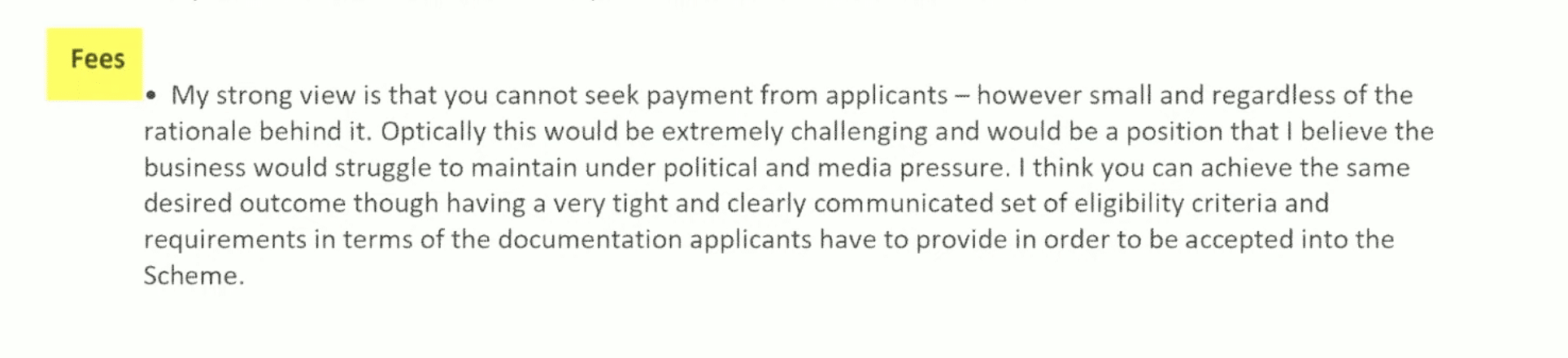
A document disclosed to the Post Office Inquiry, and published yesterday, shows that the Post Office considered requiring that postmasters pay a fee before applying for compensation. The intention was to deter applications. Realising this would be criticised, the Post Office instead designed a scheme which achieved the same effect through stringent (and unrealistic) eligibility criteria and documentation requirements.
We have previously reported on the Post Office’s HSS compensation scheme, which was designed to compensate victims of the Post Office scandal who had not received a criminal conviction, and didn’t participate in the civil GLO claim against the Post Office.
We’ve said that the HSS scheme appeared to be designed to deter applicants and minimise compensation payments. In particular:
The scheme application form was highly legal, with lengthy and complex forms to complete – but postmasters weren’t prompted to obtain legal advice, and received no help with legal fees.
The application form and documentation made it very difficult for postmasters to pursue any damages for loss of reputation, suggesting that such damages would only be available if the postmaster could prove financial loss (which is not legally correct).
Postmasters were required to provide “contemporaneous documentation“. In most cases they didn’t have any. In part because the events were more than ten years ago. In part because, when the Post Office suspended postmasters, it denied them all access to their records.1
These and other elements of the HSS scheme had the effect of minimising the compensation postmasters claimed. The Post Office paid for limited legal assistance for postmasters after it made them an offer; but by then it was too late. Everything was framed by a postmaster’s original application, and that was minimised by the design of the form and the surrounding documentation.
The evidence of intent
Many postmasters believed these elements of the HSS scheme were intentional. I agreed. But it was always possible that the Post Office was acting in good faith, with unrealistic hurdles a result of bureaucratic oversight rather than malice.
It is fairly shocking there was a discussion about charging fees, and that this was only rejected because of how it would look. Underwood was instead suggesting a “very tight and clearly communicated set of eligibility criteria and requirements in terms of the documentation applicants have to provide”, to “achieve the same desired outcome” as fees.
What was the “desired outcome”?
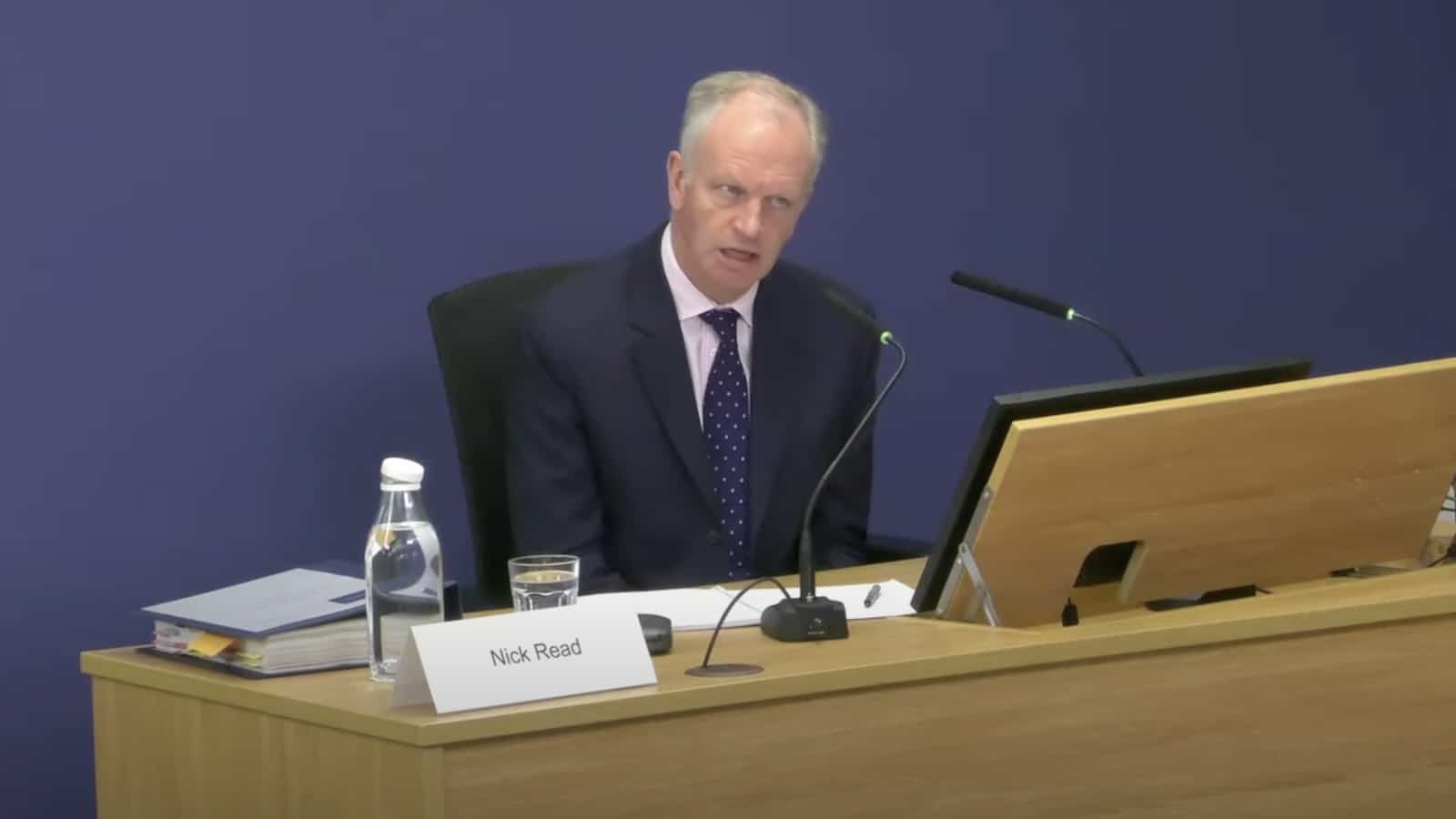
At the Inquiry yesterday, Edward Henry KC (representing the postmasters) showed the email to Nick Read, Post Office CEO. Henry put to Read that the “desired outcome” was to restrict access to the scheme and deter applicants.
Postmasters previously offered derisory compensation by the Post Office are being given a new opportunity to claim under an independent appeals process. The Post Office has written to them offering the choice of appealing, or accepting a £75k flat payment. It’s one or the other – a difficult decision for which postmasters should receive detailed legal advice. But they’re being offered no help with legal costs, and few postmasters will be in a position to afford a lawyer. Many will take the path of least resistance and simply accept the £75k – which in some cases will be much less than they should receive.
The Post Office scandal probably needs no introduction. But, in short, between 2000 and 20171, the Post Office falsely accused thousands of postmasters of theft. Some went to prison. Many had their assets seized and their reputations shredded. Marriages and livelihoods were destroyed, and at least 61 have now died, never receiving an apology or recompense. These prosecutions were on the basis of financial discrepancies reported by a computer accounting system called Horizon. The Post Office knew from the start that there were serious problems with the Horizon system, but covered it up, and proceeded with aggressive prosecutions based on unreliable data.
The Post Office created a scheme to pay compensation to about 2,750 of the postmasters who hadn’t been prosecuted for theft, but had been required to repay “shortfalls” and (in most cases) lost their livelihoods. It was first called the “Historical Shortfall Scheme” and then renamed to the “Horizon Shortfall Scheme” – the HSS. But, by accident or design, the process for claiming compensation was complex and highly legal, and the Post Office didn’t offer postmasters any legal assistance in putting their claim together.2
So many postmasters ended up receiving derisory amounts – in one case as low as £15.75. And many received nothing at all.
Campaigning postmasters like Christopher Head told the Post Office in 2023 that all the HSS settlements had to be reviewed. They were ignored, but kept pushing. Thanks to their efforts, and a subsequent recommendation from the independent Horizon Compensation Advisory Board, a new independent appeals process has been created by the Government for postmasters who feel their settlement was unfair.
The catch
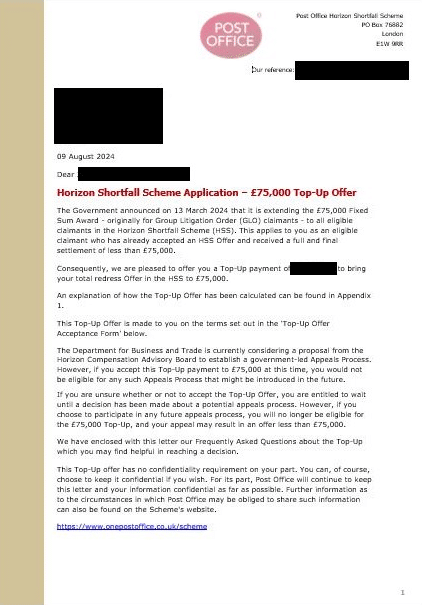
Here’s the letter the Post Office is sending Postmasters who were eligible under the HSS scheme. There’s a catch:
Postmasters have the option of receiving a fixed sum payment of £75,000, or can go through a full appeal assessment if they believe their losses are more than £75,000.
Whether or not to accept the £75,000 is a difficult decision. A postmaster would need to carefully assess the losses they suffered, which requires detailed financial analysis, plus a legal assessment of appropriate level of damages for loss of reputation and stress. We believe that the legal costs for such an an exercise would be at least £10,000.
How much is the Post Office offering to cover?
Nothing:
The Post Office will contribute towards postmasters’ legal fees during any actual appeal, but will make no contribution for legal advice on the critical decision of whether to appeal.
Most postmasters are elderly and vulnerable; only a few will have the resources to properly investigate if they could recover more than £75,000.
They’re being denied the chance to make a proper decision. There are cases where postmasters should be claiming hundreds of thousands of pounds – but without legal advice, we fear many will simply take the £75,000.
It looks like, once more, the Post Office is choosing the path that minimises compensation.
The Government should force the Post Office to do the right thing and cover postmasters’ legal costs, at this initial stage as well as during the actual appeal process.
Footnotes
I have previously written that this was between 2000 and 2013, but I have spoken to postmasters who faced false allegations of theft as late as 2017 ↩︎
They were offered legal expenses for considering any subsequent offer the Post Office made to them. But that was too late – the whole process was framed by the initial application, and for that, postmasters received no legal assistance ↩︎
Recent events have highlighted R&D tax credit fraud. However we believe the scale of the problem is much higher than previously reported. We’ve a new analysis suggesting that the total cost of fraudulent and mistaken claims could be £10bn, or even higher.The mystery is how this went on for so long, when plenty of people were warning about it, and why it wasn’t until August 2023 that the rules were significantly tightened.
The consequence is that we as taxpayers have lost a huge sum of money that could have been spent on public services or tax cuts. And many businesses have been misled into making large claims which they will now have to repay.
The history
The modern small business R&D tax relief was created in 2000, with the laudable aim of incentivising R&D investment. The scheme changed a few times over the following years. Then something dramatic happened to R&D tax claims by “small and medium-sized enterprises” (SMEs) in the 2010s.
And here’s the value of the claims (i.e. the tax benefit to business, and the cost to us/HMRC):
We’d expect to see a step change around 2014/15, as the rules became more generous at that point. And we see that, for both SMEs and large business. However SME claims just keep growing, and growing – and that can’t be explained by changes in the rules.2
HMRC’s analysis of 2020/21 claims (published in July 2023) found that half of all claims were incorrect in at least some respect. One quarter of claims were fully disallowed. Another 10% were fraudulent (5% by value). For SMEs, HMRC estimated that 25.8% of all claims by value were wrong or fraudulent. For large companies, 4.6%.
This is a very high rate of error and fraud. For comparison, across the tax system as a whole, the fraud rate is around 1% and the error rate around 3%.
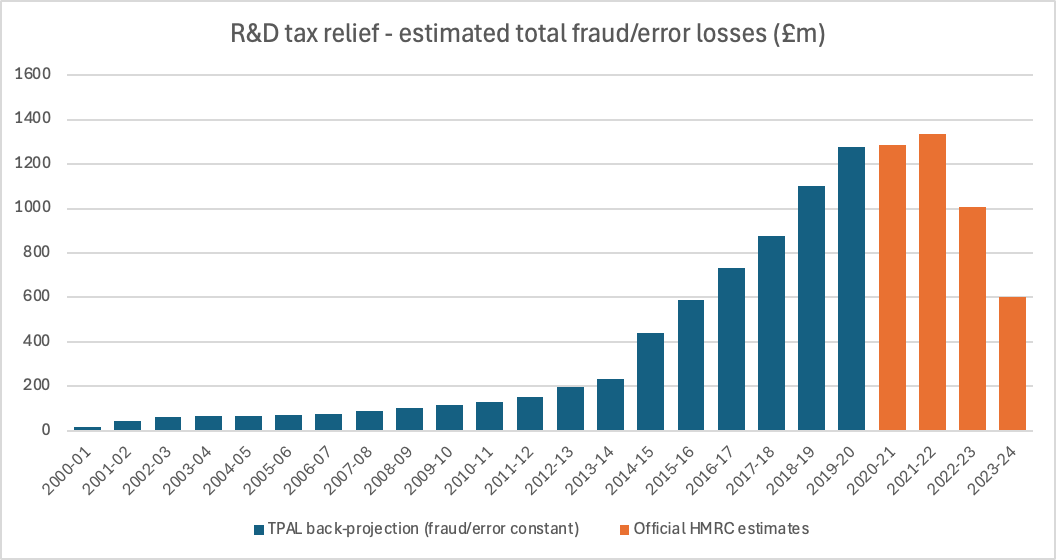
HMRC’s accounts for 2022/233 and 2023/244 included estimates of the total cost of R&D fraud and errors from 2020/21 to 2023/24. That’s been widely reported as suggesting a total of £4.1bn of wrong and fraudulent claims. However, HMRC only started to systematically analyse R&D claims from tax year 2020/21 – and so the £4.1bn figures does not include fraud and error prior to 2020/21.
Our analysis
We’ve made a very cautious estimate of the total fraud and error from 2013/14 by assuming (prudently) that there was no fraud/error in that year, and that the level of fraud/error then ramped up linearly until it reached the 25.8%/4.6% level in 2020/21.
That results in total fraud/error losses looking like this:
The total over this period is then £7bn.
But what if the level of fraud/error in 2020/21 had always been there in the past, it’s just that the number and value of claims were smaller? If we apply the 2020/21 figures to earlier years we get this:
And total losses of £10bn.
It could be worse still. A large proportion of the “new” claims after 2014/15 could be bad, with HMRC’s estimate for 2020/21 having undercounted them.
The evidence for undercounting
There are two reasons to believe that HMRC may have been undercounting fraud and mistake.
The first is anecdotal. A large number of unqualified and unregulated businesses have carried on for years, making a good living from R&D tax relief claims. In the last few years their claims have been systematically challenged by HMRC; they weren’t before that. This implies that, historically, dubious claims were missed.
It’s important to note that some of these sectors saw many more claims than others:
Looking just at the more significant sectors, the R&D tax reliefs specialists we spoke to were surprised that 58% of the claims in wholesale/retail trade were found by HMRC to be compliant. It would be unusual for a wholesaler or retailer to have any qualifying R&D expenditure. Similarly, the 60% figure for construction looks very high.
Three possibilities:
We’re wrong, and there really has been a significant amount of qualifying R&D expenditure in wholesale/retail and construction.
HMRC has missed a significant amount of non-compliance, whether it be from fraud or mistake.
We fear that the anecdotes and the data lead to a conclusion that the true cost to the UK is more than the £7-10bn estimated above. The soaring number of claims from 2015/16 did not reflect more people making claims of much the same quality as before. It reflected many new unqualified firms setting up as R&D tax advisers and making claims of significantly poorer quality than previous claims. The majority of these new claims – which by 2020/21 represented half of all claims by value – may have been non-compliant.
We shared these estimates with HMRC and they didn’t provide any specific comment, but said:
“Our recent published estimates are data driven and use a significantly improved methodology. Clearly, the level of non-compliance we have seen is unacceptable and taxpayers rightly expect us to scrutinise claims. That is why we have increased compliance activity. We do that thoroughly and fairly, and the overwhelming majority of valid claims are paid on time.“
The scandal
Tax professionals have been of aware of incompetent and fraudulent R&D tax relief claims for years. HMRC must have been aware of the claims too. And HMRC and HM Treasury must have noticed the spiralling number of claims from small business, the increasing number of unregulated firms in the market, and the suspicious sectors for which claims were being made.
So why wasn’t anything done? There was a fraud prosecution for a one-off entirely fake R&D transaction, but there appears to have been little action on what became widespread fraud and error.
Philip Hammond, Chancellor between 2016 and 2019, told The Times that the Treasury and HMRC were well aware of the problem:
“We were certainly on it. It was top of the HMRC agenda issue with me. This is probably the single biggest area in percentage terms of fraud and error in the tax system at the moment.”
However nothing much seems to have happened until 2022. It was then that The Times reported that people were treating R&D tax credits as “free money” and making clearly non-compliant claims for, most notoriously, vegan menus. HMRC then conducted its detailed analysis of claims for 2020/21, but it was a year more (August 2023) before more stringent procedures were introduced to discourage frivolous/fraudulent claims.
Why?
We don’t know. But we believe it’s a scandal. We as taxpayers have lost up to £10bn, little of which is likely to be recovered. Many small businesses that made more recent claims will find them challenged by HMRC, and will find themselves out of pocket (with the fees they paid their R&D advisers hard to recover).
It’s been described as the “next PPI scandal” given the number of businesses affected and the large liabilities they have. However, at least with the PPI scandal, the banks ended up compensating the people they’d sold useless insurance. In the case of the R&D tax scandal, most of the small businesses affected won’t receive compensation from anyone. Likely almost all of that £7-10bn is lost to the Exchequer for good. Much of that went as a chaotic and uncontrolled subsidy to small businesses. Some 20-30% of it went as fees to questionable and even fraudulent advisers.
There is now an equally depressing coda: businesses undertaking real R&D projects have had their claims delayed, putting some startups in financial jeopardy.
Who will be held accountable for this?
Thanks to Paul Rosser and T, O and A for their R&D tax credits expertise.
A business’ “sector” is determined here by a company’s Standard Industrial Classification (SIC) code, and this coding is often subjective or inaccurate. For example, Tax Policy Associates Ltd is a “tax consultancy”. It’s also unclear how HMRC allocated businesses which listed multiple different SIC codes. ↩︎
We believe everyone would benefit if all companies, everywhere in the world, had to publish basic information: their shareholders, directors, beneficial owners and accounts. But previous attempts to persuade or force this result have stalled.
We’re presenting an alternative. Companies across the world would be invited to publish their basic corporate information on Companies House. Companies that don’t would be subject to a 10% “transparency levy” on all payments received from the UK, and barred from public sector procurement contracts. Companies from countries with fully open corporate registers would be entirely exempt.
The UK could introduce the transparency levy unilaterally. We’d anticipate it would then be implemented by many other countries – OECD members and developing countries alike. We’d see a new wave of corporate transparency. All it takes is for the UK to take the first step.
The case for open company registers
Journalists frequently find their investigations stymied by offshore secrecy. We might trace a dubious business to Belize, or to Arkansas, but it’s then impossible to find out who owns it, who runs it, or what its business actually involves.
This is an obvious problem for journalists investigating malpractice and corruption; it’s also a problem for banks deciding whether or not to open a bank account for a company owned by an offshore entity.1
On the face of it, law enforcement and tax authorities don’t need open registers. The Financial Action Task Force and the OECD have made considerable progress in ensuring that, in theory, law enforcement has full access to company information (including the identity of companies’ beneficial owners). But in practice it’s often hard to obtain cross-border access; formal requests have to be made, the process can be slow, and bad actors can use legal proceedings to slow things down further (giving them the time to move their assets elsewhere).
Worse still, many countries still don’t require key information to be filed at all. The US, Bermuda and Belize, for example, don’t require companies to file accounts. If the local authorities don’t have the information, it’s impossible for foreign authorities to obtain it, short of complex local litigation.
So offshore secrecy doesn’t just block investigations by journalists and financial institutions; in practice it’s a significant impediment for investigations by public authorities. That’s why there’s a strong public interest in open corporate registers.
The current problem
Anyone can go onto the UK’s Companies House and find all the filings made by any company. This includes its shareholders, directors, accounts, and the identity of its true human owners (the “persons with significant control”2, or “beneficial owners”). This is all searchable, for free, by any member of the public.
This is not typical. This interactive chart shows how open each country’s corporate registry is. All thanks to data from opencorporates.com, and you can click on a country to go to the individual assessment:
Fewer countries still have open registers of beneficial owners – the individuals who really run a company (sometimes hidden by layers of ownership, trusts and other arrangements).4 The EU introduced mandatory public beneficial ownership registers in 2020, but an unfortunate decision of the CJEU blocked this, resulting in a significant reversal of the progress that had been made. Under the new anti-money laundering directive, the registers will be open, but only to people with a “legitimate interest” in money laundering. So, for example, it may not be possible to search the French register when investigating tax avoidance.
There are other countries, like the US, where there is a register, but it’s only accessible by local law enforcement.
The problem is that bad actors will gravitate towards countries that don’t have open registers. There is widespread agreement that this needs to change. The question is: how?
The current solution
International efforts to persuade tax havens to open up their corporate registers have largely been unsuccessful.
The UK has taken direct steps to require the Crown Dependencies (e.g. Jersey) and Overseas Territories (e.g. Cayman Islands) to have open beneficial ownership registers, overriding their local legislatures. This continues to meet resistance.
The moral case for requiring tax havens to have open beneficial ownership registers was seriously damaged when the CJEU blocked open registers across the EU on the basis they conflicted with beneficial owners’ right to privacy. If Cyprus and Malta don’t have open registers, why should Jersey? And why the focus on so-called “tax havens” (typically small islands) when the richest country in the world has some of the least transparent company laws in the world?
There are also obvious practical problems with forcing the CDs/OTs to adopt open beneficial ownership registers. Those with most to fear from transparency will move elsewhere. Increasingly that means Dubai, which has essentially zero corporate transparency. There is also a valid fear on the part of the Crown Dependencies/Overseas Territories that legitimate clients who wish privacy would also relocate to Dubai and elsewhere, putting them at a competitive disadvantage. And sometimes countries resist for darker reasons.
In any event, the project is limited in scope. There are no current plans to require “tax havens” (or indeed anyone) to publish other corporate information, in particular accounts.
We need something that is simultaneously more democratic (which doesn’t involve overriding self-governing territories), more ambitious (not just beneficial ownership) and fairer (not just “tax havens”).
An alternative model – FATCA
In the 2000s, following a series of bank secrecy scandals, the US Government resolved to require banks across the world to report their US accountholders to the IRS.6
The US of course had no way to require this as a matter of law. So it did something much smarter.
Under what became known as “FATCA“7, the US asked financial institutions worldwide to agree to report their US accountholders to the IRS. Financial institutions could freely choose whether to sign up to FATCA. But if a financial institution chose not to, it would be subject to a 30% withholding tax8 on all its US income. So, in reality, financial institutions had no choice at all – they almost all ended up becoming compliant with FATCA.9
This was highly controversial, but a brilliant innovation. The original idea was conceived by the Congressional Black Caucus, who saw it as both a more effective and fairer strategy than the previous approach of targeting small island tax havens for economic sanctions, and letting larger states off the hook. FATCA treated all countries equally.
OECD members eventually responded by creating a multilateral version of FATCA – the Common Reporting Standard.10 Thanks to CRS, over €12 trillion of accounts are automatically reported between countries every year. If a UK resident opens a bank account almost anywhere in the world, it will be automatically reported to HMRC. That is all thanks to FATCA, and the revolution in cross-border reporting that it created.
Our proposal is inspired by FATCA – we believe the UK should use a unilateral measure to incentivise businesses and countries to move towards transparency.
The proposal – the transparency levy
The following paragraphs summarise our proposal.
This is very much a “proof of concept”, and not a fully-worked-out technical proposal, but we’ve included some of the legal detail in footnotes.
Disclosed entities
The key concept is a “disclosed entity” – an entity that publishes “transparency11 disclosure” about itself. That means it lists its shareholders, directors and beneficial owners, and publishes annual accounts.12
As a policy matter, we want every company, partnership, trust or other entity13 that has any dealings with the UK to be a “disclosed entity”. An entity that isn’t, is an “undisclosed entity“.
Where an entity is incorporated in a country (like Denmark, Estonia or the UK) which already has a free public register including “transparency disclosure” – then that company would be a “disclosed entity” automatically. It wouldn’t have to do anything. HMRC would publish a list of all such countries (“disclosing jurisdictions“).14 Listed companies15 would also become “disclosed entities” automatically, given they don’t have beneficial owners in the usual sense, and already publish detailed accounts.
At the start, many countries in the world wouldn’t be “disclosing jurisdictions”, because they don’t have open company registries publishing transparency disclosure. A company in such a country could still opt to be a “disclosed entity” by filing its own transparency disclosure with Companies House in the UK. Companies House already registers plenty of foreign companies – little would be required in terms of systems/IT changes.16
So every company, trust and partnership in the world could become a “disclosed entity”. Why would it do this? Because of the transparency levy and the procurement rule.
The transparency levy
Anyone in the UK making a payment to an “undisclosed entity” would have to withhold a 10% “transparency levy“.17
So, for example, if a UK company was making a £100 interest payment to a BVI company which hadn’t registered with Companies House and become a “disclosed entity”, the UK company would deduct £10 for the transparency levy and the BVI company would only receive £90. The transparency levy would be paid to HMRC.
Payments to “disclosed entities” would not be subject to the transparency levy. It would be simple for UK payers to check if they were paying an entity which was disclosed.18
The transparency levy could simply apply to all payments, regardless of their nature, but it would be simplest – at least at first – to apply it to the narrower category of payments that are traditionally subject to withholding tax. That means UK source rent, interest19, dividends20, royalties and annual payments. By limiting the levy to financial payments, there’s no impact, for example, on a small business supplying goods or services to the UK.21
The transparency levy therefore creates a powerful economic incentive for foreign entities to become “disclosed entities”, either by registering their own details with Companies House, or to pushing their government to upgrade their public register so the country becomes a “disclosing jurisdiction”.
Who applies the levy?
Where a bank or other intermediary is making a payment, they would be subject to an obligation to withhold the transparency levy (as they are at present for UK interest withholding tax). In other cases, the payer would withhold the levy.
The transparency levy would largely be self-policing, because all the risk of failing to apply would fall on the UK payer, but the cost of the levy falls on the recipient. UK payers are therefore incentivised to err on the side of caution and apply the levy even when the technical position is unclear.2223
UK individuals and companies would list, in their tax returns, the foreign entities they’d made payments to, and whether they were disclosed entities or undisclosed entities.24
The procurement rule
The “procurement rule” is simple – no supplier would be able to enter into a contract with UK central or local government (procurement, real estate or anything else) unless it is a “disclosed entity”.25
What about avoidance and evasion?
There are two obvious approaches bad actors would take to avoid/evade these rules:
First, by simply filing false information (as is currently endemic with Companies House reporting).
Second, by registering one offshore entity, but having it secretly make payments “behind the scenes” to another undisclosed offshore entity. In tax terminology, the first entity is a “conduit“.
How to deter and prevent such behaviour?
There would have to be active enforcement by HMRC, to prevent the new register duplicating the existing problems with Companies House. But HMRC has the considerable advantage that (unlike Companies House) it has enforcement powers and expertise.
HMRC would have to be given additional powers. For example:
If HMRC has reasonable grounds for believing that a “disclosed entity” has filed false information, or is acting as a conduit for an undisclosed entity, it would require the entity to remedy the situation. If the entity doesn’t, it would be put on a “bad list” of non-compliant entities.26 Payments to an entity found to be non-compliant would become subject to the transparency levy, with an additional charge to make up for the period in which it was wrongly claiming to be compliant.27
UK companies would be liable for avoidance by offshore “conduit” companies if they are in the same group.
Making a false declaration would be a criminal offence for a company’s directors; dishonestly failing to withhold the levy would be a criminal offence for the payer’s directors (in the same way as for any tax). However, in most cases it would be the transparency levy mechanics which would incentivise compliance, not the (usually remote) prospect of criminal prosecution.
Would it be legal for the UK to introduce the transparency levy?
We don’t believe there are legal impediments that would prevent the introduction of the transparency levy:
The levy would not be subject to (or contravene) the UK’s tax treaties, because the treaties only cover certain designated taxes, and the transparency levy is different from all of them.28
The levy should be compatible with the UK’s WTO obligations, as it is being introduced to help counter tax avoidance, tax evasion, sanctions evasion, money laundering and corruption.2930
If adopted by EU Member States, the levy should be consistent with EU law, because it applies equally to all payments, depending on the objective status of the recipient, and is not discriminatory. So there should be no breach of the free movement of capital or the freedom of establishment.
There should be no GDPR violation; in most EU countries, director and shareholder information is already published. Beneficial ownership information often isn’t, and in those countries we anticipate companies may need to obtain the consent of their beneficial owners before registering and becoming “disclosed entities”. There is an obvious economic incentive on beneficial owners to give this consent.
It’s anticipated that relatively few payments would end up being subject to the levy, because most affected businesses would simply become disclosed entities. However the total amount of in-scope payments is so vast – likely in the trillions of pounds – that the transparency levy would still likely raise a large sum, particularly in the early years.
The funding raised from the transparency levy would be used to finance the additional work for Companies House and HMRC, and to help the Crown Dependencies and Overseas Territories build capacity for their own open registers (if that’s what they wish to do).
Implementation would be phased, with (for example) entities able to register as disclosed entities through the course of 2026, and the transparency levy and procurement rule both starting to apply from 2027.31 The scope of the levy could potentially expand over time, from dividends, interest, royalties and rent in 2027, to include fees and sale proceeds from 2028, and all payments from 2029. But it is possible that, as was the case with FATCA32, global adoption would render an expansion of the rules unnecessary.
Wouldn’t the levy stop people from doing business with the UK?
The transparency levy copies the brilliant innovation at the heart of FATCA – the creation of a powerful incentive for foreign companies to voluntarily comply with a rule. There is, however, one very important difference: FATCA was complicated and expensive for financial institutions – they had to create entirely new systems to operationalise the reporting of all their US accounts, costing many billions of dollars. By contrast, it would take most companies less than an hour to register with Companies House, submit their corporate information, and update it once per year. The transparency levy should be no impediment to legitimate business.
And the basic concept here is nothing new. Businesses that operate cross-border are used to the idea that, if they want to escape withholding taxes, they have to register, or complete a form.
Won’t the UK come under significant pressure from other countries not to introduce the levy?
This is a complex question, and dependent on unpredictable geopolitical events (e.g. the outcome of the upcoming US Presidential election). A Kamala Harris administration might well welcome a global transparency initiative that requires no US legislation. And there is strong support for corporate transparency across the world, particularly in the European Union, South/Latin America and Africa.
The lesson from FATCA is that, when one country announces its intention to introduce a measure of this kind, the first reaction is complaints that it amounts to extraterritorial legislation. The second reaction is that other countries see the benefit and adopt similar measures.
The UK could be pushing at an open door.
Multilateral implementation
Whilst the UK could implement the transparency levy unilaterally, the ideal outcome is that other countries would adopt it, either creating their own registration system, or taking advantage of the UK’s own implementation and simply cross-referencing Companies House.33
The UK should therefore advocate for international adoption of a transparency levy at the UN and OECD, and in bilateral discussions with other countries.
The more countries that implement the levy, the greater the moral and practical34 pressure for widespread adoption of open registers. And the easier/cheaper it becomes for other countries to implement the levy, because they can “piggy-back” on existing implementations.
Why it works
The transparency levy is a radical new way of solving an old problem:
It’s a path to worldwide corporate transparency that doesn’t require countries to act against their own immediate interest. We wouldn’t be begging Dubai to comply; we’d be giving Dubai companies a strong incentive to comply, if they want to continue to do business with the UK.
We’d be creating an incentive for countries to create their own open corporate registers, to save their businesses the bother of individually registering with the UK’s Companies House.35
The transparency levy treats all countries equally – it doesn’t attack politically vulnerable small islands whilst ignoring the widespread secrecy problem in the US and EU.
The transparency levy uses a well established pre-existing concept. Many countries impose withholding taxes on outbound payments unless procedural formalities are completed. The purpose and details of the transparency levy are different, but the basic idea is nothing new.
The disclosure, levy and procurement regime is reasonably straightforward for the UK to implement, building on an existing Companies House system and existing withholding tax mechanics.
Once the UK has implemented, it becomes easy for others, particularly developing countries, to follow. They wouldn’t need to build any kind of complex registration/compliance system, just enact a transparency levy into their own local law, and cross-refer to the register kept by the UK Companies House.36
We welcome comments, criticisms and suggestions.
Many thanks to all the tax lawyers, trade lawyers, regulatory lawyers and transparency campaigners who contributed to this proposal.
In practice the most important barrier to money laundering and other financial crime is the banks, and their anti-money laundering (AML) and “know your client” (KYC) teams. They, of course, have no special investigatory powers. Open registers would help them do their job more effectively, and that would benefit all of us. ↩︎
It is unfortunate that UK company law uses the PSC concept; it would have been better to align with the well-understood “beneficial ownership” concept. This paper won’t go into the differences between the two ↩︎
Companies House has many problems, largely caused by a failure to check data and enforce the rules (which may be about to get better). We would also be cautious about assuming that the UK is worse than others, as opposed to just having more companies, and more widely publicised problems). ↩︎
Note that some sources, like openownership.org, conflate closed registers (open only to local law enforcement) with open registers). ↩︎
The US has a particular issue here, because it taxes US citizens no matter where they live. That “citizenship based taxation” is in our view unfair – more on that here – but that doesn’t change our view of the effectiveness of FATCA. The US couldn’t in practice enforce citizenship-based tax against some of its expats before FATCA – FATCA meant that it could. So most of the complaints about FATCA, are in fact complaints about citizenship-based taxation. ↩︎
The Wikipedia article on FATCA is a pretty good summary of how things stood 10 years ago, but unfortunately is now mostly rather out of date ↩︎
A “withholding tax” is a requirement on a person making a payment to deduct from that payment an amount representing tax that is really the liability of the recipient. Withholding taxes are widely used in circumstances where it is easier for a tax authority to collect tax from the payer than the recipient. The case people are most familiar with is their own employment income, where in most countries the employer withholds the tax. But it is also very common for tax authorities to require tax to be withheld from cross-border payments, where the tax authority has little ability to tax a foreign recipient. ↩︎
This is a very simplified history. Data protection and bank secrecy laws meant that most banks feared they wouldn’t be able to voluntarily provide account information to the IRS. So they pushed their governments to enter into agreements with the US under which (e.g.) the French government would require its local financial institutions to make reports to the IRS (solving the data privacy problem) and in return the US would deem all French financial institutions to be compliant. This would never have happened if it wasn’t for the original promise/threat of a withholding tax. ↩︎
CRS was entirely consensual, with no withholding obligation to prod people into compliance. But, once a country had accepted the principle of FATCA, it was very hard for it to refuse to sign up to CRS. Large countries acted out of self-interest. Small countries fell into line. ↩︎
Discussion can be impeded by the fact that “transparency” can, in a tax context, mean that an entity is not subject to tax itself, but whose shareholders, partners or members are taxed as if they were carrying on the business. The entity is then “tax transparent” or “fiscally transparent”. If, alternatively, it is taxed like a normal company, it is referred to as being “opaque”. When we use the words “transparent” and “opaque” in this proposal, we are using the more colloquial meaning of whether the company’s details are publicly disclosed ↩︎
Thought would need to be given as to what standard is required for the accounts. The current standard for small UK companies – which is about to change – feels insufficient given that it doesn’t include the P&L. ↩︎
Whether or not strictly a legal entity under its local law. So, for example, unincorporated associations would also be included – past regulations that have omitted unincorporated associations have created loopholes. ↩︎
It would have to be a little different for trusts and partnerships, which traditionally don’t register with company registries at all. Practically, a separate “disclosed trust/partnership” concept would probably be required. As of today, it’s possible that no country in the world would be a “disclosing jurisdiction” for trusts and partnerships – the UK certainly wouldn’t be. So all trusts and partnerships receiving payments, including UK trusts and partnerships, would have to register with Companies House. This is a feature, not a bug. ↩︎
The levy of course wouldn’t have to be 10%. A levy that was too small (say 1%) could be regarded by some bad actors as an acceptable price for secrecy, and so fail to achieve change. 5% might be sufficient. 20% might be too high. But it is also advantageous to raise some funds in the short term to fund implementation in the UK and abroad. This would need careful thought. ↩︎
Indeed much simpler than it is to apply current UK withholding tax rules, which are notoriously awkward. ↩︎
The quoted Eurobond for listed bonds needs some thought. It’s not workable to e.g. require Marks & Spencers plc to identify individual bondholders, because it won’t be able to (there is a nice explanation here as to why that is). However simply excluding listed bonds creates a loophole. There would have to be an anti-avoidance rule so that, for example, the transparency levy applies to listed bonds issued between connected parties. ↩︎
Listed shares would also need thought; again, they should be generally excluded subject to an anti-avoidance rule ↩︎
And if expanded to all payments, thought would need to be given as to how to avoid creating a barrier for small businesses, particularly those in developing countries. ↩︎
And to ensure this, any contractual term that purported to prevent the levy being withheld, or make the cost of it sit with the payer (a “gross-up” or indemnity) would be void. That’s fair given that it’s entirely within a foreign company’s control whether to comply and become a “disclosed entity”. Such a rule is not unprecedented – the UK has had a rule for over a hundred years that any attempt to make one party indemnify another party’s stamp duty is void. Other countries (e.g. Switzerland) have statutory rules that prevent any attempt to make the payer contractually liable for the cost of a withholding tax caused by the recipient’s status. ↩︎
There would need to be a refund mechanism, so that if the transparency levy is wrongly applied (e.g. the payer thought the recipient was an undisclosed entity when they were in fact a disclosed entity), the recipient can reclaim it. However, there should be no way for an undisclosed entity to be subject to the levy, become a disclosed entity, and then reclaim historic levies it had been subject to. That would enable people to play games with timing of disclosure. The transparency levy is not a tax, and standard refund mechanisms are not appropriate. ↩︎
The fact a payment was made to an undisclosed entity should be of interest to HMRC, and other regulatory and enforcement authorities, given that (after the rules had bedded in) all legitimate parties would be expected to become disclosed entities. Consideration could also be given to publishing the number/amount of transparency levy payments each company makes. ↩︎
This goes further than the new requirement that contracting parties must declare their beneficial ownership. ↩︎
That mirrors the approach taken under FATCA, where (for example) a UK financial institution is automatically deemed to be compliant with FATCA, but in the event of “significant non-compliance”, they lose that status. ↩︎
There is a similar mechanic in the UK’s existing interest withholding tax rules; if a foreign company claims relief from withholding under a tax treaty, but wasn’t actually eligible, then HMRC can direct the UK payer to make “catch-up” withholdings so that the full amount of historic tax is collected. ↩︎
See e.g. Article 2 of the UK/France treaty. The question is whether the transparency levy is “identical or substantially similar to” income tax. It isn’t. The levy isn’t related to profit in any way (there are no permitted deductions), and wouldn’t be creditable against any UK tax liability the foreign entity might have). Note that the question isn’t whether the levy is similar to “withholding tax”, because there is strictly no such tax. Withholding tax is simply a particular collection mechanism for income tax, and it’s income tax which is designated in tax treaties. The transparency levy is nothing like income tax. ↩︎
See the WTO Appellate Body decision in the Argentina v Panamacase, where the Appellate Body held that countries could restrict trade with tax havens for “prudential” reasons or to comply with national laws, as long as they did so in a consistent and non-arbitrary manner. ↩︎
There would need to be some form of “anti-conduit” rule, where a UK person making a payment to a disclosed entity which it knows will be on-paid to an undisclosed entity has to apply the levy. ↩︎
Some delay is advisable to minimise “teething problems” with the new rules, as well as to give financial institutions time to build withholding and reporting systems. Delay may also increase the likelihood of international adoption – these processes tend to move slowly at first. ↩︎
FATCA was initially planned to extend to a much wider and more complex class of payments, encompassing gross sale proceeds and non-US source payments – but this ended up being deferred indefinitely because the standard withholding approach proved a sufficient incentive for widespread adoption. If that didn’t happen, and the UK remained the only country with a transparency levy, then it might be necessary to expand the scope of payments impacted by the levy to prevent avoidance by shifting one form of payment into another. ↩︎
An approach that would be particularly attractive for countries without the capacity or budget to implement their own systems. ↩︎
i.e. because if many countries created their own registration systems then that could be quite burdensome for companies – i.e. because they’d have to make numerous separate registrations. The solution is for their home jurisdiction to create its own open register, so all local companies automatically become “disclosed entities”. ↩︎
That’s a stronger incentive if many countries adopt, all with their own company registry. The burden of registering with many registries would push businesses to lobby countries to create open registries and become “disclosing jurisdictions. ↩︎
It would in many ways be preferable to create a new international register, of the kind suggested by some campaigners. Implementing such a register in the short term is likely to be difficult from both a political and a systems perspective. In the long term it’s conceivable that the transparency levy would begin a process that ends with such a register. However the important benefit of the transparency levy is that implementation isn’t dependent on international agreement or building complex new IT systems. ↩︎
Our proposal to end offshore secrecy, and move the world towards open registers, is here. But right now, the world looks like this:
The interactive chart above shows how open each country’s corporate registry is. All thanks to data from opencorporates.com, and you can click on a country to go to the individual assessment. Full screen version here.
Or we can focus on beneficial ownership registers, and look at whether each country has a register, and whether it’s “open” (available to everyone), or “closed” (available only to law enforcement) and whether they’re open or closed. You can click through to go to each country’s register’s website:
We reported on Monday that, if you incorporate a UK company, you are likely to receive an official-looking letter from “Company Registry” charging you £45. It’s a scam, and a large and well-organised one.
Today it’s Stripe, the payment company, who processed all of the victims’ payments to Company Registry. But, to their credit, Stripe have responded quickly to our report, and blocked the scammers from their systems.
The scam
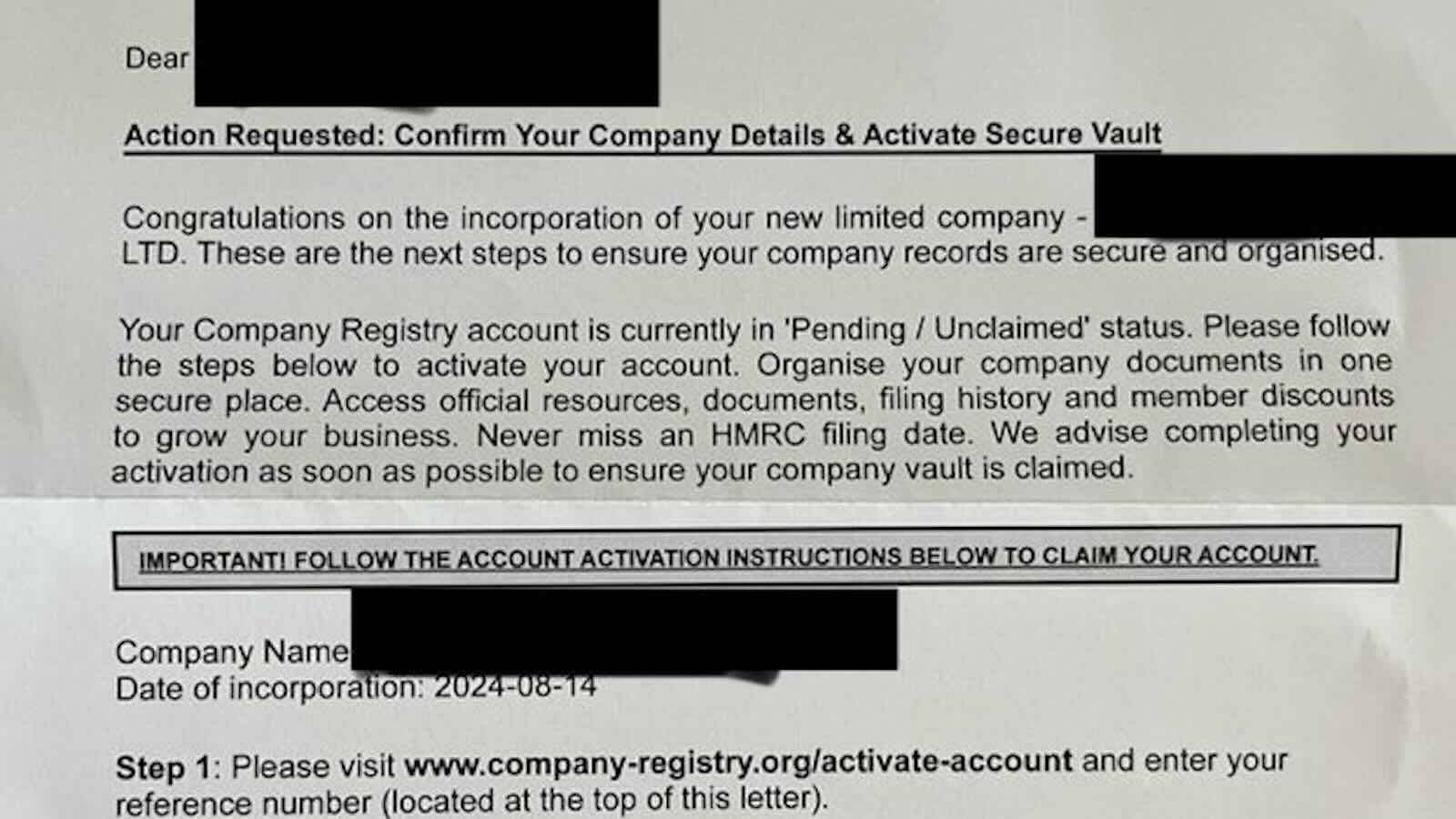
If you incorporate a UK company, you are likely to receive a letter like this from “Company Registry” (company-registry.org):
It looks like an official document – an invoice for a service that has already been purchased (“Pending”, “Complete activation”, “These are the next steps”, “IMPORTANT!”).
The reference to a “COVID 19 New Business Relief Deduction” again gives the impression this is an official letter.
FCA rules require electronic money institutions to have effective procedures to prevent them being used to facilitate financial crime. That includes customer due diligence and ongoing monitoring.1 Most financial institutions have very sophisticated2 “know your client” (KYC) and anti-money laundering (AML) systems for this purpose.3
We understand Stripe was Company Registry’s payment processor from when the scam started around October 2021. At that point there wouldn’t have been obvious signs that Company Registry was a scam. But in April 2023, Companies House published a warning about Company Registry which was widely circulated. The obvious conclusion: Stripe doesn’t update its KYC/AML checks on its clients effectively enough, and/or frequently enough.
Stripe’s response to our report
We have been regularly checking Company Registry’s website – at some point in the last week, its payment processing system failed. Attempts to make payment result in an error.7
We infer that Stripe stopped processing payments for Company Registry, either as a result of our reports, or as a result of earlier tweets. That breaks the Company Registry scam, at least for now – which is excellent news.
We reached out to Stripe for comment: they said that (understandably) they are unable to comment on individual users/clients.
The good and bad news
The bad news is obvious: Stripe didn’t spot obvious signs that their client was fraudulent, and processed payments that furthered their criminal enterprise.
But there is some good news:
We expect Stripe will be making a “suspicious activity report” to the regulator. That should include the details of the people behind Company Registry (which Stripe should have obtained during its KYC process). This information should assist law enforcement with pursuing those responsible.
Stripe now knows that all the payments made to Company Registry are suspicious – it should reverse them, and refund the victims of the scam.
We’ll also be asking the FCA to investigate Stripe’s KYC/AML processes.
We assume Company Registry will try to change their payment provider. It would be extremely disappointing if any regulated institution were to accept Company Registry as a client – but watch this space.
I know these systems well, because I used to advise some of the world’s largest financial institutions on how to make sure these systems didn’t facilitate tax evasion. Stripe were not a client, but if I was advising them now I’d say there is a risk they could be criminally liable if – as seems plausible – Company Registry has committed tax evasion. ↩︎
Unsurprisingly, a Google search (“open source research”) is usually one of the first steps a KYC/AML team takes when onboarding clients or counterparties. ↩︎
This Google search, as with others we refer to in our reports, was conducted via a UK VPN using Chrome in “incognito” mode, so it should be representative of the results for a general UK user, and not customised for Tax Policy Associates. ↩︎
Company Registry’s API fails to receive a response from Stripe, and fails with a 500 error. ↩︎
We reported yesterday that, if you incorporate a UK company, you are likely to receive a letter from “Company Registry” charging you £45. It’s a scam, and a large and well-organised one.
We’ll be naming and shaming the legitimate businesses who are facilitating the scam. The first is Tide – the FCA-regulated “all-in-one business finance platform”. Tide signed Company Registry up as an affiliate, and has been happily paying the scammers £50 for every “customer” they refer to Tide.
The scam
If you incorporate a UK company, you are likely to receive a letter like this from “Company Registry” (company-registry.org):
It looks like an official document – an invoice for a service that has already been purchased (“Pending”, “Complete activation”, “These are the next steps”).
The reference to a “COVID 19 New Business Relief Deduction” again gives the impression this is an official letter.
A few minutes after registering with the scam website, I received this:
To my surprise, that link took me to a genuine new account page from Tide:
Tide is an FCA-authorised “electronic money institution” which offers business bank accounts from ClearBank.1
What’s happened here is that Tide has signed up Company Registry an an “affiliate”, so Tide pays Company Registry £50 for every successful referral (the link in the company-registry email contains an “affiliate code” which Tide then tracks).
Tide says it’s easy to become an affiliate:
It appears to be rather too easy.
Tide’s initial response
We asked Tide for comment. It took them three weeks to get back to us with this statement:
“Tide maintains appropriate systems and controls to assess and mitigate risk associated with all Affiliate relationships, both at the onboarding stage and during the period of those relationships. If you would like to find out more we suggest that you speak directly to Company Registry LLC.“
How likely is it that Tide has “appropriate systems and controls”?
Most financial institutions have very sophisticated2 “know your client” (KYC) and anti-money laundering (AML) systems to assess potential clients, suppliers and counterparties.3
The obvious conclusion: Tide has either no controls over its affiliate relationships, or ineffective controls.
Tide’s subsequent response
We told Tide that their response suggested they weren’t taking seriously what was a significant AML failure by a regulated institution. We said we’d be asking the FCA to investigate their other affiliate relationships.
Tide responded with this:
“Our investigation is ongoing. Pending the outcome of this investigation the Affiliate has been suspended.“7
It’s not clear why an investigation should take three weeks, or why it was only mentioned after we queried Tide’s original statement.
The good and bad news
The bad news is obvious: Tide signed up an obviously fraudulent company as an affiliate without conducting even basic due diligence, and then paid (we assume) a large number of £50 referral fees to the fraudsters. This follows an unrelated recent report about apparent AML/KYC failings by Tide.8
But there is some good news:
Tide can contact every customer that was referred by Company Registry, tell them they’ve been scammed, and suggest they request a chargeback from their credit card issuer.
Tide must have conducted KYC on Company Registry LLC (the Arkansas company running the scam) before paying it referral fees. Tide therefore knows who owns the company, and how Tide was making payments to them, and can now pass this information to the police.
We’ll be asking Tide to confirm that they’re doing this. We’ll also be asking the FCA to investigate Tide’s due diligence processes.
Footnotes
ClearBank told us it doesn’t pay referral fees to anyone. We don’t think it’s fair to blame ClearBank for Tide’s error. ↩︎
I know these systems well, because I used to advise some of the world’s largest financial institutions on how to make sure these systems didn’t facilitate tax evasion. Tide were not a client, but if I was advising them now I’d say there is a risk they could be criminally liable if – as seems plausible – Company Registry has committed tax evasion. ↩︎
Unsurprisingly a Google search (“open source research”) is usually one of the first steps a KYC/AML team takes when onboarding clients or counterparties. ↩︎
This Google search, as with others we refer to in our reports, was conducted via a UK VPN using Chrome in incognito mode, so it should be representative of the results for a general UK user, and not customised for Tax Policy Associates. ↩︎
We can confirm that – the link in Company Registry’s emails no longer works. ↩︎
i.e. because in the Lennon/Robinson case, Tide had provided banking to a company likely controlled by someone with a conviction for mortgage fraud, that had large amounts of money passing through it, failed to file accounts or pay any tax for five years, and then went bust owning £325k to HMRC. ↩︎
Directors of newly incorporated UK companies are receiving official-looking letters from “Company Registry” requiring them to pay a fee. It’s a scam – and potentially a very lucrative one. We’ve looked into who’s behind it and identified one individual who the authorities should be questioning.
We frequently receive tip-offs from accountants and lawyers who’ve seen firms promoting dubious schemes of one kind or other. This often requires a large amount of analysis from us to work out exactly what’s going on.
But sometimes it’s obvious that what’s being proposed is wildly improper, even fraudulent. We’re publishing cases like this as “scam of the day” – documents and links plus a short explanation of why what’s proposed is a scam.
We hope that this helps warn potential clients off dangerous scams, and prompts the authorities to be more proactive identifying and closing down scammers.
The scam
If you incorporate a UK company, you are likely to receive a letter like this from “Company Registry” (company-registry.org):
It looks like an official document – an invoice for a service that has already been purchased (“Pending”, “Complete activation”, “These are the next steps”).
The reference to a “COVID 19 New Business Relief Deduction” again gives the impression this is an official letter.
If you go to the website to “activate your account”, everything continues to look official – entering your reference number reveals your company’s details, just as it would for a bona fide company registry:
But this is a scam, designed to look official but actually nothing to do with Companies House or HMRC.
The people behind the scam think putting this in small print on the back page absolves them of responsibility:
And there’s a disclaimer in very small print at the bottom of their website:
This doesn’t protect them at all. In fact the small print is damning, because it shows that the confusingly “official” presentation of the letter and website is by design.
The “service” they are really selling is some kind of unspecified “document vault” in which companies can store their UTR (i.e. tax code), Government Gateway and Companies House authorisation codes.
This is information that would be extremely valuable to a fraudster, as it would enable them to make Companies House filings (e.g. installing themselves as directors and changing the registered office) and receive refunds from HMRC.
We don’t think anyone should be giving these details to any untrusted third party, and certainly not to the unknown individuals behind “company-registry.org”.
Who is behind company-registry?
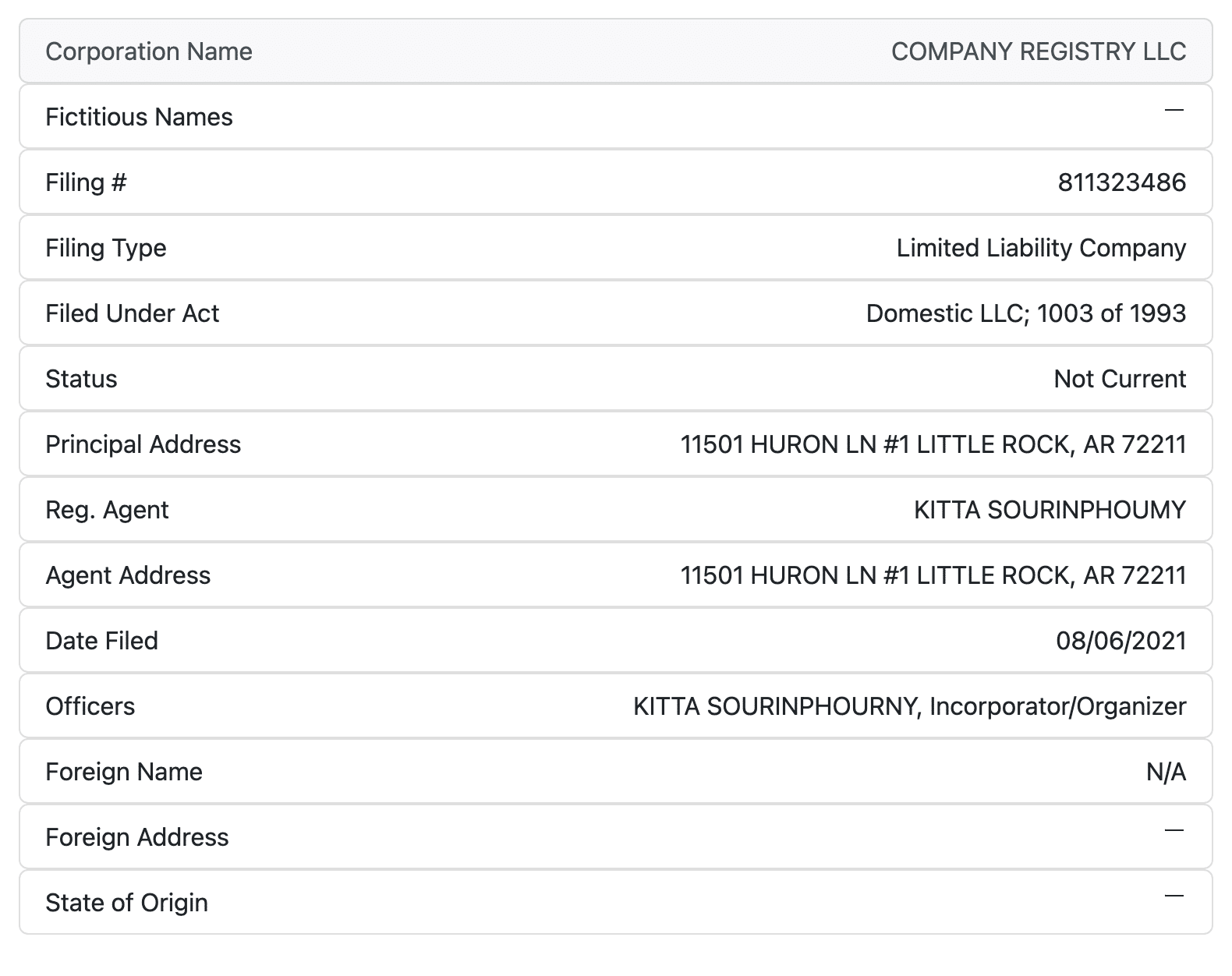
The business is run by Company Registry LLC, which is registered in Arkansas, USA.
Very few details are publicly available for Arkansas companies:
The “Not Current” means that the company is late with its filings – it is (to use the US term) not in “good standing”.
The registered address is an office which used to be an accounting firm, but their website is down, their Facebook page hasn’t been updated for a year, and it’s unclear they’re still in business (although the realtors selling the building say that it’s let to an accounting firm). We wrote to them asking for comment and haven’t heard back.
We also wrote to Company Registry asking for comment, and received this “statement of deniability”:
The letter isn’t on headed notepaper, doesn’t identify the legal name of the business, is written in italics and is curiously worded (with signs that ChatGPT was used). We wrote to Company Registry LLC asking why they’d sent us such a strange letter, but didn’t hear back.1
The letter is in the name of Octavian Balan who says he’s “legal counsel” but isn’t a qualified lawyer.2
Mr Balan has a LinkedIn page where he claims expertise across an impressive range of legal topics (“FCA related matters, crypto law, NFT law, tax law, VAT law, international law, fiscal law and corporate law”) and says he’s the founder and CEO of “global law firm” LegalX.3 Its website says it’s a “reputable global law firm” and “global leader in litigation, arbitration and financial law” which is “comprised of elite lawyers with extensive legal experience”. Neither the website nor the LegalX LinkedIn or Facebook pages list any lawyers, or indeed any individuals other than Mr Balan. Neither Mr Balan nor LegalX is registered with the Solicitors Regulation Authority or any other regulator we’re aware of.4
Mr Balan denies running Company Registry and says he was just hired to act for it.5
“in any way, including its presentation, deceives or is likely to deceive the traders to whom it is addressed or whom it reaches; and by reason of its deceptive nature, is likely to affect their economic behaviour”
We have heard from six people who were deceived by the mailshots from company-registry into thinking it was an invoice from an official body, and who went to the website and paid the fee.
There is a defence under the Regulations if a person can show they just made a mistake. That seems very unlikely given the small print – which even references the Regulations (presumably in an attempt to establish a defence; actually it does the opposite).
It is also possible that a tax offence is being committed. The fee charged by Company Registry LLC doesn’t include VAT, and a business with no UK establishment that sells digital services into the UK always has to be registered. If they have a UK establishment (e.g. because the business is actually run out of the UK) then the registration requirement would apply if their sales hit £90,000.
What should happen?
This is a large scale and well organised fraud, targeting many (and perhaps every) newly incorporated UK company.
We would hope that it is being investigated as a priority. The obvious first step would be to speak to Mr Balan. Given he isn’t a qualified lawyer7, his communications with Company Registry LLC aren’t subject to legal privilege.
Many thanks to the individuals and businesses who alerted us to this fraud.
Footnotes
We know Company Registry received our message, because we pointed out they weren’t registered with the Information Commissioner, and they registered very soon after. ↩︎
He told us he has a degree and a Masters in law, but Balan doesn’t seem to understand that doesn’t make him qualified. ↩︎
LegalX say they undertake UK litigation work (at £1,500 per hour); that is problematic, because the conduct of litigation is a “reserved legal activity” which is not permitted to be undertaken by a non-lawyer. LegalX says it has an office in Italy; the Italian prohibitions on non-lawyers practising are significantly more stringent than those in the UK. ↩︎
His explanation for his strange letter was “You do know that the right to expression exists, right? I can phrase a sentence however I prefer, thank you. That is the fundamental right to expression and to speech.“. ↩︎
There’s a report Labour’s non-dom changes will cost the UK £1bn – but the figure is meaningless, based on a self-selected survey.
The report shouldn’t distract from what’s an important question – what will actually happen if the Government completely abolishes the non-dom regime? And are the consequences bad enough that the Government should reconsider one of its flagship policies?
There is a good summary here from law firm Farrer & Co of how Labour’s proposal differs from the Conservatives’.
The question is: how will non-doms react?
Anecdotally there are many reports of non-doms leaving, either prompted by Jeremy Hunt’s budget reforms to the regime, or the prospect of Labour going further. But anecdote isn’t evidence, and people who want to prevent a change in law have an obvious incentive to exaggerate the impact of that law.
This short piece looks at what evidence we do have, and whether that suggests Labour’s proposals need to be tempered.
The lobbyists’ report
The Telegraph and City AM headlines suggesting the non-dom changes will lose £1bn in tax are taken from a report from Oxford Economics. But the report isn’t freely available.
I believe that’s wrong – people trying to influence public policy should do so openly.
The £1bn estimate and other figures in the report come from a survey of 73 non-doms and 42 tax advisers. The report says nothing about how the survey was conducted and whether there was any attempt to make it representative. There is no sign of any statistical analysis.
The results are therefore statistically meaningless, in a similar way to the private school VAT survey we commented on earlier in the year.4
The survey will also have suffered from a significant “preference signal” effect – the people surveyed will have known the use to which the survey would be put, and so have an incentive to provide a dramatic answer.
I therefore don’t think anything at all can be taken from this report. All the numbers and pretty charts flow from the meaningless survey responses.
What evidence do we have of non-dom behaviour?
There were significant reforms to the non-dom rules in 2017 – most importantly, a 15 year limit on how long someone could live in the UK and remain a non-dom. So on the face of it, many people lost all the benefit of the non-dom regime, and what happened in 2017 should be an excellent guide to what will happen now.
However we need to be cautious about extrapolating the 2017 changes to what’s now proposed, because the 2017 changes by design included a massive loophole5: “trust protections“. Someone who was about to hit the 15 year limit could put their property into trust, and therefore keep many6 of the benefits of being a non-dom including, importantly, that their non-UK assets remained outside inheritance tax.
Most non-doms don’t have significant assets outside the UK, and didn’t take advantage of the trust protections.7 It was a small number of the very wealthiest – “ultra high net worths” (UHNWs) – who did, and they therefore weren’t much affected by the 2017 changes.89
The Conservatives would have preserved that “trust protection” for assets put into trust before April 2025. Labour is committed to end it. That means all non-doms will (after a few years) be fully subject to income tax, capital gains tax and inheritance tax.
Labour’s changes therefore will impact UHNWs much more than the 2017 changes (which in economic terms barely affected most of them). I’ve spoken to many UHNWs and their advisers, and the prospect of their estate being subject to inheritance tax is seen as highly significant. Hard evidence is hard to find, and we’re left with little more than anecdote. That’s tricky when the number of people affected is very small, and the sums are very large.
So whilst I believe the research from Advani et al tells us how the vast majority of non-doms will react to Labour’s changes, I don’t believe it tells us how the UHNWs will react.
Do we care if the UHNWs leave?
There are two effects if the non-doms leave the UK, or spend less time here
(The “spend less time” is important. You will, generally speaking, be resident in the UK if you spend three months here. There are some non-doms who spend four months a year in the UK. For them, leaving the UK could involve just spending five weeks fewer here.)
The obvious effect is that they will pay less tax. Non-doms pay a large amount of tax, and “deemed doms” (who’ve been here past the 15 year time limit) also pay a considerable amount. However (whilst no data is available) my strong expectation is that most of this tax is paid by the “normal” non-UHNW non-doms, who are unlikely to leave.10
The more important, and more subtle, impact of UHNWs leaving will be economic. What happens if some of the wealthiest people in the world leave the UK, either completely or for at least 9 months each year?
I’ve spoken to a variety of economists on this and heard a wide range of views – for example:
One view is that there will be significant adverse effects. UHNWs will spend less money here, both on business investments and personal purchases. Businesses run by UHNWs (such as private equity) will leave. Property prices will be affected. There will be job losses across the entire ecosystem that has grown up around UHNWs – accountants, lawyers, restaurants, interior designers, car showrooms. The City of London, which is responsible for an outsize share of the UK’s economic output and tax revenues, will decline.
An alternative view is that the UK economy doesn’t actually benefit from UHNWs. They have caused significant asset price inflation, and of house prices in particular. The employment they generate is not particularly productive or socially useful, and their exit would prompt employment to move into more productive sectors (given that the economy is at or near full capacity). A relative decline in the City would be a good thing.
I’m not an economist and so I’m unable to judge which of these scenarios is closer to the truth. However answering the question of what happens if UHNWs leave seems to me critical to any non-dom tax reforms.
So what should Labour do?
I see four ways Labour can resolve the UHNW/non-dom issue:
Conclude that most UNHW’s won’t leave if Labour proceeds with its reforms (I am sceptical).
Accept that most UHNWs will leave, but conclude that the economic cost of this is negligible, or even that there’s a benefit.
Accept that most UHNWs will leave, and there will be an economic cost, but proceed anyway for principled and/or political reasons.
Conclude that most UHNWs will leave, and that’s undesirable – and so do the minimum necessary to stop them leaving in significant numbers. That probably means preserving11 their inheritance tax exemption.12
An important point to add: making the UK more attractive for non-doms is not just a question of tax. I’ve heard a variety of non-tax concerns which have driven some UHNWs to consider leaving the UK (or indeed pushed them to already leave). The most common: crime, difficulties navigating the immigration system, and fears about the long term economic future of the UK.
Anyone wishing to lobby for retaining the status quo, or at least elements of it, would be much better off addressing these very real tax and non-tax questions, rather than producing glossy reports based on bogus statistics.
The private schools’ attempt to lobby against Labour’s VAT proposal was a dismal failure because it chased headlines in Conservative newspapers rather than assembling evidence that could convince Labour policymakers, and making proposals for incremental changes.13 Those who wish to defend the non-dom regime should avoid falling into the same trap.
Many thanks to all the non-doms and advisers who’ve spoken to me in the last few months.
Footnotes
That’s a considerable simplification, but sometimes only one sentence will do. I talked more about the detail here. ↩︎
The size of the private school survey was much much larger, but because of the absence of statistical controls, that doesn’t make it any better. ↩︎
Since it was intentional it’s unclear if “loophole” is the correct word – but I’m not sure what term would work best here, so I’m lazily using the word “loophole”. ↩︎
This is a considerable simplification but is in essence correct, subject to careful tax planning and implementation. ↩︎
Take, for example, a professional who has come to work in the UK from abroad, perhaps a doctor perhaps a banker. They may be highly earning, but they have little in the way of assets and are relatively young. They would be paying income tax and capital gains tax at similar rates in most countries where they could be working. They are therefore not terribly bothered about inheritance tax (which they could insure against anyway). If they are working here and have a young family, it is often not very easy or desirable for them to move abroad. So it’s unsurprising we didn’t see many such people leaving in 2017. Now it has been suggested that the Tory/Labour change may cause some such people to not come to the UK in the numbers they have historically, because four years is too short a timeline. I am a little sceptical of this; I don’t think four year tax horizons are something most normal people think about when moving from one country to another. ↩︎
An extreme example would be an Arab sheik, who has property all over the world, but spends four months a year in the UK. He pays very little tax here, but spends a lot of money here. He simply won’t accept paying UK income tax or capital gains tax, and certainly not 40% inheritance tax. It would be very easy for him to cease being UK resident, because that would just have involved spending a bit less time in the UK. However it was also very easy for his advisers to set up an appropriate trust. ↩︎
Another example would be a senior private equity executive, probably American. He or she won’t care very much about capital gains tax or income tax, at their current rates, because they’re fully subject to US tax and the rates aren’t much different. But UK inheritance tax will have been seen as a big problem – in practice it’s much much higher than US estate tax. Again, it would have been fairly straightforward for them to use trust protection. ↩︎
Why? Because “normal” non-doms – doctors, bankers, etc – earn employment income here and pay tax on it. UHNWs don’t work here, and their income will mostly, or even entirely, be foreign investment income which isn’t taxed under current rules unless remitted to the UK. ↩︎
We frequently receive tip-offs from accountants and lawyers who’ve seen firms promoting dubious tax schemes. This often requires a large amount of analysis from us to work out exactly what’s going on, and what the true tax consequence is.
But sometimes it’s obvious that what’s being proposed is wildly improper, even fraudulent. We’re publishing cases like this as “tax scam of the day” – documents and links plus a short explanation of why what’s proposed is a scam.
We hope that this helps warn potential clients off dangerous scams, and prompts HMRC and other authorities to be more proactive identifying and closing down cowboy tax advisers.
Until last year, Minerva sold a variety of trusts which can only be described as magical, given their ability to avoid all tax on your income and assets. In reality, the trusts were aggressive forms of tax avoidance which we believe have no prospect of working.
Paul Baxendale-Walker was personally pushing these schemes to advisers in 2023. He offered them a 35% cut of Minerva’s fees for becoming “introducers”, i.e. introducing their clients to Minerva.9
The three schemes:
The “Umbrella Asset Trust” claimed to protect your personally owned assets from Income Tax, Capital Gains Tax and Inheritance tax. It’s a “deed in a drawer”, where it looks like your assets are held by you directly, but (if challenged) you can triumphantly produce a deed showing that you’re just a fiduciary, and the assets are really held by an offshore trust. You establish a UK company as your “personal management company” which controls the trust.
The “Remuneration Trust” is a variant of this where your company or incorporated business makes a contribution to an offshore trust. Again, profits and gains arising from the trust supposedly aren’t taxable and, again, a UK “personal management company” controls the trust. This time, the trust has “Tardis” clauses. Upon any enquiry by HMRC, the trust is automatically void, and a new trust (with the same assets) is created.10
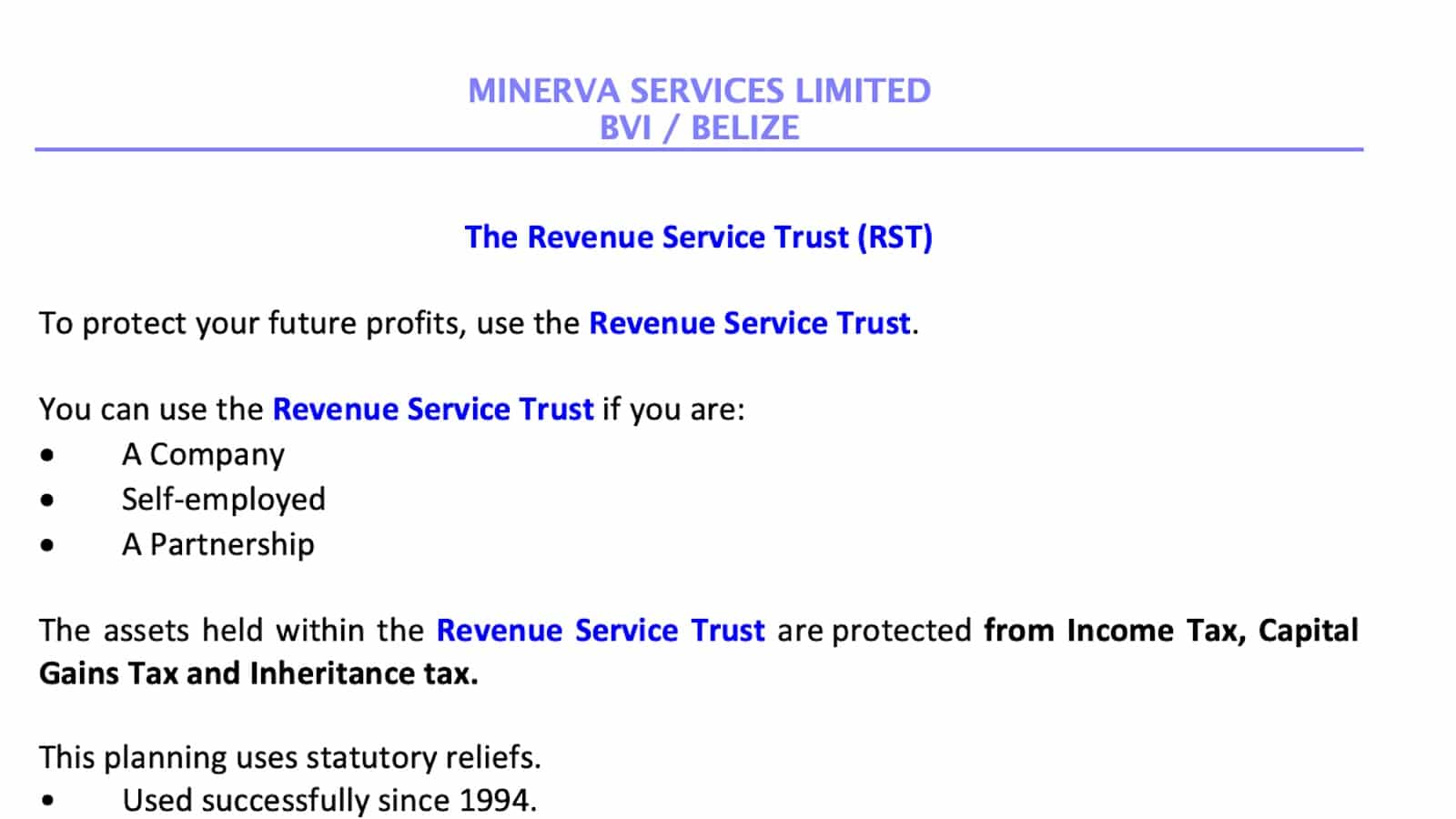
The “Revenue Service Trust” is an arrangement where you sell your future income to an offshore trust, and so aren’t taxed on the income when it actually arises. Again, control of the assets is with a UK “personal management company”.
The documents
Here are the proposal documents for the three structures, as sent by Paul Baxendale-Walker to potential “introducers” last year.
All the above documents were circulated in 2023. Minerva Services Limited was struck off on 1 January 2024, but we expect there is a successor company selling the same schemes (perhaps also called Minerva Services; perhaps something else).
These schemes are all highly artificial tax avoidance schemes. Such schemes have been repeatedly struck down by the courts over the last 25 years.14
The claims the schemes aren’t avoidance and aren’t contentious are deluded. Any reasonable person would conclude the only purpose of these schemes is to avoid tax.15 That engages a large number of anti-avoidance rules, most of which didn’t exist when these schemes were invented in the 1990s. Like the GC Wealth offshore trust structure, these structures are technically doomed.
It’s our view that no reasonably competent tax adviser would think the schemes have any prospect of success. Identifying precisely *how* the schemes would fail is not easy – HMRC would have multiple lines of attack. Here is a brief summary of the problems, as identified by our very experienced team of KCs, tax accountants, solicitors and retired HMRC officials.
No disclosure to HMRC
All three schemes are mass-marketed schemes which use standardised documentation and charge premium fees, where the sole or main benefit is to obtain a tax advantage. The schemes should, therefore, be disclosed to HMRC under the DOTAS rules (probably by the scheme users, as the promoters are offshore). We believe they aren’t disclosed to HMRC. If that’s right, any taxpayer using the schemes faces penalties for non-disclosure, and HMRC has 20 years to come back and challenge the schemes.
Sham/void sale agreemens
The magical nature of these trusts is such that they may as well not exist. Legal ownership of the assets remains where it always was. Control over the assets remains with the client.
Two questions. First, does anything in practice change at all after the trusts are put in place, other than the claimed reduction in tax? Second, does the client really intend that a strange offshore entity will have beneficial ownership of his or her assets? If the answer to these questions is “no”, then the arrangement may be a sham, and disregarded for tax purposes. A Baxendale-Walker remuneration trust was found to be a sham in the Northwood case.
Alternatively, the weird nature of the documentation means that the agreement to sell the assets into the structure may be void.
These are good outcomes for clients of these structures, because if they are valid there are likely to be an array of deleterious tax outcomes, often triggering far more tax than the structure was intended to avoid. Attempts to have the structures set aside on grounds of mistake of tax law have failed in the English courts.
Stranger danger
There are two contradictory propositions in the three structures. First, the UK fiduciary company has complete control over the trust assets. Second, the UK fiduciary company is valueless. These can’t both be true. If the UK fiduciary company has complete control over valuable assets then the company is valuable. This would have a variety of entertaining tax consequences. And if the UK fiduciary company doesn’t have complete control then congratulations: you’ve just given your assets to a stranger.
There will be up-front capital gains tax on the disposal of assets.17 It is incorrect to say that any holding of assets is a “business” for this purpose – there has to be an actively managed business. Personal assets are not business assets. But the more serious problem is that any realistic interpretation of s162 will not permit assets to be transferred to a company for five minutes, then to be immediately gifted to a trust. That is not the “transfer to a company of a business as a going concern”. Nor is the consideration really shares – the preordained arrangements mean the shares are worthless (and so either aren’t the consideration, meaning s162 fails, or the benefit of hold-over is zero). This is a gift.
The fact there is a gift means there are adverse inheritance tax consequences too. The inheritance tax rules for employee benefits trusts in s86 IHTA won’t apply because the client is both the owner of the company and a beneficiary of the trust (either because the client is listed as a beneficiary or because the client will receive beneficial loans). So there is a chargeable lifetime transfer to the trust, with an up-front inheritance tax hit, and ongoing 6% principal ten yearly charge and pro rata 6% exit charge. For the same reason, s239 TCGA won’t apply.
Remuneration Trust
The contribution to the trust is a chargeable lifetime transfer, with an immediate 20% inheritance tax charge (which, if the contribution is made by a company, is apportioned amongst its owners/participators). We expect an attempt is made to qualify for an exemption; realistically there is no prospect of that succeeding.
The “Tardis clause” seems to assume that legal documents travel backwards in time. They don’t. If the trust is declared void today, as a matter of English law it wasn’t void last week, and HMRC can open an enquiry into its position last week. The last time Baxendale-Walker ran this kind of argument in the courts, the judge dismissed it in two paragraphs.
Presumably the client wants the money at some point. That creates a problem, because at the point the trust makes a loan to the client, there will be a charge under the disguised remuneration rules. This has been a problem for previous Baxendale-Walkerremuneration trusts, many of which are now being challenged using “follower notices”. It’s unclear why this variant would achieve a different result. Previous attempts to rebrand Baxendale-Walker structures to escape anti-avoidance rules have ended badly.
The main problem with this structure is a basic failure to understand trust law. You can’t declare a trust sell your future income, and if you purport to do so, then that takes effect as a contractual agreement to sell future income as and when it arises (the usual authority cited for this proposition is Re Ellenborough). This is literally one of the first lessons taught to law students. So there will be a series of disposals as income arises, and each will be taxable (in particular capital gains tax and inheritance tax). The structure fails without even needing to apply detailed tax rules.
There are specific rules countering schemes where a person transfers a right to a future stream of income. The rules are very widely drafted.
The somewhat obscure “sale of occupational income” rules could apply (on the basis that the promise to make a contribution to the trust is “money’s worth”).
If for some reason none of these rules apply, the idea that you can escape all tax by selling your future income is unreal and unreasonable. The general anti-abuse rule (GAAR) would apply.
Why describe them as a scam?
We don’t believe schemes of this kind have any realistic prospect of success. The claims made in the promotional material about the schemes being uncontentious and escaping anti-avoidance rules are false. They are being mis-sold. Those selling the structure are at best reckless, at worst defrauding their clients.18
It is likely that HMRC will challenge the arrangements if it becomes aware of them. For this reason, we suspect that most users of the scheme won’t disclose them to HMRC – not being caught is the best chance they have of escaping tax. The nature of the schemes, with a UK company holding the assets supposedly as fiduciary, means that the schemes may not be straightforward for HMRC to identify.19 The structure incentivises tax fraud by users.
Many thanks to K for the original tip, and to James Quarmby, M, C, T, and V for the analysis. Thanks, as ever, to S for his review.
Baxendale-Walker’s letter to us talked about a “Minerva community” as if it was independent from him. The facts do not bear this out. The following footnotes set out some of those facts. ↩︎
The judgment in Northwood v HMRC [2023] UKFTT 351 (TC) includes the text of an engagement letter between Baxendale Walker LLP and a client, which includes an appendix saying that “MINERVA” is a separate business of Baxendale-Walker LLP, which sells and markets strategies devised by Baxendale-Walker LLP. MINERVA’s fees were 10% for every contribution to the trust. PBW therefore most certainly knew what fees Minerva was making and, on the basis of the text from his own engagement letter, he benefited from those fees. ↩︎
The judgment in Dukeries Healthcare Limited [2021] EWHC 2086 (Ch) describes “Minerva” as an “associated company” of Baxendale-Walker LLP. Again, the Baxendale-Walker LLP engagement letter provided for a fee equal to 10% of each trust contribution to be paid to Minerva. ↩︎
As part of some US litigation, a deed was disclosed under which Baxendale-Walker LLP said it held sums as bare trustee for Minerva Services Limited ↩︎
The judgment in Iain Paul Barker v Paul Baxendale-Walker notes that “As to [PBW’s] claim about lack of resources the Court was struck by three companies willing to financially assist Mr Baxendale-Walker, including his own remuneration trust, EW LLP, Minerva Ltd, Hawk, Brunswick Wealth and Burleigh House PTC Ltd.” ↩︎
The judgment in Paul Baxendale-Walker v APL Management Limited [2018] EWHC 543 states that, in May 2015, Baxendale Walker issued a claim “in respect of various fees that he alleged were owed to his companies (Baxendale Walker LLP and Minerva Services Ltd)” (my emphasis). That same case reports Minerva Services Limited (BVI), Minerva Services Limited (Belize) and Buckingham Wealth Ltd acting on behalf of PBW. ↩︎
There has been other litigation involving Minerva, the background to which is not clear to us, involving a Pankim Kumar Patel suing Minerva Services (Delaware) Inc, PBW himself and one other individual. The judgment is here. A witness statement is here, giving more of the background and with much criticism of PBW (although of course, as a witness statement, it must be taken with a pinch of salt). ↩︎
These introduction fees are in our view inherently corrupting – accountants receive large sums for no work, and have every incentive to refer clients to dubious schemes without any due diligence. But it’s important to note that the vast majority of accountants act properly and ethically in the interests of their clients, and indeed potential “introducers” were our sources for this article. ↩︎
We expect this kind of clause is actually in all Baxendale-Walker trusts. ↩︎
Following feedback from readers, we are now presenting documents using a PDF viewer rather than an image gallery. Do drop us a line with any comments on this approach. ↩︎
Noting as ever that metadata can only be indicative; by default on Windows it shows the name of the current user. It can therefore be wrong, e.g. if somebody uses someone else’s computer. It is also very easy to create false metadata. ↩︎
We didn’t approach Baxendale-Walker for comment because he has made clear he regards any attempt to communicate with him as criminal harassment. ↩︎
The GC Wealth structures were also advised as providing protection against divorce and against creditors. Those claims were false, but at least provided a potential non-tax rationale. The PBW proposals don’t mention anything other than tax. ↩︎
Such applications being in a different category from arguing that a bad tax result is a “mistake”. ↩︎
Potentially also s3 TCGA charges on future disposals by the trust, attributed to the client as the settlor. ↩︎
In 2017, the Court of Appeal found Baxendale-Walker to be negligent for not warning a client of the risk that his structure might fail. So it’s very hard to understand why these documents promote highly aggressive structures with no risk warning at all. ↩︎
Although once HMRC started looking into the structure, it would become apparent very quickly what was going on, because a company with legal title to assets would be claiming to be dormant and have no taxable income. ↩︎
The company was created in July 2024.1 But fair enough – people start new firms all the time.
The website lists no staff. That’s very odd for an accounting firm – it’s a business where reputation and client relationships are everything. Firms often start with barebones websites, but the website hasn’t been updated since it was created in July.
Despite the “let’s talk” button, there’s no phone number.
The Turner & Abel website says “You’re paying for qualified finanical (sic) and legal experts to build the best possible case for your innovation”. We can’t identify any qualified legal or financial professionals working for the firm.
In fact we can’t identify any staff at all. No staff are visible on LinkedIn. Someone gave Turner & Abel a LinkedIn account, but didn’t do anything with it. Zero followers. Zero employees. No text. That’s not how people launching a new firm normally behave.
The website has three testimonals, from Pixelbox, Tolemy Pharmaceutical and Bosen. We can find no evidence any of these companies exists. There is a Ptolemy Pharmaceutical and a Tolemy Bio, but they have different logos (and of course slightly different names). There is no manufacturing company called “Bosen” (there’s a Bosen Ltd, but it’s a mail order company). Pixelbox also doesn’t appear to exist, except in Wisconsin.
The three companies’ logos are also curious. The Pixelbox logo is taken from a stock image library – and, astonishingly, the name also comes from the stock image. The Tolemy logo comes from an image stock library. The Bosen graphic is in a few places on the internet, e.g. this blog. All three logos are all in the same colour.2Reverse images searches don’t find the three logos anywhere else on the internet.
The privacy page is unfinished, with template “suggested text” left in place throughout.
It’s not just coincidence. The website code shows that Turner & Abel has the same webmaster as Green Jellyfish’s affiliate, Kirby & Haslam.3
And we’ve heard the full story from sources at Green Jellyfish. The company made hundreds of fake R&D tax relief refund claims, claiming thousands of pounds for businesses that didn’t actually do R&D. At some point HMRC identified this, and started blocking refunds where Green Jellyfish was the agent.
So the answer was to create Turner & Abel and use it to make the claim. That’s what Turner & Abel did, and perhaps still does.
Who owns Turner & Abel?
On paper, the company is owned and run by Matthew Woolham. But we understand he’s just a junior sales manager who doesn’t make any business decisions. People should be more careful before they agree to become a company director, but in the circumstances of this group, Woolham’s ownership of a fraudulent company doesn’t necessarily make him a fraudster.
Green Jellyfish and its associates appear to intentionally hide the true ownership of their companies. That’s a criminal offence – but the individuals behind these companies (particularly Scott Herd, Daniel Robinson and Steve Christophi) probably have more serious problems than this right now.
Coleman Clarke’s website is similar to Turner & Abel’s, and similarly suspicious. Again the website illegally doesn’t provide the registered addressl it doesn’t even provide the legal name of the entity. However the registered address at Companies House gives the game away. Again the owner has no obvious connection to Green Jellyfish.
Clearview has been extensively used by Green Jellyfish and its affiliates but is hard to spot. The registered address is different, and there’s another owner with no obvious connection to Green Jellyfish. The company appears to have undertaken legitimate business; but more recently it’s been used as a “name” by Green Jellyfish staff, for making calls to clients, and for submitting claims to HMRC.
Comments are now closed for legal reasons. Our apologies.
The Turner & Abel users.json file shows that the Turner & Abel has the gravatar hash 18f89a4653223cd15cfcde8eea0c3cb7. The webmaster of Kirby & Haslam has the same gravatar hash. ↩︎
We frequently receive tip-offs from accountants and lawyers who’ve seen firms promoting dubious tax schemes.
This often requires a large amount of analysis from us to work out exactly what’s going on, and what the true tax consequence is.
But sometimes it’s obvious that what’s being proposed is wildly improper, even fraudulent. We’re going to start publishing cases like this as “tax scam of the day” – documents and links plus a short explanation of why what’s proposed is a scam.
We hope that this helps warn potential clients off dangerous scams, and prompts HMRC and other authorities to be more proactive identifying and closing down cowboy tax advisers.
What’s the claim?
Corporation Tax Rebates’s website says they’re the “UK’s First Corporation Tax Recovery Service Based on Data Risk Compliance”. The pitch is that GDPR can lead to large claims against businesses, so accounting rules permit companies to make large provisions against future liabilities, resulting in tax rebates.
If Corporation Tax Rebates Ltd is the “first” company offering this service, that’s for the very good reason1 that you can’t recover corporation tax based on vague thoughts that you might have to pay GDPR fines/damages at some point in the future. We explained why here but, in short, the fines/damages have to be probable and quantifiable, and for almost all small businesses this won’t be the case.
We can see no proper basis for timber wholesalers, architects, land developers or financial consulting business to have six figure provisions for GDPR damages. The obvious way to test this: how many companies in these sectors have had six figure damages awards against them? The answer is: hardly any. Civil damages awards are rare and small.
The danger for Corporation Tax Rebates’ clients is that this scam will appear to work. If you amend your corporation tax return then you may just get a refund automatically (although even this isn’t straightforward – see Richard Thomas’ comment below).
If HMRC become aware that a company’s doing this, we are confident they would open an enquiry, and the consequences for the company are likely to be bad. Any HMRC enquiry could come up to a year after the refund scheme… and, if it all goes wrong, good luck recovering your fee from Corporation Tax Rebates.
The documentation
There are many websites pushing GDPR tax credits, but most appear highly amateurish, and our suspicion is that they’re just low-level scams. Corporation Tax Rebates Ltd is different. The company and its introducers send out glossy publicity material that goes into some detail.
Ian Andrew Sinclair-Ford is listed as the “person with significant control” of the company 3 and the document metadata shows him as the author of the “confidential briefing note”. He gives his profession as “solicitor”.
We believe anyone with legal, tax or accounting training should know this scheme is improper. We therefore believe it should be investigated as criminal tax fraud, not as tax avoidance. We have reported Sinclair-Ford to the SRA
Many thanks to M for the original tip, and to Trevor Fenton for sending us the documents and looking into the Companies House materials.
We note that the documents are asserted to be confidential. They are not; they were sent to our source without any prior agreement of confidentiality, pre-existing business relationship or any other circumstances under which it is reasonable to expect a duty of confidence to arise. Even if they were confidential, there is a public interest in disclosure, and the iniquity rule means that there is never confidentiality in a fraud. ↩︎
Although it’s not clear that’s correct – each of the three holds 1/3 of the company. There are other oddities in the Companies House filings, with share capital of £105 but only one £1 share ever alloted/issued. ↩︎
R&D tax fraud outfit Green Jellyfish is part of a complex group of companies. Two of those companies, Macadam & Grant and Toucan Blue, promote “GDPR tax credits”. There is no such thing. It’s plain tax fraud.
We wrote last year about firms advertising that they’d help businesses claim “GDPR tax relief”.
The idea is that the Information Commissioner is very scary, and can slap large fines on businesses who breach GDPR, you might suffer massive damages. So it’s only prudent to amend your accounts for last year to put a reserve in place – reducing your profits and resulting in a tax refund.
But that’s wrong in three different ways. Only on rare occasions would accounting principles actually permit such a reserve – the liability has to be “probable”. Very few businesses ever suffer material fines or damages as a result of data privacy breaches.1 Civil damages awards are rare and usually small. The really big liabilities would be fines or punitive damages – but (aside from being unlikely) they’re not tax-deductible.23 And a reserve isn’t a “credit” – a credit is forever, but a reserve will be reversed over time.
A junior accountant would spot these issues in five minutes. In fact, one did – Yisroel Sulzbacher originally brought this to our attention.
One of the companies promoting the GDPR tax relief scam was Macadam & Grant:5
The launch of this product was seen as a big success by those running this business:6
And here’s Daniel Robinson, CEO of the Impact Business Partnership Group7 that owns Green Jellyfish and Macadam & Grant. Robinson says (at 1:40 in the video): “we also tested Macadam & Grant, which is our GDPR tax relief scheme business, which we’re currently taking to market at full scale during Q1 [2024]”:8
It’s jarring to see a bland corporate quarterly results presentation for a fraudulent business. Of course it’s possible that Robinson doesn’t understand that “GDPR tax relief” doesn’t exist. However, we know that employees raised concerns about this “business” with the board and were brushed aside.9 So it seems to us that, at the least, Robinson and the others were reckless
The hard sell
Macadam & Grant operated in exactly the same way as Green Jellyfish. Cold-calls from the BDEs (“business development executives”) and then follow-up emails promising massive tax refunds.
Here’s an example email from Macadam & Grant, forward to us by an outraged tax adviser:10
Like Green Jellyfish’s R&D claims, the figures bear no relation to reality. The idea any company, other than the very largest, faces six figure GDPR fines/damages is laughable. But this is worse than Green Jellyfish – at least R&D tax relief is real. Macadam & Grant was promoting a tax relief that doesn’t exist. This email was fraudulent on its face.
Here’s a promotional video posted by Toucan Blue on LinkedIn. They avoid the term “GDPR tax credits” and talk about “data security relief”, but it’s clearly the same fraudulent product:
And a website:
Toucan Blue appears to have soldother tax products – we are highly suspicious of how genuine those products are.
Toucan Blue is registered to the same address as Macadam & Grant and the other Impact/Green Jellyfish companies. It was owned by Daniel Robinson until June this year. Between then and 27 August 2024, the sole director, and sole “person with significant control”11 was Trudi Duncombe. Ms Duncombe ceased to be a director on 27 August, two days after we published this article, but is still listed as a PSC.
Who else is flogging this scam?
There are other companies flogging this. We believe all are fraudulent, including:
However there are significantly fewer people pushing this than when we first wrote on the subject – many of the companies we listed then have taken down or amended their websites.13
Green Jellyfish’s response
We wrote to Daniel Robinson on 22 August, and said that we believed these companies’ GDPR relief claims were fraudulent.
We received no substantive response, but the Toucan Blue website was taken offline shortly afterwards.
The Impact Group
Most R&D tax fraud is carried out by individuals or small companies. It’s very unusual to see a reasonably sophisticated group of companies (the Impact Group) involved in something like this. To see them involved in another unrelated fraud suggests a systemic problem with the group.
We hope there is a criminal investigation of all involved.
Many thanks to Paul Rosser for the chart, to M for the tip-off about Macadam & Grant, and to the current and former Impact Group employees who’ve bravely spoken to us.
And thanks to Yisroel Sulzbacher for the original tip about the non-existent relief.
Comments are now closed for legal reasons. Our apologies.
Footnotes
FRS 102 says a company can only recognise a provision if the liability is “probable” and can be “estimated reliably” ↩︎
A GDPR fine or punitive damages claim is non-deductible for corporation tax purposes, even if it reached by way of settlement. Damages paid out in a civil claim that compensate for actual loss (as opposed to punitive damages) may be deductible, but such claims are unlikely (and the figures would for most companies be small). ↩︎
Even if you manage to book a reserve and get a deduction, you still fail, because reserves created primarily for a tax benefit aren’t deductible anyway (and neither are the adviser’s fees). A tax tribunal recently used that principle to deny a business a tax benefit from a reserve created for unfunded pension liabilities – which were much more real than these fictional GDPR liabilities. ↩︎
We’d missed the Forbes Dawson and Justin Bryant pieces when we wrote our first article; full credit to them for spotting the issue. ↩︎
This is from an Impact Group internal communication sent to us by a source. ↩︎
There are many companies/groups called “Impact” – please be wary about drawing conclusions about any similarly named company, unless it operates from Rose Lane in Norwich ↩︎
Video kindly provided to us by a source, and authenticity confirmed with other sources. ↩︎
There appears to have been significantly more internal resistance to their GDPR tax relief business than to their R&D tax relief business. We expect the reason is that some technical knowledge is required to know that their R&D tax relief business was fraudulent; however one Google search reveals the problem with GDPR tax relief. ↩︎
We have redacted identifying information, but none of the text is changed. This was sent to us before we started investigating Green Jellyfish, and we only belatedly made the connection. ↩︎
It’s unclear why, as no Companies House documents show Ms Duncombe holding any shares; possibly there is a trust arrangement behind the scenes? ↩︎
Possibly defunct; the website’s security certificate is out of date. Not to be confused with the reputable and unrelated Osborn Knight Solicitors↩︎
None responded to us last year when we wrote asking how they justified advertising a relief that did not exist. We’ve written to the four above. We found a few others, but the websites appeared to be broken/abandoned – the above four appear live. ↩︎
The UK loses £1bn each year to fraudulent claims for research and development (R&D) tax relief. We revealed last week that one of the largest firms in the market, Green Jellyfish (and its associated firm Kirby & Haslam), made fraudulent claims. We can now reveal in detail how the fraud worked. We believe they’re responsible for over £100m of fraudulent claims.
Unqualified sales people cold-called businesses with no R&D (like carpenters and care homes), and promised them R&D relief would be available. “Technical writers” – none of whom had any relevant experience or qualifications, and many of whom had creative writing degrees – wrote reports justifying the relief. The employees were given briefings with examples of supposedly valid claims. But those briefings were false – none of the example projects actually qualified.
We are today publishing the details of how Green Jellyfish, Kirby & Haslam and other “Impact Group” companies worked from the inside, together with their internal briefing documents.
Green Jellyfish promised their clients they had a team of expert R&D specialists.
This is from a promotion sent by Green Jellyfish to care homes in 2022, talking about their team of “Tax Specialists”:
This is from their website and LinkedIn pages (as of 23 August 2024) – “we are the R&D tax experts”, a “team of specialists” and “a team of Research and Development Tax Specialists”:
And this email to a client (in 2022) talked about “an FCA regulated team of experienced experts in this field”.
The reality – zero expertise
We have not found a single Green Jellyfish or Kirby & Haslam employee with any background in tax, accounting, law, science, or technology.1
We identified ten Green Jellyfish technical writers using open source materials, and metadata from our dossier of the company’s R&D claims. In most cases they were hired straight from university. In other cases they had unrelated previous experience.
The cold-calls to clients, in which clients are assured that R&D tax relief will be available, came from “business development executives” (BDEs). Successful leads were passed to “business development managers” (BDMs) who would have telephone meetings with the clients.
This was a large team with high turnover- we’ve identified over 50 individuals who worked in this role for Green Jellyfish from 2021. They typically had a sales background, but none had any expertise in any legal, accounting, tax or technical area:3
So this was a team with zero expertise. Clients were lied to.
The employees’ story
We have been speaking to current and former Green Jellyfish employees. We have verified their employment from LinkedIn, historic emails, and document metadata.
Their stories are consistent, and paint a picture of a business that worked like this:
The sales teams
The business development executives (BDEs) cold-called clients and sent follow-up emails which (without exception, as far as we’re aware) said the BDE was confident a claim could be made.
They would target different sectors on different days, obtaining company details from Companies House and then looking up phone numbers on Google. For example: two days electricians, then plumbers, then bricklayers, groundworkers, pubs etc. The one thing these sectors had in common was that they were highly unlikely to qualify for R&D tax relief. Two sources have told us they believe that was intentional: it meant Green Jellyfish wouldn’t be competing with other advisers.
Potential leads were passed to business development managers (BDMs) for follow-up calls. There were about 15-20 BDEs at any one time, and 10-15 BDMs. As we note above, none of the BDEs or BDMs had any technical background or experience.
The BDMs asked clients about their business in very general terms, and were supposed to identify “innovative projects”. The BDMs were given lists of example qualifying R&D expenditure (see below), but in practice BDMs almost always said R&D relief was available.4
The BDEs and BDMs saw this purely as a sales job, and had no understanding of the legal requirements, or the consequences of wrongly claiming tax relief.
Several BDMs/BDEs have told us they were given the initial explanation that almost everything qualified for R&D tax relief if you worded the claim correctly.
BDEs and BDMs were under huge pressure to meet sales targets. There was rapid turnover of the BDE and BDM teams (unusually high even by the standards of junior sales jobs).
Some of the BDMs relied heavily on ChatGPT to write their notes.
That was particularly the case when, later on, BDMs were hired in the Philippines and South Africa – they heavily (one source thought “exclusively”) wrote to the technical report team using ChatGPT.
The numbers
The BDMs would put numbers together for the tax relief claims based on the clients’ accounts and corporation tax returns.
Sometimes this followed a discussion about potential R&D projects. Often it didn’t.
We have seen multiple emails from BDMs to clients saying that they would establish the qualifying R&D expenses by looking through the company’s accounts and tax returns. Qualifying R&D expenses cannot be calculated in this way – individual projects must be identified.
Several sources5 have told us that the BDM team would have “industry standards” of the amount they could claim for each sector – for example 20% for care homes. Later they would adjust percentages slightly so the numbers didn’t look too round, for example 20.21%. Later still, different percentages were used for different categories of expense. If our sources are correct, this would be blatant fraud. We would, however, caution that (unlike most of the other information provided to us by our sources) we have no documentary evidence to directly support this claim, and our sources could be mistaken or exaggerating. However we have noted many of the claims in our dossier are almost-round percentages of the company’s expenses.
Our sources have different views on the total volume of claims made by Green Jellyfish, but they all agree the total must be more than £100m. We believe that’s consistent with Green Jellyfish’s accounts. 6
HMRC are now very alert to refund claims. Several sources told us Green Jellyfish had been “blacklisted” by HMRC, and no refunds would be made when Green Jellyfish was the agent. One solution was to use affiliated entities. Another was to find businesses who were about to submit corporation tax returns, and make last minute changes to add large amounts of R&D tax relief – HMRC would then have no idea any R&D agent had been involved. (We would caution accountants to be alert to this.)
The technical team
Sometimes a BDM sent a note of their call with the client to the team of “technical writers” to prepare a report.
A report was required after August 2023, when HMRC tightened claim procedures. Before that, the technical team were only involved in some cases (we believe, but aren’t sure, it’s where there was a more realistic identifiable R&D project). More often, the claims were like Sophie’s, where a claim was submitted without a report (but a report produced much later if there was an HMRC enquiry).
The technical writers were formally employed by Kirby & Haslam, not Green Jellyfish, but in practice the two companies operated as one business.
As we note above, most of the “technical writers” were hired straight out of university with no prior experience. Many had English literature and creative writing degrees; a few had other Arts degrees. None had any prior R&D, legal, accounting or tax experience.
Two of the “technical writers” were referred to as “R&D Tax Specialists” by BDEs on client calls within a few weeks of starting work for Green Jellyfish.
The technical writers realised quite quickly that there was nobody around with any tax qualifications. The BDMs and BDEs sometimes did not realise this, and one we spoke to appears to have genuinely believed that the technical writers were experts.
The reports
We have seen images of notes sent by BDMs to the technical writers. We aren’t publishing them because of the risk our sources could be identified – but we would describe the text as poorly written half-descriptions of a standard care home business. We believe we can link one to a case where a six figure sum was claimed from HMRC (and later had to be refunded, with penalties).
It was made very difficult for the technical writers to refuse to write reports based on the BDM’s notes. If they could not write a report, the claim would go to HMRC anyway, pre-Aug 2023 (after that, the rules were tightened and additional information specifying the R&D had to be provided to HMRC).
The technical writers were dissuaded from telling BDMs that claims did not qualify for tax relief – this was considered “aggressive language”.
Some of the BDMs referred to the technical writers as the “sales prevention department”.
We have now seen many reports prepared by the technical writing team. We have not seen one which actually meets the conditions for R&D tax relief.
The group structure
The business was run day-to-day by Daniel Robinson and Scott Herd, with Steve Christophi known to be involved at board level, but rarely seen.
Several of our sources commented on the obscure group structure, with the BDMs in a different company from the technical writers. They thought this to make it easier for the technical writers and BDMs to blame each other for poor quality claims.7
There was also a “legal team” made up of recent law graduates. They were called “paralegals” but this was not accurate – the term “paralegal” usually means someone with legal training working under the supervision of a qualified lawyer. So far as we are aware, there were no qualified solicitors or barristers working for Green Jellyfish or any of the associated entities.8 The paralegal team got involved when HMRC opened an enquiry into a Green Jellyfish claim. We have also seen a number of legal letters and emails drafted by the “paralegal” team. The letters rely heavily on Google and show signs of being written by ChatGPT or a similar LLM.
The junior personnel working for Green Jellyfish had an appalling experience in a very hostile environment. We don’t see them as morally or legally responsible for the false R&D tax claims. At least two made anonymous reports to HMRC. The blame lies with those who hired staff with no experience and fed them false information, knowing that clients would be misled.
The fake training materials
Green Jellyfish gave the business development and technical writing teams examples of what they said were valid R&D relief claims; these were sometimes also given to clients to “help them identify” qualifying projects.
Here’s Green Jellyfish’s list of examples of R&D projects run by care homes (PDF here):
As a general proposition, the prospect of any care home having qualifying R&D relief is highly unlikely. A care home and its staff may be very innovative in how they plan and deliver care, but it is hard to see how they will ever look for “advances in science and technology”.
But, despite this, care homes were a key market for Green Jellyfish. Two of our sources estimated that care homes made up 40% of Green Jellyfish’s business and 25% of the group companies’ business.
In our view it is clear that none of the examples in this list are valid:
Some are not science and technology at all: e.g.: “Manage and control symptoms of dementia through a wide range of interior and exterior designs” and “Management of a specialised outdoor garden design to mitigate common dementia symptoms”
Others are just using existing technology, e.g. “new software… installation of sensors… to optimise the delivery of care services and… in particular, the detection of symptoms relating to diabetes, addiction, and dementia”, or “create a data analysis tool that can detect and recognise dementia traits”.
Some of the projects would qualify, but it’s implausible a care home would ever have the expertise, resources or facilities to carry them out. Seeking to “advance the field of clinical neuroscience” or “advance the scientific field of neurology” are realistic objectives for a hospital or laboratory, but not a care home.
Green Jellyfish also gave their staff and clients this document, again focusing on care homes (PDF here):
The summary of the qualification criteria are reasonably accurate. We believe anyone with an accounting, tax, legal or technical background reading these paragraphs will realise immediately that care homes usually won’t undertake “research and development”. But nobody in the business development or technical writing team had that background.
In our opinion the examples are, once more, all clearly invalid:
“Developments in care plans” are not an advance in science and technology. Green Jellyfish seem aware of this, by adding the caveats “if the specific care plan is an advance in science or technology” and “and is not easily deducible by a competent professional within the field”. But we don’t believe any care plan can be an advance in science or technology, and given it’s devised by professionals in the ordinary course of their business, it will be “easy deducible”. The caveats look like someone was trying to cover their back.
“IT software designed by organisation for bespoke needs of clients/ carers”. Software will only in exceptional cases be an “advance in science or technology”.9 Realistically, care homes will use existing platforms and technology with minor modifications.10
“Use of AI for service standardisation, operations, and capture of new symptoms within patients”. We doubt any care home will develop its own AI systems. It is much more likely it uses existing platforms such as OpenAI/chatGPT – and that will not be an “advance in science and technology”.
“Development and implementation of biosensors and trackers in clothing of residents and carers to monitor changes in health”. We very much doubt the care homes are developing biosensors/trackers. They will be buying off-the-shelf products. That is not an advance.
“Technology suppliers in the sector (e.g., Birdie) during COVID-19: e.g. partnering… with NHSX for Techforce19 to build the NHS111 symptom tracker into the Birdie app”. Integrating an existing service into an app is obvious, and not an advance in science or technology.
“Revolutionising technology relating to medicine (trying to mitigate medicine waste)”. It is not plausible a care home has the equipment, resources or staff to “revolutionise technology”.
“Improving or creating technology to address a specific scientific or technological problem within the care sector”. This is so vague as to be meaningless.
“R&D within risk assessments – creating a plan that is able to reduce the potential for harm or risk”. Creating a plan is not a scientific or technical advance.
“Innovation in approaches to Dementia care (or other neurological conditions), especially the use of activities and tools to aid recollection”. Using activities and tools is not a scientific or technological advance.
The more detailed “specific client examples” in the documents are, again, invalid:
Implementing behaviour strategies is not an advance in science and technology. Developing a computer programme is not usually an advance in science and technology (unless e.g. it goes “far beyond routine adaptation of existing technologies“). “Recording a person’s behaviour in real time” sounds routine, and not much like an advance at all.
Video interviews and streamlining recruitment are not advances in science and technology.
Designing gardens for people with dementia is not an advance in science and technology, and a garden designer is not a competent professional in the field of neurology.
Advancing the scientific fields of neurology and neurobiology absolutely could be a scientific advance qualifying for R&D relief, but we are very doubtful any care homes have the resources, expertise or budget for neurology research.
The game is given away by the second bullet point. A highly experienced nurse is providing care; he or she is not making scientific advances, and is not a competent professional in the fields of neurology and neurobiology.
The use of the term “neurobiology” is particularly silly. Neurobiology is the study of nerve cells at the molecular level, requiring a sophisticated laboratory. We expect the author didn’t know what the term meant.
These examples corroborate what we were told by current and former Green Jellyfish employees – that they were instructed that almost everything qualifies for R&D tax relief, provided the claim is worded correctly.
These instructions, and the lists of examples misled Green Jellyfish staff and their clients. We think this was intentional.
Who ran Green Jellyfish?
The different entities involved in the business have a variety of different owners, in some cases changing entity and owners over time. Back in 2023, all were listed as part of the “Impact Group”; today they are more shy about admitting that the entities are linked.
Three names come up again and again when we speak to current and former employees.
Steve Christophi, who owns Kirby & Haslam. He is not listed as a shareholder or director of Green Jellyfish, but he was described as a “stakeholder” in internal communications, and our sources report that he was one of those running it. It is notable that, when Paul Rosser wrote about Green Jellyfish, it was Steve Christophi who went to talk to Paul about it (Christophi’s version) or intimidate him (Paul’s version).
Scott Herd was listed as the “Non-Executive Chair” of the Impact Group in 2022 and 2023, and described as “a crucial board member at one of the leading R&D tax credit firms in the UK”. He was previously a director of the current Green Jellyfish entity.
Others are undoubtedly responsible. Paul Rosser researched a structure diagram which reveals other names; we will be writing more on this soon.
Green Jellyfish’s response.
We asked Green Jellyfish to comment on the documents and the evidence of their unqualified staff and unethical business practices. We also warned Messrs Robinson and Herd that we would be naming them in this article:
Green Jellyfish’s lawyers, Fladgate, are still acting. However, despite the seriousness of the allegations, we received a response from Green Jellyfish rather than from their lawyers. This is surprising given the seriousness of the allegations we are making.
The response complains about our timetable, makes a series of irrelevant claims about Steve Christophi’s peculiar visit to Paul Rosser, demands that we review a recording of that visit (we are unaware a recording exists), and demands “specific, detailed questions and concrete evidence to substantiate [our] claims”. They refuse to respond until we do this.
Our response was as follows:
Evidence of fraud
One explanation is that this was all an accident. That those running Green Jellyfish and its other affiliates were acting in good faith, but completely misunderstood the law. They thought all innovations qualified for R&D Tax relief, hired the wrong staff, created wrong examples, and so forth. It would follow that, whilst they were responsible for a large number of incorrect R&D tax relief applications – they did not know that would be the outcome, and no question of fraud arises.
We find this explanation implausible on its face.
As we have mentioned above, we believe that anybody with any appropriate experience would realise that the guidance provided to the staff was (and Steve Christophi, one of those who run the company, is a chartered accountant).
And even if we (charitably) assume Christophi, Herd and Robinson started out acting in good faith, they surely would have realised something was going on when they started to see HMRC challenge their claims and explain very clearly why the claims were being challenged.
At this point an honest person would stop and ask whether there was something in their procedures which was resulting in so many failed claims.
But there is no sign that this happened. Our sources suggest that things actually got worse, not better, as HMRC tightened up its procedures. Even by the sorry standards of cowboy R&D claims firms, this was extraordinary.
It is therefore our view that those in charge of Green Jellyfish (who we believe were Christophi, Robinson and Herd) knew that false R&D claims were being made, and knew that they were misrepresenting the nature of their team to clients. If they were “dishonest” then this amounts to a fraud on their own clients, and on HMRC.
Dishonesty
Whether Green Jellyfish’s leadership team were actually dishonest is a question for a jury.
The jury would be asked to decide whether their conduct was dishonest by the standards of ordinary decent people (regardless of whether the individuals in question believed at the time they were being dishonest).11 The leading textbook of criminal law and practice, Archbold, says:
“In most cases the jury will need no further direction than the short two-limb test in Barton “(a) what was the defendant’s actual state of knowledge or belief as to the facts and (b) was his conduct dishonest by the standards of ordinary decent people?”
We expect that, presented with the evidence we have published to date, most ordinary decent people would say the behaviour of those running Green Jellyfish was dishonest. However, ultimately that is something for a jury to decide.
In our view there is more than enough evidence to justify a criminal investigation of Green Jellyfish’s leadership team, which we believe includes Christophi, Robinson and Herd.
Thanks above all to the current and former employees of Green Jellyfish for telling us their stories. Given Green Jellyfish’s history of legal and physical intimidation, this involved considerable bravery on their part.
Many thanks to K and T for their R&D tax relief expertise, and to P for additional research. Thanks, as ever, to S for his review and technical suggestions.
Paul Rosser of R&D Consulting reviewed a late draft of this article – Paul deserves full credit for discovering and pursuing this story over the last couple of years.
Two exceptions. First, Steve Christophi, who is a chartered accountant. Christophi was one of those managing the business and perhaps had ultimate ownership of it, but he played no part in day-to-day advice. Second, the web design and IT staff, who had obvious technical ability but played no role in the R&D tax relief claims ↩︎
After the events of the last few days, many Green Jellyfish employees and former employees have removed their profiles from LinkedIn and/or removed Green Jellyfish from their online CVs. We would discourage others from trying to identify junior Green Jellyfish personnel; we don’t think it’s fair to hold them responsible for the misdeeds of the business. ↩︎
“Complete Care Advisory” is another firm associated with Green Jellyfish; it provided services to care homes including false R&D tax relief claims. We do not know if its other services were bona fide or not. ↩︎
Possibly this should say “always”; nobody we spoke to was aware of a case where a client was rejected. The very poor quality of the projects that were identified by the BDMs suggested that few if any were rejected. ↩︎
Current/former employees of Green Jellyfish and its affiliates ↩︎
Because trade debtors are shown as £2.3m at December 2021 and £3m at December 2022. We can conservatively assume clients paid within 90 days, which implies over £25m of fee income, which (given their 20% fee) implies £125m of tax benefit claimed before the business became much harder in August 2023. Update – 27 August: Mark Strafford, of Sedulo Forensic Accountants and his R&D tax colleagues kindly conducted a high level review of these accounts for us, pro bono, and they agree that this is the right ballpark figure. (Although they believe 60 days would be more typical for this kind of business, implying that the true figure of Green Jellyfish claims may be higher than our previous estimate). ↩︎
We are not sure that’s right; the scattered group structure looks more like an attempt to hide the true ownership of the business and segregate liability. But we do not know for sure, and we could easily be wrong. ↩︎
Nor were any of the “paralegals” registered with the (voluntary) Professional Paralegal Register. We see the use of the job title “paralegal” as a cynical way to hire law graduates and hold out the false promise that this is the start of a legal career. ↩︎
See the Get Onbord case where an “impressive” machine learning/AI system created by a tech startup was found to qualify. The judgment says that a “massive amount of new code was written as part of the project, which goes far beyond “routine” adaptation of existing technologies”. ↩︎
One can imagine a scenario where a care home commissioned a tech company to develop a very sophisticated AI system, but we haven’t seen any examples of this in our Green Jellyfish dossier, or heard about any such case from our industry contacts. ↩︎
The subjective element of the test for dishonesty (see Ghosh (1982)) was removed by Ivey [2017] for civil cases, and that decision was confirmed to apply to criminal cases in Barton [2020]. The fact that a defendant might plead he or she was acting in line with what others in the sector were doing, and therefore did not believe it to be dishonest is no longer relevant if the jury finds they knew what they were doing and it was objectively dishonest. ↩︎
Comments are now closed for legal reasons. Our apologies.
BBC Merseyside is reporting on a ludicrous attempt to avoid business rates using snails. It is so stupid that I cannot do justice to it – please read the story (radio version here).
This is, however, just one of many stupid schemes to avoid business rates. And the bizarre thing is that historically they have mostly worked. Here’s why – and how the Government should step in.
The most well-known scheme doesn’t involve snails – it’s all about cardboard boxes.
The idea is that landowners grant a lease to a tax avoidance firm. The firm stores a few boxes in the property for six weeks1, then leaves and terminates the lease. This is claimed to be “occupation” and so, after the short lease terminates, the landowner claims “empty property relief” from business rates for the next three months.2 The landowner pays 20% of its tax savings to the tax avoidance firm. And then does the whole thing again when the three months ends. And again.
To a tax lawyer, this looks laughable. It’s an artificial scheme where the only purpose is tax avoidance – and the courts have spent the last 25 years striking down almost every tax avoidance scheme they’ve seen. This one isn’t even clever. I think most tax lawyers would expect the courts to shred box-shifting schemes in minutes.
But in fact the courts have repeatedly approved these schemes.
In the Principled case from 2013, the judge ruled for the landowner, saying:
“I cannot see any good reason why, if ethics and morality are excluded from the discussion, the thing of value to the possessor should not be the occupancy itself. The verb “occupy” and the nouns “occupation”, “occupancy” and “occupier” are, in the end, ordinary English words. Their meaning has developed in case law to give them a sensible construction, but they have not been given technical statutory definitions.”
And the same judge, in the Public Health England case from 2021, applied judicial reasoning from 1949:
And then one of his “propositions of law”:
“it does not matter if the possessor’s predominant or sole motive is mitigation of or exemption from rates liability“
(I’m appalled that a government body would not only buy a tax avoidance scheme, but then cause government money to be spent on both sides of litigation defending it.)
The reason this is so surprising to tax lawyers is that it’s not how modern statutory interpretation of tax law works. Following the Ramsay case in 1982, and the Furniss v Dawson case a year later, the courts began to apply tax law purposively, interpreting terms in light of their realistic purpose. There is an excellent summary of the law here, from law firm Norton Rose Fulbright. So when a judgment starts off by using the words “tax avoidance”, the result is almost always that HMRC wins, and the taxpayer loses.
Except business rates. As this article says, the courts seemed to accept that “rate mitigation schemes” were legal and proper practice.
The result was an explosion in business rates avoidance, driven by a mini-industry of “business rates mitigation advisers” charging 20% of the tax saving.
Box-shifting was the most common scheme, but there were numerous variants – my favourite (upheld by the High Court) involved the entirely tax-motivated installation of “blue tooth3 equipment”. The snail scheme seems particularly egregious, but it’s not insane to suggest it would have worked.4
Why did the schemes succeed?
So why was it that the courts have been merrily striking down every tax avoidance scheme they see, but approving business rates avoidance schemes? There’s no reason to think that business rates are any different from any other tax.
Informed observers5 have suggested three key reasons:
HMRC has had massive success litigating avoidance schemes in the last 25 years, and lost very few cases.6 However, business rates cases are usually litigated by local authorities, who don’t have this experience or expertise.
The lawyers acting for the local authorities tended to be planning and local government lawyers, not tax specialists. Undoubtedly they are very able, but they did not run the cases as tax avoidance cases. So in the Principled and Public Health England cases, Ramsay was not even argued.7
Cases don’t come before tax tribunals and tax judges, who would have disposed of these schemes in fifteen minutes. Instead they usually end up as judicial reviews8, and (very unsatisfactorily) these courts did not apply the modern approach to interpretation of tax law.9
This all changed in 2021 with the Hurstwood case, when a particularly aggressive business rates avoidance case hit the Supreme Court.
Things are looking bad for the landowner when we get to the fourth paragraph of the judgment:
“The liquidation version of the scheme (in the form described in this judgment) has already been judicially branded an abuse of the insolvency legislation in proceedings for the winding up in the public interest of a company which promoted and managed such a scheme: see In re PAG Management Services Ltd [2015] EWHC 2404 (Ch); [2015] BCC 720. As will appear, the dissolution version of the scheme is no less an abuse of legal process and may in certain circumstances involve the commission of a criminal offence.“
And, as often happens, particularly bad facts result in a significant change of judicial approach that will affect everybody.
And then it only took one paragraph to reach the obvious conclusion:
“In our view, Parliament cannot sensibly be taken to have intended that “the person entitled to possession” of an unoccupied property on whom the liability for rates is imposed should encompass a company which has no real or practical ability to exercise its legal right to possession and on which that legal right has been conferred for no purpose other than the avoidance of liability for rates. Still less can Parliament rationally be taken to have intended that an entitlement created with the aim of acting unlawfully and abusing procedures provided by company and insolvency law should fall within the statutory description.“
When it comes to tax avoidance schemes, the common-sense result is usually the correct legal result. The taxpayer lost.11
So how come the High Court, and the Court of Appeal had come to the opposite conclusion? Because, said the Supreme Court, the local authorities and their lawyers had been rubbish at arguing their case. I paraphrase only slightly:
“The courts below appear to have received little assistance from counsel for the local authorities as regards the purpose of the rating legislation; and the same was true in this court. It is perhaps unsurprising that in these circumstances the judge and the Court of Appeal did not adopt a purposive approach to interpreting the relevant statutory provisions and considered that the “owner” as defined in section 65(1) of the 1988 Act must invariably and even on the assumed facts of these cases be identified as the person who is entitled to possession of a hereditament as a matter of the law of real property.“
They should have hired a tax lawyer – and then the local authorities wouldn’t have spent a fortune on taking a simple case all the way to the Supreme Court.
But aren’t business rates an unfair burden on many businesses?
Not as much as is often claimed. The evidence suggests that most of the economic burden of business rates falls on landowners, not retailers/tenants. This is a counter-intuitive result, and retailers often argue strongly that it’s they who are paying. They are, however, wrong – retailers pay the tax, but in the long term the burden is passed to landowners in the form of lower rents, with 75% of the cost of business rates passed onto landowners after three years.
There are certainly problems with business rates, not least that the slow five year cycle of revaluations means that retailers can be caught paying business rates that are out of all proportion to their rent.
The Sunak Government ran a consultation last year on business rates avoidance. The 2024 Spring Budget announced three outcomes:
The Finance Act made box-shifting a bit harder, by requiring premises to be reoccupied for 13 weeks rather than six weeks.
The Government said it would consult on extending the general anti-abuse rule (GAAR) to business rates.
There would be communications to warn landowners off cowboy “mitigation” firms.
This doesn’t go far enough.
The Hurstwood judgment should end all the avoidance schemes, but experience suggests that the avoidance firms will continue to flog schemes, take their 20% fees, and then disappear when – years later – the courts strike them down.
The Government should do three things.
First, drag business rates into the 21st century, and make sure all modern anti-tax avoidance rules apply to business rates. That means:
Introduce a targeted anti-avoidance rule (“TAAR”) for business rates. We see TAARs in most modern tax rules, and they work like this: if you do something artificial which has the sole or main benefit of reducing or eliminating your business rate liability, then it has no tax effect. Scotland has already done this; the rest of the UK should follow their lead.
Business rates should be covered by DOTAS, the rules that require tax avoidance schemes to be disclosed to HMRC.
Second, and more controversially, consider fixing the administrative problems that led to ten years of stupid avoidance schemes:
Everyone involved will hate this proposal; but Government should give serious consideration to requiring all non-valuation business rates litigation to be delegated to HMRC. Or, if that’s too unpopular, or administratively difficult, require HMRC to be consulted on business rates appeals involving points of law.
Another unpopular proposal: the Government should consider a new right of appeal to tax tribunals for non-valuation business rate disputes. Tax tribunals are far better placed to hear what are in reality tax disputes. The risk would be a large increase in poor quality appeals, taking up both tribunal and local authority time – one way to avoid that would be to charge higher fees for business rate tribunal appeals.
And: local authorities, when you’re dealing with tax avoidance, please hire lawyers who have expertise in tax avoidance.12
Finally, none of these technical measures will deter cowboys like the snail promoter:
So the Government should crack down on promoters of hopeless schemes – business rates as well as other tax avoidance schemes.
Make failure to comply with DOTAS a criminal offence.
Make it a criminal offence to promote a scheme or tax position which is so unreasonable no reasonable adviser would think that it works.
And impose tax-geared penalties on advisers, and their directors/shareholders, when they promote a scheme or tax position that is so unreasonable no reasonable adviser would think that it works.
Business rates need to grow up and be treated like other taxes. And the Government should empower HMRC to go after promoters, not the taxpayers they exploit.
Rachel Reeves vs the snails shouldn’t be a close fight.
Meaning: not me. I am a tax avoidance expert but not a business rates specialist, and this article leans heavily on people who are business rates specialists ↩︎
Their failures have been in failing to challenge schemes early enough). ↩︎
See para 76 of Principled: “[The Ramsay doctrine] is not relied on in the present case and [it is something] which I will not attempt, at my peril, to paraphrase.” ↩︎
Most business rates disputes are around the value of the property and these go to the Valuation Tribunal; but there is no route for appealing technical business rates points other than judicial review ↩︎
Para 117 of Principled suggests the judge didn’t understand Ramsay at all – he said “The cases on sham transactions, those founded on the Ramsay principle, and those founded on lifting of the corporate veil, do not provide the answer either. There is no question here but that the transactions are genuine and produce the legal results for which, by the wording of the documents, they provide.”. That is not the test in Ramsay – the genuineness of the transactions and the absence of sham does not prevent it applying. The judge should have required the parties to present arguments on Ramsay and other common law anti-avoidance caselaw. ↩︎
Although, in fairness, the not tax lawyers did occasionally beat the tax lawyers, although an appeal is pending. Many thanks to H (a tax lawyer) for bringing this to my attention just after publication. ↩︎
The Hurstwood judgment came just a few weeks after Public Health England, which must be regarded as wrongly decided. ↩︎
I accept no fee-paying work and have no interest in any law/accounting firm, so I can say this without a conflict of interest. ↩︎
The UK loses £1bn each year to fraudulent claims for research and development (R&D) tax relief. We can reveal that one of the firms responsible is Green Jellyfish – one of the largest firms in the market. Green Jellyfish says it’s a specialist in research and development tax relief, and that they help companies claim an average of £32,000 in tax refunds from HMRC. But they claim tax relief that doesn’t exist, and then cover it up with the help of an affiliate, Kirby & Haslam. They’re making £3m a year in profits from ripping off the taxpayer and their own clients.
We can identify that one of the largest R&D firms in the market has submitted a series of fake and potentially fraudulent R&D tax relief claims: Green Jellyfish. We have a dossier of clearly fake2 R&D tax relief claims made by Green Jellyfish and its associates. This article focuses on one – where Green Jellyfish’s client/ victim was Sophie3, who runs a small therapy business.
Green Jellyfish promised Sophie a “no win no fee” R&D tax relief claim, but there was never any basis for it, and when HMRC challenged it, Sophie was left with large bills. We believe she was defrauded. In other cases, where HMRC didn’t spot Green Jellyfish’s false claims, it will be the taxpayer who was defrauded.
We believe there is enough evidence for HMRC and the police to commence a criminal investigation, shut down Green Jellyfish’s business, and protect both their clients and the wider public interest.
R&D tax relief
R&D tax relief was created to encourage small companies to invest in research and development. It gives profit making companies a tax deduction which reduces their corporation tax bill, or in the case of loss-making companies the ability to surrender their losses for a cash payment from HMRC.
The Times reported in 2022 about highly questionable R&D tax relief claims, with restaurants being encouraged to claim R&D relief for vegan menus. In our view, claims like this have no legal basis and may be fraudulent.
Sophie runs a small therapy business. In 2021 she had £46k of revenue. She paid herself a salary of £12k, and had a profit of £18k (after other costs and corporation tax).
In 2022, Sophie was cold-called by Green Jellyfish, who said they thought her business could claim R&D tax relief.
As Sophie puts it:
“GJF from the start were persistent but very friendly and approachable, they seemed to know exactly what R and D was about, whereas I had never heard of it before. They were confident that my business could claim and after initial doubts I naively put my trust and faith in them.”
After the call, Green Jellyfish sent a follow-up email to Sophie saying this:
There is and was nothing on Sophie’s website that suggested any R&D activity. Green Jellyfish was at no point FCA-regulated. 5
And they explained their process:
We don’t believe anyone who’d even casually perused the HMRC website could “safely say that [Sophie would] easily fall within the parameters of the scheme”.
Sophie had no financial or tax background, and trusted that Green Jellyfish knew what they were talking about. She took up the offer of a telephone consultation. During the call, Green Jellyfish asked Sophie about her business and whether she thought it was “innovative”. Sophie said it was6, but didn’t provide much detail about what she did
Green Jellyfish didn’t ask about whether there were any specific R&D projects – it’s pretty obvious there weren’t, and couldn’t be, when Sophie’s business had one employee/director who was a therapist, not a researcher or engineer.
The evidence of fraud
Green Jellyfish then asked for Sophie’s accounts and corporation tax return:
And off the back of that, with no information about any R&D activity, Green Jellyfish submitted an R&D tax relief claim.
We believe this was likely fraudulent for two reasons.
First, Green Jellyfish had no basis for making a claim, because Sophie gave them no basis. They never provided her with any statement of what precisely the claim would be for, much less the kind of report you’d expect from an R&D firm. As Sophie put it to us:
“I remember chatting to Andrew about my business on the phone but I still don’t know what he was claiming for!“
This therefore isn’t a case of Green Jellyfish staff misunderstanding the legislation or guidance. There’s no evidence they paid any attention to the rules at all.
Second, Green Jellyfish claimed Sophie’s entire staff costs as qualifying R&D expenditure.
Here’s Sophie’s accounts for 2021 – we’ve blanked out the last three digits to preserve her anonymity:
Note the staff costs of £12k – the only staff member was Sophie herself. And Green Jellyfish claimed all of that as qualifying R&D expenditure:
This doesn’t survive five second’s scrutiny. Nobody in the business of filing R&D tax credit claims could seriously think Sophie spent absolutely all of her time on qualifying research and development activity.
So why did they claim the entire £12k? We expect that’s because the only way an R&D relief claim for a company of this size would make sense, and justify Green Jellyfish’s fee, is if they claimed 100% of staff costs.
We should add that we can be certain from this evidence that a false R&D tax relief claim was made, but we cannot be certain that a fraud was committed. That depends on whether those involved were dishonest to the criminal standard, which ultimately would be decided by a jury. We set out the criminal standard for fraud by false representation here, and for tax evasion (“cheating the revenue”) here.
But the evidence is in our view sufficient to merit a criminal investigation.
HMRC’s response
Green Jellyfish filed false R&D tax credit claims for Sophie for 2021 and 2022. HMRC immediately paid the refund, and Green Jellyfish took their fee.
A year later, HMRC told Sophie they were opening “compliance checks” into her R&D tax relief claims. That would mean Sophie would have to refund HMRC – and she’d remain out of pocket for Green Jellyfish’s fees.
Why does it work like this? Why couldn’t HMRC have checked the claim before paying the refund?
Because HMRC generally operate a “refund now, check later” policy. It’s a rational approach in a world of normal taxpayers and normal advisers. If HMRC checked first then refunds would take months. And who would put in a fake refund claim knowing that the consequence of getting it wrong would mean paying back the refund, plus interest and penalties?
But, unfortunately, “refund now, check later” creates a loophole for bad actors to exploit. Rogue R&D tax relief firms can file hopeless claims knowing that they keep their fees whatever happens, and that the risk sits with their poor clients like Sophie.
Kirby & Haslam
Sophie told Green Jellyfish she’d received a compliance check, and they passed her to an associated firm7, Kirby & Haslam.
At this point Sophie realised there was something very strange going on. Andrew had left Green Jellyfish, and the firm had no documentation for her claim. There was no report identifying the qualifying R&D expenditure, and not even a summary of her business activity. So Kirby & Haslam wrote to her asking the kind of questions that Green Jellyfish should have asked right at the start (but didn’t):
At this point an honest and competent firm would have realised that Sophie had no qualifying R&D expenditure. Kirby & Haslam took a different approach. They used Sophie’s responses to construct a response to HMRC which tried to claim that running remote therapy sessions during the Covid-19 lockdown was an “advance in science and technology” qualifying for R&D relief:
The idea this was an “advance in the field” is ridiculous, particularly at a time when almost every service business was finding ways to work remotely. We don’t believe any R&D tax expert would believe this claim had any prospect of success.
But the more serious problem is that it was entirely created after-the-event by Kirby & Haslam.
The consequence for Sophie
HMRC unsurprisingly rejected the Kirby & Haslam justification for her R&D tax relief claim (and another made subsequently for 2022). They sent Sophie a letter which explained why in some detail. For example:
This left Sophie with an unexpected bill of over £7,500 to repay to HMRC. That stung – because she’d only received a £4,500 refund… the rest had been taken by Green Jellyfish as their fee.
Sophie says:
“Just before Christmas I received a notice from HMRC that not only was I going to have to pay back the full amount of the first claim made by GJF, they had also found the second claim to be non-compliant, and I would also need to pay this back. I had no idea that HMRC were evaluating both claims so this came as a huge shock. I remember rushing over to my friend’s house in a state of distress, crying at the injustice of the situation and terrified about how I could pay the money back when it had already been absorbed into my business. At this stage my anxiety sky rocketed, and I spent a few days over Christmas feeling sick and stressed. I tried to put on a brave face around my children over Christmas as I did not want them to worry. The situation impacted on my mental health and triggered many negative emotions of fear, anxiety, isolation, anger, hopelessness and despair.”
The lies to escape penalties
At this point it looked likely Sophie would be hit with penalties for submitting a tax return that was “careless”.
Kirby & Haslam wrote representations to HMRC on Sophie’s behalf.
A normal firm in Kirby & Haslam’s position would have been appalled at Green Jellyfish’s original claim, and the representations would have described how Sophie had in essence been defrauded.
Instead, Kirby & Haslam wrote representations to HMRC which lied about the background. Here’s an email from them “correcting” Sophie’s initial answers to HMRC:
None of this was true. Sophie had relied entirely on the claim submission company. Andrew at Green Jellyfish (to whom Sophie had been speaking) was a “Business Development Manager”, not a tax specialist. She didn’t have a “thorough discussion” regarding her project, because she never discussed a project. Sophie had made no effort to understand the R&D tax relief claim criteria because they were never mentioned to her; she didn’t know what they were, or that they even existed.
Sophie was very uncomfortable with Kirby & Haslam’s proposed responses. She told us:
“Kirby and Haslem were pushing to avoid penalties from HMRC, and in my state of fear, I allowed them to talk me out of telling HMRC what I really wanted to say about GJF and their unscrupulous process. I was constantly told that as a company director I was expected to know about R and D and to have paid due diligence to the claim. I am a clinical professional, working in therapy. I am not a tax specialist and I’m rubbish at maths, so of course I couldn’t know the ins and outs of R and D. I had been led by the group of so called “specialists”. But apparently this was not good enough. Kirby and Haslem made me take responsibility for the claim without blaming GJF. I was so angry but felt alone with the problem, so saw no option but to take their guidance.“
Sophie escaped penalties. We think that’s a fair outcome under the circumstances – but it’s deeply unjust that Green Jellyfish and Kirby & Haslam aren’t subject to penalties themselves.
Could it just have been a mistake?
Not according to Green Jellyfish. When Sophie complained to them, they told her their “approach in preparing and submitting claims is always meticulous, based on the information provided to us and to the highest standards of care and skill”.
They refunded their fees for the 2021 claim, but not the 2022 claim (despite their “no win no fee” promise).
And it wasn’t a one-off either. We have a dossier of similar cases, often for much more money: R&D tax relief claims being made by Green Jellyfish on the basis of absolutely nothing, by businesses who realistically could never qualify. And then in these cases we again see Kirby & Haslam coming in after the event, and inventing rationales for the original claim. But at least in Sophie’s case the Kirby & Haslam document described her actual activity; we’ve seen other Kirby & Haslam letters which invent entirely fictitious R&D projects.
Green Jellyfish is not a small operation. Its accounts show that in 2022 it had 38 employees and made a profit of at least £3m.8
How much of Green Jellyfish’s business consists of genuine R&D claims, and how much fake claims? We can’t know. The size of our dossier convinces us there are many fake claims – but we can’t know if it’s 10% of their business or 100%.
We would, however, speculate that what we’ve seen is Green Jellyfish’s standard approach. We say that for several reasons:
Sophie’s experience, and the other businesses we’ve spoken to, was consistent with that. No analysis of any projects, just the numbers in the accounts and tax return.
Green Jellyfish doesn’t appear to employ any tax advisers. Only salespeople and business development officers. This isn’t how you build a legitimate R&D tax relief business – R&D tax relief is highly technical.
Kirby & Haslam didn’t seem to think there was anything strange about the absence of any records from Green Jellyfish, or the fact that they were constructing entirely original arguments for R&D tax credit relief.
Sophie’s complaint was the opportunity for a bona fide company to look at its processes and consider whether her tax relief claim had been properly handled. They instead just lied to her (“meticulous”).
Even if most/all of Green Jellyfish’s R&D tax relief claims are false, we expect some of their clients will be very happy. HMRC are unlikely to be able to identify all the false claims, and some clients will inevitably keep their refunds (even if there’s a criminal investigation).10 In those cases, it’s HMRC and the wider body of taxpayers that lose out.
Paul Rosser
This report only exists because of years of work by Paul Rosser.11
Paul is an R&D tax specialist. He’s often asked by non-specialist accountants to check R&D claims, particularly when they’re prepared by outside firms who the accountants don’t know. In 2020 he started to see claims prepared by Green Jellyfish which he thought were clearly invalid. Paul had been writing about the dubious end of the claims industry. Paul now wrote specifically about Green Jellyfish on LinkedIn, and named the firm.
On the evening of 25 April 2024, Sotiris Christophi arrived unannounced at Paul’s home and threatened him. He said Green Jellyfish had been through Paul and his wife’s social media accounts, and was preparing to release some unfavourable information about Paul to the public. Paul immediately told him to leave. Christophi then made a series of calls to Paul’s wife’s personal mobile phone.
We asked Christophi about this back in April: he responded saying he regretted his actions, and asking to speak to us in person. We said we would prefer if Christophi could put his position in writing;12 we never heard back.
The tip of the iceberg
There is a large network of companies associated with Green Jellyfish:13
The precise links between the companies aren’t clear but there is clearly a close relationship between Green Jellyfish and Kirby & Haslam. An adviser acting at arm’s length would have advised Sophie to tell HMRC she was misled by Green Jellyfish. A normal adviser would not accept repeated referrals of improper claims. The letter from Green Jellyfish responding to Sophie’s complaint was (according to the metadata) written by a paralegal working for Kirby & Haslam.
Kirby & Haslam and Aston Shaw are owned by Sotiris/Steve Christophi, an accountant regulated by the Association of Chartered Certified Accountants (ACCA).15 Christophi denies a connection to Green Jellyfish, but he certainly seemed to be speaking for Green Jellyfish when he visited Paul Rosser’s home to threaten him.
We have a dossier of other apparently fraudulent tax relief claims made by these companies, and will be writing more about them soon.
We put to Fladgate that Green Jellyfish submits R&D claims with no technical basis, and all it does is review a company’s corporation tax returns and accounts. We also put to them that Kirby & Haslam invent justifications for Green Jellyfish’s claims after the fact.
The Fladgate letter was labelled as “confidential”. It wasn’t. Solicitors are not permitted to falsely label letters as confidential, and one solicitor is currently appearing before the Solicitors Disciplinary Tribunal as a result of such a mislabelling.16
Most of Fladgate’s letter to us is taken up with allegations of an “unlawful means conspiracy” against Green Jellyfish by former employees, rival R&D advisers, and an individual who Christophi is currently suing. We have no interest or understanding of any of this (we’re confident that Sophie’s story is real). It is, however, most unusual for a solicitor to put in correspondence what amounts to a conspiracy theory.
Fladgate deny that Green Jellyfish or Kirby & Haslam is behaving improperly, but the denial is very non-specific.
Specific denials are then included in a separate email from Christophi (on behalf of Kirby & Haslam) and an unknown individual representing Green Jellyfish, which Fladgate forwarded to us. The evidence above (and other evidence we have collated) shows these denials to be false.
The Christophi/Green Jellyfish email rather deceptively ducks our allegation that it’s improper for Green Jellyfish to claim that care homes, restaurants and childcare companies can often claim R&D relief. (“The legislation is very clear and doesnot exclude a company from making an R&D claim based solely on the sector.“)17
Fladgate is a fine firm with a good reputation. We think there will be widespread disquiet amongst its partners that it’s acting for a business that is widely suspected of fraud, denying that fraud in the face of public evidence, and repeating their client’s wild conspiracy theories.
Everyone, guilty or innocent, deserves a criminal defence, and no criminal lawyer should be criticised for acting for any defendant, no matter how repugnant their crimes. However, defamation is very different. There is no professional or moral duty for a solicitor to write defamation threats on behalf of a business when there is good reason to believe it is carrying on a fraud. Particularly when the consequence of acting is that the solicitor will be facilitating the fraud.
HMRC’s response
HMRC is prohibited from commenting on individual taxpayers, but told us:
“With R&D claims, public money is at stake and taxpayers rightly expect us to scrutinise them, which is why we have increased compliance activity. We do that thoroughly and fairly, and the overwhelming majority of valid claims are paid on time.
Any customers who have a concern about an R&D claim they have made, or may have been made on their behalf, should email: [email protected] They should title the email as ‘For the attention of the R&D Anti Abuse Unit’“
What should happen to Green Jellyfish?
Sophie has been deeply affected by what happened to her:
“I contemplated closing my business, as it does not make a huge turnover and I wondered if all this pressure was worth it. I used most of my savings paying back the requested amount and I am still trying to build my savings back up.
I always follow the rules and trust others to do the right thing, and it felt like I had been taken for an idiot. I don’t understand the mentality of people who act like this and I feel let down by what I’ve experienced.“
We don’t think Sophie should blame herself. She was the victim of what looks like a fraud. Those responsible should pay the price.
We will be referring Christophi to the ACCA, although we don’t have much hope – the ACCA unaccountably is refusing to investigate Christophi’s threat to Paul Rosser. We will also be reporting Green Jellyfish’s false claim of FCA regulation to the FCA.
And the evidence presented in this article suggests that Green Jellyfish and the individuals who run it have defrauded both their own clients and HMRC.
We believe there should be an immediate criminal investigation.
We hope the authorities can move quickly; past experience is that Green Jellyfish and those behind it may not stick around to face the consequences of their actions.
How to stop the tax cowboys
Green Jellyfish are not the only tax firm defrauding their clients and HMRC.
The previous Government thought the answer was regulation – they ran a consultation on “raising standards in the tax advice market“.18 We don’t agree. Green Jellyfish weren’t regulated, but acted with total disregard for the law – they’d disregard regulation too. And Kirby & Haslam was regulated.
So it’s not at all clear that regulation is the answer. It would, however, come with a cost – a new regulatory edifice to be created for currently unregulated advisers, most of whom do a good job. That means cost for them, cost for their clients, and cost for the taxpayer.
The better answer is a simpler and more powerful one: change the incentives. Right now, the reward of churning out fake tax claims is large, and the risk of serious sanctions, or criminal prosecution, is perceived to be low. That needs to change.
Our suggestion: create a new criminal offence of promoting tax schemes, or technical tax positions, that are so unreasonable that no reasonable adviser would think they were correct.19 The offence would be accompanied by civil tax penalties equal to 100% of the tax in question, chargeable on the companies involved and the people behind them.
The challenge is to shape the new rules so that the cowboys are pushed out of the business, but legitimate advisers have nothing to be concerned about. That’s hard, but not impossible. And it’s been achieved before. When the General Anti-Abuse Rule was introduced in 2013, some feared it could apply to “normal” tax planning – in practice it hasn’t.
That’s what we’re proposing – a GAAR-style rule that’s carefully aimed at the cowboys, and with very serious consequences when it applies.
Many people’s instinctive response is that we should “make tax avoidance illegal”. That can’t, and shouldn’t be done, because we can’t rigorously define “tax avoidance”.
But we can rigorously define “trying to avoid tax by taking a position that isn’t in fact legally correct, and is so unreasonable that no reasonable adviser would have taken it”. And then make that a criminal offence.
It would be more effective than a new regulatory framework, and an awful lot simpler.
Full credit to Paul Rosser of R&D Consulting for discovering and pursuing this story over the last couple of years. It’s an extraordinary story of a tax professional doing the right thing despite considerable professional, legal and even physical risk. This article wouldn’t exist without Paul.20
Thanks above all to Sophie (and other clients/victims of Green Jellyfish) for telling us their stories. We’ve anonymised Sophie’s details but she’s aware that Green Jellyfish and K&H may identify her; in the unlikely event they’re stupid enough to threaten her, we will take full responsibility for her defence.
Many thanks to K and T for their R&D tax relief expertise, to P for additional research, and as ever to S for his invaluable review and insights. Thanks to J for picking up an accounting error in the original draft.
Hopefully the figure will be much smaller going forward, following new rules requiring much more detail in applications from 1 August 2023 ↩︎
By which we mean not just technically wrong, but indefensible ↩︎
Sophie is not her real name. For the reasons we set out below, we will not be identifying any of our sources for our Green Jellyfish investigation, except Paul Rosser. We have hidden Sophie’s name, and the details of her business, but not changed anything material to her story. ↩︎
Prior to 2 July 2021, Green Jellyfish was owned by Glide Business Solutions, which was FCA-regulated. However that is irrelevant to the status of Green Jellyfish and its staff, and in any event Glide wasn’t the shareholder when the email was sent to Sophie in 2022 ↩︎
We agree; the way Sophie carried on her therapy business during lockdown was “innovative” in the normal business meaning of the term; but that’s very different from having qualifying R&D expenditure. ↩︎
The precise nature of the association isn’t clear; more on that below ↩︎
The accounts show £558k of corporation tax owing to HMRC; the corporation tax rate at the time was 19% – this implies taxable profit of £558k/19% = £3m. The P&L reserve increased by £2.6m from 2021 to 2022, implying that taxable profits were lower then accounting profits by at least £150k. Some of this was likely due to capital allowances, as there was a c£200k addition to plant and machinery. Dividends may also have been paid. And we would not be surprised if the company artificially depressed its taxable profit, given how cavalier Green Jellyfish was with its clients’ tax position. Note that there was an accounting error in the original version of this footnote; many thanks to J for picking this up. ↩︎
Click “What documentation do I need to prepare my claim” ↩︎
It is important to add, however, that the contents of this report were written by Tax Policy Associates independently, and the only element which relies solely on evidence from Paul Rosser is the tale of Christophi’s unexpected visit. Christophi has, however, admitted that the event took place. ↩︎
The subjects of our investigation often ask to speak in person; standard journalistic practice is that responses should be in writing, and we believe there are numerous reasons why that is the only sensible approach. ↩︎
Many thanks to Paul Rosser for the diagram, which is a product of considerable research by him. The group structure has since changed slightly. ↩︎
Fladgate subsequently told us that they labelled the letter as “confidential” because they mention a police investigation. They have no first hand knowledge of that investigation and don’t appear certain it exists. We have no idea why they thought the repetition of what is little more than a rumour would be “confidential”. ↩︎
Technically it is highly unlikely for businesses of this type to be eligible for R&D relief, but there is little point in debating the law when there is evidence of fraud. We don’t intend to go into this point any further with Christophi/Green Jellyfish. ↩︎
It closed shortly before the election, and so we haven’t had a response or any follow-up, but we believe officials are still proceeding on the assumption this will be the way forward. ↩︎
There would have to be a fair defence for cases where a mistake was made by genuine accident, or where a rogue employee acted despite compliance measures being put in place. ↩︎
But, as ever, Tax Policy Associates Limited takes sole responsibility for the content of this article. ↩︎
Comments are now closed for legal reasons. Our apologies.
This page contains an automatically-updated list of every public limited company that’s missed the deadline for filing its confirmation statement. Listed companies are highlighted in yellow, and FCA-regulated companies in red.1
The confirmation statement used to be called the “annual return” – it’s simply a short confirmation that the company’s details held with Companies House are still correct. Accounts can be late for legitimate reasons (e.g. auditors raising a technical query that takes time to resolve), but there’s no legitimate reason for not filing a confirmation statement. It’s a “red flag” that something is up with a company.
In principle it’s a criminal offence to fail to file a confirmation statement, but it’s very rarely prosecuted. Companies House will automatically start the process for striking off a company that fails to file, but it’s easy to object and stop this.
You can click on each column to sort it, and click on a company name to jump to its Companies House entry.
Confirmation statements are usually filed online so, unlike accounts, if a company is on this list it’s unlikely to be due to processing delays at Companies House. 2
We publish a separate list of PLCs that failed to file their accounts on time,.
The list is generated by a script that runs at 2am every Monday morning.3
The code is available on our GitHub. Thanks to M for original idea and original coding, and to Companies House for the API which enables all this.
Tax Policy Associates provides this list as a useful tool but accepts no responsibility for any errors; if a company’s filings are important to you, please check directly with Companies House.
Footnotes
Most PLCs aren’t listed. So why become a PLC? Perhaps because you’re planning to get a listing at some point. Perhaps you want to offer securities to some of the public, without a listing. Perhaps you just like the cachet of having “PLC” in your name. But it comes with a somewhat higher level of compliance obligations. ↩︎
The companies that are many years in default are strange “zombies” which were dissolved, and then restored to the register – I don’t know what’s going on there. ↩︎
This page contains an automatically-updated list of every public limited company that’s missed the deadline for filing its statutory accounts.1 Listed companies are highlighted in yellow; FCA regulated companies in red.2
You can click on each column to sort it, and click on a company name to jump to its Companies House entry.
Note that some of the companies may have filed a few days before the deadline, but Companies House hasn’t yet processed the accounts.34
We publish a separate list of PLCs that failed to file their confirmation statement on time.
The list is generated by a script that runs at 2am every Monday morning.5
The code is available on our GitHub. Thanks to M for original idea and original coding, and to Companies House for the API which enables all this.
Tax Policy Associates provides this list as a useful tool but accepts no responsibility for any errors; if a company’s filings are important to you, please check directly with Companies House.
Footnotes
Companies House’s penalties for late filing are pretty hefty for a small business, but utterly irrelevant for a large company. In theory failure to file is a criminal offence, but it’s very rarely prosecuted. ↩︎
Most PLCs aren’t listed. So why become a PLC? Perhaps because you’re planning to get a listing at some point. Perhaps you want to offer securities to some of the public, without a listing. Perhaps you just like the cachet of having “PLC” in your name. But it comes with a somewhat higher level of compliance obligations. ↩︎
That’s a particular problem for companies who file paper accounts; for some large companies this is unavoidable, because Companies House’s systems won’t accept their accounts in electronic form. And this gets worse around year end/Christmas. However any company that files close to the deadline is asking for trouble; it’s notable that well run companies don’t do this, and to our knowledge no FTSE 100 company has ever been late filing its accounts. ↩︎
The companies that are many years in default are strange “zombies” which were dissolved, and then restored to the register – I don’t know what’s going on there. ↩︎
On 1 August 2024, there were 4,430 active public limited companies. Ignoring those that appear completely defunct1, there were 132 that hadn’t filed on time by 1 August.
Companies House’s penalties for late filing are pretty hefty for a small business, but utterly irrelevant for a large company:
It would make sense to make the fine geared to the size of the company, e.g. with the maximum fine becoming the greater of £7,500 and 0.1% of net assets (about £150k in Brewdog’s case).
The complete list is here. Note that some of these may have filed a few days before the deadline, but Companies House hadn’t yet processed the accounts.2
Many thanks to M for the idea and the coding – indeed everything.
That’s a particular problem for companies who file paper accounts; for some large companies this is unavoidable, because Companies House’s systems won’t accept their accounts in electronic form. Brewdog’s very pretty accounts get printed out, sent to Companies House, scanned, and end up ugly and unsearchable (which is bad for accessibility as well as open data). I expect that is a consequence of Companies House’s limitations and not Brewdog’s fault. ↩︎
Rachel Reeves has said there is a £22bn “black hole” in the public finances, and that she’ll have to raise tax to fill it. Labour are heavily constrained by their pre-election promises, and that makes raising £22bn a challenging endeavour. But certainly not impossible.
So, whilst I’ve previously written about eight tax cuts that the new Chancellor could consider, this article will look at ways in which the Government could raise the £22bn through new taxes, or increases in existing taxes. I won’t go into the political and economic debate over whether these tax increases are necessary or desirable.
How much room for manoeuvre does Rachel Reeves have?
Here’s how UK tax receipts looked in 2023/24 – about a trillion pounds in total:1
During the election campaign, Labour ruled out increasing income tax, national insurance, VAT or corporation tax. They’ve committed to reform business rates, so an increase there seems unlikely. Stamp taxes and bank taxes are already probably past the point where more can be raised. Customs duties are complicated by trade treaties. Raising insurance premium tax without raising VAT would be distortive. Raising alcohol duty would be unpopular out of all proportion to its significance. Labour have already planned an increase to oil/gas taxation.
What does this leave? About £150bn of taxes:
It’s going to be hard to find £20bn there – particularly when it’s dominated by council tax and fuel duties, which are politically challenging to increase.
One answer would be radical tax reform – for example replacing business rates, stamp duty land tax and council tax with a land value tax. Most people would pay broadly the same tax as before, but those owning valuable land would pay a lot more. I wrote about that here. Sadly I don’t think this is likely to happen – the poll tax casts a long shadow over anything that affects local government taxation, and some would say (not unreasonably) that the Government has no mandate for such radical change.
Absent radical tax reform, it’s a matter of scrabbling for relatively small tax increases here and there. Here are some ideas, in rough order of likeliness.2
Pension tax relief – £3-15bn. Right now, contributions to a pension are fully tax-deductible.3 If you’re a high earner, paying a 45% marginal rate, you get 45% tax relief on your pension contributions. Some view this as unfair, and suggest limiting relief to 30%, or even the 20% basic rate. That could raise significant amounts – £3bn (if limited to 30%) or up to £15bn (if limited to 20%). But withdrawals from a pension, after the tax free lump sum, are taxable at your marginal rate at the time. Offering a 20% or 30% tax deduction for pension contributions, but taxing withdrawals at 40%, isn’t a great deal. High earners may shift their investments to other products. There could be complex second and third order effects. I’d say this is streets ahead of all other tax raising candidates given the large amounts that can be raised, and the ease of implementation. But there’s a catch – applying to defined benefit schemes (meaning, in practice, public sector pensions) is more complicated. And exempting defined benefit/public sector schemes from new rules would be widely – and correctly – seen as unfair.
Limiting inheritance tax reliefs – £2bn. It’s daft that my estate would pay 40% inheritance tax on my share portfolio, but if I move it into AIM shares and live for two more years, there would be no inheritance tax at all. Commercial providers sell portfolios designed solely to take advantage of this. But it’s not just AIM shares – if, like Rishi Sunak’s wife, I hold shares in a foreign company that’s listed on an exchange that isn’t a “recognised stock exchange” then those shares would also be entirely exempt. It’s similarly daft that a private business of any size is exempt from inheritance tax – protecting small businesses and farms makes sense, but why should the estate of the Duke of Westminster pay almost no tax?4. There’s potential for £2bn or more here, for a measure that could fairly be presented as closing loopholes.
Pensions inheritance tax reform – £1bn. If you inherit the pension of someone who died before age 75, it’s completely tax free. But if they died aged 75 or over, the pension provider deducts PAYE, which means up to 45% tax if the beneficiary takes a lump sum (or less if they drawdown the pension over time). This is a very odd result. Simply applying the usual 40% inheritance tax rules could raise about £1bn (and in some cases would be a small tax cut for beneficiaries of the over-75s).
Increase capital gains tax – £1-2bn. The Lib Dems proposed equalising the rate with income tax, and said it would raise £5bn. At the time I said that, on the basis of HMRC figures, this would cost around £3bn in lost tax. There is potential to raise some tax from capital gains tax, but it would have to be a modest increase, probably raising no more than around £2bn. A more significant increase would make the UK look like an outlier, and would realistically have to be accompanied by the return of relief for inflationary gains, which would wipe out much of the revenue. And a key point – any CGT increase should be implemented immediately, at the moment it’s announced, or people will “accelerate” disposals and take their gain while the old rate still applies.
Eliminate the stamp duty “loophole” for enveloped commercial property – £1bn+. It’s common for high value commercial property to be sold by selling the single-purpose company in which it’s held (or “enveloped”). So instead of stamp duty land tax at 5%, the buyer pays stamp duty reserve tax at 0.5% of the equity value or if (as is common) an offshore company is used, no stamp duty at all. This practice has been accepted by successive Governments for decades. It would be technically straightforward to apply 5% SDLT to such transactions, and this would raise a large amount – over £1bn.5
Increase ATED – £200m+. The “annual tax on enveloped dwellings” is an obscure tax that was introduced to deter people from holding residential property in single purpose companies to avoid stamp duty. As we explain here, it’s currently failing because it’s been set too low, and raises a derisory £111m. There’s a good case for tripling it.
Increase inheritance tax on trusts – £500m. When UK domiciled individuals settle property on trust, the trust is subject to a 6% tax every ten years, and another 6% charge when property leaves the trust (broadly pro rata to the number of years since the last ten yearly charge). These taxes currently raise £1.3bn, on top of the 20% “entry charge” when property goes into trust. This all seems rather a good deal if we compare it to the 40% inheritance tax paid by estates on property that isn’t in trust. So there’s an argument for increasing the rate from 6% to 9% – and that should raise somewhere north of £500m.6
Reverse the Tories’ cancellation of the fuel duty rise – £3bn. For years, Governments have been cancelling scheduled (and budgeted) rises in fuel duty. Most recently, the Conservative Government did that in March, forgoing £3bn of revenue. It would be easy to reverse that – but (unlike most of the other tax changes listed here) it would impact people on median/lower incomes.
Abolish business asset disposal relief – £1.5bn. This is a capital gains tax relief supposedly for the benefit of entrepreneurs. But the Treasury officials forced to create it named it “BAD” for a reason. The benefit for genuine entrepreneurs is limited (a 10% rather than 20% rate). It’s widely exploited. Abolition would raise £1.5bn.7
Council tax increases for valuable property – £1-5bn. It’s indefensible that an average property in Blackpool pays more council tax than a £100m penthouse in Knightsbridge. The obvious answer is to “uncap” council tax so that it bears more relation to the value of the property – either by adding more bands, or applying say 0.5% to all property value over £2m. Depending on how it was done, this could raise several £1bn. The argument seems compelling for any Government, and particularly a Labour government. And whilst Labour promised not to change the council tax bands, that was in the context of revaluation, not adding more bands at the top.
End the pension tax free lump sum – £5.5bn. On retirement, we can withdraw 25% of our pension pot, up to £268k, as a tax free lump sum. The argument for abolition is that most of the benefit goes to people on higher incomes paying a higher marginal rate. The argument against is that people have been paying into their pensions for decades on the promise of the rules working a certain way, and it’s unfair to now change that (and I agree with this position). Labour also seemed to rule out the change. But it’s another “easy” way to raise lots of tax – limiting the benefit to £100,000 would raise £5.5bn.
Tax gambling winnings £1-3bn. The US taxes gambling winnings. The UK doesn’t (unless you are a professional gambler so gambling becomes your trade or profession). In theory this would raise £1-3bn.8 It would have two ancillary benefits: (1) discourage gambling (in a way that raising betting duties would not), (2) end the oddity that spread betting isn’t taxable when equivalent derivative transactions are. But there are two big downsides. First, it would be (in my view) unfair to tax gambling winnings without giving relief for gambling losses (as the US does). That reduces the yield. It also creates a relief that would be exploited for tax avoidance and tax evasion.9 Second, it would in practice be regressive, hitting the poor disproportionately. So, whilst an interesting thought, I can’t see this happening.
Cap tax relief on ISAs– up to £5bn. Cash and shares/stocks in ISAs is exempt from income tax and capital gains tax. This tax relief costs about £7bn of lost tax each year. Most ISAs are small – only 20% hold more than £50,000. But I expect this 20% receive around 80% of the benefit of ISA relief. So in principle the Government could save £5bn by capping relief for the first £50k (or some lesser amount for a higher cap, with diminishing returns setting in fast10). However many would regard this as unfair – they took advantage of a widely promoted Government saving scheme, and now the rules are being changed after the event. I think that’s a compelling argument.11
Reduce the VAT registration threshold – £3bn. There is compelling evidence that the current £90k threshold acts as a brake on the growth of small businesses, as they manage their turnover to stay under the threshold. Reducing the threshold so everyone except hobby businesses are taxed would raise at least £3bn, and in the view of many people across the political spectrum, could increase growth. The economy as a whole would benefit, and small businesses would benefit in the long term. But in the short term there would be many unhappy small businesspeople. I fear this is, therefore, too difficult for any Government to touch. It would also take time to put into effect – APIs/apps would need to be ready to assist micro-business compliance, and HMRC would need to significantly gear up.
Raise the top rate of income tax – <£1bn. The top rate of income tax (outside Scotland) is currently 45%. The rate was briefly 50% under Gordon Brown – could we return to that? I would be surprised. It raises very little – raising the top rate is a political signal more than it is a fiscal policy. And any increase would probably break Labour’s campaign pledge not to increase income tax.
Wealth tax – £1bn to £26bn. Manycampaigninggroups are keen on a wealth tax targeted at the very wealthy – e.g. people with assets of more than £10m. But the practical experience of wealth taxes is that they’ve been failures, with only a handful of countries retaining a wealth tax12. The recent Spanish tax – which adopted the modish idea of only hitting the very wealthy – raised a pathetic €630m. It’s another failed wealth tax to join a long list. The academics on the Wealth Tax Commission recommended against an annual wealth tax, but supported a one-off retrospective tax raising up to £260bn over ten years. My feeling is that such an extraordinary tax would require a specific political mandate, which Labour do not have. And one-off taxes have a habit of not in fact being one-offs
The last six seem unlikely to me.13 Implementing all the others should raise around £22bn (if pension tax relief was capped at 25%).
The headline and start of the article is misleading – trusts aren’t the reason the Duke of Westminster’s estate paid so little tax – it’s all about APR/BPR ↩︎
We could find no figures that enable a proper estimate to be produced – the £1bn is no more than an educated guess at the lower end of the yield – see the discussion here. ↩︎
Taxpayer responses, and the complexity of trust taxation, mean that determining the actual yield would be complicated. ↩︎
The source for this and the other reliefs are the tables found here – this one is the CGT tab on the December 2023 non-structural reliefs table. ↩︎
Rather unsatisfactorily the source is a private conversation with someone knowledgeable and I can’t provide any further information. ↩︎
Although one could imagine designing a tax to minimise these effects, e.g. automatic deduction of 40% tax from winnings, with winnings and losses reported to HMRC by regulated gambling businesses, and no other losses permitted. ↩︎
Those who say that ISAs should be capped at £1m are engaging in symbolism not tax policy – there are only a few thousand people with £1m ISAs, and most of those will be only a little over the cap. A £1m cap would raise little. ↩︎
Disclosure: I have an ISA, but not a terribly large one. ↩︎
The exception is the Swiss wealth tax – but that is charged at a low rate on most people, not just the very wealthy, and so has little in common with the campaigners’ proposals. ↩︎
But please note the caveat about taking my predictions with a pinch of salt. ↩︎