There’s a problem with a lot of Left-wing tax advocacy: it identifies a political challenge, and proposes a policy aimed at solving it. But the authors believe so strongly in the policy’s righteousness that all of their time and focus is spent on advocacy, and none on analysis. They don’t speak to outside experts, don’t think about incentives and consequences, and only look at data to find support for the proposal. It’s “policy-based evidence-making”… and ultimately it doesn’t help anybody.
It would be invidious to pick on one example – but I’m going to do that anyway.
It’s a perfect illustration of my point, because of the way it jumps from identifying a political problem to a solution, without any attempt at considering how that solution would play out. And in reality, the proposal would be a disaster – in the very year the Greens pick as their exemplar, it would have cost governments billions of Euro in tax revenue.
The policy challenge
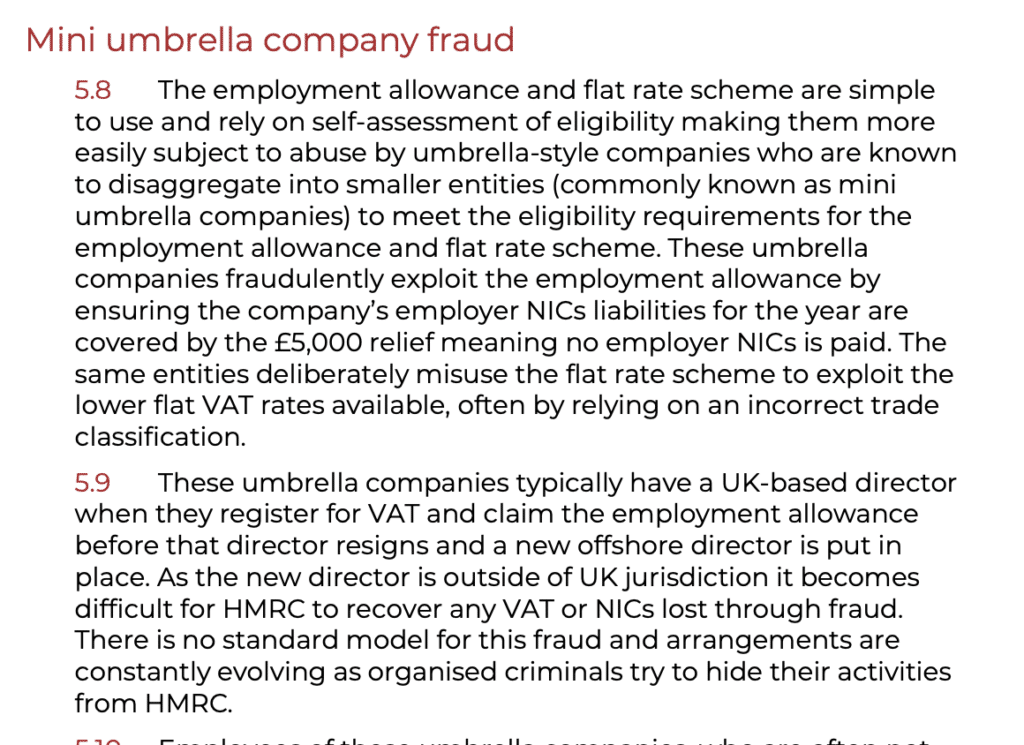
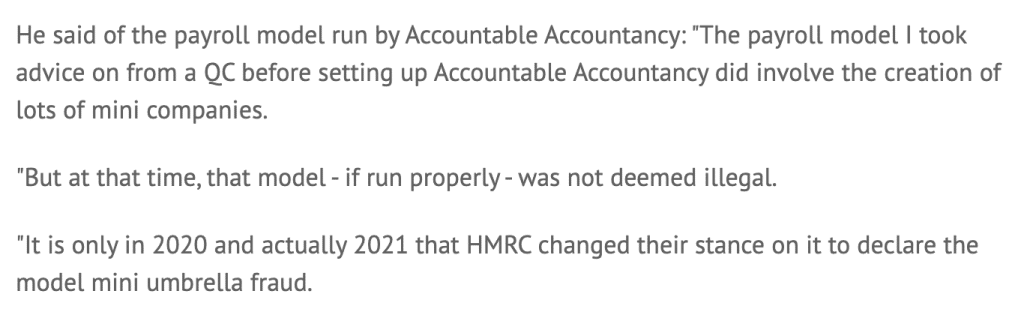
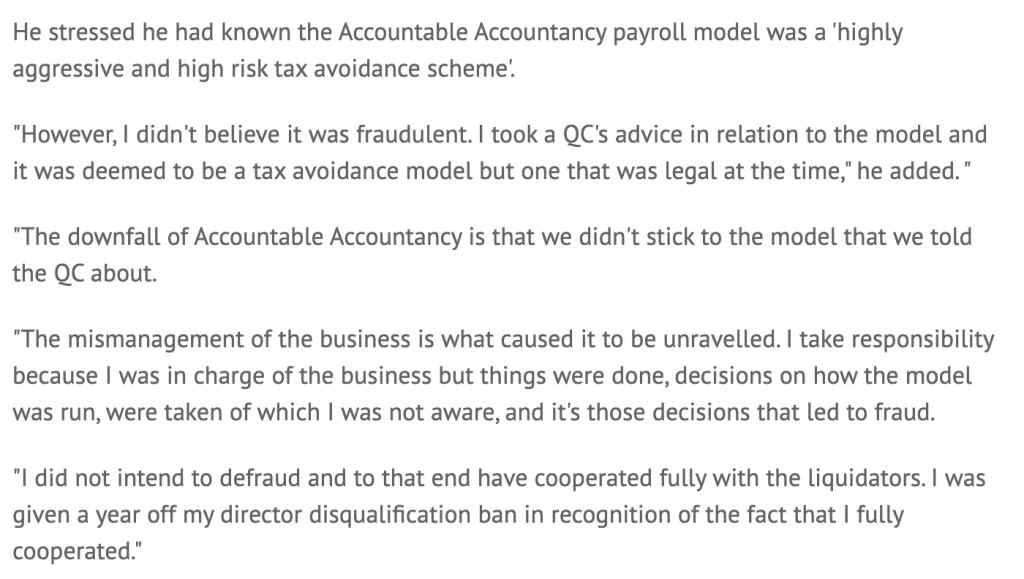
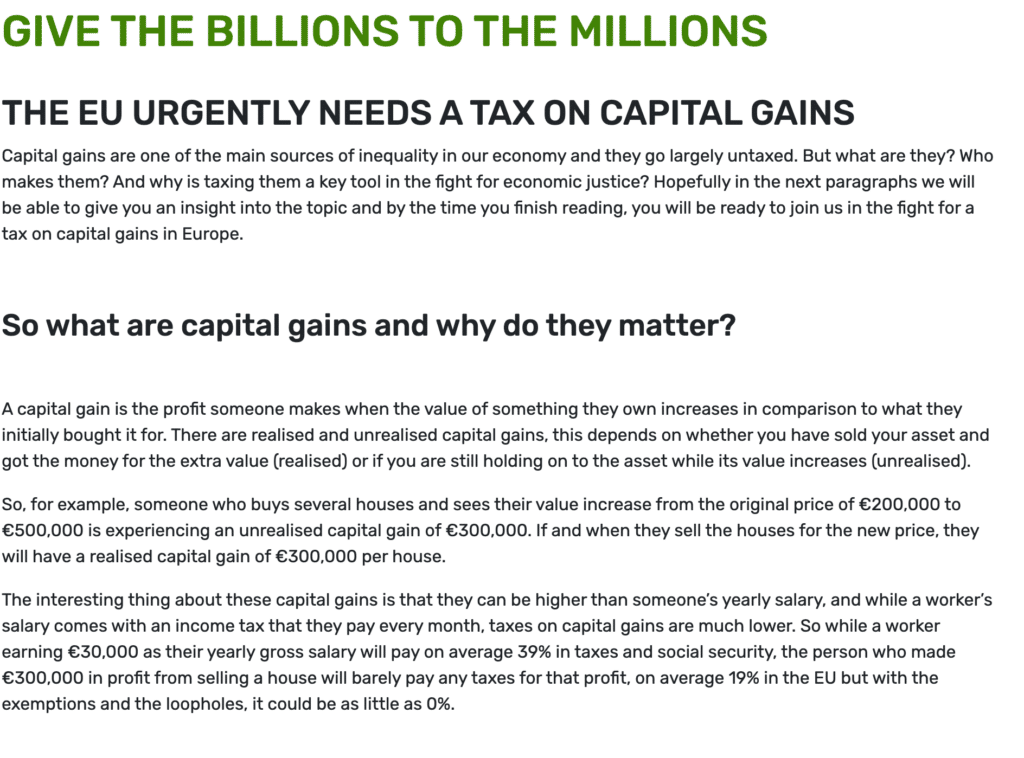
Here’s how the Greens start:
We can agree or disagree with this, but it’s undoubtedly a valid position to hold.
The conventional policy answer would be: tax capital gains at a broadly equivalent rate to labour income. That’s justified on grounds of vertical equity (the rich should pay tax at the same rate as the poor), horizontal equity (rich people making capital gains should pay tax at the same rate as rich people receiving large bonuses), and anti-avoidance (because otherwise people convert income into capital gains to achieve a lower rate).
But the Greens take a different approach.
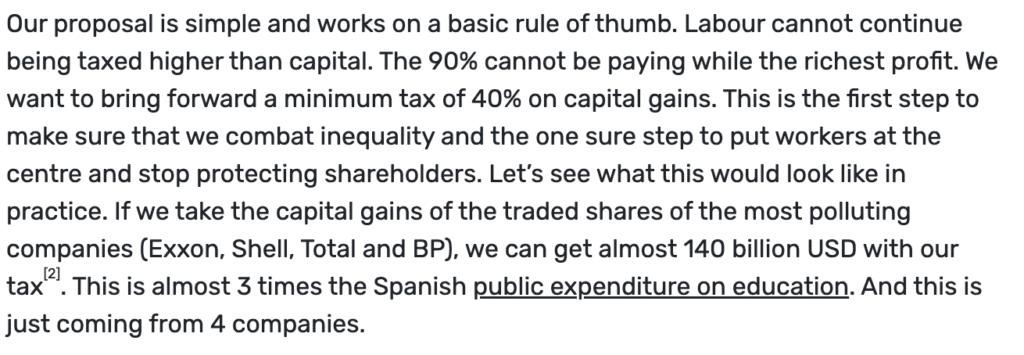
The proposal
In other words: a 40% minimum tax on capital gains, and for listed shares it would be on gains whether realised or unrealised.
To be clear, if I buy €1,000 of shares today, and sell them next year for €2,000, then that’s obviously a €1,000 capital gain on which I’d pay tax (at a minimum of 40%). But even if I don’t sell them next year, if they’re worth €2,000 then I’d pay capital gains tax on my unrealised €1,000 gain.
There are very few countries that tax unrealised capital gains. Many people find the idea counterintuitive or unfair, but it’s supported by many economists on the basis that an unrealised gain is just as “real” as income or a realised gain. Tax specialists tend to be more cautious, worrying about the difficulty of valuing property, and the practical problems that will arise from paying out refunds when people have unrealised capital losses2.
Reasonable people can certainly differ, and the Greens are absolutely not being unreasonable in seeking to tax unrealised capital gains.
Reasonable people can also disagree with a blanket 40% rate. Better to track the rate of tax on income (or, more sensibly, dividends). If capital gains is taxed at a higher rate than dividends then people will take dividends instead; if it’s lower (as is generally the case now), they’ll manufacture gains instead of taking dividends. The solution is surely to unify the rate, not to pick 40%.
These are not my point. There are two much bigger issues.
Fudging the data
You’d expect any credible tax policy proposal to be accompanied by some figures – ideally an estimate of the revenue consequences.
Here’s what the Greens give us:
There are two massive problems with this.
First, the detail is all wrong, because only a small percentage of the shareholders of these four companies will be taxed by the proposal:
any EU proposal is obviously only going to tax the capital gains of EU citizens. What percentage of these four companies’ shareholdings is held by EU citizens? I expect not much. Most of the shareholders will be outside the EU (certainly BP and Exxon, and probably also Shell).
The majority of the EU shareholders will be institutions rather than individuals. The OECD has estimated that only 18% of shareholdings in publicly listed companies are held by private companies and individuals.3. I’m assuming the Greens are not proposing taxing pension funds and other institutional investors – pension funds are generally exempt from tax, and institutional investors will either be exempt from tax (e.g. OEICs) or taxed on a mark-to-market basis already (e.g. investment banks).
So the true figure will probably be closer to $14bn.
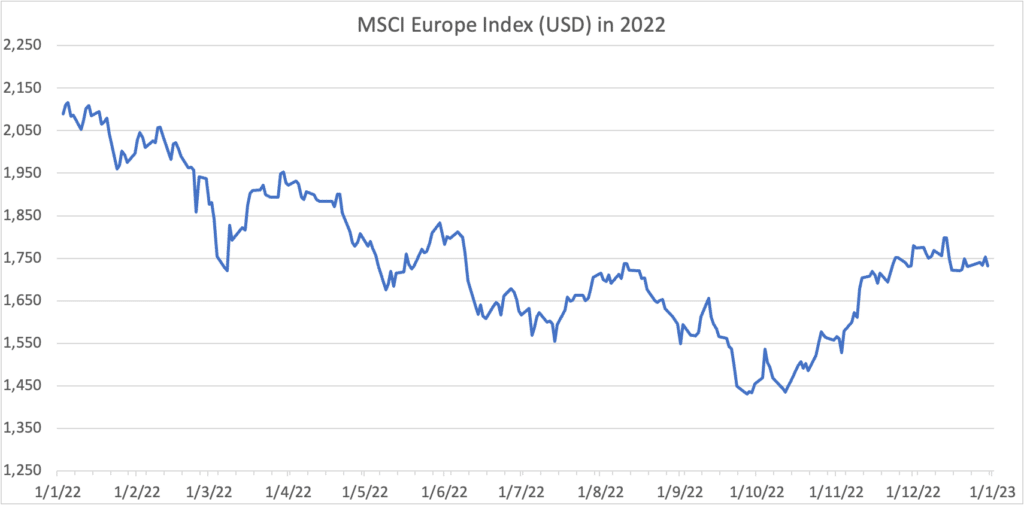
Second, the big picture: it’s extraordinarily selective to pick four companies who’ve had a good energy crisis. The proposal applies to all listed companies… so what was the total gain in market capitalisation of all listed European equities in 2022?
If this proposal had been adopted in 2022, it would have cost European governments money.
The $140bn figure is embarrassing on every level.
It’s the epitome of policy-based evidence-making. They’ve started with the idea they want to tax capital gains more heavily, and then gone hunting for some numbers that support the idea. Any neutral enquiry – “hmm, I wonder what the effect of the policy would have been in 2022” – would led to the conclusion that the policy would have cost governments €billions in 2022.
Ignoring the incentives
This isn’t a proposal to tax unrealised capital gains – it’s a proposal to tax unrealised capital gains of listed shares.
That’s a huge problem – because it creates a powerful incentive for taxpayers (and particularly the very wealthy) to not hold listed shares.
Some might create avoidance structures – e.g. establishing their own private SPV/fund in a non-EU country, and have that SPV/fund acquire listed equities. Others would simply reallocate investments to listed debt (e.g. high yield bonds), unlisted equities, real estate, private funds, and other asset classes. And you’d certainly see a decline in entrepreneurs listing their private companies.
All of which means the tax yield would be much less than expected, with the potential for undesirable non-tax consequences too (I personally think we benefit from having successful companies listed rather than private).
A good rule of thumb for tax policy is: don’t tax something in a way that depends upon a feature which has no economic reality, and can easily be changed. No baker in the UK puts chocolate on their gingerbread men covered in chocolate, other than two spots for eyes – because having more chocolate than that triggers 20% VAT. Whether a company is listed is, in many cases, about as economically relevant as chocolate eyes. It’s a terrible basis for taxing shareholders in the company.
I’m unconvinced it’s a good idea to tax unrealised capital gains. But if you disagree, it’s imperative you tax all unrealised capital gains.
How to do better
Three simple suggestions:
All tax policy proposals should be “red teamed“. People who weren’t involved in the design of the proposal should sit down and think about how they, as a taxpayer, would react to it. What are their incentives? What are the loopholes?
Europe is blessed with thousands of tax academics and tax practitioners (in government and the private sector). It’s madness to propose a tax policy without speaking to some of them. I’m certain any tax academic or practitioner would immediately have identified the two problems above.
Finally, don’t confuse means with ends. The end result here should be fair taxation of capital gains, and the question should have been: how do we best achieve that? But I suspect that this project started with a desire to tax unrealised capital gains, and that led to everything else.
Image by Stable Diffusion – “a calculator violently exploding in a massive fireball, dramatic, award winning, pop art, roy lichtenstein”
If your response is “well, we won’t refund tax for capital losses”, then the policy is no longer a tax on capital gains, and instead a crude and rather random expropriation of property ↩︎
See this document, the sixth bullet point on page 6 and Figure 2 on page 12 ↩︎
I used the MSCI Europe index captures about 85% of European equities and is therefore a reasonable way to answer the question; there will be other approaches, but the answer will likely be the same… 2022 was a bad year for equities. Historical data from investing.com. ↩︎
I wrote in February about some serious tax problems with the way the Post Office was compensating the victims of the Post Office scandal. At the Post Office inquiry last Thursday, the Department for Business and Trade said that the problems have been resolved. I am concerned that is not correct.
Now, finally – ten years after the Post Office almost certainly knew 1 that it had wronged these people, it is paying compensation. However, the way the compensation is being paid to 2,000 postmasters under the “historic shortfall scheme” (HSS) is creating serious tax problems for them.
The key issues are:
Compensation is being paid for years of lost earnings. This is paid as a lump sum – often a very large lump sum – and so is taxed at a much higher rate than would have been applicable had the earnings been paid properly at the time. For example: a postmaster earning £30k would ordinarily have taken home about £25k after tax. But if that same postmaster receives compensation for ten years’ lost earnings in one payment, of that £300k they’ll take home not £250k, but £170k. The “compression” of many years of income into one year costs them £80k more tax. That’s an unjust result, and one that compensation would normally adjust for, by paying additional compensation so that the postmaster receives (on these figures) £250k after tax. The Post Office didn’t do that.
As the claimants’ loss was many years ago, a large amount of interest is often due. This is fully taxable. The Post Office has correctly deducted 20% tax from its interest payments, but then failed to give a clear warning to claimants that they would have additional self assessment liability, taking the overall tax rate on the interest up to 40% or 45%. The Post Office also failed to provide any tax support to postmasters, or pay for tax advice – so postmasters would unlikely to be aware of the tax liability, and could easily fall into default with HMRC.
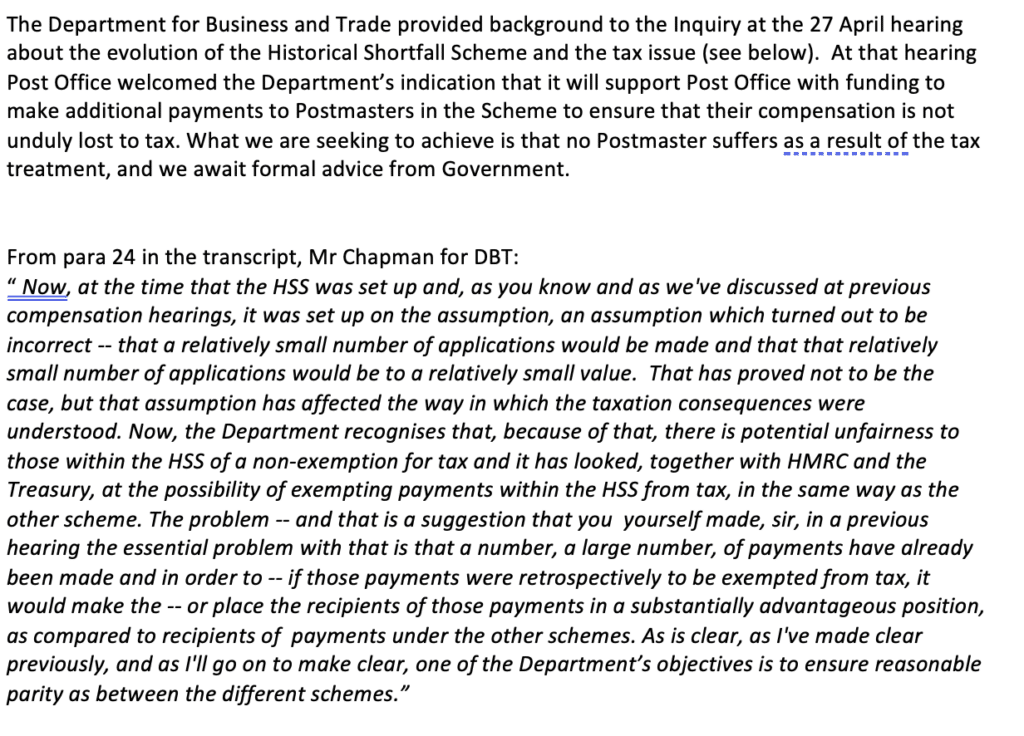
I suggested back in February that the solution was a statutory exemption for HSS claimants. Since then, an exemption has been created for postmasters claiming under the Overturned Historic Convictions (OHC) scheme and the Group Litigation Order (GLO) scheme. But nothing for the HSS scheme, despite a promising initial response from the responsible Minister.
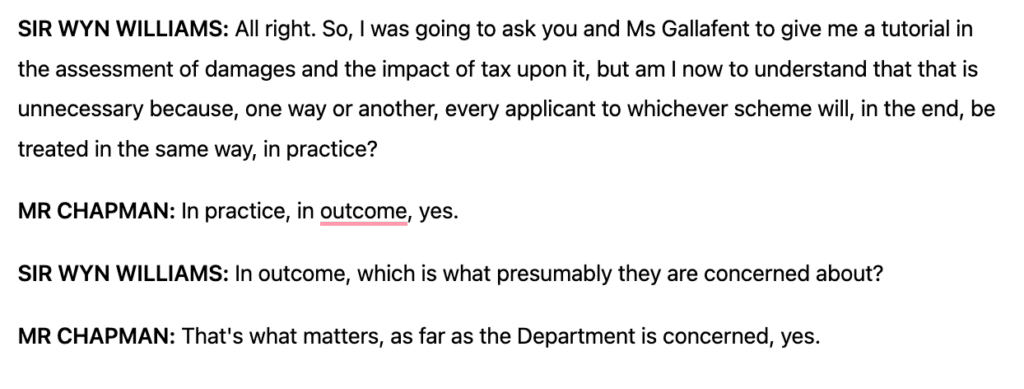
Tax on compensation payments was discussed at the Inquiry on Thursday 27 April, and we now have at least a partial explanation. The video is available in the link above, and the full transcript is available here.
On the two remaining issues:
Loss of earnings
The Post Office’s explanation last Thursday was that the GLO and OHC schemes paid compensation for lost earnings on a hypothetical net basis. In other words, a GLO claimant in the same position as in my example above would have received £250k compensation from the Government. The Government paid that amount on the expectation that a tax exemption would be created, as indeed it was. So the claimant retained the £250k, and received the correct amount.
But there’s an important caveat. Whilst that result is consistent with paragraph 4.2 of the GLO scheme, the postmasters I’ve spoken to aren’t clear that’s what happened in all cases. It would be helpful if the Inquiry requires the Government to confirm precisely how tax was treated in the GLO scheme payments.
However, let’s assume for the moment that the Post Office is right on how the GLO and OHC payments dealt with tax. How do the HSS payments compare?
If the Post Office had treated HSS payments in the same way as GLO/OHC payments then my example postmaster would have received £250k.
But, inexplicably, the Post Office actually paid the postmaster £300k, so that after-tax she retains £170k (and often the Post Office operated PAYE).
That leaves the postmaster £80k out of pocket compared to their GLO equivalent.
But if the Government enacts an exemption for HSS payments then the postmaster will retain £300k, and be £50k better off than their GLO equivalent.
So the Post Office has created a mess that is difficult to resolve. The Department for Business and Trade (DBT) reasonably want to achieve parity between claimants under the different schemes, and there is now no easy way to do that.
What’s being proposed is that the Post Office will pay “top-up” amounts so that claimants end up with the right amount, after tax. Those top-up amounts are themselves taxable, so will have to be quite large. They will also have to take account of the particular tax position of the postmasters in each of the relevant years, which will not be easy.
The alternative would be for HMRC to create a complicated special rule, which taxes claimants as if they’d received the funds in each of the years to which they relate. That is probably a worse option.
It should go without saying that the Post Office should pay for claimants to receive tax advice, both at the point of settlement and when they subsequently file their tax return. To date they’ve paid almost nothing to cover tax advice, and that has to change.
I’d conclude from this that DBT were correct to reassure the Inquiry that there is a solution for loss of earnings compensation, but proper thought does need to be given to how postmasters receive tax advice.
Interestand other compensation payments
As the harm suffered by the postmasters was some time ago, interest is due on their compensation – and for large settlements it will come to a large amount. This is fully taxable. They will also often receive other types of compensation (e.g. loss of reputation, stress, exemplary damages), and whilst that probably won’t be taxable, this won’t always be straightforward to determine.
The new tax exemption for OHC and GLO claimants mean they don’t need to worry about these issues – they are just exempt from tax on interest and everything else. The Post Office doesn’t appear to have adjusted their payments to reflect the tax exemption. It hasn’t deducted tax from interest payments (see paragraph 4.2.4 of the GLO scheme terms). This seems the right result to me. Personal injury compensation and interest is tax-exempt, and it feels entirely appropriate that this is too.
But, on the basis of DBT’s announcement at the Inquiry, HSS claimants will pay tax on interest, and potentially other compensation payments too (and will certainly have to obtain tax advice on the treatment of those other payments). Which means that this assurance from DBT to Sir Wyn was not correct…
… as things stand, HSS applicants are not being treated in the same way as GLO claimants. The obvious solution is for the Government to enact a tax exemption for HSS claimants covering interest and other compensation amounts except loss of earnings (assuming the Post Office are right in what they say about GLO compensation payments).
That exemption creates the parity between claimants that DBT are rightly seeking. It will also avoid the scenario that most concerns me – postmasters being misled by the wording in the Post Office’s settlement offer, not realising they have to self-assess tax on the interest, and falling into default with HMRC.
I have provided a copy of this article to the Inquiry.
Footnotes
Although important people at the Post Office surely knew well before 2013, albeit that the details of “who knew what when” remain unclear ↩︎
Comment policy
This website has benefited from some amazingly insightful comments, some of which have materially advanced our work. Comments are open, but we are really looking for comments which advance the debate – e.g. by specific criticisms, additions, or comments on the article (particularly technical tax comments, or comments from people with practical experience in the area). I love reading emails thanking us for our work, but I will delete those when they’re comments – it’s better if the discussion is focussed on the key technical and policy issues. I will also delete comments which are purely political in nature.
Tax Policy Associates today reveals that Premier League football clubs are avoiding tax on an industrial scale, by artificially structuring their payments to football agents. We estimate it cost £250m in lost tax from 2019-2021, and £470m since 2015.
In our view this is failed tax avoidance – it was never compliant with the law, and HMRC can and should require all the lost tax to be repaid.
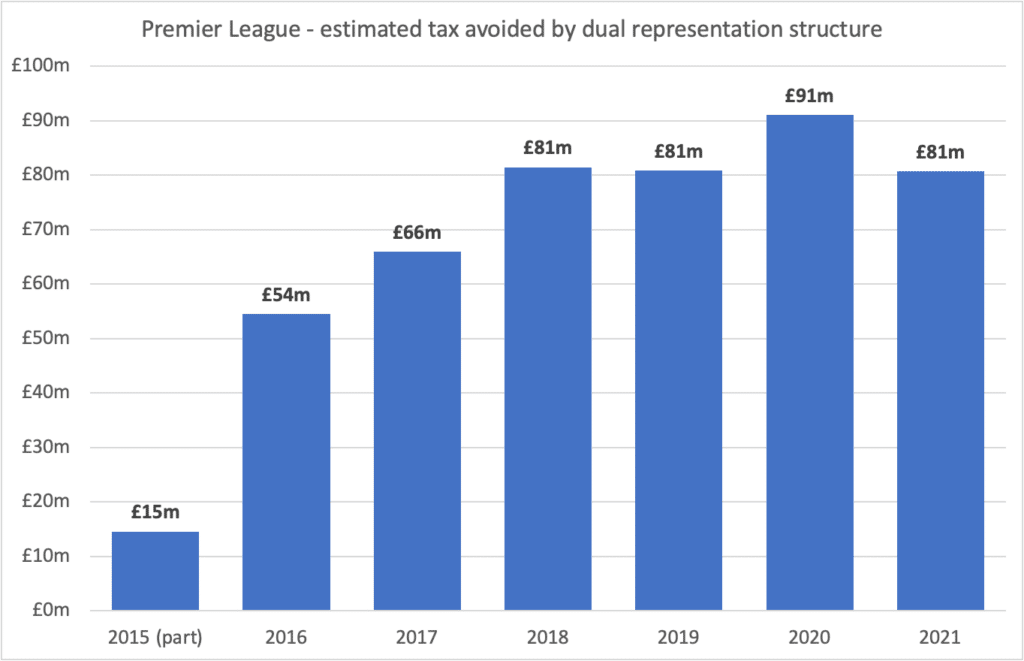
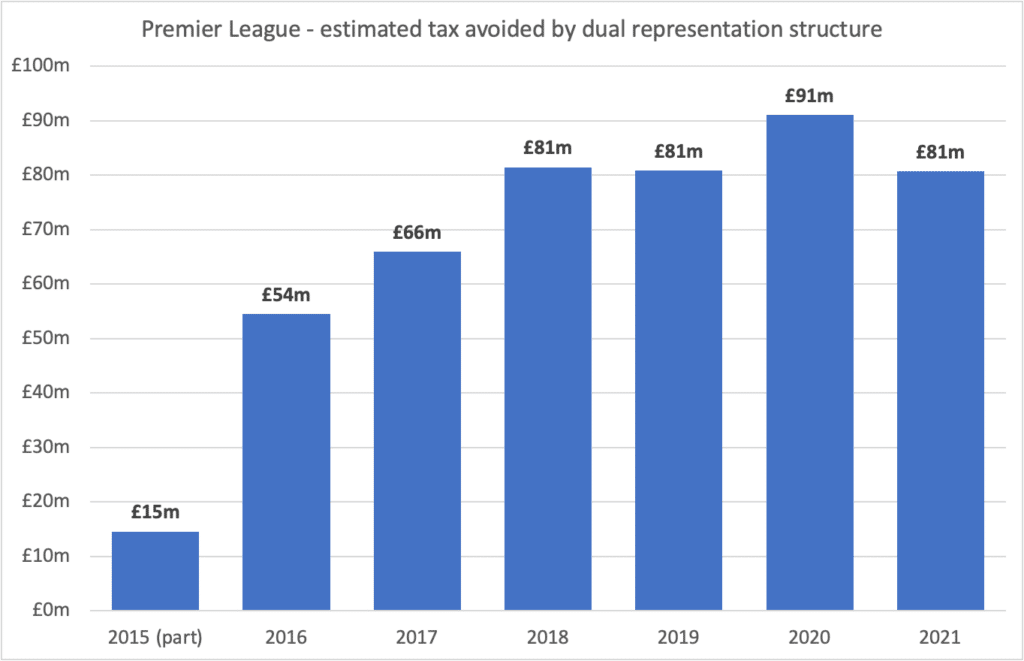
Football clubs at all levels are using an artificial tax avoidance scheme to avoid VAT, income tax and national insurance/social security. In the Premier League alone we estimate that this has resulted in £250m of lost tax in the last three years, and £470m of lost tax since 2015:
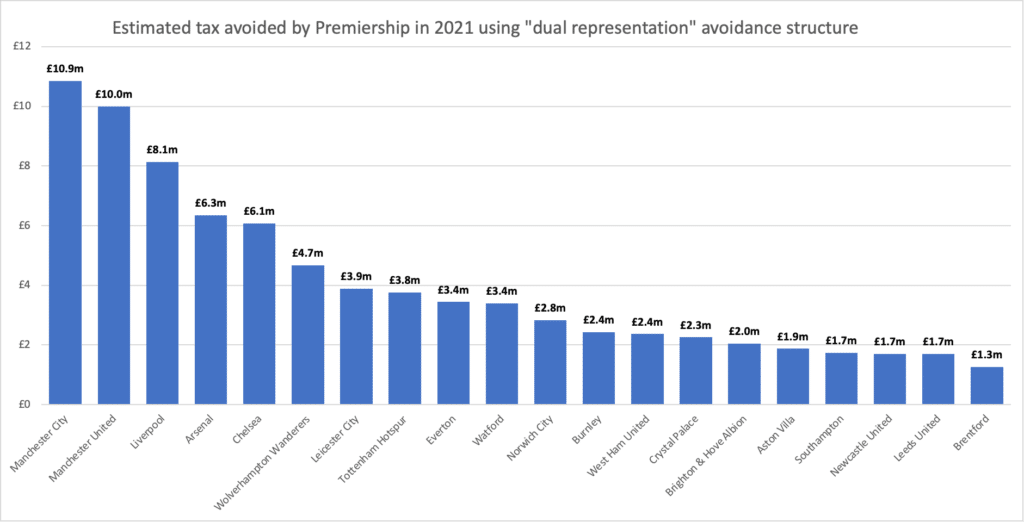
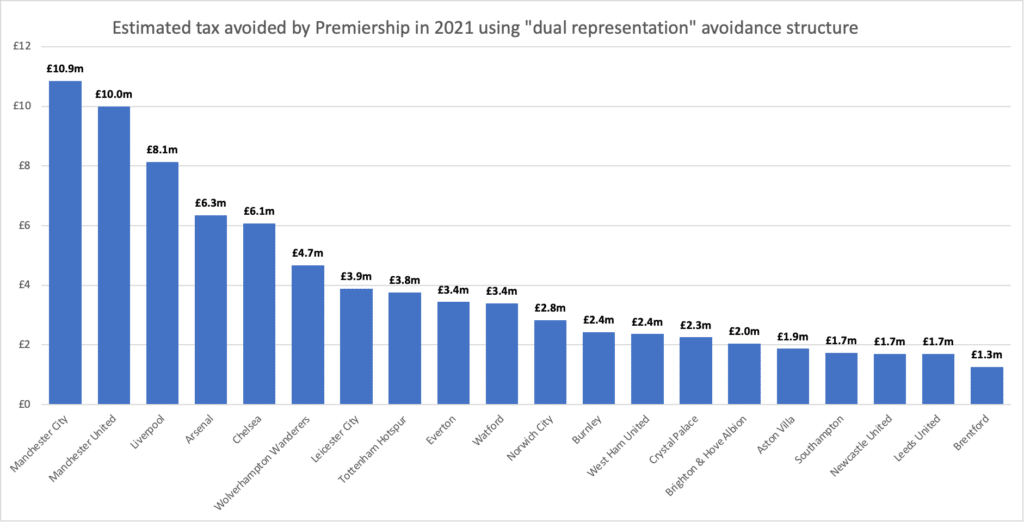
And here’s our estimate for each Premier League club’s tax avoidance in 2021:
The purpose of the scheme is to avoid employment taxes and VAT on the large commissions paid to football agents. In reality, these agents act for players. But the scheme works by constructing artificial contracts where the agent acts for the club as well as the player – so-called “dual representation contracts”. Half the fees are then paid by the club – even though it is the player who is really benefiting from all (or almost all) of the agent’s work – and these fees escape income tax, national insurance and VAT.
The defence of dual representation contracts by clubs is that “everybody does it”. That is true. But it’s our view that the arrangements are improper – they contravene both the letter and the spirit of the law. This isn’t “legal tax avoidance” – it’s a failure to comply with the law. HMRC should be aggressively challenging it (and we understand that, in least some cases, it already is).
There are potentially serious consequences for football. If HMRC were able to recover all £470m then Premier League clubs would struggle to pay it – the Premier League’s total profits in 2022 were the largest for some time, but still only £479m.
This report explains how the scheme is supposed to work, why it technically fails, and what should be done to stop it
Football agents and fees
Football agents usually act for players. Sometimes the agent is one individual who is close to a particular player and acts for them and nobody else. Sometimes the agent is a business which acts for multiple players. But the role is much the same in either case: connecting the player with clubs, managing contract negotiations, finding sponsorship, and generally advancing the player’s career.
Agents (sometimes called “intermediaries”1) are typically paid by receiving a percentage of their players’ remuneration. In the past this has sometimes led to extraordinarily high payments, with a FIFA report suggesting $3.5bn was paid to agents between 2011 and 2020, and another report estimating $500m in agent fees were paid in 2021 alone (a slight decline on the $650m paid in 2019, probably as a result of Covid).
Of all the tasks undertaken by the agents, the contract negotiations are the most critical, given that the outcome of those negotiations drives remuneration for the player, and therefore the agent.
New FIFA rules were approved in December 2022 capping agent fees at (for large amounts) broadly 6% of the remuneration paid to the player. Given the size of transfer payments, that still equates to very large fees to agents but, whilst the rules are supposed to enter force in October 2023, it is unclear whether that will happen.2
The usual treatment of agent fees
Everyone who is employed and working in the UK pays income tax and national insurance on their wages. When we hire someone to carry out a service (plumber, lawyer, estate agent, etc) we are not entitled to deduct that cost from our taxes. In other words, we pay almost all service providers on an after-tax basis. In addition, if the service provider is VAT registered, then we usually pay VAT on their fee.
In some cases, it will be the employer who pays the cost of the service. For example, an employer may agree to cover an employee’s personal legal fees. That will usually be a “benefit in kind” with the employee taxed in exactly the same way as if he or she had received the cost of the legal fees as additional salary or bonus. The legal fees will also be subject to VAT, which the employer will not be able to recover (unlike the company’s own legal fees, which will often be recoverable).
So whether an employee engages a service provider directly, or their company does so on their behalf, should make no difference to the tax result.
How should agents and clubs be taxed on agent fees?
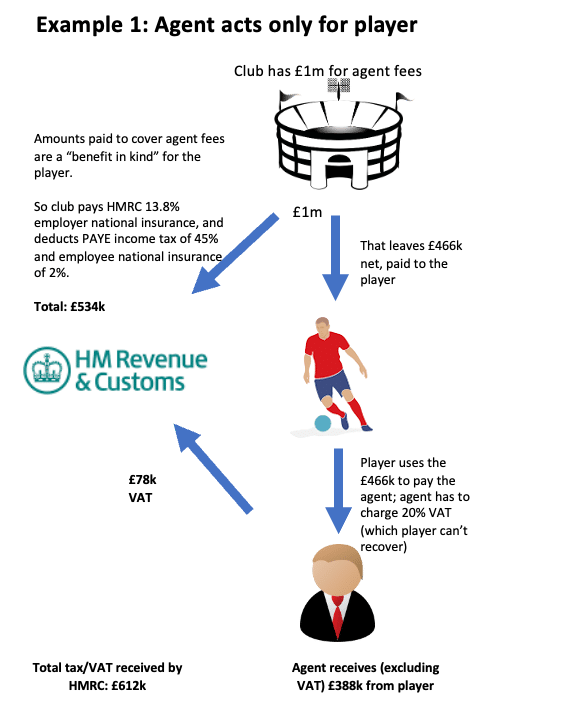
The same principles should apply for clubs and football agents. The agents are hired by the player, represent the player in fee negotiations, and their loyalty is to the player. The player therefore shouldn’t be able to deduct the agent’s fees from his income tax bill, and the player should have to pay 20% VAT on the agent fees.
And, as with the legal fee example above, none of this should change if the football club agrees to pay the agent’s fee – they’re doing so on behalf of the player, and so it’s a benefit in kind. The tax bill ends up the same – income tax, national insurance and VAT on the agent’s fee.
This example shows how it should work, with £1m paid in agent fees. HMRC ends up receiving £612,000 of tax. It would be the same if the club was paying £1m in legal fees or estate agent fees.
The tax avoidance scheme
The scheme
Historically, agents were hired by players, and either paid by players or paid by clubs (with the benefit-in-kind and VAT consequences discussed on the previous page). However, many years ago, some people in the football industry realised they could avoid a significant amount of tax if they wrote all the contracts so the agent purported to be the agent of the football club, not the player.
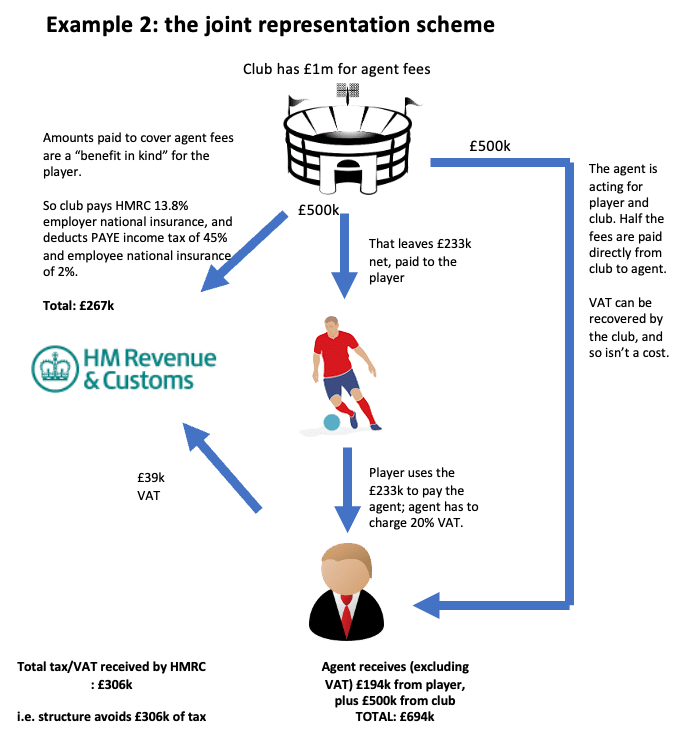
This had two sizeable tax benefits. First, the club could now pay the agent fee without it being a taxable benefit for the player – saving (at current rates) 45% income tax, 2% employee national insurance, and 13.8% employer national insurance. Second, the club (unlike the player) could recover the 20% VAT the agent will charge on the fee. Add these up, and the total tax saving is equal to 80.8% of the agent fee.
Over time, a degree of caution from advisers meant that this approach was replaced with “dual representation” – the agent supposedly acting for both the player and the club. By 2021, the fees were typically (and, we understand, almost universally) allocated 50-50 as between player and club.3 This reduced the total tax saving to (at current rates) 40.4% of the agent fee (i.e., half the benefit compared to if the agent was solely acting for the club).
This second example shows what happens when the 50-50 dual representation avoidance scheme is used. As with the first example, £1m is paid in agent fees – but the effect of the scheme is that HMRC ends up receiving £311,000 less tax.:
Why call this a “tax avoidance scheme”?
A common characteristic of tax avoidance schemes is that an arrangement which would usually have one tax result is structured in a different and artificial way, and claimed therefore to have a different and more favourable tax result. That is exactly what is happening here.
The “dual representation” arrangement is fundamentally artificial. Whatever the contract says, everybody knows the agent isn’t really the agent of the club. The agent is hired by the player, and their principal role is representing the player in negotiations with the club, to extract as a high a price as possible from the club for the player.
There’s an obvious conflict of interest. The player wants to be paid as much as possible. The agent is paid a percentage of the player’s earnings, and so also wants the player to be paid as much as possible. On the other hand, the club wants to pay as little as it can get away with.
It is often asserted that the agent does in fact provide real services for the club. For example, the agent may assist with work permits, and help the player get settled into their new home. However, there are two obvious responses to this. First, these services primarily benefit the player. Second, the value of the services is low, and can’t begin to justify half the fee being allocated to the club.
Are joint representation contracts permitted by the Football Association and FIFA?
The Football Association prohibits an agent from acting for both the player and the club – but with a remarkably wide exemption4 that in fact allows an agent to act for both the player and the club, provided the right boxes are ticked.
FIFA was at one point proposing to end joint representation contracts, but the final version of the rules mirrors the Football Association in having an apparently clear prohibition followed by an extremely wide exception to the prohibition:5
A Football Agent may only perform Football Agent Services and Other Services for one party in a Transaction, subject to the sole exception in this article.
a) Permitted dual representation: a Football Agent may perform Football Agent Services and Other Services for an Individual and an Engaging Entity in the same Transaction, provided that prior explicit written consent is given by both Clients.
So triple representation is prohibited, but dual representation has been given the green light.
How much tax is being avoided?
We estimate £470m of tax was avoided in the Premier League between 2015 and 2021:
Looking at 2021 in detail, we estimate that the £81m of tax avoided was split between clubs as follows:
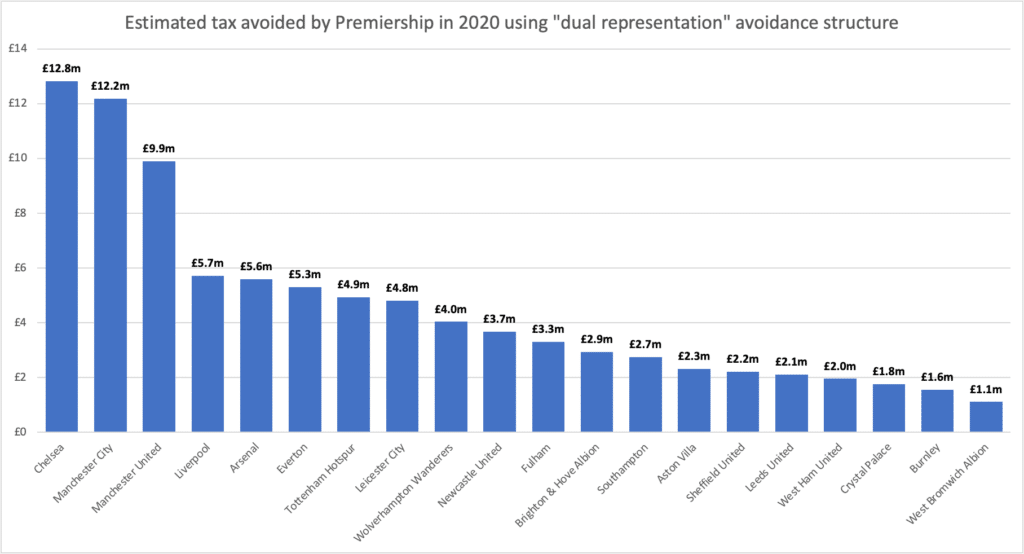
And the £91m avoided in 2020 was split as follows:
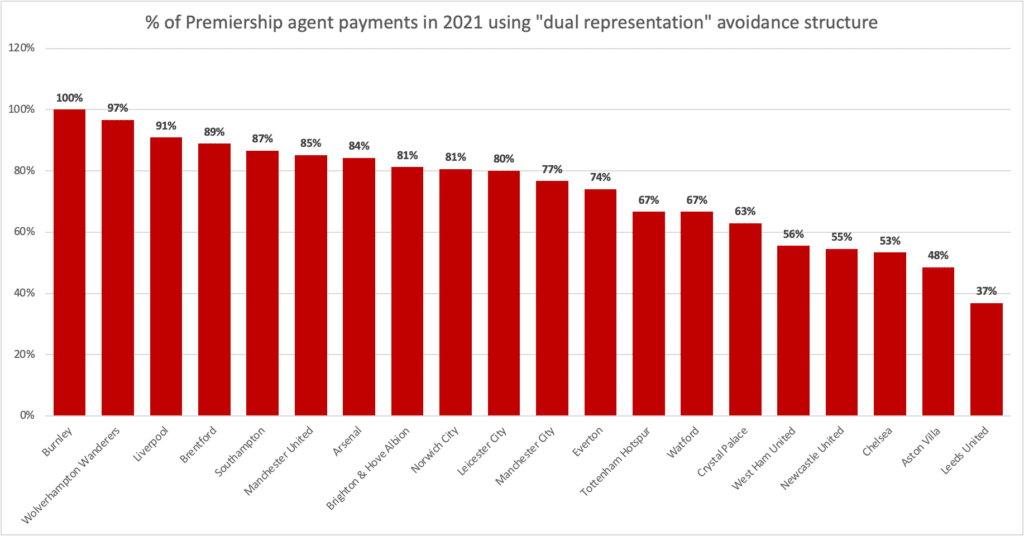
The biggest clubs pay the biggest fees, and so dominate the charts above. However, if we look at the proportion of transactions using the dual agent structure in 2021, it is clear that some clubs use the structure all the time; others are less consistent. Generally, the richest clubs are the most frequent users, but Burnley and Brentford are also heavy users:
What are HMRC doing?
In the 2010s, clubs convinced themselves that there was a “safe harbour” that meant HMRC wouldn’t challenge dual representation structures provided the split was no greater than 50-50. However we don’t believe that is correct – there never was a safe harbour, and HMRC never accepted these arrangements.
HMRC became aware of the urban myth of a “safe harbour”, and issued particularly clear guidance in May 2021 refuting the claim. The guidance says that a 50-50 split cannot be the default position, and has to be carefully justified by reference to the work actually undertaken by the agent for the club, and with detailed records kept. This was in the context of an overall high level of HMRC scrutiny on football and football agents in particular.6
HMRC guidance is just an expression of HMRC’s opinion, and is not legally binding. Given the likelihood of a dispute, well-advised taxpayers typically are very cautious before ignoring HMRC guidance. However, it is not uncommon for some taxpayers (and advisers) to follow the letter of the guidance and ignore the spirit. That seems to have happened in this case; we understand from sources in the industry that most clubs still use a 50-50 split (albeit they are more careful to justify it, and create a supportive “paper trail” which purports to demonstrate value being provided to the club).
Perhaps for this reason, there is no evidence of dual representation contracts declining in 2021 – 68% of relevant contracts were dual representation that year, the same as in 2020, and only slightly down on 2019 (when it was 70%)
Part of the problem is the competitive dynamic between clubs – agents will play one off against another, and any club that’s too scrupulous in its tax planning can find itself losing out in the race to hire new talent. This is a common dynamic that drives tax avoidance in many industries, and the solution is public pressure, aggressive enforcement by HMRC, and a change in the law. We discuss this further below.
Another problem is that we understand there is close collaboration between the tax teams at the Premier League clubs. That can create an atmosphere that their tax positions are “too big too fail” – for surely HMRC wouldn’t challenge everyone? In most industries, competition law concerns mean that tax teams in different companies do not coordinate their positions in this way. It is unclear why football is different.
We understand there are several live HMRC enquiries into the use of dual representation structures by Premier League clubs, but the scale of HMRC’s work in this area is not clear.
If HMRC does pursue the structures aggressively, and across several past years, there could be serious financial consequences for the clubs involved. In the worst-case scenario for the clubs, all the tax we identify as having been avoided could be repayable, plus interest and potentially penalties. Whilst there is certainly lots of money in the Premier League, there is very little spare cash available to fund unexpected tax liabilities – total Premier League profits for 2022 were only £479m.
Our view – is the dual representation structure lawful?
Dan Neidle worked as a tax lawyer for 25 years, and was head of UK tax for one of the world’s largest law firms7. He had particular expertise advising clients who had previously entered into tax/VAT avoidance schemes, or who were exposed to risk as a result of other parties’ use of such schemes.8
Dan’s view of the dual representation scheme is as follows:
“In my view it is clear that the dual representation schemes do not work. HMRC should challenge current and historic use of dual representation contracts, and in my view HMRC would win.
In relation to income tax and national insurance, modern caselaw has established that these taxes apply realistically to the actual commercial transaction, and not to artfully constructed paperwork.9 Realistically, the agent is acting only for the player. The most economically valuable part of the agent’s role, and the basis on which agents are remunerated, is their negotiation of the player’s remuneration. When entering into these negotiations, the agent can only be acting for the payer, and not the club (as otherwise the agent would be negotiating against him or herself). The club may be making the payments, but this is a matter of convenience – the agent is not, in reality, acting for the club (other than for minor ancillary services). Hence, I expect a tribunal would simply apply the income tax and national insurance legislation on the basis that all, or almost all, the payments made by the club to the agent are made on behalf of the player, for services provided by the agent to the player.
In some cases, where the agent in reality provides no services at all to the club, the contractual appointment of the agent by the club might be a sham.10
Different civil law-style “abuse” principles apply for VAT (see the Halifax decision), but in this case it is likely that those principles are not necessary, and the correct VAT result will simply follow from a proper analysis of the nature of the services that are actually being provided. In particular, a Tribunal is likely to readily conclude that the supplies by the agent are “made to” the player and not “made to” the club under Article 168 of the VAT Directive11 and section 24 of the Value Added Tax Act 1994 (and the fact the club is making the payment to the agent is irrelevant). That conclusion is consistent with the Supreme Court judgment in the Airtours case.
The key question for clubs to answer is why they thought it was appropriate to say that half the value provided by agents was provided to clubs, when it’s the players who receive almost all the benefit.
I expect the clubs will say that they have tax advice that the dual representation structures are appropriate. But I understand that advice is usually based upon a critical factual assumption that agents really provide value equal to half of their fees – an assumption that is plainly incorrect. If that’s right, then the advice is worthless, and the clubs should have known that. I would also query whether it was appropriate for advisers to advise on the basis of an assumption that, if they’d thought about, they would have realised was false.
The clubs may have thought they were avoiding tax; but in fact they were simply failing to pay tax that was due, based upon factual assumptions they should have known were false. If they actually knew the assumptions were false, then it is possible that criminal offences were committed.”
Recommendations
We have three key recommendations:
Parliament should enact specific income tax, national insurance and VAT anti-avoidance rules, to put beyond all doubt that the dual representation schemes do not work. Ministers have previouslywarned that employment tax avoidance can be countered by retrospective legislation, and that is something that should be considered in this instance. This would save the time and cost of litigating against dozens of clubs across the Premier League and Championships – the result of which is not realistically in doubt.
Absent retrospective legislation, HMRC should aggressively challenge all the clubs which have historically used joint representation contracts. The starting point should be that little or none of agents’ fees should be allocated to the club – they act solely (or almost solely) for the players. The tax/VAT result should follow straightforwardly from that (with late payment interest also due). Where these contracts were constructed without a reasonable contemporaneous justification for the fees allocated to clubs, penalties should be charged.12
Unless full disclosure was provided to HMRC (including the amount of value provided by agents) then HMRC should be able to open a “discovery assessment” and challenge the previous four years of tax returns (and any earlier years which remain “open”13). If a failure to provide full disclosure can be said to be “careless” (which is very plausible, particularly where there was not contemporaneous justification for the allocation), HMRC should be able to challenge six years of tax returns. The fictitious nature of the structure also creates the possibility that the 20 year time limit for deliberate loss of tax could apply.
We understand that dual representation contracts are used elsewhere in Europe, and that – as with the UK – the principal purpose is tax avoidance. Other countries’ tax authorities and football associations may wish to consider taking similar steps to those recommended above.
Methodology
Sources of data
In April 2015, FIFA required national football associations to publish statistics on agents (“intermediaries”). Originally it only published the total agent fees paid by each club, and limited data on transactions. However, from 2019, that data also includes whether agents were instructed on a sole or joint basis, which enables the analysis in this paper. The full data is here.
The fee and transaction datasets are separate, so that it is not possible to ascertain the fees paid to any individual agent, or in respect of any individual player.
Approach
We can take the Football Association statistics for 2019, 2020 and 2021 (running from February in each year to the end of January in the next year) and estimate the total tax avoided, using the approach set out below. All the calculations are available in the spreadsheet here.
For each year 2019-2021, take the FA transactions list and exclude duplicate entries (which we assume are errors). The lists are in the spreadsheet on the “transaction data” tabs for each year.
Take the FA lists of total fee payments to agents. These are in column B on the “calculations” tab for each year.
Include only permanent transfers in, loans in, updated contracts, and international loans in (as other transactions are not likely to give rise to material fee payments). These are the “in scope transactions” on the “assumptions” tab. Count the number of payments made by each club on “in scope” transactions – this is column C on the “calculations” tab.
For each club, calculate the number of those payments which involve joint representations (i.e. where agents were acting for both the player and the club). This is column D on the “calculations” tab. This gives us the percentage of dual representation transactions – column E.
Assume we can simply apply that percentage to the total agent fees paid by each club (probably resulting in too small a number, because joint representation is likely more common on larger transactions, where more tax is at stake). That gives us the “implied dual representation fees” in column G of the “calculations” tab (which excludes VAT).
Assume that all the joint representations are 50-50 (the industry standard), and so multiply the total joint representation fees by 50%. The assumption is in cell C4 of the “assumptions” tab.
Calculate the total rate of tax avoided on this VAT-exclusive agent fee. That will be VAT (20%) plus the top rate of tax (45%) plus the highest rate of employee national insurance (2%) plus the highest rate of employer national insurance (13.8%). That totals 80.8%. This total is in cell C8 on the “assumptions” tab.
Multiply the VAT-exclusive agent fee allocated to the club (from step 5) by the 50% figure (step 6) by the rate of tax avoided (step 7). This gives the estimate for tax avoided for each club for each year 2019, 2020 and 2021 (column H of the “calculations” tab for each year).
For the years before 2019, we have agent fee data but no data on the proportion of dual representation contracts. So we proceed on the assumption that the percentage of tax avoided (out of total agent fees) will be broadly the same as in the later years where we do have that data. So a simple pro-rata calculation provides the tax avoidance estimate for 2015 (where we only have the last quarter data), 2016, 2017 and 2018. This is a conservative assumption given that the industry settled on 50% as a supposed “safe harbour” – previously a higher percentage was used. The calculation here is in cells D6-D9 of the “calculation” tab.
The total tax avoidance estimate sums to £469m (cell D14).
The data also shows a smaller number of cases where the agent is solely acting for the club. Many of these appear to be cases where there are separate contracts between agent and player, and agent and club. We do not know if this is a legitimate arrangement which splits bona fide obligations and fees between player and club, or a tax avoidance arrangement which is effectively the same as a dual representation contract, but splits the contract into two halves. We are conservatively assuming it is the former, and not including any figures from these cases in our estimates of tax avoided.
We are focussing on the Premier League, as its financial predominance means that the amount of tax avoided is disproportionately focussed here. However, “joint representation contracts” are also used in the Championship/lower divisions. Agent fees in the Championship are about 15% of those in the Premier League – so as a rough order of magnitude estimate, we’d expect Championship tax avoidance to be around £70m (i.e. simply calculating 15% of £470m).
An important assumption in our analysis is that fees were allocated between players and clubs 50-50 on all “joint representation” contracts, and that this continued through to 2021 (despite the HMRC warning in the middle of that year). We understand from industry and HMRC sources that this is correct, and that clubs responded to the HMRC warning by being more careful about how they justified the 50-50 split, but not changing it.
If Premier League clubs wish to dispute our use of the 50-50 figure, they can respond by disclosing what the actual dual representation figures are, and we will then immediately update this report.
Response from Premier League clubs
Until the BBC published its story, the Premier League clubs were entirely unresponsive. We contacted the press office of each club for comment late last year, and know that our messages were received – but not a single club replied. BBC Newsnight also contacted the Premier League clubs for comment more recently – again no response was received. Nor did the BBC get a response from the Association of Football Agents.
It is highly unusual for a company which is credibly accused of tax avoidance to fail to provide even a short form response. It is even more unusual for an entire sector to refuse to respond to enquiries. The obvious inference is that the Premier League clubs collectively realise that their position is impossible to defend.
Since the BBC published its report tomorrow, we finally do have a response. Of sorts.
The Association of Football Agents now says it disputes our findings, saying we’re making “fundamental misunderstanding of how the football transfer market works”. Oddly they don’t bother saying what that misunderstanding is. They’ve had months to come up with something better.
The Premier League also provides a non-answer: “We believe that the overall figure suggested here is based on assumptions that do not recognise the individual circumstances of each transaction”. What are those assumptions? How are they wrong? They don’t say. And, again, they’ve had months.
Note what these responses don’t do. They don’t provide a principled justification for dual representation contracts existing at all. They don’t deny that the industry is using 50-50 across the board, despite HMRC guidance saying they shouldn’t.
Acknowledgements
Thanks to Mike Cowan, Ben Chu and the Newsnight team for helping to develop the story, and to all the tax professionals – solicitors, accountants, barristers and retired HMRC officers, who commented on early drafts of this paper. Particular thanks to Max Schofield for his invaluable comments on the VAT analysis, and to A, F and T for their equally valuable input on the income tax and national insurance analysis. And many thanks to the industry contacts who prompted this investigation, and provided background information on the historic and current use of dual representation contracts. Final thanks, as ever, to J.
Image by DALL-E – “a soccer ball with cash exploding from it, on a grass football pitch, digital art”
Footnotes
The football industry currently prefers to use the term “intermediary”, but in our view it is both clearer and more accurate to use the traditional term “agent”, and that is the term we will use in this report.) ↩︎
It is likely that agents will assert that there are competition law/anti-trust problems with the proposal and, whilst we have no expertise in competition law, that does not seem a frivolous objection. ↩︎
Interestingly, the 50-50 split has now been formalised by FIFA in its new regulations (see Article 12(8)(a). Indeed, at first sight, the regulations seem to incentivise joint representation, because the cap on agent fees will be 3% (rather than 6%) if an agent is acting solely for a player. The reason for this is unclear, but we would speculate that agents and/or clubs lobbied for the rule to give cover to the dual representation tax avoidance scheme. ↩︎
It is important to note that Dan never advised on the use of dual representation contracts, and so holds no client-confidential information relating to these schemes. ↩︎
This is a common commercial problem that tax lawyers are asked to solve, for example where a bank is lending to a business that had might have entered into a tax avoidance scheme, or a company taking over a business in that position. In both cases, the lawyer’s client will want to understand the nature and risks of its counterparty’s tax planning, and whether and how that planning should be conceded and settled with HMRC. ↩︎
There is an accessible summary of modern direct tax principles of interpretation in Barclays Mercantile Business Finance Limited (Respondents) v. Mawson (Her Majesty’s Inspector of Taxes (Appellant) – see paragraph 26 here. ↩︎
The sham doctrine in Snook v London and West Riding Investments Ltd (available here) is narrow in scope, and requires that parties create a document which appears to HMRC (or other third parties) to do one thing, but actually intend and act in a different way. Hence a typical artificial tax avoidance scheme is not a sham, because the parties do intend to be bound by the documentation. In this case the divergence between reality and documentation means that the potential for a sham cannot be entirely excluded, although it will depend upon the precise facts. ↩︎
The VAT Directive remains part of UK tax law post-Brexit – that was necessary to avoid the huge amount of uncertainty which would have resulted had it been repealed. ↩︎
Here are six things I think Jeremy Hunt should be doing. This isn’t my dream list if-some-idiot-made-me-Chancellor. They’re things which practically and ideologically a Conservative Chancellor could and should do right now.
1. Prevent the tax system punishing the Post Office’s victims
The Post Office wrongly accused thousands of postmasters and postmistresses of theft, and covered up the bugs in the computer system that triggered the false accusations. Some went to prison. Many had their assets seized, went into bankruptcy, and saw their reputations shredded. Marriages and livelihoods were destroyed, and at least 33 have now died, never receiving an apology or recompense.
The Post Office’s victims are finally receiving compensation – but the Post Office’s incompetence means that many will see a good chunk of their compensation disappearing in tax. At this point, the only fair solution is a complete tax exemption. I’ve written more about the tax scandal within the Post Office scandal here.
Governments from 1999 to 2013 share responsibility for the Post Office scandal. The fault lies solely with the Post Office, but Government could have seen what was happening and acted. Subsequent Governments share responsibility for allowing everything to drag on for another decade, with the Post Office (through incompetence or malice) failing, again and again, to put things right.
This Government has the opportunity to do the right thing. Sadly early indications are that they’re not, and the Post Office’s victims will continue to have to fight for every inch of progress. I hope Mr Hunt proves me wrong.
2. End 60%+ marginal rates
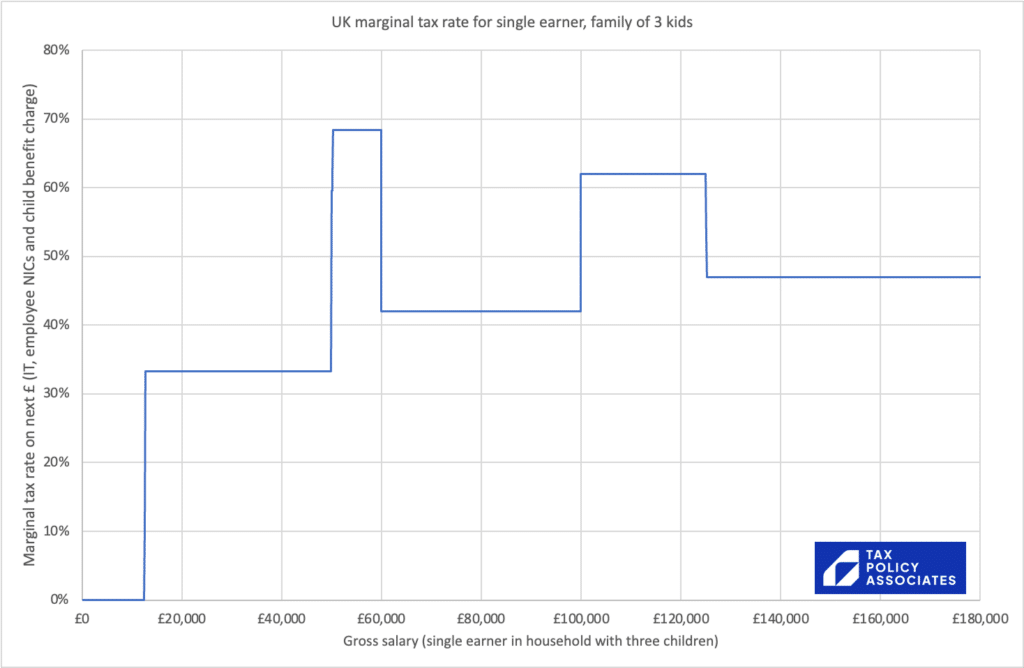
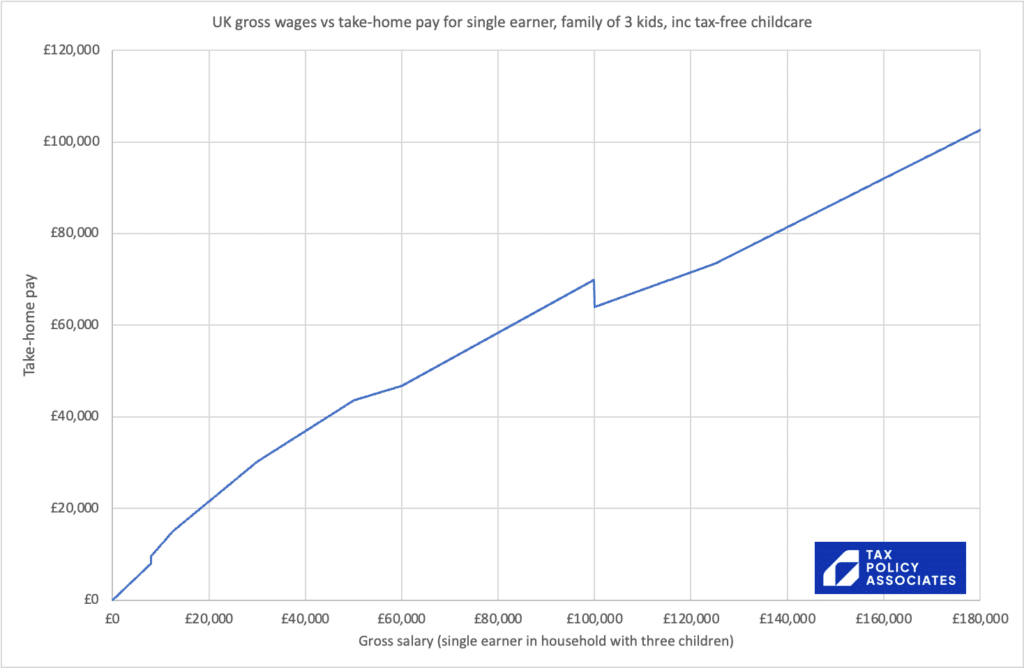
Reasonable people can disagree whether the top marginal rate of income tax should be 40%, 45% or 50%, and at what income that rate should kick in. But surely nobody thinks that there should be a marginal rate of 68% for people earning £50-60k, or 62% for people earning £100-125k. These, however, are the marginal rates you’ll pay today, if you have three children:
If you’re lucky/foolish enough to use the tax-free childcare scheme, your marginal rate can be so high that you lose money if your pay hits £100k:
(I’m pretty confident that the more you stare at that chart, the more insane you’ll think it is)
These are terrible features of any tax system. They discourage work, encourage evasion (not reporting income), and encourage [avoidance][sensible tax planning]1 such as salary sacrifice schemes/additional pension contributions. They also make people miserable. An obvious question: is the benefit to the Exchequer of the higher rates greater than the cost, in lost economic growth and lost tax?
But please, please, if the leaks about a new free childcare policy are correct, don’t claw any new benefits back with painful marginal rates once people hit a certain level of income.
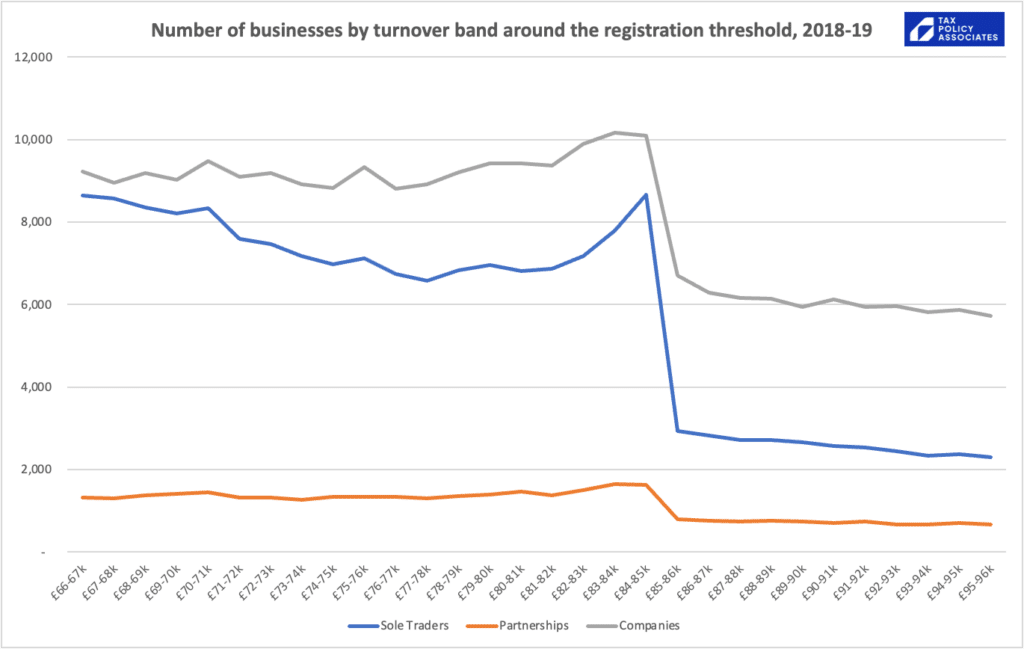
It shows the number of businesses at each level of turnover.
There’s no escaping the massive cliff-edge around £85k. By an extraordinary coincidence, businesses are required to register for VAT at £85k of turnover, and start charging 20% VAT on all sales.
A cynic would say that people are hiding their income – criminal tax evasion. In this instance, there’s good evidence the cynic is wrong. Businesses are intentionally depressing their turnover – not expanding (e.g. not taking on an apprentice), turning away work, or even going on holiday for the rest of the tax year once they hit £85k.
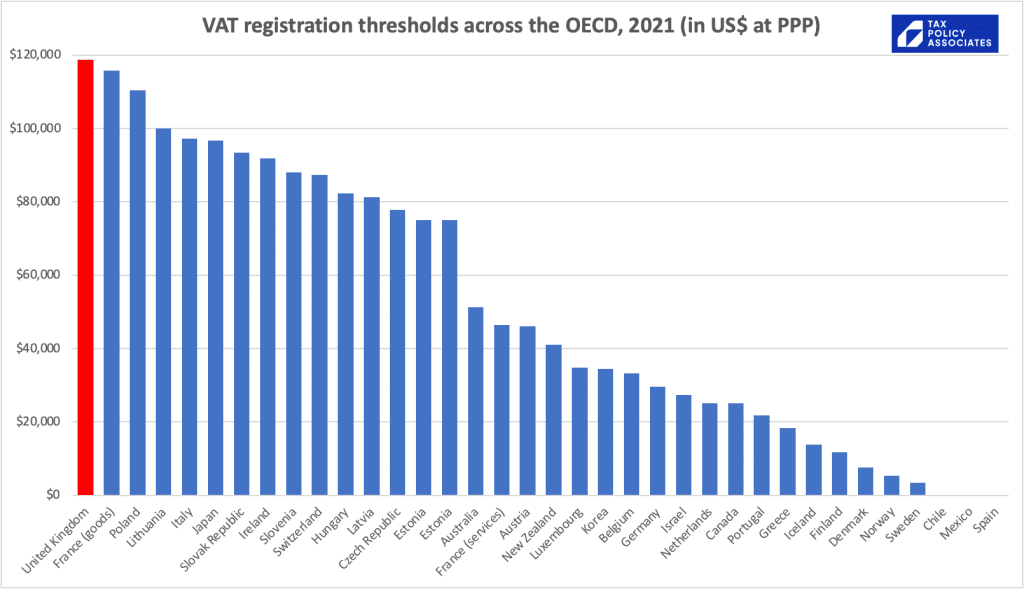
This is not a universal problem – the UK has the highest VAT threshold in the world:
A truly courageous Chancellor would solve the problem by bringing the VAT threshold down to a level where everyone except hobby businesses has to register.
A Chancellor who actually wants to keep his job probably can’t go that far. But he could announce that the VAT threshold will be gradually reduced in nominal terms (and so greatly reduced in real terms). And sweeten the pill by requiring HMRC to provide free apps to small businesses to minimise the compliance pain.
Stamp duty land tax and stamp duty reserve tax, the modern taxes on land and shares, have many problems. Taxing transactions is generally a Bad Thing – not least because it distorts decisions (for example putting people off moving house to follow employment elsewhere).
That said, SDLT and SDRT are reasonable taxes from a technical standpoint. They work okay. They raise useful amounts of money, without much avoidance or evasion.
By contrast, old-style stamp duty is a joke. The word “antiquated” doesn’t quite cut it for a tax designed 250 years ago. Horribly complicated. And realistically raises zero money. I’ve written more about it here.
The Chancellor should abolish it.
5. Introduce full expensing
The UK regime for tax relief for business investment is a horrible mess – highly technical, full of arbitrary distinctions, and rife with uncertainty (for the good taxpayers) and avoidance and even evasion (for the bad). Worse still, it changes with bewildering frequency.
All this means that it’s failing in its purpose of incentivising investment. Who plans a long term investment on the basis of a tax treatment which (a) nobody understands, and (b) will probably change several times before you strike earth?
The answer is full expensing: a simple regime of giving 100% up-front tax relief for capital investment by companies. It could be expensive – £11bn/year. But some of the cost could be reduced by further restricting tax relief for interest – and if you don’t do this (as a Government consultation paper recently pointed out), you risk incentivising inefficient investment.
One large caveat: is that there are only two years left of this Parliament. For full expensing to really work to incentivise long term investment, business would need to be confident that the next Government (of any political hue) wouldn’t scrap it. So, oddly, the success of a Conservative Government policy will plausibly depend on the actions of the Labour opposition. The right Labour response, in my view, would be to applaud full expensing and promise to maintain it through the whole of a Labour term of office.
6. Tax carried interest in a fair and open way
Private equity fund managers pay only 28% tax on their income – the “carried interest loophole”. This wasn’t created by legislation, but by an impressive piece of lobbying in 1987 which resulted in an agreement between the industry and HMRC.
I recently published a peer-reviewed paper which concludes that technically the loophole shouldn’t exist, and it’s ultra vires (outside the power) of HMRC to stand by the 1987 agreement. There are increasing signs that the private equity industry recognises that the situation is unsustainable.
Maintain the favoured tax status for carried interest, with new legislation in the Finance Bill that ends all uncertainty, and clearly provides the private equity industry with favoured treatment.
Announce that the 1987 statement will be withdrawn, and HMRC will follow the law.
Legislate to end the favoured treatment of carried interest (but perhaps preserve capital gains treatment for fund managers who properly invest in their funds, with money genuinely at stake).
Photo by Stable Diffusion: “statue of lady justice holding a (red-briefcase), photo, nikon 35mm, city street”
And the Finance Bill should tidy up the consequences – it’s invidious for investors’ own tax position to be impacted by the technical tax treatment of a fund that they don’t control. ↩︎
Stamp duty was one of the triggers for the American Revolution. Somehow, 250 years later, we still have it. That makes no sense – it raises no money, is pointlessly complex,and creates cost and uncertainty for business. The Government should abolish it.
350 years ago, stamp duty made perfect sense. The State had limited power and resources, and collecting tax from people was hard. So some unknown genius had a brilliant idea. Impose a special duty on documents. No need to have an army of tax inspectors. But if you wanted the document to be used for any kind of official purpose, you’d have to pay to get it stamped. No official would accept an unstamped document, for fear of being thrown into jail. Beautiful simplicity – a tax that doesn’t need an enforcement agency.
Stamp duty once applied to basically everything. Even tea1 – which helped spark the American Revolution. Over time, it’s shrunk and shrunk, and today it’s basically irrelevant. But still there, and still costing business millions in legal fees.
At this point I should clarify that I’m talking about old-style stamp duty, the one that actually involves things being stamped2. I’m not talking about the two modern taxes that emerged from stamp duty, but work in a sensible modern way:3 stamp duty reserve tax (SDRT – which applies to shares), and stamp duty land tax (SDLT). Both are often referred to as “stamp duty”, but they are separate taxes.
What does old-style stamp duty actually cover?
Given SDRT applies to securities, and SDLT applies to land, what does stamp duty do?
Answering that question is surprisingly hard, and requires a level of nerdy detail not really suitable for a blog post or twitter thread. But it demonstrates the insanity of the tax, so I’ll do it anyway:
The principal charging clause is paragraph 1 of Schedule 13 to Finance Act 19994. This says that stamp duty is chargeable on a transfer on sale, and paragraph 7 extends that to some agreements for sale. So at this point we think: OMG stamp duty applies to everything.
But then section 125 Finance Act 2003 says that actually stamp duty is abolished on everything except instruments relating to “stock and marketable securities”. Whew – it only applies to some stuff.
But what kind of stuff? The definition of “stock and marketable securities” is in section 122 of the Stamp Act 1891, which reads pretty much like you’d expect from 150-year-old legislation:
The expression “stock” includes any share in any stocks or funds transferable by the Registrar of Government Stock, any strip (within the meaning of section 47 of the Finance Act 1942) of any such stocks or funds, and any share in the stocks or funds of any foreign or colonial state or government, or in the capital stock or funded debt of any county council, corporation, company, or society in the United Kingdom, or of any foreign or colonial corporation, company, or society.
The expression “marketable security” means a security of such a description as to be capable of being sold in any stock market in the United Kingdom
If you stop and squint at this long enough, you’ll probably conclude it means that stamp duty applies to shares and bonds.5
But don’t stop there, because section 125 is partially undone by paragraph 31 of Schedule 15 to Finance Act 2003 which says that certain partnership transactions are also subject to stamp duty, if the partnership holds stock or marketable securities.
And we’re still not done, because the George Wimpey & Co case says that options can sometimes be subject to stamp duty, for reasons which don’t make a huge amount of sense, but there we go.6
And where’s the rule actually saying you have to pay stamp duty? There isn’t one. Stamp duty’s “teeth” are found in section 14(4) Stamp Act 1891, which says that a document executed in the UK, or which relates to the UK, can’t be used for any purpose in the UK unless it is stamped. So, for example, a share registrar won’t recognise a transfer of shares unless you get the transfer stamped. And a court won’t accept a document as evidence if it is stampable, but hasn’t been stamped. In principle your multibillion £ deal could be unenforceable if stamp duty isn’t paid, which would be awkward.7
I should emphasise – this unholy mess just tells us what the tax applies to. How it’s calculated, how the timing works, the scope of the exemptions – they make the above look simple and rational, but are a subject for another day.
So what does this mean in practice?
There are two ways in which stamp duty is actually relevant.
First, whenever shares in an unlisted UK company are bought/sold. People actually pay this, and get their documents stamped – because if they don’t, the transfer couldn’t be registered. But if stamp duty was abolished tomorrow, SDRT would apply instead. So in this scenario, stamp duty is payable but pointless.8.
Second, there’s a whole universe of cases where stamp duty might apply if you were really unlucky, but in practice never does. Some examples:
Transactions in foreign securities. The UK has no business taxing these transactions, and SDRT (stamp duty’s sensible sister) certainly doesn’t. Stamp duty in theory does tax transactions in Upper Volta, if the transactions have a UK party or are signed in the UK (or otherwise “relate” to the UK, whatever that means). But people normally don’t care – the fact you can’t enforce such a transaction in a UK court doesn’t much matter if the securities are foreign (i.e. because you’d enforce in the relevant foreign court).
A document might be thought to contain an “option”, and so be technically stampable, even though it’s not realistically an option at all.
Sales of loans, for example where a bank is selling part of its business to someone else. In practice the loans will almost always be exempt, but establishing this to a level of legal certainty means reviewing each loan. If the purpose of a tax system is to ensure revenue for tax lawyers, then job done.
I have never once seen stamp duty actually paid on any of this second class of transactions. But I’ve seen huge amount of time/money spent analysing the issues. Why? Because if a document is stampable but the duty isn’t paid, then it’s unenforceable. On a large commercial transaction that’s an unacceptable risk.
So there we have it. Stamp duty applies to some transactions pointlessly, and applies to other transactions not at all.
But all this complexity is an expensive business. During my 25 year career as a tax lawyer, I’m pretty confident I charged at least £2m in fees for stamp duty advice9. I will modestly say it was excellent advice, and my clients were very happy with it – but multiply this across all the tax lawyers in the UK, and that’s a lot of wasted fees on a pointless tax.
Abolish stamp duty. It’s an easy win: a tax-simplifying, pro-investment, pro-growth policy that costs nothing and has no downside.
It’s not even technically difficult. Expand the SDRT payment/collection rules so SDRT more easily applies to paper transactions in unlisted UK shares. Tidy up the SDRT rules that rely upon stamp duty.10. There’s even an IFS paper that goes into details on how to do this.
Job done.
Is this really the stupidest tax?
No, I lied. It’s the second stupidest.
The very stupidest is bearer instrument duty – a kind of a miniature clone of stamp duty for bearer instruments. In a world where SDRT exists, bearer instrument duty is completely irrelevant and I have never seen any actually paid. For added relevance, real bearer instruments basically don’t exist anymore. The tax is in Schedule 15 Finance Act 1999 and I have not the slightest clue why it still exists.
Why haven’t both these taxes been abolished?
Hard to say. Most bad tax rules exist because someone benefits from them – perhaps HMRC, perhaps a few deserving and/or loud taxpayers. But in this case there is literally no point to stamp duty. I can only assume the calculation for HMRC is: no downside for us in keeping it in place11; work for us in repealing it.
If so, that’s the wrong calculation. Stamp duty should join the old stamping machines in graceful retirement.
Engraving of the Boston Tea Party by E. Newbury, 1789, photo by Cornischong
Footnotes
Technically this was the Townshend Act not the Stamp Act, but facts shouldn’t get in the way of a good engraving ↩︎
By which I mean that, whilst not greattaxes from a policy standpoint, they technically/practically work just fine. They were created because stamp duty just became too old, creaking, and easily avoided. They are “normal” taxes in that if you don’t pay them, you go to jail (maybe). ↩︎
This was created as part of a rather half-hearted and very incomplete consolidation of legislation in 1999. Believe it or not, things used to be worse ↩︎
But only “probably” – there’s a reason why I’ve have seen twenty-page opinions on at least four different words in the definition of “stock” ↩︎
What exactly does Wimpey do following the partial abolition of stamp duty by s125 FA 2003? Good luck. ↩︎
This has never, to my knowledge, happened to a large transaction, but it has created injustice on a small scale – see for example the recent Highscore case – thanks to Nicholas Ostrowski for alerting me of this in the comments below. ↩︎
The interaction between stamp duty and SDRT is another deeply fascinating area ↩︎
I am thinking something like – an average of at least £100k/year x 25 years. Obviously, it’s not money I personally received. ↩︎
There are quite a few – SDRT doesn’t have many exemptions, so “hooks in” to stamp duty exemptions – these would have to be preserved ↩︎
Because whether someone stamps a document or decided by the taxpayer – HMRC has zero compliance cost ↩︎
Comment policy
This website has benefited from some amazingly insightful comments, some of which have materially advanced our work. Comments are open, but we are really looking for comments which advance the debate – e.g. by specific criticisms, additions, or comments on the article (particularly technical tax comments, or comments from people with practical experience in the area).
Private equity fund managers pay only 28% tax on their income – the “carried interest loophole”. This wasn’t created by legislation, but by an impressive piece of lobbying in 1987 which resulted in an agreement between the industry and HMRC. A new analysis shows that the 1987 agreement is unlawful; there is no loophole, and the correct legal position is that most fund managers should pay tax at the full marginal rate of 47%. An interest group could start judicial review proceedings to require HMRC to apply the law correctly.But it would be much better for the Government to clarify the law.
UPDATE: There is now a short response from Macfarlanes, who currently chair the private equity industry’s tax committee. The response neatly illustrates the problem the industry has: it correctly notes that trading is a difficult grey area (the correct technical position), but then jumps a few paragraphs later to absolute certainty (unsupportable as a technical matter). I responded in slightly more detail here.
What is carried interest?
Instead of receiving a salary, profit share, bonus, etc, private equity executives take a stake in the funds that they manage – called “carried interest“. It’s an unusual kind of stake, because they pay almost nothing3 for it. The private fund will then typically acquire a mature business, and aim to make it more efficient and then sell it at a profit. If that succeeds, then the carried interest can become incredibly valuable, with the management team receiving 20% of the profit. As the profits are often very large, and the team is pretty small, carried interest can make you seriously wealthy. At least £3.4bn of carried interest was shared between about 2,000 people in 2021/22 – and the true figure is likely significantly more.4
What’s the loophole?
When I was an overpaid lawyer, I paid 47% on most of my income. Overpaid bankers pay about 53%5. But overpaid private equity fund managers only pay 28%. One of the pioneers of the UK private equity industry famously said that he paid less tax than his cleaning lady.6
Why? Because the private equity industry claims that carried interest in a typical private equity fund is taxed as capital, not as income. And whilst income is taxed at a marginal rate of 47%, capital gains are taxed at only 28%7.
The loophole8 is worth around £600m a year to private equity fund managers.9
Why would Parliament create such a loophole?
It didn’t.
Most loopholes are created when Parliament accidentally leaves a small chink in tax legislation that a careful taxpayer can carefully squeeze through. This one is different – it was created by an impressive lobbying effort by the private equity industry back in 1987. The industry said that if it didn’t get the low tax result it wanted, then it would move offshore. And the Government blinked.
As a result, the Inland Revenue agreed a statement with the British Venture Capital Association saying that typical private equity funds were not “trading” for tax purposes, with the consequence being that carried interest was taxed as capital. Since then, the Inland Revenue has faithfully followed the BVCA statement, and private equity funds rely on it as a matter of course.
People often call it the “carried interest loophole”.
Is the loophole good tax policy?
Over the last few years there have been manyproposals to scrap this favoured treatment of carried interest, and it seems this is now Labour Party policy. The debate is somewhat predictable: campaigners say the loophole is unfair; the industry says that if they have to pay tax at the same rate as everyone else, they’ll fly off to Zurich.
I confess I don’t find the debate over whether the loophole should exist very interesting. So I’ve been wondering about a different question. Things have moved on since 1987, and these days HMRC can’t give certain taxpayers special favours – it has to follow the law. And, if you follow the law, and ignore the 1987 agreement, does the carried interest loophole actually exist?
My view is that it does not.
Why doesn’t the loophole exist?
Because, on a proper analysis, the way most private equity funds work means that they are probably “trading” for tax purposes, and so carried interest cannot be “capital”. The premise of the 1987 BVCA statement is incorrect.
The analysis in the BTR paper is somewhat detailed, but essentially it’s that investment is a passive activity – a mutual fund which buys a portfolio of stocks/shares is investing. A classic venture capital fund is also likely to be investing. But most UK private equity isn’t venture capital – most funds are “leveraged buyout funds”. Their typical activity is buying an entire business in a complex M&A process, actively managing it to maximise its value, and then selling it a few years later (in another complex M&A process). Then doing this again and again. In my view that course of activity is likely trading.
There’s much more detail on the argument in the paper, linked above. It’s important to note that I’m not saying all private equity funds are definitely trading; I’m saying that most classic LBO funds are probably trading, and therefore that HMRC should be investigating each one on a case-by-case basis before accepting that carried interest is taxed as capital.
This is not a very radical conclusion. One of the oddities of the tax world is that, whilst the private equity world operates on the assumption none of its funds are trading, in other contexts tax lawyers take a much more cautious view of what “trading” means.
HMRC appears to regard itself as bound by the 1987 BVCA statement. But the courts have repeatedly held that, whilst HMRC has some discretion in how it applies the law, it cannot depart from the law.10 It is not able to treat carried interest as capital if it is not in fact capital.
So what HMRC should be doing is individually assessing whether each private equity fund is trading and, if it is, taxing the “carried interest” at 47%.
What happens next?
There are three ways this plays out:
Everyone carries on as before, and we all pretend that private equity funds aren’t trading.
Someone judicially reviews HMRC to require it to follow the law. I explain in the paper why in my view such a judicial review would have good prospects for success. I understand it’s now quite likely this will happen.
The Government decides that a major industry can’t operate under such tax uncertainty, and legislates to either clearly tax carried interest as capital, or clearly tax it as income.11
The sensible outcome is option 3. We shouldn’t be taxed on the basis of lobbying and concessions, and tax policy shouldn’t be driven by litigation. The Government should act.
Full disclosure: I was a tax lawyer for 25 years, frequently advising on the question of whether an entity was carrying on a trade or investing; but I never advised a client on the availability of capital treatment for carried interest. As with everything I write, this article and the BTR article include no client-confidential information. ↩︎
It’s sometimes said that the private equity executives pay the same price for their carried interest as outside investors, but the key difference is that they don’t have to commit any subsequent funding. That makes a huge difference in practice. See, for example, the example in paragraph 7.2 of this document. where outside investors commit £100m to a fund, but the investment managers pay just £10,000 for their carried interest, which could eventually give them 20% of the fund returns. That’s usually justified on the basis that the carried interest starts out as pure “hope value”. But one thing’s for sure – if I offered £11,000 for the carried interest they wouldn’t give it to me. It is inextricably linked to the labour of the private equity managers – which is another reason why the status quo is so anomalous. ↩︎
That’s because many private equity managers are non-doms, and one of the effects of the BVCA statement is that there’s no UK trade, and so (to the extent their management activity is conducted outside the UK), they can hold their carried interest offshore and not be taxed on it. There are no stats on non-dom gains. ↩︎
because they are employees, with their earnings subject to employer’s national insurance, the burden of which falls on employees in the long term ↩︎
A pedant would say that, unless she was very well remunerated, his cleaning lady paid tax at the basic rate of 20%. However, Ferguson was writing at a time when standard private equity structuring (the “base cost shift”) meant that in practice fund managers enjoyed an effective CGT rate in the single digits. That game was ended in 2015. ↩︎
Normal capital gains are taxed at 20%, but ever since 2015, carried interest has been taxed at the special rate of 28% ↩︎
You can argue whether it is truly a “loophole”, but “carried interest loophole” is a common term and I’m using it for clarity ↩︎
The source for the £600m figure is this FOIA, which shows £3.4bn of gains in the most recent tax year. The difference between CGT and income tax/NI on £3.4bn is £600m. Determining the actual revenue that would be raised if the loophole disappeared is complicated. This is a “static” figure, and would be reduced if private equity managers responded by leaving the UK. On the other hand, there could be additional revenue from the loss of the remittance basis for non-dom fund managers (as their carried interest would be income from a UK trade and hence UK situs) ↩︎
The uncertainty goes to more than the treatment of carried interest – if UK-managed private equity funds are trading then that could adversely affect their investors too. In some rare cases their foreign investors could become subject to UK tax on their profits (if the investment management exemption or treaty exemptions don’t apply). In other cases UK institutional investors could have a bad tax outcome, e.g. pension funds’ usual tax exemption might not apply. The position for this result risks damaging the UK private equity industry and so, however the Government decides carried interest should be taxed, any legislation should explicitly protect the position of investors (including, in my view, investment management executives who acquire “normal” interests in the fund, as opposed to carried interest). ↩︎
Comment policy
This website has benefited from some amazingly insightful comments, some of which have materially advanced our work. Comments are open, but we are really looking for comments which advance the debate – e.g. by specific criticisms, additions, or comments on the article (particularly technical tax comments, or comments from people with practical experience in the area).
It would be great to have comments on the technical points here, and not on the different question of how carried interest *should* be taxed as a policy matter.
Between 2018 and 2020, almost 400,000 people earning less than £13,000 received a penalty for not filing a tax return on time. Very few of them had any tax to pay (the tax-free personal allowance was around £12,000). But, by failing to submit a tax return, they were fined at least £100, and often thousands of pounds.For most of those affected, the penalty represents more than half their weekly income.
This paper illustrates the scale of the problem. We believe the law and HMRC practice should change, and we make three key recommendations.
Most people in the UK aren’t required to submit a tax return – where a person’s only income is employment income and a modest amount of bank interest, then in most cases a tax return isn’t required.
For this reason, out of the 32 million individual taxpayers[1] in the UK, around a third (12 million people) are required to submit a “self assessment” income tax return[2].
Tax returns must be filed online by 31 January, or three months earlier (31 October) for people submitting paper forms.
Penalties
If HMRC has required a taxpayer to submit a tax return, but he or she misses the deadline (even by one day), then a £100 automatic late filing penalty is applied.
After three months past the deadline, the penalty can start increasing by £10 each day. After six months, a flat £300 additional penalty can be applied, and after twelve months another £300. By that point, total penalties can be £1,600.[3] Those advising taxpayers on low income commonly see clients with over £1,000 of penalties (and sometimes thousands of pounds if multiple years are involved). Filing appeals for late payment penalties often makes up a significant amount of their work.
Until 2011, a late filing penalty would be cancelled if, once a tax return was filed, there was no tax to pay. However now the penalty will remain even if it turns out the “taxpayer” has no taxable income, and no tax liability.
Appeals
Anyone receiving a late payment penalty who has a “reasonable excuse” for not paying can make an administrative appeal to HMRC, either using a form or an online service.[4] If HMRC agree, then the penalty will be “cancelled”. If HMRC don’t agree, then a judicial appeal can be made to the First Tier Tribunal, but this is very rare for late filing penalties. All the “appeals” discussed in this report are administrative form-based appeals.
The data
Data provided to Tax Policy Associates by HMRC under a Freedom of Information Act request clearly demonstrates that late filing penalties are being disproportionately levied on those on low incomes, most of whom in fact have no tax to pay.
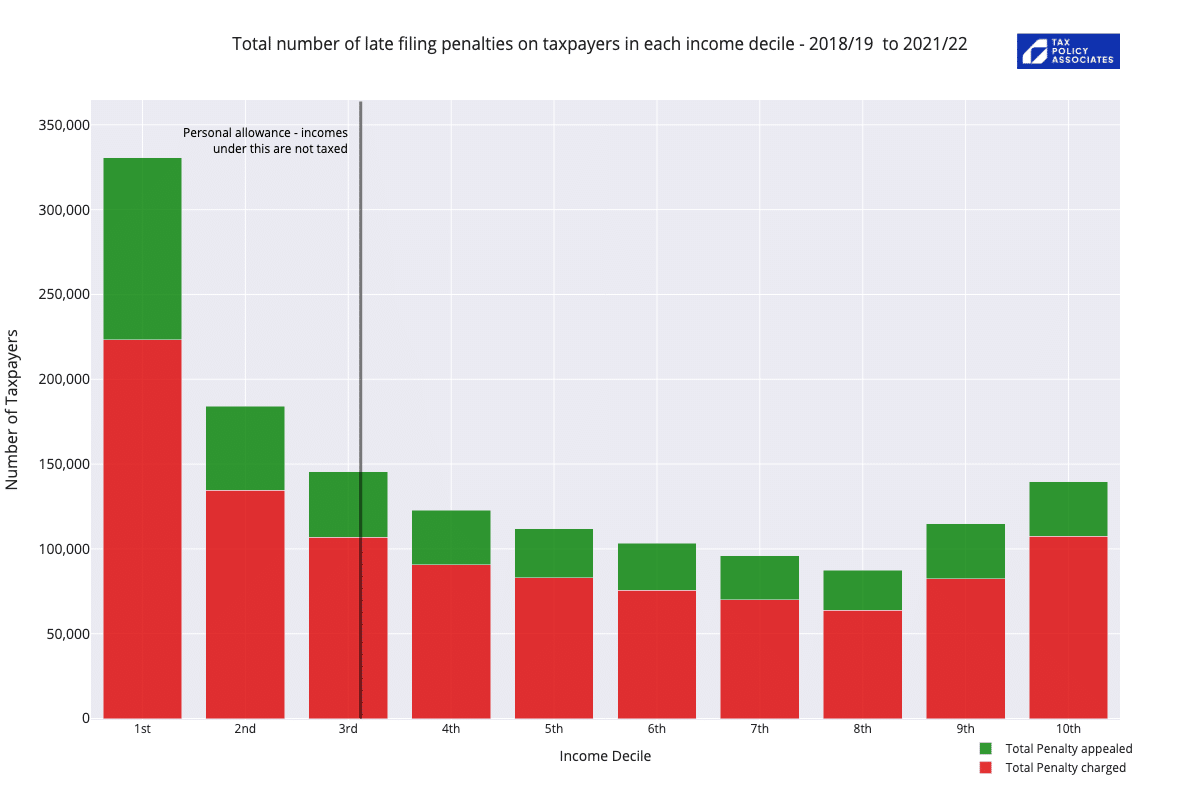
The chart below shows the percentage of taxpayers in each income decile who were charged a £100 fixed late filing penalty in 2018/19. The green bars show where penalties were assessed but successfully appealed. The red bars show where the penalty was charged.
And this is the data for 2019/20, a less representative year:[5]
The charts clearly show taxpayers in the lowest three income deciles receiving a disproportionate number of penalties – 210,000 in 2018/19 and (likely less representative) 167,000 in 2019/20.
But the critical problem is that almost none of these taxpayers have any tax to pay.
We know this for two reasons.
First, the personal allowance was £11,850 in 2018/19 and £12,500 in 2019/20, and anyone earning less than that had no income tax liability. Taxpayers in the lowest three income deciles earn less than £13,000 – so very few will have tax to pay.
Second, this is confirmed by the data on penalties issued for late payment (as opposed to late filing). The first three deciles pay almost no late payment penalties[6]. This won’t be because they are more punctual at paying than they are at filing; it will simply be because they almost always have no tax to pay.
The impact of penalties on the poor
A £100 fixed penalty is a large proportion of the weekly income of someone on a low income (indeed over 100% of the weekly income for someone in the lowest income decile), but inconsequential for someone on a high income:
And, whilst the data shows the numbers of people receiving £100 fixed penalties for late filing, many of the same people will have received late filing penalties which are much higher – up to £1,600 for one year, and more than that where a taxpayer fails to file for more than one year.
The human cost
Since publishing our initial report, we’ve been inundated with people’s stories, often very distressing.
These are vulnerable people, at a low point in their lives – and the same difficulties which meant they missed the filing deadline mean they often won’t lodge an appeal, and may take months before they pay the penalties (racking up additional penalties in the meantime).
Here are a representative sample:
Will the 2025 changes change the position?
The income tax self assessment penalty rules will likely be changing from 6 April 2025.
From that date, a one-off failure to file will not incur a penalty; rather it will result in a taxpayer incurring a “point”, and only after two points (for an annual filer) or four points (for a quarterly filer) will a penalty be issued. [7]
At the same time, the fixed penalty amount will increase to £200.
This might overall reduce the penalties imposed on low earning taxpayers (for example if they are currently missing the filing deadline by a few weeks, and then filing), but it could equally well worsen the position (if they are missing multiple deadlines, and particularly if they don’t open correspondence). At this point we have insufficient data to say. However we can say that insufficient consideration appears to have been given to the impact on the low paid when the new rules were drawn up.
Conclusions
We believe that the Government, HM Treasury and HMRC are acting in good faith, and have to date been unaware of the disproportionate impact that penalties have on the low paid.
In light of the data revealed by this report, we have three recommendations:
1. Cancellation
Fixed rate late submission penalties should be automatically cancelled (and, if paid, refunded) if HMRC later determines that a taxpayer has no taxable income. Most likely that would be after a subsequent submission of a self assessment form; but no further application or appeal should be required.
Similarly, there should be an automatic abatement of penalties (by, say, 50%) if HMRC determines that a taxpayer has a taxable income but it is low (for example less than £15,000).
In both cases, an exception could be made where HMRC can demonstrate that the failure to file was intentional (i.e. for truly exceptional cases, and not applied by an automated process).
Whilst it is possible that some cancellations could be achieved under HMRC’s existing “care and management” powers , we expect that creating a general cancellation and abatement rule falls outside those powers, and therefore may require a change of law.
This is not a radical proposal; before 2009 penalties were automatically capped at the amount of a taxpayer’s tax liability. UPDATE: It’s well worth reading the first comment below, from the respected retired tribunal judge Richard Thomas, for more background on this.
2. Monitoring
HMRC should start monitoring late submission penalties across income deciles, (using other sources of data, i.e. not limited to those provided to us) to provide a more complete picture of the impact on the low paid, including the level of penalties paid (i.e. not just the data on £100 penalties presented in this report).
And how many penalties are never paid by these deciles and get written off? We expect a fairly high proportion – in which case all that is being achieved is stress for the recipients of the penalties, and administrative cost for HMRC.
Armed with that data, HMRC should aim to reduce the disparities identified in this report, and report annually on its progress.
3. Rework processes
The data reveals that there is a significant population of self assessment “taxpayers” who are being required to complete an income tax self assessment, are charged a late submission penalty, but turn out to have no tax to pay.
HMRC should analyse this population with a view to determining:
how many of these are taxpayers who in retrospect should not have been required to submit a self assessment return at all,
whether that could have been determined in advance, on the basis of the information HMRC possessed at the time,
if it could be determined in advance, what additional processes should be put in place by HMRC to prevent such taxpayers being required to submit a self assessment in the future, and
if there are small changes which could impact this population’s tax compliance, for example changing envelope labelling (although it may be this work has already been done)
Methodology
Source of data
HMRC provided data to Tax Policy Associates following a Freedom of Information Act request.
The data shows penalty statistics by income decile of self assessment taxpayers. In the years in question there were 11.3 million self assessment taxpayers, and therefore each decile represents 1.13 million people.
Note that the income deciles are different from the usual national income deciles, as self assessment taxpayers have different (and, on average, lower) incomes than the population as a whole.
Limitations
The most important limitation is that, whilst we had asked for income level to be computed by reference to previous self assessments filed by taxpayers, HMRC’s systems were unable to do this (at least within the limited budget available for responding to FOIA requests).
The data is therefore based upon the income level revealed when a taxpayer did eventually submit his or her return. That means, if a taxpayer did not submit a return at all for the relevant year, they do not appear in this data. In fact, the majority of taxpayers fall in this category – HMRC only has income data for 44% of taxpayers receiving a late filing penalty for 2018/19, and for 30% of taxpayers receiving a late filing penalty for 2019/20.
It is plausible that the “never filing” taxpayers are more likely to be low/no income taxpayers (without the time/resources to file) than higher income taxpayers. If that is right then the data we report is under-estimating the impact of penalties on low-income taxpayers. However, this is speculation; further data is required.
Data
The complete dataset follows below.
“PF1” is the £100 fixed penalty for missing the self assessment deadline; LPP1 is the 30-day late payment penalty. “Pre” are penalties originally assessed. “Post” are penalties which are actually charged (the difference between “Pre” and “Post” being cancelled penalties, usually as the result of a successful administrative appeal).
2018/19
2019/20
PF1
LPP1
PF1
LPP1
Deciles
Pre
Post
Pre
Post
Pre
Post
Pre
Post
1st (£0 to £6k)
9.2%
6.3%
0.3%
0.2%
7.5%
4.6%
0.2%
0.1%
2nd (£6k to 10k)
5.1%
3.8%
0.2%
0.1%
4.1%
2.7%
0.2%
0.1%
3rd (£10k to £13k)
4.2%
3.1%
0.3%
0.2%
3.2%
2.1%
0.2%
0.1%
4th (£13k to £18k)
3.5%
2.6%
3.3%
3.0%
2.6%
1.7%
2.8%
2.6%
5th (£18k to £23k)
3.1%
2.3%
3.8%
3.5%
2.3%
1.6%
3.6%
3.3%
6th (£23k to £30k)
2.8%
2.1%
4.4%
4.1%
2.1%
1.4%
4.1%
3.8%
7th (£30k to £40k)
2.6%
1.9%
4.6%
4.2%
2.0%
1.3%
4.4%
4.0%
8th (£40k to £52k)
2.3%
1.7%
4.8%
4.3%
1.9%
1.3%
4.8%
4.3%
9th (£52k to £88k)
3.6%
2.5%
6.7%
5.7%
2.4%
1.6%
5.4%
4.7%
10th (above £88k)
3.7%
2.9%
5.3%
4.4%
2.9%
2.1%
4.5%
3.6%
Acknowledgments
Many thanks to HMRC for their detailed response to our FOIA request on penalties and income levels, and to their openness and responsiveness to our follow-up queries.
Many thanks to all those who responded with their personal experiences of penalties, and to the tax professionals who provided technical input and insight (many of whom spend hours volunteering to help people in this position).
[3] i.e., £100 + 90 x £10 + £300 + £300. The way in which penalties escalate does not seem rational, and will be improved from 2025 – see page 9 below. Technically all penalties after the first £100 are discretionary, but in practice they appear to be applied automatically in most cases.
[5] The pandemic meant that HMRC extended the filing deadline to 28 February 2021.
[6] Another factor is that some of the late payment penalties applied to those on low income will have been held over from a previous, higher earning, year. Hence the proportion in the lowest three deciles with tax to pay will be lower than suggested by this chart.
This website has benefited from some amazingly insightful comments, some of which have materially advanced our work. Comments are open, but we are really looking for comments which advance the debate – e.g. by specific criticisms, additions, or comments on the article (particularly technical tax comments, or comments from people with practical experience in the area). I love reading emails thanking us for our work, but I will delete those when they’re comments – just so people can clearly see the more technical comments. I will also delete comments which are political in nature.
The hundreds of victims of the Post Office scandal are finally receiving compensation for the appalling treatment they received – including malicious prosecution, jail and asset seizures. But much of the compensation could be taken in tax, the Post Office settlement offers don’t properly explain this, and victims could end up in default to HMRC. It’s a scandal on top of a scandal, and the Government should act.
UPDATE 14 March: the Government responds, and says they’ll fix the “compression” effect where postmasters receiving multiple years of lost income in one go get pushed into a higher tax bracket. But no sign of a general exemption. Disappointing.
UPDATE 27 Feb:the Post Office has finally responded in a letter to The Times – but much too slow, no acknowledgement of responsibility, and an inadequate compensation principle. These people have lost much more than money, and the compensation should reflect that. And it should certainly compensate for additional tax they suffer as a result of receiving multiple years’ income in one year. These practicalities are quite aside from the moral case for a complete tax exemption.
My conclusion is that the Mail is right. I fear that the tax impact of the settlements on the victims has not been thought-through and, as a consequence, much of the compensation will disappear in tax. There are two big issues:
No tax advice
The tax treatment of compensation is a complicated area, but the victims are being left to their own devices. The Post Office settlement offers suggest victims may wish to obtain tax advice, but don’t cover the cost4, and the settlement agreements seem to have been structured in a way that creates an unnecessarily bad tax result for the victims.
Compensation for loss of earnings is fully taxable
Much of the payments are compensation for loss of earnings. This is taxable in the same way as normal earnings, and the Post Office will operate PAYE. The problem is that, unlike normal earnings, multiple years are being taxed at the same time, pushing the victim into a high tax bracket. For example: a postmaster earning £30k ordinarily takes home about £25k after tax. But if that same postmaster receives ten years’ worth of earnings in one payment, of that £300k they’ll take home not £250k, but £170k. The “compression” of many years of income into one year costs them £80k. That’s an unjust result.5.
There were two ways to deal with this: (1) structure the compensation in a way that reflects the main harm suffered and also isn’t taxable (for example as damages for defamation or an economic tort)6, or (2) increase the compensation to make up for the additional tax. This is the approach a court would adopt when calculating damages – the ‘Gourley principle‘ – putting a claimant into the same after-tax position they would have been in had there been no breach.7. Neither of these steps appears to have been taken.
The large interest element is fully taxable
Because the compensation is covering events from many years ago (20 years in some cases), a large amount of the compensation is interest (often a six-figure sum). This will be fully taxable for the victims. 20% of the tax will be withheld by the Post Office. The remainder (another 20%-25% of tax) will be payable by the victims on their self assessment return. They are not being warned about this and may receive a nasty surprise. I am very concerned that some of the victims won’t obtain tax advice, won’t declare the interest on their tax return, and so could fall into default with HMRC. That would be an unconscionable outcome.
The settlement offer mentions tax on interest, but the wording appears to be standard “boilerplate” which in the case I saw (and I expect many others) is incorrect and misleading:
Why “incorrect”? Because, even if this individual had no other income, it is mathematically impossible that they’d be entitled to a refund of the 20% tax withheld, and mathematically certain they will have significant additional liability. I don’t understand why anyone thought this text was acceptable. It is actively misleading.
What it should say is something like: “we’ve deducted income tax at the basic rate of 20%; given the compensation amounts you are receiving, you will have additional liability of somewhere over 20% which you will need to declare and pay in your self assessment. We will cover the reasonable costs of you obtaining tax advice from one of the following firms…”
The more fundamental point: it’s fair for interest to be taxed when it’s a financial return; not when it reflects the time passed since an injury was suffered. For this reason, interest on personal injury damages/compensation is exempt from tax. The Post Office’s victims have suffered injuries similar in many ways to personal injury, but this exemption won’t apply. And then there’s, once more, the effect of compressing many years’ income into one year. That seems unjust.
Some of these problems could be fixed going forwards: ensure claimants receive proper tax advice (before and after the event), paid for by the Post Office, and ensure that the settlements appropriately account for tax considerations. The GLO scheme will be able to take account of these issues, and certainly should do.
But it’s too late for the hundreds of settlement agreements that have already been signed, and there’s no obvious solution to the interest on future settlements/payments being taxed. A better solution is needed.
The solution
There is a simple solution – this year’s Finance Bill should include two8 clauses:
All compensation should be calculated as if the exemption does not exist. The Post Office does not appear to have followed the Gourley principle in its settlements to date, but the creation of an exemption could enable it to reduce settlements still further in the future. So it’s important to prevent this.
If this cannot be achieved then the Post Office should, at an absolute minimum, take responsibility for what appear to be serious failings in its past settlements. It should make sure that the Gourley principle applies (to compensate for compression effects on both damages and interest), and pay for victims to receive proper tax advice (both before the settlements and when they come to file their tax returns). The Post Office should do this out of goodwill. If it does not, then it will potentially be open to past settlements being reopened, on the grounds that it made false statements in its settlement offers.
And, needless to say, future settlements (under either scheme) should give full consideration to the tax impact.
Why should the Post Office victims be treated differently from others receiving compensation?
And there are other precedents. Settlement payments for the Thalidomide scandal were (very belatedly), exempted from tax. Compensation payments for missold pensions were exempted from tax9
Many thanks to everyone who helped with this piece, particularly Ray McCann, Judith Freedman and M. And thanks, as ever, to J. Without their technical tax expertise and practical advice, I could not have written this piece. All mistakes, however, are mine.
Photo by Stable Diffusion, “a photo of a statue of lady justice holding a cash register”.
Footnotes
When I wrote this article I was significantly understating the number. We don’t have the full figures, but it is likely around 3,000. ↩︎
Not to be confused with the Royal Mail – the Post Office wasn’t privatised and is owned wholly by the Government. Primary responsibility for the scandal rests with the Post Office alone, but successive governments (since the 2000s) share responsibility for not responding to early reports in Private Eye and Computer Weekly ↩︎
I have relied heavily upon other tax professionals who have provided input on these points – they are much more expert in these matters than I am – but, as ever, any mistakes are mine and mine alone. ↩︎
The cost of reasonable legal advice is covered – see paragraph 44 of this document, but tax advice is not covered, and the claimant firms involved may not have the capability to provide complex tax advice ↩︎
A small compensation for this will be that many of those affected will be past retirement age, and so won’t pay national insurance – that will save them around £9,500 of tax ↩︎
Is that tax avoidance? In some circumstances changing a document to achieve a different tax result absolutely is. However in this case, given it is a fair way to view the compensation, and results in a more just outcome, I’d say the answer is “no”. Loss of earnings is perhaps the least significant harm the victims suffered. And structuring the compensation in this way would also be technically hard for HMRC to challenge (in the unlikely event they’d want to). ↩︎
In this case, using the same example figures, it would mean increasing the compensation from £300k to somewhere around £440k. ↩︎
This website has benefited from some amazingly insightful comments, some of which have materially advanced our work. Comments are open, but we are really looking for comments which advance the debate – e.g. by specific criticisms, additions, or comments on the article (particularly technical tax comments, or comments from people with practical experience in the area). I love reading emails thanking us for our work, but I will delete those when they’re comments – just so people can clearly see the more technical comments. I will also delete comments which are political in nature.
Updated: raising corporation tax to 25% will take the effective rate to the highest it’s ever been in the UK, and one the highest in the developed world. That’s bad – but the alternatives are worse.
The Johnson government increased corporation tax from 19% to 25% from April 2023. The mini-Budget reversed this. Then Jeremy Hunt’s Autumn Statement reversed the reversal, taking the rate back to 25% from April. Not a hugely stable environment for business. But how should we assess the merits of the increase to 25%? Should we reverse the reversal of the reversal?
The standard argument for the increase goes something like this:
“We’ve been cutting corporate tax for 25 years, it’s gone too far, and it’s time to go back to 25%. After all, the rate was 33% in the 80s, and is now 19%, so 25% is still a pretty good deal.”
That argument is usually accompanied by this chart, showing the headline rate falling dramatically:
This is rather less persuasive if we look at the corporate tax actually paid – here’s an overlay showing UK corporation tax receipts (in red) as a % of GDP:
The rate fell. The revenues bounced around with the business cycle, but fundamentally didn’t change much, if at all.
Could it just be that corporate profits rose, so the declining rate multiplied by increased profits kept revenues broadly constant? We can test that by dividing corporation tax revenues by the corporate “gross operating surplus” in the national accounts, which gives us a reasonable proxy for the overall effective tax rate.1 Again we see that the plummeting headline rate does not lead to much, or perhaps any, reduction in the actual effective rate (particularly bearing in mind that the 2020 figures are depressed by Covid).2:
How can the tax take remain the same when the rate has fallen so dramatically? Because of a series of technical changes that meant that, at each stage when the rate went down, the tax base (the definition of “profits” to which the rate applies) expanded. Tax = rate x base. So, through accident or brilliant HM Treasury design, nothing much changed.3
The rate increase to 25% is, by contrast, accompanied by nothing that reduces the tax base. It will therefore simply represent a 1/3 increase in the amount of tax companies pay, making our chart look like this:4
And UK corporate tax will, as a % of GDP, become one of the highest in the developed world – of large economies, only Japan and Canada’s would be higher:5
So I am convinced that raising corporate tax is a bad idea. The problem, however, is that the 25% increase was “banked” in government accounts, and the cancellation of the increase in the mini-Budget was unfunded. The £16bn+ it costs would therefore have been distributed opaquely throughout society through inflation and/or higher interest rates. I don’t regard that as good tax policy.
Alternatively one could keep the rate at 19% by cutting spending, or raising taxes elsewhere – that would certainly be a rational position to take (whether you agree with it or not), but it’s an argument that I don’t hear anyone making.
And, finally, you could argue that increasing the rate to 25% will actually bring in no more revenue, because profits will drop – in other words, the 25% is past the “revenue maximising point”. The problem with this is that there’s no evidence for it in the response to previous rate reductions.
So taking the rate to 25% feels like the least bad of several bad ideas. I therefore unenthusiastically support it.
Footnotes
Two big caveats: (1) GOS is not the same as accounting profit, and in particular excludes depreciation (so the chart understates ETR), (2) the tax stats are for cash collected by HMRC in a tax year, which used to lag profits by around a year, and now mainly doesn’t – neither factor should affect the overall trend, but both will create/mask considerable noise. With some work they could be corrected, and I’d love it if someone did that. ↩︎
I’ve added a trendline which shows a slight increase over time, but I’d be hesitant to draw too many conclusions given the large fluctuations across the business cycle ↩︎
Another factor is that a wave of incorporation by small businesses has artificially inflated corporation tax revenues, but at the cost of (greater) reductions in income tax. This effect, however, is too small to impact the trends visible in the charts above – it’s about £1bn. ↩︎
It would have gone higher than this, because this chart doesn’t include the effect of the bank surcharge, which at 8% would have meant banks would have been be paying 33% on their profits. However, controversially but sensibly, the increase to 25% was accompanied by a reduction in the surcharge to 3% ↩︎
And Canada, like Australia, is driven by the high tax revenues from mining/oil/gas ↩︎
As inews has reported, Ian Lavery MP has refused to confirm whether he paid tax on £140,000 of irregular and uncommercial payments from his former union. He says all his tax affairs are up-to-date, but refuses to comment on the specific question of these payments. That is the same answer I received from Nadhim Zahawi back in July, and it’s not good enough.
I should say up-front: credit for this story goes to David Parsley from inews and the senior tax accountant who worked with him. I stand behind the story, and provided some assistance. Please read the inews story for full background.
Normally we wouldn’t think to ask if someone paid tax on their income, and it wouldn’t be remotely fair or sensible to ask this kind of question of every MP, or everyone in a public position. However this £140,000 is different.
Here’s a short summary of what happened – but the Certification Officer report, and inews report, are well worth reading in full:
Mr Lavery received a “redundancy payment” when as a legal matter he was not made redundant – he left the union because he became an MP.
There was a peculiar arrangement whereby the union compensated Mr Lavery and his wife for the underperformance of an endowment policy that Mr Lavery and his wife (not the union) had invested in.
Mr Lavery received loan write-offs of £91,5451 – this is highly unusual for an employee.
The union (in the words of the Certification Officer’s report) “in effect purchased a share in its General Secretary’s home”, again contrary to usual commercial and trade union practice.
This was all in 2005-20132. No proper explanation or justification has ever been provided for these arrangements. The Certification Officer did not appoint an inspector to fully investigate (because he thought there would be insufficient financial records to facilitate an investigation). No prosecution was brought (or, as far as I am aware, contemplated). I will let others judge the propriety of the arrangements, and focus on the tax consequences.
The tax treatment of the payments
The experienced accountants working with inews say the loan write-offs and “redundancy payments” should have been fully taxable. I have reviewed the documentation and agree with this conclusion.
Note that there is usually an exemption for the first £30,000 of redundancy payments3, but the point is that these were not actually redundancy payments at all – Mr Lavery left his employment to become an MP, and was succeeded as general secretary by Denis Murphy (the former MP for Wansbeck – this was an unusual “job swap”). Note the description in the filed AR21 annual returns for the union:4
A redundancy, by contrast, is when a job ceases to exist. Calling it a “redundancy” does not make it a redundancy, any more than calling my sister a grapefruit makes her a grapefruit. This was either a reward for his previous work as general secretary, or part of a quid-pro-quo for Mr Lavery’s job swap with Denis Murphy. In either case, the payments were general earnings, subject to income tax and national insurance in the usual way. The union, which Mr Lavery ran at the time, should have applied PAYE.
The loan write-off was more straightforward: fully taxable, no applicable exemptions, and with the income tax payable by Mr Lavery personally (not by PAYE).
In my experience, when people fail to follow correct legal procedures for payments, and/or the payments do not make commercial sense, they often also fail to follow correct tax procedures. That’s true whether the failures are accidental (for example a result of administrative chaos), or intentional. I don’t know which was the case here, and the Certification Office report doesn’t reach any conclusions as to the parties’ motivation.
There are several possibilities:
Mr Lavery paid tax on the payments in full at the time (or the tax was collected by PAYE) and nobody did anything wrong
Mr Lavery did not pay the correct tax at the time, and/or the union did not correctly operate PAYE, but the tax was paid subsequently, e.g. as a result of an HMRC enquiry, potentially with “carelessness” or “deliberate” penalties applying.
Mr Lavery/the union did not pay the correct tax at the time, and still has not.
I and the senior tax accountant are both wrong, and the payments weren’t taxable. In that case I will happily issue an apology to Mr Lavery and make a donation to charity.
It is reasonable to ask Mr Lavery which of these scenarios we are in. The question is whether the true nature of the payments was disclosed to HMRC (for example the fact that the “redundancy” payment was not a redundancy payment).
If HMRC realises it missed something in a tax return, but has passed the twelve month deadline, then HMRC is out of luck.
But if HMRC discovers information which was not disclosed in a tax return, and suggests the tax was incorrect, they can raise a “discovery assessment”. The deadline for this is usually four years after the end of the tax year, extended to six years where a taxpayer or their advisers have been careless, and twenty years where the taxpayer’s non-disclosure was deliberate5
HMRC will review someone’s affairs internally before deciding whether to commence an enquiry or discovery assessment, and that will usually involve correspondence with the taxpayer or their advisers
I think, in the usual English meaning of the word, all of the above would class as an HMRC “investigation”, and that’s how tax advisers would use the word too. So it’s not clear to me how Mr Lavery could have had dealings with HMRC well after the event (2005-2013) unless he was under investigation. Most likely because HMRC were considering whether to raise a discovery assessment – but even the six year time limit would have been challenging at that point.
Why it’s reasonable to expect an explanation
It was the unusual and uncommercial nature of the YouGov and Balshore structure which made me wonder if Mr Zahawi failed to pay all the tax that was due – and it turned out he had not. The unusual and uncommercial nature of the payments to Mr Lavery raises the same questions. The amounts are much less than Mr Zahawi’s but the principle is the same: we expect our representatives to pay the tax that’s due, in the same way millions of ordinary taxpayers do.
The other thing that’s the same is Mr Lavery’s response. inews asked him a very simple question. He should have an equally simple answer: tax was fully paid, and here are the tax returns to prove it. Giving us the same non-answers as Mr Zahawi provided is not good enough.
Mr Zahawi may agree that, in retrospect, it would have been better if he’d provided a proper explanation at the time.
I hope Mr Lavery takes the opportunity to provide us with a proper explanation now.
Thanks to the tax lawyers, tax accountants, employment lawyers and trade unionists who assisted with this report – but most of all, thanks to David Parsley for breaking the story.
Technically it’s more complicated than that, as Andrew ably explains in the comment below, but for practical purposes most people call it an “exemption” and I’ll do that here. ↩︎
It seems that at some point an argument was made that Murphy was not a “general secretary” but a “secretary” – that is not consistent with the annual returns ↩︎
For completeness, the deadline can also be: twelve years for certain offshore cases, and 20 years for a failure to notify of liability (i.e. you never completed a return at all), or where the matter relates to a tax avoidance scheme ↩︎
Comment policy
This website has benefited from some amazingly insightful comments, some of which have materially advanced our work. Comments are open, but we are really looking for comments which advance the debate – e.g. by specific criticisms, additions, or comments on the article (particularly technical tax comments, or comments from people with practical experience in the area). I love reading emails thanking us for our work, but I will delete those when they’re comments – just so people can clearly see the more technical comments. I will also delete comments which are political in nature.
The UK charged20% VAT on ebooks until May 2020, when it was abolished following a lobbying campaign by the publishing industry. They claimed that consumers would benefit from lower prices. Our analysis shows that this didn’t happen – publishers retained the VAT saving for themselves, costing the country £200m.
Background
Books have always benefited from 0% VAT. Ebooks were subject to 20% VAT.1 An EU law change in 20182 permitted the UK to reduce the rate of VAT on ebooks, which the UK initially resisted. Following a lobbying campaign from the publishing industry, the UK scrapped3 VAT on ebooks4 in March 2020. The cost to the Exchequer was £200m.5
We analysed the detailed ONS sampling data of ebook pricing, compiled as part of the consumer price index. We found no significant change in ebook pricing around the time of the VAT cut. Full details of the ONS analysis are below.
This is the key chart, showing the change in average pricing for the 23 months6 before and after the VAT cut, for both ebooks and other comparable products:
The VAT cut means that ebook publishers could have cut their prices by 17%7 and made the same profit. They didn’t. Over this period there were 8%+ price reductions for comparable products – computer game and app downloads – where there was no VAT cut. There were no overall price reductions for ebooks.
We also analysed individual pricing data for the 30 best-selling ebooks on Amazon UK in 2020 (as Amazon is by far the most significant ebook retailer). Only (at most) four out of thirty showed a sustained price reduction which could plausibly have been attributed to the May 2020 VAT cut. That likely overstates the effect.8Full details of price movements on these ebooks are below.
VAT was also cut for electronically delivered newspapers and magazines – that’s not something we’ve looked into in this report.
Perhaps there was a benefit to consumers, but that was hidden by increased costs/inflation?
This is often the excuse for a failure to pass on VAT cuts, but it doesn’t wash here – this is an unusually clear effect:
These are ebooks. The usual fluctuations in price of inputs such as e.g. paper are irrelevant.
This was a big cut in VAT at one moment in time. It would be easy to spot the effect, if there was one.
Inflation over the period was low, much lower than the VAT cut, and was concentrated in other areas, e.g. energy prices.
There is an easy comparison with other downloaded products, which have a similar cost base and supply/demand factors.
Perhaps the cost of paper was rising, so book prices increased, and publishers felt ebook pricing had to follow book pricing?
There’s no evidence of that. Paperback fiction pricing dropped slightly across the period we looked at (1%); non-fiction pricing rose slightly (5%).
However, ebook prices are set by publishers, not Amazon. The publishers lobbied for the VAT cut. In May 2020 they could have reduced their prices by 17% and received the same post-VAT income. They didn’t.
Amazon generally retains a royalty of around 30%, so we can say that of the £200m annual cost of the VAT abolition, Amazon received about £60m and publishers/authors about £140m.
To put these figures in context, the publishing industry’s UK profit in 2021 was probably around £200m. Even after increased author royalty payments, this looks like a very significant enhancement to publisher profitability9.
“These results are consistent with previous empirical studies on VAT cuts carried out in many countries and as regards a wide range of products: VAT cuts tend not to be passed through fully to consumers. So, decreasing VAT tends to help businesses, not consumers. It is also important to note that, even if the cut had been passed [to consumers], a tax cut on e-book sales would increase the regressivity of the tax system, as we know that those products are overwhelmingly consumed by those on higher incomes. So, it represents in effect a tax cut on the richest, at the time when we should be protecting the poorest.”
We hope MPs will review the evidence of the impact of well-intentioned VAT cuts, and stop lobbying for VAT cuts that will benefit industry rather than consumers.
This interactive chart (full screen version here) shows how ebook pricing changed across the point when the 20% VAT was abolished. It’s clear there was no change at all:
The chart is normalised to April 2020 – i.e. we call the April 2020 prices 100%, and everything else is relative to that. Inflation (CPI) was low at the time (you can add that into the chart as well). We stop at two years because, after March 2022, inflation starts to dominate, and render this kind of analysis much more difficult.
There was an immediate 3% drop in ebook pricing from April 2020 to May 2020, when the VAT cut took effect. However the volatility in pricing means that does not give a true picture of the effect of the cut. The volatility is considerable, with a 70% increase in Autumn 2019 and then more-or-less a reversion to the previous trend.10
There is an even higher level of volatility for the two best comparators – mobile phone apps (green) and computer game downloads (orange):11
So it is sensible to look at averages across the 23 month12 period before and after the May 2020 VAT cut:
This shows almost no change in ebook pricing. Over the same period, the price of physical books rose by 5%, as did computer software; the price of music downloads increased by 2%; computer game downloads and mobile phone apps had åverage price reductions of over 8%. Of course none of these other products experienced any VAT change.
We would conclude from this that there is no evidence of any price reduction in ebooks.
Methodology – pricing data for the top 30 ebooks sold on Amazon UK in 2020
To sense-check the ONS results, we looked at historic ebook pricing tracked by the wonderful website eReaderIQ for the top 30 ebooks from Amazon’s 100 bestselling books in 2020 (skipping over those where eReaderIQ doesn’t have data, e.g. because no ebook was available on April 2020). All charts are taken from eReaderIQ, with their kind permission.13
It is important to note that this approach has no statistical validity as, whilst we have pricing data for each book, we don’t have data on the number of sales of each book, total Amazon UK ebook sales, or total UK ebook sales. Furthermore, looking at individual books may give a false impression of price cuts which do not reflect the market as a whole.14
So why look at individual book pricing at all? Because if, for example, we saw most of the top 30 books consistently having a 20% price cut around May 2020, that would call into question our findings from the ONS data. We do not see this. Only four books out of the top 30 show a sustained price reduction consistent with the May 2020 VAT cut. That likely overstates the effect, because these changes could be coincidental; only one book demonstrated the “correct” 17% price cut on the “correct” date.
It’s important to note that Amazon does not set prices. Amazon may have profited from the VAT cut, but it was publishers who chose not to pass the benefit onto consumers.
1. The Boy, The Mole, The Fox and The Horse:
15% price cut in May 2020 – kept at that level. This is consistent with the VAT cut being passed to consumers.
2. The Thursday Murder Club:
15% price cut, but only for four months – then back up.
3. Where the Crawdads Sing:
No change.
4. Pinch of Nom Everyday Light:
No change.
6. Pinch of Nom: 100 Slimming, Home-style Recipes:
No change.
11. Girl, Woman, Other
20% price cut on 1 May 2020, but returning to the previous price on 1 June.
15. The Mirror and the Light
20% price cut in May 2020, sustained. Potentially consistent with the VAT cut being passed to consumers.
16. Good Vibes, Good Life
17% price cut on 30 April 2020, sustained. That could be an example of the 17% price benefit being passed to consumers; although given it was a newly launched book, it could also be a post-launch price reduction.
17. Normal people
55% price cut in May 2020, but only for a month.
19. Why I’m No Longer Talking to White People About Race
No change.
20. The Beekeeper of Aleppo
17% price cut in May 2020, but only for six weeks.
21. The Silent Patient
Lots of variation, but no sustained price cut (and that trend continued right to February 2023).
24. The Family Upstairs
20% price cut, maintained for a year, then back to where it was.
25. Cook, Eat, Repeat:
No price cut.
26. Wean in 15
No price cut.
27. The Fast 800 Recipe Book
No clear trend.
32. This is Going to Hurt
No clear trend.
35. Nadiya Bakes
No price reduction.
36. Blood Orange
No price reduction.
38. Troubled Blood
No price reduction.
40. Shuggie Bain
No price reduction.
43. The Boy At the Back of the Class
No price reduction.
45. Happy: Finding joy in every day
No price reduction.
46. Hinch Yourself Happy
15% price reduction for ten weeks, then mostly reversed, trending to a 5% price reduction.
47 Ottolenghi FLAVOUR
No price reduction.
48. The Green Roasting Tin
30% price reduction in mid-May 2020. Potentially consistent with the VAT saving being passed to consumers (although the higher amount suggests there could have been another factor here).
51. Kay’s Anatomy
17% price cut in May 2020, reversed after six months.
52. The Midnight Library
17% price cut in May 2020, reversed after six weeks, stabilising at a 5% price cut.
53. The Sentinel
No price cut.
54. The Fast 800
No clear trend.
Many thanks to the ONS for publishing all their CPI data, and being so responsive to our queries. Thanks to eReaderIQ for permitting us to use their ebook pricing tracking data and publish their tracking charts.
Thanks to G and R for their review of an early draft of this report, to J and C for industry insights, and to Professor Rita de la Feria for her comments and her previous work in this area.
Image by Stable Diffusion: “cinematic photo of an electronic book, masterpiece, highly detailed, trending on artstation, 4k”
Footnotes
Historically, EU law permitted reduced or 0% VAT on books, but required ebooks to be subject to the full rate – so 20% in the UK. That was changed in October 2018, permitting Member States flexibility in what rate they applied. ↩︎
Technically this was a reduction in VAT from 20% to 0%, which is different from an exemption (and more favourable, because it means retailers/publishers can claim a refund of VAT on their inputs/expenses). In the interests of clarity we will use terms like “scrapped” and “cut” because we think that is easier to understand, and the further technical consequences of a 0% rate are not relevant to this report ↩︎
VAT was also cut for electronic newspapers/magazines, but that’s outside the scope of this report ↩︎
We set the cut-off at 23 months because inflation tends to dominate after Q1 2023 ↩︎
Why 17% and not 20%? Because a £10 ebook before May 2020 represented a £8.33 price plus £1.67 VAT. After May 2020, the publisher could charge £8.33 and receive the same net proceeds – that’s a 17% price cut to the consumer. ↩︎
Overstates because these changes could be coincidental; only one was the “correct” percentage price cut at the “correct” date; also the prices of individual books tend to fall after they are published. The ONS data samples the ebook market as a whole, and so is not prone to these problems. ↩︎
Publishing industry UK revenue was £3bn in 2021, with a profit margin of about 6% (that figure is a rough estimate from industry sources) ↩︎
It is interesting that, just as with the tampon data, there is an apparent price increase immediately prior to the VAT cut. The July spike in UK ebook pricing coincides with the moment when many other EU member states cut VAT on ebooks. However for now we are putting this down to a coincidence rather than any intentional pricing manipulation. ↩︎
We consider apps and computer game downloads the best comparators because, like ebooks, pricing is set by publishers. By contrast, music download pricing is subject to a more complex negotiation between platforms and publishers; subscriptions are (for obvious reasons) less volatile ↩︎
We have a 23 month cut-off because inflation effects start to dominate once we get into Q2 2023 ↩︎
We would discourage anyone from scraping the website to try to research pricing further; for the reasons we mention we don’t think this could achieve statistical validity; it would also abuse a fantastic service ↩︎
i.e. because many books will decline in both sales and price the longer they remain on the market, and so tracking individual books (as opposed to the market as a whole) may given a false impression of price cuts (a type of cohort effect). ↩︎
UPDATED with BP profit announcementand further thoughts
Only a small proportion of Shell and BP’s profit is made in the UK, so we should be unsurprised that only a small amount of their huge profits are taxed in the UK. But when energy companies make “windfall profits”, at the expense of the rest of us, there is a case that normal principles shouldn’t apply, and the windfall should be taxed.
$65bn of pre-tax profit – more than twice that for the previous year – and $22bn of tax. That’s a 34% effective rate – which we’d normally say is around what we’d expect (much higher than a normal company, because oil/gas extraction tends to be subject to special taxes).
Nothing surprising.
No figures yet on how much of that $22bn of tax will be paid in the UK, but it’s likely very small. Why? Because only 5% of Shell’s business is in the UK. The rest is abroad, and we don’t tax that.
Before 2009, the UK *did* tax foreign profits, but with a complex tax credit system to stop anything being taxed twice. Why did the UK abandon that, and move to an “exemption” system where we almost never tax foreign profits? A mixture of:
The credit system was *very* complicated, and it’s unclear it ultimately raised more tax.
For these reasons, other countries had dropped the credit system, and the UK government wanted to be “competitive”
So there is nothing surprising about only around $1bn of the perhaps $22bn total Shell tax bill being paid in the UK. Nothing to see here. Move along.
Except…
These are not normal times. This is not a normal level of profit. Shell made twice as much profit in 2022 as in 2021, but not by being twice as clever. Shell simply is benefiting from the same high energy prices which are hurting households and businesses across the world. There is an obvious political case for rebalancing that equation, and redistributing some of Shell’s winnings back to the people who lost the great 2022 energy game (us).
Often these kinds of populist political arguments have large economic and tax policy downsides. In this case, it’s different. Shell’s profits aren’t just normal profits – they’re “economic rent”. Shell is – by pure accident – making a return which doesn’t just exceed its costs, but exceeds the normal return it would expect for the risks that it runs. In other words: a “windfall”.
Standard economics and tax policy says we absolutely *should* tax economic rents that arise by accident. And because those profits arise by accident, that shouldn’t deter investment, or create economic distortions. Here’s what the Mirrlees Review – the bible of conventional tax policy – says:
I’d conclude:
Shell is making a windfall profit.
The fact Shell’s effective tax rate remains a fairly typical 34%, when its profits are super-normal, tells us that the windfall profit (Shell’s economic rent) is not in fact being taxed.
BP
Looks like a bumper year for BP:
But, looking at BP’s quarterly results in detail, that reported $28bn profit is the “underlying replacement cost profit” – a non-GAAP figure (i.e. not a standard accounting definition of profit). The standard GAAP figure shows a $15bn pre-tax profit, then $17bn of tax – so a post-tax *loss*:
How can actual profit be negative, but underlying profit be $28bn? Largely because of BP’s forced sale of Rosneft, which lost them around $25bn (which goes into the $30bn figure I’ve circled above).
The Rosneft loss is absolutely a real economic cost for BP, but there’s no tax relief for it (in the UK or, I expect, anywhere else). So it massively reduces BP’s profit, but doesn’t reduce BP’s tax bill. Which is why there’s $17bn of tax on a $15bn profit.
But let’s pretend the Rosneft loss didn’t exist, and do the same calculation we made for Shell – is BP paying an appropriate level of tax on that underlying $28bn of profit?
$16bn of tax on $28bn of profit = a 61% effective tax rate. That’s much higher than Shell’s 34%, and also much higher than BP’s typical effective tax rate (which averages at around 40% in recent years, but that disguises some wild variations).
Why is the rate so high? I’m not sure. I can’t see any details of the tax calculation in the BP papers published today, although it does indicate that only $2bn comes from the increase in the UK windfall tax/energy profits levy. Update: a commentator below suggests the reason may be a Q3 negative mark-to-market on gas hedges resulting in a P&L loss that’s disregarded for tax purposes, therefore increasing the ETR. That seems plausible to me.
I’d conclude from this:
Did BP make a massive windfall profit from its underlying energy business? Absolutely yes.
But did BP also make a massive “reverse windfall” loss from Rosneft? Again, yes.
It doesn’t seem fair to tax the windfall profit as if the loss wasn’t real. Because it was.
Even if it hadn’t made the big Rosneft loss, it’s still unclear whether we could say BP isn’t paying an appropriate level of tax on its windfall/economic rent.
So what to do?
The UK is already somewhat taxing windfall profits with its “energy profits levy”, which takes the total tax on UK oil and gas production to 75%. That tax is badly flawed, but that’s not the main problem here: UK oil and gas is only a small part of Shell’s revenues (and a larger, but still quite small, part of BP’s revenues).
Mostly Shell’s rent is being untaxed because it’s not the UK’s to tax, and other countries are not taxing it. The windfall taxes that have been introduced have been relatively modest.
Which prompts the thought: if nobody else is taxing Shell’s economic rent, perhaps the UK should? A temporary and absolutely one-off return to worldwide taxation for a one-off windfall tax.
The UK has had successful windfall taxes in the past, and many people would say this is a clear case of a set of exceptional circumstances resulting in a one-off profit that isn’t deserved, and should be taxed. And a proper windfall tax is retrospective: we wait and see just how much of a windfall the energy companies made, and then tax it after the event – which prevents any possibility of avoiding the tax.
There are two significant counter-arguments:
First, that energy prices are naturally cyclical, and so energy companies make big losses in bad years (2020) and big profits in good ones (2022):
The sheer scale of Shell’s 2022 profits make that a less persuasive argument.
Second, that if the UK take so extraordinary a step then we should expect BP, Shell and other large multinationals to run away, and move their holding company and headquarters elsewhere. That is much less of a risk if other countries introduce worldwide windfall taxes – that might yet happen, although the windfall taxes announced to date have tended to be territorial. But the really key question is whether people see any extraordinary new windfall tax as a one-off, never to be repeated, or the start of a series of similar taxes. The two previous UK windfall taxes: the 1981 bank deposit tax and the 1998 utility windfall tax, were promised to be exceptional one-offs, and those promises were kept. How credible would such a promise be today?
A retrospective worldwide tax on UK headquartered energy companies would unprecedented, highly controversial, and is not without risk – but in these serious times it should be given serious consideration.
This website has benefited from some amazingly insightful comments, some of which have materially advanced our work. Comments are open, but we are really looking for comments which advance the debate – e.g. by specific criticisms, additions, or comments on the article (particularly technical tax comments, or comments from people with practical experience in the area). I love reading emails thanking us for our work, but I will delete those when they’re comments – just so people can clearly see the more technical comments. I will also delete comments which are political in nature
Photo by Stable Diffusion 2.1: “beautiful photo of an oil rig in the ocean, dramatic sunset, dramatic lighting”
Tax Policy Associates has new data suggesting that around 26,000 businesses are stalling their growth for fear of hitting the VAT threshold.
This chart deserves more attention:
It shows the number of businesses at each turnover level in 2018/19. You’d expect a reasonably smooth curve, falling from a large number of small businesses on the left side, down to a smaller number of larger businesses on the right. But we don’t see that at all – we see a massive cliff edge right on the £85,000 VAT registration threshold – the point at which they’d need to charge 20% VAT.1. The FT covered this here – apologies for not writing it up sooner.
What does that mean? It means that companies are holding back their turnover – slowing and stopping growth – to avoid having to charge VAT.
That looks much worse than the data HMRC published for 2014/15, which I commented on here.2.
Worse in two ways: more bunching before the threshold, and a steeper decline afterwards. About 3,500 companies per £1k turnover band go “missing” (compared to about3 2,000 in 2014/15) and about 4,500 sole traders (around 3,500 in 2014/15). Why? I don’t know. 4 One plausible cause is the significant limitations placed on the VAT flat rate scheme after 2015-16.5
Why do we see the cliff-edge effect? Because businesses don’t want to have to charge VAT – and have to raise prices by up to 20%.6Compliance hassle is also a factor, but evidence suggests much less important than the cold hard cash cost.
So they suppress their turnover. If the 2022 Warwick paper is correct, this is decelerated growth rather than failure to report income/VAT evasion. I wrote about that more here.
How? For example: plumbers don’t take on an apprentice. Contractors stop working in February. Accountants work separately rather than combining into one business. What effect is this going to have on overall UK productivity? I’m not an economist, but it doesn’t feel fantastic…
We can approximately measure the effect by measuring the size of the “bulge” before the cliff in the chart, and counting the number of firms in it:
That’s about 26,000 businesses whose growth has been stalled by the VAT threshold.
I continue to think that this is one of the most critical UK tax policy problems.
How does the UK’s registration threshold compare with everyone else?
The UK has the highest registration threshold in the world:7
When the threshold is as low as $30,000, it becomes unrealistic for businesses to suppress their growth to keep below it. Only the most micro of micro businesses won’t charge VAT, and everyone else is on a level playing field.
Why is this a problem?
One way to view this is that the UK is losing out on VAT revenue. I think that is to miss some much more important issues.
It doesn’t seem fanciful to think that some of the 26,000 firms that are holding their growth below the VAT threshold might have thrived if they’d gone beyond it. Hired more employees, grown from micro companies into small, then medium, then – who knows? – become large businesses. What is the impact on macroeconomic growth of some companies’ growth simply stalling?
And could this be part of the productivity puzzle? The effect of staying below the threshold is that businesses never grow past one employee… but there is good evidence that businesses with more employees are more productive. There is an excellent article making exactly this point from the Adam Smith Institute (they seem to have been the first people to write about the issue – full credit to them).
I’d love to see an economist undertake some analysis on whether there is a material macroeconomic impact from the effects shown by the HMRC and Warwick data.
What’s the solution?
Here are three bad solutions:
Raise the threshold dramatically. That doesn’t remove the problem; it just moves it to a higher turnover level. It would also be extremely expensive – every £1,000 of increase in the threshold costs approximately £50m in lost VAT revenues.
Reduce the threshold to an OECD average. That in principle fixes the problem, but at that cost of requiring every small/micro business to apply VAT at 20% overnight. That doesn’t seem wise or politically realistic.
Reduce the threshold a bit. I fear even (say) a £5,000 cut in the threshold is too politically difficult, and it would just move the problem elsewhere.
And a boring solution, which is probably what’s happening at the moment:
Freeze the £85,000 registration threshold over time. Inflation is 10% this year; if we then assume 4% average inflation for the next ten years8, then in real terms the threshold will be £52,000 by 2034, and £35,000 by 2044. So a partial solution – but if the current cliff edge is a real economic problem, waiting twenty years to solve it feels like an inadequate response.
What we need is a way to eliminate the dramatic “cliff-edge” effect that takes less than twenty years, doesn’t just move the cliff-edge elsewhere, and is neutral in government revenue terms. And one benefit of Brexit is that we have the freedom to change VAT however we like.9
Here’s one potential idea:
Instead of a dramatic threshold, that takes VAT from zero to 20%, let’s smoothly phase it in. So, for example, at £30,000 VAT would be applied at 1% (and input tax recoverable at 1%), with the rate increasing bit-by-bit until by £140,000 VAT would fully apply at 20% (with the intention that the overall effect is revenue-neutral). The OTS proposed further investigation of such a system back in 2019, but I don’t believe it went any further.10
This would once have been impractical, given that the complications it creates for business customers of a business applying (say) 7% VAT. But all VAT returns will soon be digital – so that element now feels like a relatively trivial technical problem, rather than a difficult human one.
I shouldn’t understate the challenges. One particularly difficult element is how you decide in advance what rate a business should charge. Easy(ish) for an established business with a consistent quarterly turnover. Hard for a new business, or one that’s growing or shrinking unpredictably.
You could sidestep that difficulty, but achieve an economically identical result, with a rebate system. Everyone charges 20% VAT from (say) £30,000 of turnover, but 19% of that is rebated for £30k businesses. The rebate drops as turnover increases, vanishing entirely at (say) £140k. If you pay the rebate quarterly in arrears then that removes the need to predict future turnover – that does, however, create a three-month cashflow problem for small businesses, and trying to solve that problem just runs into the predictability issue again. Rebate systems also can create tricky issues with cross-border supplies – how do we give foreign suppliers a rebate? And if we don’t, how can we avoid distortions and unfairness (and potentially WTO/GATS difficulties)?
And we shouldn’t minimise the political difficulties with any proposal which increases prices/reduces profit for £30k-£85k businesses. I don’t expect the immediate beneficiaries (the £85k-140k businesses) would call many demonstrations in support. So it would take a brave Government, which recognises a potential brake on growth and is willing to court unpopularity to release it.
I’d love to see this issue becoming part of the public tax debate. I can’t lie: solving it will be really hard, and require input from people with expertise that I don’t begin to have. Specifically, economists need to confirm the intuition that this is a serious problem for the UK economy, and compliance specialists (in HMRC and the private sector) need to work up a solution that doesn’t cause more problems than it fixes. It’s possible we end up concluding that the current situation is bad, but any radical solution would be worse, and we just have to sit tight for ten/twenty years and let inflation erode the VAT threshold to something sensible.
All of this would need very serious thought, and I am absolutely not saying I have all the answers. Very possibly I have none of the answers. I do, however, believe I have a question.
Comment policy
This website has benefited from some amazingly insightful comments, some of which have materially advanced our work. Comments are open, but we are really looking for comments which advance the debate – e.g. by specific criticisms, additions, or comments on the article (particularly technical tax comments, or comments from people with practical experience in the area). I love reading emails thanking us for our work, but I will delete those when they’re comments – just so people can clearly see the more technical comments. I will also delete comments which are political in nature.
Image by DALL-E: “a colourful set of equal-sized cubic children’s wooden building blocks with the letters VAT (in order), on a wooden table, digital art”
I’m having to eyeball that, as we don’t have the raw data for 2014/15, only the chart ↩︎
An obvious response is “Brexit”, but I don’t think that can be right. Brexit certainly made things more complicated for cross-border sales, but only after legally effective exit on 1 January 2021. Some firms adapted their business models ahead of 2021, but those were generally larger firms. And in this case it would be odd for small firms to suppress their turnover (i.e. make less money!) or hide income (commit criminal tax evasion!) before it gave them any advantage. So I can’t immediately see why there would be any Brexit effects as early as 2018/19. However, there could be significant Brexit effects from 1 January 2021, meaning that the effect could plausibly be much worse today than it was in 2018/19. ↩︎
Many thanks to Damian McBride on Twitter for suggesting this. The flat rate scheme was restricted for good reason – it was being widely abused – but it would be good to have some assurance that the cure is better than the disease… right now I don’t know ↩︎
“up to” because many businesses will be able to recover significant input VAT. For example, if I run a restaurant with £100k of turnover, £20k of ingredient costs (plus VAT) and £30k of rent (plus VAT) then I’ll owe HMRC 20% of £100k but be able to recover 20% of £20k and 20% of £30k. My net VAT bill is therefore £20 – £4 – £6 = £10. So becoming VAT registered is actually costing me 10% of my turnover, not 20%. Contrast with e.g. if I’m a tax consultant operating out of my house with few VATable expenses – my VAT cost is then likely close to 20%. Of course they could instead eat some of the VAT cost in the form of reduced profits – but in most cases their profits will be too small to cover more than a teensy bit of the VAT cost ↩︎
The chart doesn’t include the US because, whilst many States apply sales taxes with thresholds as high as $500,000, they’re conceptually very different from VATs. The rates are much lower (averaging around 6%), they don’t apply B2B, and the tax bases are relatively limited. Singapore also isn’t on the chart, as it’s not an OECD member – it has a high GST registration threshold of SGD 1m/year, but that’s much easier in a country where the tax/GDP ratio is less than half the OECD average ↩︎
I am also assuming politicians can resist heavy lobbying to stop the freeze. You may feel that is like assuming a spherical cow. ↩︎
I wanted to try and scotch what I think are three wrong takes on the whole Zahawi business. So a quick few words:
This was David vs Goliath, and David won!
No – Zahawi and his advisers made the tactical mistake of accidentally SLAPPing someone with plenty of financial resources, time, litigation experience, and plenty of contacts and friends in the legal, tax and media worlds. I’m sure Zahawi spent a small fortune on advisers – but my team would probably have cost ten times as much (had they charged me). Goliath accidentally started a fight with a bigger Goliath.
That hides the unpleasant truth that the basic SLAPP strategy remains sound. In reality, when Goliath picks on David, Goliath will almost always win. That’s how our libel laws work, and it’s a disgrace.
The lamestream media missed this story because they were useless/corrupt!
But it then became a very hard story to cover. I continued to dig, sending correspondence to Zahawi’s lawyers and ultimately referring them to the Solicitors Regulatory Authority. It was complicated, relied upon believing my rather technical claims, and was in the teeth of firm denials from Zahawi and legal threats from his lawyers.
There was also something of an overdose of political news at the time. So it had little attention in the press or, for that matter, in social media.
But still, some papers covered it, particularly the specialist legal press. Catrin Griffiths at The Lawyer was fearless. And Laith Al-Khalaf and Sabah Meddings wrote, and the Sunday Times devoted space, to a lengthy profile of me, focussing on Zahawi. The Economist had a very kind piece. Much harder for the broadcast media, given the “due impartiality” rules and the additional scrutiny they are under.
After that, everyone was on the story – newspapers, broadcast media, BBC, ITV, Sky News etc. Acres of coverage, and large numbers of journalists delving further into Zahawi’s background.
So without the work of newspaper journalists, I wouldn’t have started looking at Zahawi, wouldn’t have been able to conclude that Zahawi was not telling the truth, wouldn’t have even suspected that a settlement had been made (with penalties!) and certainly the whole thing wouldn’t have reached a mass audience.
This isn’t a story of media failure – it’s a story of effective scrutiny from all corners of the media, in the teeth of denials and legal threats.
HMRC lied to Neidle and Pickard when they said no Minister was under enquiry
The timeline is still very unclear, but it appears that Zahawi was under investigation for more than a year prior to his appointment as Chancellor. However, it does not seem he was under enquiry – an enquiry being a formal status that lets HMRC freeze limitation periods and require delivery of documents. Very possibly HMRC had made a discovery assessment. Either way, it seems likely that HMRC’s response to me was accurate. I didn’t ask if a Minister was under “investigation” because there is no formal legal concept of an “investigation” and HMRC would, rightly, have said that it was therefore too imprecise a question for them to answer.
Comment policy
This website has benefited from some amazingly insightful comments, some of which have materially advanced our work. Comments are open, but we are really looking for comments which advance the debate – e.g. by specific criticisms, additions, or comments on the article (particularly technical tax comments, or comments from people with practical experience in the area). I love reading emails thanking us for our work, but I will delete those when they’re comments – just so people can clearly see the more technical comments. I will also delete comments which are political in nature
Photo by Stable Diffusion 2.1: “a photo of a statue of lady justice, carrying a newspaper”
Everyone is talking about the £3.7m of tax that Nadhim Zahawi “carelessly” failed to pay. Perhaps not enough people are talking about the cover-up: all the times Mr Zahawi said his taxes were in order, when he surely knew they were not.
UPDATE: this was written on 24 January. Now, on 29 January, we have Sir Laurie’s conclusions, and it appears that Zahawi must have known he was under investigation long before the “early July” timeline in his statement to the Telegraph. Hence the below is a dramatic understatement – we can add to it the many times Zahawi denied he was under investigation.
The statements
Here are ten of Zahawi’s statements, with links to original sources:
9 July – to the Times: “All of my business interests were properly dealt with and declared from 2000.”
10 July – to the Financial Times: “Zahawi said he has never had an interest in Balshore Investments and that neither he, his wife, nor their children are beneficiaries.”
10 July – in the same interview: “I don’t benefit from an offshore trust. Nor does my wife. We don’t benefit at all from that”.
19 July – Osborne Clarke, Mr Zahawi’s lawyers, write in a letter to me: “our client and his wife and children are not, and never have been, beneficiaries of Balshore or any entities related to it”.
1 December – Osborne Clarke writing to me: “Our client maintains that he is not the beneficiary of any offshore tax structure, nor has he set up an offshore tax structure for a tax benefit. His taxes are properly declared and paid in the United Kingdom”.
Many, perhaps all, of these statements must have been false and/or misleading at the time Mr Zahawi made them, and he must have known that. This was the cover-up.
How can we be sure these statements were false/misleading?
There are still lots of gaps in our knowledge, but we know this for sure about the timing:
Mr Zahawi and his advisers discovered he was in default on his taxes at some point in early July, perhaps soon after my report on 10 July (“questions were being raised”, he says in his statement).
And we know this for sure about Mr Zahawi’s relationship with Balshore and the trust and his tax:
Balshore held the YouGov shares, and we know they were eventually sold for around £27m (there were dividends on them as well; we don’t know the total amount).
Mr Zahawi received, directly or indirectly, the proceeds from the disposal of the YouGov shares, or was entitled to those proceeds (otherwise he would surely not have been taxed on them). In plain English – he benefited from the Balshore structure. In technical tax terms, he was likely a beneficiary of the trust.
The existence of the settlement obviously means that, prior to the settlement, Mr Zahawi had failed to pay tax that was due. The fact he admitted to “carelessness” means it was not just a technical error – there was a failure to take reasonable care.
The above facts – which nobody has contested, are simply not consistent with the ten Zahawi statements above.
Judge for yourself if Mr Zahawi was honest and truthful.
Comment policy
This website has benefited from some amazingly insightful comments, some of which have materially advanced our work. Comments are open, but we are really looking for comments which advance the debate – e.g. by specific criticisms, additions, or comments on the article (particularly technical tax comments, or comments from people with practical experience in the area). I love reading emails thanking us for our work, but I will delete those when they’re comments – just so people can clearly see the more technical comments. I will also delete comments which are political in nature.
UPDATE: this was written right after Zahawi issued his statement on 21 January. The timeline in that statement is contradicted by Sir Laurie Magnus’ conclusions in his letter to the Prime Minister, but I won’t update this piece. Suffice to say that it’s now clear Zahawi knew he had a serious tax problem well before he became Chancellor in July 2022 and, when I started analysing the Balshore structure that same month, it seems likely that HMRC were well ahead of me.
I gave an interview to BBC Breakfast this morning:
And the following is my detailed response, and reflects discussions with other tax experts – tax solicitors, KCs, tax accountants, and retired HMRC officials.
My commentary on the statement
As a senior politician, I know that scrutiny and propriety are important parts of public life. Twenty-two years ago, I co-founded a company called YouGov. I’m incredibly proud of what we achieved. It is an amazing business that has employed thousands of people and provides a world-beating service.
I agree. YouGov, and Zahawi’s role in founding it, is an amazing British success story. He should be proud of it.
When we set it up, I didn’t have the money or the expertise to go it alone, so I asked my father to help. In the process, he took founder shares in the business in exchange for some capital…
The “some capital” is a lie. It’s backing down from his initial claim that “startup capital” was provided – it’s now merely “some”. But it’s still not true. The facts are that his father/Balshore provided no capital at the time, and paid a nominal £7,000 two years later (with a Companies House form backdated – and by 2002, £7,000 was a triffling amount to the company). When I first called this a lie, Zahawi’s lawyers threatened to sue me for libel. When I pointed out the backdated form, they went silent, and never responded on the point. I don’t understand why Zahawi continues to raise a point that even his lawyers backed away from.
… and his invaluable guidance.
This was Zahawi’s fallback explanation, after I disproved the “capital”. The problem is that it contradicts all the published history of YouGov, everyone The Times talked to, and was denied by YouGov itself (in an official statement given to The Times). I wrote more about this here.
Twenty-one years later, when I was being appointed Chancellor of the Exchequer, questions were being raised about my tax affairs. I discussed this with the Cabinet Office at the time.
Following discussions with HMRC…
The timeline jumps here. It misses the small detail of me saying I thought he’d failed to pay £3.7m in tax, him sending lawyers to threaten me and half of Fleet Street with libel writs, and him issuing denials that anything was wrong.
When exactly did he realise that I was right, his denials were wrong, and approach HMRC?
It also misses the timeline of when the “taxable event” happened – the thing that resulted in him having the large tax bill. This was either all or almost-entirely-all much more recent than twenty-one years ago. The big gain on the YouGov shares was in 2017/18. This is not ancient history – it’s when Zahawi was a successful and wealthy man, who you would expect to have very competent tax advisers.
The tax return for 2017/18 was due by 31 January 2019, and could have been amended to reflect the disposal at any time up to 31 January 2020 (assuming it was not filed late). So we are talking about events of only 3-4 years ago.
… they agreed that my father was entitled to founder shares in YouGov, though they disagreed about the exact allocation.
Unclear quite what that means – it goes to the technical basis for taxing him. Obviously, his father was “entitled” to the shares, because he owned them, as a result of Zahawi’s generous decision in 2000 to arrange for YouGov to issue them to Balshore for free.
Perhaps this is suggesting the arrangement was a settlement, with Zahawi a beneficiary as to x% and his father to y%? But that’s a point of technical detail which goes down a long rabbit hole, and I won’t go further into here. The various technical ways in which Zahawi could have been taxed are fascinating, but which one was actually used doesn’t affect my conclusions – it’s also possible that neither HMRC nor the settlement needed to conclude this, and just stated an amount.
They concluded that this was a ‘careless and not deliberate’ error.
If it was deliberate, he’d be prosecuted for criminal tax evasion. HMRC “concluding” it wasn’t criminal isn’t a ringing endorsement.
“So that I could focus on my life as a public servant, I chose to settle the matter and pay what they said was due, which was the right thing to do.
This implies it was some obscure technical point, which could have gone either way, and he chose to pay up. That isn’t what happened. 30% penalties don’t get charged for being on the wrong side of obscure technical points. He was “careless”.
What does that mean? Well, it’s easy to not be “careless”: instruct proper advisers, give them all the information relevant to your tax return, follow their advice, and check your tax return (as best as you reasonably can). Then, even if your advisers turn out to have been complete idiots, the law and HMRC will agree that you weren’t careless.
So we now know for a fact Zahawi didn’t do this.
We can’t know for sure what went wrong but, under the circumstances, my view (and that of most other experts I’ve spoken to) is that the most likely scenario is that he received somewhere around £27m, didn’t obtain proper advice, and didn’t declare it to HMRC.
That settlement almost certainly contained a written admission by Zahawi of default – that he had failed to meet his obligations. That is HMRC standard practice, published here.
Additionally, HMRC agreed with my accountants that I have never set up an offshore structure, including Balshore Investments
Games with words. We know his father set it up.
We know Zahawi likes these games. When The Sun reported the story, he said he didn’t have “lawyers” negotiating the settlement with HMRC. He now admits there was a negotiated settlement, but it was actually “accountants”.
I regard these kind of games as an attempt to deceive – as a lie – and I expect most people in and outside politics will have a similar view.
and that I am not the beneficiary of Balshore Investments.
More games. Balshore Investments is a company. Nobody is a beneficiary of Balshore Investments.
The question is: is he a beneficiary of the trust? He has denied this in the past. His lawyers denied it to me as recently as 1 December 2022. There’s clear evidence it’s not true, and that he received a gift from Balshore on one occasion. By sheer luck, a corporate goof meant that this was disclosed in the YouGov 2005 IPO papers. It seems likely there were other gifts. Perhaps these are more games, and Zahawi is using “beneficiary” in a way I do not understand.
This matter was resolved prior to my appointments as Chancellor of the Duchy of Lancaster and subsequently chairman of the party I love so much. When I was appointed by the Prime Minister, all my tax affairs were up to date.
If true, this means he negotiated and signed a settlement with HMRC when he was Chancellor of the Exchequer. The phrase “conflict of interest” seems insufficient.
When Winston Churchill was Chancellor, he famously summoned the Chairman of the Board of the Inland Revenue, and had him devise a tax avoidance scheme to convert his income into capital, so it escaped tax (there was no CGT at the time). Times have changed. And Zahawi, whilst an impressive figure in many ways, is not Churchill.
Key outstanding questions
When did Zahawi become aware he had unpaid tax, and how? Was it sparked by my July report?
Why did he respond to me, and others reporting on his tax affairs, with libel threats rather than simply saying there were questions he was looking into?
What were the income/gains on which he is taxed? My expectation is that this is around £27m originating in Balshore’s gain on the YouGov shares, returned in some form – directly or indirectly – to Zahawi.
If that’s right, why did he repeatedly deny benefitting from Balshore and the trust?
Why didn’t he declare the £27m (or whatever the precise figure was) to HMRC? It was a huge figure. About a third of his net wealth at the time.
When did he/his advisers approach HMRC for a settlement?
If it was at a time when he was Chancellor, how was the obvious conflict of interest declared and handled?
Was the settlement under COP 9 – the procedure where HMRC suspects tax fraud? This can end in a contractual settlement of precisely the kind Zahawi entered into, i.e. if HMRC conclude they suspect but can’t prove fraud. Osborne Clarke, Zahawi’s lawyers, have told me that HMRC did not apply COP 9.
In the experience of advisers who work in this area, a 30% penalty implies Zahawi and his advisers did not provide full and complete cooperation. Why was that?
Settlements usually contain a written admission by the taxpayer that they had failed to meet their legal obligations – i.e. that their taxes were, prior to the settlement, in default. Did his?
If it did, then why has he repeatedly said that he has always reported, and paid, the tax that is due?
When was the settlement finalised?
Why did he attempt to mislead The Sun, by saying he didn’t have “lawyers” negotiating the settlement?
I’m ignoring the many technical questions about the nature of the arrangement and how it was taxed – they’re less important now. I’m also ignoring some of the other questions around Mr Zahawi’s tax affairs, in particular the £30m unsecured loans into Zahawi & Zahawi (the company established by Nadhim and his wife, and now solely in her name). The loans come from an unknown party – but the nature of these loans means its likely someone closely connected to him.
Comment policy
This website has benefited from some amazingly insightful comments, some of which have materially advanced our work. Comments are open, but we are really looking for comments which advance the debate – e.g. by specific criticisms, additions, or comments on the article (particularly technical tax comments, or comments from people with practical experience in the area). I love reading emails thanking us for our work, but I will delete those when they’re comments – just so people can clearly see the more technical comments. I will also delete comments which are political in nature.
It’s increasingly likely that Nadhim Zahawi should have paid £3.7m in tax at some point after 2005, but didn’t. What are the legal consequences? Did he evade tax? As lawyers always say: it depends.
UPDATE at 1pm: the Guardian is reporting that Zahawi paid 30% penalties. I’ve updated the below to reflect that
Here’s my handy tax avoidance/evasion infographic:1
Where does Zahawi sit on this chart? Going through each one:
1. Normal tax planning. This isn’t that. It doesn’t look normal, and a contractual settlement isn’t normal. But I guess in principle the Sun’s report could be wrong, and all my instincts and expertise (and that of the many other experts I collaborated with) could be dead wrong. Consequence: I apologise to Zahawi, make a donation to a charity of his choice, and then eat my hat.
2. Successful tax avoidance scheme. I always discarded this possibility – the structure just doesn’t work. The fact Zahawi appears to have approached HMRC to settle suggests that both Zahawi’s advisers and HMRC agree with me. But it’s just about still possible that I could be completely wrong. Consequence: I apologise to Zahawi, and make a donation to a charity of his choice.
3. Failed tax avoidance scheme. Zahawi was fully advised on the structure by a reputable law/accounting firm, and honestly believed it worked. The advisers were idiots, but he couldn’t know that. You might think Zahawi acted immorally, but that’s a value judgment – legally he’s squeaky clean. This feels somewhat unlikely to me, as the structure is so amateur. But it’s possible. Consequence: the tax is due, with interest. Very possibly no penalties.Zahawi should sue his advisers.
4. Non-compliant. Zahawi winged it, took no advice (except perhaps from his father or friends), and blundered into a situation where a pile of tax was legally payable, but he didn’t know that. This is very plausible, and forgivable, when a startup is founded – i.e. YouGov back in 2000. In my view it’s much less plausible once Zahawi started receiving serious sums of money from the structure – perhaps £25m or more. Surely at that point you’d obtain advice? Consequence: tax, plus interest, plus penalties of 10% to 100% (and possibly 200%) – depending on the precise facts
5. Tax evasion. Zahawi knew the YouGov proceeds were taxable, but dishonestly failed to pay or report the arrangements to HMRC. Or he was so reckless about it that it amounts to dishonesty. Consequence: tax, plus interest, plus penalties at the top end of that 10% to 100% range (maybe even 200%). Prosecution for tax evasion and potential jail time.
So I don’t think it will be scenarios 1 or 2.
I expect we will find out pretty soon if it’s scenario 3 – failed tax avoidance scheme. If advisers are at fault, then Zahawi will surely say so. That doesn’t let Zahawi off the hook for his behaviour after I revealed the avoidance. If Zahawi indeed paid a 30% penalty then we can probably discard this scenario.
Otherwise, it’s scenario 4 or 5. And here’s the key point: the only difference between the two scenarios is Zahawi’s state of mind twenty years ago. If/when the facts are clearer, and if/when we get an explanation from Zahawi, we may be able to assess the plausibility of Zahawi blundering vs Zahawi being dishonest. But it’s very unlikely we will ever know for sure… and very unlikely HMRC would be able to establish dishonesty beyond “reasonable doubt”.
Journalists should put this question to Zahawi: “did HMRC apply their investigation of fraud procedure, COP9?” If they did, then HMRC thought tax evasion was absolutely a possibility, but didn’t proceed with a prosecution. I’ll talk more about that below.
Another important point: it’s my opinion that Zahawi has been dishonest in his response to my original report. If he knew for a fact his tax affairs weren’t in order, but put out statements saying they were, then that was dishonest. But it does not necessarily follow from this that he was dishonest in not paying his tax – he could have been hiding out of embarrassment that he had blundered so badly.
So how should this be reported?
I would say:
“If the Sun report is correct, and Nadhim Zahawi reached a contractual settlement with HMRC over his YouGov arrangements, then that means that he originally failed to pay tax that was due. At this point we don’t know why.”
It’s misleading to say he avoided or evaded tax, and misleading to say definitively that he didn’t. We just don’t know enough. There is no need to use the words “avoidance” or “evasion” at all. If Zahawi doesn’t like the implication, then Zahawi can provide an explanation.
Why is there one rule for the rich, and one for the rest of us?
There isn’t. Except there kind of is.
The frustrating thing is that it’s much easier to prove dishonesty/tax evasion in simple cases. A shopowner fails to declare a chunk of their sales to HMRC, and does so regularly, keeping two sets of books. What explanation is there, other than dishonesty? Ditto some benefit fraud.
But a wealthy individual fails to declare cash in an offshore bank account, opened in the name of their dog? They can argue they forgot and got confused, and a jury might believe them. Without the dog detail, it’s even easier.
And another thing that’s frustrating to many of us: when HMRC finds tax evasion, standard policy is not to prosecute unless there are very aggravating factors. HMRC will often charge penalties, and reach a contractual settlement agreement, backed by a promise from the taxpayer that they have fully disclosed everything. This is what HMRC’s Code of Practice on fraud investigation, COP9, says:
And that’s what happened with Lester Piggott – he confessed to undeclared cash in offshore bank accounts, paid the tax and penalties, and then it later turned out he had other offshore bank accounts he hadn’t disclosed. At which point the Inland Revenue prosecuted.2
Current HMRC practice has the considerable advantage that lots of tax, and penalties, is swiftly collected without the time, cost and uncertainty of a long trial. And in the worst cases, there clearly are prosecutions. But many of us think there should be more visible prosecutions of wealthy tax evaders – it would strengthen the rule of law, and everyone’s faith in the integrity of the tax system.
But right now there is no reason to think Nadhim Zahawi has been treated any differently from anyone else. We can reassess that if/when we know the details of the settlement.
But Nadhim Zahawi committed tax evasion! Jail him!
This website has benefited from some amazingly insightful comments, some of which have materially advanced our work. Comments are open, but we are really looking for comments which advance the debate – e.g. by specific criticisms, additions, or comments on the article (particularly technical tax comments, or comments from people with practical experience in the area). I love reading emails thanking us for our work, but I will delete those when they’re comments – just so people can clearly see the more technical comments. I will also delete comments which are political in nature.
Footnotes
It’s inevitably an oversimplification. Any comments on how to improve the content or design would be gratefully received… the Tax Policy Associates infographics department has stopped returning my phone calls ↩︎
Legend has it that the Revenue found out because, when he wrote them a cheque for the tax due on the three offshore accounts he’d ‘fessed up to, it was drawn on a fourth, completely undisclosed, bank account. ↩︎
UPDATE: this was written on 19 January, and I haven’t updated it. We subsequently learned (thanks to the Guardian) that Zahawi had been charged a large penalty. And we now know, thanks to Sir Laurie Magnus, that HMRC started investigating Zahawi well before the start of this timeline, and that Zahawi knew about that by April 2021. This timeline therefore is too kind to Zahawi: his deceptions were more serious than I knew on 19 January. It is also not kind enough to HMRC; it seems likely that, but the time I started analysing the Balshore structure, HMRC were already onto it.
There’s a very lengthy backstory to Nadhim Zahawi’s HMRC settlement, and lots of people have been asking me to summarise it. Here goes:
23 June 2022: I fired a Freedom of Information Act request at HMRC to establish if any Ministers are under HMRC enquiry. I was initially told at at least one was; HMRC now tell me none are. (This is important later.) Mentioned in the later FT story here.1
5 July 2022: Nadhim Zahawi becomes Chancellor of the Exchequer
6 July 2022: The Independent reports that Zahawi had been the subject of an investigation by the NCA, the SFO and HMRC. Zahawi denied this – but how would he know if he was being investigated? Then the Guardian reports that the Cabinet Office had raised a “red flag” about Zahawi’s tax affairs before his appointment as Chancellor. This was pointedly not denied by the Cabinet Office. That caught my interest. I pulled all the publicly available documents on Zahawi’s business activities and started looking through them.
7 July 2022: I spot a filing error in the accounts of an unrelated company, Crowd2Fund Limited, which proves that Balshore Investments Limited, a Gibraltar company previously linked to Zahawi, is held by a trust controlled by Zahawi’s parents.
9 July 2022: I conclude that, when Zahawi established YouGov in 2000, he arranged for the founder shares that would have been his to go to Balshore. It paid nothing for the shares. The only plausible reason for this is tax avoidance. I check my conclusions carefully and speak to tax accountants, solicitors, QCs and retired HMRC inspectors, as well as entrepreneurs familiar with startup formation. I’m stunned by the unanimity of opinion: this stinks.
10 July 2022: I publish. I’ve calculated the tax I think Zahawi avoided – it’s mostly the gain on the YouGov shares which would have been subject to CGT had Zahawi held them, but is tax free in Gibraltar. The figure is £3.7m (a lower bound; I make some conservative assumptions).
11 July 2022: Zahawi is interviewed by Kay Burley. He says: “There have been claims I benefit from an offshore trust. Again let me be clear, I do not benefit from an offshore trust. Nor does my wife. We don’t benefit at all from that.”
13 July 2022: Zahawi’s people have been claiming Balshore got the shares because his father provided startup capital. I go through all the documents and accounts again, and am satisfied this is false. I say so, and challenge Zahawi to correct me if I’ve gotten it wrong. I know his people see this.
14 July 2022: Zahawi’s people respond by seamlessly jumping to a new explanation: that Balshore got the YouGov shares because Zahawi “had no experience of running a business at the time and so relied heavily on the support and guidance of his father, who was an experienced entrepreneur”. There is nothing in any documentation I could find, or in the publically known history of YouGov, to support this story.
16 July 2022, 8am: An investigation by The Times suggests the new explanation is false – YouGov itself, and people present at its founding, say his father wasn’t involved in the business. Zahawi is able to rustle up two people who say they met his father and he was helpful. I’m pretty helpful – nobody hands me a 40% shareholding in their startup.
16 July 2022, 8.40am: I conclude this all means Zahawi’s first explanation, that his father provided startup capital, was a lie. It is provably false, and the ease with which he slipped to a new explanation suggests it was deliberately false. I tweet this.
16 July 2022, 5pm: I receive a Twitter direct message from Osborne Clarke, Zahawi’s libel lawyers, asking to speak. I tell him to put anything he has to say in writing, and that I won’t accept “without prejudice” correspondence (which is normally kept private):
16 July 2022, 7pm: I receive an email from Osborne Clarke, labelled “without prejudice”. It tells me I cannot publish or even refer to it, and that would be a “serious matter”. It requires me to retract my allegation of lies by the end of the day, or they will write to me on an “open basis” (which usually means: they will send a “letter before action” threatening to sue me). The email is a confused mess, accusing me of saying Zahawi’s second explanation was a lie, when in fact I said his first explanation was a lie. Seems like pure bluster. No need to react.
17 July 2022: I do some more analysis. A chance company law error means YouGov IPO documents disclosed that a £99,000 dividend from Balshore was redirected to Zahawi. His claim to not have benefited from the trust is false. The obvious inference is that there were many gifts; it’s just happenstance we see this one. A forensic accountant working with me identifies almost £30m of unsecured loans going into Zahawi’s property company. Another obvious inference: some of this may be the YouGov profits coming back to Zahawi.
19 July 2022, 8am: I receive a letter from Osborne Clarke. This time it addresses what I actually said, but tells two fibs. First, it says that Balshore paid £7,000 for the shares in 2000. I’m reasonably confident it didn’t – two years later a back-dated Companies House form was filed and £7,000 paid (see page 4 here; the accounts are consistent with that). Second, it claims that £7,000 was “startup capital” – just daft. Why is he saying things that clearly aren’t true? Why are his lawyers repeating them? Again I’m warned I can’t publish the letter.
19 July 2022, 9am: I realise what the letter doesn’t contain: a statement that Zahawi’s taxes have been fully reported and paid to HMRC. I publish my analysis from the 17th.
20 July 2022: I keep hearing that other people are receiving threatening letters from Osborne Clarke, containing warnings not to publish. Time to think about whether these warnings are true. I’m not an expert in confidentiality law, but I know enough to get by, and their claim feels like nonsense. And it’s outrageous that Zahawi thinks he can not only use libel law to shut people up, and do it in secret. I call a contact who is a leading expert in confidentiality law, and he snorts with derision down the line. I call a few more, just to be cautious – lots of snorting.
22 July 2022: I publish the Osborne Clarke letters, and explain why legally I am entitled to. The Times reports it. This goes slightly viral. The Tax Policy Associates website normally gets a few thousand readers a day – today we got 400,000. Turns out people don’t like the Chancellor of the Exchequer secretly stopping people writing about his tax avoidance.
25 July 2022: I write to the Solicitors Regulation Authority, asking them to end the practice of libel lawyers sending threatening letters which they falsely claim can’t be published (or even mentioned).
1 August 2022. At this point I’ve reached an impasse. I think I’ve proven that Zahawi has lied about the YouGov structure – that and everything else makes me reasonably certain that he has avoided around £3.7m in tax. But there’s been little media interest. Why? Partly Zahawi firing out libel threats. But I think mostly that we’ve been overwhelmed by politics, and scandal, and this just didn’t break through. All I can do is keep plugging away.
24 August 2022. I ask Zahawi, through his lawyers, why there are so many inconsistencies in his story. And specifically, why he told Kay Burley he doesn’t benefit from the trust, when we know he received £99,000 from it. They duck the question. But they tell me Zahawi’s taxes are “fully declared and paid in the UK”.
6 September 2022: Zahawi steps down as Chancellor.
We now know that, at about this time, his accountants probably approached HMRC to settle his unpaid YouGov taxes – likely the same taxes I said he’d tried to avoid. Why now? Because settlements take time. If everything was finalised in early January, then he must have approached HMRC in early Autumn. And for several weeks before that (at least) his accountants must have been preparing their approach.
So we can’t be sure exactly when – but it’s likely that at some point around this date, Zahawi knew that his tax was not fully declared and paid, and that what I’d written in July was in substance correct.
13 September 2022. More evasion from Osborne Clarke. But one clear statement: “Our client’s taxes are fully declared and paid in the UK”.
15 October 2022. A second libel threat from a second set of lawyers acting for Zahawi. I posted an innocuous tweet referring to the Independent report that Zahawi had been investigated by the NCA and HMRC. The threat looks like an automated mailshot – it doesn’t refer to my previous correspondence with Zahawi, and doesn’t seem to realise I am a tax lawyer. It’s amateur hour.
29 November 2022. A great response from the SRA. They issue a warning for solicitors to stop sending libel letters which falsely claim to be confidential, and say they can’t be published. It’s not a change in practice, it’s a statement of what has always been the case – lawyers can’t lie.
1 December 2022: yet another evasive non-response from Osborne Clarke to my questions. But again one clear statement: “[Zahawi’s] taxes are properly declared and paid in the United Kingdom”:
(At this point it seems highly likely that Zahawi was deep into settlement discussions with HMRC, and therefore he knew that this statement was false)
2 December 2022. Given the clear statement from the SRA, I refer Zahawi’s lawyers, Osborne Clarke, to the SRA. Lying and bullying should have consequences.
3 December 2022: At this point the Zahawi story looks dead. His strategy of saying nothing seems to have won out.
15 January 2023. Everything changes. An absolute scoop from Ashley Armstrong in The Sun on Sunday. Zahawi paid millions in tax to settle a dispute. There’s a hilarious non-denial denial from Zahawi that he “never had to instruct any lawyers to deal with HMRC on his behalf”. Later that day, that line is dropped – he doesn’t deny the story, he just refuses to comment.
The obvious conclusion: Zahawi responded to my July analysis by instructing accountants to seek a “contractual settlement” with HMRC before an enquiry could be raised. This isn’t a dispute in the usual sense (“taxpayer says X, HMRC says Y”). It’s an admission that tax that was due wasn’t paid. These settlements are confidential. Zahawi was trying to make it all go away, quickly and quietly.
Zahawi puts out a statement: his taxes are “properly declared and paid in the UK”. This can only be true in the most hyper-literal sense: today, his taxes (maybe) are properly declared in the UK. When he approached HMRC for a settlement, they certainly weren’t.
18 January 2023, 12pm: Rishi Sunak is asked about Zahawi’s settlement at Prime Minister’s questions. I’ve the highest regard for Sunak’s probity. I know people who worked with him – they’ve no doubt as to his intelligence and his honesty. So it’s disappointing to hear this. No, Zahawi has not “addressed this matter in full”.
18 January 2023. 10:30pm: Zahawi provides a clear statement to Newsnight (report starts at 13:25) that his tax affairs “were and are fully up to date”. No more games with tenses.
If/when the settlement details come out, we will know for sure this was a lie. And we’ll know that all the denials his lawyers issued to me were a lie – because at the very time they were made, Zahawi was negotiating a settlement to quietly cover up the fact he’d avoided millions in tax.
Comment policy
This website has benefited from some amazingly insightful comments, some of which have materially advanced our work. Comments are open, but we are really looking for comments which advance the debate – e.g. by specific criticisms, additions, or comments on the article (particularly technical tax comments, or comments from people with practical experience in the area). I love reading emails thanking us for our work, but I will delete those when they’re comments – just so people can clearly see the more technical comments. I will also delete comments which are political in nature.
Footnotes
For completeness, the story doesn’t mention me because I asked Jim Pickard to keep my name out of it, and he kindly obliged – it felt too political for where I wanted Tax Policy Associates to be. The original FOIA application was mine, but Jim worked with me on interpreting it and responding to it, and deserves credit for the story that started the path that led to my Zahawi findings. ↩︎