Blog

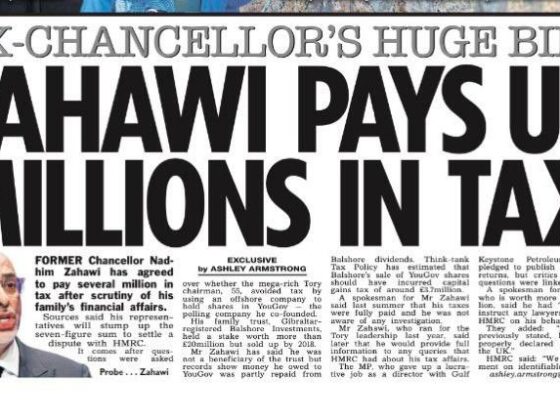
  • Did Nadhim Zahawi pay up to avoid an HMRC enquiry over YouGov?

    Did Nadhim Zahawi pay up to avoid an HMRC enquiry over YouGov?

    That’s the obvious inference of this astonishing story in today’s Sun. On the face of it, this confirms my investigation in July that concluded Zahawi had avoided around £4m in tax by arranging for his founder shares in YouGov to be held by a subsidiary of his father’s offshore trust.

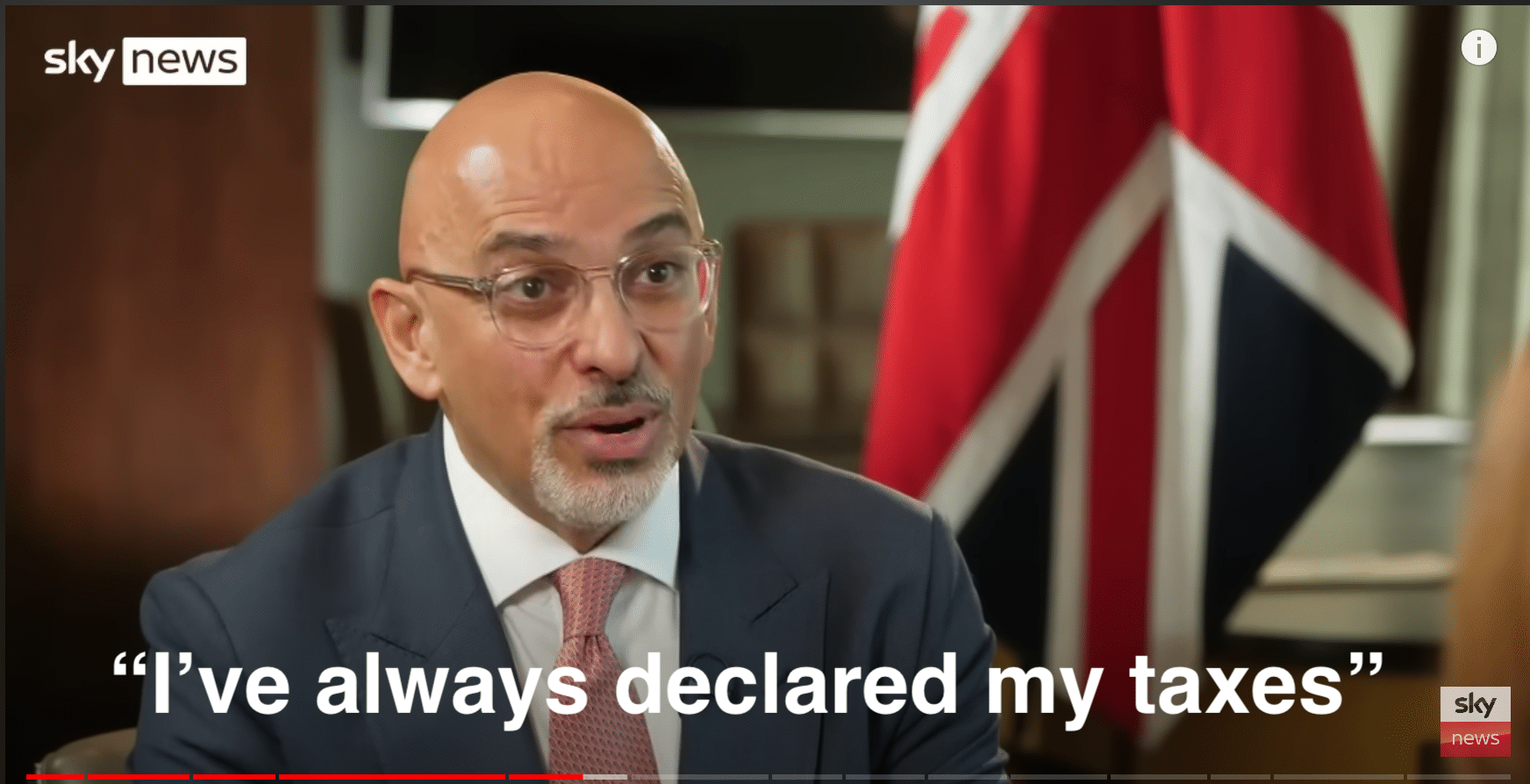
    Zahawi denies the Sun’s story, but in a curiously specific way: he “never had to instruct any lawyers to deal with HMRC on his behalf”.

    If the Sun is right, what would have happened?

    It’s reasonably clear there wasn’t a pre-existing enquiry into YouGov – Zahawi explicitly denied this and (more convincingly) around the same time I received confirmation from HMRC (in response to an FOIA request) that no ministers were under enquiry.

    So I would speculate that, when my investigation broke in July, Zahawi instructed accountants to look into his old YouGov structure. They told him that he was bang to rights; he then made a disclosure to HMRC with the aim of making swift payment in full to avoid an enquiry. If so, that might help explain the apparent speed with which a settlement was reached. Typically an HMRC enquiry involving a large amount involves years of negotiation, and HMRC has strict governance processes that they must comply with. I had expected HMRC would respond to my story by starting an investigation, and then by opening an enquiry around the end of 2022 – but if Zahawi had convincingly paid up in full by then, no enquiry would ever be opened.

    That is, however, just speculation. The payment could relate to some other matter – perhaps the mysterious NCA/HMRC investigation which was reported by the Independent, which (according to the Guardian) caused a “red flag” to be raised when Zahawi was appointed Chancellor. Zahawi denied this – but it was always a meaningless denial, because there’s no reason he would know he was under investigation. It was telling that the Cabinet Office, who could convincingly deny the “red flag” story, did not do so.

    Or the Sun could be wrong. That feels unlikely – it’s a big risk for them to run the story unless they were sure. I’ll keep an open mind – let’s see if we get any more convincing denials out of Mr Zahawi.

    UPDATE: new story from the Independent, with the interesting addition that Zahawi’s spokespeople don’t seem to be denying the story. They just repeat his usual boilerplate about his taxes being properly declared and paid. That rather begs the question of whether they’re only properly declared and paid because he approached HMRC to disclose a previous under-payment of tax)

    So what’s going on? If this was a boring ordinary course self assessment payment of tax then presumably Zahawi would say so?

    And if it wasn’t… what was it?

    More to follow.


    Comment policy

    This website has benefited from some amazingly insightful comments, some of which have materially advanced our work. Comments are open, but we are really looking for comments which advance the debate – e.g. by specific criticisms, additions, or comments on the article (particularly technical tax comments, or comments from people with practical experience in the area). I love reading emails thanking us for our work, but I will delete those when they’re comments – just so people can clearly see the more technical comments. I will also delete comments which are political in nature.

  • Donald Trump’s companies failed to file their accounts – but the scandal is that this is normal

    Donald Trump’s companies failed to file their accounts – but the scandal is that this is normal

    Updated to correct my claim that there are few if any prosecutions for failure to file. There are in fact several thousand in most years. That amazed me. So there isn’t a non-prosecution scandal. There’s a scandal of hundreds of thousands of late filings, and serious policy question as to how to fix this.

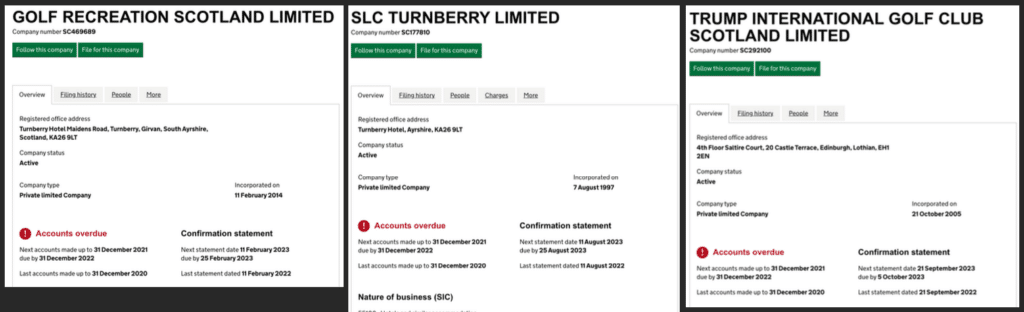
    Donald Trump’s Scottish hotel and golf businesses have failed to file their accounts for 2021:

    What does this mean?

    There’s an automatic late filing penalty of £150. Not much, but more than Trump paid in US Federal income tax in 2020.

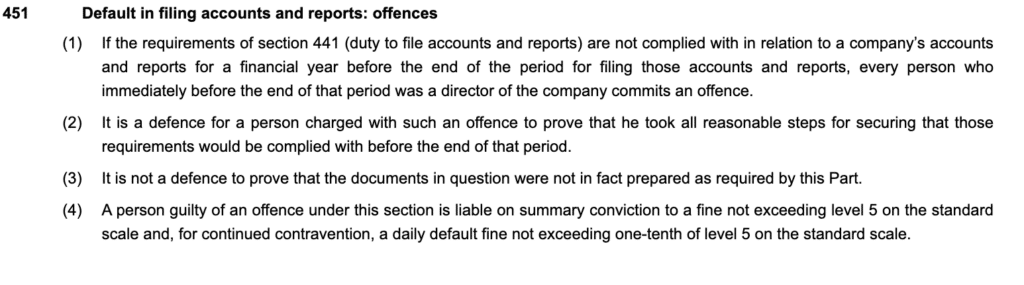
    More interestingly, if a company fails to file accounts on time, it’s a criminal offence for the directors, with a potentially unlimited fine:

    In this case there’s just one director, Eric Trump. Donald Trump stood down as director after he was inaugurated – although if (as must be possible) he is still directing things behind the scenes, then he will be a “shadow director” and also potentially criminally liable.

    There’s a defence if the directors can show they “took all reasonable steps” to file. The most common reason – and the one I’m betting is the case here – is simple disorganisation/ineptitude. That will not qualify for the defence. What would? Most often some kind of difficulty getting the auditors to sign off on the accounts. Perhaps because a difficult technical problem has arisen (unlikely with such a relatively simple business as this one). Perhaps – more interestingly – because there is a question whether the business remains a going concern.

    It’s pretty common for small companies to miss filing deadlines. Much less common for large businesses – and when I worked on big ticket corporate M&A and financings, these kind of failings were a “tell” that there were financial or governance problems.

    We’ve no way of knowing what the reason is for the Trump companies’ delinquency. The tax writer Rebecca Benneyworth spotted that it looks like the Trumps had already extended the filing deadline from 30 September to 31 December. That was probably an automatic three-month Covid extension – but that’s usually a one-off, and wouldn’t explain the late filing now. That could be down to disorganisation or chaos just as much as it could be evidence of a real problem. Chaos seems the safe bet.

    Update: thanks to The National for spotting that the Trumps filed their past accounts by post, not online. So it’s possible they posted the 2021 accounts right at the end of the year, but before the deadline, and Companies House just hasn’t gotten round to them yet. And also possible that the postal strikes delayed a filing that was actually posted before the deadline. I’ll withdraw/update this post if either turns out to be the case Further update – initial indications are that this is not the reason. More to follow.

    There is one thing we can know for certain. The Trumps won’t be prosecuted. Over 200,000 companies file late, and pay the £150 penalty. I gather in some circles late filing is considered normal, or even tactically advantageous.

    Yesterday I wrote this: “But it is almost unheard of for a director to be prosecuted. Of course it is more accurate to say: over 200,000 companies file late because it is almost unheard of for a director to be prosecuted.”

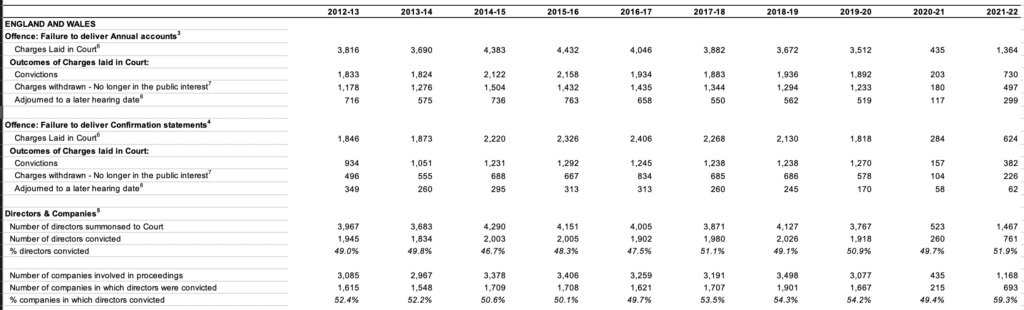
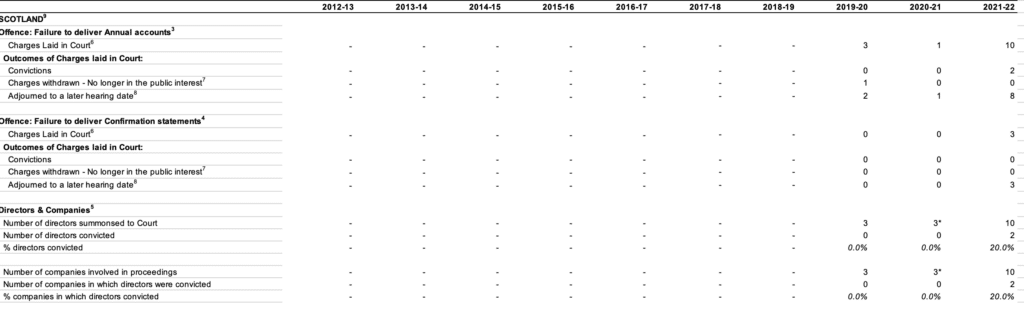
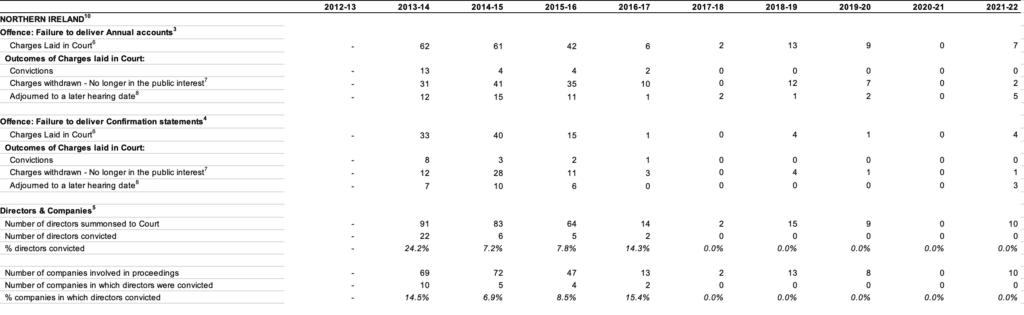
    But a lawyer (an old contact of mine) with considerable experience in this area has made clear that I am completely wrong. There are in fact a large number of prosecutions. Companies House publishes the full statistics, but they are hard to find – see Table 6 here. The upshot is that there are several thousand prosecutions in a normal, non-Covid year:

    On the surface, it looks like about a 50% conviction rate, but that’s not right – about half the charges are withdrawn… and I understand from my contact, that’s because the accounts have been filed. Account for that and adjournments, and (unless I’m mistaken) the conviction rate looks close to 100%.

    Much less going on in Scotland:

    I don’t understand why this is. There are about 20x fewer Scottish companies than in England & Wales (see tab 9 of the linked spreadsheet), but about 100x fewer prosecutions. Northern Ireland has about 1/3 of the number of companies as Scotland, but around the same number of prosecutions.

    So my conclusion that the Trumps are likely safe is surely correct, but my reasoning was completely wrong – and I apologise for having unfairly denigrated what looks like a busy and effective Companies House prosecution service (at least in England & Wales).

    The mystery

    I said there was a scandal of non-enforcement, and it looks like I was dead wrong. Instead we have a mystery – why do so many companies file late when in fact there is a non-zero prospect of prosecution?

    • Are the prosecutions not well known? (Possible, given I spoke to six experienced lawyers and only one was aware of them).
    • Is it a mistake to drop prosecutions if the directors belatedly file the accounts? The prosecutions are said to be dropped because they are “no longer in the public interest”. That is debatable. I would say the public interest is not just in making a particular director file their own accounts, but in deterring late filed accounts across the board. In essence, the prosecution policy has changed the offence from “failing to file by the due date” into “failing to file”. That does not seem right to me.
    • Do these two factors combine so that, rationally, a director can happily file late and accept the low risk of a prosecution, knowing that the prosecution will almost certainly be discontinued once they do file?

    I’m not sure what the reason is. But I am sure there’s a problem – because late filing prejudices people dealing with the companies (who often rely on filed accounts to judge creditworthiness) and facilitates financial crime.

    Here’s a suggestion for a policy response:

    • Does Companies House do enough to make people aware of prosecutions for failure to file accounts? (given my error on this, I would of course say “no”…)
    • Investigate late filing in more detail – who is filing late, how late are they filing, and what the reasons are
    • Analysis of prosecutions. Who is being prosecuted? Is it really in the public interest that prosecutions are dropped when accounts are belatedly filed?
    • Is it correct that Northern Ireland and (particularly) Scotland prosecute fewer offences? If so, why?
    • Does the automatic £150 penalty need to be increased for larger companies? It’s tempting to make it a percentage of turnover, but that could easily become disproportionate. 0.1% of turnover for the Trump companies would be a not-so-large £7,000, but for Sainsbury’s (a silly example to make the point) would be a ridiculous £38m
    • It’s ridiculous that so many companies still file on paper. That includes giants like HSBC and Tesco. The reason is that (as a number of people have now told me) Companies House’s online submission service only works for very simple cases. That’s inconvenient for those companies; it also means that Companies House records are much more difficult to analyse electronically (which is inconvenient for the rest of us).

    It would be quite wrong for a small company missing the filing deadline by a day to face prosecution. And it would be equally wrong to selectively prosecute Trump, particularly given that Scotland appears to prosecute basically nobody.

    But I remain of the view there is a problem – I’m just much less certain about the solution than I was yesterday.


    Photo by Max Goldberg, licensed under the Creative Commons Attribution-Share Alike 4.0 International license

    Footnotes

    1. The ultimate sanction is for a company to be struck off. If the failure to file continues, then Companies House will send a written warning; then another warning; then they’ll begin the process of striking the company off. ↩︎

    2. I am saying “almost” because it’s possible there have been some prosecutions, but I’m not personally aware of any ↩︎

    3. I should have known this. In my defence, I’ve only ever personally filed for very simple companies… but I should not have extrapolated that to other companies without checking. My bad. ↩︎

  • Why VAT may be a brake on UK growth, and how to fix it

    Why VAT may be a brake on UK growth, and how to fix it

    UPDATE: new data suggests the situation is now much worse than suggested in this article. Please see our latest report for the details.

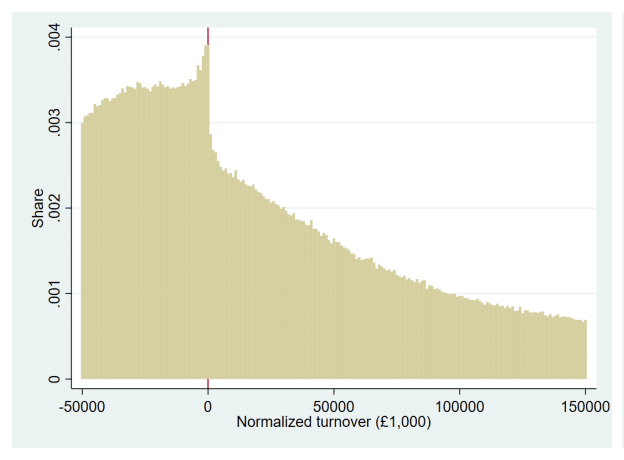
    This chart should keep the Chancellor up at night. It shows the number of businesses by turnover band.

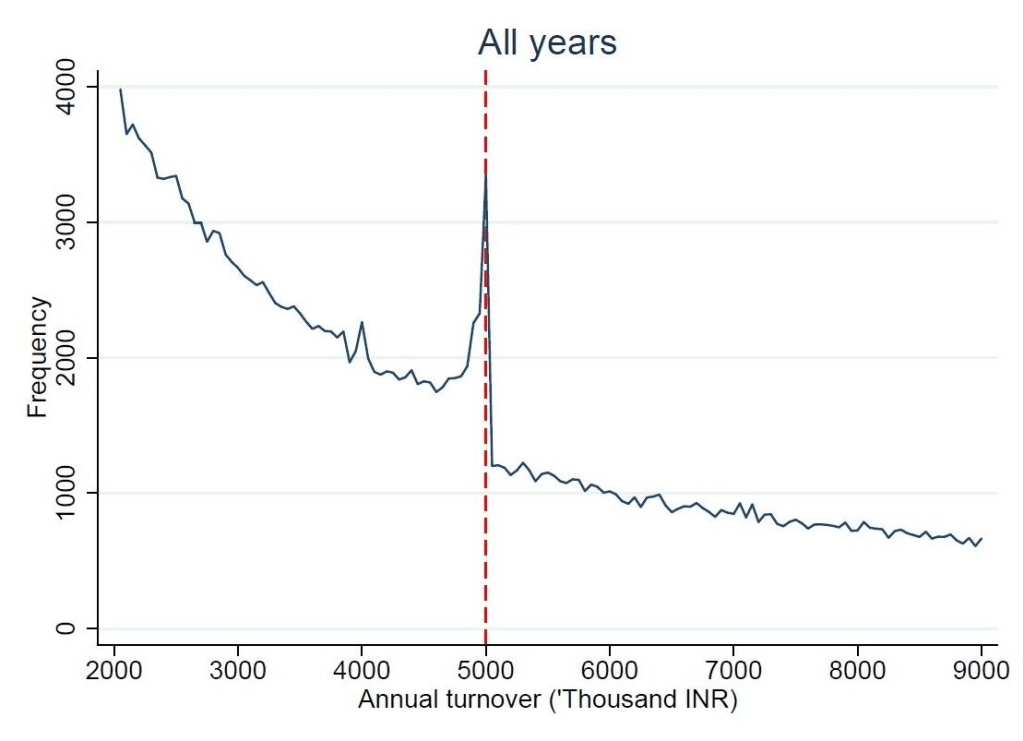
    You’d expect a reasonably smooth curve, falling from a large number of small businesses on the left side, down to a smaller number of larger businesses on the right. But we don’t see that at all – we see a massive cliff edge right on the VAT registration threshold. Businesses don’t want to have to charge VAT – and therefore either raise prices by up to20% or reduce their profits by the same amount (and the admin hassle is likely also a factor, but I expect a much smaller one). So they suppress their turnover.

    This isn’t news – and it got some coverage at the time. But a new paper from the CAGE research centre at Warwick puts beyond doubt that this one of the most critical UK tax policy problems.

    New evidence

    The CAGE team analysed a huge dataset of companies from 2004-2015, with sophisticated controls to minimise confounding effects. They find an even clearer effect than the simple OTS chart above. Here’s a chart showing the proportion of firms that are growing for given levels of turnover:

    The ‘0’ point on the x axis and red line running through it) is the VAT threshold. Look how growth peaks immediately before that point and then slumps right on the threshold.

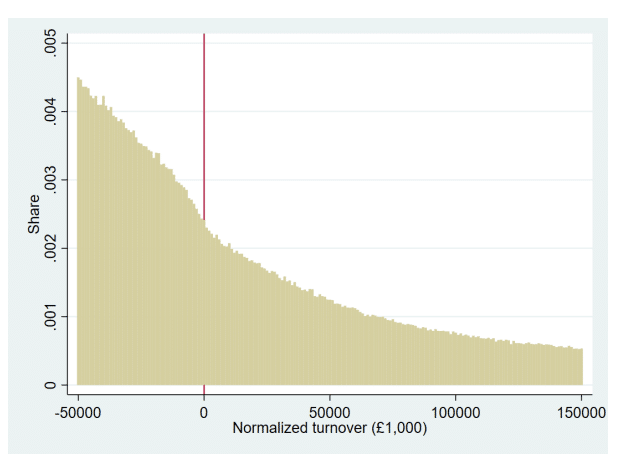
    By contrast, shrinking firms show the kind of smooth curve we’d expect:

    The smooth shrinkage curves also suggests that the growth cliff-edge is real, and not being driven by failure to declare turnover (i.e. criminal tax evasion). If firms did evade tax to keep below the threshold, then we’d expect to see the same effect in reverse, with a cliff-edge for shrinking firms (so, for example, a firm with £90k of revenue would fail to declare £5k of that, to slip below the threshold before it’s entitled to do so). But we don’t see any evidence of that.

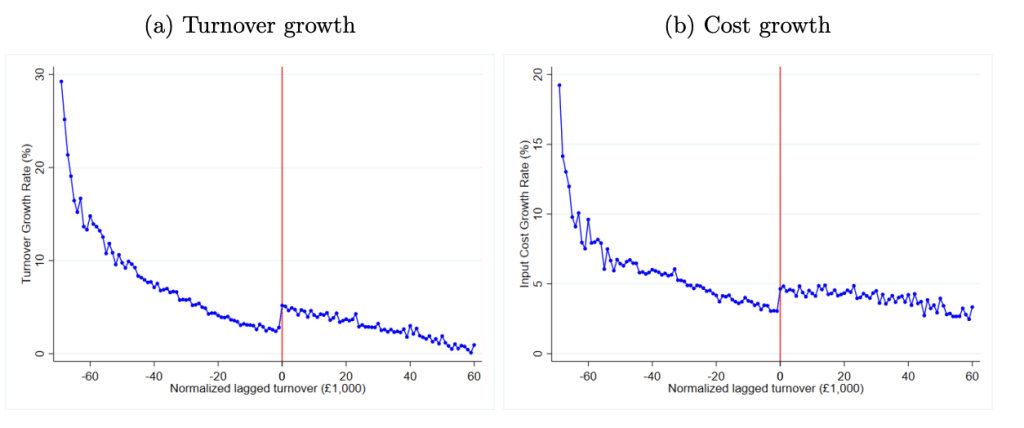
    The Warwick team goes further, and look at the impact on rates of growth on turnover and cost:

    We can see the brakes being put on – with turnover and cost growth slowing down just before the threshold, but then returning to a higher level afterwards. The fact it happens to cost as well as turnover is important, because this again suggests the effect is real and not just turnover being kept “off the books” (you can’t keep costs off the books without conspiring with your supplier).

    How do firms manage their growth?

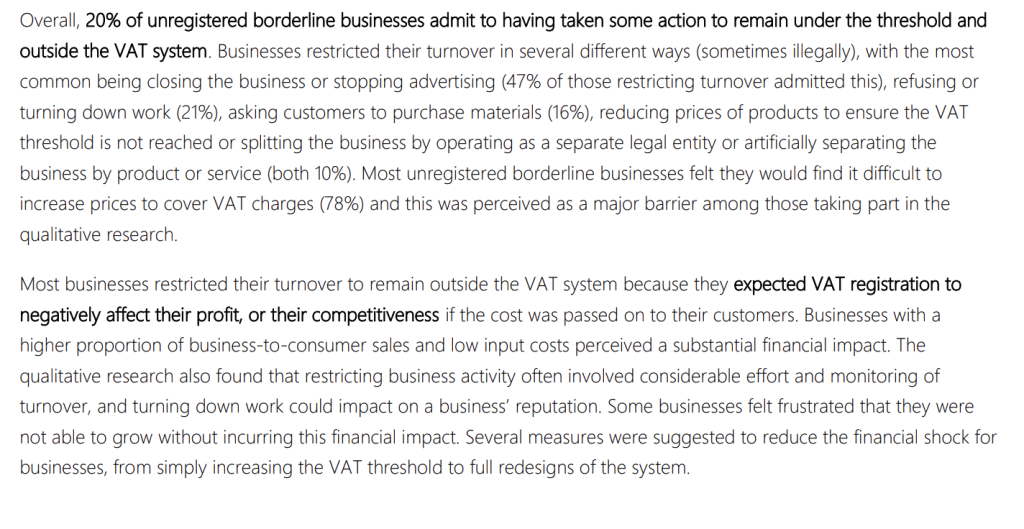
    We can get a sense of this in research which HMRC commissioned from Ipsos MORI in 2017. The findings were stark:

    If 20% admit to restricting their turnover, I expect the real proportion is significantly higher.

    And this accords with the anecdotal evidence I hear from everyone I ask about the subject – whether SME consultants, accountants, coffee shop-owners, builders, builders’ clients… it’s common knowledge that small businesses depress their revenue, most typically by not expanding, not taking on apprentices, and/or cutting back on hours when approaching the threshold. Such as:

    Anecdote is not data, but given we already have the data, I find the consistency of the anecdotes compelling.

    Are there similar effects elsewhere in the world?

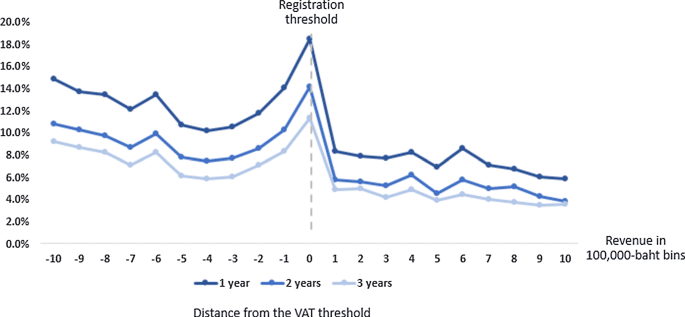
    Surprisingly little work has been undertaken in this area, and none that I can find elsewhere in the OECD. However, there has been a detailed analysis of Thai VAT returns, which can be neatly summarised by this chart:

    and this chart, from a preliminary analysis of Indian VAT returns:

    A similar effect to the UK, albeit more dramatic. Note how the Indian and Thai charts show a much more pronounced peak before the threshold than the UK chart. I would speculate this is because of increased tax evasion compared to the UK – i.e. businesses not just decelerating growth as they approach the threshold, but failing to report sales that would take them over it.

    How does the UK’s registration threshold compare with everyone else?

    The UK has the highest registration threshold in the world:

    When the threshold is as low as $30,000, it becomes unrealistic for businesses to suppress their growth to keep below it. Only the most micro of micro businesses won’t charge VAT, and everyone else is on a level playing field.

    Why is this a problem?

    One way to view this is that the UK is losing out on VAT revenue. I think that is to miss some much more important issues.

    It doesn’t seem fanciful to think that, some of the firms that are staying below the VAT threshold might have thrived if they’d gone beyond it. Hired more employees, grown from micro companies into small, then medium, then – who knows? – become large businesses. What is the impact on macroeconomic growth of some companies’ growth simply stalling?

    And could this be part of the productivity puzzle? The effect of staying below the threshold is that businesses never grow past one employee… but there is good evidence that businesses with more employees are more productive. There is an excellent article making exactly this point from the Adam Smith Institute.

    I’d love to see an economist undertake some analysis on whether there is a material macroeconomic impact from the effects shown by the HMRC and Warwick data.

    What’s the solution?

    Here are two bad solutions:

    • Raise the threshold dramatically. That doesn’t remove the problem; it just moves it to a higher turnover level. It would also be extremely expensive – every £1,000 of increase in the threshold costs approximately £50m in lost VAT revenues.
    • Reduce the threshold to an OECD average. That in principle fixes the problem, but at that cost of requiring every small/micro business to apply VAT at 20% overnight. That doesn’t seem wise or politically realistic.

    And a boring solution, which is probably what’s happening at the moment:

    • Freeze the £85,000 registration threshold over time. Inflation is 10% this year; if we then assume 4% average inflation for the next ten years, then in real terms the threshold will be £52,000 by 2034. So a partial solution – but if the current cliff edge is a real economic problem, waiting ten years to solve it feels like an inadequate response.

    What we need is a way to eliminate the dramatic “cliff-edge” effect that takes less than ten years, doesn’t just move the cliff-edge elsewhere, and is neutral in government revenue terms.

    Here’s one potential solution:

    Instead of a dramatic threshold, that takes VAT from zero to 20%, let’s smoothly phase it in. So, for example, at £30,000 VAT would be applied at 1% (and input tax recoverable at 1%), with the rate increasing bit-by-bit until by £140,000 VAT would fully apply at 20% (with the intention that the overall effect is revenue-neutral). The OTS proposed further investigation of such a system back in 2019, but I don’t believe it went any further.

    This would once have been impractical, given that the complications it creates for business customers of a business applying (say) 7% VAT. But all VAT returns will soon be digital – so that element now feels like a relatively trivial technical problem, rather than a difficult human one.

    I shouldn’t understate the challenges. One particularly difficult element is how you decide in advance what rate a business should charge. Easy(ish) for an established business with a consistent quarterly turnover. Hard for a new business, or one that’s growing or shrinking unpredictably.

    You could sidestep that difficulty, but achieve an economically identical result, with a rebate system. Everyone charges 20% VAT from (say) £30,000 of turnover, but 19% of that is rebated for £30k businesses, and the rebate dropping as turnover increases, vanishing entirely at (say) £140k. If you pay the rebate quarterly in arrears then that removes the need to predict future turnover – that does, however, create a three-month cashflow problem for small businesses, and trying to solve that problem just runs into the predictability issue again. Rebate systems also can create tricky issues with cross-border supplies – how do we give foreign suppliers a rebate? And if we don’t, how can we avoid distortions and unfairness (and potentially WTO/GATS difficulties)?

    And we shouldn’t minimise the political difficulties with any proposal which increases prices/reduces profit for £30k-£85k businesses. I don’t expect the immediate beneficiaries (the £85k-140k businesses) would call many demonstrations in support. So it would take a brave Government, which recognises a potential brake on growth and is willing to court unpopularity to release it.

    I’d love to see this issue becoming part of the public tax debate. I can’t lie: solving it will be really hard, and require input from people with expertise that I don’t begin to have. Specifically, economists need to confirm the intuition that this is a serious problem for the UK economy, and compliance specialists (in HMRC and the private sector) need to work up a solution that doesn’t cause more problems than it fixes.

    So all of this would need very serious thought, and I am absolutely not saying I have all the answers, or indeed many of the answers. I do, however, believe I have a question.


    Image by DALL-E: “a colourful set of equal-sized cubic children’s wooden building blocks with the letters VAT (in order), on a wooden table, digital art”

    Footnotes

    1. from the OTS review of VAT in 2017 ↩︎

    2. “up to” because many businesses will be able to recover significant input VAT. For example, if I run a restaurant with £100k of turnover, £20k of ingredient costs (plus VAT) and £30k of rent (plus VAT) then I’ll owe HMRC 20% of £100k but be able to recover 20% of £20k and 20% of £30k. My net VAT bill is therefore £20 – £4 – £6 = £10. So becoming VAT registered is actually costing me 10% of my turnover, not 20%. Contrast with e.g. if I’m a tax consultant operating out of my house with few VATable expenses – my VAT cost is then likely close to 20% ↩︎

    3. The one exception here is the apparently (anecdotally) common tactic of builders asking clients to buy their supplies directly, so it doesn’t go through the builder’s books and therefore take them over the threshold. This may be tax avoidance (depending on your own perspective), but in my view it’s not improper and certainly not criminal tax evasion ↩︎

    4. The chart doesn’t include the US because, whilst many States apply sales taxes with thresholds as high as $500,000, they’re conceptually very different from VATs. The rates are much lower (averaging around 6%), they don’t apply B2B, and the tax bases are relatively limited. Singapore also isn’t on the chart, as it’s not an OECD member – it has a high GST registration threshold of SGD 1m/year, but that’s much easier in a country where the tax/GDP ratio is less than half the OECD average ↩︎

    5. I am also assuming politicians can resist heavy lobbying to stop the freeze. You may feel that is like assuming a spherical cow. ↩︎

    6. See paragraph 1.29 here ↩︎

  • 5 ways to fix the UK tax system

    5 ways to fix the UK tax system

    This is a version of the article published by the Sunday Times on 1 January 2023 – it summarises some of the themes I wrote about in 2022, and some more that I’ll be writing about in 2023.

    Kwasi Kwarteng’s “fiscal event” last September was widely perceived as a disaster, but at its heart was a kernel of undoubted truth: there are features of our tax system that discourage growth — and we should fix them.

    Here are five.

    Income tax marginal rates over 60%

    The boldest, and most criticised, element of the Kwarteng mini-Budget was to scrap the 45p top rate to “simplify taxes” and “incentivise growth”. The problem with this is that, even if you accept the premises of Kwarteng’s position, 45p is not even close to the highest marginal tax rate in the UK.

    The marginal tax rate at any given income is the tax rate you pay on the next pound you earn. That’s crucially important, because it affects your incentive to earn that extra pound.

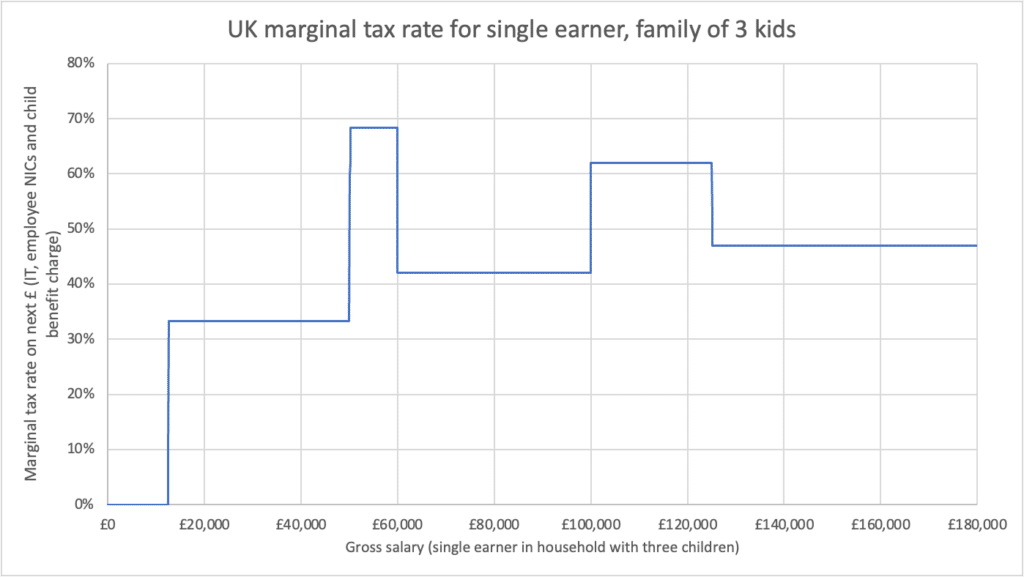
    I’ve charted the marginal rate of income tax and employee national insurance for different incomes, and it looks like this:

    This should immediately start ringing alarm bells. Why do the comfortably-off (£100-120k) pay a higher marginal rate of tax – 62%! – than those on really high incomes? Because at point the personal allowance starts to taper away – with every £1 of income earned about £100k, the personal allowance reduces by 50p.

    But we’re only getting started. What if you have three children all qualifying for child benefit? Well…

    Child benefits starts to be withdrawn at £50,000 – resulting in a marginal rate of 68% between £50k and £60k.

    Sad to say, we can make even that result look good if we throw in the effect of the Government’s much-heralded “tax free childcare” scheme. This entitles you to up to £2,000 per child. The catch is that it completely disappears if your earnings hit £100k. A couple can each earn £99,000 and they keep the benefit; but if one earns £100k they lose it (even if the other earns nothing).

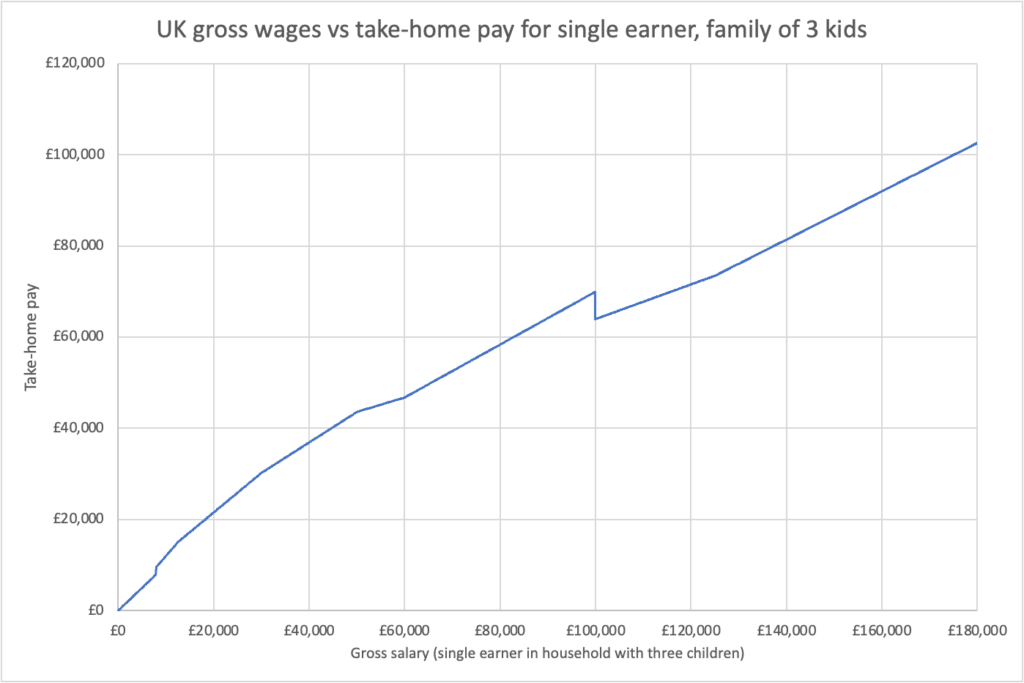
    What marginal tax rate is that? Well, if you’re claiming tax-free childcare for three children, and currently earn £99,999, your take-home pay is £69,884. Earn £1 more, and your take-home pay is less – £63,942. That’s an infinite marginal tax rate, so slightly tricky to show in a chart. Instead, here’s a chart of gross vs net wages:

    The ”dip” at £100k shows the drop in post-tax income, which isn’t recovered until you earn £20,000.

    Put all of this together, and what does it mean?

    It means that people who can control their hours usually think very carefully before putting themselves in the £50-£60,000 bracket, or the £100-£125k bracket.If they’re employed, they often make additional pension contributions, use salary sacrifice schemes, or find other ways to earn the money, but not pay tax on it. If they’re self-employed they often just stop working for the year. These are not good things for the UK economy.

    And, worse still, all these tapering effects are triggered by one person’s income hitting the £50k/£100k trigger points. That means that the Smiths (who each earn £60k) are much better off than the Joneses (where she earns £120k, and he stays at home). The Smiths take home £93k after tax; the Joneses £75k. There are many reasons why the Joneses may have chosen that one of them should work and one not – it’s mystifying why the Government should slap an £18k penalty on their choice. The irony is that these accidental tax effects are so much larger than the deliberate tax policies Governments announce with much fanfare – the “marriage allowance” is worth a fairly pathetic £252/year.

    Why isn’t there outrage about this? I think in part because people earning £50k or £100k feel it’s ungrateful or, worse, unBritish to complain about paying tax. And people earning less don’t want to hear the complaints. But it’s not about whether people on high incomes should pay more tax – it’s about whether they should pay more tax in a fair rational way, or in an unfair irrational way.

    So a truly reforming Chancellor would declare war on marginal tax rates above 50%. We can do this without giving a handout to people on high incomes – the cost can be recovered by slightly increasing the top rate of tax. And the cost may be less than the Treasury historically thought, given that people are currently going out of their way to avoid paying these rates. And those on benefits also face ridiculously high marginal tax rates of up to 96% as benefits are withdrawn, creating a perverse incentive not to work (there’s outstanding work on this from the Resolution Foundation here).

    Here’s the political challenge: politicians on the Right have to accept slightly higher taxes for some high-earners, and politicians on the Left have to accept slightly lower taxes for some others. Will they?

    VAT punishing small businesses for growing

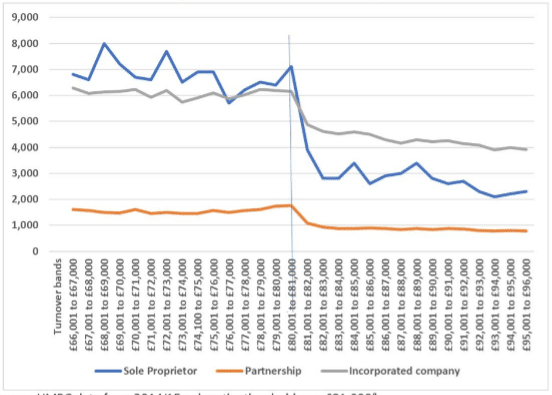
    This chart should keep the Chancellor up at night:

    Source – OTS review of VAT in 2017 – data from HMRC

    It shows, for a given £ of turnover/revenue, how many businesses there are in the UK at that level of turnover/revenue.

    You’d expect a reasonably smooth curve, falling from a large number of small businesses on the left side, down to a smaller number of larger businesses on the right. But we don’t see that at all – we see a dramatic cliff edge right on the VAT registration threshold (now £85,000). Businesses whose revenue hits the threshold suddenly have to charge VAT, meaning that – overnight – they must either raise prices or lose profits by up to 20%.

    The chart tells us that many businesses respond to this by suppressing their turnover so it never hits £85,000. A cynic would say that they do this by taking cash under the table, and not telling HMRC. But there’s recent academic evidence that the cynic is wrong – this isn’t dodgy bookkeeping… businesses are genuinely holding back their growth as they approach the £85k threshold. The data is compelling, but I hear plenty of first hand stories too – plumbers going on holiday for the rest of the tax year; electricians not hiring an apprentice; coffee shops deciding not to open up another branch.

    So here’s powerful evidence that the UK tax system has created a powerful brake on the growth of small companies…. some of which might, in time, grow into large companies.

    There are two bad answers to this problem, and one good but difficult one.

    The first bad answer is that we should raise the threshold from £85k. This is crushingly expensive, and doesn’t solve the problem… it just moves it.

    The second bad answer is that the UK has one of the highest VAT thresholds in the world, and we should reduce it to the average (around £30k). Given the sudden impact that would have on tens of thousands of businesses, this would require a Chancellor to be brave-bordering-on-suicidal.

    The good – but difficult – answer is that we shouldn’t have this kind of cliff edge threshold at all. And apps and digitalisation mean that now we don’t need to. Instead of VAT suddenly applying at 20% at £85k, what if it applied at 1% at £30k, and then slowly crept upwards, hitting 20% at £140k? We’d collect the same amount of tax, but without creating an incentive to stop growth.

    Until recently, expecting anyone to operate a system like that would’ve been delusional, but the modern digital systems HMRC has put in place make it achievable. It would take years of planning, with HMRC having to provide free apps and compliance solutions to small businesses. The challenge is less technical and more political – politicians have to sell, and voters to accept, the idea that raising tax is necessary for growth.

    Three dysfunctional land taxes

    We have three taxes on land in the UK – council tax, business rates, and stamp duty. Three parts of a very broken puzzle.

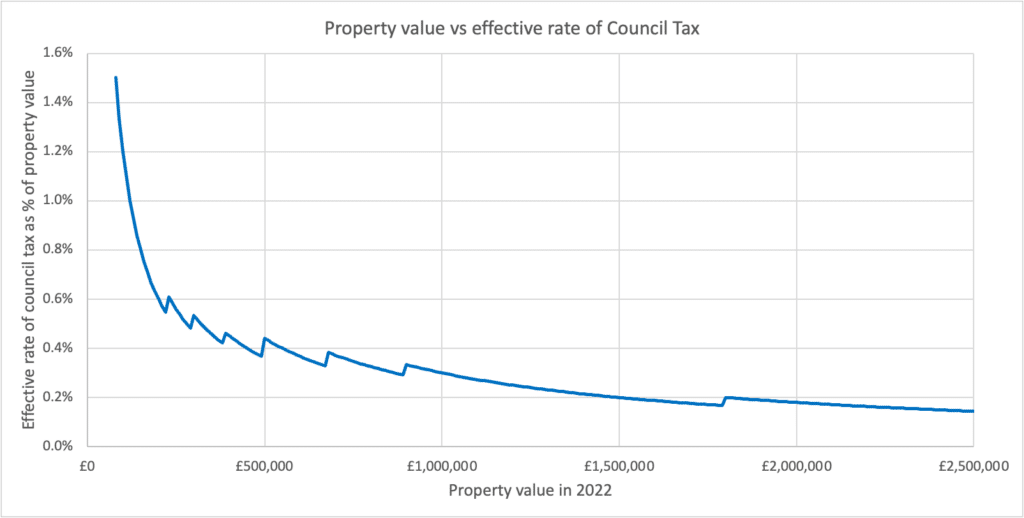
    Here’s a chart showing how much council tax is paid as a % of the value of a property:

    The more expensive the property, the less significant council tax becomes. That’s not how any tax should work. And in England, council tax is based on 1991 valuations that bear little relation to the housing market today.

    Almost as bad is the equivalent tax for businesses – business rates.

    The most common criticism of business rates – that it’s an unfair tax on retail businesses – is wrong. All the evidence shows that, in the long run, most of the economic burden of business rates falls on landlords (because rents are lower than they would be if business rates didn’t exist).

    But there are other big problems with the tax. It’s based on the “rentable value”, but the rentable value is so frequently updated that you can end up with a situation, where rents have fallen, and the business rates haven’t caught up (which is in many cases where we are now). Another problem: business rates are taxed on the rental value of a property, taking into account whether it’s been improved. That’s a disincentive to invest in improving property. The answer?

    And the final broken puzzle piece: stamp duty. It’s a good rule of taxation that we shouldn’t be discouraging transactions. Yet, as everyone who buys a house knows, that’s exactly what stamp duty does. It distorts the housing market and, by punishing people for moving in search of work, distorts the labour market too.

    How can we solve the land tax puzzle? By scrapping all three broken taxes and replacing them with land value tax – an annual tax based on the unimproved value of land. Instead of acting as a brake on investment, it would encourage it. Moving house would become a tax-free event. The economic burden would fall on landlords, not tenants.

    Land value tax has political support from economists across the political spectrum – all we need are politicians with courage to sell the idea that if we want to repeal bad unpopular taxes, then we have to create new, better, ones.

    Corporation tax

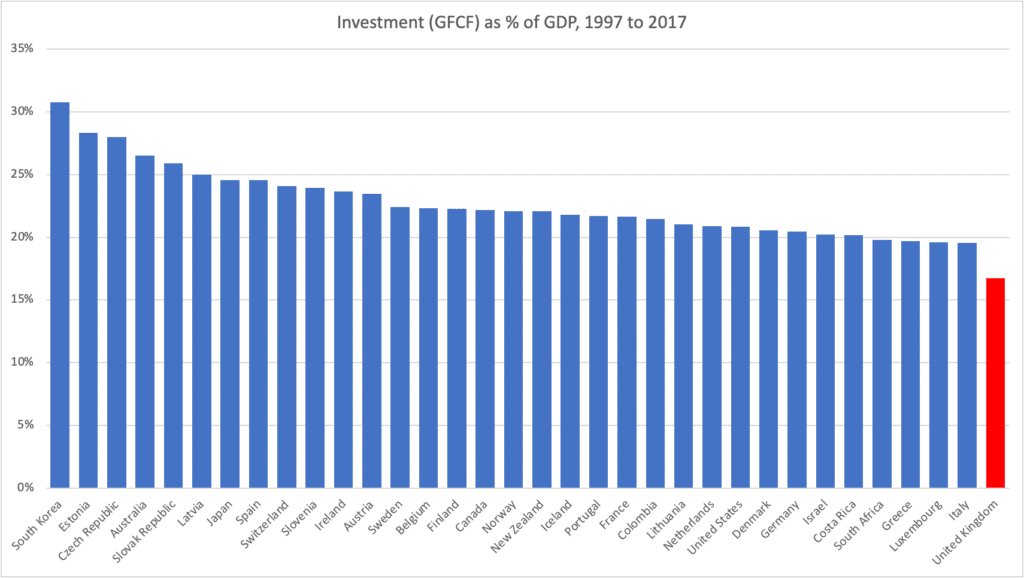
    According to the Office for National Statistics, from 1997 to 2017, the UK had the lowest level of investment (as a proportion of GDP) in the OECD:

    Is tax one of the reasons behind this?

    It’s trite economics that businesses do things they’re incentivised to do. The problem is that UK tax relief for investment exhibits the two deadly sins of tax policy: it’s really complicated, and it changes all the time. This means that you’d have to be brave or foolish to make long term investment plans on the strength of today’s tax relief rules – you can’t be sure you’ll qualify, and you certainly can’t be sure the rules will be the same when your investment actually comes to fruition. Which is another way of saying that the tax relief rules fail to achieve their purpose of incentivising investment.

    We need a radical solution. What if we didn’t have complicated rules governing what kinds of investments get tax relief, but just gave tax relief to all investment? Paid for by increasing the rate of corporate tax, so the reform was tax-neutral overall. And guaranteed to remain unchanged for the length of a Parliament – ideally with cross-party agreement that gives reasonable assurance for the longer term. Suddenly we’d create a powerful incentive to invest, made all the greater by the increased tax rate.

    This isn’t my invention – it’s called “full expensing” and it’s supported by the CBI and economists across the political spectrum. But we’d need politicians – and voters! – to accept the counterintuitive truth that sometimes tax rates have to go up to encourage growth.

    None of these issues are new. The Office of Tax Simplification has proposed reforming most of them. The problem has been that politicians prefer to duck difficult questions. Instead of adopting the OTS’ proposals, the Truss Government abolished the OTS. Let’s hope that, in an outbreak of Christmas cheer, Mr Hunt reverses that mystifying decision.


    Photo by CHUTTERSNAP on Unsplash

  • Tax Policy Associates – the plan for 2023

    Tax Policy Associates – the plan for 2023

    2022 was fun.

    Here’s the plan for 2023, in rough order of priority:

    Definitely

    • Launching in the next month, an analysis of a startling way in which tax law and HMRC are failing people on low incomes.
    • Also in the next month or so: a report into a tax avoidance scheme that’s rife in a well-known business sector, and avoided £450m of tax in the last few years, but has somehow escaped scrutiny.
    • More tax policy “blueprints” on corporate and personal tax, setting out the direction in which I think tax policy should be heading.
    • More responses to random tax stuff in the news – it’s often hard for people with actual expertise to comment publicly (whether tax professionals or academics), and the result can be that the only public comment comes from people with no technical knowledge of the subject. It’s quite wrong to say that only those with a technical tax background can comment on tax or have an opinion on tax – but it’s just dumb to report on tax with no input from anyone with tax expertise.
    • Nadhim Zahawi. We’ve just scratched the surface. More will follow – politicians shouldn’t be able to get away with lying about their tax affairs. Nothing damages public faith in the tax system as much as the perception that “they” don’t pay tax.
    • Continuing to providing tax policy assistance and advice to MPs and policymakers in all four of the main UK political parties (it’s invisible to almost everyone, but an important part of our work).

    Probably

    • How the VAT threshold strangles business growth, and how it can be fixed.
    • An academic paper on how a well-known and controversial tax break may in fact be unlawful, and HMRC’s practice ultra vires and potentially susceptible to challenge.
    • How Tax KCs facilitate tax avoidance – an alarming case study.
    • Further data-driven analyses of past tax changes – perhaps including a follow-up to our tampon tax report.
    • Working with others to push for libel law reform, and for the SRA to crack down on solicitors who act unethically.
    • Further analysis of CRS data on offshore bank accounts, and hopefully an HMRC estimate of the proportion that’s not reported.
    • Additional work on beneficial ownership and corporate transparency.

    Maybe

    • Other investigations into politicians who’ve avoided tax. It’s not our focus, and every allegation I’ve looked at to date (except one), has had nothing in it (Rees Mogg’s LLP, Jeremy Hunt, Rishi Sunak’s hedge fund days, and a handful of others that haven’t been public). But we’re always open to suggestions.
    • Big Data analytics on First Tier Tribunal cases over the last 15 years.

    Never

    • Taking on commercial work – I’m grateful for the offers, but it creates an impossible conflict.
    • Accepting donations/funding. All NGO funding comes with conditions, explicit or implicit. I want to continue to go my own way, and annoy everybody some of the time.
    • Hiring unpaid interns. I’d love the help, and goodness knows I miss the brilliant associates and trainees I used to work with. But at Clifford Chance I (and many others) pushed to end unpaid internships – they reward the well-connected and those from wealthier families, and are legally questionable. So, whilst awfully convenient, it would be hypocritical for me to take a different stance now.

    And

    • Thanks to everyone who’s supported our work – active and retired tax lawyers and accountants, academics, journalists, business people from just about every sector, and just interested people with time on their hands. I couldn’t have achieved anything without your insights, expertise and support. Particular thanks to B, M, D, J, L and S.
    • Suggestions for anything else we should be looking at are always gratefully received. Just drop us a line.

    Have a great Christmas/Channukah and New Year.

    Dan


    Photo by Jon Tyson on Unsplash

  • Updated: do Brits pay more or less tax on our wages than people in other countries?

    Updated: do Brits pay more or less tax on our wages than people in other countries?

    How do UK/Scottish taxes on wages compare with other countries’? It’s a simple question – but not straightforward to answer.

    Looking just at rates is misleading. This chart, for example, suggests that the top rate of UK tax is comparable with the US. That’s not really right. In the US, the top rate of Federal income tax (and, often, state income tax) kicks in at $523,600. The top UK rate – now 45% – applies from £125,140. So for most reasonably high-earning people, tax rates in the US are significantly less.

    A better question is, what’s the effective tax rate – the “tax wedge” on any given amount of income?

    My answer is this chart – and you can click on it for an interactive version that lets you add/remove countries:

    Some immediate conclusions:

    • The UK/Scotland has a much lower effective tax rate on average wages, and lower than average wages, than almost every other developed country.
    • This then starts catching up quite quickly once we approach twice the average wage. And once we’re on high incomes, UK effective rates look a bit more average. Less than the expansive Continental welfare states. More than smaller countries, the US, and other countries with much less generous welfare states.
    • So a good case can be made that the UK is undertaxed by international standards. That’s not something many people in the UK believe, but it doesn’t stop it being true…

    Quick notes on where the data in the chart comes from:

    • The chart is generated by some simple code, that takes worldwide data for tax rates and threshold (from the wonderful OECD tax database), applies it to different income levels.
    • The effective tax rates include employer national insurance/social security. We don’t see employer wage taxes in our wage slips, but evidence suggests it is mostly borne by workers.
    • The x axis isn’t an absolute dollar amount, as realistically we can’t compare taxes on £100k in the UK with £100k in Costa Rica. Instead, the x axis is a multiple of average wages – so we are comparing tax on (e.g.) the UK average wage with tax on the Costa Rican/French/etc average wage.
    • The chart doesn’t take account of tax reliefs/deductions – these are generally quite limited in Europe, but very generous in the US… so again the chart overstates the actual tax Americans pay.
    • The data is now updated for the 2023/24 UK and Scottish rates, but other countries are not updated (I have no good source for the data). Given the wider economic circumstances, it’s plausible that taxes will be going up worldwide, and so this chart may make the UK/Scotland rates look relatively higher than they actually are.
    • See my previous post for more detail on the methodology and a complete list of caveats and limitations.

    And if you don’t want to believe my chart, here’s the OECD’s own chart showing the effective rate of tax on average incomes:

    I continue to think that, if we want a Scandinavian level of public services, then most people have to pay similar levels of tax to most people in Scandinavia. Sorry about that.


    Photo by Javier Miranda on Unsplash

    Footnotes

    1. This combines income tax and employee national insurance/social security, and for countries (like the US) where there are state taxes as well as national taxes, it adds in the average state tax. ↩︎

    2. But not the apprenticeship levy because it’s kinda sorta hypothecated… you could definitely make a case it should be included ↩︎

    3. i.e. because the employer has an amount they’re willing/able to pay as wages, and employer NICs come out of that). ↩︎

    4. But the UK and Scottish figures just use the UK average wage, because my feeling is that this is the comparison people are interested in ↩︎

    5. original version here ↩︎

  • A legal analysis: did Douglas Barrowman commit a criminal offence?

    A legal analysis: did Douglas Barrowman commit a criminal offence?

    9 June 2023 update: the Companies House entries still fail to disclose Douglas Barrowman as the ultimate beneficial owner. PPE Medro was updated on 11 May to show Arthur John Lancaster as the owner of the company. Lancaster is a trust accountant/tax adviser for Barrowman’s group – it is unlikely he actually controls the companies himself. The PSC entry for LFI Diagnostics Limited is unchanged.

    Given the failure to correct the entries, it is now hard to see how this can be an innocent mistake. Companies House should be seriously considering a prosecution of the directors.

    UPDATE 13 August 2023: this has been overtaken by new evidence. See our new report here.

    The Guardian recently reported that two UK companies ultimately controlled by businessman Douglas Barrowman were the subject of PPE contract lobbying by his wife. I’ve no expertise or interest in the PPE lobbying issue. But I am interested in the fact that, while the Guardian says Barrowman controls the companies, their Companies House entries say no such thing:

    I’m fairly sure these are the right companies. So my immediate view is that either the Guardian was wrong, or the Companies Act rules requiring registration of “persons with significant control” were broken. I haven’t seen the document on which the Guardian relies, and I can’t know for sure if their story is correct but, given the stupidity of English libel law, and the willingness of Barrowman to use it, I expect the Guardian was very careful.

    What are the “persons with significant control” rules?

    Back in the day, Companies House showed who the shareholders of a company were, but stopped there. So if, for example, a company was owned by a tax haven holding company, you wouldn’t be able to ever find out who the ultimate shareholder was.

    This all changed in 2016 – rules were put in place requiring companies to identify their “persons with significant control” – meaning the actual humans who were able to tell the company what to do. Normally this would be the ultimate shareholder – but sometimes there would be someone who wasn’t a shareholder, but who nevertheless could ensure that the company always adopted the activities they desired. They too would be a “person with significant control”.

    So, let’s say I’m a secretive oligarch. I set up a UK company with some local directors. The shares in the company are held by a Panamanian company, and that in turn is held by my personal chef, who I throw money at and therefore always does what I ask. Pre-2016, your Companies House search stopped dead in Panama. But today, the company should register me (not the Panamanian company, and not my chef) as the “person with significant control”.

    And that’s the whole point of the rules – to enhance corporate transparency and help stop the abuse of companies for nefarious purposes.

    If the Guardian report is accurate, who is the “person with significant control” of the two companies?

    The definition of a “person with significant control” is set out in Schedule 1A of the Companies Act. In our case, the relevant section is paragraph 5: where a person (not necessarily a shareholder) has a right to exercise, or actually exercises, significant influence or control over a company.

    This passage in the Guardian article is key:

    If indeed the companies are “ultimately controlled” by Barrowman then he has “significant influence or control” and is therefore the “person with significant control”, regardless of whether he holds any shares.

    What should have happened?

    A company is required to identify and then register its “persons with significant control”.

    Section 790D of the Companies Act requires a company to take reasonable steps to find out who controls it.

    For a small part of a big international corporate group that might be hard on the poor UK directors, and so there are procedures for the directors to essentially send out begging letters to its immediate shareholders to find out who controls them. But in the PPE Medpro case there are no such complexities – the sole director is Anthony Page, who helps run Barrowman’s private office.

    So if Barrowman really controls PPE Medpro, it would be surprising (but I suppose not impossible) if Page didn’t know that.

    Since we know nothing about the LFI Diagnostics directors, Andrew Sack and Chan Chen, we can’t say anything about the likelihood they knew about Barrowman’s involvement – but surely they knew that they were not the actual controllers? Andrew Sack wasn’t even the majority shareholder:

    There are similar problems with other Barrowman UK companies. Just looking up companies where Page is a director we see Neo Space (Douglas) Limited, PPE Medical Protection Limited, Neo Space Aberdeen Limited, and a few more. All of them list Page (and sometimes other directors) as the “persons with significant control”. It seems most unlikely this is correct.

    There’s just one exception I can find, Knox House Trustees Limited, which correctly discloses Barrowman as the “person with significant control”:

    Why are they getting this wrong?

    I don’t know. It could be incompetence. It could be obsessive secrecy. It could be related to some kind of tax planning, perhaps linked to arguments that the groups are not in fact under common control (Barrowman’s group has a history of shady tax behaviour).

    Does it matter?

    The ownership disclosure rules are there for a reason: so that it’s easy to see who really controls a company. In this case the failure to comply could have had serious consequences, if it meant that civil servants assessing a PPE bid were unaware of the connection between the bidding companies and Barrowman, and hence the link to Mone. I’ve no idea if that happened – but it’s the potential for this to happen (whether in this scenario or a different one) which is why the rules are there.

    What are the criminal offences applicable to directors?

    There’s a specific offence for breach of section 790D, committed by the company itself, and every director responsible. On conviction, the director faces up to two years in jail and an unlimited fine.

    And there’s a general Companies Act offence of knowingly or recklessly delivering a false statement or document to Companies House. Again, up to two years in jail and an unlimited fine.

    So if Barrowman controls the companies, and Page knew (but didn’t register) then in principle he should be very worried.

    And Sack and Chen clearly got this wrong – how could Sack, a minority shareholder, have thought he controlled the company? But perhaps the prospect of a prosecution doesn’t bother them, given they’re based in Hong Kong.

    What are the criminal offences applicable to Barrowman?

    There’s a specific requirement that, where someone knows they control a company, but they haven’t received a notice from the company requiring them to provide information, then they have to tell the company that they do in fact control it. And if they don’t do this, then they commit an offence – again, with up to two years’ imprisonment, and an unlimited fine.

    What does this mean for Barrowman?

    It all means that, in my opinion, Barrowman may have committed a criminal offence if:

    1. The Guardian summary of the internal “crucial” document is correct, and the Guardian’s source is correct that Barrowman “ultimately controls” the private office.
    2. The correct legal analysis is that Barrowman actually exercised “significant influence or control” over either or both companies (which, if the Guardian summary and source are correct, will likely be the case).
    3. Barrowman knew, or ought reasonably to have known, that he should have been registered as a “person with significant control”.
    4. The companies never sent him a formal notice asking for him to confirm control.
    5. He never notified the companies of his status as a “registrable person”.

    Points 1, 4 and 5 are straightforwardly factual. 2 is legal, but doesn’t seem too challenging.

    The most difficult point for a prosecution, and the most obvious “out” for Barrowman, is 3. Barrowman could say he had no idea the company was incorporated. Or that he didn’t know the rules worked this way, and it’s not reasonable to say he ought to have known.

    Pleading ignorance as to the existence of the company may be challenging given the significance of the contracts the companies were reportedly involved with – but whether such a defence could be sustained turns on the facts and, in particular, what kind of paper-trail would emerge, and how credible people are on the witness stand.

    The “I couldn’t be expected to know the rules worked this way” defence would be successful in many cases, and is one of the reasons why prosecutions of these offences are so hard. The difficulty Barrowman has is that he’s a highly sophisticated businessman, who runs a group of companies that provide technical tax and legal services to private offices – in fact he is, in my view, exactly the sort of person who ought reasonably to know that the rules work this way. So this would plausibly be a harder defence for him than for the average businessman.

    If breaching these rules is a criminal offence, why do people do it?

    Because they think they won’t be prosecuted, and historically that’s been a very safe bet. So there is widespread failure to comply with the law.

    Part of the answer is a high profile prosecution or two.

    But another important part is to have effective civil penalties, which don’t require the expense and uncertainty of a criminal trial, and which deter shareholders, directors, corporate services providers, and advisers from participating in filing false information. I’ll be writing more about that soon.


    Footnotes

    1. It is relevant to note that Lancaster was heavily criticised by a tax tribunal, in the context of one of Barrowman’s avoidance schemes, for providing evidence that was “seriously misleading”. ↩︎

    2. Disclosure: I am an experienced commercial lawyer, but I am not a company law expert. However, I know many people who are; this article reflects my reading of the legislation, informed by their experience and expertise. Any errors, however, are solely mine ↩︎

    3. See here and here ↩︎

    4. PPE Medpro is easy; Anthony Page is definitely the right person. LFI Diagnostics is slightly more difficult; I’ve no idea who Andrew Sack and the other director, Chan Chen, are, but Companies House shows it as majority owned by “PPE Medpo Limited”, and the incorporation date lines up with the Guardian article. So, absent an amazing coincidence, this is the right company too ↩︎

    5. The legislation starts here, and is fairly easy to read – there’s also useful (statutory) guidance ↩︎

    6. Although LFI Diagnostics Limited may be majority held by PPE Medpro Limited (its name is shown as “PPE Medpo Limited” in the LFI confirmation statement; that could be a different company but I’m guessing is a simple typo). If that’s correct, then the correct approach should be for LFI Diagnostics Limited to report that it’s held by PPE Medpro Limited, as the “relevant legal entity”. The reason is that we can then look at the disclosure for PPE Medpro Limited and see who the ultimate owner is – but of course we can’t, because that is wrongly reported ↩︎

    7. There can be more than one “person with significant control” – so, for example, it could be that Page and Barrowman both fall in this category. ↩︎

    8. It would be a very strange private office if he didn’t ultimately control it ↩︎

  • Nadhim Zahawi’s lawyers referred to regulator for abusing libel law to shut down debate

    Nadhim Zahawi’s lawyers referred to regulator for abusing libel law to shut down debate

    I reported in July that Nadhim Zahawi, then Chancellor of the Exchequer, had founded YouGov using a tax avoidance structure. Zahawi provided an explanation which my detailed analysis showed to be false. Zahawi then shifted immediately onto a different explanation. In my opinion this showed that his first explanation was a lie – and I said so.

    Zahawi had a media profile and resources dwarfing a small tax think tank – but instead of using these to explain himself, he instructed Osborne Clarke to write to me demanding that I retract. And their letter claimed that I could not publish the letter, or even tell anyone I’d received it. It was an attempt to silence criticism which had no basis in law, and for which Zahawi and his lawyers should be ashamed.

    The Solicitors Regulation Authority this week issued a “warning notice” making clear that this kind of behaviour is unacceptable. I have therefore referred Zahawi’s lawyers, Osborne Clarke, to the regulator.

    I’m also asking the SRA to investigate Osborne Clarke more widely. In the end, their actions cost me some legal fees but otherwise failed. But I know there are many others, without my legal background, contacts or financial resources, who have received letters like this (on behalf of Zahawi and others) and been silenced. If the SRA find that people have been silenced by deception and intimidation, then this needs to be put right.

    I’ve copied below the text of my letter, with links to the referenced documents. If you prefer a PDF, that is here (but without links).

    And more on Mr Zahawi coming soon…


    SRA General Counsel

    The Cube

    199 Wharfside Street 

    Birmingham B1 1RN  

    1 December 2022

    Sent by email

    Dear Ms Oliver

    Osborne Clarke – SLAPP – breach of SRA Principles

    1. Many thanks for your publication on 28 November 2022 of the new warning notice on SLAPPs. In light of that notice, I wish to make a formal referral to you of Osborne Clarke for several significant breaches of SRA Principles. I believe you will be already aware of a number of the breaches, but you may not be aware of others.

    The background

    2. I retired from commercial practice in May 2022, and founded Tax Policy Associates; a think tank which works to improve both tax policy and the public understanding of tax. In July 2022, I wrote several articles and social media posts about Nadhim Zahawi. At that time, Mr Zahawi was the Chancellor of the Exchequer.

    3. The essence of my writings was that, when Mr Zahawi founded YouGov in 2000, the founder shares (which ordinarily would have been issued to Mr Zahawi) were instead issued to a Gibraltar company, Balshore Investments Limited. I said this looked like tax avoidance. Mr Zahawi’s team responded by briefing several journalists that the reason for Balshore receiving the shares (which I will call the “first explanation”) was that Mr Zahawi’s father, who owned Balshore, had contributed startup capital to YouGov.  

    4. I investigated the accounts and Companies House filings and found that the startup capital was contributed by another investor, Neil Copp. Balshore had contributed only a token amount (£7,215). I therefore wrote that either I was mistaken, the filings were wrong, or Mr Zahawi was lying. The key Twitter thread can be found at https://taxpolicy.org.uk/evidence (attached in PDF format as tweet1.pdf).

    5. Immediately after this, Mr Zahawi’s team started briefing a different explanation (which I will call the “second explanation”): that Mr Zahawi’s father received the shares in recognition of the significant advice and assistance he had provided to the business. The fact that Mr Zahawi was no longer defending his first explanation suggested to me that I had not made a mistake; in my opinion it suggested that the first explanation had been a lie. I said so. I did not say that the second explanation (“advice and assistance”) was a lie (although it seemed highly implausible). The key Twitter thread can be found at https://taxpolicy.org.uk/lying (attached as tweet2.pdf).

    6. On Saturday 16 July 2022, I received an unsolicited direct message on Twitter from Ashley Hurst, a partner at Osborne Clarke (see attachment SRA1). Mr Hurst sought to speak to me on a without prejudice basis. I responded that he should put what he had to say in writing, and that I did not accept without prejudice correspondence.

    7. Later that day I received an email from Mr Hurst (see attachment SRA2) asking me to retract my accusation by the end of that day, or I would receive an open letter on Monday.

    8. I did not retract. On Tuesday 19 July I received a letter from Mr Hurst (see attachment SRA3). 

    Breaches of SRA Principles

    9. The Osborne Clarke correspondence bears several of the hallmarks of strategic lawsuits against public participation (SLAPPs) which are identified in your warning notice.

    Labelling

    10. The email (SRA2) is marked “confidential and without prejudice”. It says:

    “I have marked this email without prejudice because it is a confidential and genuine attempt to resolve a dispute with you before further damage is caused. Our client wants to give you the opportunity to retract your allegation of lies in relation to our client.

    That would not of course stop you from raising questions based on facts as you see them.

    You have said that you will “not accept” without prejudice correspondence. It is up to you whether you respond to this email but you are not entitled to publish it or refer to it other than for the purposes of seeking legal advice. That would be a serious matter as you know. We recommend that you seek advice from libel lawyer if you have not done already.”

    11. However, the letter cannot possibly be “without prejudice”, for three (independent) reasons. First, I had specifically told Osborne Clarke I would not accept “without prejudice” correspondence. Second, even if I hadn’t done so, their email was not a genuine attempt to resolve an existing dispute – it offered no concessions, and was therefore not an attempt at settlement.  Third, there was no dispute – as became subsequently clear, Mr Zahawi never had any intention of instigating a claim.

    12. The claims that the email SRA2 and subsequent letter SRA3 were confidential were equally false. The content of the email and letter lacked the quality of confidence (as all the information in the documents was already public or obvious). There was nothing in our relationship which suggested that a duty of confidence could be imputed to me – the letter was unsolicited. Even if the letter had contained confidential information, there was a clear public interest in the matters under discussion (which would override the duty of confidence).

    13. Hence the claims that the email was “without prejudice” and the email and letter were “confidential” were without merit, an attempt to mislead, and a breach of the SRA Principles.

    Aggressive and intimidating threats

    14. The email asserts that the “without prejudice” rule prevents me from publishing or even referring to the letter. This is entirely false. It is often tactically unwise for a party to publish without prejudice correspondence, but the “without prejudice” rule is a rule of evidence and does not prevent publication. This was, again, false, and an attempt to mislead. However, it is more serious than that: it is an aggressive and intimidating threat (“That would be a serious matter as you know.”). 

    15. The second Osborne Clarke communication, SRA3, also seeks to intimidate me into not publishing the letter. It asserts that doing so would be “improper” (paragraph 1.3) but does not give a legal rationale for this claim – most likely because there is no such rationale. 

    Advancing meritless claims – false allegations

    16. As you identify in your warning notice, a common characteristic of SLAPP pre-action correspondence is that it advances meritless legal claims.

    17. The entirety of the first Osborne Clarke email (SRA2) is meritless. The central allegation is:

    “You have relied on comments attributed to YouGov by The Times today to support your view that our client was lying about the extent of involvement of our client’s father in the very early days of YouGov when it was set up in 2000.”

    18. This misrepresents the comments I had made. I had specifically alleged that Mr Zahawi lied when he claimed that his father provided startup capital to YouGov (his first explanation). I did not allege that Mr Zahawi’s subsequent explanation was a lie (the second explanation – that Balshore Investments acquired its shareholding because Mr Zahawi’s father was so involved in the running of the business).

    19. It is hard to imagine a more meritless defamation action than complaining about an allegation that was not in fact made. 

    20. The Osborne Clarke email (SRA2) at no point attempts to respond to my actual allegation. The closest it comes is by saying I omitted to reference that Mr Zahawi’s father paid £7,000 for his second tranche of shares. But I clearly did mention this, in both my Twitter thread (https://taxpolicy.org.uk/evidence) and my longer article (https://taxpolicy.org.uk/zahawi-capital/). The lack of attention Osborne Clarke paid to the facts evidences recklessness and/or a lack of interest in the merits of the case, both of which are identified in the SRA “conduct in disputes” guidance as unacceptable behaviour.

    Advancing meritless claims – no legal basis

    21. Your risk warning specifically mentions cases where a solicitor pursues a claim despite knowing that a legal defence to their claim will be successful.

    22. At the time, Nadhim Zahawi was Chancellor of the Exchequer. It is hard to imagine a topic of higher public interest than an accusation that the Chancellor of the Exchequer had avoided tax and lied about it. Hence Osborne Clarke would have known that a public interest defence under section 4 of the Defamation Act 2013 would likely have been successful. It is notable that their communications do not mention the public interest defence. 

    Advancing false factual claims

    23. Another common element of SLAPP pre-action letters is for the solicitor to advance factual claims by their client which are false, and which the solicitor should know are likely false. As your guidance notes, solicitors should take reasonable steps to satisfy themselves that a claim is properly arguable before putting it forward.

    24. In this instance, both Osborne Clarke communications (SRA2 and SRA3) assert that Balshore provided £7,000 of startup capital for the YouGov shares it acquired in 2000. See, for example, paragraph 2.4 of SRA3.

    25. However, the Companies House form for the share issuance shows that it was signed in October 2002, but backdated to 2000 (see attachment SRA8). My review of YouGov’s accounts and other Companies House filings confirm that the £7,000 was paid in 2002, not 2000 (I can supply evidence of this if that would be helpful).

    26. Hence the key factual component of the Osborne Clarke letters was false. Osborne Clarke cannot have made any attempt to verify the matter (given that a cursory review of the Companies House form would have immediately revealed the backdating).

    27. There is no duty on a solicitor to conduct detailed due diligence to fully investigate a client’s factual assertions. However, where the solicitor is going to assert factual matters in a letter to a third party, as a central part of a threatened claim against the third party, the solicitor should have some proper basis for doing so. The solicitor’s duty to the third party and the rule of law mean that the solicitor cannot simply advance any factual assertion made by his or her client, without the slightest investigation. A solicitor is not a mere post-box, particularly when serious allegations of defamation are being made. The failure of Osborne Clarke to make any checks on the claim was reckless and a breach of the SRA Principles.

    28. The breach subsequently became more serious. I drew Osborne Clarke’s attention to the falsehood of the £7,000 claim, but (now knowing it was likely false) they did not correct the record. At that point Osborne Clarke became complicit in misleading me. I discuss this further below.

    No intention of actually commencing litigation

    29. A further common characteristic of SLAPPs (mentioned in your guidance) is where a solicitor is acting in a public relations capacity, with a legal veneer but no actual legal content. One example of this is where a solicitor makes a threat of a defamation lawsuit which is a “bluff”. The solicitor and client have no intention of filing an actual defamation claim, either because the client’s case is too weak (for example because the honest opinion or public interest defences will apply), or because the claimant would not want to run the risk of pre-trial disclosure or cross-examination during trial. The solicitor therefore engages in purported pre-action correspondence with the aim of intimidating the recipient into withdrawing their accusation. This is abusive behaviour, damaging to the rule of law. When combined with mislabelling, the overall effect is that people are silenced, with no way for the public or the judicial system to ever know about it.

    30. It will often be hard to judge whether a solicitor’s correspondence falls within this category. This,  however, is an unusual case where we can be confident that it does. The key sentence in Osborne Clarke’s email (SRA2) reads:

    “Should you not retract your allegation of lies today, we will write to you more fully on an open basis on Monday.”

    31. The natural reading of this is that, if I did not retract, Osborne Clarke would send me a pre-action letter, with a view to subsequently commencing defamation proceedings. However when I did not retract, I did not receive a pre-action letter. Osborne Clarke’s subsequent letter (SRA3) is explicit that it is “not a threat to sue for libel”. And when I still did not retract, I received no further correspondence (and no libel claim has been forthcoming).

    32. Hence, the evidence suggests that Osborne Clarke was bluffing: this was pre-action correspondence as an end itself – a SLAPP, and a breach of the SRA Principles. It was, perhaps, not pre-action correspondence at all – but Osborne Clarke acting in a “reputation management”/“public relations” capacity of the kind that your 28 November warning identifies.

    33. It may be that, if you review Osborne Clarke’s files, you will find that Mr Zahawi had told Osborne Clarke he had no intention of commencing proceedings.

    Reason for writing

    34. I had not intended to make a formal complaint about Osborne Clarke. However, their behaviour since I called their “bluff” has evidenced a serious misunderstanding of a solicitor’s professional duties and obligations:

    35. I wrote to Osborne Clarke on 19 August 2022 (attachment SRA4) alerting them to the fact that their central claim about the £7,000 was false, and inviting them to correct the record. 

    36. Their response on 25 August 2022 did not address the point (attachment SRA5).

    37. I responded on 31 August 2022 (attachment SRA6) making clear that I expected Osborne Clarke to address the three falsehoods in their correspondence: the false claim Balshore had provided £7,000 of capital, the false claim of confidentiality, and the false claim that the “without prejudice” rule prevented publication. I invited them to justify or withdraw their claims, and pointed out that it was not open to a solicitor to make a false statement and, knowing it was likely false, fail to correct it. Whilst Osborne Clarke may originally have made a mistake, or been reckless, in presenting the false £7,000 claim, at the point they realised it was likely false, and failed to correct the record, they became complicit in misleading me.

    38. Osborne Clarke responded on 8 September (attachment SRA7). On my first point (the £7,000 of capital), Osborne Clarke simply said that their professional conduct rules prohibit them from discussing client confidential matters. This is a non-sequitur. If the solicitor becomes aware that he or she has (intentionally or unintentionally) misled a third party then the solicitor must correct the record – otherwise the failure to correct is itself a breach of the SRA Principles. Client confidentiality will in most cases not prevent such a correction (the duty of confidence will not apply if the solicitor is being asked to perpetrate a falsehood). But if there is a conflict then client confidentiality does not simply override other SRA Principles; the solicitor is then faced with a serious ethical dilemma which the solicitor may only be able to resolve by ceasing to act for the client. Osborne’s Clarke’s response was unacceptable.

    39. On my second point (the false assertions of confidentiality and without prejudice), Osborne Clarke said that they would address their responses to the SRA. Again, this is a non-sequitur. A solicitor’s duty not to mislead a third party is not owed to the SRA; it is owed to the third party.

    40. I had hoped Osborne Clarke would correct the record of their own accord, and I would not need to refer the matter to you. Unfortunately, it is clear they will not do so – it is for that reason I have written this letter.
    Wider implications

    41. It is my understanding that the key features of Osborne Clarke’s correspondence are commonplace: false assertions of confidentiality and “without prejudice”; an attempt to intimidate the recipient into not publishing the letter; basing a libel threat on a client’s assertion of facts without any attempt to very if those facts are correct.

    42. I would, therefore, ask you to review other defamation matters where Osborne Clarke was instructed, to ascertain if they have indeed breached the SRA Principles on other occasions (it may be that this is already underway as part of your thematic review into SLAPP).

    43. You will appreciate that I was a very atypical recipient: as a former partner in a large law firm I had the legal knowledge to identify that the claims being made were false, the contacts to obtain expert advice, and the financial resources to pay for that advice. Osborne Clarke’s actions caused me to incur unnecessary legal fees, but had no other adverse consequences and I was not, in the end, silenced.

    44. I expect many other recipients of these letters did not have those advantages, and were silenced by meritless claims of confidentiality. The damage to the profession and the rule of law can only be undone if these letters can be identified, and Osborne Clarke and/or the SRA then writes to the recipients making clear that the confidentiality assertions were false. Whether Osborne Clarke’s client permits them to do so is irrelevant: a solicitor’s public interest obligations override their duty to their client.

    45. If there is indeed a pattern of behaviour of Osborne Clarke falsely labelling as confidential/without prejudice letters to unrepresented parties, making meritless claims, and making false assertions of facts, then I would ask that you bring Solicitors Disciplinary Tribunal proceedings against Osborne Clarke, and seek the most serious sanctions against those involved. 

    46. Do please let me know if I can be of any further assistance. I would ask that you contact me by email rather than by post.

    Yours sincerely

    Dan Neidle


    Photo of Nadhim Zahawi by Richard Townsend

  • The SRA stops secret libel letters

    The SRA stops secret libel letters

    The SRA has warned solicitors to stop sending libel letters which falsely claim to be confidential, and mustn’t be published. This should dramatically change the landscape for everyone from large newspapers to individual tweeters and bloggers. It’s now up to us to take advantage of it.

    Back in July, the Chancellor of the Exchequer instructed lawyers to write to me, accusing me of libel and requiring me to withdraw my allegation that he had lied. They claimed their letters were confidential, and warned me of “serious consequences” if I published them. This was tosh. I did not retract, and I published the letters.

    I don’t think of myself as particularly naive, but was shocked to discover that fibbing about the confidentiality of libel threats is standard practice in the libel world. It has a chilling effect on free speech in this country – the rich and powerful can silence their critics so completely that we don’t even know they’ve been silenced. It’s a hallmark of SLAPPs – “Strategic Lawsuits Against Public Participation” – which have become distressingly common.

    It may come as a surprise to many people, but solicitors are not allowed to tell fibs. The Solicitors Regulation Authority requires solicitors to behave in accordance with the SRA Principles: to act with honesty, integrity, independence, and to uphold the rule of law. Intimidating people into not publishing letters they are perfectly entitled to publish is the very opposite of these Principles.

    So I wrote to the Solicitors’ Regulation Authority, asking them to end the practice of solicitors making phoney claims of confidentiality in libel letters. The SRA sent me a promising initial response. At the same time, the Anti-SLAPP Coalition have been pushing for both strong SRA guidance and a change in law – so I am playing a small part in a much wider campaign

    Yesterday the SRA published their final guidance on SLAPPs – and it could not be clearer. Lawyers cannot attempt to prevent the publication of their libel letters by claiming the letters are “confidential” or “without prejudice” without very good reason.
    Here’s the key section:

    We expect you to ensure that you do not mislead recipients of your correspondence, and to take particular care in this regard where that recipient may be vulnerable or unrepresented.

    One way this can happen in this context is by labelling or marking correspondence ‘not for publication’, ‘strictly private and confidential’ and/or ‘without prejudice’ when the conditions for using those terms are not fulfilled.

    We accept that marking a letter with such terms might be necessary if (for instance) an individual needs to disclose private and confidential information in order to disprove facts intended for publication [Dan note: these cases are rare – there was a reason my example involved a rampaging rhinoceros]. If so, it might also serve a purpose in ensuring correspondence is not read by an unintended recipient and/or to inform the recipient that they cannot rely on the defence of consent if they choose to publish any of the relevant material. Recipients might also properly be warned as to the legal risks of publication of such correspondence (which may include aggravation of any damages payable).

    However, you should carefully consider what proper reasons you have for labelling correspondence in these ways, and whether further explanation is required where the recipient might be vulnerable or uninformed. Such markings cannot unilaterally impose a duty of privacy or confidentiality where one does not already exist. Clients should be advised of this and warned of the risks that a recipient might properly publish correspondence which is not subject to a pre-existing duty of confidence or privacy.

    Equally, correspondence should not be marked as ‘without prejudice’ if that correspondence does not fulfil the conditions for that label. You should consider whether the communication represents a genuine attempt to compromise an existing dispute. There should ordinarily be no need to apply it to correspondence which does not offer any concessions and only argues your case and seeks concessions from the other side.

    Now compare this with what I received from Zahawi’s lawyers, Osborne Clarke:

    “It is up to you whether you respond to this email but you are not entitled to publish it or refer to it other than for the purposes of seeking legal advice. That would be a serious matter as you know.”

    And then:

    You have said that you will not accept without prejudice correspondence and therefore we are writing to you on an open, but confidential basis. If your request for open correspondence is motivated by a desire to publish whatever you receive then that would be improper. Please note that this letter is headed as both private and confidential and not for publication. We therefore request that you do not make the letter, the fact of the letter or its contents public.”

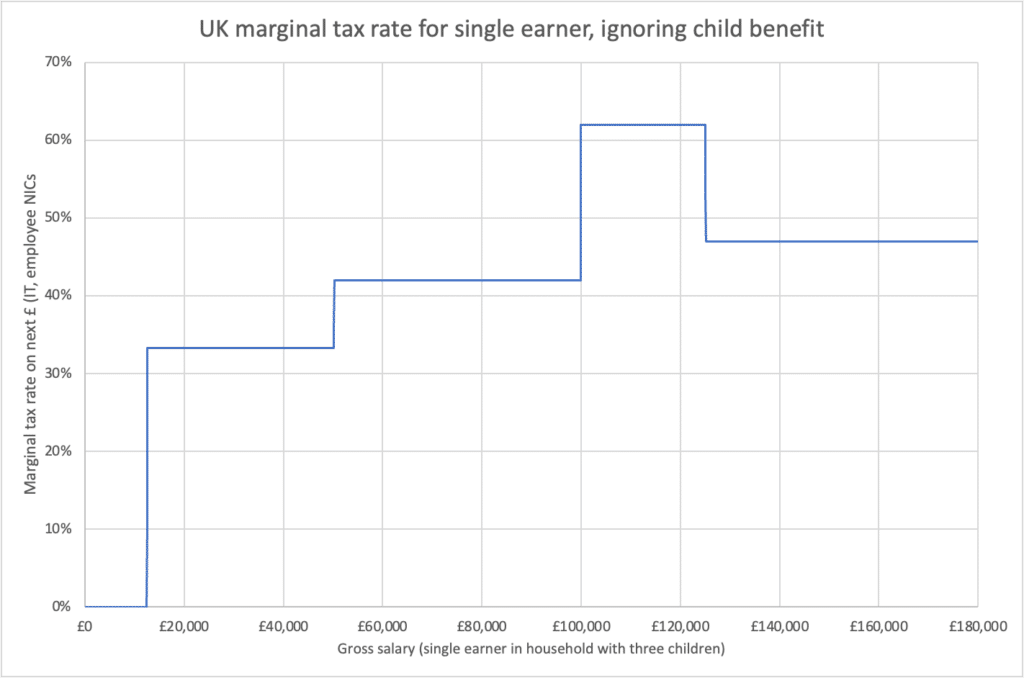
    I have given Osborne Clarke several opportunities to retract these false claims, and they have declined. I will therefore be writing to the SRA to make a formal complaint. I would urge everybody who’s received a libel letter falsely labelled as confidential/without prejudice to take similar action. This is whether you received the libel letter this morning or ten years’ ago, and whether you’re the Financial Times or a Twitter account with 20 followers. And what action should someone in this position take, particularly if they don’t have access to legal advice? There’s very good news on that front coming soon – I’ll be writing on this in the next few days.

    The point isn’t to be vindictive, it’s to change the whole risk/reward calculation for libel lawyers and their clients. Once the wealthy and powerful know they can’t stop a libel threat being published, and there’s a high risk it will receive more publicity than the original accusation, then suddenly the whole idea of sending it becomes less appealing.

    If you want to threaten someone with libel: fine. But you’ll have to face the consequences of everyone knowing what you’re up to.

    But this only works if we – the recipients of these letters – act. And that’s about to become a whole lot easier. More to follow!


    Photo from the Anti-SLAPP Coalition conference on 28 November 2022, where I was kindly invited to speak on a panel.

    Footnotes

    1. And also important to thank everyone who has personally helped me – tax accountants, lawyers, QCs, academics, experts on confidentiality and privilege etc etc – a huge amount of generosity from a large number of people, most of whom I cannot name, but all of whom I’m immensely grateful to. ↩︎

    2. This is not a theoretical example; after my experience, I was inundated with messages from people with small blogs and Twitter followings who had been at the receiving end of SLAPP letters ↩︎

    3. Actually not fine; I tend to think libel law should only apply to the most serious of deliberate lies ↩︎

  • Autumn Statement proposals: ten good, three bad, three meh

    Autumn Statement proposals: ten good, three bad, three meh

    If some idiot was to make me Chancellor, I’d do something like this, none of which are likely to actually happen:

    • Announce that, when fuel prices return to normal, there will be a retrospective windfall tax on the energy sector raising a target £30bn. But absolutely don’t announce any further details. More on the design principles here.
    • Follow Nigel Lawson’s lead, and raise the rate of capital gains tax so it is equal to the rate on income. Raises at least £8bn.
    • Abolish the non-dom regime and replace it with a straightforward exemption on foreign income/gains for the first three years after people come to the UK. Will be more useful to the workers we want to attract than the current mess, but won’t enable oligarchs and oil sheikhs to live in the UK tax-free. Plausibly raises £2bn.
    • Close the stamp duty loophole that means most commercial real estate is bought and sold inside “special purpose companies” so that no stamp duty is paid. Will probably raise at least £1bn.
    • Raise the annual tax on homes held in companies – ATED. Should yield £200m.
    • Eliminate the tapers and clawbacks that result in anomalously high marginal income tax rates of well over 50% and sometimes higher than 90%. Pay for it by increasing the additional 45p rate, or reducing the threshold at which it applies.
    • Scrap/cap over-generous inheritance tax exemptions, and use the revenues to reduce the rate from 40% to around 25%.
    • Pensions tax relief costs over £48bn, with most of the benefit going to highest earners. Capping relief at 30% should raise at least £2bn.
    • Announce the long-term objective of ending employer’s national insurance, so that all income is taxed at the same rate. This will mean tax-cuts for employees, and tax rises for others – but it will benefit the economy as a whole.
    • Start a review of other features of the tax system that penalise growth: top of the list, the high VAT threshold and the never-ending changes to corporation tax rates and reliefs.

    On the other hand, here are some things the Chancellor will probably do, and which are neither brilliant nor terrible:

    • Let fiscal drag collect an additional £30bn of tax with minimum political pain. The easiest way to collect lots of tax is to tax everyone, and this certainly does that. And conventional wisdom is that voters don’t notice fiscal drag; but until this year it was also conventional wisdom that voters don’t notice rises in national insurance.
    • Lower the threshold at which the 45% additional rate applies. As Arun Advani points out here, this is something of a “poll tax” on moderately high earners, as it has the same cash impact on someone earning £150k as it does on someone earning £1m.
    • Slight expansion of the existing windfall tax, perhaps extending it past 2025. It’s a poorly designed tax, and we’d be better off replacing it, but the case for taxing people who’ve obviously made a windfall is politically and practically irresistible.

    And here are some things we absolutely shouldn’t do:

    • Change the tax treatment of already-existing pensions or ISAs. People used these products believing they worked a particular way. It’s unfair, and will damage faith in the tax system and savings vehicles as a whole, if we change the rules of the game after people start playing.
    • Introduce a wealth tax. Almost all previous wealth taxes around the world have failed, raise little/no revenue, or both. Most wealth tax proposals ignore this, and can be discarded as unserious populism. The few that are intellectually rigorous end up being politically unfeasible (because they tax pensions and homes).
    • Create more points in the income tax/national insurance system where the marginal rate is over 50%. Chancellor Neidle would impose a 200% wealth tax on anyone proposing tax changes without saying precisely what they mean in terms of marginal rates.

    Any other suggestions?

    Image by DALL-E: “a tree in autumn, with its branches covered in brown leaves and one dollar bills, digital art”

    Footnotes

    1. Source: HMRC statistics and my napkin ↩︎

  • The first thing we do, let’s tax all the lawyers.

    The first thing we do, let’s tax all the lawyers.

    The UK taxes high-earning lawyers less than bankers. That’s irrational – and illustrates a wider problem with the tax system. It’s hard to change, but we’d all benefit if we taxed all income in the same way.

    Here’s the problem:

    • A City law firm has £100m of profits to share between 100 partners. The tax consequence: each partner has gross income of £1m on which they pay £435k income tax, plus £35k national insurance. So the lucky partners take home £530k, and lucky HMRC collects £47m.
    • A bank has £100 million of profits to share between 100 traders. The tax consequence: the bank pays employer’s 13.8% national insurance, leaving £87.9m for the bankers. So each banker has a gross income of £879k, on which they pay £380 income tax and £21k national insurance. So the poor bankers take home £477k, and even more lucky HMRC collects £52.3m.

    The lawyers have an overall effective tax rate of 47%; the bankers’ rate is 52.3%. That is an odd and irrational result.

    Why does it happen? The simple reason is that partners in a law firm are not employees, and so there’s no 13.8% employer’s national insurance. This isn’t tax avoidance, or even tax planning – it’s an inevitable consequence of the fact that our tax system puts so much weight on whether a person is an employee.

    The question is whether we should change the law and tax partners in law firms and other large professional firms the same way as employees.

    How much tax could we raise?

    The Lawyer has crunched the numbers on large law firms, and reckon that the top 50 UK law firms and top 50 US law firms have a combined UK profit of £6.3bn, implying that if they were subject to employer’s national insurance, that would yield an additional £870m of tax.

    The top 75 UK accounting firms have a profit of around £3bn, implying an extension of employer’s national insurance would yield an additional £400m of tax.

    Add in management consultants, investment managers, and other large professional partnerships (whether in partnership or corporate form) and it’s realistic to think we’d be looking at between £1.5bn and £2bn of revenue.

    Should we do it?

    Given the economic mess we currently find ourselves in, it’s hard to defend £1m lawyers paying less tax than other comparable professionals.

    As Catrin Griffiths, editor of The Lawyer, says:

    All the data points to the fact that commercial law is a highly successful UK sector that relies on an infrastructure of education, training and technology. In a climate of rising taxes for all, law firms will be increasingly challenged to consider their own financial contribution to the public finances.

    Politicians may find the prospect of an easy £2bn of additional revenue tempting. 

    And yet I pause at the idea of creating a headline tax rate of over 50%. On the one hand, that’s already what happens – the bankers in my example above have an effective rate of 53.5%. But – and this is important – they probably don’t feel like they do.

    And taxing partnerships/partners differently from companies/shareholders would be unprincipled and asking for trouble (meaning: unfair distortion and avoidance).

    Wider implications – and solutions

    It’s not just lawyers. The same distortions and difficulties arise throughout the economy.

    We tax employment income much more than other types of income, and that creates distortion, uncertainty, and tax avoidance. I’ve no doubt that employer’s national insurance is a Bad Tax and we should end it.

    But if we immediately abolished national insurance, and rolled it into income tax, then I fear many people would be aghast at how much tax they were paying (even if employers passed-on the benefit of the employer national insurance cut, which is distinctly optimistic). Tax psychology is a thing, and (on the basis of no evidence) I worry about the overall economic and fiscal effects of people feeling like they’re paying more in tax than they take home. That’s not a reason not to act, but it’s a reason to be very cautious.

    This is a hard problem.

    There are two things that might make it easier:

    • First, make the change mostly revenue-neutral. We’d be greatly expanding the base of people paying the 13.8% tax. So we don’t need the rate to be as high as 13.8% to collect the same amount. My feeling (and tax policy needs more than a feeling) is that nobody should be paying a marginal rate of over 50%.
    • Second, mandate that employers pass on the savings. This would be a highly unusual thing to do, but in this circumstance, it might be realistically achievable

    This would have two effects. People who aren’t employees would see a tax rise, but it would be less than the full 13.8%. Employees would see an actual tax cut. It’s just about possible this could make the whole proposal politically feasible. Maybe.

    Much better to actually fix the underlying problem than to pick on one particular sector – more principled, and much less susceptible to avoidance.

    All we need is a suitably courageous politician.


    Image by DALL-E: “a statue of lady justice, with a stack of dollar bills in her hand, digital art”

    Footnotes

    1. Some people unfamiliar with City law firms may be shocked at how large these figures are; some people who work in City law firms may regard this as a poor level of profitability, and possibly a failing firm. ↩︎

    2. i.e. tending towards the 45% top marginal rate ↩︎

    3. Tending towards the 2% marginal rate ↩︎

    4. It will usually be less than this, because law firms – like most businesses – have non-deductible expenditure… in practice that will raise the effective tax rate by a couple of % ↩︎

    5. There’s a good argument I should add the 0.5% apprenticeship levy, because it does behave just like another 0.5% employer’s NI. But, given it’s semi-hypothecated, I decided to leave it out. If you disagree with me on this, then that means my bigger argument has 0.5% more force. ↩︎

    6. I made a bad mistake here, and added the 13.8% employer’s NI to the £100m. That makes no sense, because the bonus pool was stated to be £100m – the bank is going to have to use that to pay the bonuses and the employer’s NI. Now corrected! ↩︎

    7. Some people will complain at this point that the bankers aren’t paying employer’s national insurance – so why include that in their effective tax rate? The answer is that the economic evidence suggests that, in the long run, the economic incidence of employer’s national insurance largely falls on wages. In my example it’s particularly clear – the bank has a bonus pool, and the employers are going to get what’s left after employer’s national insurance is paid – so it is directly reducing their income. ↩︎

    8. Except when it is – see the smart comment from ‘Tigs’ below regarding salaried “partners” ↩︎

    9. There would certainly be difficult edge cases; this post is about the principle rather than the practicality. Similarly, lots of points to think about re. non-deductible expenditure, which for some large partnerships already takes the effective rate over 50%. ↩︎

    10. The usual problem is this: when the 5% “tampon tax” was abolished, we couldn’t legally require that prices were cut by 5%, because retail prices move all the time, and it’s not possible to disentangle the tax cut from other price changes. Wages are different. It might (and this would need a lot of thought) be possible to require employers pass on an employer’s national insurance cut. That wouldn’t be a perfect solution, because an employer could pass on the cut, but at the same time scrap a wage rise that otherwise would have been paid. But it could (particularly in a time of low inflation) ensure that most of the benefit went to employees in the short term, and there’s good reason to believe that it will go to employees in the long term regardless of what we do. ↩︎

  • How the abolition of the “tampon tax” benefited retailers, not women

    How the abolition of the “tampon tax” benefited retailers, not women

    5% VAT applied to tampons until January 2021 – then it was abolished. Many were hoping that the savings would go to women, in reduced tampon prices. Our analysis of ONS pricing data shows that no more than 1% of the VAT savings was passed to consumers; the rest – and very possibly all the saving – was retained by retailers.

    Our report is available in PDF format here. An interactive chart demonstrating our conclusions is here. The Guardian report on our paper is here and the FT here.

    A web version of the PDF report follows below:

    Executive Summary

    5% VAT applied to tampons and other menstrual products until January 2021. Then, following the high-profile “tampon tax” campaign, it was abolished. Many expected that the benefit of the tax saving would go to women, in the form of reduced prices.

    However, an analysis of ONS data by Tax Policy Associates demonstrates that the 5% VAT saving was not passed onto women. At least 80% of the saving was retained by retailers (and very possibly all of it).

    The key piece of evidence is this chart showing price changes before and after the abolition of the “tampon tax” on 1 January 2021. Ignoring the large spike in December 2020, average prices after the change are only slightly lower than before the change. For reasons explained further below, this likely reflects normal market movements rather than the passing on of the VAT saving.

    Interactive charts that illustrate this in more detail are available here.

    Background

    Campaigners had been pushing for years for the 5% VAT on menstrual products to be scrapped[1]. EU law prevented this, but in 2016 the then-Government obtained in-principle agreement with the EU[2] that this would change. In the event, these discussions were overtaken by Brexit, and it was not until January 2021 that the tax was abolished. [3]

    There will be widespread interest in who benefited from the abolition of the tampon tax – consumers or retailers. And there is also an important tax policy point. We have recently seen proposals that VAT or duties be reduced or removed from particular products or services (e.g. VAT on the tourism industry, VAT on petrol or fuel duty on petrol/diesel). However, these campaigns often assume that the benefit of the tax cuts will be passed onto consumers. The “tampon tax” provides further evidence that this will often not be the case.

    Analysis

    We used Office for National Statistics data to analyse tampon price changes around 1 January 2021, the date that the “tampon tax” was abolished. We were able to do this because the ONS includes tampons (but not other menstrual products) in the price quotes it samples every month to compile the consumer prices index. Since 2017, the ONS has published the full datasets for its price sampling. [4]

    We set out our methodology below.

    Qualitative analysis

    Our methodology results in the above chart of tampon prices before and after 1 January 2021. The data is normalised to December 2020, i.e. the price on December 2020 is set at 100% for ease of reference – this facilitates easy comparisons between different products.

    Or, over a longer period:

    The charts show a 6% fall in tampon prices in January 2021 – that is largely a reversal of a 4% increase the previous month; there is then a 2.5% increase in February 2021. Overall, the average price for the period after the VAT abolition is about 1.5% less than it was beforehand.

    The December 2020 price spike

    It could be suggested that the 4% price rise in December 2020 was a deliberate strategy to make it look as though the 5% VAT cut was being passed to consumers the next month. However, we regard that as highly unlikely. It would require astonishing cynicism on the part of retailers. It would also suggest a degree of coordination between a large number of retailers that would be difficult to arrange in practice, as well as a flagrant breach of competition law.

    As we will show below, other products also show price spikes at a variety of different times, which we expect are driven by a complex and unpredictable mixture of seasonal and situational supply/demand factors. This seems the more likely explanation. However, the fact that the December 2020 price was a “spike” means that it would be incorrect to conclude from the December and January data that tampon pricing fell by 5% when VAT was abolished.

    Comparison with other products

    It is insufficient to look at tampon pricing in isolation. For example, if many other consumer products were materially increasing in price in January 2021, then the absence of an increase in tampon pricing could be consistent with the benefit of the VAT abolition being passed to consumers. However, the evidence does not show this.

    Our analysis includes price movements for thirteen other products that would likely be subject to similar supply and demand effects to tampons – toiletries and products made of cotton. It is important to note that none of these projects were subject to VAT changes over the period in question. Hence, if the benefit of the VAT abolition was passed on to consumers, we would expect to see a significant divergence between price changes in tampons and price changes in the other products. We do not.

    This chart compares price changes in tampons (the red dotted line) with price changes in tissues (the blue line).

    The two datasets seem reasonably correlated on either side of 1 January 2021 (with the exception of a large spike in tissue pricing in December 2019, and another spike at the start of the data in December 2017). If the benefit of the tampon VAT abolition was passed onto consumers we would expect a divergence between the two datasets after 1 January, as tampon prices fell but tissue prices did not. However, we see no such effect.

    This chart compares tampon pricing (red dashed line) with t-shirts (cyan line). T-shirts are largely, but not entirely, made of cotton, and therefore are in principle subject to similar demand factors:

    While t-shirt pricing seems much more volatile than tampon pricing, there is again no evidence of prices diverging after 1 January 2021.

    There is an interactive version of the chart here that lets the user compare tampon price movements with the other toiletry and cotton products included in the CPI, as well as the CPI itself (which, towards the end of the period covered by the chart, increases steeply as energy costs etc start to rise). Clicking on the legend on the right-hand side will add/remove additional products.

    Quantitative analysis

    Comparing the average change in tampon prices for the six months before the abolition to the six months after confirms what we see in the above charts – the change in the price of tampons is broadly in line with other price changes we see in products where the VAT treatment did not change:

    A similar picture is apparent over a longer period:

    This implies that none of the VAT abolition was passed to consumers in the form of lower prices.

    What if, in the interests of prudence, we ignore the other products that showed a drop in price, and look at tampon pricing in isolation? How likely is it that the apparent 1.5% drop in price is a real effect, and not just a function of the high variability of the pricing of all of these products? Our statistical analysis (see the “methodology” section on below) suggests that, at most, 1% of the price reduction was a real effect

    Conclusions

    Consumers did not in fact get the full benefit of the abolition of the 5% VAT “tampon  tax”. At most, tampon prices were cut by around 1%, with the remaining 80% of the benefit retained by retailers. More likely, the retailers took all the benefit – amounting to £15m each year.[5]

    It is open to any retailer contesting the figures in this report to publish full data showing their pricing on either side of the 1 January 2021 abolition. footnote Our analysis is of ONS data across retailers as a whole. It is, therefore, possible that some retailers did pass on the benefit of the VAT cut, and provided lower prices than the average figure in the data. That would, however, imply that other retailers provided higher prices. And where, as happened in at least one case, a retailer[6] announced tampon price cuts ahead of the actual abolition of the tax, that retailer should be able to demonstrate that the price cut happened, and as a result their prices remained diverged from other retailers up to (and perhaps beyond) 1 January 2021.

    It is our hope that the power of the “tampon tax” campaign means that public pressure will cause retailers and suppliers, at this late stage, to pass on the full benefit of the tampon tax abolition to consumers.

    Policy implications

    This is an unusual case where a product is specifically included in ONS data. Prices changes are not normally so visible; nor are they normally subject to this degree of political pressure.

    The public and policymakers should therefore be sceptical of those making proposals for cuts in VAT and duties, particularly if claims are made that this will benefit consumers, and/or those on low incomes (that was generally not the case for the “tampon tax” campaign, which was largely argued on a point of principle). If we want to support those who can’t afford to pay, then the answer is to put cash directly in their hands (through the tax and benefits system), or in some cases (perhaps such as this) provide free or subsidised products. We should be cautious before lowering tax rates in the hope that benevolent retailers and suppliers will pass the savings on to those who need it. The evidence from the “tampon tax” is that they won’t.

    Methodology

    Source of data

    The Office for National Statistics compiles detailed monthly price quotes for a large variety of products, and then calculates price indices for each of those products. Since 2017, this data has been published.

    To assess the change in tampon prices, we extracted the ONS data from December 2017 (When the data starts) through to April 2022,[7] and consolidated the index data for tampons and another thirteen broadly comparable products. We ended in April 2022 because after that point inflation effects start to dominate (see here).

    We then wrote a short python script to analyse and chart the data. This is freely available on GitHub here. For clarity, all the price indices are normalised to 31 December 2020.

    T-test

    The bar charts above provide a reasonably clear indication that nothing exceptional happened to tampon pricing on the six months either side of January 2021. Whilst the average price after this date was higher than the average price before, there were greater differences in most other comparable products.

    Apply statistical techniques to these datasets is not straightforward given the limited number of datapoints and very high degree of volatility. It was, however, thought appropriate to run an unequal variance one-sided t-test (using the python SciPy library) to compare the pricing datasets for the six months before 1 January 2021 with those for the subsequent six months. The null hypothesis would be that the price did not change; the alternative hypothesis was that the price was lower on and after 1 January 2021.

    This resulted in the following set of p-values:

    Productp-value (six month t-test)
    Tissues-Large Size Box0.00001
    Women’s Basic Plain T-Shirt0.00627
    Boys T-Shirt 3-13 Years0.00709
    Sheet Of Wrapping Paper0.03236
    Men’s T-Shirt Short Sleeved0.09442
    Toilet Rolls0.10948
    Tampons0.14045
    Kitchen Roll Pk Of 2-4 Specify0.53249
    Disp Nappies Spec Type 20-600.89392
    Baby Wipes 50-850.95865
    Toothpaste (Specify Size)0.99270
    Plasters-20-40 Pack0.99694
    Razor Cartridge Blades0.99831
    Toothbrush0.99847

    As expected, the p-value for tampons is not significant (> 0.05). More significant p-values were achieved for six other products, four of which were actually significant at 5%. Those products did not receive any change in VAT treatment over the period in question so, absent other unknown factors, this should be regarded as a product of the volatility of pricing decisions in a complex market environment, as well as potentially unknown supply and demand factors.

    If we look at longer periods than six months then the p-value for tampons becomes more significant (because, although the average does not change, the number of datapoints increases, and significance becomes “easier” to attain). At eight months, a significant result is achieved (p-value=0.03201), although given that more significant results are (again) obtained for other products, this result should be treated with caution.

    Nevertheless, if the tampon pricing results are viewed in isolation, they are compatible with the price having decreased after 1 January 2021. We can estimate the maximum likely extent of that decrease by constructing a synthetic tampon pricing sequence, identical to the actual tampon pricing sequence but with an increase of x% from 1 January 2021. If a t-test of that synthetic pricing sequence does not provide a significant p-value then that implies that the statistically significant difference between the pre-January 2021 pricing and post-January 2021 pricing is limited to a tampon price reduction of x%.

    Testing different values of x, the p-value ceases to be significant with x at 1% (p-value equal to or greater than 0.0935 for any given range of months) (the precise methodology utilised can be seen in the GitHub code).

    Hence, we can conclude that there is only weak evidence of any change in tampon pricing reflecting the cut in VAT, with the greatest realistic extent of any price reduction being approximately 1%.

    Limitations

    The analysis in this paper is subject to a number of important limitations:

    • The ONS adopts a methodology that is designed to produce statistically rigorous results across consumer prices as a whole. It is not necessarily intended to provide robust figures for changes in the price of one product. Nevertheless, around 250 tampon prices[8] are sampled each month[9].
    • The prices of tampons and the other consumer goods considered in this paper will be affected by numerous factors – the supply of raw materials, energy costs, and sheer random happenstance. It is therefore unsurprising that we see a large amount of month-to-month variation in prices; this makes it difficult to identify separate real trends from noise. More sophisticated statistical methods than a t-test are therefore not helpful (difference-in-difference and synthetic control methods were attempted, but did not produce meaningful results).
    • The January 2021 VAT change applied to all menstrual products,[10] however ONS data only covers tampons. It is therefore possible in principle that the benefit of VAT abolition was passed to consumers of e.g. sanitary towels, although it is not obvious why that would be the case.

    Acknowledgments

    Thanks to Arun Advani of the University of Warwick for his advice on statistical techniques, to Gemma Abbott for her advice on the background to the “tampon tax” campaign, and to Laura Coryton for her help and advice. Any errors in our analysis are the sole responsibility of Tax Policy Associates, as are the conclusions we draw from it.

    And many thanks to the Office for National Statistics for publishing the data at a level of detail that facilitates this kind of analysis, and also for responding swiftly and helpfully to our queries.


    [1] Technically VAT on tampons was not abolished – the rate was reduced to 0%. This is different from an exemption, because an exemption would mean that retailers can’t recover the cost of purchasing tampons from wholesalers, and would therefore probably result in higher consumer prices. However, in the interest of clarity, this report refers to “abolition”.

    [2] See, e.g. https://www.theguardian.com/money/2016/mar/18/tampon-tax-scrapped-announces-osborne

    [3] See the 1 January 2021 Government announcement: https://www.gov.uk/government/news/tampon-tax-abolished-from-today

    [4] The ONS datasets can be found here: https://www.ons.gov.uk/economy/inflationandpriceindices/datasets/consumerpriceindicescpiandretailpricesindexrpiitemindicesandpricequotes

    [5] Extrapolating from the £47m figure in the Government press release https://www.gov.uk/government/news/tampon-tax-abolished-from-today

    [6] See https://www.expressandstar.com/news/uk-news/2017/07/29/tesco-beats-tampon-tax-with-5-price-cut/

    [7] Most of that date is here, except the 2019 data which is here

    [8] The full set of price quotes obtained in January 2021 is available here: https://www.ons.gov.uk/file?uri=/economy/inflationandpriceindices/datasets/consumerpriceindicescpiandretailpricesindexrpiitemindicesandpricequotes/pricequotesjanuary2021/upload-pricequotes202101.csv

    [9] There are complex issues around sampling error in CPI which are outside the scope of this paper (see, for example, Smith (2021)). However, with 250 samples, the sampling error ought to be very much less than the 5% VAT reduction.

    [10] The VAT term is “sanitary products” – details are in HMRC VAT Notice 701/18 – see https://www.gov.uk/guidance/vat-on-womens-sanitary-products-notice-70118


    Image by DALL-E – “a pound sterling sign, £, made of tampons, digital art, on a blue background”

  • The real reason your work doesn’t let you remote-work from abroad, and how to fix it

    The real reason your work doesn’t let you remote-work from abroad, and how to fix it

    We’re delighted to publish an article on the underreported subject of tax and remote working, by Leonard Wagenaar, an M&A tax and international tax professional[1] whose insightful analysis is usually posted on LinkedIn here. This is the first in an occasional series of articles by outside tax experts – we won’t necessarily agree with every word, but we will agree that the subject is important and not currently getting enough attention.

    Since the pandemic, remote work has become common. Some countries now try to attract remote workers to settle in their country, so they can work remotely internationally. Of the 27 EU countries, 11 have implemented or are considering special ‘digital nomad visas’[2]. Two of them – Greece[3] and Spain[4] – also couple this with special tax breaks for remote workers, triggering fears of a race to the bottom on personal taxes.

    Although most of us can’t imagine a working environment without remote work, international remote work is still rare. New visa rules are unlikely to change that. Within the EU, there were never any visa restrictions on remote work for EU citizens. A culture of international remote work could transform the labour market. But the biggest obstacles are tax systems, even those from supposedly supportive countries.

    Right now, no sensible employment contract will leave the employee free to work from wherever they want, as a travelling employee could easily trigger tax for the employer wherever they travel. That’s because countries generally tax the foreign companies as soon as they have a ‘permanent establishment’ (or “PE” for short). Generally, a PE will be triggered if someone does business for the employer through a ‘fixed place of business’. This is a concept that’s over a hundred years old and though it has developed over all those years, it clearly wasn’t designed with the digital age in mind. For instance, could a desk in your holiday home be a fixed place of business? Or the kitchen table of your friend’s uncle? How about the table in the local coffee shop? Or could the ‘fixed place’ even be within the work phone you carry around?[5] No one really knows.

    There are plenty of guidance notes, published tax rulings and case law, but these are highly fact dependent and go in different directions. Being stranded abroad against your will in a global pandemic probably doesn’t trigger a PE, provided you at least tried to get back home[6]. If the company demands that you work remotely in another country, that’s likely a PE[7]. Having an office abroad and not using it is not a PE[8]. But the typical basic remote worker fact pattern? No one really knows. Countries can apply other tests to answer this question, such as “is the home office at the disposal of the employer?” or “does the employer have the ability to exclude people from the home office?”. But generally, these tests replace one obscure question with another.

    The longer a fact pattern continues, the higher the risk of a “fixed place of business” PE. The threshold is usually set at three months. But there are exceptions to this too, especially if the activities abroad repeat themselves after interruptions. And if one remote worker leaves the country, but another enters around the same time, does that reset the clock? Does it matter whether the second employee visits the same place or does similar activities? Again, no one really knows.

    Most of the time, having or not having a PE would not impact the tax due for the employer all that much. But a PE would require the employer to register locally, run a local payroll and run expensive transfer pricing analyses to figure out just how much profit should be allocated to the PE. Any position they take will displease either their home tax authority or the foreign tax authority, meaning they will live with a significant risk of challenge. So, usually, employers don’t bother and just require that they can control the employee work location, even if that’s outside the office. In the Netherlands, an employer can’t unreasonably deny a request for remote work, but they can deny such a request if someone wants to work remotely from another country.

    So, in short, archaic tax rules are holding back a modern labour market. Political discussions are dominated by images of ‘digital nomads’ backpacking their way between work, the beach and travel. But the best opportunities are for people who now struggle to find suitable work due to their location. If employers could hire remote employees internationally with minimal disruption, the biggest opportunity is for areas that have been left behind economically. Remote work – including international remote work – is a tool for levelling up.

    So far, countries have not felt empowered to solve this problem, but they have all the tools to do so. The definition for PE has been fixed in many double tax treaties. A multilateral solution would be most efficient, but will take a very, very long time, especially now that all international tax debate seems to be consumed by other topics[9]. In the meantime, there is plenty countries can do unilaterally. Tax treaties give countries the right, but not the obligation, to tax PEs. So, countries can apply higher thresholds than tax treaties. In other words, host countries can choose not to tax foreign companies with remote workers by issuing clear binding guidance that a home office does not trigger a PE and neither do workspaces in hotels, Airbnbs, coffee places or on smart devices, etc. [10] It would not bring the company’s overall tax burden down (not by much at least), but it would greatly reduce their compliance burden. And if it stops companies from trying to control where their employees are working from, I’m sure they won’t complain either.

    This simple measure could very well be more effective in attracting international remote work than new visa categories or even personal income tax breaks. Countries can adopt this simple step without a potentially damaging tax competition that comes with offering lower personal income taxes. After all, they can still collect all personal income taxes from the remote workers. It is all possible. But is the political will there?


    Photo by Glenn Carstens-Peters on Unsplash.

    [1] All views are in personal capacity and do not necessarily represent those of any employer, remote or local.

    [2] https://www.euronews.com/travel/2022/10/23/want-to-move-to-europe-here-are-all-the-digital-nomads-visas-available-for-remote-workers

    [3] https://visaguide.world/digital-nomad-visa/greece/#:~:text=Taxes.,a%2050%25%20reduction%20tax%20program.

    [4] https://www.schengenvisainfo.com/news/spain-introduces-new-visa-for-foreign-start-ups-digital-nomads-reduces-taxes-for-them/#:~:text=Digital%20nomads%20will%20also%20be,for%20up%20to%2012%20months.

    [5] To my knowledge, no one is actually claiming this, but the argument would have some technical merits. Your phone might be quite small, but there was never any size limit placed on a PE. The phone doesn’t stay in one place, but neither does a market stall nor a desk in a co-working space, both cases that are readily accepted as triggering a PE, because they are part of a ‘geographical whole’. And if the phone is generally used in the same locations (as is likely), a similar argument can be made here.

    [6] https://globaltaxnews.ey.com/news/2022-5117-spains-tax-authority-issues-ruling-on-remote-workers-and-permanent-establishments-during-and-after-covid-19-restrictions

    [7] https://skat.dk/data.aspx?oid=2350336

    [8] https://www.lindedigital.at/plink/swi

    [9] https://www.oecd.org/tax/beps/oecd-releases-pillar-two-model-rules-for-domestic-implementation-of-15-percent-global-minimum-tax.htm

    [10] Guardrails could be introduced to prevent wholly remote businesses to pretend that they are foreign companies. For instance, the guidance could require a PE once remote work FTE / payroll costs exceed 25% or certain fixed numbers.

  • ATED – the obscure tax that nobody was supposed to pay (and why we should raise £200m of tax by increasing it)

    ATED – the obscure tax that nobody was supposed to pay (and why we should raise £200m of tax by increasing it)

    We all pay stamp duty when we buy a house. But there’s a well-known trick: have your house owned by a company – a special purpose company that does absolutely nothing else (often called “enveloping”). Then, when you come to sell, you sell the shares in the company, and the buyer pays no stamp duty.

    This had been going on forever, but became widely publicised in the early 2010s. In a sane world, the “loophole” would’ve been closed by simply applying stamp duty to the sale of the shares. But for obscure reasons, the loophole was left open, but anyone exploiting it and buying residential real estate held by a company was stung with an annual tax – the “annual tax on enveloped dwellings” introduced in 2013 – ATED.

    The idea was that the prospect of paying an annual tax would put people off enveloping altogether – ATED wouldn’t raise much money, but would increase stamp duty revenues. That didn’t quite happen – and ATED, the tax that nobody was supposed to pay, ended up raising over £100m each year, with around 5,000 residential properties still held in envelopes (including about 100 properties worth more than £20m).

    Why are people stubbornly keeping their homes enveloped, despite ATED?

    Sometimes to hide the identity of owners (whether because of security concerns or more malign reasons) – although this will now be harder to do.

    Sometimes simply because ATED is way too small to undo the stamp duty saving from enveloping. The tax applies in bands like this:

    This means that the gap between stamp duty and ATED is fairly dramatic, particularly at the high end.

    In other words:

    • Stamp duty on a £1 million house is £91,250. ATED at that level is only £3,800. So you could happily pay the annual tax for 24 years before your total ATED bill exceeds the stamp duty you’d have paid if the property wasn’t enveloped. Let’s call 24 years the “ATED break-even point”.
    • Or more dramatically, stamp duty on a £25m house is over £4m. ATED is £244,750/year. So the ATED break-even point here is 17 years – i.e. you’d have to pay ATED for 17 years before the cost exceeded the stamp duty saving.
    • And ATED caps out at £244,750. So once we get into truly silly money, the benefit becomes stark: stamp duty on a £100m house is a cool £17m – the ATED break-even point is 69 years.

    So ATED is too low to do the job it was designed to do. The enveloping “loophole” is still worthwhile, and the more expensive the property, the more worthwhile it is.

    The sensible solution is to close the loophole properly, and make stamp duty apply on the sale of companies holding residential real estate (just as I think we should for companies purchasing commercial real estate). But if we don’t want to do that (or want a stopgap while we finalise how we’re going to properly sort things out), let’s just increase ATED.

    ATED currently raises £111 million, and the average ATED break-even point is about 20 years. So if we triple the rate, we can expect to raise around £200m – much of which would be in increased stamp duty revenues, as people “de-envelope”. That would reduce the average ATED break-even point to around 6 years, which seems a more realistic timeframe for ownership of high-value real estate. We’re not quite done: increasing ATED at each of the existing bands doesn’t solve the problem of ATED “capping-out” for very high-value properties – here, the obvious solution is for ATED to continue to apply at each additional £5m of value.

    This seems a simple, fair and straightforward-to-implement way to raise £200m. How could any Chancellor resist such a proposition?


    Photo of One Hyde Park by Rob Deutscher Follow, CC BY 2.0 via Wikimedia Commons. Why pick a picture of One Hyde Park? No particular reason.

    Footnotes

    1. since it’s the buyer making the stamp duty saving, why does the seller go to the trouble of enveloping the property? Because in practice, stamp duty is economically shared between the buyer and the seller, and by arranging a stamp duty-free sale, you expect that you are increasing your future sale proceeds. ↩︎

    2. If it was a UK company, there would be 0.5% UK stamp duty/stamp duty reserve tax. So all envelopes are in practice non-UK companies. Do people really go to this trouble just to save 0.5%? Yes – helped by the fact that it is often cheaper to maintain an offshore company than a UK company. ↩︎

    3. Scare quotes because I have zero interest in arguing whether or not it is really a loophole ↩︎

    4. in large part EU law complications around the Capital Duties Directive ↩︎

    5. This, and the other figures here, all assume that the buyer is a non-resident who already owns property ↩︎

    6. This ignores set-up and maintenance costs; but it also ignores the time value of money, so I don’t think it’s an unrepresentative way to look at things. ↩︎

    7. Ordinarily one worries that greatly increasing a tax will take it past the “revenue maximising” point, and actually reduce revenues (as well as do economic harm). Here we can be reasonably relaxed, because the unusual nature of ATED means that the revenue-maximising point will be where the level of ATED exactly equals the benefit that people receive from enveloping. This can’t realistically be calculated, because it will vary dependent on personal circumstances. But the important thing is that people always have an escape route – they can “de-envelope” and suffer stamp duty on their sales instead of ATED – so there shouldn’t be a risk of damaging revenues or the housing market by setting ATED too high (even if the ATED rate was set at $100bn, we would remain at (and not past) the revenue-maximising rate) ↩︎

    8. Of course one could instead have a percentage charge, but that then creates a need for precise valuation, which is probably just justified given the small scale of this tax ↩︎

  • How to raise £1bn by closing a stamp duty “loophole”

    How to raise £1bn by closing a stamp duty “loophole”

    You’re about to sign on the purchase of the Oblong – a £1bn glass monolith in the centre of the City of London. The handy HMRC calculator tells you if you execute a deed purchasing The Oblong, you’ll owe a neat £50m in SDLT.

    How do you avoid the tax?

    Well, as it happens, The Oblong – like almost every other serious bit of commercial real estate in the UK – is owned by a company – Oblong Propco Limited. This isn’t the normal kind of company that does a bunch of different things, but a “special purpose vehicle” (SPV) whose only activity is holding The Oblong, signing leases with tenants, and so forth.

    After a quick chat with your advisers you realise that, on reflection, you love The Oblong so much that you’ll buy the company. Instead of paying £1bn for the land, you pay £1bn for Oblong Propco Limited, and The Oblong will come along with it.

    Funny thing is, whilst the rate of stamp duty on land is 5%, the rate on shares is 0.5%. Funnier still, that’s shares in *UK* companies, and Oblong Propco Limited is incorporated in Jersey. So you pay nothing.

    Is this tax avoidance?

    You clearly are avoiding SDLT, in the value-free sense of not paying SDLT that you would pay if you did something else. But is it “tax avoidance” in the way that term is usually used?

    The thing is, you’re not doing anything remotely naughty. You could buy the land directly. Or you could buy the company. It’s a free choice. In many ways it’s more convenient to buy the company; it may have ancillary contracts (like window cleaners and security guards), and your bank may prefer to lend to a nice clean SPV and not a complex company with lots of different creditors. You’re just choosing to do the transaction in a particular, not remotely unusual, way.

    For this reason, it’s not “tax avoidance” within any of the technical rules that could enable an HMRC challenge, and so this is as close to a dead cert as tax planning ever gets.

    By way of comparison, here’s what would be tax avoidance. Say the current owners hold The Oblong directly, and not in an SPV. They want to sell free from SDLT (because part of the benefit will go to them in increased sale price). So, just before they sell to you, they transfer The Oblong into a new SPV and then sell you the SPV. That kind of game was stopped years ago, and now doesn’t work for a whole bunch of reasons – so HMRC would get their SDLT. But if the owners moved The Oblong into the SPV more than three years before they started talking to potential purchasers, then these rules won’t apply.

    Is this a loophole?

    The term “loophole” suggests something secret and clever, which only a few special people know about. Everybody in the real estate world knows you sell companies if you don’t want to pay SDLT. That includes HMRC. Most people would say it’s a loophole. Tax advisers and people in the real estate industry would disagree. But in my view, it’s an irrational limitation on stamp duty that shouldn’t exist. I’ll call it a “loophole” in scare quotes… but what we call it is much less important than what we do about it.

    What do other countries do?

    Spain, Germany, France, Australia… most countries that have a tax on land transfers also apply it to the sale of shares in SPVs holding land. Because it’s such a bloody obvious way to avoid tax.

    What should we do about it?

    There’s no technical barrier to charging SDLT on property SPVs. We even have legislation we could use to do it – we could copy and paste from the rules created a few years ago to charge capital gains tax on people selling property SPVs (“property rich companies“).

    How much tax would we raise if we did that?

    There are, as with many tax questions, no figures available that let us estimate this with any accuracy. However, there are around £60bn of commercial real estate transactions a year. What proportion of those involve shares in SPVs, rather than dealing in the real estate directly? There is no data available, but on the basis of my experience, I would say that it is likely, by value, the majority. It would be surprising if the revenues were less than £1bn (i.e. because if only 1/3 of these real estate transactions are currently in SPVs, changing the law would yield £60bn x 1/3 x 5% = £1bn).

    People could still use SPVs to hold real estate – and in many cases that would still make sense. But we’d be taxing SPV transactions in the same way as land transactions – and taxing economically similar transactions in a similar way is good tax policy.

    Before Brexit, EU law made it difficult in practice to impose SDLT on SPV shares without huge loopholes. But that’s fallen away – a true Brexit dividend.

    So what’s stopping us now?


    Gherkin photo by Ed Robertson on Unsplash

    Footnotes

    1. This is an updated version of my old post ‘how to avoid stamp duty’ ↩︎

    2. This trick used to work for residential real estate, but now kinda mostly sorta doesn’t, because of ATED – I’ll write about that soon ↩︎

    3. This is, I hope obviously, not legal advice. ↩︎

    4. As far as I know, but if you can point me towards anything I would be most grateful ↩︎

    5. Problem was that the Capital Duties Directive meant we couldn’t charge SDLT on the issuance of shares. So people could have responded to SDLT on the transfer of SPV shares by instead issuing new shares to the purchaser, and repurchasing/cancelling the shares of the seller. Why doesn’t EU law stand in the way of the French, German etc taxes applying to sales of shares? It’s one of life’s little mysteries. ↩︎

  • Rishi Sunak, Akshata Murty, and two big tax loopholes

    Rishi Sunak, Akshata Murty, and two big tax loopholes

    Rishi Sunak’s wife, Akshata Murty, probably – by complete accident – benefits from an obscure inheritance tax loophole worth £240m. It is possible that – by design and not accident- Ms Murty has arranged her affairs to benefit from an unrelated income tax loophole worth £5.5m each year. Mr Sunak should, in the interests of transparency, confirm whether his family in fact benefits from these loopholes. And – whether he does or not – these loopholes should be closed.

    Akshata Murty holds 0.93% of the shares in her father’s IT company, Infosys. Given the company’s current market capitalisation is $77bn, that implies – ignoring all Ms Murty’s other assets – she is worth at least £600m, and is receiving about £14m of dividends each year.

    That would normally have two tax consequences:

    • Ms Murty pays around £5.5m of UK income tax each year on her £14m of dividends.

    Ms Murty’s tax status

    Akshata Murty is a non-dom, and has historically claimed the “remittance basis”. Which means she wasn’t taxed in the UK on her £14m of annual dividends (and her tax was likely limited to a 10% Indian dividend withholding tax). Mrs Murty agreed earlier this year to stop claiming the remittance basis.

    But she remains a non-dom. That has some interesting consequences.

    The accidental £200m inheritance tax loophole

    As a non-dom, Ms Murty’s estate isn’t subject to inheritance tax on her Indian shares. But good things don’t last forever – non-doms lose that benefit after being resident in the UK for 15 years. That probably gives Ms Murty about five more years before her estate becomes taxable.

    Except it won’t.

    There’s an obscure loophole in a 1950s tax treaty between the UK and India. The effect of the treaty is that an Indian non-dom like Ms Murty is never subject to UK inheritance tax. The 15-year rule that applies to everyone else doesn’t apply to Indians.

    Why this weird result? Because, in the 1950s, India and the UK had similar estate duties, and it was perfectly rational for UK-domiciled individuals to pay only UK estate duty, and Indian-domiciled individuals to pay only Indian estate duty. The problem is that India abolished its estate duty in the 1970s, so the treaty now serves no rational purpose – it just creates a loophole for UK resident Indian domiciled individuals.

    It’s not up to Ms Murty whether to claim the treaty, and she’s not remotely to blame for being a non-dom or having a potential treaty claim. But the result is inequitable. The treaty should be scrapped and the loophole closed.

    The potential £5.5m income tax loophole

    Non-doms aren’t taxed on their foreign income and gains – so until earlier this year, Ms Murty escaped around £5.5m of annual income tax on her Infosys dividends.

    Like inheritance tax, the income tax benefit ends after 15 years. However, there is a very common practice amongst non-doms of putting their assets into an “excluded property trust” before the 15 years are up. The effect of the trust is broadly that the benefit of non-dom status lasts forever. I’ve no evidence Ms Murty put such a trust in place, but it is sufficiently common – indeed almost universal – planning for wealthy non-doms that it’s fair to ask the Sunaks to confirm, in the interests of transparency, whether she did.

    My view is that excluded property trusts are a loophole that should be closed (ideally as part of a wider reform of non-dom rules). If the Prime Minister’s family take advantage of the loophole then that argument becomes all the more powerful.

    Has Rishi Sunak himself avoided tax?

    There was a report in the Independent that Rishi Sunak was listed as a beneficiary of two offshore trusts. Sunak denied this very clearly in an interview with Andrew Marr, and – whilst am sure the Independent was acting in good faith – there is nothing in Sunak’s background or history that gives me any reason to doubt his denial.

    There was a report on Channel 4 that, when Sunak was a hedge fund manager, he was involved in tax avoidance. I investigated this and concluded that he had done nothing wrong, and that the Channel 4 report was misleading.


    Photo by Simon Walker / HM Treasury – Flickr, OGL 3

    Footnotes

    1. See Infosys’s most recent disclosures, page 3, about 2/3 of the way down ↩︎

    2. That’s just taking the five-year average dividend yield of 2.36% and multiplying it by the £600m holding ↩︎

    3. You might think a relatively young couple like the Sunaks wouldn’t be thinking about inheritance tax; but in my experience the very wealthy absolutely do from an early age. ↩︎

    4. Enacted by The Double Taxation Relief (Estate Duty) (India) Order 1956. ↩︎

    5. At least I don’t believe other countries have equivalent treaties; there is a similar treaty between the UK and Italy, but in practice that has no effect ↩︎

    6. Final point of detail: if the treaty didn’t apply, it’s possible that Ms Murty’s holding in Infosys would benefit from business relief. The relief is intended to apply to unlisted companies, and so excludes shares listed on a “recognised stock exchange”. Infosys shares are listed on the Bombay Stock Exchange and the National Stock Exchange of India, which are not recognised stock exchanges. Infosys has also listed ADRs, which are listed on NASDAQ; however it appears that Ms Murty holds actual Infosys shares, and not ADRs. ↩︎

    7. This also has an inheritance tax benefit; but the 1950s treaty means Ms Murty doesn’t need any inheritance tax protection ↩︎

    8. Infosys’ disclosure shows the shares held in Ms Murty’s own name, which on its face suggests there is no trust. However, it is possible Indian disclosure rules “look through” trusts; a more paranoid possibility is that Miss Murthy holds the shares as a nominee for a trust, so that the trust does not become publicly disclosed ↩︎

    9. try a Google search for “excluded property trust” ↩︎

  • Nadhim Zahawi – another baseless libel threat

    Nadhim Zahawi – another baseless libel threat

    Yesterday, Nadhim Zahawi responded to an innocuous tweet with a libel threat. He refuses to answer any of the many, many questions about his tax affairs. The inevitable conclusion I and many others will reach is that he has something to hide.

    UPDATE 31 January 2023: when I received the email below forcibly denying that Zahawi was the subject of an HMRC investigation, I had no idea that Zahawi was not only fully aware of an HMRC investigation, but had recently settled it and paid a large penalty. It seems most unlikely his lawyers knew that. Zahawi probably lied to them. The whole episode is extraordinary.

    During the two-hour window between knowing Kwasi Kwarteng had been fired as Chancellor, and knowing Jeremy Hunt had been appointed as his successor, there was some speculation that Nadhim Zahawi was about to be appointed. I posted this tweet:

    Fortunately I was right, and she wasn’t. But two hours later, I received this email:

    When I was a trainee lawyer, assisting in some long-running piece of litigation, I drafted a response to the other side. I said I was “astonished” at some point they were asserting. The senior partner supervising me was not impressed. “We are never surprised, astonished, perplexed, amazed, stunned or shocked”, he said. Lesson learned.

    Well, I am surprised, astonished, perplexed, amazed, stunned and shocked at this email.

    The story that Zahawi was under investigation by the NCA was first reported by the Independent. The Guardian then ran another story, apparently independently sourced, that the Cabinet Office’s propriety and ethics team alerted Boris Johnson to an HMRC “flag” over Zahawi before his appointment. The Times then reported that HMRC launched an enquiry after being passed information by the NCA. This has all been widely covered elsewhere. It is surprising, astonishing, perplexing, amazing, stunning and shocking that Zahawi or his lawyers think it can possibly be defamatory to refer to these reports. All the more so when, so far as I am aware, he has taken no action against any of the newspapers involved.

    It is also wrong in law. A statement is only defamatory if it causes “serious harm” to the reputation of the claimant. These newspaper allegations may well have caused “serious harm” to Mr Zahawi. My repeating them does not – it is a drop in the ocean of harm that Mr Zahawi’s reputation has suffered.

    Furthermore, there is a clear and compelling public interest in allegations that a former Chancellor (and current rather less important Chancellor) is under criminal investigation. Before the Defamation Act 2013, tough luck – public interest was no defence to a defamation claim. But, unless my watch has stopped, it is not 2013, and it is.

    And my view that Mr Zahawi is almost certainly under investigation by HMRC is informed by my experience as a senior tax lawyer, and head of UK tax for one of the largest law firms in the world, as well as the discussions I’ve had with other tax experts and retired HMRC officials. This is far from being wild speculation. If media reports are correct, then HMRC already had an investigation running at the point I and others started writing about Mr Zahawi’s tax affairs. If the reports are not correct, then HMRC would almost certainly have started an investigation at some point around July 2022 (as if there are credible public reports that a wealthy and high-profile individual may have avoided or evaded tax, then HMRC will normally commence an investigation). There is no reason Mr Zahawi would know about it. An “investigation” is not a formal legal step: it happens behind closed doors, and the taxpayer is not informed. At some point, HMRC would often (but not always) write to the taxpayer raising any questions that the investigation has raised (but would normally not use the word “investigation”). If HMRC then concludes they have enough to launch a formal enquiry then it’s at that point Mr Zahawi would be informed, with the word “enquiry” likely used – and the way that HMRC deadlines work mean that it’s likely they would do so in December 2022 or January 2023.

    So I cannot be certain, as a strictly factual matter, that Mr Zahawi is under HMRC investigation – nobody outside HMRC can be. It is, however, my expert and informed opinion that he is almost certainly under investigation (whether he knows it or not). And that is absolutely a matter of public interest. And, unless it is 2013, “honest opinion” and “public interest” are both defences to defamation.

    All this means that the email from Mr Zahawi’s lawyers asserts, rather aggressively, legal claims that are baseless, and which a few minutes’ research would have shown to be baseless. These arguments are not particularly obscure or difficult to identify. A couple of good Google searches would have done the trick. But I don’t think Mr Zahawi or his lawyers cared – the point of the email was not to assert a legitimate legal claim, but to stifle public discussion of his affairs. It was, in other words, a SLAPP – a “strategic lawsuit against public participation”. Here’s an excellent summary of what that means:

    Strategic Lawsuits Against Public Protection, or SLAPPs, are a growing threat to freedom of speech and a free press – fundamental liberties that are the lifeblood of our democracy.  

    Typically used by the super-rich, SLAPPs stifle legitimate reporting and debate. They are at their most pernicious before cases ever reach a courtroom, with seemingly endless legal letters that threaten our journalists, academics, and campaigners with sky-high costs and damages.  

    SLAPPs pile on the pressure until investigations into corruption are shut down, and some individuals or corporations are regarded as ‘no go’ zones, because of the risk of legal retaliation.

    That’s courtesy of the government, of which Mr Zahawi formed part, as part of its laudable initiative to stamp out SLAPPs. Mr Zahawi should look in the mirror.

    It is unethical and improper for ACK Media Law LLP to write emails of this kind, making baseless legal threats. At a time when the Solicitors Regulation Authority has taken a strong stance against SLAPPs, it is also extremely unwise. I have therefore invited them to withdraw; if they do not, I will refer them to the SRA:

    I will continue to write about Mr Zahawi, and others should too. It is in the public interest and, post-2013, it is in practice almost impossible for a senior politician to win a defamation claim on a matter of public interest. When Zahawi refuses to answer any of the many, many questions about his tax affairs, and responds to innocuous tweets with libel threats, the inevitable conclusion I and many others will reach is that he has something to hide.


    Photo of Nadhim Zahawi by Richard Townshend – CC BY 3.0

    Footnotes

    1. I am not a defamation specialist. I spoken to lawyers who are (for which: many thanks). This is one of the many reasons why making baseless legal threats to senior lawyers is not the greatest idea ↩︎

  • How to raise £8bn by increasing capital gains tax

    How to raise £8bn by increasing capital gains tax

    The two biggest tax-cutting Conservative Chancellors in British history both increased capital gains tax – and for good reasons. Jeremy Hunt should follow them, and raise £8bn.

    Here’s the current situation: someone earning £50k pays income tax at a marginal rate of 40%; someone earning £150k pays a marginal rate of 45%. But the same person making a capital gain pays nothing on the first £12,300 of gain, and only 20% on the rest. This is a problem for several reasons:

    • It’s inequitable that a type of income received mainly by the wealthy is taxed less than other types of income (and particularly employment income). “Mainly” understates the case – HMRC statistics show that over half of all taxable gains are received by only 5,000 people:
    £75bn of CGT taxable gain in 2020-21 – this chart shows how that is distributed between taxpayers
    • The difference between income tax and capital gains tax rates is so great that it creates a powerful incentive to shift income into capital. This can be done on a small level by an individual investor – for example, if you hold shares in a company or mutual fund about to pay a large dividend, then that dividend would be taxed at a top marginal rate of 39.35%. If instead, you sell the shares after the dividend is declared (but before it is paid) then you’re receiving the value of the dividend (embedded in the share price), but only paying 20% capital gains tax. It can be done on a much larger scale by a large investor, or indeed the owner of a sizeable private company.
    • On a larger scale, a good chunk of the private funds industry gives its executives “carried interest” in its funds, which makes up the majority of their remuneration. This is usually subject to capital gains tax at 28% (a higher rate than usual, but still considerably less than the 39.35% dividend rate). That is inequitable. It also creates a distortion where the precise nature of an asset management business can have a dramatic effect on the tax paid by its executives
    • And finally, there’s a £12,570 personal allowance for income tax – anything below that isn’t taxed. Fair enough. But then there’s another completely separate £12,300 allowance for capital gains. Shouldn’t there be just one allowance for everything? (Perhaps with a small de minimis, say £1,000, to remove the need for filing for small gains.) Otherwise it’s just a £2.5k giveaway to investors, and one which is widely gamed.

    To my mind, the case for change is irresistible.

    How did we get into this mess?

    Today’s CGT problems are nothing compared to how things were before 1962, when capital gains were completely untaxed. So when you see 90%+ top rates of income tax in the 1950s, you’re safe to assume that the properly wealthy took most of their returns as capital gain, and paid no tax at all. The halcyon days of progressive taxation it was not.

    Then in 1962 the second most spectacularly tax-cutting Chancellor in British history, Anthony Barber, introduced (when he was Financial Secretary to the Treasury) a “speculative gains tax” that taxed some short-term capital gains as income (countering some of the most obvious avoidance schemes that were around at the time). Three years later, an actual capital gains tax was introduced, at a flat rate of 30%. Again much less than the rate of tax on normal income – I’m not clear why.

    The rate stayed at 30% for 20 years, with an “indexation allowance” introduced in 1982 so that inflationary gains wouldn’t be taxed. And then the absolutely most spectacularly tax-cutting Chancellor in British history, Nigel Lawson, in the absolute most tax cutting Budget in British history, increased the rate in 1988, so it applied at whatever the taxpayer’s marginal rate was. His explanation couldn’t have been clearer:

    There it stayed throughout the Blair premiership. Then one of Gordon Brown’s big mistakes – he and Alistair Darling cut the rate to 18% in 2008. George Osborne pushed it back up to 28% in his first Budget in 2010; then cut the rate to 20% (in most cases) in 2016.

    This leaves us today with the problem that Lawson thought he’d solved: a capital gains tax rate that’s often much lower than the income tax rate.

    What’s the answer?

    In short:

    • Go back to the Lawson solution, with capital gains charged at the same marginal rate as income.
    • One exception: just as dividends are taxed at a somewhat lower rate than other income (to reflect the fact they’re paid out of a company’s post-tax profits), so capital gains in shares should be taxed at a somewhat lower rate. The obvious answer is to simply apply the relevant dividend rate.
    • Merge the income tax and CGT personal allowances. Once the allowance is used, all capital gains should be taxable (with say a £1,000 de minimis to prevent taxpayers and HMRC having the hassle of dealing with small gains).
    • If we keep Business Asset Disposal Relief then there should be little/no impact on small businesses (which is where much of the debate has been around changing CGT rates, even though CGT is mostly paid elsewhere).
    • Care also needs to be taken to introduce any increase in CGT rates very quickly, ideally overnight. Otherwise, people will accelerate gains to beat the rate increase. If an incoming Labour Government plans to increase the rate then it may be wise to pre-announce it ahead of a Budget, and very soon after the election, with the new rate applying retrospectively from the date of the announcement.

    None of this is very controversial in tax policy circles. Rishi Sunak asked the Office of Tax Simplification to look into problems with CGT, and equalising rates and reducing the allowance were their key recommendations. Sadly, Rishi shelved it.

    There is a debate to be had as to whether, if we’re returning to the higher rates of the 80s and 90s, we should return to having an indexation allowance so that inflationary gains aren’t taxed. The argument for: it’s unfair to tax a gain that isn’t real. The argument against: we tax inflationary elements of income returns (e.g. interest on a loan, bond or bank account is fully taxed). However the CGT position is different: the indexation allowance is solely applied to capital which was locked up/put at risk. So on balance, I would support the reintroduction of an inflation allowance (or, alternatively, follow the Mirrlees Review recommendation of giving an allowance equal to the risk-free return on government bonds).

    Would increasing the rate of CGT adversely affect business investment?

    There is no evidence for that. IFS research has found that the current low CGT rates save plenty of tax for investors, but don’t increase investment.

    How much would it raise?

    In 2020-21, CGT raised a record £14.3bn. I estimate an additional £7bn would have been raised that year if CGT rates had been equalised with income tax and dividend rates. That’s on the basis of a simple static analysis applied to HMRC data on how much gain is attributable to the various different asset types. It’s quite a lot less than some other estimates out there, very possibly because I am equalising at the dividend tax rate, not the income tax rate. And it would be sensible and just to reintroduce the “indexation allowance” that prevents CGT from taxing illusory gains that are wiped out by inflation.

    HMRC estimated that in 2020-21 the £12,300 annual allowance cost £900m.

    So overall we are looking at approximately £8bn of revenues. Dynamic effects will reduce this, but I don’t expect by much provided sensible steps are taken to protect the base.


    Footnotes

    1. for example Anthony managing “managed accounts” for several large clients can’t have carried interest; Amelia managing a private fund for several large clients can. That’s an undesirable and inefficient distortion. ↩︎

    2. To return to a recent theme: never, ever, look at tax rates in isolation – the question is *what* the rates apply to, and what they *don’t*. ↩︎

    3. I got this muddled in my first draft, and said Barber was Chancellor in 1962, which he wasn’t until 1970 ↩︎

    4. There is a nice summary of the history from HMRC here ↩︎

    5. I’m skipping over the taper, entrepreneur’s relief etc ↩︎

    6. The trust rate would also have to be increased. ↩︎

    7. If you don’t buy the logical argument for this, then accept the pragmatic one: if the CGT rate is higher than the dividend income tax rate, people will shift from gains into dividends. That’s precisely what happened in the post-Lawson era, with people using scrip dividends for this purpose. ↩︎

    8. There’s a good discussion of this in Arun Advani’s paper here. ↩︎

    9. Much of the revenue would be income tax, as people cease bothering to convert income to gains ↩︎