
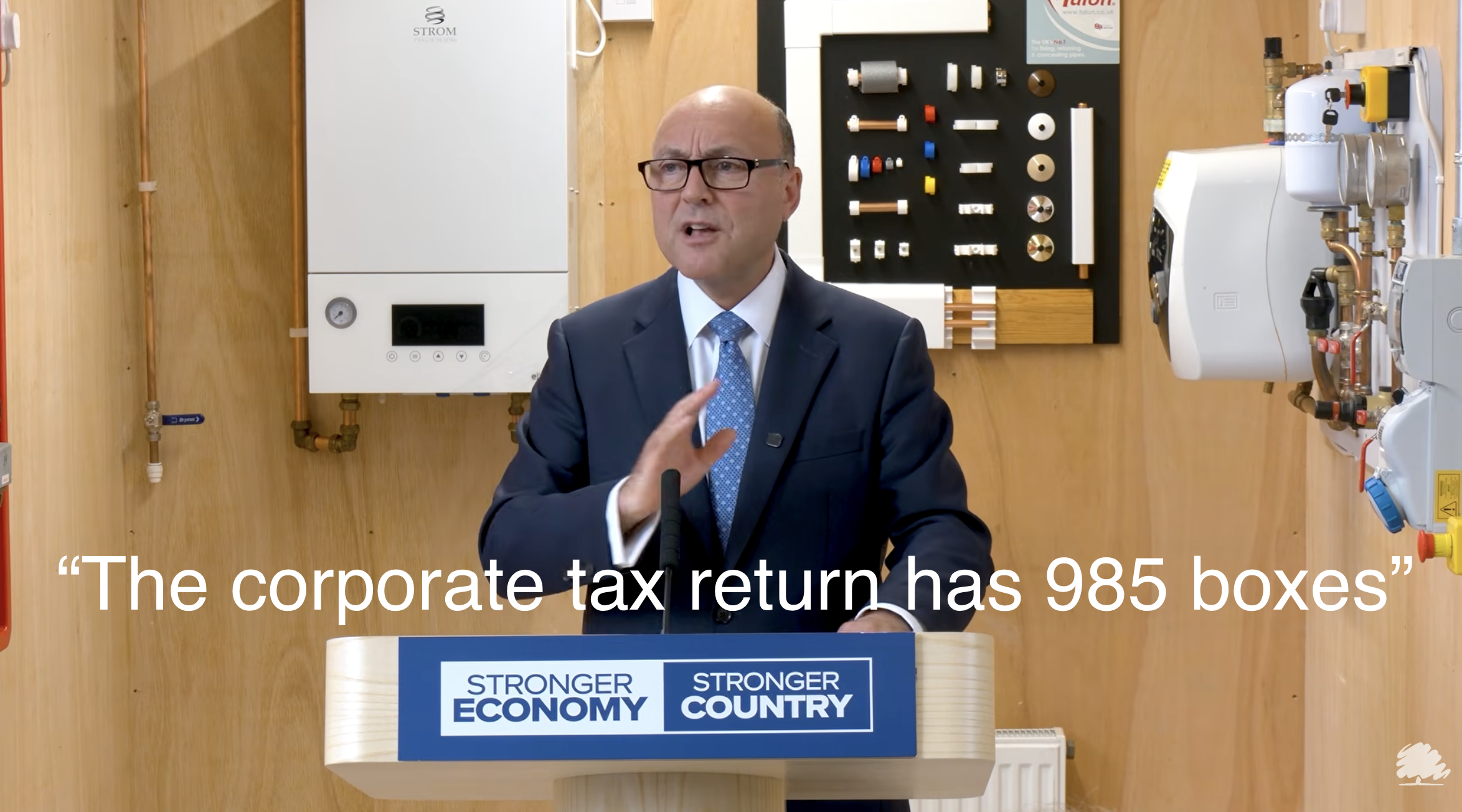
In his first major speech as Shadow Chancellor, Andrew Griffith said that the UK corporate tax return has 985 boxes. I used the same number in an article I wrote earlier in the year for the Financial Times, and so BBC Verify contacted me today to check the figure.
It’s wrong. 1
Depending on how you count it, it could be 733 or could be 1,697, but probably 908. Definitely not 985.
The difference between 985 and 908 isn’t terribly significant. Rather more important: the count has been increasing exponentially since 2015.
Where the 985 number came from
I took the 985 figure from the National Audit Office’s report on the administrative cost of the tax system, published in February 2025. Paragraph 1.13 says:
The complexity of a tax and taxpayer circumstances can increase what HMRC needs to do to check returns and address non-compliance. For example, the Corporation Tax return has 985 boxes;
I used the number without checking. That was foolish – there’s no footnote and no source, and you can see it’s wrong in approximately 15 seconds.
To do this, just go to the principal corporation tax form, CT600.
Yes, the last box is numbered 985:
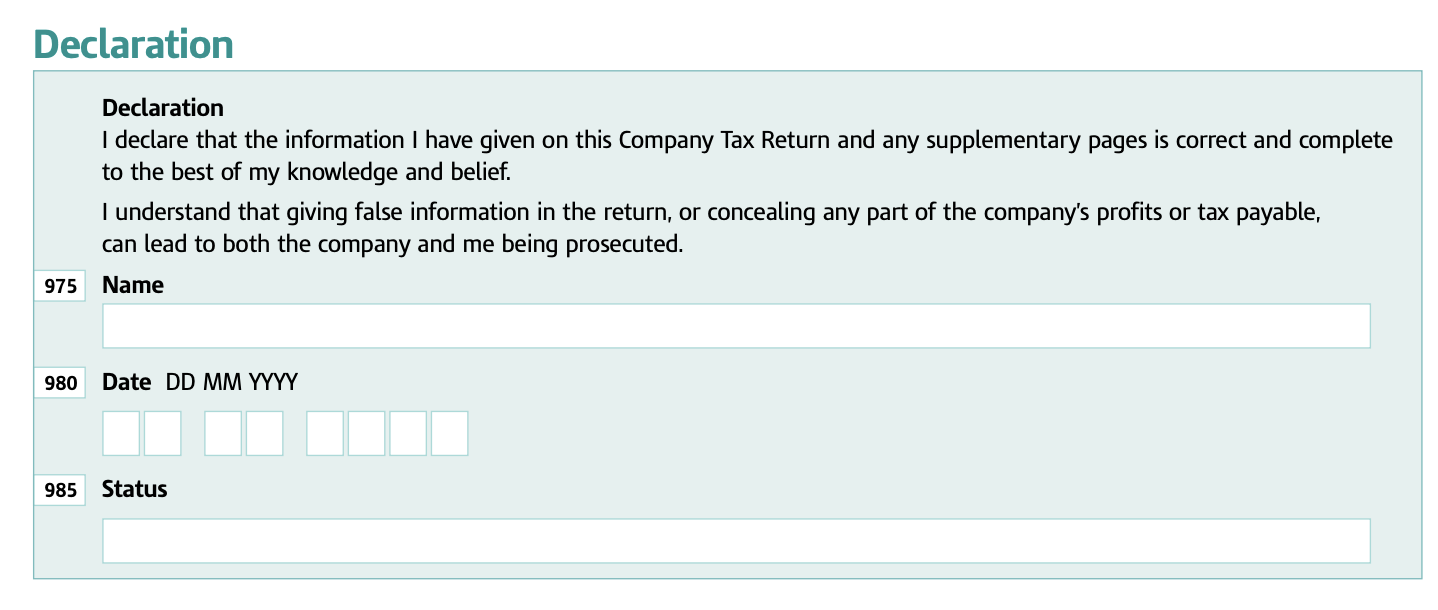
But the eye only needs to move slightly up the page to see that the previous box is numbered 980. And looking at the whole form makes the problem obvious. The boxes aren’t numbered sequentially. They run 1 to 8, then jump to 30, 35, 40, 45 and carry on mostly in fives, with odd numbers wedged into the gaps every time a new rule turns up (which is often).2
985 is just a number. It’s not a count of anything. It isn’t even the highest number (boxes 986 and 987 are hiding on page 5, for some reason).
There are not 985 boxes on CT600. My apologies to the FT and Andrew Griffith.
So how many boxes are there?
That depends on what you count.
The numbers on the form are marking rows, and the CT600 has 276 numbered rows. Each row has an entry box, apart from box 535:
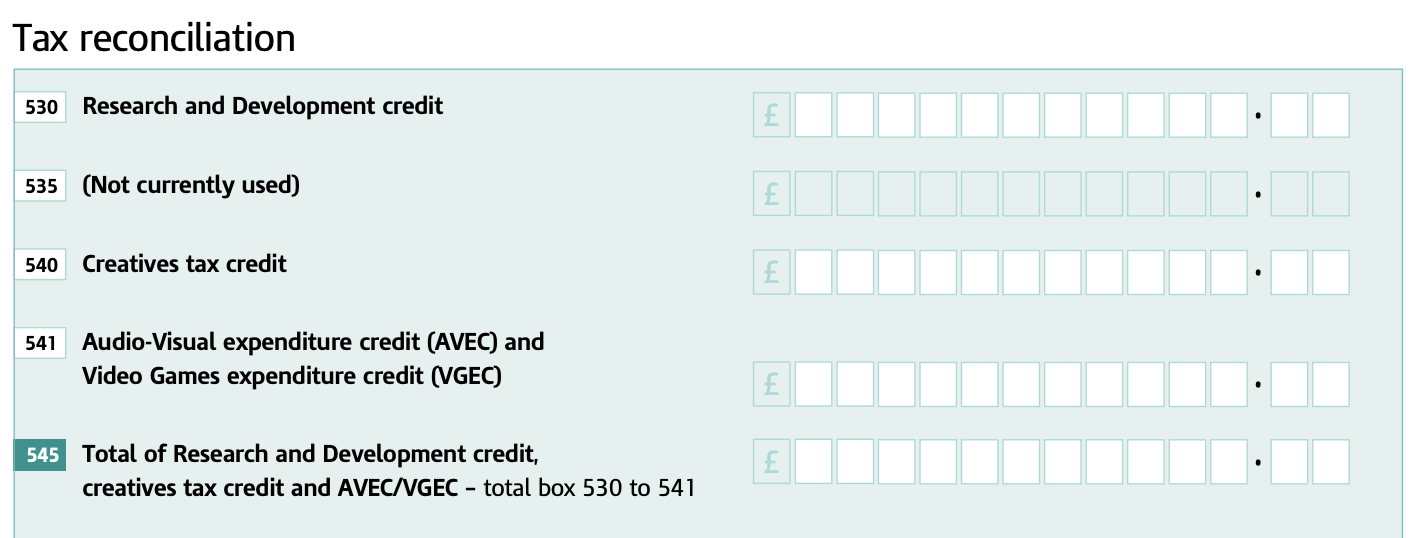
So the CT600 has 275 boxes.
But there are many supplementary forms, and some have multiple boxes on a row, e.g. on CT600B, a company with foreign subsidiaries will get to row B5, and then have to fill in ten boxes per company:

The form has a large table, with enough space for twelve companies. Most companies never complete CT600B at all. Of those that do, many will have no subsidiaries/branches claiming an exemption. Some will have lots.
So do we count this as one box, ten boxes, or 120 boxes?
I’m going to invent a rule, just to be consistent, and say the count here is ten (plus the totals at the bottom of the table).3
I used this rule to count all the boxes in CT600 and its fourteen supplementary forms. The total came to 908 boxes.
I say “I” because I went through the fun of counting the boxes myself. At the same time I asked Claude Code to do the same thing, and we mostly agreed.4
You’re free to disagree with my rule, and instead count every box in every table – then the total is 1,697.5 Or if you think we should only count the numbered rows, we get 733.6 The total number of pages is much clearer – that’s 61.
The full results are at the bottom of this page.
Has it changed over time?
Whether we measure pages or boxes, there’s a clear trend:
The form was redesigned in 2015. Since then, the number of boxes has grown at a remarkably steady rate. An exponential rate. 7.72% growth a year, or a doubling every 9.3 years.
If trends continue, there will therefore be 1,713 boxes by 2035 (which seems plausible), and one million boxes by 2120 (perhaps less plausible).7
Does this matter?
Nobody completes all the boxes. I doubt even the largest companies complete half of them.
Each supplementary page is triggered by a specific circumstance: being a closely held company that’s lent money to a shareholder, owning ships, developing residential property, claiming film relief, etc. I doubt anybody does all of this at once.8
A micro business probably completes just a few dozen boxes. And most companies file online – they only see the relevant stuff.
So “908 boxes” is not a measure of how much work any company actually has to do. It is, however, a reasonable rough-and-ready measure of how complicated the system has become. Every new box exists because there’s a new rule requiring it. And this is just corporation tax. There has been a blizzard of new taxes, each of which has its own set of forms to fill in.
A government serious about growth should look for low-hanging fruit. Corporate tax simplification is the lowest and sweetest of these fruits. It would cost almost nothing. It would make the UK more competitive. It would reduce costs for business. And it would be a sign that the Government is committed to growth.
All of which means the National Audit Office were right to cite “number of boxes” as a simple complexity metric.
And they were mostly right about the number.
The box count details
In case anyone is interested:
| Form | Description | Numbered rows | Boxes (my rule) | Boxes (all) |
|---|---|---|---|---|
| CT600 | The return itself | 276 | 275 | 275 |
| CT600A | Loans to participators | 20 | 27 | 77 |
| CT600B | Controlled foreign companies | 21 | 30 | 140 |
| CT600C | Group and consortium relief | 51 | 61 | 143 |
| CT600D | Overseas life assurance | 5 | 5 | 5 |
| CT600E | Charities and CASCs | 45 | 51 | 128 |
| CT600F | Tonnage tax | 31 | 40 | 121 |
| CT600H | Cross-border royalties | 5 | 12 | 76 |
| CT600I | Ring fence trades | 36 | 75 | 75 |
| CT600J | Avoidance scheme disclosure | 24 | 8 | 24 |
| CT600K | Restitution tax | 11 | 18 | 18 |
| CT600L | Research and development | 67 | 67 | 82 |
| CT600M | Freeports and investment zones | 10 | 19 | 140 |
| CT600N | Residential property developer tax | 61 | 80 | 229 |
| CT600P | Creative industries | 70 | 140 | 164 |
| Total | 61 pages | 733 | 908 | 1,697 |
And here’s the change over time:
| Year | Forms | Pages | Numbered rows | Boxes (my rule) | Boxes (all) |
|---|---|---|---|---|---|
| 2014 (Version 2) | 11 | 38 | 316 | 488 | 969 |
| 2015 | 10 | 31 | 380 | 401 | 762 |
| 2018 | 11 | 34 | 438 | 470 | 873 |
| 2021 | 12 | 39 | 517 | 588 | 991 |
| 2024 | 14 | 54 | 645 | 744 | 1,432 |
| 2026 | 15 | 61 | 733 | 908 | 1,697 |
Thanks to Anthony Reuben at BBC Verify, for the original question.
Claude Code was used to count boxes, after I verified that its count for 2026 was almost identical to mine. I checked ten random forms across the other years and verified Claude’s count for those was accurate. I did not verify the other counts.

How to reform corporation tax

The reality of tax complexity, and how to fix it
The UK has 90 different taxes. France has 348. Germany has 60. Why?
Why does Britain have more taxes than at any time since 1834?

90 UK taxes. On one chart.
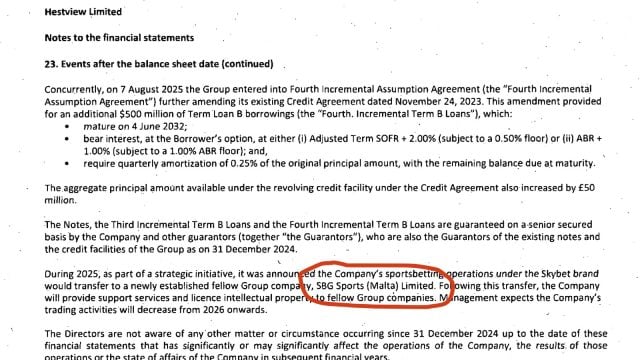
Betting on tax avoidance – is Sky Bet avoiding £55m tax per year?
Footnotes
And entirely my mistake. On the other hand, it was completely reasonable for Andrew Griffith to use it. ↩︎
The insertions are easy to spot: 141 to 144, 471 to 474, 653 to 659, 688 to 695. Sometimes there are too many changes to fit, so box 96 is printed on page 2 after box 144, because the creative industries form was added to a list that had already run out of room. ↩︎
The same thing happens all over the supplementary forms. Box M5 on the freeports form is twelve rows by six columns. The tonnage tax form has a table of ten ships by nine columns, with no number on it at all. Charities get twelve rows by seven for legacy donors. In each case I’ve counted one line’s worth of cells, plus any totals underneath, and ignored the spare rows. ↩︎
Sixteen agents for the current forms: one per form, with the main CT600 counted twice over by two agents working separately. Each looked at every page as an image, and none could see my working or each other’s. Across the whole exercise, including the older versions of the forms, it was 41 agents. Mostly we agreed: we differed on four of the fifteen forms, by between one and four boxes. ↩︎
That’s from Claude Code, not me. I didn’t check this. This may be an article about the importance of checking data, but I wasn’t going to count 1,697 boxes to verify a number I don’t suggest anyone uses. ↩︎
Again Claude Code, and again I didn’t check. ↩︎
I used an ordinary least squares fit from the redesign year and found boxes = e-143.881 + 0.074362 × year. It’s a pretty good fit – R² of 0.9902 on the log scale, every residual inside ±4%. I don’t suggest taking these numbers very seriously. I do suggest taking the overall growth very seriously. ↩︎
If you do, please get in touch. ↩︎


Leave a Reply