
For the third Budget in a row, everyone’s talking about capital gains tax. The Chancellor, John Healey, says he won’t give “any answers or signals that will fuel Budget speculation”, but in the same Sunday Times interview noted that the UK has the “lowest capital gains tax (CGT) of any European G7 nation”.
To understand where we now are, we have to recognise several apparently paradoxical things. UK capital gains tax is anomalous domestically and in international terms – but not because the rate is low. Recent budgets greatly raised capital gains tax revenues – but this was a policy failure. And the consequence of that failure is that, whilst capital gains tax reform would have been the right thing to do – it’s now dead.1
1. The UK has the lowest CGT of any European G7 country
When Mr Healey said the UK has the lowest CGT of any European G7 nation, he made a very specific and narrow claim, but he was correct.
This chart compares the top marginal rates on gains from long-held private company shares across the OECD, with the UK in red and the G7 in bold.2
The UK’s 24% is below France, Germany and Italy. It isn’t exceptionally low across the OECD as a whole. The international picture depends heavily on what kind of shareholder we’re comparing.3
2. The UK has a large gap between CGT and tax on dividends
The most important capital gains tax comparison isn’t between countries at all. It’s a comparison within each country: how does the rate of CGT compare to the rate of income tax on dividends?
That’s important because, for someone who owns their own company, or is a large shareholder in a company, whether to take value out as dividends or as a capital gain is a choice.
In the UK, it can be a very rewarding choice. Pay yourself a dividend, and you pay income tax at up to 39.35%. Sell the company, and you pay CGT at 24%.4 This is a choice people absolutely take – research by Helen Miller, Thomas Pope and Kate Smith used tax records to show that UK owner-managers systematically hold profits in their companies for years so they can eventually take them as capital gains.5
This chart compares the tax on dividends with the tax on gains. The tail of each arrow is the dividend rate; the arrowhead is the CGT rate. Again, the UK is in red and the G7 are in bold.6
The size of the arrow tells us the potential for arbitrage. This is why Nigel Lawson equalised the rates back in 1988. As he told the House of Commons: “Taxing them at different rates distorts investment decisions and inevitably creates a major tax avoidance industry.”7
There are two things to notice about the UK. We hear a lot about one of them and much less about the other.
- The thing we hear about: the UK has a large gap between CGT and dividend tax. France taxes both at 35.4%, Italy at 26% and Spain at 30%. Germany’s substantial-shareholder CGT rate is about 28.5%, against 26.4% on dividends. The US, Norway and Denmark also have little or no gap on the bases shown. The UK’s 15 point gap is large beside those countries, although Japan’s gap is larger still.8
- The thing we hear less often: the UK also has a high dividend tax rate. In this comparison, Ireland, Japan, Korea and Denmark are higher; Canada is almost identical.
The October 2024 rate rise cut the UK’s gap from 19 points to 15. That still creates a substantial incentive to shift income into capital gains, an incentive that France, Germany, Italy and the US largely avoid on these comparisons.
The gap is partly a result of our high dividend tax rate – but politically it seems most unlikely we’re going to cut that.
Equalising rates by increasing CGT to 39.35% would give us one of the higher rates in the developed world.
3. The UK has a typical gap between CGT and tax on employment income
As a tax lawyer, I focus on the comparison with dividends, because it’s a straightforward opportunity to turn income into gains. Most people making the political argument are comparing CGT with wages. It strikes many as unfair that £1 of gains is taxed at 24% when £1 of salary can be taxed at 47%. Here’s the comparison with employment income, including employee national insurance or social security.9
Most countries in the chart tax wages more heavily than gains. The UK’s gap is substantial, but it’s far from unique. Belgium, for example, taxes wages at around 60%, against a new CGT rate of up to 10% on ordinary investment gains.
Taking UK CGT all the way to 47% would put it near the top of this comparison. That doesn’t settle the argument. It does mean we should be careful about raising the rate while keeping everything else as it is.
4. We should reform CGT
The paradoxical reality is that the rate of capital gains tax in the UK is too high and too low. We can demonstrate that with three examples:
- Alexander is hired as a chief executive. The company allocates £2m to pay him a bonus. After employer’s national insurance of about £260,000 is taken off, Alexander stands to get just under £1.8m. Then he pays income tax and national insurance, leaving him with about £900k, and a total tax bill of about £1m. We can say this was the “correct” amount of tax.
- Belinda is also a chief executive, but of a company she founded. She eventually sells it for £2m and pays capital gains tax (CGT) at 24 per cent: total tax of under £500k. Belinda’s rate of tax was too low.10
- Carter invested £4 million in a company ten years ago and sells his stake for £6m. He has a £2m gain and pays CGT of just under £500k, the same as Belinda. But £1.6m of Carter’s “gain” was just inflation. His real gain is £400,000. That £500k of CGT represented an effective rate of 120 per cent. Carter’s rate of tax was much too high.
We and many others have proposed reforming CGT: equalising rates to match the rate on dividends, but giving an allowance for either inflation or (better) the “normal” (risk-free) return on investment.
Any reform would need to go further to prevent avoidance. We’d need to stop accumulated gains being wiped out at death: so instead, the heir would inherit the original cost and pay CGT when they eventually sell. Someone building up a gain in the UK and then disposing after they leave the UK, should pay UK tax on their UK gain (with credit for foreign taxes): an exit tax (with deferral).11
CenTax estimated this kind of reform would raise about £11bn a year once established. Its modelling also found that 51% of the people who paid CGT in 2020 would have paid less.1213
CGT reform has now built significant momentum. The Chancellor is pointing to Britain’s low CGT rate, senior Labour figures (including Louise Haigh, and Wes Streeting) have backed rate alignment, and the Institute for Government is urging a substantial reform in this Budget.14 And Australia has just announced something very similar. The timing looks right for reform.
But the timing is in fact very wrong, because of the actions of the last Government.
5. CGT reform is dead
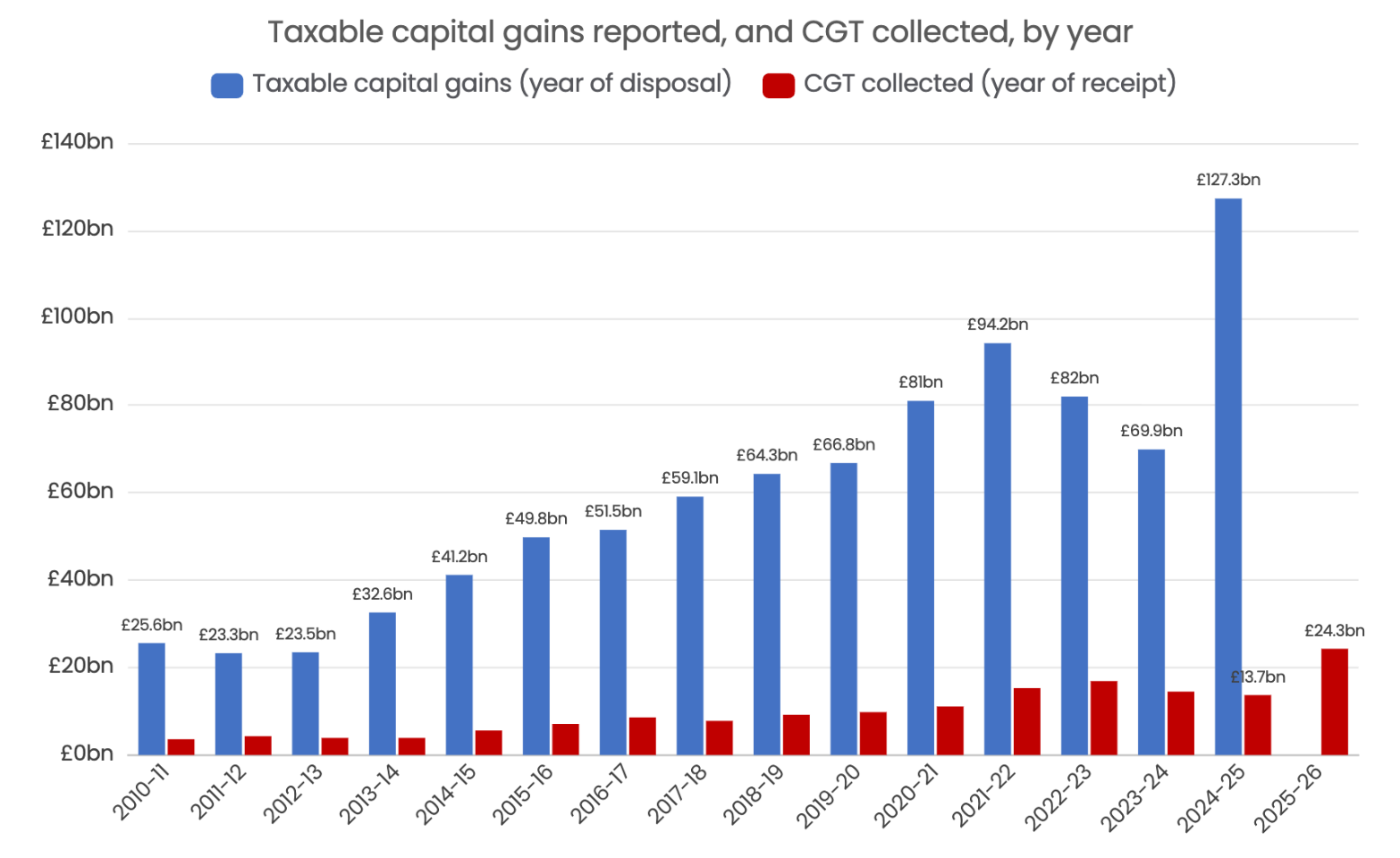
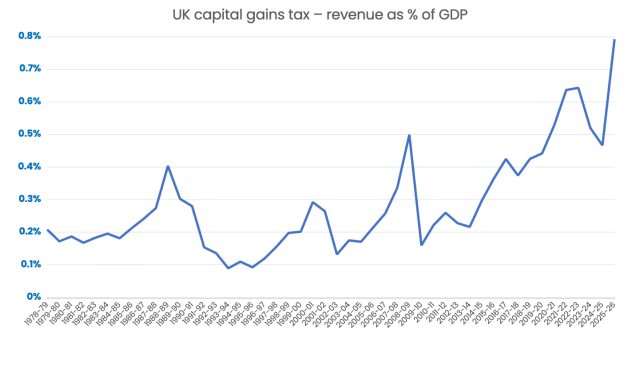
Contrary to what some have said,15 recent UK capital gains tax data looks like a triumph. Tax year 2024/25 saw record taxable gains of £127bn – 82% above the previous year, and a third above the previous peak in 2021-22, a year when asset prices had surged after the pandemic:16
That big increase in disposals in 2024/25 was driven by the October 2024 Budget, or rather by expectations of that Budget. Months of rumours of CGT increases caused people sitting on unrealised gains to sell and beat the increase – and this effect was concentrated among the largest gains.17
The actual tax increase turned out to be smaller than many expected, but the rush of people selling was much, much larger. Check out the size of the 2025/26 red receipts bar compared to 2024/25.
The OBR expected a £2bn increase in receipts.18 The actual increase was much higher, potentially £6bn (note that most CGT is collected the year after the asset is sold).19
We don’t have precise figures here, but our estimate is that about £45bn of gains were brought forward.20
So expectations of a rate rise appear to have raised a great deal of tax.21
But not really. These were mostly22 gains that would otherwise have been realised over the next few years, and taxed at 24%.23 Instead they were realised in a rush and taxed at 20%.
That’s a policy failure, which cost somewhere between £1.4bn and £2.4bn.24 Pre-Budget rumours turn out to be expensive.
It’s worse than that, because we should expect the same thing happened before the November 2025 Budget, and the same thing is happening now. We can’t measure these effects – the tax on 2025-26 share disposals is paid in January 2027, and HMRC’s figures for the year won’t be published until August 2027. But there’s anecdotal and hard evidence that they are real.25
If the 2025 and 2026 rushes are anything like the 2024 one, then something in the region of £100bn to £165bn of gains that a reformed CGT could have taxed may already have been taxed at the old rates.
One might expect each rush to be smaller than the last, since every sale depletes the pool of historic gains available to crystallise. I’m not sure that’s right. About half of all taxable gains come from unlisted shares in private companies.26 Selling a private company is slow – in a relatively simple case six to twelve months from preparation to completion. The 2024 CGT rumours began in earnest after the July election, under four months before the Budget. That was enough time to sell listed shares, liquidate a company or rush through a sale that was already under way, and the figures suggest a lot of people did that. It wasn’t enough time for most owners of private companies to start and finish a sale. But those owners have had two years since. The 2025 Budget speculation was, if anything, more hysterical than the previous year’s. The November 2025 Budget’s cut in relief for sales to employee ownership trusts, with immediate effect, will have taught anyone still waiting that waiting is expensive.
These are our estimates, based on the published figures and the assumptions explained below. There is considerable uncertainty, and the 2025 and 2026 estimates are judgment calls. But we can be reasonably confident that many of the disposals/gains that an increased CGT rate would expect to tax have already happened.
CenTax estimated that its proposed reform would raise about £11bn a year – that’s the steady-state position, and early revenues would be lower. If there really were £100bn to £165bn of forestalled gains then the position in the early years would be much worse, with a total (i.e. not annual) revenue loss of £11bn to £18bn.27
There are further problems, which are serious but harder to quantify:
- The last two Budgets have left many businesspeople and investors feeling that the tax system has taken a decisive turn against them. Whether that’s fair is beside the point; the feeling is real and it’s widespread. The Institute of Directors’ confidence index fell to -65 after the 2024 Budget, close to its pandemic low, and stood at -73 before the 2025 Budget, with 80% of directors viewing that Budget negatively.28 I can personally attest to how widespread the view is. My judgment is that, even if it raised revenue, CGT reform at this moment would be damaging.
- We are now mid-Parliament. The next election must be held by August 2029 – someone sitting on a large gain could rationally29 hold out for two/three years in the hope/expectation that a new government would cut the rate.30 This was a much smaller risk in the first year of a Government with a large majority.313233
- Reform isn’t simply a tax increase. With an allowance for the normal return, many portfolio investors and landlords would pay about the same, or less. The increase falls on gains with little or no base cost: founders, private equity, and owner-managers liquidating their companies.34 Those are exactly the people with the most to gain from waiting for a future government to reverse the change – and so any deferral effect will have an outsized impact on revenues.
In my judgment, these issues together create a serious risk that CGT reform35 would raise very little in its first few years, and could initially cost money.36
CGT reform is dead.
Conclusion
CGT reform could and should have been the centre of the first Budget of the Parliament. A higher CGT rate, a generous investment allowance and properly designed relief for entrepreneurs would have improved our tax system; it would also have raised a significant amount of tax, reducing the need for the damaging increase in employer’s national insurance.37
The 2024 Budget wasn’t just, as we said at the time, a missed opportunity. Together with the 2025 Budget, it has ended the prospect of CGT reform in this Parliament.
There may be a time when reform is again viable. That will need several years of stability in the tax system – rebuilding the stock of gains and (more importantly) rebuilding trust in Government tax policy. CGT reform needs to be seen as part of a coherent package of tax reform, not a desperate grab for cash.
I’ll be writing shortly about what tax reform might look like.
But right now, the best thing the Chancellor can do for CGT policy is to say that there will be no changes to CGT for the rest of this Parliament, and mean it.
Thanks to T and B for their input and L for review. Thanks to the OECD and PwC for the data they make freely available, and to the local counsel who gave us their time.
Footnotes
I should cover myself by saying this is not a prediction. My view is that the shrunk CGT base and passage of time means that it would be a mistake to increase or reform capital gains tax now. I am, however, not a political commentator, and my track-record of prediction is not good. ↩︎
The chart compares resident individual owners of unlisted ordinary shares, using long-term holding reliefs where available. We’re looking at substantial individual shareholders, because they’re the people who can choose between dividends and selling their company. Rates include relevant personal surtaxes and compulsory charges, with representative local rates where these vary. It’s the top marginal rate, not effective rates. We used OECD materials, updated with PwC’s worldwide tax summaries and discussions with local tax advisers. Mexico and Chile use their unlisted-share rates of 35% and 40%; Korea uses the 27.5% major-shareholder rate; the Netherlands uses the 31% box 2 rate. The US uses the OECD’s representative federal/state basis, Canada includes Ontario, and Japan includes local inhabitant tax. Australia’s 23.5% reflects the 50% discount for assets held over a year. There are then many, many special rules. Germany taxes 60% of a substantial shareholder’s gain (and has church tax!). Luxembourg’s substantial-shareholding regime reaches 22.89%, plus a 1.4% care contribution = 24.29%. Slovakia has a listed-share exemption. Latvia has a 3% surcharge above €200,000. Poland has a 4% solidarity levy. Lithuania has a 15% rate for shares held over five years – from 2026, other gains are taxed at up to 32%. All these are resident-taxpayer comparisons; non-resident rules differ. Property-related gains often have separate rules (with non-residents often taxed). ↩︎
The simple unweighted average of the rates shown is about 24%, but that mixes very different tax bases and reliefs, so it isn’t a useful target for UK policy. Much of this article updates our February 2024 comparison. Since then, the UK has raised its main CGT rate from 20% to 24%, France’s rate has reached 38.6%, Spain’s 30%, and Belgium has introduced a 10% tax on financial gains from January 2026. Belgium previously exempted many ordinary private investment gains, with exceptions. The new tax is gentle: pre-2026 gains are excluded, there is a €10,000 annual exemption, and qualifying owners of at least 20% of a company have a €1m exemption followed by graduated rates. ↩︎
18% for basic rate taxpayers. Business Asset Disposal Relief (the successor to entrepreneurs’ relief) no longer changes this picture much: the once-generous 10% rate reached 18% in April 2026, against a 24% main rate, still with a £1m lifetime limit. ↩︎
Miller, Pope and Smith, “Intertemporal income shifting and the taxation of business owner-managers”, Review of Economics and Statistics (2024). And note that the paper finds no evidence that the retained profits result in more business investment. There’s an accessible IFS version. ↩︎
Dividend rates start with the OECD tax database, Table II.4, 2026 (Israel: latest observation, 2025). These are personal rates, allowing for imputation credits; corporation tax paid before distribution is excluded. Colombia has no OECD observation and is omitted. Finland is also omitted from this dividend comparison: its unlisted dividends split between capital and earned income according to company net assets, so the OECD headline 34% isn’t a comparable dividend rate. Czechia uses the 15% domestic dividend rate. Japan uses aggregate taxation for unlisted dividends, rather than the separate rate available on listed portfolio dividends: 49.44% at the top after the national and local dividend credits. We adjust Sweden for the peak qualified-shareholder band, Luxembourg for solidarity and care contributions (23.59% on qualifying dividends), and Latvia for its high-income surcharge (9% under the optional 6% dividend regime). Under Latvia’s ordinary regime, dividends generally exempt from personal income tax can still face the 3% surcharge above €200,000. Estonia taxes distributions at company level and generally exempts them in the shareholder’s hands. Israel’s 35% includes the 30% substantial-shareholder rate and both high-income surtaxes. Differences from the 2024 charts include changes in comparison basis as well as changes in law. ↩︎
It’s often forgotten that Lawson didn’t just raise the rate. The same Budget took all pre-1982 gains out of tax (after a period of extremely high inflation). ↩︎
The US federal top rates on qualified dividends and long-term gains are both 20%, plus the 3.8% net investment income tax. Leaving aside zero-rate cases, Belgium, Ireland, Japan and Korea have larger gaps favouring gains than the UK. Zeroes in this chart are exemptions for qualifying disposals, not an absence of CGT on all assets: Czechia, New Zealand, Slovenia, Switzerland and Türkiye. Holding periods, business activity and company type matter. Slovenia requires a holding of more than 15 years; Türkiye’s exemption for long-held share certificates doesn’t cover every form of private company. Luxembourg and Slovakia have portfolio exemptions which don’t extend to the private company owner we’re comparing here. ↩︎
Employment rates start with OECD Table I.7, 2025: national and sub-national income tax plus employee social contributions. The UK figure is for England, Wales and Northern Ireland; Scotland’s top rate is higher. Estonia’s published 10.27% observation is unsuitable for this top-rate comparison: we use 22% income tax and 1.6% employee unemployment insurance, with the contribution deductible, giving 23.25%. Optional funded pension contributions are excluded. Latvia is omitted because its 2025 OECD observation is invalid. Slovakia is updated for its 2026 rates: 35% income tax and 14.4% deductible employee contributions at the top-band threshold, giving 44.36%. Sweden uses the 2026 municipal average, giving 52.38%. Other employment figures remain 2025 observations. Employer contributions are excluded: in the long run much of their burden falls on wages, but including them requires changing both the numerator and denominator of the comparison. The OBR assumes that 76% of the employer NIC increase is eventually passed through to employees. ↩︎
Let’s assume she’s ineligible for BADR or has exhausted her allowance. ↩︎
These are features of the IFS reform analysis and the CenTax package. CenTax’s model uses a £1m threshold for the exit charge. Carry-over at death defers the gain until the heir sells; it doesn’t create an immediate CGT bill on death. CenTax propose a CGT deduction reflecting any inheritance tax paid. ↩︎
The August 2025 technical note estimates £11.3bn from CGT, or £11.8bn including carried interest. It updates the October 2024 modelling for the subsequent Budget changes and March 2025 OBR forecast. The original modelling is a medium-term estimate, roughly five years after reform, allowing for behavioural responses. CenTax propose a rate of 45%, which we don’t think is viable. The rate logically should not be higher than the top dividend rate of 39.35%, or people will simply extract dividends. ↩︎
There are other simple estimates around which look at the increase in capital gains tax alone, and conclude they would lose money. My view is these estimates are worthless and should be regarded as lobbying, not analysis. They extrapolate HMRC illustrations which HMRC expressly warns cannot be scaled, and make no attempt to assess the effect of the other elements of reform. IG’s June 2026 release derives its claim from HMRC’s illustrative tax changes bulletin. HMRC says CGT responses are highly nonlinear and the estimates cannot be scaled to other rate changes. ↩︎
Tax Policy Associates was a co-signatory of last year’s “Tax Reforms for Growth” which brought together organisations from the Adam Smith Institute to the New Economics Foundation. They didn’t agree on raising a particular sum or setting a particular rate, but agreed on an investment allowance, carry-over at death and the exit charge. So it would be wrong to say this document indicates support for CGT reform of the kind that, e.g. Mr Streeting backed. It would be reasonable to assume, for example, that the ASI would want to bring income tax towards the current CGT rate, rather than increase CGT. ↩︎
Media reports often look at the year of receipts, forgetting that receipts very significantly lag disposals. This results in headlines that are simply wrong: “Capital gains tax receipts fall 10% as wealthy exit UK” said The Times in April 2025; “Reeves’s capital gains tax changes ‘backfire’ as Treasury receipts fall sharply”, said MoneyWeek in July 2025. These headlines blamed the Labour government for a fall in CGT tax receipts when most of the disposals in question happened during the previous government. ↩︎
The chart shows HMRC’s figures for total taxable gains in each tax year of disposal, from Table 1 of its capital gains tax statistics (August 2026), covering individuals and trusts. HMRC compiles the figures from self assessment and UK property returns that report a CGT liability, so gains wholly covered by losses, reliefs or the annual exempt amount don’t appear. The gains are measured after reliefs available at disposal and after in-year losses, but before the annual exempt amount. The figures for 2022-23 onwards are provisional. ↩︎
Compared with the average of the previous three years, about 70% of the extra gains in 2024-25 came from people with gains of £1m or more, and nearly half from people with gains of £5m or more (HMRC CGT statistics, Table 2). Gains qualifying for Business Asset Disposal Relief were £18.4bn, £6.3bn above that average (Table 4), and carried interest gains were £5.4bn, £1.3bn above it (Table 9). ↩︎
Paragraph 4.28 of the OBR’s October 2024 Economic and fiscal outlook: “The first part of 2024-25 has seen evidence of forestalling – bringing forward the disposal of assets in advance of the possibility of CGT increases at the Budget. We have assumed that this will increase CGT revenues by £2.0 billion in 2025-26 (most 2024-25 gains will be paid through self-assessment in 2025-26), with an offsetting reduction in future years.” The OBR based that on the smaller rush seen before the March 2021 Budget, after the Office of Tax Simplification recommended aligning CGT and income tax rates. By March 2026 (paragraph 3.25) it was attributing the surplus in 2025-26 receipts “largely” to “higher-than-expected forestalling which we expect to unwind from 2026-27 onwards”. Its November 2025 forecast (paragraph 4.33) also notes that Companies House data on members’ voluntary liquidations, which are how many owners extract value from a company at capital gains rates, “indicates an increase in liquidations ahead of Autumn Budget 2024 and April 2025”, when the BADR rate first rose. ↩︎
HMRC’s own commentary says that speculation about rate rises ahead of the Budget contributed to the increase, as did the pre-announced rises in the rate for Business Asset Disposal Relief. ↩︎
Comparing 2024-25 with the years before it suggests that something like £45bn to £57bn of gains were brought forward. Working back from the tax that arrived in January 2026 gives a lower figure, £35bn to £40bn. We’ll use £35bn to £55bn, and around £45bn as a central estimate. We have two methods for this. First, from the gains: HMRC reports £127.3bn of taxable gains in 2024-25, against £69.9bn in 2023-24 and an average of £81.7bn over the four years 2020-21 to 2023-24. That gives an excess of £45bn to £57bn. About £3bn of it is residential property, where gains rose from £9.6bn to £12.9bn (HMRC Table 8a) – the rates on residential property didn’t change in October 2024 but many people thought they would. Second, from the receipts: CGT receipts in 2025-26 were £24.3bn, against the OBR’s March 2025 forecast of £19.7bn, which already included £2bn of forestalled tax. If (as seems likely) the surplus was largely forestalling, that’s about £6.6bn of tax on forestalled gains. BADR gains rose from £11.1bn in 2023-24 to £18.5bn in 2024-25 (HMRC Table 4), so £7.4bn of the excess was taxed at 10%; the rest at 20% implies about £30bn more, so £35bn to £40bn in total. Both are approximate, and everything is affected by asset prices, the cut in the annual exempt amount to £3,000, ordinary year-to-year variation, and the fact the 2024-25 figures are provisional. ↩︎
These are well known effects. Alan Auerbach’s 1988 paper concluded that “the expected change in rates, rather than the level of rates, may be the important factor governing realizations”. The later theoretical analysis by Hines and Schaffa, published in Economics Letters in 2024, also explains how anticipated future changes can affect current sales. Its conclusion is qualified: higher current rates can encourage or discourage realisations, depending on expectations. ↩︎
i.e. Because some of the assets would instead have been held until death, when they’d have escaped CGT altogether. That could be because their portfolio assets, which the holder simply wouldn’t have sold, or it could be because they are large private shareholdings, which the owner would have sold but died unexpectedly. Either way, that means that just counting the accelerated gains gives us the top of the range of future gains that would have been made but now will not be. ↩︎
Or, for business owners, at the new 18% BADR rate, instead of the old 10% rate ↩︎
Roughly £28bn to £48bn of non-BADR gains were brought forward and taxed at 20% rather than 24%, which is £1.1bn to £1.9bn. Roughly £7bn of BADR gains were taxed at 10% rather than the 14% that applied in 2025-26 or the 18% that applies now, which is £0.3bn to £0.6bn. The residential property gains then reduce the estimate by £120m. ↩︎
The OBR saw a second wave of liquidations ahead of the April 2025 BADR rate rise. A January 2026 survey for Brown Shipley found 35% of entrepreneurs planning to accelerate profit extraction ahead of the April 2026 dividend tax rise, and advisers report clients “accelerating disposals to lock in current rates” ahead of this Budget. My own experience, from discussions with advisers, investors and business owners over the past two years, is the same. ↩︎
£33bn of £70bn in 2023-24 on HMRC’s asset-type figures (Table 7.2), and the IFS puts it at around half. ↩︎
This is our estimate, built on CenTax’s approach. CenTax’s August 2025 technical note estimates £11.3bn a year from the CGT package (£11.8bn including carried interest), after behavioural responses, on a 2026-27 tax base that it uprates to the OBR’s March 2025 forecast of CGT receipts for that year, £19.4bn (Economic and fiscal outlook, March 2025, Table A.5). CGT liabilities have been between 18%-19% of reported gains in recent years (see Table 1 of HMRC’s CGT statistics), which puts the 2026-27 base at roughly £100bn of gains and the package’s yield at about 11p per £ of gain (on average). 11p x (£100bn to £165bn) of forestalled gains gives £11bn to £18bn. This estimate assumes that all of the forestalled gains would otherwise have been realised and taxed under the reform; some would have been held until death or emigration, which the reform package also taxes, and some would have been deferred further, so it’s an over-estimate in that respect. CenTax’s August 2025 update did take account of forestalling, but used the OBR’s March 2025 assumption of £2bn of forestalled receipts, which we now know was far too low. ↩︎
The IoD’s Directors’ Economic Confidence Index fell to -65 in November 2024, from -52 in October; its record low was -69 in April 2020. In November 2025 it was -73 before the Budget and -72 in a snap poll immediately after, with directors’ confidence in their own organisations at -20, the second lowest reading on record. Survey evidence on emigration is weaker, because stated intentions run far ahead of behaviour: a Censuswide survey for Evelyn Partners of 500 owners of £5m+ businesses in September 2024 found 48% would “consider” moving abroad if the Budget was unfavourable. CenTax’s Companies House analysis shows business owners do emigrate before selling, although it predates the 2024 Budget. ↩︎
Would it be rational to hold out? There’s the chance of an upside – you’d be waiting three years in the hope of the rate dropping back from 39.35% to 24% – that’s worth 15% of the sale price. What’s the downside? You may not be able to find a buyer in 3 years’ time. You may really want the money now. You may be planning a retirement. It’s hard to put a figure on these things, so, not really possible to say something like “if you think there’s a 50% chance CGT reform will be reversed in three years then you should hold on”. And an important overlay is that people often, in my experience, don’t act rationally when they see the prospect of saving tax – they sometimes jump at the chance, regardless of wider costs (and sometimes regardless of the risk). ↩︎
Reversal would be easy: a new government could cut the rate, keep the allowance and give CGT payers a tax cut. ↩︎
Canada shows how fragile a late CGT rise can be. In April 2024, a government well into its term announced an increase in the proportion of gains subject to tax. The opposition promised to reverse it. In January 2025 the government deferred it; in March, a new Prime Minister cancelled it. Canada’s Parliamentary Budget Officer flagged the political uncertainty when costing the measure. ↩︎
Arun Advani, Andrew Lonsdale and Andy Summers made the same point in the CenTax paper that produced the original revenue estimates. They accepted that people might defer selling in the hope that a future government would cut the tax, but called this “a risky strategy, especially in the first year of a new government”. The evidence that expectations drive the timing of disposals is strong: the 2024-25 rush, the US experience in 1986 and 2012, and the OBR’s own costing. The evidence on how much deferral an election two to three years away would cause is thin. No study links CGT revenue to the electoral cycle, and no opposition party has promised to reverse a rise that hasn’t yet happened. ↩︎
The IFS Green Budget chapter, published just before the 2024 Budget, made this very point: “reforms introduced during the first year of a new government with a big majority can perhaps be expected to be more durable than if done shortly before a closely contested election”. ↩︎
In 2023-24, gains on unlisted shares were 68% of sale proceeds, against 19% for listed shares and 27% for residential property (HMRC CGT statistics, Table 7). And – obviously – the lower the base cost, the less an allowance is worth. We can’t put figures on the consequence without knowing precisely how a normal return allowance would work and the degree to which it would be retrospective (it really should be – but might not be!). But roughly speaking, we’d expect a tax cut for owners of residential property, somewhere between a tax cut and an increase for holders of listed shares, and a tax increase for holders of unlisted shares. ↩︎
An additional point: I think that CenTax’s proposal to raise to 45% is not viable. It makes more sense to equalise at 39.35%, but that on its own will reduce revenue by around 20% – see page 25 and Table A2. ↩︎
The shrinkage in the CGT base doesn’t itself mean that CenTax’s proposal loses money. By definition, raising the rate will always make money for a given base. But the sentiment and deferral effects would, I think, be significantly worsened if CGT reform were implemented now, and that’s where there’s the potential for reform to reduce CGT revenue. ↩︎
It couldn’t credibly have replaced the whole increase. The employer NIC increase was originally forecast to raise around £25bn a year. CenTax’s original £14bn CGT estimate, and its revised £11.3bn estimate, are substantially smaller (and medium term). ↩︎

Will Labour tax your house sale? Why CGT on homes makes no sense
The UK tax calculator that shows you what you’re really paying
Banks say they’re overtaxed. The TUC says they’re undertaxed. Who’s right?
A £2.6bn lobbyist fairytale: economic consultancy Cebr sold VAT-free shopping as a tax cut that pays for itself

37 ways Andy Burnham could raise £4.7bn


Leave a Reply