Tax in the UK is on course to be the highest since 1945. That’s been well publicised – but another trend has been largely missed: the number of taxes in the UK is at its highest since the end of the Napoleonic Wars.
Back then, the Government was fighting France and building the modern state. Afterwards, and over the 20th Century, the number of taxes fell, as the size of the state increased. But that changed thirty years ago. There was a sudden explosion in the number of taxes, and it’s kept going. Taxes didn’t rise during most of that period – so what happened? And why do we have so many taxes?
We first published this article in May 2026, and updated it in November 2026. The UK now has more taxes than at any time since 1831 (we previously said 1834).1
The data
This chart shows all the UK taxes we could identify since William the Conqueror.
Chart: Number of UK taxes over timeData: 1,027 rows, 8 columns (X, Employment taxes, Goods/services, Business, Land, Wealth, Environment & energy, Other).The first 20 of 1,027 rows are shown below.Download the chart data (CSV)
X
Employment taxes
Goods/services
Business
Land
Wealth
Environment & energy
Other
1000
2
1001
2
1002
2
1003
2
1004
2
1005
2
1006
2
1007
2
1008
2
1
1009
2
1
1010
2
1
1011
2
1
1012
2
1
1013
2
1
1014
2
1
1015
2
1
1016
2
1
1017
2
1
1018
2
1
1019
2
1
The next chart shows every individual tax. The horizontal lines each represent the lifetime of individual taxes, and if you tap on them or hover, you’ll see the details of each tax:
Duty for redemption of captives of Mediterranean pirates
Goods/services
1643-01-01
1660-12-31
Salt excise
Goods/services
1643-01-01
1660-12-31
Gold and silver wire excise
Goods/services
1643-01-01
1826-12-31
Beer duty
Goods/services
1643-01-01
2027-01-01
Tobacco duty
Goods/services
1643-01-01
2027-01-01
Excise on flesh and victuals
Goods/services
1644-01-01
1647-12-31
Excise on alum
Goods/services
1644-01-01
1660-12-31
Excise on copperas
Goods/services
1644-01-01
1660-12-31
Excise on Monmouth caps and hats
Goods/services
1644-01-01
1660-12-31
Excise on saffron
Goods/services
1644-01-01
1660-12-31
Excise on silks and stuffs
Goods/services
1644-01-01
1660-12-31
Duty on copper and other metal wire/material
Goods/services
1647-01-01
1660-12-31
Duty on iron
Goods/services
1647-01-01
1660-12-31
Duty on lead
Goods/services
1647-01-01
1660-12-31
Duty on linseed, whale, blubber, rape, pilchard and other oils
Goods/services
1647-01-01
1660-12-31
Duty on metheglin and mead
Goods/services
1647-01-01
1660-12-31
Duty on tin
Goods/services
1647-01-01
1660-12-31
Excise on drugs
Goods/services
1647-01-01
1660-12-31
Excise on dyed silk
Goods/services
1647-01-01
1660-12-31
Excise on raw silk, rosin, pitch, wax, tallow and cordage
Goods/services
1647-01-01
1660-12-31
Excise on silk lace/ribbons and gold/silver lace/ribbons
Goods/services
1647-01-01
1660-12-31
Excise on woollen cloth and stuffs
Goods/services
1647-01-01
1660-12-31
Poll taxes under Charles II
Other
1660-01-01
1685-12-31
Vinegar duty
Goods/services
1660-01-01
1880-12-31
Raisins duty
Goods/services
1660-01-01
1885-12-31
Tea duty
Goods/services
1660-01-01
1929-12-31
Coffee duty
Goods/services
1660-01-01
1962-04-10
Wine seller licences
Goods/services
1660-01-01
1967-10-01
Spirits duty
Goods/services
1660-01-01
2027-01-01
Hearth-money
Land
1662-01-01
1689-12-31
Special tax on bankers, personal estates, offices, land and mines
Business
1670-01-01
1670-12-31
Law proceedings stamp duty
Goods/services
1670-01-01
1824-12-31
Special duties on French and East India linen, silks and brandy
Goods/services
1685-01-01
1690-12-31
Special duties on tobacco and sugar
Goods/services
1685-01-01
1693-12-31
Sugar duty
Goods/services
1685-01-01
1693-12-31
Special duties on wine and vinegar
Goods/services
1685-01-01
1787-12-31
Single poll
Other
1689-01-01
1689-12-31
Review of 1689 poll and additional poll
Other
1690-01-01
1690-12-31
Second poll
Other
1690-01-01
1690-12-31
Quarterly poll tax
Other
1692-01-01
1692-12-31
Tax on East India, Royal African and Hudson's Bay Company joint stock
Wealth
1692-01-01
1693-12-31
Indigo/indico duty
Goods/services
1692-01-01
1721-12-31
Land tax
Land
1692-01-01
1963-12-31
Second quarterly poll
Other
1694-01-01
1694-12-31
Stage-coach and caravan duty
Goods/services
1694-01-01
1695-12-31
Salt duty
Goods/services
1694-01-01
1730-12-31
Hackney coach, carriage and cab duty
Goods/services
1694-01-01
1870-12-31
Probate, administration and inventory duties
Goods/services
1694-01-01
1894-12-31
Receipt stamp duty
Goods/services
1694-01-01
1971-02-01
Stamp duty on land conveyances
Land
1694-01-01
2003-12-01
Stamp duty on shares and marketable securities
Wealth
1694-01-01
2027-01-01
Stone and earthen bottle duty
Goods/services
1695-01-01
1698-12-31
Tobacco pipe duty
Goods/services
1695-01-01
1698-12-31
Glass duty
Goods/services
1695-01-01
1699-12-31
Bachelor and widower duties
Goods/services
1695-01-01
1706-12-31
Marriage, birth and burial duties
Goods/services
1695-01-01
1706-12-31
New duty on coffee, cocoa-nuts, tea and spices
Goods/services
1695-01-01
1787-12-31
Coal duty
Goods/services
1695-01-01
1831-12-31
Mead and metheglin duty
Goods/services
1696-01-01
1834-12-31
Sweets and made wines duty
Goods/services
1696-01-01
1834-12-31
Window tax
Land
1696-01-01
1851-12-31
Capitation tax
Other
1697-01-01
1697-12-31
Leather duty
Goods/services
1697-01-01
1700-12-31
Malt duty
Goods/services
1697-01-01
1880-12-31
Hawkers and pedlars tax
Goods/services
1697-01-01
1966-12-31
Quarterly poll tax
Other
1698-01-01
1698-12-31
Whale-fins / whalebone duty
Goods/services
1698-01-01
1724-12-31
Duties on Scotch linens: twill and ticking
Goods/services
1698-01-01
1787-12-31
Pepper duty
Goods/services
1709-01-01
1866-12-31
Sugar duty
Goods/services
1709-01-01
1874-12-31
Apprenticeship indentures duty
Goods/services
1710-01-01
1811-12-31
Leather duty
Goods/services
1710-01-01
1830-12-31
Candles duty
Goods/services
1710-01-01
1831-12-31
Almanacs duty
Goods/services
1710-01-01
1834-12-31
Hops duty
Goods/services
1710-01-01
1862-12-31
Beer seller and brewer licences
Goods/services
1710-01-01
1993-06-01
Dice duty
Goods/services
1711-01-01
1862-12-31
Playing cards duty
Goods/services
1711-01-01
1960-12-31
Printed foreign calicoes duty
Goods/services
1712-01-01
1831-12-31
Printed linens duty
Goods/services
1712-01-01
1831-12-31
Printed silks duty
Goods/services
1712-01-01
1831-12-31
Starch duty
Goods/services
1712-01-01
1834-12-31
Paper-hangings / stained paper duty
Goods/services
1712-01-01
1839-12-31
Advertisement duty
Goods/services
1712-01-01
1853-12-31
Soap duty
Goods/services
1712-01-01
1853-12-31
Newspapers duty
Goods/services
1712-01-01
1855-12-31
Paper duty
Goods/services
1712-01-01
1861-12-31
Sunderland's silver plate tax
Goods/services
1720-01-01
1758-12-31
Salt duty revived
Goods/services
1732-01-01
1825-12-31
Printed mixed stuffs duty
Goods/services
1736-01-01
1831-12-31
Rum duty
Goods/services
1740-01-01
1885-12-31
Glass duty
Goods/services
1745-01-01
1845-12-31
Duty on carriages
Goods/services
1747-01-01
1945-01-01
Household plate chest duty
Other
1756-01-01
1777-12-31
Plate dealer licence
Goods/services
1758-01-01
1949-07-05
Dashwood's cider and perry tax
Goods/services
1763-01-01
1765-12-31
Chip, straw, cane and horsehair hats and bonnets duty
Goods/services
1767-01-01
1770-12-31
Printed cottons / British manufactory duty
Goods/services
1774-01-01
1831-12-31
Tax on property sold by auction
Land
1777-01-01
1845-12-31
Male servants duty
Goods/services
1777-01-01
1937-12-31
Auctioneers tax
Goods/services
1777-01-01
1949-07-05
Inhabited house duty
Land
1778-01-01
1834-12-31
Post-horse and horse-hire duty
Goods/services
1779-01-01
1870-01-01
Stage-coach and caravan duty
Goods/services
1779-01-01
1870-01-01
Legacy duty
Wealth
1780-01-01
1949-07-30
Tax on fire insurance
Goods/services
1782-01-01
1869-12-31
Tax on sea/marine insurance
Goods/services
1782-01-01
1959-12-31
Bills of exchange and promissory notes stamp duty
Goods/services
1782-01-01
1971-02-01
Waggons, wains and carts duty
Goods/services
1783-01-01
1792-12-31
Parish register stamp duty
Goods/services
1783-01-01
1794-12-31
Proprietary medicines duty
Goods/services
1783-01-01
1941-12-31
Agreements stamp duty
Goods/services
1783-01-01
1971-12-31
Cotton stuffs duty
Goods/services
1784-01-01
1785-12-31
Hats duty
Goods/services
1784-01-01
1811-12-31
Bricks and tiles duty
Goods/services
1784-01-01
1850-12-31
Horse duty
Goods/services
1784-01-01
1874-12-31
Racehorse duty
Goods/services
1784-01-01
1874-12-31
Gold and silver plate duty
Goods/services
1784-01-01
1890-12-31
Spirit retailer and merchant licences
Goods/services
1784-01-01
1967-10-01
Sporting licences
Goods/services
1784-01-01
2011-12-31
Tax on shopkeepers
Other
1785-01-01
1789-12-31
Female servants duty
Goods/services
1785-01-01
1792-12-31
Gloves and mittens duty
Goods/services
1785-01-01
1794-12-31
Coachmakers licence duty
Goods/services
1785-01-01
1869-12-31
Attorneys, solicitors, proctors, conveyancers and special pleaders tax
Goods/services
1785-01-01
1949-12-31
Pawnbrokers tax
Goods/services
1785-01-01
1985-05-19
Toilet articles duty
Goods/services
1786-01-01
1800-12-31
Silk duty
Goods/services
1787-01-01
1846-12-31
Butter and cheese duties
Goods/services
1787-01-01
1860-12-31
Currants duty
Goods/services
1787-01-01
1885-12-31
Imported corn/wheat duties
Goods/services
1791-01-01
1869-12-31
Madder duty
Goods/services
1793-01-01
1816-12-31
Ships' hulls and materials duty
Goods/services
1793-01-01
1816-12-31
Silk thread and lace duty
Goods/services
1793-01-01
1816-12-31
Flax duty
Goods/services
1793-01-01
1845-12-31
Indigo duty
Goods/services
1793-01-01
1845-12-31
Stone and slates duty
Goods/services
1794-01-01
1831-12-31
Hair-powder duty
Goods/services
1795-01-01
1869-12-31
Passport fees
Other
1795-01-01
2027-01-01
Dog licence duty
Goods/services
1796-01-01
1988-05-24
Clock and watch duty
Goods/services
1797-01-01
1798-12-31
Iron duty
Goods/services
1797-01-01
1845-12-31
Triple Assessment
Land
1798-01-01
1798-12-31
Convoy tax
Goods/services
1798-01-01
1802-12-31
Armorial ensigns duty
Goods/services
1798-01-01
1945-01-01
Income tax / property and income tax
Employment taxes
1799-01-01
1802-12-31
Imported tallow duty
Goods/services
1799-01-01
1860-12-31
Imported timber duty
Goods/services
1801-01-01
1866-12-31
Duty on exports and imports in lieu of the convoy tax
Goods/services
1802-01-01
1816-12-31
Cotton duty
Goods/services
1802-01-01
1845-12-31
Income tax / property and income tax
Employment taxes
1803-01-01
1806-12-31
Wool duty
Goods/services
1803-01-01
1845-12-31
Income tax / property and income tax
Employment taxes
1806-01-01
1816-12-31
Appraisers tax
Goods/services
1806-01-01
1949-07-05
Note bankers tax
Business
1808-01-01
1972-06-25
Hemp duty
Goods/services
1809-01-01
1845-12-31
Stone and earthen bottle duty
Goods/services
1812-01-01
1834-12-31
Soda, potash and aerated waters duty
Goods/services
1812-01-01
1838-12-31
Barilla duty
Goods/services
1815-01-01
1845-12-31
Olive oil duty
Goods/services
1815-01-01
1845-12-31
Seeds duty
Goods/services
1815-01-01
1853-12-31
Imported eggs duty
Goods/services
1815-01-01
1860-12-31
Oranges and lemons duty
Goods/services
1815-01-01
1860-12-31
Railway passenger duty
Goods/services
1832-01-01
1929-04-01
Cocoa-nuts/cocoa duty
Goods/services
1832-01-01
1962-04-10
Chicory duty
Goods/services
1833-01-01
1962-04-10
Cochineal duty
Goods/services
1842-01-01
1845-12-31
Imported cattle, sheep, pigs and meat duties
Goods/services
1842-01-01
1846-12-31
Income tax / property and income tax
Employment taxes
1842-01-01
2027-01-01
Companies House fees
Other
1844-01-01
2027-01-01
Inhabited house duty
Land
1851-01-01
1924-12-31
Succession duty
Wealth
1853-01-01
1949-07-30
Cheque stamp duty
Goods/services
1853-01-01
1971-02-01
Lighthouse dues
Other
1854-01-01
2027-01-01
Figs, plums and prunes duty
Goods/services
1860-01-01
1885-12-31
Furnished-house agents tax
Other
1861-01-01
1949-07-05
Land Registry fees
Other
1862-01-01
2027-01-01
Gun licences
Goods/services
1870-01-01
1966-12-31
Corporation duty
Business
1885-01-01
1959-12-31
Vehicle Excise Duty
Goods/services
1889-01-01
2027-01-01
Estate duty
Wealth
1894-01-01
1975-03-12
Fuel duties
Goods/services
1909-01-01
2027-01-01
Increment value duty
Land
1910-01-01
1920-12-31
Reversion duty
Land
1910-01-01
1920-12-31
Undeveloped land duty
Land
1910-01-01
1920-12-31
Mineral rights duty
Land
1910-01-01
1967-12-31
Super-tax / Surtax
Employment taxes
1910-01-01
1973-12-31
Employee NICs
Employment taxes
1912-07-01
2027-01-01
Employer NICs
Employment taxes
1912-07-01
2027-01-01
Other NICs
Employment taxes
1912-07-01
2027-01-01
Excess mineral rights duty
Business
1915-01-01
1921-08-04
Excess profits duty
Business
1915-01-01
1921-12-31
Munitions levy
Business
1915-01-01
1921-12-31
Matches duty
Goods/services
1916-01-01
1993-01-01
Table waters duty
Goods/services
1916-05-15
1926-08-01
Entertainments Duty
Goods/services
1916-05-15
1960-04-10
Corporation profits tax
Business
1920-01-01
1924-06-30
Churchill betting duty
Goods/services
1926-04-16
1929-04-16
General rate
Land
1927-01-01
1990-04-01
Mechanical lighters duty
Goods/services
1928-01-01
1993-01-01
Tea duty
Goods/services
1932-04-20
1962-04-10
National Defence Contribution / Profits Tax
Business
1937-01-01
1966-12-31
Excess profits tax
Business
1939-01-01
1946-12-31
Armament profits duty
Business
1939-01-01
1947-12-31
Purchase tax
Goods/services
1940-01-01
1973-04-02
TV licence fee
Other
1946-06-01
2027-01-01
Special Contribution
Wealth
1948-01-01
1948-12-31
Development charge
Land
1948-01-01
1953-12-31
Pool Betting Duty
Goods/services
1948-01-01
2027-01-01
Self-employed NICs
Employment taxes
1948-07-05
2027-01-01
Composite Rate Tax
Wealth
1951-01-01
1991-04-06
Excess Profits Levy
Business
1952-01-01
1953-12-31
Horserace Betting Levy
Other
1961-01-01
2027-01-01
Bearer Instrument Duty
Wealth
1963-01-01
2027-01-01
Capital gains tax
Wealth
1965-01-01
2027-01-01
Onshore corporation tax
Business
1965-01-01
2027-01-01
Bingo Duty
Goods/services
1966-01-01
2026-04-01
General Betting Duty
Goods/services
1966-01-01
2027-01-01
Selective Employment Tax
Employment taxes
1966-09-05
1973-04-02
Betterment levy
Land
1967-01-01
1970-12-31
Visa fees
Other
1971-01-01
2027-01-01
Value Added Tax
Goods/services
1973-01-01
2027-01-01
Car tax
Goods/services
1973-04-01
1992-11-13
Investment Income Surcharge
Wealth
1973-04-06
1984-04-05
Advance Corporation Tax
Business
1973-04-06
1999-04-06
Tax on development gains
Land
1973-12-17
1976-12-31
Offshore / ring fence corporation tax
Business
1975-01-01
2027-01-01
Petroleum Revenue Tax
Business
1975-01-01
2027-01-01
Capital Transfer Tax
Wealth
1975-01-01
1986-03-17
Development Land Tax
Land
1976-01-01
1985-03-19
NI business rates
Land
1977-01-01
2027-01-01
NI domestic rates
Land
1977-01-01
2027-01-01
National Insurance Surcharge
Employment taxes
1977-04-06
1985-04-06
Supplementary Petroleum Duty
Business
1981-01-01
1982-12-31
Special tax on banking deposits
Business
1981-04-01
1982-03-31
Advance Petroleum Revenue Tax
Business
1983-01-01
1986-12-31
Inheritance tax
Wealth
1986-03-18
2027-01-01
Stamp Duty Reserve Tax
Wealth
1986-10-27
2027-01-01
Community Charge / Poll Tax
Other
1989-01-01
1993-12-31
Community Charge / Poll Tax
Other
1990-01-01
1993-12-31
Business rates / national non-domestic rates
Land
1990-01-01
2027-01-01
Council tax
Land
1993-04-01
2027-01-01
DVLA registration fees
Other
1994-01-01
2027-01-01
Lottery Duty
Goods/services
1994-01-01
2027-01-01
Lottery payments
Other
1994-01-01
2027-01-01
Insurance premium tax
Goods/services
1994-10-01
2027-01-01
Air passenger duty
Goods/services
1994-11-01
2027-01-01
Amusement Machine Licence Duty
Goods/services
1995-01-01
2013-02-01
Landfill tax
Environment & energy
1996-10-01
2027-01-01
Windfall Tax on privatised utilities
Business
1997-07-02
1998-12-01
Gaming Duty
Goods/services
1997-10-01
2027-01-01
Shadow ACT
Business
1999-04-06
2026-04-01
Climate change levy
Environment & energy
2001-04-01
2027-01-01
Aggregates levy
Environment & energy
2002-04-01
2027-01-01
Renewables Obligation
Environment & energy
2002-04-01
2027-01-01
Non-residential SDLT
Land
2003-12-01
2027-01-01
Residential SDLT
Land
2003-12-01
2027-01-01
British Transport Police levy
Other
2004-01-01
2027-01-01
Pension Protection Levy
Other
2005-01-01
2027-01-01
Remote Gaming Duty
Goods/services
2007-09-01
2027-01-01
ATOL Protection Contribution
Other
2008-04-01
2027-01-01
Feed-in Tariffs
Environment & energy
2010-01-01
2027-01-01
Community Infrastructure Levy
Other
2010-01-01
2027-01-01
Bank Payroll Tax
Business
2010-04-08
2010-12-31
Bank levy
Business
2011-01-01
2027-01-01
Warm Home Discount
Environment & energy
2011-04-01
2027-01-01
Machine Games Duty
Goods/services
2013-02-01
2027-01-01
Annual tax on enveloped dwellings
Land
2013-04-01
2027-01-01
Consumer credit fees
Other
2014-04-01
2027-01-01
HGV Road User Levy
Goods/services
2014-04-01
2027-01-01
Diverted profits tax
Business
2015-01-01
2026-01-01
Capacity Market supplier charge
Environment & energy
2015-01-01
2027-01-01
Contracts for Difference supplier obligation
Environment & energy
2015-01-01
2027-01-01
Land and Buildings Transaction Tax
Land
2015-01-01
2027-01-01
Scottish Landfill Tax
Environment & energy
2015-01-01
2027-01-01
Immigration Health Surcharge
Other
2015-01-01
2027-01-01
Bank surcharge
Business
2016-01-01
2027-01-01
SDLT higher rates for additional dwellings
Land
2016-04-01
2027-01-01
Apprenticeship levy
Employment taxes
2017-04-06
2027-01-01
Immigration Skills Charge
Other
2017-04-06
2027-01-01
Land Transaction Tax
Land
2018-04-01
2027-01-01
Landfill Disposals Tax
Environment & energy
2018-04-01
2027-01-01
Soft drinks industry levy
Goods/services
2018-04-06
2027-01-01
Digital services tax
Business
2020-01-01
2027-01-01
Customs duties
Goods/services
2021-01-01
2027-01-01
UK Emissions Trading Scheme auction receipts
Environment & energy
2021-01-01
2027-01-01
SDLT non-resident surcharge
Land
2021-04-01
2027-01-01
Green Gas Levy
Environment & energy
2021-11-30
2027-01-01
Public Interest Business Protection Tax
Business
2022-01-28
2027-01-01
Economic Crime Levy
Other
2022-04-01
2027-01-01
Plastic Packaging Tax
Environment & energy
2022-04-01
2027-01-01
Residential Property Developer Tax
Business
2022-04-01
2027-01-01
Health and Social Care Levy / NIC increase
Employment taxes
2022-04-06
2022-11-05
Energy Profits Levy
Business
2022-05-26
2027-01-01
Electricity Generator Levy
Business
2023-01-01
2027-01-01
Domestic Top-up Tax
Business
2023-12-31
2027-01-01
Multinational Top-up Tax
Business
2023-12-31
2027-01-01
Levy-funded bodies
Other
2024-01-01
2027-01-01
Bank of England Levy
Other
2024-03-01
2027-01-01
Extended Producer Responsibility packaging fees
Environment & energy
2025-01-01
2027-01-01
Statutory Gambling Levy
Goods/services
2025-01-01
2027-01-01
Sizewell C levy (nuclear RAB)
Environment & energy
2025-01-01
2027-01-01
Scottish Aggregates Tax
Environment & energy
2026-04-01
2027-01-01
Building Safety Levy
Other
2026-10-01
2027-01-01
Vaping Products Duty
Goods/services
2026-10-01
2027-01-01
Landlord registration fee
Other
2026-12-15
2027-01-01
Carbon Border Adjustment Mechanism
Environment & energy
2027-01-01
2027-01-01
Our methodology is set out below, but for the pre-20th century position, we relied very heavily on Stephen Dowell’s 1884 four volume A Sketch of the History of Taxes in England. That means we generally miss older Scottish taxes and all Irish taxes. We tried to apply the ONS definition of what is and what is not a “tax” (except that in our view National Insurance is, realistically, a tax).2.
This plot overlays a chart of tax as a percentage of GDP:
Chart: Number of UK taxes over time, and tax receipts as % of GDPData: 1,027 rows, 3 columns (X, Taxes in force, Tax receipts (% GDP)).The first 20 of 1,027 rows are shown below.Download the chart data (CSV)
X
Taxes in force
Tax receipts (% GDP)
1000
2
1001
2
1002
2
1003
2
1004
2
1005
2
1006
2
1007
2
1008
3
1009
3
1010
3
1011
3
1012
3
1013
3
1014
3
1015
3
1016
3
1017
3
1018
3
1019
3
There’s a little spike for the English civil war, and then two much bigger spikes.
The first in the late eighteenth century reflecting the Government’s need for huge new sources of funding to cover the expansion of the state, and the immense cost of the Napoleonic Wars. The single largest contribution came from the introduction of income tax, but there were also a dizzying number of very specific small taxes covering everything from dogs to wigs. When the Napoleonic Wars came to an end, Government spending dropped, and there was a significant rationalisation of all the little taxes. Patrick Karl O’Brien has written a fantastic history of this.
From the First World War there was a massive, and sustained, increase in the size of the state. But this time it was achieved by a small number of large taxes, rather than lots of little taxes – so the number of taxes actually declined.
Then we see something strange. There hasn’t been an increase in overall tax over the last 30 years (except very recently), but there has been an increase, and a very sharp and sudden one, in the number of taxes.
Some possible theories:
“Stealth taxes” – attempting to reduce the burden of income tax on workers by applying small, segmented taxes to particular industries and services. Ultimately, in many cases, the burden falls on ordinary people, but it’s less noticeable.
Environmental taxes – there were none before the 1990s.
Devolved taxes – again, none before 2015 (Scotland) and 2018 (Wales)
Behavioural taxes (plastic bags, soft drinks, etc.). Another recent innovation.
We’re not sure. But, as we said earlier this week, there’s a strong argument for cutting back. Taxes that raise little or no revenue create cost, and largely uncounted cost, for both taxpayers and HMRC.
Methodology
The complete list of taxes and code creating the charts is available on our GitHub.
How the tax history dataset was constructed
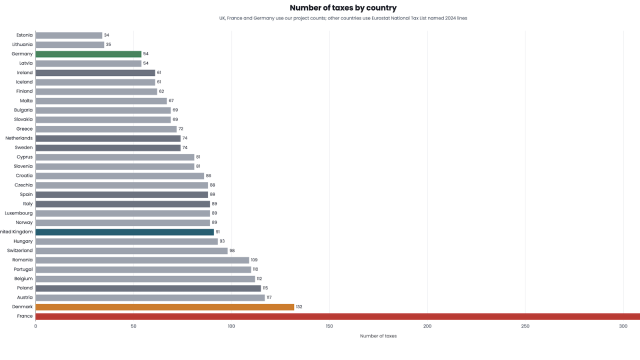
For the current UK tax system we began with the revenue taxonomy used in our UK tax-system sunburst chart (and we set out the methodology there). We count today’s taxes in exactly the same way as that chart, so both articles reach the same total of 92. That means, for example, that the four classes of national insurance are counted separately, but income tax is counted once.
We created the list of historic taxes from a manual and then automated/AI review of O’Brien and Dowell, plus numerous other sources including UK Parliament’s taxation timeline, legislation.gov.uk, The National Archives, Hansard, British History Online, HMRC manuals and statistics, GOV.UK tax information and impact notes, and devolved-revenue authority guidance. The list was then reviewed by veteran/retired tax advisers and HMRC personnel.
We made no attempt to weight by revenue – that would be wonderful, but we couldn’t find any reliable sources that would enable us to do it. The bulk of the taxes raised very little (even in their own time).
Where a tax was known to exist but the exact start or repeal date was uncertain, we used the best available “known in force by” or approximate endpoint and marked the row as lower confidence. Where the source showed an episodic tax, such as a one-year poll tax, the row runs only for that episode. Where a tax regime plainly continued under a modern name or successor form, we generally treated it as continuous only if that was the better description of the tax, rather than automatically splitting every statutory amendment into a new tax.
The dataset behind the charts now contains 373 tax episodes across 343 tax identifiers. The count chart excludes 15 rows which are only there to show how a tax is split, and one tax which has been announced but isn’t yet law (the international student levy). It includes two taxes which are law but haven’t yet started (the carbon border adjustment mechanism and the landlord registration fee), so the count ends at 92.
There are many, many limitations to this data:
The historical list is incomplete. It is strongest for England, Great Britain and the UK, and weakest for older Scottish and Irish taxes. That’s largely because Dowell is an English tax history.
There is a huge risk of presentism. Modern taxes are much easier to find, especially small statutory levies and ONS-classified fee-like taxes. Older equivalents may be missing, particularly late nineteenth and early twentieth century taxes (i.e. too late for the 1884 publication of Dowell, but too early for modern sources).
Many medieval and early-modern dates are approximate. Some taxes were episodic grants, evolved into later regimes, or were consolidated into broader customs and excise systems.
The boundary between a separate tax, a tax surcharge, a licence duty and an administrative fee is often contestable. We tried to apply the same rules consistently, but reasonable people could draw the line differently.
The count is sensitive to granularity. Counting every stamp-duty instrument head or every customs commodity head would raise the historical count; grouping them into umbrellas would lower it. Our approach is to count named taxes where sources treat them as distinct and to avoid obvious parent-child double-counting.
The endpoint includes two taxes which are on the statute book but haven’t yet started. If those are excluded, the final number is 90.
We’d love people to send us additions/corrections.
How the tax/GDP dataset was constructed
The main source is the OBR’s historical public finances database, using the workbook sheet headed “Receipts (per cent of GDP)”. We used the best available tax-like receipts measure in that workbook for each period:
1700-01 to 1899-1900: central government receipts as a percentage of GDP, because the workbook does not provide a public-sector or National Accounts taxes total for those years.
1900-01 to 1945-46: public sector current receipts as a percentage of GDP, because the National Accounts taxes line is not available for this period.
1946-47 and 1947-48: National Accounts taxes as a percentage of GDP, from the OBR historical public finances database.
1948-49 to 2025-26: National Accounts taxes as a percentage of GDP, from the OBR’s public finances databank (October 2026). This reflects the latest revisions to both tax and GDP, and 2025-26 is the latest year for which there are actual figures.
This is all highly approximate and should be regarded as no more than indicative of long-term trends.
Many thanks to T, V and O.
Chart created using Apache ECharts, by the Apache Software Foundation and contributors (Apache-2.0).
The UK now has 92 taxes, not 90: the changes are explained in our chart of the current tax system. We’ve also corrected the historical data. We previously showed three old licence duties, for selling beer, wine and spirits, as still in force… actually they were abolished in 1967, and for brewers in 1993. We had counted income tax as four taxes, when it’s one as a legal matter (although economically and in practical terms it’s reasonable to regard it as separate taxes on rent, interest, dividends and all other income). And we now count national insurance, corporation tax, stamp duty land tax and the alcohol duties in the same way as the chart of the current system (previously we had a different total in the two articles). The overall result is that the last year with more taxes than today becomes 1831, not 1834. Finally, the tax/GDP line now uses the OBR’s October 2026 figures, which revise the last few years downwards (2022-23, for example, from 36.3% to 35.3%). ↩︎
We weren’t able to find an ONS analysis of whether Danegeld was a tax, but we took the view that it was ↩︎
3 responses to “Why does Britain have more taxes than at any time since 1834?”
The attachment to your earlier post on the 85 taxes did not work on my machine. This makes I think the same point.
I am guessing but at the time of the Napoleonic wars the domestic population was not so involved and most of the monies raised were used to pay for other countries armies to fight Napoleon so rather than raise big blockbuster taxes it was seen perhaps as desirable to spread the net wider by it appears lots of duties on various classes of goods so no big hit to any particular group of citizens. The two world wars were very different being much closer to home and impacting all citizens so the need for high taxes was obvious and acceptable so no need to attempt to “spread” the burden and to keep collection costs to a minimum by using existing taxes.
Today we have unpopular governments with the populace expecting them to spend, but not very keen on the taxation levels needed to fund that spend, hence the proliferation of “small” taxes as well as the politicians making unrealistic promises while cutting themselves off from the big revenue raising taxes. All hugely inefficient with high administration and collection costs for sums which in government terms raise peanuts (the Mansion Tax for one).
It is worth also remembering that in 1797, William Pitt took Britain off the gold standard and debased the currency. We went back on the gold standard in 1821.
Pitt was well known for his plethora of petty taxes, and it was the introduction of income tax by Sir Robert Peel in the 1840s, which enabled them to get rid of so many petty taxes And simplify things. There were even taxes on things like wigs and face powder, which caused both to go out of fashion quite quickly.
The inflation tax, which Milton Friedman described as taxation by legislation that ensued from coming off the gold standard, was a big one however
A similar method was used in World War I. Britain actually nominally stayed on the gold standard, unlike France and Germany, but it withdrew gold from circulation, so the effect was similar. It issued government bonds in lieu and eventually came off the gold standard after the war
Of course, the final removal of gold in 1971 by the US, which affected everyone because other currencies were tied to the US dollar, has meant the inflation tax has been extremely pernicious since 1971. You’re losing about 7% a year to money supply growth.




Leave a Reply