
In 2014, a massage therapist called Sylvie Berki accused Russell Brand of assaulting her. The police took no further action. Mr Brand and his then girlfriend, Jemima Goldsmith, sued her. Ms Berki had no lawyer, and there was no trial. But the High Court issued an extraordinary injunction that silenced her for the rest of her life. This week Mr Brand was convicted of rape and three sexual assaults.
We have obtained a copy of the injunction, which has never previously been published. It was supposed to prevent harassment, but it went well beyond that. It prohibits Ms Berki from telling anyone what she says happened to her – not journalists, not friends, not family, and not even the police. The court also orderd Ms Berki to pay £50,000 in legal costs within two weeks (which she couldn’t afford) and authorised her bankruptcy.
We don’t know whether Ms Berki’s allegations were true, and Mr Brand’s convictions don’t establish that they were. But whilst nobody established that Ms Berki was lying, the High Court made an order that prevents her from ever speaking about what she says happened to her.
This September, a Court of Appeal judge acknowledged concerns about the extraordinary breadth of the injunction, but it remains in place. We think the injunction should never have been granted in these terms. It’s a disturbing example of what happens when wealthy, powerful people take an unrepresented defendant to court.
What happened
In June 2014 Ms Berki told Thames Valley Police that Mr Brand had assaulted her. The police found no case to answer.1 She also took her allegations to the press and Twitter, and Mr Brand and Ms Goldsmith sued. The claim form initially included libel, for which it is in practice almost impossible to obtain an injunction, but the claim they ended up pursing was for harassment.2
The interim judgment thought the claimants would probably show her allegations were false, but said their truth was “not the ultimate issue”.3 In October 2015 Mr Justice Jay gave summary judgment, a month before the trial was due to start. Ms Berki represented herself.4 He refused permission to appeal, and the Court of Appeal has since turned her down three times.
We don’t know if her allegations were true; none of the parties gave evidence to the court, and there was never any finding of facts.Mr Brand’s convictions this week for rape and sexual assault don’t tell us what happened in 2014. But we don’t think Ms Berki should be silenced for life.
The order
Here’s the final injunction order:5
This was a harassment injunction. So, given the judge’s findings, it would have been appropriate for the court to injunct Ms Berki from harassing Mr Brand and Ms Goldsmith. Paragraph 3(a) is perhaps what one would expect:
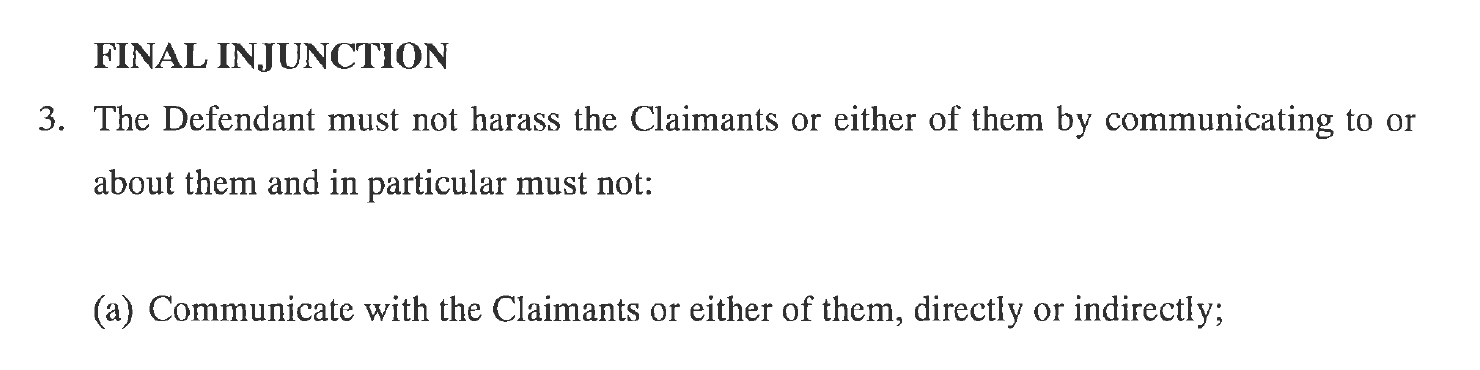
But that introduction to paragraph 3 talks about harassment by communicating “about” the Claimants. And paragraph 3(b) prohibits contact with journalists. If a journalist called Ms Berki today about Mr Brand, and she spoke to them, Ms Berki would be breaching the injunction (and so would the journalist if they knew about its terms).

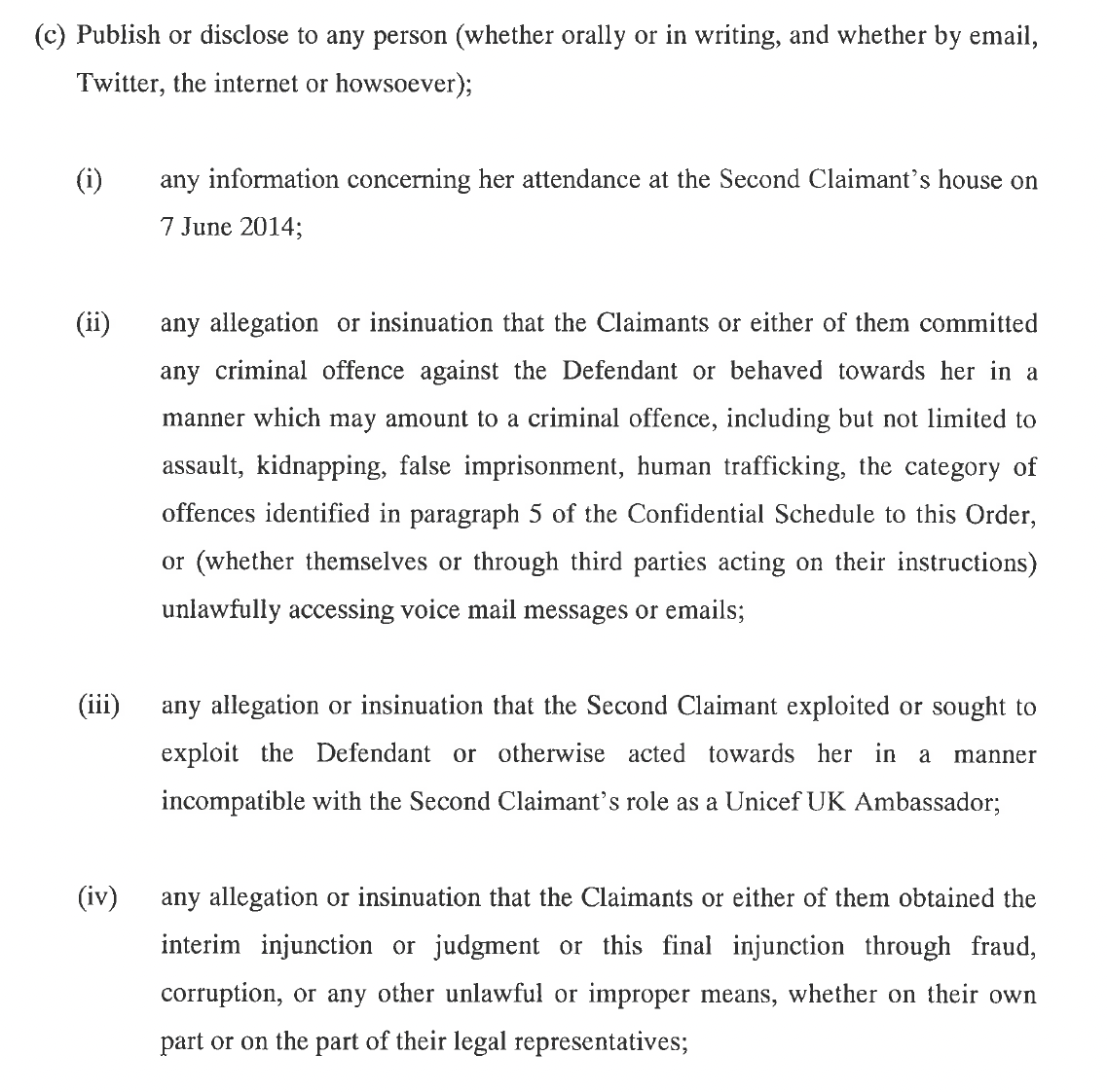
The order then goes much further, constraining Ms Berki’s private speech. She cannot disclose “any information” about the events in question, to anyone. In no sense is a private discussion with friends or family “harassment”. But it’s prohibited:
There’s an exception, but it is extremely narrow:
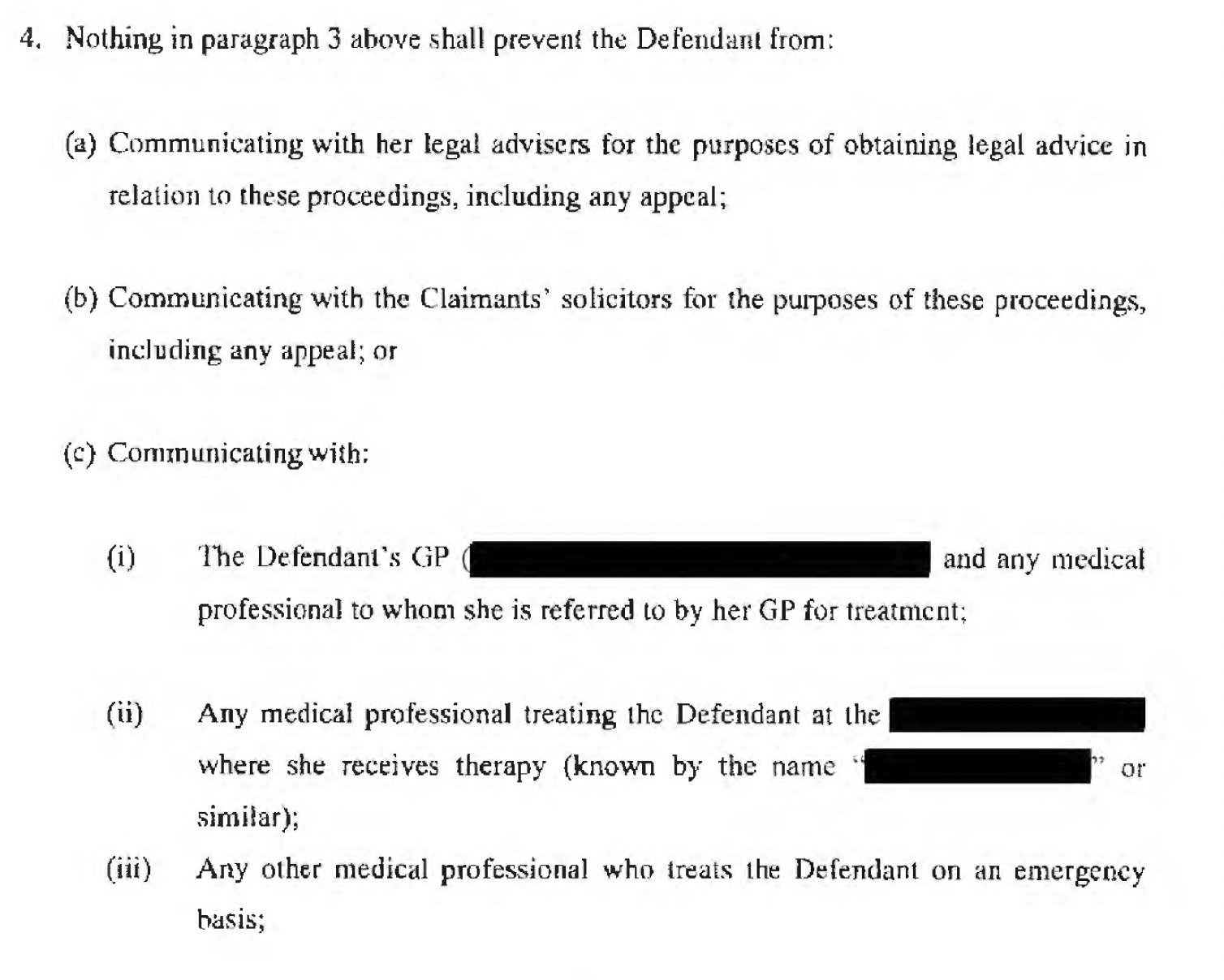
The obvious omission: she can’t speak to the police.6 The police are expecting more of Mr Brand’s victims to come forward, but Ms Berki can’t: if she even answered the phone, she’d be prohibited from speaking to them.
The Court of Appeal’s order this year records that the doctors named in (i) and (ii) no longer treat Ms Berki. Those exceptions are now useless. Short of an emergency, she cannot mention the incident to any doctor or therapist.
None of this seems necessary or proportionate in an harassment injunction.
The overall impression is that in substance this wasn’t a harassment injunction at all. It was a libel injunction in disguise. That’s an attractive strategy for a claimant because libel defendants can raise the defence of truth; harassment defendants cannot (and libels injunction are hardly ever issued). The courts have, therefore, been rightly sceptical about attempts to dress up libel as harassment. Mr Justice Jay was not.
The specifics of Ms Berki’s accusations are contained in a Confidential Schedule, which we have seen but cannot publish because of the reporting restriction in the order:
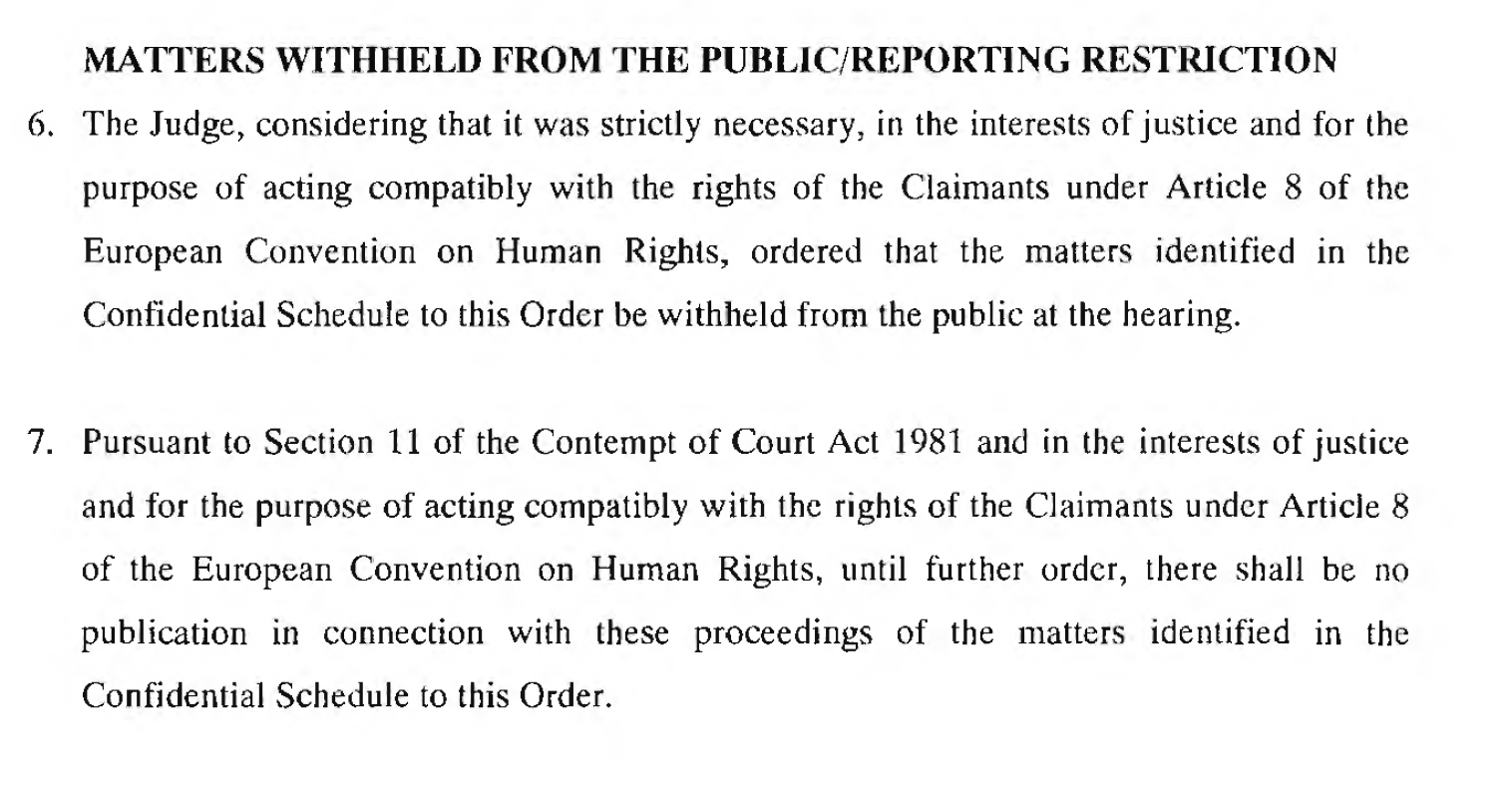
and:
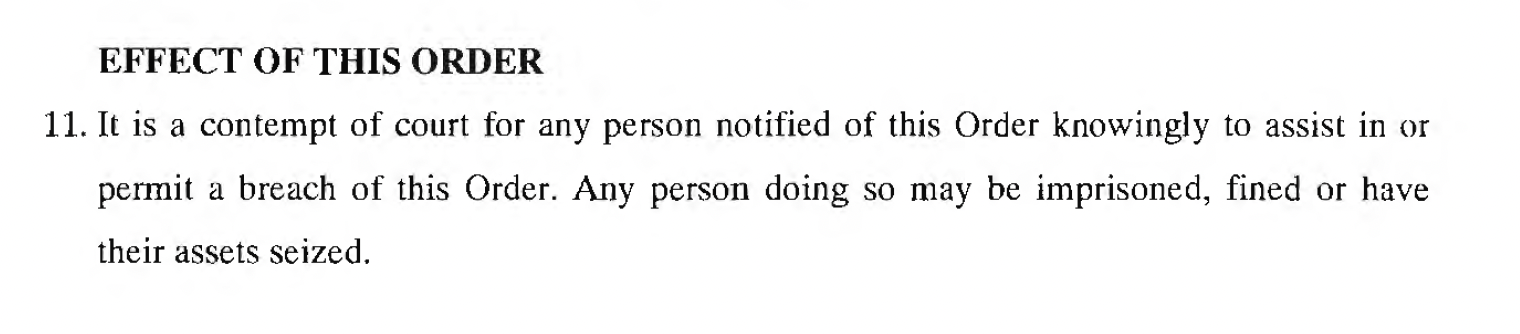
The claimants’ lawyers then obtained permission to bankrupt Ms Berki if she didn’t pay £50,000 within two weeks (although that was just the initial payment; we expect total costs would have been £100,000 or more):
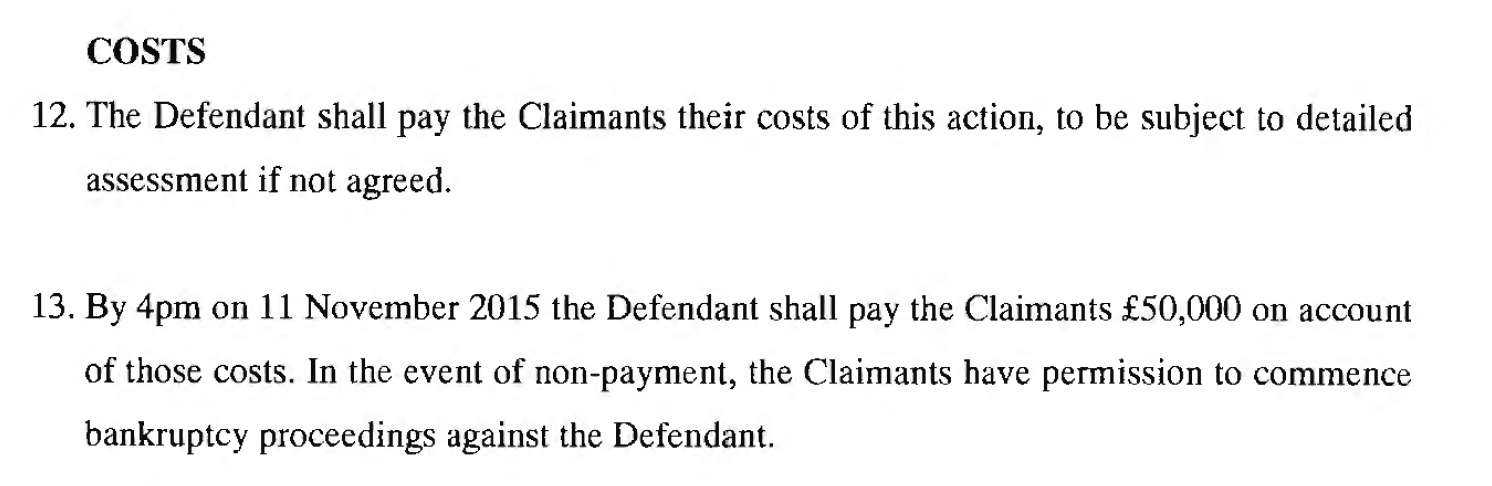
Mr Justice Jay had said Ms Berki was “probably impecunious”, so there was no prospect of her paying this.
How did this happen?
The summary judgment, by Mr Justice Jay, explains the reasons for granting an injunction, but does not discuss the terms of the injunction order itself, or explain why it was so draconian.
We’d expect the judgment would contain the discussion of whether these restrictions were necessary and proportionate, and whether they were compatible with the exclusions in the Protection from Harassment Act. It does not. A lawyer would surely have raised these arguments, but Ms Berki of course had no lawyer.
It’s not obvious why this was susceptible to summary judgment at all. Mr Justice Jay didn’t find that Ms Berki was lying. There was a two-hour pre-trial review, with a trial of four to five days scheduled for a month later. The judge said the dispute about what happened that day was “likely to be resolved in the claimants’ favour, but I cannot say that the defendant has no real prospect of success”. He then decided it didn’t need resolving, because her motive was to harass “regardless of the rights and wrongs of what occurred on 7 June”.7
When a person is not represented by a lawyer, a judge is supposed to make allowances. The rules say so. The overriding objective requires the court to ensure that “the parties are on an equal footing”, and from 1 October 2015, four weeks before this hearing, the court has had an express duty in any case with an unrepresented party to “adopt such procedure at any hearing as it considers appropriate to further the overriding objective”.8 Lady Justice Falk, who read the available transcript this year, thought “some of Jay J’s comments could have been put in more muted terms”, but that Ms Berki “was properly heard, and had a full opportunity to put the points she wished to make”. Being heard on whether you harassed someone is one thing. Settling the terms of a lifelong injunction is another – and there’s no evidence Ms Berki’s interests were protected when those terms were settled. We think the judge should have scrutinised the form of the order (which was likely drafted by Mr Brand’s lawyers). It seems he did not.9
Mr Justice Jay does not have a good record of dealing with litigants-in-person. Two years later, in a different case, he behaved so poorly that the Court of Appeal and then the Supreme Court found that he’d bullied a litigant-in-person. The Supreme Court found that he had aimed a “barrage of hostility” at the litigant-in-person, and “harassed and intimidated him in ways which surely would never have occurred if the claimant had been represented”.
The appeals
Ms Berki tried to appeal, still without a lawyer. In August 2016 Lady Justice Arden refused permission on the papers: the skeleton argument was too long, too general, and had no proper grounds of appeal (the result we’d expect if a layperson tried to conduct an appeal). But she had read the judgment herself, and set out what troubled her. Mr Justice Jay “did not give any reasons” for concluding that Ms Berki had no defence. He “appears to have made findings about the appellant’s motives on the basis of her submissions (and not on evidence given in her witness statements or in the witness box)”, and it was “not clear that the appellant had an opportunity to deal with these matters”. If Ms Berki tried again, the claimants’ lawyers were to answer those points:
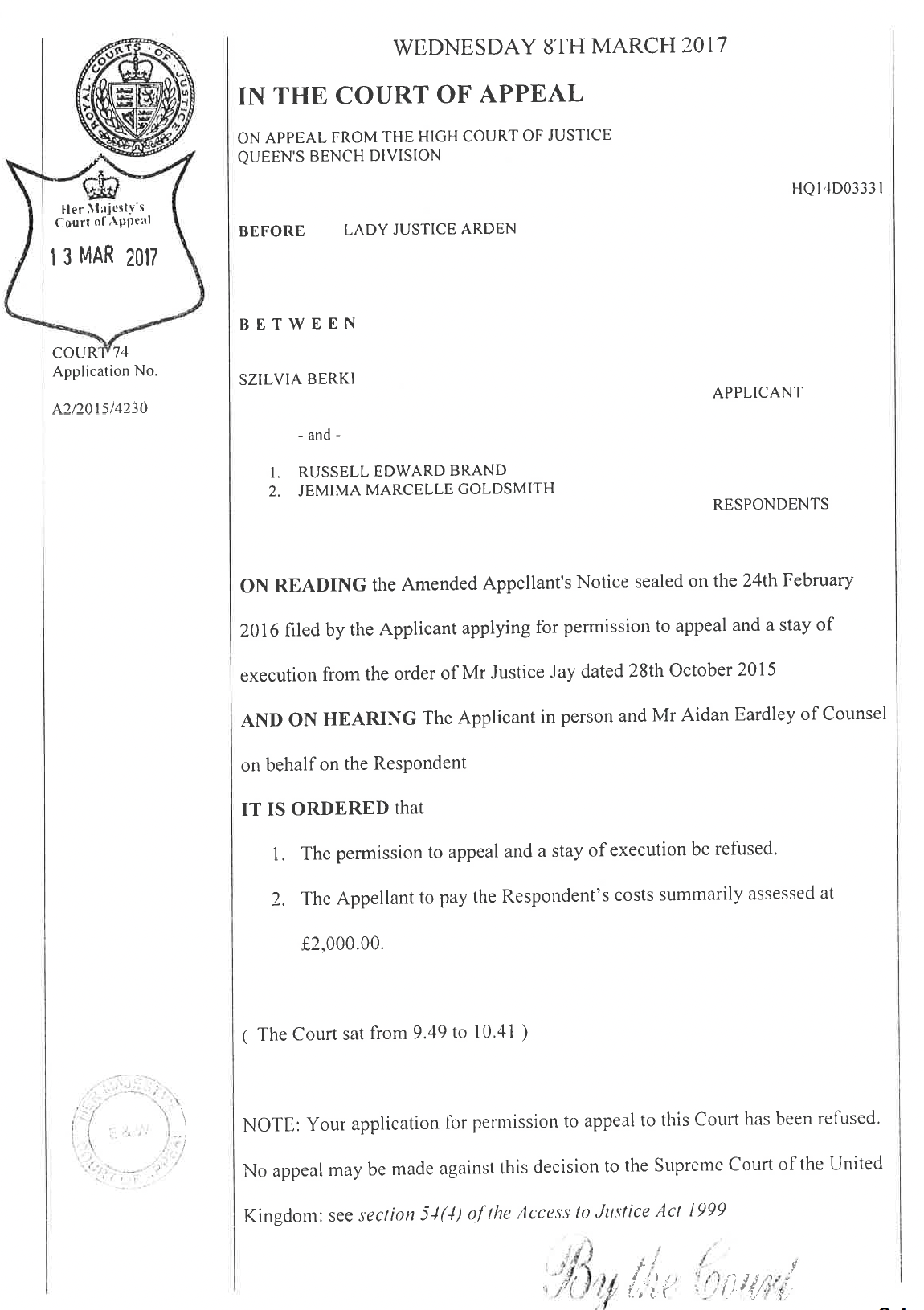
Ms Berki tried again. In March 2017, after a 52 minute hearing at which she represented herself against the claimants’ barrister, Lady Justice Arden refused permission and ordered her to pay another £2,000. The order gives no reasons:
This year, now with a pro bono lawyer, Ms Berki asked the Court of Appeal to reopen that refusal. In September Lady Justice Falk declined to do so. We think that was inevitable. The court reopens a final decision only in “exceptional cases, where the integrity of the earlier process has been critically undermined”.
Lady Justice Falk said that the concerns in the 2016 order “must be taken to have been addressed to her satisfaction” when Lady Justice Arden refused permission in 2017. But we don’t know if the concerns were ever actually addressed, and it’s not clear Lady Justice Falk if knew that either.
Lady Justice Falk seemed uncomfortable with the terms of the order, though. It “on its face appears to prohibit”, she said, “further communication to the police, communication with other claimants in relation to civil claims, and disclosures to treating physicians or therapists”. And:
While I quite see the concerns about the breadth of the order, the proper way to deal with those concerns would be to apply to the High Court to amend the scope of the injunction based on changed circumstances.
That must be correct: as she said, “It is not a matter for this court.” We understand that Ms Goldsmith has indicated she is amenable to the injunction being varied. Presumably Mr Brand will not be, so a court application is required.
The responsibility of the lawyers
The firm acting for Messrs Brand and Goldsmith was Archerfield Partners LLP. We think they have serious questions to answer.
How could lawyers justify asking a court to prohibit speech that couldn’t conceivably constitute harassment – including private conversations with friends and family, and reports to the police?
There are also questions for the judiciary: how could Mr Justice Jay grant an order of such breadth against an unrepresented defendant, without a trial, and without determining whether her allegations were true? Did he consider the proportionality and necessity of the order?
Then there’s a bigger question. Was this a one-off? Or have other injunctions been granted, supposedly to prevent harassment, but actually silencing people even in private conversations with friends, family and the police?
Photo by Gage Skidmore, CC BY-SA 4.0, via Wikimedia Commons
Many thanks to T, V and P for their PHA 1997 expertise.

We defeated an £8m libel claim – and it shows libel law and the Tax Bar need reform.
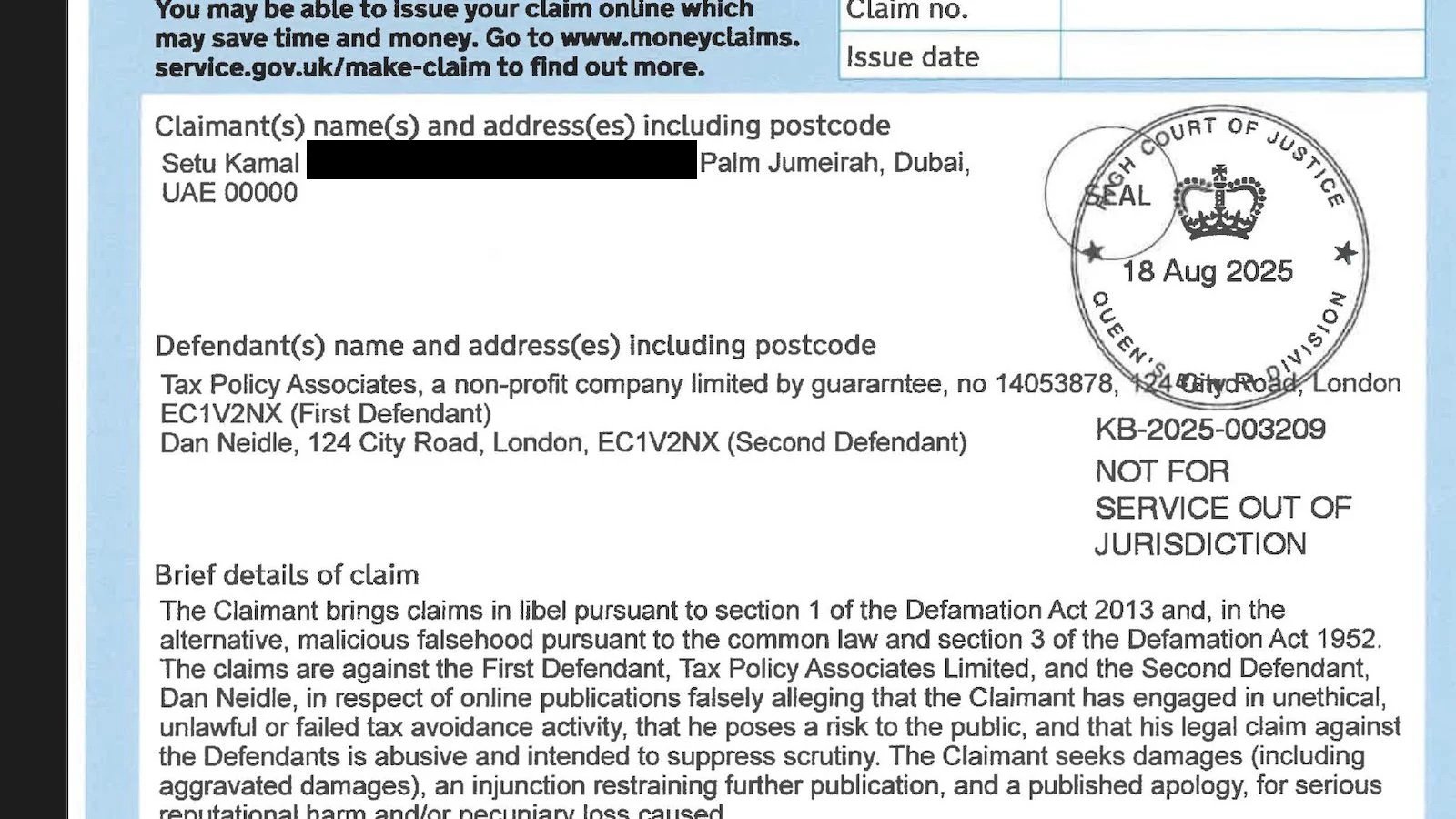
I’m being sued for £8m for a report on tax avoidance
Carter-Ruck enabled the $4bn OneCoin fraud. Was it a crime?

Carter-Ruck: the libel firm trying to cover up that they’d acted for the $4bn OneCoin fraud
An incompetent attempt to silence me by tax barrister Setu Kamal

The Zahawi libel story isn’t over – his lawyer is appealing
Footnotes
See the order for an interim injunction Brand v Berki [2014] EWHC 2979 (QB) at paragraph 11. ↩︎
Same judgment, at [32]. ↩︎
Same judgment, at [44]. ↩︎
There’s also a summary on Inforrm. She’d had “some legal assistance” with her defence, “but since then she has been on her own”. ↩︎
It is important to say: we did not obtain this document from Ms Berki, either directly or indirectly. We have redacted Ms Berki’s personal details: the names of her GP and clinic. This copy does not include the Confidential Schedule, which is subject to a reporting restriction. ↩︎
The interim injunction at least let Ms Berki contact Thames Valley Police to pursue her complaint about their decision. See Brand v Berki at [22]. ↩︎
See paragraphs 42 and 44. ↩︎
CPR 1.1(2)(a) and 3.1A(4). Rule 3.1A was inserted by the Civil Procedure (Amendment No. 4) Rules 2015. ↩︎
Unless of course the original draft order was more draconian; it is not clear what such an order could even look like. ↩︎


Leave a Reply