
Keir Starmer announced £15 billion of additional defence spending – £4.7bn of that is currently unfunded. That leaves Andy Burnham, expected to become Prime Minister, with a problem. Where is he going to find £4.7bn?
One answer would be to cut spending. However, I expect the politics are such that Mr Burnham will not do that. I also expect he won’t increase borrowing – that seems unattractive/expensive at current gilt rates. It seems most likely Mr Burnham will be looking for tax increases – and he said yesterday that, despite Labour’s manifesto promises, there is “some room for movement on tax“.
I’ve previously written about the case for tax reform, and argued for specific tax cuts. This article solely looks at potential tax-raising measures (plus one potential tax cut that those measures could enable). I’m not an economist or a defence expert, and so I won’t discuss the question of whether this level of tax increase at the present time is necessary or desirable. I’ll take the £4.7bn as a given and proceed from there.
The problem
How much room for manoeuvre does Andy Burnham have?
Here’s how UK tax receipts are expected to look in 2027/28 – about £1.2 trillion in total:1
During the election campaign, Labour ruled out increasing income tax, national insurance, VAT or corporation tax. Whilst politicians have broken pre-election tax promises many times before, the difficult political situation Mr Burnham is inheriting means that this route feels (at least to me) out of the question.
The promise not to increase tax on “working people” probably rules out council tax and air passenger duty. Stamp taxes, bank taxes and the various environmental taxes are already probably past the point where more can be raised. Customs duties are complicated by trade treaties. Raising insurance premium tax without raising VAT would be distortive (and many would view as a tax on “working people”). Raising alcohol duty would be unpopular out of all proportion to its significance. Tobacco taxes are already causing a significant problem with illicit imports. So I would probably rule all of these out in practice.
There are then taxes the Labour Government has already increased – gaming taxes, oil/gas taxes and fuel duty (it began unwinding the fuel duty freeze).
What does this leave? About £64bn of taxes:
It’s challenging to find £4.7bn here. Others can comment on the practicality of raising visa fees or the immigration health surcharge – we don’t have expertise in either area.
One answer is to create new taxes, but that is a slow process. The “mansion tax” introduced in the last Budget was not terribly complex, but there was still two-and-a-half years between announcement and implementation. So new taxes are not a compelling answer to an immediate need for funds.
The most likely change – business rates
Mr Burnham has said he wants to shift business rates from retail and pubs onto warehouses and out-of-town shopping centres. The idea seems to be a redistribution rather than a pure tax increase – but it’s an important issue and worth looking at.
In fact a version of this has already begun. In the November 2025 Budget the Government confirmed that, from April 2026, the temporary retail, hospitality and leisure relief would be replaced by permanently lower business rates multipliers for those sectors, funded by a new higher multiplier on the most valuable properties – those with a rateable value of £500,000 or more, a category that captures the large warehouses and distribution centres Mr Burnham has in mind. So Mr Burnham would be extending a shift the current Government has already started, rather than starting from scratch.
But the overall position with business rates is complex. Across the economy as a whole, business rates raise less revenue (as a percentage of GDP) than before the pandemic:2
However, many businesses, particularly retail and hospitality businesses, feel business rates have become a more serious burden. There are several reasons for this:
- There were a series of business rate reliefs during and after the pandemic, and those are either withdrawn or becoming less generous.
- Whilst rates have declined as a percentage of GDP, many retail and hospitality businesses have not seen profits rise with GDP. Therefore, both the actual and the relative burden on them has increased.
- The general decline of the high street has meant rents have gone down. Business rates are (in theory) linked to rents and so should also go down, but the long delay between business rate valuations and business rates being paid means that often the two end up significantly out of step.
The problem with Mr Burnham’s proposal is that, in the long run, most of the economic burden of business rates is borne by landlords. That’s because, when business rates are cut, rents on new leases will go up, and when business rates rise, rents will go down. This is often not believed by businesses, but the evidence is reasonably clear.
A business rate cut will therefore provide short-term relief to retail and pubs, but in the long term, will be a tax cut for landlords. Politicians rarely talk about this, but they know it, and this is why all the various recent business rate cuts have been temporary in nature. A permanent cut would, in my view, be a mistake.
A much better approach would be to reform the business rate system to remove its worst feature, the slow cycle of revaluation – which means that often the economic value of a site can fall, but business rates still remain high. Perhaps the simplest fix is to link business rates to local property indexes between revaluations.
A more dramatic change would be to change legal liability so that, for all new leases, it is the landlord and not the tenant who pays the tax. That won’t change the long-run economic incentives (as rents will adjust), but it will change the short-run incidence. It will also have the benefit that politicians will no longer find themselves under pressure to execute cuts which are believed by businesses to help them but, in the long term, will not.
The solutions we probably will see
This leaves Mr Burnham and his future Chancellor scrabbling for relatively small tax increases here and there. Here are items I’d expect to be on the Chancellor’s longlist, in a roughly descending order of likelihood:3
- Fiscal drag – £5bn from 2031. Inflation and earnings growth mean we’re all earning more in cash terms, but not in real terms – however tax thresholds have stayed the same for years. The Johnson and then Sunak Governments raised very large amounts with fiscal drag – over £29bn by 2027/28. This has only a limited effect on median earners, but represented a significant tax increase for higher earners. Rachel Reeves extended the freeze to April 2031. It seems likely that we will get another extension from Mr Burnham, raising around £5bn in 2031/32 and more in subsequent years.4 So this is not a way to find funding for 2027/28.
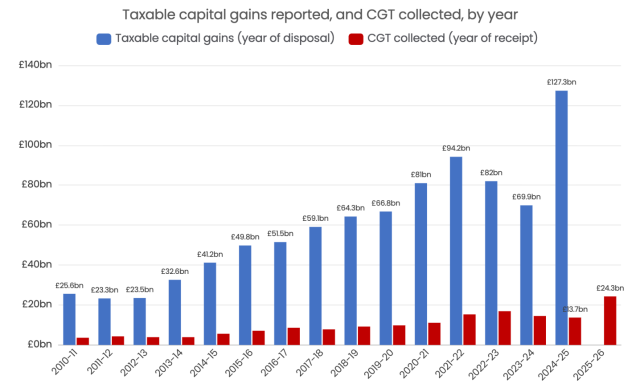
- Increase capital gains tax – £6bn+. It’s obvious from the charts above that capital gains tax is the single largest way to raise tax without breaking pre-election promises. However, it comes with a large catch. A simple rate increase will, on the basis of HMRC figures, lose revenue, not raise it.5 There is a better way, to cut the effective rate of CGT for investors putting capital at risk, but increase it for others. That could even be combined with an income tax cut, and still raise significant sums. Wes Streeting has proposed aligning capital gains tax with income tax – although he treats the whole thing as revenue to be raised, and was not proposing an income tax cut. My view is that, given the cost of living crisis and the widespread sense that tax is already too high, pairing CGT reform with an income tax cut could be extremely shrewd politically. I used to see it as good policy – but I fear the time is no longer right, and the measure could easily backfire.
- Close the tax gap – £0 in the short term – unknown in the long term. The most attractive option is not, strictly speaking, a tax increase at all: collect more of the tax that is already legally due. I recently wrote about this in How Andy Burnham could raise £15bn – without a tax rise. HMRC’s latest estimate is that the UK tax gap is £59.2bn, or 6.4% of all tax theoretically due. The common view is that this is mostly big business and wealthy individuals. That is wrong. HMRC says tax avoidance is under £1bn. The biggest problem is small business non-compliance. The striking figure is small business corporation tax. HMRC estimates that the small business corporation tax net gap has risen from £9.5bn in 2020/21 to £17.3bn in 2024/25. Over the same period, HMRC’s compliance yield from small business corporation tax has been only £0.1bn to £0.2bn. That is extraordinary. If a private business had a £17bn leakage problem and was recovering £200m, the board would not regard that as acceptable. The sums are huge, and if HMRC could make the same kind of progress with the small business corporation tax gap that it previously made with large business corporation tax, the yield could be around £15bn. But this is a long-term project, and it would take months, even to identify what the issues are here, and years before there was any new revenue. It is still, however, something I regard as imperative.
- CGT on death – £unknown. There’s been considerable focus in the US on the ability of the very wealthy to use a “buy, borrow, die” strategy to avoid tax. A wealthy tech entrepreneur (for example) could be sitting on shares with a large capital gain, and so would face a considerable capital gains tax bill if they sold their shareholding. So what they do is borrow against their shares. They then receive a lump sum, just as they would if they had sold the shares, but with no tax at all. Of course they are paying a funding/interest cost, but this will usually be much lower than the CGT. Eventually they die, their children inherit the shares, but the historic capital gain disappears, so when the children sell, they are only taxed on the gain during their period of ownership. The original capital gain is wiped out.6 The same strategy works in the UK – but an important point that’s often forgotten is that it’s a strategy that was very successful pre-pandemic, but in today’s high-interest-rate environment, the maths don’t work very well.7One option for the Chancellor would be to trigger a CGT charge on death. However, the high resultant overall rate (up to 52%) could be politically unattractive8 and economically distortive. The alternative would be to change the law so that, when you inherit property that is sitting at a capital gain, you inherit the capital gain too. So if you sell the property immediately you pay the same CGT as the original owner would have done. That seems a pretty rational change.9
- Introduce an exit tax – £unknown. There are two features of the UK capital gains tax system which practitioners take for granted, but which non-specialists often think are peculiar. First, if you arrive in the UK, become fully UK tax resident, and then dispose of an asset, the UK taxes you on the entire lifetime gain of that asset (even if almost all of that gain accrued when you lived abroad). This is rather unfair and deters some entrepreneurs from moving to the UK. Second, if you spend years building up a business in the UK, then leave the UK and dispose of the business in the next tax year, then the UK taxes none10 of that gain (even if almost all of it accrued when you live here). It would be rational to end both anomalies, so that the UK fairly taxes UK gains. We should measure the gain from the point at which someone arrives in the UK11 and when someone leaves the UK, the gain they accrued here should still be taxable here as and when they sell.12 This would overall be a fairer system. It would also likely raise some tax, because entrepreneurs would no longer be able to escape UK CGT by moving to Monaco five minutes before selling their business. And a deferred charge would be less harsh than the United States and some other countries which impose an immediate tax charge, even if you still own the asset. I wrote about exit taxes and other countries’ systems here.
- Employer national insurance on law firms and other professional partnerships – £1-2bn. Employees pay income tax, and their employer pays 15% employer national insurance. Partners in law firms and other professional practices pay income tax, but there’s no employer national insurance. It’s a big tax saving, and it’s unclear how, in principle, it’s justified. Equalising the treatment is not straightforward, and there would be complaints from some very influential interest groups, but it could probably raise significant sums. I wrote about this here.
- Pension tax relief – £3-15bn. Right now, contributions to a pension are fully tax-deductible.13 If you’re a high earner, paying a 45% marginal rate14, you get 45% tax relief on your pension contributions. Some view this as unfair, and suggest limiting relief to 30%, or even the 20% basic rate. That could raise significant amounts – £3bn (if limited to 30%) or up to £15bn (if limited to 20%). But withdrawals from a pension, after the tax free lump sum, are taxable at your marginal rate at the time. Offering a 20% or 30% tax deduction for pension contributions, but taxing withdrawals at 40%, isn’t a great deal. High earners may shift their investments to other products. There could be complex second and third order effects. And – most significantly – applying any new rule to defined benefit schemes (meaning, in practice, public sector pensions) means either a large unexpected tax liability for those affected, or exempting defined benefit/public sector schemes from new rules. Either of these would widely – and correctly – be seen as unfair. So I doubt this will happen.
- Tax large gifts – £unknown. Properly wealthy people often pay remarkably little inheritance tax because they give property to their children, and provided they live for seven years after they do this, it’s completely untaxed. There’s also an exemption for gifts which classify as “normal expenditure out of income“, which in practice enables people with large amounts of investment income to make very large untaxed gifts. Neither is something that merely moderately wealthy people can do, because they generally need their wealth to live in (their house) or live off (their investments).15 Lots of countries tax lifetime gifts over a certain amount. Potentially large sums would be raised if Mr Burnham did that. To prevent difficult compliance (and difficult politics!) this would likely only be for large gifts, say over £1m. It would raise significant additional sums… but how much is hard to say.
- Eliminate the stamp duty “loophole” for enveloped commercial property – £1bn+. It’s common for high value commercial property to be sold by selling the single-purpose company in which it’s held (or “enveloped”). So instead of stamp duty land tax at 5%, the buyer pays stamp duty reserve tax at 0.5% of the equity value or if (as is common) an offshore company is used, no stamp duty at all. This practice has been accepted by successive Governments for decades. It would be technically straightforward to apply 5% SDLT to such transactions, and this would raise a large amount – over £1bn.16
- Increase ATED – £200m+. The “annual tax on enveloped dwellings” is an obscure tax that was introduced to deter people from holding residential property in single purpose companies to avoid stamp duty. As we explain here, it’s currently failing because it’s been set too low, and raises a derisory £111m. There’s a case for tripling it.
- Increase inheritance tax on trusts – £50m. When UK domiciled individuals settle property on trust, the trust is subject to a 6% tax every ten years, and another 6% charge when property leaves the trust (broadly pro rata to the number of years since the last ten yearly charge). These taxes currently raise abour £100m/year17, on top of the 20% “entry charge” when property goes into trust. This all seems rather a good deal if we compare it to the 40% inheritance tax paid by estates on property that isn’t in trust. So there’s an argument for increasing the rate from 6% to 9% – and that should raise somewhere around £50m.18
- Reform R&D tax relief – £3bn. We’ve had a series of tax reliefs designed to incentivise research and development. They now cost £7bn per year, but I fear most of this is wasted. R&D tax relief is highly complex – only the most sophisticated companies are able to plan R&D with confidence that the relief will apply. And they have been widely abused, with perhaps as much as £10 billion wasted in wrong and fraudulent relief claims; HMRC’s response to that is now blocking legitimate claims. The people who could really do with the relief aren’t getting it. The Chancellor could solve all these problems at once. Focus the relief narrowly on significant projects aimed at real science and engineering innovation, with harsh penalties for companies and advisors making indefensible claims. Create a simple and fast pre-clearance process to provide certainty. The aim should be to provide more generous relief for, e.g., bio science, engineering, and tech companies, and no relief for anybody else. Simultaneously promote growth and stop wasting taxpayer funds.
- Stop the Bank of England paying interest on some of its reserves – c£5bn. This is somewhat esoteric and not strictly tax19 – but it does represent a relatively pain-free way to raise somewhere around £5bn each year (for the short to medium term). The Bank of England currently pays interest on the reserves that commercial banks place with it. In theory it could raise up to £23bn by dividing the reserves into “tiers”, ceasing to pay interest on one tier, and requiring the banks to continue to keep that tier with the BoE. Reform UK thought that £35bn could be raised this way – but most observers believe that would destabilise the BoE’s control of interest rates, and somewhere around £5bn is more reasonable. I can’t do justice to this point – there’s a pair of excellent FT articles by Chris Giles and (in more detail) Toby Nangle. Rachel Reeves (perhaps because of her background?) was against such a move – but Mr Burnham may regard it differently. What’s not clear is who would ultimately bear the economic cost of such a change (the “incidence” in tax wonk-speak). The banks’ shareholders? Their employees, particularly the highly paid ones? Or their customers, meaning “normal” businesses?20
- Council tax and property tax reform – up to £5bn (but little in the short term). It’s indefensible that an average property in Blackpool pays more council tax than a £100m penthouse in Knightsbridge. The obvious fix is to “uncap” council tax so that it bears more relation to the value of the property – by adding more bands, or applying say 0.5% to all property value over £2m – which could raise several £1bn. The Government has already made a modest start: the November 2025 Budget introduced a high value council tax surcharge – a “mansion tax” of £2,500 to £7,500 a year on homes worth £2m or more from April 2028 – although it raises only about £400m, and it would have been much better to revalue council tax and add more bands. But Mr Burnham wants to go much further. He calls council tax “highly regressive“, notes that “you can be paying much more council tax in a Band D house in Greater Manchester than in some of the very wealthiest parts of London“, and says he has “long been persuaded of the argument for a Land Value Tax“. He appears to have endorsed the Fairer Share campaign’s proposal to replace both council tax and stamp duty with an annual “proportional property tax” of 0.48% of a home’s value (0.96% for second homes, empty properties and overseas owners), which its backers call “a de facto land value tax”. This is essentially the reform I have long argued for. But the poll tax casts a long shadow, and the Fairer Share campaign tries to defuse the inevitable opposition by protecting existing owners: the proposal would cap their bills, with that cap only falling away once a property is sold, so the full charge bites only on future purchasers. That softens the politics – but creates a new problem. A tax that only applies after future sales raises very little in the short to medium term. And something that is sensible, potentially unpopular, and won’t raise much revenue any time soon is unlikely to be at the top of a new Prime Minister’s list. I would love to be wrong.
- Equalise income tax on different types of income – several £bn. Mr Burnham has said he wants to shift taxation from income to wealth. Often, when people say this, they’re thinking about increasing tax on savings, rent, and dividends – and the IPPR and others have put the yield of extending national insurance to rental income alone at around £3bn. But none of this is as easy as it looks. There is a good case for increasing the rate on rents, but the way individual landlords are taxed means that many already face a very high effective rate (sometimes over 100%). On the other hand, the rate of income tax on dividends is probably at the “correct” rate21 because dividends are subject to corporation tax, and corporation tax plus dividend income tax is broadly equivalent to employer national insurance, employee national insurance, and employment income tax.22 A sensible reform would be to end the distortive, unfair and economically damaging gap between the tax treatment of employment income and the tax treatment of self-employment income. This, however, would be politically challenging. So none of this looks like an easy way to raise significant sums.
- National Insurance for workers over State Pension age – around £1.5bn. National Insurance has one of the strangest features of the UK tax system: once someone reaches State Pension age, they usually stop paying employee National Insurance, even if they carry on working. The same broad rule applies to the self-employed: they stop paying Class 4 NICs from the start of the tax year after they reach State Pension age. Employers, however, continue to pay employer NICs on employees over State Pension age. There is no principled reason for this. National Insurance is often presented as a contribution towards contributory benefits, but really it’s just another tax on earnings. A 66-year old employee and a 65-year old employee doing the same job for the same pay should face the same tax treatment. I and most other tax policy people would strongly support this change. The question is whether Mr. Burnham would have enough political courage to face down a highly motivated and significant voter base.
- Cap tax relief on ISAs – several £bn. Cash and shares/stocks in ISAs are exempt from income tax and capital gains tax. This tax relief costs about £7bn of lost tax each year. Most ISAs are small – only 20% hold more than £50,000. But I expect this 20% receive most of the benefit of ISA relief.23 So in principle the Government could save £5bn by capping relief for the first £50k (or some lesser amount for a higher cap, with diminishing returns setting in fast24). However many would regard this as unfair – they took advantage of a widely promoted Government saving scheme, and now the rules are being changed after the event. I think that’s a compelling argument. An alternative approach would be to reduce the £20k annual allowance, which naturally benefits people with the highest disposable income.25 This however wouldn’t raise very much in the near term; Mr Burnham’s Chancellor may regard the negative optics as outweighing the small financial benefit.
- Abolish business asset disposal relief – £500m. This is a capital gains tax relief supposedly for the benefit of entrepreneurs. But the Treasury officials forced to create it named it “BAD” for a reason. The benefit for genuine entrepreneurs is limited (an 18% rather than 24% rate). It’s widely exploited. If CGT isn’t to be reformed more widely, then abolishing BAD would raise some money, but materially less than older estimates.26
- Increase vehicle excise duty – £200m+. VED currently applies at various rates for different vehicles, depending on the type of vehicle, registration date and emissions/engine sizes. The average for a car is about £200. A £5 increase would raise £215m, and raising £1bn wouldn’t be terribly challenging. However it would impact “working people“.
- Introduce “sin taxes” on unhealthy food – £3.6bn. An IPPR report last year proposed a “10 per cent tax on non-essential, unhealthy food categories including processed meat, confectionary, cakes and biscuits”, modelled on successful taxes in Hungary and Mexico. As a tax lawyer, my instinct is to be sceptical of such proposals; decades of VAT cake litigation attest to the difficulty of clearly defining different categories of food.27 There is a concerning gap between the claims from health advocates and the IPPR, and the actual evidence28 So whilst taxing “unhealthy food” would be an effective way of raising tax, it is questionable if there would be any health benefits, and the tax would overall be regressive.
- Review VAT exemptions – £1bn+. Many of the VAT exemptions/special rates make little sense and should be abolished. The 0% rate on children’s clothes should be first to go, with child benefit uprated by 10% so that people on low/moderate incomes don’t lose out. This change alone would yield about £1bn.29
- Increase the digital services tax – £400m. The digital services tax is a flat % tax on large internet businesses’ income from digital services. So, for example, advertising revenue paid to search platforms and fees paid to marketplaces. The rate is currently 2%, and it raises around £800m, so a 1% increase should raise £400m. On the face of it, an easy tax to increase. However there are two good reasons not to. First, most of the economic burden of the tax falls on UK businesses, the customers of the digital companies. Second, there are geopolitical complications – Donald Trump has threatened retaliation for existing digital services taxes, never mind increases in the rate. I discussed the issues in more detail when the Lib Dems proposed tripling the tax in their 2024 manifesto. There is a good summary from the House of Commons Library here.
- Increase the bank surcharge – £1.5bn to £2bn. One politically obvious target would be the bank corporation tax surcharge. Banks currently pay corporation tax in the ordinary way, and then an additional surcharge on their banking profits. The surcharge was originally 8%, but from April 2023 it was cut to 3%, with the allowance increased from £25m to £100m. The bank surcharge raised £1.0bn in 2024/25. So a simple static calculation suggests that reversing the 2023 cut and restoring the 8% rate would raise somewhere around £1.5bn to £2bn each year.30 This would be politically tempting. It would, however, be, in my view, both unprincipled and a dangerous mistake. The original purpose of the surcharge was to prevent banks benefitting from the cut in corporation tax, so it was rational that when corporation tax went back up, the surcharge went down. A return to the old 8% surcharge would mean banks paying a 33% headline corporation tax rate on profits. That would create a significant competitiveness problem for London versus other financial centres.
- Reduce the VAT registration threshold – £3bn. There is compelling evidence that the current £90k threshold acts as a brake on the growth of small businesses, as they manage their turnover to stay under the threshold. Reducing the threshold so everyone except hobby businesses are taxed would raise at least £3bn, and in the view of many people across the political spectrum, could increase growth. The economy as a whole would benefit, and small businesses would benefit in the long term. But in the short term there would be many unhappy small businesspeople. I fear this is, therefore, too difficult for any Government to touch. It would also take time to put into effect – APIs/apps would need to be ready to assist micro-business compliance, and HMRC would need to significantly gear up.
- End the pension tax free lump sum – £5.5bn. On retirement, we can withdraw 25% of our pension pot, up to £268k, as a tax free lump sum. The argument for abolition is that most of the benefit goes to people on higher incomes paying a higher marginal rate. The argument against is that people have been paying into their pensions for decades on the promise of the rules working a certain way, and it’s unfair to now change that (and I agree with this position). Labour also seemed to rule out the change. But it’s an “easy” way to raise lots of tax – abolition has been estimated to raise around £5.5bn in the long run, while limiting the benefit to £100,000 would raise around £2bn.31
- Tax gambling winnings – £1-3bn. The US taxes gambling winnings. The UK doesn’t (unless you are a professional gambler so gambling becomes your trade or profession). In theory this would raise £1-3bn.32 It would have two ancillary benefits: (1) discourage gambling (in a way that raising betting duties would not), (2) end the oddity that spread betting isn’t taxable when equivalent derivative transactions are. But there are three big downsides. First, it would be (in my view) unfair to tax gambling winnings without giving relief for gambling losses (as the US does). That reduces the yield. It also creates a relief that would be exploited for tax avoidance and tax evasion.33 Second, it would in practice be regressive, hitting the poor disproportionately. Third, the tax would realistically need to be withheld at source (as it is in the US), which requires a new taxing infrastructure to be created. So, whilst an interesting thought, I can’t see this happening.
- Online sales tax – around £1bn. An online sales tax would fit neatly with Mr Burnham’s rhetoric about shifting tax from high streets to warehouses. The argument is simple: physical retailers pay high business rates because they occupy valuable premises, whilst online retailers can operate from relatively low-value warehouses. An online sales tax would, in theory, rebalance that. The Treasury has already looked at this. It consulted on an online sales tax in 2022, after sustained lobbying from parts of the retail sector. The conclusion was negative. The Treasury said an online sales tax would be “complex”34 and “distortive”, would probably be passed on to consumers35, and would not raise enough money to fund the business rates reductions retailers wanted. Initial estimates suggested a yield of only about £1bn a year. So I see this as a poor idea. The boundary between physical and digital is thin and easily manipulated. Online retail is often more efficient and more popular with consumers; we should not tax efficiency and popularity.
- Raise the top rate of income tax – <£1bn. The top rate of income tax (outside Scotland) is currently 45%. The rate was briefly 50% under Gordon Brown – could we return to that? I would be surprised. The previous 50p rate was in place so briefly that nobody’s quite sure what effect it had… but even in a best case analysis it would raise very little. Raising the top rate is a political signal more than it is a fiscal policy. And any increase would probably break Labour’s campaign pledge not to increase income tax.
- CGT on unrealised gains – £unknown. Another proposal popular with campaigners is to tax capital gains annually, regardless of whether they are realised. No developed country has implemented such a tax. The Dutch tried, but their Supreme Court held it was contrary to the European Convention on Human Rights.36 Kamala Harris proposed a similar tax in the US during the 2024 presidential campaign, albeit only for taxpayers with wealth of $100m or more. There are four significant problems: valuation, dealing with unrealised losses, people leaving the UK before they hit the threshold, and other avoidance if (as is probably inevitable) some asset classes are excluded. In the event, Harris lost the election and no such tax was introduced. Absent a successful example elsewhere, I doubt the Chancellor would want to experiment with this one.
- A tax on share buybacks – probably very little. When a listed company returns cash to shareholders by buying back its own shares rather than paying a dividend, some campaigners argue it should face a special tax, modelled on the 1% excise tax the US introduced in 2022. In the last election, the Lib Dems proposed a 4% version they said would raise £1.4bn; IPPR and Common Wealth modelled a 1% version raising about £225m.37 I am sceptical. As I explained here, the US rationale doesn’t translate to the UK, companies would simply shift back towards dividends (which are already taxed), and the realistic yield is much lower – possibly close to nothing. A neat-sounding tax that mostly isn’t.
- Financial transaction tax – £7bn+. This is another very popular tax amongst campaigners.38 The usual argument goes: there is a huge volume of financial transactions. Placing a small tax on each of them would be barely noticed, but raise a lot of money. In 2019, Labour claimed they could raise £7bn. The catch lies in what precisely a “financial transaction tax” is. The idea was originated by James Tobin in 1972 – his idea was to “throw sand in the wheels” of international currency markets and tax every currency transaction in the world. The tax would “cascade” as trades flowed through currency markets, essentially ending them in their current form. That was Tobin’s aim – he wasn’t trying to raise revenue. Existing taxes on financial transactions, like UK stamp duty or the French, Italian and Spanish taxes39, are quite different. They apply once, to the end-purchaser of securities, and not to market-makers and intermediaries – there is no “cascade effect”. They are designed not to deter transactions (although they have this effect to some degree) but to raise revenue. An actual FTT would necessarily end markets in their current form. The European Union spent years fruitlessly trying to come up with an FTT that didn’t have that effect – it failed, and gave up on the project. In my past life, I wrote about the problems with Labour’s proposal, and the problems with the EU proposal. UK stamp duty is already the highest such tax in any large economy. The question isn’t whether it should be increased – it’s whether we’d raise more tax revenue by abolishing it.
- Wealth tax – £1bn to £26bn. Many campaigning groups are keen on a wealth tax targeted at the very wealthy – e.g. people with assets of more than £10m. But the practical experience of wealth taxes is that they’ve been failures, with only a handful of countries retaining a wealth tax40. The recent Spanish tax – which adopted the modish idea of only hitting the very wealthy – raised a feeble €630m. It’s another failed wealth tax to join a long list. The academics on the Wealth Tax Commission recommended against an annual wealth tax, but supported a one-off retrospective tax raising up to £260bn over five years. My feeling is that such an extraordinary tax would require a specific political mandate, which Labour do not have. And one-off taxes have a habit of not in fact being one-offs.
- CGT on homes – £31bn. We have a complete and unlimited capital gains tax exemption on homes – our “main residence”. On the face of it, that costs £31bn – quite the sum – and people often look at the huge numbers and a light on this as an easy way to raise money. But to do it that simply is a non-starter – you’re creating a cost for many people moving house. Even if they’re moving from one house to another that’s similarly priced, they’d potentially have a large tax on their historic gain (a gain which has done them no good). It would make the current problems with stamp duty even worse. So realistically you can’t just tax all home sales – you have to introduce exemptions of some kind – and the £31bn figure is therefore something of a mirage. For this reason, those countries that in theory impose CGT on homes, in practice end up collecting little, thanks to a variety of exemptions, loopholes, and rules that let you roll the gain into your next house.41 I would therefore be very surprised to see any change on this – perhaps it’s something we could see for the very highest value properties, but then it would raise small sums.
- Reform creative industry tax reliefs – £500m to £1bn+. The UK has a series of generous tax reliefs and expenditure credits for film, high-end television, animation, children’s television, video games, theatre, orchestras, museums and galleries. They cost a serious amount of money: £2.40bn was paid out in 2023/24. Some of this may be excellent value: genuinely additional investment, jobs, skills, exports and soft power. But some of it is inevitably deadweight subsidy for productions that would have happened anyway, or which are location-mobile only because countries have trapped themselves in a subsidy race. The answer is not to abolish the reliefs, but to make them more hard-headed: focus support on genuinely additional UK activity, cap or reduce relief for the very largest productions, require better evidence of economic benefit, and stop pretending that every pound of subsidised expenditure is a triumph of industrial strategy. However, I’d put this way down the list because I fear that the powerful industry lobby would be difficult to resist.
- Tax private medicine – £500m to £1bn+. Private healthcare is another politically tempting target. Medical services supplied by registered health professionals are generally exempt from VAT, and private medical insurance is subject only to the standard 12% insurance premium tax, not the 20% higher rate that applies to some other insurance. A Chancellor raise money by increasing IPT on private medical insurance, imposing a specific levy on private hospital income, or narrowing the VAT exemption where private treatment is not substituting for NHS care. Politically this could be sold as a tax on those able to opt out of the NHS. There is an obvious problem: some private treatment reduces pressure on NHS waiting lists, and a tax that makes it more expensive may push some patients back into the NHS. There’s also a subtle but serious problem: most private businesses that provide their employees with private medical care could recover the VAT. I therefore expect we’d see businesses responding to the VAT cost by moving to a “self insurance” model where they pay directly, with the revenues consequently being much less than anticipated.
- Increase the rate of VAT – £9bn+. This is one of the easiest ways to raise significant sums – HMRC estimate that a 1% increase in VAT raises £9.6bn. The Cameron and Major Governments raised VAT upon coming into office, after saying they wouldn’t during the previous election campaign. But this feels very unlikely now.
- Means test the State pension – £1bn+. The State pension pays out about £12,500 per year. It’s easy to think that’s an irrelevant amount to wealthy retirees, and we should means test the pension to stop them benefiting. Given the Government spends over £150bn each year on pensioner benefits, blocking even just the wealthiest 1% from pensions would raise over £1bn. It seems a slam dunk. But that makes an elementary mistake – a pension of £12,500 per year, updated with the “triple lock“, is actually a highly valuable asset. It would cost the average 66-year old somewhere over £250,000 to buy an asset like that.424344 A family “just” in the wealthiest 1% has average assets of £1.9m per adult. So removing their pension would effectively expropriate over 10% of their wealth. That feels unjust. I doubt any Chancellor would do this.
If you have additional suggestions, do please comment below or drop me a line.
Photo of Andy Burnham by NHS Confederation and licensed under the terms of the CC-BY-2.0.
Footnotes
The source is the OBR economic and fiscal outlook, broken out with EFO detailed tables 3.1/3.2/3.20. Also the OBR devolved tax and spending forecast for LBTT/LTT. ↩︎
Business rates receipts are shown as a share of GDP. Outturn figures for 2016-17 to 2024-25 are business rates receipts from the ONS Public Sector Finances (appendix D, series CUKY) — the same series the OBR uses for business-rates outturn. Forecast figures for 2025-26 to 2030-31 grow the 2024-25 outturn in line with the OBR’s business-rates forecast in its March 2026 Economic and fiscal outlook (Table A.5). Throughout, receipts are expressed as a percentage of financial-year nominal GDP taken from the OBR Public Finances Databank. ↩︎
Disclosure: my previous attempt to predict Government tax increases was a dismal failure. So please take with a pinch of salt. I’m a tax lawyer, not a political columnist. ↩︎
there’s no official number on this. It’s just a simple extrapolation based upon existing OBR figures ↩︎
The IFS and some others believe the HMRC figures overstate the cost of a significant CGT increase; my understanding is that the dramatic HMRC figures reflect people accelerating gains to escape the increase, and then (after it comes in) deferring gains to try to wait it out. The first effect could be negated if the CGT rise was instantaneous, rather than taking effect from the next tax year. ↩︎
Tax people would say it is “rebased” to current market value. ↩︎
Even then it was less significant in the UK than the US for the very wealthiest, as we have fewer entrepreneurs, and less significant for the “mass wealthy because it’s harder to obtain a margin loan than in the US. But people certainly used the strategy with UK real estate. ↩︎
The political problem is that if someone dies holding a £1m portfolio they bought for £100,000 twenty years ago, CGT on death at 24% would be £216,000, and inheritance tax on the remaining £784,000 estate would be £314,000 — total tax of £530,000, an effective rate of 53% on the portfolio (54.4% on the gain itself). That is actually a rational result: it’s precisely what they’d have paid if they’d sold the portfolio the day before they died. But politically I suspect the fear of an upfront high rate means this is a non-starter. ↩︎
With the inheritance tax liability then slightly lower to reflect the fact that the asset being inherited is pregnant with CGT. Alternatively the inheritance tax liability could be unchanged, but the CGT base cost adjusted to “credit” the IHT paid on the gain – a messier result. ↩︎
Unless you return within five years. ↩︎
i.e. the base cost should start at market value on the date a taxpayer becomes UK tax resident, not the historic base cost from when they lived abroad ↩︎
In other words, a deferred “exit tax”. ↩︎
Subject to an annual £60k limit, tapering down to £10k for high earners. ↩︎
Or indeed someone on £60k, with an anomalously high marginal rate of 57% thanks to child benefit clawback, or someone on £100k with an anomalously high marginal rate of 20,000%. ↩︎
And the “gifts with reservation of benefit” rules prevent people from legally giving away property but, in practice, still benefiting from it. ↩︎
We could find no figures that enable a proper estimate to be produced – the £1bn is no more than an educated guess at the lower end of the yield – see the discussion here. ↩︎
There was a bad mistake in the original version of this article, which resulted in the potential yield being out by a factor of ten. I’m very grateful to the HMRC Press Office for identifying the mistake. The correct source is Table 12.7. Calculating the average total tax liability for tax years 2010/11-2023/24 using the figures in column S, taxpaying trusts subject to entry, ten-year anniversary, and exit charges respectively were £8 million, £88 million, and £14 million. There is helpful commentary on this here. ↩︎
Taxpayer responses, and the complexity of trust taxation, mean that determining the actual yield would be complicated. ↩︎
although it is economically akin to one. ↩︎
When the numbers get large, the answer can’t be the shareholders, because the bank profits aren’t enough to cover the figure. In a market where banks compete with non-banks for traders and other highly remunerated employees, the answer may not be employees either. The answer, as is often the case with tax incidence questions, depends on how competitive the market is for each of the banks’ products – in less competitive areas, banks have more scope to pass on the cost. ↩︎
This was borne out in the November 2025 Budget: the Chancellor raised the basic and higher rates of tax on dividend, savings and property income by 2 percentage points, but pointedly left the top (additional) rate of dividend tax unchanged – precisely because, taking corporation tax into account, it was already at the right level. I discuss this here. ↩︎
This is a pure intuitive guesstimate from speaking to people in the industry. Unfortunately, I am not aware of any good data sources that would enable a proper estimate to be computed here. ↩︎
Those who say that ISAs should be capped at £1m are engaging in symbolism not tax policy – there are only a few thousand people with £1m ISAs, and most of those will be only a little over the cap. A £1m cap would raise little. ↩︎
The £20k allowance was very generous when introduced in 2017/18, but has since been eroded by inflation. It’s fully used by about 7% of ISA holders, i.e. about 3% of all adults. ↩︎
£500m is my estimate based on the older data in the tables found here – this one is the CGT tab on the December 2023 non-structural reliefs table. ↩︎
There isn’t just legal pedantry; there’s evidence that definitional problems meant that Mexican consumers switched to equally unhealthy but untaxed products, so that calorie consumption did not change (but there was an impact on sugary soft drink consumption, with a resultant improvement in dental health). ↩︎
Papers from health organisations report the Hungarian tax positively, but the evidence is much less conclusive. A study in 2021 found that the Hungarian tax had been effective in depressing consumption in economic downturns (when households are economising) but not at other times; and a more recent longitudinal study found that, over the long term, prices were higher but consumption returned to its previous level (and indeed increased). A systematic review in 2021 looked at over 2,000 studies and found no clear effect. The two studies cited by the IPPR are a theoretical modelling study and a review, neither of which refer to the contrary Mexican and Hungarian papers. ↩︎
0% on children’s clothes costs £2bn/year. It’s hard to find good sources on the average spend on children’s clothes, but estimates range between £380 and £780, suggesting the VAT saving is around 10% of child benefit. ↩︎
A 3% surcharge raising £1.0bn implies an 8% surcharge on the same base would raise about £2.7bn, i.e. about £1.7bn extra. That is only a rough static calculation: actual receipts would depend on bank profits, losses, financing structures, and behavioural responses. The TUC has put the yield of returning the surcharge to 8% at about £8bn over four years, which is consistent with this kind of ballpark. ↩︎
These are long-run estimates and would depend heavily on transitional protection and behavioural response. ↩︎
Rather unsatisfactorily the source is a private conversation with someone knowledgeable and I can’t provide any further information. ↩︎
Although one could imagine designing a tax to minimise these effects, e.g. automatic deduction of 40% tax from winnings, with winnings and losses reported to HMRC by regulated gambling businesses, and no other losses permitted. ↩︎
The technical problem is that “online sale” is much harder to define than it sounds. Is click-and-collect online? What about an order placed in-store on a tablet? What about a customer who researches in-store but buys online? What about groceries, takeaway food, digital products, subscriptions, marketplaces, overseas sellers and business-to-business sales? The Treasury consultation found no consensus on these questions. ↩︎
The burden would not fall neatly on Amazon and large online retailers. It would often fall on consumers, small online businesses, and physical retailers with successful online operations. ↩︎
I am sceptical this is consistent with ECHR caselaw and I doubt a UK court would take the same approach, although I am sure it would consider the Dutch Supreme Court’s reasoning carefully. ↩︎
The contrast between the Lib Dems’ £1.4bn (at 4%) and IPPR/Common Wealth’s ~£225m (at 1%) illustrates how sensitive the number is to rate and behaviour. ↩︎
I confess I find this depressing. The problems with an FTT are not obscure; they’re well known amongst economists and tax policy specialists. The question isn’t whether you agree or disagree with the tax, it’s whether it’s workable – and I’m not aware of anyone with expertise who thinks it is. NGOs like Oxfam wasted many £m of their donors’ money on a hopeless and counterproductive cause. And columnists who should have known better hailed the politics without thinking about the actual impact. ↩︎
The French, Italian and Spanish taxes were called “financial transaction taxes” to catch the wave of popularity of such taxes at the time. They are, however, essentially more limited versions of UK stamp duty reserve tax, and nothing like actual FTTs. ↩︎
The exception is the Swiss wealth tax – but that is charged at a low rate on most people, not just the very wealthy, and so has little in common with the campaigners’ proposals. Switzerland has no capital gains tax or inheritance tax, and income tax on dividends is easily avoided. So the Swiss wealth tax in practice operates as a kind of minimum tax on wealth – but even with that tax, many Swiss cantons tax wealth much less than the UK (which is why so many very wealthy people move there). The Norwegian tax also applies widely, not just to the very wealthy. The impact of its recent increases is currently unclear. Reports of a large exodus appear to be exaggerated, but the nature of Norwegian wealth is very different from wealth in the UK. My favourite statistic is that 10% of the top 100 richest Norwegians made their fortunes in salmon farming. ↩︎
Some people have suggested we just tax someone’s “final” sale. Good luck defining that. And the problem then is that people simply won’t sell, as death/inheritance wipes out all gains. You’re locking up the housing market, increasing what’s already a serious problem. Or you just tax at death, which is better dealt with by a general CGT reform. None of these ideas are very workable. ↩︎
Annuities can be purchased in the market, but none have anything like the “triple lock”, so precisely pricing such a product is hard. A number of people with expertise kindly commented when I asked about this on social media, with estimates ranging from £250,000 to £400,000. ↩︎
An important caveat is that whilst this figure fairly reflects the commercial cost of such a pension, it doesn’t reflect the cost to the Government of providing it. In part because the Government has access to much cheaper funding than any commercial provider; in part because government will usually collect tax from the pension that it is paying (perhaps income tax on the pension itself; definitely VAT on purchases). ↩︎
Some people thought that a pension can’t be valued in this way, because the government could stop paying it at any time. That’s true in principle, but it’s also true in principle that a commercial annuity could stop paying, e.g. because the insurer goes bust, perhaps in a market crisis in which the FSCS couldn’t afford to cover the loss. That’s far fetched – but still in my view more likely than government suddenly ceasing to pay existing pensions. ↩︎
Capital gains tax reform was right. Now it’s dead.
A £2.6bn lobbyist fairytale: economic consultancy Cebr sold VAT-free shopping as a tax cut that pays for itself

John Healey should cut National Insurance, not raise the personal allowance
The Budget – what it says

The Budget small print: six key reforms to watch


Leave a Reply