

The Conservatives propose exempting family homes from inheritance tax and increasing the tax-free allowance to £500,000 per person. They say this would cost £6bn a year. Our analysis suggests £7.7bn–£10.9bn, once we account for the incentive to hold on to homes and move other wealth into housing.
The problem is that the proposal gives wealthy pensioners a powerful reason to buy bigger houses. If you sell investments, and put the money into your home, then your children could save 40p in tax for every £1 you spend. If you downsize, on the other hand, every £1 of house value you sell could increase IHT by 40p.
These effects are substantial. We estimate the proposal could shift £60bn–£110bn from savings and investments into housing and reduce the number of £1m-plus homes coming onto the market in London and the South East by 3%–6% each year. Around 90% of the tax cut would go to the wealthiest fifth of pensioner households.
For £7.7bn, we could instead raise the tax-free allowance to £900,000 per person or cut the inheritance tax rate from 40% to 17.5%. Either would be a better way to cut inheritance tax, without giving people a tax incentive to buy bigger houses or stay in homes they would otherwise sell.
But if the priority is growth, then inheritance tax is the wrong tax to cut.
The analysis in this article is built on the inheritance tax model we developed to show the proportion of pensioner households potentially impacted by IHT. We set out our methodology below, and the code is published on our GitHub, for anyone to check.
What does the Conservative Party propose?
Today, the inheritance “nil rate band” is £325,000 – if your estate is less than this, there is no inheritance tax. There is a complex additional “residence nil rate band” of up to £175,000 for a qualifying home left to direct descendants, which tapers away for estates above £2m.
The Conservatives are proposing two changes:
First, replacing the £325k and £175k with one simple £500,000 nil rate band – £1m per married couple.
Second, no inheritance tax at all on a main home passed to children or grandchildren, with (it seems) no cap on the value.
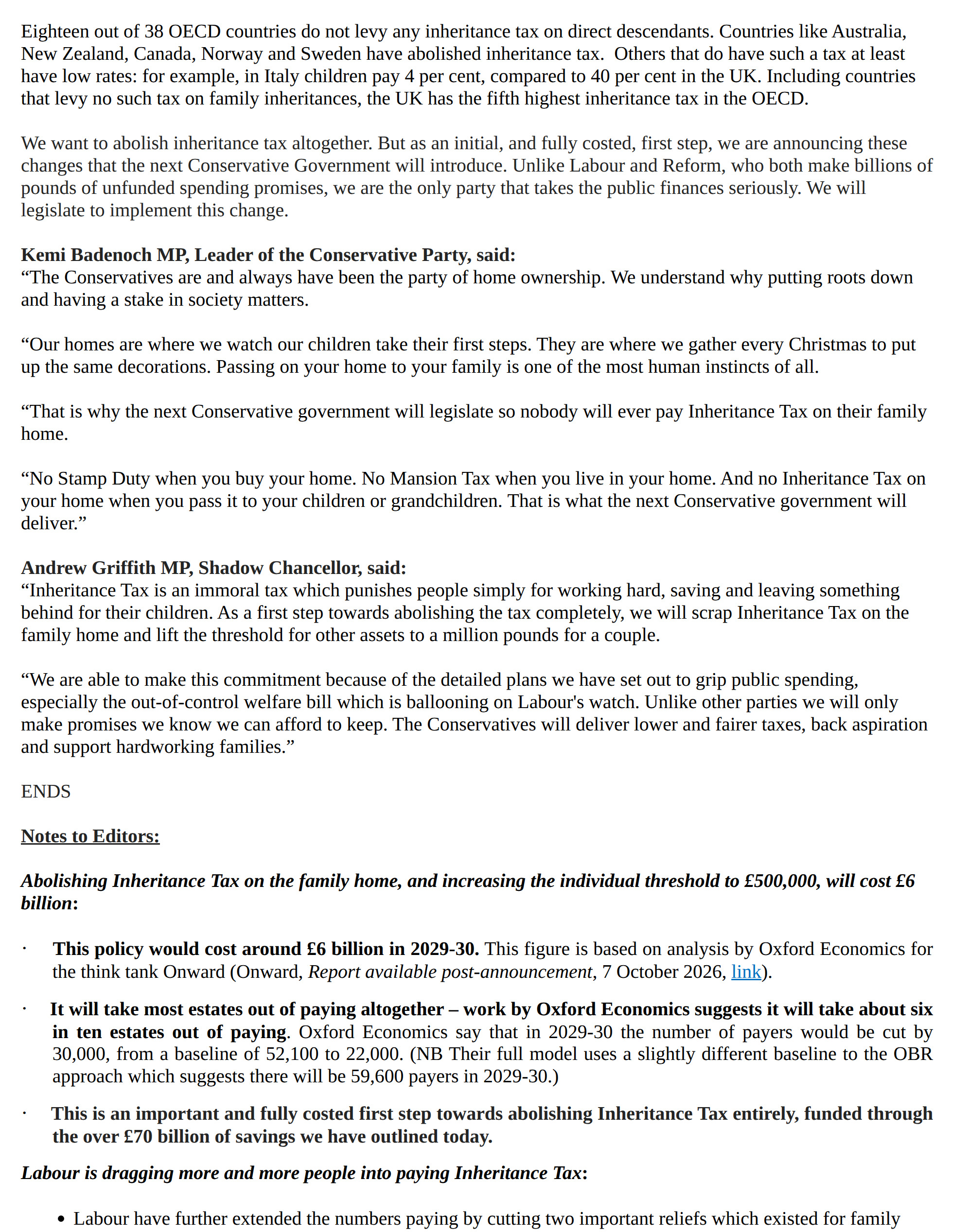
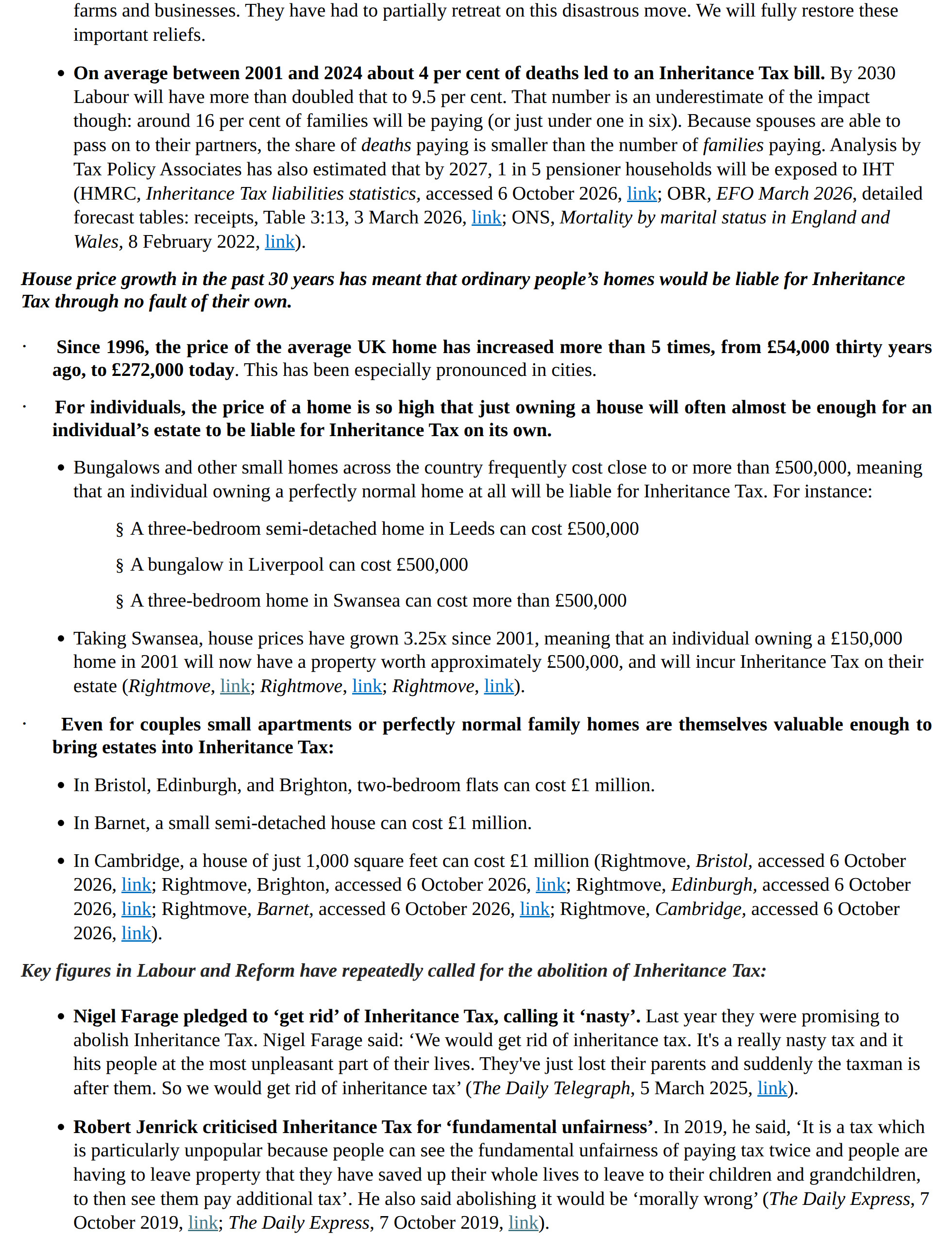
Kemi Badenoch described the policy as “a first step” towards abolishing the tax altogether. Here’s the official press release:
![Press Release
FP 020 7984 8121
7h October 2026
CPC26A
%. Conservatives
STRONGER STRONGER
ele] fe] hae COUNTRY
FOR IMMEDIATE RELEASE
Conservatives to abolish Inheritance Tax on the family home
The Conservatives will abolish Inheritance Tax on the family home, as well as raising the individual
threshold to £500,000. This will mean that a couple can pass on their family home to direct descendants,
plus a further £1,000,000 of assets without paying a penny of Inheritance Tax.
House price inflation has meant that owning a normal family home in some parts of the country is enough
to drag middle-class families into paying inheritance tax, punishing people who have worked hard, saved
and want to pass that on to the next generation.
Inheritance tax is Britain’s most hated tax. That is why Kemi Badenoch’s Conservatives will bring the
majority of people who would be paying out of Inheritance Tax altogether and deliver a tax cut for every
person who would have to pay it.
This is an important and fully costed first step towards abolishing Inheritance Tax entirely.
Today [Wednesday 7" October 2026], the Conservative Party has announced that we will abolish Inheritance Tax on
the family home and raise the individual threshold to £500,000. This will mean that a couple can pass on their main
home to direct descendants inheritance tax free, and a further £1,000,000 to anyone without any inheritance tax
liability.
This will replace the current thresholds of £325,000 per person, and a £175,000 further allowance for residential
property. The £325,000 threshold, first set in 2009, is being frozen by Labour out to 2031, dragging more and more
people with smaller estates into paying tax.
THT is a bad tax. It is morally wrong and a form of double taxation to take assets that people have purchased with
income — which has already attracted tax — and then force them to pay even more to the state just because they have
died. The really wealthy have always set up trusts, or taken other steps to shelter assets from Inheritance Tax.
The Conservatives want to protect families who work hard and save, and want to make sure that the next generation
benefit from their efforts. This is a contrast with Labour, who are widening the IHT net including by sucking in family
farms, pensions and family businesses.
We have already pledged to scrap Labour’s family farm tax and the family business tax, but today we are going
further.
Explosive house price growth over the past thirty years has turned Inheritance Tax into a postcode lottery. Perfectly
normal houses that were purchased decades ago will now be worth enough to drag families into the [HT net.](https://taxpolicy.org.uk/wp-content/uploads/2026/10/media-Vmzynd3b-scaled.jpg)
![¢ Torsten Bell, Pensions Minister and former Chief Executive of the Resolution Foundation, said
‘Inheritance Tax should be abolished’, adding ‘it is regarded as Britain’s least fair tax’. “This
unpopularity is due in part to it being perceived as a tax on the dead, having a high marginal rate of 40 per cent,
and because it is often seen as merely a voluntary tax for the very rich and well advised’ (Resolution
Foundation, Scrap Inheritance Tax and replace it with one that is fairer to families and harder to avoid, 2 May
2018, link).
Inheritance Tax is bad for growth
¢ There is good evidence that investors leave the UK because of it. An adviser to Lakshmi Mittal, the Indian
steel billionaire, said that levying Inheritance Tax on otherwise exempt assets resulted in him leaving the
country.!£! Chris Rokos, who was Britain’s third biggest taxpayer left the UK lasty month and “reportedly cited
reasons including non-domiciled resident payments, inheritance tax concerns and private school fees.”!2!
¢ A 2024 survey of tax advisers by Oxford Economics found that Inheritance Tax was the most cited
reason for considering migrating from the UK among both investors and entrepreneurs.!3!- A study of the
US by Moretti and Wilson find very wealthy people move noticeably away from US states with estate taxes.
After an offsetting Federal tax credit was eliminated in 2001 the number of Forbes 400 individuals in fell by 35
per cent in states with estate taxes!4],
¢ Inheritance tax at the UK’s high rate also gives people later in their careers who are nearing the
threshold a huge incentive to retire earlier - rather than work and face this double tax (paying first their
income tax then 40% of what they save above the limit on IHT).
¢ For this reason many other countries have abolished Inheritance Tax: Austria in 2008, Czech Republic
2014, Portugal 2004, Cyprus 2001, Slovakia 2004, Sweden 2004, Norway 2014, Australia 1979, Canada 1972,
Israel 1980, Mexico 1961, and New Zealand 1993.
| The Times, 22 November 2025, link.
| LBC, 8 September 2026 link
] Oxford Economics, Assessing the Impact of Proposed Reforms to the Non-Dom Regime, September 2024, link.
]
[
[
[
[4] AEJ: Economic Policy, 2023.
L
2
3
4](https://taxpolicy.org.uk/wp-content/uploads/2026/10/media-WQdzWJ3O.jpg)
Who benefits?
Our model suggests that 90% of the tax cut goes to the richest 20% of pensioner households, and 40% to the richest 5%, whose estates are worth £1.75m or more.1
Unsurprisingly, most of the benefit goes to London and the South East. Those two regions have a quarter of Britain’s pensioner households but receive 70% of the benefit.
What does the Conservative Party say it would cost?
“Around £6 billion in 2029-30”, based on modelling by Oxford Economics for the think tank Onward, which also says the number of taxable estates would fall from 52,100 to 22,000.2
The Conservatives say this would be funded from the £70bn of spending cuts they announced at the same time.
What do we think the cost would be?
When estimating the impact of a tax increase or tax cut there are usually two components. First, a static estimate, which assumes nobody changes their behaviour. Second, a dynamic estimate which attempts to build in taxpayers’ behavioural response.
We built our estimate like this:
| Component | Lower estimate | Upper estimate |
|---|---|---|
| Static cost: no change in behaviour | £7.0bn | £9.0bn |
| Keeping homes that would otherwise be sold | £0.25bn | £0.70bn |
| Fewer people downsizing | £0.25bn | £0.65bn |
| Moving savings and investments into homes | £0.30bn | £0.60bn |
| Less tax avoidance: revenue recovered | −£0.12bn | −£0.02bn |
| Total annual cost, rounded | £7.7bn | £10.9bn |
Our methodology is summarised in this section, then set out in detail in the full methodology description below.
Static estimate
We’ve costed the proposal using two approaches. Both give a higher static cost than the Conservative Party’s £6bn figure (which includes an unknown behavioural adjustment).
The OBR forecasts inheritance tax receipts of £13.7bn in 2029-30.3 Applying our estimates to that forecast gives a static cost of £7bn to £9bn.
Dynamic effects – lock-in
Most tax changes cause taxpayers to change their behaviour in some way. Usually these effects are small. In this case, we should expect a substantial effect, because the proposal is economically equivalent to a 40% charge on an elderly person selling their house.
Today, selling a £1m house and moving to a £400,000 flat won’t change your children’s inheritance tax bill. The estate is the same size.4 Under the Conservatives’ proposal, the £1m house was exempt from IHT, the £400k flat continues to be, but the £600,000 you released is fully subject to IHT.
Your house move cost your heirs £240,000.5 People are going to respond to an incentive this large. Our rough estimate of the “lock-in” effect is £250m to £700m a year on the 2029-30 receipts scale. People will also have a powerful incentive not to downsize.6 We estimate that this effect would shelter another £250m to £650m of IHT on the 2029-30 receipts scale.
All of which suggests that behavioural responses increase the cost of the measure by somewhere between £500m and £1.35bn on the 2029-30 receipts scale.
Dynamic effects – upsizing
The proposal also gives people a reason to move their assets into housing – to “upsize”.
For example, someone with a £2m house and £10m of financial investments could sell £5m of investments and buy a £7m house. That potentially moves £5m out of the taxable estate and saves £2m of inheritance tax.78
There’s strong evidence that people shift wealth into tax-exempt assets. When Spain exempted owner-managers’ shares from wealth tax in 1994, exempt stock went from 15% to 77% of the total within eight years (see Alvaredo and Saez); business property relief on AIM shares built a £6bn industry in Britain; and in Japan, where residential land is heavily favoured, the elderly hold real estate until death and a 2015 tightening of IHT valuation rules set off a boom in apartment building for tax reasons.9
This history suggests we should expect a significant shift.10 If eligible homeowners moved 7.5% to 15% of their financial wealth into their main residences, the remaining inheritance tax would fall by about 6% to 12%. On the OBR’s 2029-30 receipts scale, that is an additional annual cost of about £0.3bn to £0.6bn. A 30% shift would cost about £1.1bn.
Dynamic effects – less avoidance
There is an effect in the other direction. If inheritance tax bills become smaller, then there’s less of an incentive to engage in tax planning. Meaning more inheritance tax could be collected than the simple static estimate suggests. Oxford Economics includes this effect in its £6bn costing (but frustratingly doesn’t separate the effect out from its static estimate).
The question is how large this effect would be. There are three categories of estates:
- People currently engaging in IHT planning who wouldn’t need to after the Conservative’s proposed reforms come in, because they’d be paying no IHT even with no planning. That’s a reduction in planning, but it doesn’t boost IHT revenue.
- People currently engaging in IHT planning who still would need to after the reforms, because the new exemptions don’t fully cover them, and they pay 40% IHT on their post-exemption assets. The Conservatives’ proposal gives these people no incentive to reduce tax planning.
- People who still pay IHT on their post-exemption assets, but the marginal rate drops because of the reforms. About 5% of estates would be in this position, because of the personal allowance taper, but it’s a small effect – boosting IHT revenues by c£20m to c£70m.
There could be another effect even where the marginal rate stays at 40%. A smaller bill can make paying for tax planning less worthwhile. The effect is real, but small – likely less than £50m.
Our detailed reasoning is in the methodology section below, but ultimately we believe dynamic effects are only going to have a small positive impact on the costing of this proposal.
Oxford Economics appear to have concluded there are much larger positive effects, but we can’t see what they did. They cite research by the Wealth Tax Commission which used average IHT rates, not marginal rates, but does not publish their coefficient, asset allocation or the size of their adjustment. If Oxford Economics simply applied elasticities to a change in average tax rate, then we think they made a mistake.
The wider impact
Given the large incentive the proposal creates to shift money from investments into housing, it’s going to have a wider impact. We’re tax people, not economists, so we’re not going to try to estimate the economic impact or the effect on the housing market, but we can estimate the number of homes and value of investment affected. The workings are in the methodology section.
The impact on the housing market
Our model says that, under the Conservative proposal, about 1.5m pensioner households in Great Britain would face an inheritance tax penalty if they sold their home and kept the cash. For 900,000 of them, the penalty would be more than £100,000. And 840,000 would face a penalty just for moving to a home worth half as much, with a typical bill of around £95,000.
That translates into two effects. First, homes that are sold today before their owner dies would instead be held until death: we estimate 1,000 to 3,000 a year. Second, fewer pensioners would downsize. Our rough estimate is 3,000 to 4,000 fewer downsizing moves a year.
Put together, that’s perhaps 4,000 to 7,000 fewer homes coming onto the market each year, against about 1.1m to 1.2m residential sales across the UK.11 That’s under 1%, so as a raw number pretty small. But these aren’t typical homes. Almost half the households facing a downsizing penalty are in London and the South East, and nearly two thirds of the homes are worth £750,000 or more.
So the more relevant figure is that there would be a 3% to 6% decline in £1m-plus homes going on the market in London and the South East each year.
The impact on savings and investments?
About 460,000 pensioner homeowners would still face an inheritance tax bill after the reform, and between them they hold about £780bn of savings and investments. Every pound of that moved into a bigger house, a renovation or an extension saves 40p of tax.
On the scenario we use above, where 7.5% to 15% of that money moves into homes within five years, that’s £60bn to £110bn shifted out of financial assets and into housing, or roughly £125,000 to £245,000 per household. That’s somewhere between 3% and 6% of all the financial wealth held by pensioner households.
What if the money was spent on a simple IHT cut?
If a government really did want to spend £7.7bn a year cutting inheritance tax, there are two simpler ways to do it, neither of which distorts the housing or investment market.
The first is to scrap the residence nil rate band, with all of its complexities, and simply increase the ordinary nil rate band. £7.7bn would take the nil rate band from £325,000 to about £900,000 per person, so £1.8m for a married couple.12 This would make the family home IHT-exempt for the vast majority of people.
The second is to keep the system exactly as it is and cut the rate. £7.7bn would take inheritance tax from 40% to about 17.5%.13 This would be a significant benefit for the very wealthy, but that can be viewed as a feature – inheritance tax is currently a significant push factor for the wealthy, particularly those who are internationally mobile.
Both of these seem a better use of the money.
Would there be wider economic benefits?
The Conservatives’ press release says inheritance tax is “bad for growth”. The evidence doesn’t support that.
The OECD’s 2021 review of the research concluded that:
“While the number of studies is limited, the empirical literature generally suggests that inheritance taxes tend to have more limited effects on savings than other taxes levied on wealthy taxpayers, and confirms their positive effects on heirs’ labour supply“
In other words, people receiving large inheritances tend to work less, and so a smaller inheritance tax will, at the margin, reduce the incentive to work.14
The Conservative Party’s press release mentions wealthy people emigrating because of inheritance tax on their worldwide assets. That’s a real issue, and there are changes to the non-dom rules that could deal with it. But the family home is of limited importance to this group. If the aim is to stop inheritance tax pushing wealthy people out of the UK, then the answer is to abolish the tax or lower the rate.
How does it compare with other tax cuts?
We like to assess tax cuts by the “bang for the buck”: the amount of GDP growth each pound of tax cut creates. Here’s our rough and ready estimate for sixteen tax cuts, with the family home exemption highlighted:15
If growth is the priority, it’s hard to justify deploying £7bn+ on an inheritance tax cut.
Methodology
This section sets out the workings behind the figures above: the two static estimates, each of the dynamic effects, the housing and investment figures, and why our numbers differ from Oxford Economics’. The code is on our GitHub.
Static estimate – two approaches
Our model of pensioner households, built from the ONS Wealth and Assets Survey, implies that the proposal removes about two thirds of inheritance tax revenue. An estimate built from HMRC’s published estate tables says about half: 50% to 53%. Oxford Economics’ estimate is 48%, including its behavioural adjustment. We don’t know which of our two static estimates is more accurate. HMRC’s tables accurately describe estates at death but are a historical snapshot and lose the detail within each band. The survey has known inaccuracies, and describes living households (not estates at death) – so extrapolation is required to produce figures for estates.
Static estimate – our model
We used the model behind our article on pensioner households, where the methodology is set out in full.
We take every household in the Wealth and Assets Survey with a member aged 65 or over, value their estate in April 2027 money, apply the inheritance tax rules in full (nil-rate bands, the residence band and its taper, the spouse exemption, agricultural and business reliefs, and pension pots from April 2027), and turn the stock of households into a year of deaths using ONS mortality rates.
The model over-predicts the number of taxpaying estates against HMRC’s outturn by about 1.6 times, and tax liabilities by about 1.45 times when compared on 2023-24 prices and rules. It measures living households rather than estates at death. Spending, gifts and tax planning are possible explanations, alongside survey and modelling errors; the comparison does not identify their separate contributions. We use the proportional change in modelled tax and apply it to actual receipts or the OBR forecast. That is useful only to the extent that the errors affect baseline and reform similarly.
Removing the main home from estates where there are children or grandchildren, abolishing the residence band and setting the nil-rate band at £500,000 cuts modelled tax by 66% under 2023-24 rules and 64% under the 2027-28 rules with pension pots in estates. The number of taxpaying estates falls by about three quarters. We tested possible valuation errors: marking homes down by 5% and financial wealth up by 25% takes the 2023-24 cost share to 60%; homes down 10% and financial wealth up 50% takes it to 55%. These are sensitivity assumptions, not estimates of the survey’s errors.
We also tested different asset drawdowns. Applying annual reductions of 1% to the main home, 3% to financial assets and 5% to pension pots for ten years brings the model’s count of taxpaying estates to within 20% of HMRC’s and raises the cost share to 67% (those rates are taken from Oxford Economics, but this is a simplified stress test, not a replication). Pension changes don’t affect the tax calculation in this test because it uses 2023-24 rules. If we reduce homes by a fifth while holding other assets fixed then that takes the cost share to 59%.
Static estimate – HMRC data
HMRC’s table 12.3b gives, for each band of tax liability in 2023-24, the number of taxpaying estates, how many owned UK residential property, and its value. Existing residence relief should then be deducted from the extra exemption. Our simulation varies tax bills and home values within each band. It assumes 80% of estates have qualifying descendants, 42% have a transferred band and the main home is 85% to 100% of HMRC’s residential category. We also approximate the residence-band taper by tax-liability band. That gives a home-only cost of 27% to 31% of revenue, a threshold-only cost of 14% to 15%, and a package cost of 50% to 53%. Varying the descendant and transferred-band assumptions gives 48% to 53% for the package.
Dynamic effects – lock-in
The data shows that significant numbers of people currently sell their houses as they age. 20% of taxpaying estates of people aged 85 and over don’t include a house. See HMRC table 12.5c, 2023-24: 12,300 of the 15,600 taxpaying estates aged 85 and over contained UK residential property. The figure is only 10% for those aged 65 to 74. And if we look at living households of the same age and wealth in the Wealth and Assets Survey, 97% own their home. Under the Conservatives’ proposal, most of those families would have been better off, often by hundreds of thousands of pounds, if the house had been kept (provided there were children to leave it to, and it still counted as the main residence).
The best evidence on how strongly a tax on selling suppresses sales is American: Shan (2011) finds each $10,000 of capital gains tax saved by not selling cut the sale rate by 7% to 13%. Cunningham and Engelhardt (2008), discussed by Shan, find that the 1997 removal of the age-55 restriction raised moves among homeowners aged 52 to 54 by 22% to 31%. The reform replaced the old reliefs with a new capital gains exemption; it did not abolish the tax.
The penalty here is 40% of the equity released, typically £50,000 to £200,000. The historical inputs are for 2023-24; we scale revenue amounts to 2029-30 by £13.7bn / £7.03bn. If every taxpaying estate aged 65-plus that holds no house had kept one worth the average for its age band, the potentially sheltered wealth would be £2.9bn a year. We approximate their tax bills using HMRC’s distribution of estates without residential property across tax-liability bands. We assume 80% have qualifying descendants and 42% have a transferred band, as in our static HMRC calculation. We apply the new £500,000 bands and cap each saving at the remaining tax bill.
This reduces the tax at risk to about £260m to £440m before behavioural responses, allowing for none or all of the eligible estates having claimed existing downsizing relief. At this level of wealth care fees are paid from savings, so these sales will generally be a choice rather than a necessity. Under the proposal there would be a six-figure reason not to make that choice.
If we assume 50% to 80% of eligible households reverse that choice, it would mean £130m to £350m of IHT is sheltered on the 2023-24 basis, or about £250m to £700m on the 2029-30 receipts scale.
Dynamic effects – downsizing
About 40,000 to 50,000 older owners in England downsize each year, releasing £5bn to £7bn; perhaps a quarter to a third of that would remain taxable after the new allowances, and half to 70% is still there at death, so if the incentive halved downsizing numbers then that shelters £125m to £327m of tax each year on the 2023-24 basis. Multiplying by £13.7bn / £7.03bn gives about £250m to £650m on the 2029-30 receipts scale.
Dynamic effects – upsizing, and the shift out of savings and investments
From our model, under the Conservative proposal: households with a member aged 65 or over, owning their home and weighted by the chance they have children or grandchildren, whose estate would still be taxable if they died today. Their financial wealth (cash, savings accounts, ISAs, shares, bonds and investment funds) totals £775bn, and their combined taxable excess over the thresholds is £734bn. For comparison, all households with a member aged 65 or over hold about £1.8tn of financial wealth on the same basis. The model includes our correction for the survey’s under-coverage of the very wealthy, so the top of these totals is partly a statistical reconstruction.
We apply the 7.5% and 15% to each household’s financial wealth, but cap the amount moved at the household’s taxable excess: there’s no tax reason to move more than that. The result is £57bn at 7.5% (about £125,000 per household) and £113bn at 15% (about £245,000). A 30% shift would be £219bn.
Dynamic effects – less avoidance
The current residence allowance tapers away above £2m, creating an effective marginal rate of 60% for some estates. Removing that taper reduces the rate to 40%. So people in this position would have a weakened incentive to tax-plan. We rebuilt the calculation around those marginal rates. With an assumed responsiveness of 0.2, it recovers about £45m a year on the 2029-30 receipts scale. Varying that assumption from 0.1 to 0.3 gives about £20m to £70m. We held the home and business assets fixed and allowed ordinary non-housing wealth to respond with a constant elasticity to the share of an additional pound retained after tax. A fall from 60% to 40% raised that share from 0.4 to 0.6; at an elasticity of 0.2, responsive wealth rises by (0.6/0.4)^0.2 minus 1, or 8.45%. We solved the new tax schedule including the £500,000 threshold, so an estate initially outside tax cannot keep a 0% incentive after crossing into the 40% band. We then recalculated each estate’s liability. The £45m is the resulting revenue increase divided by modelled baseline tax and multiplied by £13.7bn. Restricting the response to financial wealth gives £34m. These calculations exclude fixed planning costs, income effects, migration and changes in gifts that the survey does not observe.
If an arrangement costs £10,000 and saves 20% of the potential tax bill, it makes sense when the bill is £100,000 but not when it’s £30,000. Someone who would previously have paid for the arrangement might now decide to pay the tax. Assume planning saves 20% of the bill, costs £10,000, and a quarter to a half of applicable households would use it. Applying those assumptions to our model gives about £6m to £13m a year of additional revenue on the 2029-30 receipts scale. Varying the assumed cost from £5,000 to £20,000 widens that to roughly £1m to £30m.
The housing market – the penalty for selling or downsizing
These figures come from our Wealth and Assets Survey model, using April 2027 prices and the 2027-28 rules (with pension pots in estates). We take every household with a member aged 65 or over that owns its home, and ask what the inheritance tax bill would be under the Conservative proposal in three cases: if they kept the home; if they sold it and held the proceeds as cash; and if they moved to a home worth half as much and kept the difference. The penalty is the extra tax. Because the exemption only applies where there are children or grandchildren, each household is weighted by the chance that it has descendants. We get 1.48m households with any penalty from selling up (24% of pensioner homeowners with descendants), 1.17m with a penalty over £50,000 and 0.88m over £100,000. The median penalty for selling up, among households facing one, is about £134,000. For moving to a home worth half as much, it’s 0.84m households, 0.62m over £50,000, and a median penalty of about £95,000. Under current law these penalties are close to zero, because the residence nil rate band follows the sale proceeds under the downsizing rules. The figures assume everyone dies today, as our model always does; they measure the incentive, not what will happen.
The housing market – homes kept until death
HMRC table 12.5c, 2023-24: 4,780 taxpaying estates of people aged 65 and over held no UK residential property at death (390 aged 65 to 74, 1,090 aged 75 to 84, 3,300 aged 85 and over). As above, allowing for qualifying descendants and the new allowances leaves about 1,900 to 3,800 estates with a tax incentive to retain a home, depending on existing downsizing relief. We assume 50% to 80% of those homes would be kept under the proposal, so about 950 to 3,060 a year, worth £0.6bn to £1.8bn at the average residential value for each age band. These are mostly delayed sales rather than lost ones: the heirs would usually sell after the death. If the delay averages two to three years, which is roughly the length of a typical stay in residential care, that’s something like 2,000 to 9,000 homes held off the market at any one time. Many would be empty.
The housing market – fewer downsizing moves
About 2% of older homeowners move each year (English Housing Survey), and 36% to 47% of older movers move to somewhere smaller or cheaper (Savills; the Rightsizing report for Greater Manchester). Applying those rates to the 0.84m households that would face a penalty for halving the value of their home gives 6,000 to 7,900 downsizing moves a year. If the penalty halved them, that’s 3,000 to 4,000 fewer. Unlike the first effect, these are not just delayed: someone who doesn’t downsize at 75 will usually stay put until they die, so the effect builds up. After ten years it could be in the region of 30,000 to 40,000 family-sized homes occupied by people who would otherwise have moved, though that assumes the halving persists and ignores deaths along the way. Halving is an assumption; the US evidence on capital gains lock-in suggests that a five or six figure tax on moving reduces moves by a large fraction, but nobody has measured a penalty of this size.
The housing market – London and the South East
From our model, under the Conservative proposal: of the 840,000 households facing a downsizing penalty, 391,000 are in London or the South East, and 252,000 of those have a home worth £750,000 or more at April 2027 prices (151,000 at £1m or more, 61,000 at £1.5m or more). Applying the same assumptions as above (2% move each year, 36% to 47% of movers downsize, half deterred) gives 1,400 to 1,800 fewer downsizing moves a year in the two regions, 550 to 700 of them involving homes worth £1m or more. For homes kept rather than sold, we split the national 1,000 to 3,000 using HMRC’s regional table, which puts 39% of taxpaying estates in London and the South East, and assume those homes are spread by value like the homes of the remaining payers in those regions in our model (39% at £1m or more). The denominators are standard sales in 2024 from the Land Registry’s price paid data: 210,000 in London and the South East, of which 20,900 at £1m or more and 8,400 at £1.5m or more, with the thresholds deflated by 7% to put them in 2024 money. 2024 was a quiet year; against the year to March 2025 the percentages would be about a tenth lower. The survey records bedrooms for only one household in ten, so we can’t identify large houses directly and use value instead. In London a £1m home is often not a large one. Nine in ten of these households live in houses rather than flats.
Why does Oxford Economics get £6bn?
The Conservative Party rely upon a £6bn figure from a report by Oxford Economics for the think tank Onward. The report describes the method in two pages and an appendix. It sets out the main assumptions, but not the model, and it doesn’t quantify the behavioural adjustment it makes.
As a matter of principle, we don’t think much weight should be placed upon commissioned reports that don’t publish their full methodology.
So we can’t be sure precisely what Oxford Economics did, but there appear to be four reasons why their figure differs from ours:
- Oxford Economics forecasts £12.6bn of liabilities in 2029-30, against the OBR’s £13.7bn of receipts.16 Applying their percentage reduction to the OBR figure gives £6.5bn, not £6bn.
- Oxford Economics don’t appear to take any account of dynamic effects that increase the cost of the policy, as taxpayers’ behaviour is distorted and reduces yields. That is surely not correct.
- On the other hand, their costing includes a favourable behavioural adjustment which they don’t set out, but for the reasons explained above, may be mistaken (because it applies elasticities to average, not marginal rates).
- Our high-end static estimate comes from our survey model, and this shows a significantly larger reduction in IHT than our HMRC calculation. Oxford Economics also used a Wealth and Assets Survey model, but with different assumptions.
The underlying household model is on GitHub.
Thanks to T for help with modelling.
Photo by Toa Heftiba on Unsplash.
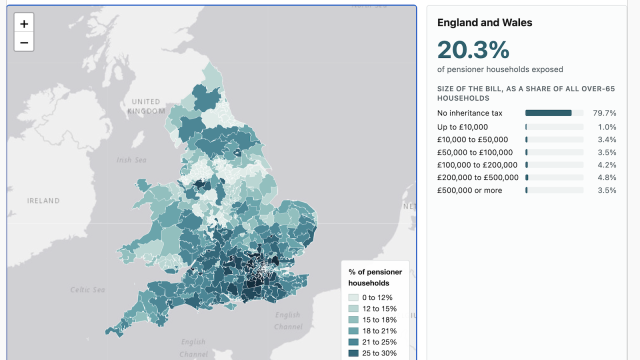
The hidden reach of inheritance tax: one in five pensioner households

MP Estate Planning: the unregulated firm selling defective trusts to the elderly

The problem with unregulated tax advisers: a scheme from Property118 that could cost clients £100k+

Did Keir Starmer use a trust to avoid inheritance tax?

A fair solution to inheritance tax on farms and small businesses

How to stop IHT avoidance but protect farmers
Footnotes
Households with a member aged 65 or over are ranked by estate wealth at April 2027 values. The top 1%, 5%, 10% and 20% wealth thresholds are approximately £4.6m, £1.75m, £1.24m and £840,000. The survey misses the very wealthiest, so, in all likelihood, this chart understates the benefit to that cohort. These are model results for Great Britain. ↩︎
Assessing the implications of inheritance tax reforms in the UK, Onward and Oxford Economics, October 2026. ↩︎
Economic and fiscal outlook, March 2026, Table A.5. Applying our estimated percentage reductions to that forecast is an approximation: it assumes the saving shares carry over to 2029-30 and does not model payment lags between liabilities and receipts. ↩︎
Existing rules can preserve residence relief after downsizing – subject to the conditions for HMRC’s downsizing addition. ↩︎
Assuming other nil rate bands are exhausted. ↩︎
The current residence nil rate band has a downsizing allowance, but I’m doubtful that could apply to the Conservative proposal. The numbers at stake would simply be too large, and the potential for avoidance too great. ↩︎
Assuming the house is bequeathed to children or grandchildren, and ignoring for the moment any capital gains tax and transaction costs. The Conservatives have separately pledged to abolish stamp duty on main homes. ↩︎
People might also be able to game the system by borrowing against investments rather than selling them. The extent to which that is viable depends upon whether there are anti-avoidance rules, and how they would work. Existing IHT rules already restrict deductions for borrowing used to acquire relieved assets or excluded property. ↩︎
On Japan: Takatoshi Ito, “Public Policy and Housing in Japan”, in Noguchi and Poterba (eds), Housing Markets in the US and Japan, 1994: inheritance tax valuation rules “help explain why the elderly in Japan retain housing and other real estate until their death. The share of real estate in taxable bequests in Japan is about 60 percent, while the comparable ratio in the United States is about 25 percent.” On the 2015 reform: Mikawa, Yasuda and Yukutake, “Does inheritance taxation reform promote to build inexpensive rental housing?”, Journal of the Japanese and International Economies, 2023, which finds the reform “potentially served as a good incentive for people to build inexpensive low-rise apartments for tax savings”; Reuters reported in December 2016 that apartment construction loans had set a record for seven consecutive quarters since the tax rise. Seko, Sumita and Yoshida, “Bequest Motives, Inheritance Tax, and Housing Choice” (2019), find that “the motive to bequeath housing makes moving less likely but capacity-increasing renovations more likely”. On AIM: Peel Hunt’s estimate of £6bn in AIM inheritance tax funds was reported by City AM in 2024; the Office of Tax Simplification noted in 2019 that “investment houses actively market the Inheritance Tax savings for qualifying shares purchased through AIM”. ↩︎
Although less than was seen in Spain, because houses are obviously much less liquid than shares. ↩︎
HMRC’s UK monthly property transactions statistics show 573,000 residential transactions in the first half of 2025, and forecasters expected about 1.18m for the year as a whole. ↩︎
The calculation is from our wealth and assets model and can be run from our GitHub. ↩︎
Before behavioural responses, cutting the rate cuts the tax in exact proportion, because every estate’s taxable amount is unchanged: a 56.2% cut in revenue needs a rate of 40% × (1 − 0.562) = 17.5%. We’ve ignored the reduced 36% rate for estates leaving 10% to charity, which would presumably be cut pro rata. ↩︎
OECD, Inheritance Taxation in OECD Countries, 2021, p.38. On heirs, p.57: “Empirical evidence shows that inheritance receipts depress heirs’ labour supply and that inheritance taxes could raise their incentives to work.” The classic study is Holtz-Eakin, Joulfaian and Rosen (1993), who found that people receiving a large inheritance were more likely to leave the labour force. A German lifecycle model cited by the OECD finds that every euro of inheritance tax brings in a further nine cents of income tax, because heirs work more. ↩︎
We explain the evidence for each of the others in our article on Reform UK’s overtime proposal. Costs are mostly from HMRC’s ready reckoner. The GDP figures are our approximate long-run estimates, using the OBR’s scoring of the 2024 employer NI rise as the yardstick for rate changes, and published studies for the structural reforms. For the family home exemption we use a cost of £7bn, the low end of our static range for 2029-30, and a GDP range of zero to £0.3bn: the top allows for a small saving response by donors, and the bottom is floored at zero rather than going negative, which is generous given the evidence on heirs. The bar for each option is the upper end of our GDP range divided by the cost, so these are generous to every proposal, including this one. Please bear in mind that these are approximate estimates, not forecasts. ↩︎
Geography explains a small part: the report says Northern Ireland accounts for less than 1% of liabilities. ↩︎
Leave a Reply