
We’re getting into Budget lobbying season. The latest is from Universities UK, who want a tax cut for employers – a new National Insurance exemption for graduates and others under 25. But their only research involved asking employers if they wanted a tax cut. They didn’t bother to calculate the cost, which turns out to be over £6bn. And they didn’t look at the evidence, which shows that this kind of tax cut creates very few jobs, and does so at enormous expense.
The proposal
It’s contained in Universities UK’s “Future Jobs Roadmap” – a series of recommendations to improve the job market for graduates and employers.
One of those recommendations is that employers should pay no National Insurance on employees under 25 earning less than £50,270. It’s presented as a way to boost graduate recruitment:
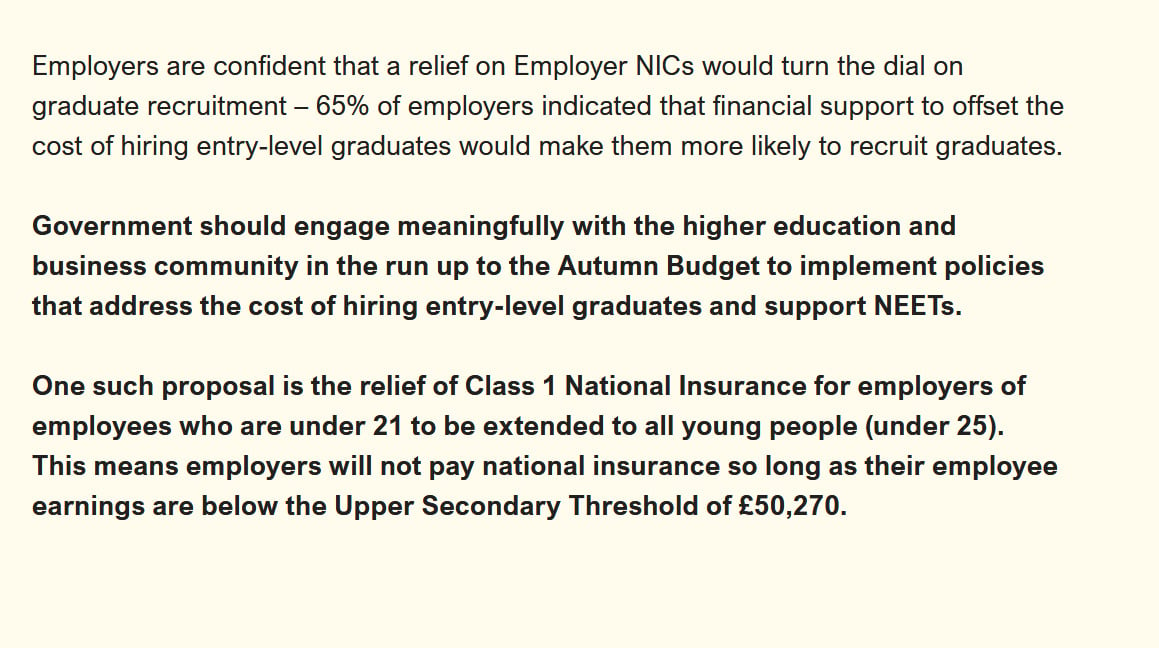
There are two obvious things missing here.
Universities UK’s report makes no attempt to calculate the cost of such a tax cut, and no attempt to calculate the benefit of the proposal in terms of jobs or economic growth.
We don’t know why such a well-resourced project would make a policy proposal with no underlying analysis.
Why we estimate the cost at £6-7bn
We use two different methods to estimate the cost:
First, a simple multiplication based on published statistics
Employers already pay no NI on employees under 21, or on apprentices under 25.1 So this proposal only affects 21 to 24 year olds who are not in apprenticeships.
That means about 2.2 million existing employees would be affected.2 The average employer NI for each of these is about £3,300,3 meaning a total cost of £6bn to £7bn each year.4
Second, a microsimulation model
We checked this result with PolicyEngine, an open-source microsimulation model of the UK tax and benefit system that runs on the government’s own household survey data. Its estimate was £6.3bn.56
These calculations don’t take account of two dynamic effects. First, we hold wages fixed but, in the long term, we should expect a national insurance cut to go to increased pay; that would reduce the cost.7 Second, and more immediately, to the extent jobs were created, that would increase tax revenue (both directly from those jobs and indirectly through wider multiplier effects). This effect, however, will be small – see further below.
You can see all our calculations and code on our GitHub.
Would it create jobs?
Universities UK polled employers as to what they might do in the future: 65% said financial support would make them “more likely” to recruit graduates.
This kind of polling is a notoriously bad guide to how people will actually behave. Ask people whether they’d pay for something, for example, and they say “yes” at two to three times the rate they actually do. It’s particularly bad here because the question was, in effect, “would you like a tax cut?”8
We’ve seen this before. Before each increase in the National Living Wage, employer surveys predicted job cuts – but those job cuts weren’t seen in reality.9 What employers say they’ll do in response to a tax or wage change, and what they then do, are different things.
It’s a much better idea to look at how employers have actually behaved. HMRC did this in 2018, commissioning an evaluation of the existing under-21 and apprentice reliefs. It surveyed 907 employers claiming the reliefs and concluded:
“In isolation neither relief has had a significant impact on workforce planning or decisions about hiring.“
Eighty per cent of employers said they simply absorbed the saving (and given this was self-reported, we should expect it to be an underestimate). Of those who had taken on more under-21s, only 2% mentioned the relief as a reason.10 This has the weakness that it’s reliant on recollection and psychology, but – unlike the Universities UK survey – the results run against the interest of the firms in question. We should therefore take it more seriously.
And something we should take even more seriously is the evidence from other countries.
Sweden introduced a very similar relief in 2007, cutting employer payroll tax from 31% to 15% for everyone under 26. The largest study of the tax cut found that it raised employment among the young by two to three percentage points, mostly by employers keeping on existing employees (as opposed to making new hires).11
This all creates a problem. The National Insurance cut has a huge “deadweight cost” – the £6-7bn cost of giving a cut for existing employees. If there’s only a small benefit in terms of new jobs, then that’s never going to overcome the deadweight cost. The cost per new job created will, therefore, be very high.
To put this into hard figures, we can apply the Swedish employment effect to the 3.36m people in the UK aged 21 to 24. That suggests the £6-7bn tax cut would create 70,000 to 100,000 jobs, costing £60,000 to £100,000 per job each year. There are many, many ways that £6-7bn could be employed more efficiently.
A second study of the same Swedish reform12 came to an even bleaker conclusion:
The estimated cost per created job is at more than four times that of directly hiring workers at the average wage. Hence, we conclude that payroll tax cuts are an inefficient way to boost employment for young individuals.
It’s worse than this in practice, because some of these jobs will have been displaced from elsewhere. The figures we’ve cited measure increased employment among the favoured age group, which is not necessarily the same as an increase in overall employment. At the margins, employers will hire or retain a 24-year-old instead of a 25-year-old. It’s redistributing jobs, not creating them.13
There’s also the odd effect that there will no longer be a National Insurance incentive to hire apprentices – undoing the aim of current policy.14 It’s unclear from the Universities UK paper if its authors understand that there’s an existing incentive, and that they’re breaking it.
As the Resolution Foundation put it earlier this year:
“Tax cuts such as these are a very expensive way to boost youth employment, with most of the spend simply paid to employers who would have taken on young workers anyway.“
A better tax cut
It’s not at all clear any plausible Government will have £6bn available for a tax cut. But, if it does, there are many better ways to cut tax than Universities UK’s proposal.
The April 2025 employer National Insurance increase hit hospitality and retail hardest – the sectors that employ most young people.15 Reversing part of that increase would be a far better use of the money. The same £6-7bn would raise the employer NI threshold from £5,000 to about £6,500, cutting the cost of every job by over £225.16 That helps the low-paid and part-time jobs where young people actually are, without needing an explicit (and potentially counter-productive) age boundary.
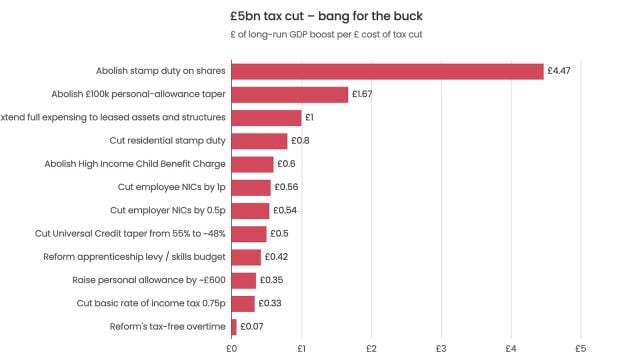
We like to assess tax cuts by the “bang for the buck”: the amount of GDP growth that each pound of tax cut creates. Here’s our updated rough and ready estimate for fifteen different tax cuts:17
You’ll see Universities UK’s proposal right near the bottom. In fact the four worst tax cuts on the chart are all ones that somebody is currently campaigning for: UKHospitality’s cut in VAT for hospitality, Reform UK’s tax-free overtime, Universities UK’s National Insurance proposal, and Reform UK’s £15,000 personal allowance.18
The worst tax cuts get the loudest support. The tax cuts that would do the most good are left with nobody to lobby for them.
Thanks to T for help with modelling, and K for Swedish data. And many thanks to PolicyEngine.
Ten better tax cuts than Reform’s £14bn overtime gimmick
Untaxing – The Laffer curve, and the napkin that changed the world
Tax cuts and tax rises: do tax cuts pay for themselves?

The Budget – a missed opportunity

Badenoch’s inheritance tax cut could cost £11bn – almost twice the advertised price
Capital gains tax reform was right. Now it’s dead.
Footnotes
Both reliefs are a zero rate of employer (Class 1 secondary) National Insurance on earnings up to the upper secondary threshold of £50,270. HMRC’s tax relief statistics (January 2026, Table 2) say these measures cost (respectively) £1,900m and £570m for 2025-26. Universities UK’s proposal uses the same design: a zero rate up to £50,270, with the normal 15% above it. ↩︎
The arithmetic: ONS’s Annual Survey of Hours and Earnings 2025 (Table 6.1a) reports 1.36m employee jobs aged 18 to 21 at a mean of £329 a week, and 4.59m aged 22 to 29 at £635 a week. A quarter of the first band plus three eighths of the second gives 2.06m jobs aged 21 to 24. A cross-check from ONS population estimates (3.36m people aged 21 to 24) and the Labour Force Survey employment rate gives 2.27m; we use 2.16m. ↩︎
Employer NI is 15% of pay above £96 a week. At the weekly pay typical of these ages (£470 for 21 year olds, £530 for 22 to 24 year olds) that is about £3,300 a year. ↩︎
Multiplying the two figures, then deducting NI on pay above £50,270 and the share of the apprentice relief already going to 21 to 24 year olds, gives £6.7bn on 2025-26 pay, with a range of £6.2bn to £7.4bn depending on what we assume about pay; uprating for pay growth to 2026-27 gives around £7bn. This is obviously a very simple approach, but the same method reproduces HMRC’s published cost of the existing under-21 relief within 1%, so we can be reasonably confident we’re in the right ballpark. ↩︎
PolicyEngine UK simulates taxes and benefits for every person in a representative sample of households (its calibrated version of the Family Resources Survey 2024-25), which lets you cost a reform by changing the rules and recomputing. We took each person’s age, earnings and employer NI from the baseline, with PolicyEngine’s default assumption that employer NI is passed through to wages switched off so that the figure is the statutory amount, and summed the NI the proposal would remove from 21 to 24 year olds. The raw result was £9.1bn. But PolicyEngine’s dataset has 2.9m employees aged 21 to 24 against about 2.2m in reality, and its counts by single year of age are unreliable (140,000 employees aged 18, 999,000 aged 24). We corrected this with the actual figures and cross-checked the result against HMRC’s published cost of the existing reliefs. So PolicyEngine is not giving us better data on the population (we end up using the same data), but it does give us better data on the per-head employer national insurance figure – £3,113 instead of the £3,300 figure we used in our simple calculation. ↩︎
The Resolution
Foundation costed this policy in June 2026 and put it lower, at £5.1bn. The scope of what they are costing isn’t entirely clear – they describe it as scrapping employer NICs for under-25s “altogether”, where Universities UK propose a zero rate only up to £50,270 – and their methodology isn’t set out in enough detail for us to see why their figure differs from ours. However, their lower figure for the cost is less significant than their much harsher conclusion on the benefit. They estimate the policy would create 38,000 jobs at a cost of £132,000 each (30% higher than our worst-case figure, for which see more below). Their press release calls it “a wasteful ratio of £132,000 per job”. ↩︎i.e. as income tax and employee NI claw back part of the pay increase ↩︎
The economics literature on “hypothetical bias” compares what people say they’d pay in a survey with what they actually pay when the money is real. Two meta-analyses of that literature, List and Gallet (2001) and Murphy and others (2005), find stated values exceed real ones by a factor of around two to three on average. Bertrand and Mullainathan’s “Do People Mean What They Say?” (American Economic Review, 2001) is the standard account of why economists distrust answers to questions of the form “would you do X if Y”: respondents answer in ways that are socially acceptable, that cost them nothing, and that they think will benefit them. A question that asks employers whether a tax cut would make them “more likely” to hire fails all three tests. ↩︎
Low Pay Commission, The National Living Wage review 2015-2020: headlines: “Econometric evidence consistently found only muted effects on employment. Where negative effects are found they are small and transitory.” Employer surveys ahead of each rise, from the CBI, the British Chambers of Commerce and trade bodies, routinely predicted the opposite. Note that this was for up to 2020. It is plausible that the minimum wage increases since then have had more significant effects. ↩︎
HMRC Research Report 514, Employer National Insurance contributions reliefs for apprentices under 25 and employees under 21 (Kantar Public, November 2018), pages 1 to 3 and 26 to 28. ↩︎
Saez, Schoefer and Seim, “Payroll Taxes, Firm Behavior, and Rent Sharing: Evidence from a Young Workers’ Tax Cut in Sweden“, American Economic Review 109(5), 2019: “compelling positive effects on the employment rate of the treated young workers, of about 2-3 percentage points, which arise primarily from fewer separations”, with “a zero effect on net-of-tax wages of young treated workers relative to slightly older untreated workers”. ↩︎
Egebark and Kaunitz, “Do payroll tax cuts raise youth employment?” (IFAU 2013, published in Labour Economics 2018 as “Payroll taxes and youth labor demand”). It found a smaller employment effect than Saez and colleagues, implying a labour demand elasticity for young workers of around -0.3. ↩︎
Direct age discrimination is unlawful. Whether because of ethics or anti-discrimination rules, employers are unlikely to just fire people over 25. The Swedish evidence is that the boundary produced retention below it rather than dismissals above it. But in the long term, the overall effect is the same. ↩︎
Under-19s accounted for 21.2% of the 353,500 new apprenticeships in 2024/25 and over-25s for 51.3%, leaving about 97,000 new apprenticeships aged 19 to 24 (DfE, Apprenticeships 2024/25). HMRC’s evaluation found employers saw the apprentice relief “as part of an overall package of incentives”, with the levy cited far more often as a reason for taking on apprentices; so the effect at the margin is real, but likely modest. ↩︎
The Low Pay Commission’s 2025 report notes that young people are “more likely to work in hospitality and retail, which have seen significant falls in vacancies and employee numbers… These industries were also hit by the NICs increase, even though younger workers themselves do not attract employer NICs”. We looked at the pressure on the sector in more detail in our article on the proposed hospitality VAT cut. ↩︎
HMRC’s ready reckoner puts a £2 per week change in the employer threshold at £420m in 2026-27, so £6bn buys about £28 per week, or £1,500 a year. At the 15% rate that is £225 per employee. The threshold was cut from £9,100 to £5,000 in April 2025. And of course the top of the range, £7bn, implies £262 per employee. ↩︎
We explain the evidence for each of them in our article on Reform UK’s overtime proposal. Costs are mostly from HMRC’s ready reckoner. The GDP figures are our approximate long-run estimates, using the OBR’s scoring of the 2024 employer NI rise (about 0.1% of potential output for £25bn) as the yardstick for rate changes, and published studies for the structural reforms; the workings are in the overtime article and, for the hospitality VAT cut, here. The bar for each option is the upper end of our GDP range divided by the cost, so these are generous to every proposal, including this one. For Universities UK’s proposal we take the Swedish employment effect described above, and then reduce it to allow for the jobs that are displaced from over-25s rather than created. These are approximate estimates, not forecasts. ↩︎
Reform UK proposes raising the personal allowance from £12,570 to £15,000. We estimate that costs £20-23bn a year across the UK, using both HMRC’s published statistics and PolicyEngine. Reform UK’s own figure is £17.7bn in the first year, which looks like a receipts-timed number covering England and Northern Ireland only (and if so, that’s a mistake because National Insurance is a UK-wide tax). It scores poorly here because about 90% of the money goes to people whose marginal tax rate does not change at all, and because it extends the 60% personal allowance taper from £125,140 to £130,000 – making worse the very distortion that sits near the top of this chart. ↩︎


Leave a Reply