
The Post Office told wrongly-accused postmasters their compensation offers were secret, and couldn’t be shown to anyone but a lawyer. That wasn’t true. They could have shown the offers to friends, other postmasters and the media – but the Post Office gagged them. The Solicitors Regulation Authority spent three years investigating, and was going to prosecute – then it dropped the case. It won’t say why.
We published our report in May 2023. The Solicitors Regulation Authority started to investigate almost immediately. In February 2025, the SRA served a formal notice on the Post Office’s law firm, Herbert Smith Freehills1, alleging breaches of its Principles 2 and 5 (upholding public trust in the profession, and acting with integrity) and recommending that the firm be referred to the Solicitors Disciplinary Tribunal.2
Last month, the SRA dropped the whole thing.
The SRA’s conclusion: the firm “exercised proper professional judgment”. The SRA refused to provide any explanation.
How the lawyers gagged the postmasters
Between 2000 and 2013, the Post Office falsely accused thousands of postmasters of theft. Some went to prison. Many had their assets seized and their reputations shredded. Marriages and livelihoods were destroyed, and thirteen suicides are linked to the scandal.
In 2020, the Post Office finally agreed to pay compensation to its victims under the “Horizon Shortfall Scheme” (HSS)3– about 2,500 postmasters.4
For many it was too late. At least 61 postmasters died, never receiving an apology or recompense.
The HSS scheme had numerous features which minimised the compensation postmasters received. Most importantly, postmasters were asked to complete a complex application form for which they were given no legal assistance.
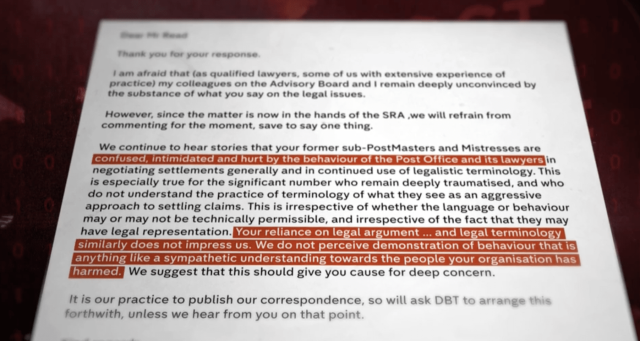
Then, when they received a response from the Post Office, making or denying a settlement offer, it contained this paragraph:

The postmasters we spoke to believed this meant they couldn’t tell anyone the terms of the offer (except a lawyer, and they had no lawyer). We think this is the natural interpretation.
It is, however, untrue:
- Settlement offers are often made “without prejudice”. This means that the correspondence cannot generally5 be shown to a court if the dispute is later litigated. But labelling an offer “without prejudice” does not magically make the offer confidential. The “This means that” sentence was, therefore, false.6
- Was the offer confidential on general principles? That’s clearly what the Post Office wanted – they later said that “allowing postmasters to compare offers could have some unwanted consequences”. But one party’s desire for secrecy does not create a duty of confidentiality – the duty will arise if “confidential information comes to the knowledge of a person… in circumstances where he has notice, or is held to have agreed, that the information is confidential”.7 And the Post Office later said that “there are no confidentiality provisions in the settlements and postmasters are free to discuss their settlements in full with anyone they choose to, once they have been agreed”.8
- A settlement offer may well have contained confidential information regarding the postmaster, such as their private financial information. When the Post Office was pressed on the confidentiality point by the Advisory Board, its answer was that postmasters “value their privacy” and that letting them compare offers “could have some unwanted consequences”. But this is a confidentiality that existed for the benefit of the postmaster – it did not bind them. And the Post Office’s response is damning: when given the opportunity to defend its position, the Post Office failed to identify any proper legal or factual basis for having asserted that postmasters had a duty of confidence.
The claim that the letter was confidential, and the postmaster couldn’t show it to anyone (other than their lawyer) was, therefore, false.
In some cases, the claim that the letter was “without prejudice” was also false, because the letter said the Post Office would pay nothing. A letter that makes no offer and concedes nothing is not a negotiation, and is not “without prejudice”.9 The Post Office has conceded this. In a note to the Horizon Compensation Advisory Board on 22 February 2024 it referred to “the labelling of nil offers which we accept was inappropriate”.10
The impact of the false confidentiality claim
The Post Office paid postmasters’ legal fees in only 198 of the first 1,924 HSS settlements. So the Post Office knew that 90% of recipients had no lawyer.11 Most were elderly; many were vulnerable. They needed to speak to family, friends and other postmasters – but the Post Office told them they couldn’t.
The SRA’s response
We referred the matter to the SRA. The Times covered the story here. The Horizon Compensation Advisory Board took the point up at the end of that year.
In January 2024 the SRA’s General Counsel wrote to the Advisory Board saying that a label could not unilaterally impose a duty of private or confidentiality. They asked (i.e. ordered) the Post Office and its solicitors to urgently change their practice:
![prejudice’ when the conditions for using those terms are not fulfilled. Particular care
in this regard may be needed where that recipient may be vulnerable or
unrepresented. Such markings cannot unilaterally impose a duty of privacy or
confidentiality.
The ‘Without Prejudice’ rule governs the admissibility of evidence, and the use of the
term should only be attached to an offer to negotiate (Galliford Try Construction Ltd v
Mott MacDonald Ltd [2008] EWHC 603 (TCC) at [5]). As our Warning Notice goes on
to state, “correspondence should not be marked as ‘without prejudice’ if that
correspondence does not fulfil the conditions for that label. You should consider
whether the communication represents a genuine attempt to compromise an existing
dispute. There should ordinarily be no need to apply it to correspondence which does
not offer any concessions and only argues your case and seeks concessions from
the other side.”
We have asked both the Post Office and their solicitors to confirm as a matter of
urgency that they are not and will not going forward use labels other than in
accordance with the Warning Notice.](https://taxpolicy.org.uk/wp-content/uploads/2026/08/sra_gc_body.jpg)
The Post Office obeyed, and stopped using the wording shortly after.
The SRA investigation
The SRA’s investigation ran for over three years.
It seems the abuse of “without prejudice” went beyond the Horizon Shortfall Scheme, as the SRA’s investigation also covered the Overturned Convictions Scheme, the Suspension Remuneration Review and the Post Office Process Review.12
When we wrote our 2023 report, we assumed the letters had been written by the Post Office’s in-house lawyers; we said we didn’t know if the Post Office’s external lawyers, Herbert Smith Freehills, were involved – we rather assumed they were not. But they were – and the firm became the main subject of the SRA’s investigation.
Herbert Smith Freehills served detailed representations disputing the allegations. In August 2025 the SRA made a further evidential request specifically about the nil-offer letters. In December 2025 the SRA told us it had “completed our investigation” and expected to give us the outcome in January 2026.
But we didn’t receive notice of the outcome until 13 August 2026.
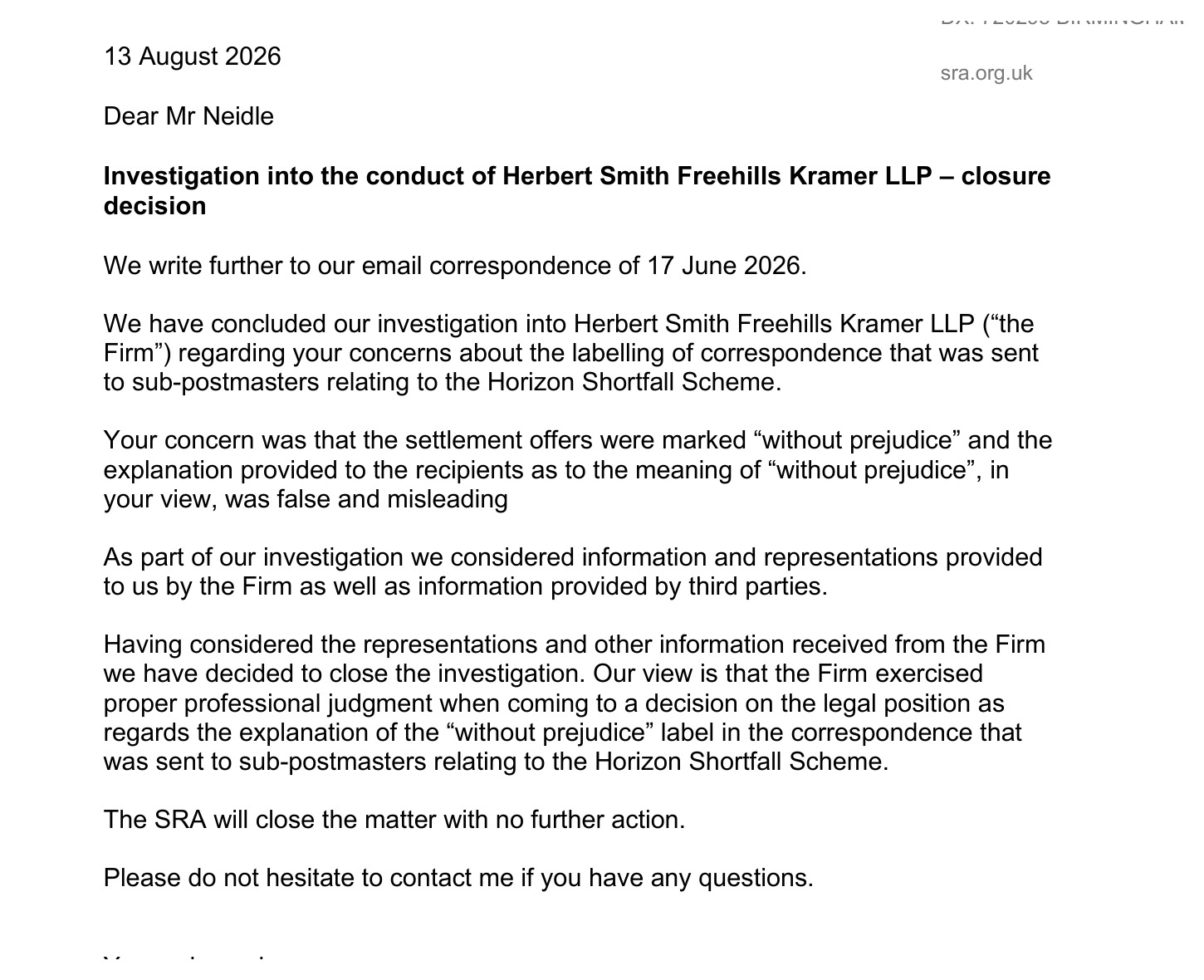
That’s the entire reasoning. The firm “exercised proper professional judgment when coming to a decision on the legal position”. There’s no indication of what the legal position is said to be, and no reference to the fact that the SRA had already stated that the Post Office’s approach was incorrect.
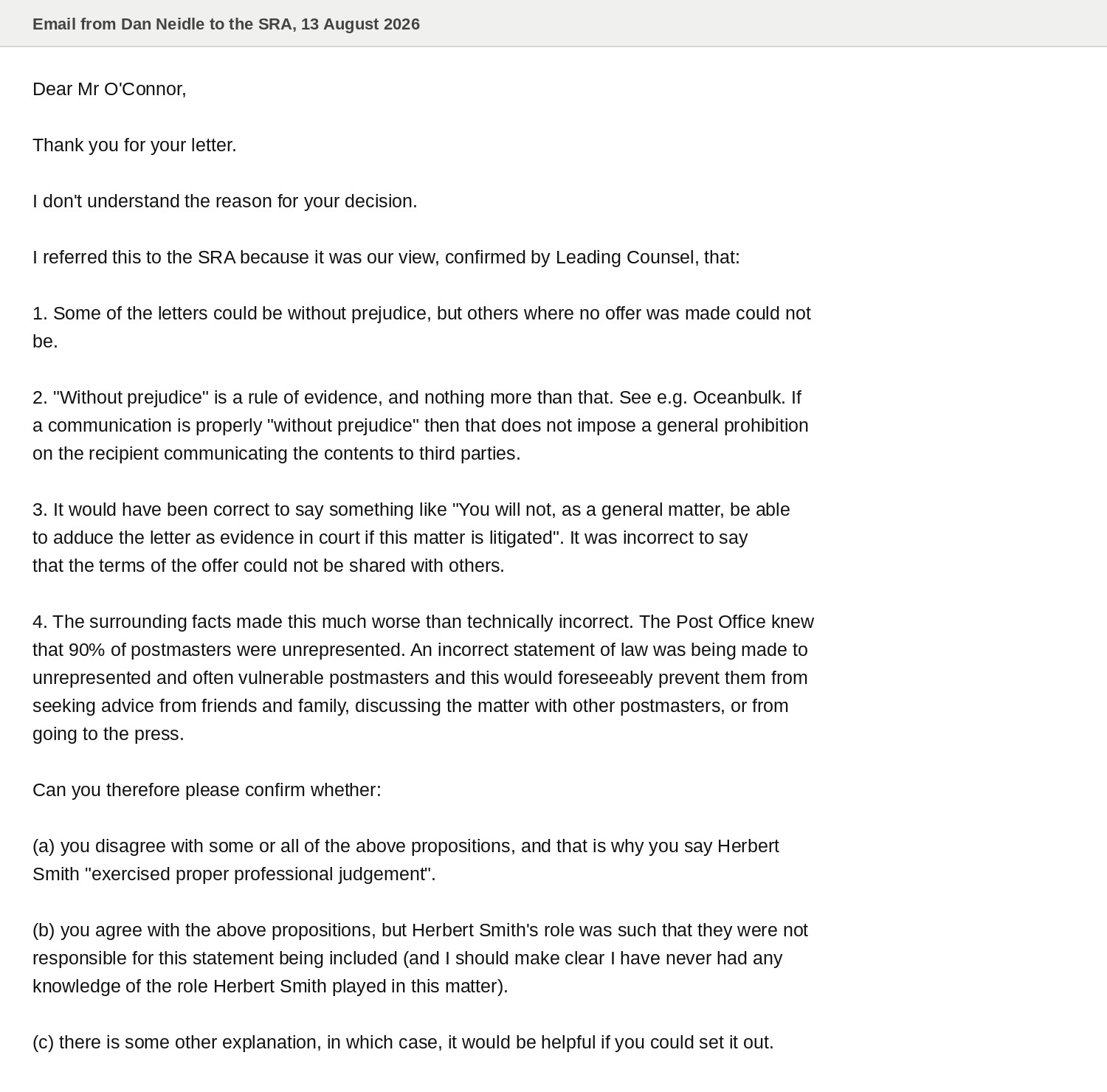
We asked for an explanation:
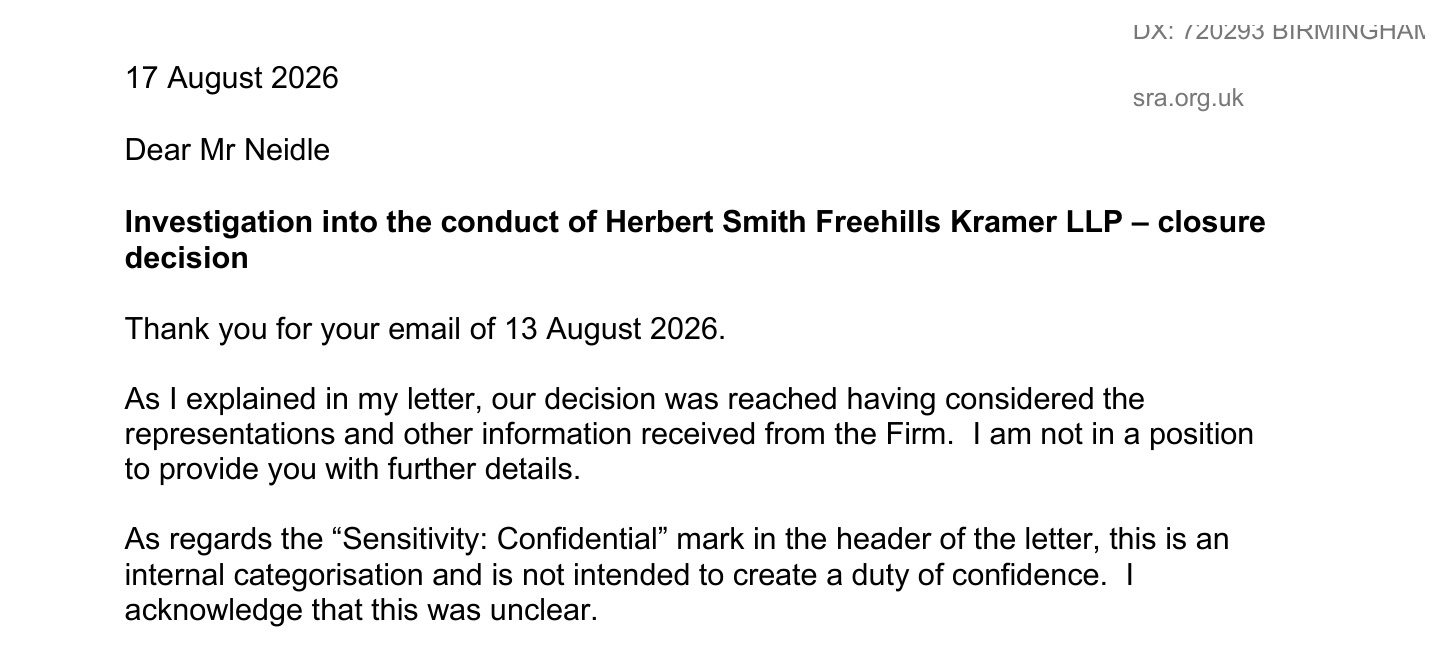
The SRA wasn’t willing to answer these questions:
Why the SRA changed its mind
What happened between the SRA’s January 2024 statement that “without prejudice” did not impose confidentiality, and the SRA’s August 2026 statement that Herbert Smith Freehills “exercised proper professional judgment”?
The Hurst case.
On 20 January 2026, the High Court handed down judgment in Hurst v Solicitors Regulation Authority. Ashley Hurst, a partner at Osborne Clarke, had acted for Nadhim Zahawi and sent tax lawyer (and Tax Policy Associates founder) Dan Neidle an email headed “Confidential & Without Prejudice” saying he was “not entitled to publish it or refer to it other than for the purposes of seeking legal advice”. He published it. The SRA prosecuted Hurst.13
In December 2024 the Solicitors Disciplinary Tribunal found misconduct, fined Hurst £50,000 and awarded £260,000 in costs.
Collins Rice J allowed Hurst’s appeal and set the Tribunal’s decision aside. She held that the Tribunal had misdirected itself on the law, had not properly analysed the email as a whole, and had not adequately explained its findings. Its reasoning was “condensed to the point of compromised intelligibility”, and its decision was “insufficiently analysed and reasoned, vitiated by misdirection and error of law, and unfair”.
The High Court did not decide that the email was definitely confidential, or that Hurst would have succeeded in a claim to prevent its publication. The question was whether the position advanced in the email was properly arguable, and whether advancing it could fairly be treated as professional misconduct.
The judge held that there was a legally recognisable basis for Hurst’s position. The email concerned an identifiable legal dispute, proposed retraction as an alternative to litigation, contained private family and financial information known to very few people, and stated that the information was being supplied for the limited purpose of resolving the dispute. That was enough to make the confidentiality and without prejudice arguments “properly arguable”. The Court stressed that the “properly arguable” threshold does not require an argument to be strong or even persuasive.
We understand that the Hurst decision is the sole reason for the SRA’s about-face.
Why this is not Hurst
There are very obvious and highly material differences between the Post Office case and Hurst.
First, Hurst was a decision about professional misconduct and arguability. The High Court did not establish a general rule that a solicitor may declare settlement correspondence confidential. It decided that, on the particular facts, Hurst had a properly arguable legal basis for what he wrote and that the Tribunal had not lawfully or fairly explained its finding of misconduct. The Post Office’s own response to the advisory board showed no properly arguable legal basis.14
Second, there was no confidential material belonging to the Post Office. Collins Rice J held that the Tribunal was correct that “without prejudice” was a rule of admissibility and did not, of itself, create a confidentiality obligation.15 The judge’s analysis turned on the fact that the Zahawi email actually contained something capable of being confidential: private family and financial information about Mr Zahawi and his father which “very few people” knew, supplied for a single stated purpose.16 We’re not aware of anything like that in an HSS offer letter. The information in it is the postmaster’s own, plus the sum the Post Office is prepared to pay them. There is no third party whose privacy is engaged. When the Post Office was pressed on this by the Advisory Board, its answer was that postmasters “value their privacy” and that letting them compare offers “could have some unwanted consequences”. Not even the Post Office attempted to claim that the letters contained material confidential to the Post Office.
Third, this was policy, not a hurried judgment call. The email in Hurst was written on a Saturday afternoon in July 2022, about ninety minutes after a phone exchange, in response to a tweet posted that morning, and it promised a fuller open letter on the Monday. The law can be more generous to a solicitor making a fast call under pressure than to a considered institutional position. The HSS paragraph absolutely was a considered institutional position – it was template wording, sent to at least the 1,924 postmasters who had settled by April 2023, over a period of years, with a documented decision behind it. It was sent in the context of a national scandal which was of the highest public interest.17 And it was still being defended, on its lawyers’ advice, as “entirely correct and proper as a matter of law” in February 2024, nine months after we first raised it.
Fourth, the recipients were not lawyers. Neidle was an experienced lawyer and was a senior partner at one of the world’s largest law firms. The postmasters were not in that position. They were mostly elderly. All of them had spent years being told by the Post Office that they were thieves; many were still traumatised by that. Only 10% had a lawyer. Telling someone in that position they couldn’t show a letter “to others” wasn’t legal shorthand between professionals. It was an instruction, from the institution that had spent years trying to destroy them.
Fifth, the SRA’s own guidance is written for exactly this case. The SRA’s SLAPP warning notice at the time told solicitors not to mislead recipients by labelling correspondence “without prejudice” where the conditions were not met. The section on “labelling” started by saying:
“We expect you to ensure that you do not mislead recipients of your correspondence, and to take particular care in this regard where that recipient may be vulnerable or unrepresented.
…
Such markings cannot unilaterally impose a duty of privacy or confidentiality where one does not already exist.”
On the information available to us, the SRA’s decision is inexplicable. And they’ve refused to explain it.
The consequences
Nearly two thousand postmasters received these letters and settled for an average of around £32,000, at a time when they believed they were forbidden from comparing notes with each other, from asking a friend whether the number looked right, or from going to the press. Some of them will have accepted less than they should have. We will never know how many, or how much.
The lawyers responsible will now never face any consequences.
That’s bad enough – but when the SRA make a decision that contradicts their own statements and guidance, you can expect unscrupulous lawyers to ignore those statements and guidance in the future.
We’ve asked the SRA if lawyers are now permitted to send unrepresented and vulnerable people a lowball settlement offer, and tell them it’s confidential and can’t be shown to anyone. We’ll publish their response.
Many thanks to B, P and T for their advice and analysis of the without prejudice and common law confidentiality position. Thanks to R and C for their general review.
Photograph “Mundesley post office and shop” by Pauline E, via Geograph Britain and Ireland and Wikimedia Commons, used under the Creative Commons Attribution-ShareAlike 2.0 Generic licence. I should add for completeness that there is no suggestion that this branch, or anyone connected with it, was involved in any of the matters described above.

How the Post Office gagged postmasters with false confidentiality claims
New evidence: the Post Office deliberately designed its compensation scheme to deter postmasters from applying

The Post Office – pushing postmasters to accept £75,000 compensation without legal advice

The Post Office – reckless with postmasters’ personal data; abusing data privacy to protect itself
The Post Office’s top priority is covering-up its mistakes
The Post Office has finally stopped intimidating postmasters into silence; but it’s too late
Footnotes
The firm was Herbert Smith Freehills LLP when the letters went out. It became Herbert Smith Freehills Kramer on 1 June 2025, after merging with the New York firm Kramer Levin, and that’s the name the SRA uses in its closure letter. We call it Herbert Smith Freehills throughout, because that’s what it was called at the time. ↩︎
The SRA told us on 11 March 2025 that it had “issued a notice setting out alleged breaches of our Principles two and five”, and on 13 June 2025 that the Notice was issued on 17 February 2025 and included a “recommendation that the matter be referred to the Solicitors Disciplinary Tribunal”. Principle 2 requires a solicitor to “act in a way that upholds public trust and confidence in the solicitors’ profession and in legal services provided by authorised persons”. Principle 5 requires a solicitor to “act with integrity”. A finding under Principle 5 is serious. It’s the principle under which want of probity is charged. ↩︎
Previously the “Historic Shortfall Scheme”. ↩︎
The HSS scheme doesn’t cover the postmasters who were wrongly convicted, or the 555 postmasters who claimed under the group litigation order (GLO) – these two groups overlap, but there are likely others who haven’t claimed under any scheme. And there have been many more claimants since – as at July 2026 about 15,000. ↩︎
“Generally” because without prejudice material is admissible for a range of purposes. It can be used to prove whether a settlement was in fact reached, and as an aid to construing the resulting agreement (Oceanbulk). It can found an estoppel. It can be relevant to costs determinations where a Calderbank offer is made, and where exclusion would cloak “unambiguous impropriety”. See Robert Walker LJ’s survey of the exceptions in Unilever plc v Procter & Gamble Co [2000] 1 WLR 2436. ↩︎
In Rush & Tompkins Ltd v Greater London Council [1989] AC 1280 at 1299, Lord Griffiths said: “The ‘without prejudice rule’ is a rule governing the admissibility of evidence and is founded upon the public policy of encouraging litigants to settle their differences rather than litigate them to a finish.” See also Oceanbulk Shipping & Trading SA v TMT Asia Ltd [2010] UKSC 44. ↩︎
This is Lord Goff’s statement of the established law in Attorney General v Guardian Newspapers (No 2) [1990] 1 AC 109. ↩︎
We spoke to a range of practitioners; settlement offers are only very rarely made confidential. Final settlements, on the other hand, often are made confidential (sometimes improperly), but that is typically achieved by a separately negotiated confidentiality agreement, not just an assertion by one party. There would usually be a list of people to whom disclosure could be made (such as family members, lawyers and insurers). ↩︎
The label properly attaches to an offer to negotiate, not the bare assertion of a position: Buckinghamshire County Council v Moran [1990] Ch 623, applied by Coulson J in Galliford Try Construction Ltd v Mott MacDonald Ltd [2008] EWHC 603 (TCC) at [5.2(c)]. ↩︎
While maintaining that on offers of money the label “was entirely correct and proper as a matter of law”. ↩︎
Post Office FOIA response of 11 April 2023: 1,924 settlements totalling £62m as at 4 April 2023. 198 postmaster legal fees paid as at 9 March 2023, totalling £217,000, with 29 more pending. That is an average settlement of roughly £32,000, and roughly £1,100 of legal fees for the one postmaster in ten who had a lawyer. ↩︎
We have no specific information as to what happened on this point in relation to the other schemes. ↩︎
We therefore have an obvious conflict of interest, but it is important to note that Neidle had no role in the decision to prosecute, the grounds for prosecution, or the conduct of the prosecution or appeal (beyond making the original referral and giving witness evidence). This is not the place to discuss whether the High Court decision in Hurst was correctly decided, and this article therefore proceeds on the assumption that it was. ↩︎
it is possible that the Post Office or its lawyers came up with an arguable basis subsequently, but that is irrelevant. The question is whether they had a properly arguable legal basis at the time. It is presumably also possible that they had a basis of some kind, but decided not to give it to the advisory board. That would raise its own questions. ↩︎
“The use
of the ‘without prejudice’ label is however, as the Tribunal decision rightly identified,
a proposition about the admissibility of communications rather than about their
publication as such (although if a communication is made on a without prejudice basis
that may be part of the factual matrix within which confidentiality has to be considered,
as discussed below).” ↩︎i.e. Collins Rice J was applying the classic test in Coco v A N Clark (Engineers) Ltd [1968] FSR 415 at 419: information having the necessary quality of confidence, imparted in circumstances importing an obligation of confidence. ↩︎
The SRA told us on 11 March 2025 that it had obtained from the Post Office and its lawyers “the template letters, and contemporaneous records showing the decision-making around the use of the label and the volume of letters issued”. This was, presumably, a decision that somebody took, recorded, and stood behind. ↩︎


Leave a Reply