Oxfam – taxing a windfall that doesn’t exist

18 July 2023

3 Comments

Here’s Oxfam’s press release from earlier this month:

Big business’ windfall profits rocket to “obscene” $1 trillion a year amid cost-of-living crisis; Oxfam and ActionAid renew call for windfall taxes
Published: 6th July 2023
 

722 mega-corporations raked in $1 trillion a year in windfall profits in 2021 and 2022.
A windfall tax of 90 percent on last years’ windfall profits could generate $941 billion —money that now could be used to tackle poverty and climate change.
While profits soared, one billion workers across 50 countries took a $746 billion real-term pay cut in 2022. 
Oxfam and ActionAid are calling for permanent windfall taxes on windfall profits across all sectors. 

722 of the world’s biggest corporations together raked in over $1 trillion in windfall profits each year for the past two years amid soaring prices and interest rates, while billions of people are having to cut back or go hungry.  

Analysis by Oxfam and ActionAid of Forbes’ “Global 2000” ranking shows they made $1.09 trillion in windfall profits in 2021 and $1.1 trillion in 2022, with an 89 percent jump in total profits compared to average total profits in 2017-2020. For this analysis, windfall profits are defined as those exceeding average profits in 2017-2020 by more than ten percent.

45 energy corporations made on average $237 billion a year in windfall profits in 2021 and 2022. Governments could have increased global investments in renewable energy by 31 percent had they taxed at 90 percent the massive windfall profits that oil and gas producers funneled to their rich shareholders last year. There are now 96 energy billionaires with a combined wealth of nearly $432 billion ($50 billion more than in April last year).

To Oxfam’s credit, they now link to the methodology from the press release:
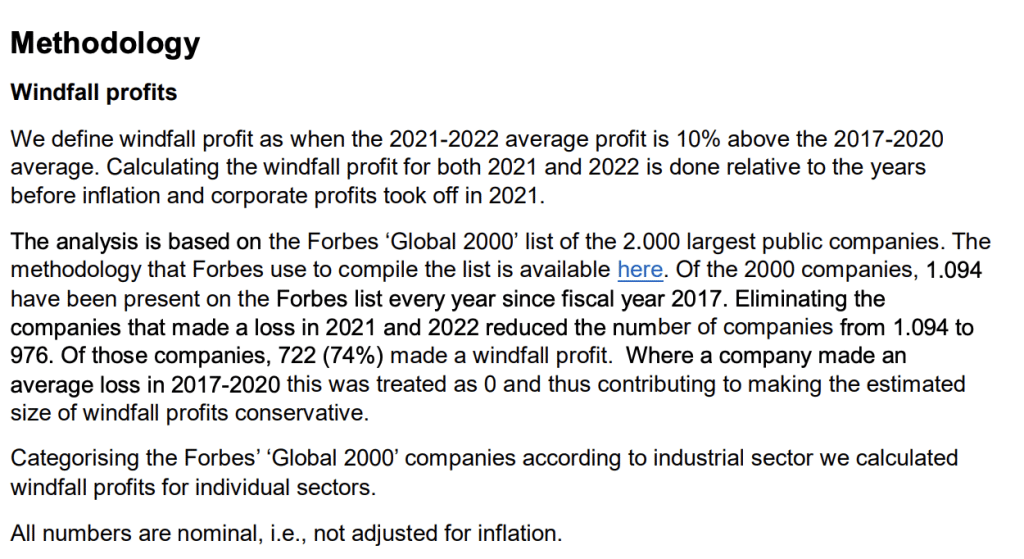
Methodology section describing the calculation of windfall profits from the Forbes Global 2000 list: Methodology

Windfall profits

We define windfall profit as when the 2021-2022 average profit is 10% above the 2017-2020 average. Calculating the windfall profit for both 2021 and 2022 is done relative to the years before inflation and corporate profits took off in 2021.

The analysis is based on the Forbes 'Global 2000' list of the 2.000 largest public companies. The methodology that Forbes use to compile the list is available here. Of the 2000 companies, 1.094 have been present on the Forbes list every year since fiscal year 2017. Eliminating the companies that made a loss in 2021 and 2022 reduced the number of companies from 1.094 to 976. Of those companies, 722 (74%) made a windfall profit. Where a company made an average loss in 2017-2020 this was treated as 0 and thus contributing to making the estimated size of windfall profits conservative.

Categorising the Forbes' 'Global 2000' companies according to industrial sector we calculated windfall profits for individual sectors.

All numbers are nominal, i.e., not adjusted for inflation.

So a company has made a “windfall profit” – and gets taxed at 90% – if its 2021-2022 average profit is 10% above the 2017-2020 average profit.

Here’s a simple math question: how fast would a company’s profitability have to grow over those six years before it has a 10% profit increase, and therefore a “windfall”?

Let’s start by assuming no real terms profitability growth at all, and see what happens. Starting with $100 profit in 2017, and using a very simple model that just uprates each year’s profit by global average inflation in the previous year:
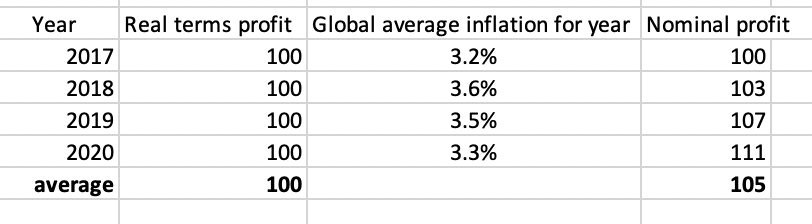
Table calculating nominal profit from constant real terms profit and global average inflation between 2017 and 2020: With real terms profit constant at 100 each year and annual inflation between 3.2% and 3.6%, nominal profit rises from 100 in 2017 to 111 in 2020, resulting in a four-year nominal average of 105 compared to a real average of 100.

Year | Real terms profit | Global average inflation for year | Nominal profit
2017 | 100 | 3.2% | 100
2018 | 100 | 3.6% | 103
2019 | 100 | 3.5% | 107
2020 | 100 | 3.3% | 111
average | 100 | | 105

Now let’s keep going, and see where zero real terms profitability growth takes us in 2021-22:

Spreadsheet table showing profit calculations for 2021 and 2022: The table compares values of 100 to adjusted figures of 114 for 2021 and 120 for 2022 (averaging 117), calculating a nominal increase in 2021/22 profit over 2017–20 profit of 11.2%.

2021 | 100 | 4.7% | 114
2022 | 100 | | 120
average | 100 | | 117
Nominal increase in 2021/22 profit over 2017-20 profit: | 11.2%

That 11.2% increase is, in Oxfam’s terms, a windfall – and the 90% tax applies (because they only use nominal figures). But in real terms, there’s been no profit increase at all.

So the answer to the simple math question is: Oxfam forgot about inflation, and compounding. so its methodology will always consider a company to have a windfall unless its profit has shrunk in real terms. They didn’t actually find 722 multinationals that had made a windfall; they found 722 multinationals whose profits hadn’t fallen in real terms (or at least hadn’t fallen much).

I wrote to Oxfam pointing this out and received a disappointing response (full copy here) which justifies reporting profits in nominal figures (which is fine, indeed commonplace), but doesn’t justify using nominal figures/ignoring inflation to calculate “windfalls”. I don’t think it can reasonably be defended.

I don’t think this was intentional. Oxfam used to write thoughtful pieces about the role of taxation in development. Now they just throw out endless identikit windfall tax and wealth tax proposals; how and whether such proposals could actually be implemented doesn’t seem terribly important to them anymore.

It’s a shame. Oxfam have considerable resources and a large research team. If they turned back to serious tax policy they could do a lot of good.


3 responses to “Oxfam – taxing a windfall that doesn’t exist”

  1. John Teal avatar

    What profit are we talking about? There are many steps between value added, value added at current prices, pre- and post- tax profits, etc. I can see Oxfam have persuasive publicity in favour of redistribution of benefits from economic activity but this doesn’t do anything for serious improvement of the human lot. Some kind of tax has to be levied in this wonderful, complex, globalized world. Would a slice of gross revenue be simpler and enforceable?
    Any suggestion based on firm facts and careful analysis would be welcome.

    1. Dan avatar

      I don’t understand that at all. What’s wrong with taxing profits?

  2. AMK avatar

    I think you have it, Dan. Most of these proposals placed by campaign groups are as enmeshed in what I call the Anger Reaction Complex which they believe is wholly confined to the the political right. Getting the Clikz are what they are primarily interested in.
    Dear Oxfam, the sources you give for your numbers are reputable sources aimed primarily aimed at smart professional investors (plus Forbes readers). They know about inflation. They discount the nominals for inflation and other stuff and pay (or paid) people like Dan to check it and advise on aspects of investment decisions. So I agree with Dan. Unless you do this your conclusions are meaningless. He is not saying that companies do not make supra-normal profits. He is saying that your methodology mis-identifies them. but Hey! It’s all capitalist breadhead, Dude.

    I have transferred my daily adjusted minor irritation from some random oligopolist megacorp to Oxfam. I will fine Oxfam one old unwanted paperback.

    Cheers,

    A.

Leave a Reply

Your email address will not be published. Required fields are marked *