
The EU Tax Observatory have just published an excess profits tax proposal which would tax listed energy companies on 33% of the increase in their market capitalisation in 2022. EU headquartered companies get fully taxed. Non-EU headquartered companies get taxed pro-rata to their sales in the EU.
So, for example, if the UK was to implement such a tax1 then BP and Shell, whose market cap has increased by c£150bn so far this year, would pay £50bn in tax.
This is a highly unusual proposal, and therefore interesting from a tax policy standpoint. I’m very conscious of the “not invented here” problem in tax policy, and I don’t want to bash this proposal just because I view my, simpler and more conventional, windfall tax proposal as preferable. However, there are five issues with this proposed tax which illustrate why conventional tax designs are often more effective. These kinds of design choices are going to be critical when (and I think it is a “when”) ambitious windfall taxes become a political inevitability.
1. Breaching the norms of international taxation
There is much to criticise about the norms of international taxation, but one thing is inarguable: the further a tax departs from these norms, the more likely there are to be geopolitical complications. The various digital services taxes causes ructions and the threat of a trade war, even though the amounts raised were extremely modest.
Imposing a very unusual €10bn+ tax on national champions such as Saudi Aramco, Equinor, Exxon and BP seems much more provocative than the digital services taxes, and is therefore very likely to trigger complaints that the tax is contrary to international norms. Others can comment on the likely geopolitical consequences with more authority than I can.
2. Potential breaches of WTO/GATS
As a practical matter, complaints about taxes breaching international norms often take the form of arguments that the taxes are contrary to WTO/GATS. Often this is theoretical (on the part of academics) and rhetorical (on the part of politicians) rather than leading to an actual WTO challenge; we certainly saw this dynamic playing out for the digital service taxes.
Here there would be two arguments:
- The excess profits tax breaches the EU’s national treatment (NT) obligations under GATS, because it is (in its effect) discriminatory in disproportionately applying to non-EU companies. This is precisely the same point that has been made about digital services taxes.
- The tax breaches the EU’s most favoured nation (MFN) obligations under GATS, because it applies to listed companies but exempts unlisted companies, even where the companies are in essence carrying on precisely the same business.
These are complicated issues, and I won’t go into them further here – other than to note these points are political as much as technical/legal.
3. The design problem with snapshot taxes
As a general principle, there are problems with “snapshot” taxes, applying to a taxpayer’s position at a particular moment in time. The results can be arbitrary; they can also be easily manipulated.
If we pre-announce an excess profits tax that applies to the end 2022 market capitalisation, then I don’t think it’s impossibly cynical of me to expect depressed revenue projections, profit warnings, takeover offers, and other events before year end which just happen to mean that shares in energy companies take a mysterious and temporary dip at the end of 2022. To put it more neutrally: people respond to incentives, and energy companies will have a very large incentive to depress their share price by year-end.
We could prevent manipulation/avoidance by keeping schtum for now as to the precise details of the tax, waiting until the current crisis passes, and then applying the snapshot date (and other mechanics) retrospectively. This is one of the reasons why I said in my windfall tax blueprint that the best windfall taxes are retrospective.
That still leaves the problem of arbitrariness. That is inevitable when, on a day-to-day level, share prices are famously random. What if market cap falls just before the snapshot date, and then recovers just afterwards? What if, conversely, market cap peaks just beforehand, and then falls back to 2021 levels afterwards (very possible, if more gas supplies come online than expected)? Do companies get refunds? What if the delta between the price on the snapshot date, and the price when the tax falls due, is so great that raising enough capital to pay the tax is impossible?
The snapshot problem would be less serious if we were taxing something that companies “had” – like profits or property. The result would still be arbitrary, but a company could always afford to pay the tax. Here we would be taxing something that is, for the company, mostly notional, and so we risk the company not “having” it when the tax falls due.
So I would say it’s preferable from a tax design perspective for windfall taxes to be retrospective, and to tax things that have economic reality for the taxpayer – like actual cash money/profits.
3. Legal conflict with double tax treaties
The double taxation treaty between France and the UK prevents France from taxing UK companies on their capital gains (save in certain circumstances, not relevant here). So would it stop France taxing BP/Shell under this proposed excess profits tax?
The definition of taxes covered by the treaty is wide, and I would say clearly covers the proposed excess profits tax:
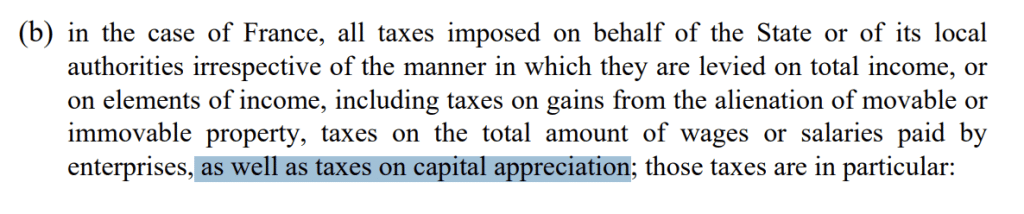
The capital gains article looks like this:
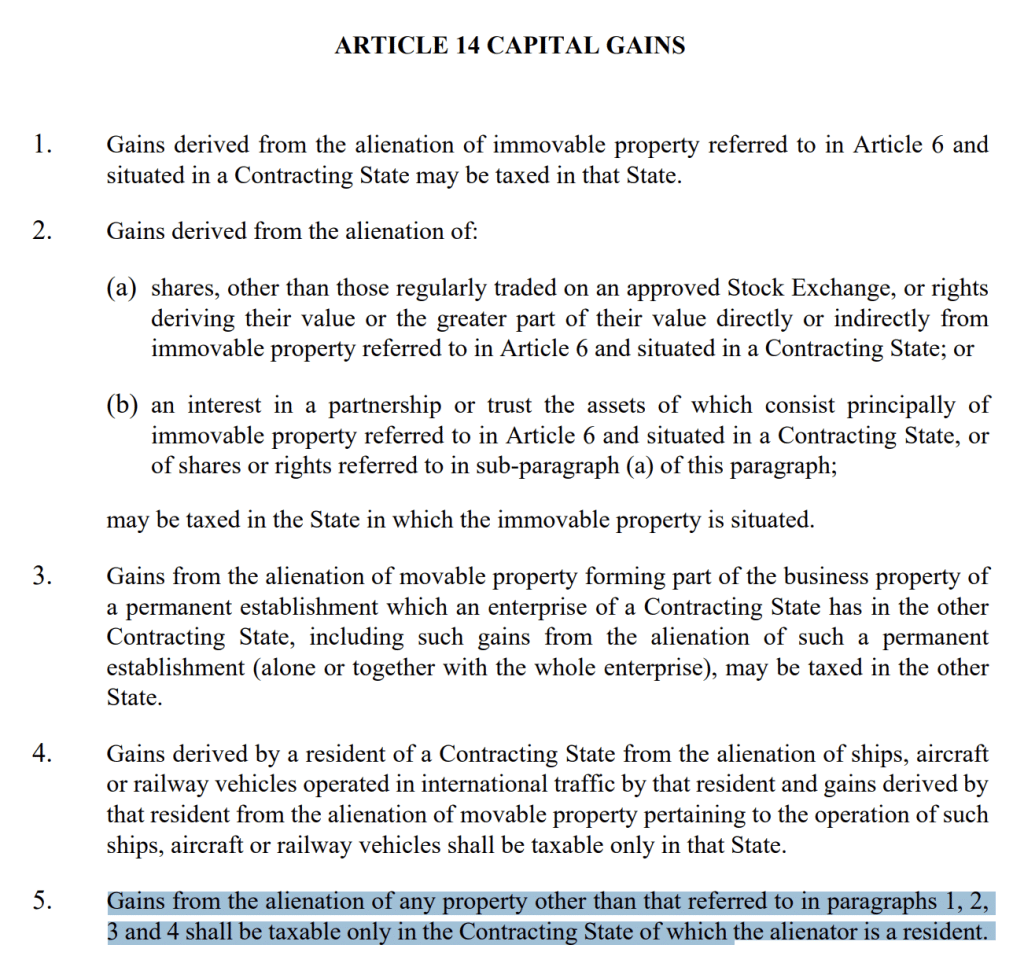
Article 14(5) would prevent France from taxing BP/Shell, because their gains are taxable only in the UK, provided they are gains “from the alienation of any property”. Are they? On its face you’d say “no” – nothing is being sold/alienated. However, the OECD Commentary to the Article2 specifically envisages taxes on unrealised capital appreciation. Logically it probably has to, as if tax treaties only covered realised gains, then a country could sidestep treaty restrictions by taxing unrealised gains.
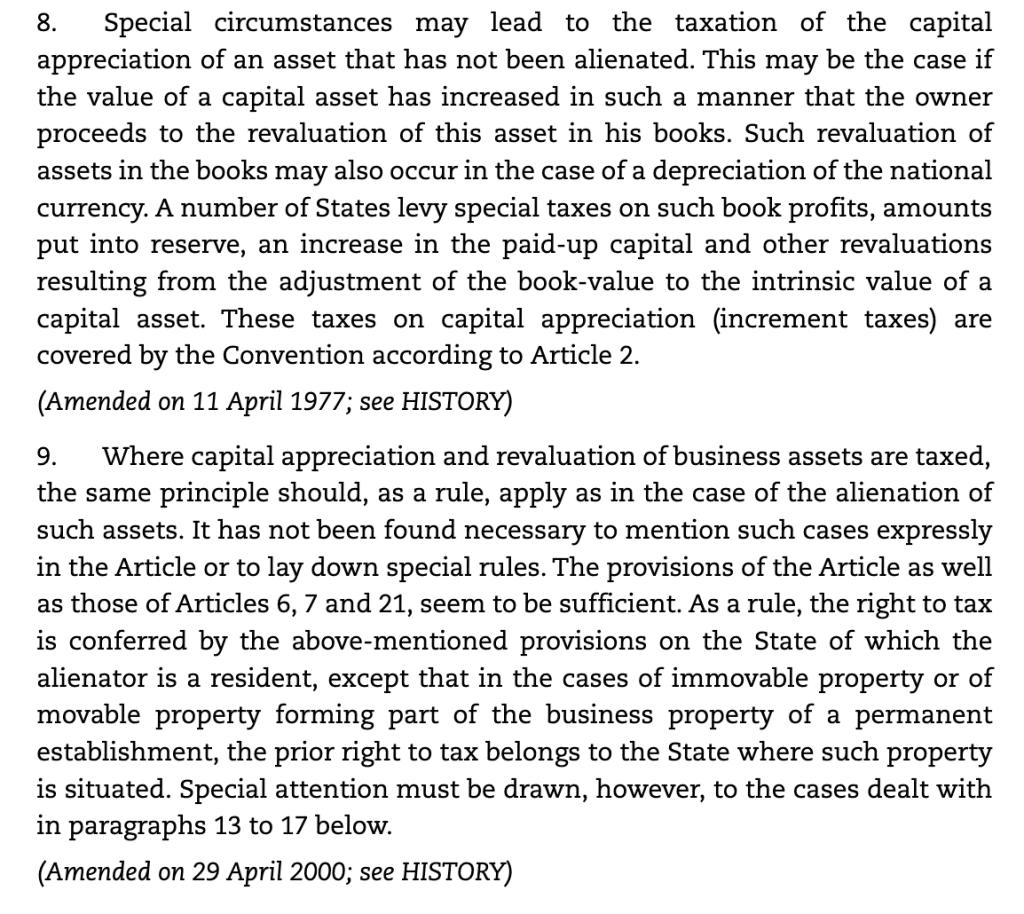
So in my view it’s likely the treaty would prevent France taxing BP or Shell. This is not beyond doubt – one could argue that this is not a capital gain *of* the company in question; however, I would say that is not a requirement of the treaty.
Similar issues would arise with the French treaty with the US, Norway, Saudi, etc; and the German treaties, and so on – although the argument is particularly strong for the treaties which refer explicitly to “capital appreciation” – many do not.
Applying the proposed tax to non-EU businesses is therefore going to be legally challenging.
4. Potential legal conflict with the Capital Duties Directive
The Capital Duties Directive prohibits indirect taxes on a variety of transactions relating to companies’ capital. It used to be an obscure, sleepy little Directive, until it was applied to nullify UK stamp duty/SDRT on issuances into clearance services and depositary receipts, and cost the UK perhaps £5bn. So the Capital Duties Directive is now a famously terrifying Directive, which the CJEU interprets exceptionally broadly:
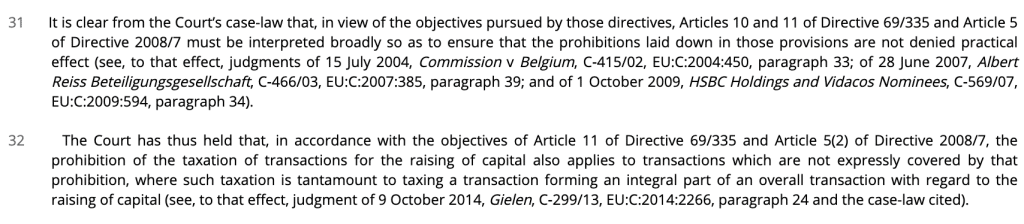
It is therefore in my view probable (but far from certain3) that the CJEU would prohibit the proposed tax (on the basis that the tax is an indirect tax on the capital of companies admitted to a stock exchange).
Conclusion
This is not a complete list – there are potentially other difficulties with the tax, for example EU law discrimination arguments (of the type discussed by Ruth Mason and others), and the potential incentive for EU energy companies to migrate to outside the EU, so they become taxed at a lower rate.
However my conclusion is simple: the more important a tax, and the more money you seek to raise, the more important it is for the design of the tax to be as conventional as possible.
Image by DALL-E – “a picture of an oil rig paying tax, digital art”
Footnotes

Oxfam – taxing a windfall that doesn’t exist

Is it right that Shell and BP made $70bn profit in 2022 but pay little tax in the UK? Yes. And also, no.
The £5bn flaws in the UK oil and gas windfall tax

How to design a £30bn windfall tax on the energy sector

Budget 2026 – what it means


Leave a Reply