
Search results for: “embed”

  • How to raise £8bn by increasing capital gains tax

    How to raise £8bn by increasing capital gains tax

    The two biggest tax-cutting Conservative Chancellors in British history both increased capital gains tax – and for good reasons. Jeremy Hunt should follow them, and raise £8bn.

    Here’s the current situation: someone earning £50k pays income tax at a marginal rate of 40%; someone earning £150k pays a marginal rate of 45%. But the same person making a capital gain pays nothing on the first £12,300 of gain, and only 20% on the rest. This is a problem for several reasons:

    • It’s inequitable that a type of income received mainly by the wealthy is taxed less than other types of income (and particularly employment income). “Mainly” understates the case – HMRC statistics show that over half of all taxable gains are received by only 5,000 people:
    £75bn of CGT taxable gain in 2020-21 – this chart shows how that is distributed between taxpayers
    • The difference between income tax and capital gains tax rates is so great that it creates a powerful incentive to shift income into capital. This can be done on a small level by an individual investor – for example, if you hold shares in a company or mutual fund about to pay a large dividend, then that dividend would be taxed at a top marginal rate of 39.35%. If instead, you sell the shares after the dividend is declared (but before it is paid) then you’re receiving the value of the dividend (embedded in the share price), but only paying 20% capital gains tax. It can be done on a much larger scale by a large investor, or indeed the owner of a sizeable private company.
    • On a larger scale, a good chunk of the private funds industry gives its executives “carried interest” in its funds, which makes up the majority of their remuneration. This is usually subject to capital gains tax at 28% (a higher rate than usual, but still considerably less than the 39.35% dividend rate). That is inequitable. It also creates a distortion where the precise nature of an asset management business can have a dramatic effect on the tax paid by its executives
    • And finally, there’s a £12,570 personal allowance for income tax – anything below that isn’t taxed. Fair enough. But then there’s another completely separate £12,300 allowance for capital gains. Shouldn’t there be just one allowance for everything? (Perhaps with a small de minimis, say £1,000, to remove the need for filing for small gains.) Otherwise it’s just a £2.5k giveaway to investors, and one which is widely gamed.

    To my mind, the case for change is irresistible.

    How did we get into this mess?

    Today’s CGT problems are nothing compared to how things were before 1962, when capital gains were completely untaxed. So when you see 90%+ top rates of income tax in the 1950s, you’re safe to assume that the properly wealthy took most of their returns as capital gain, and paid no tax at all. The halcyon days of progressive taxation it was not.

    Then in 1962 the second most spectacularly tax-cutting Chancellor in British history, Anthony Barber, introduced (when he was Financial Secretary to the Treasury) a “speculative gains tax” that taxed some short-term capital gains as income (countering some of the most obvious avoidance schemes that were around at the time). Three years later, an actual capital gains tax was introduced, at a flat rate of 30%. Again much less than the rate of tax on normal income – I’m not clear why.

    The rate stayed at 30% for 20 years, with an “indexation allowance” introduced in 1982 so that inflationary gains wouldn’t be taxed. And then the absolutely most spectacularly tax-cutting Chancellor in British history, Nigel Lawson, in the absolute most tax cutting Budget in British history, increased the rate in 1988, so it applied at whatever the taxpayer’s marginal rate was. His explanation couldn’t have been clearer:

    There it stayed throughout the Blair premiership. Then one of Gordon Brown’s big mistakes – he and Alistair Darling cut the rate to 18% in 2008. George Osborne pushed it back up to 28% in his first Budget in 2010; then cut the rate to 20% (in most cases) in 2016.

    This leaves us today with the problem that Lawson thought he’d solved: a capital gains tax rate that’s often much lower than the income tax rate.

    What’s the answer?

    In short:

    • Go back to the Lawson solution, with capital gains charged at the same marginal rate as income.
    • One exception: just as dividends are taxed at a somewhat lower rate than other income (to reflect the fact they’re paid out of a company’s post-tax profits), so capital gains in shares should be taxed at a somewhat lower rate. The obvious answer is to simply apply the relevant dividend rate.
    • Merge the income tax and CGT personal allowances. Once the allowance is used, all capital gains should be taxable (with say a £1,000 de minimis to prevent taxpayers and HMRC having the hassle of dealing with small gains).
    • If we keep Business Asset Disposal Relief then there should be little/no impact on small businesses (which is where much of the debate has been around changing CGT rates, even though CGT is mostly paid elsewhere).
    • Care also needs to be taken to introduce any increase in CGT rates very quickly, ideally overnight. Otherwise, people will accelerate gains to beat the rate increase. If an incoming Labour Government plans to increase the rate then it may be wise to pre-announce it ahead of a Budget, and very soon after the election, with the new rate applying retrospectively from the date of the announcement.

    None of this is very controversial in tax policy circles. Rishi Sunak asked the Office of Tax Simplification to look into problems with CGT, and equalising rates and reducing the allowance were their key recommendations. Sadly, Rishi shelved it.

    There is a debate to be had as to whether, if we’re returning to the higher rates of the 80s and 90s, we should return to having an indexation allowance so that inflationary gains aren’t taxed. The argument for: it’s unfair to tax a gain that isn’t real. The argument against: we tax inflationary elements of income returns (e.g. interest on a loan, bond or bank account is fully taxed). However the CGT position is different: the indexation allowance is solely applied to capital which was locked up/put at risk. So on balance, I would support the reintroduction of an inflation allowance (or, alternatively, follow the Mirrlees Review recommendation of giving an allowance equal to the risk-free return on government bonds).

    Would increasing the rate of CGT adversely affect business investment?

    There is no evidence for that. IFS research has found that the current low CGT rates save plenty of tax for investors, but don’t increase investment.

    How much would it raise?

    In 2020-21, CGT raised a record £14.3bn. I estimate an additional £7bn would have been raised that year if CGT rates had been equalised with income tax and dividend rates. That’s on the basis of a simple static analysis applied to HMRC data on how much gain is attributable to the various different asset types. It’s quite a lot less than some other estimates out there, very possibly because I am equalising at the dividend tax rate, not the income tax rate. And it would be sensible and just to reintroduce the “indexation allowance” that prevents CGT from taxing illusory gains that are wiped out by inflation.

    HMRC estimated that in 2020-21 the £12,300 annual allowance cost £900m.

    So overall we are looking at approximately £8bn of revenues. Dynamic effects will reduce this, but I don’t expect by much provided sensible steps are taken to protect the base.


    Footnotes

    1. for example Anthony managing “managed accounts” for several large clients can’t have carried interest; Amelia managing a private fund for several large clients can. That’s an undesirable and inefficient distortion. ↩︎

    2. To return to a recent theme: never, ever, look at tax rates in isolation – the question is *what* the rates apply to, and what they *don’t*. ↩︎

    3. I got this muddled in my first draft, and said Barber was Chancellor in 1962, which he wasn’t until 1970 ↩︎

    4. There is a nice summary of the history from HMRC here ↩︎

    5. I’m skipping over the taper, entrepreneur’s relief etc ↩︎

    6. The trust rate would also have to be increased. ↩︎

    7. If you don’t buy the logical argument for this, then accept the pragmatic one: if the CGT rate is higher than the dividend income tax rate, people will shift from gains into dividends. That’s precisely what happened in the post-Lawson era, with people using scrip dividends for this purpose. ↩︎

    8. There’s a good discussion of this in Arun Advani’s paper here. ↩︎

    9. Much of the revenue would be income tax, as people cease bothering to convert income to gains ↩︎
  • In which country do employees pay the highest tax on their income? Is it the UK?

    In which country do employees pay the highest tax on their income? Is it the UK?

    How does the UKtax on employment income compare with other countries? It’s a simple question – but not straightforward to answer.

    One way is to look at different tax rates. But the rates alone are misleading. The biggest missing element is: when do the rates apply? The 37% top rate of Federal income tax in the US kicks in at $523,600. The top UK rate – now again 45% – applies from £150k. So saying the UK rate is just a bit higher than the US rate misses the most important question: how much tax do people actually pay? What is the effective tax rate on any given income?

    So I wrote some simple code to calculate and chart the effective rate of tax. on an employee – or the “tax wedge” for different multiples of the average wage in each country. See my previous post introducing this approach for more detail and a complete list of caveats and limitations. The updated code is here.

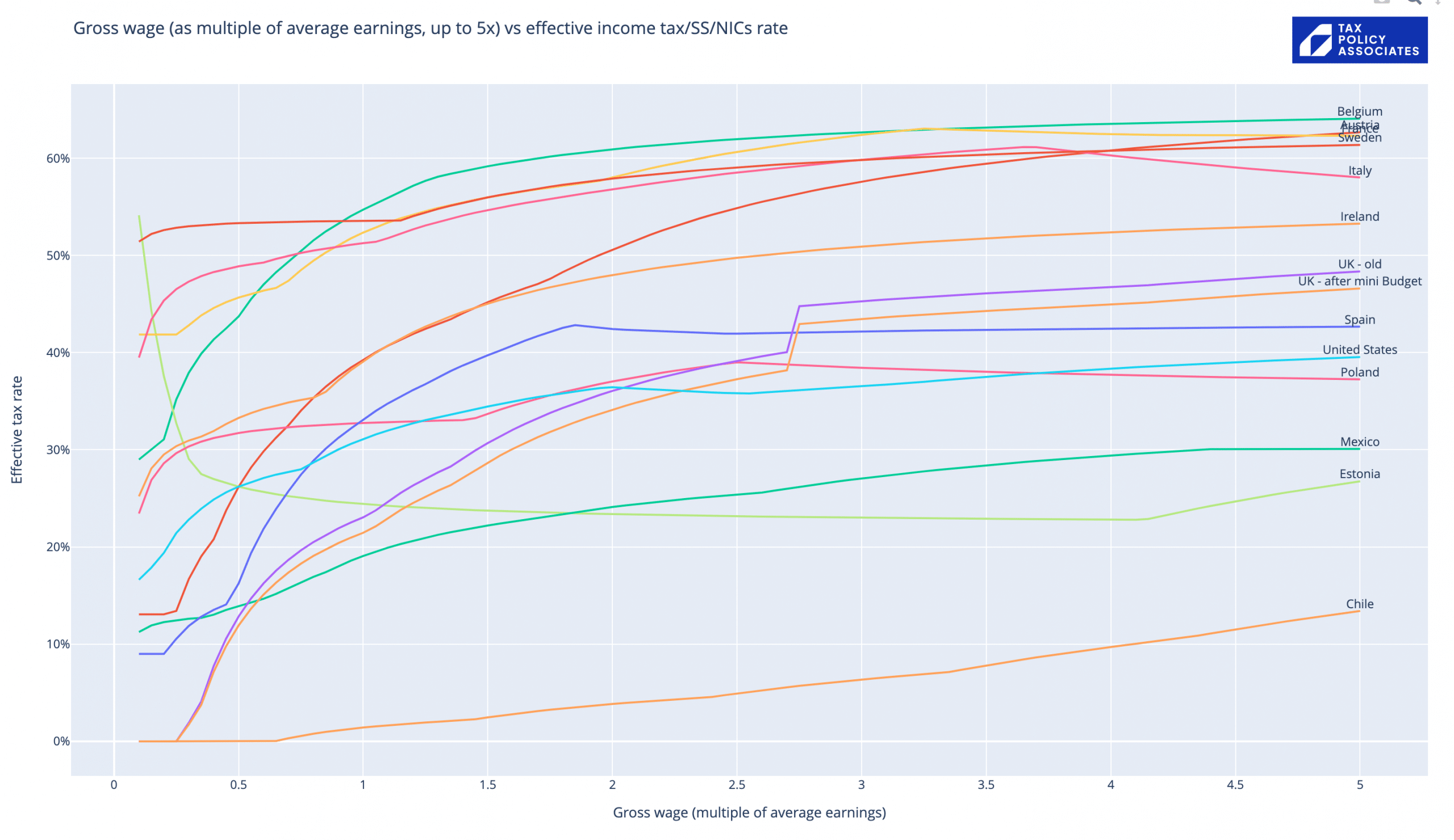
    Here’s the chart comparing UK tax (before and after the mini-budget) with the rest of the OECD, looking at incomes going up to 5x average wage. For context: the average (mean) UK wage is about £37k, so the top end of this chart goes to a touch under £200k.

    Click the chart for an interactive version that lets you select/deselect different countries (which prevents it becoming unreadable):

    The generous UK personal allowance means that a Brit on an average income pays less income tax/national insurance than most anyone in the developed world. The basic rate and national insurance however are high enough to accelerate our rate towards other countries. The introduction of the higher rate is hard to spot on the chart, because it is (more or less) accompanied by a reduction in national insurance (and these figures don’t model child benefit or other features that can create horrible marginal rates in the UK around the £60k point). Things do kick off at the 2.7x point/£100k, as the phase-out of the personal allowance escalates the effective rate.

    What if we look at tax on higher incomes? Let’s go up to 20x average wages, so about £500k in the UK. Again, click the chart for an interactive version:

    All in all, the UK has a rather average level of tax on high earners, compared with the rest of the OECD. And for employees the rate caps out at just over 50% once we take employer’s national insurance into account (as we should).

    Does anyone actually pay these really high rates?

    Usually, the only high earners who pay these rates are employees. For others, the rates are often much less. In the UK the rates drop to 47% (partners in partnerships), 45% (rent), 38.1% (dividends), 28% (capital gains on real estate) or 20% (capital gains on securities). And the evidence is that really higher earners tend to be in these categories (or can plan their way into these categories).

    Employment tends to be heavily taxed because it’s so easy to do. Those poor, poor bankers get all the flak, but pay a lot of tax. Their private equity cousins pay about half as much. And the same’s true almost everywhere… call me cynical, but I’m doubtful there are many Austrian millionaires actually paying a 68% effective rate.

    So if, as a political or economic matter, we want to increase taxation on high earners, I’d suggest that the focus shouldn’t be on changes that increase the 50% rate (which already looks high) – better to focus on the others.

    Can it really be true that the UK taxes average income significantly less than most other countries?

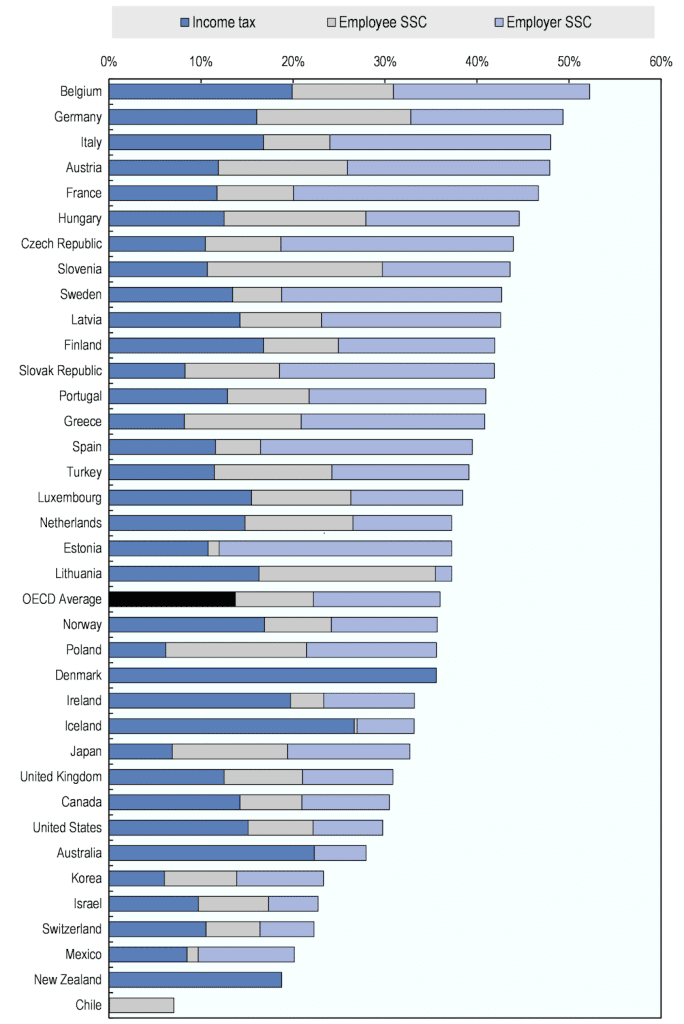
    It’s something almost nobody believes – but it’s nevertheless true. If you don’t believe my chart, here’s the OECD comparison for average incomes:

    It shouldn’t be a surprise that the countries with more extensive welfare states than the UK have higher rates of tax on the average worker. By contrast, some of them tax higher earners more; some don’t. The thing is, whilst the level of tax on the rich is of huge political significance, it is not very significant to the public finances. The 45p rate which the Tories abolished-then-didn’t raises £2bn. Income tax as a whole raises £228bn. NHS spending is £136bn.

    If we want a Scandinavian level of public services, then most people have to pay similar levels of tax to most people in Scandinavia. Sorry about that.


    Footnotes

    1. excluding Scotland – that’s very similar but a bit higher… although Scotland’s actual freedom of manoeuvre here is very limited ↩︎

    2. This is an update of previous posts with updated data, better code, and more footnotes ↩︎

    3. based on data from the wonderful OECD tax database, updated for the Budget changes and the return of the 45p top rate ↩︎

    4. The effective rate is total tax paid divided by total gross income. Not to be confused with the marginal rate – the tax rate on the next £ you earn ↩︎

    5. The calculation realistically has to include employer national insurance and social security. Yes, it’s paid by the employer, and isn’t visible on our wage slip, but evidence suggests it is mostly borne by workers (i.e. because the employer has an amount they’re willing/able to pay as wages, and employer NICs come out of that). ↩︎

    6. i.e. because realistically you don’t compare taxes on £100k in the UK with £100k in Costa Rica; you should compare taxes on three times the average wage in the UK with three times the average wage in Costa Rica. The OECD adopts a consistent methodology for calculating average wages using national accounts, but a limitation of this approach is that it results in the mean not the median wage. For most purpose this is much less useful, but for this purpose it remains a useful way to meaningfully compare tax rates across different economies… as ever, I’m open to other suggestions ↩︎

    7. Yes, that is a lot higher than the usual figures we see because, as above, it’s the median not the mean, and it’s the average wage not average income ↩︎

    8. I crashed WordPress trying to embed this. Any better suggestions would be appreciated! ↩︎

    9. Including employer national insurance – for which see the footnote above… we may not recognise it, but it’s nevertheless tax that employees bear economically ↩︎

    10. Yes, I avoided tax for years, but in my defence it’s just the way partnerships have always worked ↩︎

  • The Channel 4 News report on Sunak’s fund management

    The Channel 4 News report on Sunak’s fund management

    Last night, Channel 4 News reported that Sunak had received payments from a tax haven. My view: Sunak did nothing wrong, and the way Channel 4 reported this was unfair and misled viewers.

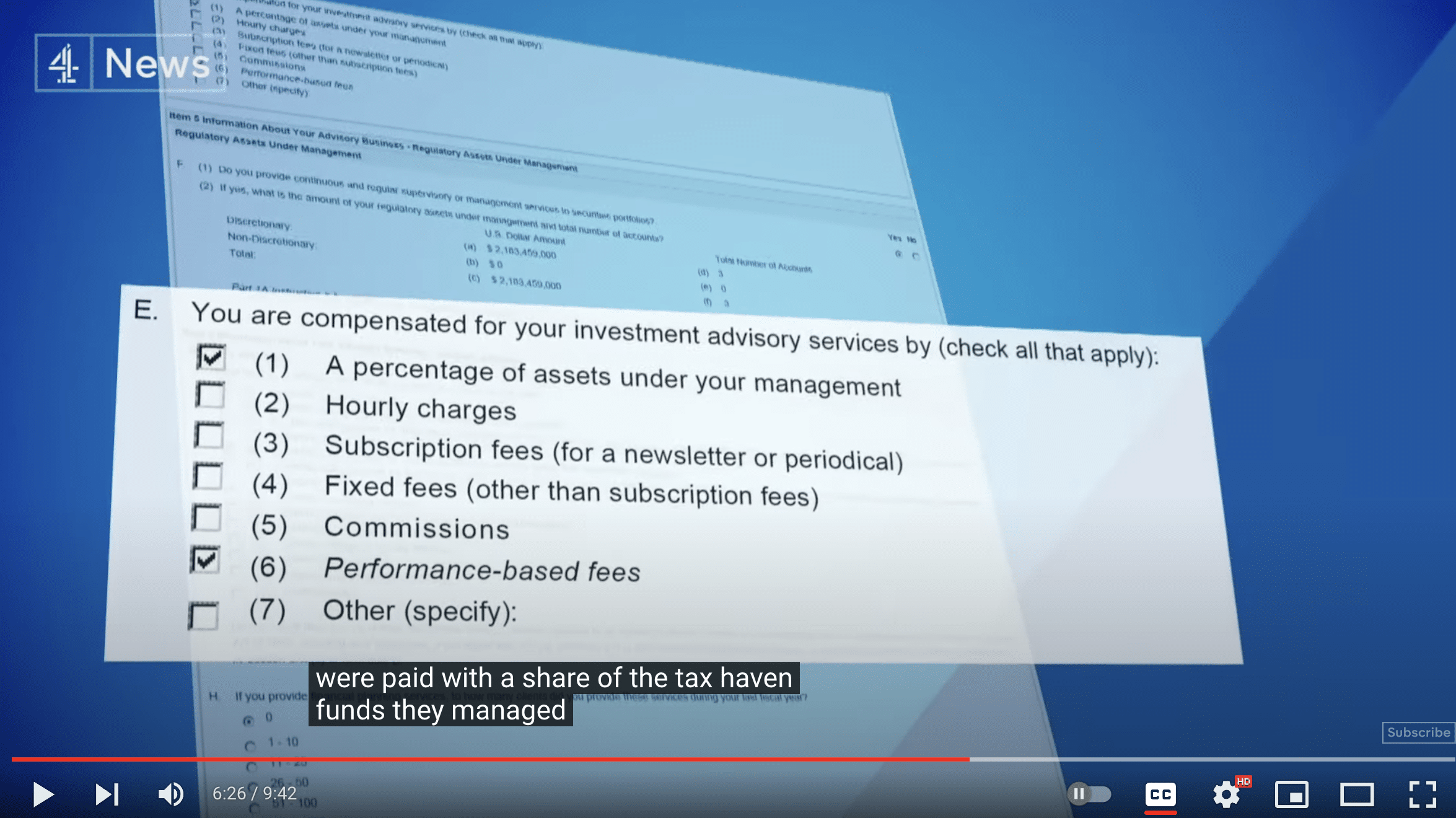
    The central allegation is that Sunak, when in the US, was a partner in a hedge fund established in the Caymans, and the partners were paid with a share of the tax haven funds they managed.

    This is true. But it omitted three key facts, and that made it misleading.

    First, almost all hedge funds are based in tax havens. Why? Because if you’re based in country A, making the tax and regulatory rules work for investors from countries A thru Z is really hard. Tax havens make it much easier. Channel 4 fail to mention how standard it is for a hedge fund to be offshore. They imply it’s suspicious.

    Second, they also present as an exciting discovery that Sunak, as a partner in the hedge fund, was entitled to a share of the fund returns. But that’s how hedge funds work – managers’ interests are “aligned” with investors by giving managers a share of the fund returns.

    Third, they suggest there’s some mystery and potentially some tax dodginess here – “Did Mr Sunak earn bonuses offshore in the Cayman Islands”. But at the time, Sunak was living in the US and had a green card. So he was subject to US tax on his income, whether it came from the US, the Cayman Islands, or the moon. (They later give Sunak a quote saying this, but it’s not just his view – it’s intrinsic to the US tax system.

    Then they say “There’s no suggestion Mr Sunak did anything illegal”? No – there’s no suggestion of anything remotely out-of-the-ordinary. And what triggers me is that the media use this same caveat when reporting on the most egregious of tax scams.

    Connoisseurs of the genre will spot the absence of any tax experts in the report. Either:

    1. Channel 4 didn’t speak to any. In which case WTF?
    2. Channel 4 did – the experts said there was nothing to see here, and Channel 4 ignored them.

    There are lots of good reasons to criticise the fund industry. And Sunak is obviously very privileged. If the focus of the report was on these issues then I’d have no argument with it.

    Is it possible that there was tax avoidance going on? In principle, sure. Here’s some questions Channel 4 could have asked:

    • Was this “carried interest”, taxed at the lower capital gains rate in the US and UK rather than the full income rate? (For a hedge fund it shouldn’t be)
    • Did Sunak continue to be entitled to payments from funds he used to manage when he was Chancellor?
    • If so, were these fully declared? And was he fully taxed on them as income (45%), at the lower capital gains rate (20%), or something else?
    • What did the funds do? How were they structured? Was there avoidance going on “lower down” in the structure?

    What we got instead was insinuation-heavy, context-light reporting, which damages the public understanding of tax, and undermines our ability to identify people and politicians who really have been engaged in tax avoidance. Mentioning no names.

    Footnotes

    1. More background – almost no funds pay tax. Why? Because if you buy shares in ten companies you pay tax on your income/gains from the companies. If you buy a fund that invests in the same ten companies then the tax result should be the same. If instead there is another level of tax, in the fund, then you wouldn’t invest through a fund. Collective investment management is a *good thing* for a bunch of reasons. So policymakers generally accept that funds should not be taxed. For onshore funds (e.g. unit trusts) it’s achieved by specific exemptions. For offshore funds, it’s achieved by rules that delineate “good” funds that don’t avoid tax, and “bad” funds that do, and imposing punitive taxes on them (the UK offshore fund rules, the US PFIC rules, and other equivalents elsewhere).

      So for a hedge fund to pay no tax is the correct policy outcome, whether that’s achieved by an onshore company within a specific exemption, or a tax haven company that falls within specific rules that permit it.

      There are currently a few initiatives to enable funds to come onshore; that’s a good thing for a large number of reasons, and I’ll talk more about that another time. ↩︎

  • Who am I? Why am I here?

    Who am I? Why am I here?

    I decided, about a year ago, to retire from partnership with Clifford Chance LLP. It’s a job that I loved, and I’ve nothing but good things to say about Clifford Chance and my colleagues in London and around the world. It’s a genuinely meritocratic place, and an amazing way for people from all sorts of backgrounds, often (like mine) pretty ordinary, to reach a level of professional success that a generation ago was only available to a very few.

    So I was and remain thankful for all the opportunities Clifford Chance gave me, but after almost 25 years I felt it was time to move on. My family deserves to see more of me, and I’m privileged enough to be able to make that decision. But I also felt I had a chance to use my accumulated expertise and contacts to make a difference, and achieve better tax policy in the UK and abroad. That’s what Tax Policy Associates Ltd is about. As the name suggests, it’s about tax policy, and about working in association with a bunch of different people: policymakers, academics, journalists, and others.

    What’s my agenda? To improve public debate around tax policy, and improve tax policy. The two are linked. Change can’t be achieved from a purely tax-technical direction; it also can’t be achieved by gotcha stories about famous companies and celebrities avoiding tax (even when they are). It sounds trite to say we need both – but we need both.

    What are my biases?

    Many and varied.

    I describe myself as a “tax realist”, with a firm bias towards evolution rather than revolution, and what is achievable and workable. Any tax proposal that doesn’t take account of past experience here and abroad, and which doesn’t consider likely taxpayer responses, should be DOA.    

    My political views have never been very well hidden – I believe the UK should have a larger and more generous welfare state, and a greater degree of redistribution, and tax should rise to pay for it. But that should be achieved with as few taxes as possible, and they should be simple and have as few exemptions as possible. Wide base, low rate.

    Plenty of room for disagreement on the size of the state, and what tax rates should be – but no reason people across the spectrum can’t agree on what the taxes should be, and how they should work.

    So that’s who I am, why I’m here, and what Tax Policy Associates Ltd aims to achieve. To help create better tax policy, in association with policymakers, academics, journalists – and anyone else interested in tax and improving our tax systems.