
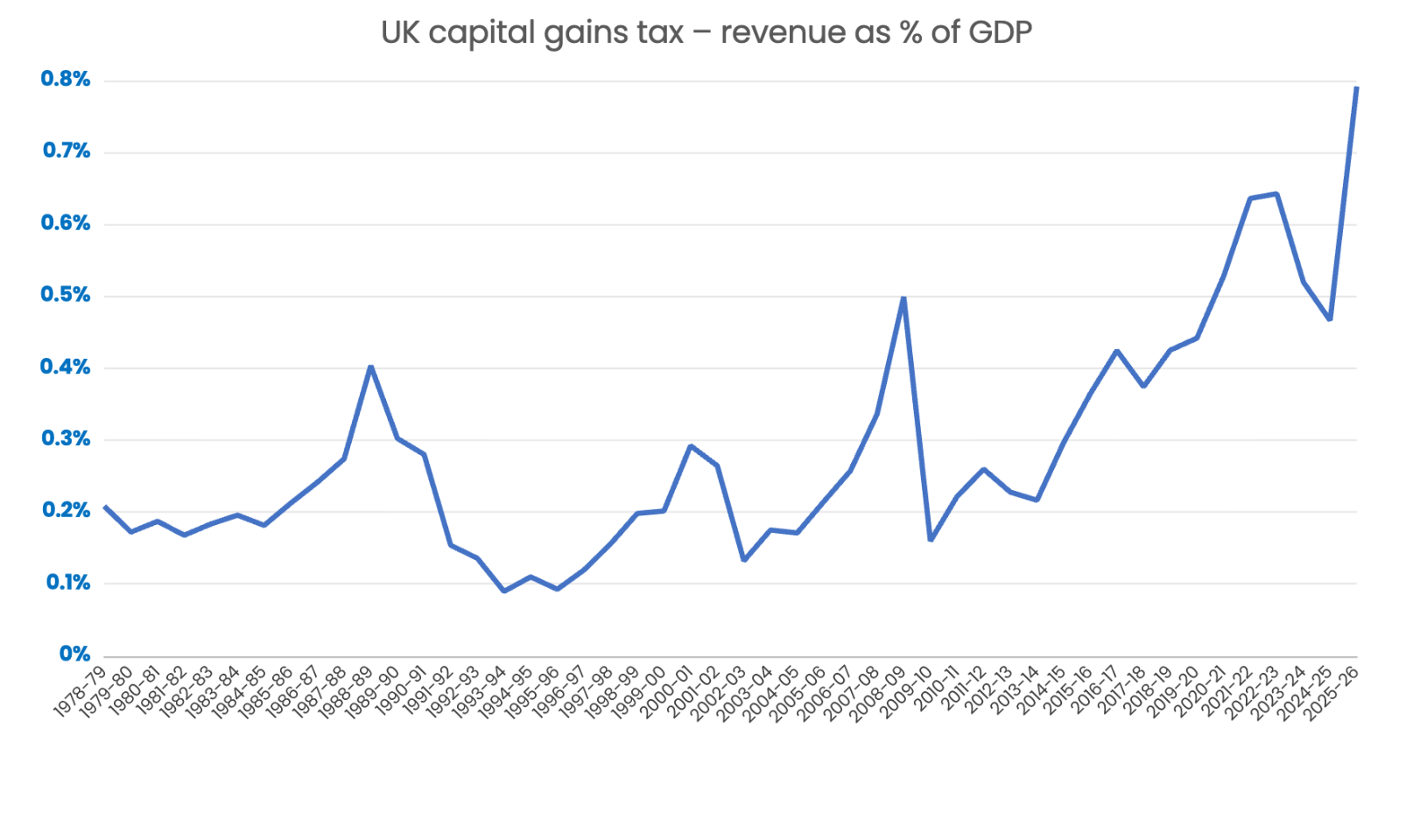
This article looks at the history of UK capital gains tax, and how revenues have changed when the rate and rules changed. There’s a separate article on reforming CGT here.
The chart at the top of this page shows what happens if you plot UK capital gains tax revenues as a % of GDP since 1978. It looks like somebody having a heart attack.
Income tax revenues, by contrast, look much more steady:
What on earth is going on?
Politicians fiddling with the rules. Again and again. And people taking advantage: when the rate is about to go up, taxpayers accelerate their sales to benefit from the current lower rate. When the rate is about to go down, taxpayers delay their sales until the rate has dropped.
The chart makes more sense if we overlay the rates:
CGT statistics are complicated by the fact that the most complete statistics show the year in which the tax revenue was received by HMRC, not the year in which a disposal was made. CGT is mostly paid by the 31 January after the end of the tax year, so the figures lag the underlying disposals, often by a year or more. The huge 2025-26 figure, for example, largely reflects gains made in 2024-25, including a rush to sell ahead of the October 2024 rate rise.
I’ve tried to draw the lines above showing the different rates at the point that the announcement of the change in rates was made. So, for example, Nigel Lawson increased the rate from 30% to 40% in his Budget on 15 March 1988. The rate took effect from 6 April 1988. So lots of people who had large gains, and were planning to sell in the near future, accelerated their plans and sold quickly.1 That acceleration greatly increased the amount of gains in the 1987/88 tax year and reduced gains in the next year (because the assets had already been sold). We see this in this chart as a revenue peak in 1988/89.
So the overall story of Nigel Lawson’s CGT increase is that CGT revenue in the year after the increased rate took effect (1989/90) was about the same as CGT revenue in the year before the announcement of the increased rate (1987/88). There was a drop-off in 1991/92; but by that point, the CGT change was history, and this was driven by the economic cycle.
But rate changes don’t explain all the peaks in the chart. For that we have to overlay all the constant messing around with the details of the rules:2
At this point some people can get very excited about the Laffer curve, and how the lower rates incentivised economic activity. I’m unconvinced. Even out the peaks and troughs caused by immediate rate-change shocks, and patterns are hard to find. it’s not obvious there was any net change between 1978 and 2016. And, given the constant changes, it’s not obvious how any rational businessperson could make decisions based on the rate at the time.
Some other people get very excited about the impact on inequality. I’m unconvinced. Put CGT and income tax onto the same chart, and we see quite how unimportant CGT is, and will always be (regardless of rate):
My view is that the current system is dysfunctional. The large gap between the income and capital gains rates creates an unfortunate incentive to convert income (taxed at 45%) into capital (taxed at 24%). On the other hand, there’s no allowance for inflation, so long term investors find themselves taxed on a return that isn’t real. Rewarding avoidance and punishing long-term investment is not a rational outcome.
I tend to think the sensible approach would be:
- Close or eliminate the gap between CGT and income tax rates.
- Bring back the “indexation allowance” that stops inflationary gains from being taxed. Nigel Lawson got this right in 1988. Or, better still, an allowance for the normal/risk-free return, as recommended by the Mirrlees Review.
- Introduce a low rate or even complete exemption for genuine founders/entrepreneurs, as opposed to private equity executives or people converting income into capital, with a generous cap (say £20m).
- Make the change immediate, to prevent a sudden spike in disposals.
- Promise stability from that point: be clear that the rules will not change again for the rest of the Parliament, and maybe beyond. Without this, investors and entrepreneurs can’t plan for the long term.
Footnotes
That was easy for people holding liquid assets like publicly traded shares – they just sold them and then bought them immediately afterwards (the rules that stop this weren’t introduced until ten years later). It was harder for people with illiquid assets like real estate and private shares. But if someone in this position had already been planning a sale, they might be able to make things move a little faster and beat the 6 April deadline. Other people could put artificial transactions in place, which essentially moved assets from one pocket to another, crystallising the gain but still retaining ownership. ↩︎
This is greatly simplified. The number of changes when Gordon Brown was Chancellor were particularly egregious ↩︎

Could we have stopped Revolut’s founder from leaving the UK?

Will Labour tax your house sale? Why CGT on homes makes no sense

How to reform capital gains tax and cut income tax

Are you living with your spouse? The unreal world of capital gains tax

Did Angela Rayner fail to pay CGT on her house sale?



Leave a Reply