
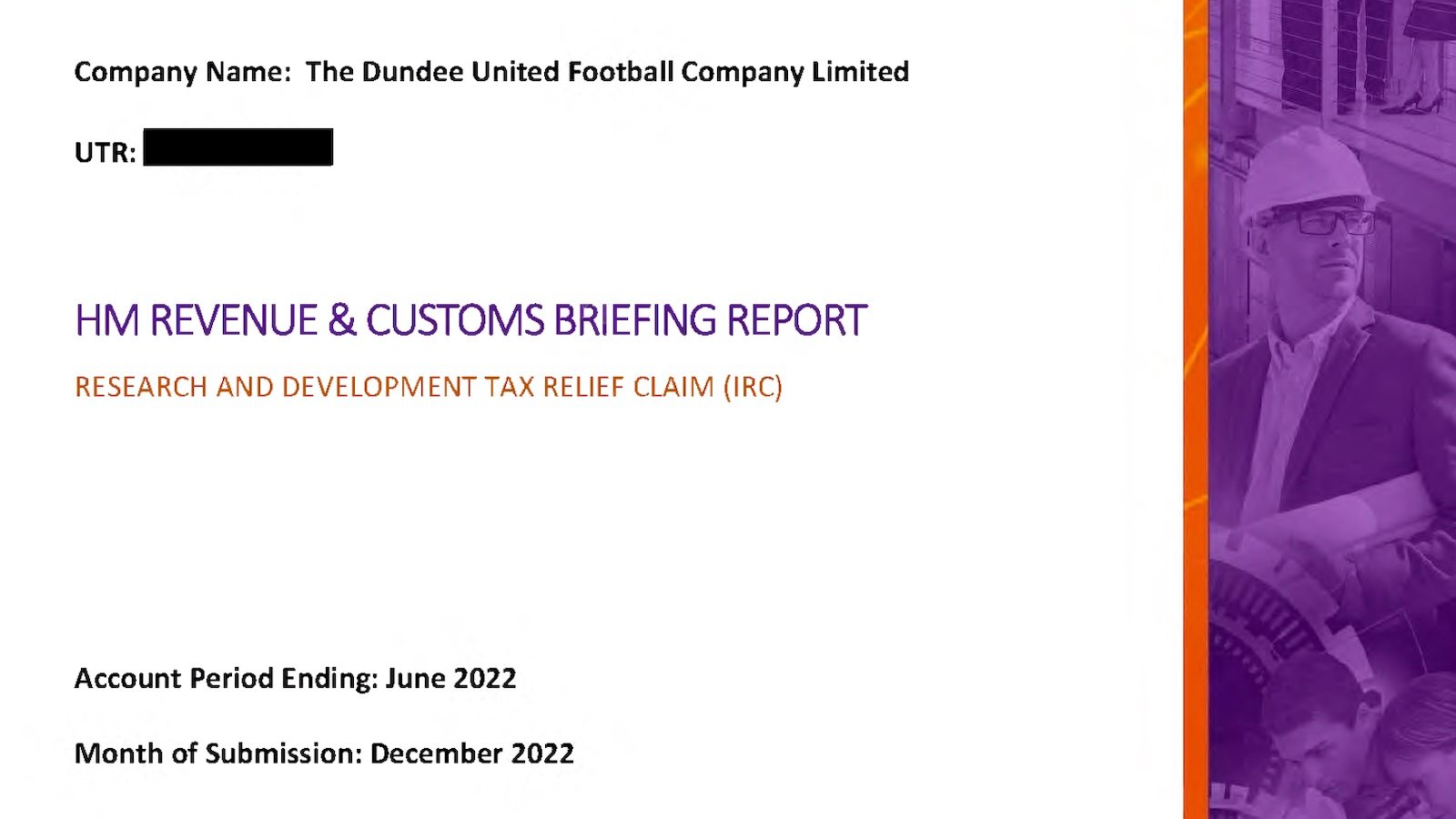
As The Times has reported, there’s evidence that Dundee United claimed R&D tax relief for a quarter of its players’ wages. HMRC – and therefore all of us – may have subsidised the club’s wage bill.
The Times‘ article was based on an R&D tax relief claim document we obtained – we’re publishing it in full below. We’re publishing the document because it’s not just invalid – it is outrageous. R&D tax relief is intended to incentivise innovation. It applies to businesses seeking an “advance in science or technology”. It was never intended to apply to the wages of football players, and in our view it’s clear that it cannot apply in this way.
Dundee United have refused to comment. The firm that drafted the document, ZLX, denied that this document was sent to HMRC, but were unable to explain why it was created, or why it was signed by Dundee United’s finance director and a director of ZLX.
We believe this is part of a wider problem. The Times previously reported that 33 football clubs are being investigated by HMRC. And we have previously reported that the total cost of invalid and fraudulent R&D tax credit claims could be £10bn.
UPDATE: The Courier published an article on 10 October 2025 in which a former director of Dundee United says that the document is genuine. And – critically – the Courier obtained emails from Abertay University which suggest that the research project described in the ZLX document never existed, and Abertay University confirmed that in a statement. Paul Rosser has found a research paper which may be the genesis what appears to be a false claim by ZLX/Dundee United. If the ZLX/Dundee United claim we publish below was submitted to HMRC, but the research it describes never existed, then anyone involved who knew they were submitting a false document may have committed tax fraud. We put this point to Stephen McCallion, CEO of ZLX, but his only response was a vague denial; he was unable or unwilling to explain the ZLX document and the Abertay emails.
What is R&D tax relief?
The modern small business R&D tax relief was created in 2000, with the laudable aim of incentivising R&D investment. As the name suggests, it’s only available for “research and development”. That term is defined in guidance published by BEIS/DSIT and given statutory force under the Corporation Tax Act 2010. HMRC accurately summarise the rules as follows:

The Dundee United claim
Here’s the document supporting a claim for £1.4m of R&D tax relief. It’s signed by Dundee United’s finance director and a director of ZLX:
Does the Dundee United document describe valid R&D tax relief claims?
It does not. We spoke to three leading R&D tax advisers, and all were amazed that anyone could consider such a claim legitimate.
The document covers three obvious things that any sports team would do – training, diet and analytics. This is all dressed-up in pseudo-technical language such as “position-specific carbohydrate periodisation” (meaning changing players’ diets based on their activity). All the verbiage cannot hide the fundamental problem with the three projects: if something is widely known about by clubs, then a club simply doing the same is not attempting to create an “advance in science/technology”, and no relief is available.1
The document is therefore invalid on its face, but what’s more troubling is the expenses that the document says are claimed for tax relief:
- 24% of their players’ wages – as if the players were carrying out scientific/technical research. That is a huge amount of money, and in our view is indefensible. Even if the R&D projects were real, and qualified for relief, the players would be the subjects of that research, and their wages would not qualify for relief.
- 80% of their chef’s wages – and whilst he appears to be an excellent chef, it seems most unlikely he spent 80% of his time on an R&D project. Even if he did, supporting activities of a non-technical nature are not eligible for relief.
- 90% of the wages of their “head of tactical performance“. Even if he was a professional engaged in R&D, we are doubtful he spent 90% of his time on this.
- 21% of their heating and lighting costs, implying that 21% of the use of their premises was for R&D projects. This seems implausible.
The document is for a 2022 claim; Dundee United also claimed £1.27m for 2020 and 2021.
Who would make such a claim?
The document was prepared by ZLX – the R&D tax firm notorious for suing a client who wasn’t willing to put in a comical R&D tax claim for installing a fridge. ZLX was an official partner of Dundee United and, as The Times reported, the club made an R&D tax relief claim worth £600k.
ZLX’s owner, Stephen McCallion, told us that it is “not a document that was submitted to HMRC and the contents were not submitted to HMRC”. However he was unable to explain why the document was created and signed, and he did not deny (to us or The Times) that Dundee United’s claimed R&D tax relief for a large percentage of its player’s wages.
We and The Times asked Dundee United for comment; we didn’t hear back.
We previously reported that ZLX appeared to employ nobody with any tax qualifications. In 2024, ZLX had two people in its compliance team – their previous experience was as a bartender and sales assistant. It is therefore to be expected that ZLX would make invalid claims. The question is whether this was merely reckless, or whether it crosses the line into criminality on the part of ZLX’s management.
Mr McCallion objects to our previous reporting – but has not identified any specific errors.
We don’t believe any reasonable adviser would have thought this claim was valid, or that any reasonable business would have submitted it. We expect HMRC will charge Dundee United penalties.
If ZLX/Dundee United did make R&D tax relief claims described on the basis of the document we reviewed (or substantively similar claims) then we believe ZLX should be the subject of a criminal investigation.
Thanks to George Greenwood and The Times.
The document attached is © ZLX Limited, and reproduced here in the public interest.
Footnotes
The first clubs to use e.g. player analytics would in principle have had a valid R&D tax relief claim. ↩︎

Untaxing: the £10bn fridge – the full story

Same cowboys, new name: ZLX is now TaxTek R&D
Turner & Abel – a fake accounting firm fronting for the Green Jellyfish R&D fraud
Inside a fake tax refund factory
![THE HON. MRS JUSTICE COLLINS RICE DBE CB
Approved Judgment
Kamal v Tax Policy Associates
31. In the circumstances, the pleading that it was ‘false and misleading’ to suggest that a
judicial finding of breach of duty had been made against him is incapable of forming a
part of the just disposal of Mr Kamal’s libel claim. The attempt to do so is an abuse of
the court’s processes. I grant the Defendant’s application to strike out [5(b)] of Mr
Kamal’s particulars of claim.](https://taxpolicy.org.uk/wp-content/uploads/2026/03/padded_judgment-640x360.jpg)
We defeated an £8m libel claim – and it shows libel law and the Tax Bar need reform.


Leave a Reply to Steve Cancel reply