
The Post Office’s incompetent compensation process left thousands of postmasters with large tax liabilities. When we revealed this, the Government forced the Post Office to fix the situation – but the Post Office did so far too slowly. New Freedom of Information Act disclosures reveal that, when we identified this new problem, the Post Office’s only concern was the PR impact. And the Post Office continues to cover-up the reasons for its failures.
The Post Office scandal has had three separate phases, with three separate scandals. First, from 1999 to 2015, persecuting and prosecuting postmasters for “shortfalls” which it knew were caused by bugs in its Horizon system, and withholding evidence which would have demonstrated their innocence. Second, from 2017 to 2021, aggressively and improperly litigating to cover-up its failures, when it knew a core plank of its defence was a lie. Third, from 2021, designing and running compensation schemes to ensure it paid its victims as little as possible.
The Post Office says that it’s changed and is now dedicated to righting the wrongs of the past. But the evidence shows that it continues to prioritise covering-up its misdeeds over doing the right thing.
The incompetence
One small scandal within the compensation scandal was that, when the Post Office designed its HSS compensation scheme, it gave no thought to the tax position of the postmasters. The result was that many saw almost half of their compensation lost to tax. Any competent tax adviser would have identified this issue and suggested solutions; the Post Office either didn’t obtain proper advice, or ignored it. It was incompetent.
When we identified the issue, the Government intervened and, in June 2023, required the Post Office to make “top-up” payments to postmasters to cover their tax liability, and provide them with a letter explaining their tax position. It then changed the law to ensure the “top-up” payments would not themselves be taxable. Everything had been done to fix the Post Office’s mess, and all that the Post Office had to do was run the calculations and get the letters out.
So it was incomprehensible that, by the end of 2023, with the self assessment deadline looming, the Post Office had only made a fraction of the top-up payments. 1,100 postmasters hadn’t received a letter or top-up payment, and were left with a £10k tax bill they’d have to pay without any help or assistance.
This should not have been a difficult task. The Post Office knew what the HSS compensation payments were, and what years they covered. So calculating the amount of the top-up payment should have been a spreadsheet exercise. I’ve spoken to accountants familiar with this kind of exercise (from other compensation schemes), and they think a small team could have calculated the appropriate top-ups in a few weeks.1
However the Post Office was unable to do this after six months. More incompetence.
The sole focus was on the PR
How did Nick Read, the Post Office CEO, react when we reported that the Post Office had incompetently left 1,200 postmasters with a serious tax problem? Did he demand an explanation for this from his team? Did he ensure a solution was prioritised?
Thanks to a Freedom of Information Act application from Christopher Head, we know the answer to these questions.
There is no sign of Read being surprised by the Post Office’s slow response, much less being disturbed by it. Instead, the sole focus of Read and his team was on the public relations impact. Apparently my twitter thread identifying the issue wasn’t very “helpful”:
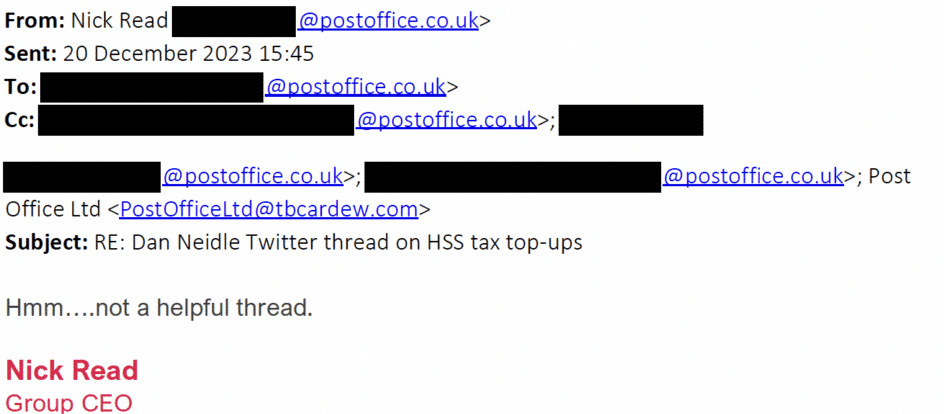
The team’s subsequent response showed no attempt to understand, or even recognise, the actual criticism: that the Post Office’s response was unjustifiably slow, and had – completely unnecessarily – left 1,100 postmasters in a difficult position:

I don’t know if this is because they didn’t understand the issue, or were shielding Read from it. Either way, this looks like a dysfunctional management team.
And so, in the end, Read thought it was all okay, because there wasn’t much media pickup of the story:

Read had zero interest in the fundamental question: how come the Post Office had left 1,100 postmasters hanging?
The full set of documents is here.
The cover-up
I tried to establish how the Post Office had got this so wrong, and failed to achieve in six months what a competent team of accountants would have achieved in a few weeks. The obvious answer is that they didn’t have enough staff engaged on the task – so I filed a Freedom of Information Act request asking how many staff had been involved.
The Post Office is refusing to tell me:

Needless to say, the idea that telling me the number of staff involved in a project would enable those staff to be identified is daft. It’s a cover-up, and not a very good one. (You can see the Post Office’s complete response here.)
I asked for a review of this decision immediately, on 21 February. The Post Office should have responded within 20 business days. They haven’t responded at all, not even to acknowledge receipt.
The Post Office hasn’t changed. Its only interest is in preserving the little that’s left of its own reputation.
Footnotes
A few would have been trickier, for example where the postmaster operated their business through a partnership or company; but reasonable simplifying assumptions could have been made. ↩︎
The SRA was going to prosecute the Post Office’s lawyers. Then it stopped.
New evidence: the Post Office deliberately designed its compensation scheme to deter postmasters from applying

The Post Office – pushing postmasters to accept £75,000 compensation without legal advice

The Post Office – reckless with postmasters’ personal data; abusing data privacy to protect itself
The Post Office has finally stopped intimidating postmasters into silence; but it’s too late



Leave a Reply