

Now updated following Jemima Goldsmith’s response to our original report.
In 2014, a massage therapist called Sylvie Berki accused Russell Brand of assaulting her. The police took no further action. Mr Brand and his then girlfriend, Jemima Goldsmith, sued her. Ms Berki had no lawyer, and there was no trial. But the High Court issued an extraordinary injunction that silenced her for the rest of her life. On 5 November 2026, Mr Brand was convicted of rape and three sexual assaults, and subsequently jailed for ten and a half years.
We have obtained a copy of the injunction, which has never previously been published. It was supposed to prevent harassment, but it went well beyond that. It prohibits Ms Berki from telling anyone what she says happened to her – not journalists, not friends, not family, and not even the police. The court also ordered Ms Berki to pay £50,000 in legal costs within two weeks (which she couldn’t afford) and authorised her bankruptcy.
We don’t know whether Ms Berki’s allegations were true, and Mr Brand’s convictions don’t establish that they were. But whilst nobody established that Ms Berki was lying, the High Court made an order that prevents her from ever speaking about what she says happened to her.
This September, a Court of Appeal judge acknowledged concerns about the extraordinary breadth of the injunction, but it remains in place. We think the injunction should never have been granted in these terms. It’s a disturbing example of what happens when wealthy, powerful people take an unrepresented defendant to court.
What happened
These are the key dates, and the terms we use for each decision in this article:
In June 2014 Ms Berki told Thames Valley Police that Mr Brand had assaulted her. The police found no case to answer.1 She also took her allegations to the press and Twitter, and Mr Brand and Ms Goldsmith sued. The claim form initially included libel, for which it is in practice almost impossible to obtain an injunction, but the claim they ended up pursuing was for harassment.2
In the 2014 judgment, Mrs Justice Carr thought the claimants would probably show her allegations were false, but said their truth was “not the ultimate issue”.3 In October 2015 Mr Justice Jay gave summary judgment (the 2015 judgment), a month before the trial was due to start. Ms Berki represented herself.4 He refused permission to appeal, and the Court of Appeal has since turned her down three times.
We don’t know if her allegations were true; the parties provided witness statements but they are not available to us, nobody was ever cross-examined, and there was never any finding of facts. Mr Brand’s convictions for rape and sexual assault don’t tell us what happened in 2014. But we don’t think Ms Berki should be silenced for life.
The order
Here’s the final injunction:5
This was a harassment injunction. So, given the judge’s findings, it would have been appropriate for the court to injunct Ms Berki from harassing Mr Brand and Ms Goldsmith. Paragraph 3(a) is perhaps what one would expect:
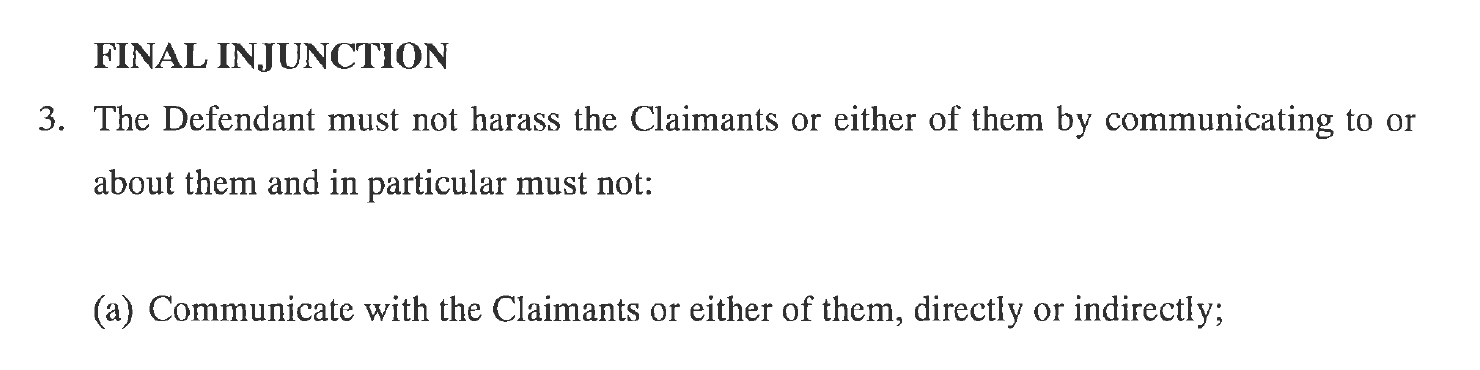
But that introduction to paragraph 3 talks about harassment by communicating “about” the Claimants. And paragraph 3(b) prohibits contact with journalists. If a journalist called Ms Berki today about Mr Brand, and she spoke to them, Ms Berki would be breaching the injunction (and so would the journalist if they knew about its terms).

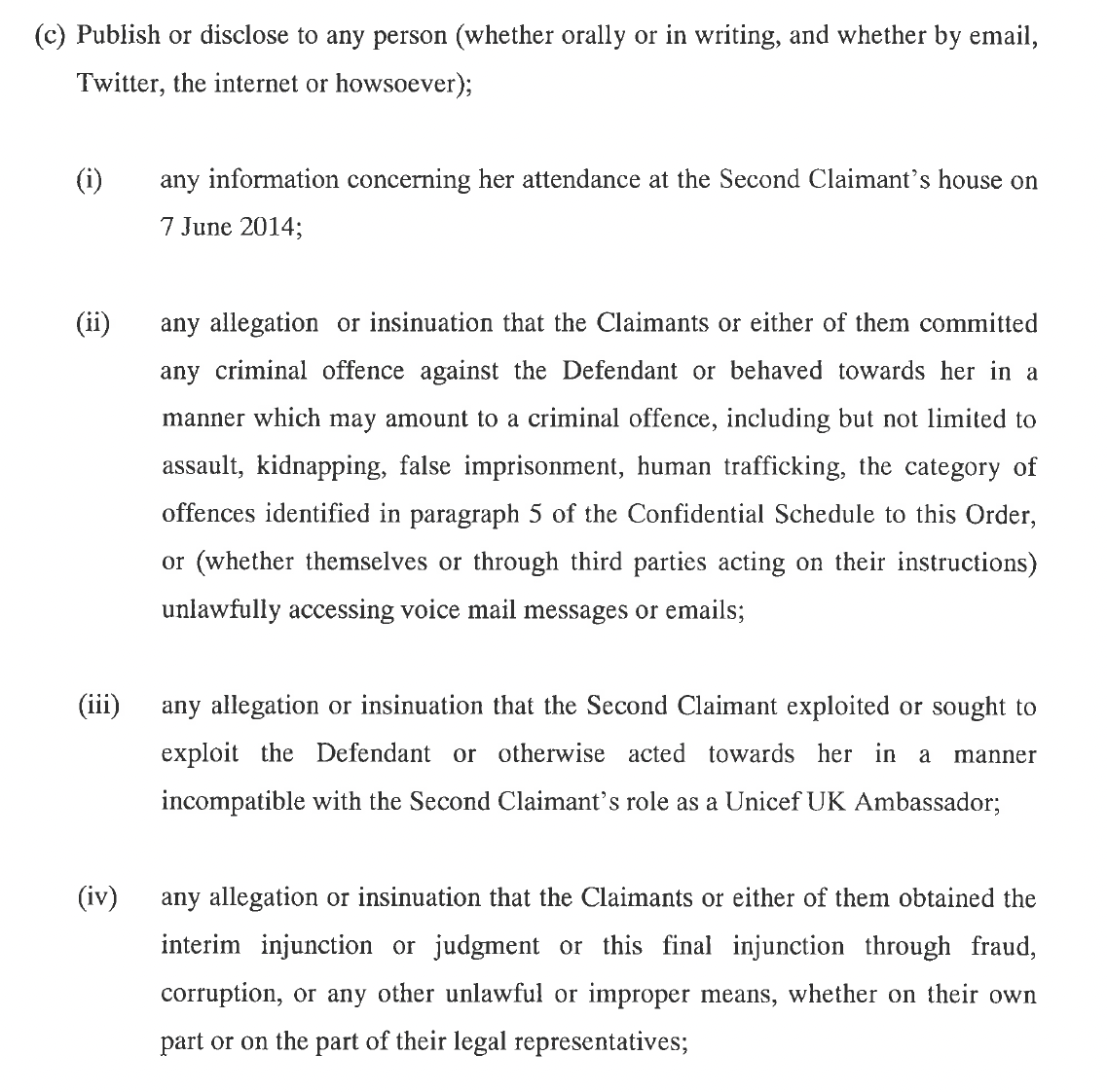
The order then goes much further, constraining Ms Berki’s private speech. She cannot disclose “any information” about the events in question, to anyone. In no sense is a private discussion with friends or family “harassment”. But it’s prohibited:
There’s an exception, but it is extremely narrow:
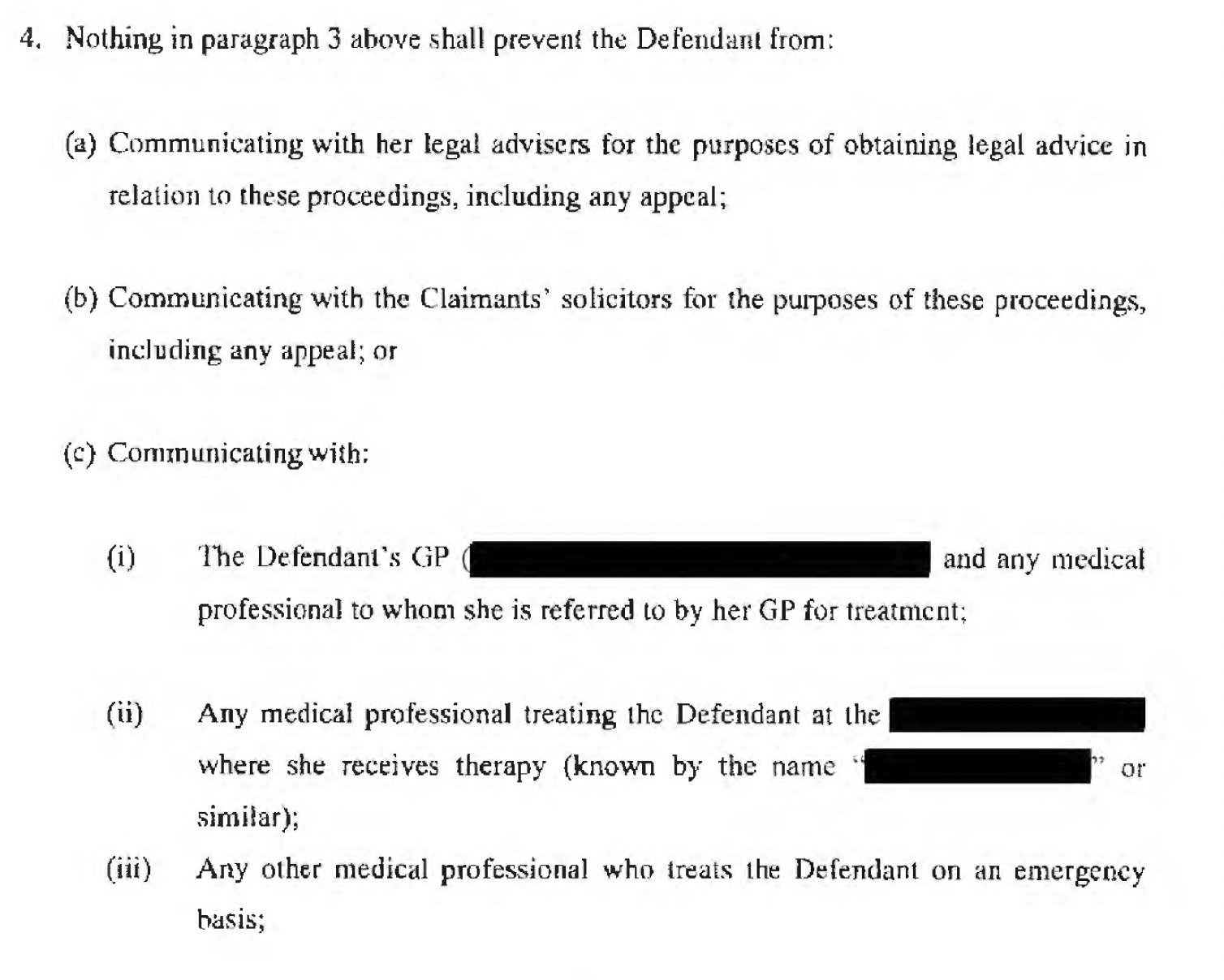
The obvious omission: she can’t speak to the police.6 The police are expecting more people to come forward and say they’ve been assaulted by Mr Brand, but Ms Berki can’t: if she even answered the phone, she’d be prohibited from speaking to them.
The 2026 order records that the doctors named in (i) and (ii) no longer treat Ms Berki. Those exceptions are now useless. Short of an emergency, she cannot mention the incident to any doctor or therapist.
None of this seems necessary or proportionate in a harassment injunction.
The overall impression is that in substance this wasn’t a harassment injunction at all. It was a libel injunction in disguise. That’s an attractive strategy for a claimant because libel defendants can raise the defence of truth; harassment defendants cannot (and libel injunctions are hardly ever issued). The courts have, therefore, been rightly sceptical about attempts to dress up libel as harassment. Mr Justice Jay was not.
The specifics of Ms Berki’s accusations are contained in a Confidential Schedule, which we have seen but cannot publish because of the reporting restriction in the order:
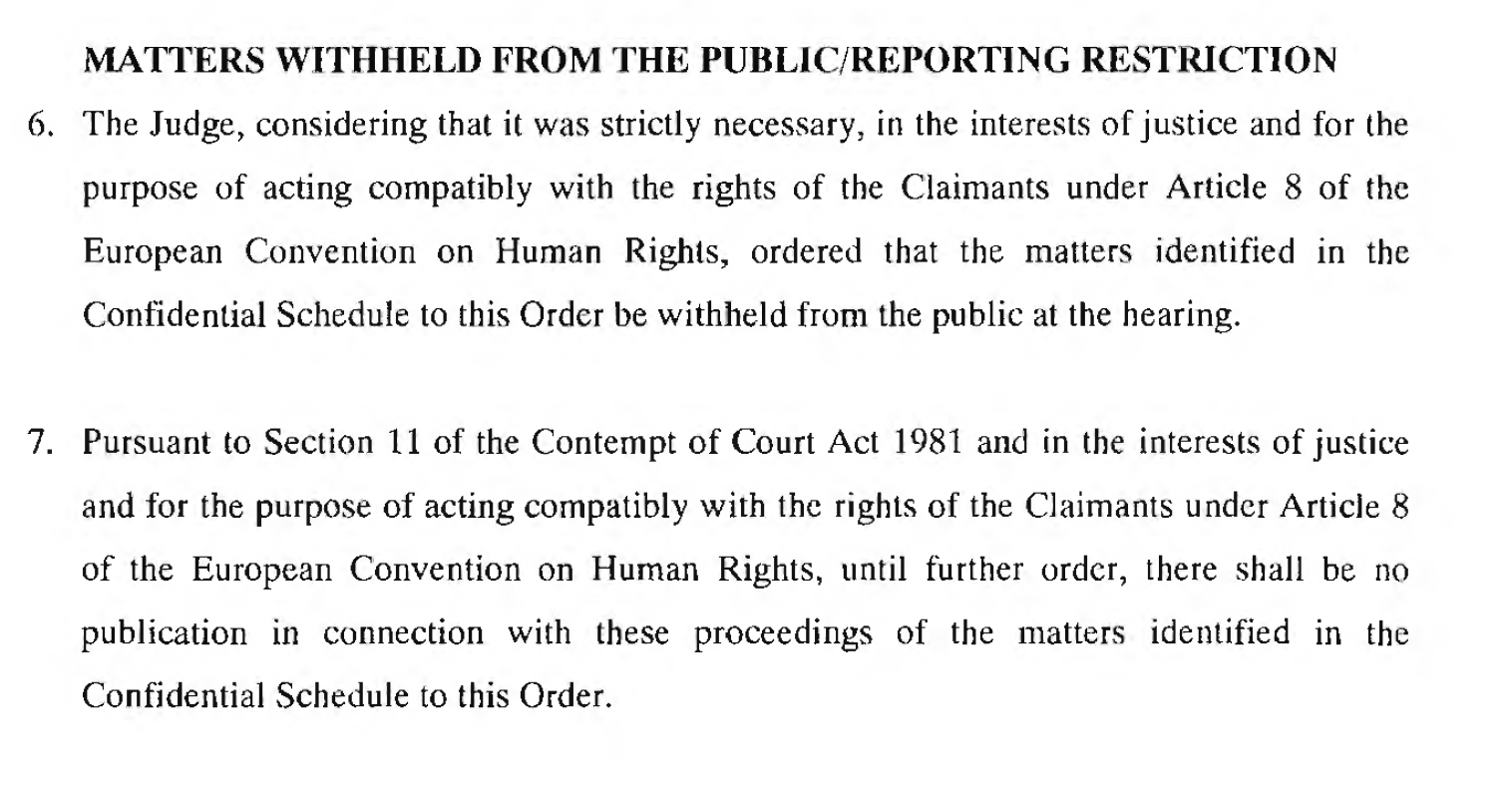
and:
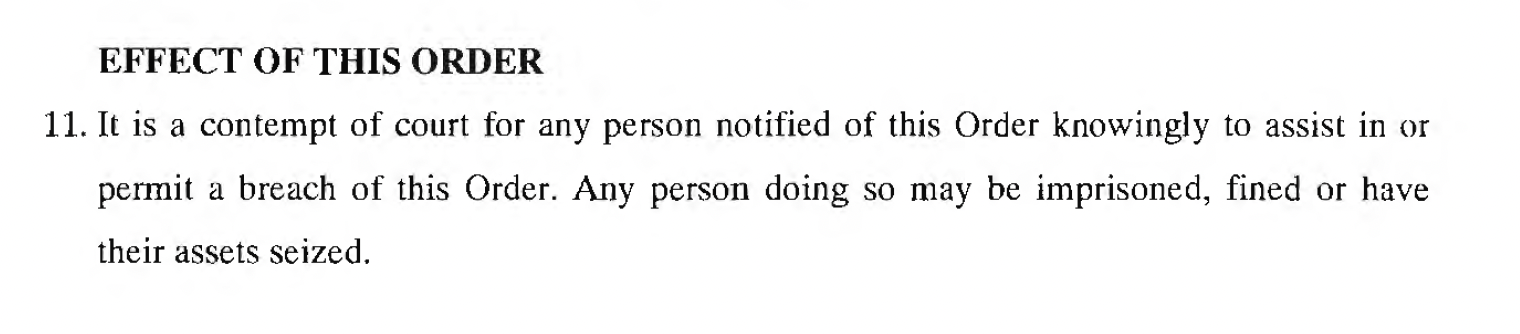
The claimants’ lawyers then obtained permission to bankrupt Ms Berki if she didn’t pay £50,000 within two weeks (although that was just the initial payment; we expect total costs would have been £100,000 or more):
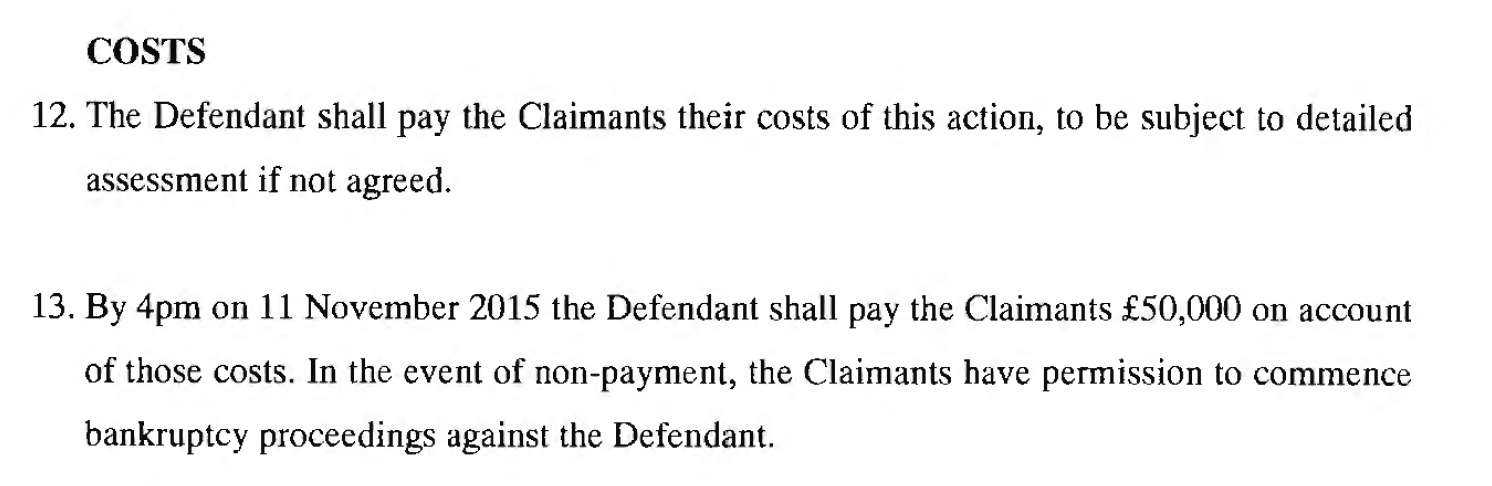
Mr Justice Jay had said Ms Berki was “probably impecunious”, so there was no prospect of her paying this.
How did this happen?
The 2015 judgment, by Mr Justice Jay, explains the reasons for granting an injunction, but does not discuss the terms of the final injunction itself, or explain why it was so draconian.
We’d expect the 2015 judgment to contain a discussion of whether these restrictions were necessary and proportionate, and whether they were compatible with the exclusions in the Protection from Harassment Act. It does not. A lawyer would surely have raised these arguments, but Ms Berki of course had no lawyer.
It’s not obvious why this was susceptible to summary judgment at all. Mr Justice Jay didn’t find that Ms Berki was lying. There was a two-hour pre-trial review, with a trial of four to five days scheduled for a month later. The judge said the dispute about what happened that day was “likely to be resolved in the claimants’ favour, but I cannot say that the defendant has no real prospect of success”. He then decided it didn’t need resolving, because her motive was to harass “regardless of the rights and wrongs of what occurred on 7 June”.7
When a person is not represented by a lawyer, a judge is supposed to make allowances. The rules say so. The overriding objective requires the court to ensure that “the parties are on an equal footing”, and from 1 October 2015, four weeks before this hearing, the court has had an express duty in any case with an unrepresented party to “adopt such procedure at any hearing as it considers appropriate to further the overriding objective”.8 Lady Justice Falk, who read the available transcript this year, thought “some of Jay J’s comments could have been put in more muted terms”, but that Ms Berki “was properly heard, and had a full opportunity to put the points she wished to make”. Being heard on whether you harassed someone is one thing. Settling the terms of a lifelong injunction is another – and there’s no evidence Ms Berki’s interests were protected when those terms were settled. We think the judge should have scrutinised the form of the order (which was likely drafted by Mr Brand’s lawyers). It seems he did not.9
Mr Justice Jay does not have a good record of dealing with litigants-in-person. Two years later, in a different case, he behaved so poorly that the Court of Appeal and then the Supreme Court found that he’d bullied a litigant-in-person. The Supreme Court found that he had aimed a “barrage of hostility” at the litigant-in-person, and “harassed and intimidated him in ways which surely would never have occurred if the claimant had been represented”.
The appeals
Ms Berki tried to appeal, still without a lawyer. In August 2016 Lady Justice Arden refused permission on the papers (the 2016 order): the skeleton argument was too long, too general, and had no proper grounds of appeal (the result we’d expect if a layperson tried to conduct an appeal). But she had read the 2015 judgment herself, and set out what troubled her. Mr Justice Jay “did not give any reasons” for concluding that Ms Berki had no defence. He “appears to have made findings about the appellant’s motives on the basis of her submissions (and not on evidence given in her witness statements or in the witness box)”, and it was “not clear that the appellant had an opportunity to deal with these matters”. If Ms Berki tried again, the claimants’ lawyers were to answer those points:
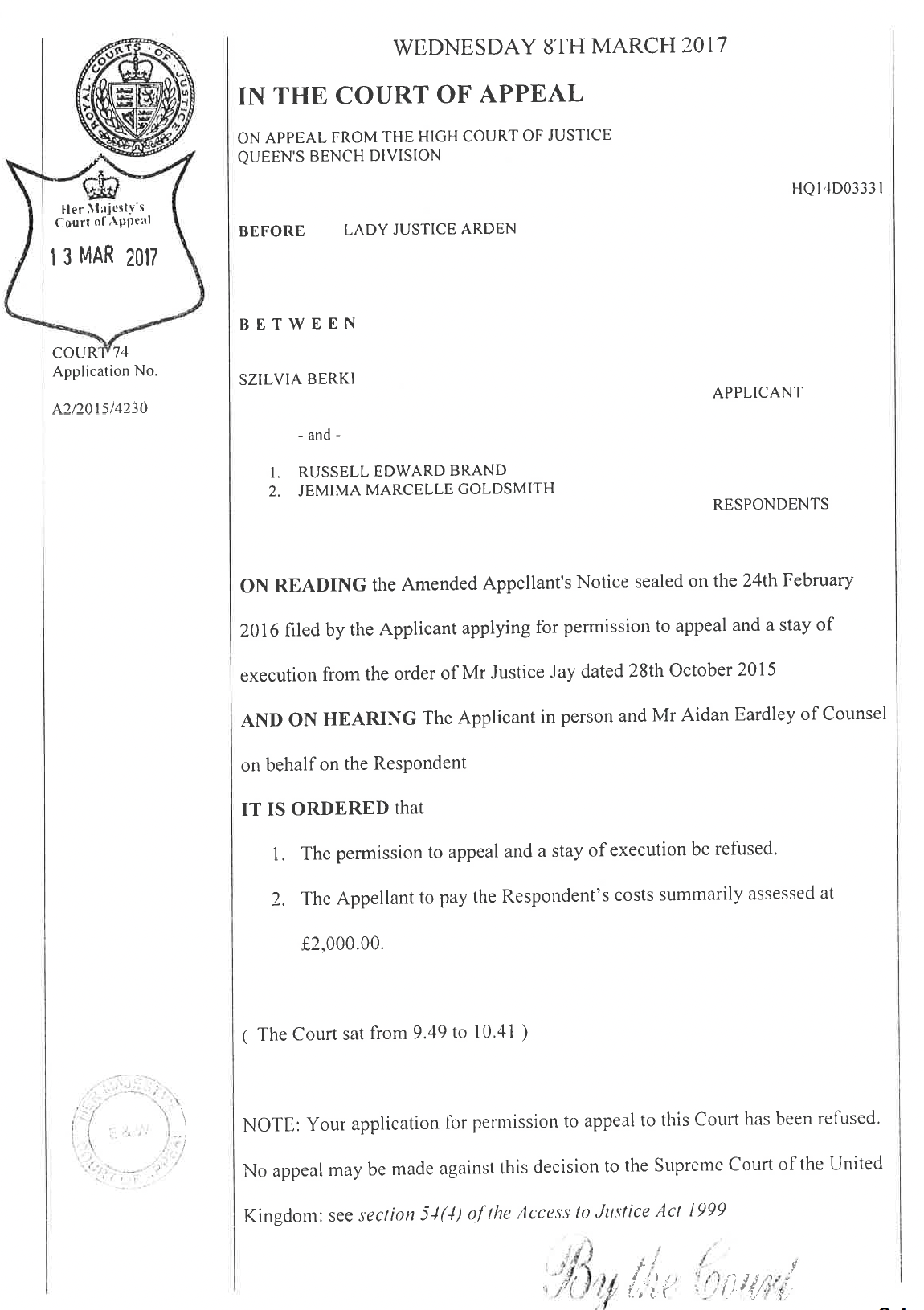
Ms Berki tried again. In March 2017, after a 52 minute hearing at which she represented herself against the claimants’ barrister, Lady Justice Arden refused permission and ordered her to pay another £2,000. The 2017 order itself gives no reasons (Lady Justice Arden gave her reasons in a judgment at the hearing, the 2017 judgment, which hasn’t been published):
This year, now with a pro bono lawyer, Ms Berki asked the Court of Appeal to reopen that refusal. In September Lady Justice Falk declined to do so (the 2026 order). We think that was inevitable. The court reopens a final decision only in “exceptional cases, where the integrity of the earlier process has been critically undermined”.
Lady Justice Falk, who had read the 2017 judgment, said that the concerns in the 2016 order “must be taken to have been addressed to her satisfaction” when Lady Justice Arden refused permission in 2017. She said the 2017 judgment had dealt with the basis of the summary judgment and with Ms Berki’s statutory defences. The 2026 order doesn’t say how the 2017 judgment answered the specific concerns raised in the 2016 order.
Lady Justice Falk seemed uncomfortable with the terms of the final injunction, though. It “on its face appears to prohibit”, she said, “further communication to the police, communication with other claimants in relation to civil claims, and disclosures to treating physicians or therapists”. And:
While I quite see the concerns about the breadth of the order, the proper way to deal with those concerns would be to apply to the High Court to amend the scope of the injunction based on changed circumstances.
That must be correct: as she said, “It is not a matter for this court.” Ms Goldsmith has said she is amenable to the injunction being varied. Presumably Mr Brand will not be, so a court application is required (and appears to have already have been made; we do not have a copy).
The responsibility of the lawyers
The firm acting for Mr Brand and Ms Goldsmith was Archerfield Partners LLP. The barrister was Aidan Eardley KC, now a High Court judge. We think they have serious questions to answer.
How could lawyers justify asking a court to prohibit speech that couldn’t conceivably constitute harassment – including private conversations with friends and family, and reports to the police?
There are also questions for the judiciary: how could Mr Justice Jay grant an order of such breadth against an unrepresented defendant, without a trial, and without determining whether her allegations were true? Did he consider the proportionality and necessity of the order?
Then there’s a bigger question. Was this a one-off? Or have other injunctions been granted, supposedly to prevent harassment, but actually silencing people even in private conversations with friends, family and the police?
Did the injunction really prevent Ms Berki from speaking to the police?
Some have suggested the injunction can’t really have prevented Ms Berki speaking to the police.
We think it’s important to separate the expected legal outcome (that, probably, no court would enforce such a prohibition) from the practical effect of the injunction (rational people would obey it very strictly in the absence of a court order).
It is reasonably clear that Ms Goldsmith and Mr Brand’s lawyers tried to create a prohibition on speaking to the police. The interim injunction had a specific and narrow exclusion for speaking to Thames Valley Police (“for the purpose of pursuing her complaint as to its decision not to charge the Claimants with any offence”) – and therefore by inference prohibited speaking to other police and/or for other purposes.10 There is then no exclusion in the final injunction.11 The 2026 order says it “on its face appears to prohibit”, among other things, “further communication to the police, communication with other claimants in relation to civil claims, and disclosures to treating physicians or therapists”.12 Ms Goldsmith has said her lawyers are ready to agree to a variation of the injunction to permit speaking to the police.
There’s an obvious parallel with NDAs. In 1998, Harvey Weinstein’s lawyers negotiated an NDA with Zelda Perkins which purported to restrict what she could disclose to the police and in criminal proceedings. This was widely viewed as unacceptable, so section 17 of the Victims and Prisoners Act 2024 expressly made such provisions void. The Government had said this strictly wasn’t necessary because common law overrode any contractual provision.
So as a practical matter, in terms of how Ms Berki (and anyone helping her) should rationally regard the injunction, we think it’s fair to say it does prevent her speaking to the police. Our challenge for any lawyer who disagrees: would you risk taking her to a police station without the protection of a court order?
Jemima Goldsmith’s response
After we published, Jemima Goldsmith published a statement on X:
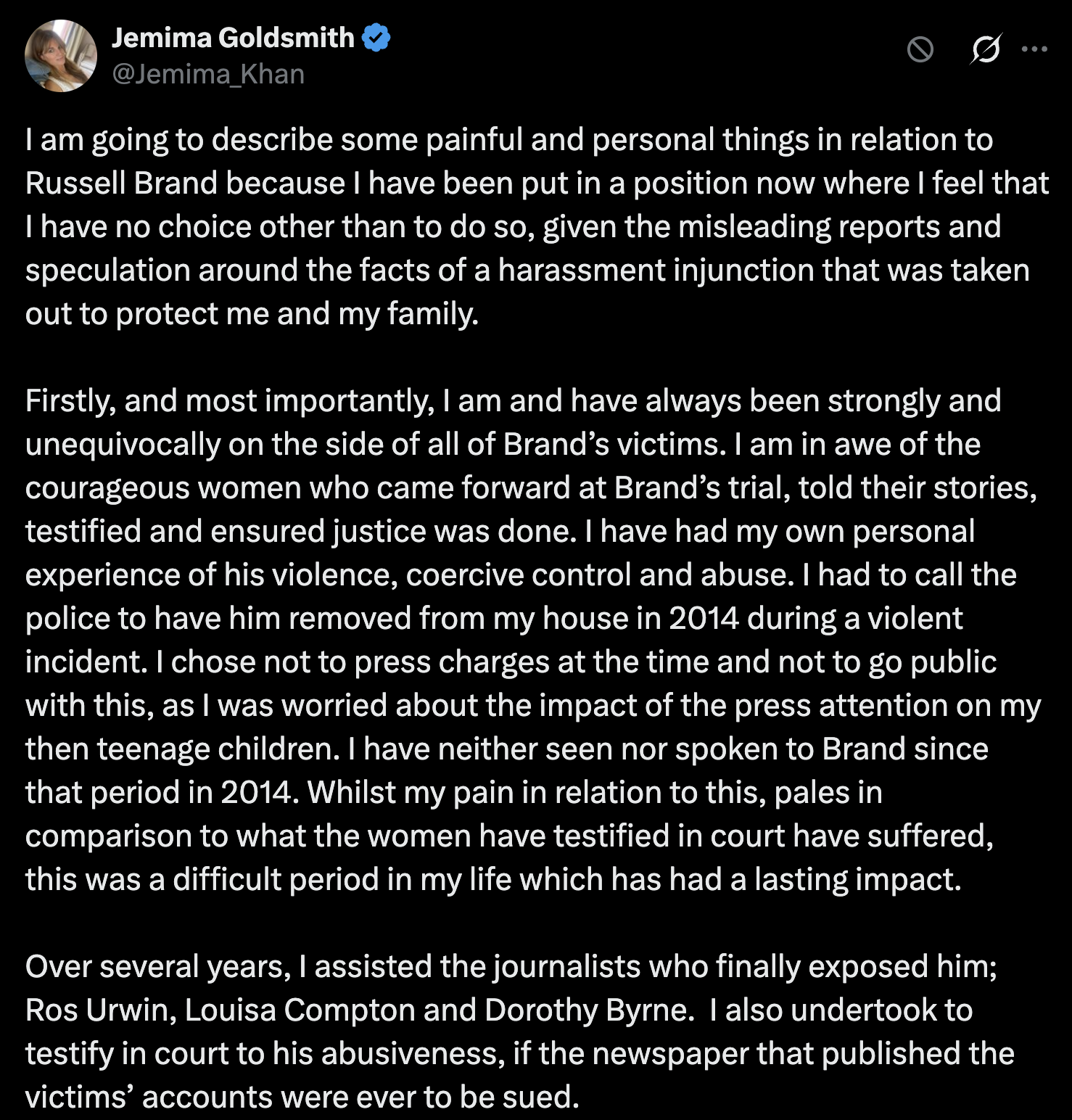
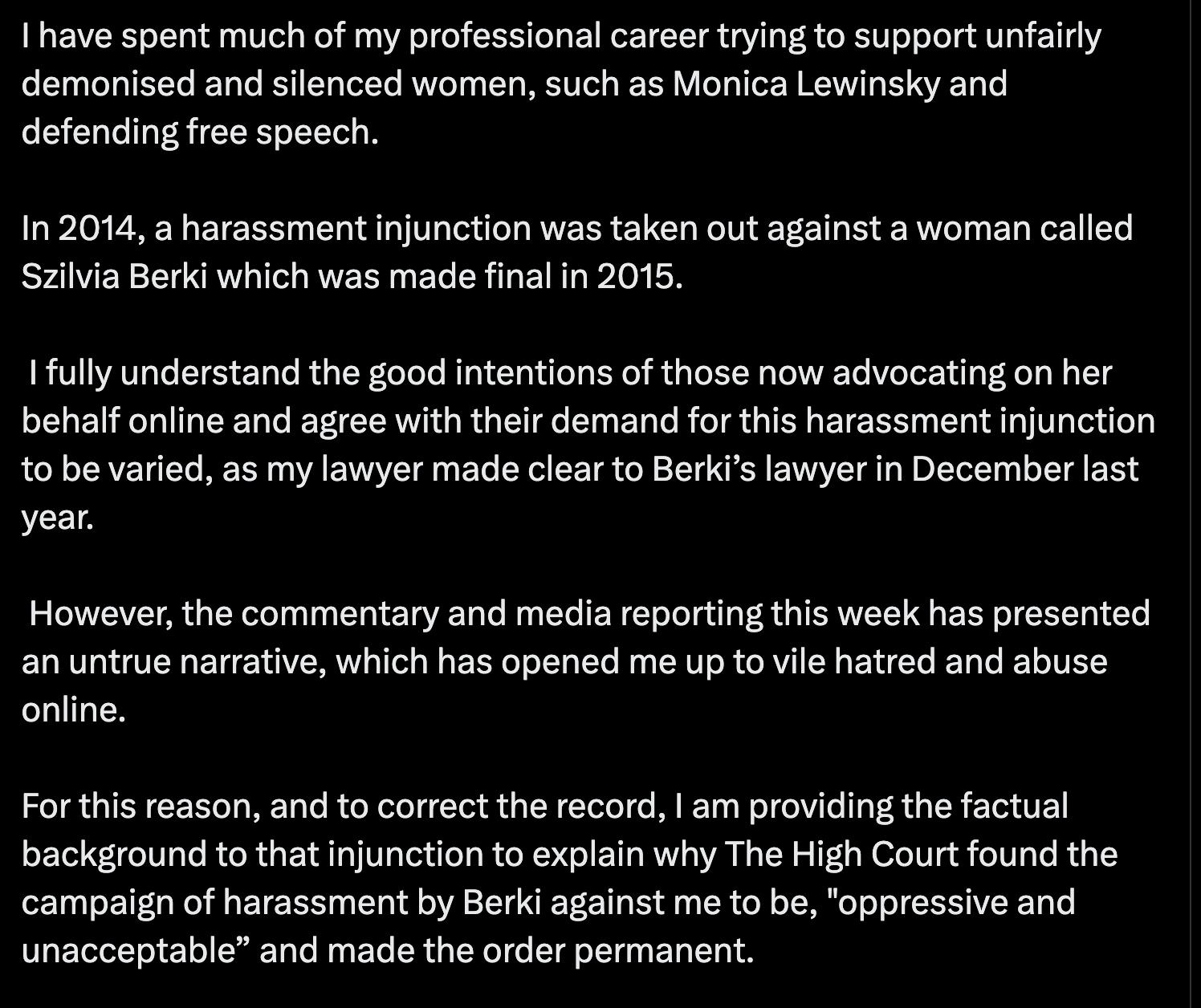
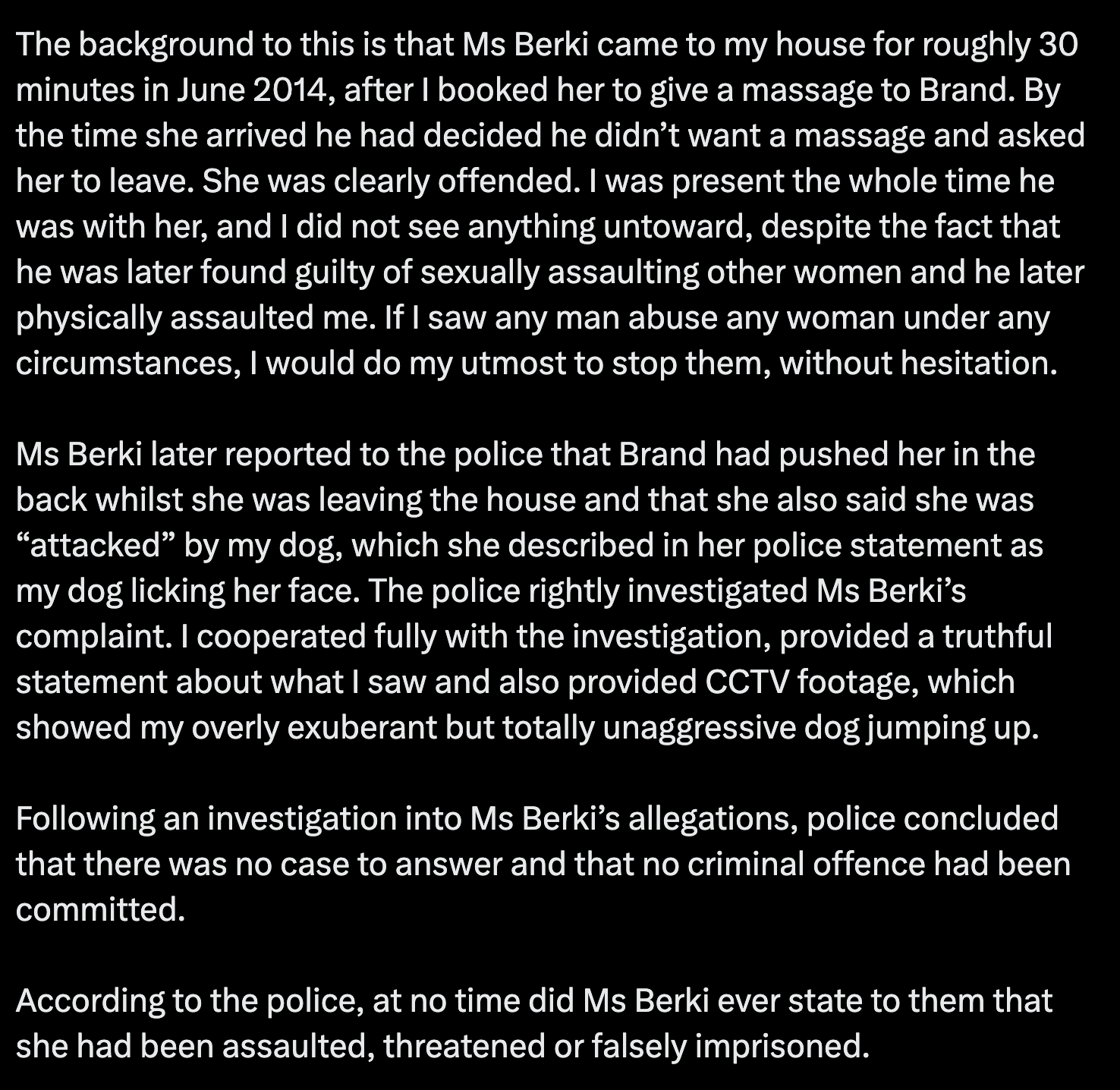
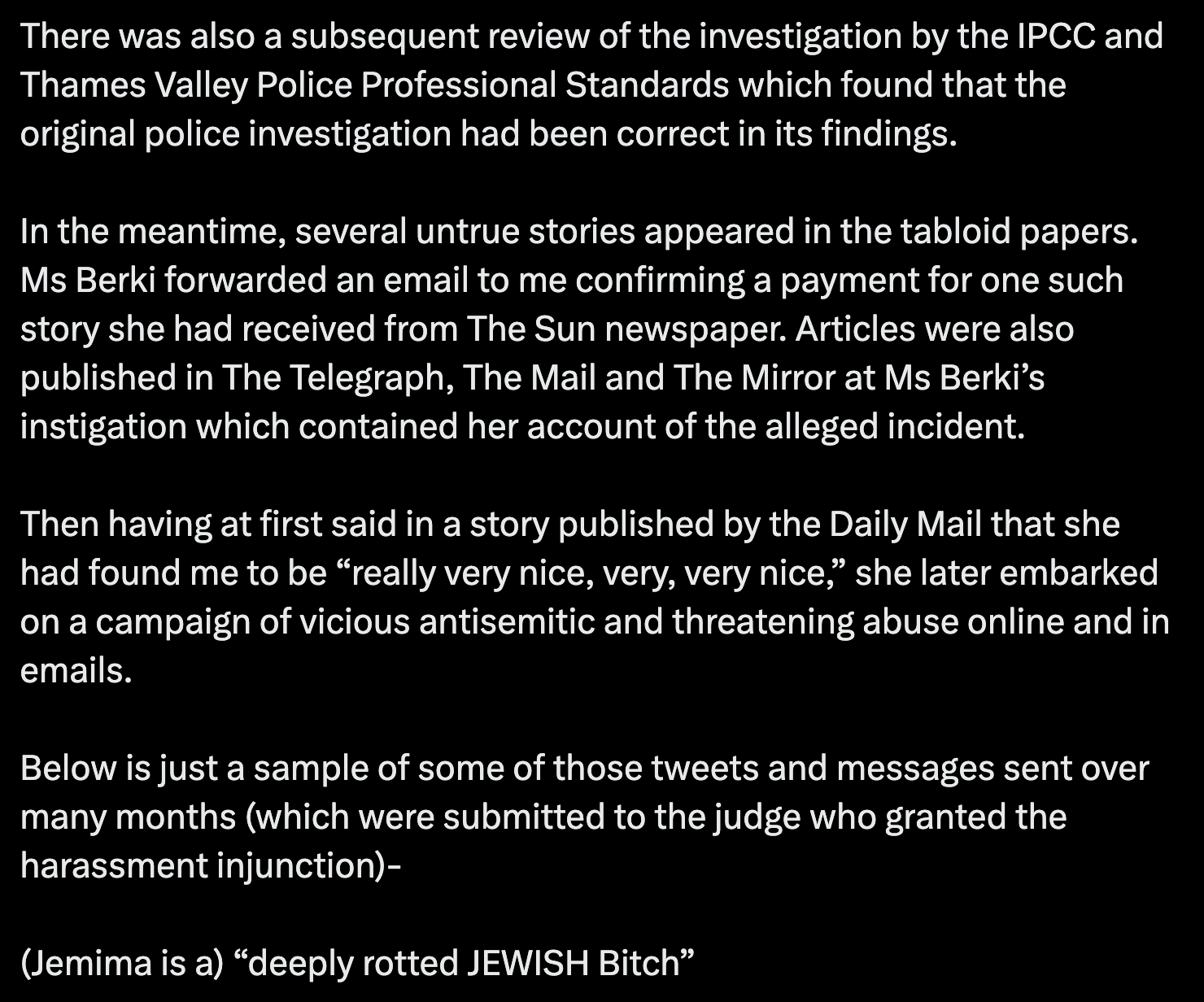

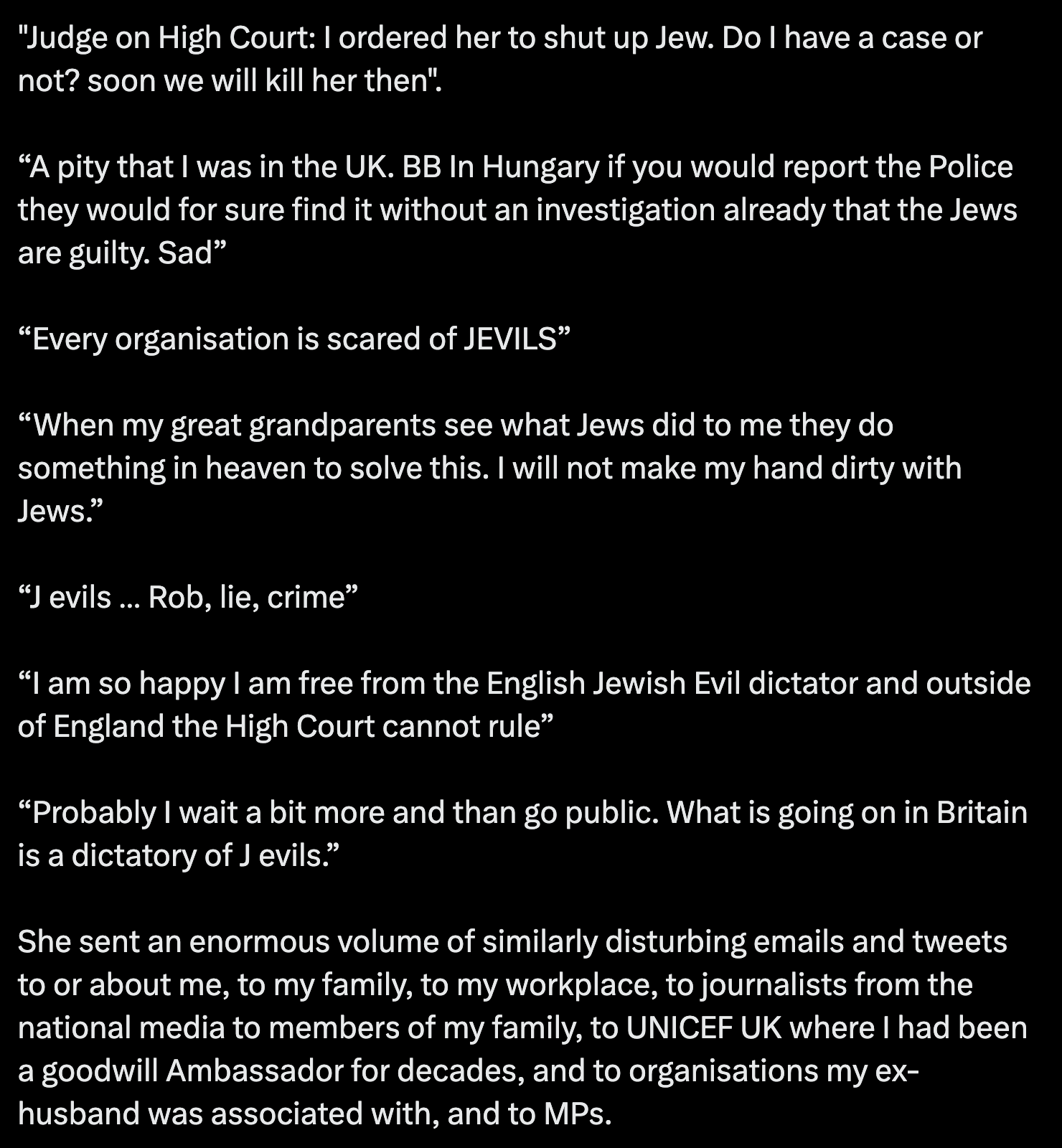
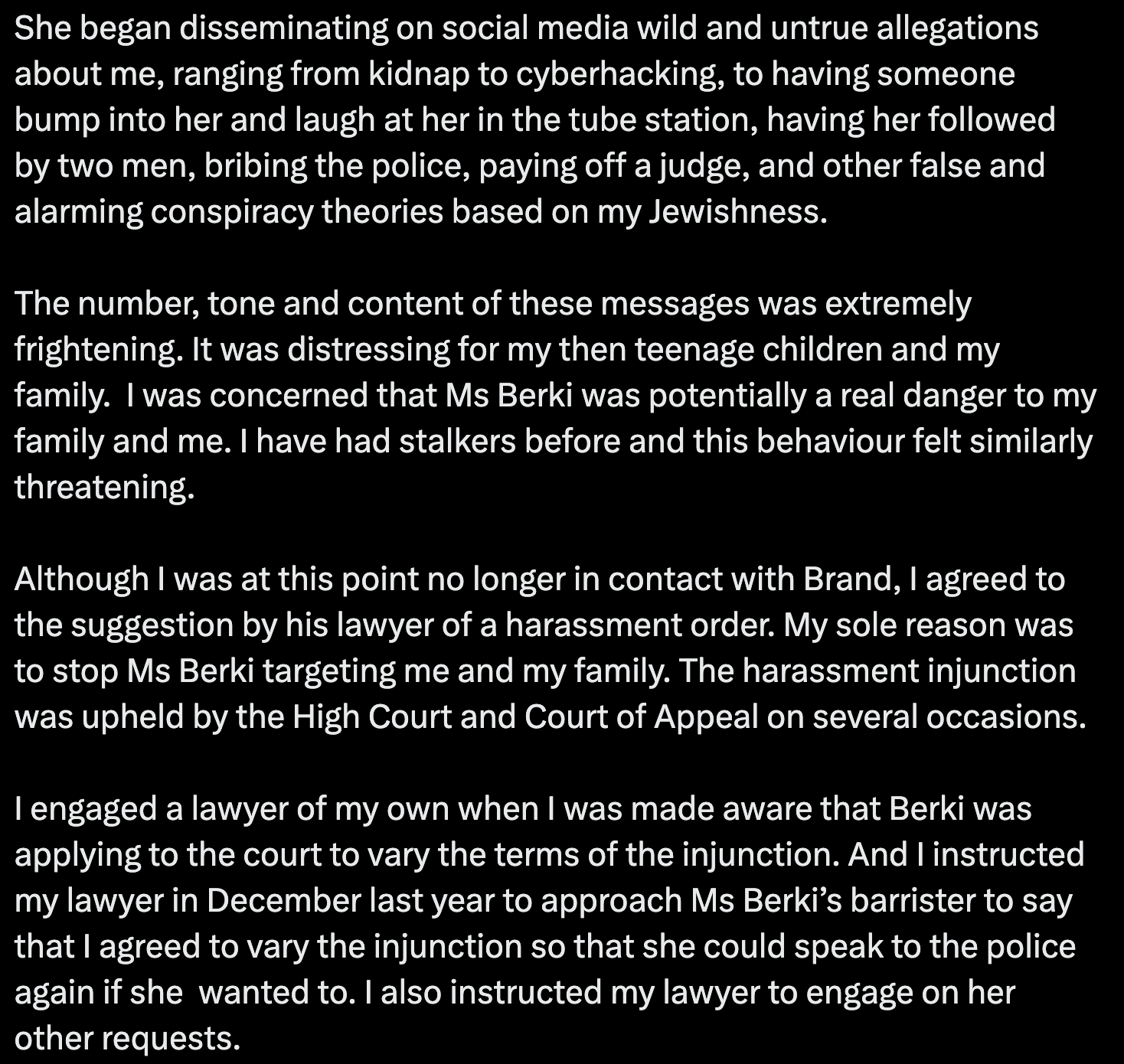
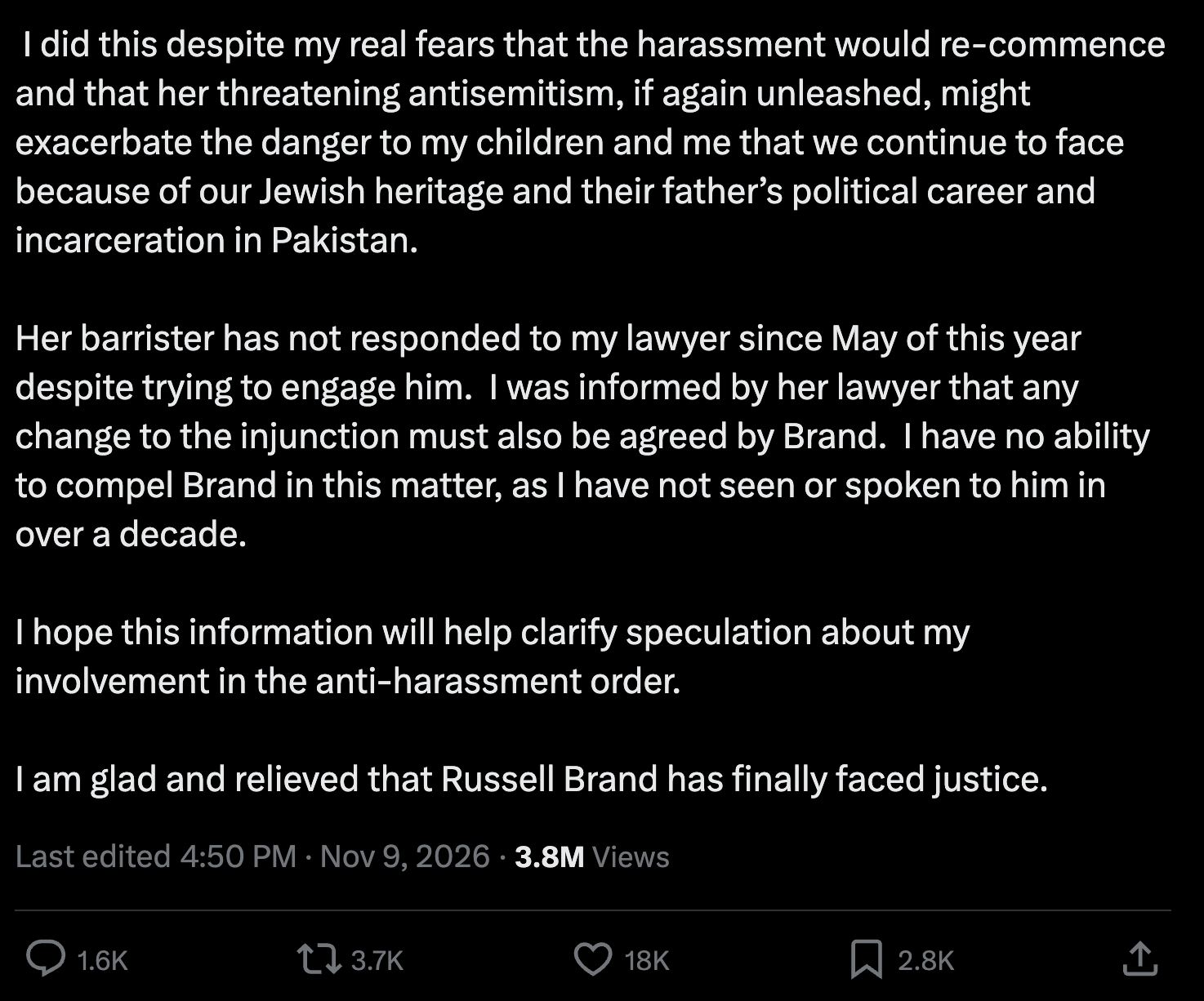
Ms Goldsmith says the injunction was taken out to protect her and her family. She says she was present whilst Mr Brand was with Ms Berki and saw nothing untoward; that the police found there was no case to answer and that, according to the police, Ms Berki never told them she had been assaulted; and that Ms Berki then began a campaign of antisemitic and threatening messages, which is why she agreed to the suggestion by Mr Brand’s lawyer of a harassment order. She also says that Mr Brand assaulted her in 2014, that she has neither seen nor spoken to him since, and that last December she agreed the injunction should be varied so that Ms Berki can speak to the police.
We were aware of some of this before we published (we had corresponded with Ms Goldsmith’s lawyers), but not all of it. Our concern was always the breadth of the injunction, and how it doesn’t seem justified by the reported actions of Ms Berki. That remains our view, for several reasons:
We cannot know whose version of events is correct
We now have Ms Goldsmith’s version of events, but Ms Berki isn’t able to reply. Ms Berki would be breaking the injunction if she spoke, and we would be breaking the injunction if we asked her for comment.13 The terms of the injunction mean that we can’t even repeat most of Ms Berki’s original allegations.14
One element in Ms Goldsmith’s statement appears to be incorrect. Ms Goldsmith says that “According to the police, at no time did Ms Berki ever state to them that she had been assaulted, threatened or falsely imprisoned”. But the 2014 judgment says that “according to the police disclosure notice, [Ms Berki] reported to the police that [Mr Brand] had assaulted her during her visit”.15 We don’t know whether Mrs Justice Carr has this wrong, Ms Goldsmith has this wrong, or there has been some other confusion.
The interim injunction was based on Ms Berki’s campaign of making accusations against Brand and Goldsmith, not on antisemitic tweets and threats
Ms Goldsmith quotes some appalling antisemitic tweets that she says Ms Berki sent, and says she was “concerned that Ms Berki was potentially a real danger to my family and me”.
We’ve no reason to doubt Ms Goldsmith’s word here – the 2015 judgment says Ms Berki had made “a series of scarcely veiled threats, some of which I have to say are extremely unsavoury”, and refers to “some rather unpleasant tweets”.16 If, however, we look at the 2014 judgment17 and the contents of the tweets18 it appears that these tweets were sent after the interim injunction was granted. They therefore do not explain the interim injunction.
The stated justification for the interim injunction in 2014 was Ms Berki’s campaign of making and widely publicising her accusations (most of which we cannot repeat here). This was the “harassment” described in the 2014 judgment19 – “a concerted campaign of emails to the Second Claimant, emails to the Claimants’ solicitors, emails to journalists, contact with UNICEF and numerous Twitter posts and internet publicity”.20 What those emails, tweets and publications had in common was that they made Ms Berki’s allegations against Mr Brand and Ms Goldsmith, or said she was going to.21 Mrs Justice Carr said that “whether or not the Defendant’s allegations are true is not the ultimate issue”, and that “What is at issue is the (unwarranted) manner of her dissemination of her extremely serious allegations about the Claimants. The sheer scale, content and variety of publication by the Defendant makes her conduct unreasonable in all the circumstances.”22
There can be no justification for the antisemitic posts (assuming Ms Berki indeed sent them), regardless of what happened at her original meeting with Mr Brand and Ms Goldsmith. Ms Goldsmith would have been perfectly entitled to report Ms Berki’s behaviour to the police, and it may have reached the level of criminal harassment. But Ms Berki’s subsequent behaviour cannot justify the original interim injunction.
What about the final injunction? By October 2015 it seems the abusive messages were before the court, and an injunction could have prevented Ms Berki from contacting Ms Goldsmith, sending abusive messages about her, or threatening her. That is, however, not the focus of the final injunction. Its terms are much the same as the interim injunction’s, which appears to have been granted before the abusive tweets were sent.23 They are aimed at Ms Berki’s allegations, not at abuse or threats: she cannot tell anyone, in any form, what she says happened.
It is not clear the court was told the full truth
Ms Goldsmith says that Mr Brand physically assaulted her, that she had to call the police to have him removed from her house in 2014 “during a violent incident”, and that she has neither seen nor spoken to him “since that period in 2014”. That is a terrible thing to have gone through, and it can’t have been easy to say publicly. Of the injunction, she says: “Although I was at this point no longer in contact with Brand, I agreed to the suggestion by his lawyer of a harassment order.”
The alleged assault therefore came before the injunction. The police were called to Ms Goldsmith’s house on 25 July 201424, and the first injunction was granted on 12 August 2014.
This should have been relevant to all three applications by Mr Brand and Ms Goldsmith. Ms Berki alleged that Mr Brand assaulted her. Mr Brand and Ms Goldsmith denied it. No court hearing the injunction applications decided who was telling the truth, but both judges gave a view on whose account was likely to be accepted at a trial. In both cases it was Mr Brand and Ms Goldsmith’s.25 An allegation that Mr Brand had assaulted his own co-claimant that same year was relevant to that view.26
The problem is that we don’t know whether any of the three judges who heard the claimants’ applications was told about the alleged assault by Mr Brand on Ms Goldsmith. There is no sign of it in either judgment, and we would expect there to be: it is hard to see a judge saying that Mr Brand’s denial would probably be believed, without mentioning that his co-claimant had reported him to police for assault.27
If the judges weren’t told, we think that is troubling, ethically and legally. The first injunction was granted “on an urgent basis”, at a hearing Ms Berki attended without a lawyer and “on short (and abridged) notice”. Someone who applies for an injunction on short notice has a duty of full and frank disclosure: they must tell the court everything material, including what hurts their own case. The High Court has held that this duty continues even where the other side has a lawyer at the hearing.28 Ms Berki had no lawyer, and no means of knowing what had happened between the two claimants.
The later hearings, in September 2014 and October 2015, were on proper notice. The claimants did not therefore have the same general duty to volunteer everything material that might hurt their case. But they and their lawyers still had a duty not to mislead the court. That includes creating a false impression by leaving something out,29 or acting in a way which “by omission leads the court to believe something he knows not to be true”.30 A statement need not be literally false to be misleading.31
The alleged assault went to the credibility of the claimants’ denial, both claimants knew about it, and Ms Berki could not have found out about it. If it was not disclosed to any of the courts considering Ms Goldsmith’s and Mr Brand’s applications then that is potentially serious.32
The Berki injunction in context
We’ve spoken to veteran media lawyers who believe that the wide scope of the injunction was a creature of its time. The era of super-injunctions had just ended33 and lawyers who had previously employed super-injunctions were using very broad harassment injunctions. Those lawyers told us they do not think an injunction in these terms would be granted today, and that there would, for example, always be a sunset period after which the order would be reviewed. They also do not think there would be even the appearance of preventing a defendant from speaking to the police. However, we are concerned that the reaction from some other lawyers working in this area suggests that, actually, injunctions of this kind continue to be granted.
The fundamental problem is this. If a person claims to be the victim of a crime, the police do not act, and the person then publicises their case, then the legal remedy for the alleged criminal should be defamation. Defamation law has a rightly high hurdle before an interim injunction can be granted.34 It also – crucially – permits a defendant to raise the defence of truth. Harassment injunctions have neither of these limitations.35 That seems to us quite wrong, and creates a dangerous and “gendered chilling effect“36, enabling the wealthy and powerful to silence true accusations made against them.
The police don’t always get it right when serious allegations are made. The prosecution and conviction of Mr Brand were not at the instigation of the police; they followed an investigation by journalists. So people who say they’ve been wronged need to be able to speak for themselves. That doesn’t mean they have a licence to harass or threaten, and anyone falsely accused can sue for libel.
But the law shouldn’t enable people to silence accusations using harassment and privacy law, before any court has decided who’s telling the truth. Parliament never intended to create such a right, and it runs against 130 years of the courts’ reluctance to restrain speech ahead of publication. It’s a development Parliament should reverse.
Photo by Gage Skidmore, CC BY-SA 4.0, via Wikimedia Commons

Many thanks to T, V and P for their PHA 1997 expertise.

We defeated an £8m libel claim – and it shows libel law and the Tax Bar need reform.
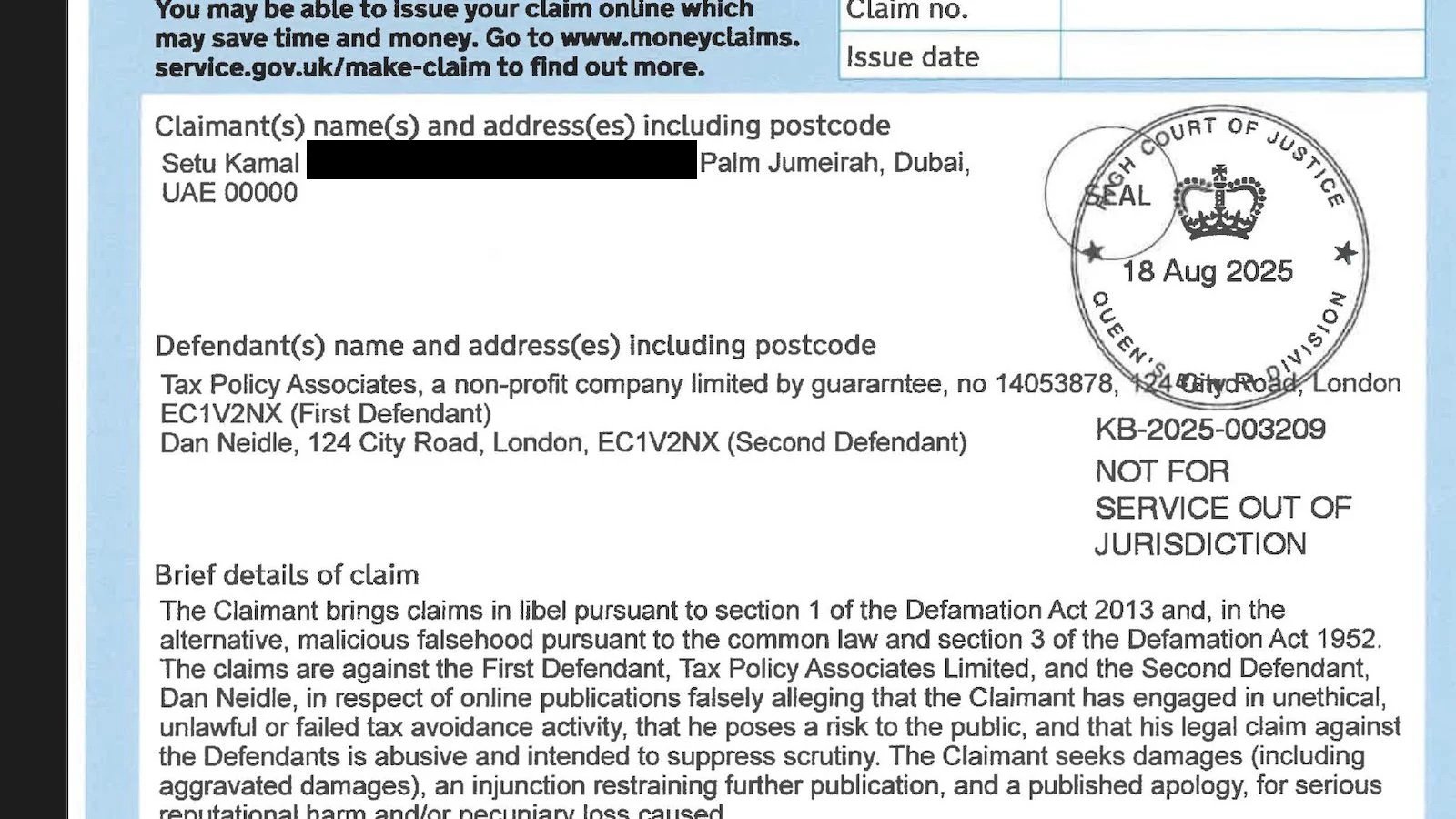
I’m being sued for £8m for a report on tax avoidance
Carter-Ruck enabled the $4bn OneCoin fraud. Was it a crime?

Carter-Ruck: the libel firm trying to cover up that they’d acted for the $4bn OneCoin fraud
An incompetent attempt to silence me by tax barrister Setu Kamal

The Zahawi libel story isn’t over – his lawyer is appealing
Footnotes
See the 2014 judgment, Brand v Berki [2014] EWHC 2979 (QB), at paragraph 14. ↩︎
Paragraph 32 of the 2014 judgment. ↩︎
Paragraph 44 of the 2014 judgment. ↩︎
There’s also a summary on Inforrm. She’d had “some legal assistance” with her defence, “but since then she has been on her own”. The journalists in court don’t appear to have seen the final injunction, and presumably had no idea how wide it was. ↩︎
It is important to say: we did not obtain this document from Ms Berki, either directly or indirectly. We have redacted Ms Berki’s personal details: the names of her GP and clinic. This copy does not include the Confidential Schedule, which is subject to a reporting restriction. ↩︎
The interim injunction at least let Ms Berki contact Thames Valley Police to pursue her complaint about their decision. See paragraph 22 of the 2014 judgment. ↩︎
See paragraphs 42 and 44 of the 2015 judgment. ↩︎
CPR 1.1(2)(a) and 3.1A(4). Rule 3.1A was inserted by the Civil Procedure (Amendment No. 4) Rules 2015. ↩︎
Unless of course the original draft order was more draconian; it is not clear what such an order could even look like. ↩︎
This is the description of the interim injunction at paragraph 22 of the 2014 judgment; we haven’t seen the interim injunction itself. Mrs Justice Carr relied on the exclusion when rejecting Ms Berki’s defence that she was acting to prevent or detect crime: “The proposed injunction does not prevent her from communicating with the police in connection with her dissatisfaction with the police decision” (paragraph 44(b)). ↩︎
See paragraph 4 of the final injunction: the only exceptions are for lawyers and specified medical practitioners. ↩︎
Paragraph 19 of the 2026 order. ↩︎
Paragraph 11 of the final injunction: “It is a contempt of court for any person notified of this Order knowingly to assist in or permit a breach of this Order.” ↩︎
Those details are in the Confidential Schedule, which is subject to the reporting restriction in paragraph 7 of the final injunction. ↩︎
Paragraph 11 of the 2014 judgment. Ms Goldsmith’s own statement says Ms Berki “reported to the police that Brand had pushed her in the back”. It is reasonably clear that Ms Berki’s story was inconsistent. The 2015 judgment refers, at paragraph 35, to “the allegation of assault which has not been consistently advanced”. The 2015 judgment records the police saying that Ms Berki “was vague at interview as to what she was alleging actually occurred, and appeared to have focused on what could have happened rather than what did happen”. ↩︎
Paragraphs 33 and 34 of the 2015 judgment. Neither judgment quotes the messages or mentions antisemitism, and in the 2016 order Lady Justice Arden said Mr Justice Jay had “referred to threats which the appellant had made without specifying them and I do not know precisely what they were”. ↩︎
Mrs Justice Carr sets out what Ms Berki did before the interim injunction of 12 August 2014 at paragraphs 10 to 17 of the 2014 judgment, with dates. There is no reference to threats (other than threatening to repeat allegations) or antisemitism. She then says, at paragraph 18: “I have seen a very large number of tweets since the order of Lewis J making allegations of criminal and other wrongful activity on the part of the Claimants … They include highly offensive material.” ↩︎
One of the messages Ms Goldsmith quotes begins “Judge on High Court: I ordered her to shut up”, and another says “outside of England the High Court cannot rule”. Both must have been written after a court order. Ms Goldsmith also says that Ms Berki “later embarked on a campaign of vicious antisemitic and threatening abuse” after a story in the Daily Mail; the Mail on Sunday published Ms Berki’s allegations on or about 2 August 2014 (see paragraph 16 of the 2014 judgment), ten days before the interim injunction. We can’t date every message, and it’s possible some are earlier. ↩︎
The interim injunction was granted by Mr Justice Lewis on 12 August 2014, and there is no published judgment from that hearing. A month later Mrs Justice Carr reheard the application in full (“This application proceeds by way of complete re-hearing”: paragraph 1 of the 2014 judgment) and continued the interim injunction. The 2014 judgment is the only statement we have of the reasons for it. ↩︎
Paragraph 42(a) of the 2014 judgment. Mrs Justice Carr said this went “well beyond annoyance” and could “fairly be described as oppressive and unacceptable”, which is the phrase Ms Goldsmith quotes. ↩︎
Paragraphs 10 to 17 of the 2014 judgment: emails “setting out the allegations that she intended to make”, approaches to the Sun, the Daily Mail and the Daily Telegraph, an email to UNICEF “making various allegations against the Second Claimant, including of serious criminal conduct”, an email to journalists, an MP and the Prime Minister, a petition on Change.org, and tweets “which allege serious criminal wrongdoing on the part of the Claimants”. ↩︎
Paragraph 44(c) of the 2014 judgment. By then Mrs Justice Carr had seen the tweets sent after 12 August, so they may have played some part in her decision to continue the interim injunction. They can’t have played any part in the original decision to grant it. ↩︎
Compare paragraph 3 of the final injunction with the summary of the interim injunction at paragraph 21 of the 2014 judgment. The final injunction adds a prohibition on alleging that the injunction was improperly obtained, and drops the exception for contacting Thames Valley Police. ↩︎
The timeline isn’t quite that tidy. On 7 August 2014, thirteen days after the police say they were called, and five days before the injunction, Ms Goldsmith tweeted at Mr Brand: “Hey @rustyrockets …Please get off twitter so we can enjoy our holiday? xx #Oneyear”. The tweet is no longer on X, but the Internet Archive captured it on 3 September 2014. It appears to show the two of them on holiday together. If so, the police may have the date wrong, Ms Goldsmith’s recollection may not be quite right, or there may be another explanation (for instance, that they stayed together for a short time after the incident). Either way, it’s reasonably clear the alleged assault came before the injunction: on the police’s date it was eighteen days earlier, and on Ms Goldsmith’s own account she was no longer in contact with Mr Brand when she agreed to it. ↩︎
Mrs Justice Carr: “The Claimants deny any such conduct” (paragraph 3 of the 2014 judgment), and “I incline to the view that the likelihood is that the Claimants will establish that the Defendant’s allegations are false” (paragraph 44(c)). Mr Justice Jay: the dispute about what happened was “likely to be resolved in the claimants’ favour, but I cannot say that the defendant has no real prospect of success” (paragraph 42 of the 2015 judgment). Both judges said the injunction did not depend on the allegations being false. But Mr Justice Jay said the truth of what happened “does bear on the issue of whether the defendant’s conduct was reasonable or unreasonable”, and that the events of 7 June 2014 were relevant “in so far as they throw light on the issue of credibility of witnesses and on the defendant’s motives”. He then decided the case on his view of Ms Berki’s motives. ↩︎
It’s what lawyers call “similar fact” evidence. In a civil case it is admissible if it is potentially probative of an issue in the case, and the judge then decides whether to admit it: O’Brien v Chief Constable of South Wales Police [2005] UKHL 26. ↩︎
Both claimants gave written evidence. Mrs Justice Carr refers to their witness statements at paragraph 19 of the 2014 judgment, and Mr Justice Jay had “the claimants’ full witness statements” (paragraph 41 of the 2015 judgment). We have not seen those statements. There is no published judgment from the first hearing, before Mr Justice Lewis on 12 August 2014. For completeness: paragraph 2 of the 2014 judgment, given after a hearing on 10 September 2014, says that Mr Brand and Ms Goldsmith “have at all material times been in a personal relationship together”. That could be read as the court being told that the relationship was continuing, although that is not entirely clear. ↩︎
CEF Holdings v City Electrical Factors [2012] EWHC 1524 (QB), at paragraph 183: “the duty of the applicant who makes an application with less than the prescribed period of notice to give full and frank disclosure continues even when the opposing party is represented on short notice”. See also ASA v Mitchell [2019] EWHC 1527 (QB) at [20]. The applicant is absolved only for matters the other side has itself drawn to the court’s attention. The prescribed period is normally three days, but here Ms Berki had less (we don’t know how much less). The descriptions of the first hearing are from paragraph 1 of the 2014 judgment. ↩︎
In Boreh v Republic of Djibouti [2015] EWHC 769 (Comm), at paragraph 224, Flaux J distinguished the duty of full and frank disclosure from the duty not to mislead, which applies at every stage, including contested hearings. The case involved deliberate deception in obtaining a freezing injunction, so it does not establish that every omission of an adverse fact is improper. See also Shaw v Logue [2014] EWHC 5 (Admin), at paragraph 37, on the duty to correct a court that has inadvertently been misled. ↩︎
Brett v Solicitors Regulation Authority [2014] EWHC 2974 (Admin), paragraphs 111 and 112. The case concerned the identification of the anonymous blogger Nightjack. A journalist’s witness statement created the impression that he had identified the blogger using public sources, when he had first identified him through unlawful access to his emails. The solicitor allowed that impression to stand, creating a misleading case. ↩︎
In ZXC v Bloomberg, a journalist said he had been “shown” a confidential letter, without revealing that he had been given and retained a copy. The judge held that this was misleading by omission. Similarly, a party shouldn’t remain silent when evidence that was originally accurate has become misleading – see Vernon v Bosley. ↩︎
The Court of Appeal’s refusal in 2026 to reopen the case does not answer this point. Lady Justice Falk rejected Ms Berki’s attempt to rely on fresh evidence supporting her version of events, because “Jay J did not grant summary judgment having resolved that issue against her”, and because subsequent events cannot justify unravelling a final decision (paragraphs 15 and 16 of her order). The alleged assault on Ms Goldsmith is not a subsequent event. Both claimants knew about it when they applied. ↩︎
A super-injunction is an injunction whose existence can’t be reported. After the Trafigura and John Terry cases, a committee chaired by the Master of the Rolls reported in May 2011 that exceptions to open justice should be allowed only “when they are strictly necessary in the interests of justice”, so that “super-injunctions will only be granted in very limited circumstances and, at least normally, for very short periods of time”. That was followed by the Practice Guidance on Interim Non-Disclosure Orders [2012] 1 WLR 1003, which is cited at paragraph 9 of the 2014 judgment. ↩︎
“The ‘defamation rule’ precludes the grant of an interim injunction unless it is clear that no defence can succeed”: paragraph 32 of the 2014 judgment, citing Bonnard v Perryman [1891] 2 Ch 269. Mr Brand and Ms Goldsmith’s claim form included a claim in libel, but by the time of the hearing the claim was limited to harassment. ↩︎
There are limits, but they are much weaker. Under section 12(3) of the Human Rights Act 1998 the claimant has to show they are “likely” to succeed at trial, not that no defence can succeed. And whilst a defendant can argue that their conduct was reasonable (section 1(3)(c) of the Protection from Harassment Act 1997), a court can find harassment without deciding whether the allegations are true, as both judges did here. ↩︎
That link is to a special edition of the Journal of Media Law – “Making Public Allegations” – that discusses the parallel issues in privacy law (short summary here). The phrase comes from Townend & Doughty. ↩︎
43 responses to “The injunction that permanently silenced Russell Brand’s accuser”
Has anyone reached out to Sylvie Berki?
that would potentially be a contempt of court, for Ms Berki and the person contacting her.
I had never heard of the law firm so I googled it. Its Companies House filings raise questions any tax adviser would ask. There may be perfectly good answers to all of them.
1. Archerfield Partners LLP has had two corporate members since August 2010, one company owned by each founding partner. Before 2014 that structure was common, mainly because profit allocated to a company was taxed at corporation tax rates rather than income tax rates. Parliament changed the rules in 2014 to stop it. I don’t know why this firm did it. I do wonder why it took 19 months, until March 2012, to tell Companies House the companies were members, when the deadline was 14 days.
2. One of the companies’ accounts say it was entitled to a share of LLP profits until at least 2018. Were the 2014 rules applied?
3. The other company owed its director £325,780 in August 2021. The loan was repaid at some point after that, and the company reclaimed the £105,878 of tax charged on the loan. The company was then liquidated, and 13 days in he was paid £325,781. Getting money out of a company as a liquidation payment is usually taxed as a capital gain, at a much lower rate than dividend income. If the loan was cleared by anything other than a real cash repayment, the Upper Tribunal held last month (Powell v HMRC) that it counts as a release, which is taxed as income. And because the firm’s website lists him as a consultant, there’s also the anti-avoidance rule for liquidation payments to people who carry on a similar activity afterwards. So: how was the loan repaid?
1. One for (pro bono) lawyers again ? Or a crowdfunder????
Para 4(a) of the order expressly allows her to speak to lawyers – so time to engage again ?
2. And/or time for the Met and Thames Valley Police to make the application to vary the order, as interested/affected parties.
If they really want to take sexual assault allegations seriously, that is what they should be doing.
Come on…… please – do the right thing.
It is not the court’s role to stop the police from investigating alleged offences. The circumstances have changed since the police originally closed this investigation.
It would be very hard now to oppose an application to vary this one.
NB the order does not purport to prevent the police from reopening the investigation and speaking to the original parties. They should.
Everything in the order should be about stopping harassment, not stopping her from saying/doing anything at all.
Someone should make sure that Mark Rowley is aware of this and invite him to provide a witness statement in support of an application to vary the order. Or, better still, the police can make such an application as an interested/affected party. It would surely be unwise for either claimant to oppose the relevant variation.
This is a great article, but why did you censor my previous comment saying it was illegal and should be ignored? That’s supporting the injunction.
the injunction is not illegal and cannot be ignored, and anyone following your advice could end up in jail with their assets seized. I won’t publish stuff that isn’t correct and could endanger people.
I would appreciate it if someone could tell where the order says that the defendant may not contact the police about her allegations. Many thanks
the injunction says she can’t contact anyone, with specified exceptions that don’t include the police. By contrast, the interim injunction had a (narrow) exception for contacting the police. So that means, on its face, the order prevents her speaking to the police.
Doesn’t seem that the claimants or the judges thought that, given that the interim injunction had a specific and narrow exception for one police force and one purpose. The final injunction had no exception at all.
A clear misuse of injunction and a woman silenced. have we not learnt anything in the legal profession how to treat women who come forward. I hope the judge is called to answer for this. This does not look good in terms of ensuring justice. Shame ..
All very very sad but what’s this got to do with taxation?
Tax is our focus but we also cover legal policy. I’ve been writing about SLAPP for three years.
My god, is there anyone here that can help address this for this individual? And then I hope those capable of creating some level of accountability and preventing such orders being possible in future are reading this. Surely this cannot be allowed to stand??
Great work (as ever) Dan. It is beyond my comprehension how the judiciary could restrict someone from talking to the police about an allegation of abuse.
I would hope that, if Ms Berki wants to talk to the police (in the light of the comments made by Mark Rowley and the conviction of Brand), a lawyer will be willing – on a pro bono basis – to help her make an application to vary the order. The courts don’t usually vary final orders, but their is jurisdiction to do so in appropriate circumstances. Goldsmith and Brand would do themselves no favours by trying to oppose such an application.
I would argue if Brand was the good christian now he professes to be, then he would forgive her and do nothing!
Excellent analysis, as ever – and a real injustice. How the injunction was ever granted in these terms is beyond me – even if Brand was as pure as the driven snow, and Berki was pure malice, I can’t see how the stringent terms of the injunction could be justified.
And if there is this injunction which we are now aware of, one has to assume that there must be others in similar terms in existence. This requires urgent investigation – perhaps directed by the President of the Supreme Court – as the law is being made (rightly) to look an ass
The injunction’s requirement that she hand over all of the case papers – every record that she’d ever been sued – seems extraordinary?
Brilliant work and an eye-opener regarding the acts of various parties in connection with Ms Berki.
The word “appalling” is often used in satirical jokes in Private Eye based on reported use by one particular prominent person.
In this particular case it looks like it can be used justifiably when describing the way the defendant has been treated
I consider we need to ask whether had the defendant been treated differently criminal justice would have come far sooner and possibly saved others from what Mr Brand has been found guilty of
(Some of this thought-stream on naming Judges and other villains – is in response to Dan’s brilliant work and is off-piste in places, but bear with me)
Victims of sexual abuse will attest, it is double punishment when the sexually abused victim is blamed . I am very glad Justice Jay is named several times here. Often journalists will simply refer to : ‘The Judge in this case’. Justice Jay’s behaviour makes the law a party to the abuse. What Dan has done in writing about this particular SLAPPS , is expose rotten process and judgement which has consequences beyond the particular egregious purpose of the SLAPPS. I have an unproven theory, that when the public is badly failed over time by our legal institutions, it can have an existential impact . It perhaps creates a surge of public dissatisfaction , and when other social , political and economic factors are present, feeds into political vigilantism, which in turn is often manipulated by the far right. Witness ‘Tommo’ encouraging black apparelled stormtroopers, in balaclavas, many of them previously convicted of violent abuse of women as reported by the Guardian, patrolling streets in Dover, Bournemouth & Portsmouth ostensibly to protect British women from sexual abuse! Impunity is the zeitgeist word leeching into every aspect of the State and its institutions here and across the Atlantic. Do what I do is one signal sent by a debased, lowering US President to his supporters. He is already convicted of sexual abuse, known to have associated with Epstein, kept in power by billionaires, courtier grifters and placemen in the Supreme Court. There is not that much which separates the balaclava’d idiots here from the mindset of the leader of the ‘free world’ . The precarity of the British state, our social cohesion is not helped by the Bar Council and the SRA who seem understaffed, inept, slow as well as unwilling to do their job properly. The CCRC and other legal intitutions, particularly Britain’s regulators, disciplinary and oversight bodies with powers, fail us all the time. Judges too get away with impunity. Judges were not even included as witnesses to the Horizon Post Office Statutory Public Inquiry. Former President of the Supreme Court Neuberger, was not called to give evidence as to why he advised Post Office to recuse Justice Fraser in the Alan Bates itigation of 555 Subpostmasters in 2018. It will e interesting to see what Fraser produces next year on Reform in our legal system as he nowheads up the Law Commission. I admire him but don’t hold out much hope. Some campaigners in the know are aware that UK Government Investments, based in the Treasury, had representatives on the Post Office board over a perriod of decades. One of those on the Board at the time when the Post Office were warned that many convictions were unsafe, is now a Permanent Secretary of a major Government Department. What did they know? Was Project Brisbane part of the cover-up? The law’s negative role in what could be called a political protection racket in the Horizon Post Office scandal is well documented. but it is not talked about enough Lawyers and solicitors hired by the Post Office got away with ruining thousands of lives, contributing to suicides, early deaths and slowed up compensation were paid £335 million of public money. It was in their financial interests to be slow. Only One PM did something useful and that was Rishi Sunak and he did it for political advantage following the ITV drama. Some lawyers at Bond Dickinson (now Wombles Bond Dickinson) advised against a paper trail on indemnity insurance in case they got found out covering up prior knowledge of unsafe convictions. But the naming of these villains in what is left of our legacy media is muted because of constraints and shrunken nature of our faced by a shrinking industry Perhaps out of work investigative journalists should try their hand at writing TV plays? Finally, in the Khan/Band case, Justice Jay, Justice Falk as well as Solicitors Archerfield Partners have brought the law into disrepute. Court reporting is a dying field except in celebrity trials. .Myriad important Civil Cases and in Family Courts ( Louise Tickle’s work on the later here acknowledged) are hardly reported upon. In this case, Justice Jay’s behaviour surely requires him to be kicked off the bench? I have asked John Hyde at Law Gazette why Judges are often not named in such cases, simply referred to as ‘the Judge in this case’ but have not got an answer. I also want to know how difficult is it to sack a Judge -kick them out of the Profession, and what role the Attorney General plays in this.
When you wrote about this on X, Dan, you said that the only way around the injunction was through the exercise of parliamentary privilege. You suggested that the Women and Equalities Select Committee could invite Ms Berki in to speak. Is that definitely the case? If so, it’s something that should be pursued.
Good idea. He is right.
Let’s hope that someone like Jess Phillips reads this, as I am sure she wouldn’t be afraid to take the matter up, and god help anyone who tries to stop her!
She’ll be aware of it now given the publicity. Let’s see if she does anything.
Sadly yet another example of the professionals in the legal system being found wanting. What really appalls me is that there is little effective regulation of the profession. Whilst there are undoubtedly good people in the legal system, there are enough bad apples and routine systemic failures without consequence, to leave me feeling nothing but distain.
An excellent analysis. This is an appalling abuse of process in which Jay, J was complicit. This brings the entire system of ‘justice’ in the UK into disrepute. There needs to be a reckoning.
This is absolutely abhorrent and deserves far wider attention. How can someone be subjected to an injunction for so many years, potentially leaving them unable to tell their side of the story? Surely it’s time for an independent review of the circumstances surrounding it and whether it can still be justified.
What I find particularly troubling is that Jemima Goldsmith speaks publicly about protecting women and girls and women’s safety. But surely that should also mean standing up for a woman’s right to be heard, even when what she has to say might be uncomfortable?
Wealth, status and connections should never put anyone beyond scrutiny. Everyone deserves to be treated fairly, and nobody should be denied a voice simply because someone else has more power or influence.
I don’t see how much of this could possibly be enforced.
It’s fairly clear that Russell Brand’s solicitor will seek to enforce it.
She has already been forcibly bankrupted once. That is highly effective enforcement. Claimants and their solicitors in this case have shown their intent to aggressively enforce this, so even if it was a media outlet that breached the reporting restrictions, there’s a high likelihood the claimants would sue. Or anyone breaking the reporting restrictions could be held in contempt by the courts for the purpose of protecting the sanctity of reporting restrictions. These kinds of injunctions are enforced regularly in other cases, so your comment makes no sense.
In my experience, ( I am a retired police officer) I rarely found the rich and powerful ever answered for their crimes and would recourse immediately to the law, which they can afford and lesser mortals rarely can.
It’s a sad indictment of the law, the system, governance and government.
Just look at how the amelioration of legal aid has stripped so many of any power to challenge.
I think that sums up the situation succinctly. Like the current computer says no comedian who has tried – and failed – to have a super injunction in his favour, only the millionaires can afford legal protection.
Will Archerfield Partners LLP answer, though?
<
Extremely dystopian. This young woman has been treated abominably by the courts.
It is an absolute disgrace that something like this is allowed to happen but we have seen time and time again that wealthy ne’er do wells are very quick to run to the courts to stop their wrongdoings becoming public knowledge and the Courts seem happy to oblige. The very notion that you can be prevented from reporting a crime to the police is absurd.
‘Was this a one-off?’ Highly unlikely. How many more vile people like Brand are hiding behind similar court orders?
Fortunately Brand is being dealt with but Ms Goldsmith isn’t entirely blameless here either.
Hopefully this matter will be taken up in the House of Commons and SLAPPs will soon be a thing of the past.
Terrific analysis. Even though she failed in her objective huge credit should go to Ms Szilvia Berki for even trying and finding the resilience to persist. Without her endeavour this story, which shines a spotlight on how the legal system is used to facilitate rapists.
“The credit belongs to the (wo)man who is actually in the arena… ” – Theodore Roosevelt
…used to facilitate rapists, would not be possible.
I mean in this respect and especially now in light of Brands conviction and the well known secret at the time of his prolific and serial predatory sexual behaviour – this makes the law look a complete and utter ass .
However also irrespective of what was known or not known at the time the breadth and completeness of the injunction is shockingly awful .
And illegal.
Excellent report and analysis of a very disturbing story.
Wow!
This does nothing positive for the really honest members of the profession.
Matters like this really do bring the idea that justice is not fair and open to everyone.
No wonder there is concern from some they have no faith in justice in the UK, (me included).
It appears to me, judges seem to be subject to criticism only and get ‘retired’ if they are in the wrong. Individuals like Jay should be subject to a full investigation and prosecuted if they fail to act within the law.
As for lawyers who get paid handsomely for things like this and seem untouchable,my words to describe them are unprintable.
I think we can reasonably call this two-tier justice.