THE HON. MRS JUSTICE COLLINS RICE DBE CB
Approved Judgment

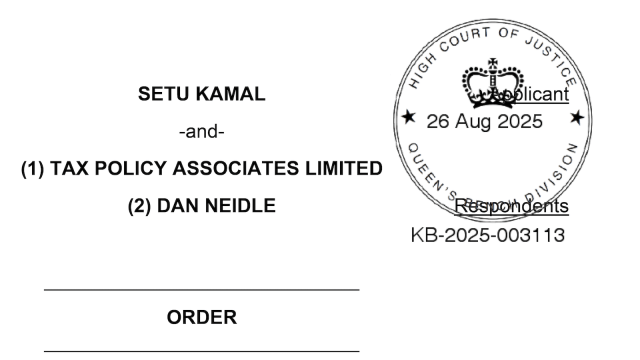
Kamal v Tax Policy Associates

31. In the circumstances, the pleading that it was ‘false and misleading’ to suggest that a
judicial finding of breach of duty had been made against him is incapable of forming a
part of the just disposal of Mr Kamal’s libel claim. The attempt to do so is an abuse of

the court’s processes. I grant the Defendant’s application to strike out [5(b)] of Mr
Kamal’s particulars of claim.

We defeated an £8m libel claim – and it shows libel law and the Tax Bar need reform.

By Dan Neidle

March 11, 2026

35 Comments

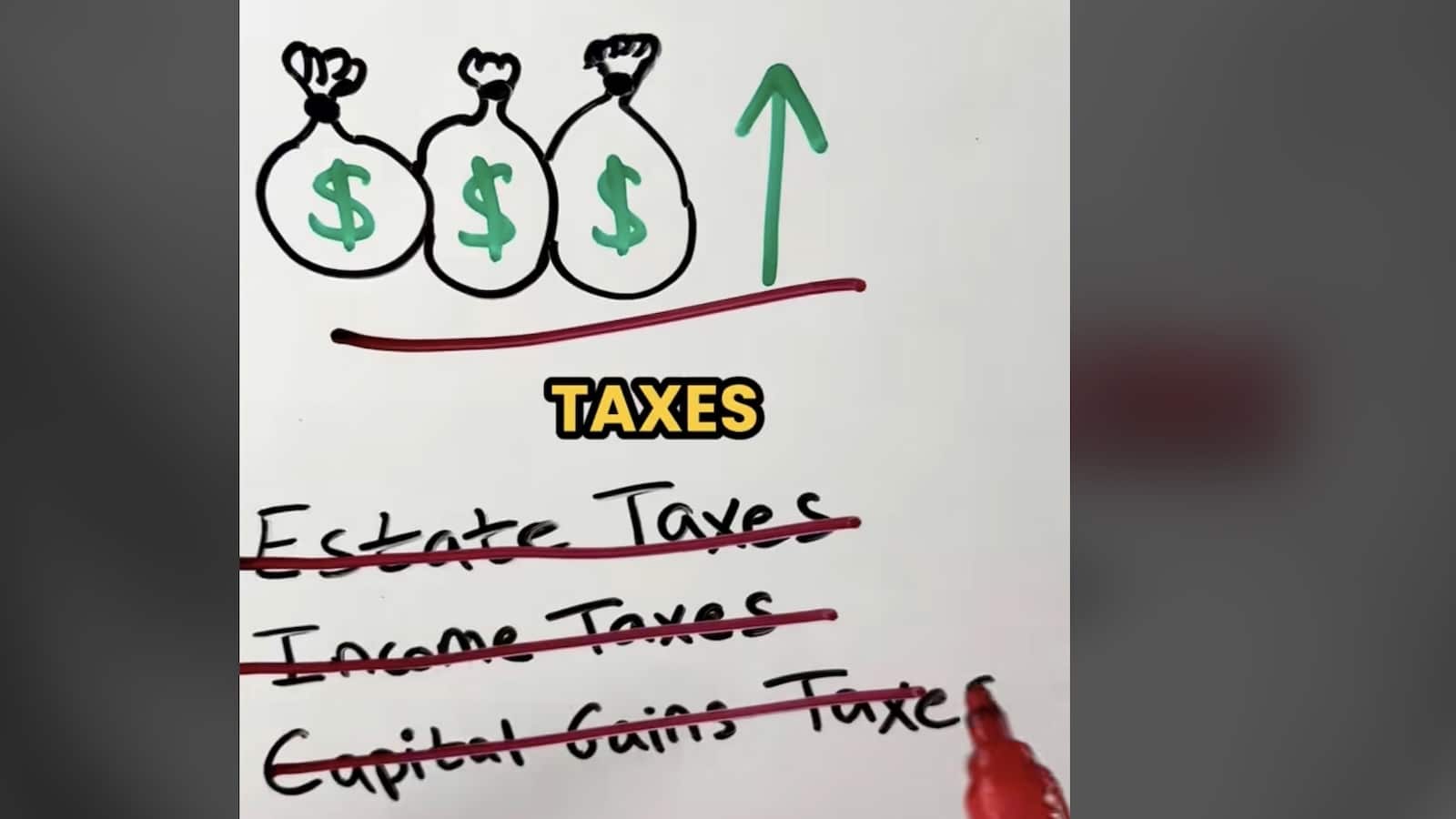
In February 2025, we published a report about a firm called Arka Wealth. They’d published hundreds of TikTok videos promoting a scheme that claimed to eliminate all corporate tax, income tax, capital gains tax and inheritance tax – not just in the UK but across Europe. An unbelievable claim, and all the tax advisers I spoke to – in the UK and across Europe – said the scheme was technically without merit. Many thought it could amount to fraud. But the really surprising part was that the firm was backed by a tax barrister, Setu Kamal, who said in a YouTube video he provided an opinion to all of Arka Wealth’s clients.

Kamal declined to comment on our article, either before publication or immediately afterwards. Months later, he threatened defamation proceedings unless we removed the article, although he was never very specific about what, precisely, his complaint was. He then sent me an email demanding that I pay him 80% of the amount his clients claimed he’d lost in fees, and that I publicly state my “sincere belief” that he is “the leading barrister in the field of taxation in the country”:

In light of the reputational harm caused, which easily passes the threshold of “serious harm” under Lachaux v
Independent Print Ltd [2019] UKSC 27, | require the following steps to be taken within 7 days:

1. Publication of a clear and public confirmation of your sincere belief that | am the leading barrister in the
field of taxation in the country, as previously stated, and a sincere apology for your misleading and disparaging
remarks;

2. Retraction or substantial amendment of the headline and body of the article so as to remove the defamatory
implications it currently conveys;

3. Publication in full of my letter to the Information Commissioner, together with acknowledgment of the
outcome of the BSB investigation;

4. Written confirmation that you shall apply higher editorial standards in the future, and that no further false or
misleading references to any persons will be made in your publications;

5. Undertaking to make the following payment: you shall undertake to pay 80% of any amounts which my
regular or historic clients represent to you, in writing, as amounts they would have paid to me under an
engagement with me, but did not do so because of your publications.

Should you fail to take these steps, | will proceed without further notice to pursue all remedies available to me,
including injunctive relief, damages, and costs.

There was then a strange episode in August when Kamal tried to obtain an interim injunction against me and Tax Policy Associates but, in a serious breach of court procedure, failed to give us notice of his injunction application. Fortunately the Court rejected the application out of hand. I wrote about that here.

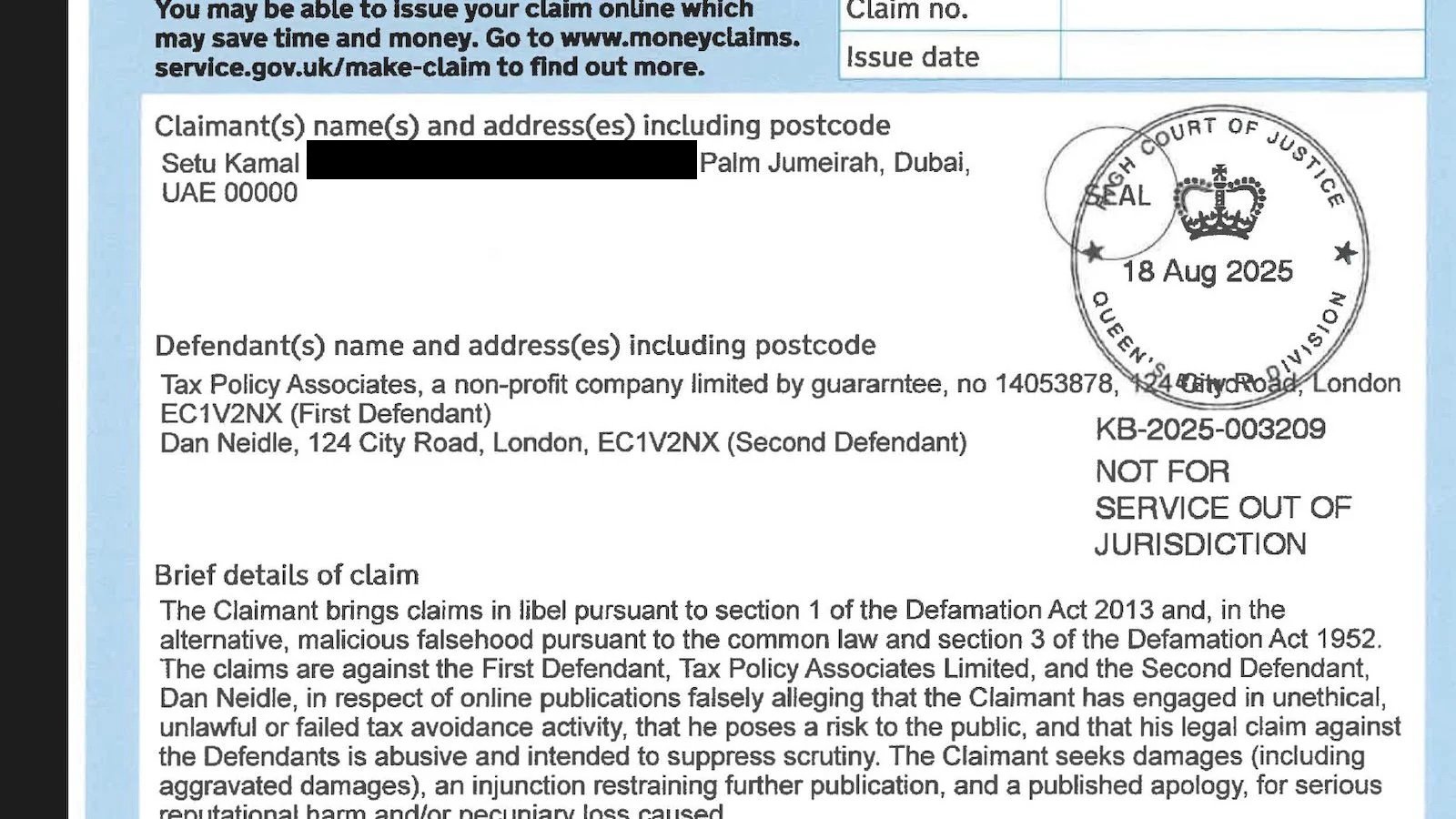
Soon after that, Kamal commenced an £8m defamation claim – again against me and Tax Policy Associates.

We had two responses. The first was traditional: we applied to the court to strike out the parts of the claim that were technically hopeless, and sought summary judgment on the rest. The second was novel: we were the first defendants to rely on the new anti-SLAPP rules in the Economic Crime and Corporate Transparency Act 2023. I wrote about that here, including Kamal’s court papers and our strike-out application.

The Court issued its judgment today. We won on all grounds. Part of the claim was struck out, and we obtained summary judgment on the rest. The court also held that the case was a SLAPP – had any part of the claim survived the earlier rulings, it would have been struck out on that basis alone.

The judgment is here (or, if you prefer, in Word format here):

Thanks to my brilliant legal team: Matthew Gill and Charlotte Teasdale at the Good Law Project, and to our counsel, Greg Callus and Hannah Gilliland from 5RB. And thanks to the team who initially wrote the report, and everyone who supported us since – particularly Nik Williams, Index on Censorship and the UK Anti-SLAPP Coalition.

Libel law chills free speech

First, this demonstrates the two big truths about English libel law.

  • Substantive libel law is fairly sensible, and a journalist who writes something that is true and/or opinion should expect to prevail in court.
  • The procedural aspects of a libel claim chill free speech.

Kamal’s claim was hopeless, elements of it were downright abusive (and intentionally so), and his conduct of the claim was incompetent. In other circumstances it would be met with ridicule – but the sum he claimed was so large that I had to take it seriously. It took six months, costs of about £146k, and an 85-page judgment, for me to have the claim dismissed.

For someone without my legal training or financial resources, it would be irrational to have fought Kamal. The rational thing to do would have been to give in, and delete the report. That’s why most libel threats succeed, and we never hear about them: a lawyer’s letter is sent, and the blogger or journalist quietly backs off. That’s a catastrophe for freedom of speech.

But it’s worse than that – it would have been irrational for a national newspaper to carry the story, because it was too niche to justify the editorial time and cost that a libel lawsuit carries. I have nothing but respect for the newspapers that do fight huge libel claims – but they have to pick their fights, and that means small but important stories get missed.

This is the chilling effect of libel law. No other area of litigation has libel law’s potential to damage public life. Libel law enabled Jimmy Savile, Robert Maxwell, Cyril Smith, and many other monsters (note that I’m too cowardly to mention the still-living examples). Rules that are rational in commercial litigation become actively dangerous when they can be weaponised to silence critics of wrongdoing. And so it’s right that we should treat libel law, and other laws that SLAPPers are abusing, differently from other litigation.

That means dramatically changing the cost equation for defendants. The SLAPP strike-out goes a little in that direction, but even in my case – just about the most favourable imaginable – the cost equation was still brutal. More radical reform is required:

  • Make it much harder to bring claims. Right now, you can bring a libel claim without any evidence that a journalist said something false. The journalist has to prove truth (or opinion, or another defence). We should put the onus on claimants: require claimants to prove falsity, and that the publication wasn’t an opinion and wasn’t in the public interest.
  • Go further: introduce an American-style requirement to prove malice when the claimant is a public figure.
  • Give defendants assurance that, if they win, their costs will be covered. Make indemnity costs the default position.
  • Introduce sanctions against claimants who knowingly or recklessly make untrue statements in the course of pursuing a libel claim (whether they ultimately win or lose the claim).
  • Or go even further: take defamation out of the court and into informal “alternative dispute resolution” – faster, cheaper, and with no prize for the winner except a declaration that the article was false.

The Tax Bar enables abusive tax schemes

We published a report recently concluding that a small number of barristers were enabling abusive tax avoidance schemes which very possibly could be viewed as fraud, because nobody involved could seriously think the schemes had any prospect of success, and all the companies involved were liquidated as soon as HMRC started investigating.

We now have further evidence of this.

Kamal was claiming £8m in damages because he said he’d had a contract that was worth £8m, which he’d lost as a result of our article. My lawyers, Matt and Charlotte, realised something I’d missed – we were now entitled to ask for a copy of the contract. We received it just a few days before trial.

As the contract was referred to in court, I can now publish it in full:

The document has several extraordinary features:

  • Kamal had designed a tax avoidance scheme which supposedly enabled a company, Umbrella Link Limited⚠️, to hire individuals (and on-supply them to recruitment companies) but avoid accounting for income tax/PAYE on their wages.
  • It’s stated that Kamal’s analysis confirms the scheme won’t have to be disclosed to HMRC. The document is also very careful to ensure it remains confidential. That strongly suggests that in fact it had to be disclosed to HMRC. Prima facie, this was an improper arrangement.
  • Umbrella Link targeted contractors, often on modest earnings – particularly social workers. We expect most had no idea they were participating in a tax avoidance scheme. These schemes are fundamentally unethical.
  • The company paid Kamal £50,000 up-front for the scheme, plus 0.6% of the turnover of the company, and 0.4% for turnover over £8m. The nature of the scheme meant that Kamal was effectively receiving a percentage of the tax avoided.
  • The contract was signed on 11 November 2024. Our article on Arka Wealth was published 26 February 2025. But two weeks before that, HMRC had publicly listed the company as operating a tax avoidance scheme and told the company it had unlawfully failed to disclose the scheme to HMRC. The company was doomed from that point.
  • On 25 July 2025, HMRC issued a tax avoidance “scheme reference number” to Umbrella Link (with the five month delay probably thanks to delaying tactics from Umbrella Link).
  • These companies never defend their tax positions – their (mysterious) ultimate owners just let them fold. So at some point, HMRC presented the company with a tax bill, the company ignored it, and HMRC applied for a winding up petition on 27 October 2025. A winding-up order was made on 10 December 2025.

The narrow point is that Kamal was never going to make £8m from this company. It only had a few months of operation. His claim was abusive, intended to intimidate me. As Mrs Justice Collins Rice said:

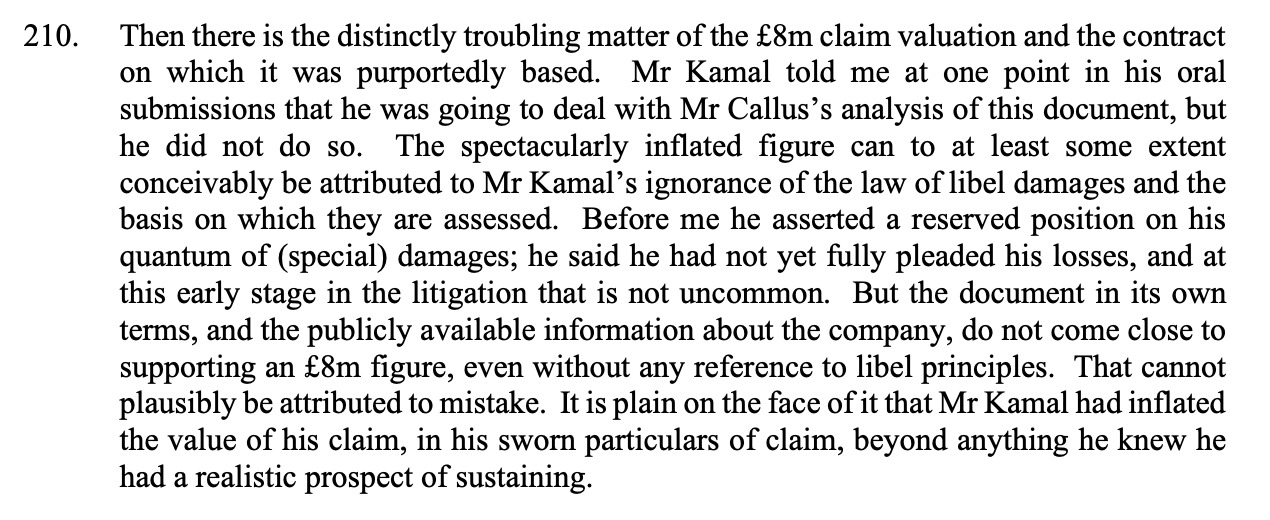
Then there is the distinctly troubling matter of the £8m claim valuation and the contract on which it was purportedly based. Mr Kamal told me at one point in his oral submissions that he was going to deal with Mr Callus’s analysis of this document, but he did not do so. The spectacularly inflated figure can to at least some extent conceivably be attributed to Mr Kamal’s ignorance of the law of libel damages and the basis on which they are assessed. Before me he asserted a reserved position on his quantum of (special) damages; he said he had not yet fully pleaded his losses, and at this early stage in the litigation that is not uncommon. But the document in its own terms, and the publicly available information about the company, do not come close to supporting an £8m figure, even without any reference to libel principles. That cannot plausibly be attributed to mistake. It is plain on the face of it that Mr Kamal had inflated the value of his claim, in his sworn particulars of claim, beyond anything he knew he had a realistic prospect of sustaining.

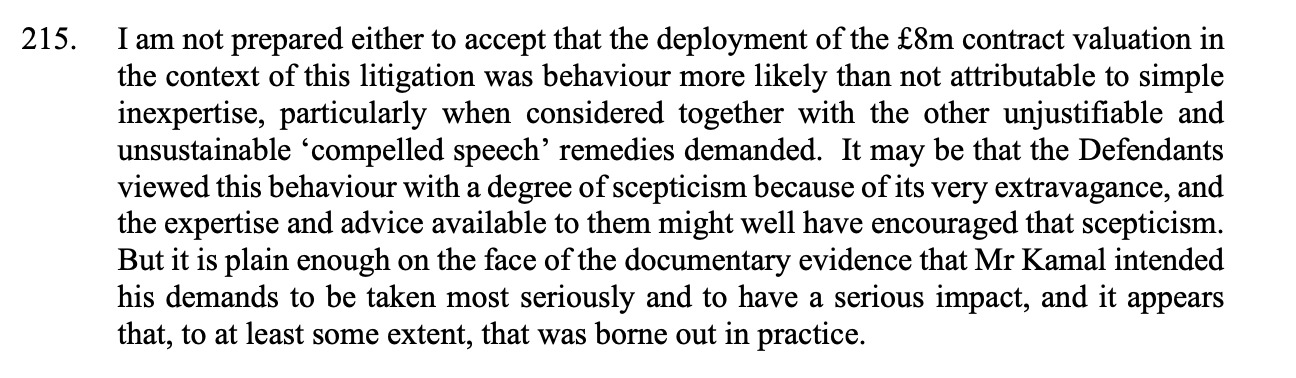
I am not prepared either to accept that the deployment of the £8m contract valuation in the context of this litigation was behaviour more likely than not attributable to simple inexpertise, particularly when considered together with the other unjustifiable and unsustainable ‘compelled speech’ remedies demanded. It may be that the Defendants viewed this behaviour with a degree of scepticism because of its very extravagance, and the expertise and advice available to them might well have encouraged that scepticism. But it is plain enough on the face of the documentary evidence that Mr Kamal intended his demands to be taken most seriously and to have a serious impact, and it appears that, to at least some extent, that was borne out in practice.

This may have consequences for Kamal, but there’s a much more important point. Tax barristers (and Kamal is not alone) are entering into contracts which are pure conflicts of interest. There is no “independence” or “integrity” to an opinion that a tax scheme works, when the barrister is paid per pound that goes into the scheme. I find it hard to believe that such contracts are permitted by the Bar Standards Board – if they are, it’s a disgrace, and if they’re not, action should be taken.

Why Kamal lost

Here’s a very brief summary of each of the points:

1. Kamal tried to sue on a Google search result. You can’t.

He complained that search engines displayed the following description of the article: “Failed tax avoidance from Arka Wealth and Setu Kamal” which he said was defamatory. But the rule in the Charleston case is that you can’t sue for defamation based on a headline in isolation – only on the complete publication. So Mrs Justice Collins Rice said the pleading was “bad in law” and “certain to fail”:

18.

However I agree with Mr Callus that I am bound as a matter of law to apply the rule in
Charleston to Mr Kamal’s pleadings. The last two sentences of [4] of his particulars
of claim, whatever he intended by them, read as plainly and irremediably inconsistent
with the rule. I do not consider they can survive a strike-out application. They are bad
inlaw. As such, they disclose no reasonable grounds for bringing a libel claim in those
terms and are certain to fail.

2. Kamal alleged I was dishonest, with zero evidential basis

He pleaded “malicious falsehood” – meaning that I wrote the article dishonestly or with an indifference to truth. But he had no basis for this, even if every fact in his pleading was accepted. So Mrs Justice Collins Rice struck this out. It was “irremediably defective”.
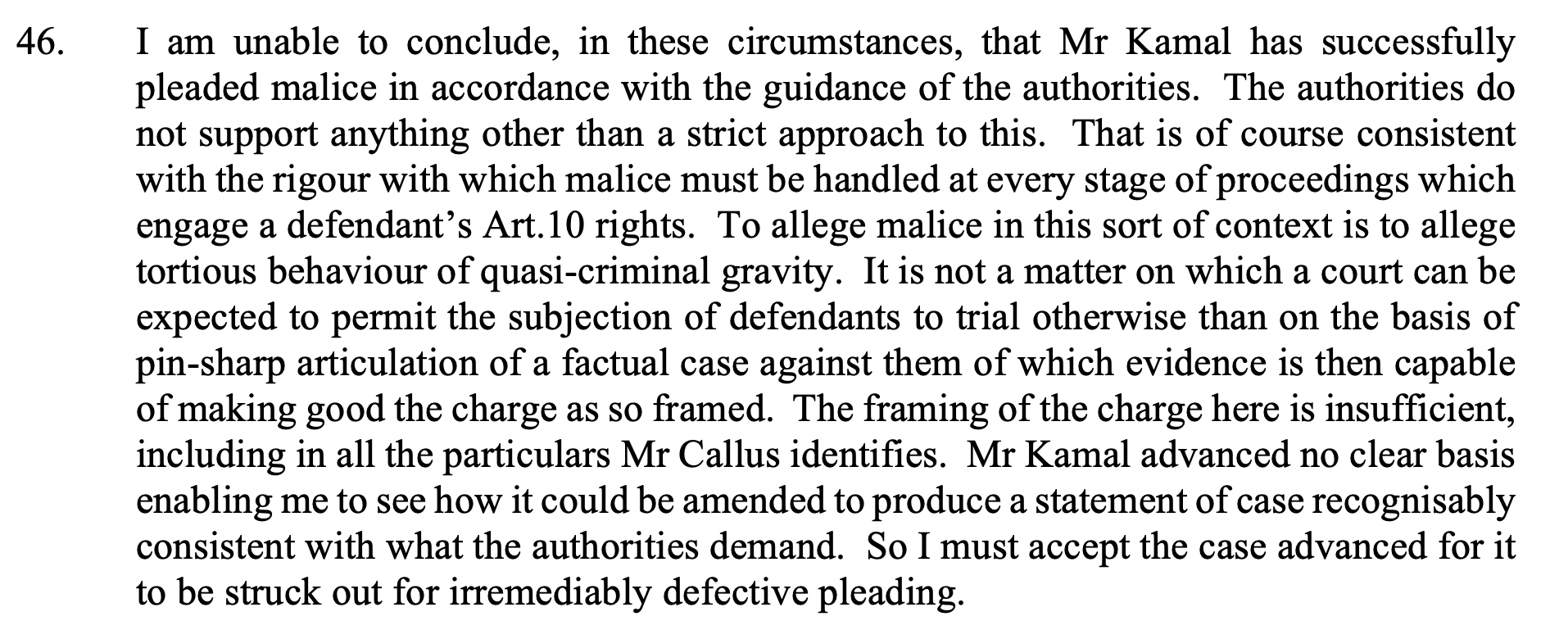
46.

I am unable to conclude, in these circumstances, that Mr Kamal has successfully
pleaded malice in accordance with the guidance of the authorities. The authorities do
not support anything other than a strict approach to this. That is of course consistent
with the rigour with which malice must be handled at every stage of proceedings which
engage a defendant’s Art.10 rights. To allege malice in this sort of context is to allege
tortious behaviour of quasi-criminal gravity. It is not a matter on which a court can be
expected to permit the subjection of defendants to trial otherwise than on the basis of
pin-sharp articulation of a factual case against them of which evidence is then capable
of making good the charge as so framed. The framing of the charge here is insufficient,
including in all the particulars Mr Callus identifies. Mr Kamal advanced no clear basis
enabling me to see how it could be amended to produce a statement of case recognisably
consistent with what the authorities demand. So I must accept the case advanced for it
to be struck out for irremediably defective pleading.

3. Kamal said it was “false and misleading” for me to accurately report a High Court decision

At this point Kamal approaches dishonesty. He said it was “false and misleading” for us to write that a court had found that he’d breached his duty of candour to the court. That was bizarre, because a court had found exactly that. Mrs Justice Collins Rice granted the strike-out and said Kamal’s pleading was an abuse of court processes:

31.

In the circumstances, the pleading that it was ‘false and misleading’ to suggest that a
judicial finding of breach of duty had been made against him is incapable of forming a
part of the just disposal of Mr Kamal’s libel claim. The attempt to do so is an abuse of
the court’s processes. I grant the Defendant’s application to strike out [5(b)] of Mr
Kamal’s particulars of claim.

4. Kamal’s attempt to compel me to apologise had no legal basis

He asked the court to order me to apologise. But courts can’t compel speech. So Mrs Justice Collins Rice struck this out too – it was “bad in law, and certain to fail”:

34.

35.

Mr Kamal did not engage with the substance of this objection before me. Mr Callus is
undoubtedly right as to the law. To order an apology would be a form of compelled
speech which clearly engages the Article 10 ECHR rights of defendants. There would
have to be an identifiable basis in law for a court to be able to do it. There is none. A
court has no such power.

I grant the Defendants’ application to strike out [14] of Mr Kamal’s particulars of claim
(and the equivalent parts of the claim form). It is bad in law and certain to fail.

5. The rest of the article was just honest opinion

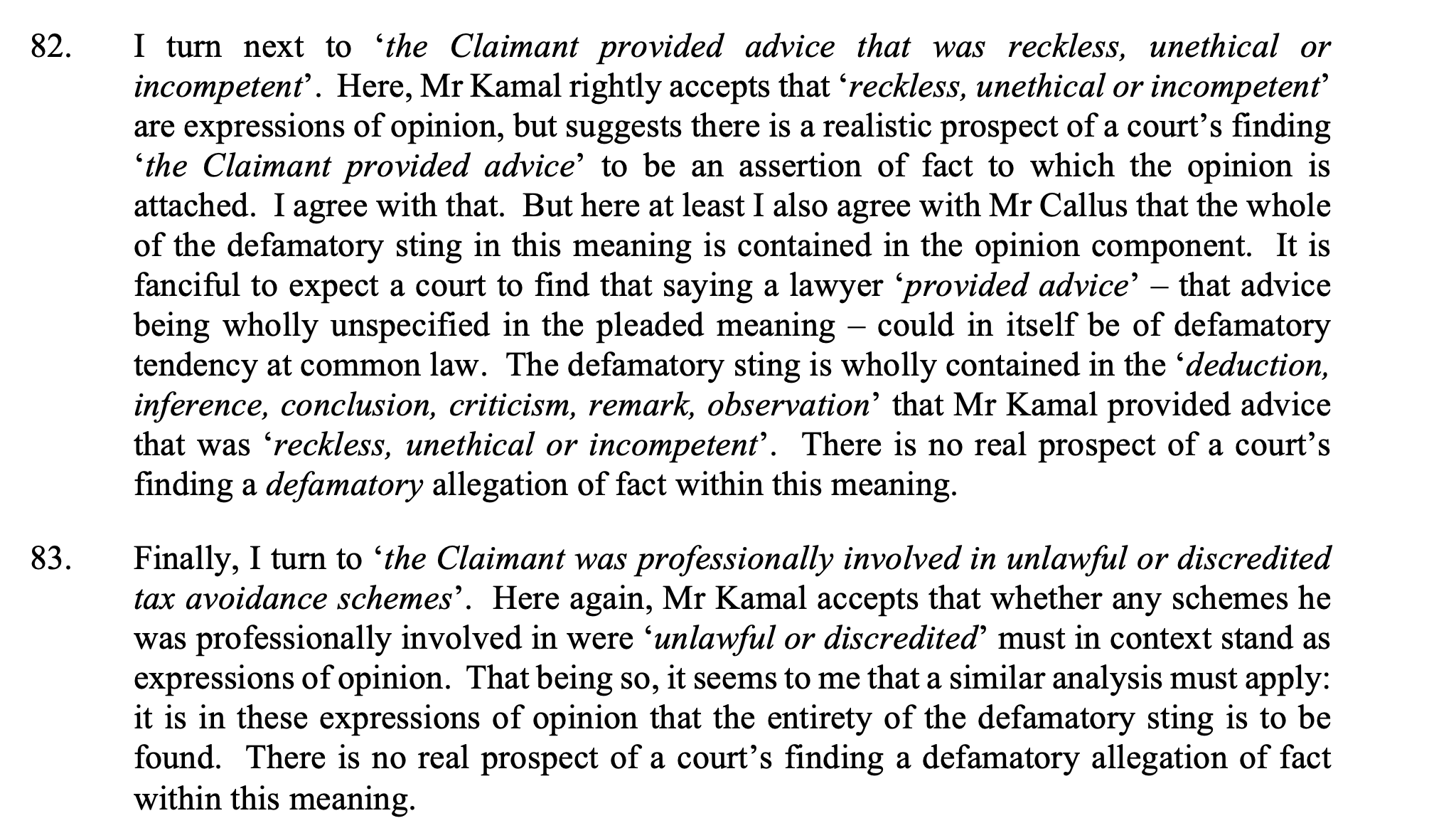
We then applied for summary judgment on the rest of the libel claim, on the basis that it was honest opinion. It’s unusual to obtain summary judgment on an opinion point, but in this case Kamal’s pleaded meanings for the article were “disciplinary or regulatory action ought to be taken against” Kamal, he “poses a risk to clients and the public”, he provided advice that was “reckless, unethical or incompetent” and was “professionally involved in unlawful or discredited tax avoidance schemes”. Each of these was clearly an expression of opinion, so we obtained summary judgment:
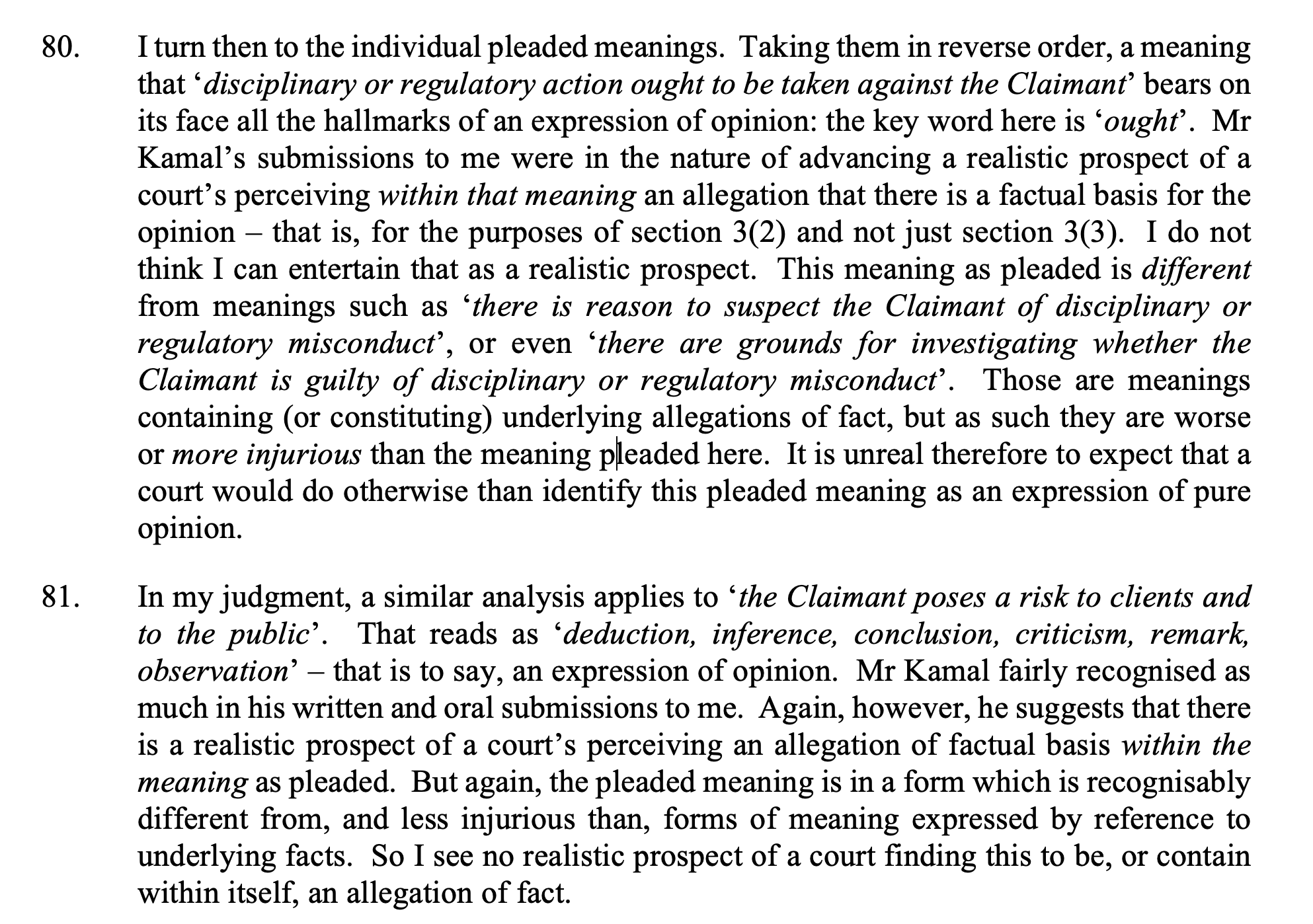
80.

81.

I turn then to the individual pleaded meanings. Taking them in reverse order, a meaning
that ‘disciplinary or regulatory action ought to be taken against the Claimant’ bears on
its face all the hallmarks of an expression of opinion: the key word here is ‘ought’. Mr
Kamal’s submissions to me were in the nature of advancing a realistic prospect of a
court’s perceiving within that meaning an allegation that there is a factual basis for the
opinion — that is, for the purposes of section 3(2) and not just section 3(3). I do not
think I can entertain that as a realistic prospect. This meaning as pleaded is different
from meanings such as ‘there is reason to suspect the Claimant of disciplinary or
regulatory misconduct’, or even ‘there are grounds for investigating whether the
Claimant is guilty of disciplinary or regulatory misconduct’. Those are meanings
containing (or constituting) underlying allegations of fact, but as such they are worse
or more injurious than the meaning pleaded here. It is unreal therefore to expect that a
court would do otherwise than identify this pleaded meaning as an expression of pure
opinion.

In my judgment, a similar analysis applies to ‘the Claimant poses a risk to clients and
to the public’. That reads as ‘deduction, inference, conclusion, criticism, remark,
observation’ — that is to say, an expression of opinion. Mr Kamal fairly recognised as
much in his written and oral submissions to me. Again, however, he suggests that there
is a realistic prospect of a court’s perceiving an allegation of factual basis within the
meaning as pleaded. But again, the pleaded meaning is in a form which is recognisably
different from, and less injurious than, forms of meaning expressed by reference to
underlying facts. So I see no realistic prospect of a court finding this to be, or contain
within itself, an allegation of fact.
82.

83.

I turn next to ‘the Claimant provided advice that was reckless, unethical or
incompetent’. Here, Mr Kamal rightly accepts that ‘reckless, unethical or incompetent’
are expressions of opinion, but suggests there is a realistic prospect of a court’s finding
‘the Claimant provided advice’ to be an assertion of fact to which the opinion is
attached. I agree with that. But here at least I also agree with Mr Callus that the whole
of the defamatory sting in this meaning is contained in the opinion component. It is
fanciful to expect a court to find that saying a lawyer ‘provided advice’ — that advice
being wholly unspecified in the pleaded meaning — could in itself be of defamatory
tendency at common law. The defamatory sting is wholly contained in the ‘deduction,
inference, conclusion, criticism, remark, observation’ that Mr Kamal provided advice
that was ‘reckless, unethical or incompetent’. There is no real prospect of a court’s
finding a defamatory allegation of fact within this meaning.

Finally, I turn to ‘the Claimant was professionally involved in unlawful or discredited
tax avoidance schemes’. Here again, Mr Kamal accepts that whether any schemes he
was professionally involved in were ‘unlawful or discredited’ must in context stand as
expressions of opinion. That being so, it seems to me that a similar analysis must apply:
it is in these expressions of opinion that the entirety of the defamatory sting is to be
found. There is no real prospect of a court’s finding a defamatory allegation of fact
within this meaning.
84.

85.

I have thought particularly hard about this last point because, in his written and oral
submissions to me, Mr Kamal laid great emphasis on his principal objection to the
Article being its association of him with the Arka Wealth scheme it critiques. He says
he did not devise or advise on that scheme, and the Article suggests he did. I can see
that Mr Kamal might have pleaded (I do not necessarily say as to any particular
outcome) not only the generalised meaning he in fact pleaded at [6(a)] but also a factual
allegation setting out that (as he complains) he invented, promoted or advised on a
specific scheme and an associated expression of opinion that that particular scheme was
unlawful or discredited. That would be a worse meaning than he has in fact pleaded,
so there can be no real prospect a court would find such a meaning.

Mr Kamal might have pleaded single natural and ordinary meaning in a number of
respects which are worse than he has in fact pleaded (professionally-advised libel
claimants tend to plead meanings which are as high as they consider plausible short of
extravagance, precisely because they know they set a ceiling on a court’s
determination). A court is meaningfully limited in law by a claimant’s pleaded
meaning. Mr Kamal has made choices about the claim he is asking the Defendants to
address and the court to consider. His pleading of meaning in his particulars of claim
is not technically deficient as such — it does not require remedial amendment in order
to set out a case it would be fair to ask a defendant to defend. But it does delineate the
claim he himself has chosen to advance. I can consider the claim he has pleaded. I
cannot on a summary judgment application consider speculatively different claims he
might have pleaded but did not.
87.

88.

The first is the point of principle that, their Art.10 rights being engaged, courts ought
not to strive officiously to impute factual allegations to defendants where, informed by
the context of a publication read as a whole and by the ceiling imposed by a claimant’s
own pleading, it is straightforward to recognise that an ordinary reasonable readership
would have no difficulty in understanding they were receiving defendants’ opinions. A
court ‘should be alert to the importance of giving free rein to comment and wary of
interpreting a statement as factual in nature, especially where as here it is made in the
context of political issues’ (Yeo v Times Newspapers Ltd [2015] 1 WLR 971 at [97] per
Warby J (as he then was)). The subject matter of the present Article is not (party-
)political in the narrow sense, but it does avowedly enter the sphere of public policy
debate and law reform. In any event, the scheme of the statutory defences in the
Defamation Act 2013 is itself a recognition of the respect due to free speech in the form
of expression of opinion, the protection of which should not be ‘whittled away by
artificially treating comments as if they were statements of fact’.

The second reason lies in the structure of section 3 of the Act itself. The issue of basis
of opinion is something different from the prior question of fact/opinion, and courts
necessarily have to be careful not to elide the two. It is to the issue of basis of opinion
(section 3(3)) that I turn next.

Kamal spent much of his time arguing we’d defamed him by saying he devised or advised on the particular Arka Wealth scheme in question. But this wasn’t part of Kamal’s pleaded claim – and it never could have been, because we didn’t say that. We set out evidence from Arka Wealth and Kamal himself linking him to the scheme. More on that below.

The claim was a SLAPP

At that point, I had won. But we also applied to strike out the claim under the – new and untested – anti-SLAPP rules in the Economic Crime and Corporate Transparency Act 2023.

This required us to establish, first, that there was a SLAPP within the definition in section 195 of the Act.

That first requires satisfying the conditions in subsections (1)(a) to (c):
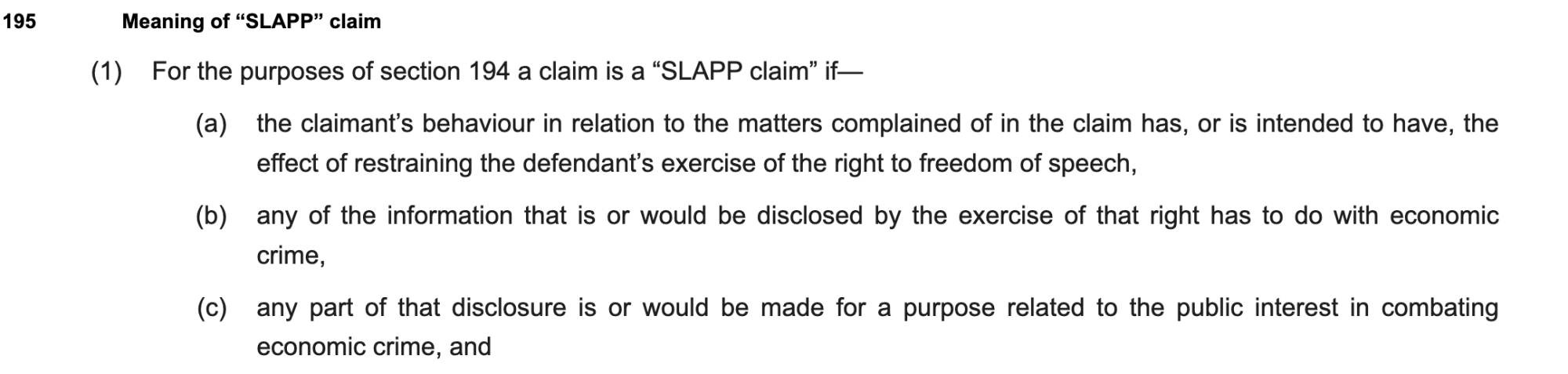
195 Meaning of “SLAPP” claim
(1) For the purposes of section 194 a claim is a “SLAPP claim” if—

(a) the claimant’s behaviour in relation to the matters complained of in the claim has, or is intended to have, the
effect of restraining the defendant’s exercise of the right to freedom of speech,

(b) any of the information that is or would be disclosed by the exercise of that right has to do with economic
crime,

(c) any part of that disclosure is or would be made for a purpose related to the public interest in combating
economic crime, and

We could do this without much difficulty because:

  • Kamal’s actions had the effect of “restraining [my] exercise of the right to freedom of speech”. Defamation actions will almost always have this effect.
  • The “information” disclosed by the exercise of my freedom of speech had to be “to do with economic crime”. There was some discussion about the meaning of “information” but to my (non-libel lawyer) mind this is a straightforward point – the “information” is simply the stuff that we said.
  • The Arka Wealth scheme was plausibly tax fraud in several countries, potentially including the UK – and those were “economic crimes” within the definition.
  • I had to have “reason to suspect that an economic crime may have occurred and [believe]that the disclosure of the information would facilitate an investigation into whether such a crime has (or had) occurred”. I said I did, and Kamal didn’t challenge that.
  • The disclosure had to be “for a purpose related to the public interest in combating economic crime”. We had said there should be an investigation; that was sufficient.

We then had to show that the condition in subsection (1)(d) was satisfied:
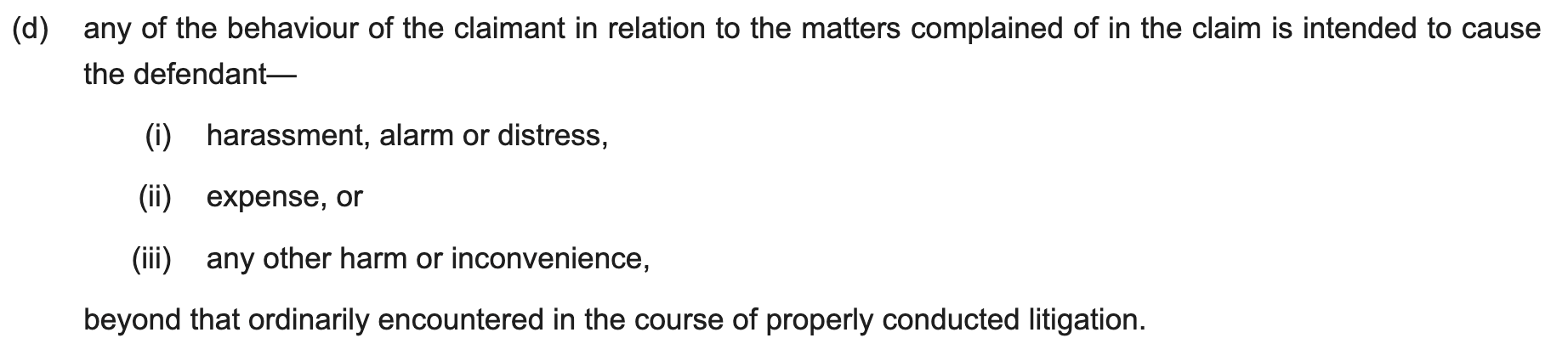
(d) any of the behaviour of the claimant in relation to the matters complained of in the claim is intended to cause
the defendant—

(i) harassment, alarm or distress,
(ii) expense, or
(iii) any other harm or inconvenience,

beyond that ordinarily encountered in the course of properly conducted litigation.

“Inconvenience” in particular is a very low bar, but I’d also suffered some alarm/distress at the size of the claim, and certainly significant expense. And Mrs Justice Collins Rice had no difficulty concluding that numerous elements were beyond that ordinarily encountered in litigation:
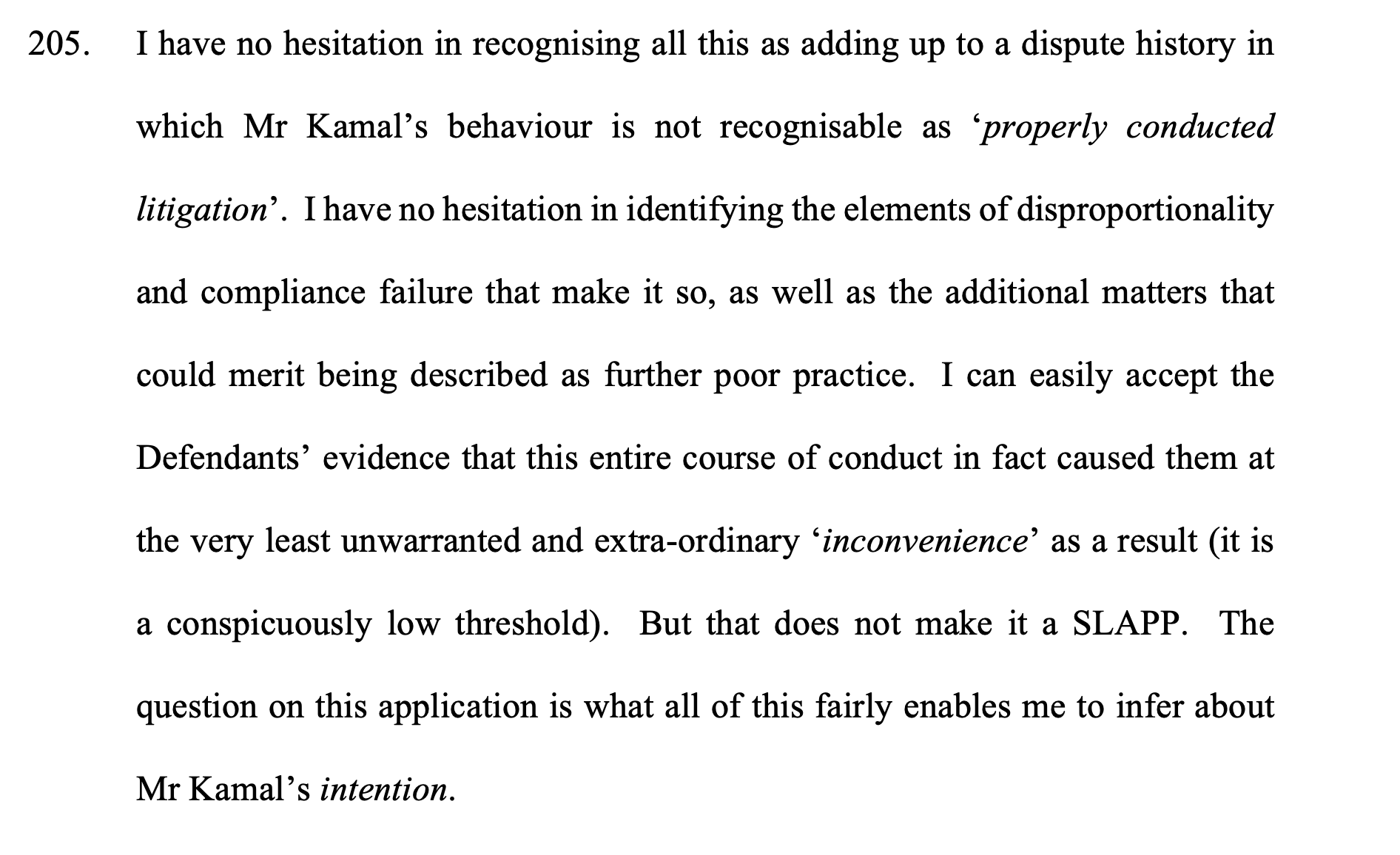
205.

I have no hesitation in recognising all this as adding up to a dispute history in
which Mr Kamal’s behaviour is not recognisable as ‘properly conducted
litigation’. [have no hesitation in identifying the elements of disproportionality
and compliance failure that make it so, as well as the additional matters that
could merit being described as further poor practice. I can easily accept the
Defendants’ evidence that this entire course of conduct in fact caused them at
the very least unwarranted and extra-ordinary ‘inconvenience’ as a result (it is
a conspicuously low threshold). But that does not make it a SLAPP. The
question on this application is what all of this fairly enables me to infer about

Mr Kamal’s intention.

And then the difficult element: was all this intentional?

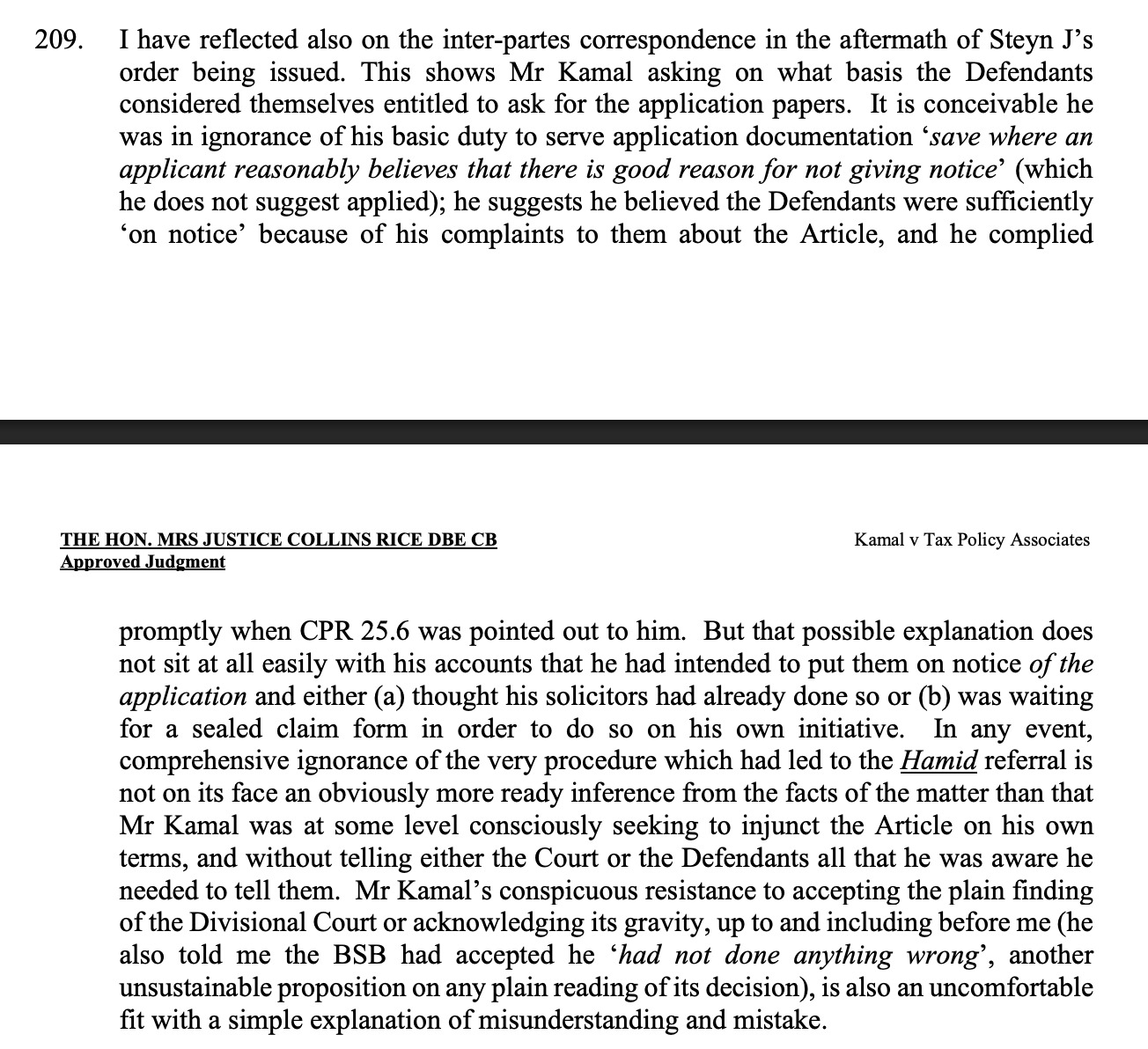
Some of it was simple incompetence, but Mrs Justice Collins Rice concluded that key elements on balance were intentional – in fact she comes close to saying that Kamal had been dishonest:
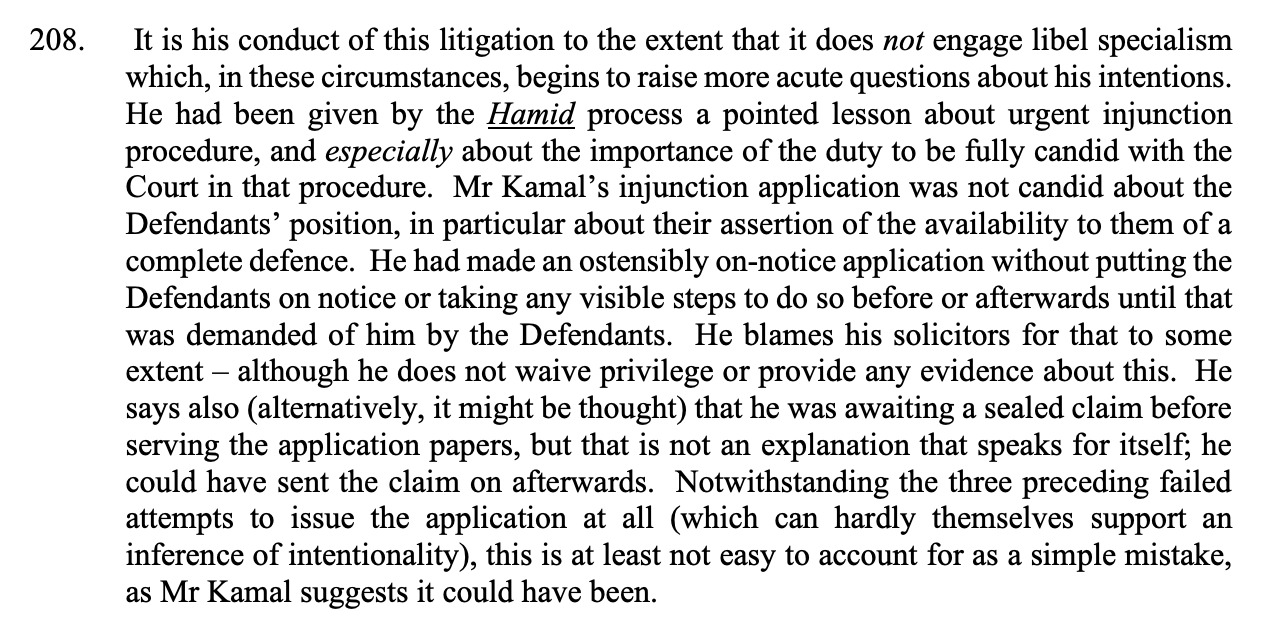
208.

It is his conduct of this litigation to the extent that it does not engage libel specialism
which, in these circumstances, begins to raise more acute questions about his intentions.
He had been given by the Hamid process a pointed lesson about urgent injunction
procedure, and especially about the importance of the duty to be fully candid with the
Court in that procedure. Mr Kamal’s injunction application was not candid about the
Defendants’ position, in particular about their assertion of the availability to them of a
complete defence. He had made an ostensibly on-notice application without putting the
Defendants on notice or taking any visible steps to do so before or afterwards until that
was demanded of him by the Defendants. He blames his solicitors for that to some
extent — although he does not waive privilege or provide any evidence about this. He
says also (alternatively, it might be thought) that he was awaiting a sealed claim before
serving the application papers, but that is not an explanation that speaks for itself; he
could have sent the claim on afterwards. Notwithstanding the three preceding failed
attempts to issue the application at all (which can hardly themselves support an
inference of intentionality), this is at least not easy to account for as a simple mistake,
as Mr Kamal suggests it could have been.
209. I have reflected also on the inter-partes correspondence in the aftermath of Steyn J’s
order being issued. This shows Mr Kamal asking on what basis the Defendants
considered themselves entitled to ask for the application papers. It is conceivable he
was in ignorance of his basic duty to serve application documentation ‘save where an
applicant reasonably believes that there is good reason for not giving notice’ (which
he does not suggest applied); he suggests he believed the Defendants were sufficiently
‘on notice’ because of his complaints to them about the Article, and he complied

THE HON. MRS JUSTICE COLLINS RICE DBE CB Kamal v Tax Policy Associates
Approved Judgment

promptly when CPR 25.6 was pointed out to him. But that possible explanation does
not sit at all easily with his accounts that he had intended to put them on notice of the
application and either (a) thought his solicitors had already done so or (b) was waiting
for a sealed claim form in order to do so on his own initiative. In any event,
comprehensive ignorance of the very procedure which had led to the Hamid referral is
not on its face an obviously more ready inference from the facts of the matter than that
Mr Kamal was at some level consciously seeking to injunct the Article on his own
terms, and without telling either the Court or the Defendants all that he was aware he
needed to tell them. Mr Kamal’s conspicuous resistance to accepting the plain finding
of the Divisional Court or acknowledging its gravity, up to and including before me (he
also told me the BSB had accepted he ‘had not done anything wrong’, another
unsustainable proposition on any plain reading of its decision), is also an uncomfortable
fit with a simple explanation of misunderstanding and mistake.
210.

Then there is the distinctly troubling matter of the £8m claim valuation and the contract
on which it was purportedly based. Mr Kamal told me at one point in his oral
submissions that he was going to deal with Mr Callus’s analysis of this document, but
he did not do so. The spectacularly inflated figure can to at least some extent
conceivably be attributed to Mr Kamal’s ignorance of the law of libel damages and the
basis on which they are assessed. Before me he asserted a reserved position on his
quantum of (special) damages; he said he had not yet fully pleaded his losses, and at
this early stage in the litigation that is not uncommon. But the document in its own
terms, and the publicly available information about the company, do not come close to
supporting an £8m figure, even without any reference to libel principles. That cannot
plausibly be attributed to mistake. It is plain on the face of it that Mr Kamal had inflated
the value of his claim, in his sworn particulars of claim, beyond anything he knew he
had a realistic prospect of sustaining.
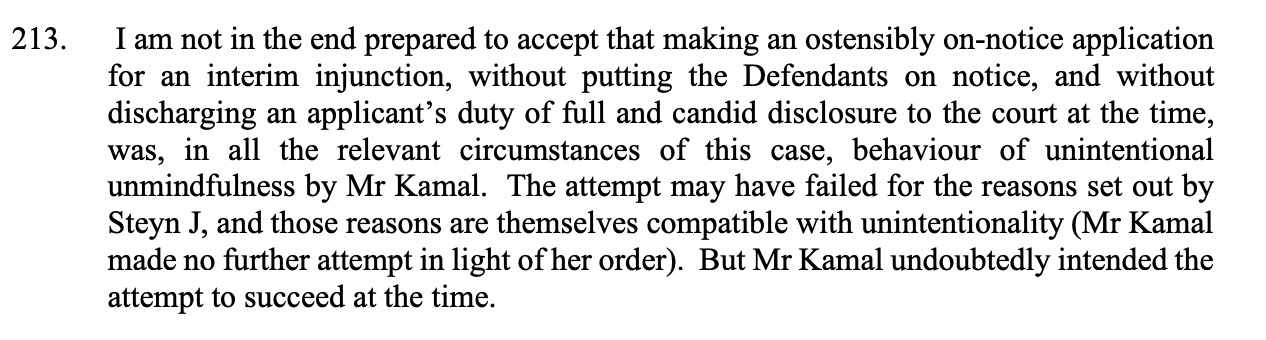
213.

lam not in the end prepared to accept that making an ostensibly on-notice application
for an interim injunction, without putting the Defendants on notice, and without
discharging an applicant’s duty of full and candid disclosure to the court at the time,
was, in all the relevant circumstances of this case, behaviour of unintentional
unmindfulness by Mr Kamal. The attempt may have failed for the reasons set out by
Steyn J, and those reasons are themselves compatible with unintentionality (Mr Kamal
made no further attempt in light of her order). But Mr Kamal undoubtedly intended the
attempt to succeed at the time.
215.

J am not prepared either to accept that the deployment of the £8m contract valuation in
the context of this litigation was behaviour more likely than not attributable to simple
inexpertise, particularly when considered together with the other unjustifiable and
unsustainable ‘compelled speech’ remedies demanded. It may be that the Defendants
viewed this behaviour with a degree of scepticism because of its very extravagance, and
the expertise and advice available to them might well have encouraged that scepticism.
But it is plain enough on the face of the documentary evidence that Mr Kamal intended
his demands to be taken most seriously and to have a serious impact, and it appears
that, to at least some extent, that was borne out in practice.
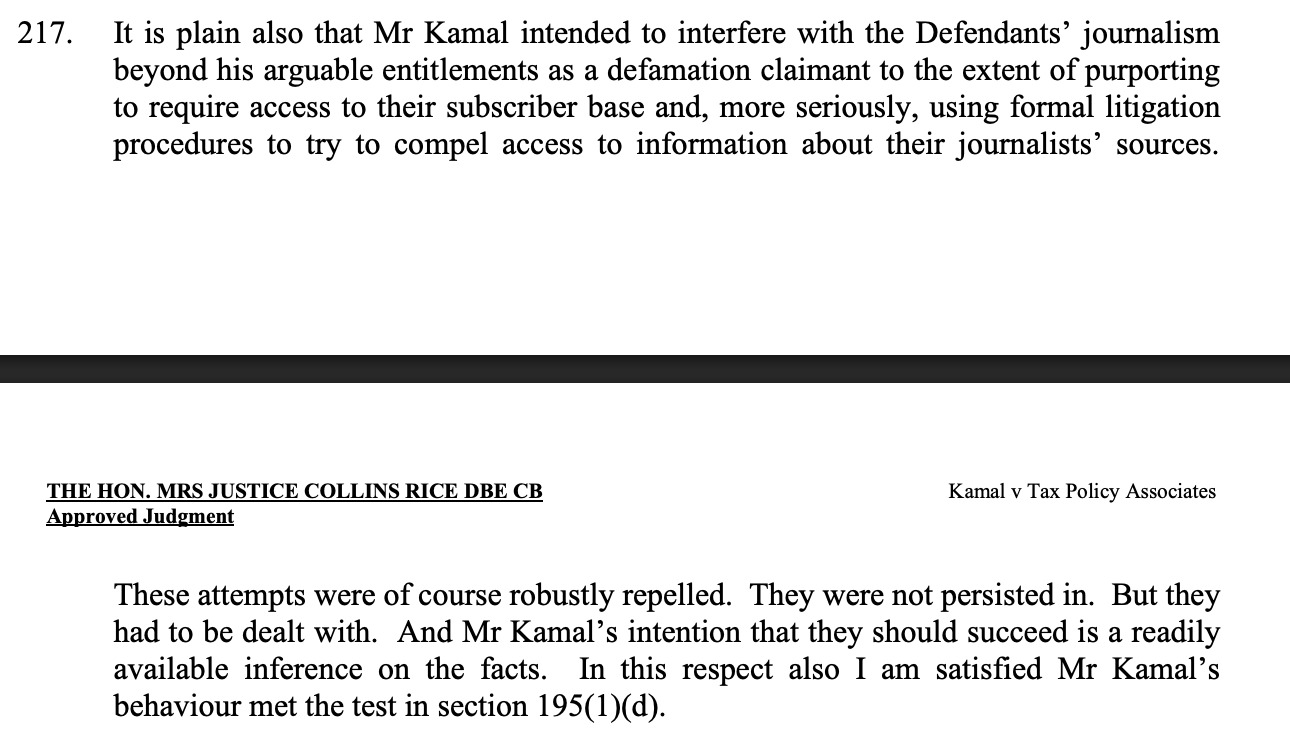
217. It is plain also that Mr Kamal intended to interfere with the Defendants’ journalism
beyond his arguable entitlements as a defamation claimant to the extent of purporting
to require access to their subscriber base and, more seriously, using formal litigation
procedures to try to compel access to information about their journalists’ sources.

THE HON. MRS JUSTICE COLLINS RICE DBE CB Kamal v Tax Policy Associates
Approved Judgment

These attempts were of course robustly repelled. They were not persisted in. But they
had to be dealt with. And Mr Kamal’s intention that they should succeed is a readily
available inference on the facts. In this respect also I am satisfied Mr Kamal’s
behaviour met the test in section 195(1)(d).

At that point, Civil Procedure Rule 3.4(2)(d) is engaged, giving the judge the discretion to strike out a case if:
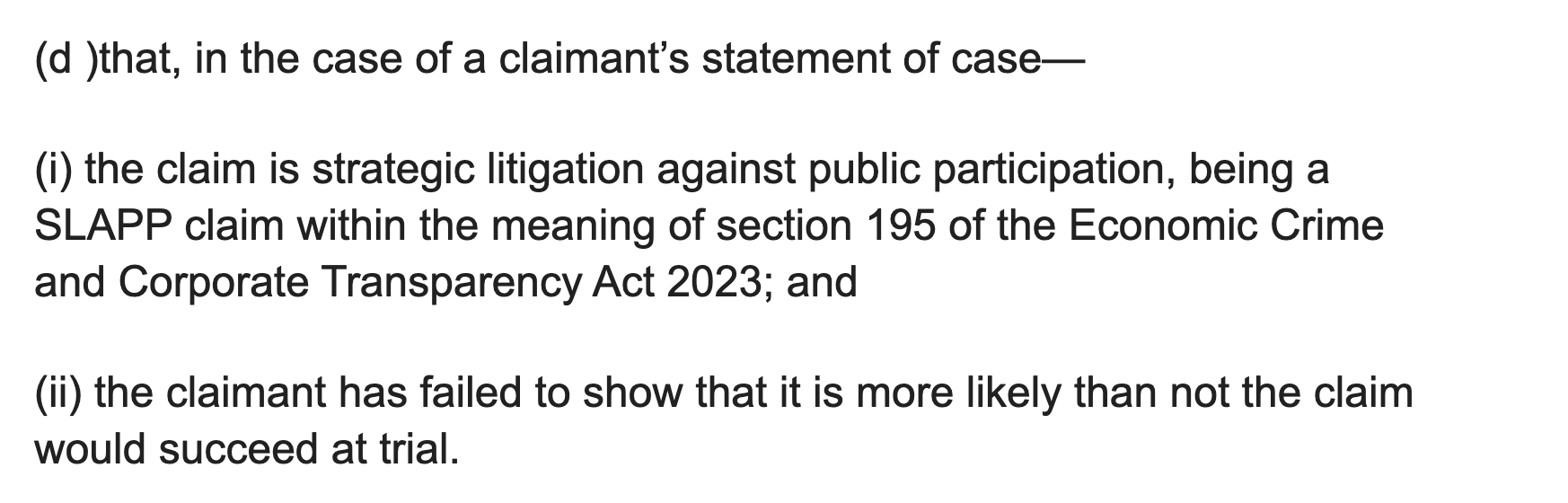
(d )that, in the case of a claimant’s statement of case—

(i) the claim is strategic litigation against public participation, being a
SLAPP claim within the meaning of section 195 of the Economic Crime
and Corporate Transparency Act 2023; and

(ii) the claimant has failed to show that it is more likely than not the claim
would succeed at trial.

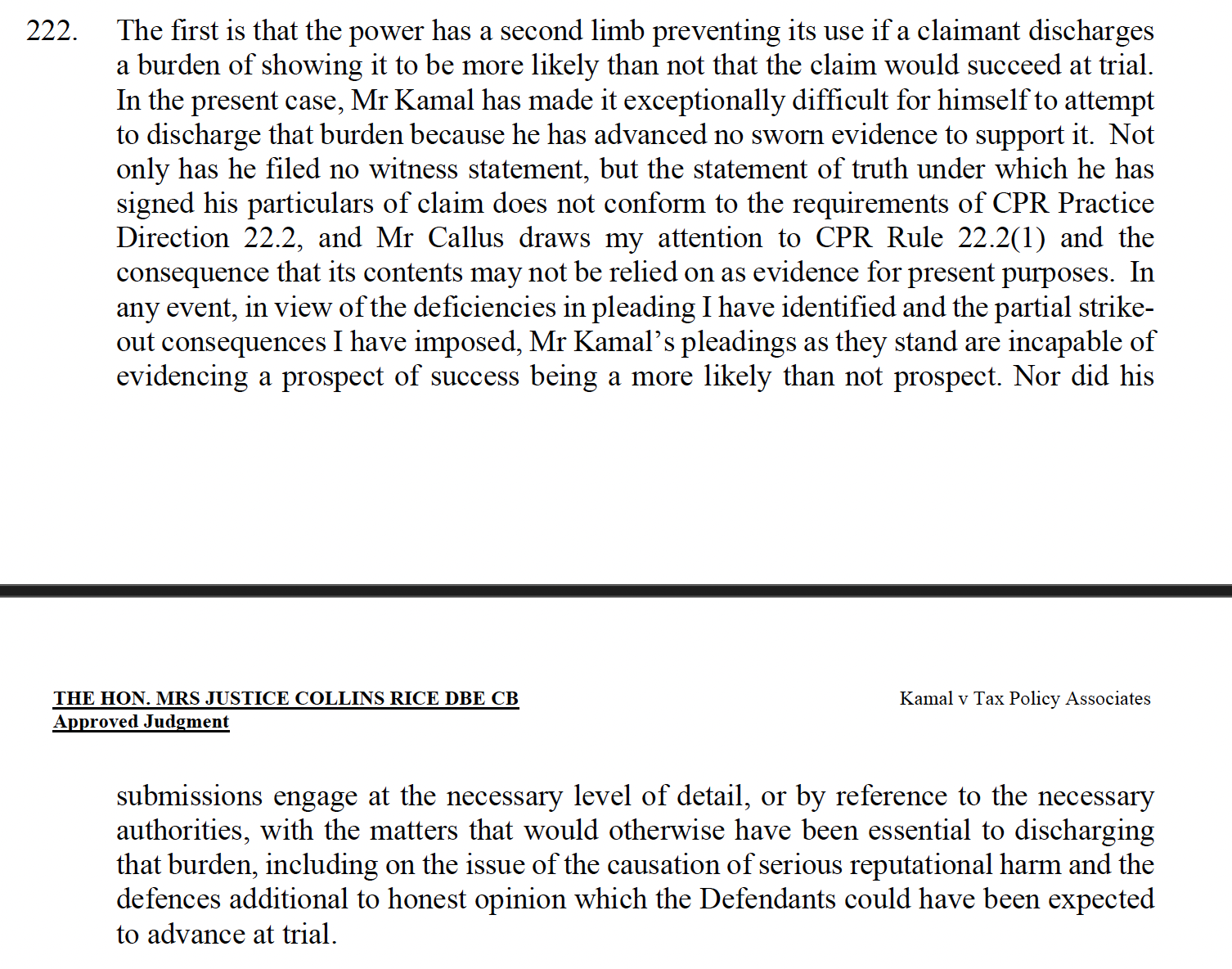
We had established the first part. The onus for the second is on the Claimant – and (for reasons which are unclear) Kamal had failed to provide any sworn evidence to the court. So Mrs Justice Collins Rice had no hesitation in disposing of the point:
222.

The first is that the power has a second limb preventing its use if a claimant discharges
a burden of showing it to be more likely than not that the claim would succeed at trial.
In the present case, Mr Kamal has made it exceptionally difficult for himself to attempt
to discharge that burden because he has advanced no sworn evidence to support it. Not
only has he filed no witness statement, but the statement of truth under which he has
signed his particulars of claim does not conform to the requirements of CPR Practice
Direction 22.2, and Mr Callus draws my attention to CPR Rule 22.2(1) and the
consequence that its contents may not be relied on as evidence for present purposes. In
any event, in view of the deficiencies in pleading I have identified and the partial strike-
out consequences I have imposed, Mr Kamal’s pleadings as they stand are incapable of
evidencing a prospect of success being a more likely than not prospect. Nor did his

THE HON. MRS JUSTICE COLLINS RICE DBE CB Kamal v Tax Policy Associates
Approved Judgment

submissions engage at the necessary level of detail, or by reference to the necessary
authorities, with the matters that would otherwise have been essential to discharging
that burden, including on the issue of the causation of serious reputational harm and the
defences additional to honest opinion which the Defendants could have been expected
to advance at trial.

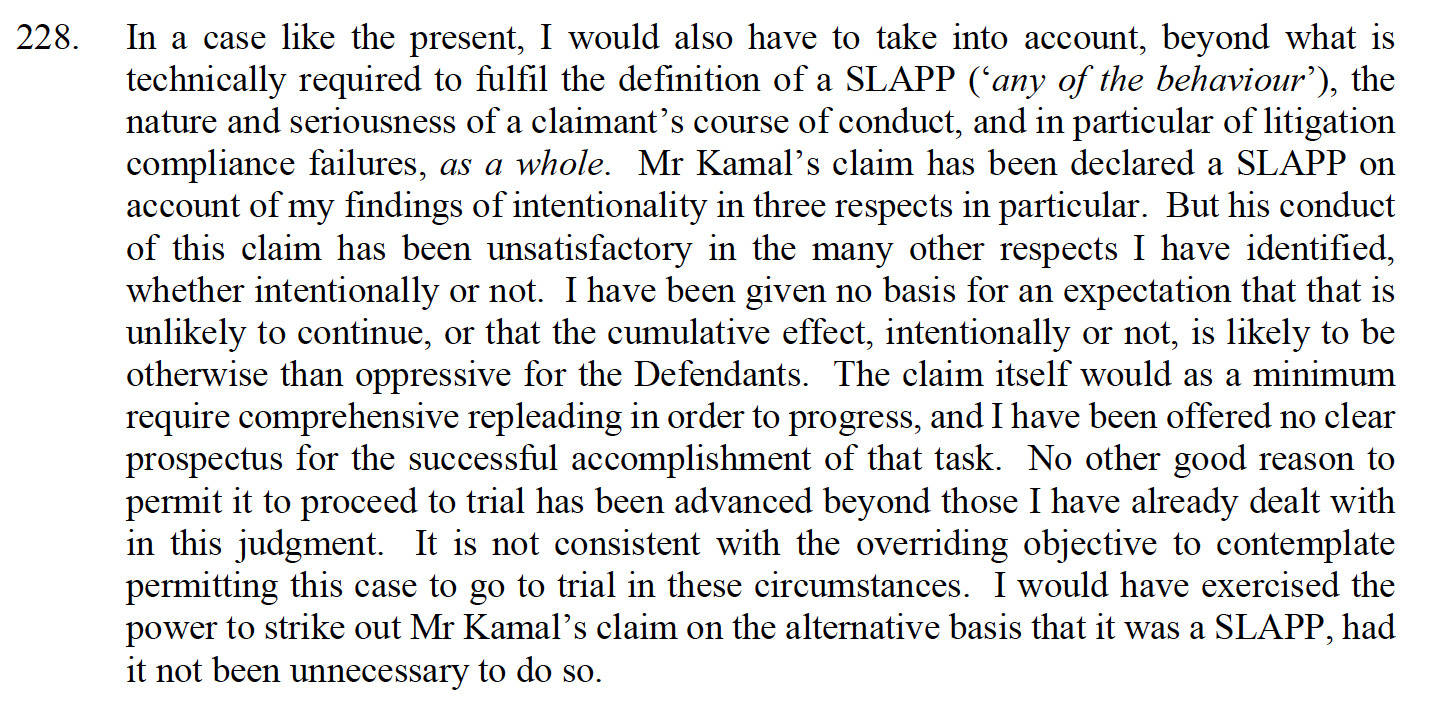
That just left the question of whether the Court should exercise its discretion to strike out the case. Mrs Justice Collins Rice concluded that, in light of Kamal’s behaviour, she would:
228.

In a case like the present, I would also have to take into account, beyond what is
technically required to fulfil the definition of a SLAPP (‘any of the behaviour’), the
nature and seriousness of a claimant’s course of conduct, and in particular of litigation
compliance failures, as a whole. Mr Kamal’s claim has been declared a SLAPP on
account of my findings of intentionality in three respects in particular. But his conduct
of this claim has been unsatisfactory in the many other respects I have identified,
whether intentionally or not. I have been given no basis for an expectation that that is
unlikely to continue, or that the cumulative effect, intentionally or not, is likely to be
otherwise than oppressive for the Defendants. The claim itself would as a minimum
require comprehensive repleading in order to progress, and I have been offered no clear
prospectus for the successful accomplishment of that task. No other good reason to
permit it to proceed to trial has been advanced beyond those I have already dealt with
in this judgment. It is not consistent with the overriding objective to contemplate
permitting this case to go to trial in these circumstances. I would have exercised the
power to strike out Mr Kamal’s claim on the alternative basis that it was a SLAPP, had
it not been unnecessary to do so.

Kamal’s response

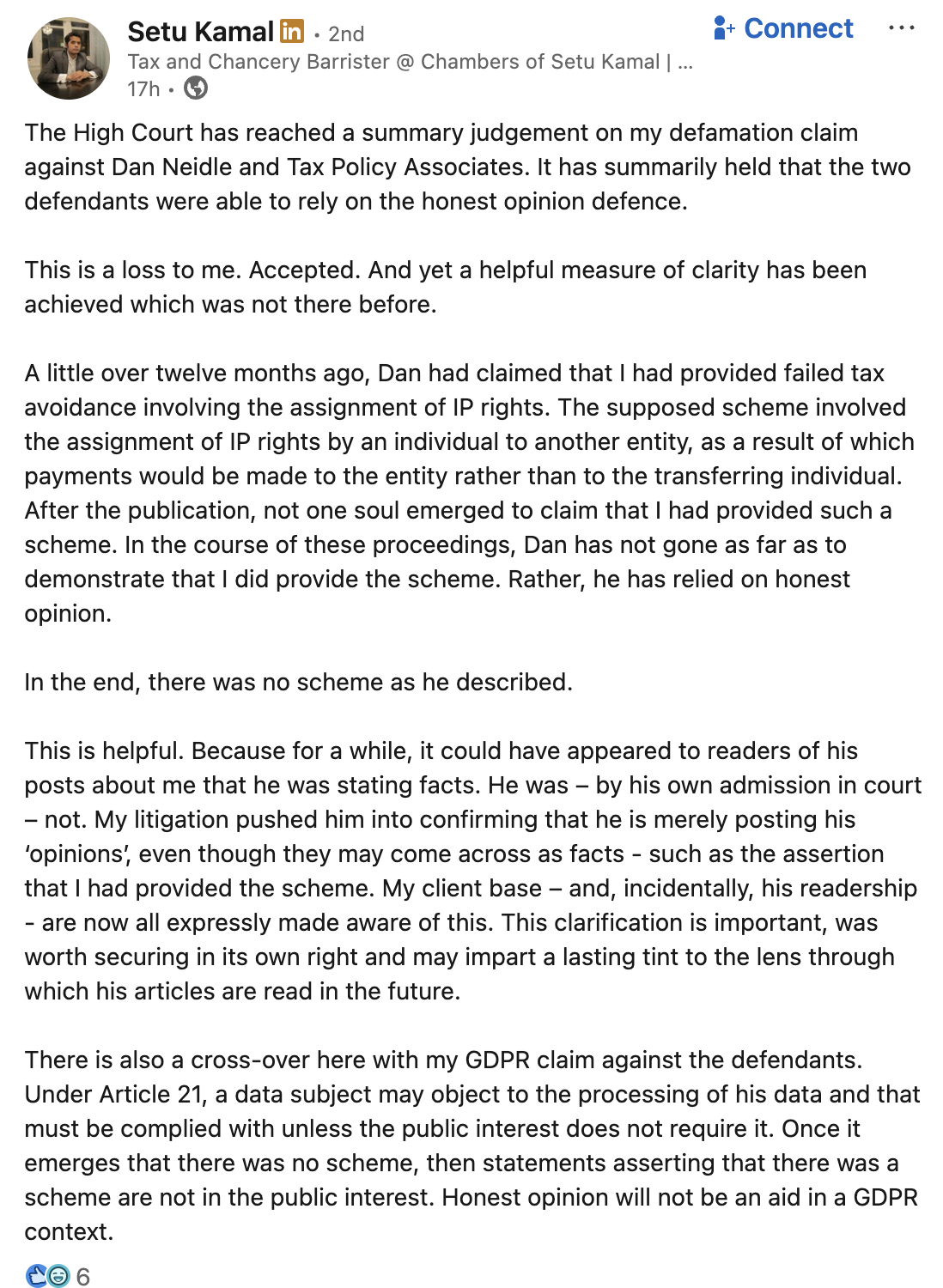
Here’s Kamal’s response to the judgment on LinkedIn:
- Setu Kamal & - 2nd a+ Connect
Tax and Chancery Barrister @ Chambers of Setu Kamal | ...

17h- @

The High Court has reached a summary judgement on my defamation claim
against Dan Neidle and Tax Policy Associates. It has summarily held that the two
defendants were able to rely on the honest opinion defence.

This is a loss to me. Accepted. And yet a helpful measure of clarity has been
achieved which was not there before.

A little over twelve months ago, Dan had claimed that | had provided failed tax
avoidance involving the assignment of IP rights. The supposed scheme involved
the assignment of IP rights by an individual to another entity, as a result of which
payments would be made to the entity rather than to the transferring individual.
After the publication, not one soul emerged to claim that | had provided such a
scheme. In the course of these proceedings, Dan has not gone as far as to
demonstrate that | did provide the scheme. Rather, he has relied on honest
opinion.

In the end, there was no scheme as he described.

This is helpful. Because for a while, it could have appeared to readers of his
posts about me that he was stating facts. He was — by his own admission in court
— not. My litigation pushed him into confirming that he is merely posting his
‘opinions’, even though they may come across as facts - such as the assertion
that | had provided the scheme. My client base — and, incidentally, his readership
- are now all expressly made aware of this. This clarification is important, was
worth securing in its own right and may impart a lasting tint to the lens through
which his articles are read in the future.

There is also a cross-over here with my GDPR claim against the defendants.
Under Article 21, a data subject may object to the processing of his data and that
must be complied with unless the public interest does not require it. Once it
emerges that there was no scheme, then statements asserting that there was a
scheme are not in the public interest. Honest opinion will not be an aid ina GDPR
context.

€66

This is delusional. It bears no relation to the actual reasons why he lost.

But what of Kamal’s complaint that he didn’t provide an opinion on the scheme?

That point was never litigated, because Kamal never pleaded it. But he couldn’t have done – because we never said that he did provide an opinion. Our report was very carefully worded and says no more than we could prove from available facts at the time.

Those facts were:

The Arka Wealth website said Kamal was their “legal partner” and provided a “comprehensive legal opinion” for everyone buying the scheme:

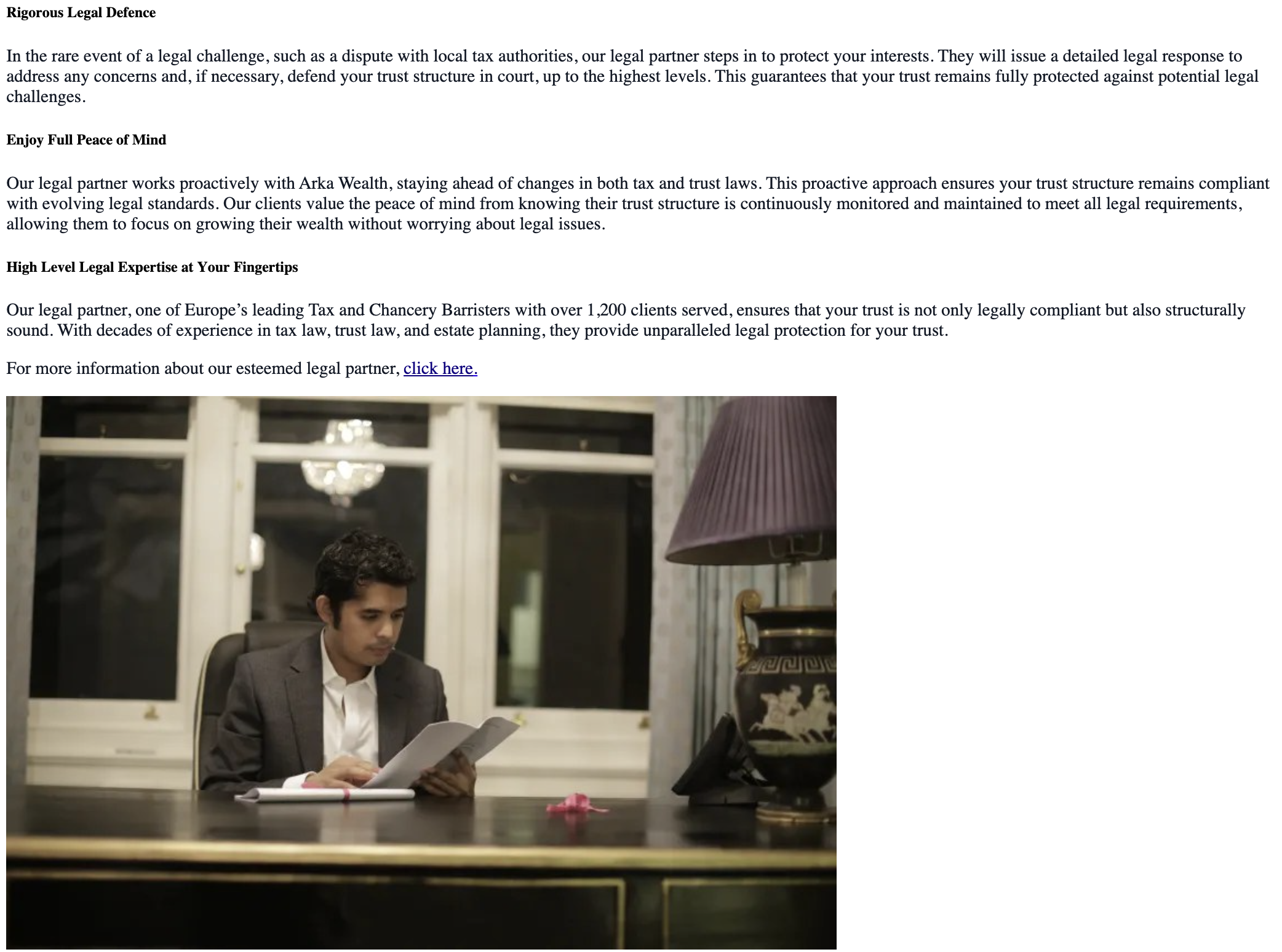
Am| legally protected when implementing the "Work For Your Trust" Structure?

Yes, through our legal partner, Arka Wealth offers several layers of legal protection to ensure you can enjoy the benefits of the “Work
For Your Trust” structure with full peace of mind. This includes:

+ Professional Indemnity: Protection against legal liability.

« Fines and Penalties Coverage: Safeguarding you from financial penalties.

* Comprehensive Legal Opinion: A detailed legal opinion from our esteemed legal partner, ensuring your trust structure is secure
and compliant with all relevant laws.

Our legal partner, a leading tax and chancery barrister, has extensive experience in trust law and a proven track record with regulatory
bodies. This top-tier expertise guarantees that your trust benefits from the highest level of legal protection and compliance.

To learn more about our legal protection service, click here.
Rigorous Legal Defence

In the rare event of a legal challenge, such as a dispute with local tax authorities, our legal partner steps in to protect your interests. They will issue a detailed legal response to
address any concerns and, if necessary, defend your trust structure in court, up to the highest levels. This guarantees that your trust remains fully protected against potential legal
challenges.

Enjoy Full Peace of Mind

Our legal partner works proactively with Arka Wealth, staying ahead of changes in both tax and trust laws. This proactive approach ensures your trust structure remains compliant
with evolving legal standards. Our clients value the peace of mind from knowing their trust structure is continuously monitored and maintained to meet all legal requirements,
allowing them to focus on growing their wealth without worrying about legal issues.

High Level Legal Expertise at Your Fingertips

Our legal partner, one of Europe’s leading Tax and Chancery Barristers with over 1,200 clients served, ensures that your trust is not only legally compliant but also structurally
sound. With decades of experience in tax law, trust law, and estate planning, they provide unparalleled legal protection for your trust.

For more information about our esteemed legal partner, click here.
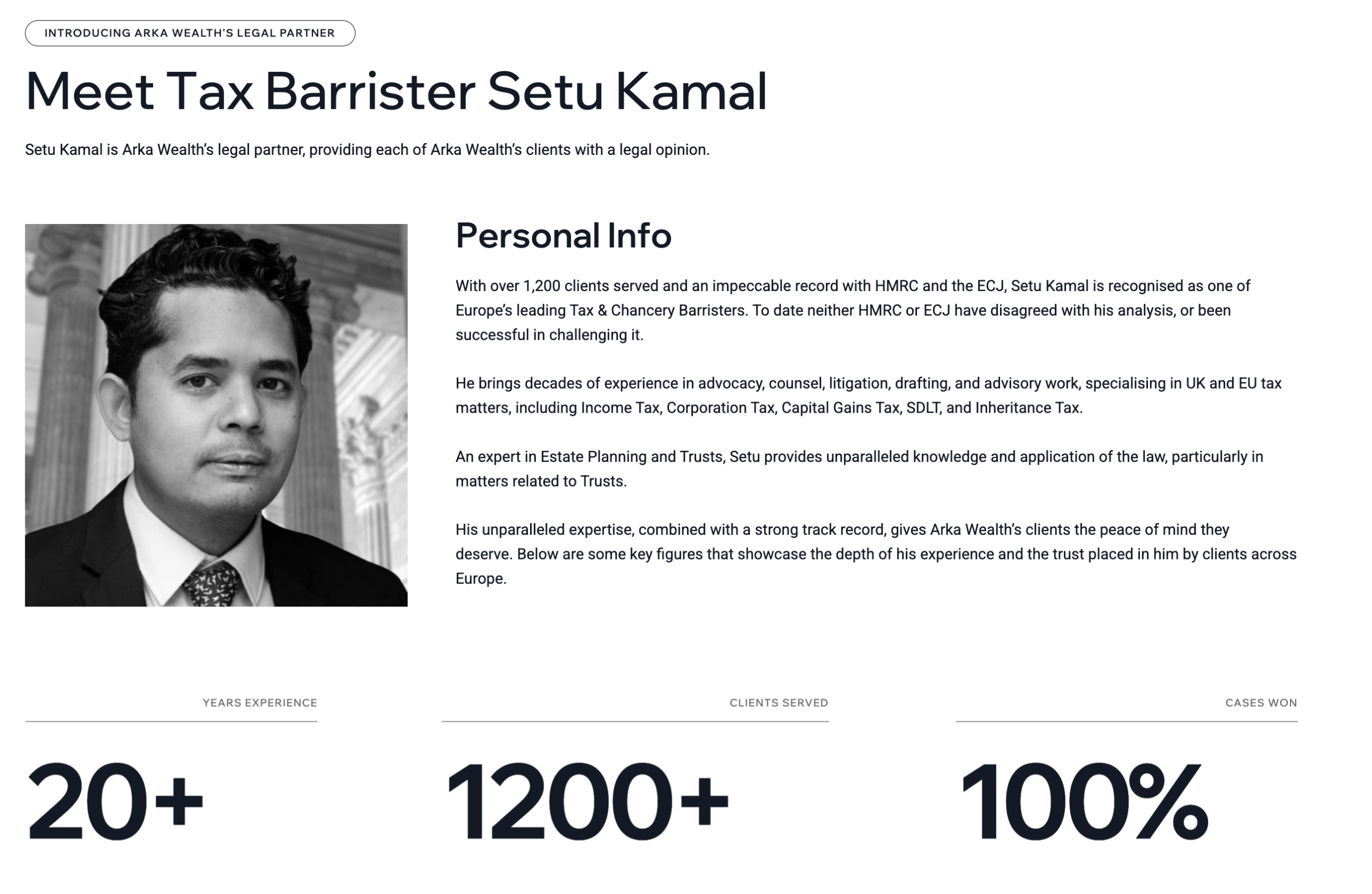
C INTRODUCING ARKA WEALTH’S LEGAL PARTNER )

Meet Tax Barrister Setu Kamal

Setu Kamal is Arka Wealth’s legal partner, providing each of Arka Wealth’s clients with a legal opinion.

Personal Info

With over 1,200 clients served and an impeccable record with HMRC and the ECJ, Setu Kamal is recognised as one of
Europe's leading Tax & Chancery Barristers. To date neither HMRC or ECJ have disagreed with his analysis, or been
successful in challenging it.

He brings decades of experience in advocacy, counsel, litigation, drafting, and advisory work, specialising in UK and EU tax
matters, including Income Tax, Corporation Tax, Capital Gains Tax, SDLT, and Inheritance Tax.

An expert in Estate Planning and Trusts, Setu provides unparalleled knowledge and application of the law, particularly in
matters related to Trusts.

His unparalleled expertise, combined with a strong track record, gives Arka Wealth's clients the peace of mind they
deserve. Below are some key figures that showcase the depth of his experience and the trust placed in him by clients across
Europe.

YEARS EXPERIENCE CLIENTS SERVED CASES WON

+ 1200+ 100%

Kamal appeared in a video for Arka Wealth confirming that every Arka Wealth client receives a legal opinion from him:

The people alleging that Kamal provided opinions on the scheme were Setu Kamal and Arka Wealth.

Mr Kamal should sue himself.


Footnotes

  1. The website went offline in July 2025 and it appears the company ceased trading around that time. ↩︎

  2. This wasn’t always the case, particularly prior to the 2013 Defamation Act. ↩︎

  3. Particularly the law of confidence, GDPR and privacy torts. ↩︎

  4. The company was claimed to be ultimately owned by an individual resident in Mauritius, and later by an individual resident in Kazakhstan. It is likely these Companies House filings were false, unlawfully hiding the true beneficial owner. ↩︎

  5. Promoters sometimes contest the application of the disclosure rules in front of tribunals – they have lost on almost every single occasion (the one exception was where the arrangement was disclosable, but the “promoter” targeted by HMRC wasn’t actually the promoter). ↩︎

  6. Kamal’s actual pleadings were much more confused than this. He said he was complaining about the “slug” – the bit of the URL after the domain. But the slug was “tiktok-tax-avoidance-from-arka-wealth-why-the-government-and-the-bar-should-act” – Kamal should have referred to the website metadata that is picked up by search engines. That’s why Collins Rice J says “whatever he intended by them”. But even if he had pleaded the point competently, the rule in Charleston meant it was hopeless. ↩︎
35 responses to “We defeated an £8m libel claim – and it shows libel law and the Tax Bar need reform.”

  1. Sam Jones avatar

    Many congratulations Dan.

    Just to clarify – why were you not awarded costs against Kamal? Is it not standard practice for the loser in litigation to pay costs? Or are the rules different in libel cases?

  2. MK avatar

    The two things that concern me about all of this and they are linked and that is the costs and the accountability and what this does to the profession at large.

    I ask what is the point of a legal system where due to the costs it is out of the reach of all normal persons and 2) why should folks like me have faith in the system as it is where any accountability is in effect self-regulating, we know in other areas where this has failed.

    Now I know there are good people out there in the legal system, but having overheard and witnessed some, there are many in it just for the money.

    Personal I want to trust the legal system, however I feel I can’t do that!

    In my opinion things need to change and we need a system which starts with parliament (making sure laws are actually fit for purpose) to a legal system where money doesn’t appear to be the driver.

    By the way, I am glad you won, but it should never have come to this in the first place.

  3. BJ avatar

    Great job Dan, well done. Looks like the last part of the article has gone missing though, it ends with “That’s just bizarre, because we never said he had. We said”

    1. Dan Neidle avatar

      apologies, should now work.

  4. Jon Little avatar

    Excellent work, well done for taking up the cause although it’s sad that the money ended up with The Good Law Project.

  5. Jonathan R avatar

    Your criticism of the costs and procedural hurdles you had to overcome to have this obviously nonsensical claim struck out apply not only to libel claims but to most, if not all, civil claims. It’s not just libel. Civil justice is unobtainable for all but the richest. At the same time, judicial timidity about dismissing what everybody knows to be wholly bankrupt claims results in enormous angst and costs to the other parties and, perhaps more significantly, means the court system is clogged with dross to the detriment of the deserving. Mrs Justice Collins Rice’s judgment is a tour de force, but how much judicial resource did it consume? a resource that could have been better spent on claims of substance.

    Your criticism of the Bar is less well-founded. Most barristers will be horrified by Mr Kamal’s conduct and appalled at the damage it does to the reputation of their profession. The BSB had the chance to do something about him. After all, judges do not make Hamid reports other than in the clearest and most egregious cases. Yet why did they fine him a mere £600? It is bizarre given the BSB’s sledgehammer-to-crack-a-nut approach to more fashionable causes.

    Finally, it is clear that the SLAPP legislation is hopelessly over-complicated and ill-drafted. It is difficult to see how the people it is intended to protect can invoke it in the real world unless they have the superb but expensive representation that you had.

    1. Dan Neidle avatar

      it is odd that they fined him £600.

      I should be clear that I am a huge supporter of the Bar generally, and the Tax Bar in particular. There are a small number of tax barristers who have been coddled and permitted to engage in abusive practices for decades. The Bar and the BSB should act.

  6. Andrew Carey avatar

    The services of two lawyers from the Good Law Project stiffed you for some of that £146k, and you thanked them for doing so even though it was their job.
    Please tell me that interpretation is wrong.

  7. Pikolo avatar

    £146k is a ludicrous number to have to spend given the preposterousness of the claim. Do I understand correctly that you won’t be able to recover it?

    1. Richard Sage avatar
      Richard Sage

      I cannot see anything in the judgement about costs of Defendants to this point.
      Is it not standard to seek such costs?

  8. Sam Whimpenny avatar
    Sam Whimpenny

    Fantastic result Dan, well done.
    (And you, sir, are no coward!)

  9. Fiona Rae avatar

    Well done Dan! You have been courageous and loyal to the truth. Very well done.

  10. Simon Haslam avatar
    Simon Haslam

    Excellent result Dan – but horrified by your costs in defending it; entirely see the point about changes to libel law.

  11. Lindsey Sherman avatar
    Lindsey Sherman

    Fab work Dan

  12. Ash Tayub avatar

    Congratulations
    Amazing,

  13. Helen Kemp avatar

    Many congratulations! I am sorry you had this nuisance case brought against you.

  14. Nick avatar

    It must be exhausting to wade through the amount of nonsense that comes your way, particularly when it is parceled up into costly legal claims. However, I hope you are also having some fun, not least in scoring another win. If even 10% of people who have been at a senior level in the financial and legal services decided to put some of their skills and knowledge to similar use for the public benefit, the country would be transformed.

  15. Gordon avatar

    Will Kamal face disciplinary action from professional bodies for having launched such cynical action? If not, why not?

    1. Theresa Burton avatar
      Theresa Burton

      I had the same thought – surely this meets the threshold to be disbarred?

  16. Jeff Harrison avatar
    Jeff Harrison

    Well done Dan – keep up the good work and let’s hope that Kamal and tax barristers like him do indeed face “consequences”.

  17. Alex McKenzie avatar
    Alex McKenzie

    You are a hero and, if my high-level connections bear fruit, are the imminent recipient of the Nobel Peace Prize.

  18. David Matthewson avatar
    David Matthewson

    Congrats to GLP & TP .. more please!

  19. Mike Bradley avatar
    Mike Bradley

    Well done Dan – you are doing us all a great service in your endeavours and successes. Thank you.

  20. Ritesh Gudka avatar
    Ritesh Gudka

    You are a star. I am myself a CA and CTA and practicing Accountant for over 40 yrs and have stayed away from any schemes, although some of the promotors of the scheme has offered us commission.

  21. chris hamnett avatar
    chris hamnett

    This is great stuff. You are doing a real public service and, because you have the specialist tax and legal knowledge, you are not intimidated. Keep it up and hit them where it hurts

  22. Alun avatar

    Should achieve the same status as Arkell v Presdram 😀

  23. Jon Pedley avatar

    Wow. I am of an age where we were raised believing that professionals operated to a set of standards commensurate with the respect their positions demanded. It is clear that Kamal has behaved badly and has dishonoured his profession – not just through this SLAPP action but also by being nothing more than a peddler of illegal tax evasion schemes. Why would the Law Society or a regulatory body not just disbar him? Congratulations on the win by the way.

    1. SIAN DICKENS avatar
      SIAN DICKENS

      I think Bar Standards Board & Legal Services Board action depends on how he represents himself & what ‘services’ he is offering ie whether he tries to get annual AtP & registration before 31 March
      Odds on he no longer parks his bottom at any reputable chambers – possibly an office rental as a sole practitioner offering non-reserved matters ?

  24. Daniel Walsh avatar
    Daniel Walsh

    Well, done, Dan.

  25. Rob avatar

    Thanks Dan for bravely running this gauntlet, given the financial chasm that is UK libel law. The UK is a better place because of your efforts 👍

  26. Julian P avatar

    Huge congrats Dan and team. It must have been a very stressful period being attacked with this abusive litigation even though you knew you’d simply reported the truth and that his claim was meritless. Agree with all your suggestions for libel law reform.

  27. Neil Scott avatar

    Congratulations. I don’t have time to read the entire Judgement but I hope that you were awarded costs.

    1. Richard Adams avatar
      Richard Adams

      May I recommend you at least read Dan’s commentary, Neil, and particularly his comments about costs, please?

  28. Paul Rosser avatar

    An excellent and quite correct decision by the judge.

Leave a Reply

Your email address will not be published. Required fields are marked *