
The Law Society has played an exemplary role in calling for libel law reform⚠️ to prevent abusive SLAPPs – “strategic lawsuits against public participation”. In other words, the use and abuse of legal processes to silence allegations of wrongdoing.
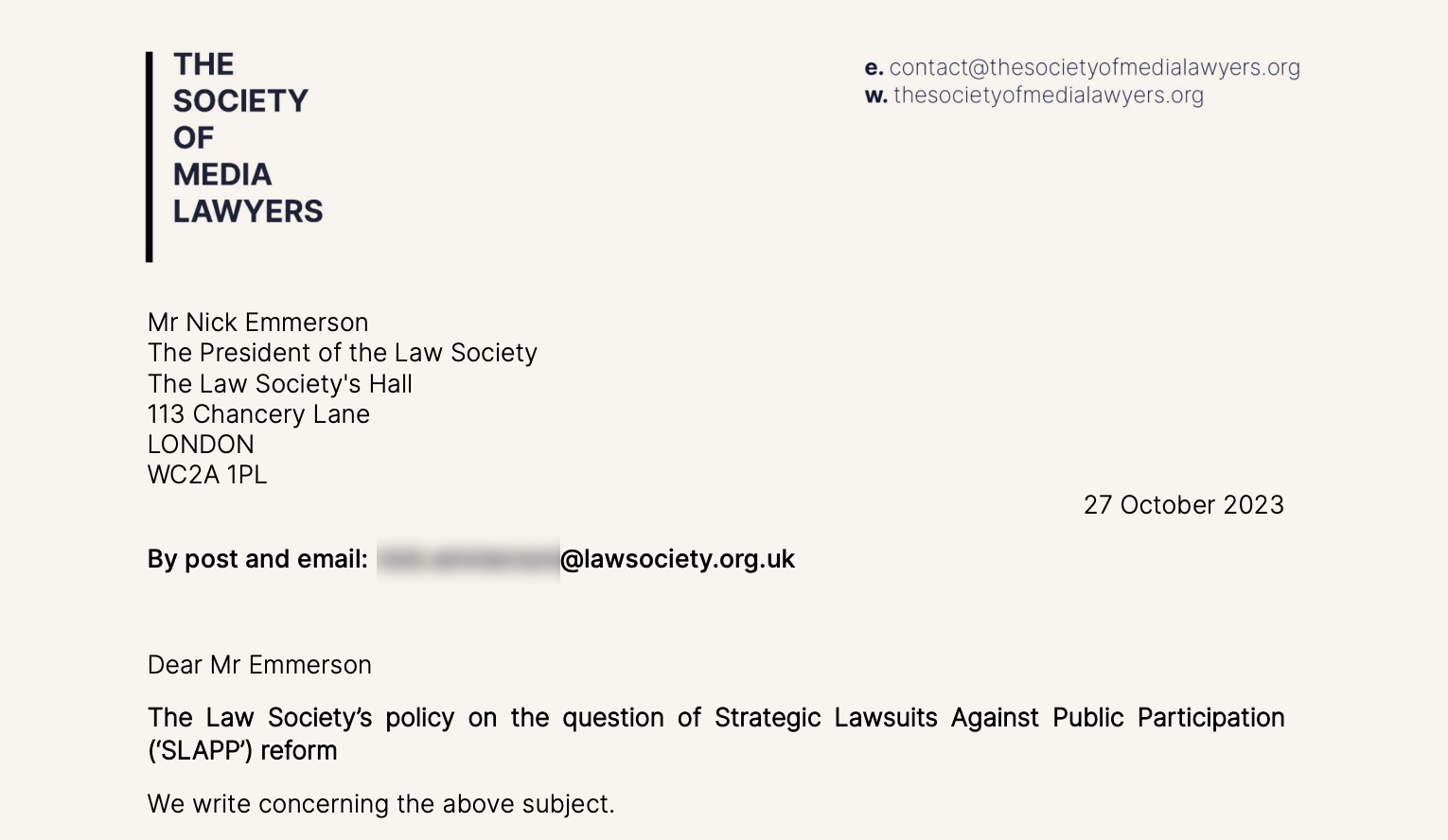
The Society of Media Lawyers is unhappy with this. They’ve written to the President of the Law Society asking the Law Society to stop advocating against SLAPP. Indeed the Society of Media Lawyers don’t seem to accept SLAPP exists – they say there is “not a significant SLAPP problem in the UK”.
They go further: they want Society of Media Lawyers members to be involved in the implementation of the anti-SLAPP provisions of the Economic Crimes Bill, and to be appointed to the Department for Culture, Media and Sport’s SLAPP taskforce.
The Society’s members include the likes of Carter-Ruck – described by David Davis MP as “the go-to law firm for every bad actor seeking to undermine or misuse British justice”. It is clear why Carter-Ruck and friends would want to shape anti-SLAPP rules. It is much less clear why the rest of us would agree to this.
Letter to the President of the Law Society
Dear Nick,
I am a solicitor and the founder of Tax Policy Associates, a think tank established to improve tax and legal policy.
I am aware of a recent letter sent to you by the Society of Media Lawyers. criticising the Law Society’s position on SLAPPs.
The Society of Media Lawyers say there is “not a significant SLAPP problem in the UK” and are unhappy that the Law Society is taking a stand against SLAPP. They ask to be involved in the implementation of the Economic Crimes Bill, and to have a representative on the Department for Culture, Media and Sport’s SLAPP taskforce.
The assertion there is not a significant SLAPP problem in the UK is deeply unserious. To take just a few examples from the last few years:
- Schillings acted for Russell Brand, attempting to make the Metro newspaper retract a clearly factual report about a “joke” about sexual assault which Brand had made on live television. Asserting defamation with no legal or factual basis is characteristic of a SLAPP.
- An unnamed law firm acted for Russell Brand, and sent an aggressive and intimidating email to an alleged victim of Brand’s, which included an entirely inappropriate allegation of blackmail. The making of unevidenced criminal accusations in correspondence is characteristic of SLAPPs.
- Archerfield Partners acted for Russell Brand in an attempt to prevent reporting of accusations of sexual assault by Szilvia Berki. This included defamation letters to newspapers and ultimately a successful application for an an anti-harassment restraining order. If Ms Berki’s allegations were correct (which now seems at least plausible) then this was an outrageous abuse of the legal system to silence her.
- Several unnamed law firms acted for PPE Medpro, Michelle Mone and Douglas Barrowman, and wrote to the Guardian saying that any claim that Mone/Barrowman were linked to PPE Medpro was defamatory. The parties have subsequently admitted that Mone/Barrowman are in fact linked to PPE Medpro. Aggressive correspondence based on an untruth is a key characteristic of a SLAPP.
- TT Law Ltd acted for William Hay in a defamation claim against Nina Cresswell, who had alleged Hay had sexually assaulted her. Mrs Justice Williams found that Cresswell’s allegations were substantially true. This is part of a very disturbing trend of perpetrators of sexual assault using SLAPPs to silence their victims.
- An unnamed law firm acting for an individual accused of sexually assaulting Lucy and Verity Nevitt. The law of confidence was used in a successful attempt to prevent him being named. This is another very disturbing case. Parliament has expressly not given anonymity to those accused of sexual offences, and to attempt to achieve this through secret threats of litigation is an affront to the rule of law.
- An unnamed law firm acted for Wirecard against the FT in a defamation action following the FT’s reporting that Wirecard was engaged in fraud. That reporting turned out to be entirely correct. The use of defamation proceedings to silence correct accusations of criminality is characteristic of a SLAPP.
- Carter-Ruck acted for Mohamed Amersi in a defamation claim against former MP Charlotte Leslie. Mr Justice Nicklin found for Leslie, and said he had “real cause for concern” that the litigation had an “impermissible collateral purpose”. That is a textbook definition of a SLAPP. It is relevant to note Carter-Ruck’s claim that it has not encountered any SLAPP cases
- Discreet Law acted for Yevgeny Prigozhin in a case against journalist Eliot Higgins of investigative website Bellingcat for claiming that Prigozhin ran the mercenary Wagner Group. At the time of Higgins’ report, Prigozhin had been widely reported as running the Wagner Group and had been sanctioned by the US and UK for his role in it. The case was abandoned after Russia invaded Ukraine, and Prigozhin subsequently admitted running the Wagner Group. It is hard to imagine a more obvious SLAPP than bringing a defamation action for a claim that was in fact true, and was widely known to be true at the time.
- Taylor Wessing acted for Eurasian Natural Resources Corporation Limited against journalist Tom Burgis. Mr Justice Nicklin found that the passages complained about in Burgis’ book were not defamatory, but noted that the very serious other allegations in the book (that ENRCL was a “corporate front” for criminal activities) were not the subject of a defamation claim. This is a typical SLAPP technique – ignoring the core allegation made and pursuing defamation allegations on an ancillary issue.
- Carter Ruck acted for the President of Malaysia’s PAS Islamic Party, Abdul Hadi Awang, in an extraordinarily far-fetched case against Clare Rewcastle Brown with the apparent aim of preventing her reporting about corruption in Malaysia. The case was eventually withdrawn and a settlement agreed in her favour. The far-fetched theory run by Carter Ruck, and the eventual concession, is characteristic of a SLAPP.
- An unnamed law firm acted for Jeffrey Donaldson in a defamation claim against OpenDemocracy for their reporting on political donations. The action eventually timed out. Commencing and then eventually withdrawing proceedings is characteristic of a SLAPP.
- An unnamed law firm acted for Javanshir Feyziyev against Paul Radu, a Romanian reporter for the Organized Crime and Corruption Reporting Project in relation to allegations of involvement in the Azerbaijani Laundromat. The case was settled in the reporter’s favour shortly before the court date. The decision to bring a claim against an individual journalist rather than the news organisation who published the accusations is characteristic of a SLAPP.
- Taylor Wessing acted for Al Wazzan, an investment advisor currently on bail in Kuwait for his role in the 1MDB scandal. Taylor Wessing attempted to prevent Clare Rewcastle Brown from even mentioning that Al Wazzan was on bail. Taylor Wessing abused the law of confidence in an attempt to keep their correspondence from being published.
And from my personal experience:
- ACK Media Law wrote to me alleging defamation after I “retweeted” a newspaper article claiming Nadhim Zahawi was under investigation by HMRC. The firm said Nadhim Zahawi was unaware he was being investigated by HMRC. Zahawi had indeed been under investigation, and at that point was in the process of settling the matter. The Prime Minister’s ethics adviser concluded that Zahawi should have understood he was under investigation. Threatening defamation against a member of the public “retweeting” a news article, and not against the newspaper that published the article is characteristic of a SLAPP. Alleging defamation where an accusation is in substance true is characteristic of a SLAPP.
- Osborne Clarke acted for Nadhim Zahawi, and accused me of defamation for allegations about Zahawi’s tax position which turned out to be correct. In the course of correspondence, Osborne Clarke stated repeatedly that Zahawi’s taxes were fully declared and paid, a statement that was false, and that Zahawi must have known was false. Osborne Clarke abused the law of privilege and confidence in an attempt to keep their correspondence from being published. Pursuing a defamation claim where the underlying accusation is true; attempting to keep the claim secret; and making false statements in correspondence – all features of a SLAPP.
- Brett Wilson LLP acting for a tax avoidance boutique called Property118, accused me of defamation for stating opinions on tax law which are shared by the majority of the profession. A libel action on that basis never had any prospect of success, and the Brett Wilson letter was therefore a SLAPP. Brett Wilson abused the law of copyright and confidence in an attempt to keep their correspondence from being published. Another characteristic of a SLAPP.
All of this presents a disturbing pattern of law firms acting for clients who are using defamation law to inappropriately stifle free discussion and, in many cases, to prevent publication of allegations that are in substance correct. In a number of these cases the lawyers had good reason to know or suspect that the allegations were correct. And these are likely just a small minority of cases: the intention behind most SLAPPs is that they never become public. The stifling of debate by lawyers, through the use of abuse of pseudo-legal arguments and the making of false factual claims, represents a threat to free expression and (in my view) to the rule of law.
I would therefore urge you to continue your current approach to SLAPP, which I am confident has the support of the vast majority of the profession, as well as the general public.
A final point: many of these examples involve members of the Society of Media Lawyers. To say they have a conflict of interest would be a considerable understatement. It would therefore, in my view, be highly inappropriate for the Society of Media Lawyers to involved in the implementation of the Economic Crimes Bill, or to be appointed to the Department for Culture, Media and Sport’s SLAPP taskforce. I would urge you to reject this request.

How libel firm Carter-Ruck recklessly enabled a $4bn fraud

Zahawi, Barrowman and Mone: why libel law rewards liars, and how we could change it.

Nadhim Zahawi’s lawyers referred to regulator for abusing libel law to shut down debate
The SRA stops secret libel letters
Nadhim Zahawi – another baseless libel threat


Leave a Reply to Dan Cancel reply