
On 9 December 2009, Chancellor Alistair Darling unveiled a one-off 50% tax on bankers’ bonuses. New documents from the Epstein Files reveal that a serving cabinet minister privately advised JPMorgan on how to fight back. Peter Mandelson, then Business Secretary, counselled Jamie Dimon on how to threaten the Government into softening the tax. Those exchanges were channelled through Jeffrey Epstein.
We worked on this story with the Financial Times.
The lobbying
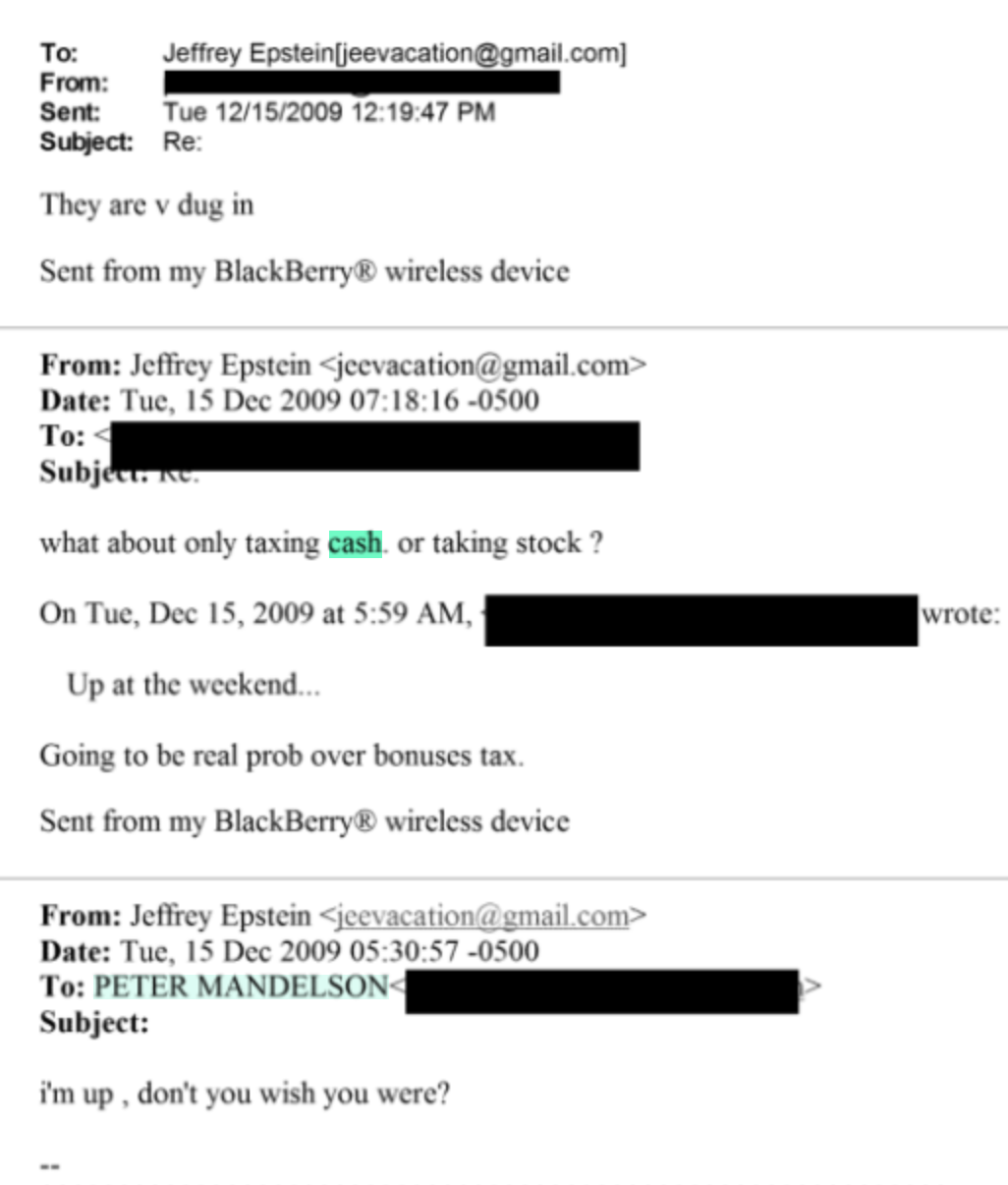
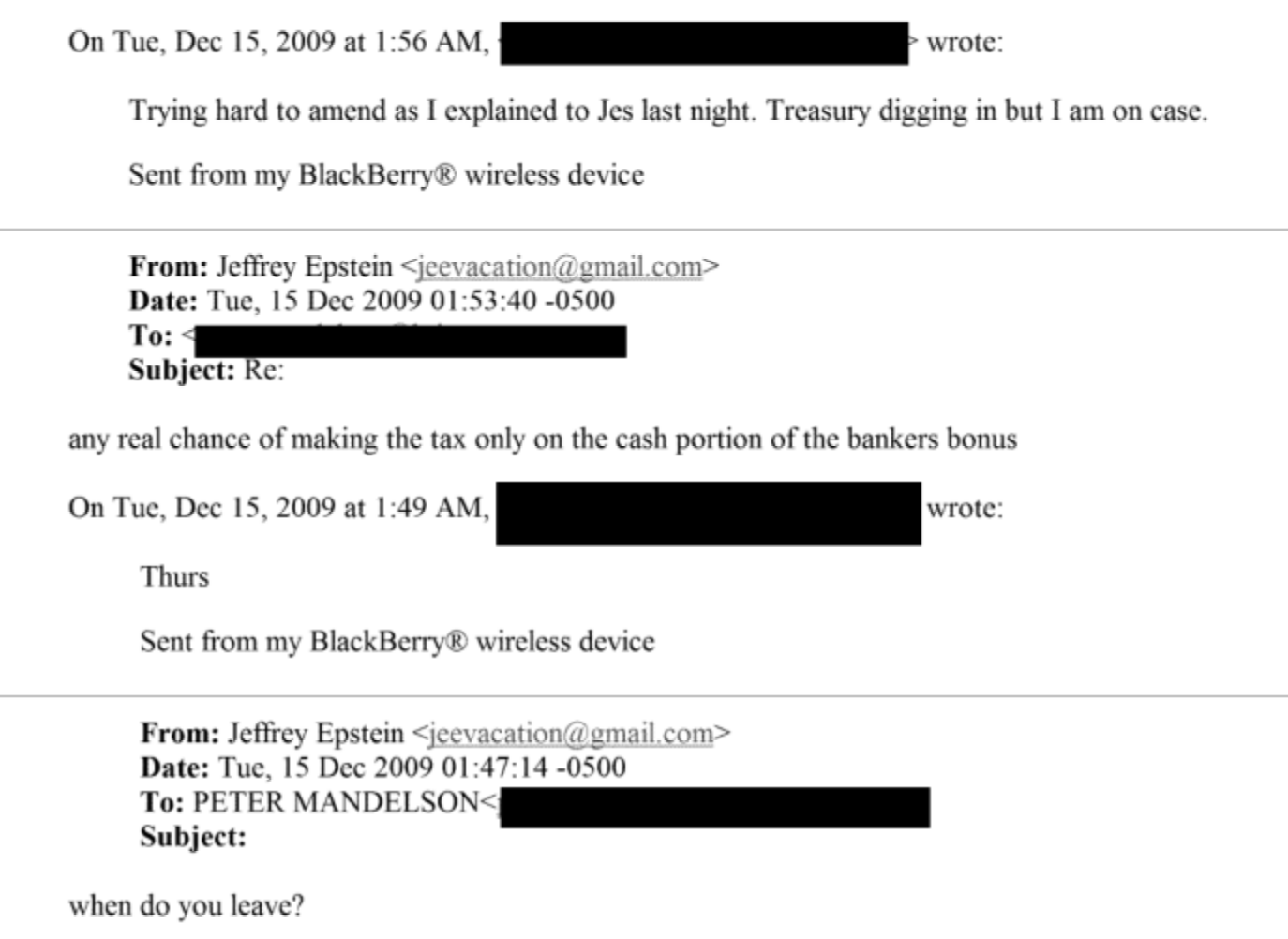
On 15 December, Mr Epstein asked Mr Mandelson if the bank payroll tax could be amended so it applied only to cash bonuses (not the, much more valuable, non-cash elements such as share options). Mr Mandelson replied that he’d explained to Jes Staley (then a senior JPM executive, with close links to Epstein) that he was trying hard to amend the tax. Mr Epstein said Mr Mandelson should let Epstein know of any result before Mr Mandelson spoke to Mr Staley:
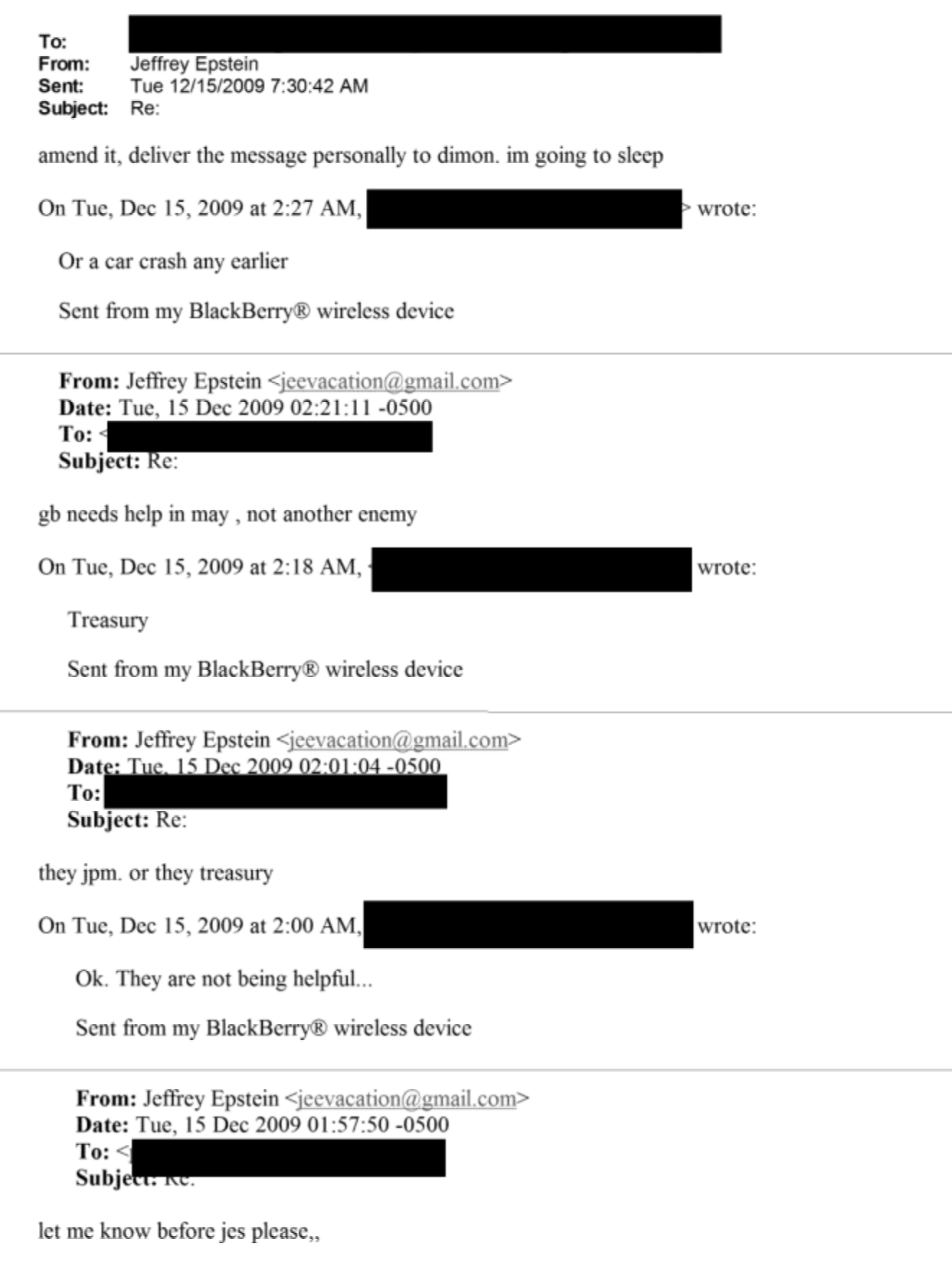
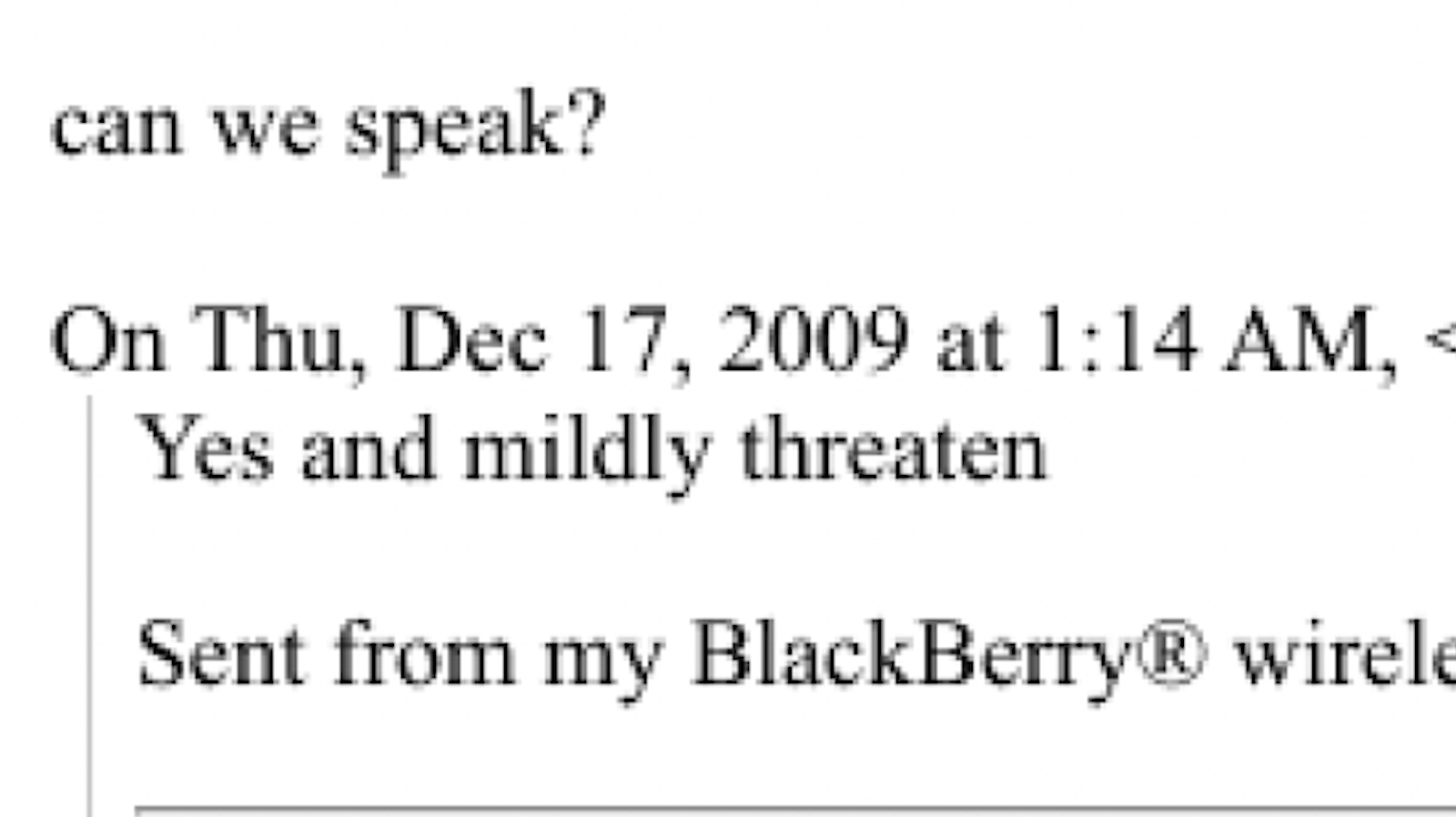
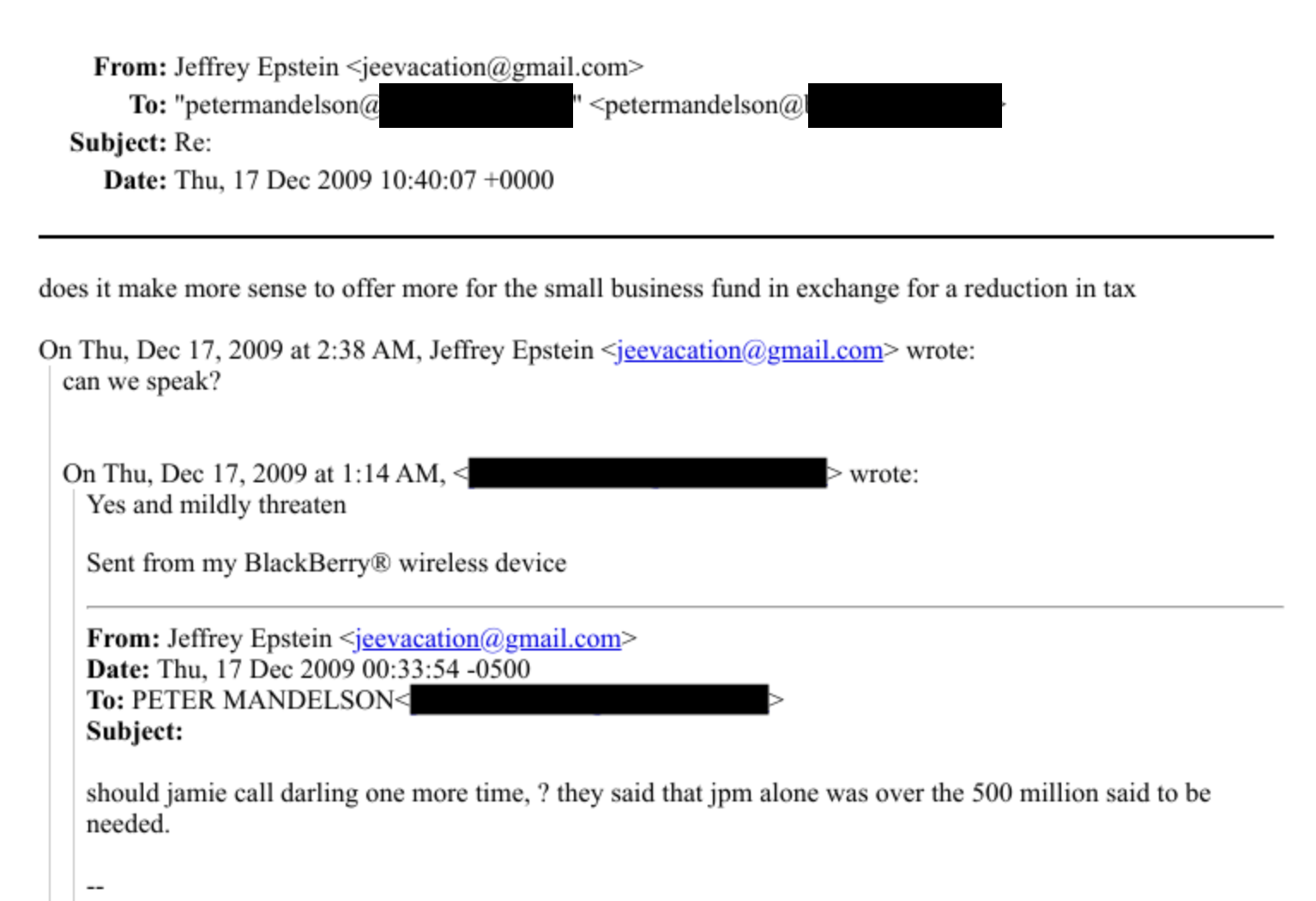
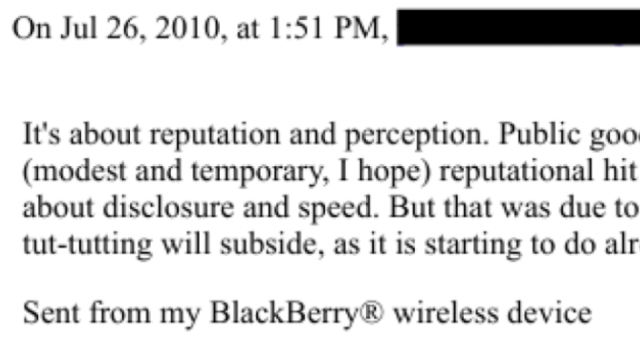
On 17 December 2009, Mr Epstein asked Mr Mandelson if Jamie Dimon should call the Chancellor one more time.1 Mr Mandelson responded that Jamie Dimon should “mildly threaten” Alistair Darling (presumably threatening to pull business/personnel out of the UK):
It looks like Mr Mandelson then spoke to Jamie Dimon directly:
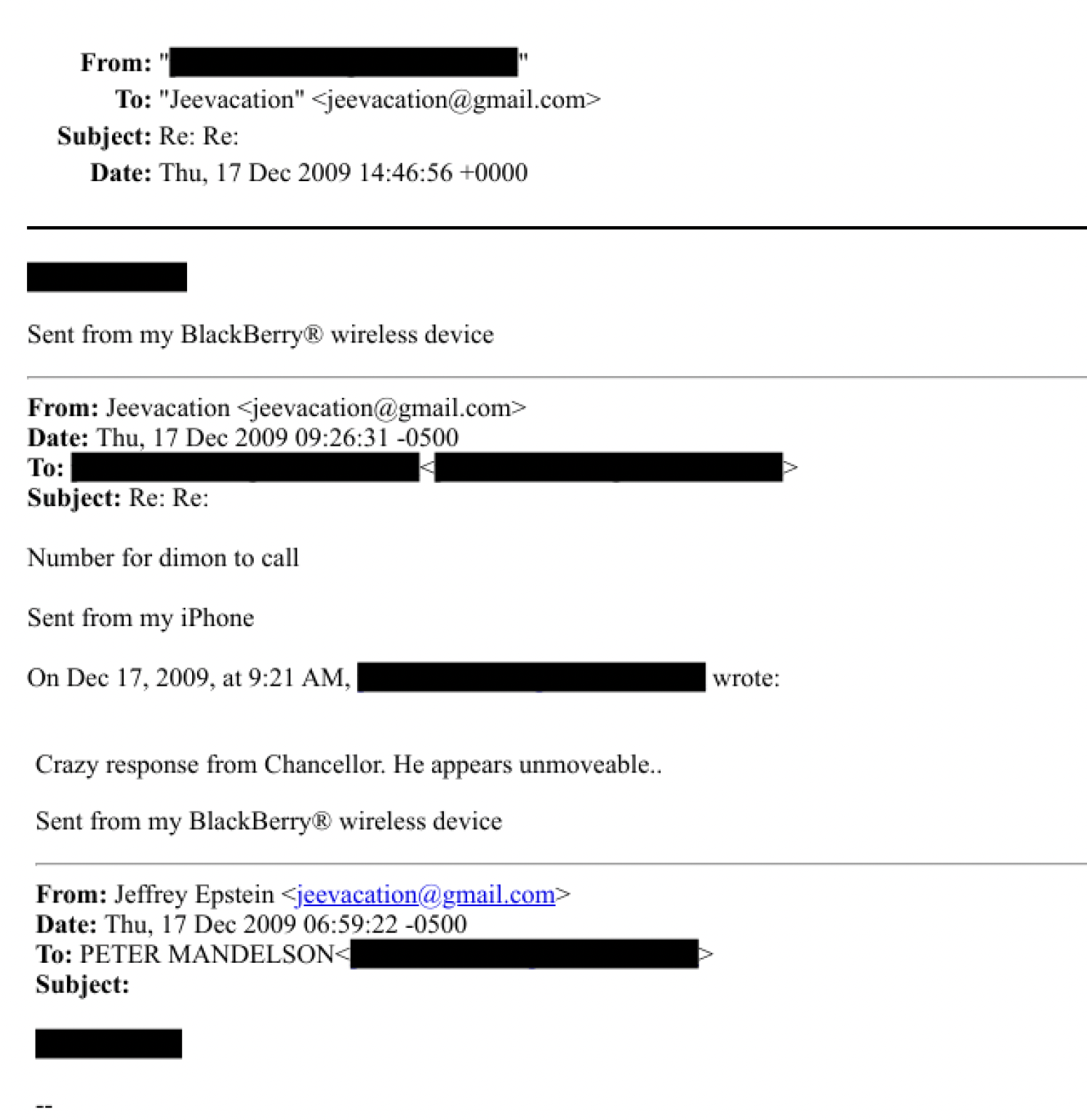
Jamie Dimon appears to have followed up on the “mildly threaten” suggestion. In his autobiography, Alistair Darling describes Mr Dimon’s mood as “angry, very angry” and says he threatened to reduce JPMorgan’s gilt holdings and would reconsider their plans to build a new headquarters in London.2 Faisal Islam, the BBC’s economics editor, has written more about that call, and the light the Epstein emails shed on it.
The Government did not back down, and the tax went ahead.
After the election
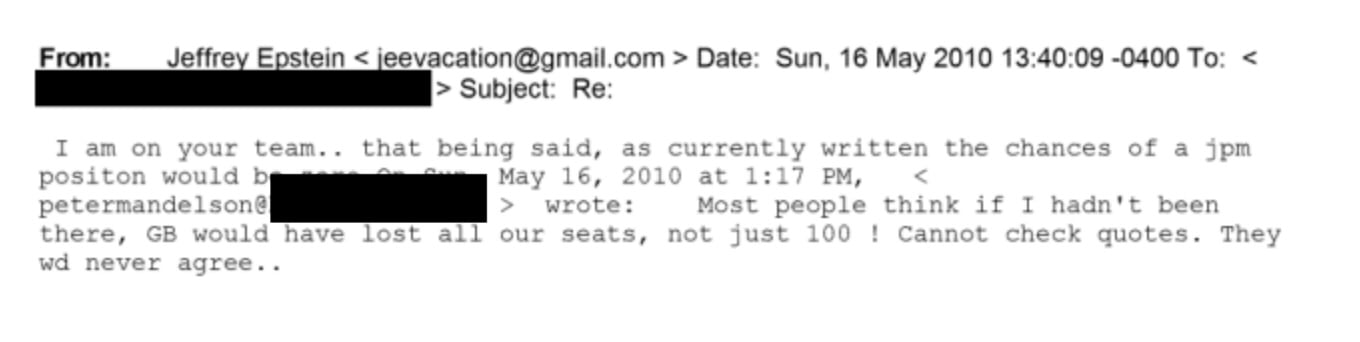
After Labour lost power in 2010, Mr Mandelson founded lobbying/consultancy firm Global Counsel. Subsequent email exchanges with Mr Epstein (and a phone call on Christmas Day) appear to show Mr Mandelson positioning for work and perhaps even a position with JPM (with Mr Epstein playing down his chances):
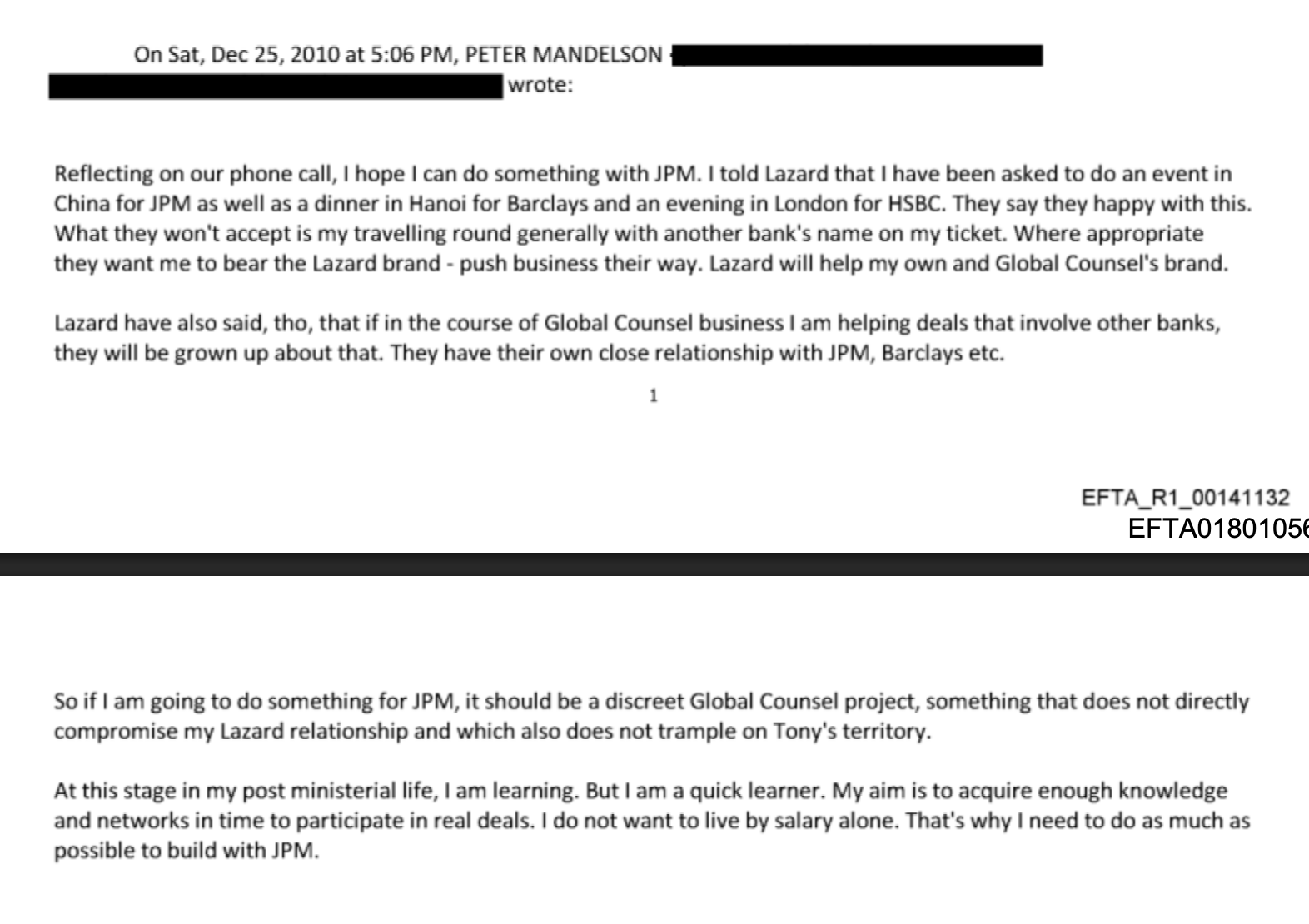
Mr Mandelson said: “My aim is to acquire enough knowledge and networks in time to participate in real deals. I do not want to live by salary alone. That’s why I need to do as much as possible to build with JPM”.
Mr Mandelson’s response
Mr Mandelson told the FT:
Every UK and international bank was making the same argument about the impact on UK financial services. My conversations in government at the time reflected the views of the sector as a whole not a single individual.
This doesn’t explain Mr Mandelson’s actions. It’s quite extraordinary for a serving Government minister to advise a foreign bank to threaten the Chancellor in order to reduce its UK tax bill.
Thanks to K for research, and many thanks to Jim Pickard at the Financial Times.
Footnotes
Mr Dimon’s reported comment that JPM’s bill would be over the total revenue the tax was expected to raise reveals the problem with the tax. The intention was to reduce bonuses as well as raise money – £550m was the projected figure. That kind of dual purpose is often problematic – the need for revenue ends up undermining the quasi-regulatory purpose. So whilst the Government expected it would incentivise banks to reduce bonuses, JPM’s response illustrates what actually happened: competitive pressure (from banks in other countries, and non-banks in the UK) meant that bonuses did not reduce much at all. The tax therefore raised significantly more than anticipated – £2.3bn. Our view is that this was a badly designed tax – its short timescale was distortive and unfair, and it failed to achieve its stated policy aims. A financial activities tax would have been more rational and, probably, more effective. ↩︎
See Back from The Brink, near the end of Chapter 11. Thanks to Faisal Islam for spotting this. ↩︎
Mandelson and the Epstein emails: could he be prosecuted?

Epstein files: Mandelson email search
Mandelson leaked No 10 documents to Epstein – who then helped him pursue multi-million dollar jobs
![To: jeevacation@gmail com[eevacation@gmail com]
From: Peter Mandelson
Sem: Sun 11/7/2010 2 34 57 PM
Subyect: Fwd Rio apartment
Seat to mys bank manager Gratetul tor helpful thoughts trom my chief lite adviser
Sent from ims iPad
Bevin torwarded messave
From: Peter Mander iS
Date: 7 November 2010 [4 29 12 GMI
Subject: Rio apartment
P| ag awe dpeecussed Pan consdernne a purchase of an apartmentin Rion Ttisain](https://taxpolicy.org.uk/wp-content/uploads/2026/01/Screenshot-2026-01-31-at-21.27.15-640x360.png)
Emails show Peter Mandelson discussing Panama tax structure with Jeffrey Epstein
![THE HON. MRS JUSTICE COLLINS RICE DBE CB
Approved Judgment
Kamal v Tax Policy Associates
31. In the circumstances, the pleading that it was ‘false and misleading’ to suggest that a
judicial finding of breach of duty had been made against him is incapable of forming a
part of the just disposal of Mr Kamal’s libel claim. The attempt to do so is an abuse of
the court’s processes. I grant the Defendant’s application to strike out [5(b)] of Mr
Kamal’s particulars of claim.](https://taxpolicy.org.uk/wp-content/uploads/2026/03/padded_judgment-640x360.jpg)
We defeated an £8m libel claim – and it shows libel law and the Tax Bar need reform.


Leave a Reply to Dan Neidle Cancel reply