-

The Budget – what it says

By Dan Neidle

November 26, 2025

54 Comments

Here’s our summary of the Budget and a quick take on what the various measures are likely to mean.

(The first draft of this article appeared unusually early, thanks to the OBR accidentally publishing their assessment of the Budget about half an hour before the Chancellor started her speech.)

Key elements

It’s all about fiscal creep:

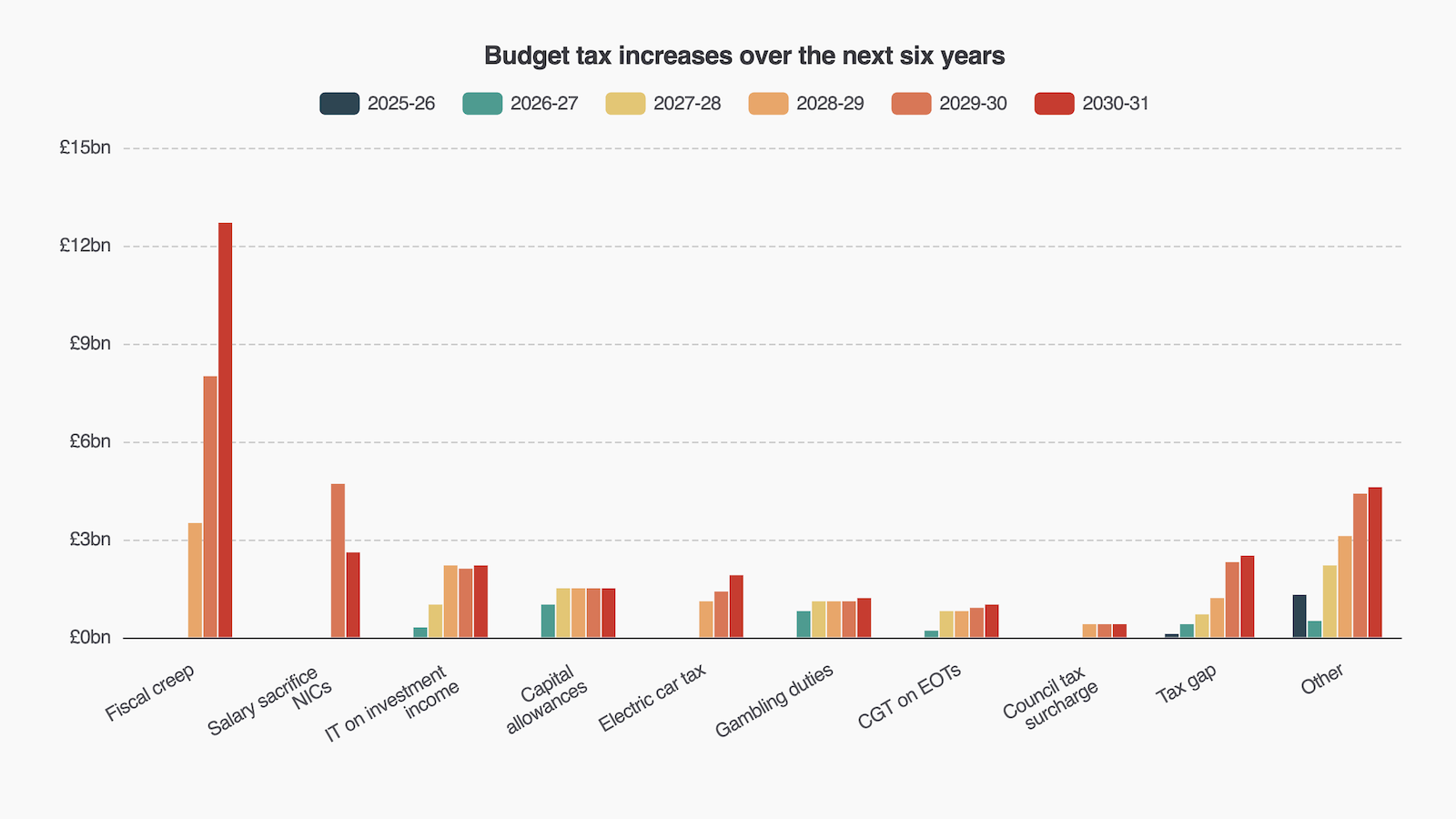
The overall impact is one of the largest medium-term tax rises in recent years – £30 billion a year by 2030/31:
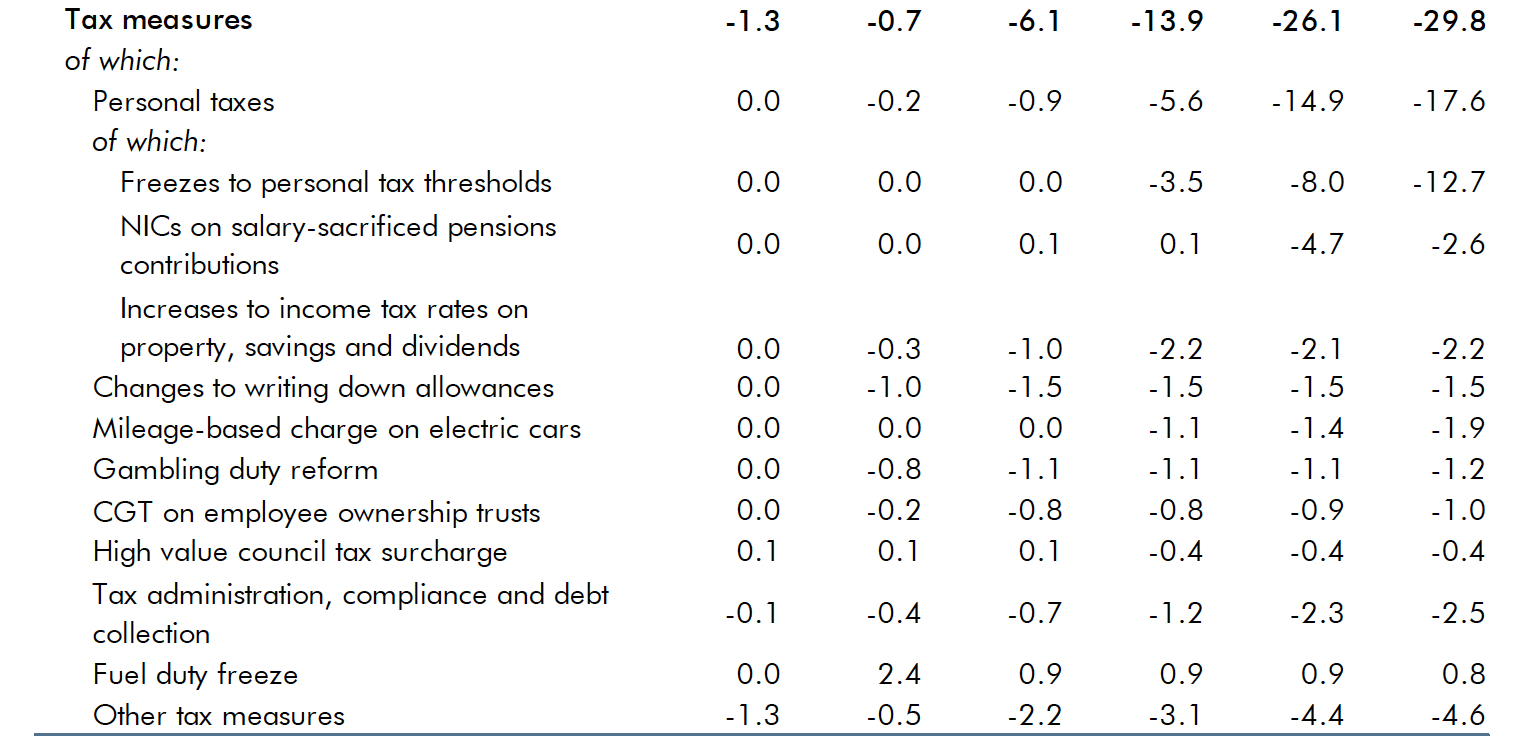
Three measures do most of the work.

First, that “fiscal creep”. Since 2018, successive Chancellors have let tax thresholds become eroded by inflation. The IFS said in 2023 that this was the largest single tax-raising measure since 1979, but after two years’ of further creeping, the OBR’s latest estimate is that fiscal creep will raise £32bn in 2026/27 and £39bn in 2029/30. This is likely the largest overall tax increase from a single policy in the post-war period.

This means median earners have been paying a bit more tax (but less than before the personal allowance was cut in 2011), and many more people have become higher rate taxpayers (paying quite a bit more tax):

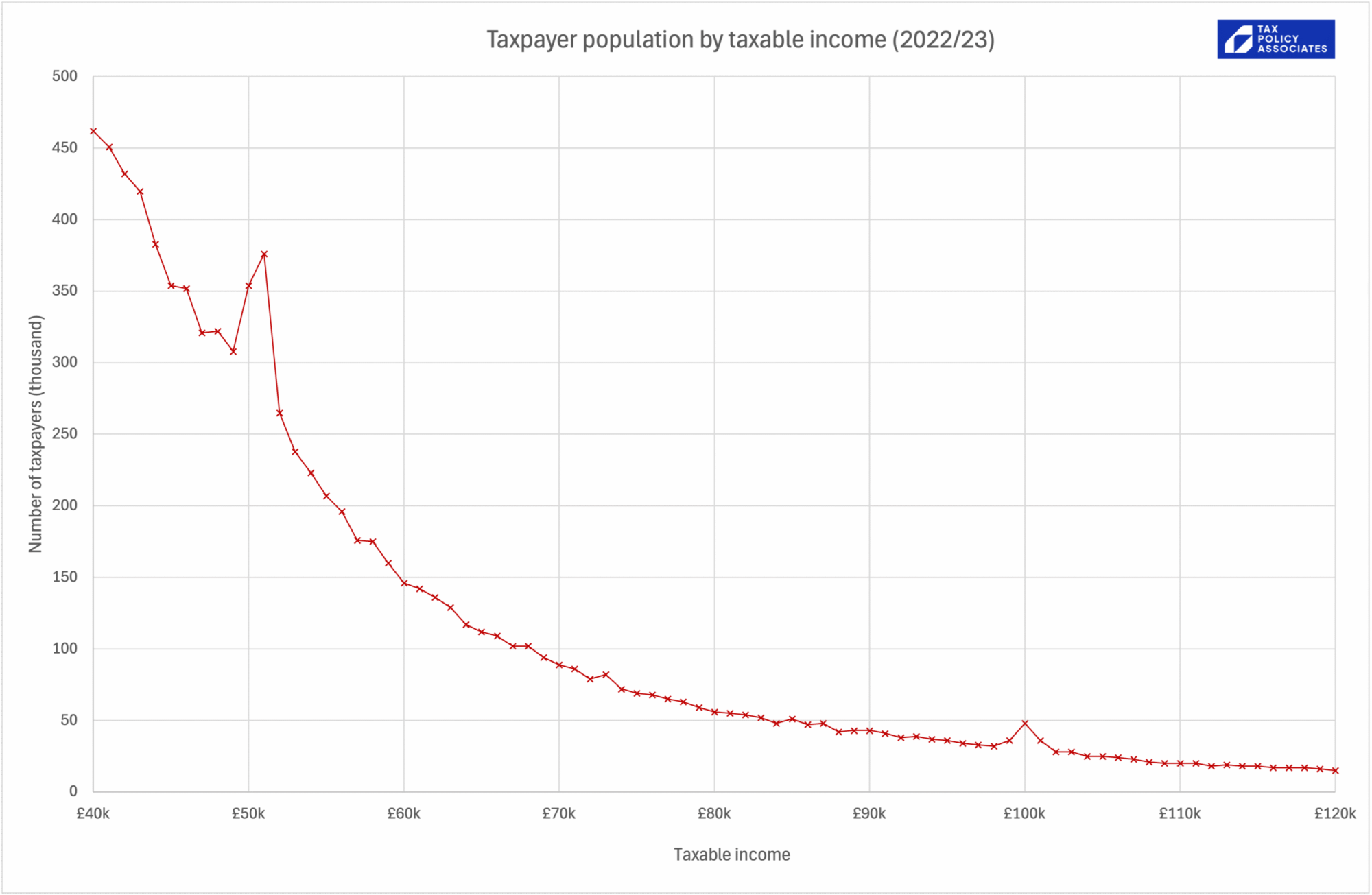
Second, salary sacrifice is being capped to £2,000. We may see this exacerbate the “bumps” in the income distribution, where people can currently use salary sacrifice to stay under thresholds that result in high marginal rates:
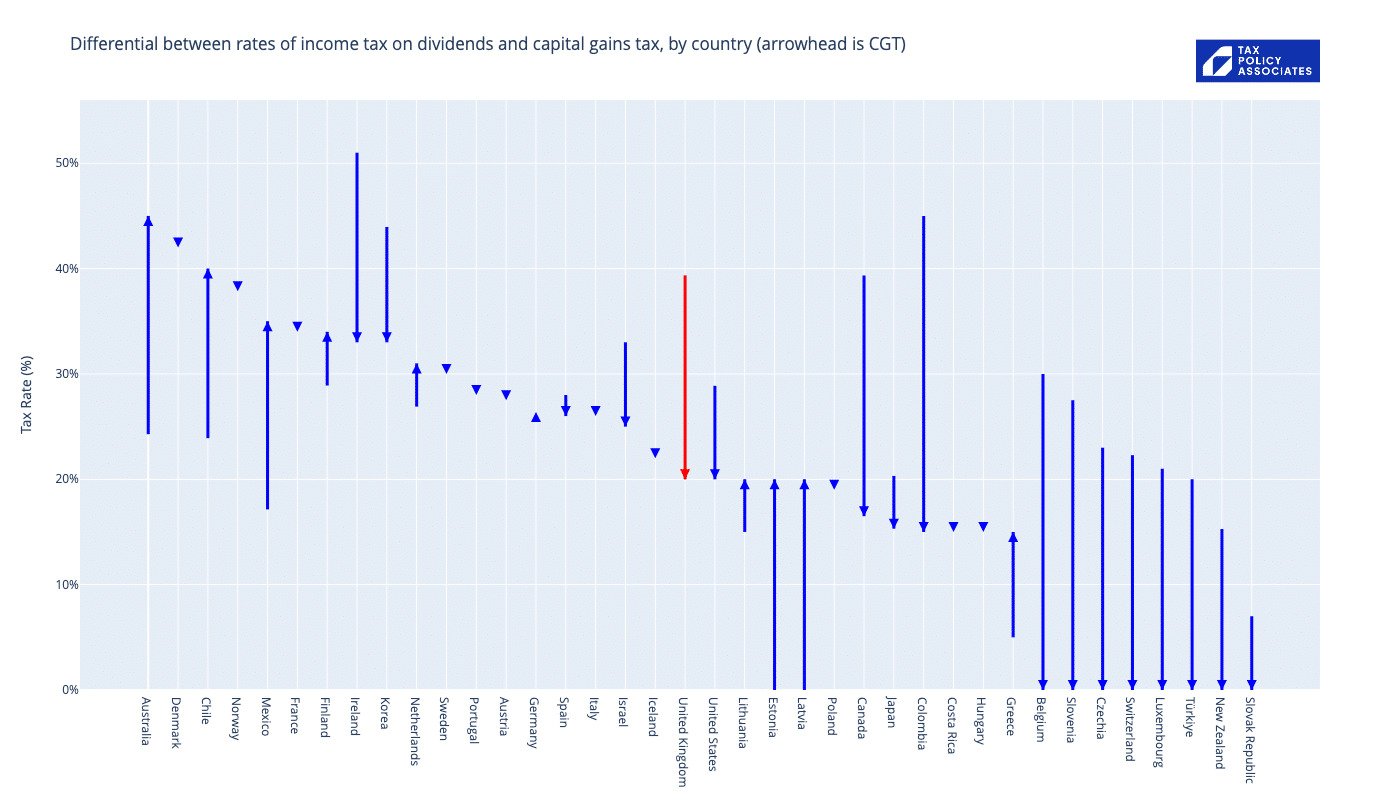
Third, a slight surprise: an increase in income tax on investment income – property, savings and dividends. The political attraction is obvious, and the Chancellor sensibly didn’t put up the top (additional) rate of dividend tax. That’s probably because UK dividend tax is already one of highest in the world. Look at the top of the arrow tails on this chart:
There’s a nice infographic in the Budget documents showing how the different rates of basic rate income tax now look:
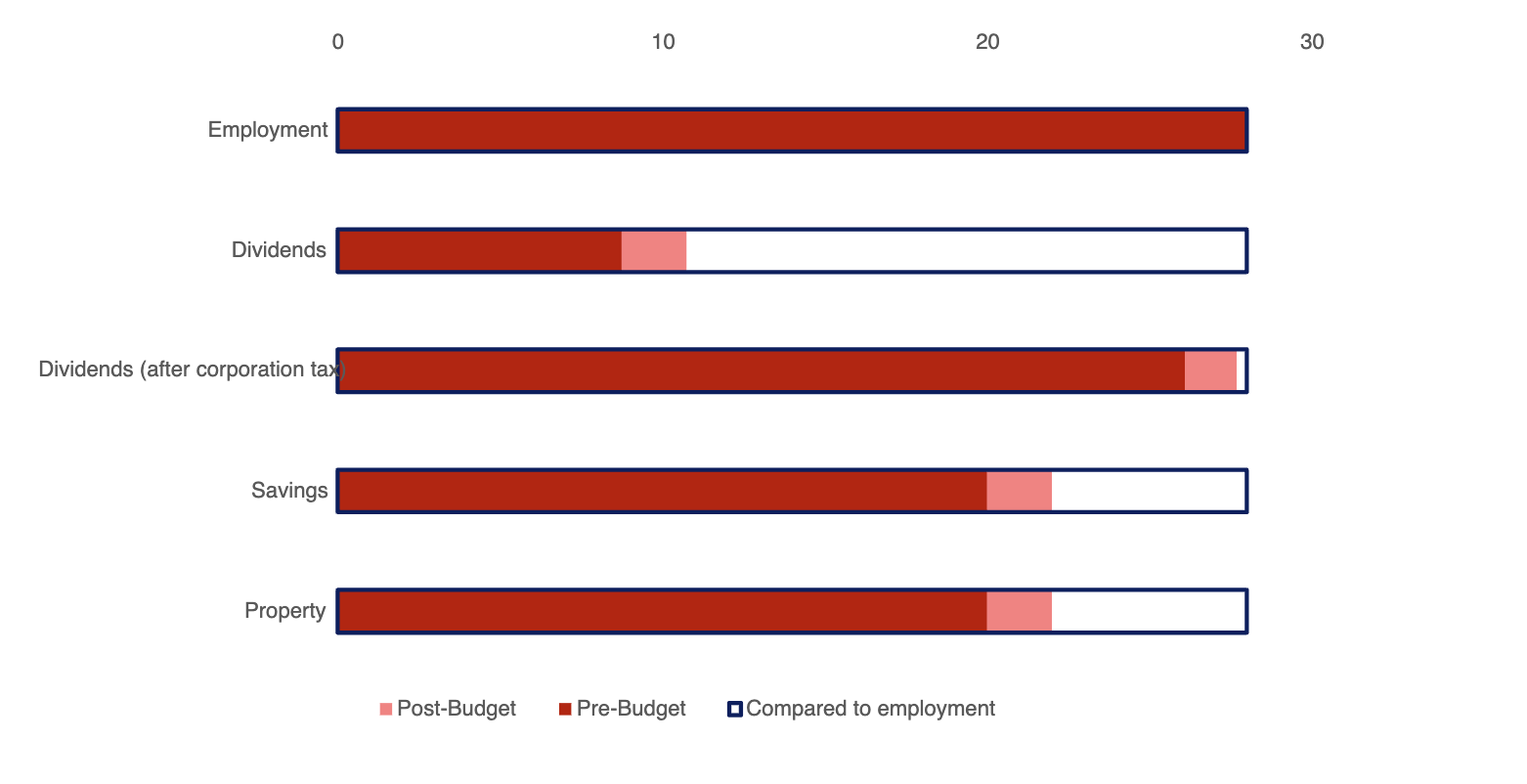
Basic rate dividend tax is therefore (taking corporation tax into account) no at the “right” rate – and additional rate dividend tax already was.

All these measures are back-loaded:

Fourth, a significant HMRC compliance package, which the OBR seems to accept will materially reduce the tax gap:

Fifth, a council tax surcharge:

My immediate reaction is that it’s fair that expensive houses pay more council tax. The current system is inequitable – a tax that looks like this can’t be defended:

It would have been much better to revalue council tax and add more bands. Given that is seen as politically too hard, the Government instead created a new tax working off a fresh valuation basis:
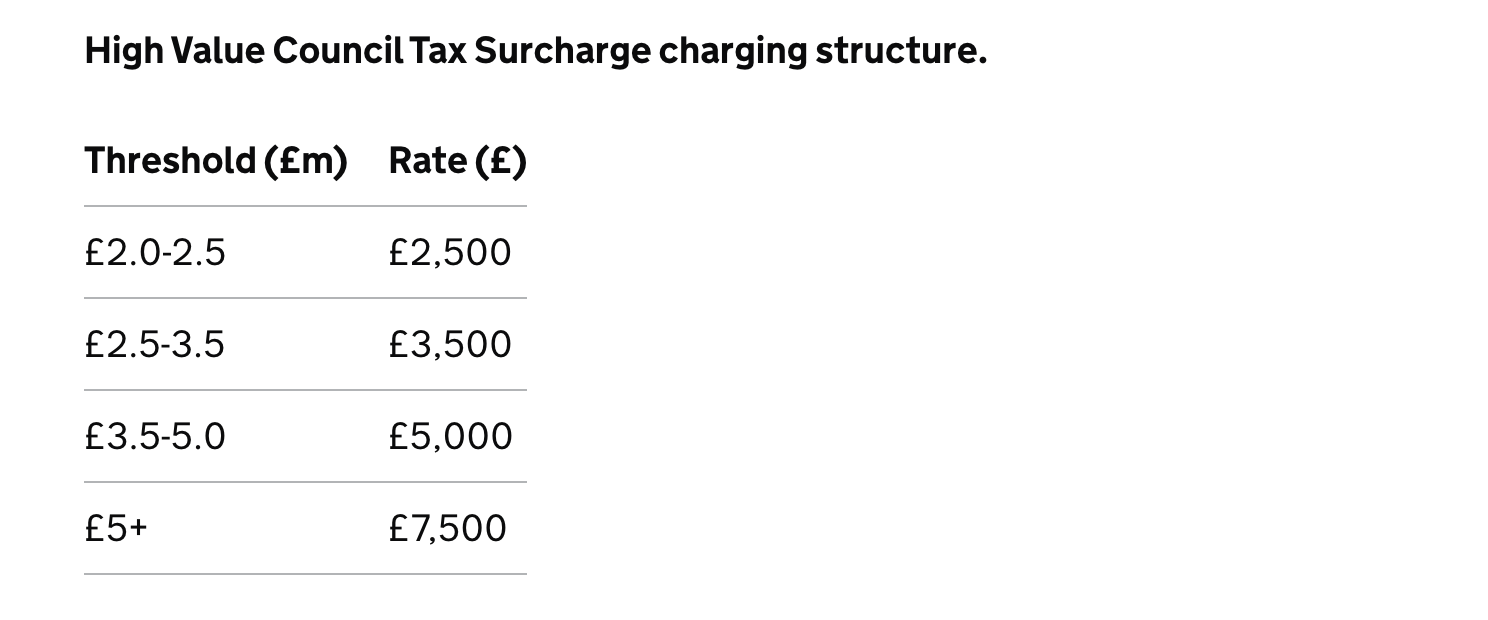
The oddity is the limited number of bands. That probably makes valuation easier, but means there is a sharp discontinuity at the boundaries (and so lots of appeals around the £2m point) and that £100m properties don’t pay more than £5m properties. So the curve created by the new tax is an improvement, but still looks a bit odd:

Economists usually assume that an annual property tax is “capitalised” into prices – buyers factor in the future stream of payments. On that basis, a £7,500 annual charge cuts the value of a £5m property by perhaps £200k to £300k, i.e. 4-6%. However that’s if people are rational calculating machines – obviously they are not. Stamp duty on a £2m property is £150k; on a £5m property it’s £500k. These ridiculous numbers are why stamp duty should be abolished and replaced with an annual property tax. But their sheer size means buyers may not regard the prospect of £2,500 to £7,500 annual taxes with enormous trepidation.

The tax will apply from April 2028. It will be collected by local authorities (together with council tax), with the revenue going to central Government, and central Government compensating local authorities for the admin cost.

The tax doesn’t raise much – £400m. That was the correct decision. A “proper” percentage mansion tax would have had a much more serious impact on the property market. It would also have been unfair to people who happen to own property today, as they would have taken the hit (with the economic effect rather like one-off tax on property wealth). We absolutely should have a proper percentage-based property tax, but that has to be part of wholesale reform, meaning abolishing stamp duty. Having both would be inequitable, and do damage to an already very troubled property market.

Sixth, what is I think a sensible introduction of a mileage tax for electric cars:
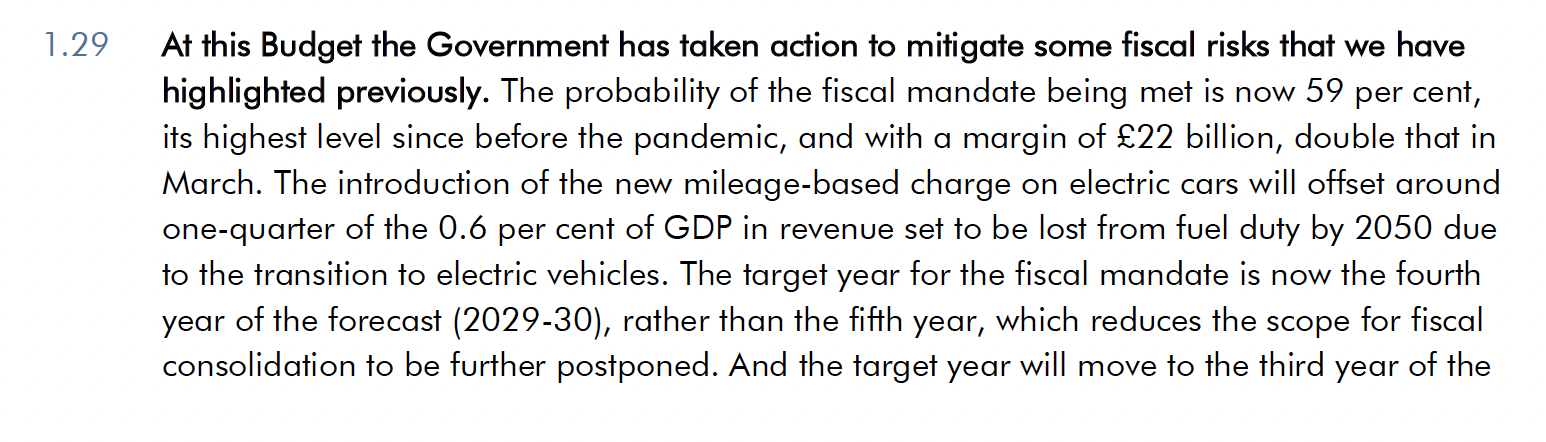
There’s a consultation document – the tax will be a new kind of tax for the UK, and that always takes time to design and build. Perhaps sugaring the pill, a consultation on allowing EV charging to be installed across pavements (safely) without planning permission.

Seventh, a reduction in capital gains tax relief for disposals to employee ownership trusts. This was a measure intended to encourage employee ownership. It has been abused in some quarters – and costs much more than originally anticipated.

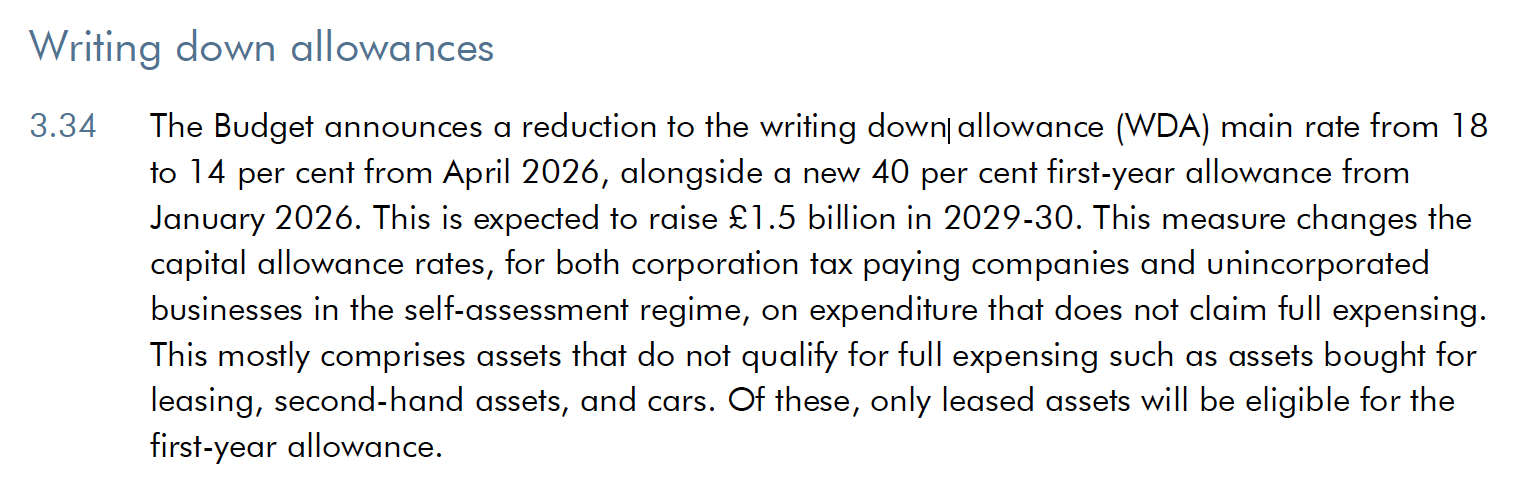
Eighth, a reduction in writing-down allowances, which allow businesses to claim tax relief when they buy capital items. There’s “full expensing” (immediate complete tax deduction) for plant and machinery, but some items don’t qualify, and must be written off over time (perhaps the most important example is second-hand/used plant and machinery). This change slows down the rate. It will therefore (at the margin) reduce investment in such items.
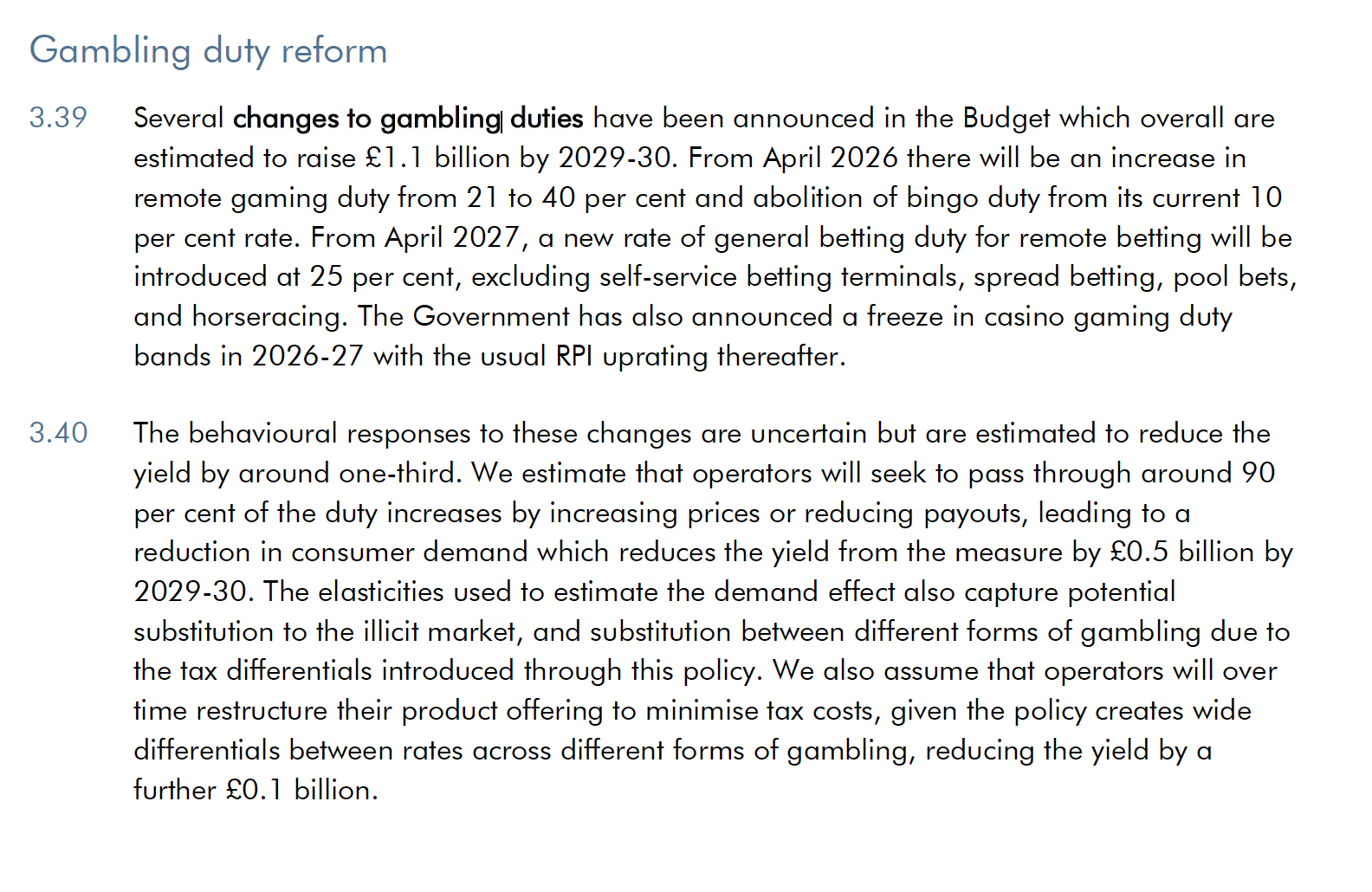
The final big item is, as widely expected, an increase in gambling tax:
Then some smaller measures:

  • Closing the loophole that meant that some taxi firms (think: Uber) paid a lot less VAT than they should. This will be portrayed as a “taxi tax” but it’s really just fairness and common-sense – all taxies should have the same VAT rules.
  • As expected, closing “low value consignment relief”, which exempts imports of £135 or less from customs duties. The intention was always to avoid disproportionate duty and administration charges. The problem is that the relief has essentially been weaponised by the likes of Shein, making UK retailers uncompetitive.
  • The expected expansion of the higher air passenger duty for private jets, to include large private jets as well as smaller ones.
  • The Energy Profits Levy (or “windfall tax”) to remain in place until at least March 2030. I expect it will in reality become a permanent feature of the tax system.
  • A consultation on letting elected mayors introduce tourist taxes. The question is how much they will adversely impact the already-under-pressure hospitality sector. Will be writing more about that soon. The (obvious) lesson of the council tax second home surcharge is that local authorities are so strapped for cash that they will maximise any opportunity they have to make additional revenue, regardless of the merits of the tax.
  • Changes to the sugar levy, intended to reduce the amount of sugar in drinks – it’s not immediately clear if this will raise additional revenue.

The overall result: by the end of the decade, the UK tax take hits 38% of GDP – the OBR says that is an “all time high”.

Tax cuts

There were a few:

  • A temporary three year holiday from SDRT/stamp duty on shares for new listed companie. No details yet. It’s good to see focus on this – stamp duty is a damaging tax, and higher than the similar taxes imposed by comparable countries. But I’m sceptical it will be effective. Investors and companies look further out than a few years.
  • As announced in last year’s Budget, a reduction in business rates for retail, hospitality and leisure businesss, paid for by an increase in business rates for businesses with larger properties (including, but not limited to, the warehouses used by the likes of Amazon).

The Budgets we were never going to see

Quite a lot of complaints are from people expecting Budgets we were never realistically going to see. Three types in particular:

A Budget that cuts spending.

The Spending Review was in June and it seems unlikely any of those decisions will be re-opened. The attempt to find £5bn of welfare savings was a failure, with Labour MPs and much of the public opposed. Whilst many politicians are in favour of generic spending cuts and “efficiency savings”, it’s much rarer to find anyone active in politics (as opposed to think tanks) committed to a specific programme to constrain or even shrink the size of the state.

A Budget that raises income tax

The kind of Budget I and other tax wonks and economists would prefer: where any immediate “black hole” and need for fiscal headroom was resolved with transparent increase in income tax. Every economist I’ve spoken to, Left or Right, believes this would be the least damaging tax increase.

But it is also one of the least popular.

So it’s hardly a surprise that’s not what we saw.

A Budget that introduces totemic taxes on the wealthy

The “wealth tax” (meaning a percentage tax on assets of the wealthy) is very popular, particularly in a three-second conversation. When, however, there is a need for revenue to finance current spending, a tax that will likely raise nothing before 2029 is not an attractive option (quite aside from the many serious practical and technical problems with the tax).

We will not see a wealth tax under this or probably any other conceivable government.


Thanks to Beth Rigby at Sky News.

Footnotes

  1. There have certainly been Budgets raising more than this; but no single policy has raised anything like as much. ↩︎

54 responses to “The Budget – what it says”

  1. Robin avatar

    OMG! They are going to ban “cash like instruments” from Stocks & Shares ISAs. This will be the same mess as a “British ISA”. What is cash like! A 1 month Gilt? A bond Fund? A fund with 50% stocks 50% money market?
    Is this “Cash like” – it only holds stocks but pays SONIA:
    https://www.amundietf.lu/en/individual/products/fixed-income/amundi-smart-overnight-return-ucits-etf-acc/lu1190417599

  2. Charles Levett-Scrivener avatar
    Charles Levett-Scrivener

    Looks odds on a March or April 2029 General Election.

  3. Chris avatar

    The infographic in the Budget documents showing the different basic rate income tax bands is a useful illustration, but I feel it is misleading. In reality, few companies are able to extract profits at the small profits rate because of working capital requirements or because there are multiple shareholders.

    For the illustration to be more accurate, it should include two additional fields showing the effect of basic rate dividend tax after corporation tax at both the marginal rate and the main rate of corporation tax.

    Based on my calculations, the effective tax rates are:

    Dividends after corporation tax at the marginal rate:
    Pre-Budget 32.9% and Post-Budget 34.4%

    Dividends after corporation tax at the main rate:
    Pre-Budget 31.6% and Post-Budget 33.1%

    These effective rates are higher than the 28% benchmark shown in the infographic. When you also take into account the higher rates of tax, the withdrawal of the personal allowance, and the additional rate, the effective tax burden on dividends is well above the employed rates of tax used as the comparison point.

  4. Claire Aston avatar

    On the fossil fuels windfall tax RR was silent on it during her speech but there is a fairly significant measure hidden in the document. The EPL will finish in March 2030 (unless a commodity price crash switches it off via ESIM beforehand). Thereafter a new Oil & Gas Price Mechanism takes over which levies a charge on sales of oil and gas above a set price point $90/bbl for liquids, 90p/therm for gas. It’s the OGPM which will add to the permanent regime, not EPL. A bit niche but may well have long term tax policy consequences

  5. Adam avatar

    I was quite interested to see that the changes to EIS, VCTs and EMI will not apply to many companies in Northern Ireland – presumably because it’s state aid and NI remains part of the EU Single Market?

  6. MK avatar

    Not convinced any way the ‘significant compliance package will reduce the tax gap significantly’, when Osbourne did this the results were below expectations – I worked there then, and HMRC are in a far worse state now than they were ever then.

    There are some serious problems at HMRC, we have seen the problems with Child benefits, but this is only the tip of the iceberg, there are serious problems in compliance, collection and HMRC’s operation of the Construction Industry Scheme (from my recent experiences).

    The one positive thing is that most people and accountants will try their best to ensure the correct income is declared and the right tax is paid, despite their concerns.

  7. Richard Bryan avatar

    The arrow chart of differences between Dividend and Capital Gains rates is I suspect recycled from last year – surely the CGT rate is now 24%?

  8. Ryan Jones avatar

    Hi, can anyone explain why the business rates for RHL properties will be lower if you have a band below 49,000. It seems to me that there is an increase of 10-20% and not a decrease as the RHL relief of 40% is abolished. Everyone seems to say that business rates are reduced but 40% relief over 49p is a multiplier to Rateable Value of 29.4p versus 38.2p that seems a 29% increase, unless I miss something.

  9. Anne Noble avatar

    I look forward to your thoughts on tourist tax, Dan. My insights into it are at the most basic level, i.e. being someone who pays it when I travel. The amount is usually so low e.g. 3€ per day, that it isn’t a factor that prevents travelling to a particular location. So from from my side it seems to be an easy revenue maker. Therefore it would be interesting to see if, from your analysis, tourist tax really would raise money.
    And, to a add a personal gripe about all shades of UK Government,…what’s the betting that if a tourist tax were decided upon the Government would create it’s own system and reinvent the wheel, rather than copying what some other countries already do, and therefore bury any benefit in implementation costs 🙂

  10. Mr Bob avatar

    Hello. Long follower first time commenter. Will the new NI tax charges above £2k apply to (and be paid by the employee) in relation to the amount your employer contributes to your pensions? What about all these electric car leases structured through salary sacrifice? Thanks!

    1. Oliver I avatar

      According to the government’s press release (https://www.gov.uk/government/publications/changes-to-salary-sacrifice-for-pensions-from-april-2029/changes-to-salary-sacrifice-for-pensions-from-april-2029) , employer pension contributions are still fully NI exempt. What I don’t understand, is that given this exemption what is to stop all employers just reducing employee’s salaries by the amount they would have scarified and paying it all as an employer contribution to dodge the tax entirely?

      1. Matt Rowbotham avatar

        Swapping salary for employer pension contributions is a workable definition of salary sacrifice! It’s not what you do it’s the way that you do it that matters. Which creates weird boundaries for HMRC to police. I can understand HMRC wanting to squish this so that it’s a mild impact on the Treasury rather than a stonking cost that mostly correlates with v high earners (but not v v high earners because of the taper!). Not sure I would have done it like this because it’s a lot harder for HMRC to police than (e.g.) an annual threshold for ALL NIC-free employer pension contributions (whether deriving from sal sac or not)

    2. dearieme avatar

      Google tells me “salary sacrifice can fund various benefits tax-efficiently, including pensions, childcare vouchers, cycle-to-work schemes, company cars (especially electric vehicles), technology (like phones and laptops), and additional annual leave.”

      If someone wants additional annual leave just pay them less: is that ‘salary sacrifice’? If you pay them less then they owe less in income tax and NI and the employer owes less in NI too. I’ve no objection to that: a wage is a price and the price is different according to the terms e.g. annual leave.

      But government fannying about with the other things on the list is absurd. Stop it: it wastes people’s time on coping with needless complexity. Abolish salary sacrifice for all those other things. Tax breaks for bikes and virtue-signalling motor cars? For heaven’s sake!

  11. Sandra avatar

    I wonder if it’s yet known how the council tax surcharge will be administered for non primary residences? For example, in areas where a local authority doubles council tax for second homes, would they be doubling the surcharge too ahead of passing it onto the treasury?

  12. Andy Adamson avatar

    The closing of low value consignment relief is a win for UK retailers and should help to remove the cheap tat that is being imported from China.

    1. ian M avatar

      100%. But why would you wait till 2029 to introduce it?

    2. Guy Incognito avatar

      As someone who has extensive experience manufacturing in China (and selling in the UK) the reality is that it will just make things more expensive for consumers.

      The tat will still be made in China. Cost of VAT / duty will just be passed straight on to consumers.

      UK manufacturing of tat is non-existant due to minimum wage and energy costs.

      1. James avatar

        By making things more expensive to the consumer from direct sellers such as Shein etc, this would therefore make the UK retailer more competitive as the UK retailer currently does not benefit from low value consignment relief.
        A win for UK Retailers as they are more competitive against direct shipment companies.
        A (probably small) win for the Gov as tax will be collected on these imports from Chinese retailers.
        A win for the environment as more expensive tat will equal less tat imported.

  13. GuyW avatar

    Is there anything to prevent employers from swapping from a salary sacrifice scheme to a pension sacrifice scheme. ie “we are going to decrease your salary by 25% but increase your pension by an equivalent sum. If you want you can sacrifice some of that pension in return for an increase in salary.”
    Presumably this could also be achieved gradually over time by increasing pension contributions on an annual basis but leaving base pay the same.

    1. Marcus Hassall avatar
      Marcus Hassall

      Employee take home goes down. The balance between salary and pension has always been an available mechanism. But even with the better pension, that’s not exactly replicating the reduction in EEs/ERs NICs with the extant system.

      I think the change is sensible, in limiting abuse of salary sacrifice by higher earners.

      1. dearieme avatar

        But what’s sensible about £2k rather than £0k?

    2. Richard Cuthbertson avatar
      Richard Cuthbertson

      Technically possible but the difficulty is that his would need to be done by collective agreement with the whole workforce. Maybe a workaround could be to operate the business as two employers – Widgets Ltd and Widgets 2029 Ltd and move all the participating employees into Widgets 2029.

  14. Anita K avatar

    Dan, thanks for this. Just to point out (although apologies if I have misunderstood something as a layperson) that in the ‘% of income taxpayers paying higher rate’ chart, the vertical axis should be expressed in % and not in £ as it is at the moment.

    1. Dan Neidle avatar

      hopefully now fixed – sorry!

  15. Guy Incognito avatar

    The dividend tax increase is scandalous. It’s a 25% increase. The budget chart you cite seems inaccurate as well, because for a basic rate tax payer the corporation tax is 19%, and then it’s 10.75% of 81%, so a total of 27.7%. Of course that doesn’t account for the fact that corporation tax increases to 25%, nor the massive jump up at the higher level (51.8% once you add corporation tax and dividend tax).

    It is yet another hammer blow to SMEs and directors / operators of businesses.

    1. BJ avatar

      I’m don’t get why you add the corporation tax to the dividend tax. I know some call it double taxation, but double taxation is everywhere (eg. VAT).

      I guess that the Australian system could be looked at, where dividends are effectively classed as income and tax at the same rate. Would that be preferable?

      BTW what do you mean by “basic rate tax payer the corporation tax is 19%”? Corporation tax is only paid by corporations not “basic rate tax payer[s]”.

  16. Alan Grahame avatar

    Is there anything that indicates how the EV milage tax and the High Value House Surcharge will actually be implemented. Are EVs to be fitted with some sort of tracking device? Are houses to be revalued?

    As will everything else, the devil is in the detail

    1. John Hills avatar

      The milage is expected to be calculated from your yearly MOT milage reading, this is already publically available from the MOT history from the DVSA

      1. Andrew James avatar

        That could get interesting where a car is sold. And MOTs don’t align with the tax year.

        1. Tim H avatar

          And no MOTs for 1st three years for new vehicles (which plenty of EVs will be, for obvious reasons!)

    2. Tom Ward avatar

      There was a chap from the AA on the news earlier describing all sorts of anomalies, (such as driving in Europe means you pay tolls there and in the UK when you haven’t driven on UK roads.
      Why not report monthly via an online account as we do with household energy which is confirmed officially at the MOT or by an odometer reading on change of ownership?
      You could report European travel that way, with dates confirmed via passports and the threat of spot checks by police/dvla/customs.

    3. Arnold Smith avatar

      I don’t think it’ll be a problem. For example, If you have a limited milage classic car insurance policy you have to tell the insurer each year what the milage is, and what’s the sense in lying when all you’re doing is building up a backlog for whenever the next MOT is, or you have an accident, or your car gets stolen, or you sell the car and the new owner reports the milage, or you upset a police officer that’s stopped you for speeding, or some offense where you might end up it court. It’s just not worth it.

  17. David Stewart avatar

    Would be good if got could twist the arms of the motorway service stations to offer fast charging at a decent but profitable price (not the 8p/kWh you might manage at home but maybe 30p or so). Whether by threat of stick (charging those that don’t offer decent capacity) or carrot or a mix.

  18. Graeme avatar

    Front-page headline from this day in 1996: “Major orders inquiry into Budget leak” – Telegraph. Plus ca change!

  19. John C avatar

    It will be interesting to see what happens with the NI on pension contributions. The change is touted as being on salary sacrifice arrangements but what if the contract of employment for an individual says their salary is £50,000 and the employer pension contributions are £10,000: this is not salary sacrifice.

    If the Govt decide to extend NI to any employer’s pension contributions in excess of £2,000 the biggest losers will probably be public servants including doctors. Doctors are already at the end of their tether having been hit over the past 15 years by loss of Child Benefit, loss of personal allowance, less advantageous pension scheme and freezes in pay over many years.

    1. Ganesh Sittampalam avatar
      Ganesh Sittampalam

      There are a bunch of rules here about what makes something a salary sacrifice scheme: https://www.gov.uk/hmrc-internal-manuals/employment-income-manual/eim42755

      Maybe they’ll need to be tweaked further.

      1. Andrew avatar

        Reading the policy costing there is something very odd going in. Static impact of +£4.87bn in 29/30 and +£5.07bn in 30/31.

        However post behavioural impact goes from virtually the same as static in 29/30 (+£4.845bn) to barely 50% of static in 29/30 (+£2,585bn). Suggests they expect a very large behavioural response but that it won’t start until a year after the new measures come in. Given they don’t start for 3 years, why wouldn’t behaviour change immediately as there is loads of time to do so?

        1. Oliver I avatar

          Yes, hopefully Dan will be able to dig into what assumptions are driving this one. Given it seems that in principle you could flip over pension that would have been sacrificed to be pure employer contribution, the impact would surely be nearly zero?

    2. Richard Nabavi avatar
      Richard Nabavi

      There’s some useful detail here:

      https://www.gov.uk/government/publications/changes-to-salary-sacrifice-for-pensions-from-april-2029/changes-to-salary-sacrifice-for-pensions-from-april-2029

      It only applies to salary sacrifice, and it’s explicitly stated that normal employer contributions won’t be hit. They also say “Employees who choose to sacrifice salary to receive Tax Free Childcare or Child Benefit can keep doing so. ”

      I think it’s a bit of an odd measure, which adds to the inconsistency of the tax treatment of pensions, hitting only some workers. It seems for example that it won’t affect a small company deciding to pay a large directors’ pension contribution because they’ve had a good year (not that I want to give Rachel Reeves any ideas!!).

      1. AM avatar

        Thanks for this extra info. I was also wondering if it would stop people using salary sacrifice to avoid cliff edges – seems it won’t.

        Feels like an odd policy to me as while it seems logical to levy NI somewhere – on the way in or the way out – it means basic rate tax payers pay 8% tax to add to their pensions above the cap and higher rate tax payers pay 2%. And if your employer makes generous contributions (like in the public sector) then no tax on that either. Being honest that the basic and higher rate tax bands are 28% and 42%, no tax on the way in, full tax on the way out seems fairer.

    3. Paul R avatar

      I can’t see how anyone in a Defined Benefit pension scheme would “lose out” if Employers’ NI was imposed on the Employer contributions. The Defined Benefit will be unchanged, so the doctors (or whoever) will have no loss of pension, or of take-home pay. It’s just an extra NI cost on the employer, which of course in the public sector (almost the only DB schemes remaining) is circular, as we saw in the last budget – Government puts more money into the relevant part of the public sector to compensate for taking more out….
      It’s those employees in the private sector DC schemes who have been foregoing take-home pay in trying to get to a pension somewhere near the public sector level that will lose out. I have known many employers who shared some of the NI saving with their employees on the sacrifice amount. That will cease. My last employer gave me 10% of the (then) 13.8% – under these new rules, my pension funding would be reduced by 6%-7%.

  20. John C avatar

    A mileage charge on EV’s equivalent to around 50% of the duty paid by petrol and diesel cars is going to create some serious issues.
    Our modern and pretty efficient EV has a realistic range on the motorway of around 250 miles depending on headwinds, headlight, windscreen wiper and heater use. The cost of “filling up” on the motorway averages around 70p/Kwh which if converted to mpg is around about 25mpg. If there is going to be a further charge for the number of miles, it becomes a no brainer that we take the other car in the household which is a 4 litre V8 which can do about 32mpg on a long motorway run.
    Charging up at home is considerably cheaper when we can get an overnight charge at 7.9p/kwh which makes local trips much cheaper but anyone having to charge up on the road is going to avoid an EV like the plague.

    1. Martin H avatar

      I’m afraid 250 miles is now a poor range for an EV, newer sodium ion batteries will transform mileages in the very near future, so I’m not sure yours is an accurate comparison.
      Overall I agree with an EV mileage charge as currently I’m wearing out the road system and literally paying nothing towards its upkeep.

      1. Crispin Doyle avatar

        Also agree that a charge for EVs is just.
        However, there are about 1.4m BEVs on our roads, a bit over 5% of all cars. They’re going to stay in use for at least another 10-15 years, so that coming transformation you speak of isn’t going to help drivers of these vehicles and the few million others that will get bought with today’s battery types. What will happen is that the BEVs on the road today will become the cheaper used BEVs of tomorrow, driven by lower-income households and they will end up being the ones hit hardest by extortionate public charging costs.

    2. John avatar

      Well only if money is their key consideration rather than other benefits of ev (reduced pollution, quiet, great tech, remote functions etc).

    3. Sabrina Provenzani avatar
      Sabrina Provenzani

      What will be the impact on sales?

      1. Tigs avatar

        The OBR estimates 440,000 fewer sales up to 5 April 2031 by just the 3p per mile change. But then goes on to say that the lost sales will be 130,000 less than this because of other Budget measures.

        1. Andrew avatar

          The OBR (not having a great day) have now amended the effect of other budget measures on lost sales to 320k rather than 130k.

    4. Mark Browell avatar

      The EV mileage charge is 3ppm (how they administer that appears to be tbd). You do you, but if you think that makes a 4-litre V8 the preferential alternative, you are a bigger berk than the rest of the post makes you already look.

    5. Paul Childs avatar

      Yes it is already much more expensive to fill an EV on the road compared to charging at home and this will just increase that differential.

      On doctors, not sure that salary sacrifice is really relevant: I am assuming that the NHS doesn’t operate a salary sacrifice scheme!

    6. Ian avatar

      Vat should have been removed from public EV chargers at same time as the per mile EV tax is introduced.

      1. Dan Neidle avatar

        evidence strongly suggests that will increase profits for suppliers and not reduce the public price of the chargers.

    7. Crispin Doyle avatar

      I see an opportunity for some maths here.

      EV cost is (2.25p+3p)mile for the first 250 miles off a home charge, then max (25p+3p)/mile for any extra distance (assuming 3.5 m/kWh and 88p/kWh motorway fast charging).
      Diesel cost at £1.44/litre and 32 mpg is about 20p/mile.

      Up to 700 miles, the EV is still cheaper.
      At 3 m/kWh, the crossover point is 500 miles.
      This assumes normal pump prices rather than motorway pump robbery – if you have to stop to refuel the V8 then the crossover mileage gets a bit higher.
      Hope that’s right – happy to correct it if not.

Leave a Reply

Your email address will not be published. Required fields are marked *