Day: 22 July 2022

  • Why publish “without prejudice” and “confidential” correspondence?

    Why publish “without prejudice” and “confidential” correspondence?

    This is a slightly wordy explanation that I’ve written primarily for lawyers who are curious why an experienced lawyer would publish “without prejudice” correspondence. The main post is here.

    The short answer is: because it wasn’t really “without prejudice” or “confidential”. If I write you a letter, and say the letter is an elephant, that doesn’t make it an elephant.

    Without prejudice?

    We generally want lawyers to negotiate to reach settlements, rather than taking everything to a time-consuming and expensive court hearing. “Without prejudice” is a longstanding rule designed to facilitate that. The Civil Procedure Rules summarise it as:

    In other words, if I’m suing someone for £100m, and offer in a “without prejudice” letter to settle for £1 then, if we later get to court, the defendant can’t point to my £1 offer and say it suggests I don’t believe in my own case. The court will generally refuse to accept my letter as evidence. It is probably also improper for the defendant’s lawyer to publish my letter – it’s certainly bad manners.

    The Osborne Clarke email goes further than “bad manners”, and says:

    “It is up to you whether you respond to this email but you are not entitled to publish it or refer to it other than for the purposes of seeking legal advice. That would be a serious matter as you know.”

    This is poppycock – indeed it’s more than poppycock, it’s an improper attempt to intimidate someone without the rest of the world finding out about it.

    But you can’t just slap “without prejudice” on any old letter – there has to be a genuine attempt to settle a dispute. As Lord Griffiths said in Rush & Tomkins v. GLC:

    The “without prejudice” rule is a rule governing the admissibility of evidence and is founded upon the public policy of encouraging litigants to settle their differences rather than litigate them to a finish … The rule applies to exclude all negotiations genuinely aimed at settlement whether oral or in writing from being given in evidence.

    That’s the key: there must be a dispute, and the correspondence must be – “genuinely aimed at settlement”. So actually my £1 offer above might not be “without prejudice”, because the recipient could well claim it wasn’t “genuine”.

    There are several reasons we can be confident the “without prejudice” doctrine doesn’t apply to this letter:
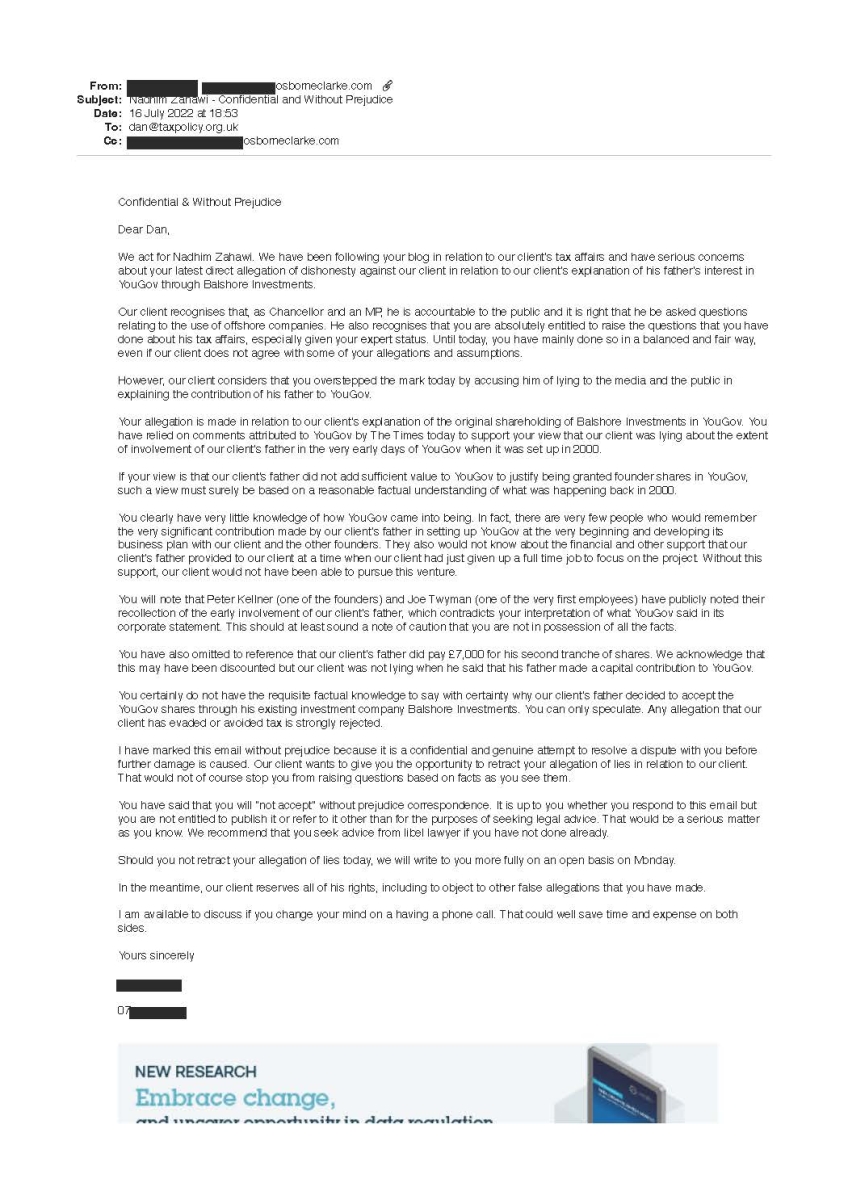
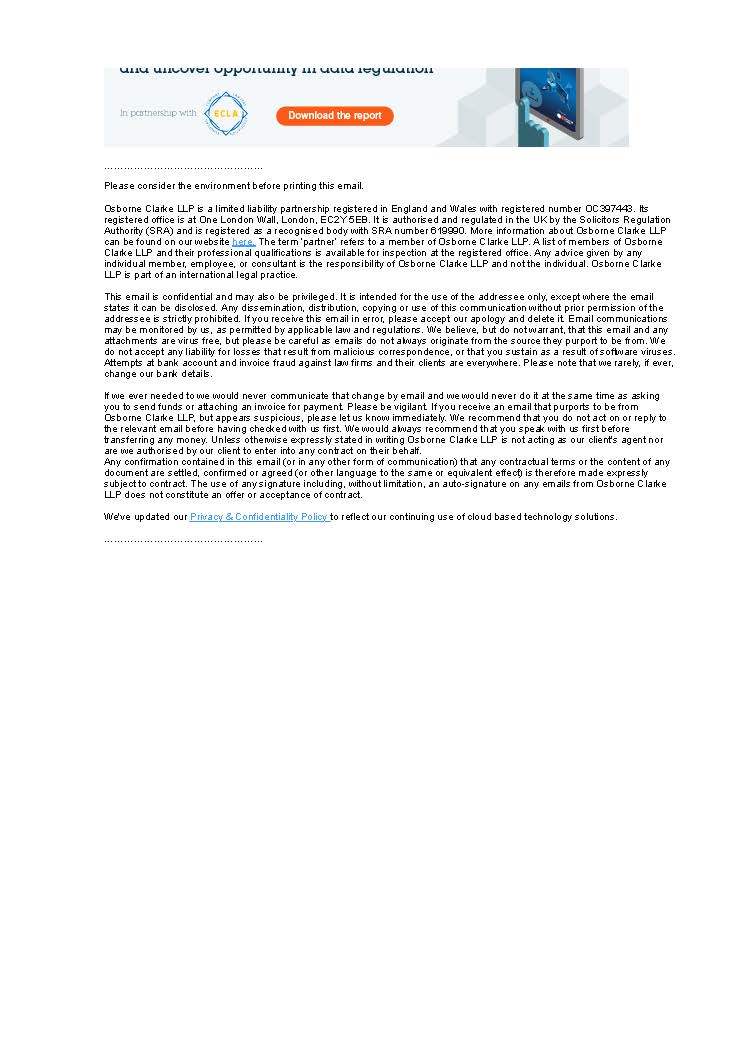
    • This wasn’t a genuine attempt to settle a dispute. The way a normal settlement offer works is that, if the settlement isn’t accepted, you proceed to litigation. In fact here, when I rejected Zahawi’s “offer” (that I retract my claim about Zahawi), their next letter said they’re not suing me. So there was no dispute, and this wasn’t a genuine attempt to settle it. It was a bluff, aimed at getting me to retract.
    • There wasn’t even a dispute. The “without prejudice” letter claims that I said Zahawi “was lying about the extent of involvement of [Zahawi’s] father in the very early days of YouGov when it was set up in 2000.”. That is not correct – I said no such thing. Osborne Clarke’s second letter correctly identifies what I actually said – that Zahawi’s first explanation – that his father contributed startup capital – was a lie. So the “without prejudice” letter relates to a matter that was never under dispute.
    • I said explicitly I would not accept without prejudice correspondence.

    I am therefore confident that the first letter was not in fact a “without prejudice” letter, it is not improper for me to publish it, and it could be adduced as evidence in court (in the laughably unlikely event this matter ever goes to trial).

    Confidential?

    Here’s the second Osborne Clarke letter.
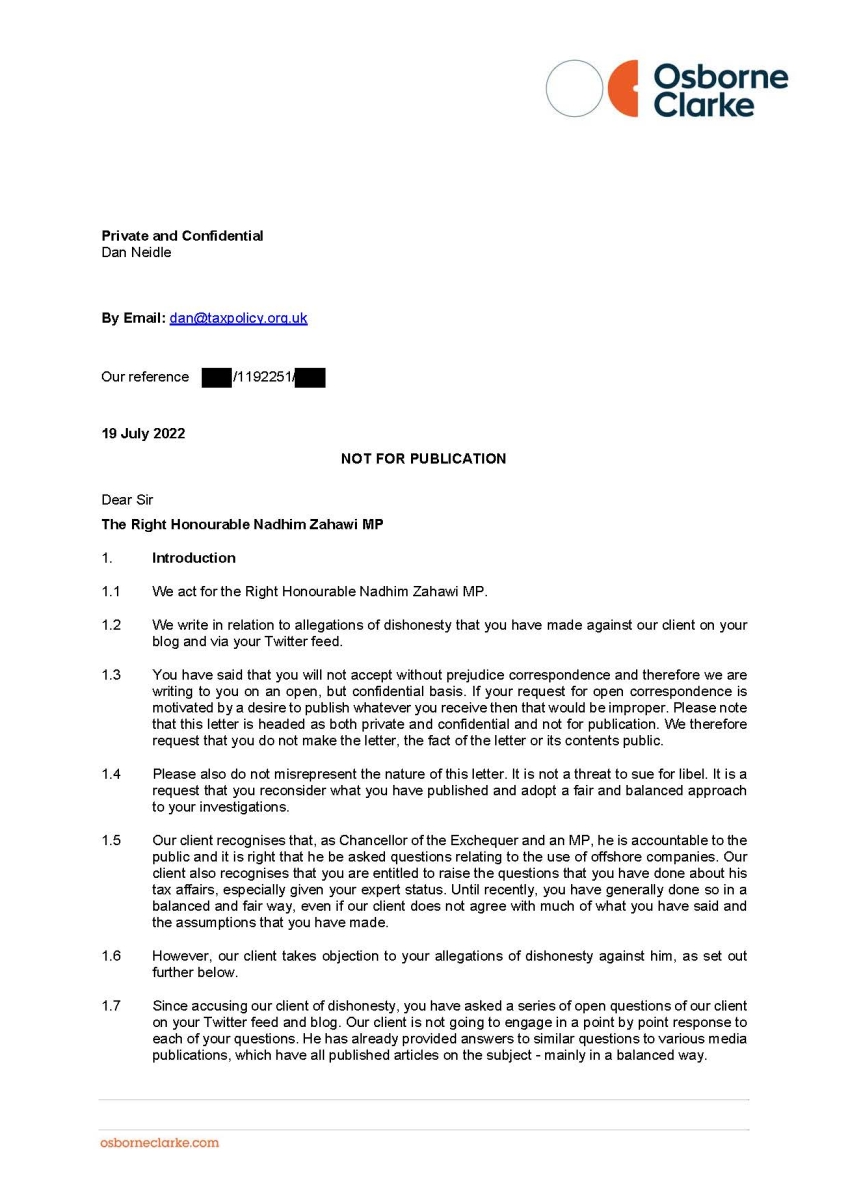
    They really, really, don’t want me to publish it:

    You have said that you will not accept without prejudice correspondence and therefore we are writing to you on an open, but confidential basis. If your request for open correspondence is motivated by a desire to publish whatever you receive then that would be improper. Please note that this letter is headed as both private and confidential and not for publication. We therefore request that you do not make the letter, the fact of the letter or its contents public.”

    Slapping “confidential” on a letter doesn’t stop the recipient publishing it. You need two things: contents that are actually confidential, and then a duty of confidence must be agreed or implied.

    We can dispose of the second point immediately. Obviously I hadn’t agreed to treat their correspondence as confidential, and there’s no reason to imply that I had; in fact they imply the opposite (that I may publish the letter). So no duty of confidence exists.

    The first is more subtle, but here’s the problem: there is nothing confidential in the letter. Imagine they’d written “Look, Zahawi’s first explanation was wrong, and we admit that. But his press secretary had just been eaten by a rhinoceros, and the intern was so traumatised they put out any old nonsense. We still haven’t tracked down his family, so please treat this as confidential.”

    Now that could have been confidential information. But nothing in the actual letter is confidential. They say nothing that the world doesn’t know already about Zahawi’s unconvincing explanations for his tax affairs.

    Oh, and there’s a further problem. Even if the letter was confidential, and a duty of confidence could be established, there is a defence if I can establish a public interest in publishing. Here I would say that publishing the fact the Chancellor is seeking to silence an allegation of dishonesty against him is absolutely in the public interest.

    Wider implications

    I believe the tactics Osborne Clarke used here are fairly common in the libel world – abusing “without prejudice” and confidentiality to ensure that libel threats are not reported. These aren’t real libel claims – they’re strategic lawsuits against public participation (SLAPP).

    The Solicitors’ Regulatory Authority already warns lawyers about the potential for SLAPP misconduct. I will be writing them to ask that they expand their guidance to make clear that only in rare cases will a libel letter before claim be without prejudice and/or confidential. More generally, lawyers should not make assertions that their letters cannot be published unless they have a very clear and stated basis for doing so.

    I should add that I am not making an SRA complaint against Osborne Clarke – my sole aim is for the SRA to ensure that SLAPP defendants are not misled into thinking that they cannot mention the purported claim against them to third parties.

    I’m leaving comments on this post open for now, but will police them more than usual, for which my apologies.

    Footnotes

    1. This is a very smart point that I’d missed, but was picked up by a litigator – thank you Chris! ↩︎
  • The Chancellor’s secret libel letters

    The Chancellor’s secret libel letters

    The Chancellor of the Exchequer, Nadhim Zahawi, has been sending threatening letters, drafted by expensive lawyers, to people investigating his tax affairs. The letters are designed to intimidate, and say they are confidential and can’t be published. One was sent to me. I am publishing it.

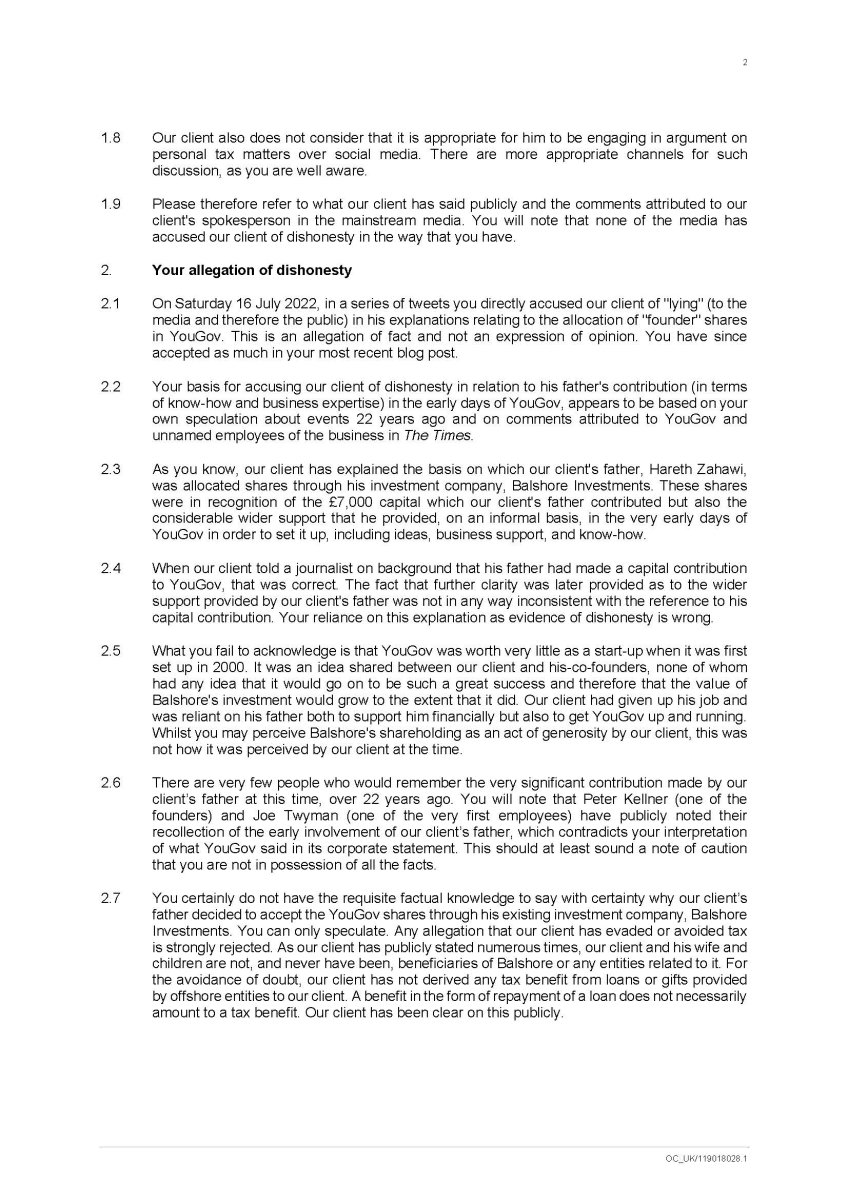
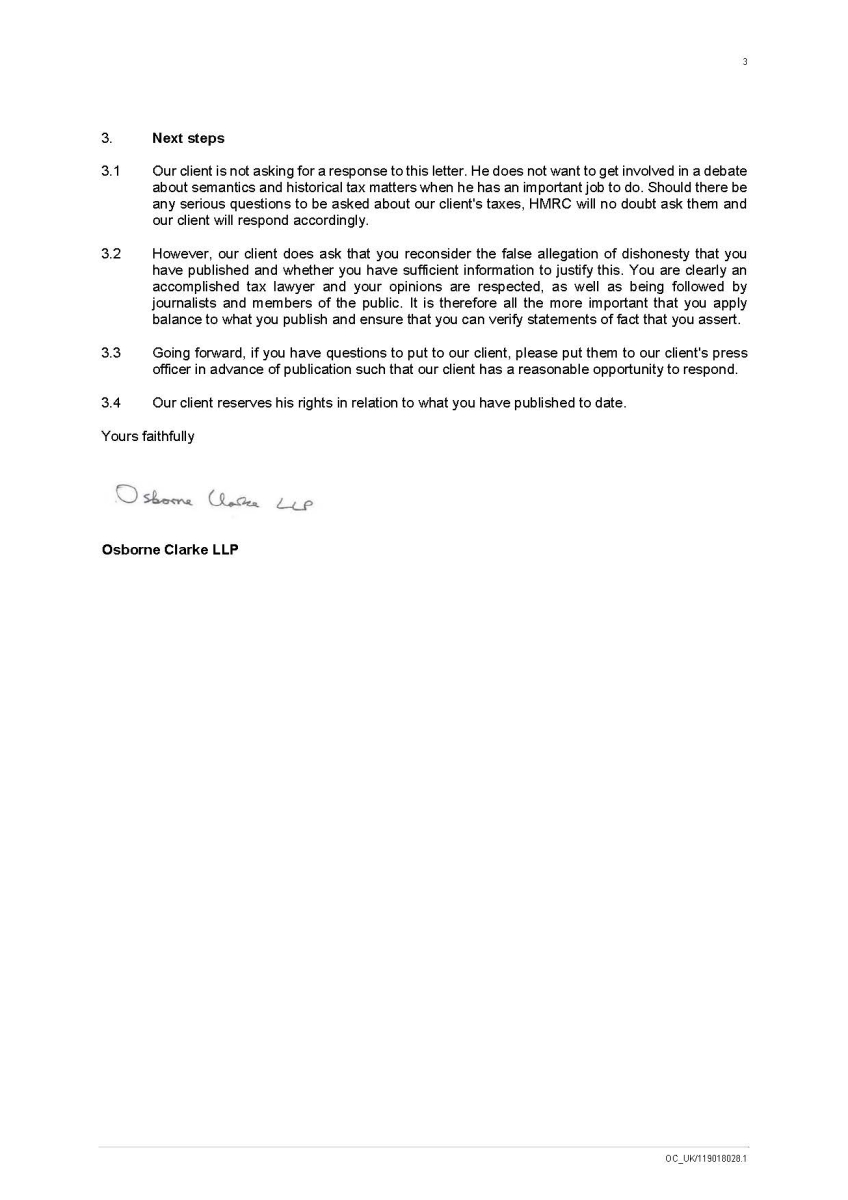
    Update: The Times has the story here. For those who prefer PDFs, I’ve uploaded the first Zahawi letter here, my response here, and the second here.

    The letters

    The public have a right to know if the Chancellor of the Exchequer – the person responsible for HMRC and tax – created a tax avoidance scheme to avoid £4m of his personal tax. At this moment I expect HMRC is considering whether to launch an investigation… it’s hard to imagine a worse conflict of interest than the Chancellor being investigated by tax inspectors whose conduct he can influence.

    And the public definitely have a right to know if the Chancellor sends letters to prevent the media and others from writing about his tax avoidance.

    I believe in transparency. I think it’s improper for lawyers acting in the shadows to curtail legitimate public debate about important public figures, particularly when there are allegations they’ve been dishonest. So I told the Chancellor’s lawyers I’d only accept open correspondence. They persisted in sending me letters that claim to be confidential. They aren’t. They contain no confidential information, and I never accepted a duty of confidence – indeed I explicitly rejected it. I don’t believe the Chancellor ever really intended to pursue a claim. The public interest is so obvious, and so strong, any libel claim would be farcical.

    The letter they sent me says, rather artfully, that it’s not actually a threat to sue for libel. But it comes from a libel lawyer, and tries to prevent me publishing it. Similar letters have been sent to others in recent weeks, and I understand Zahawi has done this before – using lawyers to silence people writing about his tax affairs.

    I’ve considered very carefully whether I should publish the correspondence. I’ve considered the matter with others and spoken to several legal ethics experts. All support my view that in the circumstances of this case there is no legal or ethical reason not to publish the letters, and a powerful public interest in publishing. So that is what I’m doing. And I will be writing to the Solicitors Regulatory Authority to ask them to make clear that lawyers should never assert that letters of this kind are confidential unless there is a proper and reasoned basis for such an assertion (which is is clearly absent here). More here on why I am confident this is both lawful and proper.

    The background

    For the last couple of weeks, I’ve been writing about how, when Nadhim Zahawi co-founded YouGov, his 42.5% founder shareholding ended up with a Gibraltar company, Balshore, owned by a secret offshore trust controlled by his parents. I said it looked like tax avoidance. I am a tax expert. And every other tax expert I’ve spoken to agrees – accountants, solicitors, QCs, and retired HMRC inspectors.

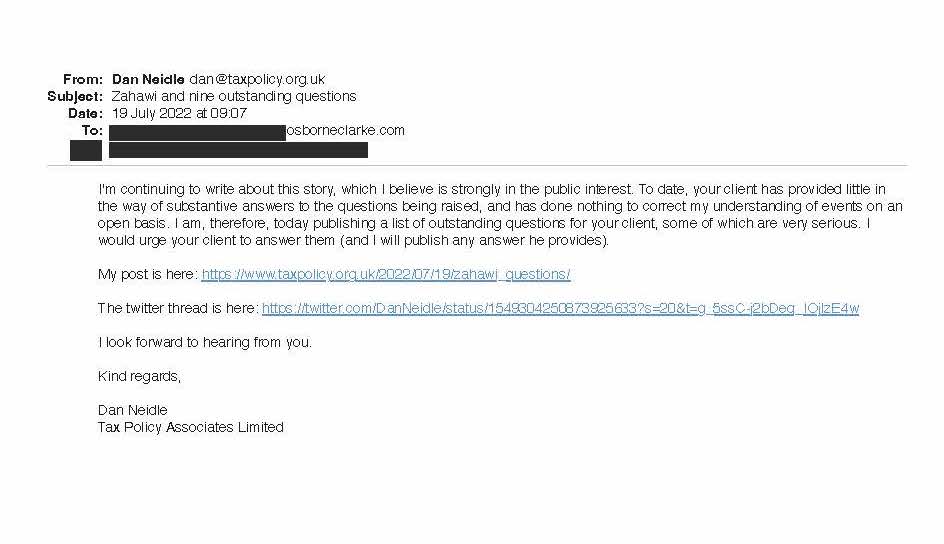
    Zahawi provided an explanation for this: that his father had provided “startup capital”. But he hadn’t. He may have provided £7k for some of the 42.5% but (according to documents filed by YouGov) another investor paid £285,000 for 15% of the shares at the same time. Clearly £7k didn’t justify 42.5%. I published my conclusion – there were three possibilities: I’d made a mistake; YouGov had filed a series of wrong documents; or Zahawi was lying. I invited Zahawi to respond. He didn’t – instead he switched to a new explanation – that his father had provided so much assistance, and Zahawi was so inexperienced, that it was only fair for YouGov to give his company (Balshore) the shares.

    I couldn’t understand why he provided that first explanation, and then dumped it and alighted on a new one (itself not very credible). I couldn’t think of any explanation except deliberate deception – so I called it what I thought it was: a lie. It’s this that has Zahawi so unhappy. The latest defence piles on more of what look like falsehoods. They suggest the false explanation was given only once, when I know it was given to at least three people. Zahawi’s lawyers confuse the words “capital contribution” and “startup capital” (they surely know the difference). They muddle Zahawi’s first explanation with his second. I think they know they have no real argument, and no serious libel claim. Which is why, instead, they have focused on silencing me – with bullying letters from the shadows. But I’m not going to play that game.

    This is not the only false statement from Zahawi.  On 11 July he told Sky News he didn’t benefit from an offshore trust and wasn’t a beneficiary of it. In fact he was – in 2005 Zahawi absolutely received a gift from Balshore. This was a benefit and he was a beneficiary – in both everyday English and technical tax law. I have not called this a “lie” because Zahawi may just have been confused. But for him not to correct his past statement is unacceptable.

    And Zahawi’s tax avoidance may have triggered a raft of further taxes: value added tax in 2000; trust taxation on gifts and capital gains in subsequent years; and withholding tax on his many interest payments to Gibraltar. I’ve asked Zahawi’s lawyers if he paid these taxes. Their response – he doesn’t want to get into a debate when he has an important job to do. But a large part of that job is being in charge of the tax system. And it’s not a debate, it’s a simple question: did the Chancellor fail to pay tax that was due? The public has a right to know.


    The documents

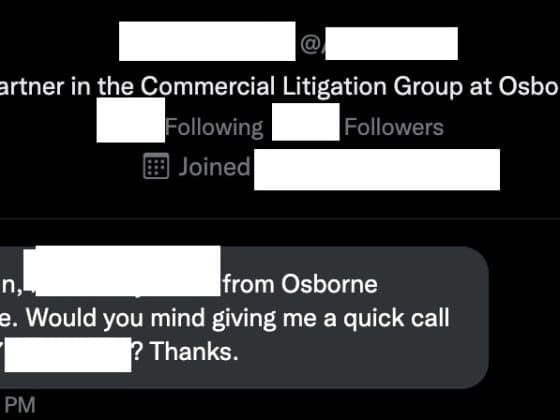
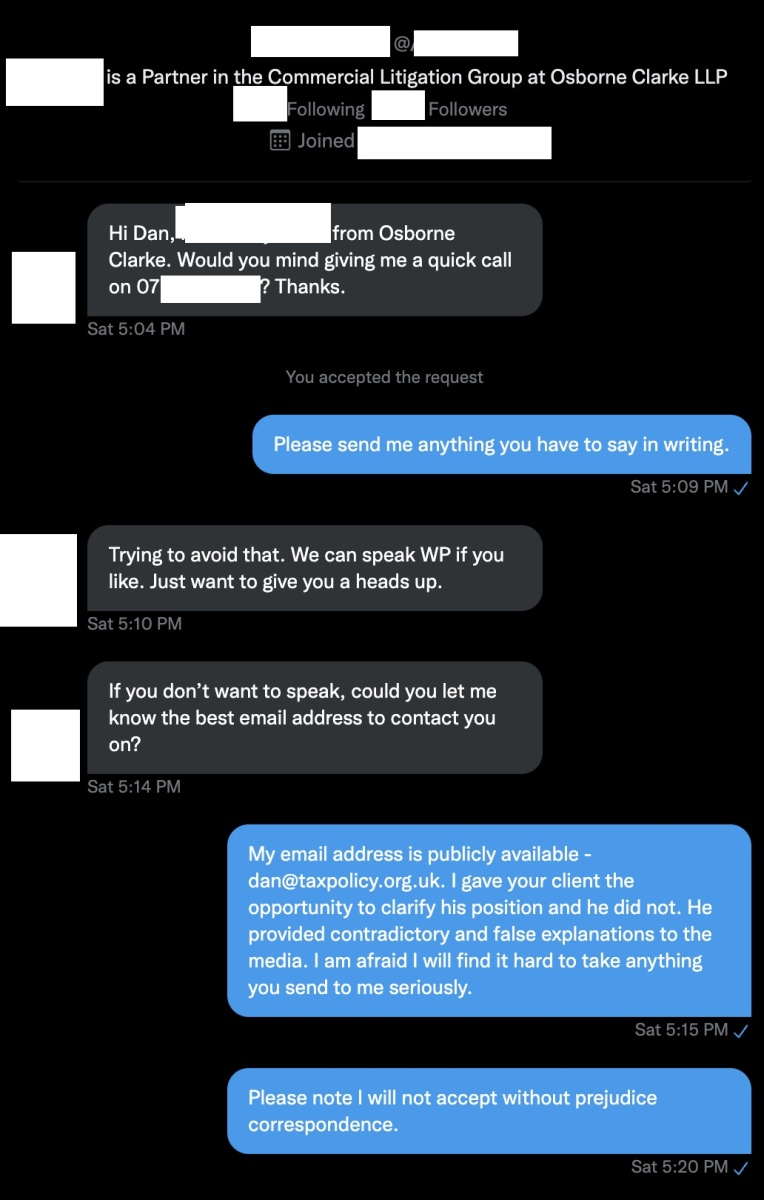
    Here’s the initial Twitter DM I received from Zahawi’s lawyers, Osborne Clarke. Note my reply that I won’t accept “without prejudice” letters (a “without prejudice letter” is often sent by lawyers negotiating a settlement; it can’t subsequently be put before a court, because that would dissuade people from trying to settle disputes). The opposite is an “open” letter.

    Their response was to send me a (supposedly) without prejudice letter – the very thing I’d said I wouldn’t accept:

    I responded as follows:

    I then received this response:

    I hope it’s clear from the above why I believe publishing the letters is the right thing to do. I explain in more detail here why Osborne Clarke’s assertion that I can’t publish these letters is wrong in law.

    I’m leaving comments on this post open for now, but will police them more than usual, for the predictable tedious legal reasons – sorry.

  • The Channel 4 News report on Sunak’s fund management

    The Channel 4 News report on Sunak’s fund management

    Last night, Channel 4 News reported that Sunak had received payments from a tax haven. My view: Sunak did nothing wrong, and the way Channel 4 reported this was unfair and misled viewers.

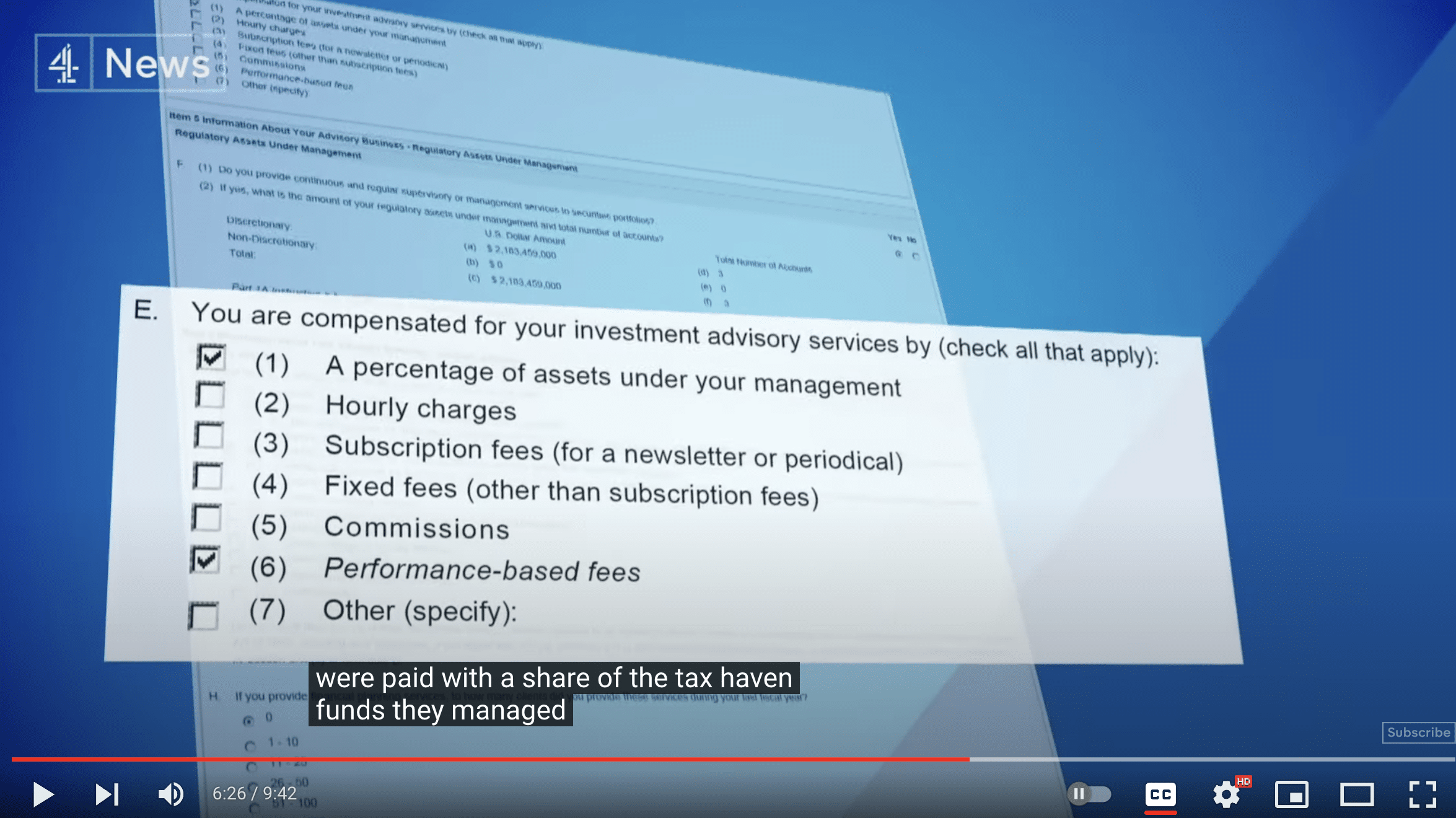
    The central allegation is that Sunak, when in the US, was a partner in a hedge fund established in the Caymans, and the partners were paid with a share of the tax haven funds they managed.

    This is true. But it omitted three key facts, and that made it misleading.

    First, almost all hedge funds are based in tax havens. Why? Because if you’re based in country A, making the tax and regulatory rules work for investors from countries A thru Z is really hard. Tax havens make it much easier. Channel 4 fail to mention how standard it is for a hedge fund to be offshore. They imply it’s suspicious.

    Second, they also present as an exciting discovery that Sunak, as a partner in the hedge fund, was entitled to a share of the fund returns. But that’s how hedge funds work – managers’ interests are “aligned” with investors by giving managers a share of the fund returns.

    Third, they suggest there’s some mystery and potentially some tax dodginess here – “Did Mr Sunak earn bonuses offshore in the Cayman Islands”. But at the time, Sunak was living in the US and had a green card. So he was subject to US tax on his income, whether it came from the US, the Cayman Islands, or the moon. (They later give Sunak a quote saying this, but it’s not just his view – it’s intrinsic to the US tax system.

    Then they say “There’s no suggestion Mr Sunak did anything illegal”? No – there’s no suggestion of anything remotely out-of-the-ordinary. And what triggers me is that the media use this same caveat when reporting on the most egregious of tax scams.

    Connoisseurs of the genre will spot the absence of any tax experts in the report. Either:

    1. Channel 4 didn’t speak to any. In which case WTF?
    2. Channel 4 did – the experts said there was nothing to see here, and Channel 4 ignored them.

    There are lots of good reasons to criticise the fund industry. And Sunak is obviously very privileged. If the focus of the report was on these issues then I’d have no argument with it.

    Is it possible that there was tax avoidance going on? In principle, sure. Here’s some questions Channel 4 could have asked:

    • Was this “carried interest”, taxed at the lower capital gains rate in the US and UK rather than the full income rate? (For a hedge fund it shouldn’t be)
    • Did Sunak continue to be entitled to payments from funds he used to manage when he was Chancellor?
    • If so, were these fully declared? And was he fully taxed on them as income (45%), at the lower capital gains rate (20%), or something else?
    • What did the funds do? How were they structured? Was there avoidance going on “lower down” in the structure?

    What we got instead was insinuation-heavy, context-light reporting, which damages the public understanding of tax, and undermines our ability to identify people and politicians who really have been engaged in tax avoidance. Mentioning no names.

    Footnotes

    1. More background – almost no funds pay tax. Why? Because if you buy shares in ten companies you pay tax on your income/gains from the companies. If you buy a fund that invests in the same ten companies then the tax result should be the same. If instead there is another level of tax, in the fund, then you wouldn’t invest through a fund. Collective investment management is a *good thing* for a bunch of reasons. So policymakers generally accept that funds should not be taxed. For onshore funds (e.g. unit trusts) it’s achieved by specific exemptions. For offshore funds, it’s achieved by rules that delineate “good” funds that don’t avoid tax, and “bad” funds that do, and imposing punitive taxes on them (the UK offshore fund rules, the US PFIC rules, and other equivalents elsewhere).

      So for a hedge fund to pay no tax is the correct policy outcome, whether that’s achieved by an onshore company within a specific exemption, or a tax haven company that falls within specific rules that permit it.

      There are currently a few initiatives to enable funds to come onshore; that’s a good thing for a large number of reasons, and I’ll talk more about that another time. ↩︎