
Companies associated with the struck-off solicitor, convicted fraudster, bankrupt, pornographer, and negligent tax avoidance scheme promoter Paul Baxendale-Walker continue to sell elaborate tax avoidance schemes. The details of the schemes, and their purported technical justifications, are kept a closely guarded secret. Today we are publishing them, and explaining why they fail.
We frequently receive tip-offs from accountants and lawyers who’ve seen firms promoting dubious tax schemes. This often requires a large amount of analysis from us to work out exactly what’s going on, and what the true tax consequence is.
But sometimes it’s obvious that what’s being proposed is wildly improper, even fraudulent. We’re publishing cases like this as “tax scam of the day” – documents and links plus a short explanation of why what’s proposed is a scam.
We hope that this helps warn potential clients off dangerous scams, and prompts HMRC and other authorities to be more proactive identifying and closing down cowboy tax advisers.
What’s the claim?
Minerva Services Limited was a BVI and then a Belize company⚠️ associated with Paul Baxendale-Walker.12345678 Baxendale-Walker can be fairly described as the UK’s most notorious promoter of tax avoidance – we’ve written in detail about his very strange career.
Until last year, Minerva sold a variety of trusts which can only be described as magical, given their ability to avoid all tax on your income and assets. In reality, the trusts were aggressive forms of tax avoidance which we believe have no prospect of working.
Paul Baxendale-Walker was personally pushing these schemes to advisers in 2023. He offered them a 35% cut of Minerva’s fees for becoming “introducers”, i.e. introducing their clients to Minerva.9
The three schemes:
- The “Umbrella Asset Trust” claimed to protect your personally owned assets from Income Tax, Capital Gains Tax and Inheritance tax. It’s a “deed in a drawer”, where it looks like your assets are held by you directly, but (if challenged) you can triumphantly produce a deed showing that you’re just a fiduciary, and the assets are really held by an offshore trust. You establish a UK company as your “personal management company” which controls the trust.
- The “Remuneration Trust” is a variant of this where your company or incorporated business makes a contribution to an offshore trust. Again, profits and gains arising from the trust supposedly aren’t taxable and, again, a UK “personal management company” controls the trust. This time, the trust has “Tardis” clauses. Upon any enquiry by HMRC, the trust is automatically void, and a new trust (with the same assets) is created.10
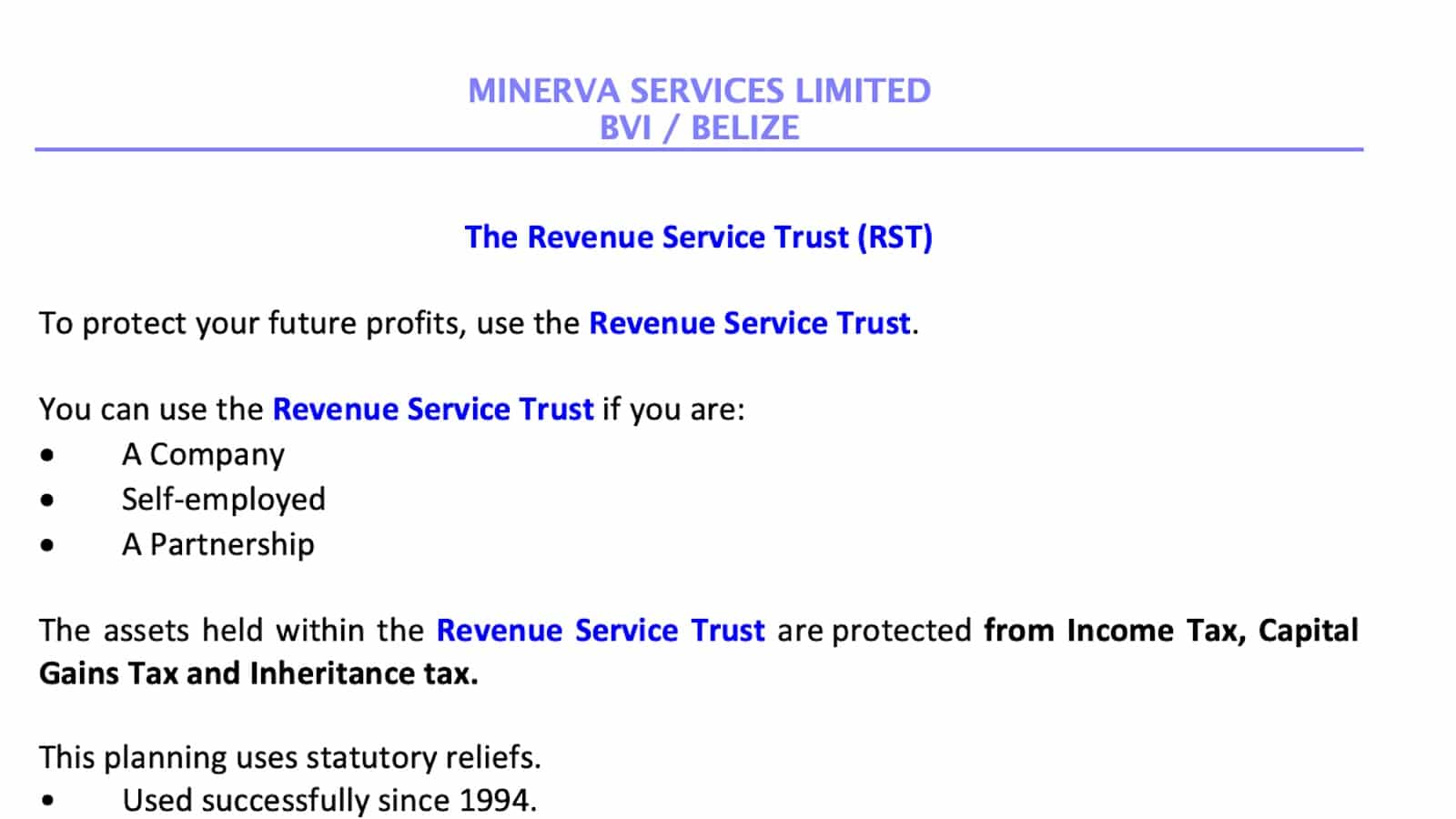
- The “Revenue Service Trust” is an arrangement where you sell your future income to an offshore trust, and so aren’t taxed on the income when it actually arises. Again, control of the assets is with a UK “personal management company”.
The documents
Here are the proposal documents for the three structures, as sent by Paul Baxendale-Walker to potential “introducers” last year.
The Umbrella Asset Trust11
[pdfjs-viewer url=https://taxpolicy.org.uk/wp-content/assets/UAT%20BRIEF.pdf viewer_width=600px viewer_height=700px download=true fullscreen=false print=true]
Remuneration Trust
[pdfjs-viewer url=https://taxpolicy.org.uk/wp-content/assets/RT%20BRIEF.pdf viewer_width=600px viewer_height=700px download=true fullscreen=false print=true]
Revenue Service Trust
[pdfjs-viewer url=https://taxpolicy.org.uk/wp-content/assets/RST%20BRIEF.pdf viewer_width=600px viewer_height=700px download=true fullscreen=false print=true]
All the above documents were circulated in 2023. Minerva Services Limited was struck off on 1 January 2024, but we expect there is a successor company selling the same schemes (perhaps also called Minerva Services; perhaps something else).
Whilst the documents were sent to introducers by Paul Baxendale-Walker, the author in the original metadata is “tony ashbolt”.12 Mr Ashbolt is a wealth adviser who has been the subject of a criminal investigation for his use of Baxendale-Walker tax schemes. The outcome of that investigation is unknown. We approached Ashbolt for comment and he didn’t respond.13
Why do the schemes fail?
These schemes are all highly artificial tax avoidance schemes. Such schemes have been repeatedly struck down by the courts over the last 25 years.14
The claims the schemes aren’t avoidance and aren’t contentious are deluded. Any reasonable person would conclude the only purpose of these schemes is to avoid tax.15 That engages a large number of anti-avoidance rules, most of which didn’t exist when these schemes were invented in the 1990s. Like the GC Wealth offshore trust structure, these structures are technically doomed.
It’s our view that no reasonably competent tax adviser would think the schemes have any prospect of success. Identifying precisely *how* the schemes would fail is not easy – HMRC would have multiple lines of attack. Here is a brief summary of the problems, as identified by our very experienced team of KCs, tax accountants, solicitors and retired HMRC officials.
No disclosure to HMRC
- All three schemes are mass-marketed schemes which use standardised documentation and charge premium fees, where the sole or main benefit is to obtain a tax advantage. The schemes should, therefore, be disclosed to HMRC under the DOTAS rules (probably by the scheme users, as the promoters are offshore). We believe they aren’t disclosed to HMRC. If that’s right, any taxpayer using the schemes faces penalties for non-disclosure, and HMRC has 20 years to come back and challenge the schemes.
Sham/void sale agreemens
- The magical nature of these trusts is such that they may as well not exist. Legal ownership of the assets remains where it always was. Control over the assets remains with the client.
- Two questions. First, does anything in practice change at all after the trusts are put in place, other than the claimed reduction in tax? Second, does the client really intend that a strange offshore entity will have beneficial ownership of his or her assets? If the answer to these questions is “no”, then the arrangement may be a sham, and disregarded for tax purposes. A Baxendale-Walker remuneration trust was found to be a sham in the Northwood case.
- Alternatively, the weird nature of the documentation means that the agreement to sell the assets into the structure may be void.
- These are good outcomes for clients of these structures, because if they are valid there are likely to be an array of deleterious tax outcomes, often triggering far more tax than the structure was intended to avoid. Attempts to have the structures set aside on grounds of mistake of tax law have failed in the English courts.
Stranger danger
- There are two contradictory propositions in the three structures. First, the UK fiduciary company has complete control over the trust assets. Second, the UK fiduciary company is valueless. These can’t both be true. If the UK fiduciary company has complete control over valuable assets then the company is valuable. This would have a variety of entertaining tax consequences. And if the UK fiduciary company doesn’t have complete control then congratulations: you’ve just given your assets to a stranger.
- Some PBW clients have found their assets stranded, with no ability to control them at all – a number of court applications were successfully made in Jersey to void these trusts on grounds of mistake.16
Umbrella Asset Trust
- There will be up-front capital gains tax on the disposal of assets.17 It is incorrect to say that any holding of assets is a “business” for this purpose – there has to be an actively managed business. Personal assets are not business assets. But the more serious problem is that any realistic interpretation of s162 will not permit assets to be transferred to a company for five minutes, then to be immediately gifted to a trust. That is not the “transfer to a company of a business as a going concern”. Nor is the consideration really shares – the preordained arrangements mean the shares are worthless (and so either aren’t the consideration, meaning s162 fails, or the benefit of hold-over is zero). This is a gift.
- The fact there is a gift means there are adverse inheritance tax consequences too. The inheritance tax rules for employee benefits trusts in s86 IHTA won’t apply because the client is both the owner of the company and a beneficiary of the trust (either because the client is listed as a beneficiary or because the client will receive beneficial loans). So there is a chargeable lifetime transfer to the trust, with an up-front inheritance tax hit, and ongoing 6% principal ten yearly charge and pro rata 6% exit charge. For the same reason, s239 TCGA won’t apply.
Remuneration Trust
- The contribution to the trust is a chargeable lifetime transfer, with an immediate 20% inheritance tax charge (which, if the contribution is made by a company, is apportioned amongst its owners/participators). We expect an attempt is made to qualify for an exemption; realistically there is no prospect of that succeeding.
- The “Tardis clause” seems to assume that legal documents travel backwards in time. They don’t. If the trust is declared void today, as a matter of English law it wasn’t void last week, and HMRC can open an enquiry into its position last week. The last time Baxendale-Walker ran this kind of argument in the courts, the judge dismissed it in two paragraphs.
- Presumably the client wants the money at some point. That creates a problem, because at the point the trust makes a loan to the client, there will be a charge under the disguised remuneration rules. This has been a problem for previous Baxendale-Walker remuneration trusts, many of which are now being challenged using “follower notices”. It’s unclear why this variant would achieve a different result. Previous attempts to rebrand Baxendale-Walker structures to escape anti-avoidance rules have ended badly.
- The trust contribution won’t be tax deductible.
Revenue Service Trust
- The main problem with this structure is a basic failure to understand trust law. You can’t declare a trust sell your future income, and if you purport to do so, then that takes effect as a contractual agreement to sell future income as and when it arises (the usual authority cited for this proposition is Re Ellenborough). This is literally one of the first lessons taught to law students. So there will be a series of disposals as income arises, and each will be taxable (in particular capital gains tax and inheritance tax). The structure fails without even needing to apply detailed tax rules.
- There are specific rules countering schemes where a person transfers a right to a future stream of income. The rules are very widely drafted.
- If the income in question is UK source then the trust will be taxed on it.
- The somewhat obscure “sale of occupational income” rules could apply (on the basis that the promise to make a contribution to the trust is “money’s worth”).
- The profit fragmentation rules may apply.
- If for some reason none of these rules apply, the idea that you can escape all tax by selling your future income is unreal and unreasonable. The general anti-abuse rule (GAAR) would apply.
Why describe them as a scam?
We don’t believe schemes of this kind have any realistic prospect of success. The claims made in the promotional material about the schemes being uncontentious and escaping anti-avoidance rules are false. They are being mis-sold. Those selling the structure are at best reckless, at worst defrauding their clients.18
It is likely that HMRC will challenge the arrangements if it becomes aware of them. For this reason, we suspect that most users of the scheme won’t disclose them to HMRC – not being caught is the best chance they have of escaping tax. The nature of the schemes, with a UK company holding the assets supposedly as fiduciary, means that the schemes may not be straightforward for HMRC to identify.19 The structure incentivises tax fraud by users.
Many thanks to K for the original tip, and to James Quarmby, M, C, T, and V for the analysis. Thanks, as ever, to S for his review.
Documents © Minerva Services Ltd (as far as we aware), and reproduced here in the public interest and for purposes of criticism.
Footnotes
Baxendale-Walker’s letter to us talked about a “Minerva community” as if it was independent from him. The facts do not bear this out. The following footnotes set out some of those facts. ↩︎
The judgment in Northwood v HMRC [2023] UKFTT 351 (TC) includes the text of an engagement letter between Baxendale Walker LLP and a client, which includes an appendix saying that “MINERVA” is a separate business of Baxendale-Walker LLP, which sells and markets strategies devised by Baxendale-Walker LLP. MINERVA’s fees were 10% for every contribution to the trust. PBW therefore most certainly knew what fees Minerva was making and, on the basis of the text from his own engagement letter, he benefited from those fees. ↩︎
The judgment in Dukeries Healthcare Limited [2021] EWHC 2086 (Ch) describes “Minerva” as an “associated company” of Baxendale-Walker LLP. Again, the Baxendale-Walker LLP engagement letter provided for a fee equal to 10% of each trust contribution to be paid to Minerva. ↩︎
As part of some US litigation, a deed was disclosed under which Baxendale-Walker LLP said it held sums as bare trustee for Minerva Services Limited ↩︎
The judgment in CIA Insurance Services v Commissioners for HMRC also referred to a Baxendale-Walker LLP engagement letter where 10% of each trust contribution was to be paid to Minerva. ↩︎
The judgment in Iain Paul Barker v Paul Baxendale-Walker notes that “As to [PBW’s] claim about lack of resources the Court was struck by three companies willing to financially assist Mr Baxendale-Walker, including his own remuneration trust, EW LLP, Minerva Ltd, Hawk, Brunswick Wealth and Burleigh House PTC Ltd.” ↩︎
The judgment in Paul Baxendale-Walker v APL Management Limited [2018] EWHC 543 states that, in May 2015, Baxendale Walker issued a claim “in respect of various fees that he alleged were owed to his companies (Baxendale Walker LLP and Minerva Services Ltd)” (my emphasis). That same case reports Minerva Services Limited (BVI), Minerva Services Limited (Belize) and Buckingham Wealth Ltd acting on behalf of PBW. ↩︎
There has been other litigation involving Minerva, the background to which is not clear to us, involving a Pankim Kumar Patel suing Minerva Services (Delaware) Inc, PBW himself and one other individual. The judgment is here. A witness statement is here, giving more of the background and with much criticism of PBW (although of course, as a witness statement, it must be taken with a pinch of salt). ↩︎
These introduction fees are in our view inherently corrupting – accountants receive large sums for no work, and have every incentive to refer clients to dubious schemes without any due diligence. But it’s important to note that the vast majority of accountants act properly and ethically in the interests of their clients, and indeed potential “introducers” were our sources for this article. ↩︎
We expect this kind of clause is actually in all Baxendale-Walker trusts. ↩︎
Following feedback from readers, we are now presenting documents using a PDF viewer rather than an image gallery. Do drop us a line with any comments on this approach. ↩︎
Noting as ever that metadata can only be indicative; by default on Windows it shows the name of the current user. It can therefore be wrong, e.g. if somebody uses someone else’s computer. It is also very easy to create false metadata. ↩︎
We didn’t approach Baxendale-Walker for comment because he has made clear he regards any attempt to communicate with him as criminal harassment. ↩︎
The one exception, the SHIPS 2 scheme, was intended to be countered by the general anti-abuse rule, introduced in 2013. ↩︎
The GC Wealth structures were also advised as providing protection against divorce and against creditors. Those claims were false, but at least provided a potential non-tax rationale. The PBW proposals don’t mention anything other than tax. ↩︎
Such applications being in a different category from arguing that a bad tax result is a “mistake”. ↩︎
Potentially also s3 TCGA charges on future disposals by the trust, attributed to the client as the settlor. ↩︎
In 2017, the Court of Appeal found Baxendale-Walker to be negligent for not warning a client of the risk that his structure might fail. So it’s very hard to understand why these documents promote highly aggressive structures with no risk warning at all. ↩︎
Although once HMRC started looking into the structure, it would become apparent very quickly what was going on, because a company with legal title to assets would be claiming to be dormant and have no taxable income. ↩︎
MP Estate Planning: the unregulated firm selling defective trusts to the elderly
![To: jeevacation@gmail com[eevacation@gmail com]
From: Peter Mandelson
Sem: Sun 11/7/2010 2 34 57 PM
Subyect: Fwd Rio apartment
Seat to mys bank manager Gratetul tor helpful thoughts trom my chief lite adviser
Sent from ims iPad
Bevin torwarded messave
From: Peter Mander iS
Date: 7 November 2010 [4 29 12 GMI
Subject: Rio apartment
P| ag awe dpeecussed Pan consdernne a purchase of an apartmentin Rion Ttisain](https://taxpolicy.org.uk/wp-content/uploads/2026/01/Screenshot-2026-01-31-at-21.27.15-640x360.png)
Emails show Peter Mandelson discussing Panama tax structure with Jeffrey Epstein
Tax barristers and fraud: how the Bar responded to our allegations
Rogue barristers are enabling a billion pound tax fraud – and the Bar won’t act

Samuel Leeds: the “property guru” and his bogus tax loopholes


Leave a Reply to DThompson Cancel reply